
Puck, 1877-07-18 · page 6 of 16
Puck — July 18, 1877 — page 6: what you’re looking at
What you’re looking at
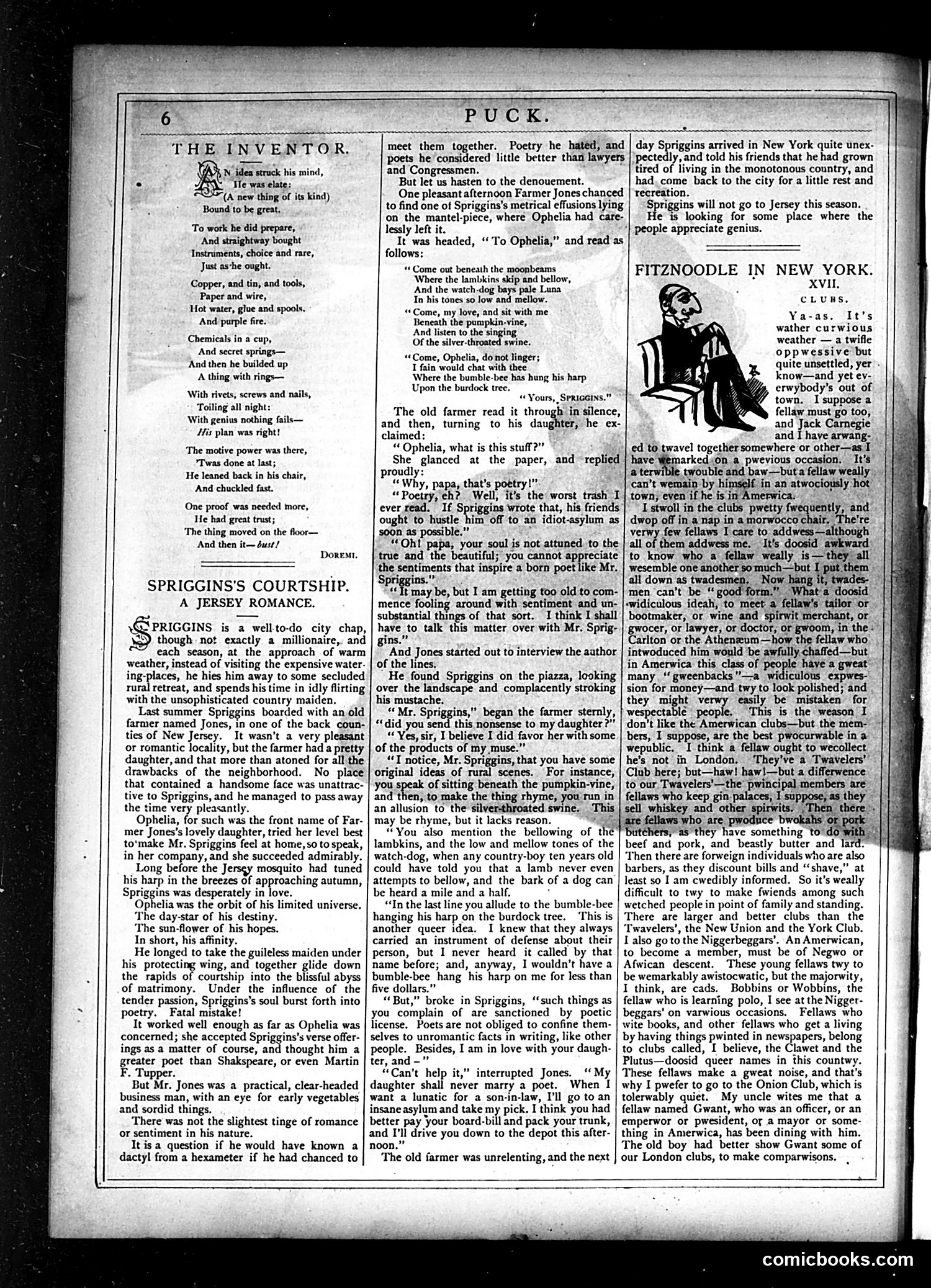
This satirical story mocks a practical, unromantic suitor named Spriggins who pursues a farmer's daughter named Ophelia. The humor lies in contrasting his prosaic, business-minded nature with her romantic expectations. When Spriggins attempts to impress her with sentimental poetry, her father dismissively calls it "the worst trash I ever read," while a friend warns Spriggins that poetry suggests impracticality—a dangerous quality in a potential son-in-law. The satire targets both rural attitudes (valuing practicality over sentiment) and urban pretensions. The story suggests that Spriggins's materialism and lack of genuine feeling make him ridiculous as a suitor, while also mocking Ophelia's romantic idealism as unsuited to farmer's life.
📄 Transcribed text from this page (OCR, searchable)
Machine-transcribed from the original scan — historical spelling and the odd misread are preserved.
PUCK. THE INVENTOR. N ides struck his mind, He was elate: (A new thing of its kind) Bound to be great, To work he did prepare, ‘And straightway bought Instruments, choice and rare, Just ashe ought. Copper, and tin, and tools, Paper and wire, Hot water, glue and spools, And purple fire. Chemicals in a cup, And secret springs— ‘And then he builded up A thing with rings— With rivets, screws and nails, Toiling all night: With genius nothing fails— His plan was right! The motive power was there, "Twas done at last; He leaned back in his chair, And chuckled fast. One proof was needed more, He had great trust; ‘The thing moved on the floor— And then it—dust/ Doren. SPRIGGINS'S COURTSHIP. A JERSEY ROMANCE. PRIGGINS is a ‘2 well to-do city chap, <5 though not exactly a millionaire, and each season, at the approach of warm weather, instead of visiting the expensive water- ing-places, he hies him away to some secluded rural retreat, and spends his time in idly flirting with the unsophisticated country maiden, Last summer Spriggins boarded with an old farmer named Jones, in one of the back coun- ties of New Jersey. It wasn’t a very pleasant or romantic locality, but the farmer had a pretty daughter, and that more than atoned for all the drawbacks of the neighborhood. No place that contained a handsome face was unattrac- tive to Spriggins, and he managed to pass away the time very pleasantly. Ophelia, for such was the front name of Far- mer Jones’s lovely daughter, tried her level best to'make Mr. Spriggins feel at home, so to speak, in her company, and she succeeded admirably. Long before the Je: mosquito had tuned his harp in the breezes of approaching autumn, Sprigins was desperately in love. lia was the orbit of his limited universe. The day-star of his destiny. ‘The sun-flower of his hopes. In short, his affinity. He longed to take the guileless maiden under his protecting wing, and together glide down the rapids of courtship into the blissful abyss of matrimony. Under the influence of the tender passion, Spriggins’s soul burst forth into poetry. Fatal mistake! Tt worked well enough as far as Ophelia was concerned; she accepted Spriggins’s verse offer- ings as a matter of course, and thought him a greater poet than Shakspeare, or even Martin F. Tupper. But Mr. Jones was a practical, clear-headed business man, with an eye for early vegetables and sordid things. There was not the slightest tinge of romance or sentiment in his nature. It isa question if he would have known a dactyl from a hexameter if he had chanced to meet them together. Poetry he hated, and poets he ‘considered little better than lawyers and Congressmen. But let us hasten to the denouement. One pleasant afternoon Farmer Jones chanced to find one of Spriggins’s metrical effusions lying on the mantel-piece, where Ophelia had care- lessly left it. It was headed, ‘To Ophelia,” and read as follows: “Come out beneath the moonbeams ‘Where the lambkins skip and bellow, And the watch-dog bays pale Luna In his tones so low and mellow. “Come, my love, and sit with me Beneath the pumpkin-vine, And listen to the singing Of the silver-throated swine. “Come, Ophelia, do not linger; T fain would chat with thee Where the bumble-bee has hung his harp Upon the burdock tree. “Yours, Srricains.” The old farmer read it through in silence, and then, turning to his daughter, he ex- claimed: “ Ophelia, what is this stuff?” She glanced at the paper, and “replied proudly: “Why, papa, that’s poetry !"” “Poetry, eh? Well, it’s the: worst trash I ever read. If Spriggins wrote that, his friends ought to hustle si off to an idiot-asylum as soon as possibl ‘‘Ohl papa, your soul is not attuned. to the true and the beautiful; you cannot appreciate hs fen sentiments that inspire a born poet lil Tike Mr, pri Poayhes but I am getting too old to com- mence fooling around with sentiment and un- substantial things of that sort. I think I shall hae to talk this matter over with Mr. Sprig- ‘And Jones started out to interview the author of the lines. He found Spriggins on the piazza, looking over the landscape and complacently stroking his mustache. “Mr, Spriggins,” began the farmer sternly, “(did you send this nonsense to my daughter ?”” “Yes, sir, I believe I did favor her with some of the products of my muse.” “T notice, Mr. Spriggins, that you have some original ideas of rural scenes. For instance, you at of sitting beneath the pumpkin-vine, andt to make the thing rhyme, you run in an allusion to the silverthroated swine. This, may be rhyme, but it lacks reason. “You also mention the bellowing of the lambkins, and the low and mellow tones of the watch-dog, when any country-boy ten years old could have told you that a lamb never even attempts to bellow, and the bark of a dog can be heard a mile and a half, “In the last line you allude to the bumble-bee hanging his harp on the burdock tree. ‘This is another queer idea. I knew that they always carried an instrument of defense about their person, but I never heard it called by that name before; and, anyway, I wouldn’t have a bumble-bee hang ‘his harp on me for less than five dollars.” “But,” broke in Spriggins, “such things as you complain of are sanctioned by poetic license. Poets are not obliged to confine them- selves to unromantic facts in writing, like other people. Besides, I am in love with your daugh- ter, and-" “Can't help it,” interrupted Jones. ‘My daughter shall never marry a poet. When I want a lunatic for a son-in-law, I'll go to an insane asylum and take my pick. I think you had better pay your board-| biltind pack your trunk, and I'll drive you down to the depot this after- noon.” The old farmer was unrelenting, and the next Spriggins arrived in New York quite unex- cas ly, and told his friends that he had grown tired of living in the monotonous country, and had. come back to the city for a little rest and recreation. Spriggins will not go to Jersey this season. He is looking for some place where the ‘| people appreciate genius. FITZNOODLE IN NEW YORK. XVII, CLUBS, Ya-as. It’s wather curwious weather — a twifle oppwessive but quite unsettled, yer - know—and yet ev- erwybody’s out of town. I suppose a fellaw must go too, and Jack Carnegie and I have arwang- ed to twavel together somewhere or other—as I have Wemarkedson a pwevious occasion. It’s a terwible twouble and baw—buta fellaw weally , can’t wemain by himself in an atwociously hot town; even if he is in Amerwica, I stwoll in the clubs pwetty fronnentiyy ant and. dwop off in a nap in a morwocco verwy few fellaws I care to srpibopan enti all of them/addwess me. “It’s coma awkward to know who a fellaw weally ae wesemble one Dionergoarch= bat T put all down as twad ‘Now hang it, twades- © men can’t be “good form.” What-a doosid -widiculous ideah to meet a fellaw’s tailor or bootmaker, or wine and spirwit merchant, or rocer, or lawyer, or doctor, or gwoom, in'the ‘arlton or the Atheneum —how the fellaw who intwoduced him would ‘be awfully, chaffed—but in Amerwica this class of People have a gweat many‘ gweenbacks”"—a wi iculous ex; sion for taredebecs 2 ey to oes polished;'and they might Sekt easily be’ mistaken for wespectable le. “This is the weason I don’t like the rAcaerwiean clubs—but the mem- bers, I suppose, are the best pwocurwable in a wepublic. I think a fellaw ought to wecollect he’s not in London. They've a Twavelers’” Clab here; but—haw! haw!—but a differwence to our Twavelers'—the’ pwincipal members are fellaws who keep gin-palaces, I suppose a8 the ey sell whiskey and other spirwits. ;Then the: are fellaws who are pwoduce bwokahs’ ‘butchers,"as they have something to do beef and pork, and beastly butter and lard: Then there are forweign individuals who are also barbers, as they discount bills and “‘shave,” at least so 1 am cwedibly informed. So it’s weally difficult to twy to make fwiends among such wetched people in point of family and standing. There are larger and better clubs than the ‘Twavelers’, the New Union and the York Club. I also go to the Niggerbeggars’. An Amerwican, to become a member, must be of Negwo or Afwican descent. These young fellaws twy to be wemarkably awistoewatic, but the majorwity, I think, are cads. Bobbins or Wobbins, the fellaw who is learning polo, I see at the Nigger- beggars’ on varwious occasions. Fellaws who wite books, and other fellaws who get a living by having things pwinted in newspapers, belong to clubs called, I believe, the Clawet and the Plutus—doosid queer names in this countwy. These fellaws make a gweat noise, and that's why I pwefer to go to the Onion Club, which is tolerwably quiet. My uncle wites me that a fellaw named Gwant, who was an officer, or an emperwor or pwesident, of a mayor or some- thing in Amerwica, has been dining with him. The old boy had better show Gwant some of our London clubs, to make comparwisons. | comicbooks.com