
Puck, 1877-07-18 · page 4 of 16
Puck — July 18, 1877 — page 4: what you’re looking at
What you’re looking at
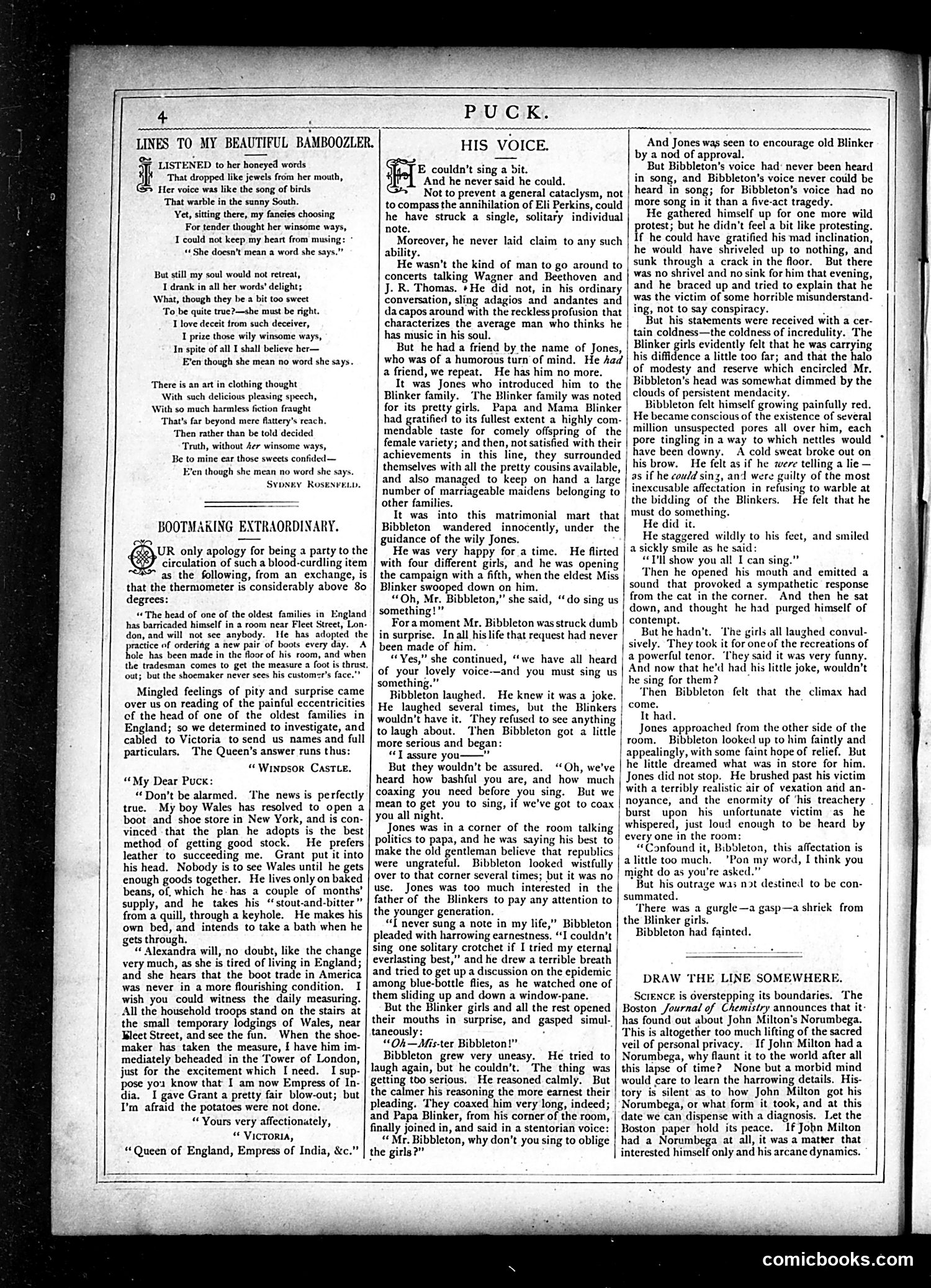
This page contains three distinct pieces of satirical content: 1. **"Lines to My Beautiful Bamboozler"** — A poem mocking a woman who is deceptive or manipulative in romance, using flowery language to describe her dishonesty. 2. **"His Voice"** — A narrative story satirizing Mr. Bibbleton, a man with no singing talent whom his friend Jones pressures into performing. The satire ridicules both Bibbleton's lack of ability and the social pressure to participate in amateur entertainment despite obvious incompetence. 3. **"Bootmaking Extraordinary"** and related advertisements — These appear to be humorous advice columns and product advertisements typical of Puck's mixed editorial-advertising format. The overall tone targets Victorian-era social pretensions and the embarrassments of polite society gatherings where untalented individuals are coerced into public performances.
📄 Transcribed text from this page (OCR, searchable)
Machine-transcribed from the original scan — historical spelling and the odd misread are preserved.
PUCK. LINES TO MY BEAUTIFUL BAMBOOZLER. LISTENED to her honeyed words That dropped like jewels from her mouth, Her voice was like the song of birds That warble in the sunny South. Yet, sitting there, my fancies choosing For tender thought her winsome ways, I could not keep my heart from musing: * «She doesn't mean a word she says.”” But still my soul would not retreat, I drank in all her words’ delight; What, though they be a bit too sweet To be quite true?—she must be right. I love deceit from such deceiver, I prize those wily winsome ways, In spite of all I shall believe her— E’en though she mean no word she says. ‘There is an art in clothing thought With such delicious pleasing speech, With so much harmless fiction fraught That's far beyond mere flattery’s reach. ‘Then rather than be told decided Truth, without Aer winsome ways, Be to mine ear those sweets confided — Even though she mean no word she says. Sypney Rosenvenp. BOOTMAKING EXTRAORDINARY. x val UR only apology for being a party to the circulation of such a blood-curdling item as the following, from an exchange, is that the thermometer is considerably above 80 degrees: “The head of one of the oldest families in England has barricaded himself in a room near Fleet Street, Lon- don, and will not see anybody. He has adopted the practice of orderitg a new pair of boots every day. A ole has been made in the floor of his room, and when the tradesman comes to get the measure a foot is thrust. out; but the shoemaker never sees his custom=t’s face."” Mingled feelings of pity and surprise came over us on reading of the painful eccentricities of the head of one of the oldest families in England; so we determined to investigate, and cabled to Victoria to send us names and full particulars. The Queen’s answer runs thus: “Winpsor CasTLe. “My Dear Puck: “Don’t be alarmed. ‘The news is perfectly true. My boy Wales has resolved to open a boot and shoe store in New York, and is con- vinced that the plan he adopts is the best method of getting good stock. He prefers leather to succeeding me. Grant put it into his head. Nobody is to see Wales until he gets enough goods together. He lives only on baked beans, of, which he-has a couple of months’ supply, and he takes his “stout-and-bitter” from a quill, through a keyhole. He makes his own bed, and intends to take a bath when he gets through. “ Alexandra will, no doubt, like the change very much, as she is tired of living in England; and she hears that the boot trade in America was never in a more flourishing condition. I wish you could witness the daily measuring. All the household troops stand on the stairs at the small temporary lodgings of Wales, near leet Street, and see the fun. When the shoe- maker has taken the measure, { have him im- mediately beheaded in the Tower of London, just for the excitement which I need. I sup- pose you know that I am now Empress of In- dia. I gave Grant a pretty fair blow-out; but I’m afraid the potatoes were not done. “Yours very affectionately, “ VicTorRIA, “ Queen of England, Empress of India, &c.” HIS VOICE. E couldn't sing a bit. And he never said he could. Not to prevent a general cataclysm, not to compass the annihilation of Eli Perkins, could he have struck a single, solitary individual note. Moreover, he never laid claim to any such ability. He wasn't the kind of man to go around to concerts talking Wagner and Beethoven and J. R. Thomas. +He did not, in his ordinary conversation, sling adagios and andantes and da capos around with the reckless profusion that characterizes the average man who thinks he has music in his soul. But he had a friend by the name of Jones, who was of a humorous turn of mind. He Aad a friend, we repeat. He has him no more. It was Jones who introduced him to the Blinker family. ‘The Blinker family was noted for its pretty girls. Papa and Mama Blinker had gratified to its fullest extent a highly com- mendable taste for comely offspring of the female variety; and then, not satisfied with their achievements in this line, they surrounded themselves with all the pretty cousins available, and also managed to keep on hand a large number of marriageable maidens belonging to other families. It was into this matrimonial mart that Bibbleton wandered innocently, under the guidance of the wily Jones. He was very happy for a time. He flirted with four different girls, and he was opening the campaign with a fifth, when the eldest Miss Blinker swooped down on him. “Oh, Mr. Bibbleton,” she said, ‘do sing us something!” Fora moment Mr. Bibbleton was struck dumb in surprise. In all his life that request had never been made of him. “Yes,” she continued, ‘we have all heard of your lovely voice—and you must sing us something.” Bibbleton laughed. He laughed several times, but the Blinkers wouldn’t have it. ‘They refused to see anything | to laugh about. Then Bibbleton got a little more serious and began: “T assure you” But they wouldn't be assured. ‘Oh, we’ve heard how bashful you are, and how much coaxing you need before you sing. But we mean to get you to sing, if we've got to coax you all night. Jones was in a corner of the room talking politics to papa, and he was saying his best to | make the old gentleman believe that republics were ungrateful. Bibbleton looked wistfully over to that corner several times; but it was no | use. Jones was too much interested in the father of the Blinkers to pay any attention to the younger generation. “I never sung a note in my life,” Bibbleton pleaded with harrowing earnestness. “I couldn’t sing one solitary crotchet if I tried my eternal everlasting best,” and he drew a terrible breath and tried to get up a discussion on the epidemic among blue-bottle flies, as he watched one of them sliding up and down a window-pane. But the Blinker girls and all the rest opened their mouths in surprise, and gasped simul- taneously : . “Oh—Mis-ter Bibbleton!” Bibbleton grew very uneasy. He tried to laugh again, but he couldn't. ‘The thing was getting too serious. He reasoned calmly. But the calmer his reasoning the more earnest their pleading. They coaxed him very long, indeed; and Papa Blinker, from his corner of the room, finally joined in, and said in a stentorian voice: “Mr. Bibbleton, why don't you sing to oblige | the girls?” He knew it was a joke. | | come. It had. Jones approached from the other side of the And Jones was seen to encourage old Blinker by a nod of approval. But Bibbleton’s voice had: never been heard | in song, and Bibbleton’s voice never could be | heard in song; for Bibbleton’s voice had no | more song in it than a five-act tragedy. He gathered himself up for one more wild protest; but he didn't feel a bit like protesting. If he could have gratified his mad inclination, | he would have shriveled up to nothing, and | sunk through a crack in the floor. But there was no shrivel and no sink for him that evening, and he braced up and tried to explain that he was the victim of some horrible misunderstand- ing, not to say conspiracy. Z But his statements were received with a cer- tain coldness—the coldness of incredulity. The | Blinker girls evidently felt that he was carrying his difidence a little too far; and that the halo of modesty and reserve which encircled Mr. | Bibbleton’s head was somewhat dimmed by the clouds of persistent mendacity. Bibbleton felt himself growing painfully red. | He became conscious of the existence of several | million unsuspected pores all over him, each | pore tingling in a way to which nettles would | have been downy. A cold sweat broke out on his brow. He felt as if he were telling a lie — as if he could sing, and were guilty of the most inexcusable affectation in refusing to warble at the bidding of the Blinkers. He felt that he must do something. He did it. He staggered wildly to his fect, and smiled a sickly smile as he said: “T'll show you all I can sing.” Then he opened his mouth and emitted a sound that provoked a sympathetic response from the cat in the corner. And then he sat | down, and thought he had purged himself of contempt. But he hadn't. ‘The girls all laughed convul- | sively. They took it for one of the recreations of | a powerful tenor. ‘They said it was very funny. And now that he’d had his little joke, wouldn't he sing for them? Then Bibbleton felt that the climax had room. Bibbleton looked up to him faintly and | appealingly, with some faint hope of relief. But he little dreamed what was in store for him. Jones did not stop. He brushed past his vi with a terribly realistic air of vexation and an- noyance, and the enormity of ‘his treachery | burst upon his unfortunate victim as he whispered, just loud enough to be heard by every one in the room: “Confound it, Bibbleton, this affectation is alittle too much. 'Pon my word, I think you might do as you're asked.” But his outrage was not destined to be con- summated. ‘There was a gurgle—a gasp—a shriek from the Blinker girls. Bibbleton had fainted. DRAW THE LINE SOMEWHERE. Science is Overstepping its boundaries. The Boston Journal of Chemistry announces that it has found out about John Milton's Norumbega. This is altogether too much lifting of the sacred veil of personal privacy. If John Milton hada Norumbega, why flaunt it to the world after all this lapse of time? None but a morbid mind would care to learn the harrowing details. His- tory is silent as to how John Milton got his Norumbega, or what form it took, and at this date we can dispense with a diagnosis. Let the Boston paper hold its peace. If John Milton had a Norumbega at all, it was a matter that interested himself only and his arcane dynamics. comicbooks.com