
A complete issue · 16 pages · 1877
Puck — April 1877
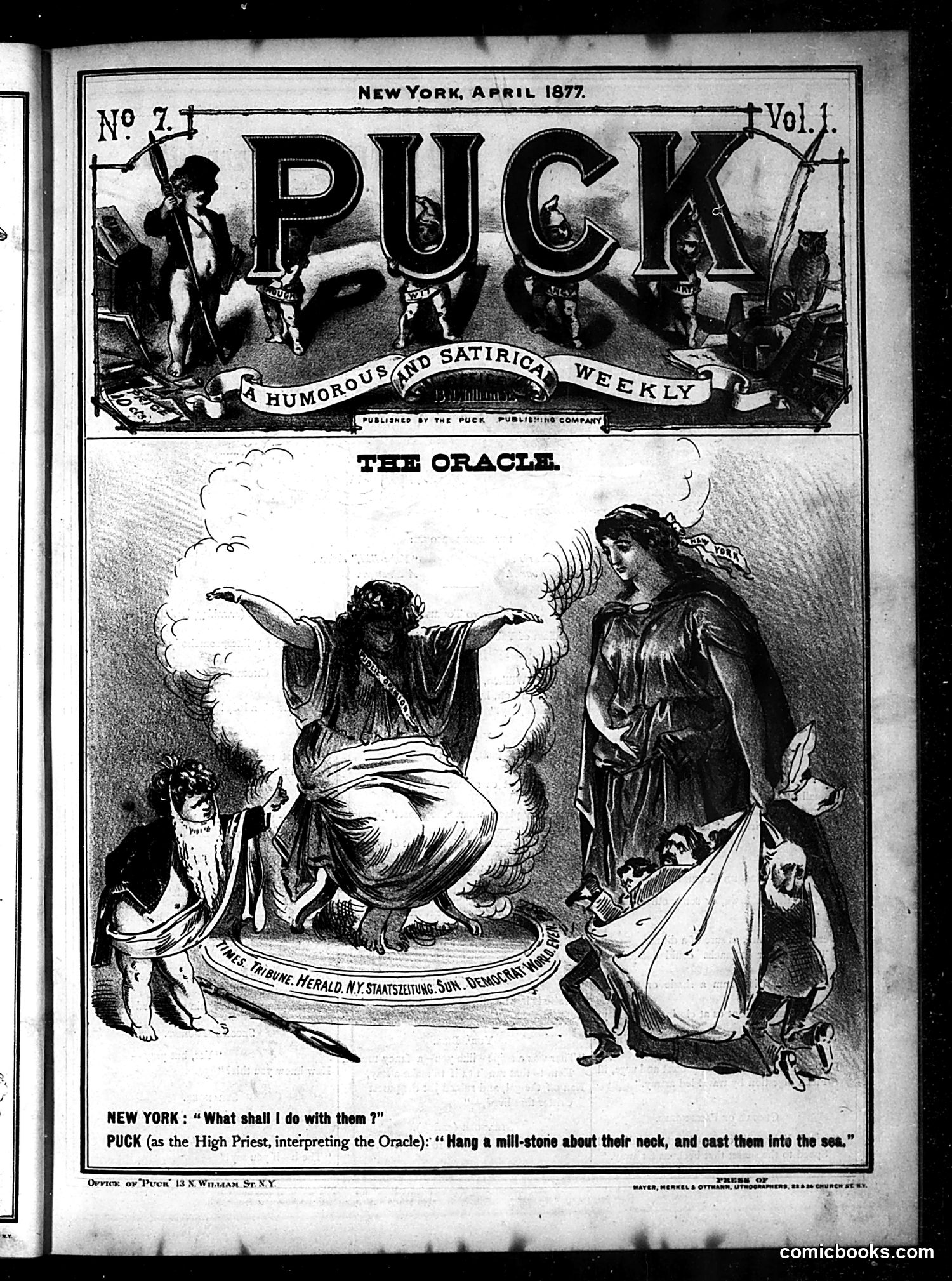
This satirical cartoon mocks New York's response to a contemporary crisis. The central figure labeled "The Oracle" (appearing as a priestess or fortune-teller) is being consulted by personified figures representing New York and other entities about a serious problem: "What shall I do with them?" The Oracle's darkly humorous response—"Hang a mill-stone about their neck, and cast them into the sea"—references a biblical punishment, suggesting an extreme solution to whatever group or problem New York faced in 1877. The specific crisis is unclear from this image alone, but given the 1877 date and Puck's satirical nature, it likely comments on a contemporary political or social scandal where authorities seemed incompetent or the public demanded severe action. The allegorical format was typical of Puck's social commentary.
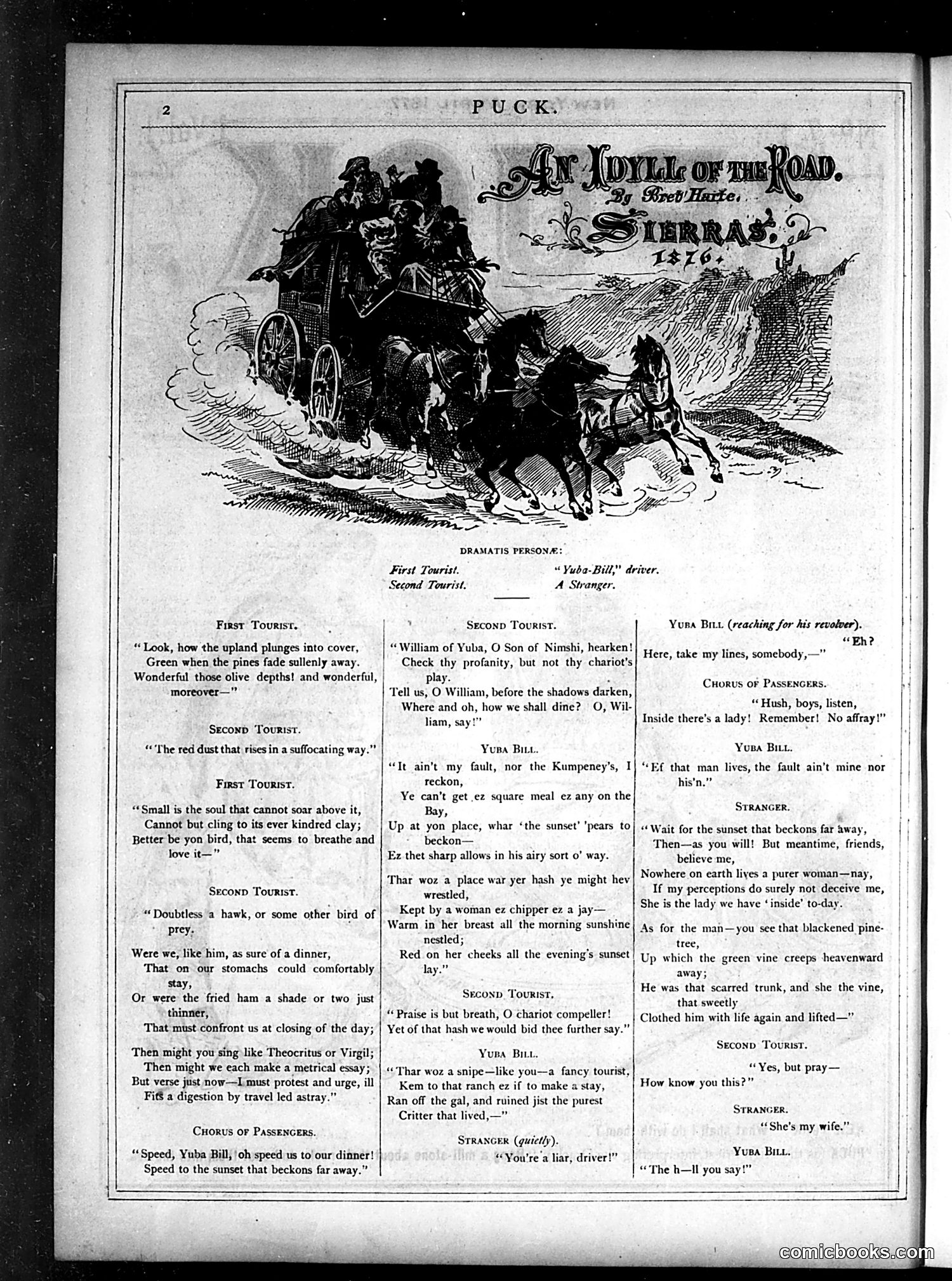
This page reproduces a dramatic sketch adapted from Bret Harte's famous short story about stagecoach travel in California's Sierra Nevada mountains. The illustration shows an overloaded stagecoach with multiple passengers precariously perched on top, drawn by struggling horses—depicting the chaotic reality of frontier transportation. The theatrical dialogue between "First Tourist," "Second Tourist," and "Yuba Bill" (the driver) captures Harte's sardonic humor about Western life: tourists marvel romantically at "upland plunges" and olive depths while the practical driver and fellow travelers discuss hunger, dangerous conditions, and a mysterious woman passenger. The stranger's revelation that "she's my wife" provides the sketch's dramatic twist, referencing Harte's exploration of frontier morality and unexpected human connection amid hardship.
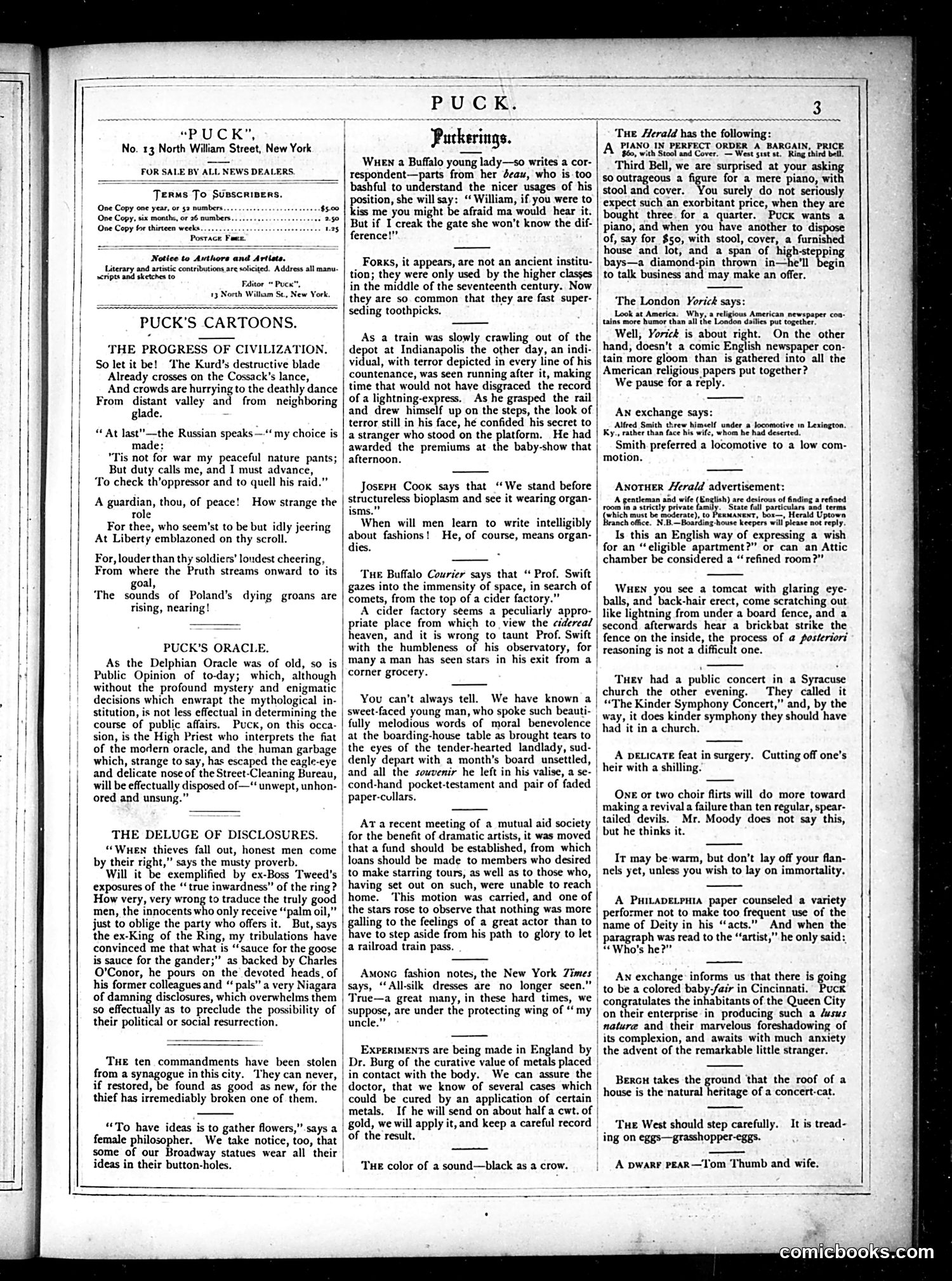
This page consists primarily of **text columns and advertisements** rather than political cartoons. The main content includes: **"Puck's Cartoons" section** featuring satirical poems about: - "The Progress of Civilization" — critiquing Russian pacifism and military posturing - "Puck's Oracle" — commentary on public opinion and social issues **Miscellaneous humor and social commentary** covering topics like: - Fashion absurdities (forks as toothpicks, "all-silk dresses") - Theatrical and musical performances in Syracuse - Scientific experiments in England regarding metal alloys - Various quips about human behavior The page lacks identifiable political caricatures or named figures. Instead, it offers **generalized satirical commentary on contemporary manners, fashion, and society** — typical of Puck's approach as a humor magazine mixing social observation with light ridicule of American and international customs.
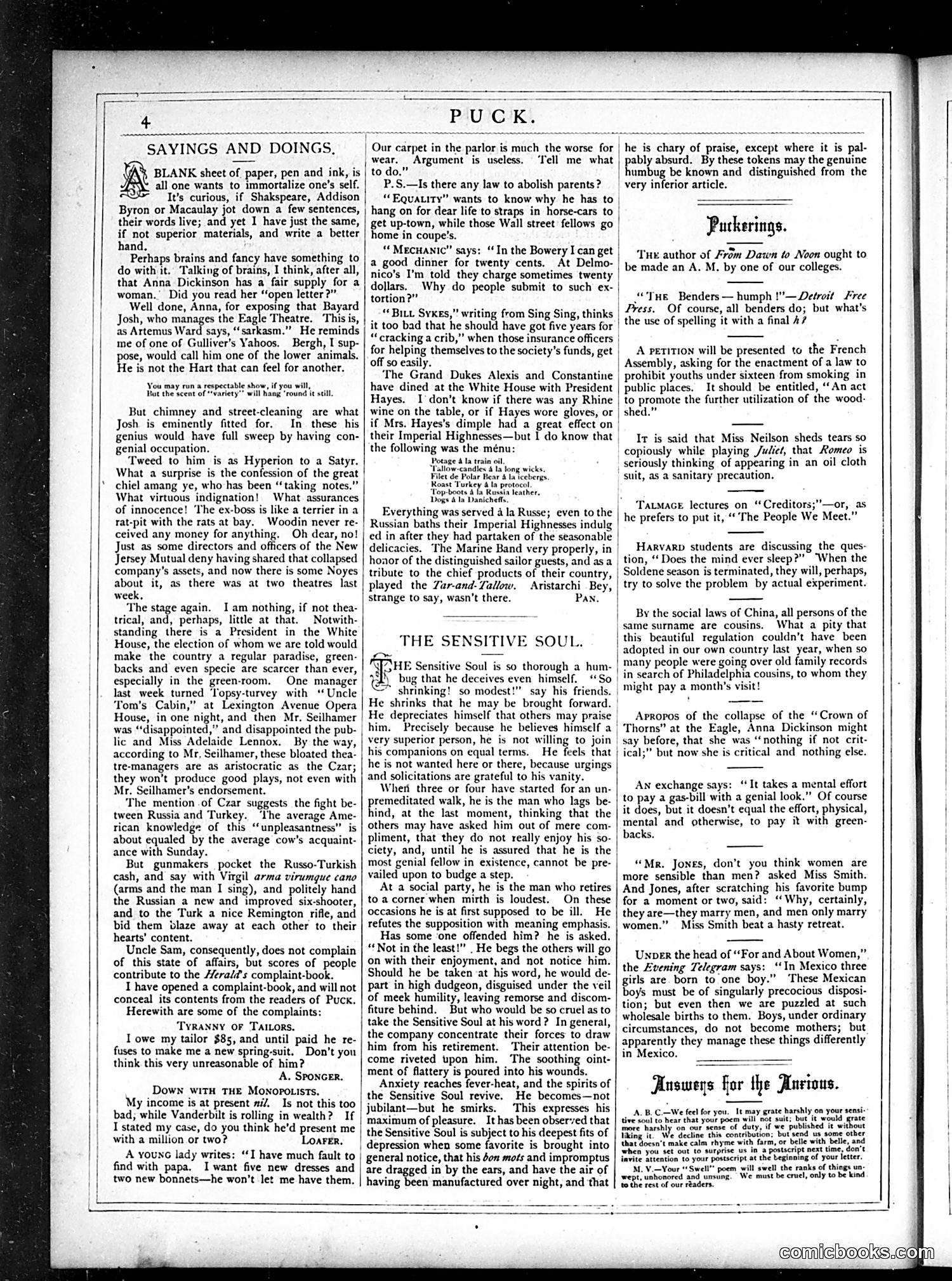
This page consists primarily of **text columns** rather than political cartoons. The content includes: **"Sayings and Doings"** - A humor column featuring brief anecdotes and observations about society, including comments on Shakespeare's writings, theatrical management, and social conventions. **"The Sensitive Soul"** - A satirical essay mocking overly emotional people who deceive themselves about their own nature and importance. It describes how such individuals seek constant reassurance and attention while being ungrateful to those around them. **"Answers for the Anxious"** - An advice column addressing reader questions about etiquette and personal matters. The page appears to be from Puck's editorial/humor section rather than featuring illustrated political cartoons. Without visible images to analyze, the satire relies entirely on **written wit targeting contemporary social behavior and character types** rather than visual caricature.
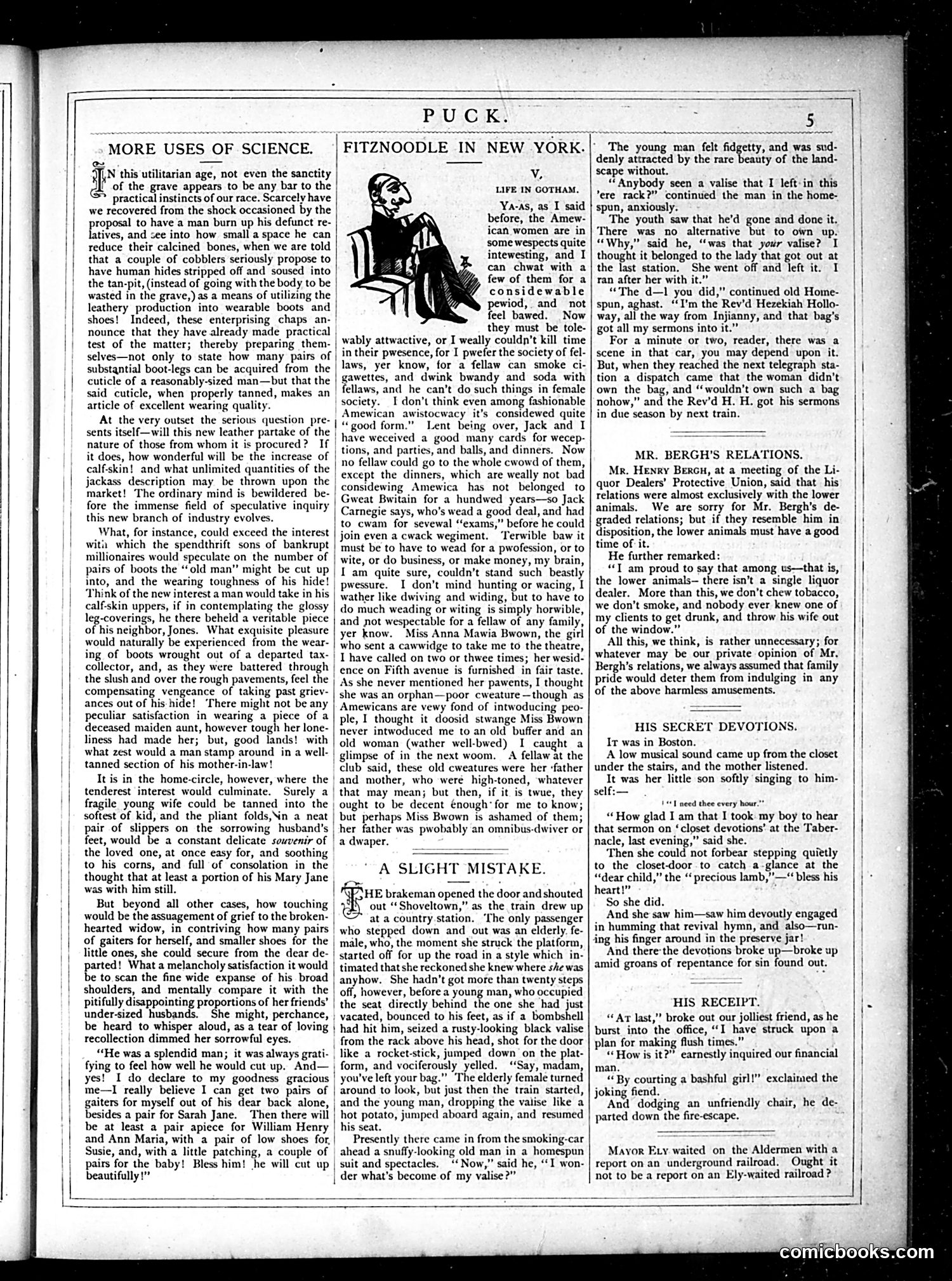
This page contains several satirical articles rather than political cartoons. The main illustrated piece, "Fitznoodle in New York: Life in Gotham," features a caricatured man and appears to be a humorous serial story about an American visitor's observations of New York society and women. Other articles include "More Uses of Science" (discussing practical applications), "Mr. Bergh's Relations" (concerning animal welfare and the ASPCA), "His Secret Devotions" (a domestic humor piece), "A Slight Mistake" (a comedic anecdote about train travel), and "His Receipt" (another humor story). The content reflects late 19th-century American satirical interests: social etiquette, urban manners, animal welfare reform, and domestic life. No major political figures or events appear to be directly referenced on this particular page.
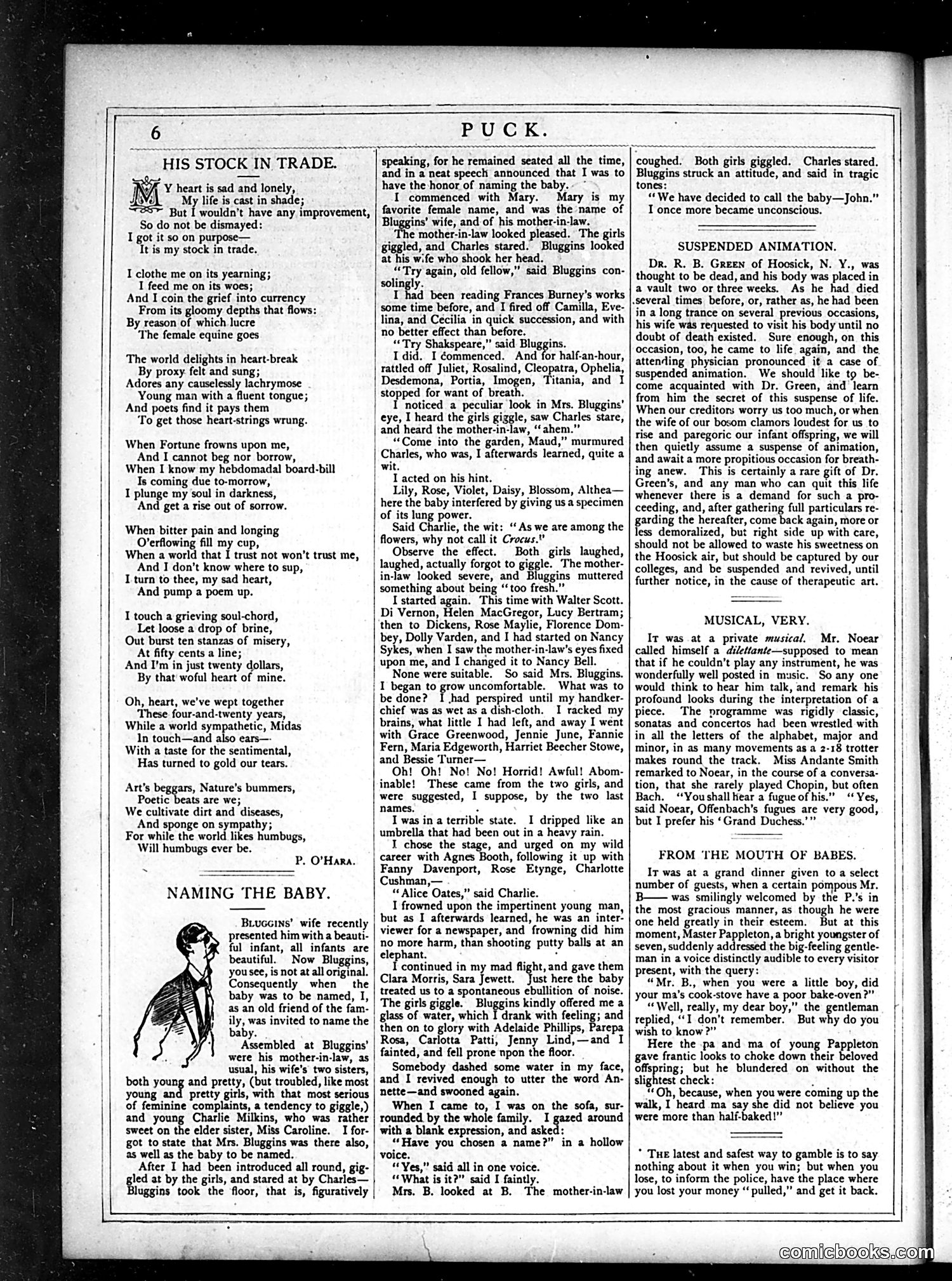
This page contains three distinct sections: 1. **"His Stock in Trade"** (left column): A poem criticizing someone's character or profession, suggesting they traffic in gloom and misery rather than offering genuine value. 2. **"Naming the Baby"** (center, with illustration): A humorous anecdote about naming an infant. The story involves a man presenting a baby to be named at a social gathering. The narrative satirizes pretentious naming practices and includes comic confusion when various names are suggested—apparently making fun of overly elaborate or fashionable baby-naming conventions among the upper classes. 3. **"Suspended Animation"** and **"Musical, Very"** (right column): Brief anecdotes about medical curiosities and musical charlatanism. The overall tone targets social pretension and absurdity in elite circles, typical of Puck's satirical approach. The specific historical context of these pieces is unclear without dating information.
This page contains primarily **text content rather than cartoons**: letters to the editor, theater criticism ("The Matinée Belle"), and several short humor pieces or articles. The main illustrated content appears to be sections titled "HIGH TREES-ON," "A TOUCHING APPEAL," and "A BARB-ROUS SUGGESTION," though the actual cartoon images are not clearly visible in this reproduction. The text discusses **theatrical matters** (particularly matinee performances), social commentary about newspapers and family stories, and humorous anecdotes about lawyers and social situations. Without clearer images of any illustrations, I cannot identify specific caricatures or political figures. The page appears to be a typical Puck format mixing satire, letters, and editorial commentary on American social and cultural topics of the era.
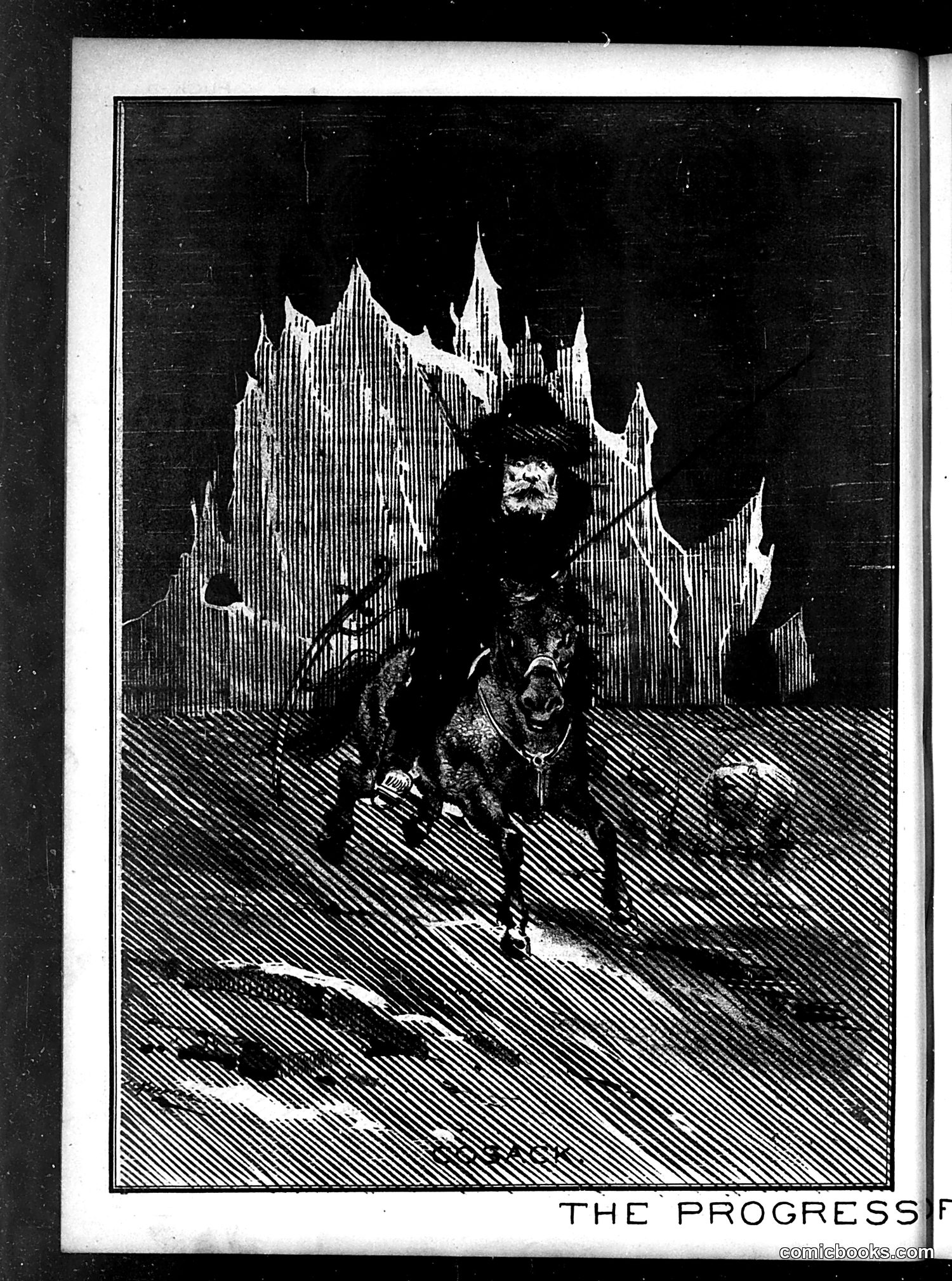
This engraving shows a figure on horseback approaching a Gothic cathedral or castle. The rider appears to be a wealthy or aristocratic person, given the ornate clothing and decorative horse tack. The title "THE PROGRESS" suggests commentary on advancement or development. Without additional context from the OCR text (which appears incomplete), the specific satirical target is unclear. The image could reference: - Social or political "progress" being questioned or critiqued - A wealthy figure's journey through society - Commentary on architectural or urban development The Gothic architecture in the background might symbolize tradition or the past. The engraving style and composition suggest this is commentary on contemporary society, but **I cannot confidently identify the specific figure, event, or political reference without more complete text or contextual information from the magazine issue.**
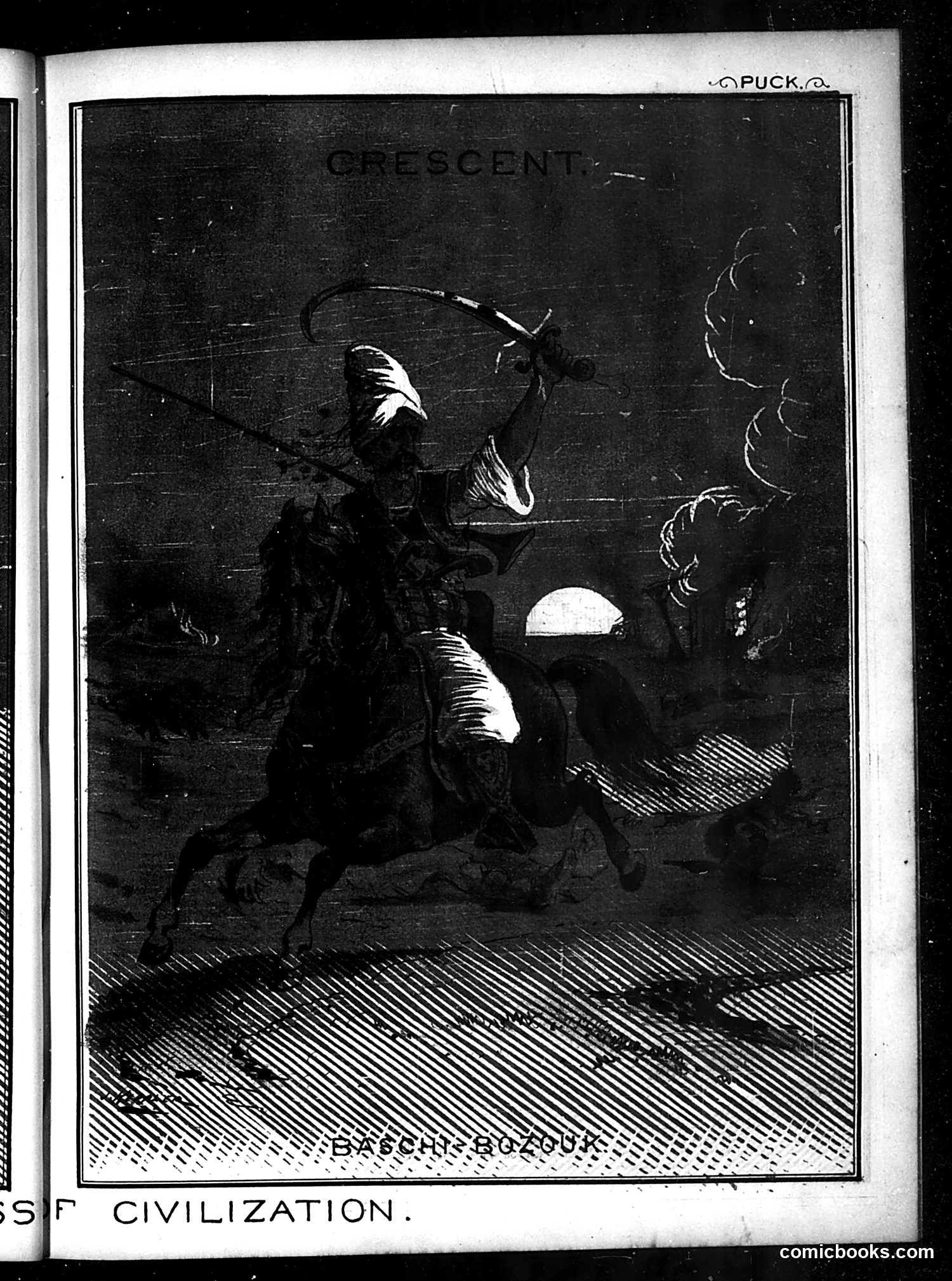
This Puck cartoon satirizes Western colonial attitudes toward Islam and the Ottoman Empire. The image depicts a figure wielding a crescent-topped sword (symbolizing Islamic/Ottoman power) confronting what appears to be Western civilization, represented by figures on the right and a rising sun or moon in the background. The title "Crescent" references the crescent moon symbol of Islam and the Ottoman Empire, while the caption "Civilization" suggests ironic commentary on how Western powers viewed non-Western cultures as uncivilized. The composition positions these forces in apparent conflict, likely reflecting late 19th-century anxieties about Ottoman decline, European imperial expansion, or tensions between Western and Islamic spheres of influence during the colonial era.
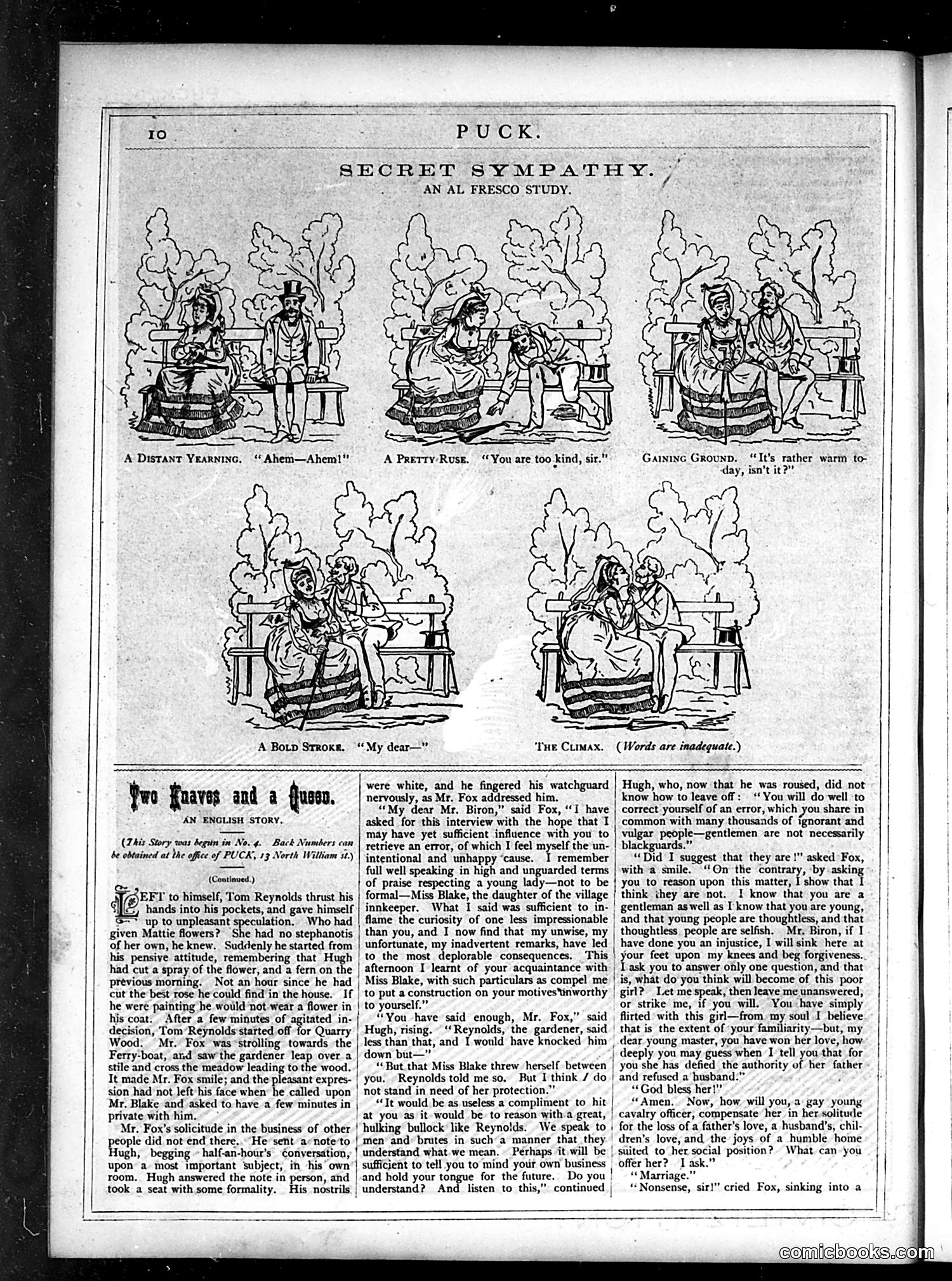
This five-panel comic strip depicts a flirtation between a well-dressed man and woman on a park bench. The sequence shows: 1. **A Distant Yearning** – They notice each other 2. **A Pretty Ruse** – She feigns kindness 3. **Gaining Ground** – Conversation progresses 4. **A Bold Stroke** – He makes an advance 5. **The Climax** – (noted as having inadequate words) The satire mocks Victorian courtship rituals and the elaborate social game of romance. Each panel's caption reveals the characters' inner thoughts versus outward behavior—demonstrating the gap between what people say and what they truly mean. The humor targets the pretense and strategic maneuvering inherent in upper-class romantic encounters of the period. Below is an unrelated serialized story, "Two Knaves and a Knave."
This page contains primarily **text narrative rather than editorial cartoon**—it's a serialized fiction story (appears to be "Puck" magazine's ongoing serial). The page shows dialogue between characters named Gregory Biron, Hugh, Mr. Blake, and Mr. Fox discussing romantic and financial entanglements. At the bottom, there's a letter addressed to "Dear Grandpapa" from "René Biron" describing a son dying in a hospital and seeking forgiveness and charity. This appears to be a **sentimental narrative device**, likely meant to tug at readers' heartstrings. Without visible cartoons on this particular page, I cannot identify specific political satire or caricatures. This is primarily **serialized humorous fiction content** rather than satirical political imagery.
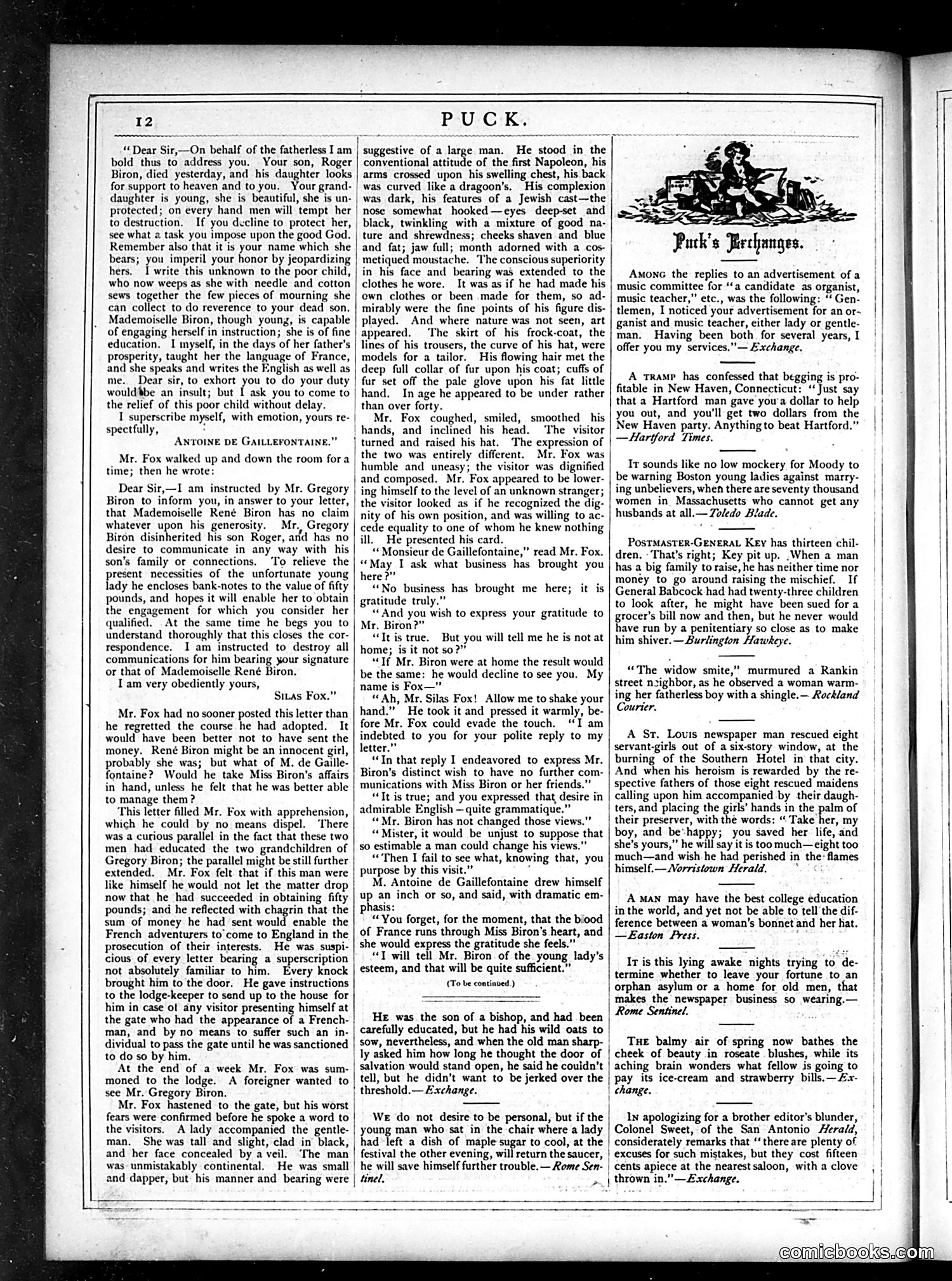
This page contains primarily **text content rather than political cartoons**. The main feature is a satirical letter titled "Dear Sir" addressing social etiquette and family matters. The visible cartoon in the upper right, titled "Puck's Briefs," appears to show a caricatured figure—possibly depicting physical characteristics that were used in period satire, though the specific identity is unclear from the image alone. The text discusses a character named Mr. Fox and a visit involving family honor and social propriety. Various brief anecdotes follow, mocking contemporary social situations—including warnings to Boston women about marriage, a postmaster's large family, and hotel mishaps. The page exemplifies Puck's satirical approach: **mockery of social conventions, domestic disputes, and genteel pretensions** through both illustration and humorous written commentary.
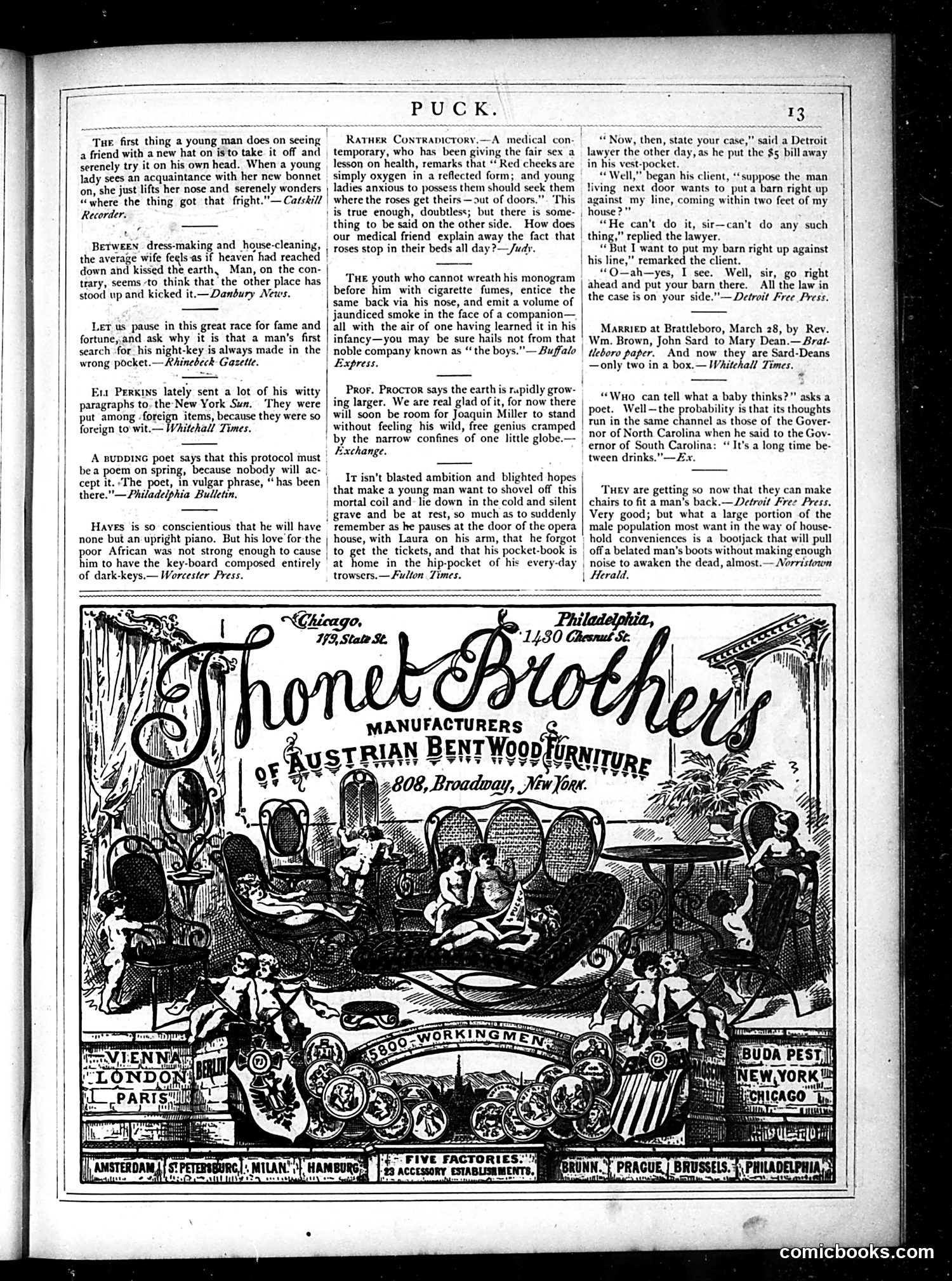
This page is **primarily an advertisement**, not a political cartoon. The large central illustration advertises Thönet Brothers, manufacturers of Austrian bentwood furniture. The ornate advertisement shows their factory operations and product showrooms, with cherubs and decorative elements promoting their bent-wood chairs and furnishings. Multiple factory locations are listed: Vienna, London, Paris, and various American cities including New York, Chicago, and Philadelphia. The surrounding text consists of **brief satirical commentary** typical of Puck magazine—witty social observations about marriage, ambition, and daily life. These are unrelated to the advertisement and appear to be filler content, not political commentary. The page represents standard late-19th-century magazine layout mixing editorial material with paid advertising.
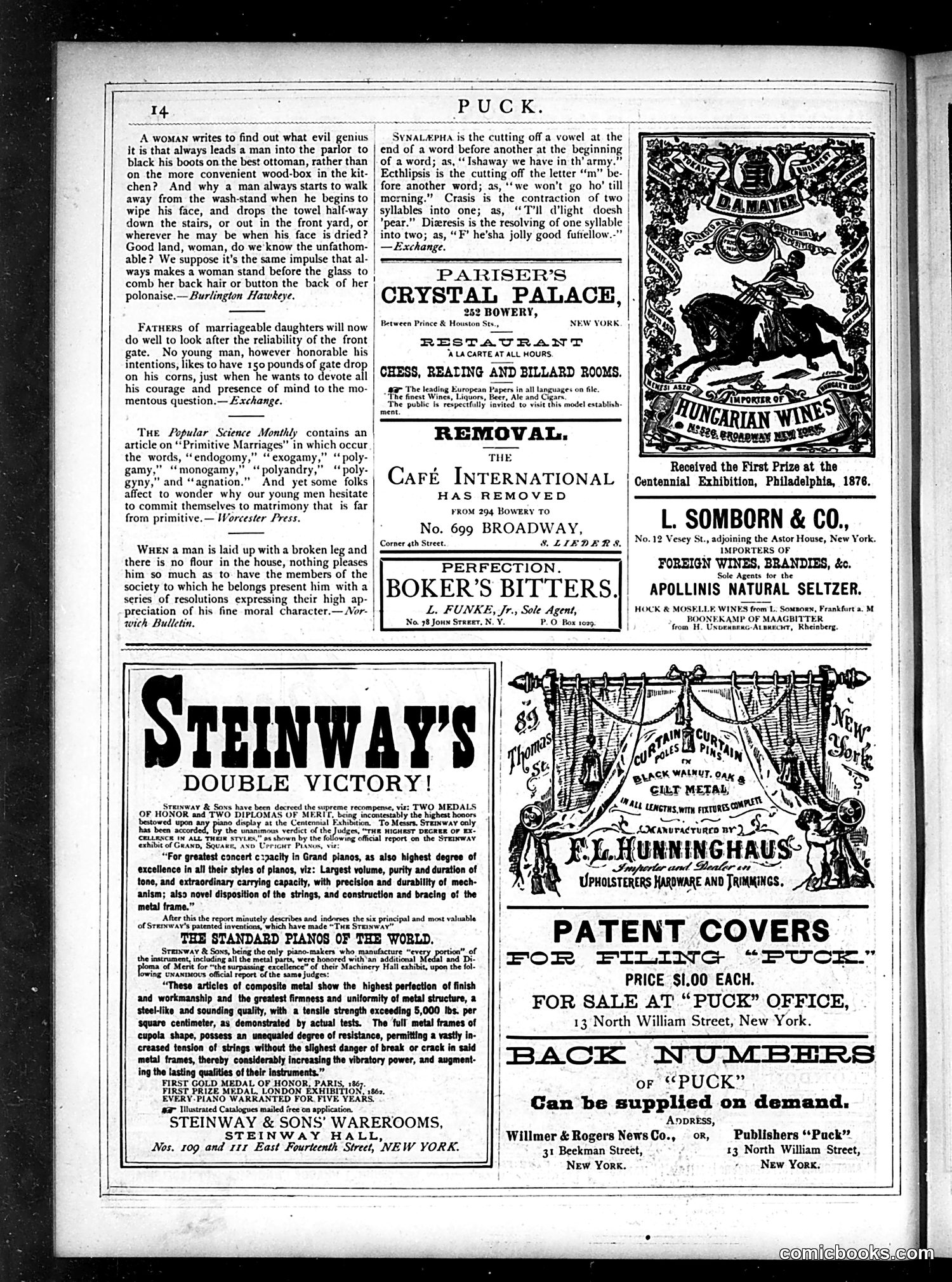
This page is primarily **advertising and editorial content** rather than political cartoons. The main visual elements include: 1. **Pariser's Crystal Palace advertisement** - a New York restaurant 2. **Hungarian Wines advertisement** - featuring an ornate label design 3. **Steinway Piano advertisement** - prominently featuring two medals and emphasizing the pianos' superior quality, craftsmanship, and durability ("finest gold medal honors," "five years warranty") 4. **Patent covers for "Puck"** - available for purchase The editorial text discusses linguistic terms (syncope, eclipsis, crasis) and social commentary about fathers of marriageable daughters and men with broken legs. **No identifiable political figures or satire appear on this page**—it represents standard 19th-century magazine filler combining advertisements with light editorial content.
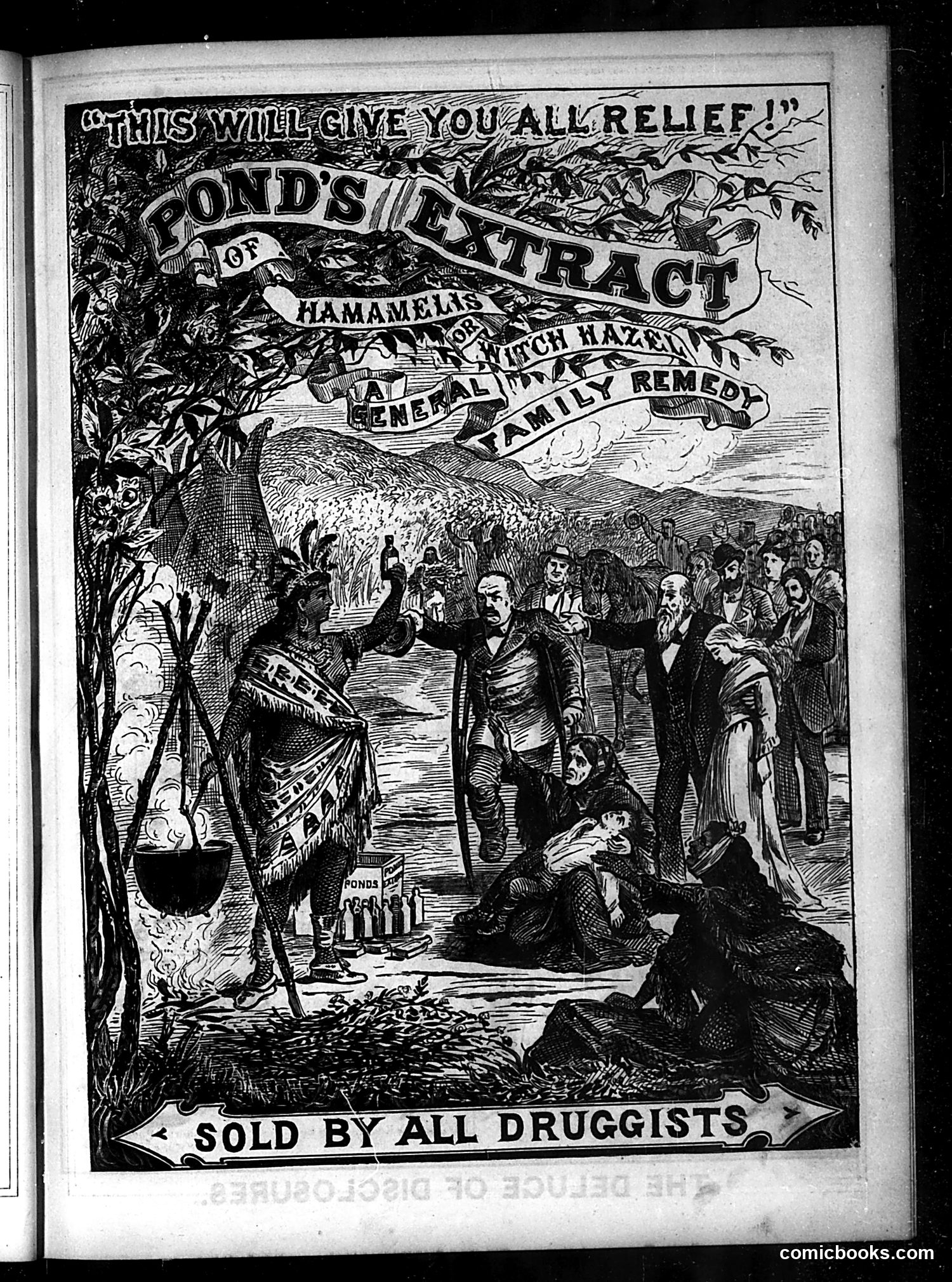
This is a **product advertisement** rather than a political cartoon. It's a Victorian-era ad for "Pond's Extract," a patent medicine marketed as a general family remedy for various ailments. The dramatic scene depicts people in distress—some appearing injured or ill—gathered around a cauldron of the extract, which is portrayed almost mystically (note the ethereal vapors). The headline "THIS WILL GIVE YOU ALL RELIEF!!" promises miraculous healing. This reflects **19th-century patent medicine marketing tactics**: exaggerated health claims, theatrical imagery, and appeals to desperation. Such unregulated products often contained questionable or harmful ingredients. The ad's inclusion in *Puck* likely served as advertising revenue rather than satirical commentary. "Sold by all druggists" at bottom confirms this as straightforward commercial marketing.
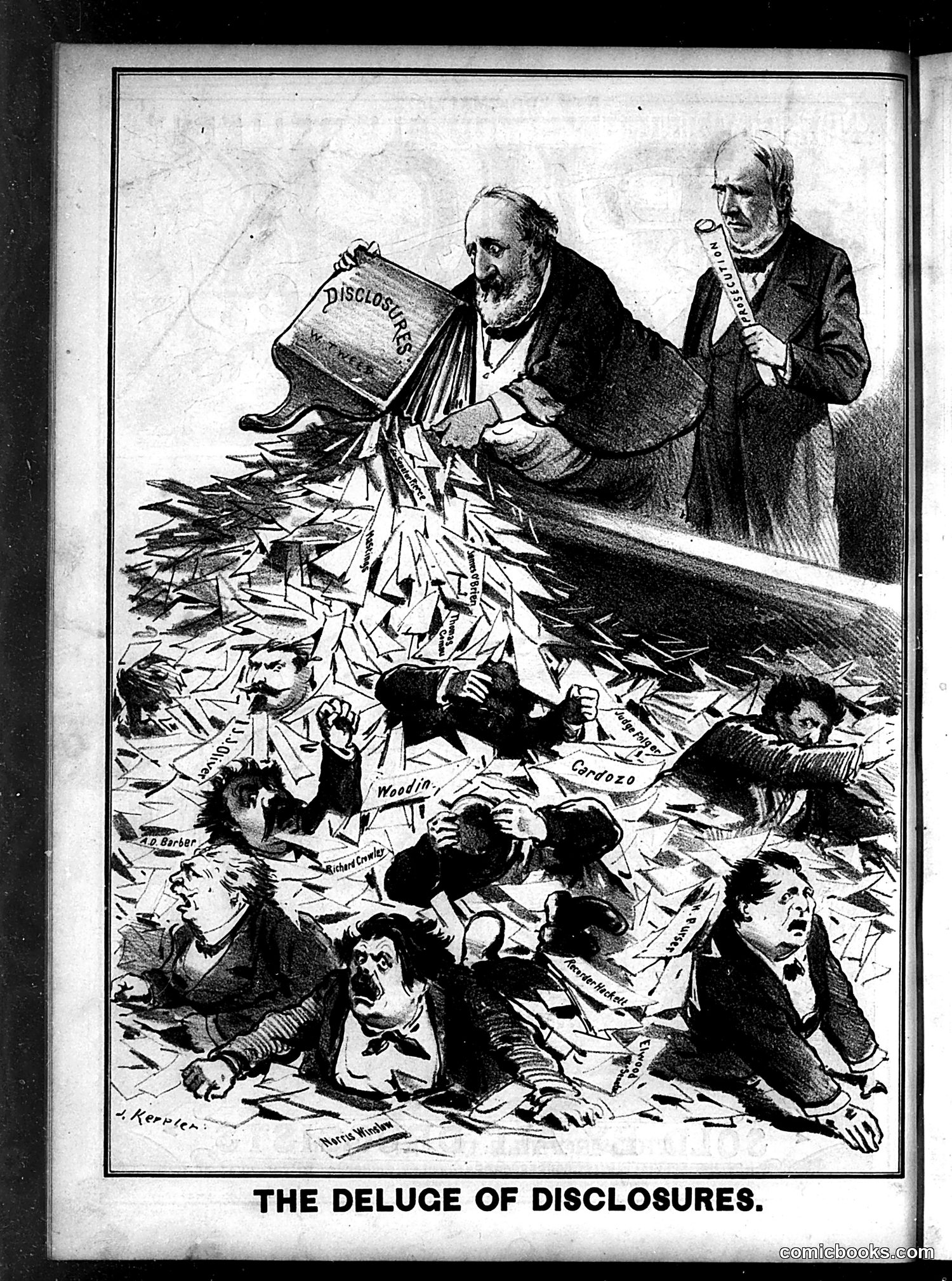
This political cartoon depicts a man labeled "DISCLOSURES" dumping cascading papers onto a group of distressed figures below. The man holding the vessel appears to be a government official or politician pouring out documents, while another figure on the right holds what looks like a measuring stick or rod—possibly representing oversight or investigation. The figures drowning in papers below appear to be political opponents or scandal-ridden individuals being overwhelmed by revelations. Some papers are labeled with names like "Woodin" and "Cordoza," though their specific identities require historical context. The satire critiques either a whistleblower campaign, congressional investigation, or political scandal where damaging disclosures are being weaponized against adversaries, burying them under the sheer volume of exposed information. The cartoon suggests this flood of revelations is chaotic and overwhelming rather than clarifying.