
Puck, 1877-04 · page 5 of 16
Puck — April 1877 — page 5: what you’re looking at
What you’re looking at
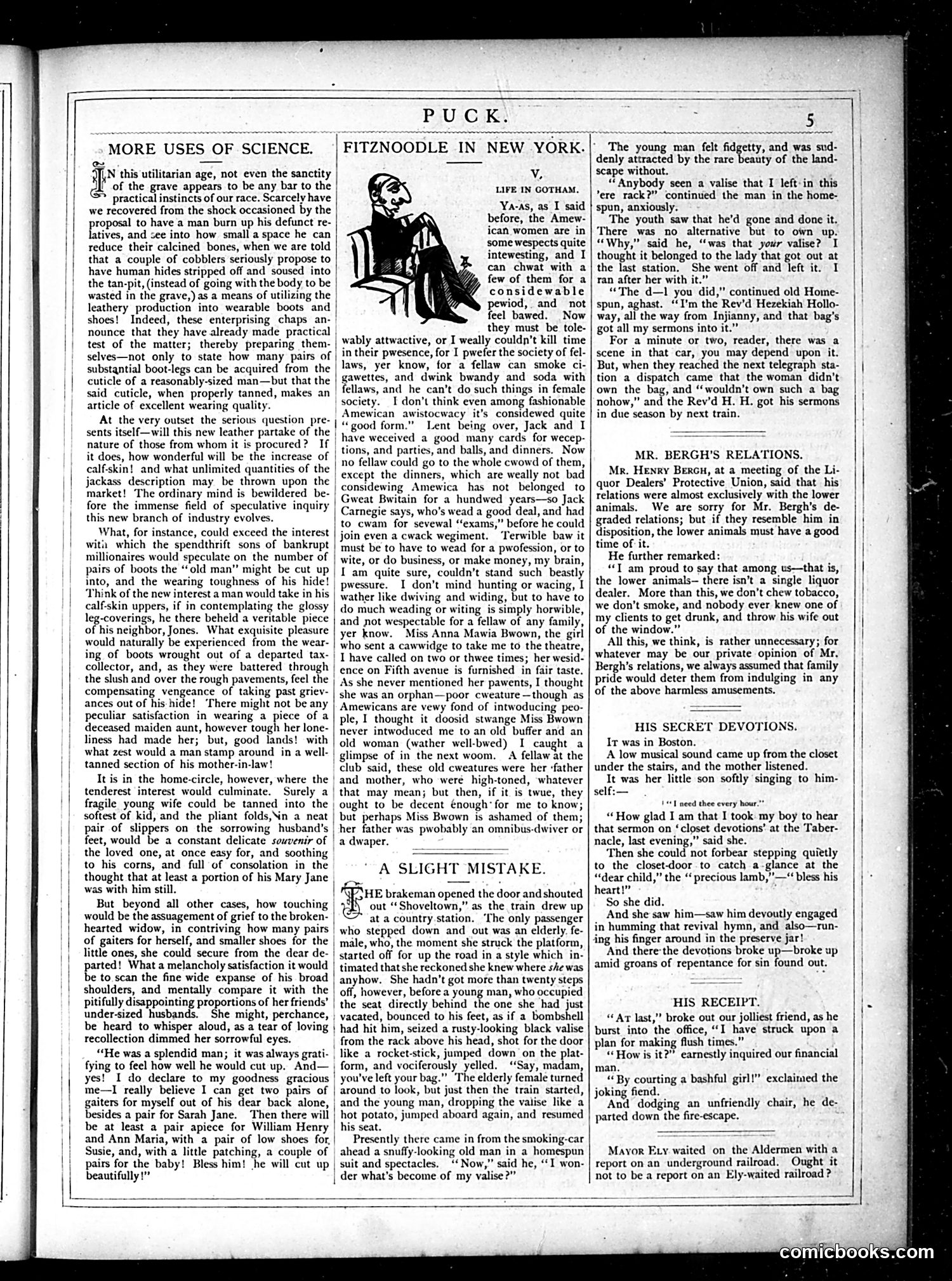
This page contains several satirical articles rather than political cartoons. The main illustrated piece, "Fitznoodle in New York: Life in Gotham," features a caricatured man and appears to be a humorous serial story about an American visitor's observations of New York society and women. Other articles include "More Uses of Science" (discussing practical applications), "Mr. Bergh's Relations" (concerning animal welfare and the ASPCA), "His Secret Devotions" (a domestic humor piece), "A Slight Mistake" (a comedic anecdote about train travel), and "His Receipt" (another humor story). The content reflects late 19th-century American satirical interests: social etiquette, urban manners, animal welfare reform, and domestic life. No major political figures or events appear to be directly referenced on this particular page.
📄 Transcribed text from this page (OCR, searchable)
Machine-transcribed from the original scan — historical spelling and the odd misread are preserved.
MORE USES OF SCIENCE. an nen N this utilitarian age, not even the sanctity & of the grave appears to be any bar to the practical instincts of our race. Scarcely have we recovered from the shock occasioned by the roposal to have a man burn up his defunct re- Eitives, and see into how small a space he can reduce their calcined bones, when we are told that a couple of cobblers seriously propose to | have human hides stripped off and soused into the tan-pit, (instead of going with the body to be wasted in the grave,) as a means of utilizing the leathery production into wearable boots and | shoes! Indeed, these enterprising chaps an- | nounce that they have already made practical ; test of the matter; thereby preparing them- selves—not only to state how many pairs of substantial boot-legs can be acquired from the cuticle of a reasonably-sized man—but that the said cuticle, when properly tanned, makes an article of excellent wearing quality. At the very outset the serious question pre- | sents itself—will this new leather partake of the | nature of those from whom it is procured? If it does, how wonderful will be the increase of | calf-skin! and what unlimited quantities of the jackass description may be thrown upon the market! The ordinary mind is bewildered be- fore the immense field of speculative inquiry this new branch of industry evolves. What, for instance, could exceed the interest with which the spendthrift sons of bankrupt millionaires would speculate on the number of | pairs of boots the “old man” might be cut up into, and the wearing toughness of his hide! ‘Think of the new interest a man would take in his calf-skin uppers, if in contemplating the glossy leg-coverings, he there beheld a veritable piece of his neighbor, Jones. What exquisite pleasure would naturally be experienced from the wear- ing of boots wrought out of a departed tax- collector, and, as they were battered through | the slush and over the rough pavements, feel the compensating vengeance of taking past griev- ances out of his-hide!_ ‘There might not be any peculiar satisfaction in wearing a piece of a deceased maiden aunt, however tough her lone- liness had made her; but, good lands! with what zest would a man stamp around in a well- tanned section of his mother-in-law! It is in the home-circle, however, where the tenderest interest would culminate. Surely a fragile young wife could be tanned into the softest of kid, and the pliant folds,Nn a neat pair of slippers on the sorrowing husband’s feet, would be a constant delicate souvenir of the loved one, at once easy for, and soothing to his corns, and full of consolation in the thought that at least a portion of his Mary Jane | was with him still. | But beyond all other cases, how touching would be the assuagement of grief to the broken- | hearted widow, in contriving how many pairs | of gaiters for herself, and smaller shoes for the | little ones, she could secure from the dear de- | parted! What a melancholy satisfaction it would | be to scan the fine wide expanse of his broad shoulders, and mentally compare it with the | pitifully disappointing proportions of her friends’ | under-sized husbands. She might, perchance, be heard to whisper aloud, as a tear of loving | recollection dimmed her sorrowful eyes. “He was a splendid man; it was always grati- fying to feel how well he would cut up. And— yes! I do declare to my goodness gracious me—I really believe I can get two pairs of | gaiters for myself out of his dear back alone, | besides a pair for Sarah Jane. Then there will | be at least a pair apiece for William Henry and Ann Maria, with a pair of low shoes for, | Susie, and, with a little patching, a couple of pairs for the baby! Bless him! he will cut up | beautifully!” | PUCK. FITZNOODLE IN NEW YORK. Vv, LIFE IN GOTHAM. Ya-as, as I said before, the Amew- ican women are in some wespects quite intewesting, and I can chwat with a few of them for a considewable pewiod, and not feel bawed. Now they must be tole- wably attwactive, or I weally couldn't kill time in their pwesence, for 1 pwefer the society of fel- laws, yer know, for a fellaw can smoke ci- gawettes, and dwink bwandy and soda with , and he can’t do such things in female iety. I don’t think even among fashionable Amewican awistocwacy it’s considewed quite “good form.” Lent being over, Jack and I have weceived a good many cards for wecep- tions, and parties, and balls, and dinners. Now no fellaw could go to the whole cwowd of them, | except the dinners, which are weally not bad considewing Amewica has not belonged to Gweat Bwitain for a hundwed years—so Jack Carnegie says, who's wead a good deal, and had to cwam for sevewal “exams,” before he could join even a cwack wegiment. Terwible baw it must be to have to wead for a pwofession, or to wite, or do business, or make money, my brain, { am quite sure, couldn’t stand such beastly pwessure. I don’t mind hunting or wacing, I wather like dwiving and widing, but to have to do much weading or witing is simply horwible, and not wespectable for a fellaw of any family, yer know. Miss Anna Mawia Bwown, the girl who sent a cawwidge to take me to the theatre, I have called on two or thwee times; her wesid- ence on Fifth avenue is furnished in fair taste. As she never mentioned her pawents, I thought she was an orphan—poor cweature—though as Amewicans are vewy fond of intwoducing peo- ple, I thought it doosid stwange Miss Bwown never intwoduced me to an old buffer and an old woman (wather well-bwed) I caught a glimpse of in the next woom. A fellaw at the Club said, these old cweatures were her ‘father and mother, who were high-toned, whatever that may mean; but then, if it is twue, they ought to be decent énough*for me to know; but perhaps Miss Bwown is ashamed of them; her father was pwobably an omnibus-dwiver or a dwaper. A SLIGHT MISTAKE. out “Shoveltown,” as the train drew up at a country station. ‘The only passenger who stepped down and out was an elderly. fe- male, who, the moment she struck the platform, started off for up the road in a style which in- timated that she reckoned she knew where she was anyhow. She hadn't got more than twenty steps off, however, before a young man, who occupied the seat directly behind the one she had just vacated, bounced to his feet, as if a bombshell had hit him, seized a rusty-looking black valise from the rack above his head, shot for the door like a rocket-stick, jumped down on the plat- form, and vociferously yelled. “Say, madam, you've left your bag.” The elderly female turned around to look, but just then the train started, and the young man, dropping the valise like a hot potato, jumped aboard again, and resumed his seat. Presently there came in from the smoking-car ahead a snuffy-looking old man in a homespun suit and spectacles. “Now,” said he, “I won- ler what's become of my valise ?” | es brakeman opened the door and shouted The young man felt fidgetty, and was sud- denly attracted by the rare beauty of the land- scape without. “ Anybody seen a valise that I left-in this ’ere rack?” continued the man in the home- spun, anxiously. The youth saw that he’d gone and done it, There was no alternative but to own up. “Why,” said he, ‘was that your valise? I thought it belonged to the lady that got out at the last station. She went off and left it. I ran after her with it.” “The d—1 you did,” continued old Home- spun, aghast. ‘I'm the Rev'd Hezekiah Hollo- way, all the way from Injianny, and that bag’s got all my sermons into it.” For a minute or two, reader, there was a scene in that car, you may depend upon it. But, when they reached the next telegraph sta- tion a dispatch came that the woman didn't own the bag, and ‘wouldn’t own such a nohow,” and the Rev’d H. H. got his sermons in due season by next train. MR. BERGH'’'S RELATIONS. Mr. Henry BerGu, at a meeting of the Li- quor Dealers’ Protective Union, said that his relations were almost exclusively with the lower animals. We are sorry for Mr. Bergh’s de- graded relations; but if they resemble him in disposition, the lower animals must have a good time of it. He further remarked: “I am proud to say that among us—that is, the lower animals— there isn’t a single liquor dealer. More than this, we don’t chew tobacco, we don’t smoke, and nobody ever knew one of my clients to get drunk, and throw his wife out of the window.” All this, we think, is rather unnecessary; for whatever may be our private opinion of Mr. Bergh’s relations, we always assumed that family pride would deter them from indulging in any of the above harmless amusements. HIS SECRET DEVOTIONS. Ir was in Boston. A low musical sound came up from the closet under the stairs, and the mother listened. It was her little son softly singing to him- self:— 11 need thee every hour.” “ How glad I am that I took my boy to hear that sermon on ‘closet devotions’ at the Taber- nacle, last evening,” said she. ‘Then she could not forbear stepping quietly to the closet-door to catch a-glance at the “dear child,” the “ precious lamb,”"—“ bless his heart!” So she did. ‘And she saw him—saw him devoutly engaged in humming that revival hymn, and also—run- ing his finger around in the preserve jar! ‘And therethe devotions broke up—broke up amid groans of repentance for sin found out. HIS RECEIPT. “Ar last,” broke out our jolliest friend, as he burst into the office, “I have struck upon a plan for making flush times.” “How is it?” earnestly inquired our financial man. “By courting a bashful girl!” exclaimed the joking fiend. : z And dodging an unfriendly chair, he de- parted down the fire-escape. Mayor ELy waited on the Aldermen with a report on an underground railroad. Ought it not to be a report on an Ely-waited railroad ?