
Puck, 1877-04 · page 10 of 16
Puck — April 1877 — page 10: what you’re looking at
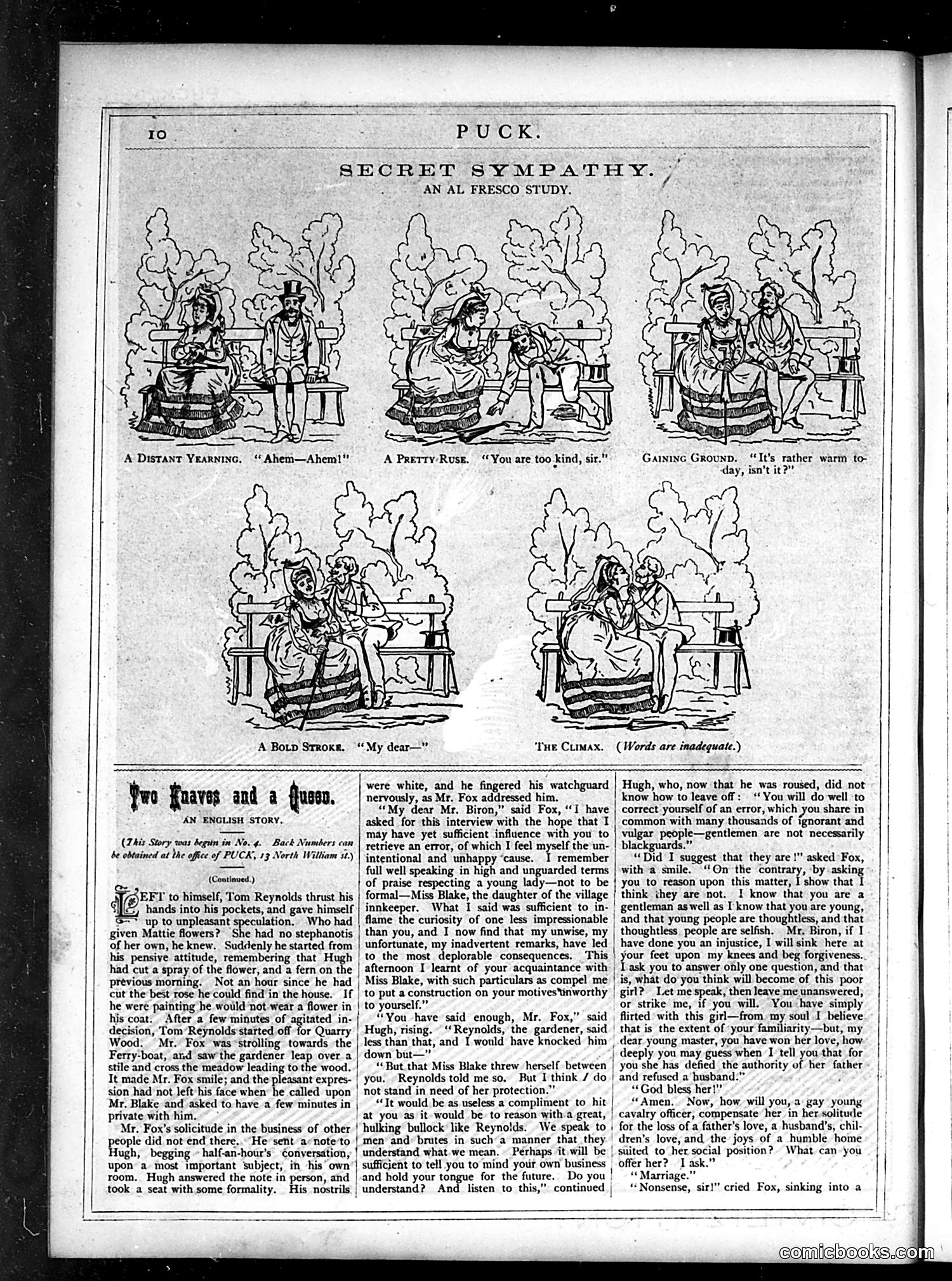
What you’re looking at
This five-panel comic strip depicts a flirtation between a well-dressed man and woman on a park bench. The sequence shows: 1. **A Distant Yearning** – They notice each other 2. **A Pretty Ruse** – She feigns kindness 3. **Gaining Ground** – Conversation progresses 4. **A Bold Stroke** – He makes an advance 5. **The Climax** – (noted as having inadequate words) The satire mocks Victorian courtship rituals and the elaborate social game of romance. Each panel's caption reveals the characters' inner thoughts versus outward behavior—demonstrating the gap between what people say and what they truly mean. The humor targets the pretense and strategic maneuvering inherent in upper-class romantic encounters of the period. Below is an unrelated serialized story, "Two Knaves and a Knave."
📄 Transcribed text from this page (OCR, searchable)
Machine-transcribed from the original scan — historical spelling and the odd misread are preserved.
Io. SECRET SYMPATHY. pe A Distant Yearninc, ‘Ahem—Ahem!” A Botp Stroke. “My dear—” AN AL FRESCO STUDY. 7 Py ‘Te Cumax. (Words are inadequate.) Gaininc Grounp. ‘It’s rather warm to- day, isn’t it?” uo fuaves and a ffueon, AN ENGLISH STORY. (This Story was begin in No.4. Back Numbers can be obtained at the office of PUCK, 13 North William st. (Continued.) rer to himself, Tom Reynolds thrust his hands into his pockets, and gave himself ~ up to unpleasant ulation, Who had given Mattie flowers? She had no stephanotis of her own, he knew. Suddenly he started from his pensive attitude, remembering that Hugh had cut a spray of the flower, and a fern on ‘the prévious morning. Not an hour since he had cut the best rose hecould find'in the house. If he were painting he would not-wear a flower in his coat. After a few minutes of agitated in- decision, Tom’Reynolds'started off for Quarry Wood. Mr. Fox was «strolling towards the Ferry-boat, ard saw'the gardener leap over.a stile and cross the meadow leading to the wood. It made Mr. Fox smile; and the pleasant expres- | sion had ‘not left his face when’ he called upon Mr. Blake and asked to-have a few minutes in | private with him. Mr. Fox's solicitude in the business of other | people did not end there. "He sent a-note’to ugh, begging ~ halfan-hour’s ¢onversdtion, | upon a most important subject, in his’ own room. Hugh answered the note in person, and | took a seat with some formality. His nostrils. | were white, and he fingered his watchguard nervously, as Mr, Fox addressed him. “(My dear Mr. Biron,” said Fox, “I have | asked for this interview with the hope that I Hugh, who, now that he was roused, did not know how to leave off: ‘You will do well to correct yourself of an error, which you share in common with many thousands of fgnorant and may have yet sufficient influence with you to | vulgar people—gentlemen are not necessarily retrieve an error, of which I feel myself the un- | blackguards.” intentional and unhappy “cause. I remember | ‘Did I suggest that they are!” asked Fox, full well speaking in high and unguarded terms | with a smile. “‘On the contrary, ‘by asking of praise respecting a young lady—not to be | you to reason upon this matter, I show that I formal—Miss Blake, the daughter of the village | think they are not. ! know that you are a innkeeper. What I said was sufficient to in- | gentleman aswell as I know that you are young, flame the curiosity of one less impressionable | and that young people are thoughtless, and that than you, and I now find that my unwise, my | thoughtless. people are selfish. Mr. Biron, if I unfortunate, my inadvertent remarks, have led | have done you an injustice, I will sink here at to. the: thest deplorable consequences: This | your feet’ apon’ my, knees aiid beg forgivences, afternoon I learnt of your acquaintance with | I\ask you to answer only one question, and that Miss Blake, with such particulars as compel me | is, what do'you think will become of this poor | to put a construction on your motivestinworthy | | to yourself.” “You have said enough, Mr. Fox,” said Hugh, rising. “Reynolds, the gardener, said less than that, and I would have knocked him down but—” “But that Miss Blake threw herself between you. Reynolds told me so. But I think / do | | not stand in need of her protection.” “Tt would be as useless a compliment to hit | | dear young master, you have won her love, how. | deeply you may guess when I tell you that for you she has defied the authority of her father girl? Let me speak, then leave me unanswered, or strike me, if you will. You have simply flirted with this girl—from. my soul I believe. that is the extent of ‘your familiarity—but, my and refused a’ busband.” “God bless her!” “Amen. Now, how will you, a gay young at you as it would be to reason with.a great, | cavalry officer, compensate her in her.solitude hulking’ bullock like Reynolds. We speak to | for the loss of a father’s love, a husband’s, chil- men’ and’ brutes in sucha manner that they.! dren’s love, and the joys of a humble home understand what.we mean.» Perhaps it will be | sufficjent to tell you to mind your own business and hold your tongue for the future. Do you | understand? And listen to this,” continued | suited to her social position? What can you offer her? I ask.” “ Marriage.” “Nonsense, sir!” cried Fox, sinking into a comichooks.cayn