
Puck, 1877-04 · page 2 of 16
Puck — April 1877 — page 2: what you’re looking at
What you’re looking at
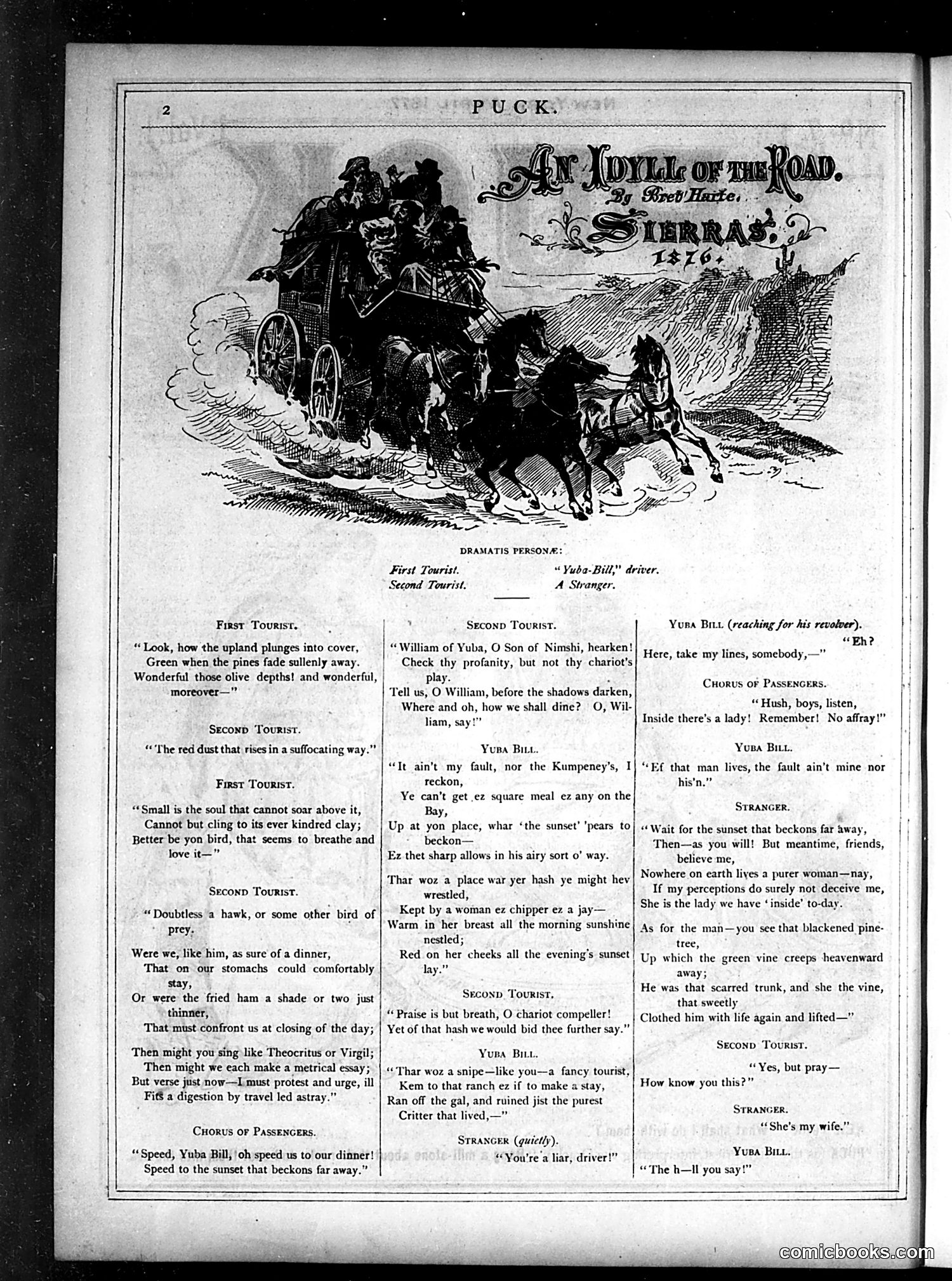
This page reproduces a dramatic sketch adapted from Bret Harte's famous short story about stagecoach travel in California's Sierra Nevada mountains. The illustration shows an overloaded stagecoach with multiple passengers precariously perched on top, drawn by struggling horses—depicting the chaotic reality of frontier transportation. The theatrical dialogue between "First Tourist," "Second Tourist," and "Yuba Bill" (the driver) captures Harte's sardonic humor about Western life: tourists marvel romantically at "upland plunges" and olive depths while the practical driver and fellow travelers discuss hunger, dangerous conditions, and a mysterious woman passenger. The stranger's revelation that "she's my wife" provides the sketch's dramatic twist, referencing Harte's exploration of frontier morality and unexpected human connection amid hardship.
📄 Transcribed text from this page (OCR, searchable)
Machine-transcribed from the original scan — historical spelling and the odd misread are preserved.
First Tourist. ‘Look, how the upland plunges into cover, Green when the pines fade sullenly away. Wonderful those olive depths! and wonderful, moreover—" Seconp Tourist. “The red dust that rises in a suffocating way.” First Tourist. “Small is the soul that cannot soar above it, Cannot but cling to its ever kindred clay; Better be yon bird, that seems to breathe and love it—” Seconp Tourist. “Doubtless a hawk, or some other bird of Prey. Were we, like him, as sure of a dinner, That on our stomachs could comfortably stay, Or were the fried ham a shade or two just thinner, That must confront us at closing of the day; ‘Then might you sing like Theocritus or Virgil; Then might we each make a metrical essay; But verse just now—I must protest and urge, ill Fi a digestion by travel led astray.” Corus oF PassENGERS. “Speed, Yuba Bill; /oh speed us to!our dinner! Speed to the sunset that beckons far away.” DRAMATIS PERSON ®:: First Tourist. Second Tourist. A Stranger, \ Seconp Tourist. “William of Yuba, O Son of Nimshi, hearken! Check thy profanity, but not thy chariot’s play. ; Tell us, O William, before the shadows darken, Where and oh, how we shall dine? O, Wil- liam, say!” Yusa Bit. “Tt ain't. my fault, nor the Kumpeney’s, I reckon, Ye can’t get ez square meal ez any on the Bay, Up at yon place, whar ‘the sunset’ 'pears to beckon— Ez thet sharp allows in his airy sort o’ way. ‘Thar woz a place war yer hash ye might hev wrestled, Kept by a woman ez chipper ez a jay— Warm in her breast all the morning sunshine nestled; Red on her cheeks all the evening's sunset lay.” Seconp_ Tourist, “Praise is but breath, O chariot compeller! Yet of that hash we would bid thee further say.” Yupa Bi. “Thar woz a snipe—like you—a fancy tourist, Kem to that ranch ez if to make a stay, Ran off the gal, and ruined jist the purest Critter that lived,—” STRANGER (quietly). “You're'a liar, driver!” “Yuba-Bill,” driver. Yuna Bri (reaching for his revolver). “En? Here, take my lines, somebody,—” Cuorus OF PASSENGERS. “Hush, boys, listen, Inside there’s a lady! Remember! No affray!” Yousa Bit. “Ef that man lives, the fault ain’t mine nor his'n.” STRANGER. ‘Wait for the sunset that beckons far away, Then—as you will! But meantime, friends, believe me, Nowhere on earth liyes a purer woman—nay, If my perceptions do surely not deceive me, She is the lady we have ‘inside’ to-day. As for the man—you see that blackened pine- tree, | Up which the green vine creeps -heavenward away; He was that scarred trunk, and she the vine, that sweetly Clothed him with life again and lifted—” | Seconp Tourist. “Yes, but pray— How know you this?” STRANGER. “She's my wife.” Yusa Bit. | The h—il you say! comicihooks.celyn