
Puck, 1877-04 · page 12 of 16
Puck — April 1877 — page 12: what you’re looking at
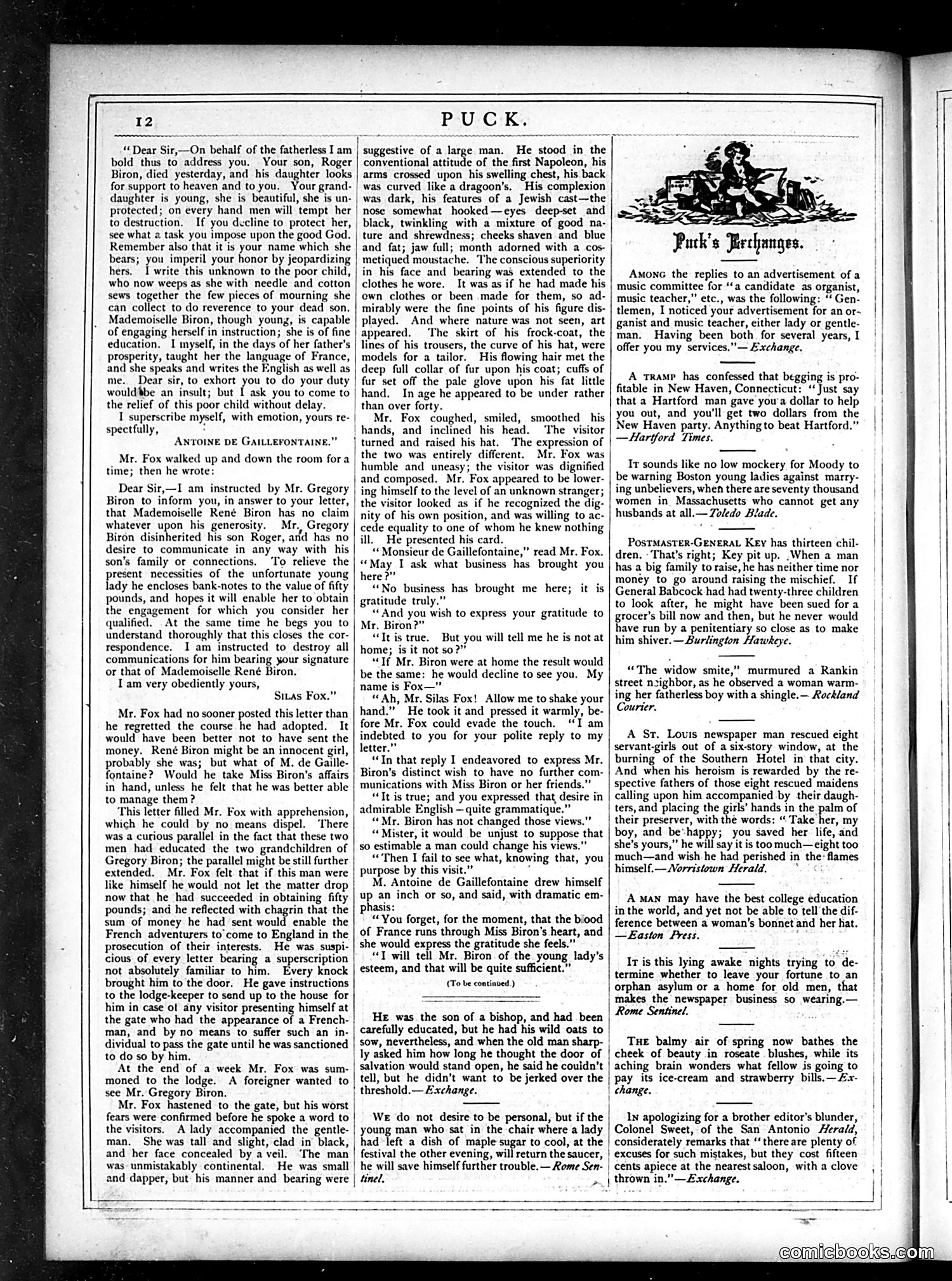
What you’re looking at
This page contains primarily **text content rather than political cartoons**. The main feature is a satirical letter titled "Dear Sir" addressing social etiquette and family matters. The visible cartoon in the upper right, titled "Puck's Briefs," appears to show a caricatured figure—possibly depicting physical characteristics that were used in period satire, though the specific identity is unclear from the image alone. The text discusses a character named Mr. Fox and a visit involving family honor and social propriety. Various brief anecdotes follow, mocking contemporary social situations—including warnings to Boston women about marriage, a postmaster's large family, and hotel mishaps. The page exemplifies Puck's satirical approach: **mockery of social conventions, domestic disputes, and genteel pretensions** through both illustration and humorous written commentary.
📄 Transcribed text from this page (OCR, searchable)
Machine-transcribed from the original scan — historical spelling and the odd misread are preserved.
i] “Dear Sir,—On behalf of the fatherless I am | bold thus to address you, Your son, Roger Biron, died yesterday, and his daughter looks for support to heaven and to you. Your grand- daughter is young, she is beautiful, she is un- protected; on every hand men will tempt her to destruction. If you decline to protect her, see what a task you impose upon the good God. Remember also that it is your name which she bears; you imperil your honor by jeopardizing ers. I write this unknown to the poor child, who now weeps as she with needle and cotton sews together the few pieces of mourning she can collect to do reverence to your dead son, Mademoiselle Biron, though young, is capable of engaging herself in instruction; she is of fine | education. I myself, in the days of her father’s | prosperity, taught her the language of France, and she speaks and writes the English as well as me. Dear sir, to exhort you to do your duty would‘be an insult; but I ask you to come to | the relief of this poor child without delay. I superscribe myself; with emotion, yours re- | spectfully, ANTOINE DE GAILLEFONTAINE.”” Mr. Fox walked up and down the room fora | time; then he wrote: Dear Sir,—I am instructed by Mr. Gregory | Biron to inform you, in answer to your letter, that Mademoiselle René Biron has no claim whatever upon his generosity. Mr., Gregory Biron disinherited is son Roger, and has no desire to communicate in any way with his son’s family or connections. ‘To relieve the present necessities of the unfortunate young lady he encloses bank-notes to the value of fifty pounds, and hopes it will enable her to obtain the engagement for which you consider her qualified. At the same time he begs you to understand thoroughly that this closes the cor- respondence. I am instructed to destroy all communications for him bearing your signature or that of Mademoiselle René Biron, I am very obediently yours, Sitas Fox.” Mr. Fox had no sooner posted this letter than he regretted the course he had adopted. It would have been better not to have sent the money. René Biron might be an innocent girl, probably she was; but what of M. de Gaille- fontaine? Would he take Miss Biron’s affairs in hand, unless he felt that he was better able to manage them? This letter filled Mr. Fox with apprehension, which he could by no means dispel. ‘There was a curious parallel in the fact that these two men had educated the two grandchildren of Gregory Biron; the parallel might be still further extended. Mr. Fox felt that if this man were like himself he would not let the matter drop now that he had succeeded in obtaining fifty pounds; and he reflected with chagrin that the sum of money he had sent would enable the French adventurers to’come to England in the prosecution of their interests. He was suspi- cious of every letter bearing a superscription not absolutely familiar to him. Every knock brought him to the door. He gave instructions to the lodge-keeper to send up to the house for him in case ot any visitor presenting himself at the gate who had the appearance of a French- man, and by no means to suffer such an in- dividual to pass the gate until he was sanctioned | to do so by him. At the end of a week Mr. Fox was sum- moned to the lodge. A foreigner wanted to see Mr. Gregory Biron. Mr. Fox hastened to the gate, but his worst | fears were confirmed before he spoke a word to the visitors. A lady accompanied the gentle- | man. She was tall and slight, clad in black, and her face concealed by a veil. ‘The man | was unmistakably continental. He was small | | turned and raised his hat. and dapper, but his manner and bearing were suggestive of a large man. He stood in the conventional attitude of the first Napoleon, his arms crossed upon his swelling chest, his back was curved like a dragoon’s. His complexion was dark, his features of a Jewish cast—the nose somewhat hooked—eyes deep-set and black, twinkling with a mixture of good na- ture and shrewdness; cheeks shaven and blue and fat; jaw full; month adorned with a cos- metiqued moustache. The conscious superiority in his face and bearing was extended to the clothes he wore. It was as if he had made his own clothes or been made for them, so ad- mirably were the fine points of his figure dis- played. And where nature was not seen, art appeared. ‘The skirt of his frock-coat, the lines of his trousers, the curve of his hat, were models for a tailor. His flowing hair met the deep full collar of fur upon his coat; cuffs of fur set off the pale glove upon his fat little hand. In age he appeared to be under rather than over forty. Mr. Fox coughed, smiled, smoothed his hands, and inclined his head. ‘The visitor ‘The expression of the two was entirely different. Mr. Fox was | humble and uneasy; the visitor was dignified and composed. Mr. Fox appeared to be lower- ing himself to the level of an unknown stranger; the visitor looked as if he recognized the dig- nity of his own position, and was willing to ac- cede equality to one of whom he knew nothing ill. He presented his card. “ Monsieur de Gaillefontaine,” read Mr. Fox. “May I ask what business has brought you here?” “No business has brought me here; it is gratitude truly.” nd you wish to express your gratitude to Mr. Biron?” “Tris true. But you will tell me he is not at home; is it not so?” “(If Mr. Biron were at home the result would | be the same: he would decline to see you. My name is Fox—" “Ah, Mr. Silas Fox! Allow me to shake your hand.” He took it and pressed it warmly, be- fore Mr. Fox could evade the touch. “I am indebted to you for your polite reply to my letter.” “In that reply I endeavored to express Mr. Biron's distinct wish to have no further com- munications with Miss Biron or her friends.” “Tt is true; and you expressed that, desire in admirable English — quite grammatique.” “Mr. Biron has not changed those views."” “Mister, it would be unjust to suppose | that so estimable a man could change his views.” “Then I fail to see what, knowing that, you purpose by this visit.” M. Antoine de Gaillefontaine drew himself up an inch or so, and said, with dramatic em- phasis: “You forget, for the moment, that the biood of France runs through Miss Biron’s heart, and she would express the gratitude she feels.” “T will tell Mr. Biron of the young lady's esteem, and that will be quite sufficient.” (To be continved.) He was the son of a bishop, and had been carefully educated, but he had his wild oats to sow, nevertheless, and when the old man s! ly asked him how long he thought the door of | salvation would stand open, he said he couldn't tell, but he didn’t want to be jerked over the | threshold.— Exchange. We do not desire to be personal, but if the young man who sat in the chair where a lady | had left a dish of maple sugar to cool, at the festival the other evening, will return the saucer, | he will save himself further trouble.— Rome Sen- tinel. s Pack 8 Ebon Amonc the replies to an advertisement of a music committee for “a candidate as organist, music teacher,” etc., was the following: ‘ Gen- tlemen, I noticed your advertisement for an or~ ganist and music teacher, either lady or gentle- man. Having been both for several years, I offer you my services.”"— Exchange. A tRaMp has confessed that begging is pro- fitable in New Haven, Connecticut: “Just say that a Hartford man gave you'a dollar to help you out, and you'll get two dollars from the New Haven party. Anything to beat Hartford.” —Hartford Times. Ir sounds like no low mockery for Moody to be warning Boston young ladies against marry- ing unbelievers, when there are seventy thousand women in Massachusetts who cannot get any —Toledo Blade. husbands at all. PostMasTeR-GENERAL Key has thirteen chil- dren. «That's right; Key pit up. .When a man has a big family to raise, he has neither time nor monéy to go around raising the mischief. If General Babcock had had twenty-three children to look after, he might have been sued fora grocer’s bill now and then, but he never would have run by a penitentiary so close as to make him shiver.—Burlington Hawkeye. “The widow smite,” murmured a Rankin street nzighbor, as he observed a woman warm- ing her fatherless boy with a shingle.— Rockland Courier. A Sr. Louis newspaper man rescued eight servant-girls out of a six-story window, at the burning of the Southern Hotel in that city. And when his heroism is rewarded by the re- spective fathers of those eight rescued maidens calling upon him accompanied by their daugh- ters, and placing the girls’ hands in the palm of their preserver, with the words: “Take her, my boy, and be*happy; you saved her life, and she’s yours,” he will say it is toomuch—eight too much—and wish he had perished in the- flames himself.— Norristown Herald. A MAN may have the best college education in the world, and yet not be able to tell the dif- ference between a woman's bonnet and her hat. —Easton Press. Ir is this lying awake nights trying to de- termine whether to leave your fortune to an orphan asylum or a home for old men, that makes the newspaper business so wearing.— Rome Sentinel. Tue balmy air of spring now bathes the cheek of beauty in roseate blushes, while its aching brain wonders what fellow is going to pay its ice-cream and strawberry bills.—£x- | change. In apologizing for a brother editor's blunder, Colonel Sweet, of the San Antonio Herald, | considerately remarks that “there are plenty of | excuses for such mistakes, but they cost fifteen cents apiece at the nearest saloon, with a clove | thrown in.” —Zxchange, comichooks.cetn