
Puck, 1877-04 · page 6 of 16
Puck — April 1877 — page 6: what you’re looking at
What you’re looking at
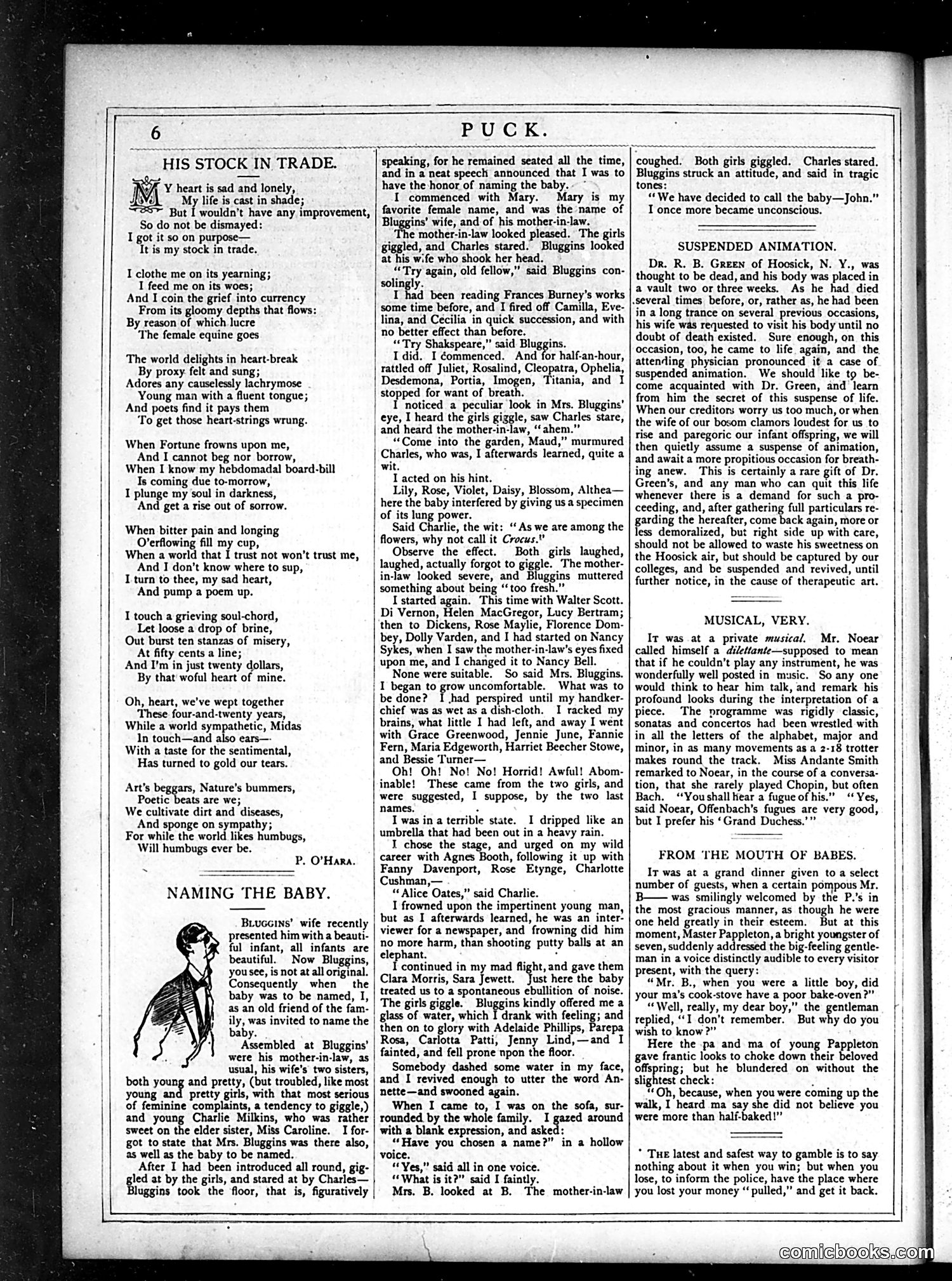
This page contains three distinct sections: 1. **"His Stock in Trade"** (left column): A poem criticizing someone's character or profession, suggesting they traffic in gloom and misery rather than offering genuine value. 2. **"Naming the Baby"** (center, with illustration): A humorous anecdote about naming an infant. The story involves a man presenting a baby to be named at a social gathering. The narrative satirizes pretentious naming practices and includes comic confusion when various names are suggested—apparently making fun of overly elaborate or fashionable baby-naming conventions among the upper classes. 3. **"Suspended Animation"** and **"Musical, Very"** (right column): Brief anecdotes about medical curiosities and musical charlatanism. The overall tone targets social pretension and absurdity in elite circles, typical of Puck's satirical approach. The specific historical context of these pieces is unclear without dating information.
📄 Transcribed text from this page (OCR, searchable)
Machine-transcribed from the original scan — historical spelling and the odd misread are preserved.
"HIS STOCK IN TRADE. Y heart is sad and lonely, My life is cast in shade; But I wouldn’t have any improvement, So do not be dismayed: I got it so on purpose— It is my stock in trade. I clothe me on its yearning; I feed me on its woes; And I coin the grief into currency From its gloomy depths that flows: By reason of which lucre The female equine goes The world delights in heart-break By proxy. felt and sung; Adores any causelessly lachrymose Young man with a fluent tongue; And poets find it pays them To get those heart-strings wrung. When Fortune frowns upon me, And I cannot beg nor borrow, When I know my hebdomadal board-bill Ts coming due to-morrow, I plunge my soul in darkness, And get a rise out of sorrow. When bitter pain and longing O'erflowing fill my cup, When a world that I trust not won't trust me, And I don’t know where to sup, I turn to thee, my sad heart, And pump a poem up. I touch a grieving soul-chord, Let loose a drop of brine, Out burst ten stanzas of misery, At fifty cents a line; And I'm in just twenty dollars, By that’ woful heart of mine. Oh, heart, we've wept together These four-and-twenty years, While a world sympathetic, Midas In touch—and also ears—- With a taste for the seatimental, Has turned to gold our tears. Art’s beggars, Nature's bummers, Poetic beats are we; We cultivate dirt and diseases, And sponge on sympathy; For while the world likes humbugs, Will humbugs ever be. P. O'Hara. NAMING THE BABY. Biuccins’ wife recently | presented him with a beauti- ful infant, all infants are beautiful. Now Bluggins, you see, is not at all original. Consequently when the baby was to be named, I, as an old friend of the fam- ily, was invited to name the y Assembled at Bluggins’ were his mother-in-law, as usual, his wife's two sisters, | both young and pretty, (but troubled, like most young and pretty girls, with that most serious of feminine complaints, a tendency to giggle,) and young Charlie Milkins, who was rather sweet on the elder sister, Miss Caroline. I for- got to state that Mrs. Bluggins was there also, | rattled off Juliet, Rosalind, Cleo) | I began to grow uncomfortable. as well as the baby to be named. After I had been introduced all round, gig- ged at by the girls, and stared at by Charles— | luggins took the floor, that is, figuratively | PUCK. speaking, for he remained seated all the time, and in a neat speech announced that I was to have the honor of naming the baby.. ~ I commenced with Mary. Mary is my favorite female name, and was the name of Bluggins’ wife, and of his mother-in-law. ¢ mother-in-law looked pleased. The girls giggled, and Charles stared. Bluggins looked at his wife who shook her head. “Try again, old fellow,” said Bluggins con- solingly. I fad been reading Frances Burney’s works some time before, and I fired off Camilla, Eve- lina, and Cecilia in quick succession, and with no better effect than before. “Try Shakspeare,” said Bluggins. I did. I éommenced. And for half-an-hour, tra, Ophelia, fitania, and I Desdemona, Portia, Imogen, | stopped for want of breath. noticed a peculiar look in Mrs. Bluggins’ | eye, I heard the girls giggle, saw Charles stare, and heard the mother-in-law, “ahem.” “Come into the garden, Maud,” murmured | Charles, who was, I afterwards learned, quite a wit. 1 acted on his hint. Lily, Rose, Violet, Daisy, Blossom, Althea— here the baby interfered by giving us a specimen of its lung power. Said Charlie, the wit: “As we are among the flowers, why not call it Crocus." Observe the effect. Both girls laughed, | laughed, actually forgot to giggle. The mother- in-law looked severe, and Bluggins muttered something about being ‘too fresh.” I started again. This time with Walter Scott. Di Vernon, Helen MacGregor, Lucy Bertram; then to Dickens, Rose Maylie, Florence Dom- bey, Dolly Varden, and I had started on Nancy Sykes, when I saw the mother-in-law's eyes fixed upon me, and I changed it to Nancy Bell. None were suitable. So said Mrs. Bluggins. What was to be done? I .had perspired until my handker- chief was as wet as a dish-cloth. I racked my brains, what little I had left, and away I went with Grace Greenwood, Jennie June, Fannie Fern, Maria Edgeworth, Harriet Beecher Stowe, | and Bessie Turner— Oh! Oh! No! No! Horrid! Awful! Abom- inable! These came from the two girls, and were suggested, I suppose, by the two last names. . I was ina terrible state. I dripped like an umbrella that had been out in a heavy rain. I chose the stage, and urged on my wild | career with Agnes Booth, following it up with Fanny Davenport, Rose Etynge, Charlotte Cushman,— “Alice Oates,” said Charlie. I frowned upon the impertinent young man, but as I afterwards learned, he was an inter- viewer for a newspaper, and frowning did him no more harm, than shooting putty balls at an elephant. . I continued in my mad flight, and gave them Clara Morris, Sara Jewett. Fast here the baby treated us to a spontaneous ebullition of noise. The girls giggle. Bluggins kindly offered me a glass of water, which I drank with feeling; and then on to glory with Adelaide Phillips, Parepa Rosa, Carlotta Patti, Jenny Lind,—and I fainted, and fell prone npon the floor. Somebody dashed some water in my face, | and I revived enough to utter the word An- nette—and swooned again. When I came to, I was on the sofa, sur- rounded by the whole family. I ged around with a blank expression, and asked: “Have you chosen a name?” in a hollow voice. “Yes,” said all in one voice. ‘What is it?” said I faintly. Mrs. B. looked at B. The mother-in-law coughed. Both girls giggled. Charles stared. Bluggins struck an attitude, and said in tragic tones: “We have decided to call the baby—John.” T once more became unconscious. SUSPENDED ANIMATION. Dr. R. B. Green of Hoosick, N. Y., was thought to be dead, and his body was placed in a vault two or three weeks. As he had died .several times before, or, rather as, he had been in a long trance on several previous occasions, his wife was requested to visit his body until no doubt of death existed. Sure enough, on this occasion, too, he came to life again, and the attending physician pronounced it a case of. suspended animation. We should like tp be- come acquainted with Dr. Green, and learn from him the secret of this suspense of life. When our creditors worry us too much, or when the wife of our bosom clamors loudest for us to rise and paregoric our infant offspring, we will then quietly assume a suspense of animation, and await a more propitious occasion for breath: ing anew. This is certainly a rare gift of Dr. Green’s, and any man who can quit this life whenever there is a demand for such a pro- ceeding, and, after gathering full particulars re- garding the hereafter, come back again, more or less demoralized, but right side up with care, should not be allowed to waste his sweetness on the Hoosick air, but should be captured by our colleges, and be suspended and revived, until further notice, in the cause of therapeutic art. MUSICAL, VERY. It was at a private musical. Mr. Noear called himself a dilettante—supposed to mean that if he couldn’t play any instrument, he was wonderfully well posted in music. So any one would think to hear him talk, and remark his profound looks during the interpretation of a piece. The programme was rigidly classic, sonatas and concertos had been wrestled with in all the letters of the alphabet, major and minor, in as many movements as a 2-18 trotter makes round the track. Miss Andante Smith remarked to Noear, in the course of a conversa- tion, that she rarely played Chopin, but often Bach. ‘Youshall Kear a fugue of his.” ‘‘ Yes, said Noear, Offenbach’s fugues are very good, but I prefer his ‘Grand Duchess.’” FROM ‘THE MOUTH OF BABES. Ir was at a grand dinner given to a select number of guests, when a certain pompous Mr. B— was smilingly welcomed by the P.’s in the most gracious manner, as though he were one held greatly in their esteem. But at this moment, Master Pappleton, a bright youngster of seven, suddenly addressed the big-feeling gentle- man in a voice distinctly audible to every visitor present, with the query: “Mr. B., when you were a little boy, did your ma’s cook-stove have a poor bake-oven?” “Well, really, my dear boy,” the gentleman replied, ‘I don’t remember. But why do you wish to know ?”” Here the pa and ma of young Pappleton gave frantic looks to choke down their beloved offspring; but he blundered on without the slightest check: % “Oh, because, when you were coming up the walk, I heard ma say she did not believe you were more than half-baked!” * Tue latest and safest way to gamble is to say nothing about it when you win; but when you lose, to inform the police, have the place where you lost your money “pulled,” and get it back. comichooks.couy