
A complete issue · 64 pages · 1928
Life — December 7, 1928
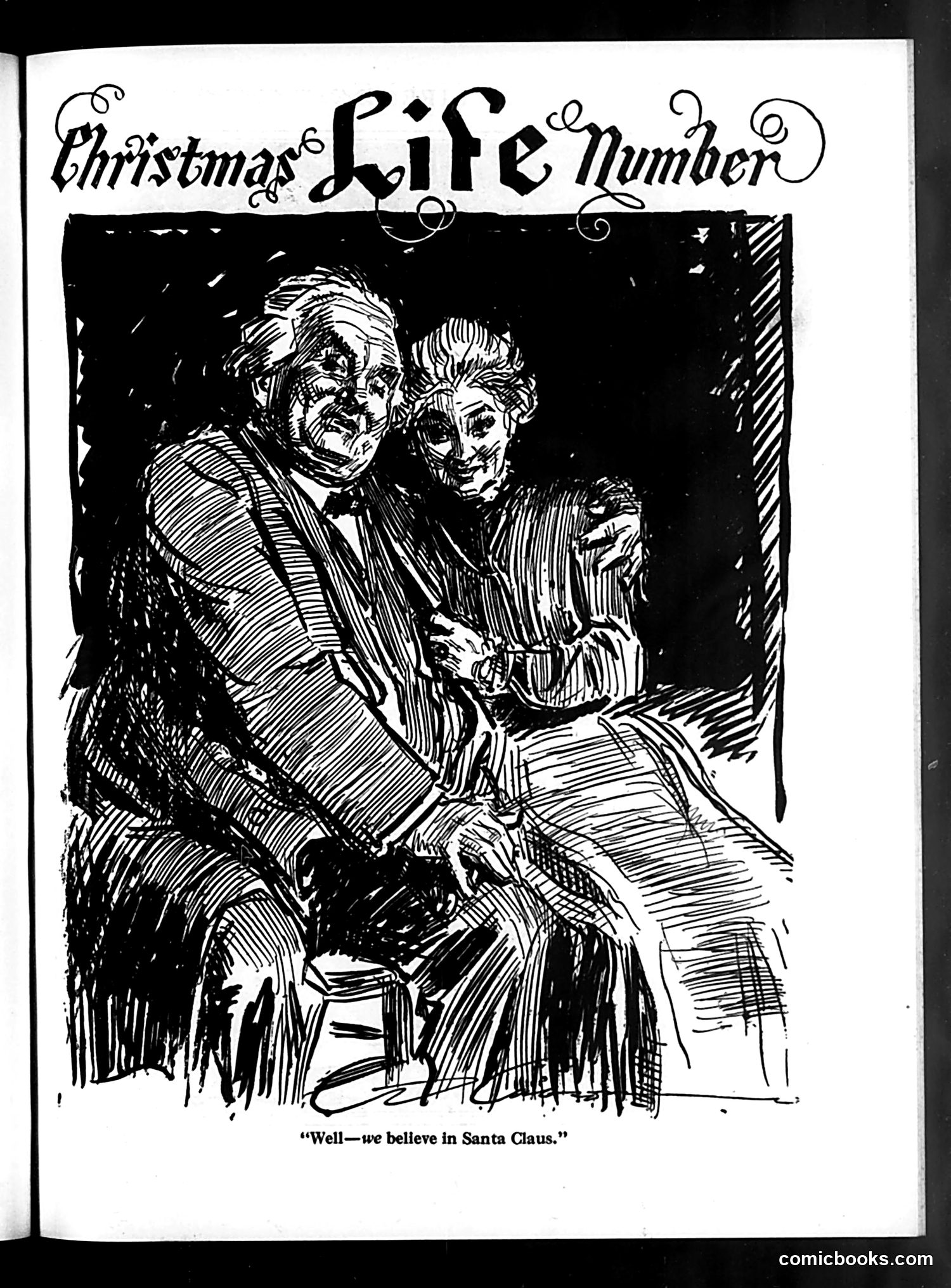
This is the cover of *Life* magazine's Christmas issue. The sketch shows two elderly figures with exaggerated, somewhat wizened features looking at what appears to be a document or letter together. The caption reads: "Well—we believe in Santa Claus." The satire likely targets adult credulity or naiveté during the Christmas season. Rather than depicting children's innocent belief in Santa, the cartoon mocks older people maintaining faith in Santa—possibly suggesting they're gullible about holiday commercial appeals, charitable giving expectations, or other seasonal "cons." The worn, skeptical faces contrasted with their stated belief creates the humorous irony: these worldly-looking individuals claim to believe in something patently fictional, suggesting Christmas brings out foolishness in everyone.
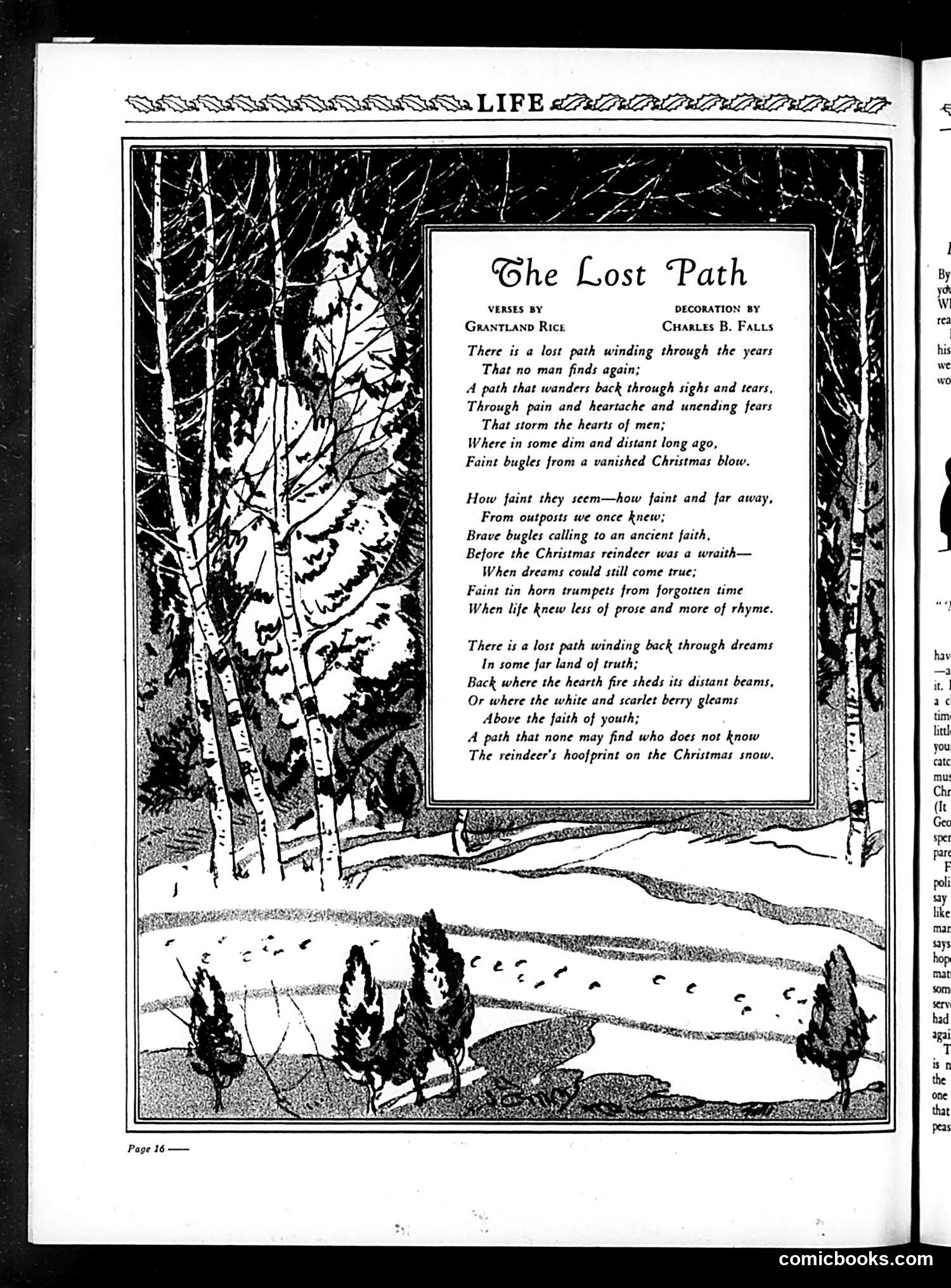
This is not a political cartoon but rather an illustrated poem by Grassland Rice with decoration by Charles B. Falls, published in *Life* magazine. The poem appears to be a nostalgic, melancholic piece reflecting on lost Christmas traditions and childhood memories. It references "faint bugles from a vanished Christmas blow" and "the reindeer's hoofprint on the Christmas snow," suggesting themes of vanished innocence and the passage of time. The stark winter woodland illustration complements the poem's mood of loss and distance from a cherished past. Rather than satire, this is sentimental literary content typical of early 20th-century *Life* magazine, which balanced humor with reflective, artistic pieces celebrating American traditions and nostalgia.
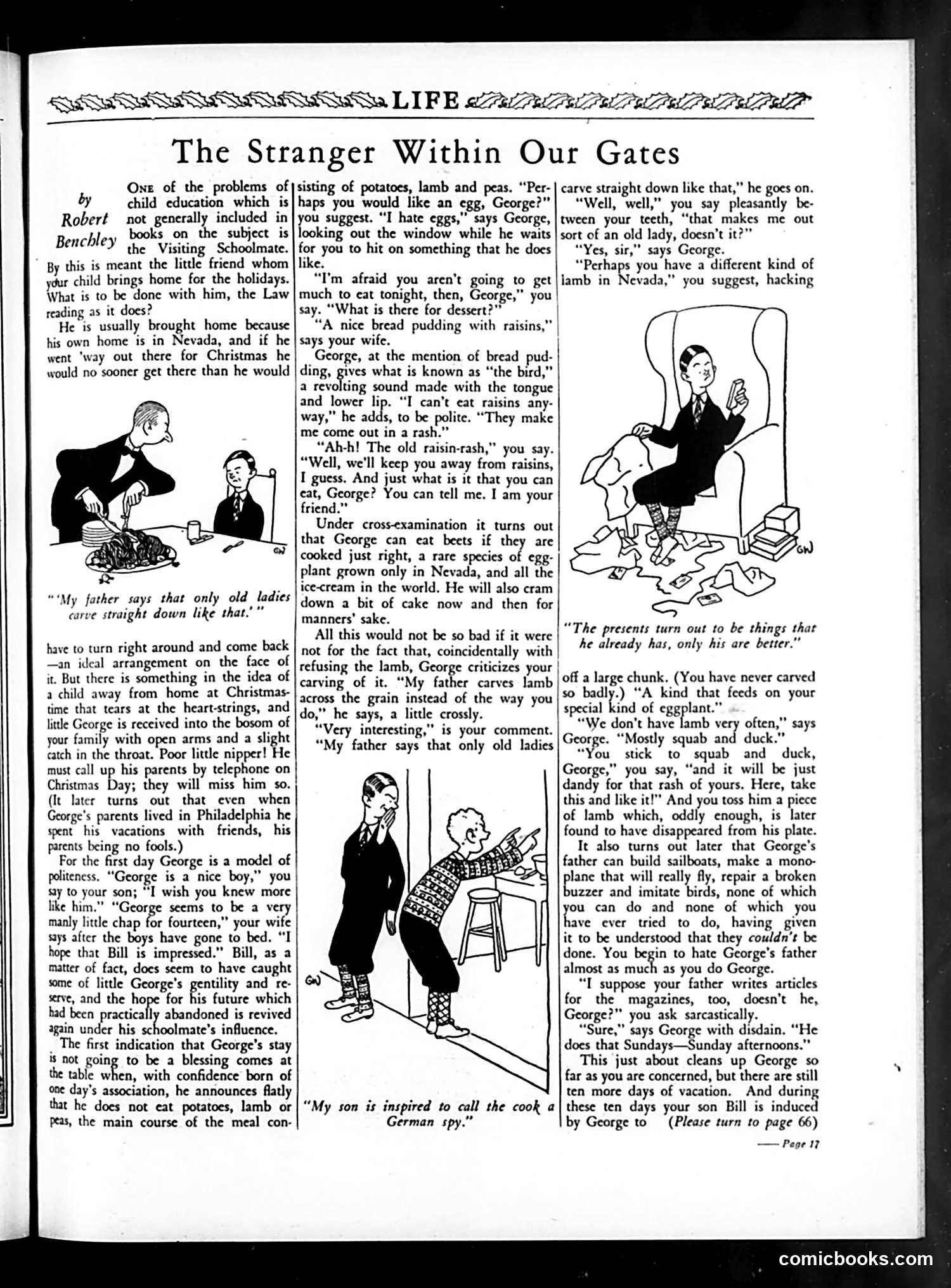
This satirical story by Robert Benchley mocks the awkwardness of hosting a visiting child during Christmas holidays. The humor centers on cultural and regional differences: George, a boy from Nevada, has unfamiliar eating habits and manners that baffle his Eastern host family. The cartoons illustrate George's peculiar behaviors—his unconventional way of carving meat, his preference for squash and duck, his father's work as a magazine writer and airplane builder. The satire gently pokes fun at regional American stereotypes (Nevada versus the East Coast), child-rearing philosophies, and the discomfort of hosting someone whose family customs differ sharply from one's own. The piece reflects early 20th-century American attitudes about regional identity and social etiquette.
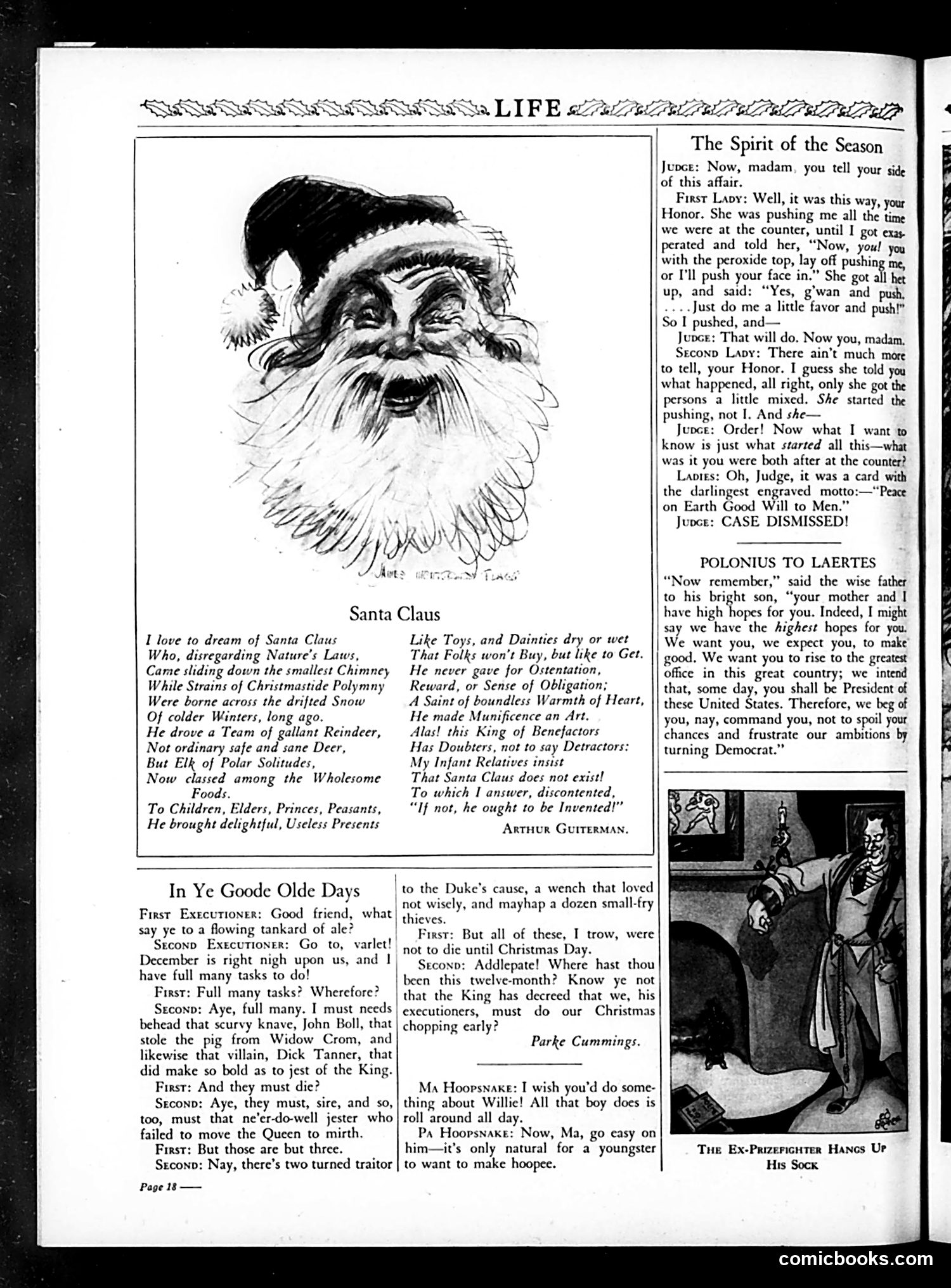
**Santa Claus Illustration & Poem:** The left side features a cheerful Santa illustration with Arthur Guiterman's poem critiquing the commercialization of Christmas. The poem laments that Santa has become focused on material goods ("Folks won't Buy, but like to Get") rather than spiritual values, and that children receive "Useless Presents" instead of meaningful gifts. This reflects early 20th-century anxieties about Christmas losing its religious significance to consumer culture. **"The Spirit of the Season":** A satirical courtroom dialogue mocking Christmas behavior. A judge hears a case where a woman at a store counter engaged in pushing over a "peroxide top" item. The exchange ridicules how Christmas shopping descends into undignified, aggressive competition—even over trivial goods—contradicting the holiday's stated values of "Peace on Earth Good Will to Men." **Overall Theme:** Satire of commercialized Christmas contradicting its spiritual ideals.
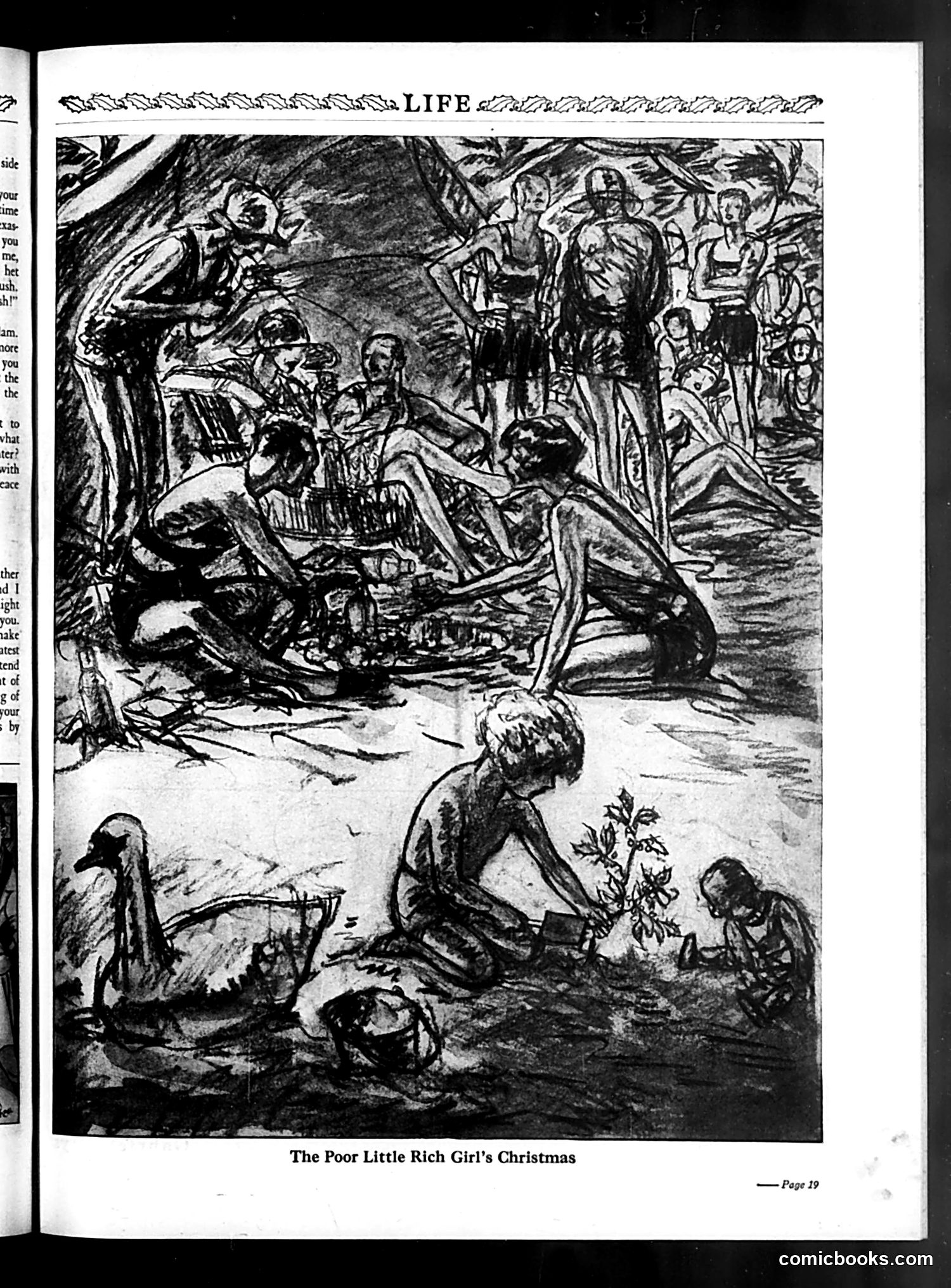
This illustration depicts a stark social contrast typical of early 20th-century Life magazine's satirical commentary. The title refers to a wealthy child experiencing a lavish Christmas celebration in the background—surrounded by servants, elaborate decorations, and abundant gifts. In the foreground, poor children gather around meager resources near water, apparently without adequate shelter or provisions. The satire critiques the gross inequality between wealthy and impoverished children during the Christmas season, when charity and goodwill are supposedly emphasized. The "rich girl" labeled in the title is visually absent or obscured, emphasizing how the privileged are detached from the suffering of poor children. This reflects Progressive Era concerns about poverty and class disparity in America.
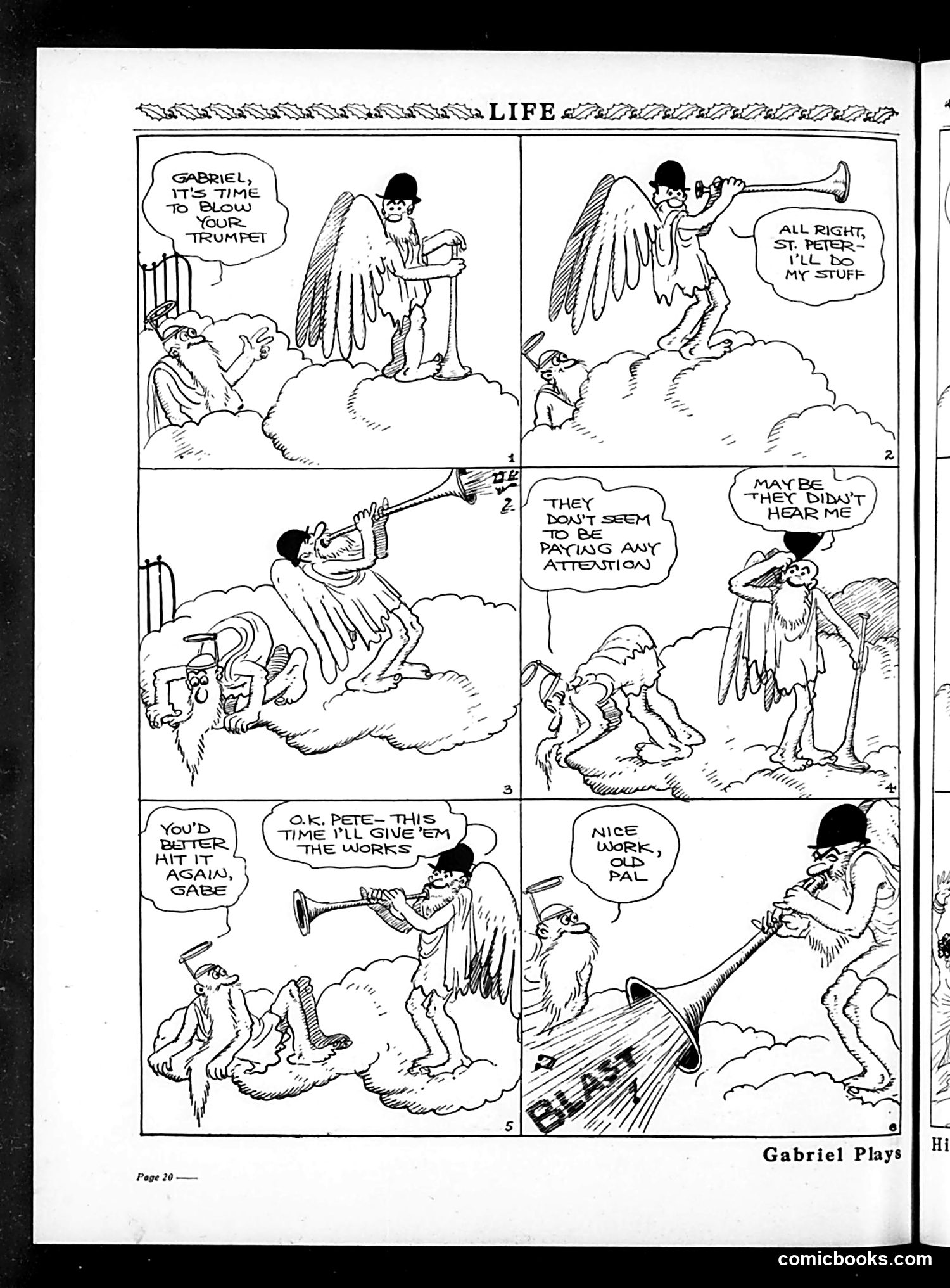
This is a humorous comic strip titled "Gabriel Plays" depicting the biblical archangel Gabriel attempting to play his trumpet in heaven. The joke centers on Gabriel's incompetence as a musician. Despite being instructed by God ("Gabriel, it's time to blow your trumpet!"), Gabriel produces increasingly chaotic results—his trumpet playing causes complete pandemonium among the heavenly residents, who scatter in confusion and complaint that nobody is paying attention. The satire appears to mock the contrast between divine expectation and mortal (or angelic) failure: Gabriel is supposed to perform the solemn duty of his trumpet, but instead creates musical disaster. The final panel shows him literally knocking someone over with a trumpet blast, suggesting his complete inability to execute his sacred responsibility competently.
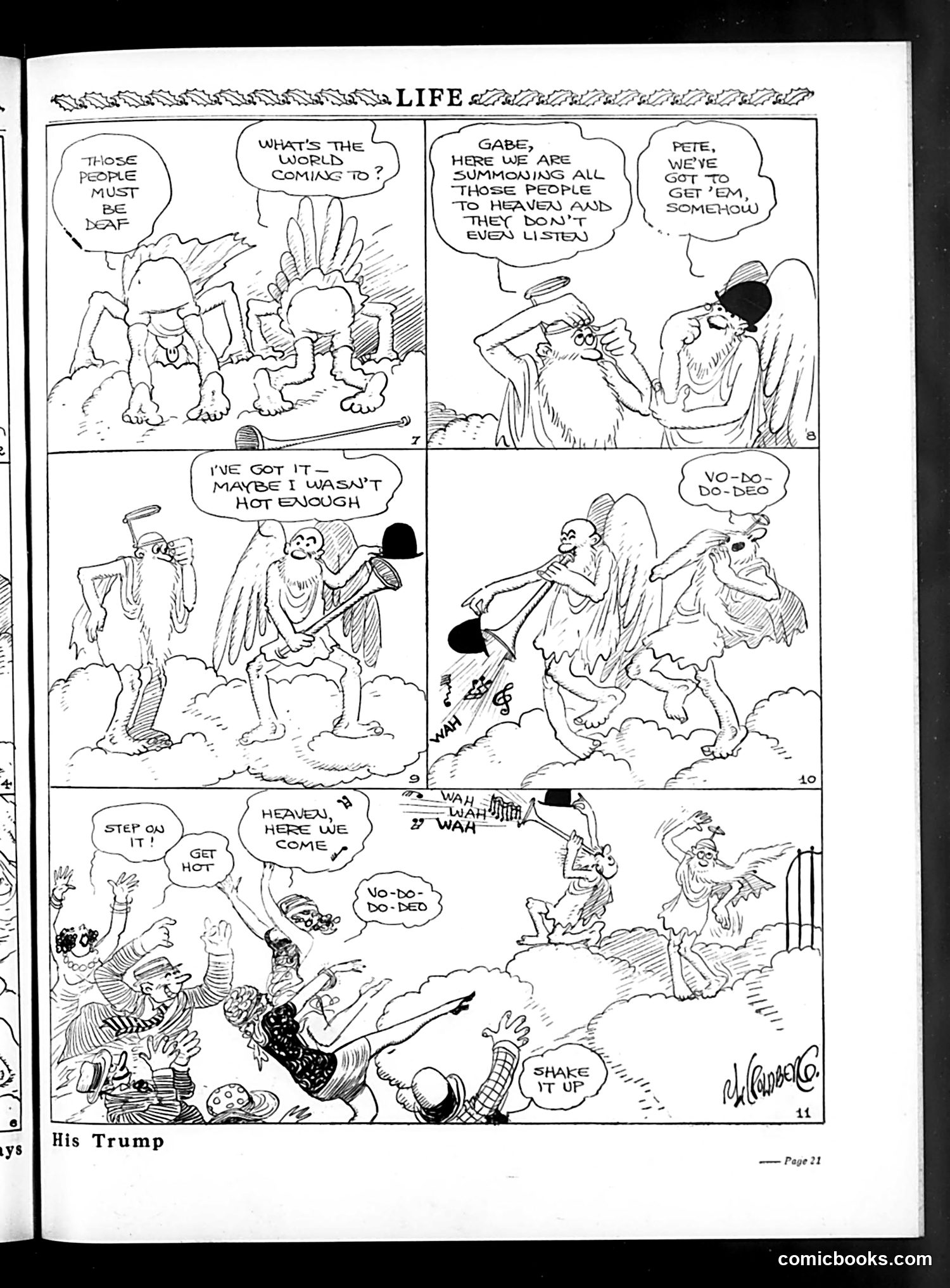
This is a multi-panel comic satirizing **St. Peter at the Pearly Gates**, a common religious trope. The joke concerns admission to heaven based on "hotness" rather than virtue. In panel 1, demonic creatures note "those people must be deaf." Panel 2 shows St. Peter and an angel (Gabe) summoning people to heaven, with Pete instructed to "get 'em somehow." The subsequent panels depict increasingly chaotic scenes where angels employ seductive dancing and gyrating movements ("Yo-ho do-do," "WAH," "shake it up") to lure souls upward. The satire mocks both religious afterlife concepts and the mid-20th century obsession with physical attractiveness and "hotness" as a social currency. The irreverent humor—using sexual appeal to populate heaven—parodies both conventional piety and contemporary celebrity culture.
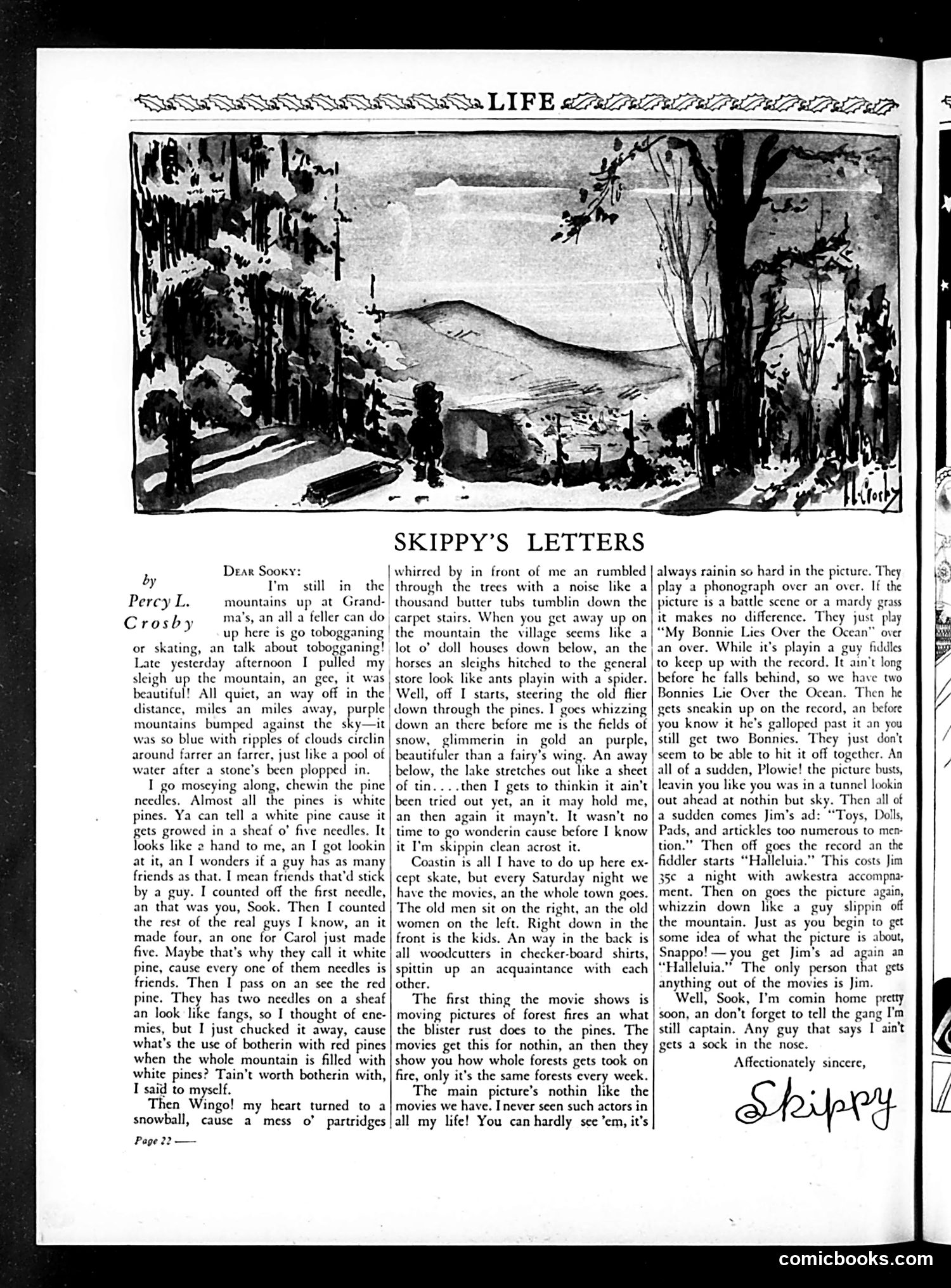
This is a humorous column by Percy L. Crosby featuring letters from a character named Skippy to his friend Sooky. The illustrated letter describes a visit to the mountains where Skippy went sledding, skating, and toboganning. The main joke involves Skippy's breathless, rambling description of a movie he saw in a mountain village—featuring forest fires and actors—which he found far more impressive than the actual mountain scenery surrounding him. He's obsessed with cinema, finding the flickering images on a screen more captivating than real nature. The satire gently mocks how entertainment (particularly movies, then a relatively new medium) could captivate young people more than genuine natural beauty. The childish excitement and scattered narrative style effectively capture juvenile enthusiasm.
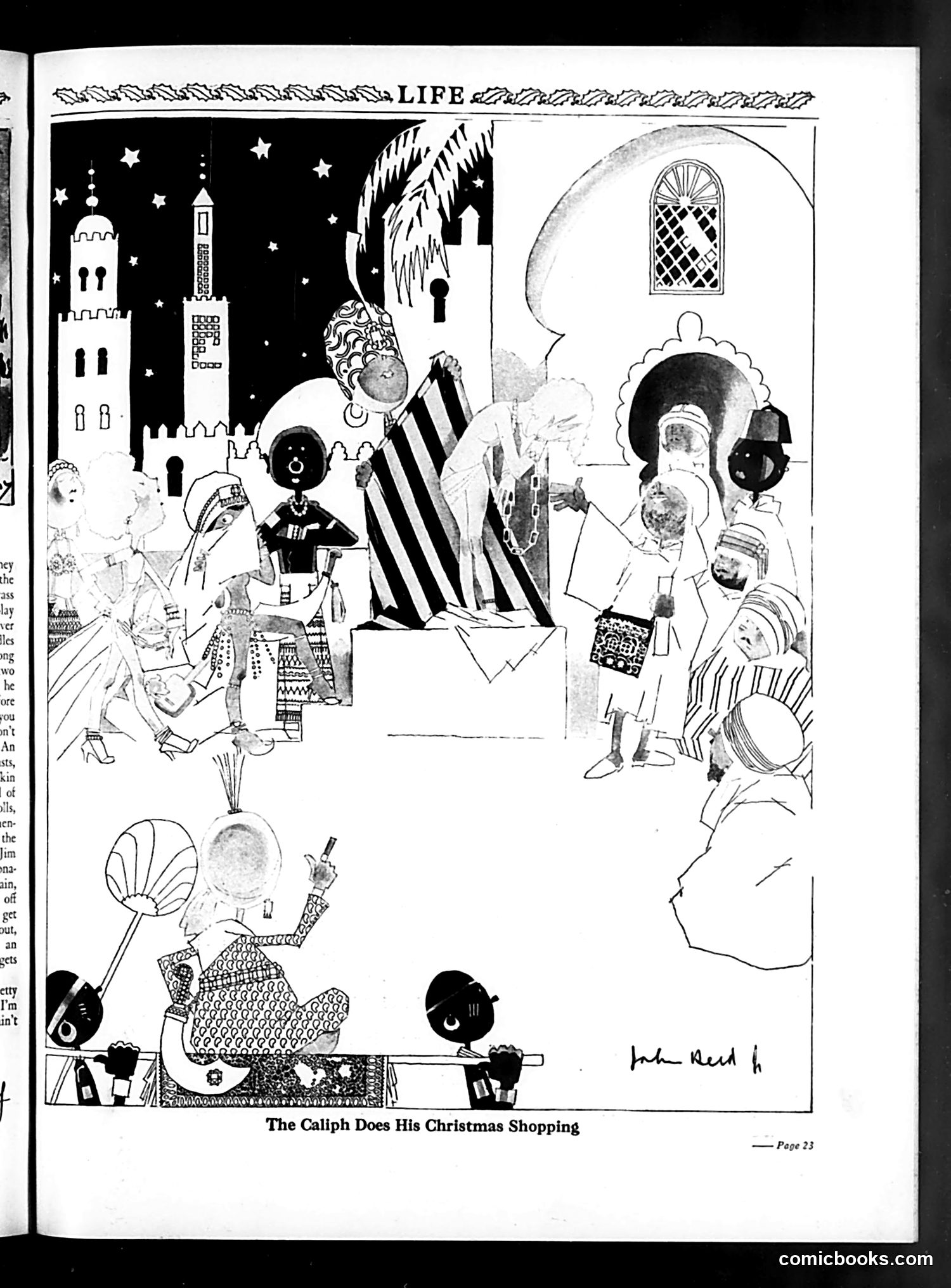
This satirical cartoon depicts an exotic, orientalist scene of a wealthy Middle Eastern ruler (a "Caliph") conducting Christmas shopping. The humor stems from the incongruity: a Muslim authority figure participating in a Christian holiday tradition, likely satirizing either American consumerism's reach into foreign cultures or the absurdity of wealthy foreigners adopting Western customs. The scene shows elaborate architectural backdrops (minarets, domed buildings) and ornately dressed attendants carrying luxurious goods and parcels. The Caliph's entourage and excessive material display mock both extravagant wealth and the commercialization of Christmas itself. This reflects early-20th-century American attitudes toward the "Orient"—combining exoticization with gentle mockery of cultural mixing and capitalist expansion. The cartoon's tone is lighthearted rather than genuinely critical.
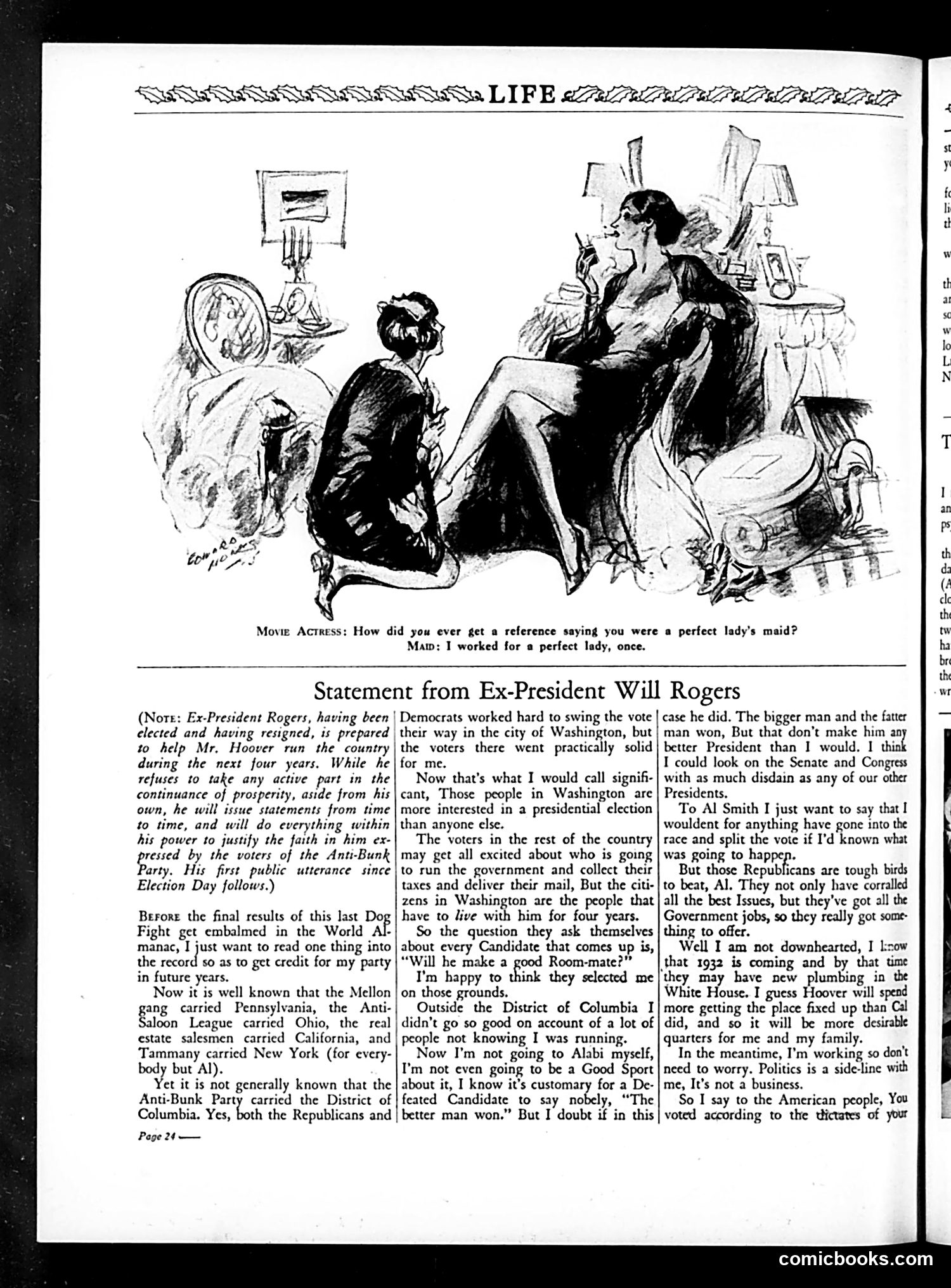
**The Cartoon:** The top illustration shows a woman (labeled "Movie Actress") being interviewed by a man. The joke hinges on a reference gap: she claims to have worked for "a perfect lady, once"—implying that being a "perfect lady's maid" is an absurd or impossible achievement, making it a dubious qualification. **The Statement Below:** Will Rogers, the famous humorist and ex-presidential candidate, provides commentary on the 1928 election. He discusses how both major parties (Democrats and Republicans) worked to influence voters, particularly in Washington, D.C., and expresses skepticism about politicians' character. Rogers adopts a detached, cynical tone about the entire political process, joking that he won't worry about politics while working on other matters.
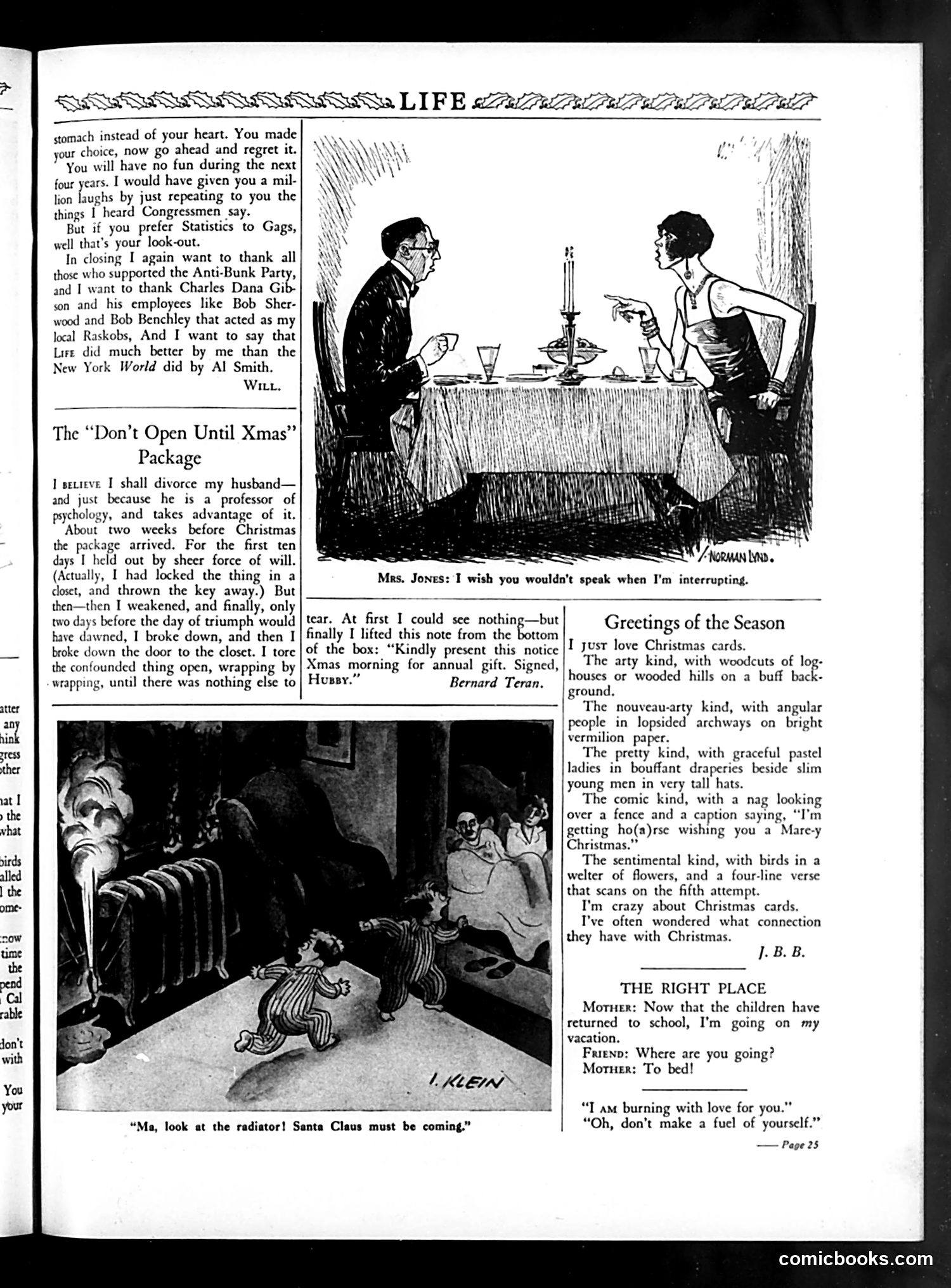
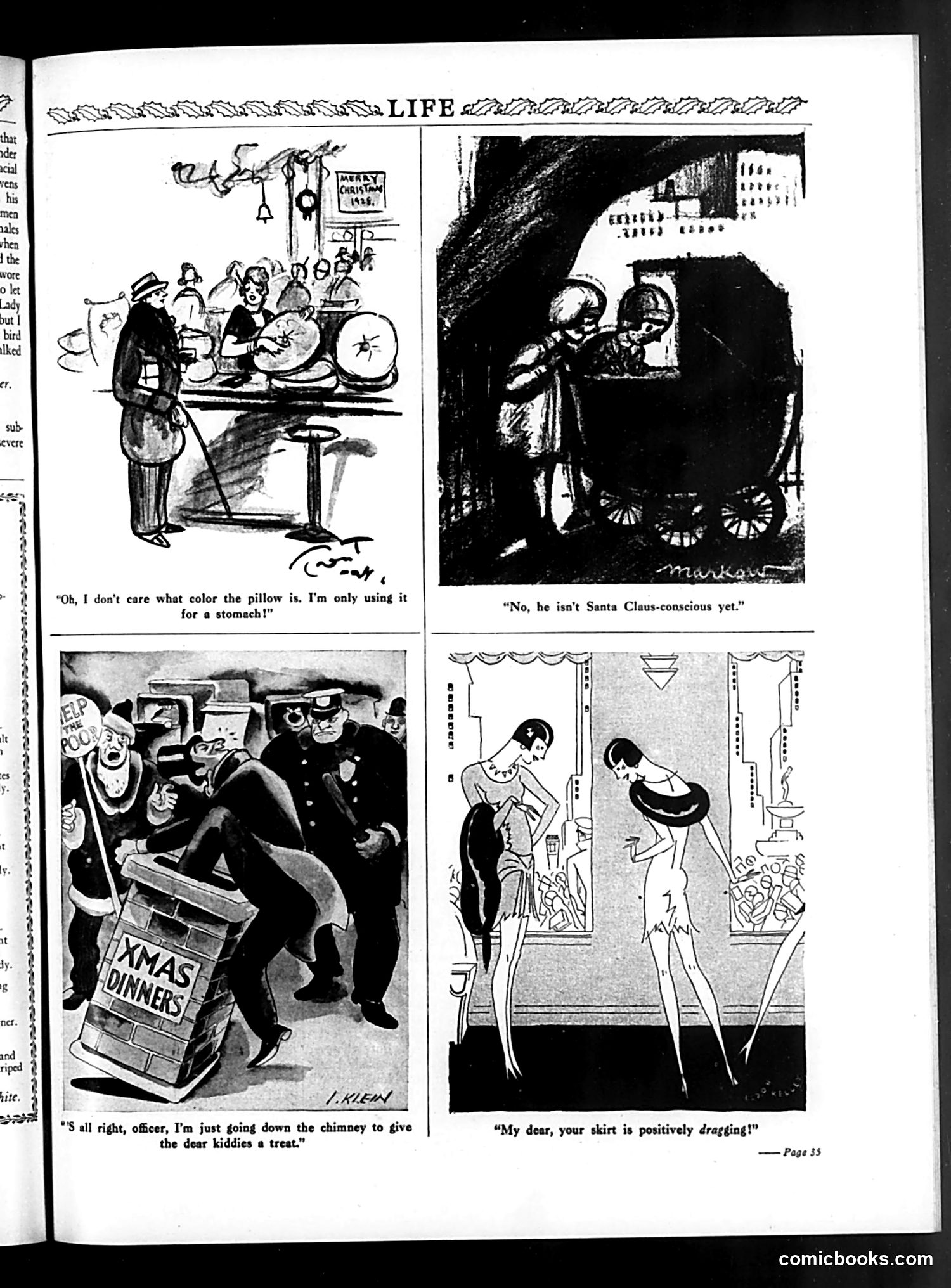
This page contains several humor pieces typical of early 20th-century Life magazine: **Top cartoon** (by Norman Imus): Shows a dinner conversation where a woman interrupts a man's story. The caption "Mrs. Jones: I wish you wouldn't speak when I'm interrupting" satirizes wives who dominate household conversations. **Bottom cartoon** (by I. Klein): Depicts a child excited about a radiator, saying "Ma, look at the radiator! Santa Claus must be coming." This jokes about poverty—the child mistakes the heating radiator for Santa's arrival, implying families of limited means had little else to celebrate. **Right column**: Various short holiday-themed humor pieces and witty exchanges about Christmas cards and domestic situations, reflecting middle-class American life and social conventions of the era.
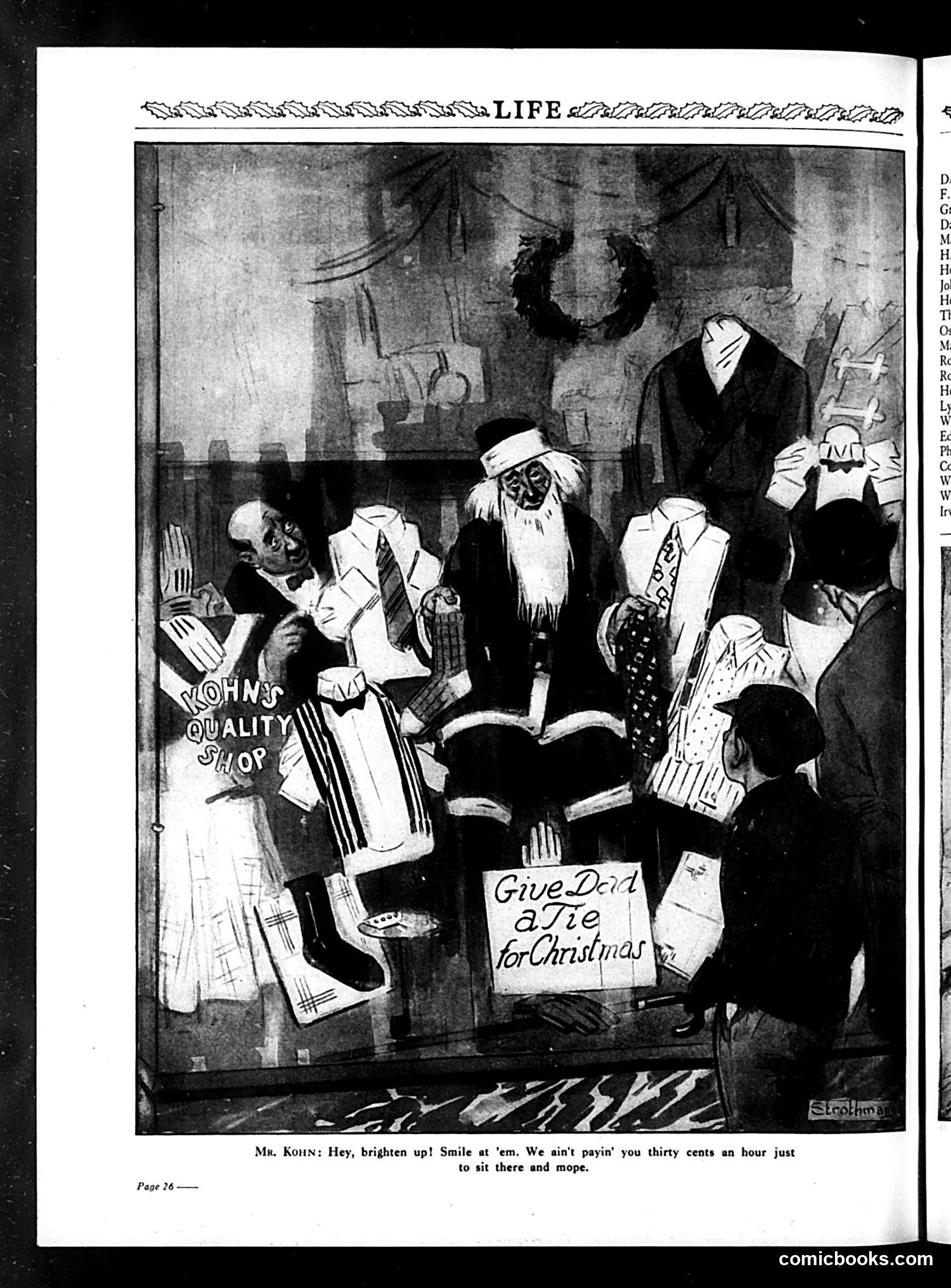
This Life magazine cartoon satirizes labor disputes and wage negotiations, likely from the early 20th century. The scene depicts "Kohn's Quality Shop," where workers display a sign reading "Give Dad a Tie for Christmas" while appearing impoverished and gaunt. The caption has Mr. Kohn telling workers to "brighten up" and smile, claiming he won't pay them "thirty cents an hour just to sit there and mope." The satire targets exploitative working conditions: Kohn demands cheerfulness from underpaid laborers while simultaneously guilt-tripping customers into purchasing gifts. The contrast between the meager wages and the suggestion that workers should seem content exposes the callousness of employers toward their workforce during this era of labor tensions.
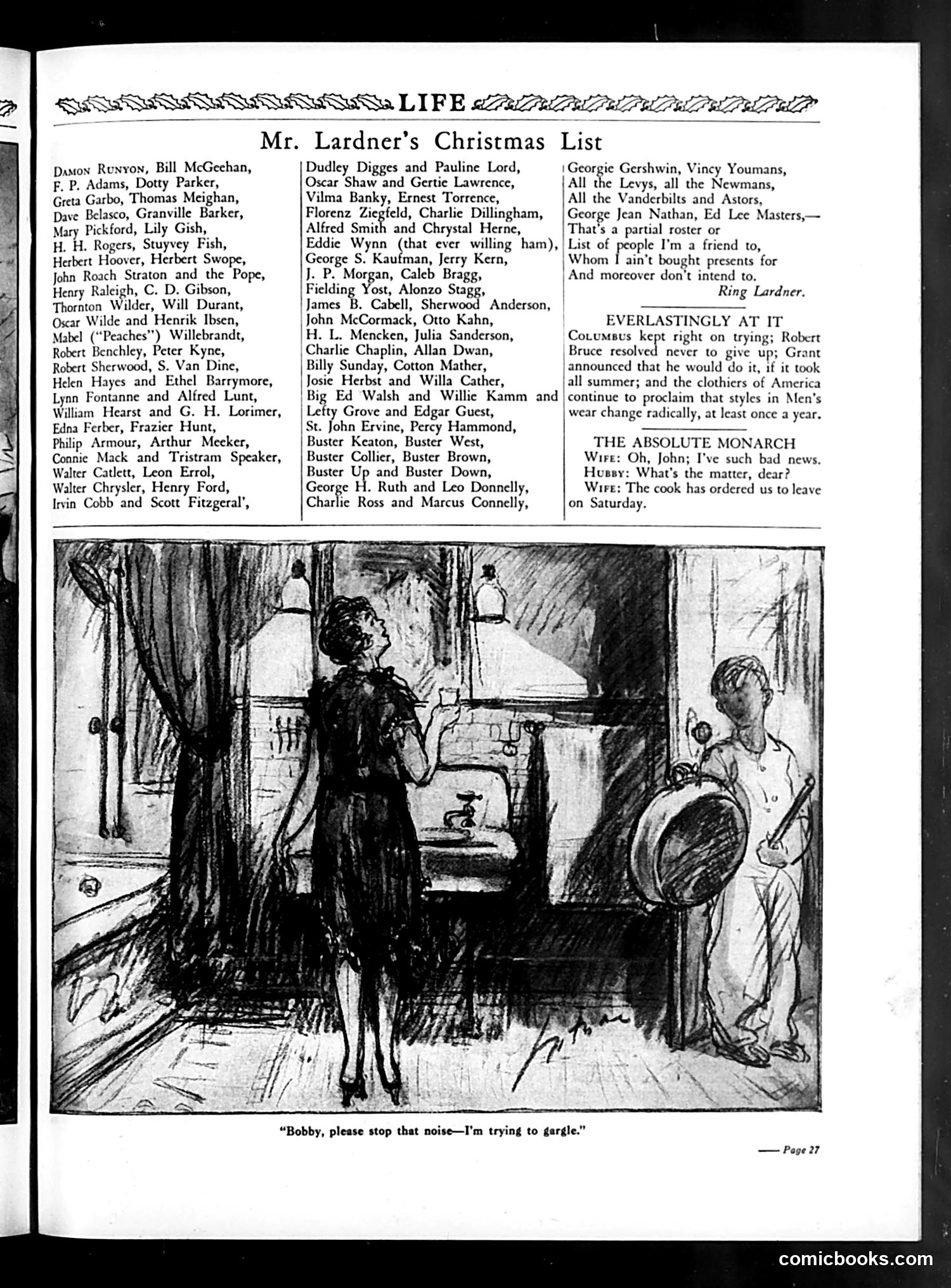
This page contains **"Mr. Lardner's Christmas List"**—a humorous roster of names (likely celebrities, politicians, and public figures of the era) that Ring Lardner supposedly intended to give presents to, with a comedic final note that he "don't intend to" give gifts to most of them. The cartoon below depicts a domestic scene: a woman at a bathroom sink is attempting to gargle while a boy makes noise in the background. She pleads, "Bobby, please stop that noise—I'm trying to gargle." This is straightforward domestic humor about the conflict between a mother's grooming routine and a child's disruptive behavior—a relatable, timeless scenario requiring no historical context to understand the joke.
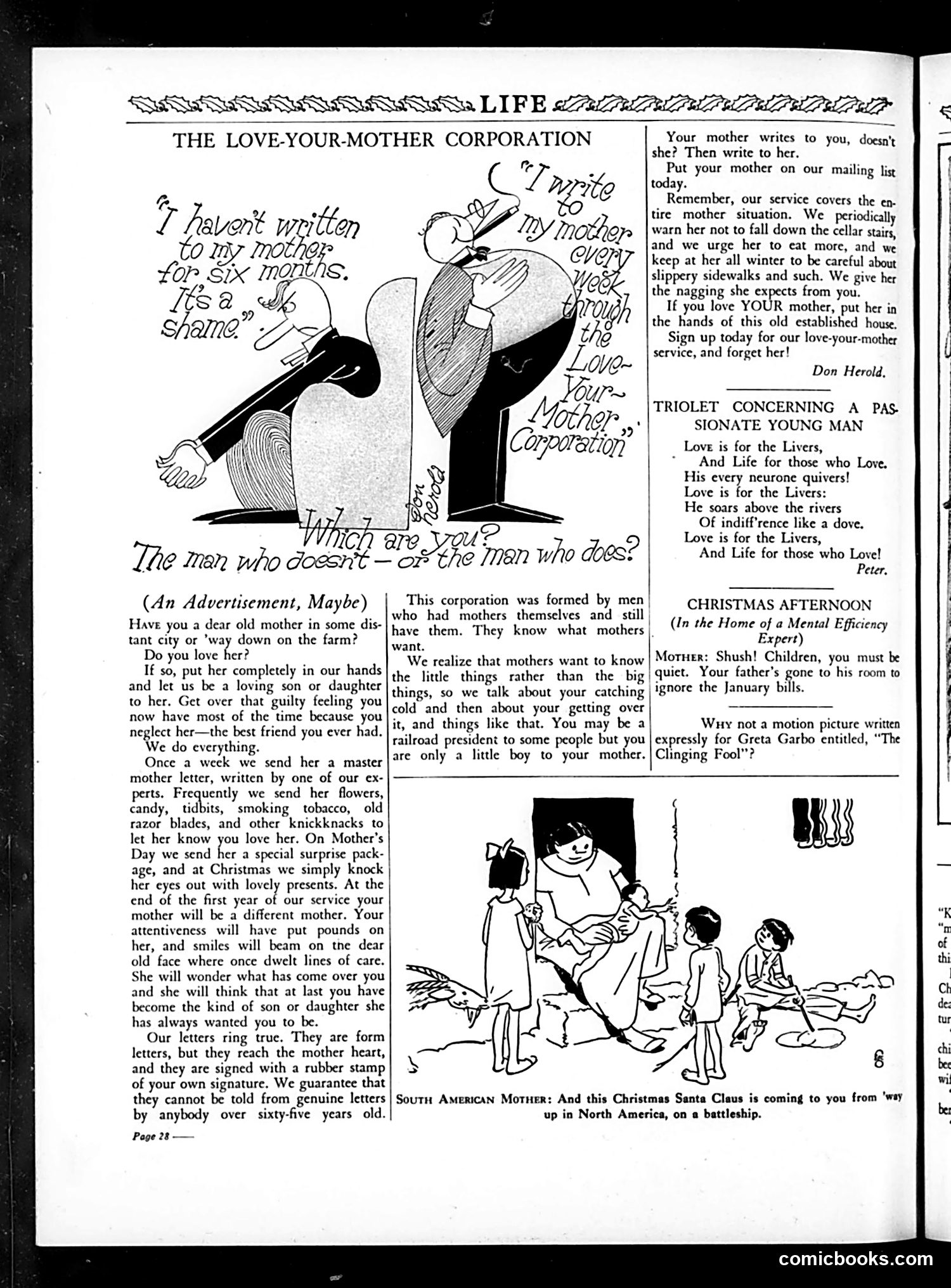
This page satirizes filial neglect through "The Love-Your-Mother Corporation," a mock business service. The central cartoon depicts a man writing letters to his mother on behalf of negligent sons—the joke being that some men are so remiss in their duties that they require a hired service to maintain the relationship. The accompanying advertisement-style text mocks this neglect while paradoxically offering to solve it. It criticizes sons who ignore aging mothers, particularly those living alone or on farms, while offering solutions like sending flowers, tobacco, and surprise packages. The lower cartoon shows a mother with children at Christmas, with a caption about Santa arriving "from way up in North America, on a battleship"—likely referencing WWI naval activities, though the exact reference is unclear without additional context.
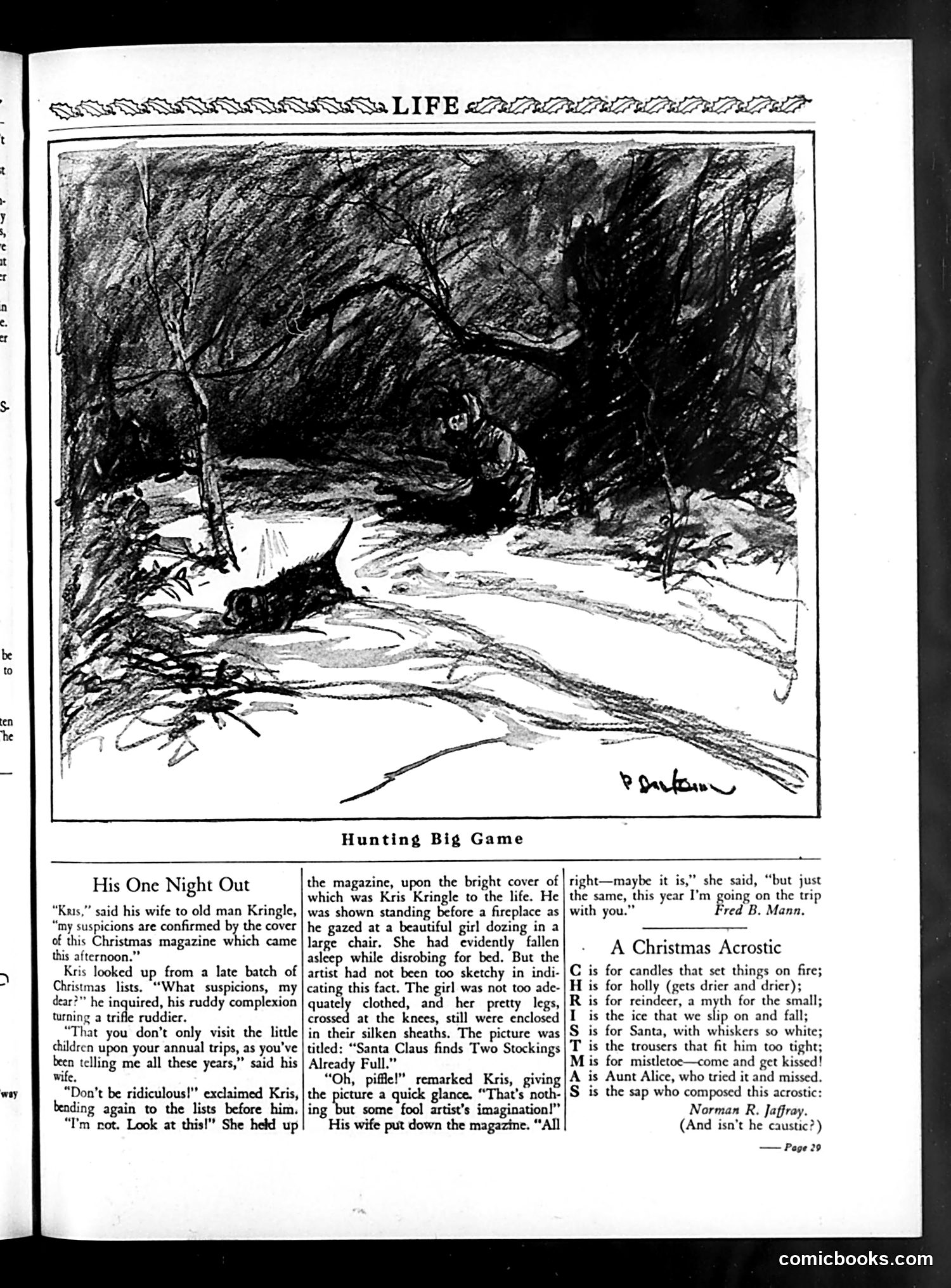
This page contains a sketch titled "Hunting Big Game" depicting a winter forest scene with what appears to be a dog or animal in snow. The main text story, "His One Night Out," describes a domestic dispute. A husband named Kris consults old man Kringle about Christmas gift lists. His wife suspects he's planning a trip without her. Kris defends himself against accusations of infidelity, insisting he's "not too Look. Look at this!" The story satirizes marital tension and suspicion around holiday gift-giving and time away from home. A Christmas acrostic poem by Norman R. Jaffray appears on the right side, a lighthearted verse spelling out seasonal references. The humor targets ordinary domestic squabbles rather than political issues.
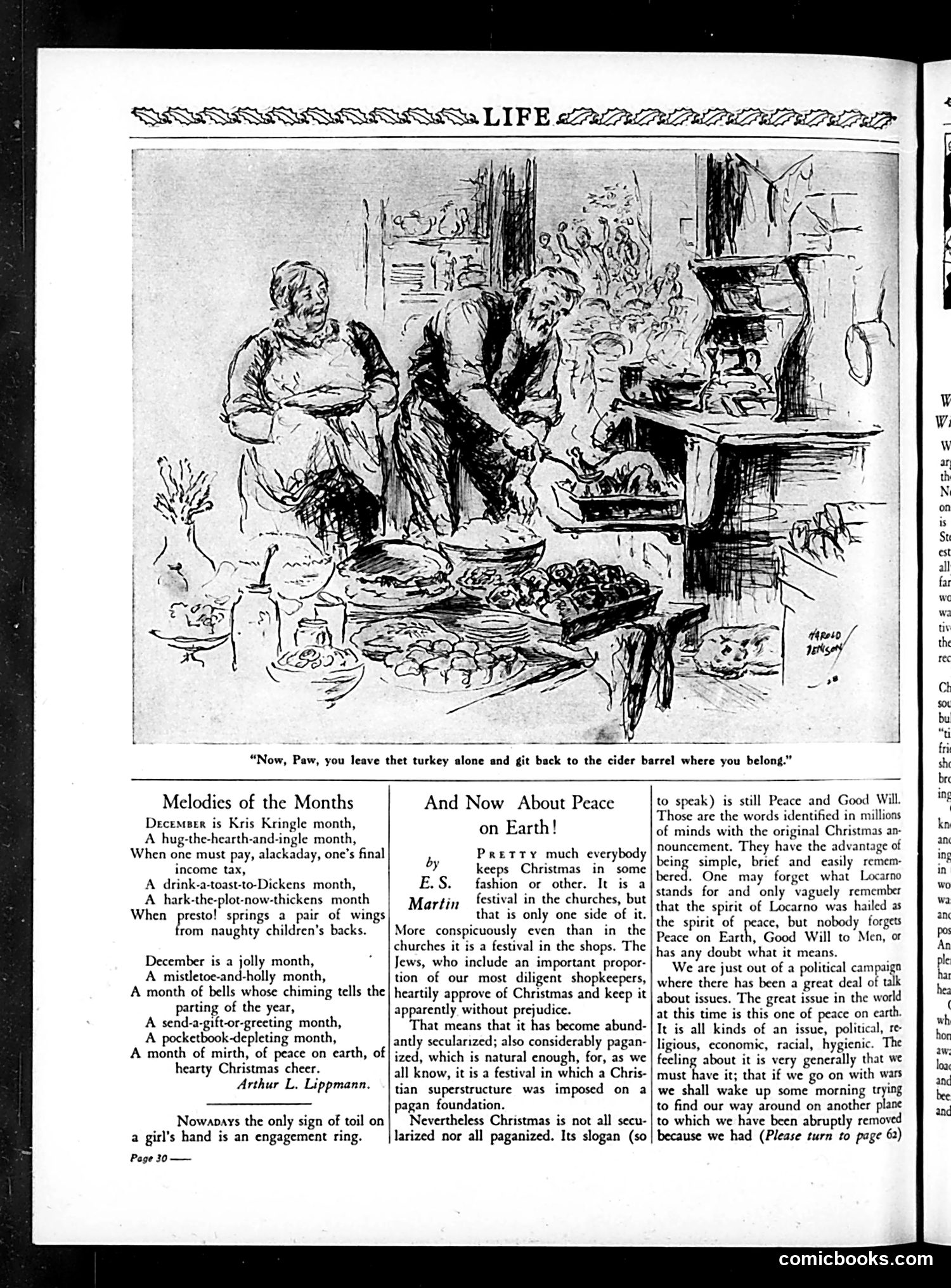
The main illustration depicts a domestic kitchen scene where a woman (likely a cook or housewife) is being scolded by a man for allowing a dog near food—specifically "that turkey" and a "cider barrel." The caption reads: "Now, Paw, you leave that turkey alone and git back to the cider barrel where you belong." This is a humorous domestic scene satirizing the tension between discipline and indulgence in household management, particularly around holiday meals (turkey suggests Christmas/Thanksgiving). The "Paw" character appears to be the man of the house being metaphorically treated like a misbehaving dog—a joke about husbands gravitating toward food and drink rather than restraint. The accompanying text columns address Christmas commercialization and peace advocacy, offering cultural commentary typical of *Life* magazine's satirical approach.
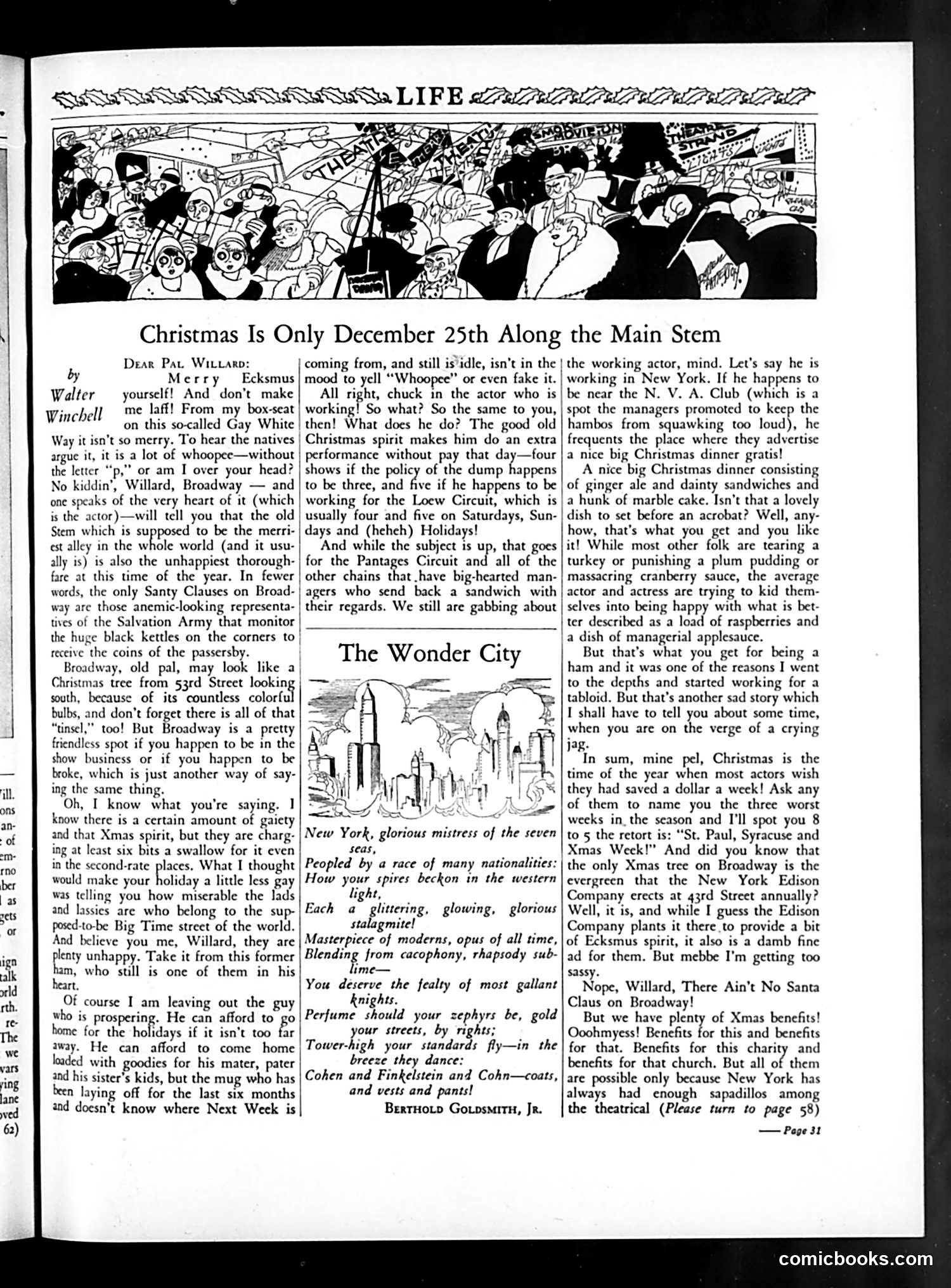
This page contains a satirical column by Walter Winchell titled "Christmas Is Only December 25th Along the Main Stem," addressing Broadway theater workers' holiday conditions. The large cartoon at top depicts a crowded, chaotic Times Square scene—likely showing holiday shopping crowds and theater district activity. **The satire's point:** Winchell criticizes how Broadway actors and workers receive minimal Christmas compensation despite their labor, while theaters expect them to work through the holidays. He contrasts this with off-Broadway charitable organizations (like the Salvation Army) that actually help the poor during Christmas. The secondary illustration shows New York's skyline labeled "The Wonder City," accompanying Winchell's commentary on urban disparities during the holiday season. **Overall message:** A critique of theatrical industry labor practices and capitalist indifference to workers' welfare during Christmas.
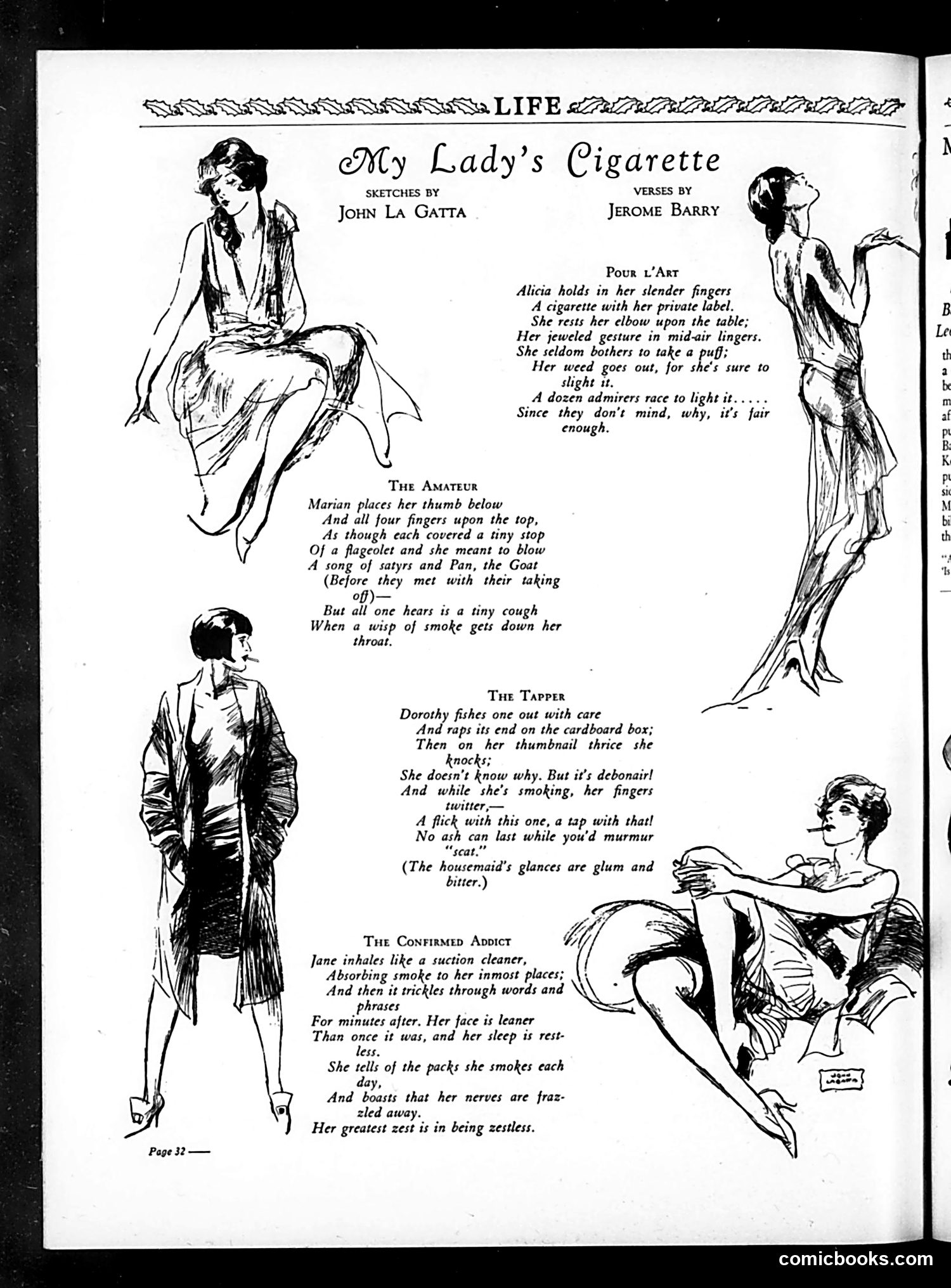
This page satirizes women smoking cigarettes in the 1920s-1930s era, a relatively new and controversial social practice. The verses by John La Gatta and Jerome Barry describe five female "types" and how they smoke: - **Pour L'Art**: The aesthetic, pretentious smoker - **The Amateur**: An inexperienced, awkward smoker who coughs - **The Tapper**: A nervous smoker who fidgets with the cigarette - **The Confirmed Addict**: A heavy, habitual smoker showing physical decline The accompanying sketches mockingly illustrate each "type." The satire mocks both women's adoption of smoking and broader anxieties about changing female behavior and independence during this era. The tone is lighthearted ridicule of modern women challenging traditional gender norms.
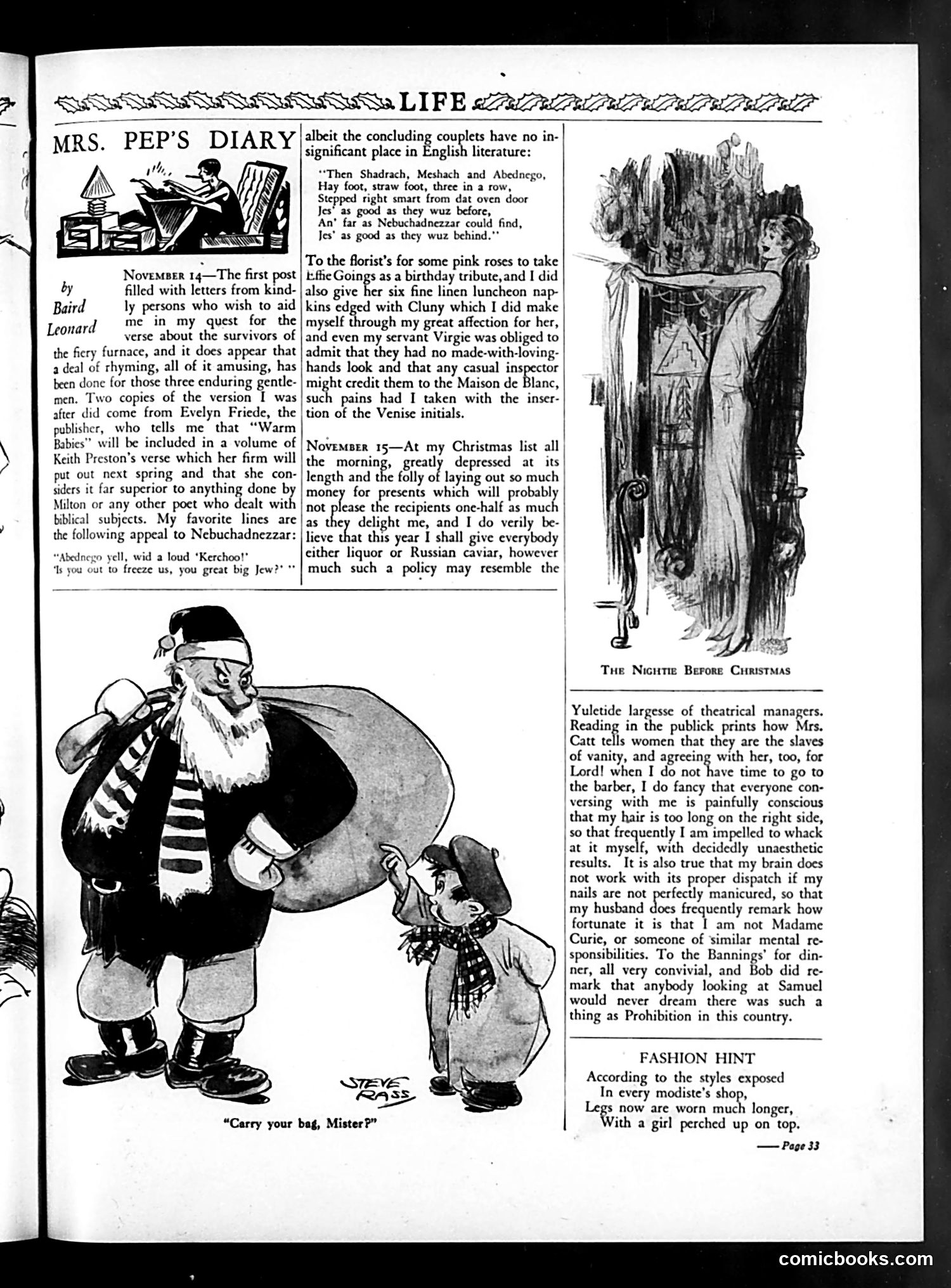
This page features a humorous diary column mixed with social commentary. The main cartoon depicts Santa Claus asking a child, "Carry your bag, Mister?" — a reversal suggesting the child will carry Santa's heavy sack, playing on post-WWI economic hardship where even Christmas gift-giving has become burdensome. The diary entries mock upper-class holiday anxieties: Mrs. Pep frets over expensive Christmas gifts she can barely afford, complains about her hair and manicure, and makes caustic remarks about the Prohibition era (references to "liquor or Russian caviar"). The accompanying illustration "The Nightie Before Christmas" parodies the famous poem title. Overall, the satire targets affluent women's vanity and materialism during economically uncertain times.
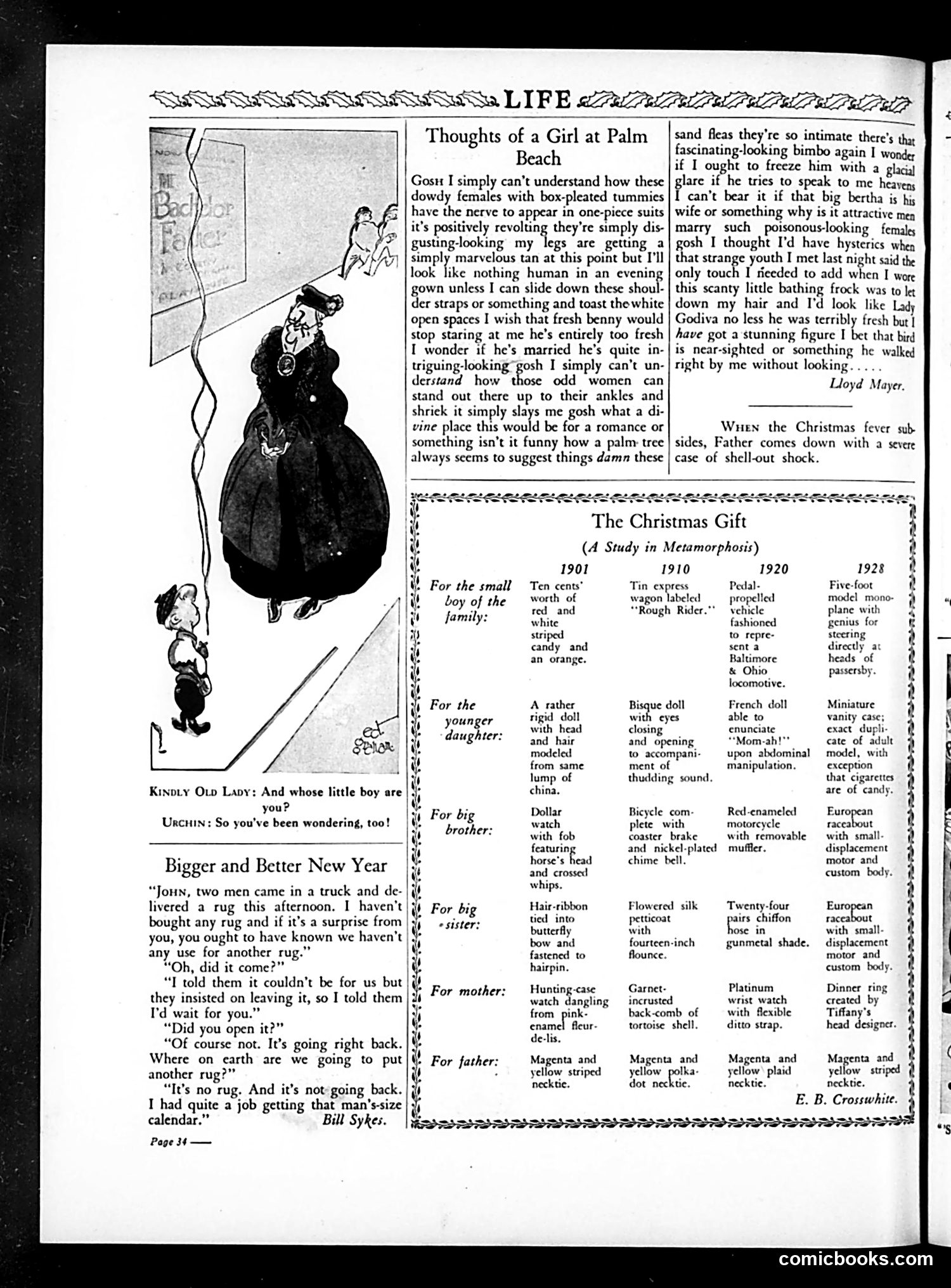
This page contains three distinct pieces of humor: **"Bigger and Better New Year"** (bottom left): A husband surprises his wife by delivering a large object claiming it's a "man's-size calendar"—a euphemism suggesting he's smuggled in a pinup or similar inappropriate item disguised as a rug delivery. The joke relies on marital tension over hidden purchases. **"Thoughts of a Girl at Palm Beach"** (top right): Stream-of-consciousness satire mocking a wealthy young woman's superficial vanity—her obsession with her tan, appearance, and judging other women's bodies at a fashionable beach resort. The rambling, catty internal monologue parodies the self-absorbed leisure class. **"The Christmas Gift: A Study in Metamorphosis"** (center/right): A clever comparative chart showing how Christmas presents "evolved" from 1901 to 1928, tracking inflation and changing consumer culture. A ten-cent candy gift became a toy airplane; a dollar watch became a European raceabout. It satirizes growing materialism and the escalating expense of gift-giving across generations. All three pieces mock upper-class American society and consumer culture of the 1920s.
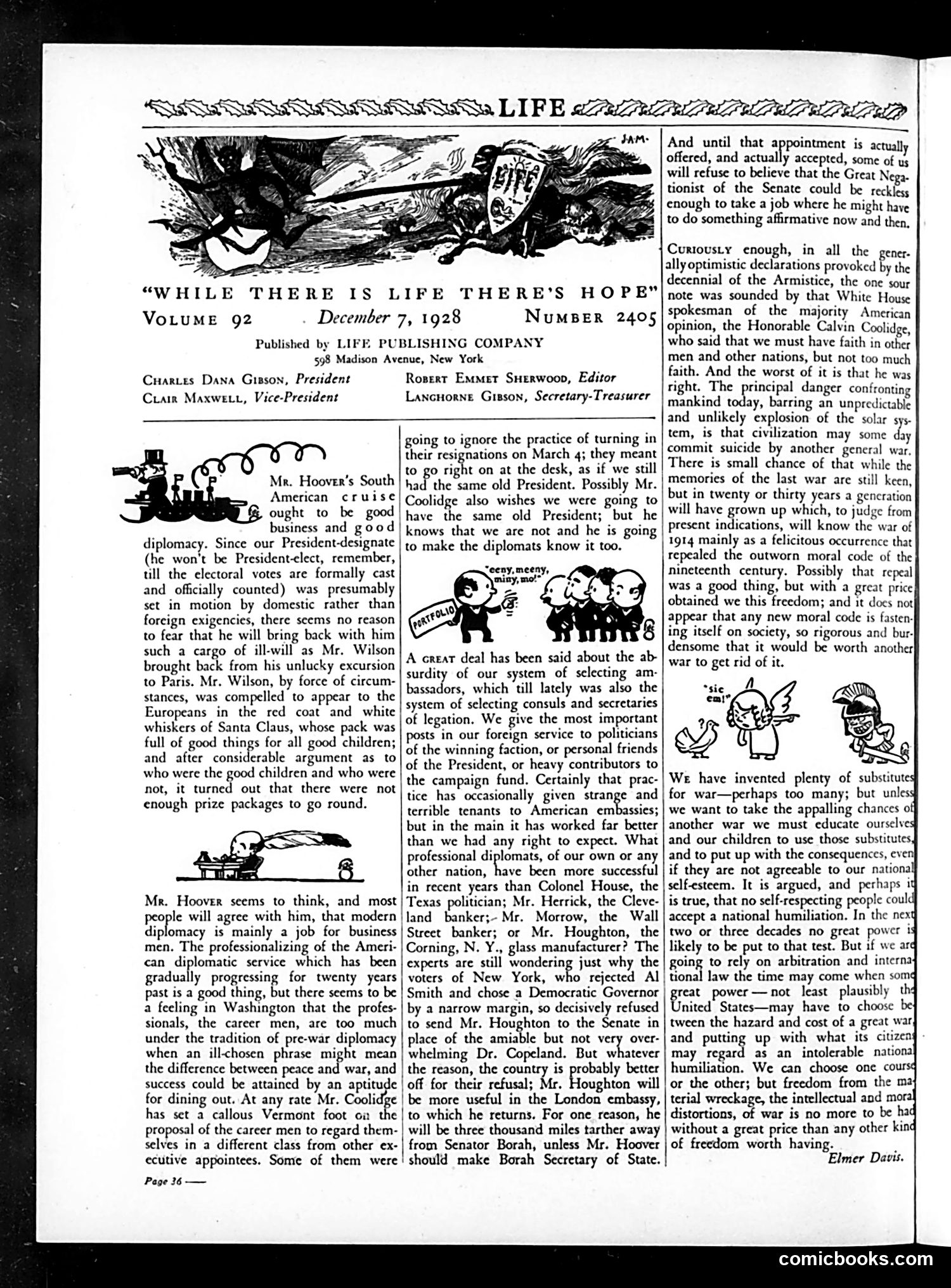
This editorial discusses President-elect Herbert Hoover's (incoming President after Calvin Coolidge) approach to appointing ambassadors and diplomats. The cartoons appear to satirize the traditional spoils system—giving diplomatic posts to wealthy political allies and campaign contributors rather than career professionals. The text references specific controversial appointees: Colonel House, Myron Herrick, Dwight Morrow, and Alanson Houghton. The editorial criticizes how American ambassadorships have historically gone to politicians, wealthy businessmen, and party loyalists rather than merit-based career diplomats. A notable reference: the editorial mocks the New York electorate for voting against sending Houghton to the Senate, then approving his appointment to the London embassy instead—suggesting voters inadvertently moved an unpopular politician further away from home. The piece questions whether Hoover will break with this patronage tradition or whether career diplomats will retain their positions after his inauguration on March 4, 1929.
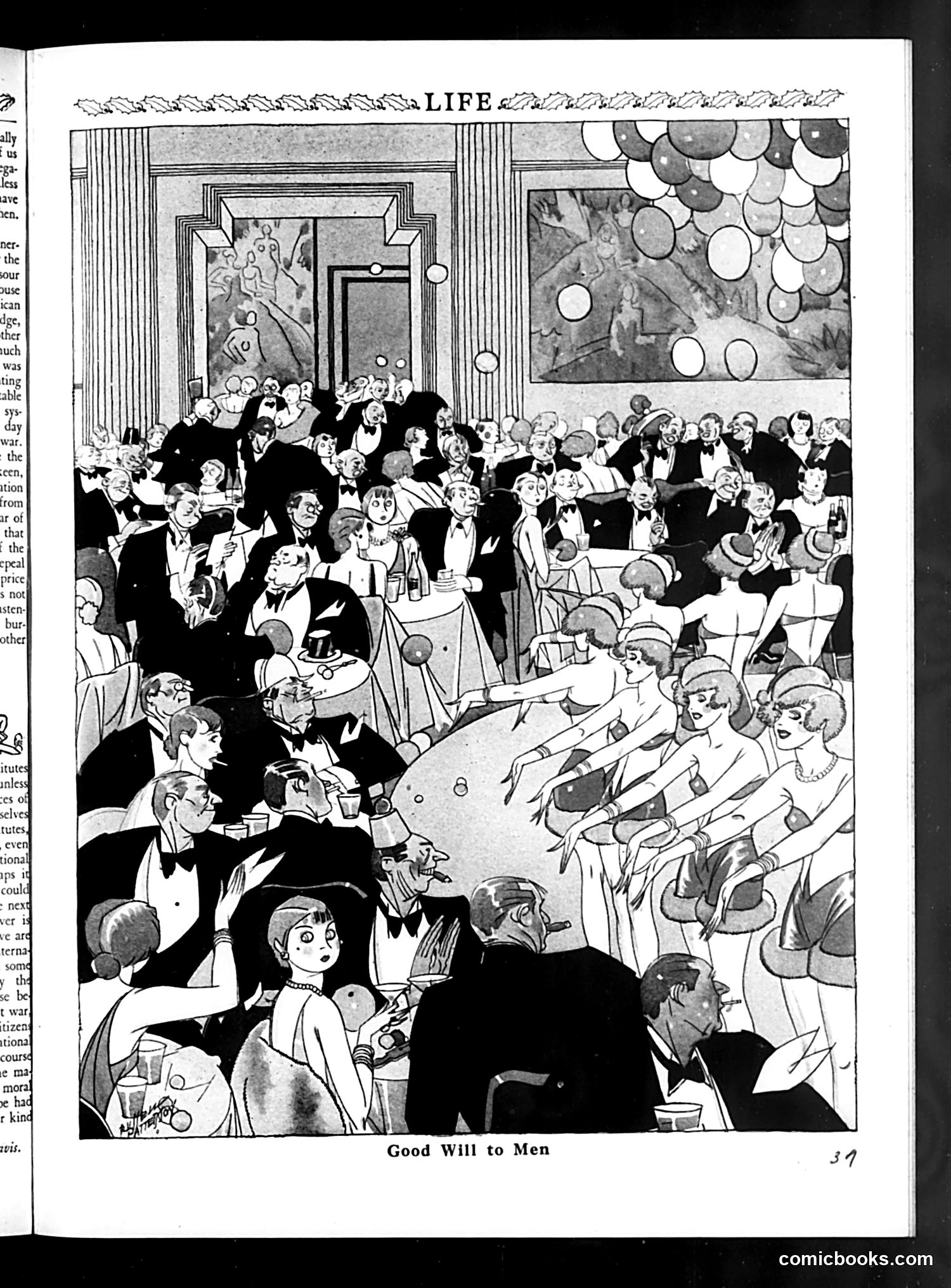
This illustration depicts an elegant formal gathering—likely a high-society dinner or charity event—where wealthy, formally-dressed guests mingle while partially-clothed or minimally-dressed figures recline in a pool or water feature in the foreground. The stark contrast between the clothed observers and the exposed figures suggests social satire about class disparity and indifference to poverty. The caption "Good Will to Men" appears ironic, invoking Christian charity while depicting the wealthy ignoring or commodifying those in need. The composition critiques how the affluent socialize comfortably while remaining detached from human suffering nearby. This likely comments on 1920s-era wealth inequality and the gap between professed humanitarian values and actual charitable action during the Jazz Age.
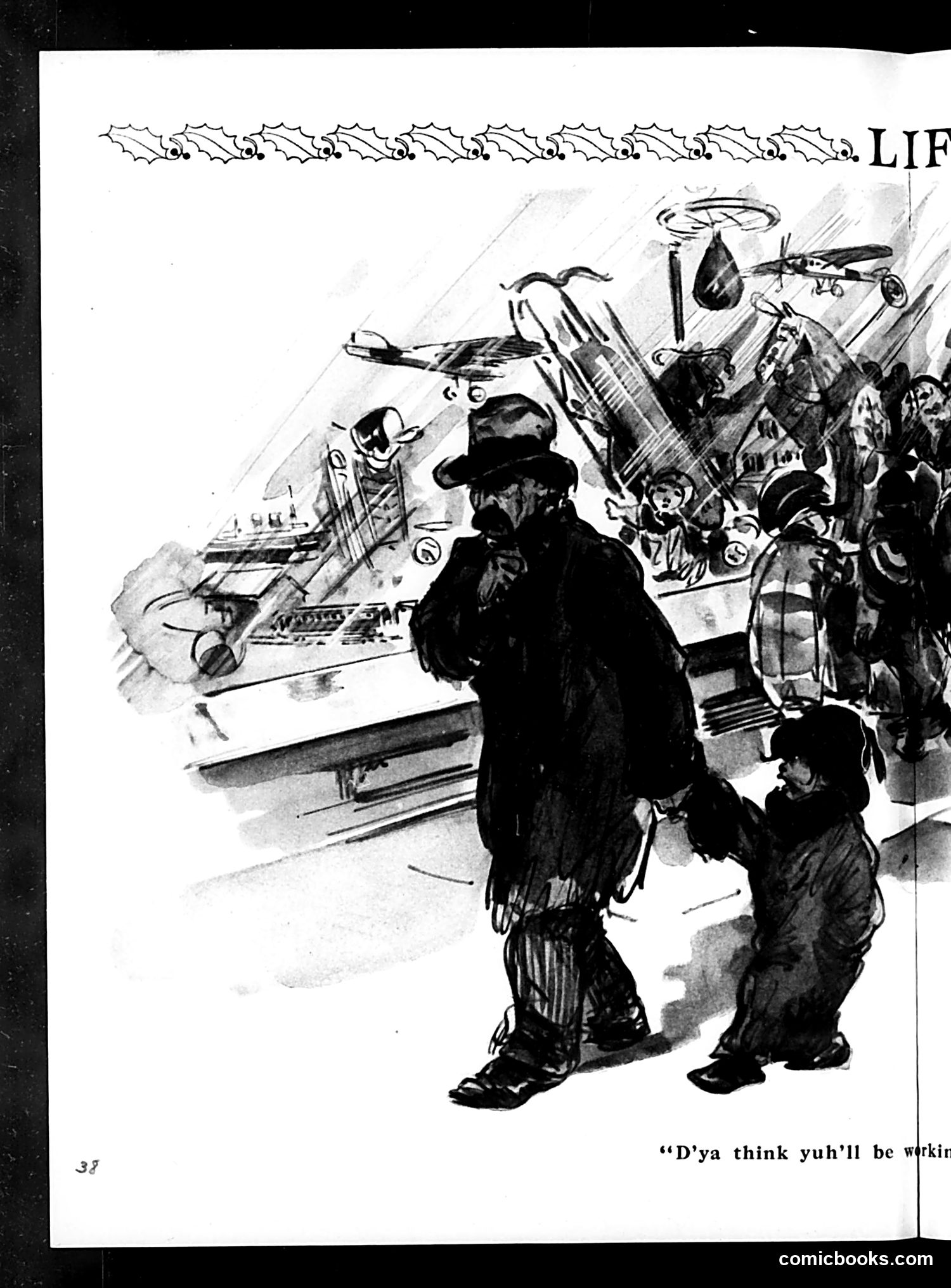
This appears to be a satirical cartoon from Life magazine showing a well-dressed man in a bowler hat speaking to a young boy near a busy dock or port. Ships, airplanes, and crowds of people are visible in the background. The caption reads: "D'ya think yuh'll be workin..." (text cuts off). The cartoon likely satirizes employment prospects or economic conditions—possibly commenting on Depression-era or wartime job availability. The contrast between the adult's formal dress and the boy's worn clothes, combined with the dock setting and crowded scene, suggests commentary on labor, opportunity, or social class. However, without the complete caption or publication date, I cannot definitively identify the specific political/economic reference or the cartoon's precise satirical target.
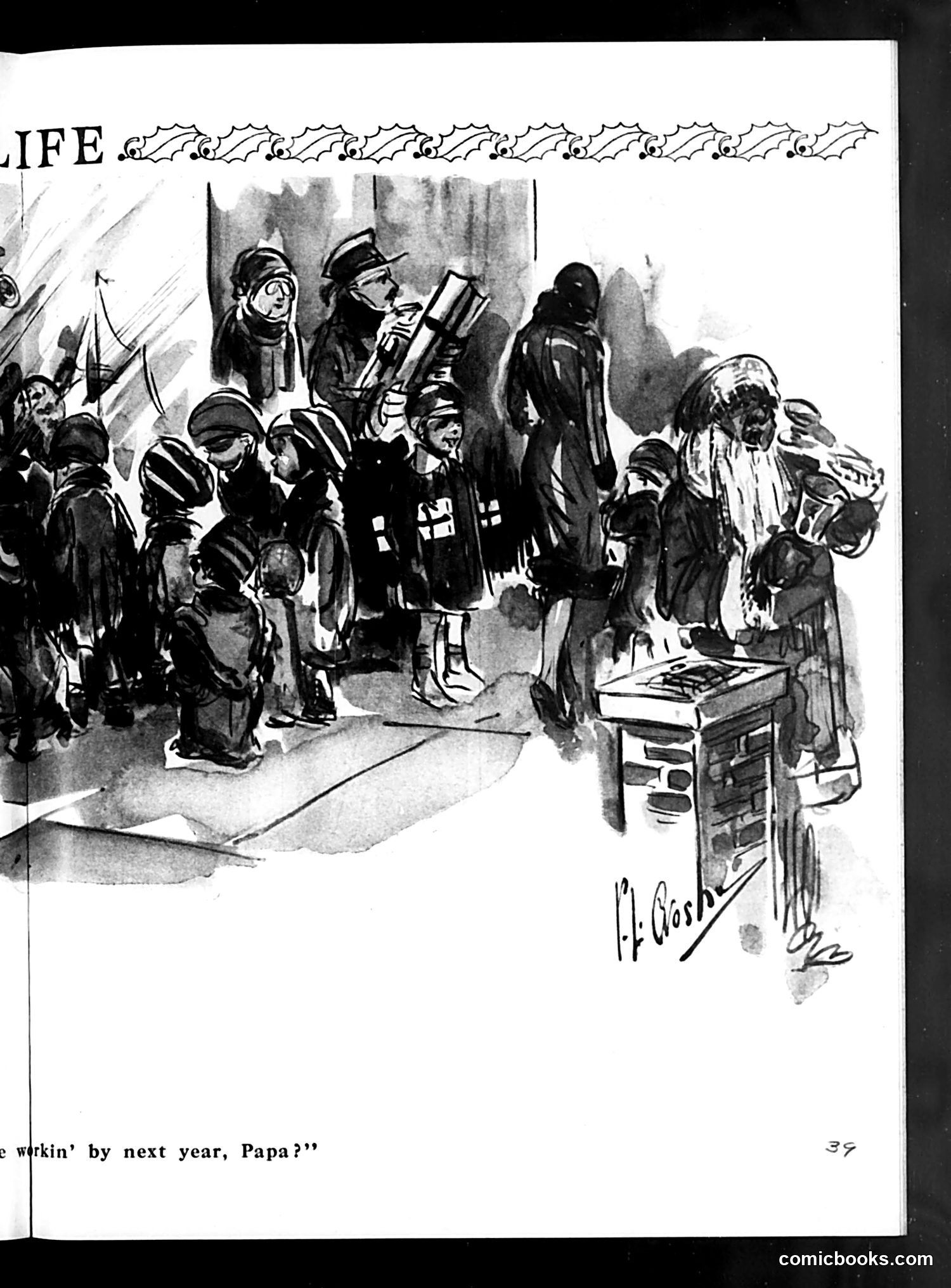
This appears to be a WWI-era satirical cartoon from *Life* magazine. The scene depicts military officers (identifiable by their uniforms and headgear) presenting what looks like weapons or military equipment to a group of children and civilians, including what appears to be elderly figures. The caption—"Wérkin' by next year, Papa?"—suggests dark satire about child labor or conscription. The cartoon likely criticizes either: 1. **Militarization of youth**: forcing children into military service or weapons manufacturing 2. **War's economic desperation**: making even children work to support the war effort 3. **Generational toll**: depicting how war consumes successive generations The crowded, chaotic composition emphasizes the scale of this societal problem. The cartoonist's signature appears to read "H. Gosha" or similar.
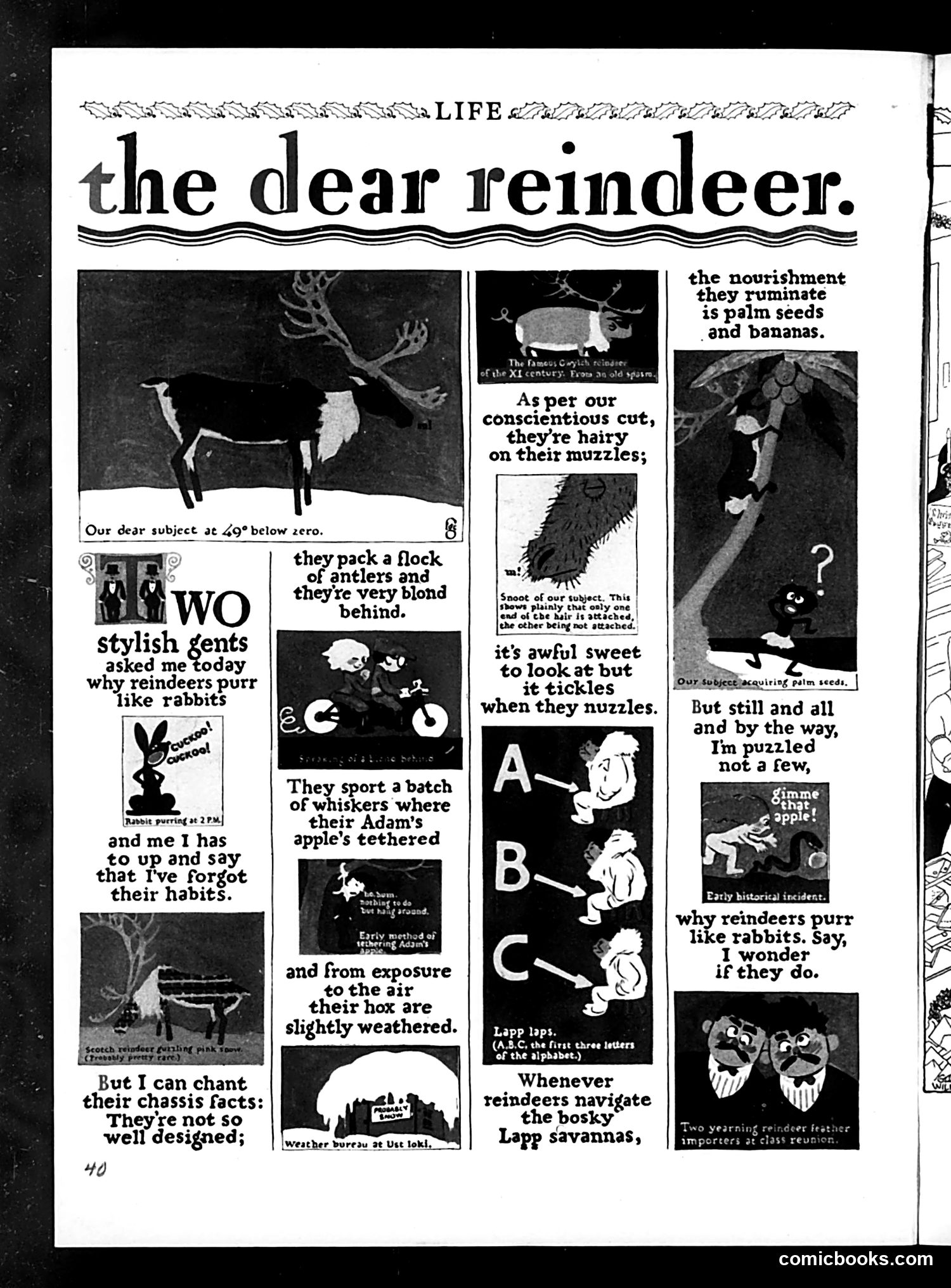
This is a humorous illustrated article about reindeer, likely written in response to popular interest in Arctic exploration or Scandinavian culture. The piece adopts a mock-scientific tone, presenting absurd "facts" about reindeer alongside genuine observations. The satire targets credulous readers and pseudoscientific claims. It presents ridiculous assertions—that reindeer "purr like rabbits," have improperly designed chassis, sport "Adam's apples"—alongside actual details (diet of palm seeds and bananas, hairy muzzles, antlers, exposure to harsh weather). References to "Lapp" people and "Lapp savannas" indicate engagement with Scandinavian reindeer herding cultures. The repeated joke "why reindeers purr like rabbits" mocks both the animals and people who might believe such claims without questioning them. The tone is gently ridiculous throughout, poking fun at both pseudo-experts and their audiences.
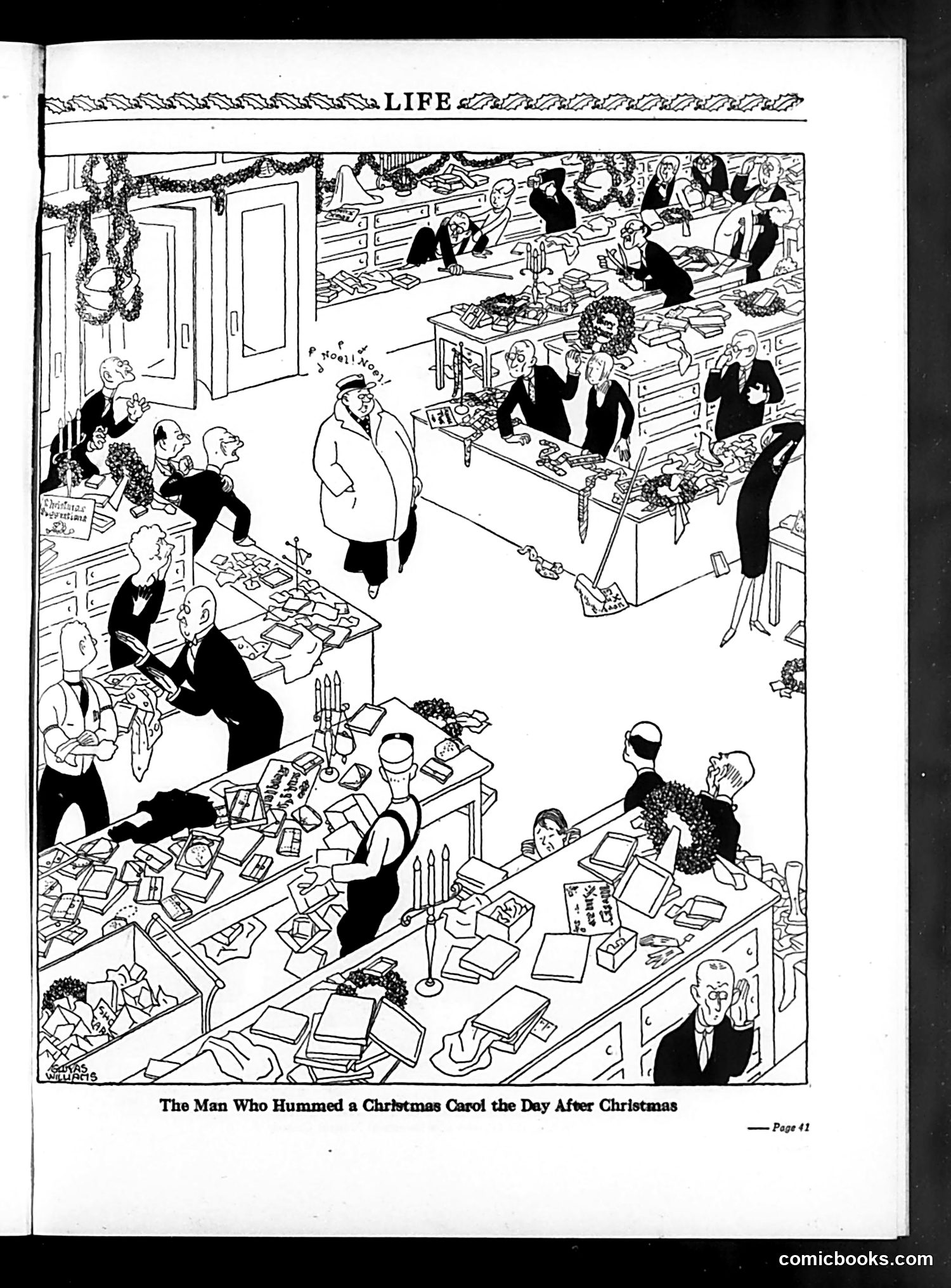
This single-panel cartoon satirizes workplace chaos and holiday aftermath. The scene depicts a chaotic office or warehouse filled with papers and money scattered everywhere, with numerous workers in apparent disarray. A man in the center (the titular character) appears to be humming cheerfully despite the surrounding pandemonium—suggesting his obliviousness or deliberate indifference to the workplace disaster. The humor derives from the contrast between his casual, cheerful holiday spirit and the frantic work environment around him. The satire likely mocks workers who maintain cheerfulness amid professional chaos, or perhaps critiques the disconnect between holiday sentimentality and harsh business realities. The specific reference to "the day after Christmas" emphasizes the jarring transition from festive peace to workday frenzy.
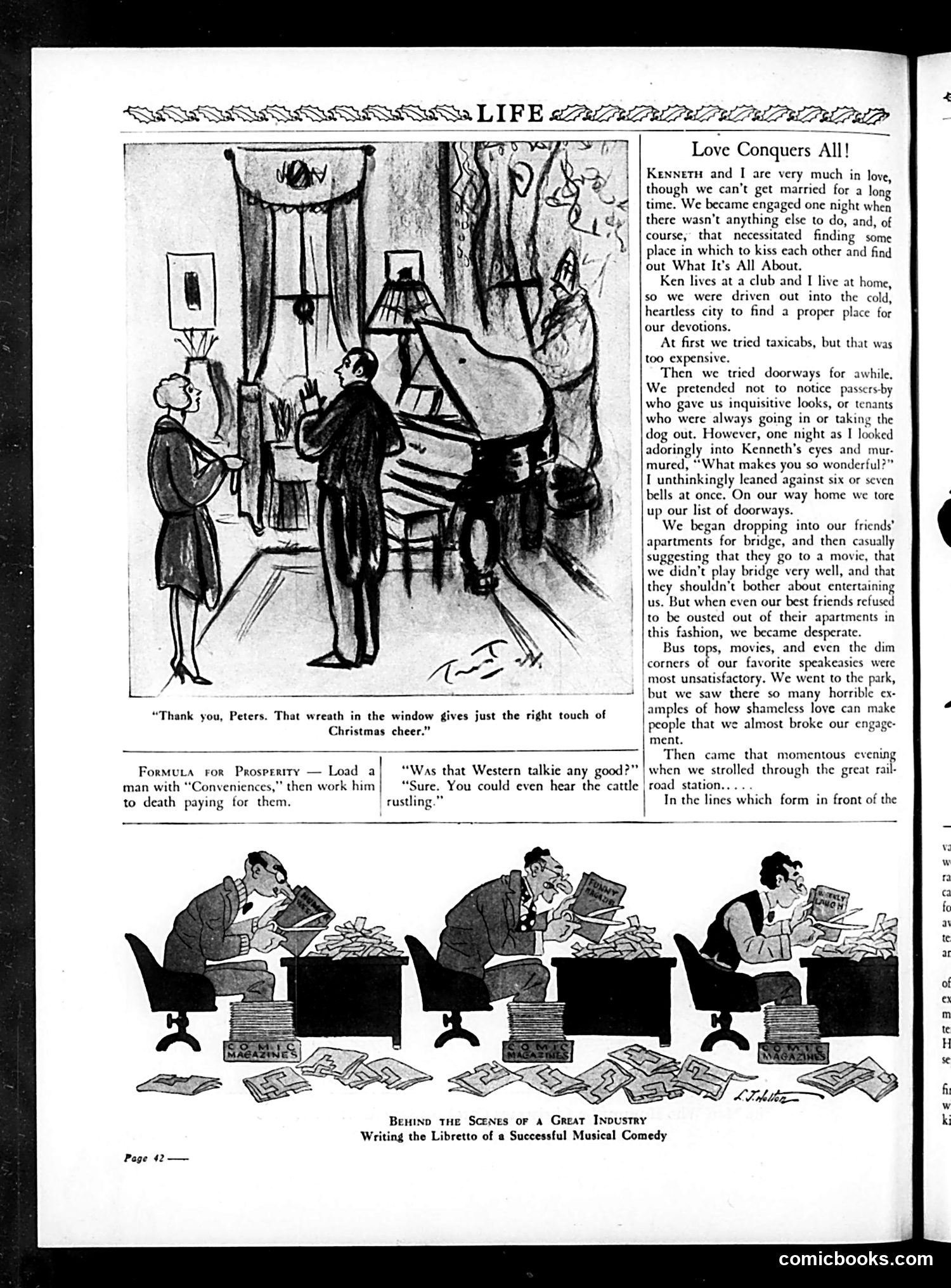
**Top Cartoon:** A couple seeks privacy for romance in the city. The humor derives from their escalating desperation—trying taxis (too expensive), doorways (embarrassing), friends' apartments (friends won't leave), parks (witnessing other couples' indiscretions), and finally a railroad station. It satirizes the practical obstacles young engaged couples faced in finding private spaces during the era when dating norms required discretion. **Bottom Cartoons:** Three identical panels show a man at a desk surrounded by money, progressively becoming more disheveled. The caption "Behind the Scenes of a Great Industry: Writing the Libretto of a Successful Musical Comedy" suggests that creating popular entertainment is lucrative but exhausting work—the writer literally works himself ragged handling profits. It's satire on artistic labor versus financial reward in commercial theater. **Side Note:** A brief joke mocks early "talking pictures" (talkies) for poor audio quality—you could hear cattle rustling in a Western film.
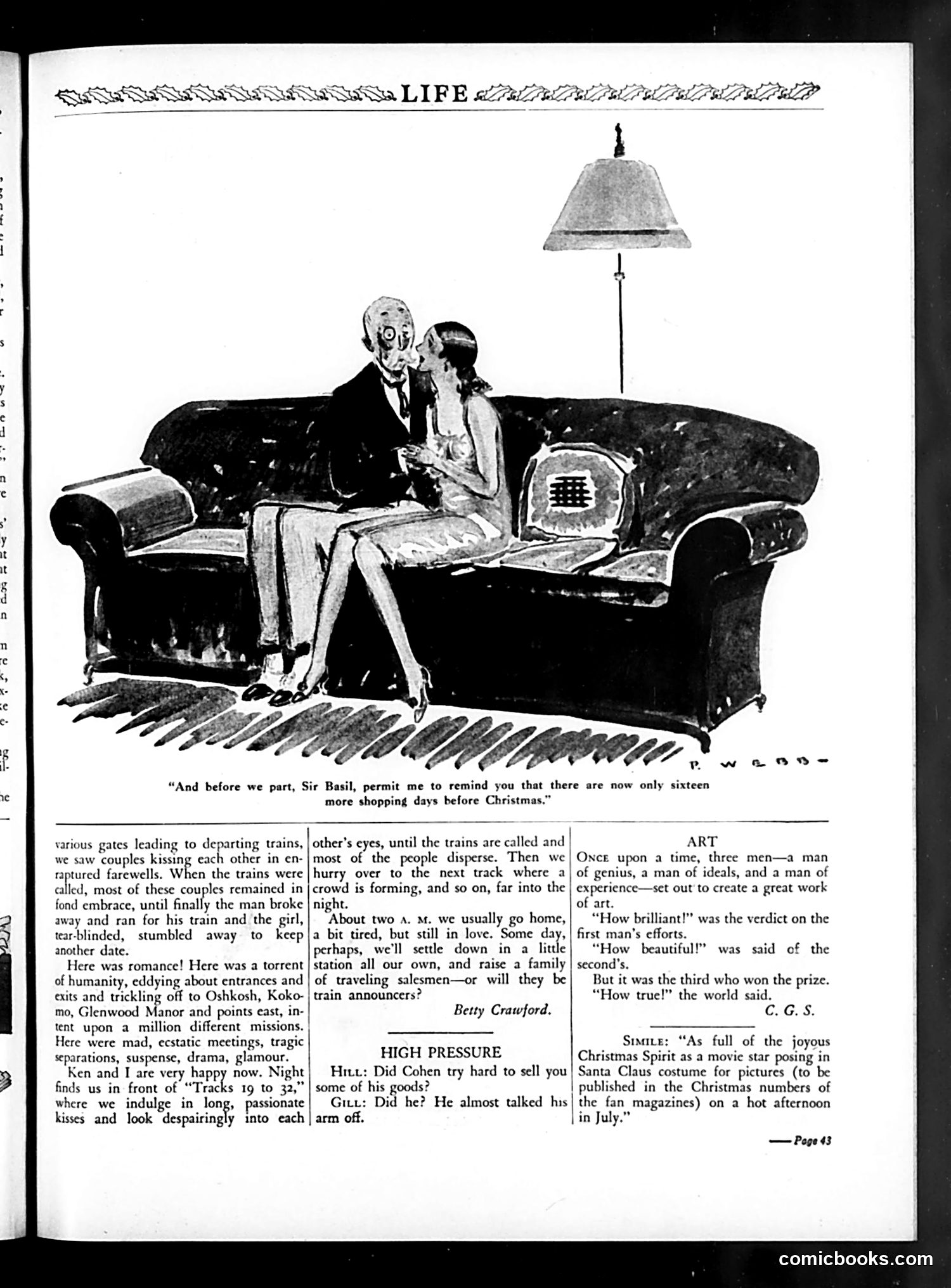
This page contains three distinct satirical pieces typical of early 20th-century Life magazine humor: **Main Cartoon (top):** A couple sits on a sofa while a man (labeled "Sir Basil," likely a British character based on the formal address) reminds them of Christmas shopping deadlines. The satire mocks how romantic moments get interrupted by commercial concerns—even intimate encounters can't escape holiday consumerism. **"Tracks to 32" Column:** A humorous essay describing young couples who meet at train stations for passionate farewells, treating the repetitive romance as entertainment. It satirizes the melodrama and artificiality of such encounters. **"High Pressure" and "Art" Sections:** Brief jokes: one about aggressive salesmanship, another mocking how art criticism rewards "truth" over beauty or brilliance—suggesting popularity trumps aesthetic merit. The overall tone reflects Life's satirical approach to American social customs, commercialism, and pretension during this era.
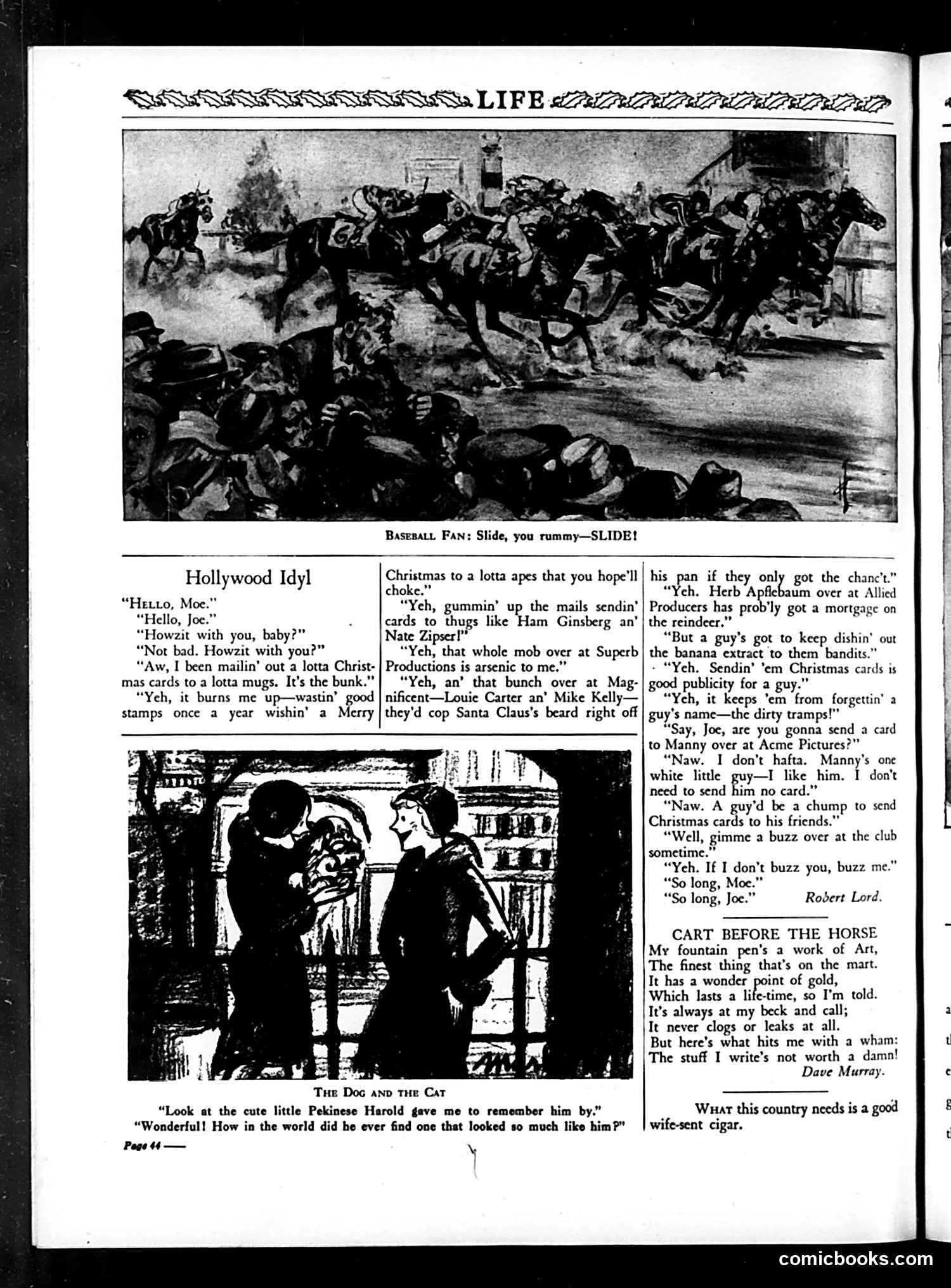
This page satirizes the cynicism and phoniness of 1920s Hollywood social conventions, particularly Christmas card-sending among film industry figures. **The Main Cartoon:** Two characters ("Moe" and "Joe," likely representing generic Hollywood types) complain bitterly about mailing Christmas cards to people they despise—naming figures like "Ham Ginsberg" and others at studios like "Superb Productions" and "Magnificent." The joke is that sending cards to people you hate is obligatory career networking, a wasteful charade. The punchline: they admit they wouldn't send a card to their actual friend Manny, because "he's a white little guy"—the one person they genuinely like doesn't *need* a card to remember them. **Secondary Content:** "The Dog and the Cat" makes a joke about physical resemblance (a Pekinese dog resembling someone named Harold). "Cart Before the Horse" is an unrelated poem about a fountain pen. The satire targets Hollywood's hollow professionalism and the absurdity of obligatory social rituals masking actual contempt.
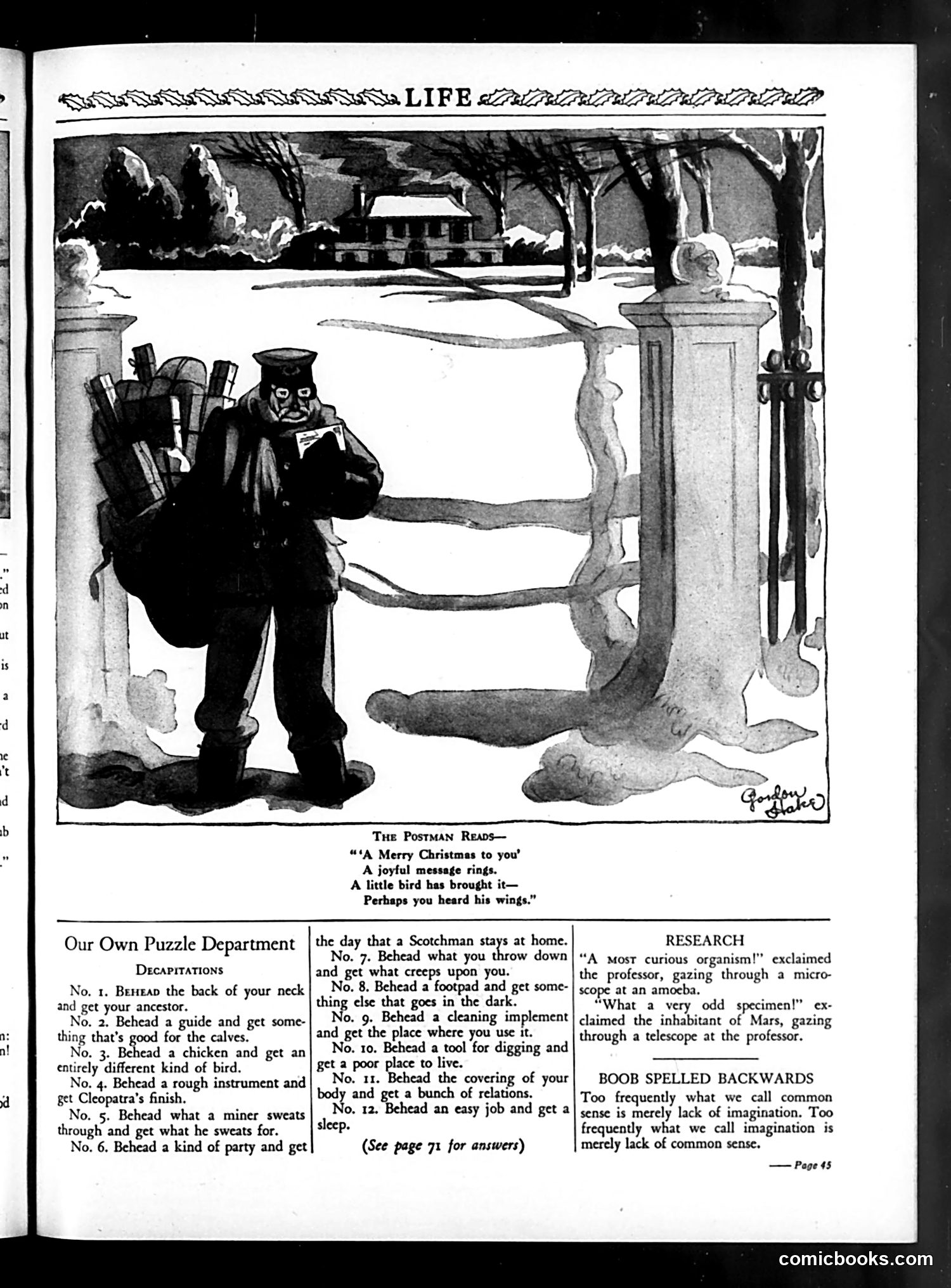
This page from the satirical magazine *Life* contains three distinct humor features: **"The Postman Reads"** (top cartoon): A cheerful postman delivers Christmas greetings at an elegant estate gate. The accompanying verse is sentimental holiday doggerel—typical of the greeting-card sentimentality Life often mocked through juxtaposition with absurd or cynical imagery. **"Our Own Puzzle Department"** (middle): Word-play riddles using "decapitation" (removing the first letter). These are traditional parlor games for readers—lighthearted, not political. **"Research" and "Boob Spelled Backwards"** (bottom): Two brief satirical observations. The first uses a professor studying an amoeba to mock pretentious academia (with a Martian observer providing ironic perspective). The second ironically suggests "common sense" and "imagination" are opposite poles of stupidity—likely critiquing both rigid rationalists and frivolous dreamers in contemporary society. The page is primarily entertainment-focused rather than topical political satire, reflecting *Life*'s mix of wordplay, gentle social commentary, and visual humor.
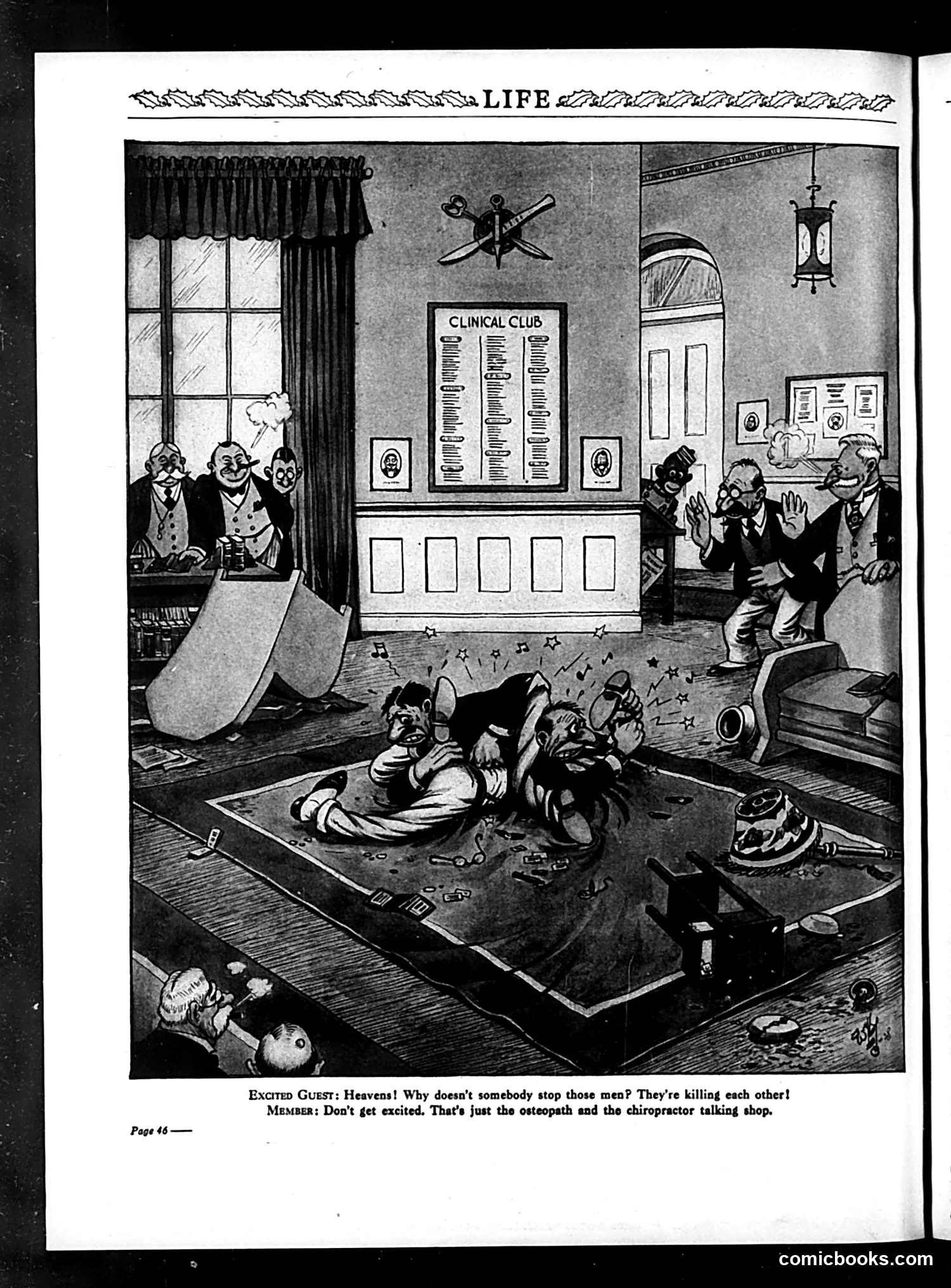
This Life magazine cartoon satirizes professional rivalry between osteopaths and chiropractors—alternative medical practitioners competing for patients in the early 20th century. The joke depicts two men fighting violently on the floor of a "Clinical Club," while an excited guest thinks they're genuinely battling. A club member reassures the guest that this is merely "shop talk"—professional discussion typical between these competing practitioners. The satire mocks both the intensity of their rivalry and, implicitly, questions the legitimacy of their practices by equating professional disagreement with actual combat. The cartoon suggests these practitioners were contentious enough that their heated debates resembled physical fights, poking fun at what Life likely viewed as dubious alternative medicine versus conventional medicine.
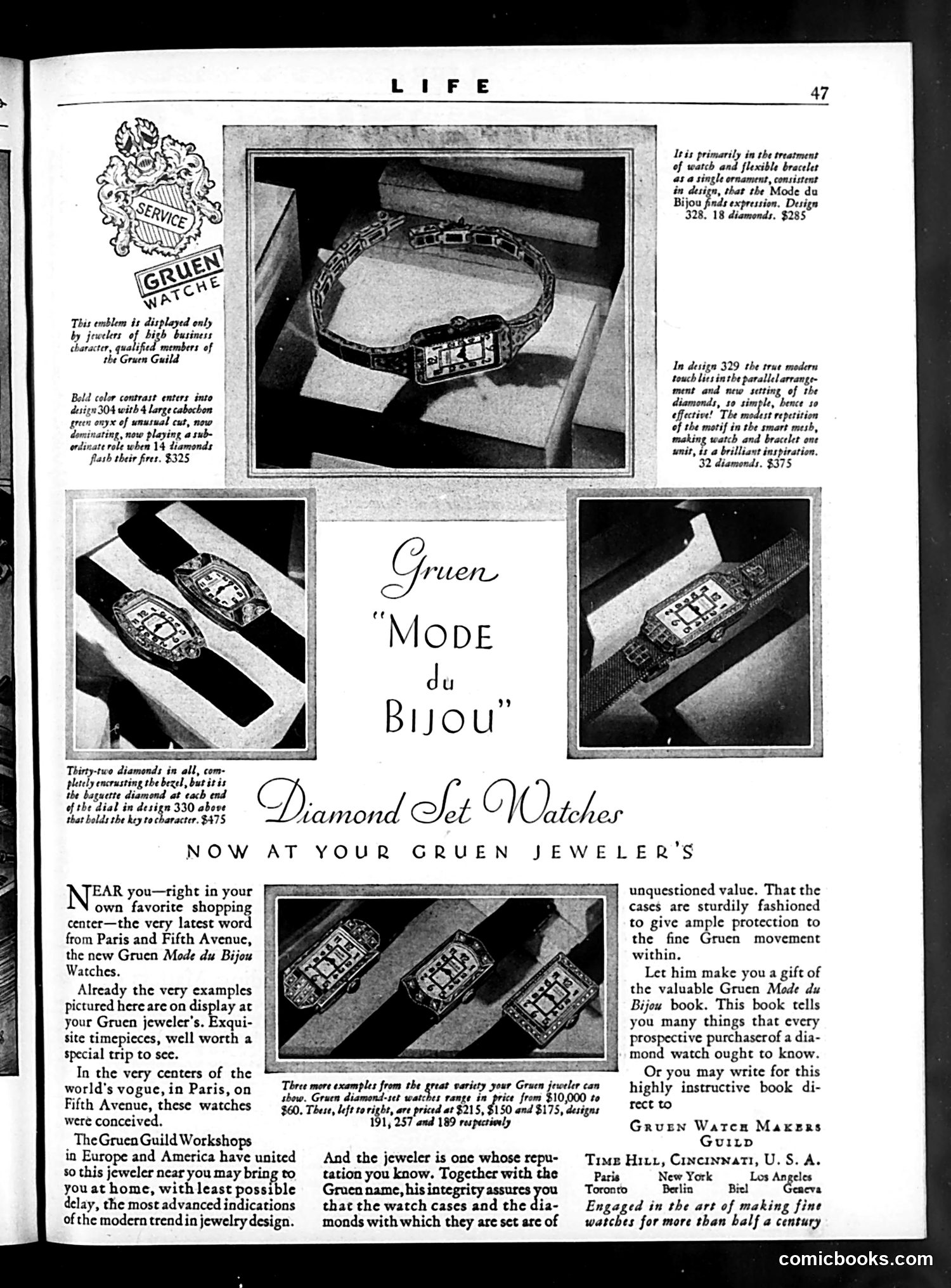
This page is **not a cartoon or satire**—it's a luxury advertisement for Gruen diamond-set wristwatches, circa 1920s-1930s. The ad promotes Gruen's new "Mode du Bijou" (Fashion of the Jewel) line, positioning wristwatches as fashion jewelry rather than mere timekeeping devices. Multiple watch designs are displayed with prices ranging from $285 to $475, each emphasizing diamond settings and aesthetic design. The marketing strategy targets affluent consumers by: - Referencing Paris and Fifth Avenue as sources of inspiration - Emphasizing the "Gruen Guild"—a certification mark for jewelers of "high business character" - Offering an instructional book to educate purchasers - Stressing craftsmanship from European and American workshops The page reflects the era's shift toward wristwatches as status symbols and jewelry pieces, particularly appealing to women. There is no political content or satire present.
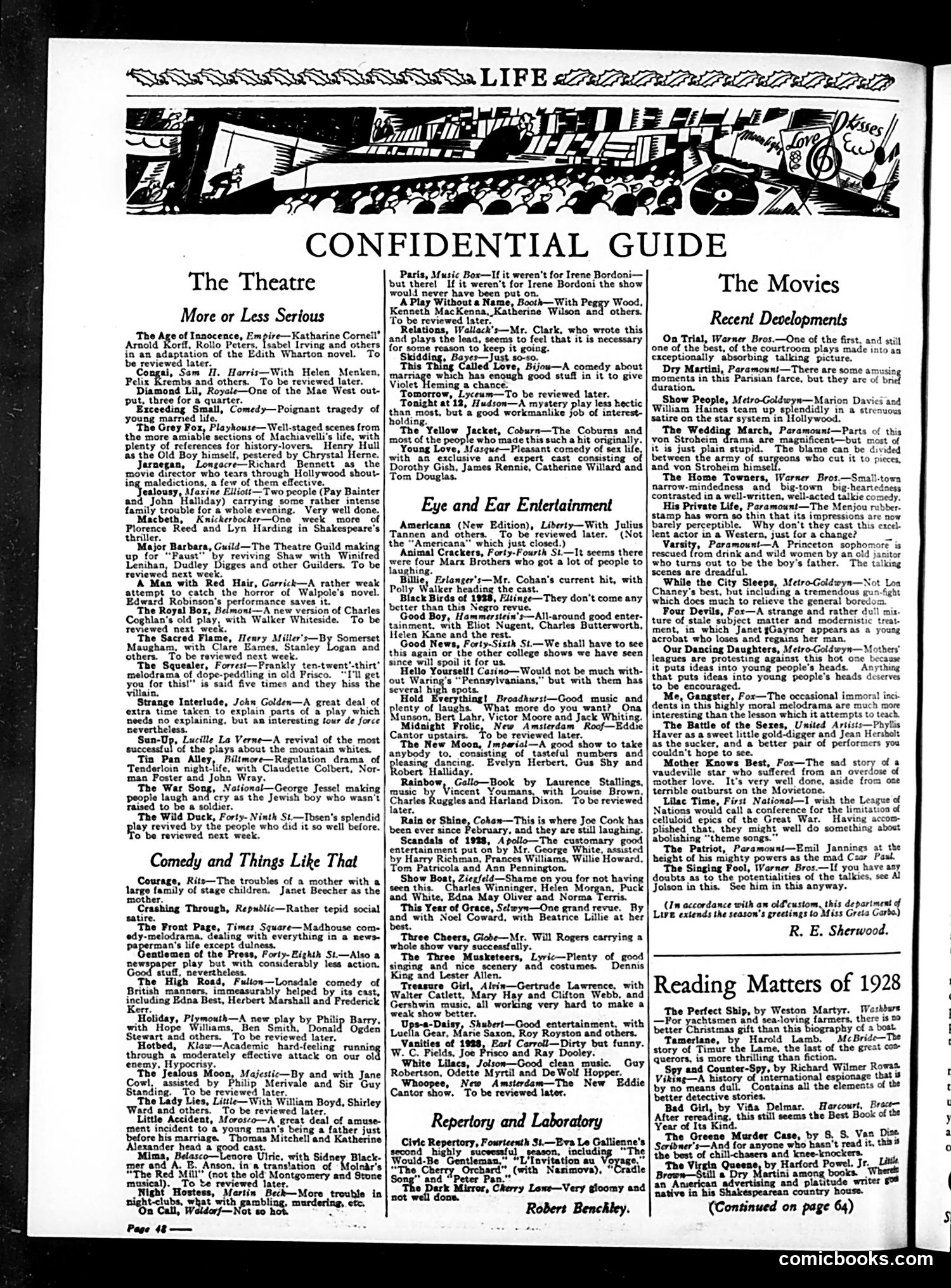
This page is a **theatre and film review guide**, not a political cartoon. It's a "Confidential Guide" listing Broadway shows and movies currently playing, with brief critical descriptions. The content reflects 1928 entertainment: Broadway hits like *Strange Interlude*, *Macbeth* (with Florence Reed), and Mae West's *Diamond Lil*; films including *Our Dancing Daughters* and *The Patriot*. Notable context: Reviews mention "to be reviewed later," indicating LIFE's forthcoming detailed critiques. The tone is gossipy and irreverent—typical of the satirical magazine's style. References to "dope-peddling" melodramas and Jewish soldier stories reflect entertainment of the Jazz Age period. The page serves as a contemporary entertainment listings guide rather than satire, showing what educated readers could see in New York theaters during 1928.
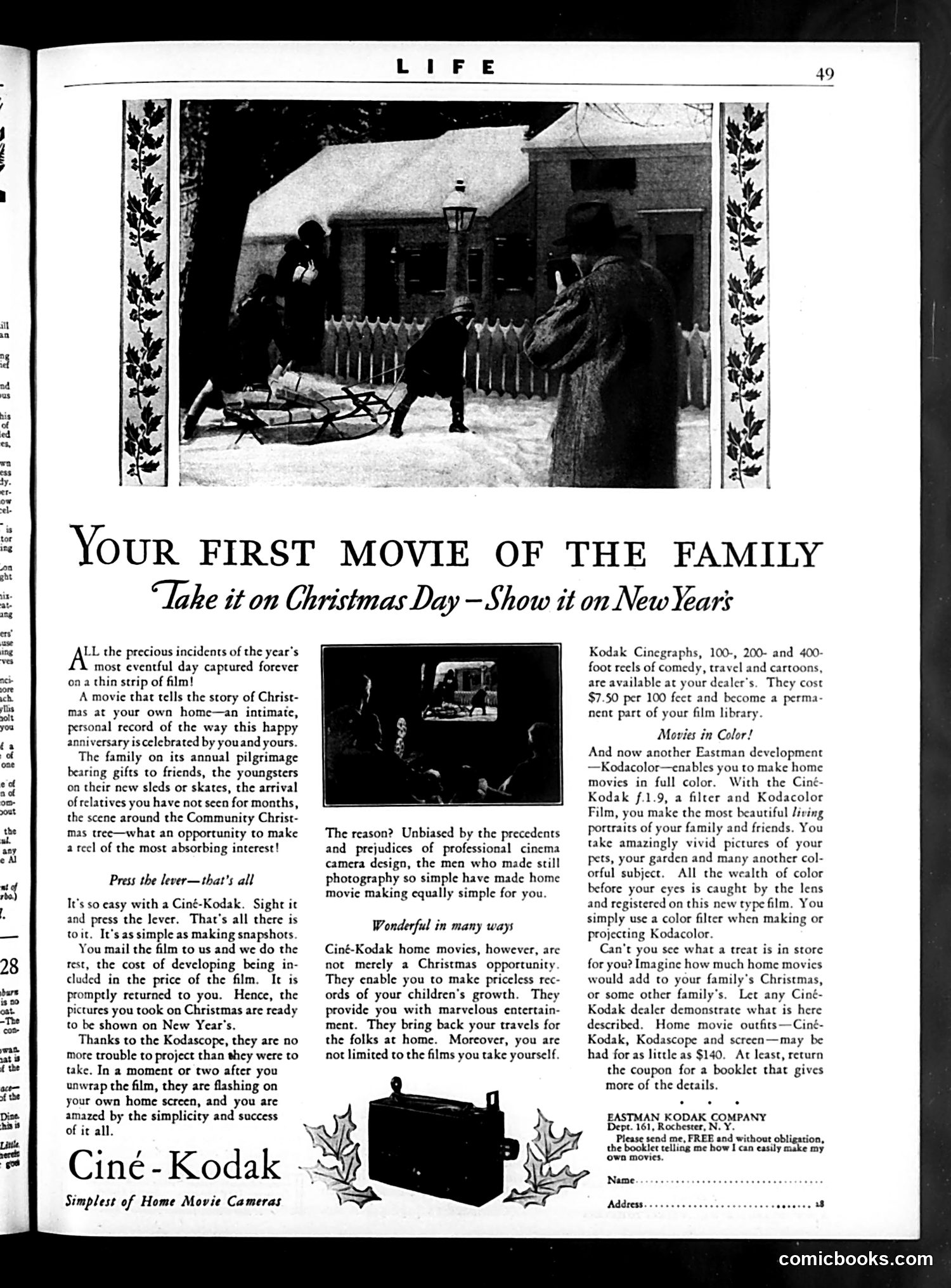
This is **not a cartoon or satire**, but a full-page **product advertisement** for Kodak's home movie camera system. The ad promotes the Ciné-Kodak camera by positioning home filmmaking as an accessible Christmas gift idea. It emphasizes simplicity: users merely "sight it and press the lever," mail film to Kodak for processing, and receive developed reels back quickly—ready to project on New Year's Day. The appeal targets middle-class families wanting to document personal moments—children's growth, holiday gatherings, relatives' visits, and community Christmas celebrations. The photograph at top shows a snowy domestic scene typical of the promised memories. The ad also touts Kodacolor, a new color film technology, and Kodascope projectors. A coupon at bottom invites readers to request a free informational booklet. This represents early-to-mid 20th-century consumer marketing celebrating the democratization of film technology for amateur home use.
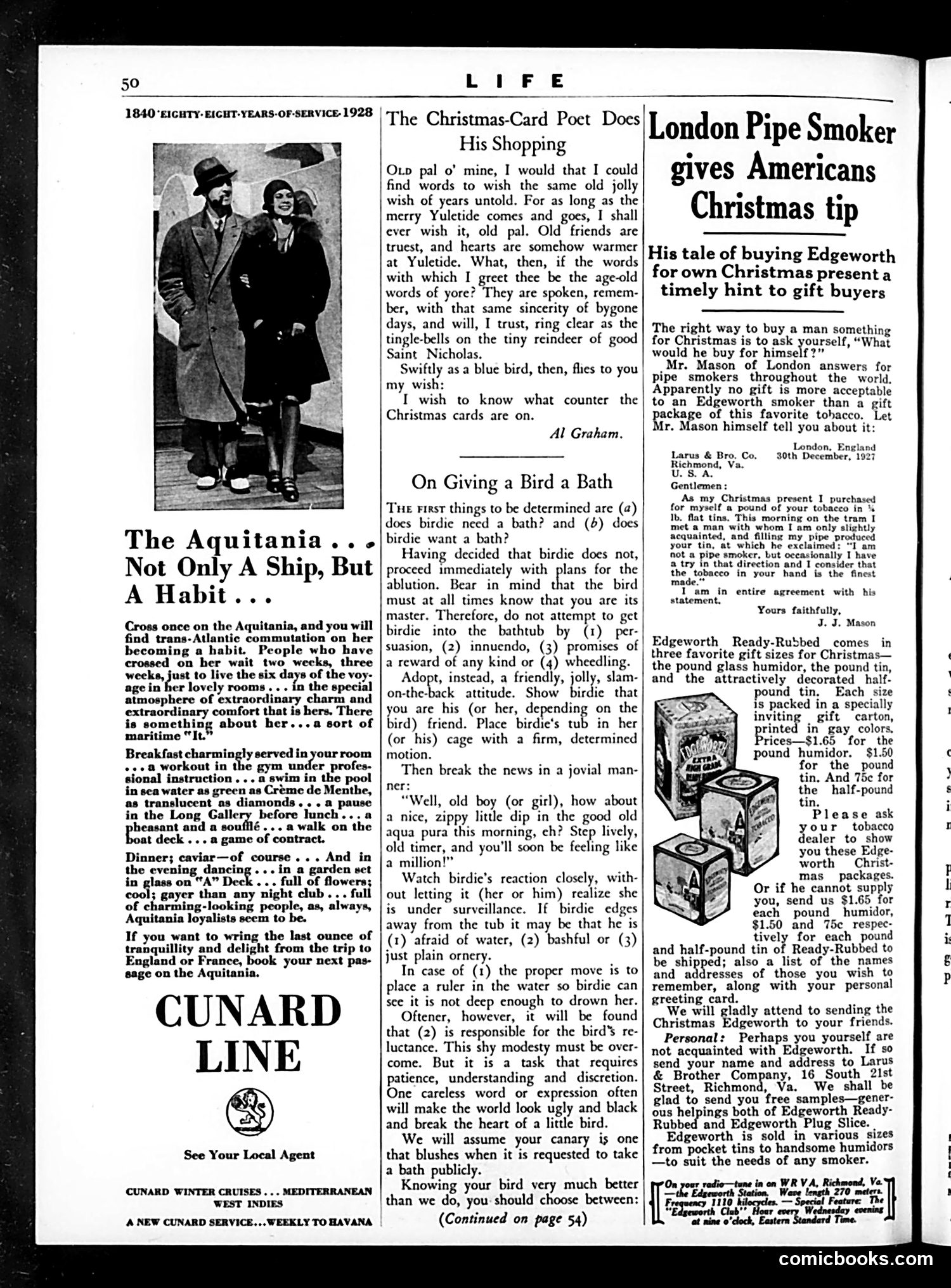
This page contains several distinct pieces of 1920s content: **Top Left:** A photograph captioned "1840 'EIGHTY-EIGHT-YEARS-OF-SERVICE' 1928" shows a couple in period dress, likely illustrating the Cunard Line's advertising claim about the ship's longevity and reliability. **Main Satire:** "The Christmas-Card Poet Does His Shopping" by Al Graham mocks the clichéd sentimentality of Christmas card verse. The poet uses flowery, old-fashioned language ("old pal," "Yuletide," "tingle-bells") — yet his actual shopping quest is mundane: simply locating where cards are sold. The humor lies in the gap between the overwrought poetic sentiment and the banal reality. **Educational Humor:** "On Giving a Bird a Bath" provides absurdist advice on bathing a reluctant canary, treating the bird-bathing scenario with mock-serious, pseudo-psychological analysis. It's gentle domestic humor typical of 1920s magazines. The page is primarily **advertising** (Cunard Line, Edgeworth tobacco) with lighter satirical and humorous filler content.
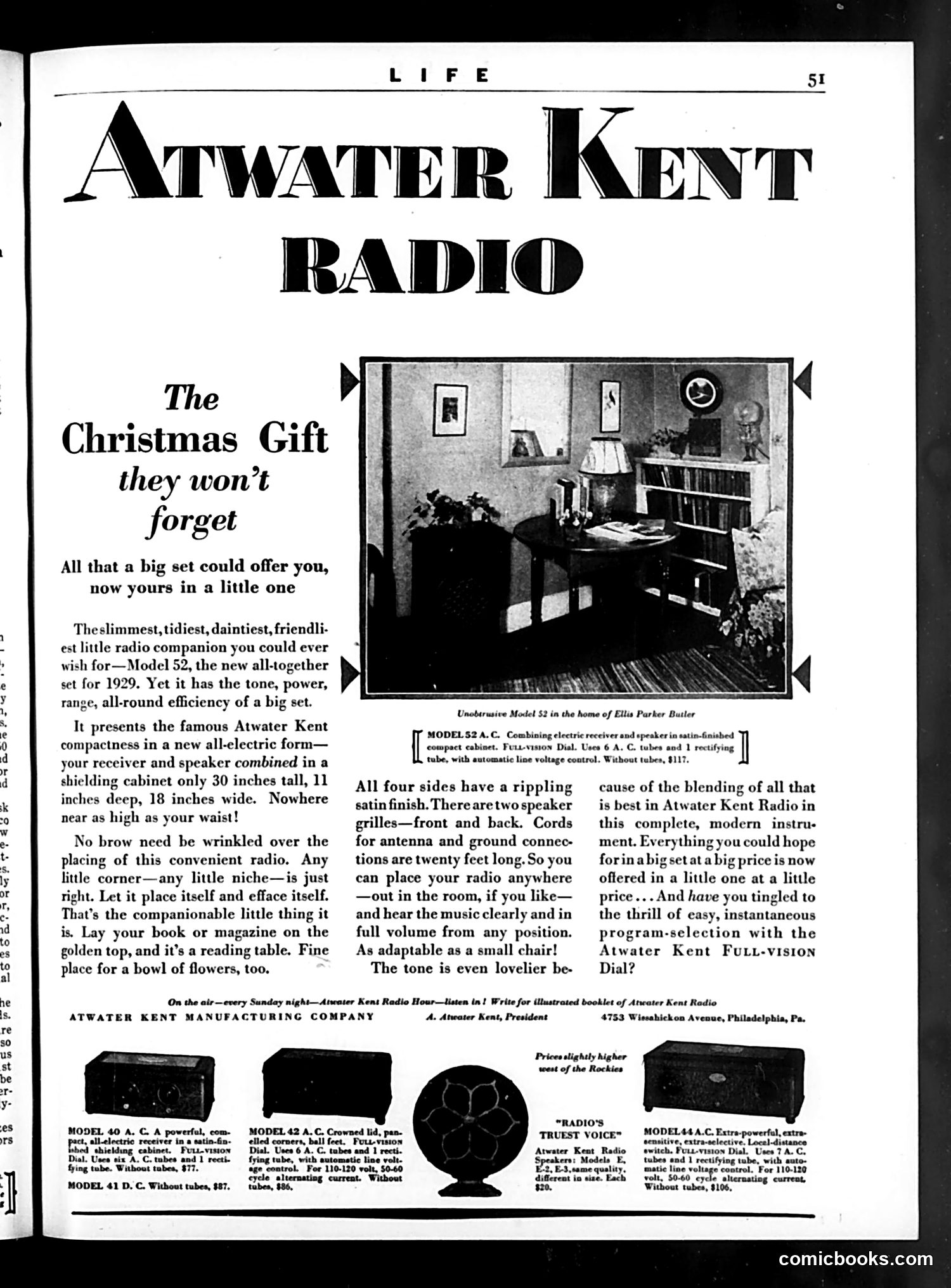
This is **not a cartoon or satire** — it's a straightforward product advertisement for Atwater Kent radios, positioned as Christmas gift suggestions. The page promotes the Model 52, a compact, all-in-one radio receiver and speaker designed for 1929. The marketing appeal emphasizes its small footprint (30 inches tall, fitting unobtrusively into home décor) while claiming the audio quality of larger models. The photograph shows the radio placed casually in a home office/study, presented as furniture that doubles as a functional appliance. The advertising copy uses domesticity and convenience as selling points — it's small enough to fit anywhere, can serve as a reading table, and requires no installation worry. Several radio models are displayed at the bottom with pricing information (Model 52 costs $117 without tubes). This reflects 1929's radio boom, when compact, consumer-friendly receivers were becoming aspirational Christmas gifts for middle-class households.
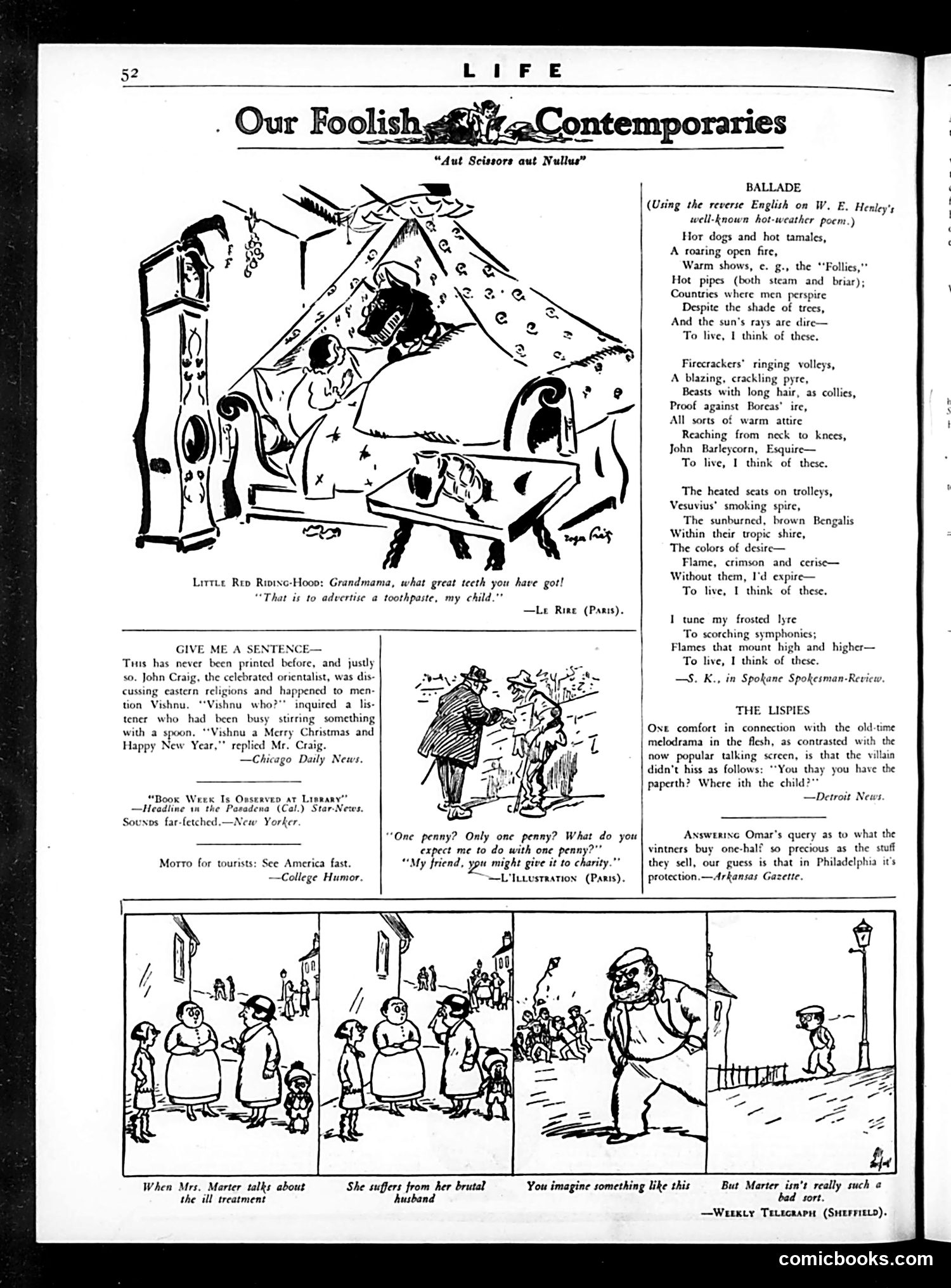
This page from *Life* magazine contains several short satirical pieces and cartoons mocking contemporary follies: **"Little Red Riding-Hood"** (top): A dental advertisement joke—a fairy tale reference is being used to sell toothpaste, showing how commercialism invades even classic stories. **"Give Me a Sentence"** and other brief quips: These are reprinted jokes from newspapers and magazines, poking fun at minor absurdities (religious confusion, book week promotion, tourist culture). **The "Mrs. Marter" Comic Strip** (bottom): Shows a woman complaining about her husband's brutality, yet when she imagines "something like this" (a man with a stick), the reality is revealed as trivial—satirizing melodramatic exaggeration in talking films versus old stage melodrama. **"The Lispies"**: Mocks villains in old theatrical melodramas who would hiss their lines with exaggerated speech impediments. The overall theme is satirizing modern life's foolishness—commercialism, media sensationalism, and melodramatic overreaction. The page represents *Life*'s traditional format of reprinting witty observations from various publications.
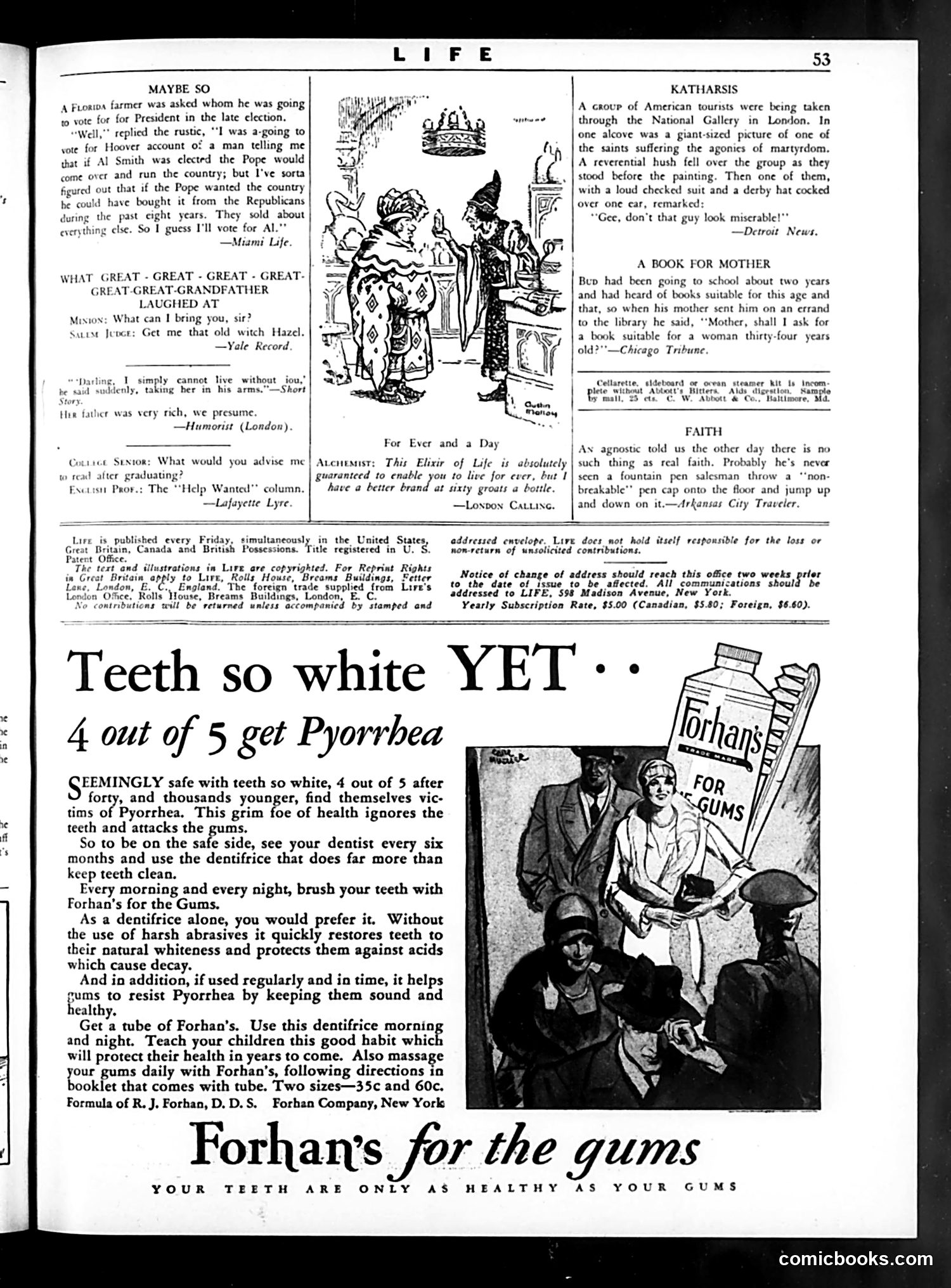
**The "Maybe So" cartoon** references the 1928 U.S. presidential election between Herbert Hoover (Republican incumbent) and Al Smith (Democratic candidate). The joke satirizes anti-Catholic prejudice: a farmer initially planned to vote for Hoover because someone warned him that electing Smith (a Catholic) would allow "the Pope" to control America. The farmer's punchline—that Republicans already "sold" the country during their eight years in power—mocks both the religious bigotry and Republican governance. The remaining content consists of short humorous anecdotes about everyday life (generational differences, job prospects, library etiquette) and advertisements, particularly the Forhan's dentifrice ad promoting gum health. The page reflects 1920s anxieties about immigration, Catholicism, and economic concerns during the pre-Depression era.
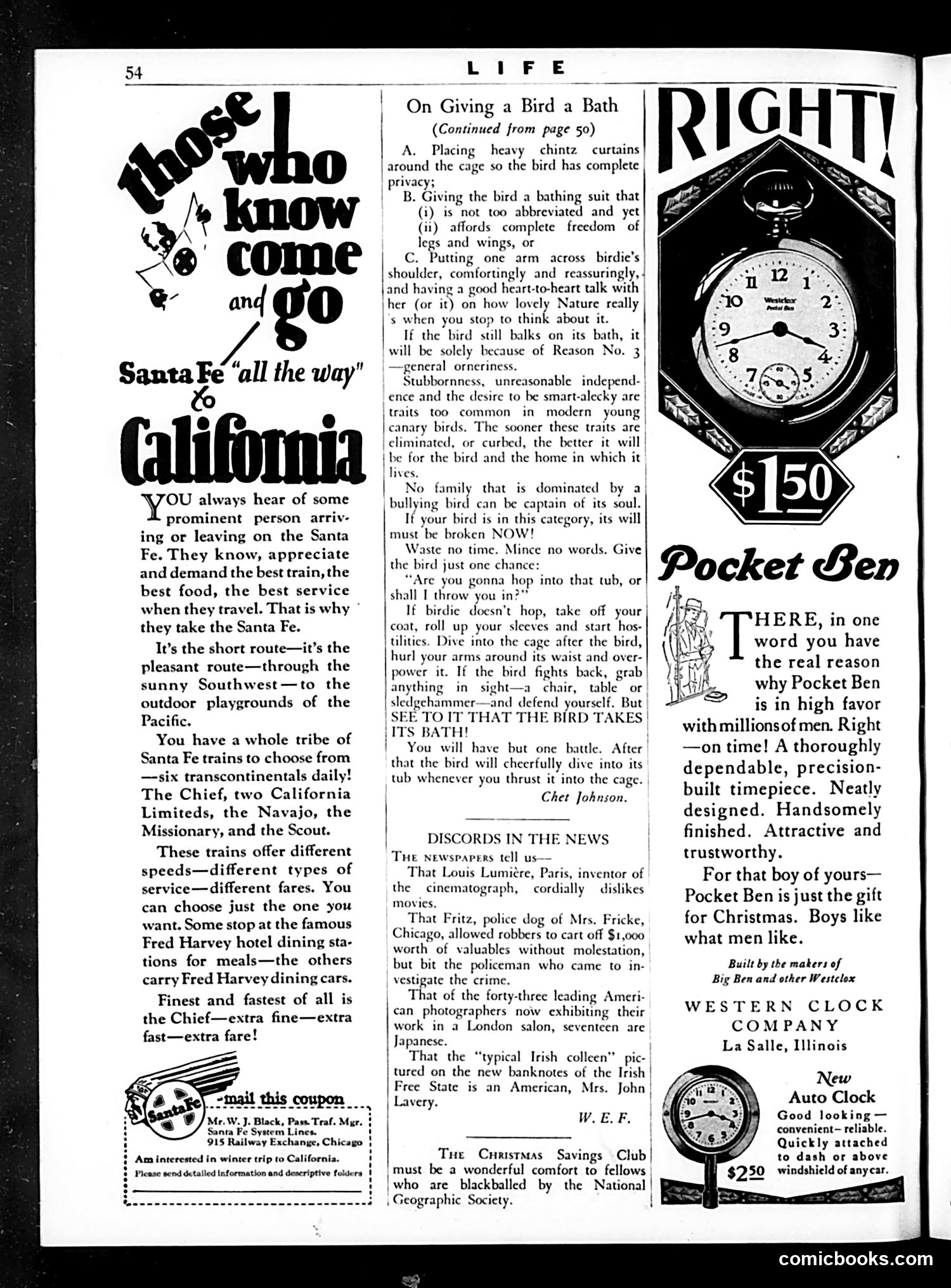
This page combines railroad and product advertising with satirical humor pieces typical of Life magazine's format. The main content includes: 1. **Santa Fe Railroad ad**: Promotes their train services to California, emphasizing luxury and frequency of service (six transcontinentals daily). References the famous Fred Harvey dining establishments. 2. **"On Giving a Bird a Bath"**: A humorous advice column (by Chet Johnson) that satirizes overly-serious parenting advice of the era. It mock-seriously proposes absurd solutions (bird bathing suits, heart-to-heart talks) before advocating forceful dominance—a joke about the tough-love child-rearing philosophy some promoted. The humor lies in treating a pet bird's bath resistance as a character flaw requiring "breaking." 3. **"Discords in the News"**: Brief satirical items noting amusing contradictions—a cinema inventor who dislikes movies, a police dog who attacks the cop but ignores robbers, and Irish banknotes featuring an American woman. 4. **Pocket Ben watch ad**: Standard product advertising claiming reliability and masculine appeal. The page is primarily advertising-driven but uses satirical commentary to engage readers.
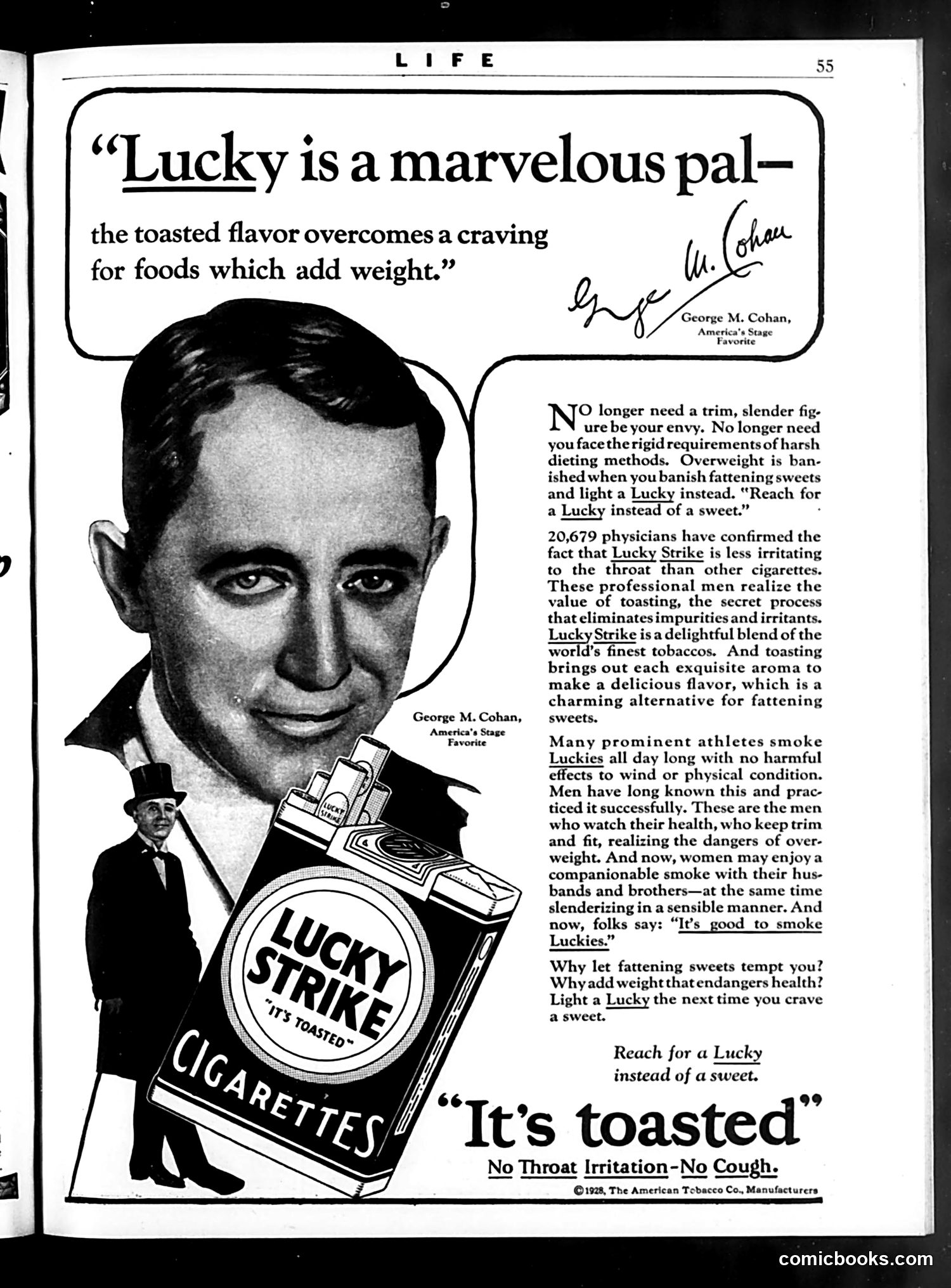
This is **not satire**—it's a genuine 1928 cigarette advertisement, not from Life's editorial content. The page features George M. Cohan, a famous Broadway star of the era, endorsing Lucky Strike cigarettes. The ad makes extraordinary health claims by modern standards: that smoking replaces eating sweets and prevents weight gain, that 20,679 physicians confirmed Lucky Strikes are "less irritating," and that athletes smoke all day with "no harmful effects." It explicitly targets women, suggesting cigarettes offer "slenderizing" benefits alongside male companionship. This represents pre-regulation advertising (before tobacco health warnings were required). The "It's toasted" slogan claimed the toasting process removed impurities. The tagline "Reach for a Lucky instead of a sweet" directly marketed smoking as appetite suppression and weight control—claims now recognized as dangerous and false. The advertisement reveals how completely different early-20th-century attitudes toward tobacco were, and how celebrity endorsements were used without disclosure.
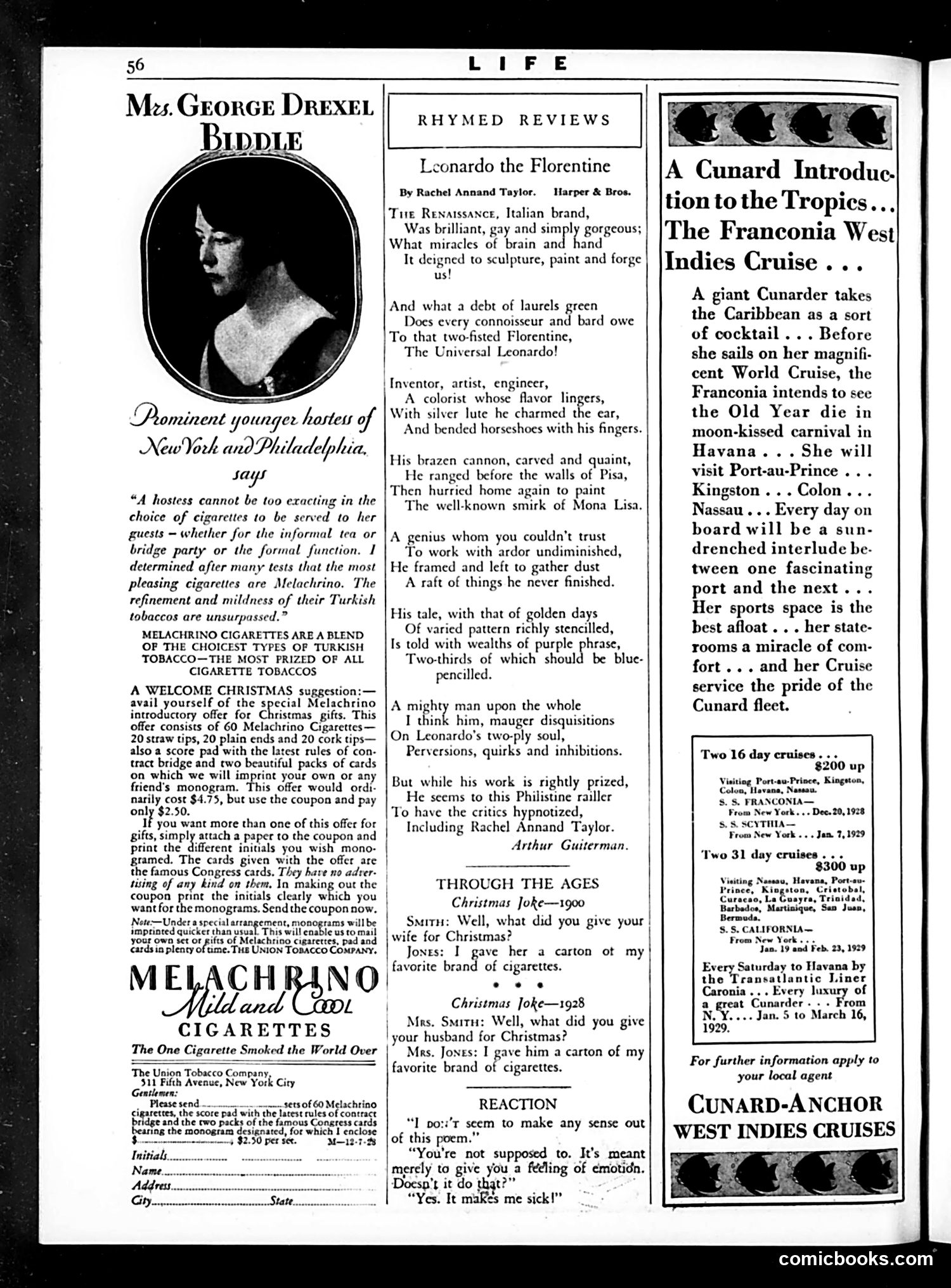
This page is primarily **advertising**, not political satire. The dominant content is a Melachrino cigarette advertisement featuring Mrs. George Drexel, a prominent Philadelphia/New York socialite endorsing the product's "refinement and mildness." The satirical elements are minor and gentle: 1. **"Rhymed Reviews"**: Arthur Guiterman's poem about Leonardo da Vinci humorously critiques both the subject and the book being reviewed. It mocks Leonardo as a genius who left projects unfinished and suggests the book's "purple phrase" is overwrought—poking fun at overwrought literary criticism rather than Leonardo himself. 2. **"Through the Ages"**: A lightweight joke comparing Christmas gifts across decades (1900 vs. 1928)—both involve giving cigarettes, suggesting cultural stagnation in gift-giving. The page reflects 1920s advertising culture where celebrities endorsed products, and tobacco was marketed without health warnings. The humor is literary and mild rather than political.
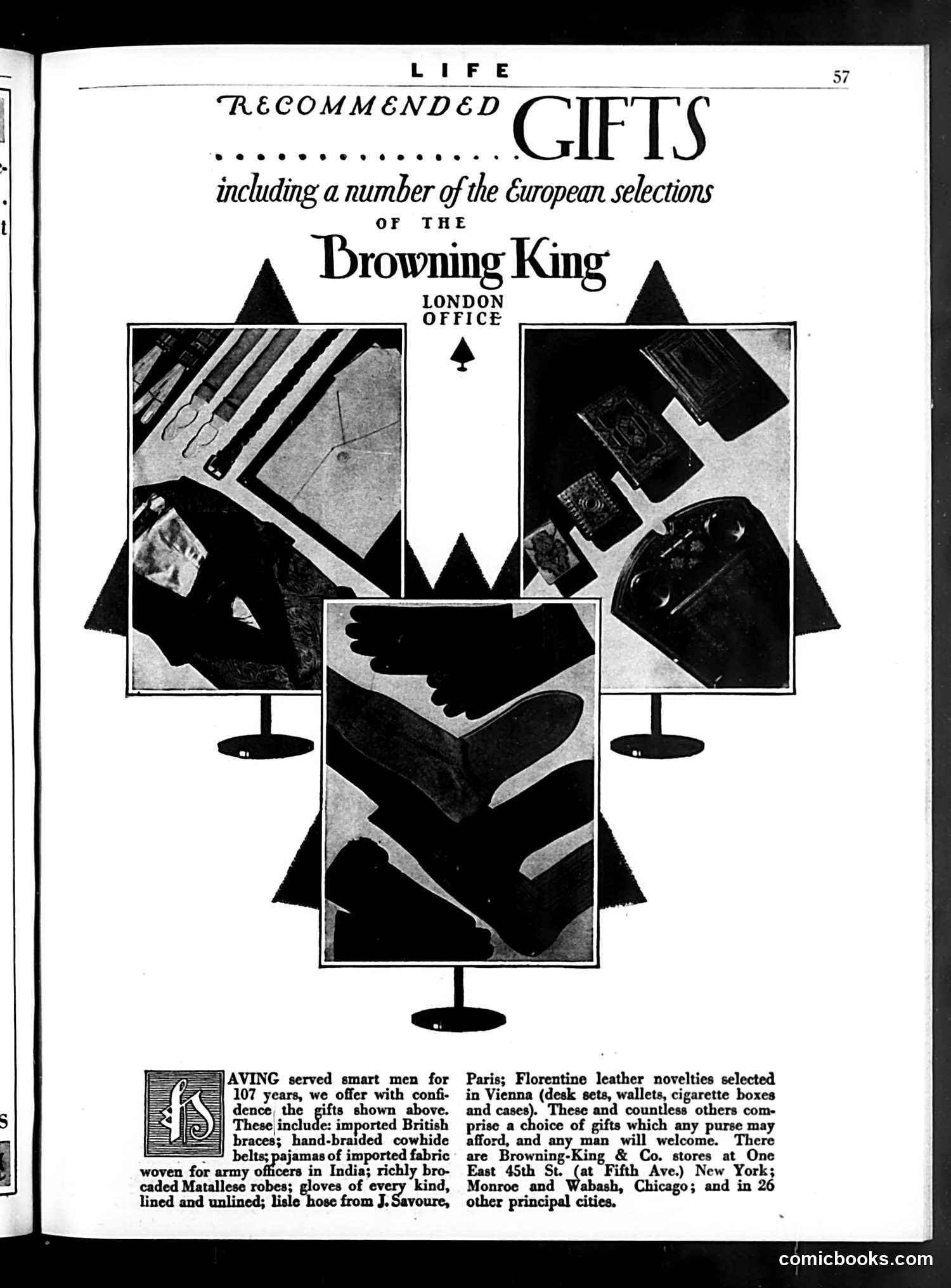
This is primarily a **department store advertisement**, not satire or political cartoon. It appears on page 57 of *Life* magazine and promotes Browning-King & Co., a men's clothier claiming 107 years of service to "smart men." The layout uses three photographs arranged in a tree-like pattern with decorative triangular elements. The images display luxury gift items: leather goods, accessories, and clothing. The text emphasizes imported European goods—British braces, Viennese leather items, Indian silk pajamas—positioning these as prestigious gifts for affluent male customers. The advertisement reflects early 20th-century consumer culture and aspirational marketing: selling not just products but refinement, worldliness, and masculine sophistication. The "European selections" language capitalizes on post-WWI American interest in Continental goods as markers of class status. This is commercial promotion rather than editorial commentary or satire.
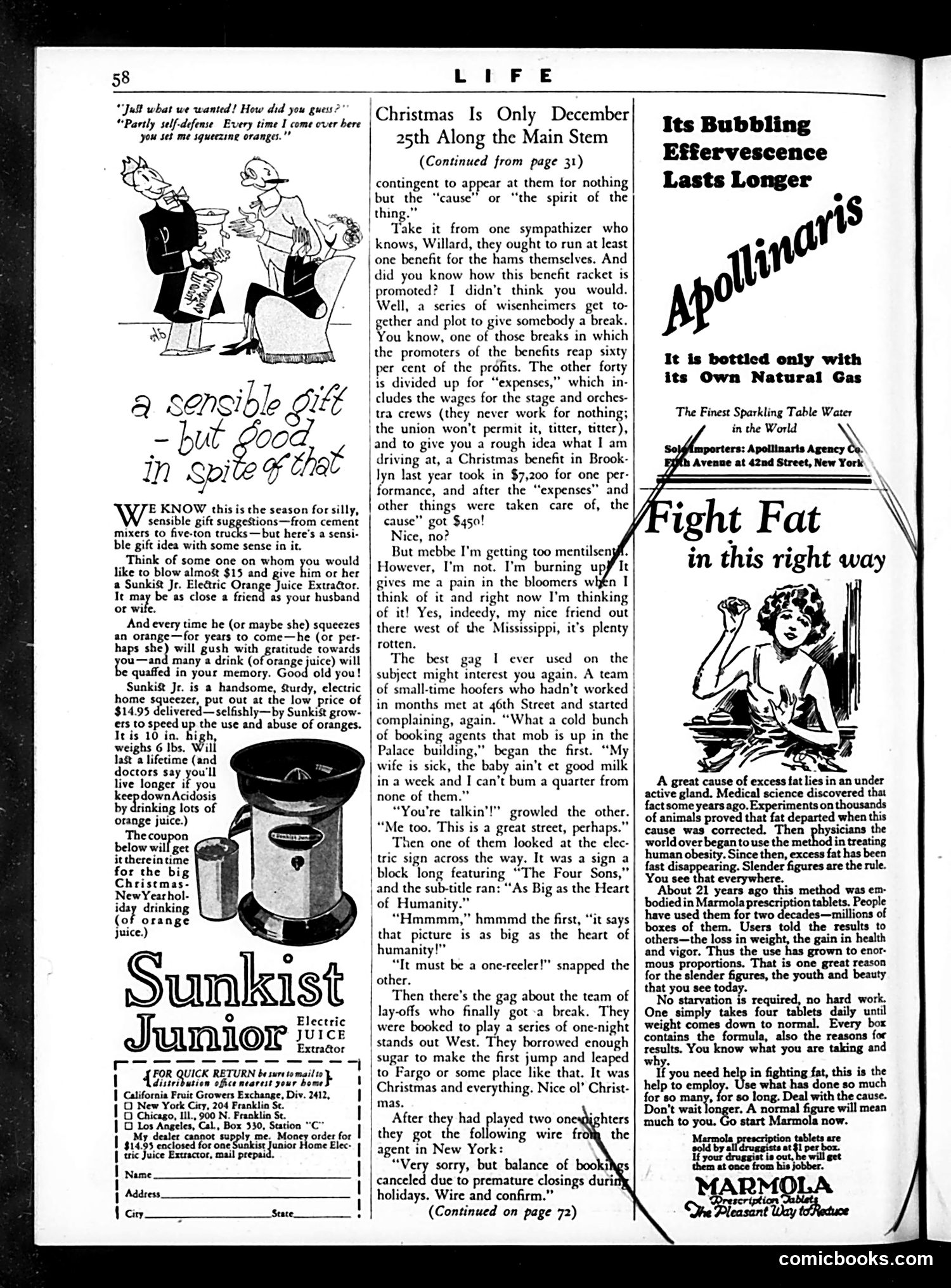
This page contains two distinct elements: **Left side:** A Sunkist orange juice extractor advertisement disguised as editorial content, humorously framed as a "sensible gift" suggestion. The satire is gentle—the writer jokes that giving someone an electric juicer ensures they'll think of you fondly every time they use it, making it a self-interested gift despite appearing generous. **Right side:** A continuation of a theatrical gossip column about Broadway ("the Main Stem"). The author criticizes benefit concerts organized for struggling theater workers (hams/actors). The complaint: organizers pocket 60% of proceeds while the actual cause receives pittance (a $7,200 benefit netted only $450). A humorous anecdote follows about unemployed vaudeville dancers discussing their poverty while staring at a theater marquee advertising "The Four Sons"—a play promoted as "As Big as the Heart of Humanity"—highlighting the ironic contrast between theatrical sentimentality and real hardship. The satire targets both theatrical charity fraud and the disconnect between entertainment's emotional messaging and performers' actual struggles.
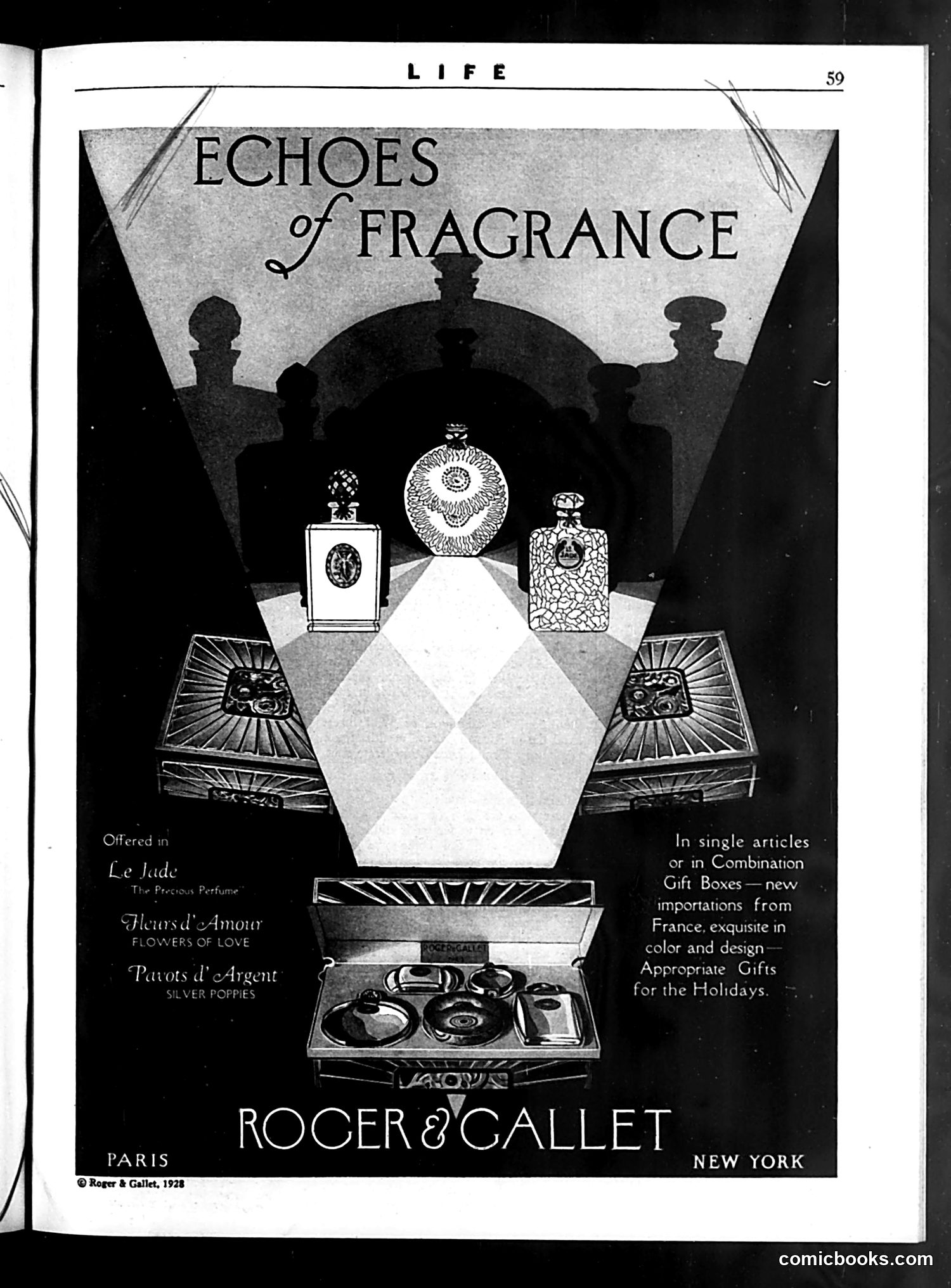
This is a **luxury perfume advertisement**, not political satire. Published in Life magazine (1928), it promotes French fragrances from the Paris-based company Roger & Gallet, with a New York location. The Art Deco design features perfume bottles and accessories arranged symmetrically on a geometric diamond pattern, with ornamental urns and an open gift box displaying product samples. The dramatic theatrical lighting and composition emphasize elegance and exclusivity. The ad lists three specific products: "Le Jade," "Fleurs d'Amour" (Flowers of Love), and "Pivots d'Argent" (Silver Poppies). It targets holiday gift-giving, marketing these "exquisite" French imports as appropriate luxury presents. The aesthetic appeals to sophisticated, affluent readers—typical for Life magazine's audience in the prosperous pre-Depression era.
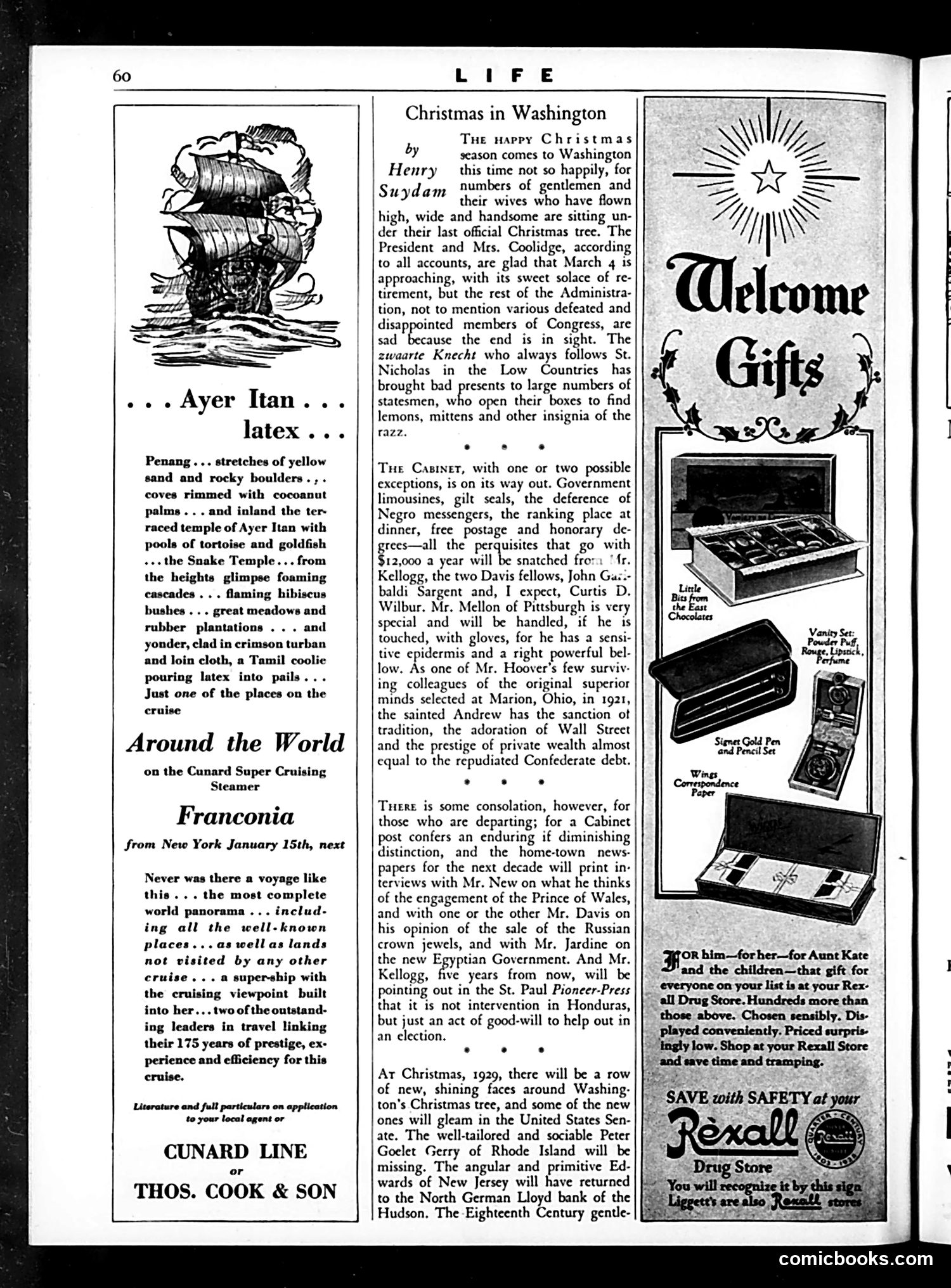
This satirical article mocks the outgoing Coolidge Administration as it approaches March 4, 1929 (Coolidge's final day in office). The piece uses dark humor to describe departing Cabinet members discovering they're losing their positions and perquisites—government limousines, deference, free postage, and prestige. Secretary of State Kellogg and others face dismissal, while Treasury Secretary Andrew Mellon, being wealthy and well-connected to Wall Street, will be "handled with gloves." The satire suggests these officials will find consolation in their diminished but still prestigious post-government status, remaining locally famous for decades through newspaper interviews. The reference to "the zwaarte Knecht" (likely a Dutch/Germanic folklore figure) mocking politicians reinforces the mockery. The article concludes by noting new faces will replace these departing officials in Washington and the Senate, with specific mention of some departing senators. It's political commentary on the impermanence of political power and officials' desperate clinging to prestige.
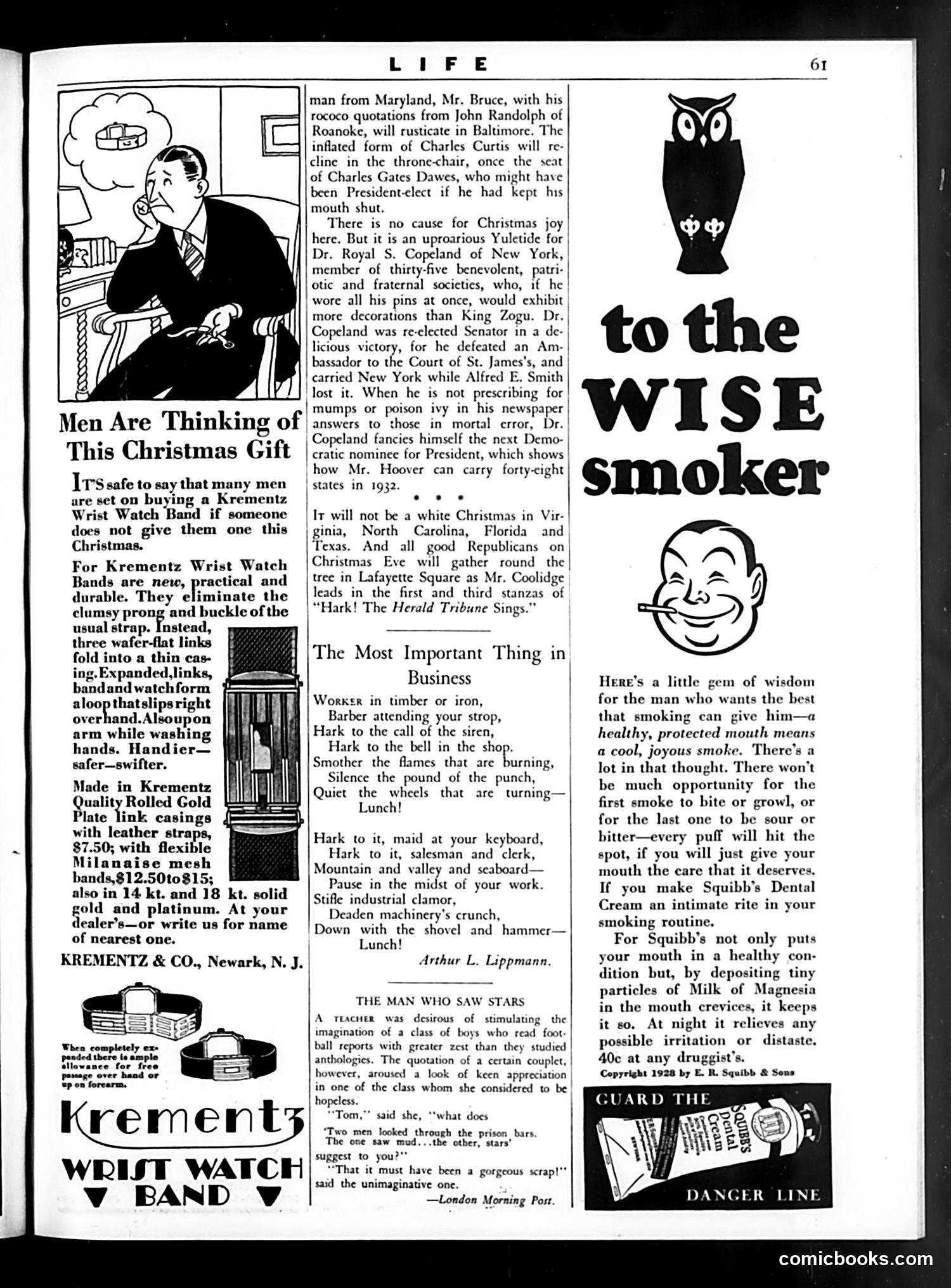
This page is primarily **advertising and humorous commentary** rather than political cartoons. The main content satirizes American politicians circa 1928-1932. References include: - **Charles Curtis** (Vice President under Hoover) - **Charles Gates Dawes** (former VP candidate) - **Dr. Royal S. Copeland** (New York Senator, humorously described as joining thirty-five organizations) - **Alfred E. Smith** (likely the defeated ambassador mentioned) - Implied criticism of **Herbert Hoover's** political standing The satire mocks Republican politicians and holiday politics, suggesting no "Christmas joy" for them while Copeland's Senate victory is "uproarious." The page also contains a **Krementz wrist watch band advertisement** and a humorous anecdote about a schoolboy who misinterprets poetry about "stars" as a prison fight ("scrap"), satirizing literal-minded youth. A **Squibb's Dental Cream advertisement** occupies the right column.
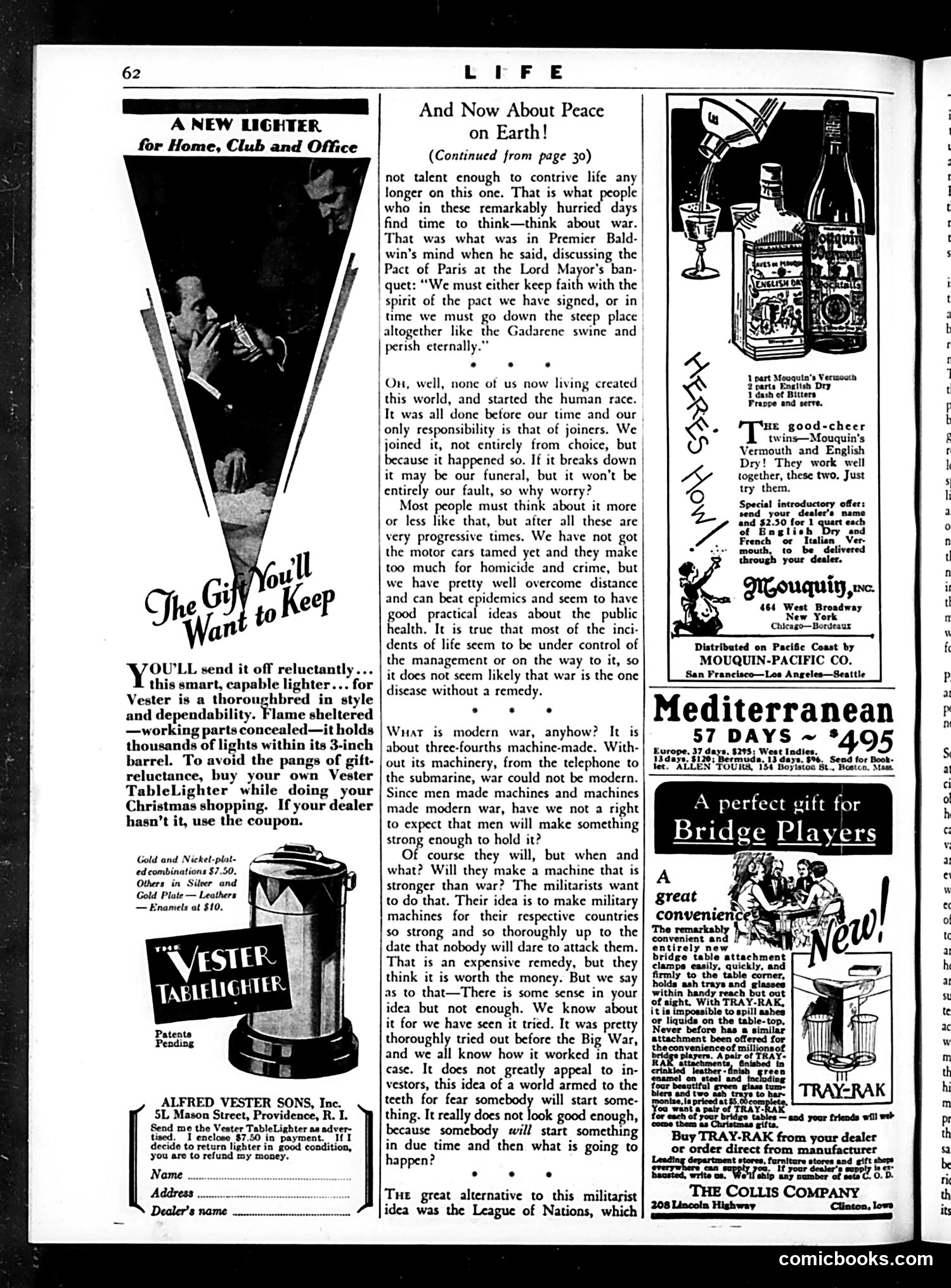
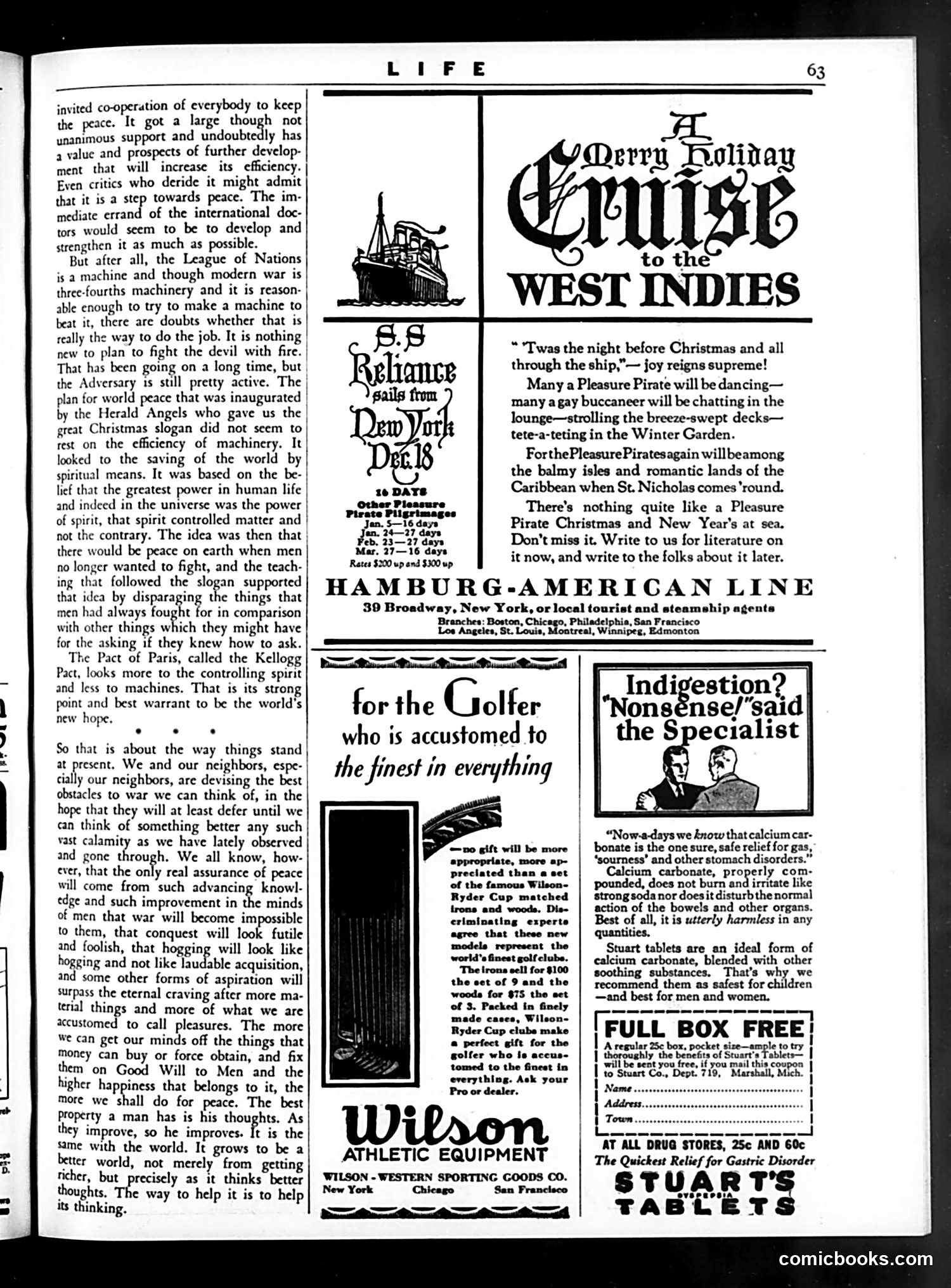
**Main Content:** This page is primarily **advertisements** interspersed with editorial text discussing peace efforts. **Editorial Commentary:** The unsigned essay addresses the League of Nations and the Kellogg-Briand Pact (the "Pact of Paris"), contrasting mechanistic approaches to preventing war with spiritual/moral solutions. The author argues that lasting peace requires changed human hearts and values, not merely institutional machinery—referencing the Biblical "peace on earth, good will toward men" as the true model. **Advertisements:** - **S.S. Reliance cruise** to West Indies (Hamburg-American Line) - **Wilson Athletic Equipment** golf set promotion - **Stuart's Tablets** for indigestion relief - Generic advertising for holiday cruises marketed as "Pleasure Pirate" voyages **Satire/Humor:** The juxtaposition of peace advocacy with luxury cruise marketing offers implicit social commentary—the wealthy pursue pleasure while the world debates preventing war.
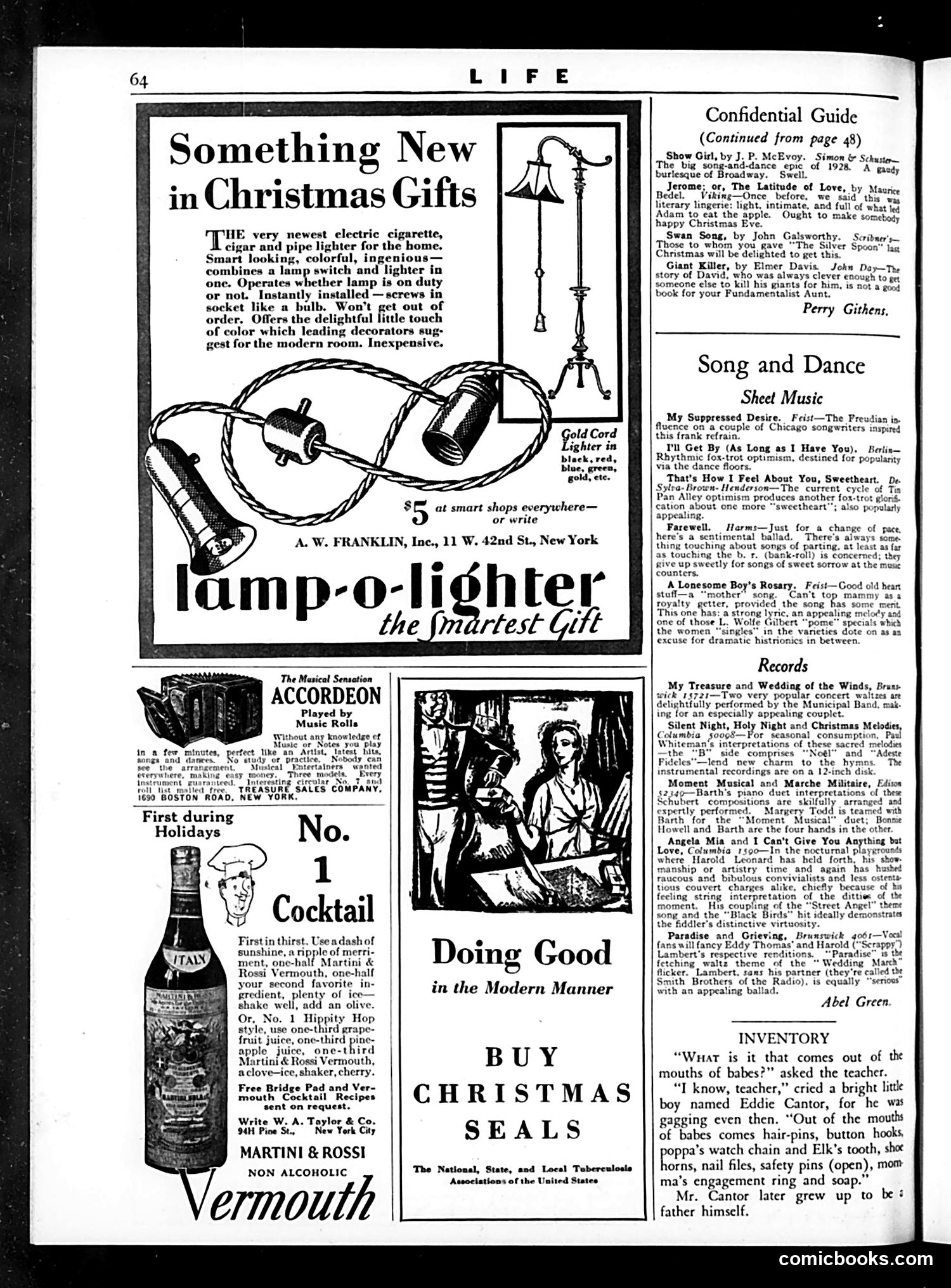
This page is primarily **advertising and entertainment content**, not political satire. It showcases Christmas gift suggestions circa 1928. The main advertisements include: - A **lamp-o-lighter** (electric cigarette/cigar lighter), marketed as a modern convenience item - An **accordion with music rolls** for home entertainment - **Martini & Rossi vermouth** for cocktails (notably "non-alcoholic," likely during Prohibition) - **Christmas Seals** from tuberculosis associations (a genuine charitable campaign) The right column contains book and music reviews recommending seasonal purchases. **Historical context for modern readers**: This reflects 1920s consumer culture—electrified homes, commercial entertainment, and cocktail sophistication. The "non-alcoholic vermouth" is notable given Prohibition (1920-1933); alcohol was technically illegal but vermouth was marketed creatively. The tuberculosis seal campaign represents pre-antibiotic medicine when TB was a major public health concern. There is no political cartoon or satire visible on this page.
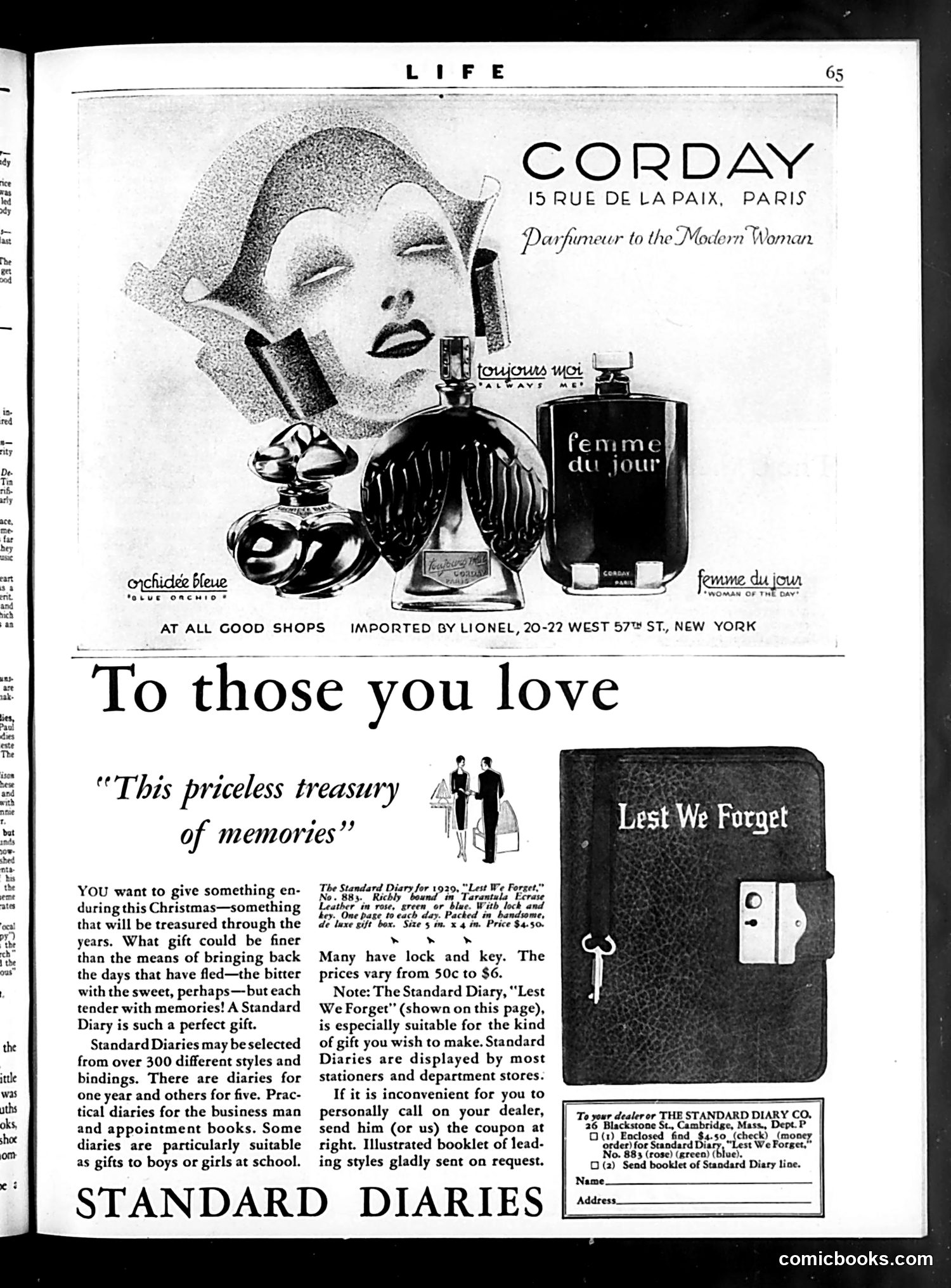
This page combines two distinct advertisements with no political satire present. **Top Advertisement (Corday Perfume):** Shows a stylized 1920s woman's face with marcelled waves and bold makeup, advertising French perfumes ("Orchidée Bleue," "Toujours Moi," "Femme du Jour"). The tagline "Parfumeur to the Modern Woman" targets affluent female consumers during the Jazz Age, emphasizing sophistication and cosmopolitan elegance. The imagery reflects 1920s beauty standards. **Bottom Advertisement (Standard Diaries):** Promotes diaries as Christmas gifts, emphasizing sentimental value ("priceless treasury of memories"). Features the "Lest We Forget" diary model with lock and key—likely a subtle reference to WWI's recent conclusion (1918), appealing to buyers wanting to preserve personal wartime memories. The gift-giving angle and pricing ($4.50 top model, down to 50¢) targets middle-class consumers. Both ads reflect post-war consumer culture and modern femininity of the 1920s era.
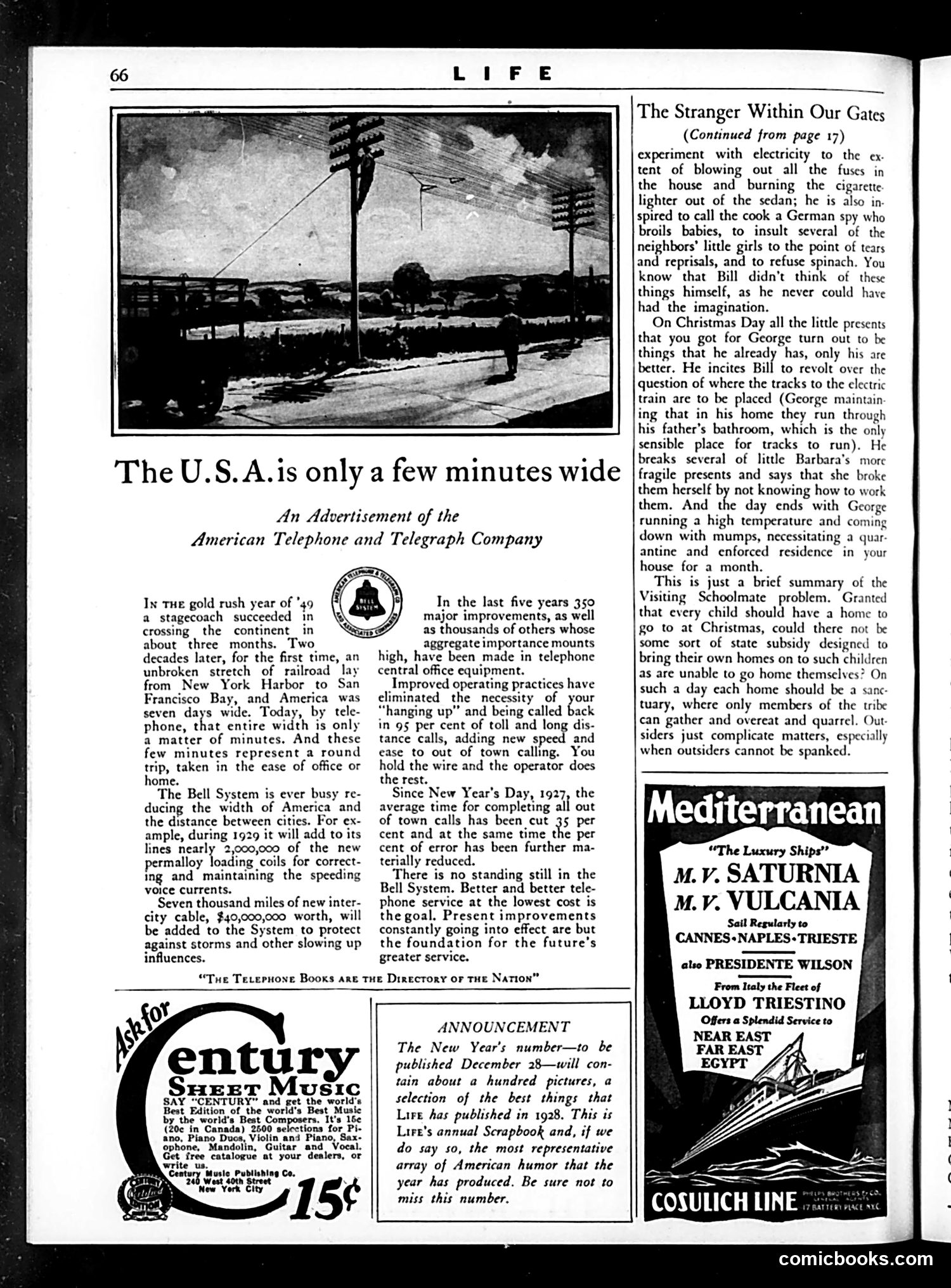
This page consists primarily of **advertisements and announcements** rather than political cartoons. The main content is a **corporate advertisement for American Telephone & Telegraph (Bell System)**, using patriotic language to celebrate telephone infrastructure. It contrasts historical progress—a stagecoach crossing America in three months (1849), then railroads in "seven days," to modern telephone technology spanning "only a few minutes." The ad emphasizes Bell's ongoing investments in cables and equipment to reduce call completion times. The page also includes smaller ads for Century Music records and Mediterranean cruise ships, plus an announcement that Life's upcoming New Year's issue will be an annual "Scrapbook" of 1928's best humor. The right column continues a story titled "The Stranger Within Our Gates" about a visiting relative (George) whose misbehavior—breaking gifts, encouraging vandalism, feigning illness—disrupts a family's Christmas. **No political satire or caricature appears on this page.** It reflects 1920s corporate optimism about technology and contains standard period advertising.
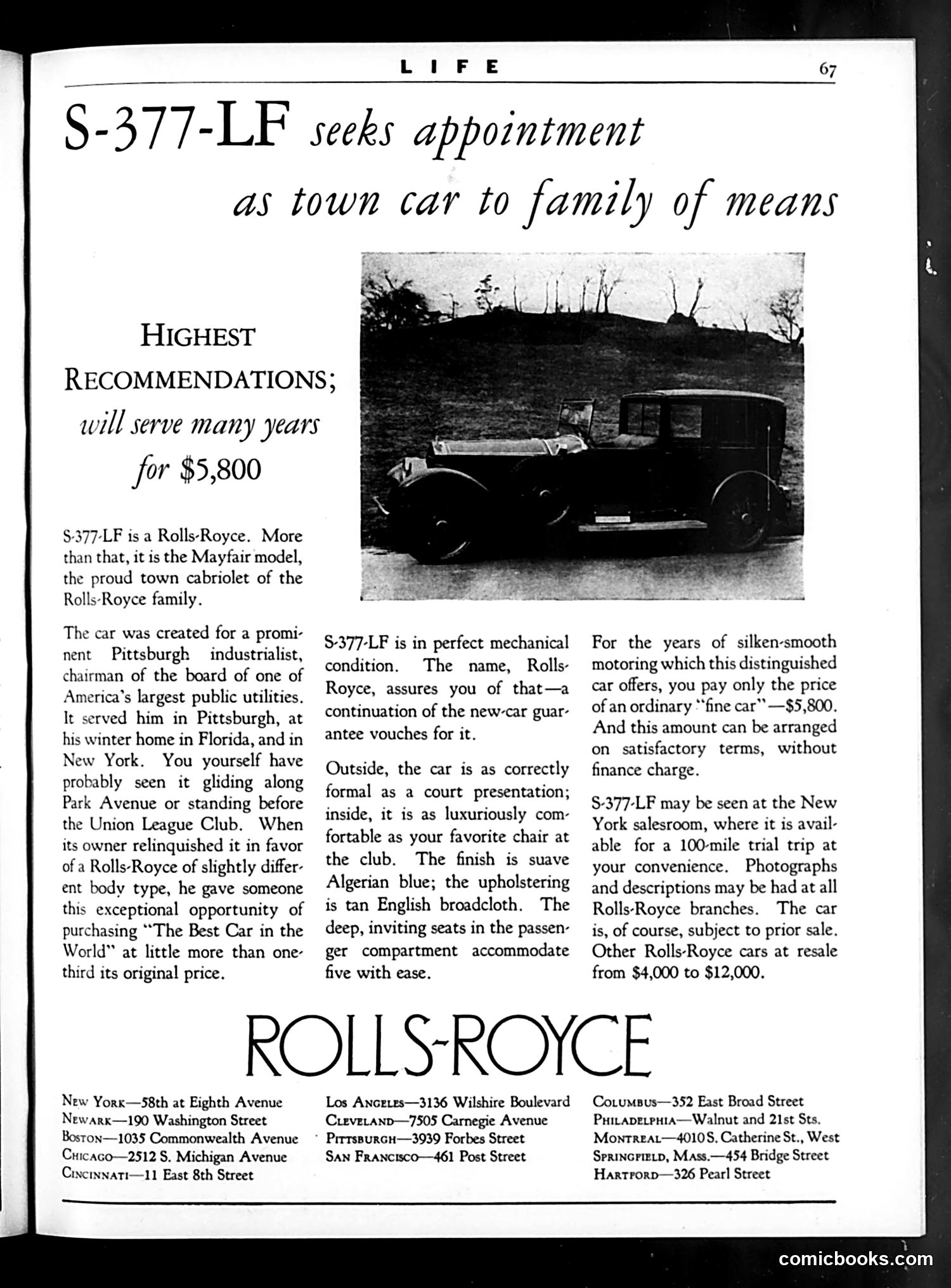
This is a **Rolls-Royce automobile advertisement**, not a political cartoon. The page uses satirical, tongue-in-cheek language typical of *Life* magazine's advertising style in the early 20th century. The "satire" is gentle: the ad personifies the car (S-377-LF) as if seeking employment as a "town car to a family of means," presenting it as a used vehicle originally owned by a prominent Pittsburgh industrialist. The humor lies in the mock-formal job-application tone and the emphasis on the car's *previous* prestigious ownership—it's selling luxury through pedigree and social status. The real point is marketing: a $5,800 Rolls-Royce (presented as a bargain, being "one-third its original price") to wealthy buyers who value exclusivity and appearance. The car's features—formal styling, comfortable interior, Algerian blue finish—appeal to aspirational affluence during the Jazz Age. This reflects 1920s consumer culture: luxury goods marketed through implied social prestige rather than mechanical superiority alone.
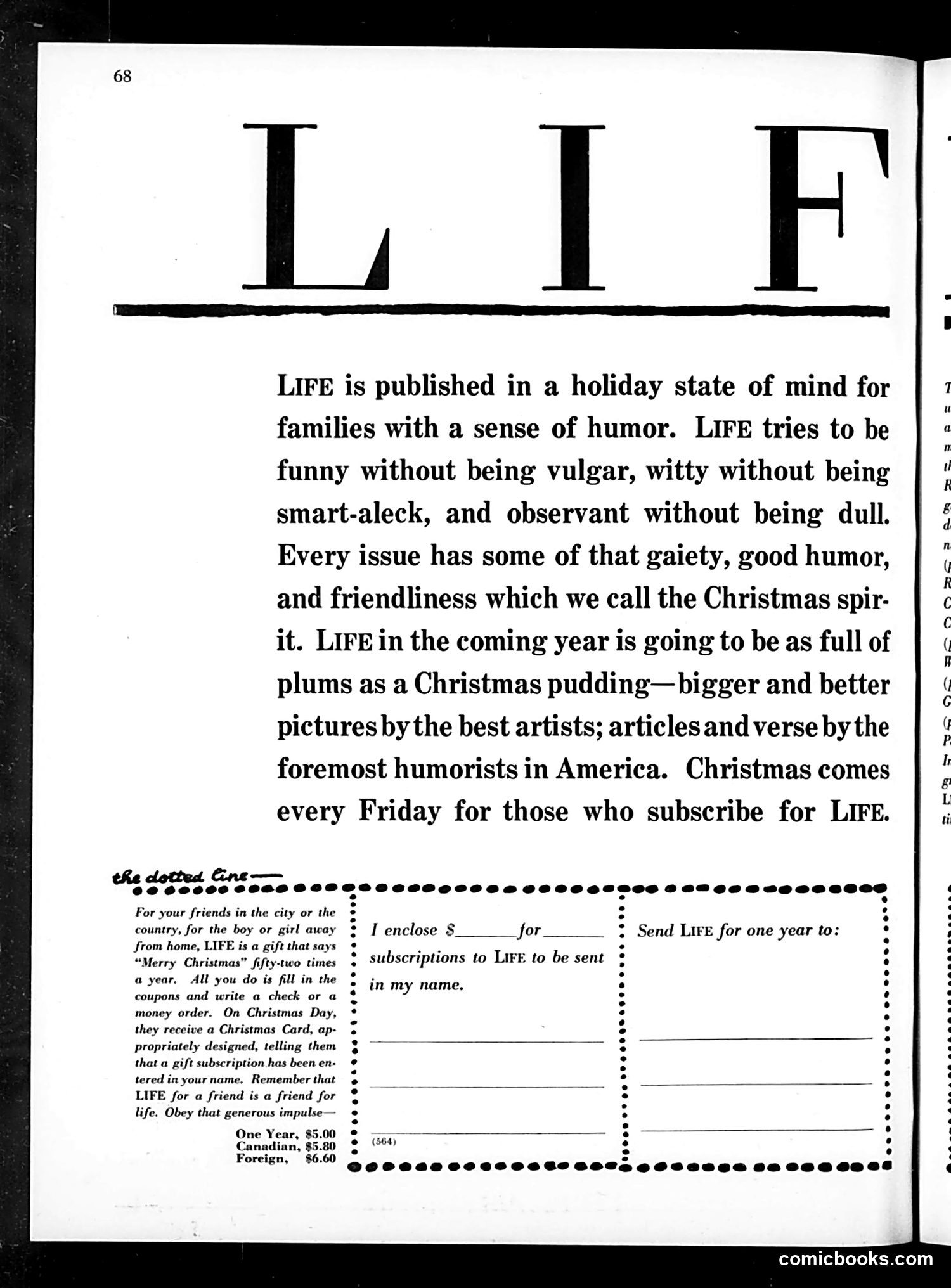
This is a **title page and gift subscription advertisement**, not a cartoon. The page promotes *Life* magazine as a humor publication suitable for families, emphasizing its "Christmas spirit" and promising "bigger and better pictures by the best artists" and contributions from "foremost humorists in America." The advertisement below pitches gift subscriptions as an ideal Christmas present—subscribers receive 52 "Merry Christmas" messages yearly. The clever tagline "LIFE for a friend is a friend for life" plays on the magazine's name. Pricing is listed: $5.00 for one year domestically, with Canadian and foreign rates slightly higher. The dotted coupon sections allow readers to purchase subscriptions for multiple recipients, making it convenient holiday gift-giving by mail—a marketing strategy common in early 20th-century magazines.
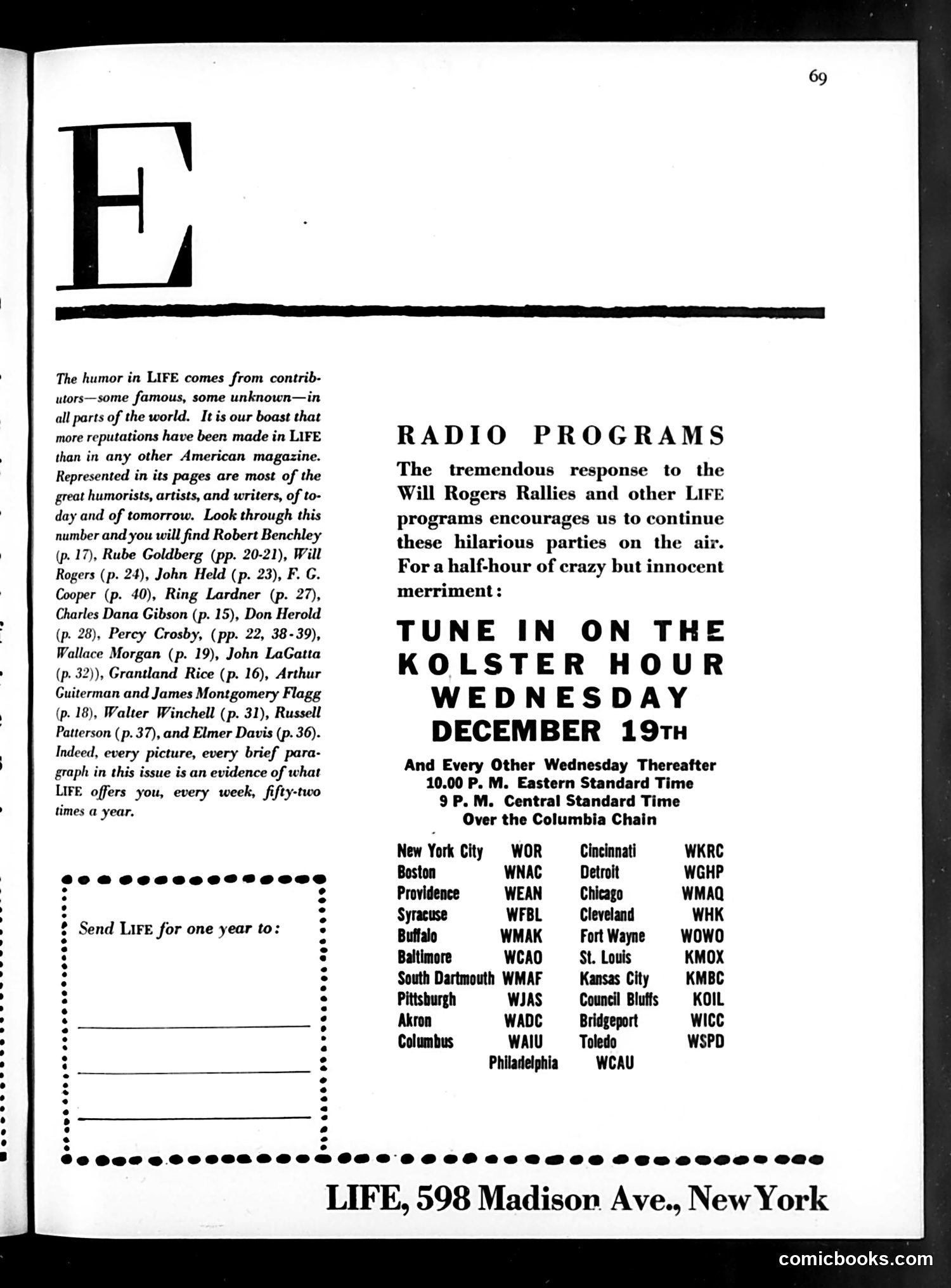
This page is primarily a **promotional announcement** rather than editorial content. Life magazine advertises its contributors—naming famous humorists like Will Rogers, Rube Goldberg, and Ring Lardner—to establish itself as publishing America's premier talent. The main content announces **"The Kolster Hour,"** a radio program debuting December 19th, featuring Will Rogers Rallies and "crazy but innocent merriment." The Kolster was a radio manufacturer sponsoring entertainment programming; Life is promoting its own radio show across the Columbia Broadcasting Chain, listing affiliate stations nationwide. The subscription form invites readers to "Send Life for one year." This reflects 1920s-30s media expansion when magazines partnered with radio networks, and demonstrates Life's cultural influence—it didn't just publish humor; it produced entertainment across platforms. The "tremendous response" claim suggests the venture was commercially successful.
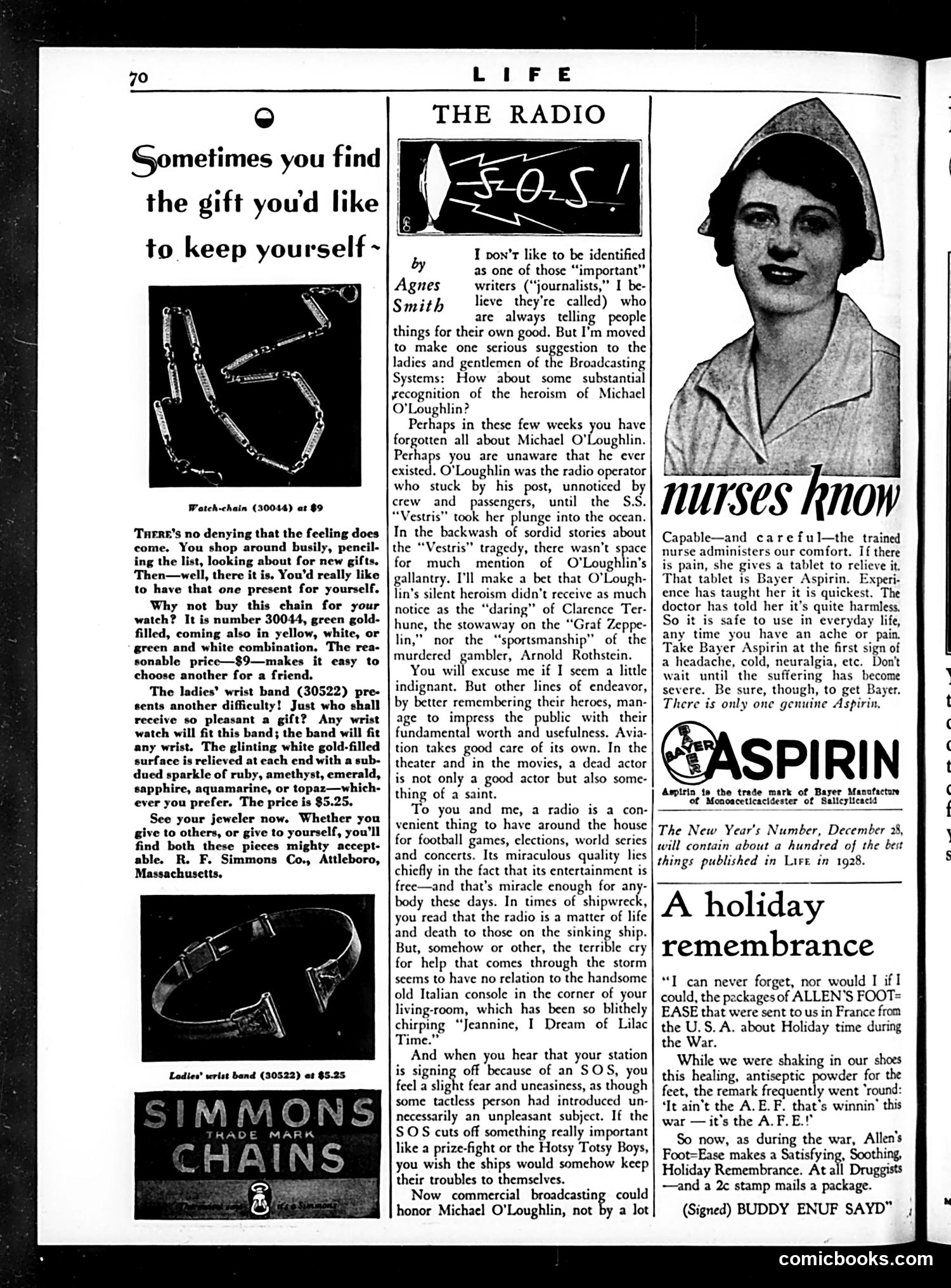
This page contains gift advertisements and a satirical radio column by Agnes Smith. **The Advertisements:** The left side promotes jewelry from R.F. Simmons Co.—watch chains and wrist bands priced $5.25-$9—presented as gifts one might secretly want for oneself. **"The Radio" Column:** Smith criticizes radio broadcasters for failing to honor Michael O'Loughlin, a radio operator who died at his post during the sinking of the S.S. *Vestris* (a real 1928 maritime disaster). She argues that other professions—aviation, theater, movies—memorialize their heroes, but radio hasn't recognized O'Loughlin's sacrifice despite radio's life-saving role in emergencies. Smith's satire targets commercial broadcasting's disconnect: radio stations will interrupt entertainment for SOS distress calls, yet they fail to honor the operators whose dedication makes such rescues possible. She suggests the industry treats radio as mere entertainment rather than acknowledging its serious humanitarian function. The column contrasts radio's trivial programming (football, concerts) with its genuine capacity to save lives—a tension unresolved by the industry's silence on O'Loughlin.
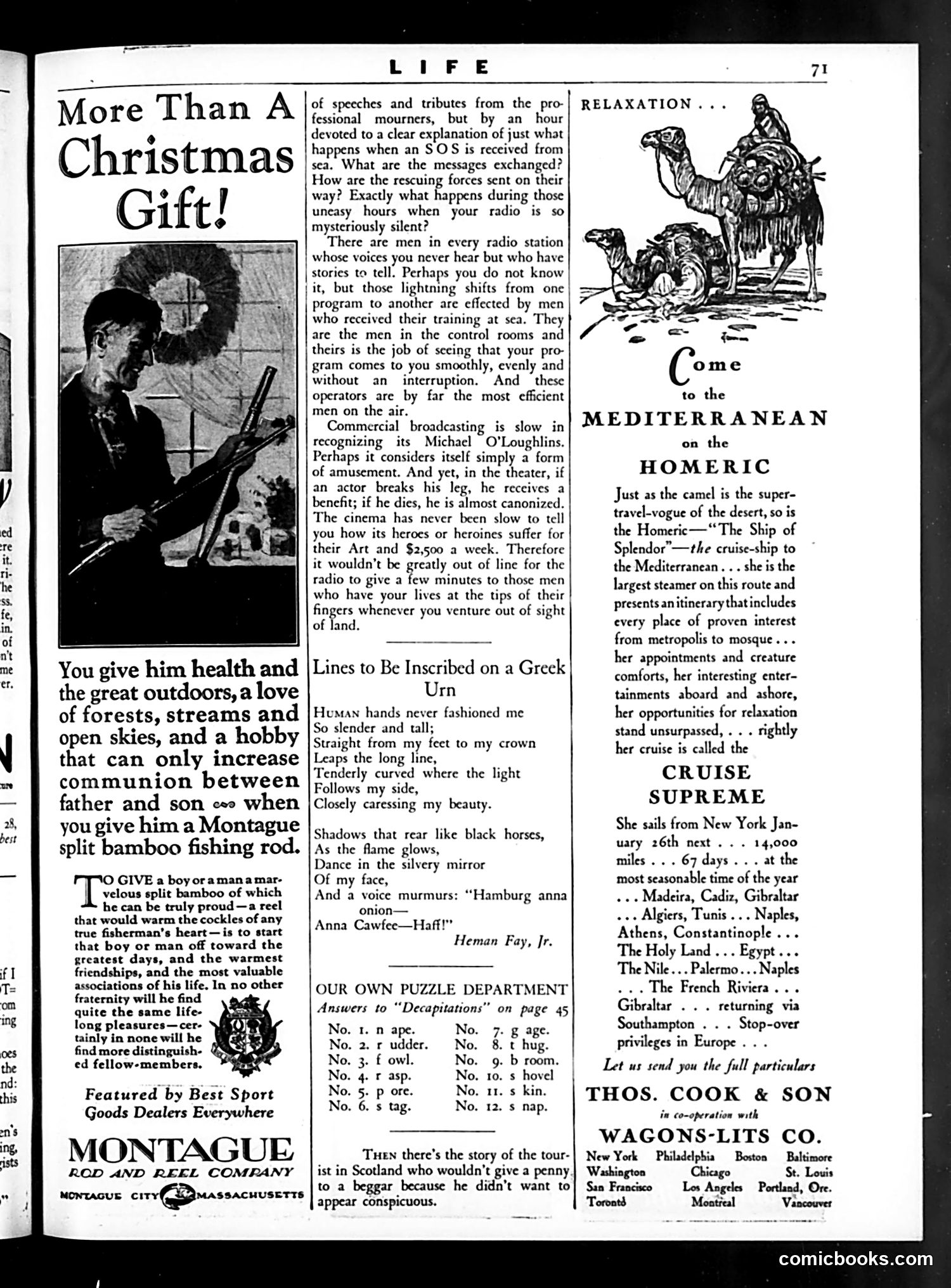
This page combines advertisements with editorial content typical of 1920s-30s *Life* magazine. **Main Advertisement:** Montague fishing rods occupy the left third—a gift-giving pitch emphasizing that giving a boy fishing equipment builds character, outdoor appreciation, and father-son bonding. The rhetoric ("truly proud," "cockles of any true fisherman's heart") is earnest and sentimental about masculine self-improvement through angling. **Editorial Content:** The center discusses radio operators who work behind the scenes during maritime rescues and broadcasts—invisible heroes deserving recognition comparable to theater actors or film stars. This appears to be advocacy for recognizing working-class technical labor. **Poetry and Humor:** "Lines to Be Inscribed on a Greek Urn" satirizes advertising copy by presenting a product (likely a coffee pot) in overwrought, mock-classical language—poking fun at inflated sales rhetoric. The final joke mocks Scottish frugality. **Cruise Advertisement:** The Homeric ship advertises Mediterranean travel to wealthy readers. The page reflects *Life's* mix of consumerism, social commentary, and gentle satire.
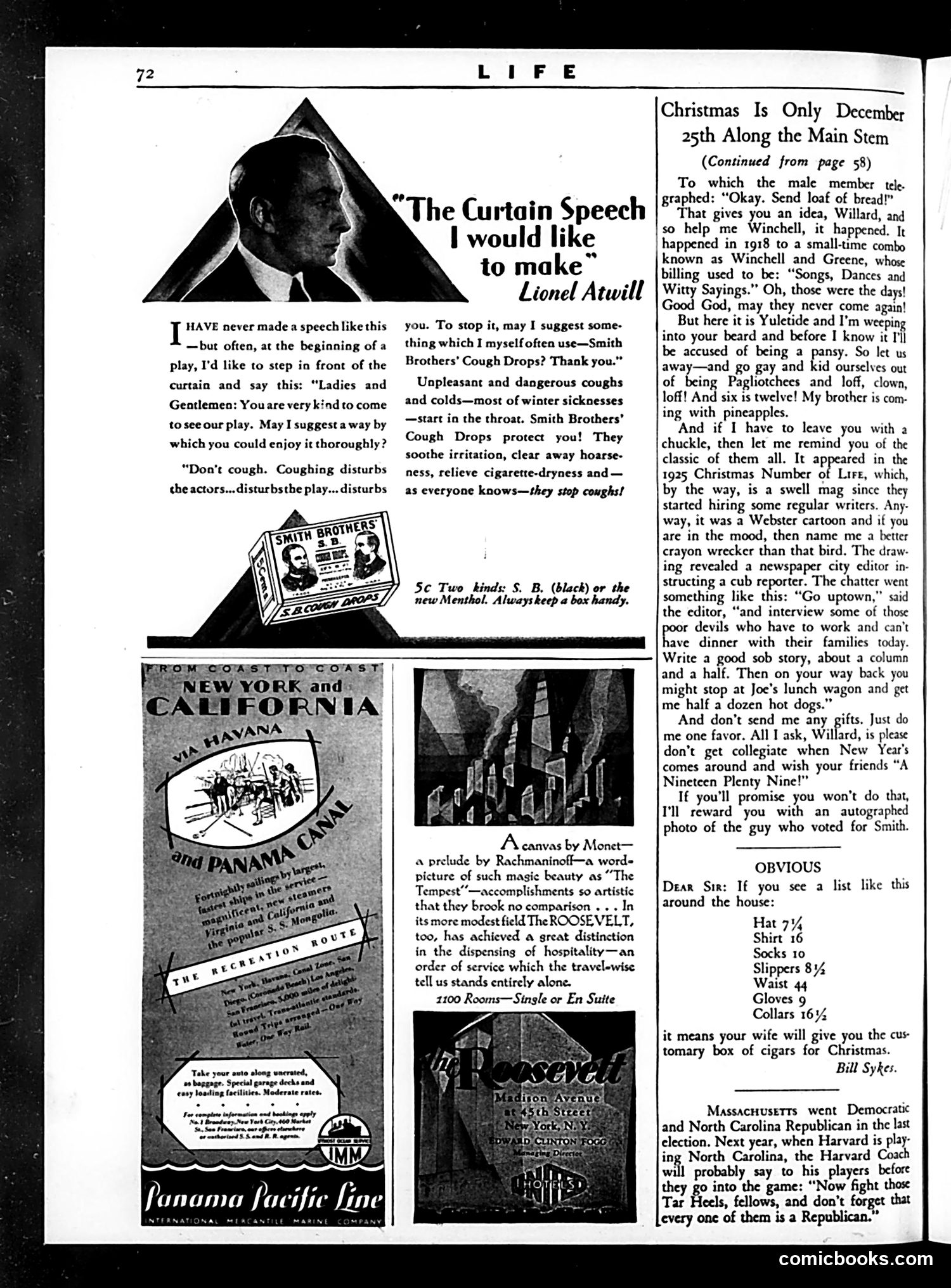
This page contains **primarily advertisements and light comedy** rather than political satire. The main content features **Lionel Atwill**, a stage actor, endorsing Smith Brothers' Cough Drops by describing a curtain speech he'd like to give asking theater audiences not to cough during performances. The advertisement uses his celebrity to promote the product as a throat remedy. The page includes travel advertisements (Havana, Panama Canal, Roosevelt Hotel) typical of 1920s-era Life magazine. A brief humor column by what appears to be a gossip columnist discusses Christmas gift-giving and makes a light joke about Harvard-North Carolina football rivalry based on 1928 election results (Massachusetts went Democratic, North Carolina Republican). The **Monet painting reference** and Roosevelt Hotel ad appeal to readers' aspirational class sensibilities—common advertising strategy of the era. Overall, this is a **commercial and entertainment page** with minimal political content, reflecting Life's shift toward lifestyle advertising in the late 1920s.
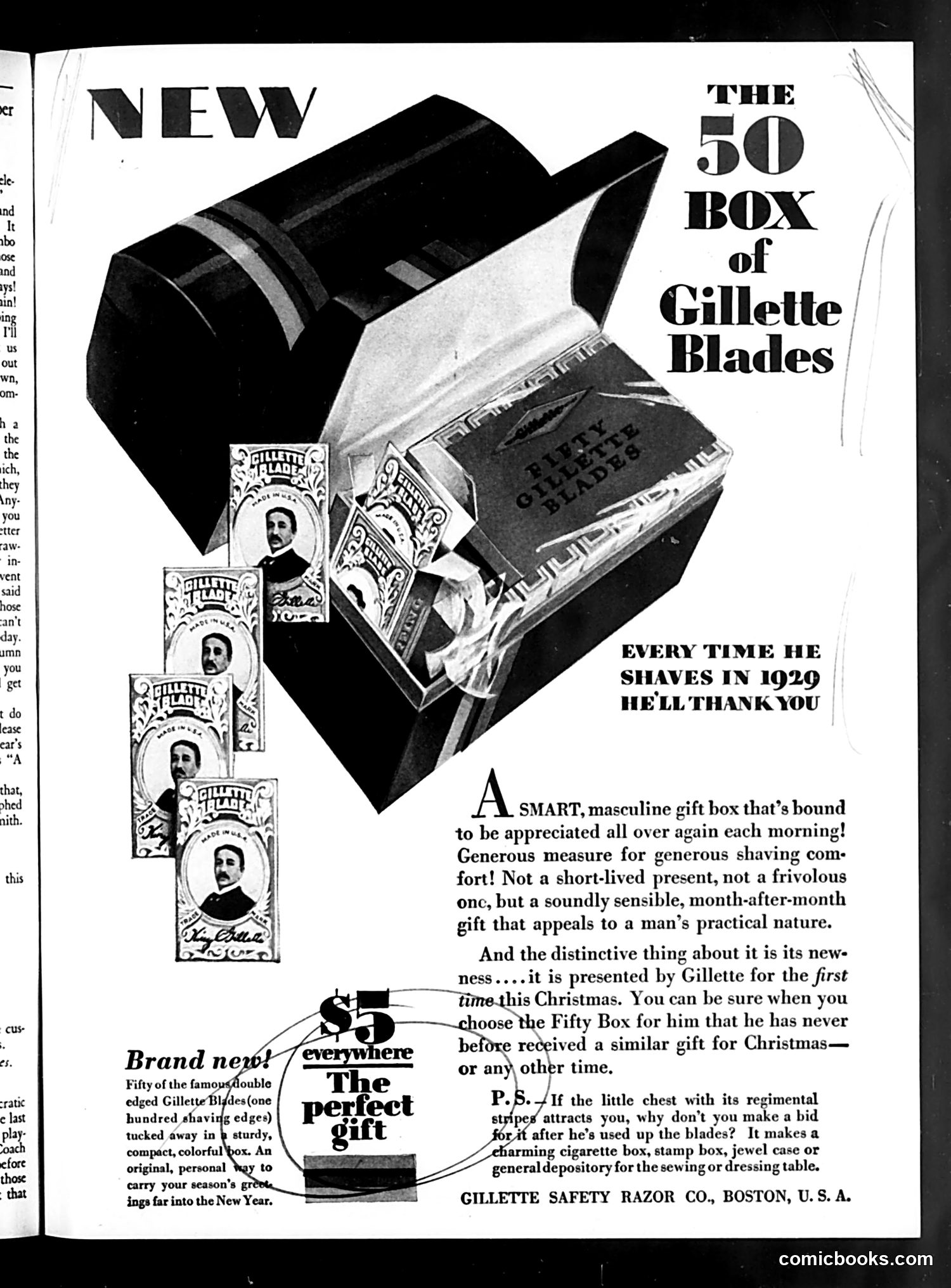
This is a **Gillette Safety Razor advertisement**, not a political cartoon. It promotes "The 50 Box of Gillette Blades" as a Christmas gift for 1929. **Key elements:** The ad uses the marketing strategy of positioning razors as a practical, recurring gift—something a man will appreciate "every time he shaves in 1929." The text emphasizes this isn't frivolous but "soundly sensible," appealing to masculine practicality. The decorative box shown features regimental stripes and the Gillette branding. A clever secondary pitch suggests the attractive chest, once emptied of blades, could be repurposed as a cigarette, stamp, or jewelry box—extending its perceived value. **Historical context:** This reflects early 20th-century consumer marketing emphasizing utility and durability. The mention of "the first time" Gillette presents such a gift signals novelty in packaging/marketing rather than product innovation. The ad targets gift-givers seeking something a male recipient would use continuously rather than a one-time novelty item.
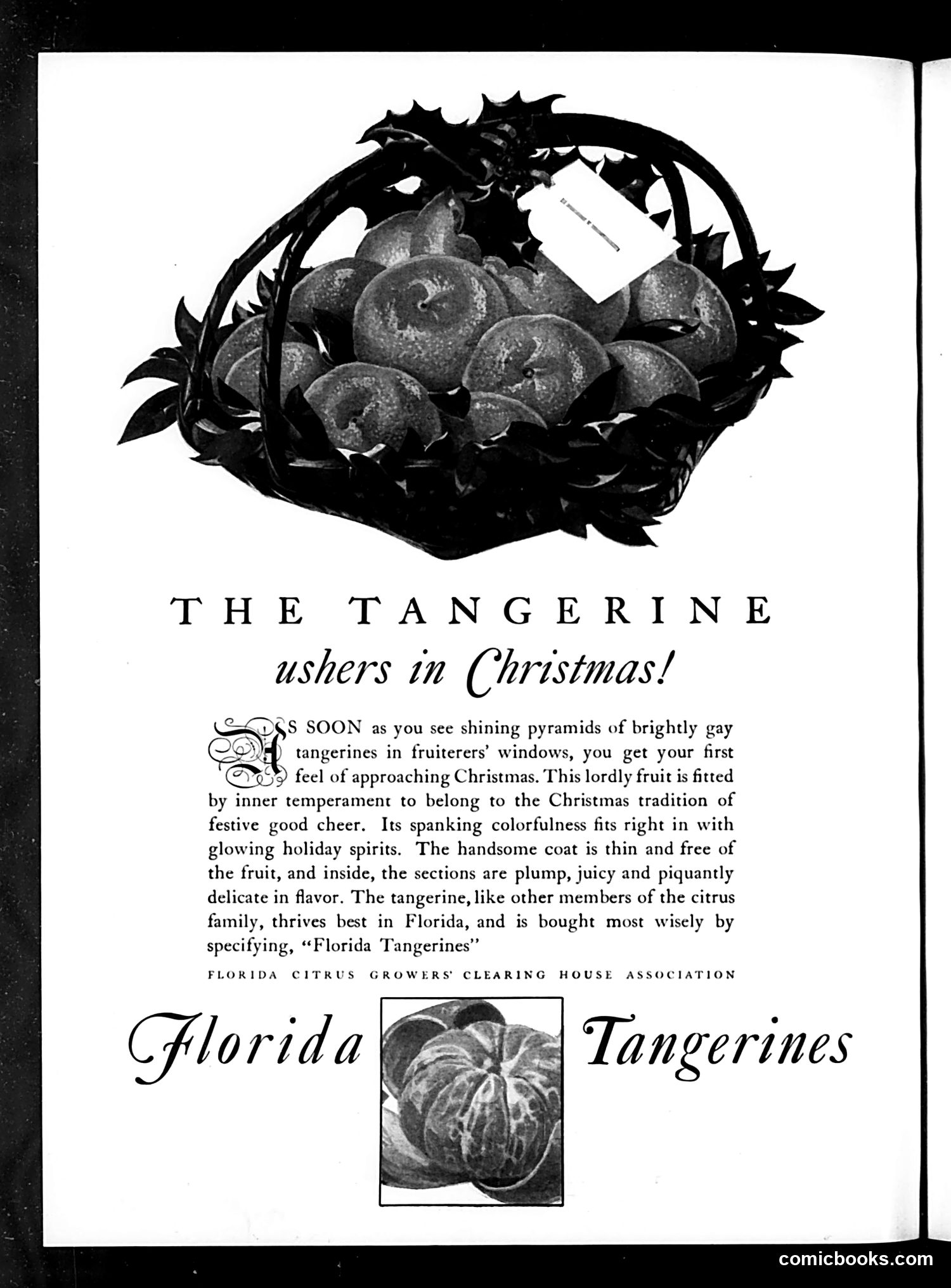
This is **not a political cartoon or satire**—it's a straightforward **advertisement** for Florida tangerines as a Christmas fruit, placed by the Florida Citrus Growers' Clearing House Association. The page uses marketing language to associate tangerines with holiday tradition and festive cheer, emphasizing their bright color, easy-to-peel skin, and juicy interior. It includes two images: an ornate basket of tangerines at top, and a single peeled fruit below, to showcase the product's appeal. The only "message" is commercial: buy Florida tangerines specifically (the ad notes they "thrive best in Florida") during the Christmas season. This represents early 20th-century advertising strategy—linking products to holidays and emotions rather than relying on practical product information alone. There is no satire or political content present.
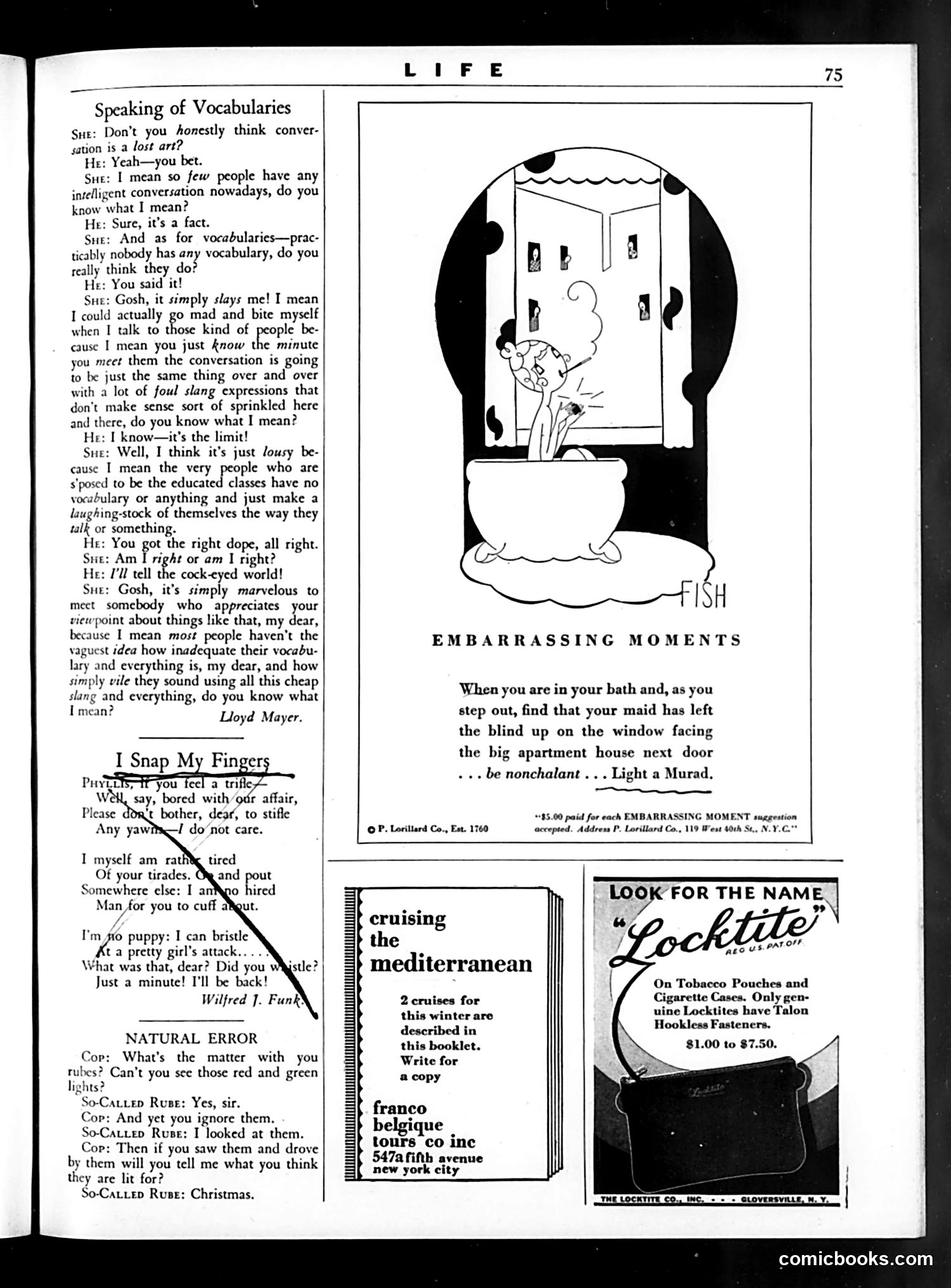
**"Speaking of Vocabularies"**: This dialogue satirizes people who complain about others' poor vocabulary while simultaneously demonstrating abysmal vocabulary themselves. Sue criticizes the "educated classes" for lacking vocabulary and using "foul slang," yet her own speech is repetitive ("I mean," "my dear") and intellectually empty. The joke is ironic: she's oblivious to her own linguistic inadequacy while pontificating about language standards. This mocks social pretension and self-awareness gaps. **"Embarrassing Moments"**: A brief humorous scenario about bathroom exposure—a maid leaving a window blind open while the bather exits the tub, visible to neighbors in an adjacent apartment building. The caption suggests maintaining composure ("be nonchalant") by smoking a cigarette. This reflects 1920s-30s social anxieties about modesty and propriety. **"I Snap My Fingers" and "Natural Error"**: Light humor pieces about relationship dynamics and mistaken traffic signals (the "So-Called Rube" confuses red/green lights with Christmas decoration). The page is primarily **satirical social commentary** mixed with advertising.
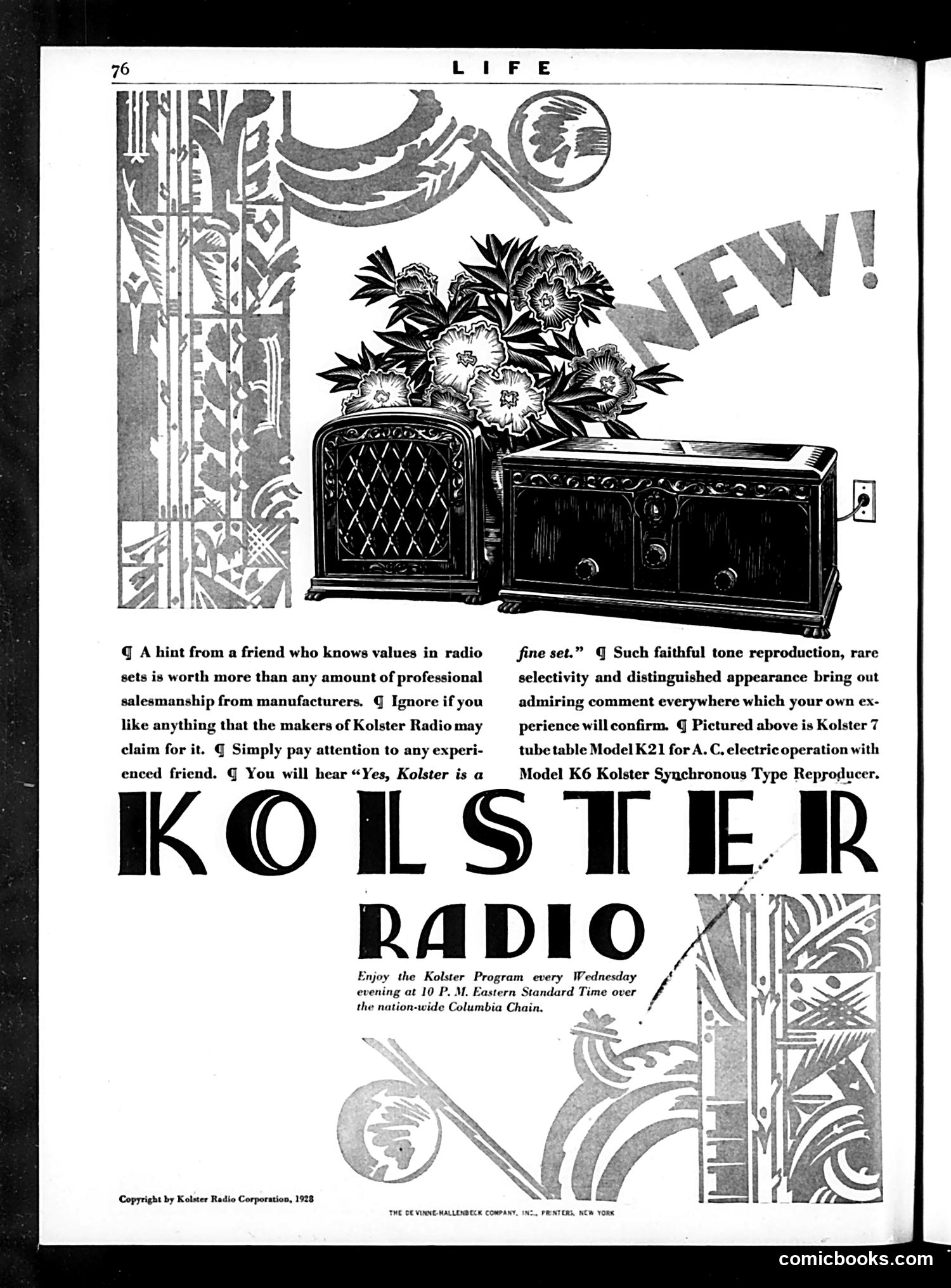
This is a **product advertisement**, not a political cartoon. It promotes Kolster Radio sets from 1928. The ad uses a marketing strategy appealing to word-of-mouth recommendations over formal salesmanship. It depicts two radio models with decorative Art Deco styling and a vase of flowers, emphasizing their "distinguished appearance." The copy suggests that satisfied users naturally praise Kolster radios for their "faithful tone reproduction" and "rare selectivity." The ad also promotes "The Kolster Program," a radio show broadcast Wednesdays at 10 P.M. over the Columbia network—likely featuring entertainment to drive interest in the sets themselves. For modern readers: this represents early 20th-century consumer marketing, when radios were luxury items, and when sponsoring entertainment programs was a key advertising strategy. The emphasis on friend recommendations reflects pre-television consumer culture.
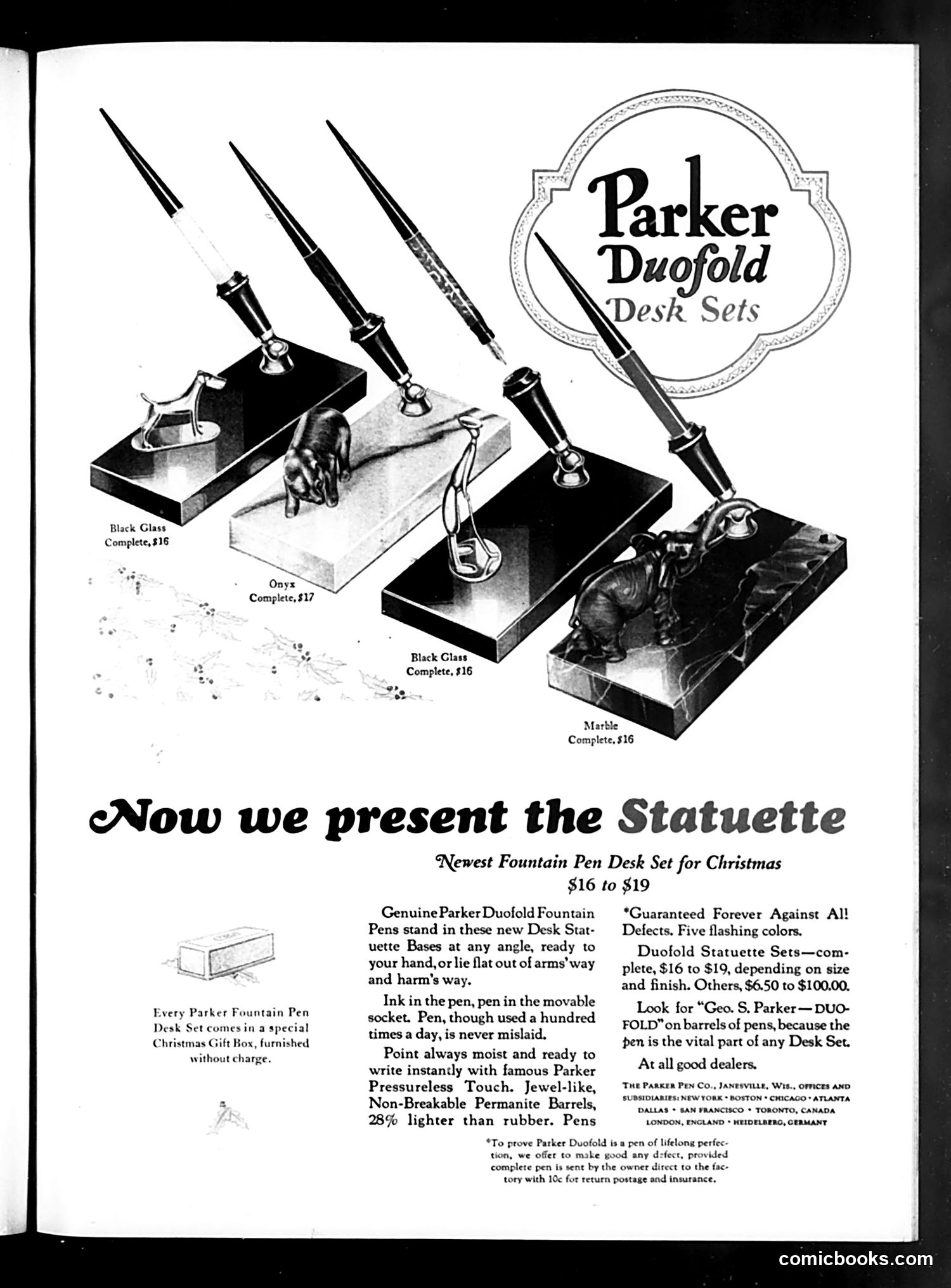
This is a **product advertisement, not a political cartoon**. It promotes Parker Duofold fountain pen desk sets as Christmas gifts ($16–$19, roughly $250–$300 in modern money). The page features four decorative desk set bases in different materials (black glass, onyx, marble) with matching fountain pens in ornamental holders. The "Statuette" bases display small sculptural figures—a dog, a classical figure, and what appears to be a bulldog or similar animal. The advertisement emphasizes durability ("Guaranteed Forever Against All Defects"), convenience (pen stored in movable socket, always ready), and quality materials (Permanite barrels, 28% lighter than rubber). It targets affluent consumers seeking prestigious gift items for the holiday season. There is no satire or political commentary present—this is straightforward luxury goods marketing from the early 20th century.
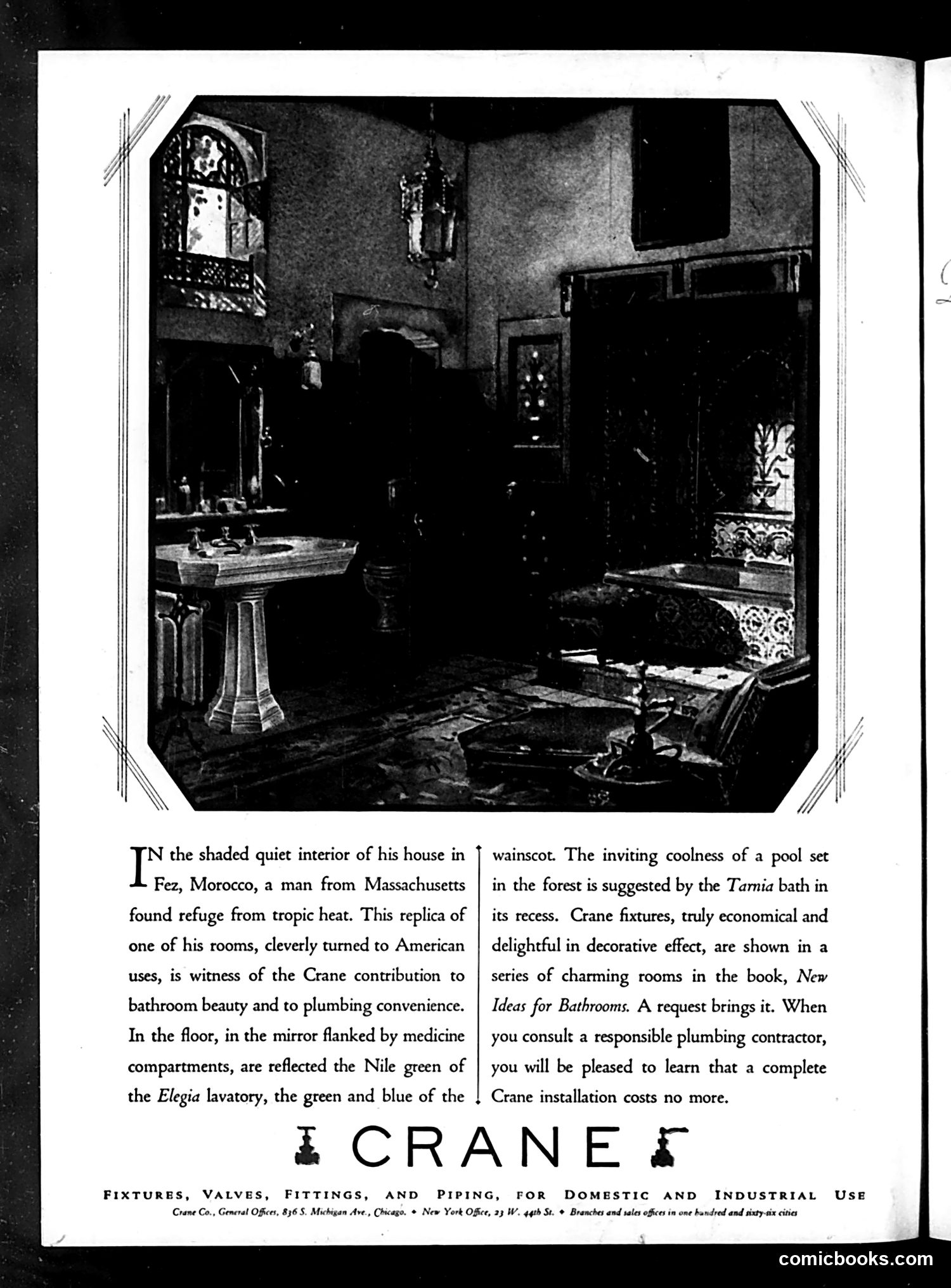
This is **not a political cartoon or satire**—it's a **full-page advertisement** for Crane plumbing fixtures. The image shows an ornate Moroccan-inspired bathroom interior designed to appeal to wealthy American consumers. The text describes how a Massachusetts man created a "Moroccan retreat" in his home using Crane bathroom products, positioning luxury plumbing as a way to achieve exotic, aspirational living spaces. The marketing strategy conflates **colonial tourism aesthetics** (references to Fez, Morocco, the Nile) with **modern American domestic convenience**. By framing Crane fixtures as enabling this fantasy, the ad suggests that installing their products grants access to worldly sophistication and escape from everyday heat and drudgery. The phrase "costs no more" is the sales pitch: luxury need not be prohibitively expensive. This reflects early-20th-century consumer capitalism targeting affluent readers of *Life* magazine. There is **no satire or political commentary**—just commercial persuasion through aspirational imagery.