
Life, 1928-12-07 · page 16 of 64
Life — December 7, 1928 — page 16: what you’re looking at
What you’re looking at
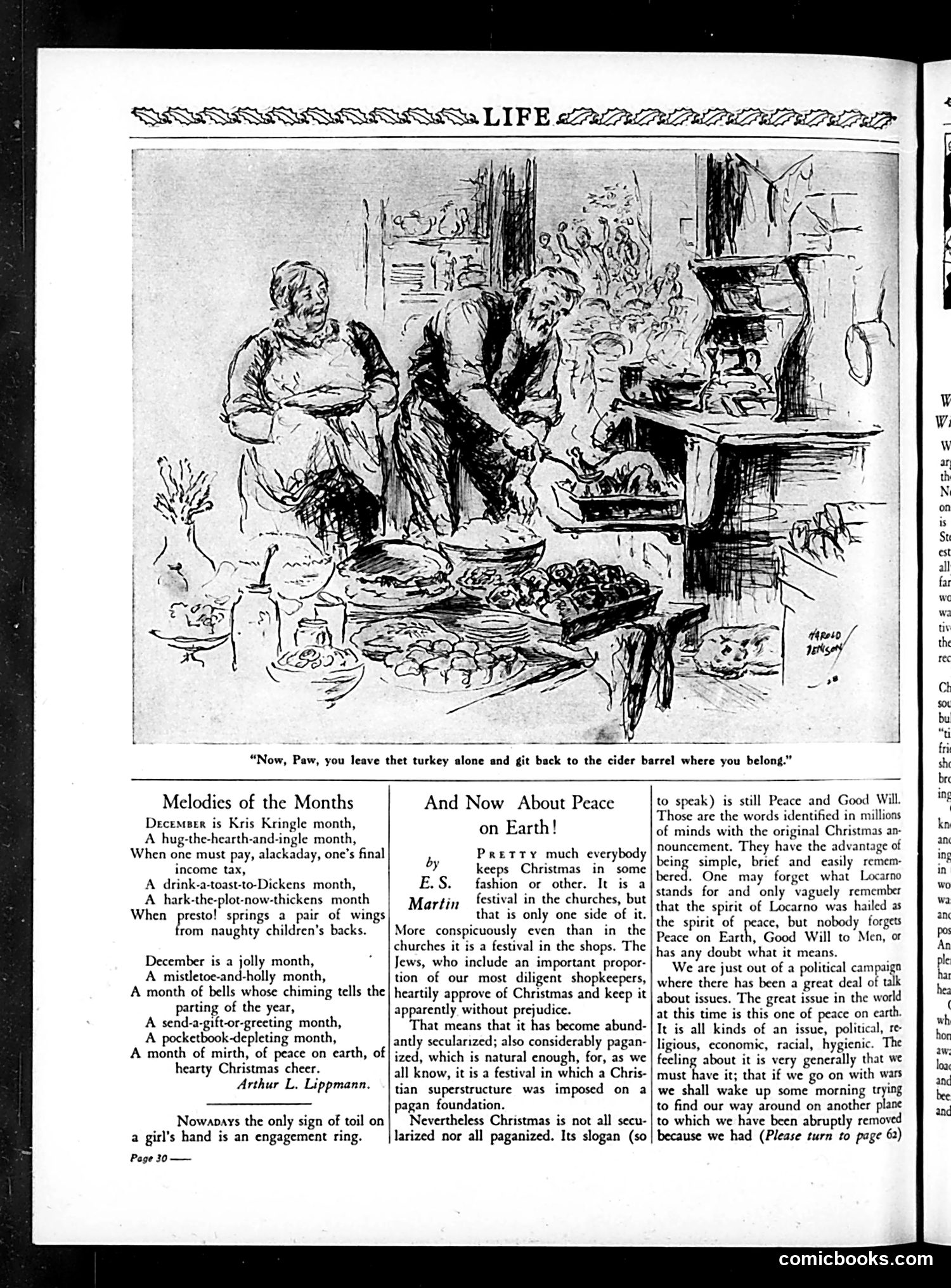
The main illustration depicts a domestic kitchen scene where a woman (likely a cook or housewife) is being scolded by a man for allowing a dog near food—specifically "that turkey" and a "cider barrel." The caption reads: "Now, Paw, you leave that turkey alone and git back to the cider barrel where you belong." This is a humorous domestic scene satirizing the tension between discipline and indulgence in household management, particularly around holiday meals (turkey suggests Christmas/Thanksgiving). The "Paw" character appears to be the man of the house being metaphorically treated like a misbehaving dog—a joke about husbands gravitating toward food and drink rather than restraint. The accompanying text columns address Christmas commercialization and peace advocacy, offering cultural commentary typical of *Life* magazine's satirical approach.
📄 Transcribed text from this page (OCR, searchable)
Machine-transcribed from the original scan — historical spelling and the odd misread are preserved.
SSeS MIS LIFE “Now, Paw, you leave thet turkey alone and git back to the cider barrel where you belong.” Melodies of the Months Decemser is Kris Kringle month, A hug-the-hearth-and-ingle month, When one must pay, alackaday, one’s final income tax, A drink-a-toast-to-Dickens month, A_hark-the-plot-now-thickens_ month When presto! springs a pair of wings rom naughty children’s backs. December is a jolly month, A mistletoe-and-holly month, A month of bells whose chiming tells the parting of the year, A send-a-gift-or-greeting month, A pocketbook-depleting month, A month of mirth, of peace on earth, of hearty Christmas cheer. Arthur L. Lippmann. Nowapays the only sign of toil on a girl’s hand is an engagement ring. Poge 30 — And Now About Peace on Earth! Pretty much everybody keeps Christmas in some E.S. fashion or other. It is a Martin — festival in the churches, but that is only one side of it. More conspicuously even than in the churches it is a festival in the shops. The Jews, who include an important propor- tion of our most diligent shopkeepers, heartily approve of Christmas and keep it apparently without prejudice. That means that it has become abund- andy secularized; also considerably pagan- ized, which is natural enough, for, as we all know, it is a festival in which a Chris- tian superstructure was imposed on a pagan foundation. Nevertheless Christmas is not all secu- larized nor all paganized. Its slogan (so by to speak) is still Peace and Good Will. Those are the words identified in millions of minds with the original Christmas an- nouncement. They have the advantage of being simple, brief and easily remem- bered. One may forget what Locarno stands for and only vaguely remember that the spirit of Locarno was hailed as the spirit of peace, but nobody forgets Peace on Earth, Good Will to Men, or has any doubt what it means. We are just out of a political campaign where there has been a great deal of talk about issues. The great issue in the world at this time is this one of peace on carth. It is all kinds of an issue, political, re ligious, economic, racial, hygienic. The feeling about it is very generally that we must have it; that if we go on with wars we shall wake up some morning trying to find our way around on another plane to which we have been abruptly removed because we had (Please turn to page 62) comicbooks.com