
A complete issue · 34 pages · 1928
Life — January 26, 1928
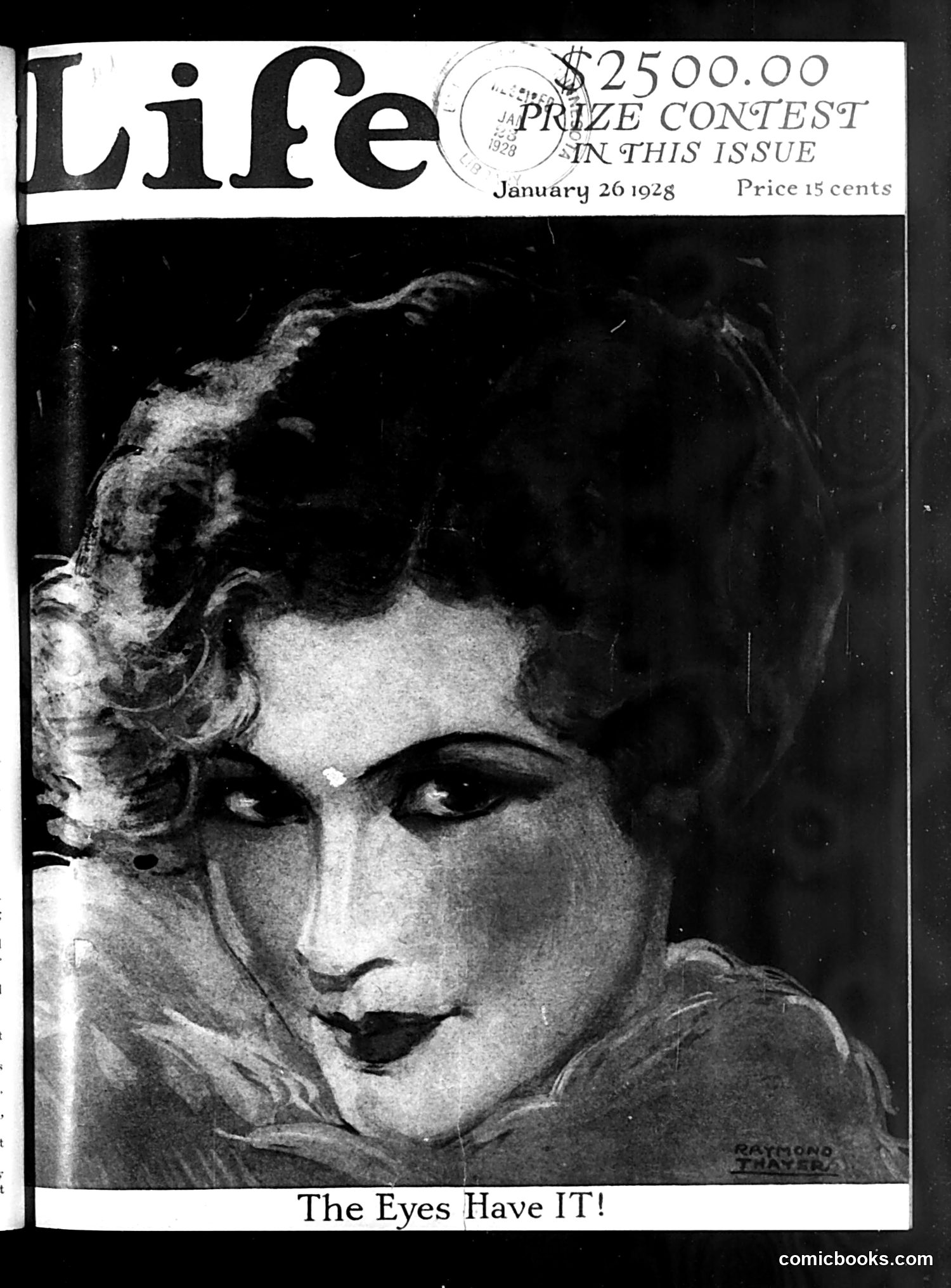
This is a **Life magazine cover from January 26, 1928**. The image shows a glamorous woman's face in close-up, with the caption "The Eyes Have IT!" The cover appears to be **celebrity-focused rather than political satire**. The photograph showcases a woman with 1920s styling—sculpted eyebrows, defined eye makeup, and curled hair—typical of silent film era beauty standards. The emphasis on "eyes" likely references either silent cinema (where actors conveyed emotion through facial expression) or contemporary beauty trends. The $2,500 prize contest advertised suggests Life was using celebrity imagery to boost circulation. Without additional context identifying the specific person pictured, the primary appeal appears to be entertainment and fashion-oriented rather than satirical commentary.
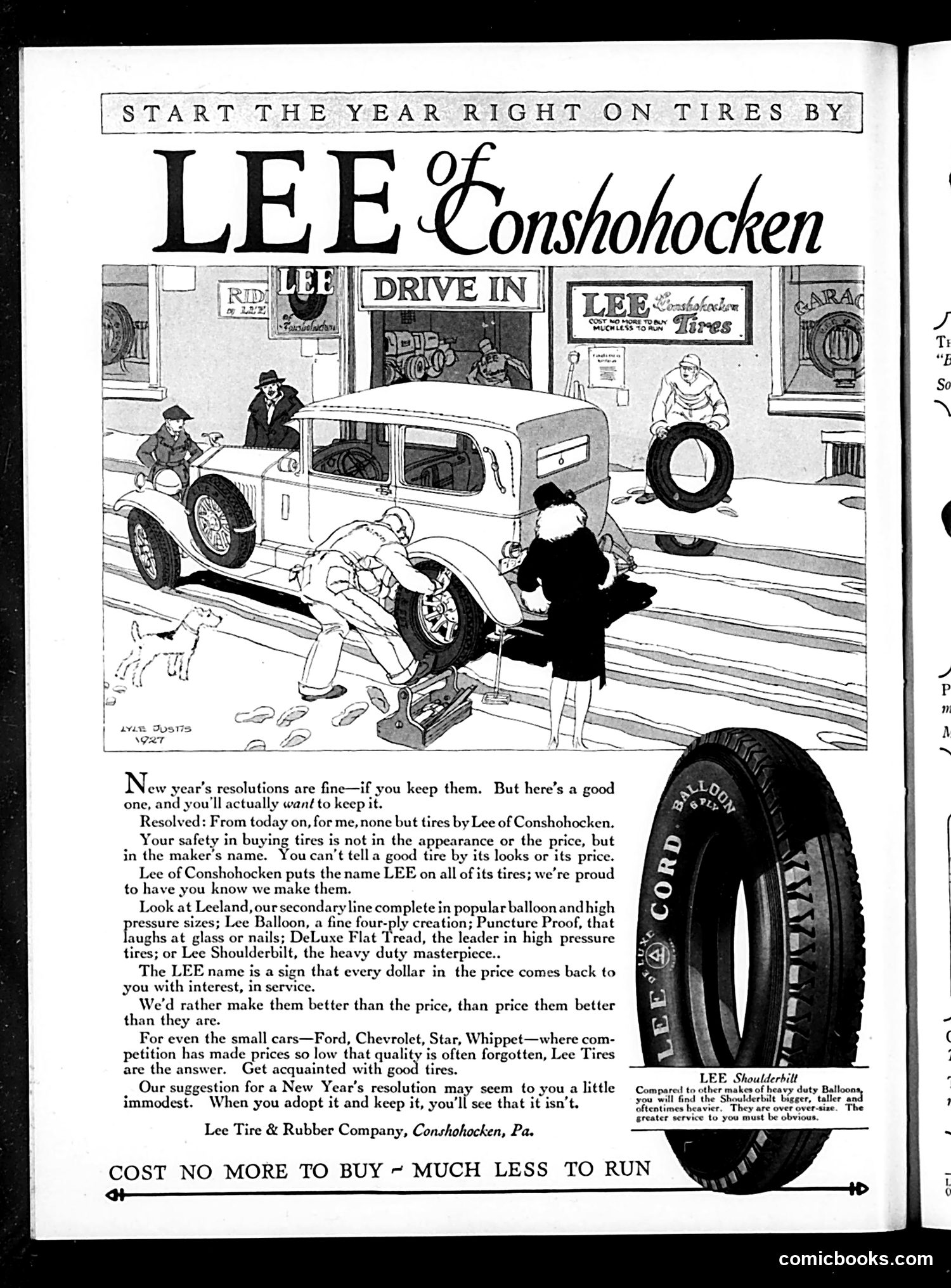
This is primarily a **tire advertisement**, not political satire. The page promotes Lee Tires of Conshohocken, Pennsylvania as a New Year's resolution. The cartoon depicts a tire shop scene where customers examine tires while a mechanic works on a vehicle. The illustration humorously shows the everyday inconvenience of tire maintenance—a relatable scenario for 1920s car owners. The advertisement's message is straightforward: resolve to buy quality Lee brand tires for safety and reliability rather than cheaper alternatives. It emphasizes that tire quality depends on the manufacturer's reputation, not appearance or low price. The tagline "Cost No More to Buy—Much Less to Run" promises value, while specific tire types (Lee Balloon, Puncture Proof, DeLuxe Flat Tread, Shoulderbilt) are marketed for different vehicle needs. This reflects the early automotive era when tire reliability was a genuine consumer concern.
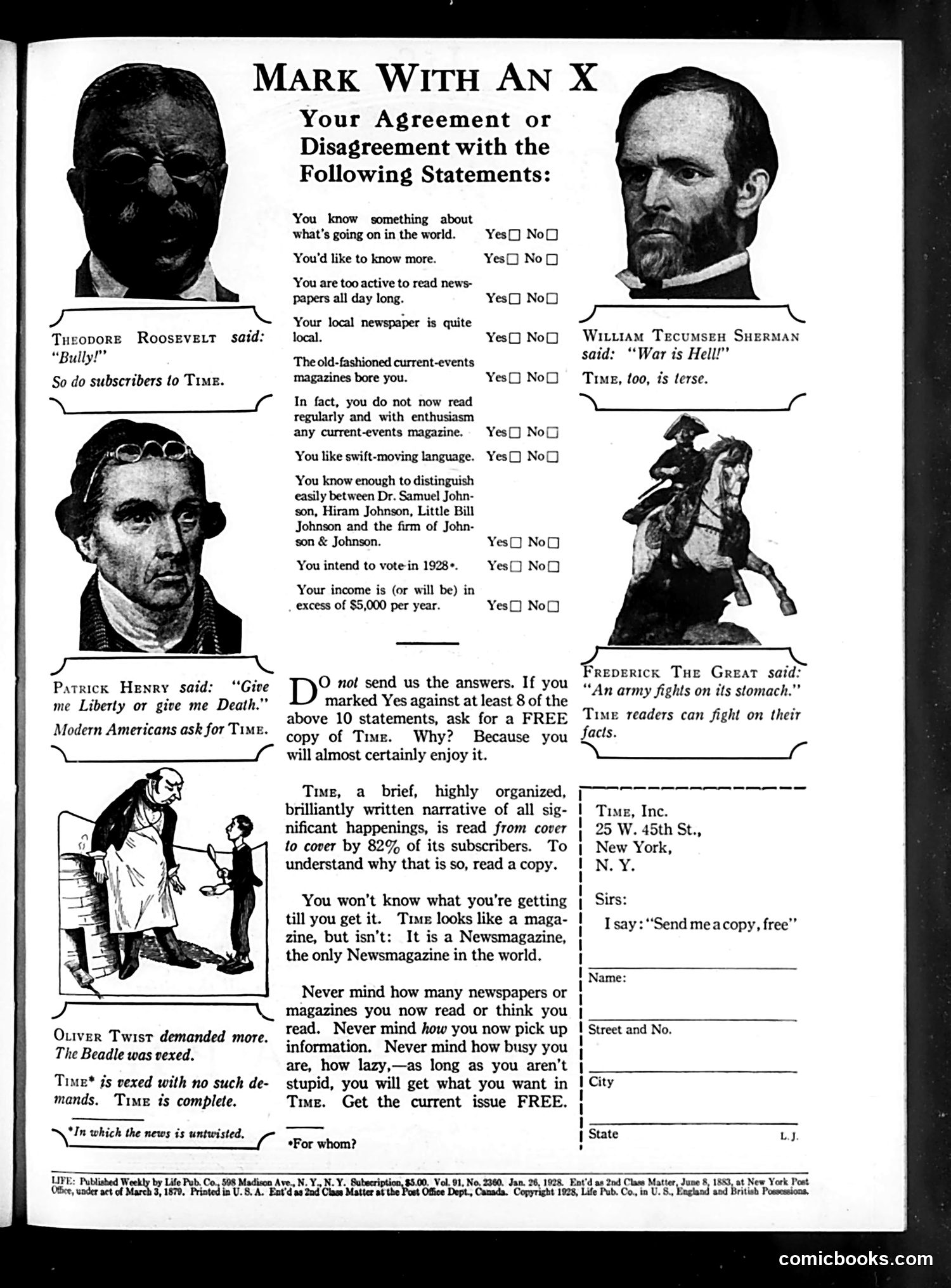
This is a **TIME Magazine subscription advertisement** disguised as political satire (circa 1928, based on the "1928" voting reference). The page features four historical figures—Theodore Roosevelt, William Tecumseh Sherman, Patrick Henry, and Frederick the Great—each paired with famous quotes about action, liberty, or warfare. The satire suggests these great men would endorse TIME Magazine as essential reading for informed citizens. The bottom section mocks other publications, claiming TIME is the "only Newsmagazine in the world" and boasts 82% subscriber retention. The joke is that TIME presents itself as indispensable for intelligent people—implying that not reading it would be un-American or foolish. The advertisement encourages readers to request a free copy by completing the form provided.
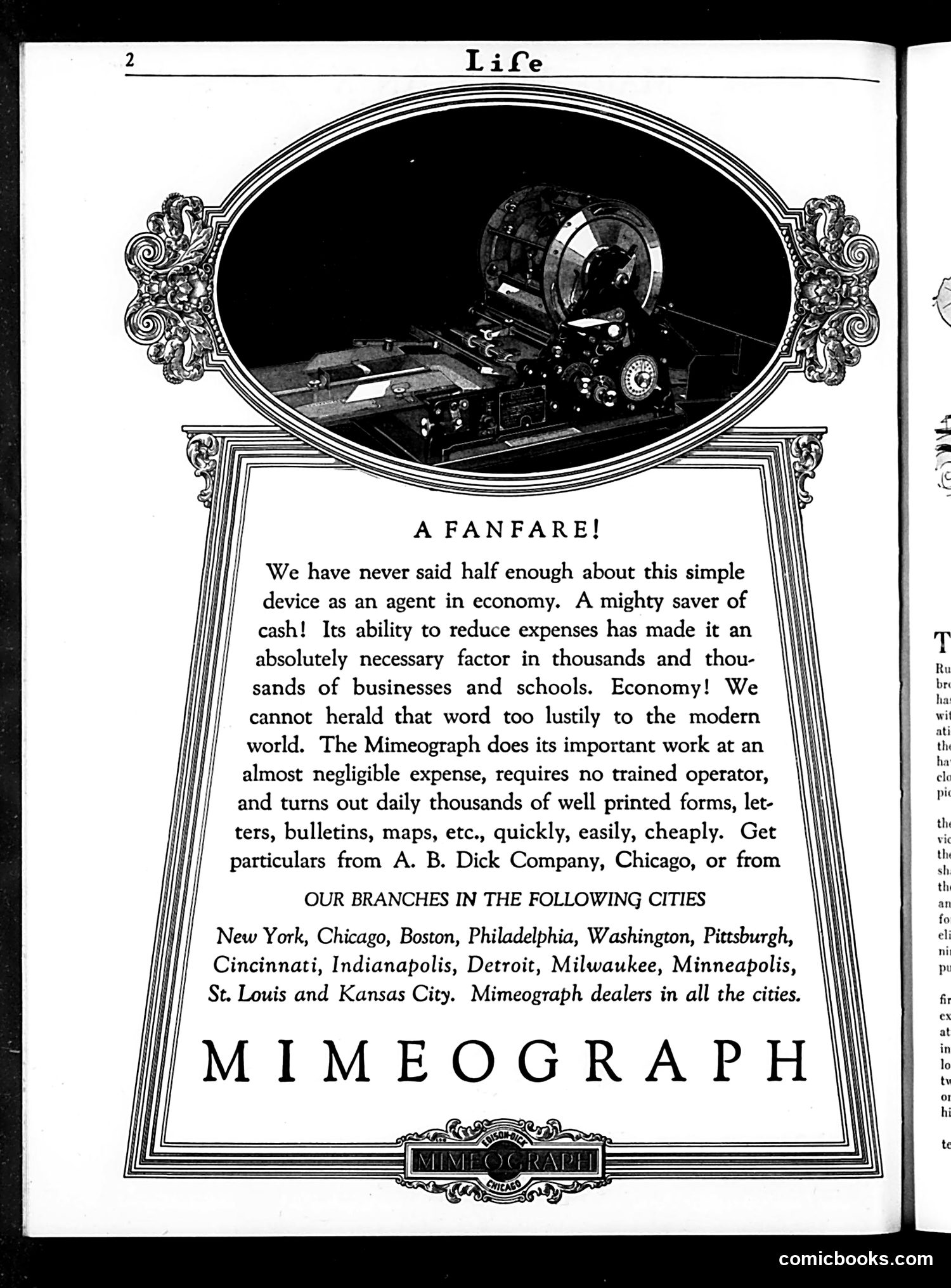
This page is primarily **advertising copy**, not editorial satire. It promotes the Mimeograph machine—a document reproduction device—manufactured by the A. B. Dick Company of Chicago. The ad uses enthusiastic language ("AFANFARE!") to tout the mimeograph as an economical business tool that reduces printing costs. It emphasizes the device's speed and low operational expense, claiming it produces "thousands of well printed forms, letters, bulletins, maps, etc., quickly, easily, cheaply." The decorative oval photograph at top shows the mimeograph equipment itself. The ad lists the company's branch offices across major American cities and mentions mimeograph dealers are available nationwide. This reflects early-20th-century business culture, when mimeography represented cutting-edge, affordable office technology.
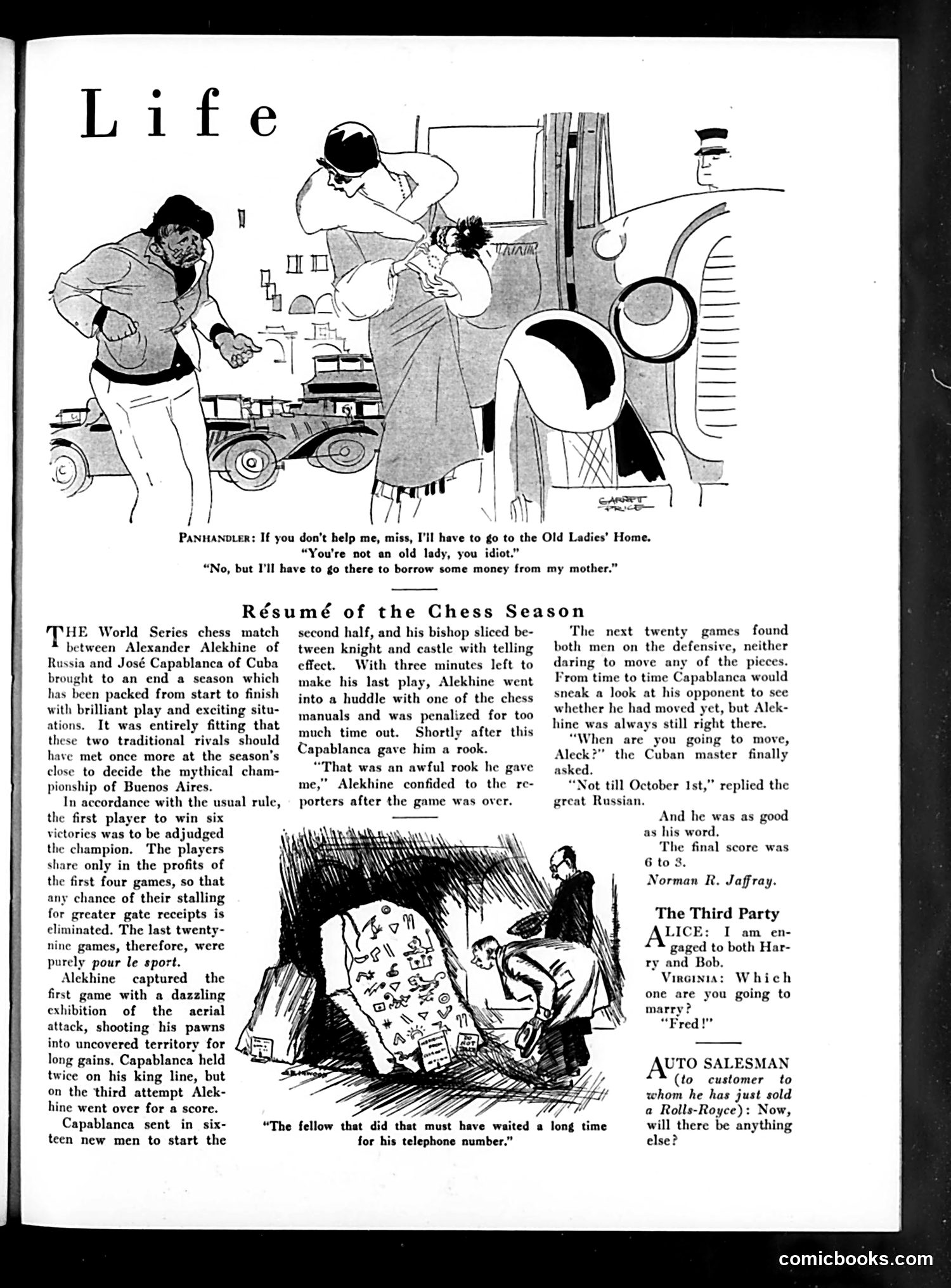
**Top Cartoon**: A slapstick domestic scene showing a man (labeled "Panhandler") making excuses to avoid helping a woman. He threatens to go to an "Old Ladies' Home" unless she helps him, then pivots to claiming he needs to borrow money from his mother. The joke satirizes male dependency and the reversal of traditional gender roles—a man playing the victim to manipulate a woman into supporting him. This reflects early 20th-century anxieties about masculinity and economic vulnerability. **Chess Section**: Discusses World Series chess matches between Alexander Alekhine and José Raúl Capablanca, describing their strategic play and final score (6 to 3). Appears to be a legitimate sports report rather than satire. **Bottom Section**: Brief comic dialogues about marriage and auto sales—light domestic humor typical of Life's format.
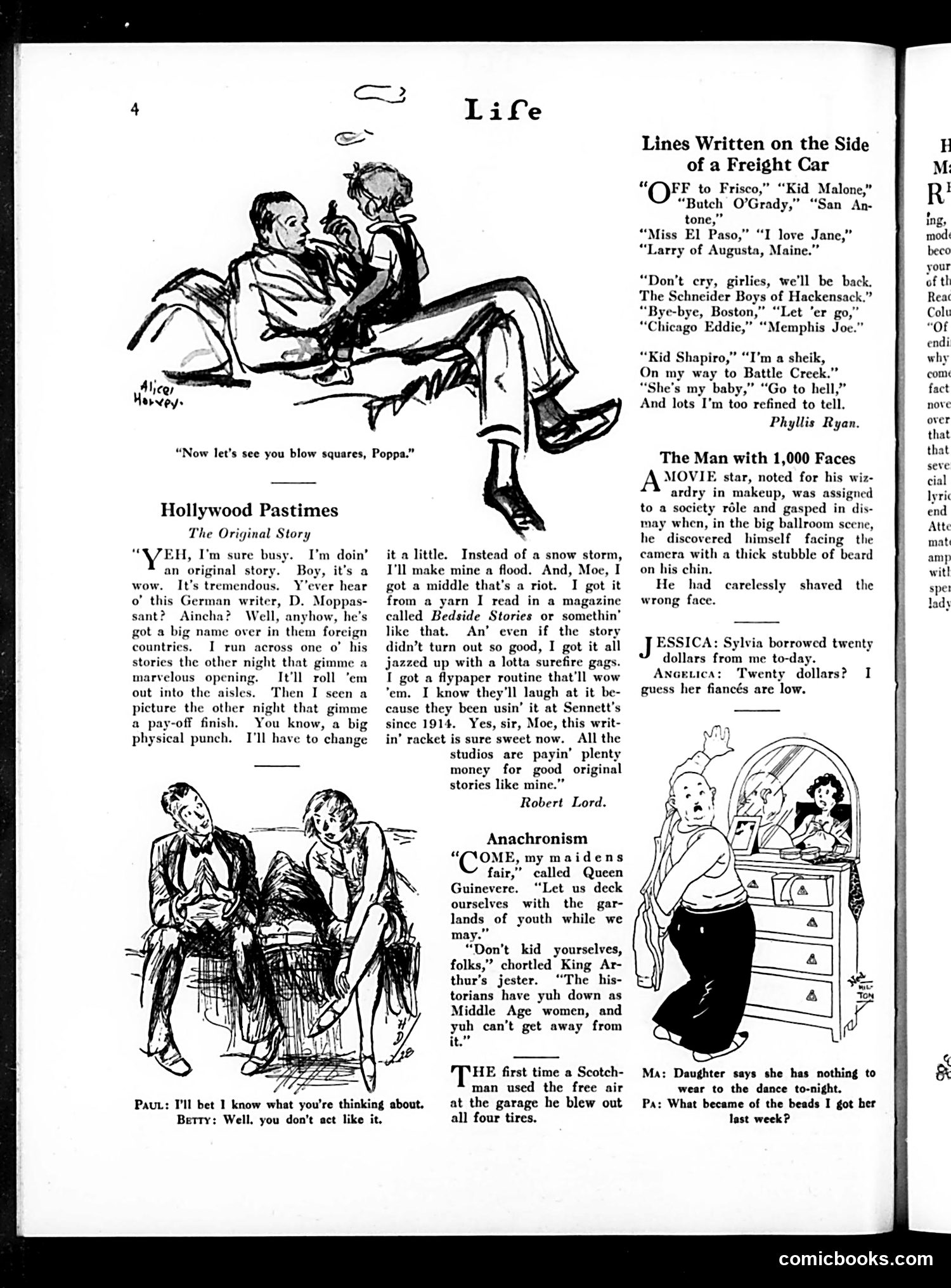
This page contains humorous short pieces and cartoons typical of 1920s Life magazine. The top cartoon shows a father and child on a freight car, captioned "Now let's see you blow squares, Poppa"—likely mocking adults who adopt childish behaviors or pretend expertise they lack. "Hollywood Pasttimes" satirizes screenwriter Robert Lord's explanation of how he invents movie stories through exaggeration and melodrama, poking fun at the formulaic nature of early cinema. "Anachronism" mocks historical inaccuracy in entertainment—a Queen Guinevere reference with King Arthur's jester using modern slang, highlighting the absurdity of mixing medieval settings with contemporary speech. The bottom cartoons contain domestic humor about marriages and family misunderstandings—standard comedy fare for the era, focusing on confusion between spouses rather than political commentary.
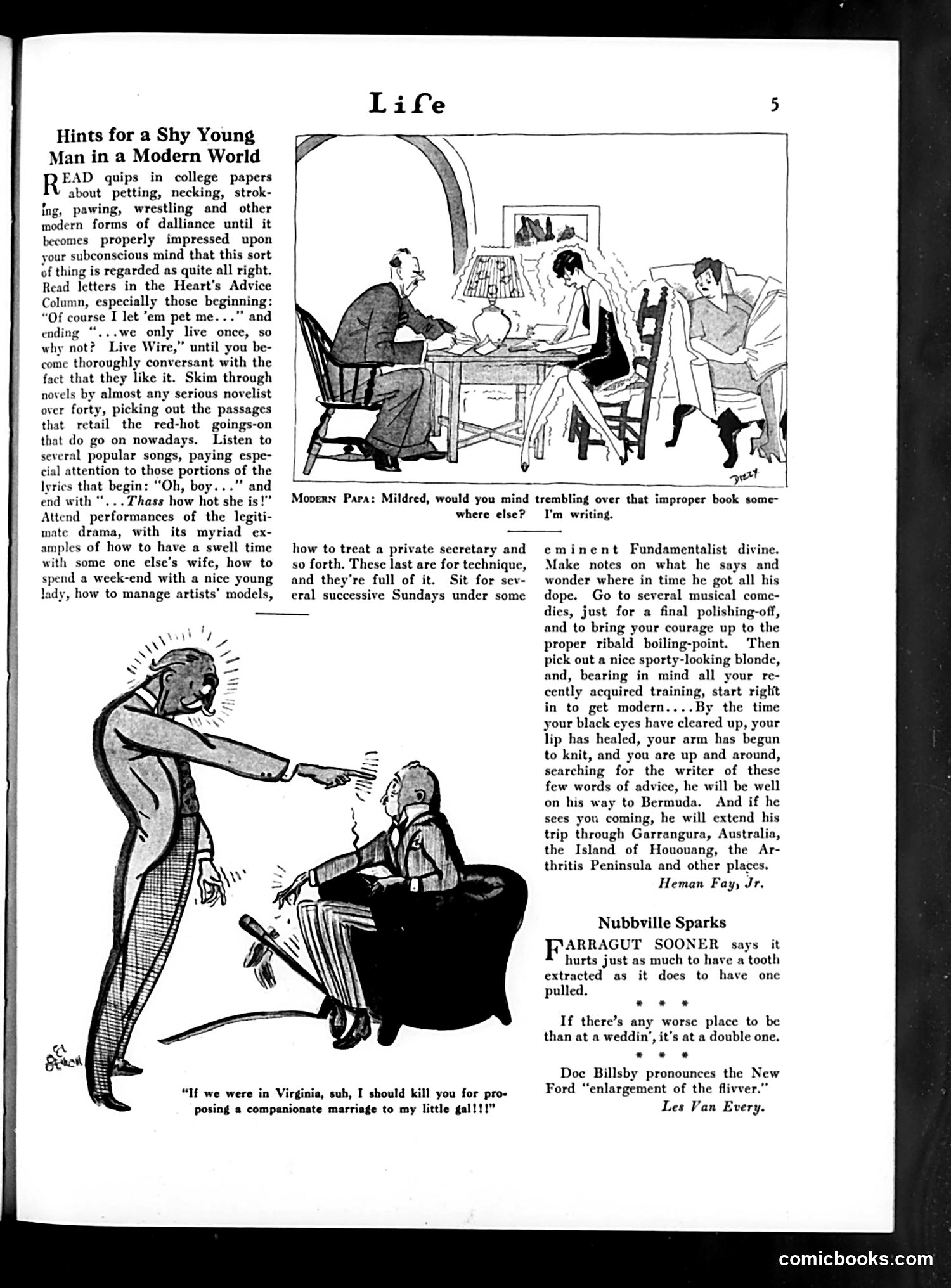
This satirical page mocks advice columns and dating etiquette for young men in the modern era. The upper cartoon shows a domestic scene where a man writing at a desk appears oblivious while his wife sits nearby—captioning the hypocrisy of advice on romance and proper behavior. The lower cartoon depicts two exaggerated figures in a violent confrontation over romantic rivalry, with the caption referencing Virginia law (likely dueling culture), mocking outdated masculine honor codes. The figure on the left threatens the seated figure. The text column "Hints for a Shy Young Man in a Modern World" ironically advises reading romance novels and attending musical comedies to become "modern," suggesting young men remain hopelessly naive about contemporary courtship despite cultural exposure. The satire targets the gap between prescribed behavior and actual social reality.
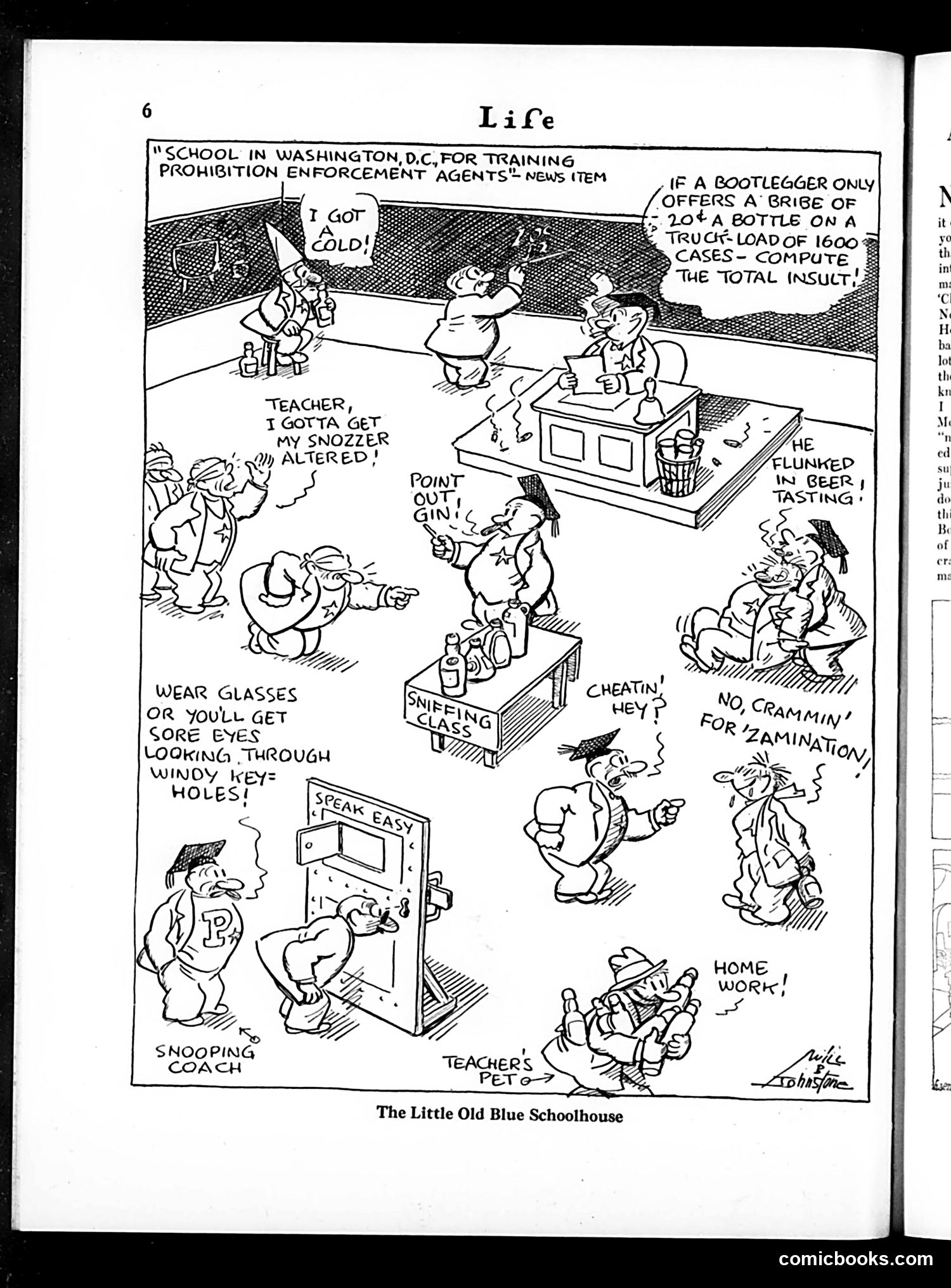
This satirical cartoon mocks Prohibition enforcement training by depicting absurd scenarios in a classroom setting. The header references "a school in Washington, D.C., for training prohibition enforcement agents." The cartoon shows various comical violations and enforcement methods: students learning to detect bootleggers' bribes, spot gin by taste, identify altered snooze (likely alcohol), detect sore eyes from peering through "spy holes," and catch cheating on exams. One student mentions "flunked in beer tasting." The satire critiques the widespread corruption and incompetence of Prohibition agents during the 1920s-1930s era—suggesting that enforcement officials themselves were often bribed, alcoholics, or simply ineffective. The cartoon implies that Prohibition enforcement was fundamentally unworkable, with agents unable to stay sober or honest.
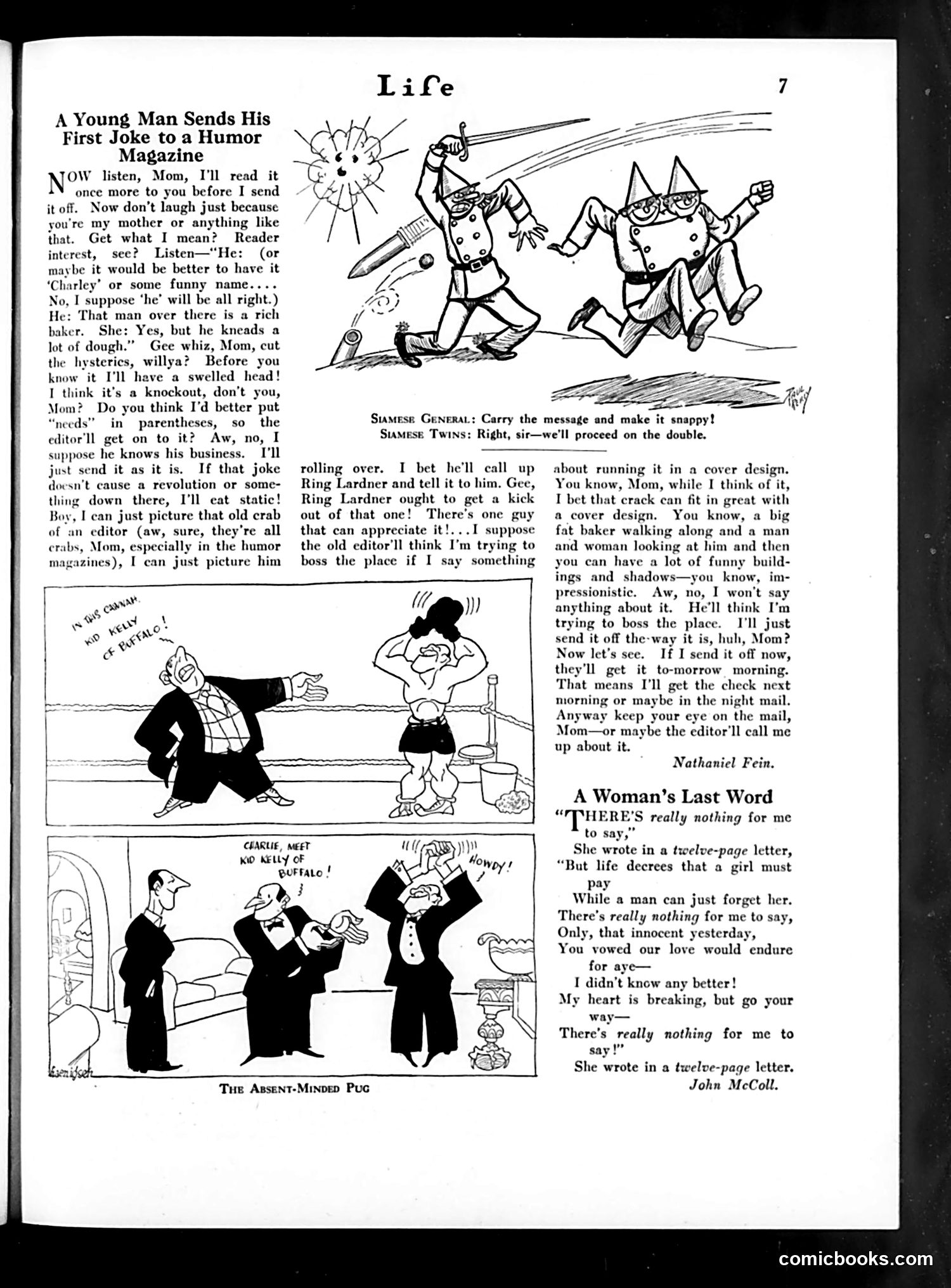
This page contains three pieces of humor content: 1. **"A Young Man Sends His First Joke to a Humor Magazine"** — A monologue by Nathaniel Fein satirizing aspiring comedians. The young man nervously pitches a joke to his mother, worrying it might offend her, then obsesses over whether an editor will accept it. The satire targets the pretentiousness and anxiety of amateur humorists trying to break into magazine publishing. 2. **"The Absent-Minded Pug"** — A cartoon showing a man and woman at a social gathering with a distracted pug dog, illustrating the stereotype of absent-minded behavior in pets. 3. **"A Woman's Last Word"** — A poem by John McColl about a woman's final letter to a departing lover, expressing resignation and heartbreak while maintaining dignity. It reflects period attitudes about gendered emotional expression.
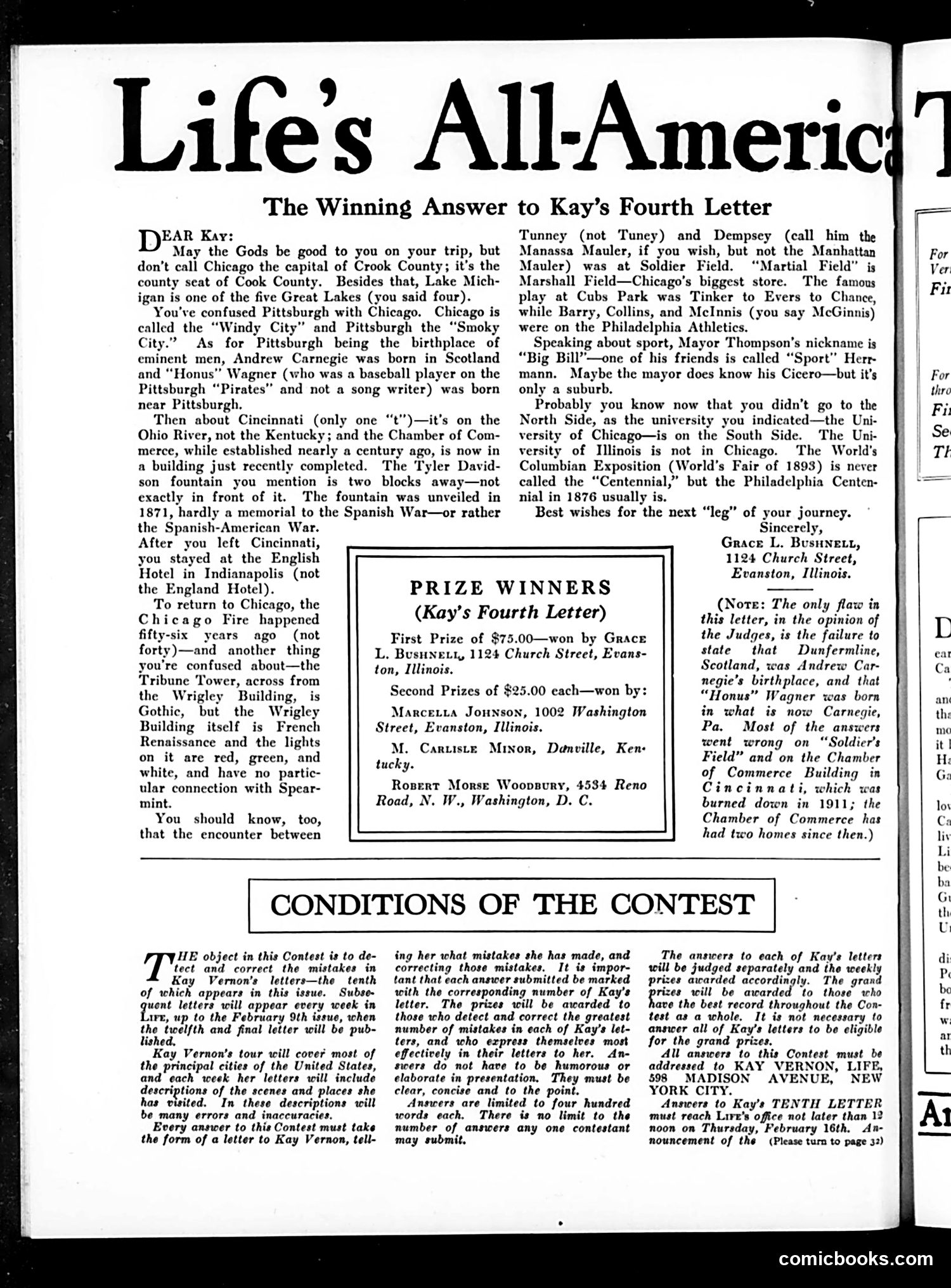
This page is primarily **editorial content, not a cartoon**. It features "Life's All-America" — a contest where readers submit letters correcting geographical and factual errors in Kay Vernon's travel column about American cities. The main text is a **humorous letter from Grace L. Bushnell** correcting Kay's mistakes about Chicago, Pittsburgh, Cincinnati, and other cities. Bushnell playfully mocks Kay for confusing details (like thinking Tunney boxed in Chicago when he fought elsewhere, or misidentifying Chicago landmarks). The page includes a **"Prize Winners" box** announcing contest results, and "Conditions of the Contest" explaining submission rules. The satire targets **travel writing inaccuracy** and invites reader participation in fact-checking published content — a form of interactive magazine humor common to Life's era.
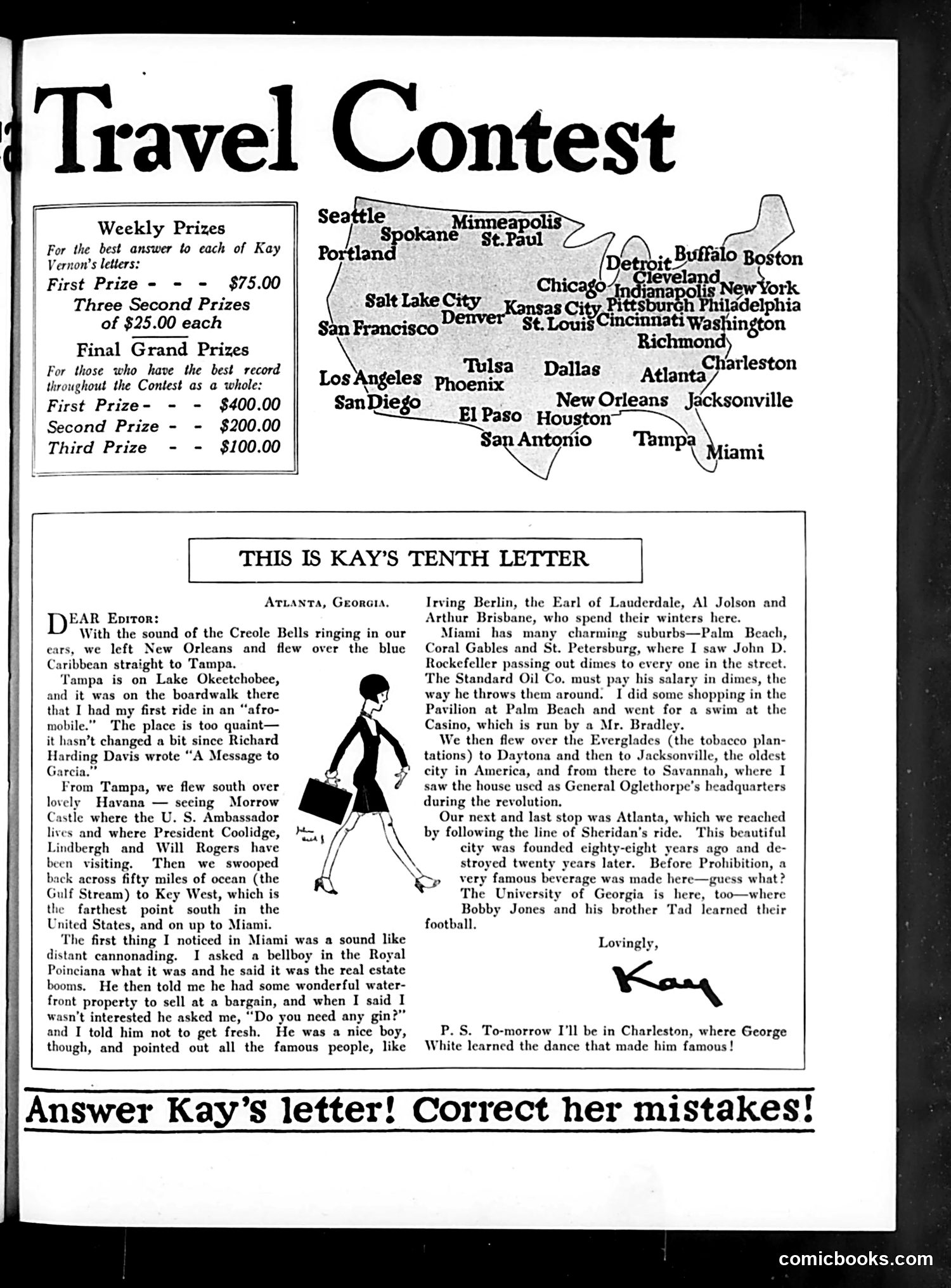
This page presents a reader participation game, not a political cartoon. "Travel Contest" invites readers to find errors in Kay's tenth letter—a travelogue describing a journey through American cities from New Orleans to Atlanta. The letter humorously recounts travel experiences: flying over the Caribbean, visiting Tampa, driving to Key West (described as "the furthest point south in the United States"), and encounters with famous people and landmarks. Readers must identify geographical or factual mistakes Kay made in her account to win prizes ($75 weekly, up to $400 grand prize). The illustration shows a stylized woman traveler with luggage—representing the contest's travel theme. This was a common early-20th-century magazine engagement strategy: combining entertainment with reader participation.
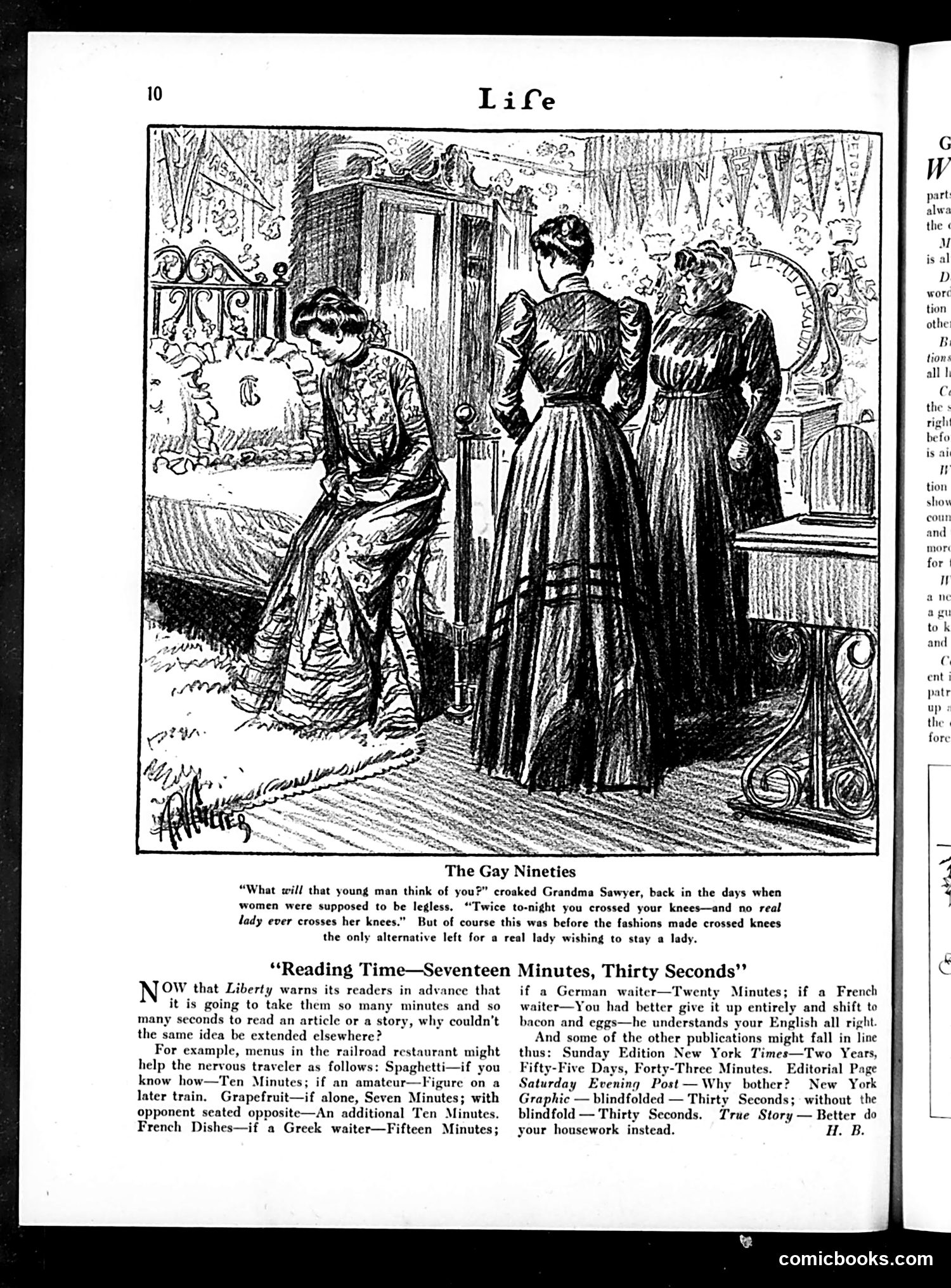
This satirical cartoon mocks outdated 1890s social conventions about women's modesty. The caption quotes "Grandma Sawyer" claiming that no "real lady" would cross her knees—implying that doing so was scandalous. The joke is that by the time this was published (appears to be early 1900s), fashion had changed; women could now wear crossed-knee skirts without losing respectability, making the old rule absurd. The accompanying article humorously extends this satirical premise, listing absurdly specific dining times for various restaurant scenarios, poking fun at excessive etiquette rules generally. The overall message: social conventions that seemed serious in the 1890s now appear ridiculous, and modern readers should recognize how arbitrary such "rules" were.
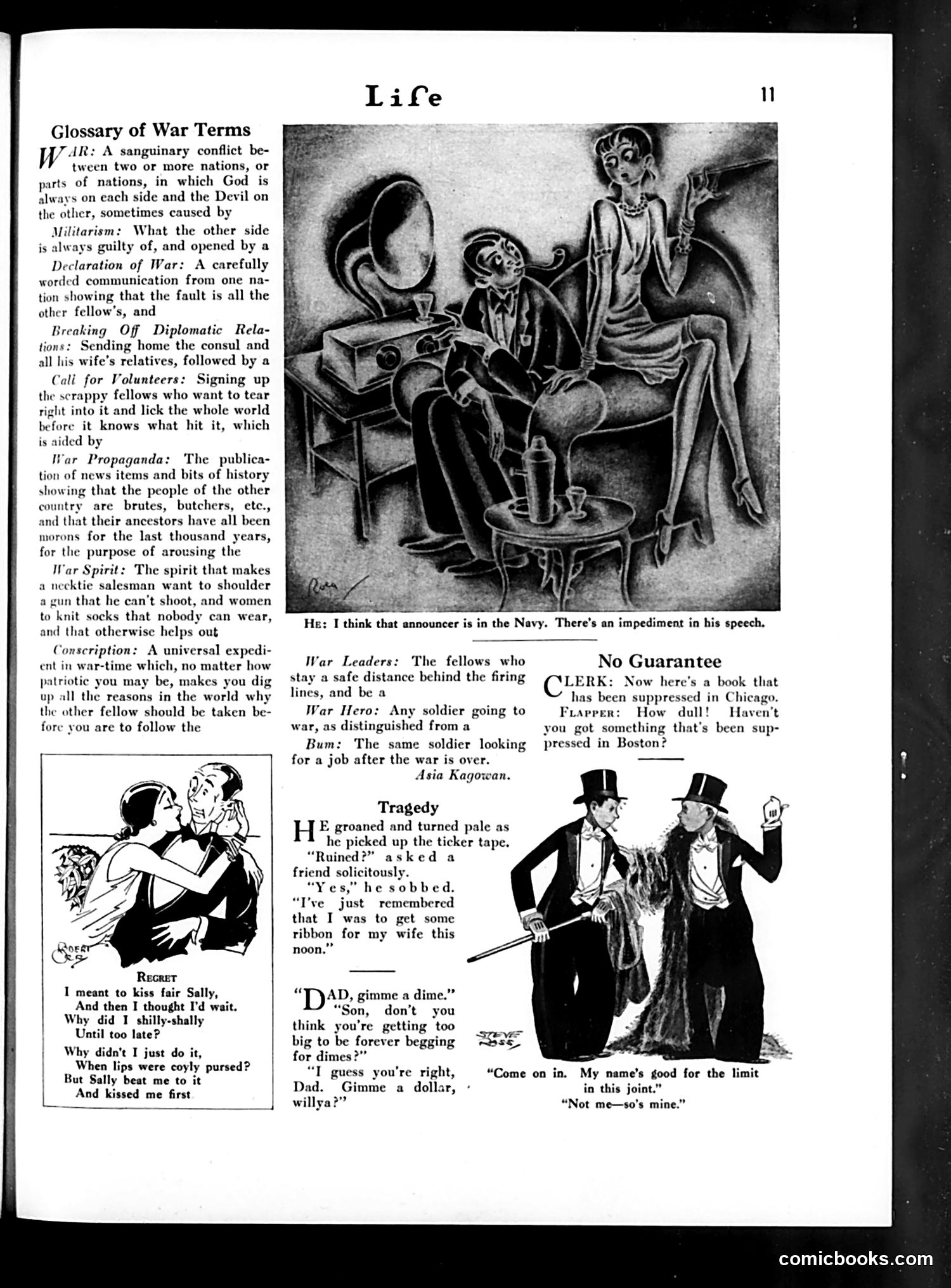
This page from *Life* magazine contains satirical commentary on World War I. The "Glossary of War Terms" on the left mocks propaganda and military jargon—defining concepts like "War Propaganda" as exaggeration about enemy brutality, and "War Spirit" as peer pressure disguised as patriotism. The cartoons below illustrate romantic regret and financial hardship during wartime. "Regret" shows a man remembering he promised to buy his girlfriend ribbon, explaining his tardiness; "Tragedy" depicts a father unable to give his son spending money, only able to "gimme a dollar." The bottom cartoon shows two men in top hats, one inviting the other to a joint with a "good limit"—likely commenting on wartime social venues or illegal establishments operating despite restrictions. The overall theme critiques how war disrupts ordinary life and civilian morale.
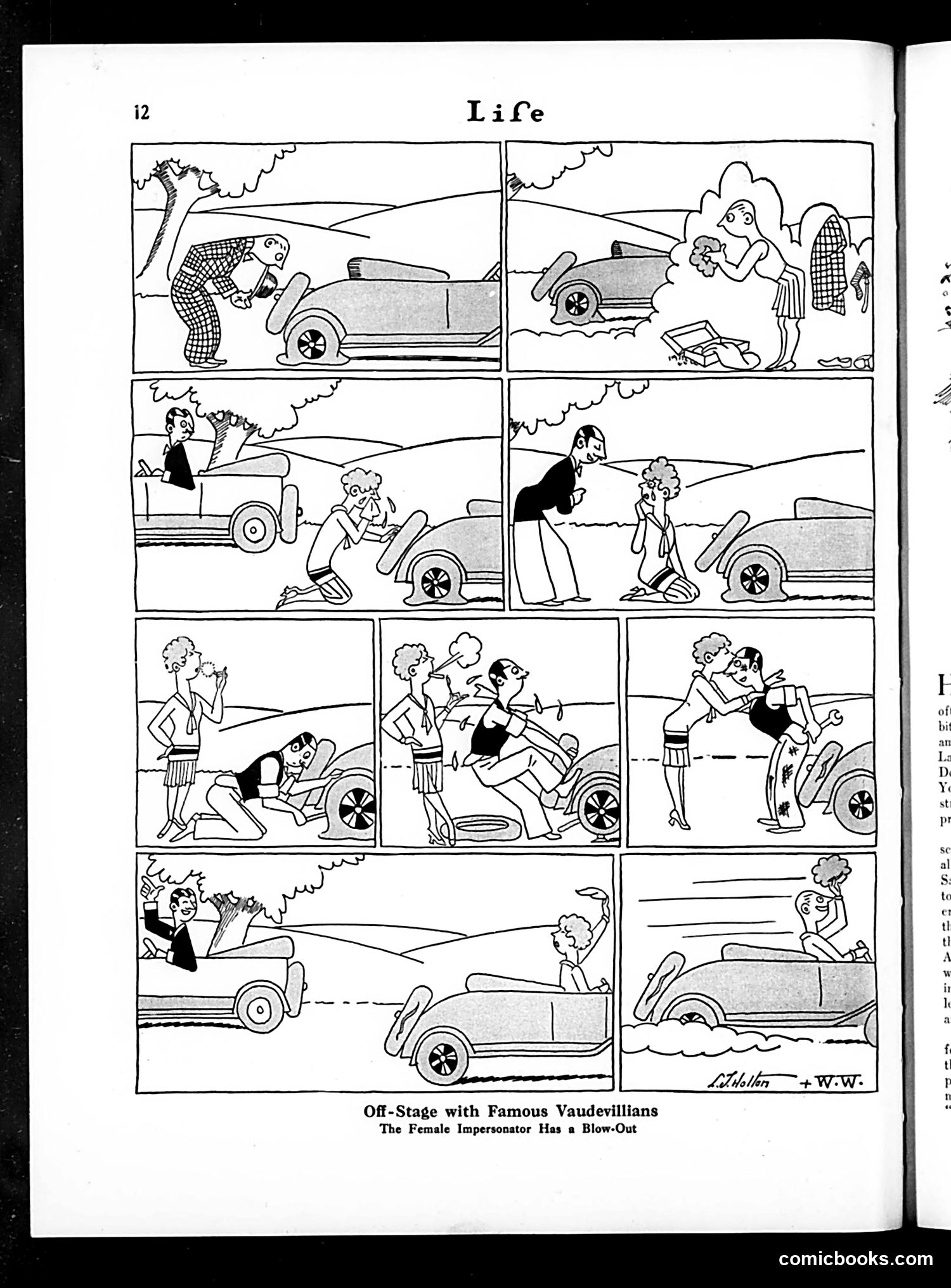
This comic strip satirizes vaudeville performers, specifically a male performer who does female impersonation acts. The humor follows a slapstick sequence: a woman in a car gets a flat tire; a female impersonator (a man in drag) stops to help; through a series of increasingly physical comedy mishaps, both characters end up in ridiculous situations—crawling under the car, tumbling, and generally getting covered in dirt and embarrassment. The satire mocks both the pretentiousness of vaudeville stars and the physical degradation of slapstick comedy. The punchline plays on the irony of a performer known for glamorous female impersonation being reduced to undignified physical comedy offstage. It's a commentary on the gap between performers' polished public personas and their messy reality.
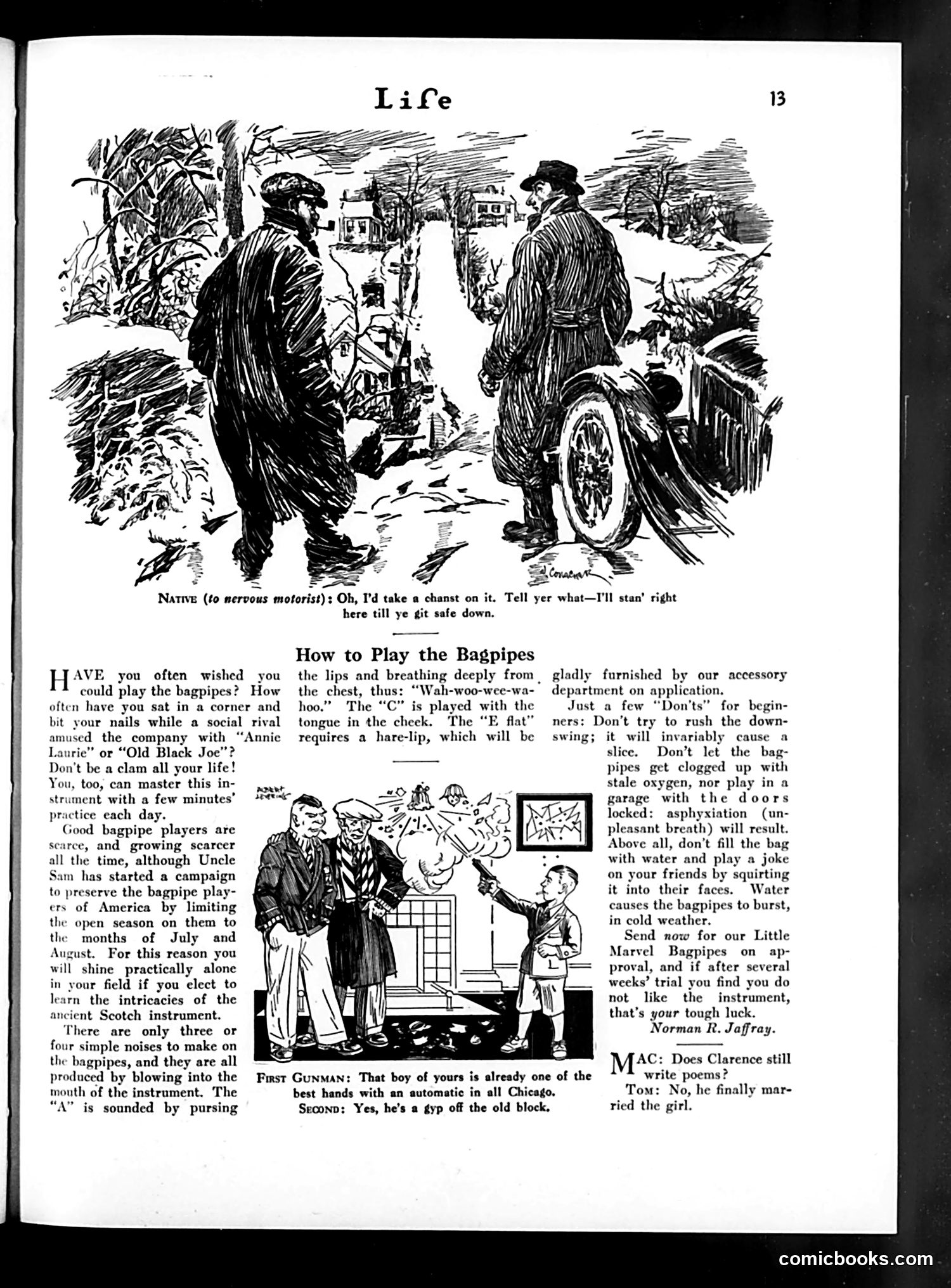
**Top Cartoon:** A motorist (labeled "Native (to nervous motorist)") encounters a pedestrian who warns him to "take a chanst on it" and "stan' right here till ye git sale down." This satirizes early automobile dangers and the collision between modern vehicles and traditional pedestrian culture. The nervous motorist represents anxious drivers navigating unpredictable road conditions and pedestrians unfamiliar with automobiles. **Main Article:** "How to Play the Bagpipes" is humorous instructional content about learning Scottish bagpipes. It references Uncle Sam's campaign to preserve traditional bagpipe playing in America, treating the instrument humorously while offering genuine playing tips. The inserted dialogue between gunmen jokes about Chicago's violent reputation, contrasting the innocent bagpipes with the city's crime associations.
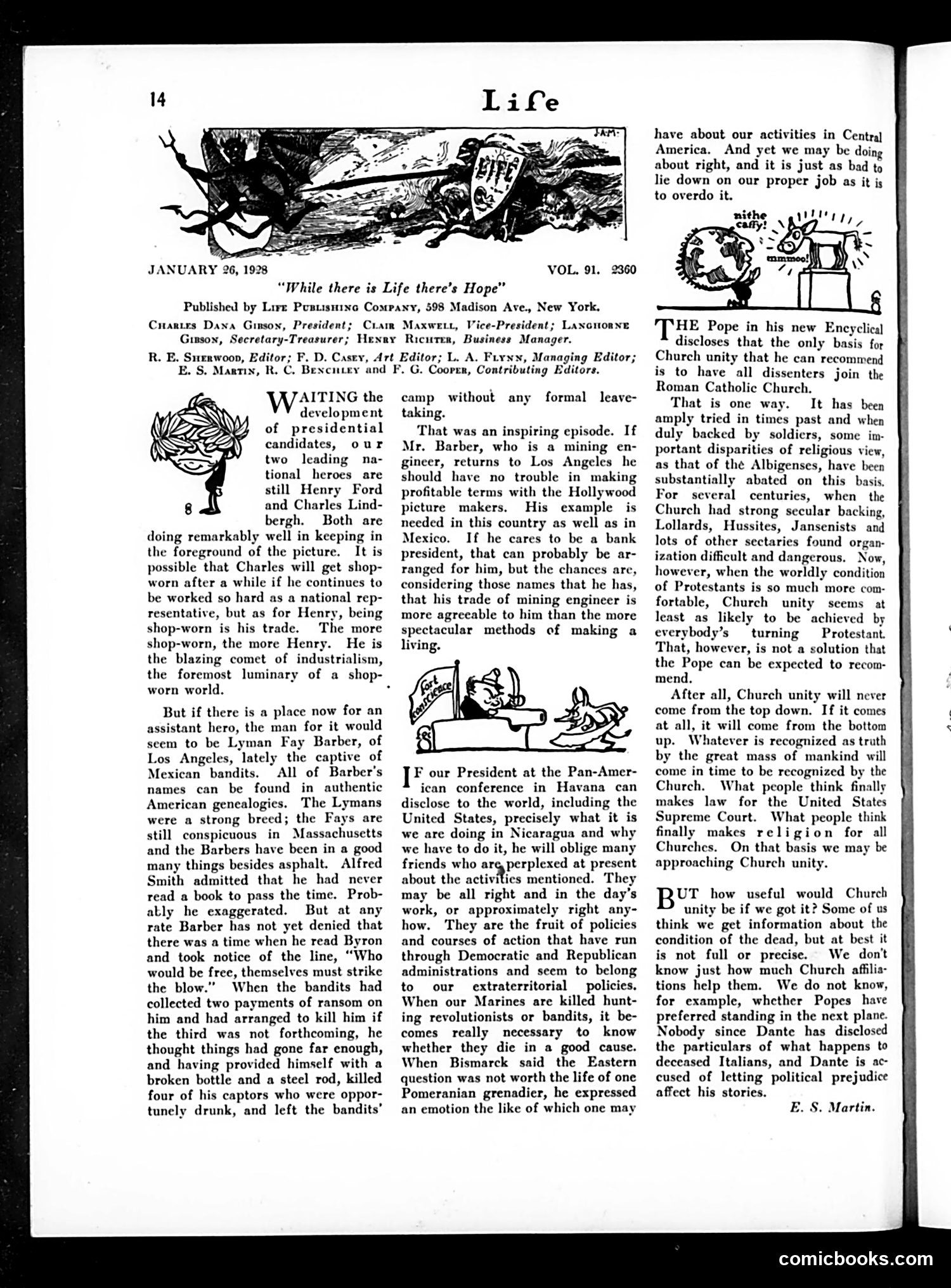
This page discusses presidential candidates and contains a small cartoon showing what appears to be a figure at a desk or work station. The main text discusses **Henry Ford** and **Charles Lindbergh** as potential presidential candidates, praising their effectiveness in their respective fields (automotive industry and aviation). The article suggests that while Ford might make a good president, his successor as an industrialist would be harder to find—implying talented leaders shouldn't leave their positions. The text also references **Lyman Jay Barber**, a mining engineer from Los Angeles, as a possible presidential assistant. The second article discusses **the Pope's new Encyclical** on Church unity and religious tolerance, critiquing the idea that all Christian denominations should simply join the Roman Catholic Church. The cartoons appear to be illustrative rather than satirical commentary on these topics.
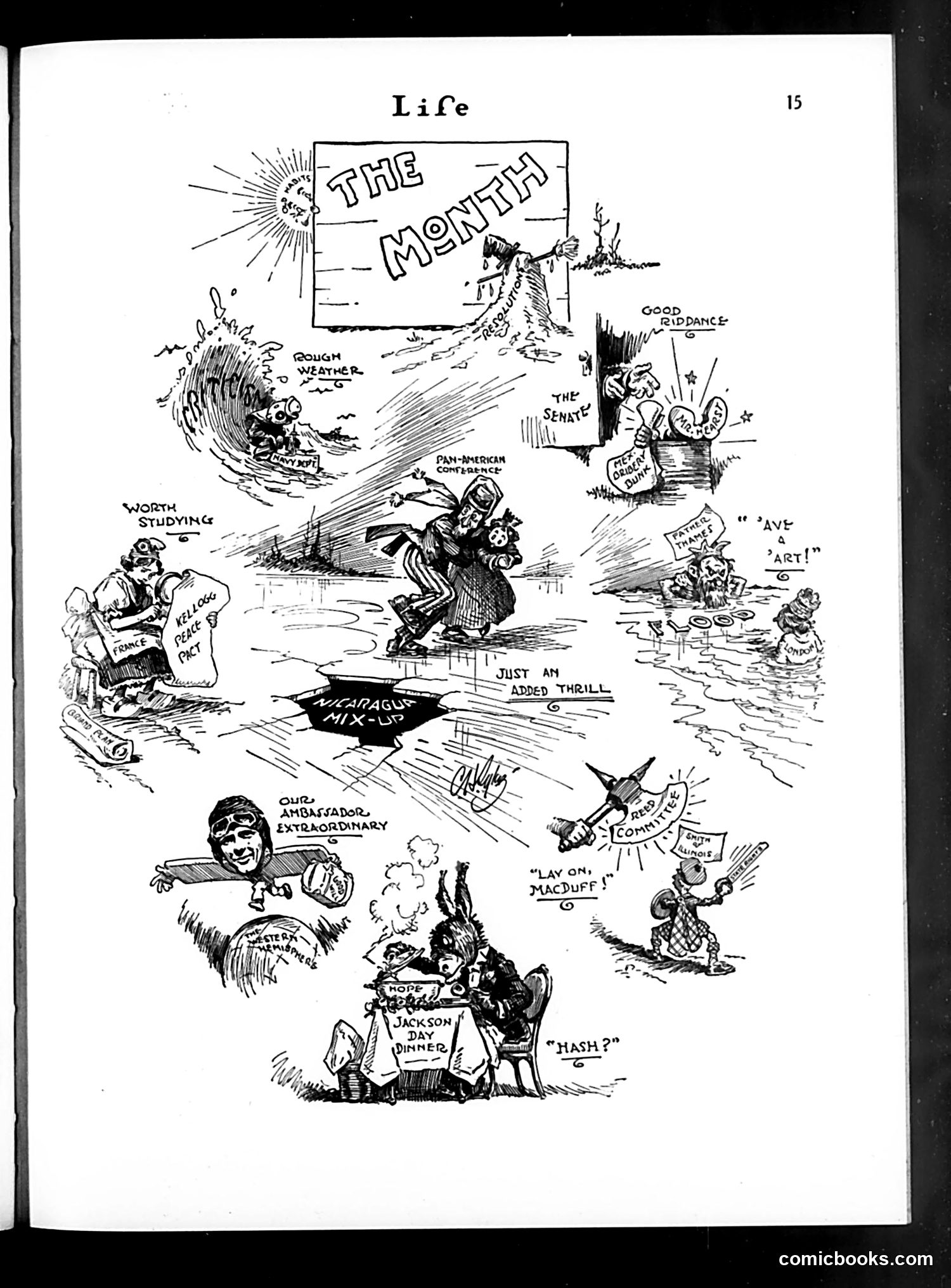
This is a satirical overview of major events from a particular month. The central figure appears to be a political leader navigating various crises depicted as turbulent weather and obstacles. Key labeled elements include: - **"Rough Weather"** and **"Worth Studying"** (left): Domestic political challenges - **"Pan-American Conference"** (center): International diplomatic efforts - **"The Senate"** (right): Congressional opposition or debate - **"Nicaragua"** (bottom center): Foreign policy complications - **"Good Finance"** and **"'Ave & Art!'"** references suggest cultural/economic commentary - Bottom scene shows what appears to be a "Jackson Day Dinner" The cartoon satirizes a leader juggling multiple simultaneous political, diplomatic, and domestic pressures during this month. The chaotic composition emphasizes the difficulty of managing these competing crises.
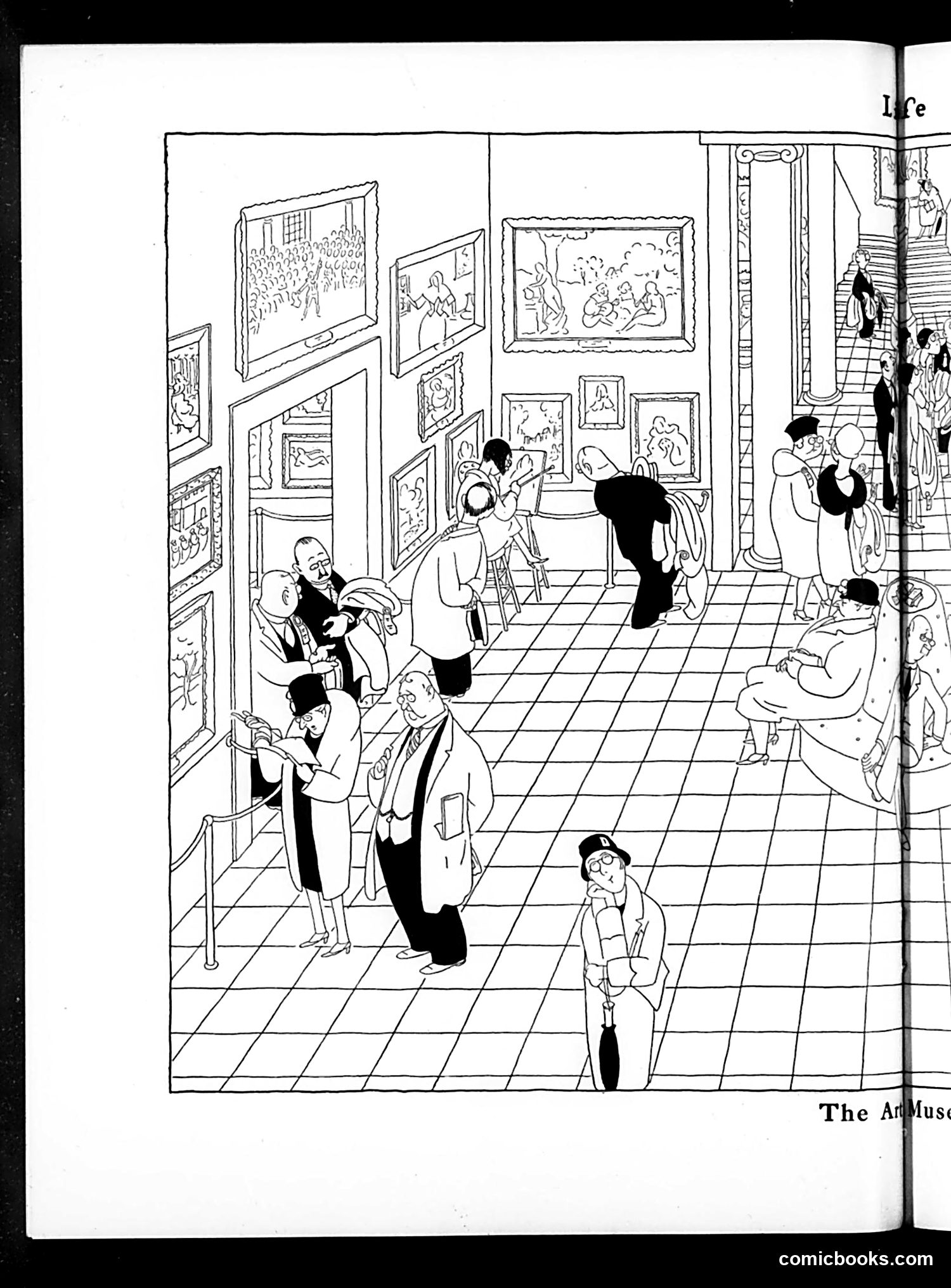
This cartoon satirizes the pretension and chaos of an art museum visit. The scene depicts well-dressed visitors examining artworks on the walls while appearing confused, bored, or self-consciously serious about understanding modern art. The satire targets the gap between art's supposed sophistication and visitors' actual comprehension—note the various figures striking exaggerated poses of contemplation while seemingly bewildered. One figure crouches unnaturally, suggesting the absurdity of attempting to appear intellectually engaged with abstract or modern works. The joke reflects early 20th-century American skepticism about modernism: that museums attract social climbers and pretentious audiences more interested in appearing cultured than genuinely appreciating art. The title "The Art Muse" suggests irony—questioning whether genuine artistic inspiration exists in these settings.
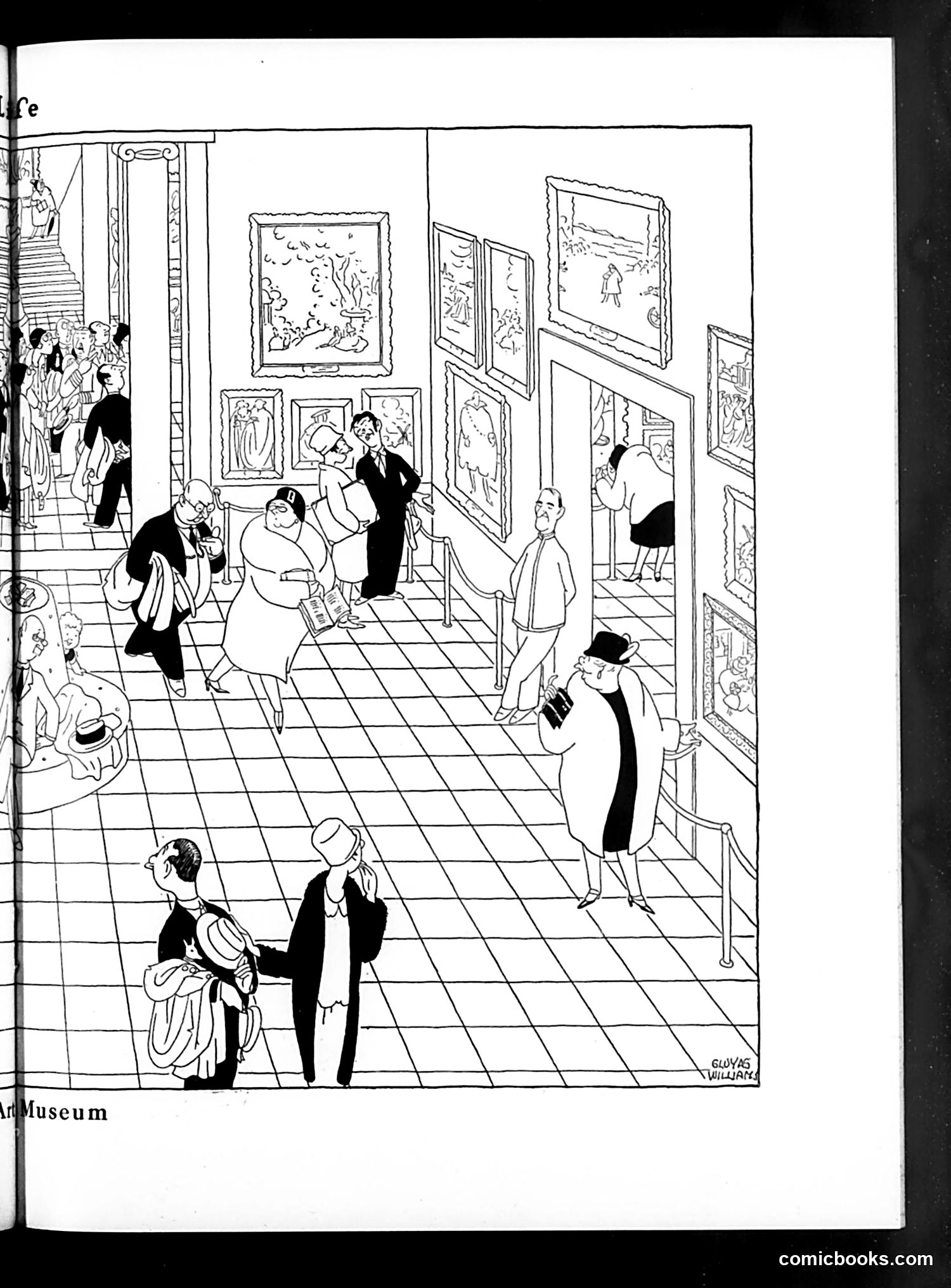
This cartoon depicts visitors touring an art museum gallery. The drawing shows well-dressed patrons examining paintings on walls while gallery staff or guards observe them. The style and composition suggest satire about museum-going behavior—likely poking fun at how visitors interact with art. The specific satirical target isn't entirely clear from the image alone, but given Life magazine's tradition, it could be mocking: - Pretentious art appreciation among the wealthy - The performative nature of museum visits - How visitors engage (or fail to engage) with artwork The artist is credited as "Gluyas Williams" (visible in the signature), known for humorous social commentary illustrations. Without additional context text, the exact point of satire remains somewhat unclear, though the crowded scene and varied visitor postures suggest commentary on museum culture itself.
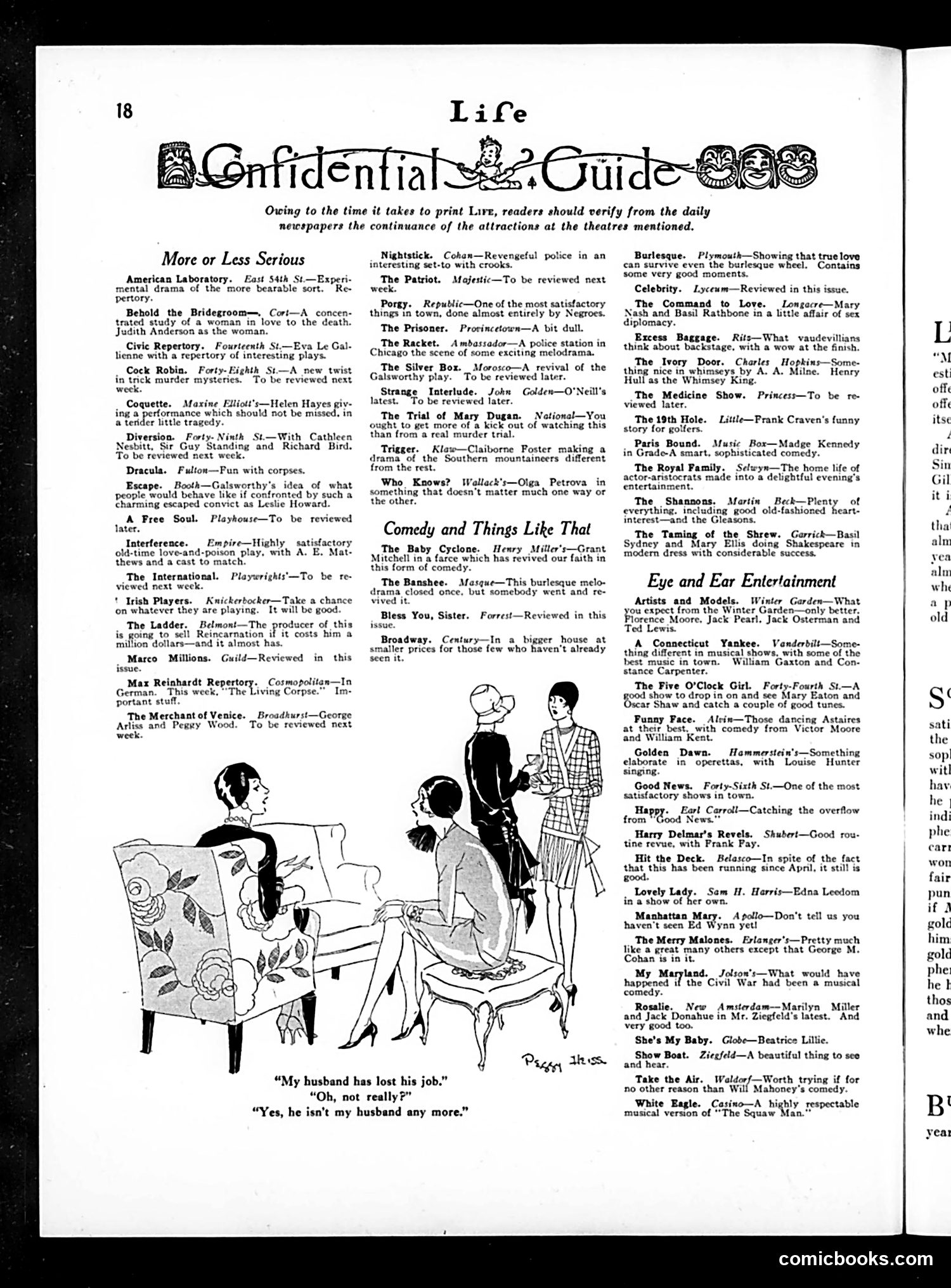
This page from *Life* magazine presents theater reviews organized by tone—"More or Less Serious" and "Comedy and Things Like That." The cartoon depicts a domestic conversation between a husband and wife seated in a living room. The husband announces, "My husband has lost his job," and the wife responds, "Oh, not really?" He replies, "Yes, he isn't my husband any more." **The joke's meaning:** This is a Depression-era joke playing on economic anxiety and marital instability. The humor hinges on the wife's casual misunderstanding—she initially thinks he means he's *lost* a job (temporarily), when he actually means he's been *fired* permanently and can no longer support her, thus making their marriage effectively void. It satirizes how economic collapse could dissolve marriages and how wives' dependency on husbands' income defined their marital status. The period detail and casual tone reflect 1920s-30s anxieties about economic security and gender roles.
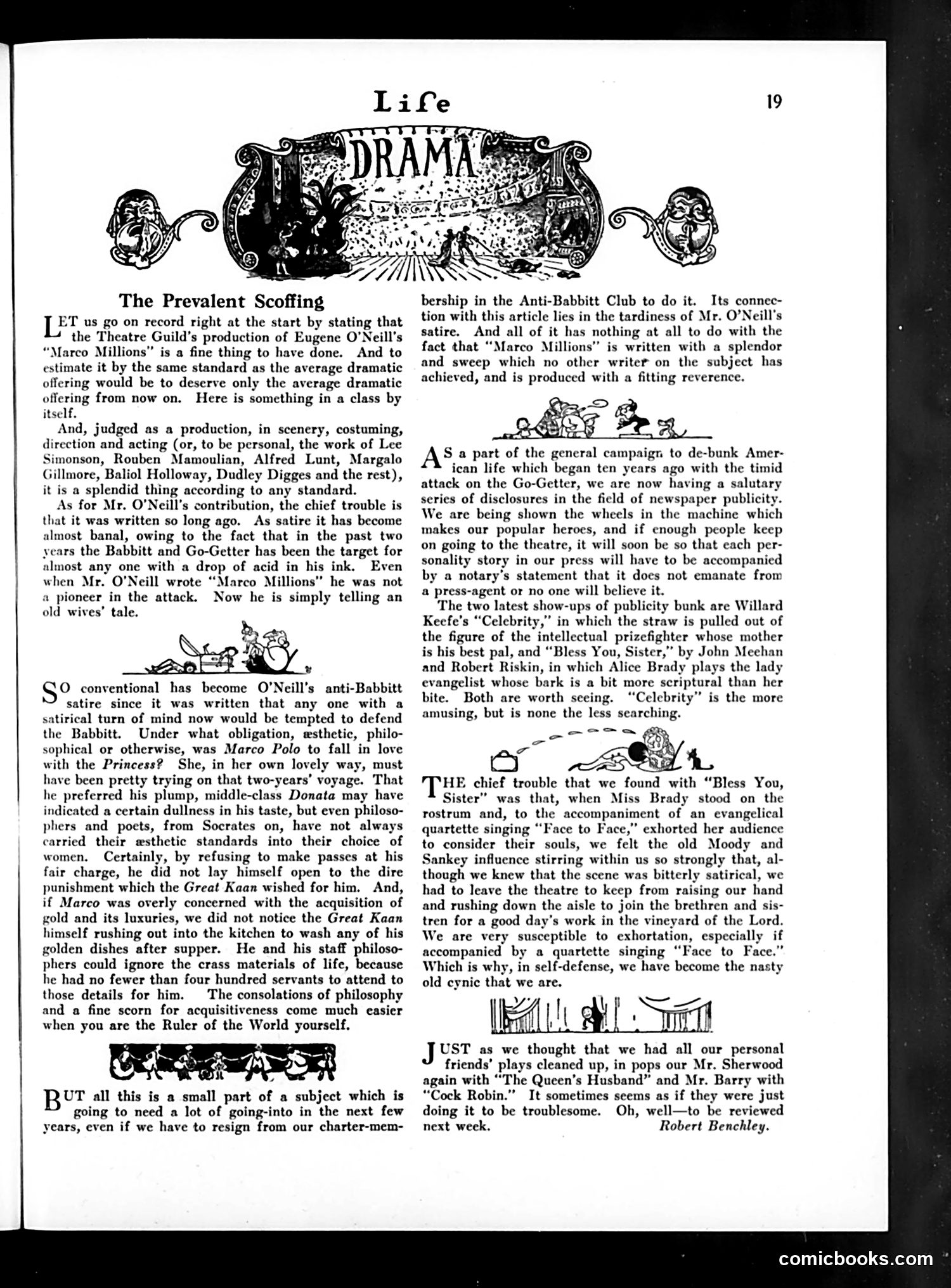
This is a theater review of Eugene O'Neill's *Marco Millions*. The critic praises the production's quality but argues O'Neill's satire has become outdated and conventional. The piece attacks the "Babbitt" stereotype — the philistine American businessman — which had become such an easy target by the 1920s that defending the Babbitt seemed almost necessary. The critic notes O'Neill wasn't pioneering this attack even when he wrote the play. The review then pivots to broader cultural criticism: Americans have spent ten years debunking American life through theater and journalism, exposing publicity stunts behind popular "heroes." Recent plays like *Celebrity* (by Willard Keefe) and *Bless You, Sister* reveal how the media manufactures celebrity personas. The underlying point: satire of materialistic, status-seeking Americans had become so prevalent and predictable that it lost satirical bite. The critique ironically suggests joining an "Anti-Babbitt Club" while acknowledging the Babbitt deserves defense against such worn-out attacks.
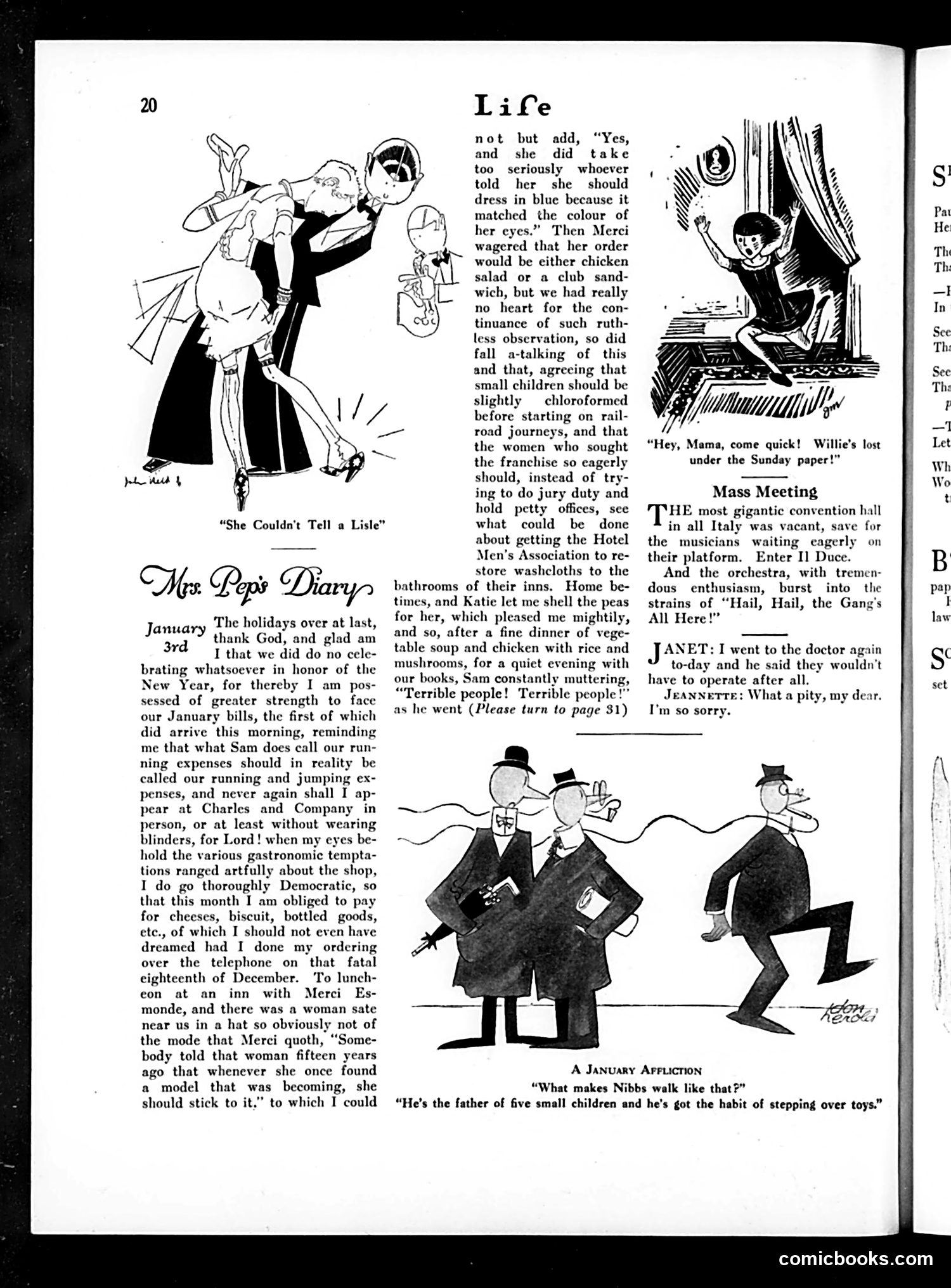
This page from Life magazine (early 20th century) contains three distinct satirical pieces: **"She Couldn't Tell a Lisle"**: A humorous diary entry mocking wealthy women's pretensions and consumer habits. The narrator complains about January bills resulting from impulsive shopping at fancy food shops, and recounts gossiping with a friend about an unfashionable woman stubbornly wearing an outdated hat. The piece satirizes upper-class women's obsession with fashion and trends. **"Mass Meeting"**: A brief joke about Mussolini ("Il Duce") conducting an orchestra in an empty Italian convention hall, suggesting empty spectacle and propaganda. **"A January Affliction"**: A cartoon about a man with five children who walks awkwardly because he's constantly stepping over toys—a relatable domestic joke about the chaos of large families. The overall tone is lighthearted social satire targeting consumer culture, fashion obsession, and domestic life among the middle and upper classes.
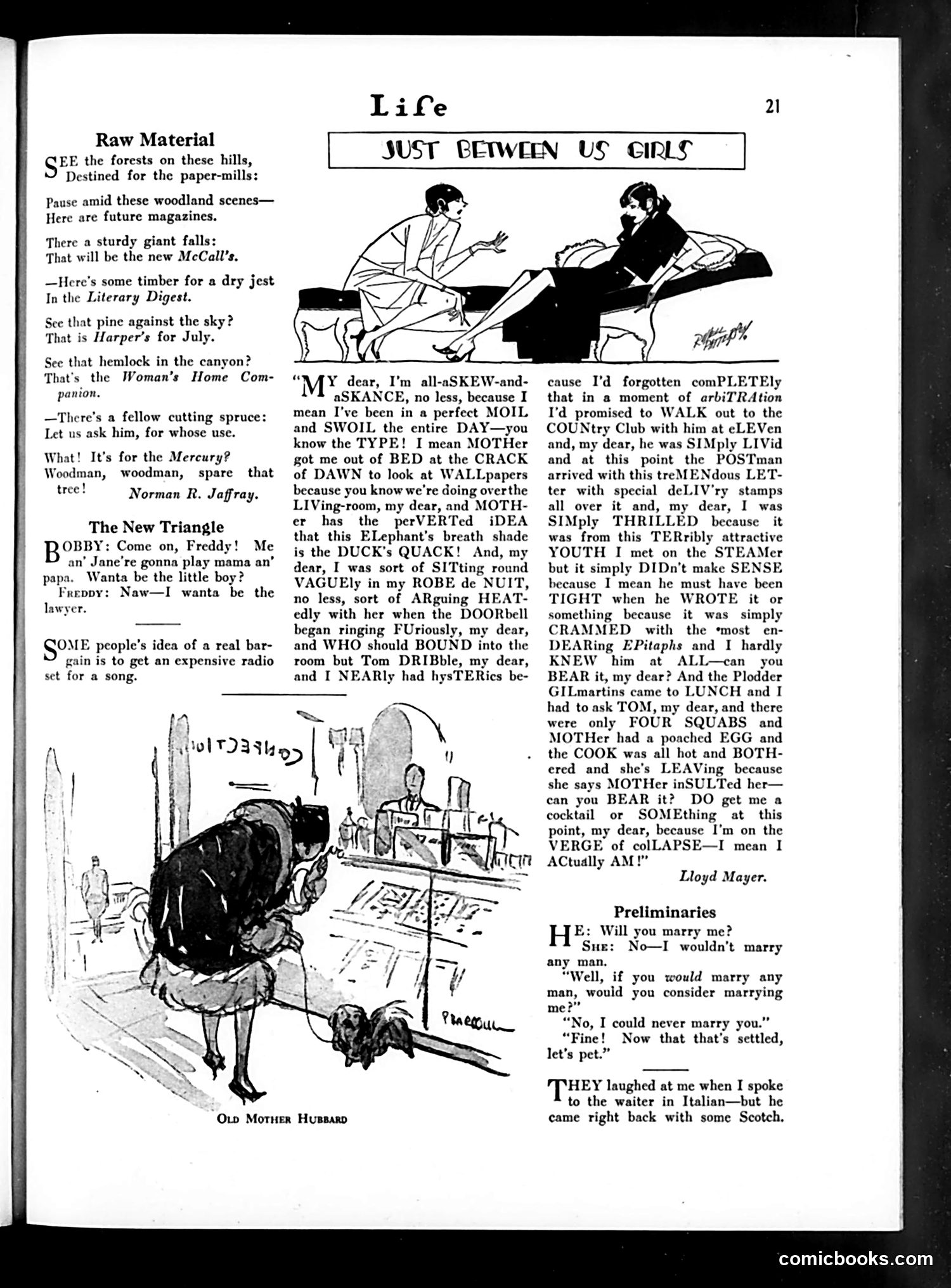
This page contains three distinct pieces of 1920s satire: **"Raw Material"** mocks the timber industry and magazine publishing by personifying forests as future magazines—specific pines becoming *McCall's*, *Harper's*, and *Woman's Home Companion*. The joke: forests are being harvested solely to feed paper mills for glossy magazines. **"Old Mother Husbard"** (illustration, lower left) appears to satirize domestic life, though details are unclear from the image alone. **"Just Between Us Girls"** is a monologue parodying upper-class women's affected speech patterns—exaggerated capitalization and arbitrary emphasis (*aSKEW*, *MOIL*, *POSTman*) mock vapid socialite chatter. The narrator obsesses over trivial concerns (wallpaper, an attractive stranger's letter) while dismissing servants and complaining endlessly. **"The New Triangle"** jokes about modern legal-mindedness: a child prefers being "the lawyer" over playing house, reflecting anxieties about professionalization and changing social values. **"Preliminaries"** contains a sardonic pickup-line joke where a man's shameless persistence after rejection is rewarded.
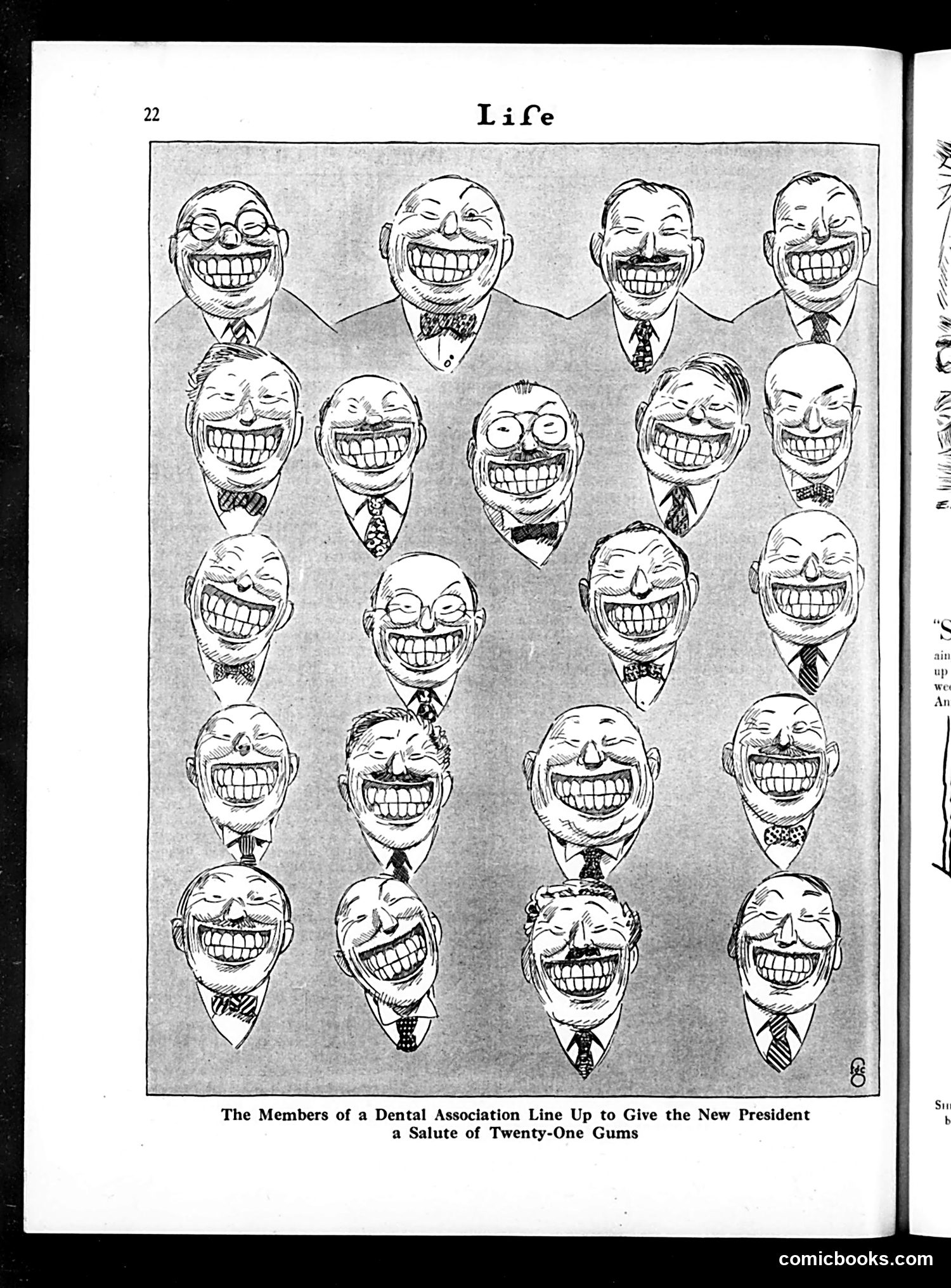
This is a visual pun from Life magazine satirizing a presidential inauguration ceremony. The cartoon depicts 21 men with exaggerated, gleaming smiles arranged in formal rows, all wearing business attire and ties. The joke plays on "twenty-one gun salute"—the traditional military honor for a new president—by substituting "gums" for "guns." Since these are members of a dental association, they're literally displaying their teeth/gums in a cheerful salute. The satire gently mocks both dental professionals' enthusiasm and the pomp of presidential ceremonies. The cartoonist exaggerates their grins to absurd levels, suggesting dentists' perpetual cheerfulness and their professional preoccupation with teeth. This appears to be humorous commentary rather than political critique—purely a visual wordplay joke exploiting the homophone between "guns" and "gums."
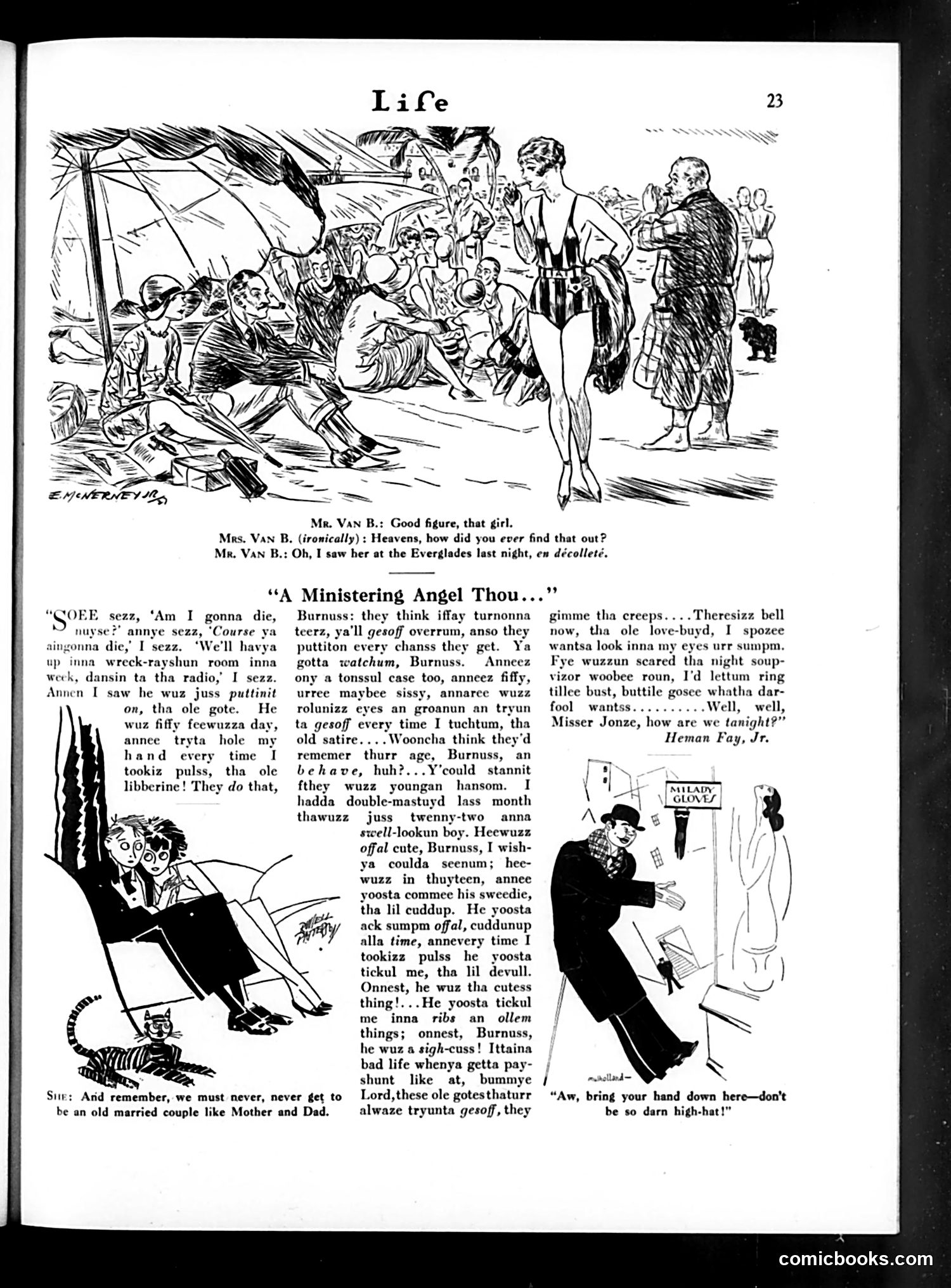
This page contains satirical commentary on courtship and marriage across different social classes and life stages. The top cartoon mocks wealthy society: Mr. Van B. compliments a young woman's figure, claiming he saw her at the Everglades in revealing dress ("en décolleté"). His wife's ironic response suggests this is an obvious or inappropriate basis for flattery. The main story, "A Ministering Angel Thou...," presents a nurse's monologue in exaggerated dialect, describing elderly male patients who use flirtation and physical touch as manipulation—feigning illness to gain attention and affection from younger female caregivers. The nurse contrasts this with younger patients who were genuinely charming. The bottom cartoon shows a man at a "Milady Clothes" shop being corrected by a woman, suggesting social hierarchy in romantic or courtship situations. Together, the page satirizes how both wealthy men and aging patients use deceptive tactics to pursue women, and warns young women against such manipulation.
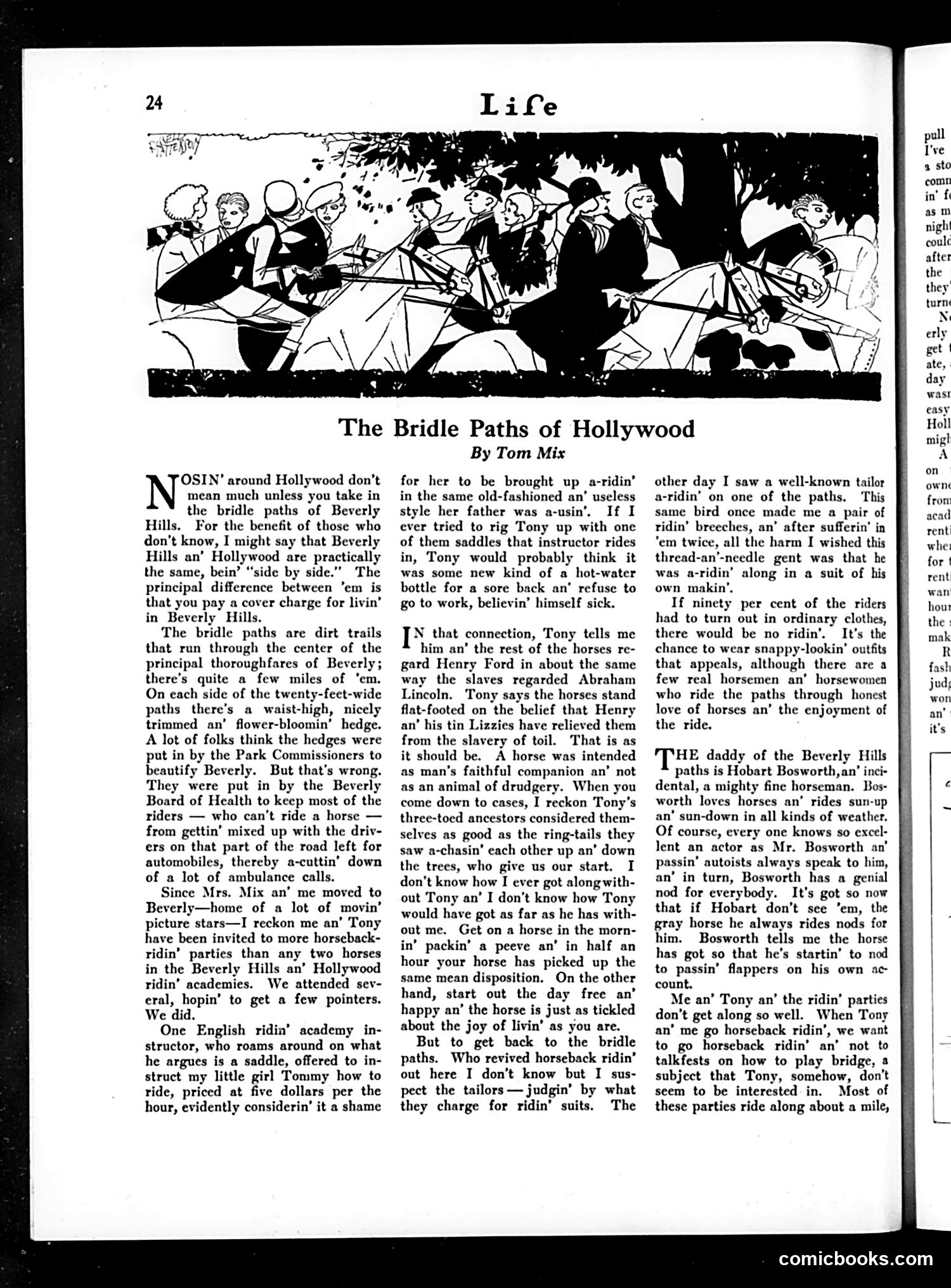
This satirical article by Tom Mix (the famous cowboy actor) mocks Beverly Hills' fashionable horseback-riding culture. The accompanying cartoon shows wealthy Hollywood residents horseback riding in elaborate outfits. Mix's humor targets several things: the pretentiousness of English riding instructors charging high fees to teach "proper" technique to people who can't actually ride; the artificial hedges installed by the Board of Health to protect bad riders from traffic; and especially the tailors who profit by selling expensive, "snappy-lookin'" riding suits—the real reason most people ride at all. The piece contrasts authentic horsemen (like Mix himself) with Beverly Hills dilettantes motivated purely by fashion. His comparison of horses' attitude toward Henry Ford (as a liberator from labor) to slaves' view of Lincoln adds folksy philosophy. The satire suggests Beverly Hills riding is about conspicuous consumption and status display, not genuine horsemanship.
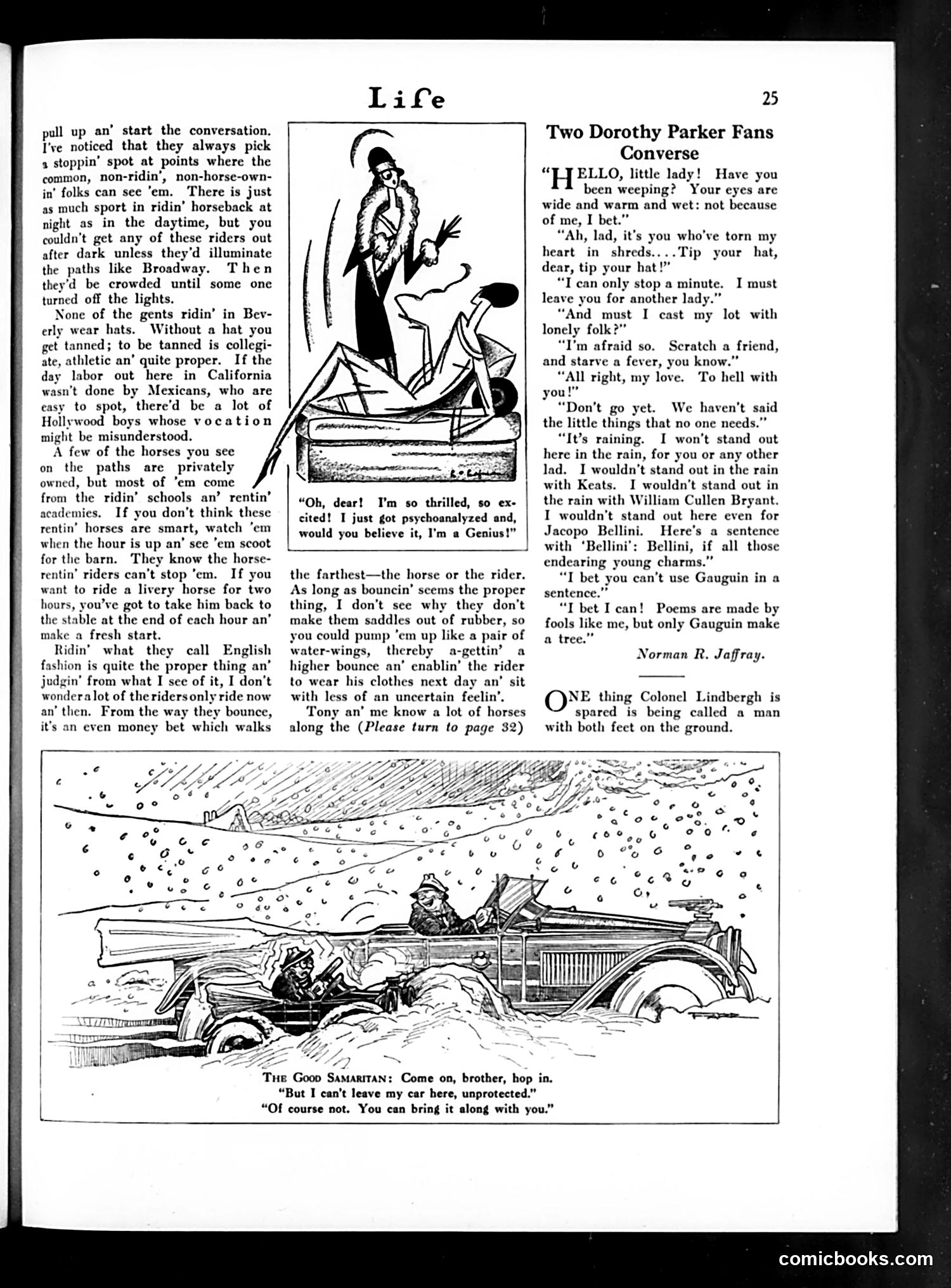
This page contains three satirical pieces targeting 1920s-30s American culture: **1. The Horse-Riding Commentary** (left column): Mocks Beverly Hills residents—likely Hollywood actors and wealthy leisure class—who ostentatiously ride horses on bridle paths, performing their athleticism and "collegiate" status for public view. The writer notes they rent horses from academies and ride only during daylight for visibility. The satire critiques performative leisure and vanity. **2. "Two Dorothy Parker Fans Converse"** (center): Parodies the witty, affected literary banter of Dorothy Parker's circle—affected intellectuals dropping names (Keats, Gauguin, Jacopo Bellini) and quoting/misquoting famous works while conducting melodramatic romantic dialogue. The humor lies in their self-conscious cleverness and pretension. **3. "The Good Samaritan" cartoon** (bottom): A man refusing a ride because he can't leave his unprotected car unattended, defeating the helper's purpose—satire on American materialism and car culture obsession. All three pieces mock affectation, vanity, and shallow materialism in contemporary American society.
This page critiques Hollywood's handling of religious and racial themes in 1920s cinema. **"The Circus"** (left column): A brief, admiring review of Charlie Chaplin's latest film, praising his return to simple slapstick comedy as his finest work. **"Race Prejudice"** (right column): The author criticizes filmmakers—particularly Cecil B. DeMille—for sanitizing the Crucifixion narrative in biblical epics like "The King of Kings" and "Ben-Hur" to avoid offending Jewish audiences. The author argues that by minimizing the mob's role (as depicted in the Gospels), filmmakers strip the story of its universal moral significance about how crowds turn against prophets throughout history. Notably, the author's self-deprecating reference to identifying as a "Grand Kleagle of the Ku Klux Klan" is sarcastic—acknowledging how such criticism might be misconstrued. The point appears to be advocating for historical/biblical accuracy rather than racial blame.
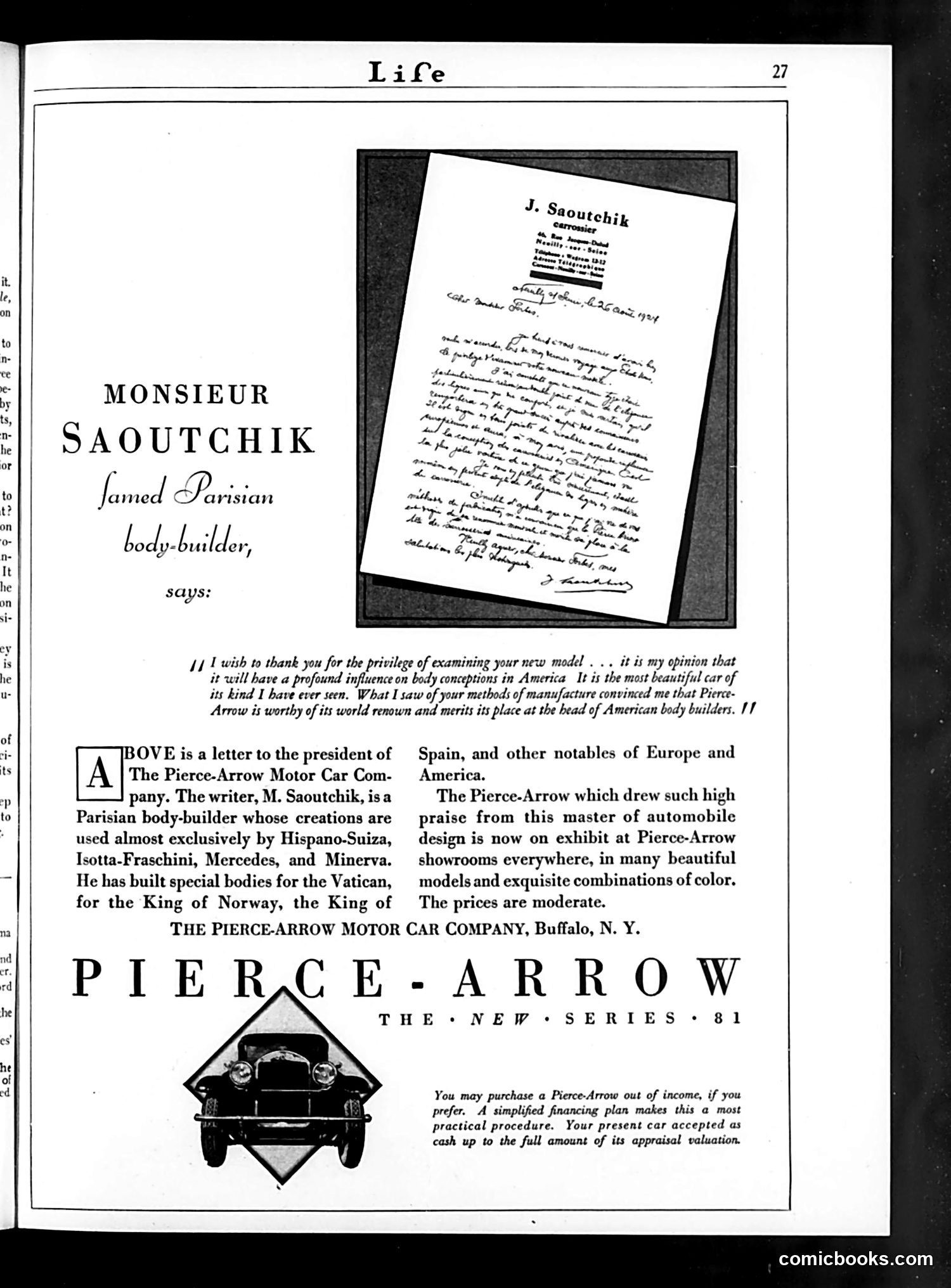
This page is primarily **advertising**, not political satire. It features a testimonial letter from Monsieur J. Saoutchik, a famous Parisian automobile body-builder, praising the Pierce-Arrow Motor Car Company. The "satire" element—if any—is subtle: the ad presents a prestigious European craftsman endorsing an American luxury vehicle, suggesting Pierce-Arrow rivals European prestige. The handwritten letter itself serves as proof of authenticity and high-class association. The Pierce-Arrow company emphasizes their custom bodies were used by royalty (King of Norway, King of Spain) and nobility, positioning the brand as elite. The financing plan at bottom democratizes this luxury, targeting wealthy American buyers willing to trade in their current vehicles. This is straightforward luxury advertising using social prestige and European validation as marketing strategy.
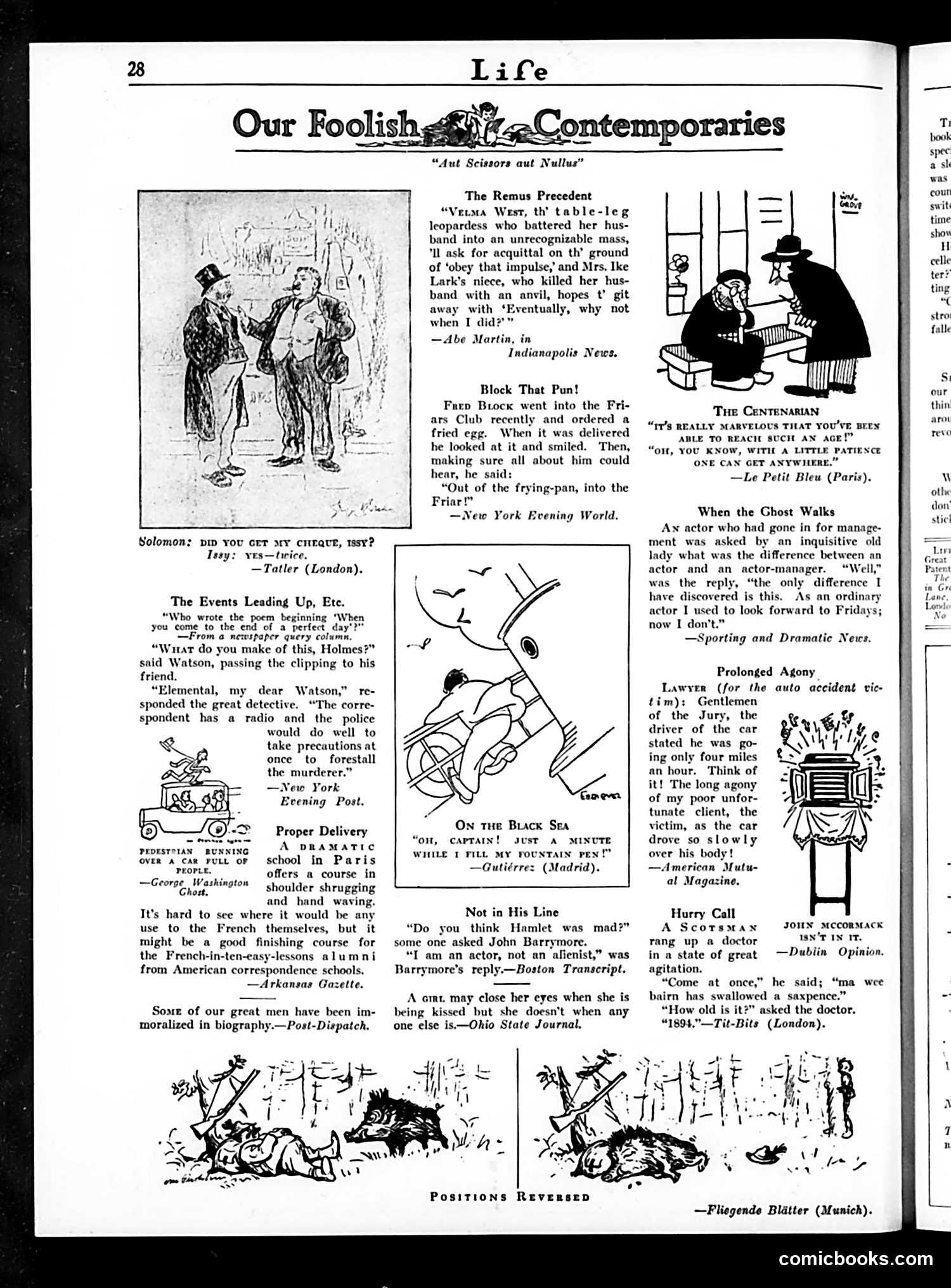
This is a satirical humor page collecting jokes and cartoons from various newspapers and magazines, organized by theme. Key content includes: **"The Remus Precedent"**: References women (Verma West, Mrs. Ike Lark) who killed husbands and sought acquittal using the defense of acting on impulse—mocking the legal strategy of claiming temporary insanity. **"Block That Pun!"**: A man at the Friars Club makes an obvious pun ("out of the frying pan into the Friar") about his fried egg—satirizing groan-worthy wordplay. **"The Centenarian"**: A long-lived person credits patience for reaching old age, with the implication that patience helps one endure life's difficulties. **"When the Ghost Walks"**: An actor-turned-manager jokes that the only difference from being an ordinary actor is he no longer looks forward to paydays ("when the ghost walks"—slang for payday). **Other jokes** mock French dramatic schools, legal strategies in accident cases, and a Scottish father's concern about his son swallowing a coin. The page exemplifies *Life*'s format: reprinting humorous observations from contemporary newspapers with satirical commentary on society.
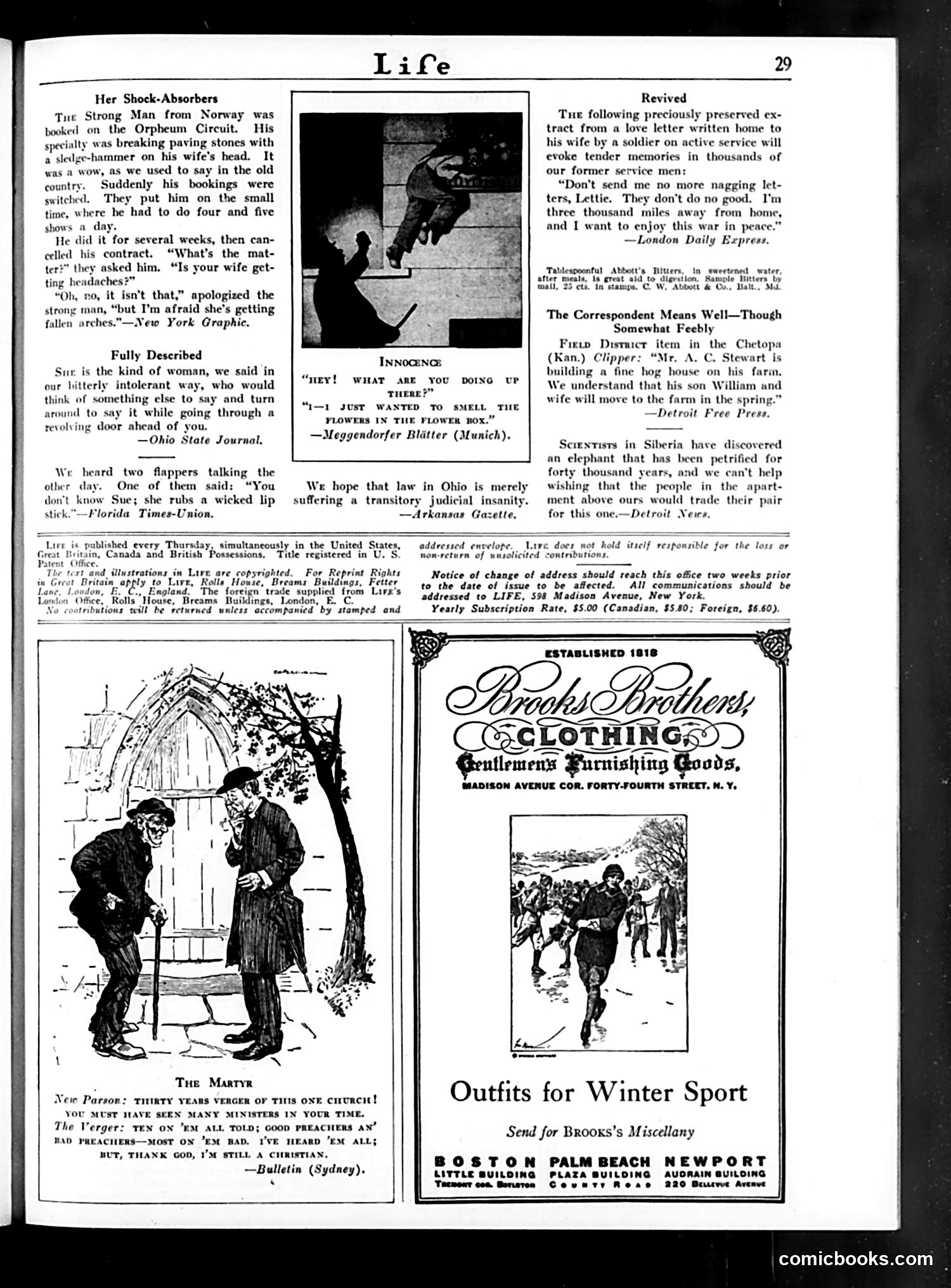
This page from Life (a major American satirical magazine) contains short humorous anecdotes reflecting early 20th-century social attitudes. **Key Jokes:** 1. **"Her Shock-Absorbers"**: A Norwegian strongman performed by smashing paving stones on his wife's head. When moved to smaller venues with multiple daily shows, he quit—not because his wife was injured, but because she was developing "fallen arches" from the repeated physical impact. The joke satirizes both vaudeville's brutal acts and the performer's callous indifference. 2. **"The Martyr"**: A new clergyman learns his church's 30-year verger has endured "good preachers and bad preachers—mostly bad"—yet remains Christian. The humor undercuts preachers' effectiveness while praising the verger's patience. 3. **Soldier's Letter**: A soldier requests his wife stop sending nagging letters, claiming he wants to "enjoy this war in peace"—absurdist humor about domestic complaints amid wartime. The page also includes period advertisements (Brooks Brothers clothing, Abbott's Bitters) and appears to be from approximately the World War I era based on military references.
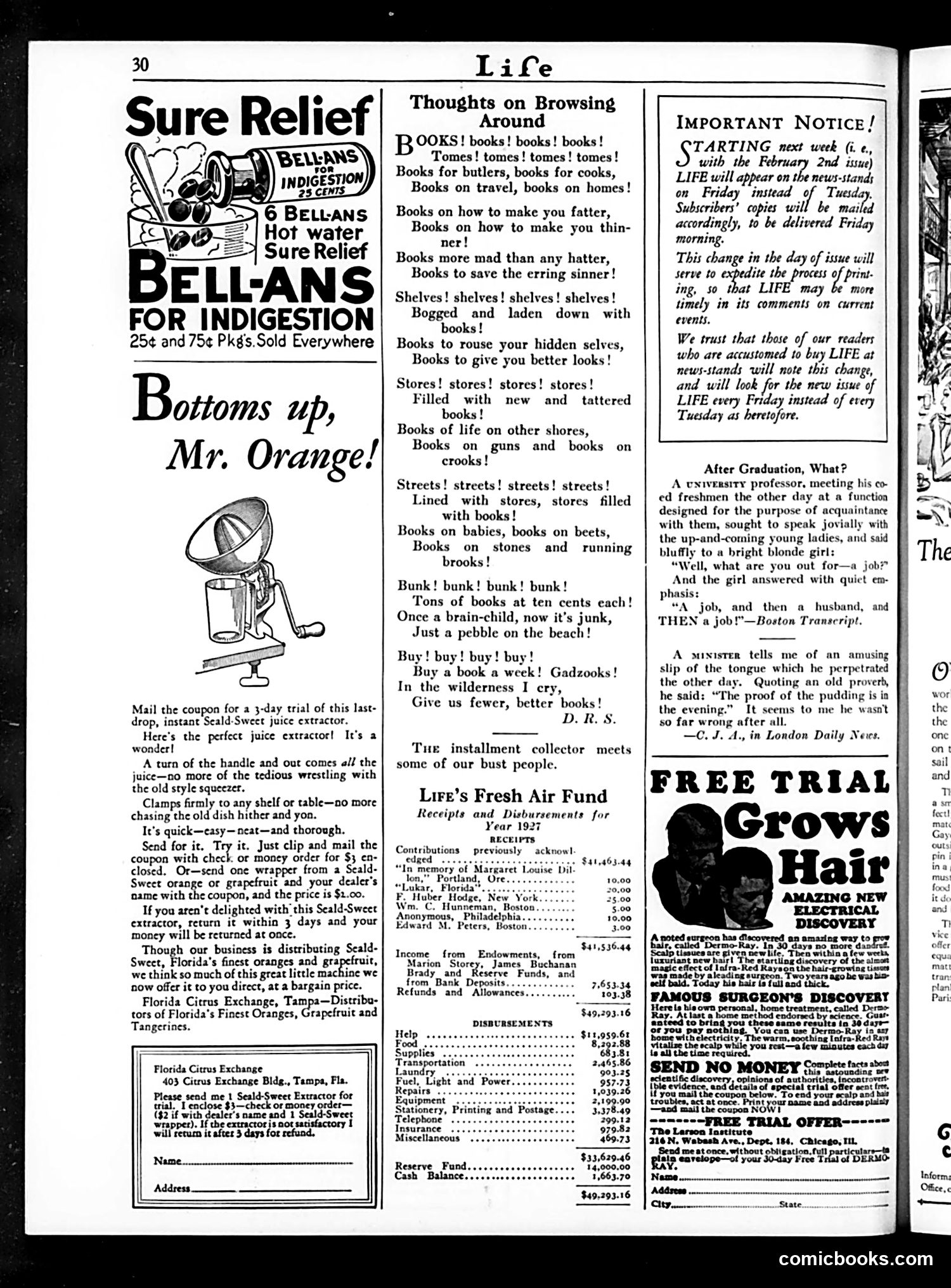
This page is primarily **advertising and administrative content** rather than political satire or comics. The main visual elements are ads: Bellans indigestion relief (featuring a digestive system cartoon labeled "Mr. Orange"), and a Seald-Sweet juice extractor ad showing a mechanical device. The "Thoughts on Browsing Around" poem by D.R.S. satirizes **1920s consumer culture and mass-market publishing**—mocking the proliferation of cheap, disposable books ("ten cents each") flooding stores and streets. The repeated "bunk! bunk! bunk!" refrain criticizes the decline from serious literature to pulp junk, expressing nostalgia for quality over quantity. The page also contains **Life magazine's Fresh Air Fund** financial statement (a charitable initiative providing recreation for underprivileged children) and an **Important Notice** announcing a publication schedule change from Tuesday to Friday delivery. No specific political figures or events are referenced. This reflects typical Life magazine content mixing humor, social commentary on consumer trends, and institutional information.
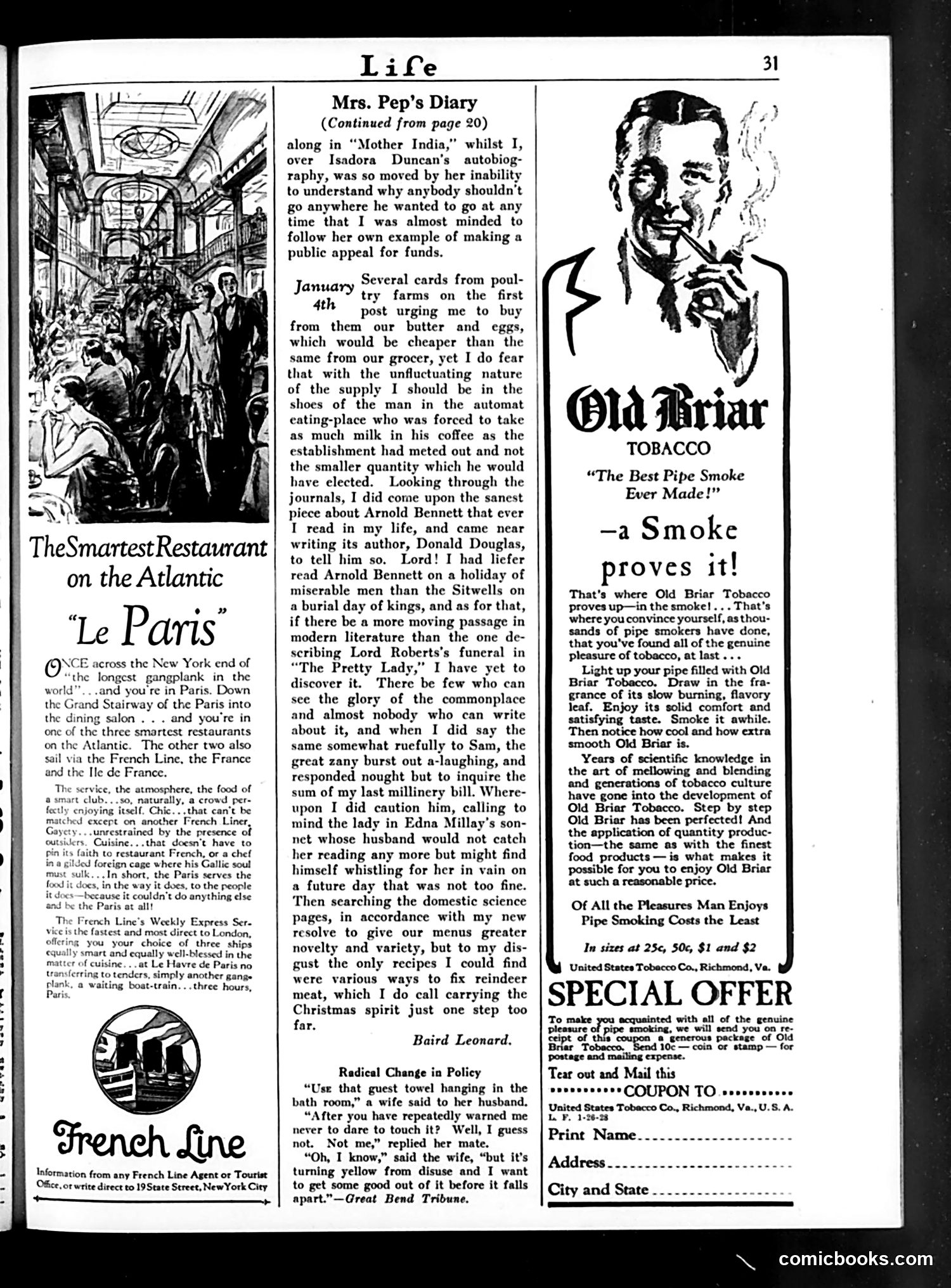
This page contains two main elements: **Left side**: An advertisement for "Le Paris," a French ocean liner restaurant, emphasizing its sophistication and fine dining experience. The French Line is marketing luxury transatlantic travel. **Right side**: Two distinct pieces— 1. **"Mrs. Pep's Diary"** (continued): A satirical diary entry by "Baird Leonard" mocking upper-class intellectualism. The writer describes pretentious literary discussions (Isadora Duncan, Arnold Bennett) and absurd domestic problems, like farms offering cheaper eggs but inconsistent supply, or obsessing over reindeer recipes. The humor targets snobbish cultural pretension and trivial concerns of wealthy society figures. 2. **"Radical Change in Policy"**: A brief joke about a husband refusing to use a "guest towel" after his wife warned him never to touch it—even though she now wants him to use it before it deteriorates. This satirizes the absurdity of rigid household rules and stubbornness. The page is primarily satirical humor targeting upper-class social conventions and pretension typical of *Life* magazine's editorial voice.
This satirical piece mocks Hollywood gossip and the inconstancy of film industry marriages. The narrative describes two ex-spouses—a recently remarried actor (on his fourth wife) and actress (on her third husband)—who encounter each other on bridle paths near Beverly Hills, riding horses that were once a matched team. Though they're traveling in opposite directions and weren't speaking, their horses' training forces them to stay together, side by side. The joke: Hollywood observers, seeing them ride together smiling, immediately assume reconciliation and spread rumors of new divorces and remarriage. The narrator uses this anecdote to critique both the fickleness of Hollywood marriages and the celebrity gossip mill's eagerness to manufacture scandal from innocent circumstances. It's a gentle roasting of the entertainment industry's marital instability and scandal-hungry reporting.