
Life, 1928-01-26 · page 5 of 34
Life — January 26, 1928 — page 5: what you’re looking at
What you’re looking at
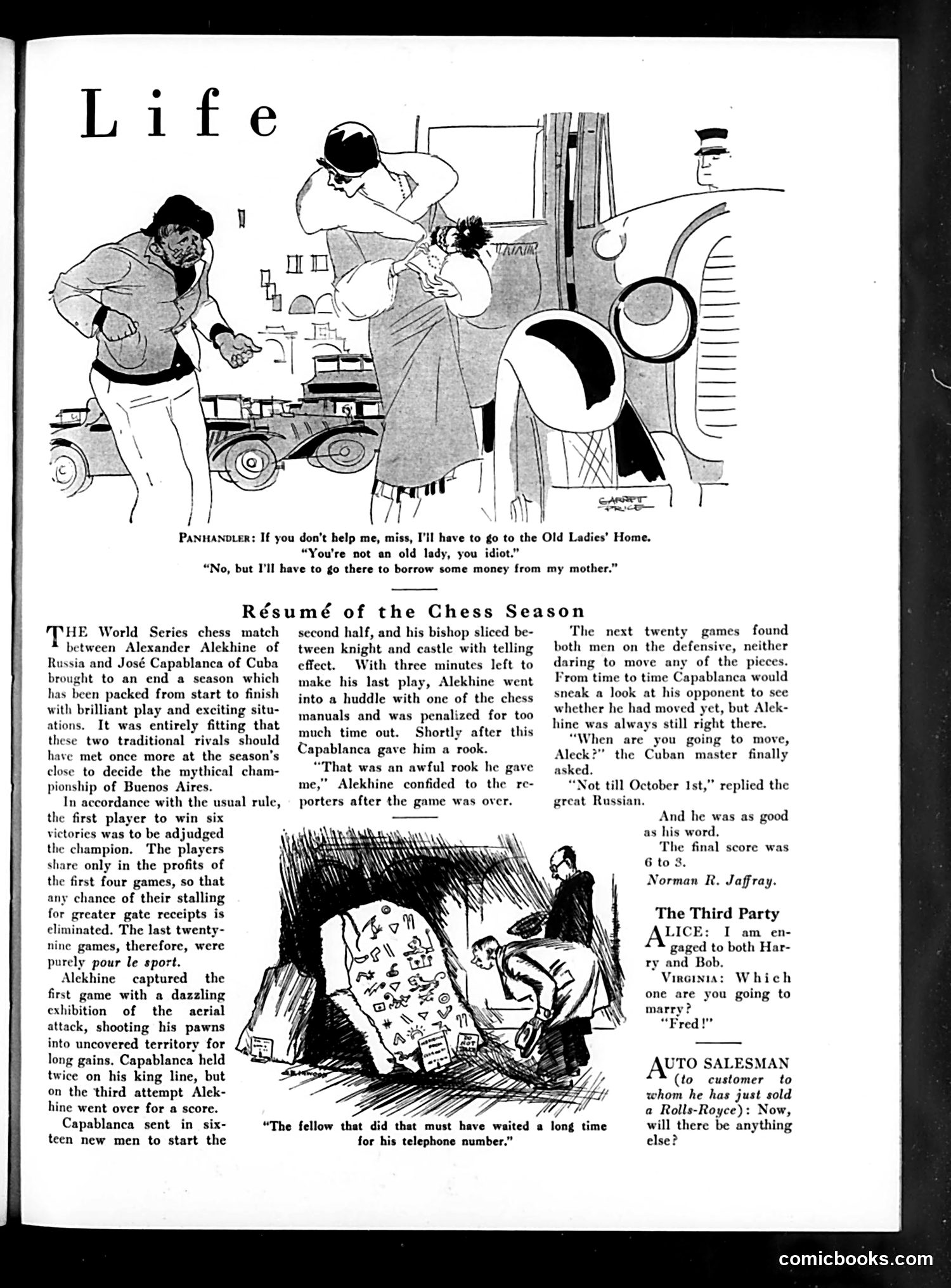
**Top Cartoon**: A slapstick domestic scene showing a man (labeled "Panhandler") making excuses to avoid helping a woman. He threatens to go to an "Old Ladies' Home" unless she helps him, then pivots to claiming he needs to borrow money from his mother. The joke satirizes male dependency and the reversal of traditional gender roles—a man playing the victim to manipulate a woman into supporting him. This reflects early 20th-century anxieties about masculinity and economic vulnerability. **Chess Section**: Discusses World Series chess matches between Alexander Alekhine and José Raúl Capablanca, describing their strategic play and final score (6 to 3). Appears to be a legitimate sports report rather than satire. **Bottom Section**: Brief comic dialogues about marriage and auto sales—light domestic humor typical of Life's format.
📄 Transcribed text from this page (OCR, searchable)
Machine-transcribed from the original scan — historical spelling and the odd misread are preserved.
PANHANDLER: If you don’t help me, miss, I'll have to go to the Old Ladies’ Home. “You're not an old lady, you idiot.” “No, but I'll have to go there to borrow some money from my mother.” Résumé of the Chess Season HE World Series chess match between Alexander Alekhine of Russia and José Capablanca of Cuba t to an end a season which has been packed from start to finish with brilliant play and exciting situ- ations. It was entirely fitting that these two traditional rivals should have met once more at the season's close to decide the mythical cham- pionship of Buenos Aires. In accordance with the usual rule, the first player to win six victories was to be adjudged the champion. The players share only in the profits of the first four games, so that any chance of their stalling for greater gate receipts is eliminated. The last twenty- nine games, therefore, were purely pour le sport. Alekhine captured the first game with a dazzling exhibition of the aerial attack, shooting his pawns into uncovered territory for long gains. Capablanca held twice on his king line, but on the third attempt Alek- hine went over for a score. Capablanca sent in six- teen new men to start the second half, and his bishop sliced be- tween knight and castle with telling effect. With three minutes left to make his last play, Alekhine went into a huddle with one of the chess manuals and was penalized for too much time out. Shortly after this Capablanca gave him a rook. “That was an awful rook he gave me,” Alekhine confided to the re- porters after the game was over. AA ANNO \ SAS AO nyaee Taek phe “The fellow that did that must have waited a long time for his telephone number.” The next twenty games found both men on the defensive, neither daring to move any of the pieces. From time to time Capablanca would sneak a look at his opponent to see whether he had moved yet, but Alek- hine was always still right there. “When are you going to move, Aleck?” the Cuban master finally asked. “Not till October Ist,” replied the great Russian. And he was as good as his word. The final score was 6 to 3, Norman R. Jaffray. The Third Party LICE: I am en- gaged to both Har- ry and Bob. Virginia: Which one are you going to marry? “Fred!” UTO SALESMAN (to customer to whom he has just sold a Rolls-Royce): Now, will there be anything else? comicbooks.com