
Life, 1928-01-26 · page 16 of 34
Life — January 26, 1928 — page 16: what you’re looking at
What you’re looking at
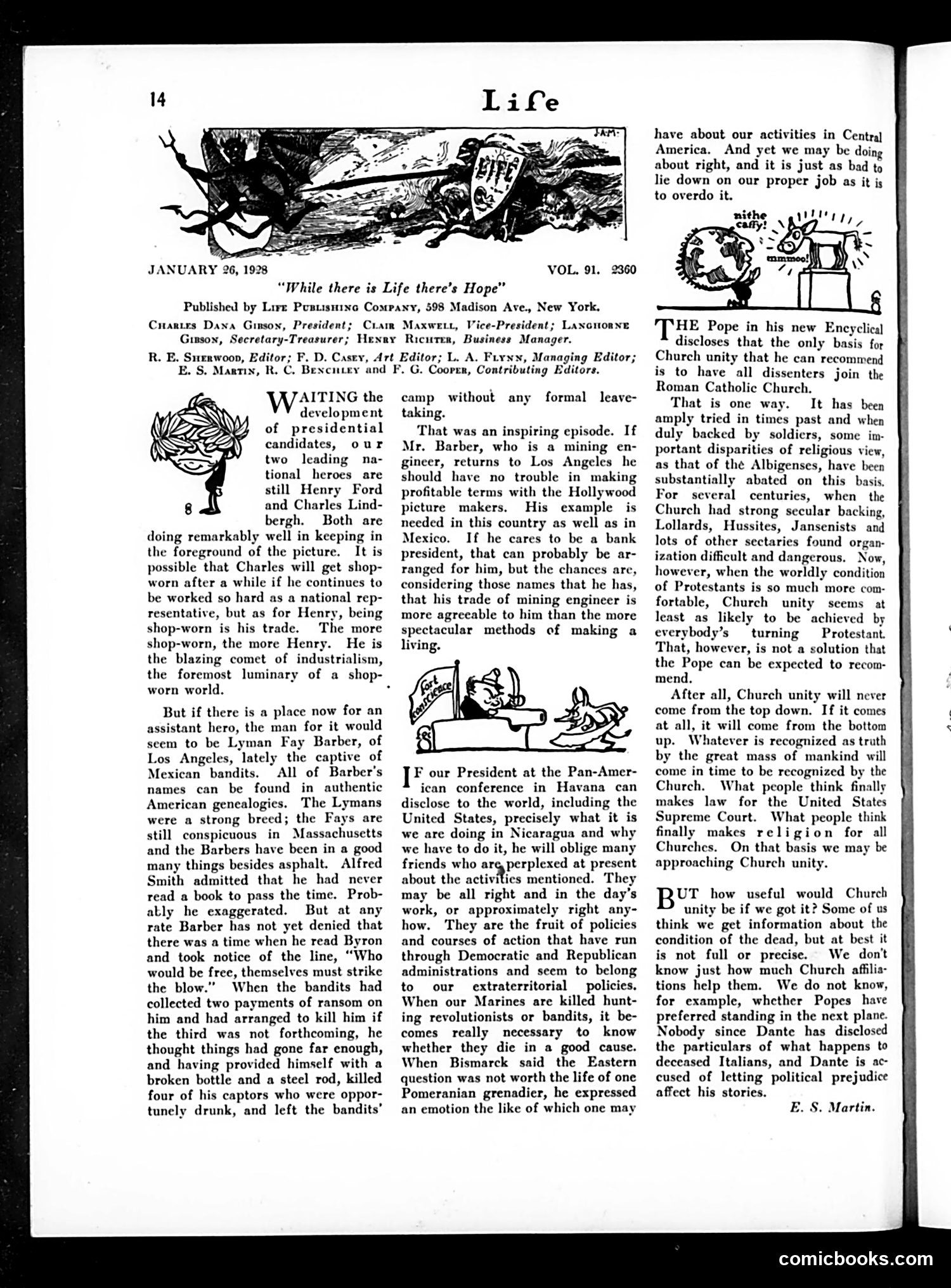
This page discusses presidential candidates and contains a small cartoon showing what appears to be a figure at a desk or work station. The main text discusses **Henry Ford** and **Charles Lindbergh** as potential presidential candidates, praising their effectiveness in their respective fields (automotive industry and aviation). The article suggests that while Ford might make a good president, his successor as an industrialist would be harder to find—implying talented leaders shouldn't leave their positions. The text also references **Lyman Jay Barber**, a mining engineer from Los Angeles, as a possible presidential assistant. The second article discusses **the Pope's new Encyclical** on Church unity and religious tolerance, critiquing the idea that all Christian denominations should simply join the Roman Catholic Church. The cartoons appear to be illustrative rather than satirical commentary on these topics.
📄 Transcribed text from this page (OCR, searchable)
Machine-transcribed from the original scan — historical spelling and the odd misread are preserved.
VOL, 91. 2360 “While there is Life there’s Hope” Published by Lirg Pustisuinc Company, 598 Madison Ave., New York. Cnantrs Dana Ginsox, President; C Ginsox, Secretary-Treasurer; He R. E. Suenwoon, Edito E. S. Martin, R, AITING the development of presidential candidates, our two leading na- tional heroes are still Henry Ford and Charles Lind- bergh. Both are doing remarkably well in keeping in the foreground of the picture. It is possible that Charles will get shop- worn after a while if he continues to be worked so hard as a national rep- resentative, but as for Henry, being shop-worn is his trade. The more shop-worn, the more Henry. He is the blazing comet of industrialism, the foremost luminary of a shop- worn world. But if there is a place now for an assistant hero, the man for it would seem to be Lyman Fay Barber, of Los Angeles, lately the captive of Mexican bandits. All of Barber's names can be found in authentic American genealogies. The Lymans were a strong breed; the Fays are still conspicuous in Massachusetts and the Barbers have been in a good many things besides asphalt. Alfred Smith admitted that he had never read a book to pass the time. Prob- atly he exaggerated. But at any rate Barber has not yet denied that there was a time when he read Byron and took notice of the line, “Who would be free, themselves must strike the blow.” When the bandits had collected two payments of ransom on him and had arranged to kill him if the third was not forthcoming, he thought things had gone far enough, and having provided himself with a broken bottle and a steel rod, killed four of his captors who were oppor- tunely drunk, and left the bandits’ Maxwett, Vice-President; Laxcntonne Ricuren, Business Manager. F. D. Casey, Art Editor; L. A. Fiyxx, Managing Editor; . Bencutey and F. . Coorer, Contributing Editors. camp without any formal leave- taking. That was an inspiring episode. If Mr. Barber, who is a mining en- gineer, returns to Los Angeles he should have no trouble in making profitable terms with the Hollywood picture makers. His example is needed in this country as well as in Mexico. If he cares to be a bank president, that can probably be ar- ranged for him, but the chances are, considering those names that he has, that his trade of mining engineer is more agreeable to him than the more spectacular methods of making a F our President at the Pan-Amer- ican conference in Havana can disclose to the world, including the United States, precisely what it is we are doing in Nicaragua and why we have to do it, he will oblige many friends who arg perplexed at present about the activities mentioned. They may be all right and in the day’s work, or approximately right any- how. They are the fruit of policies and courses of action that have run through Democratic and Republican administrations and seem to belong to our extraterritorial _ policies. When our Marines are killed hunt- ing revolutionists or bandits, it be- comes really necessary to know whether they die in a good cause. When Bismarck said the Eastern question was not worth the life of one Pomeranian grenadier, he expressed an emotion the like of which one may have about our activities in Central America. And yet we may be doing about right, and it is just as bad to lie down on our proper job as it is to overdo it. THE Pope in his new Encyclical discloses that the only basis for Church unity that he can recommend is to have all dissenters join the Roman Catholic Church. That is one way. It has been amply tried in times past and when duly backed by soldiers, some im- portant disparities of religious view, as that of the Albigenses, have been substantially abated on this basis. For several centuries, when the Church had strong secular backing, Lollards, Hussites, Jansenists and lots of other sectaries found organ- ization difficult and dangerous. Now, however, when the worldly condition of Protestants is so much more com- fortable, Church unity scems at least as likely to be achieved by everybody’s turning Protestant. That, however, is not a solution that the Pope can be expected to recom- mend. After all, Church unity will never come from the top down. If it comes at all, it will come from the bottom up. Whatever is recognized as truth by the great mass of mankind will come in time to be recognized by the Church. What people think finally makes law for the United States Supreme Court. What people think finally makes religion for all Churches. On that basis we may be approaching Church unity. UT how useful would Church unity be if we got it? Some of us think we get information about the condition of the dead, but at best it is not full or precise. We don't know just how much Church affilia- tions help them. We do not know, for example, whether Popes have preferred standing in the next plane. Nobody since Dante has disclosed the particulars of what happens to deceased Italians, and Dante is ac- cused of letting political prejudice affect his stories. E. S. Martin. comicbooks.com