
Life, 1928-01-26 · page 20 of 34
Life — January 26, 1928 — page 20: what you’re looking at
What you’re looking at
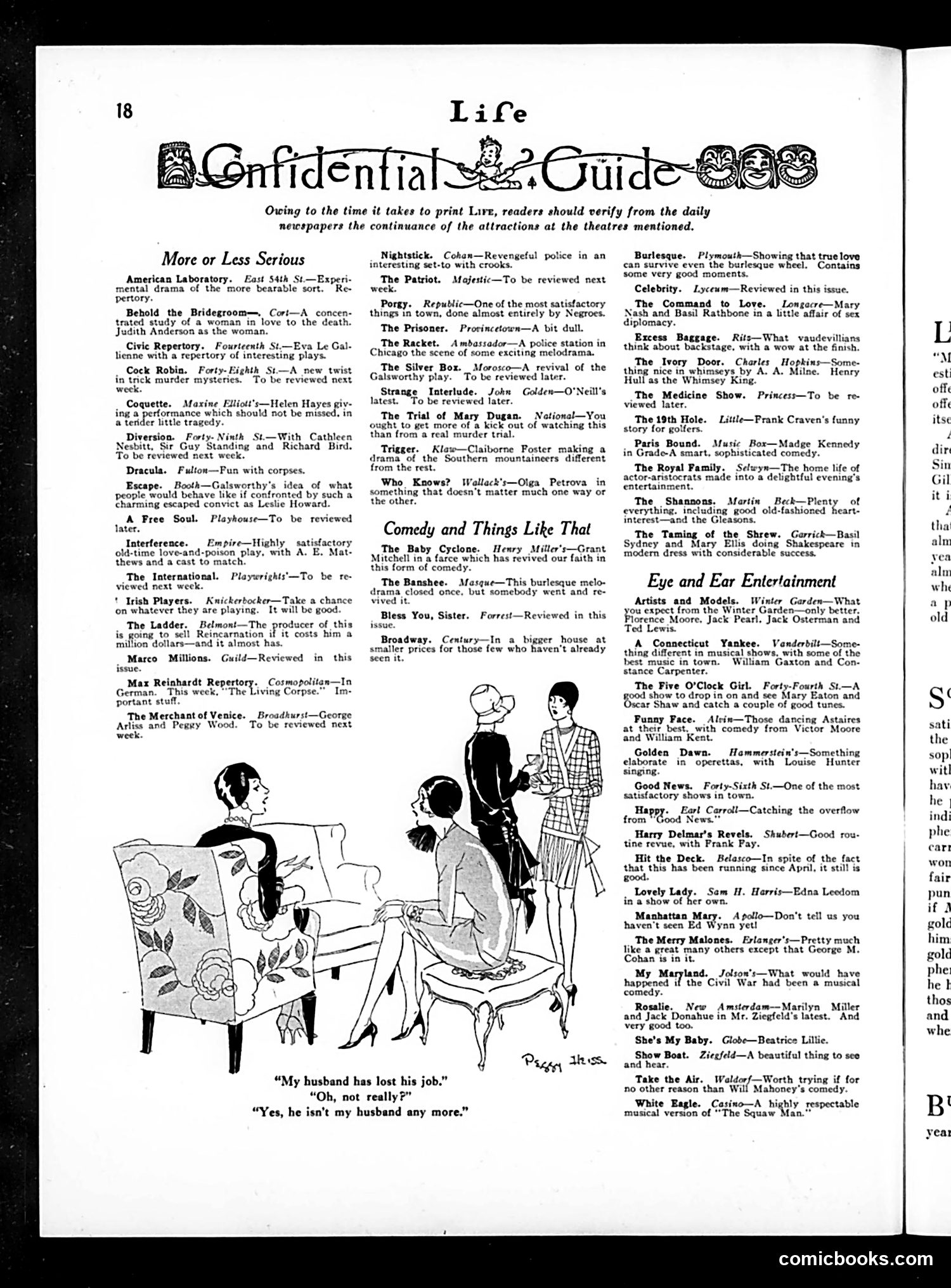
This page from *Life* magazine presents theater reviews organized by tone—"More or Less Serious" and "Comedy and Things Like That." The cartoon depicts a domestic conversation between a husband and wife seated in a living room. The husband announces, "My husband has lost his job," and the wife responds, "Oh, not really?" He replies, "Yes, he isn't my husband any more." **The joke's meaning:** This is a Depression-era joke playing on economic anxiety and marital instability. The humor hinges on the wife's casual misunderstanding—she initially thinks he means he's *lost* a job (temporarily), when he actually means he's been *fired* permanently and can no longer support her, thus making their marriage effectively void. It satirizes how economic collapse could dissolve marriages and how wives' dependency on husbands' income defined their marital status. The period detail and casual tone reflect 1920s-30s anxieties about economic security and gender roles.
📄 Transcribed text from this page (OCR, searchable)
Machine-transcribed from the original scan — historical spelling and the odd misread are preserved.
Owing to the time it takes to print Lire, readers should verify from the daily newspapers the continuance of the attractions at the theatres mentioned. More or Less Serious American Laboratory. East S4th St—Experi- mental drama of the more bearable sort. Re- pertory. Behold the Bridegroom—, Cori—A_ concen- trated study of a woman in love to the death. Judith Anderson as the woman. Civic Repertory. Fourteenth St.—Eva Le Gal- lienne with a repertory of interesting plays. Cock Robin. Forty- Eighth St—A new twist in trick murder mysteries. To be reviewed next week. Coquette. Maxine Filiott's—Helen Hayes giv- ing a performance which should not be miss a terider little tragedy. Diversion. Forty. Ninth St—With Cathleen Nesbitt, Sir Guy Standing and Richard Bird, To be reviewed next week. Dracula. Fulfon—Fun with corpses. Escape. Booth—Galsworthy’s idea of what people would behave like if confronted by such a charming escaped convict as Leslie Howard. A Free Soul. Playhouse—To be reviewed later. Interference. Empire—Highly satisfactory old-time love-and-poison play, with A. E, Mat- thews and a cast to match. The International. viewed next week. Irish Players. Knickerbocker—Take a chance on whatever they are playing. It will be good. The Ladder. Belmont—The producer of this is going to sell Reincarnation if it costs him a million dollars—and it almost has. Marco Millions. Guild—Reviewed in this issue. Max Reinhardt Repertor German. This week, ‘The portant stuf. The Merchant of Venice. _ Broadhurst—George Arliss and Peggy Wood. To be reviewed next week. Playwrights'\—To be re- Cosmopolitan—In ‘ing Corpse.” Im- Nightstick. Cohan—Revengeful police in an interesting set-to with crooks. The Patriot. Majestic—To be reviewed next week. Porgy. Republic—One of the most satisfactory things in town, done almost entirely by Negroes. The Prisoner. Provincetown—A bit dull. _ The Racket. Ambassador—A police station in Chicago the scene of some exciting melodrama. The Silver Box. Morosco—A revival of the Galsworthy play. To be reviewed later. Strange Interlude. John Golden—O'Neill’s latest. To be reviewed later. The Trial of Mary Dugan. National—You ought to get more of a kick out of watching this than from a real murder trial. Trigger. Klaw—Claiborne Foster making a drama of the Southern mountaineers different from the rest. Who Knows? |Wallack's—Oiga Petrova in something that doesn't matter much one way or the other. Comedy and Things Like That The Baby Cyclone. Henry Miller's—Grant Mitchell in a farce which has revived our faith in this form of comedy. The Banshee. Masque—This burlesque melo- dams closed once, but somebody went and re- vived it Bless You, Sister. Forrest—Reviewed in this issue. Broadway. Century—In a bigger house at smaller prices for those few who haven't already seen it, “My husband has lost hi “Oh, not really?” “Yes, he isn't my husband any more.” Burlesque. Plymouth—Showing that true love can survive even the burlesque wheel. Contains some very good moments. Celebrity. Lyceum—Reviewed in this issue. The Command to Love. Longacre—Mary Nash and Basil Rathbone in a little affair of sex diplomacy. Excess Baggage. Rits—What vaudevillians think about backstage, with a wow at the finish. The Ivory Door. Charles Hopkins—Some- thing nice in whimseys by A. A. Milne. Henry Hull as the Whimsey King. The Medicine Show. Princess—To be re- viewed later. The 19th Hole. Littlh—Prank Craven's funny story for golfers. Paris Bound. Music Box—Madge Kennedy in Grade-A smart, sophisticated comedy. The Royal Family. Selwyn—The home life of actor-aristocrats made into a delightful evening's entertainment. The Shannons. Martin Beck—Plenty of everything. including good old-fashioned heart- interest—and the Gleasons. The Taming of the Shrew. Gorrick—Basil Sydney and Mary Ellis doing Shakespeare in modern dress with considerable success. Eye and Ear Entertainment Artists and Models. Winter Garden—What Re expect from the Winter Garden—only better. jorence Moore, Jack Pearl. Jack Osterman and Ted Lewis. A Connecticut Yankee. Vanderdilt—Some- thing different in musical shows, with some of the best music in town. William Gaxton and Con- stance Carpenter. The Five O’Clock Girl. Forty-Fourth St.—A geod show to drop in on and see Mary Eaton and Jscar Shaw and catch a couple of good tunes. Funny Face. Alrin—Those dancing Astaires at their best, with comedy from Victor Moore and William Kent. Golden Dawn. Hammerstein's—Something elaborate in operettas, with Louise Hunter singing. Good News. Forty-Sixth St.—One of the most satisfactory shows in town. Happy. Ear! Carroll—Catching the overflow from "Good News.” Harry Delmar’s Revels. Shuber!—Good rou- tine revue, with Prank Pay. Hit the Deck. Belasco—In spite of the fact that this has been running since Apri, it still is good. , Lovely Lady. Sam H. Harris—Edna Lecdom in a show of her own. Manhattan Mary. A pollo—Don't tell us you haven't seen Ed Wynn yet! The Merry Malones. Erlanger's—Pretty much like a great many others except that George M. Cohan is in it. My Maryland. Jolson’s—What would have happened if the Civil War had been a musical comedy. Rosalie. New Amsterdam—Marilyn Miller and Jack Donahue in Mr. Ziegfeld’s latest. And very good too. She's My Baby. Globe—Beatrice Lillie. Show Boat. Ziegfeld—A beautiful thing to see and hear. Take the Air. Waldorf—Worth trying if for no other reason than Wilf Mahoney's comedy. White Eagle. Casino—A highly respectable manent verse of “The Squaw Man." “M est off off itse y dir Sin Gil iti tha’ alm yea alm whe ap old S sati the sop! wit hav he | indi phe carr won fair pun if J golc him gold phei he f thos and whe comicbooks.com