
A complete issue · 41 pages · 1927
Life — December 29, 1927
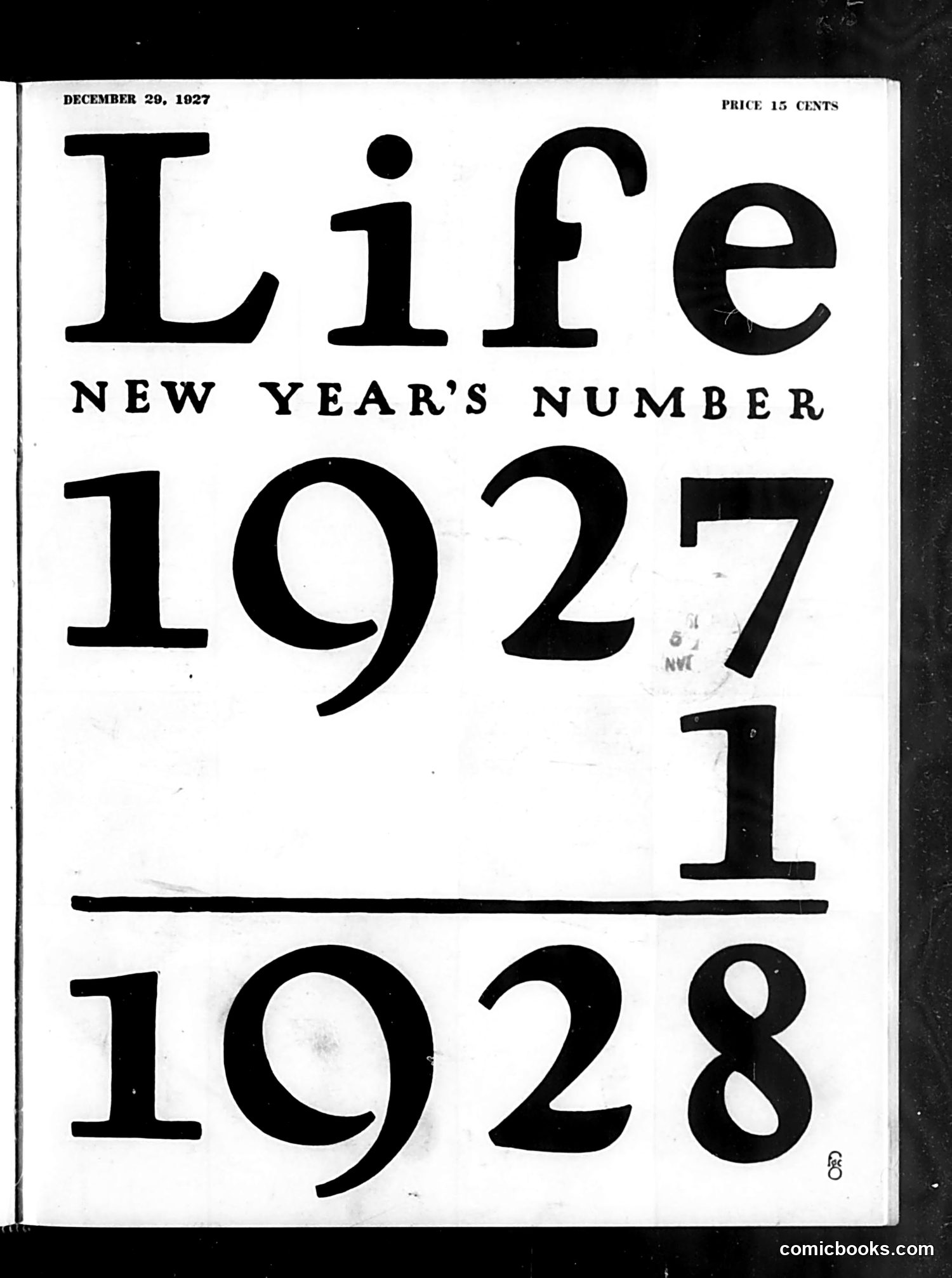
This is the cover of Life magazine's New Year's issue, presenting a straightforward visual pun rather than political satire. The large typography announces "Life" as the masthead, followed by "NEW YEAR'S NUMBER," then displays the years "1927" and "1928" separated by a horizontal line. The joke is typographical: the four numbers and the line create the visual appearance of a simple arithmetic equation (1927 + 1 = 1928), representing the passage from the old year to the new. It's a clever visual play on the concept of time advancing by one year at midnight on December 31st—an accessible, universal New Year's theme requiring no knowledge of specific 1927 events to appreciate.
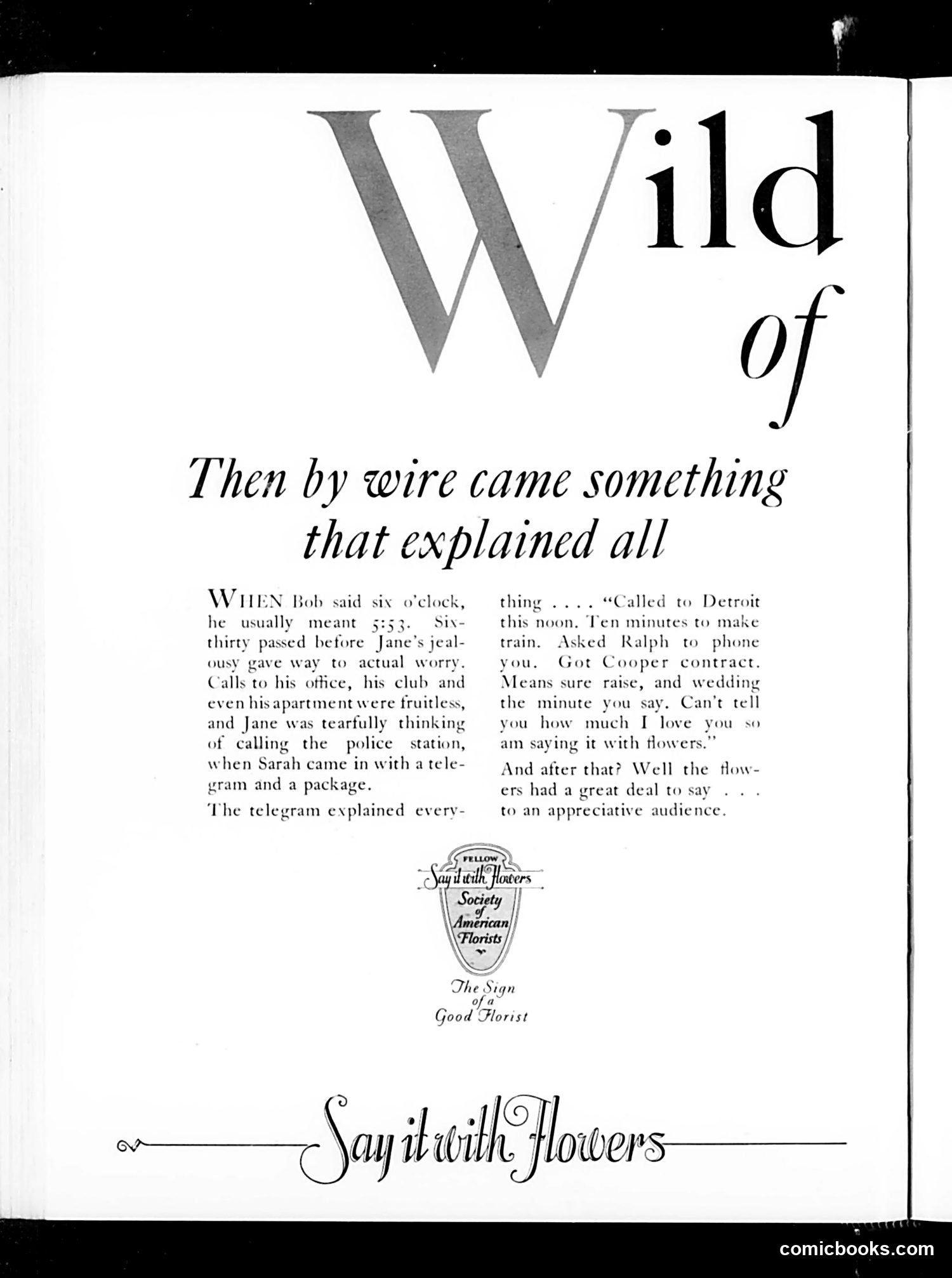
This is a **florist advertisement**, not a political cartoon. The page presents a narrative advertisement for "Say it with Flowers," promoting the services of the Society of American Florists. The story describes a scenario where a man named Bob misses a 6 o'clock appointment with his wife Jane. When Jane grows concerned and nearly calls the police, a telegram arrives explaining Bob's delay and requesting flowers be sent as an apology. The advertisement emphasizes that flowers can effectively communicate affection and resolve romantic situations. The page concludes with the florist society's seal and tagline "The Sign of a Good Florist," establishing flowers as an appropriate solution to domestic miscommunications—a common marketing strategy in early 20th-century consumer advertising.
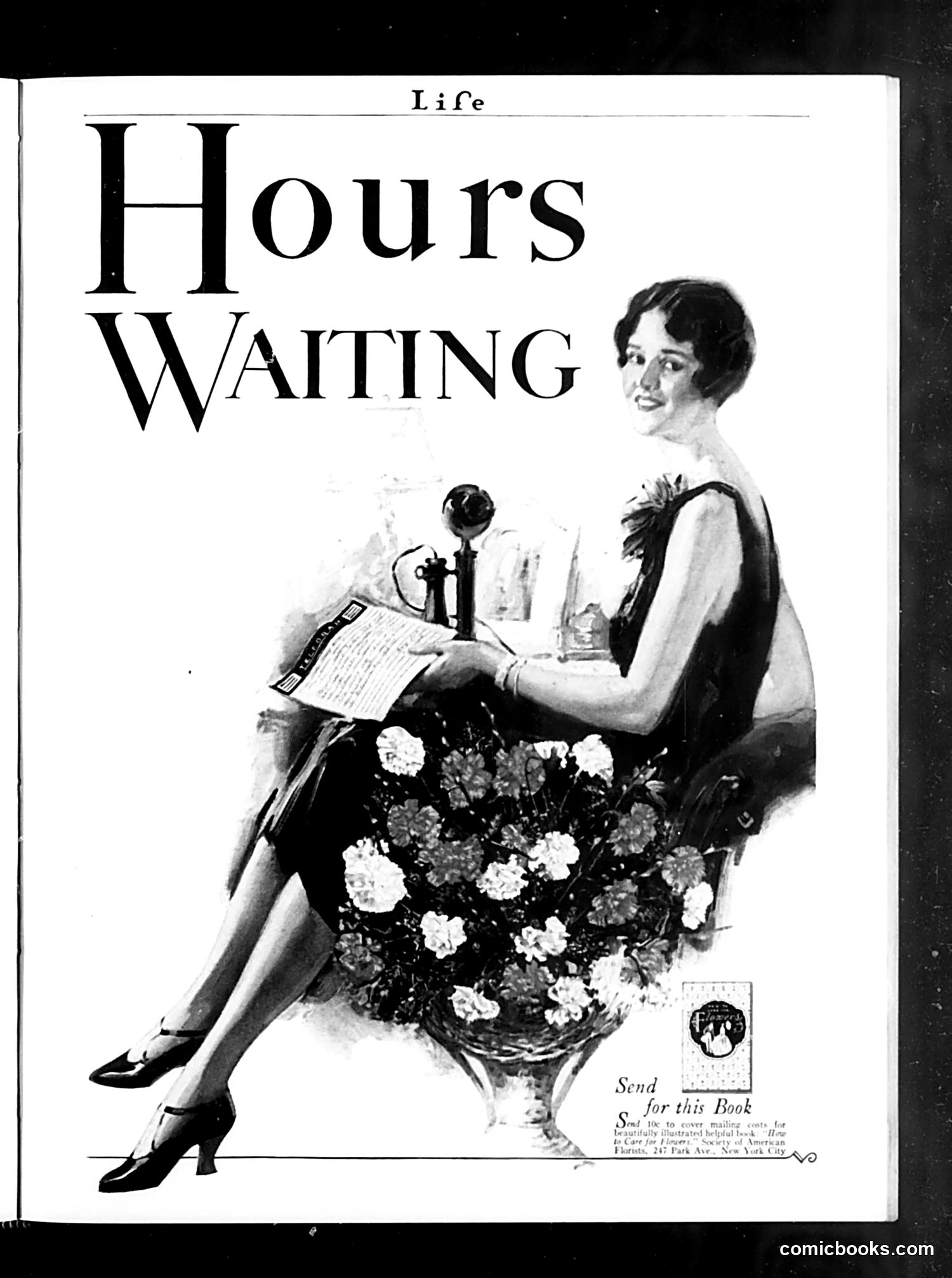
This appears to be a **book advertisement** rather than political satire. The page shows a stylishly dressed woman of the 1920s-30s era sitting in a large decorative flower vase, reading what appears to be a book or magazine. A telephone and flowers are visible nearby. The title "Hours Waiting" likely references the book's subject matter—possibly romantic anticipation or idle time. The image plays on the period's aesthetic: the fashionable woman, art deco styling, and decorative flowers suggest leisure and modernity. The bottom text instructs readers to "Send for this Book," with mailing details to a New York City address, confirming this is promotional content for a published work rather than editorial commentary.
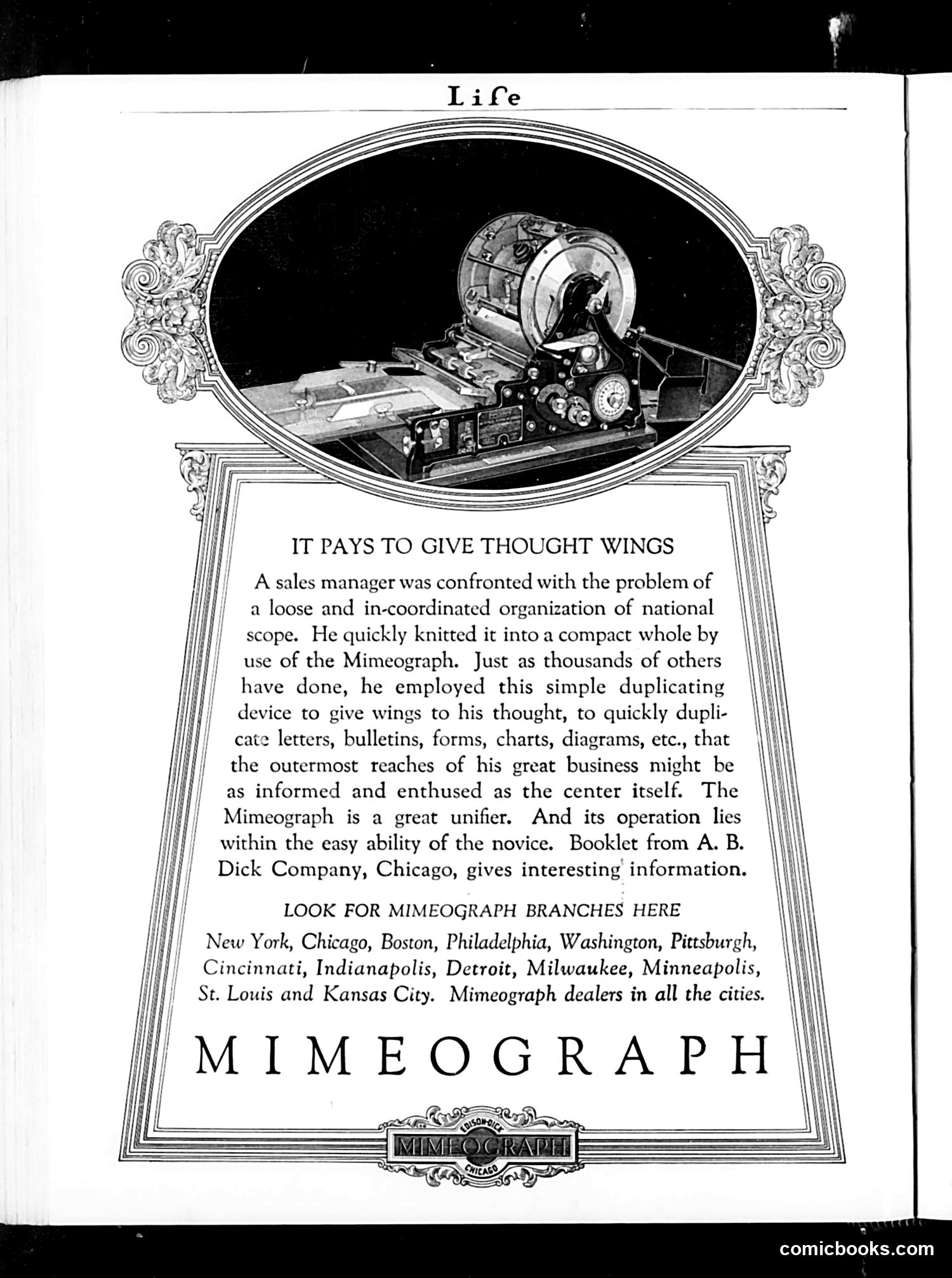
This is primarily an **advertisement** for the Mimeograph, a duplicating machine, rather than political satire or editorial cartoon. The page uses a business-focused pitch: a sales manager solved organizational chaos by using a Mimeograph to duplicate letters, bulletins, forms, and charts. The headline "It Pays to Give Thought Wings" frames document duplication as enabling efficient business communication across distributed operations. The image shows the actual machine itself. The ad lists Mimeograph branch locations across major American cities and notes that dealers operate nationwide. This represents early-20th-century office technology marketing—positioning the Mimeograph as essential business equipment for growing organizations needing to standardize and distribute information quickly. It's promotional material, not satirical commentary.
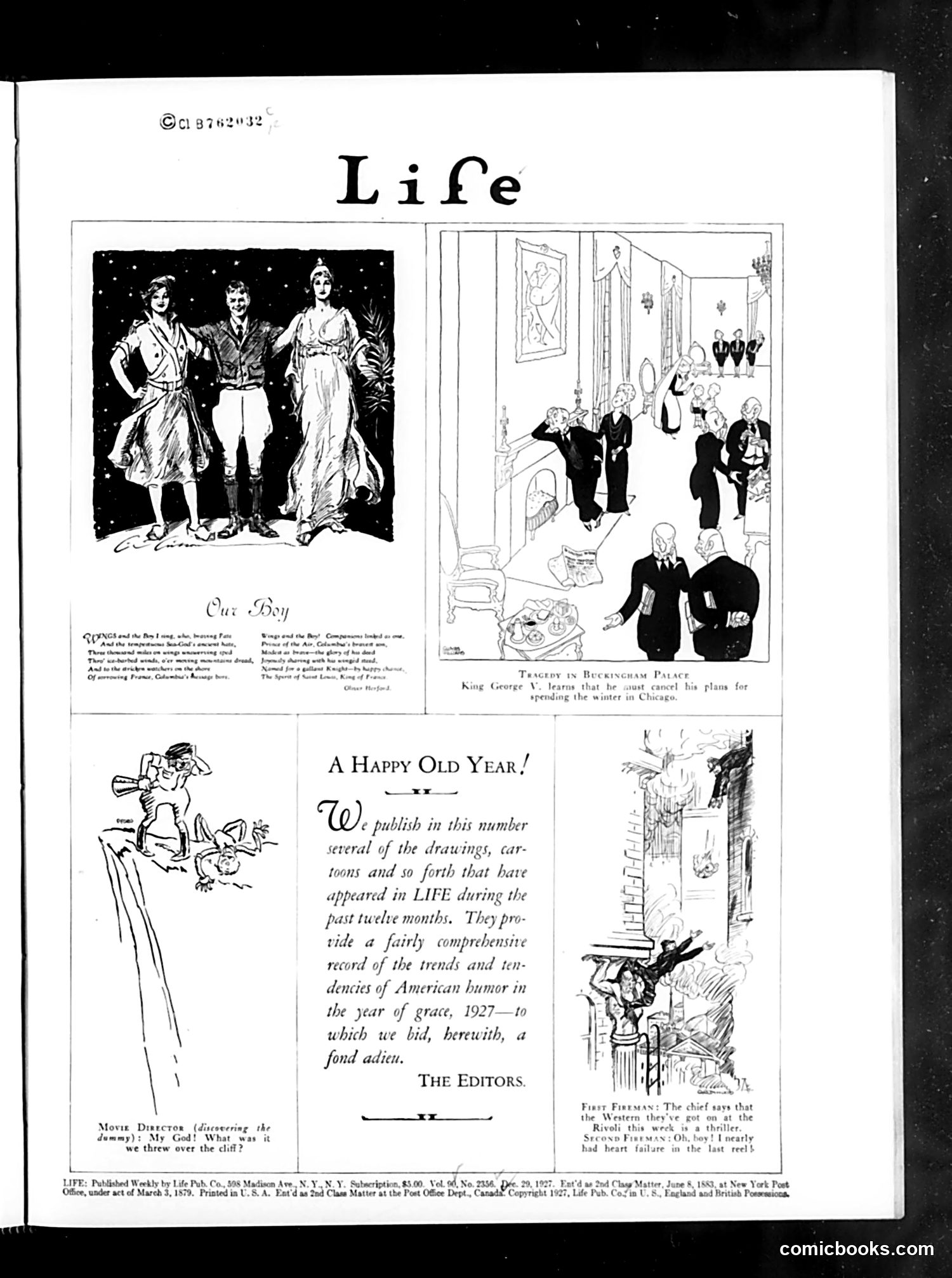
This page commemorates 1927's American humor through several cartoons. The top left, "Our Boy," depicts three figures in formal dress against a starry backdrop—likely referencing a significant political or social figure of that year, though the specific identity isn't clear from the image alone. The top right, "Tragedy in Buckingham Palace," shows King George V learning he must cancel his winter plans for Chicago—satirizing either royal pretension or American expectations of monarchs. The center text from editors promises a "comprehensive record of trends and tendencies of American humor in 1927." The remaining cartoons appear to reference movie industry figures ("Movie Director") and possibly crime/thriller narratives, typical satirical subjects for Life's sophisticated audience during the Jazz Age.
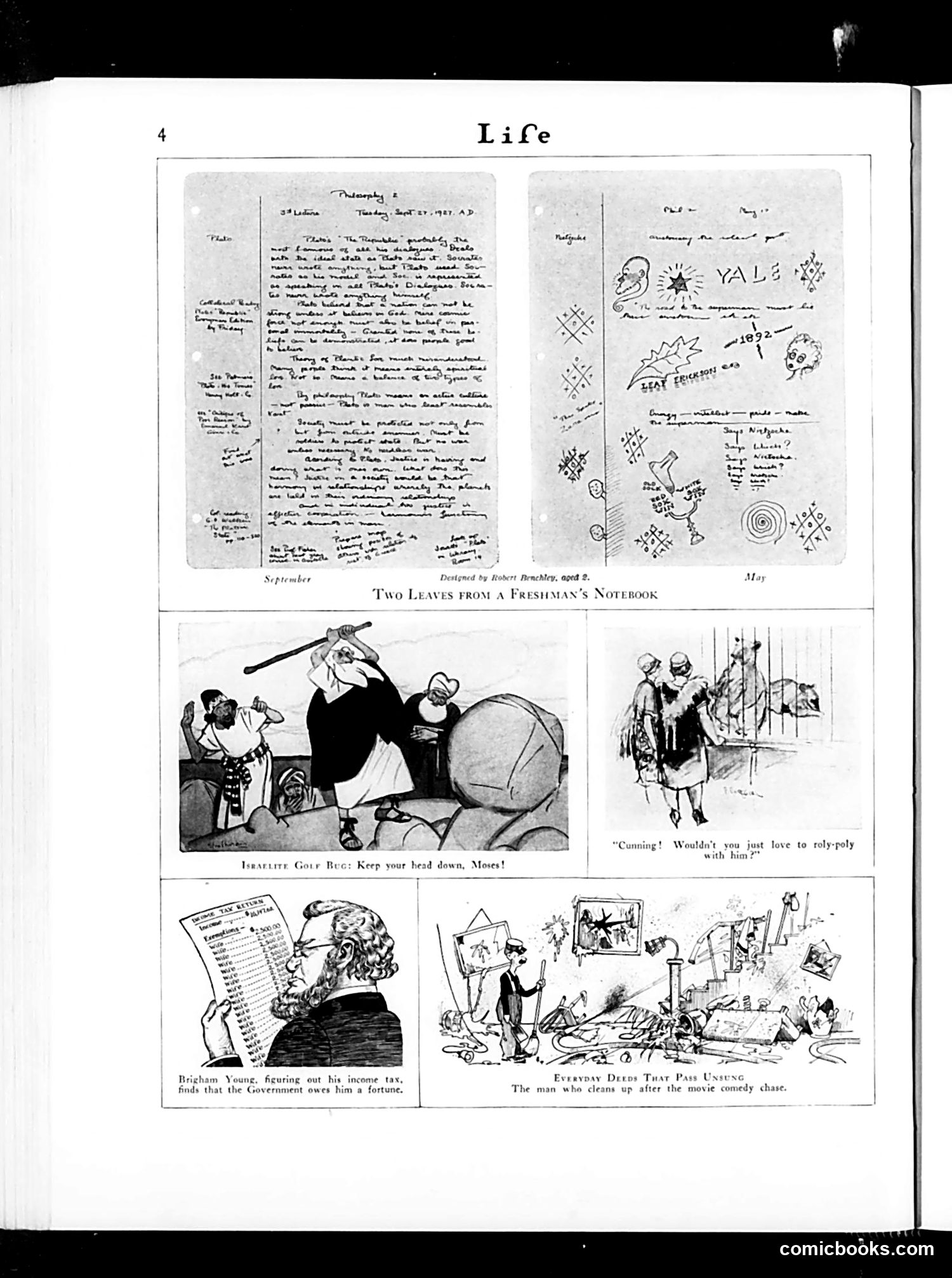
This page contains four satirical cartoons addressing early 20th-century American life: 1. **"Irascible Golf Bust: Keep your head down, Moses!"** — A golf instructor criticizes a student's form during a lesson. 2. **"Cunning! Wouldn't you just love to roly-poly with him?"** — Social commentary on courtship or flirtation, likely poking fun at romantic customs. 3. **"Brigham Young, figuring out his income tax, finds that the Government owes him a fortune."** — References the polygamist Mormon leader Brigham Young, satirizing tax calculations and implying his large family (multiple wives/children) creates unexpected tax advantages. 4. **"Everyday Dress That Passes Unusing: The man who cleans up after the movie comedy chasc."** — Mocks the janitor left to clean theaters after slapstick comedy scenes caused chaos and mess. The page emphasizes social absurdities and bureaucratic humor typical of Life's satirical style.
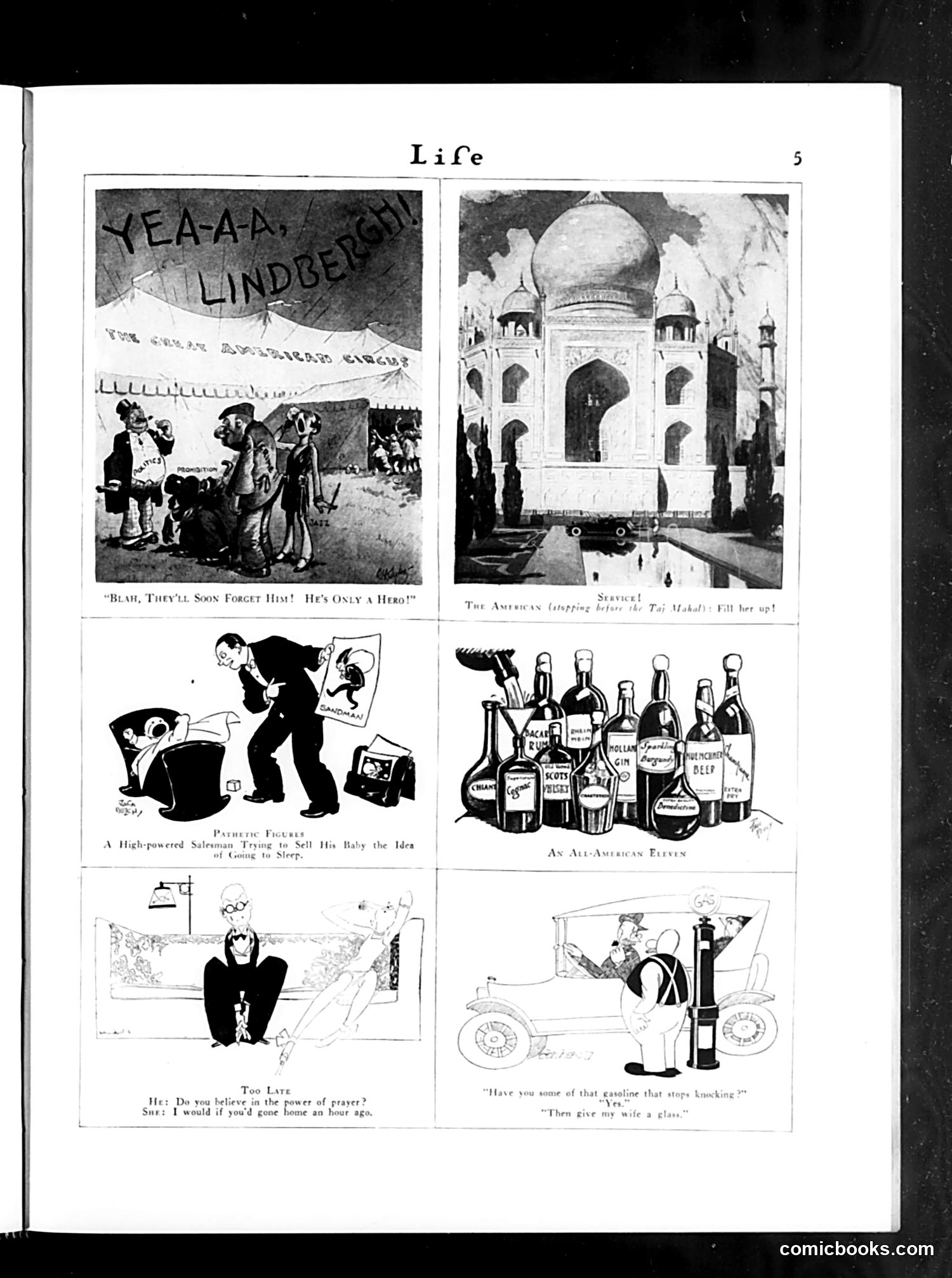
This satirical page combines topical commentary with humor: **Top left**: "Yea-a-a, Lindbergh!"—references Charles Lindbergh's 1927 transatlantic flight, shown being celebrated by crowds. The caption "Blah, They'll soon forget him! He's only a hero!" mocks public fickleness. **Top right**: "The American Grasping Before the Taj Mahal" satirizes American tourists as greedy and unsophisticated abroad. **Middle left**: A salesman pitching his "baby" idea—satirizing aggressive American salesmanship culture. **Middle right**: "An All-American Eleven"—bottles of liquor labeled with American names, mocking Prohibition-era bootlegging and American drinking culture. **Bottom cartoons**: Domestic scenes satirizing contemporary American life—prayer's efficacy and automotive gasoline concerns. The page collectively critiques American materialism, tourism, sales culture, and Prohibition through humor.
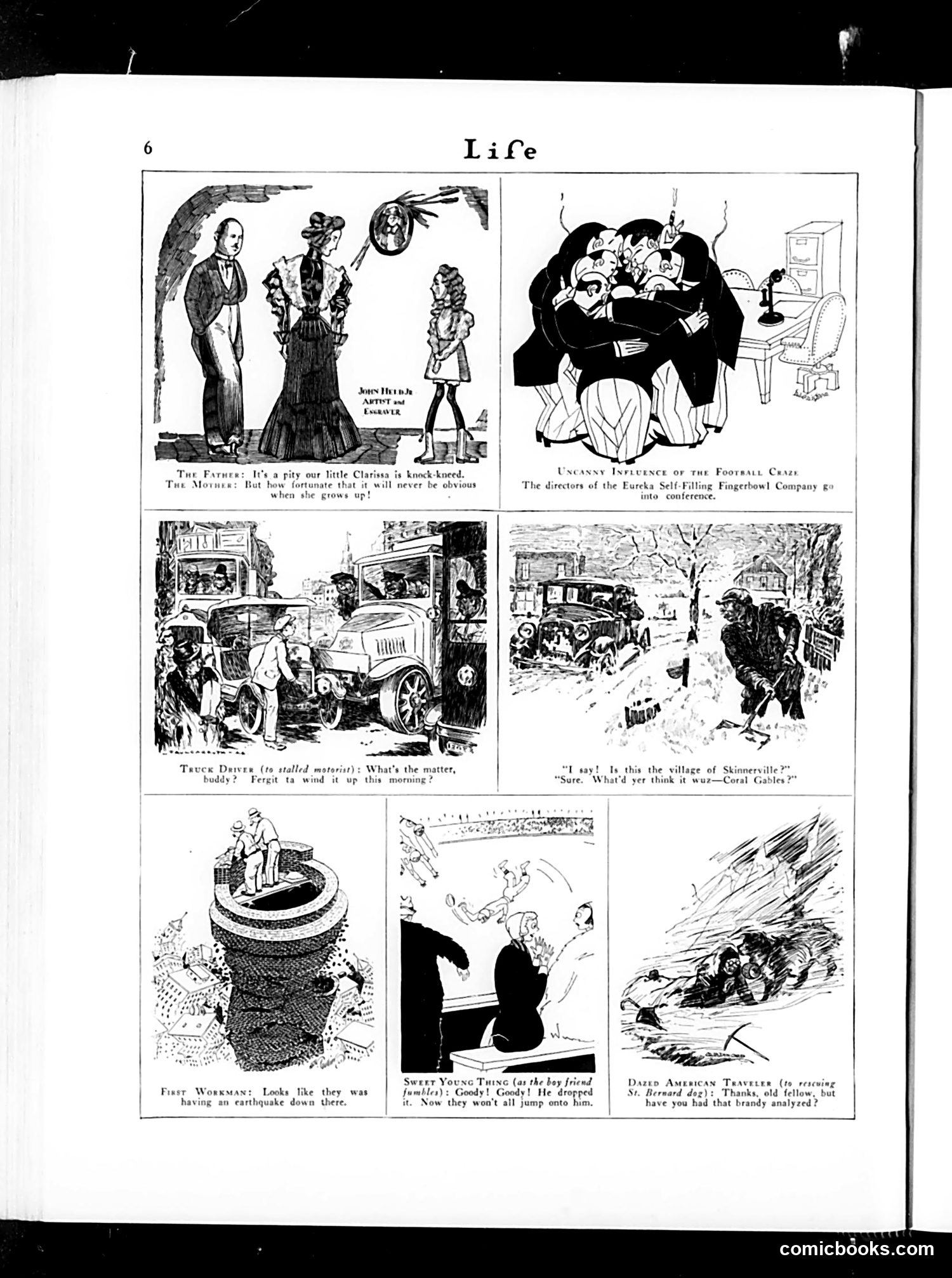
This page presents six cartoon vignettes satirizing contemporary society. The top panel mocks artistic pretension—a mother hopes her daughter will become an "artist" (implied: unmarriageable). The second panel lampoons corporate absurdity: directors of the "Eureka Self-Filling Fingerbowl Company" conduct a conference, suggesting ridiculous products spawned the era's business boom. Remaining panels joke about everyday frustrations: a stalled motorist, village gossip (referencing "Skinnerville"), workers in dangerous conditions, young romance, and a drunken "Dazed American Traveler" mistaking St. Bernard rescue dogs for brandy kegs—a classic sight-gag about Swiss Alpine rescues. The humor targets social pretension, commercial excess, modern technology's failures, and American tourist stereotypes—all characteristic of *Life* magazine's early satirical approach.
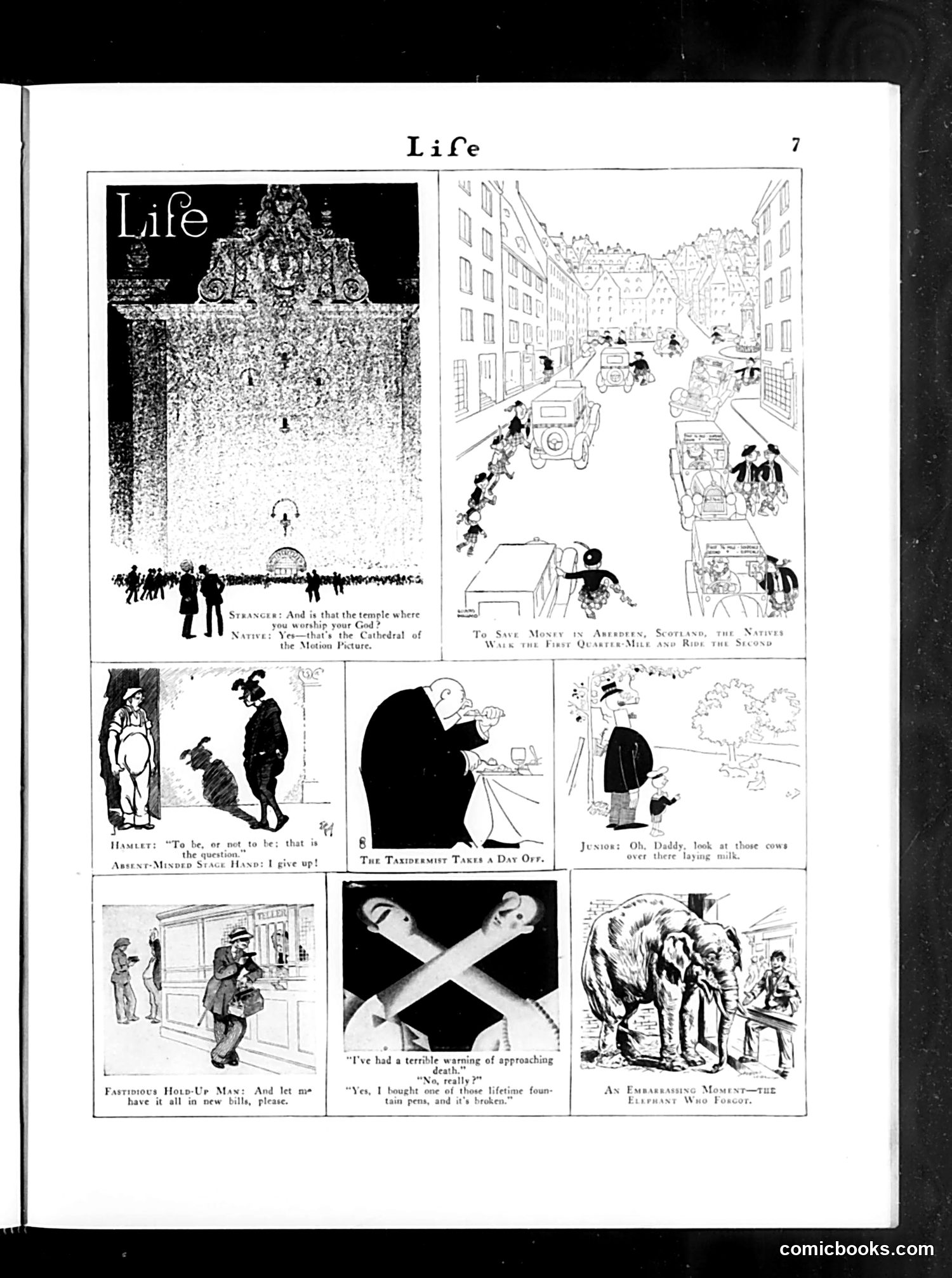
This page contains eight comic panels satirizing various aspects of early 20th-century life. The top features a **Life magazine cover parody** about cathedral attendance, and a street scene mocking Scottish tourism. Lower panels include: - **Hamlet reference**: A character debates existence ("To be, or not to be") - **Taxidermist joke**: A man examines a stuffed animal - **Father-son rural scene**: Discussing dairy cows - **Real estate humor**: A man pitching new construction - **Broken fountain pen**: An injury mishap with dark comedy - **Elephant wonder**: Children viewing an exotic animal The satire targets middle-class anxieties—religion, cultural pretension, family dynamics, consumer goods, and urban modernization. These vignettes use brief dialogue and visual gags typical of Life's humor style, relying on recognizable social situations for comedic effect.
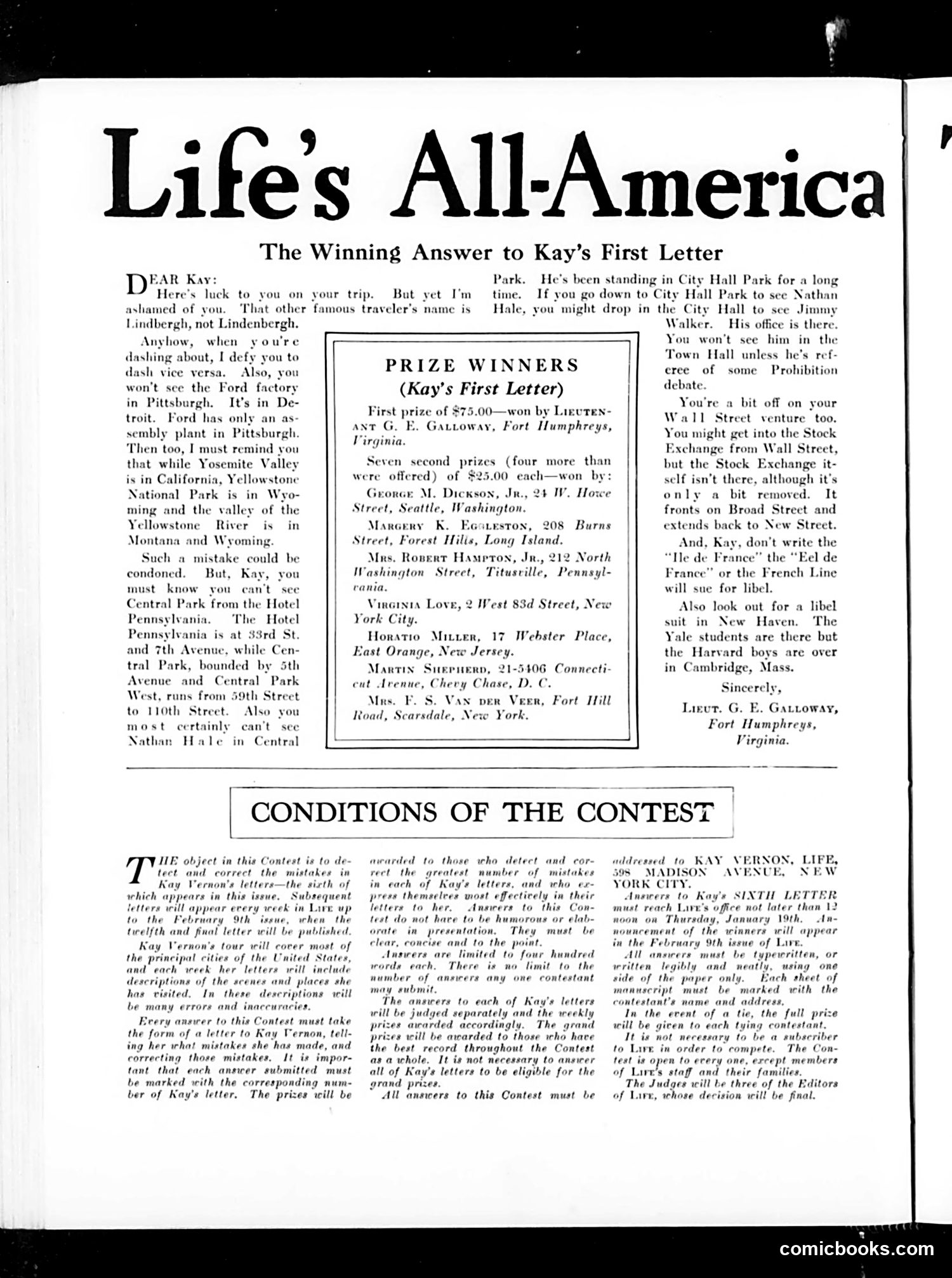
This page is primarily a **contest announcement and prize results**, not a political cartoon. It announces "Life's All-America" contest, which asked readers to identify and correct mistakes in Kay Vernon's letter describing American geography and landmarks. The winning answer came from Lieutenant G.E. Galloway of Fort Humphreys, Virginia, who received $75. The page lists seven additional $25 prize winners from various U.S. locations. The contest rules explain that readers should identify errors in Kay's descriptions of American cities, geographical features, and landmarks—suggesting Kay's original letter contained deliberate factual mistakes about well-known American locations and institutions. This represents **Life magazine's interactive satirical approach**: engaging readers in identifying inaccuracies while implicitly mocking geographical ignorance or careless travel writing.
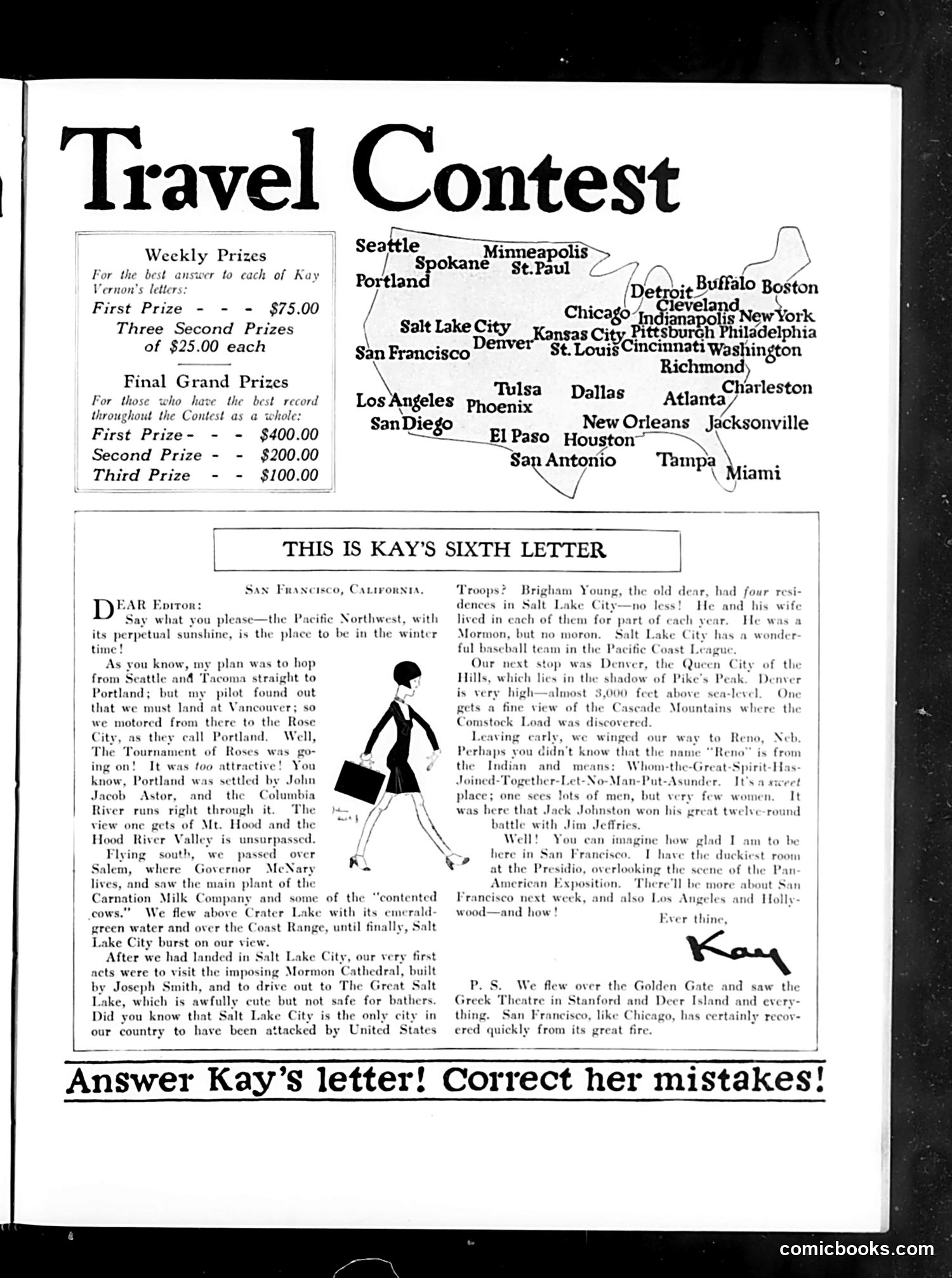
This is a **reader participation contest** from Life magazine, not a political cartoon. The page invites readers to find geographical and factual errors in a letter from "Kay," who describes a cross-country trip visiting major American cities. The contest's appeal lies in **checking Kay's travel narrative for mistakes**—whether she correctly identified landmarks, cities, geographic features, or historical facts. Readers who spot all errors correctly could win weekly prizes ($75) or grand prizes up to $400. This reflects early 20th-century magazine culture, when such interactive contests engaged readers and built loyalty. The detailed map of US cities shows the geographic knowledge assumed of educated readers at the time.
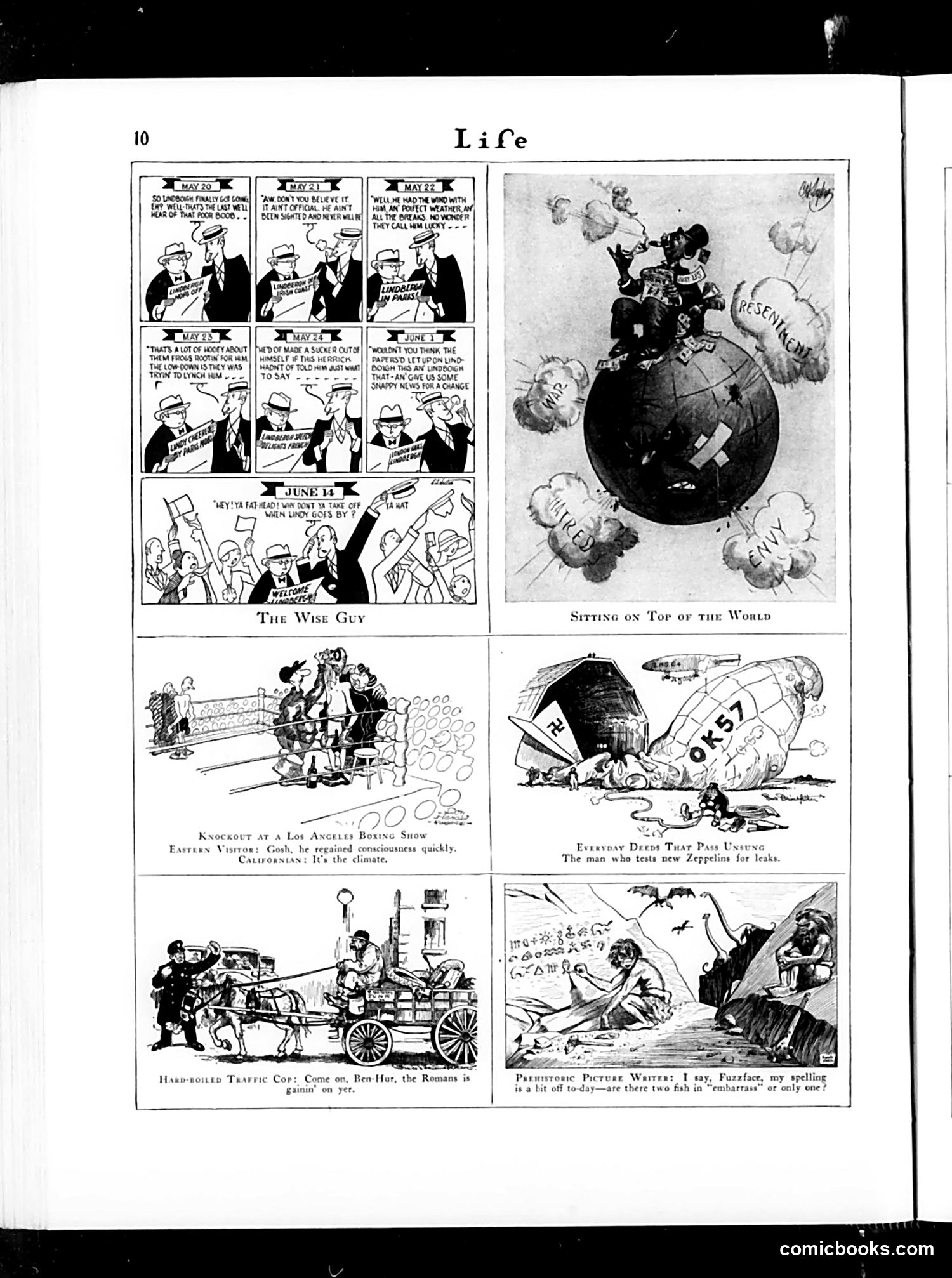
**"The Wise Guy"** (top left) is a six-panel comic strip dated May 20–June 11, showing a man repeatedly making predictions about events that fail to materialize, then fabricating excuses. The satire mocks people who make overconfident public predictions and then rationalize failures. **"Sitting on Top of the World"** depicts a figure perched on a globe labeled "RESENTMENT," surrounded by angry faces. This appears to critique someone in a position of power surrounded by hostility and discontent. The remaining cartoons—including "Everyday Deeds That Pass Unsung," "Hard-boiled Traffic Cop," and "Prehistoric Picture Writer"—appear to be separate satirical vignettes about modern life, traffic conditions, and human behavior, though specific contemporary references are unclear without additional historical context.
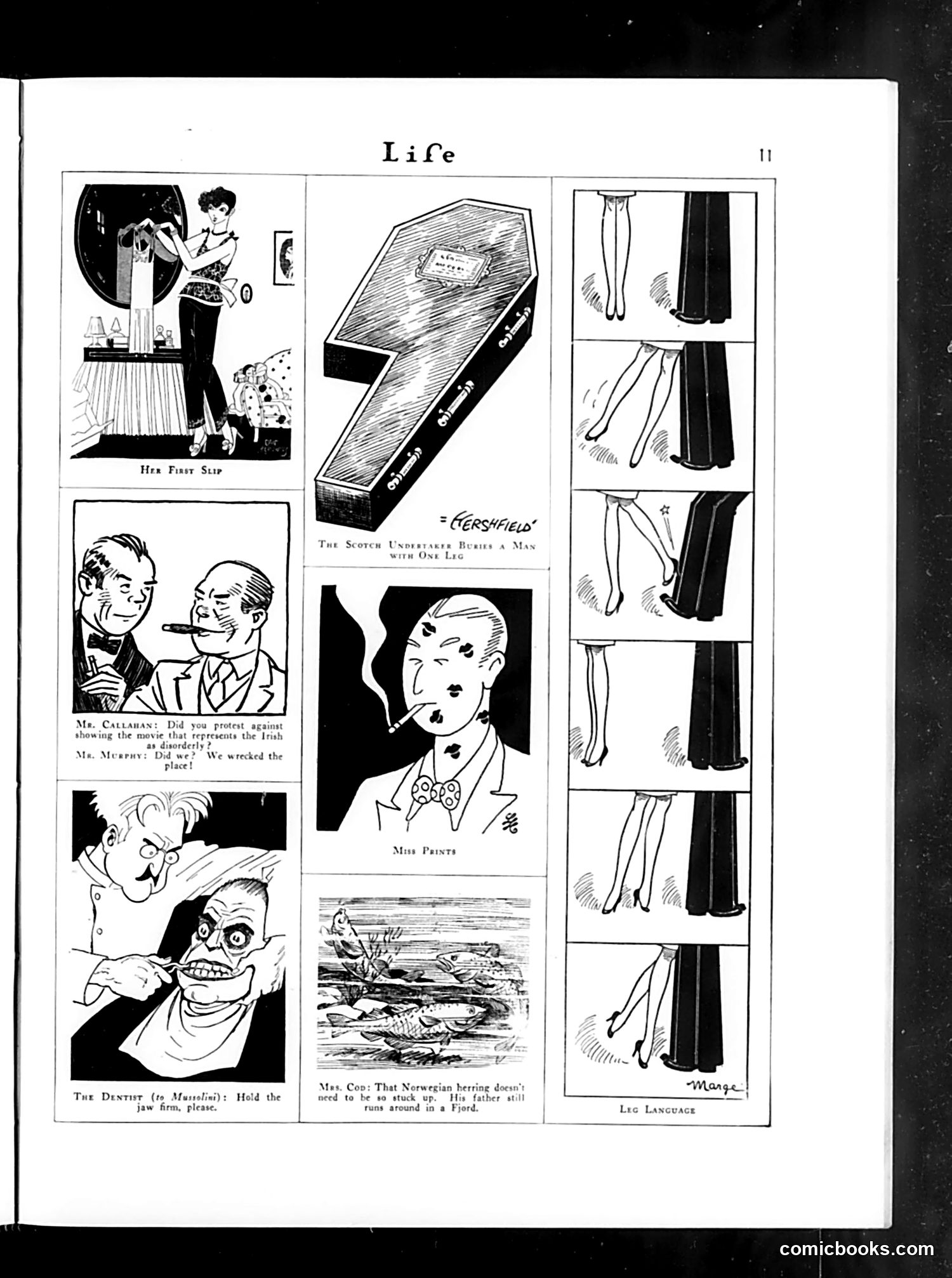
This page contains several unrelated satirical sketches typical of Life magazine's humor format: **"Her First Slip"** shows a woman at a vanity, captioned to suggest an embarrassing wardrobe malfunction. **"The Scotch Undertaker Buries a Man with One Leg"** depicts a coffin shaped like an "L," mocking Scottish frugality through dark humor. **"Miss Paints"** is a portrait caricature with smoking cigarettes, likely mocking a contemporary figure or artistic pretension. **"The Dentist (in Munich)"** shows dental torture, apparently referencing Munich (Germany), possibly alluding to Bavarian stereotypes. **"Leg Language"** illustrates various leg positions, a visual joke about non-verbal communication through women's leg movements and clothing. The overall page demonstrates Life's tradition of quick, cynical humor targeting social foibles, ethnic stereotypes, and sexual innuendo typical of early-to-mid 20th century American satire.
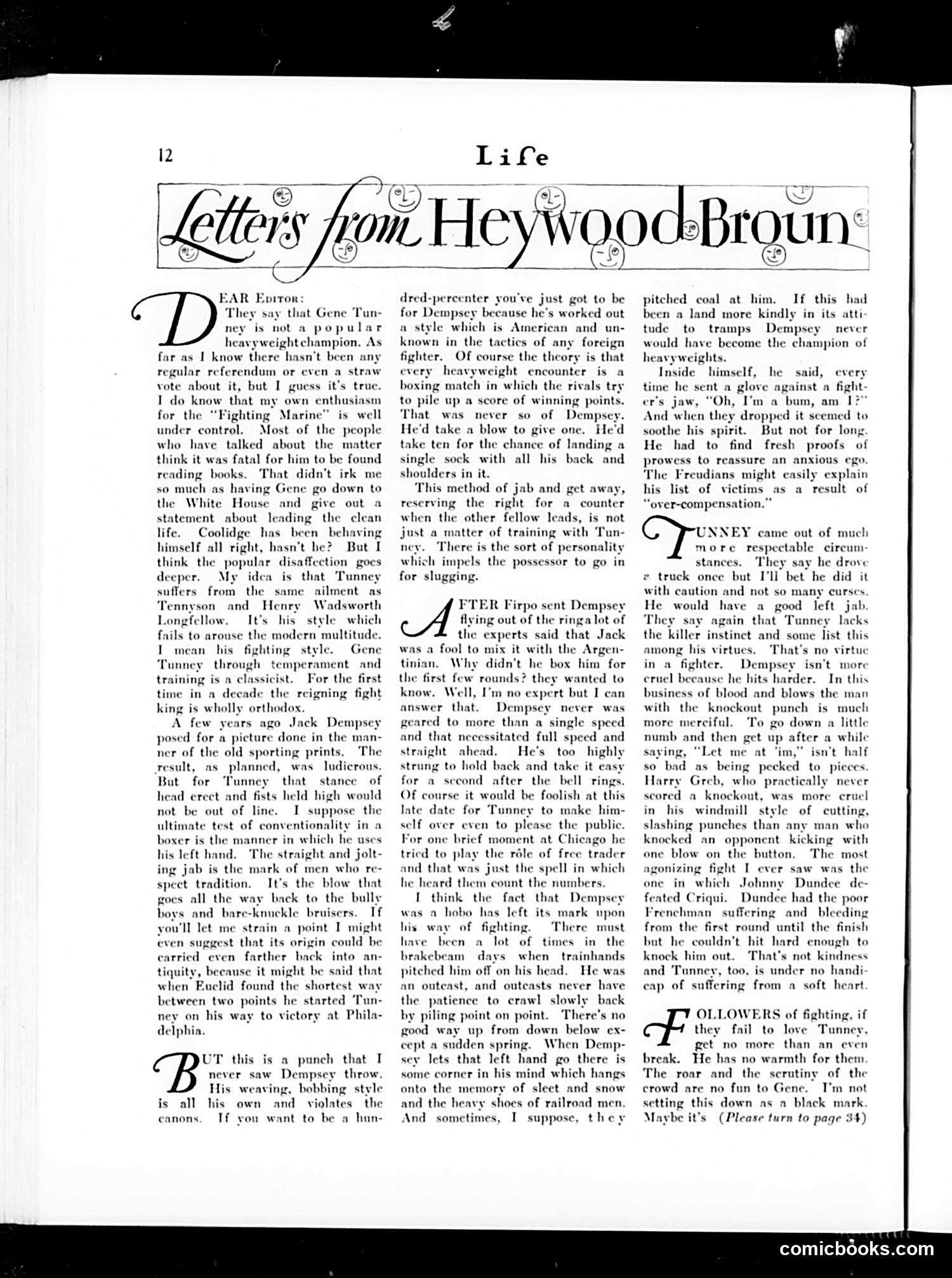
This page features a column by Heywood Broun, a prominent sports journalist and social commentator, discussing heavyweight boxing champion Gene Tunney. The letter critiques Tunney's fighting style and public persona, suggesting he's overly intellectual and literary-minded for a boxer—a departure from the expected brutish image. The writer argues Tunney lacks the "killer instinct" compared to his rival Jack Dempsey, and criticizes his attempt to appeal to refined audiences rather than traditional fight fans. There's satire about the tension between Tunney's educated, genteel image and boxing's working-class roots. The piece reflects 1920s debates about modernization, class, and whether athletes should be brutish entertainers or cultured public figures.
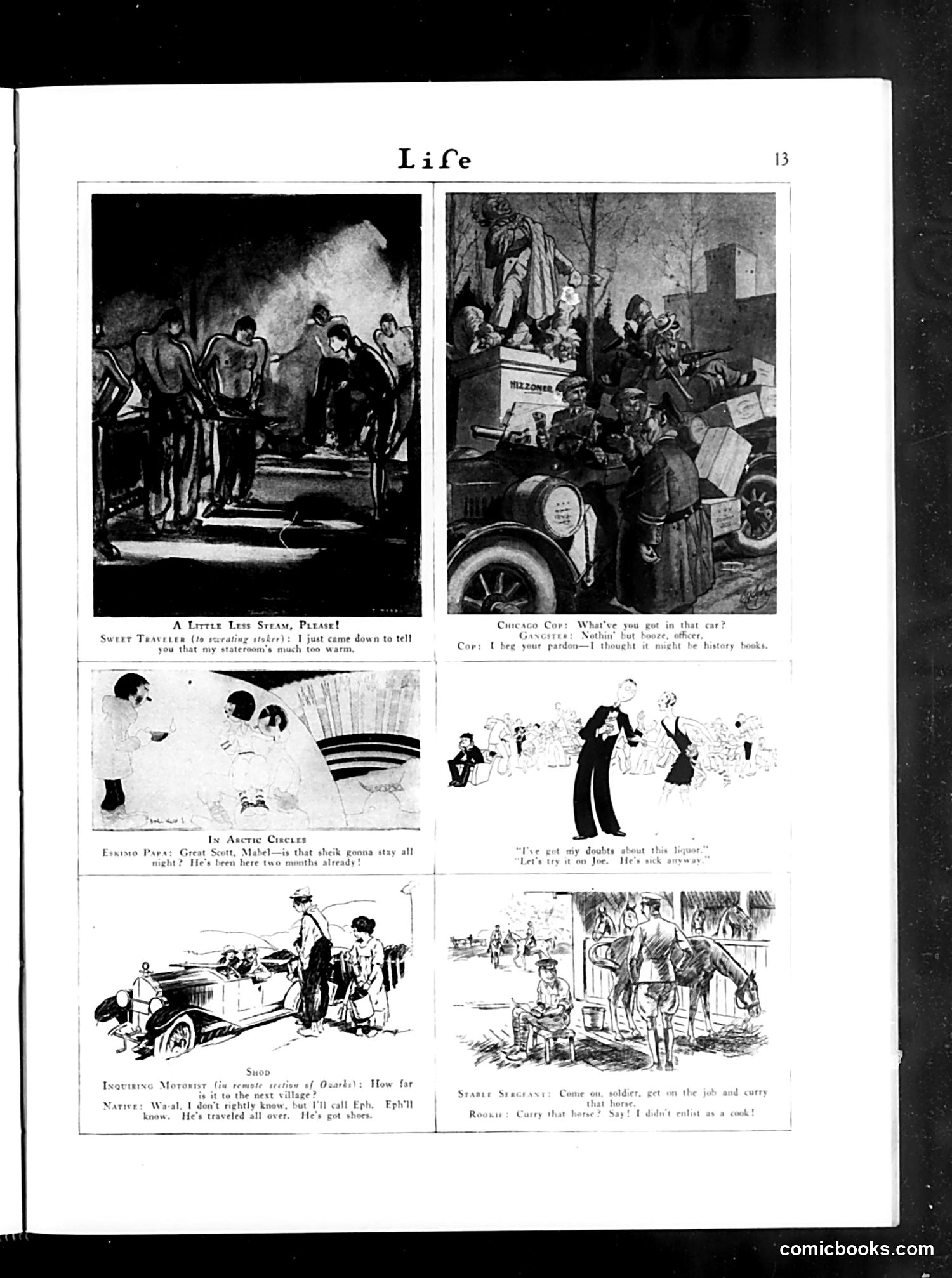
This page contains six satirical vignettes depicting early 20th-century social scenes: 1. **"A Little Less Steam, Please!"** - A stateroom attendant complains about overheated quarters on what appears to be a ship. 2. **"Chicago Cop"** - Police officers question a motorist about suspicious cargo, joking about "history books" rather than contraband. 3. **"Arctic Circles"** and **"Liquor"** sketches - Social commentary on discomfort and drinking. 4. **"Snob"** - A motorist inquires about directions to the next village. 5. **"Stable Sergeant"** - Military/domestic help discussing cooking duties. The humor targets contemporary inconveniences (heating systems, police profiling, social pretension, servant interactions) and likely references Prohibition-era tensions regarding alcohol. The cartoons reflect early 1900s American life and class dynamics through gentle satirical observation.
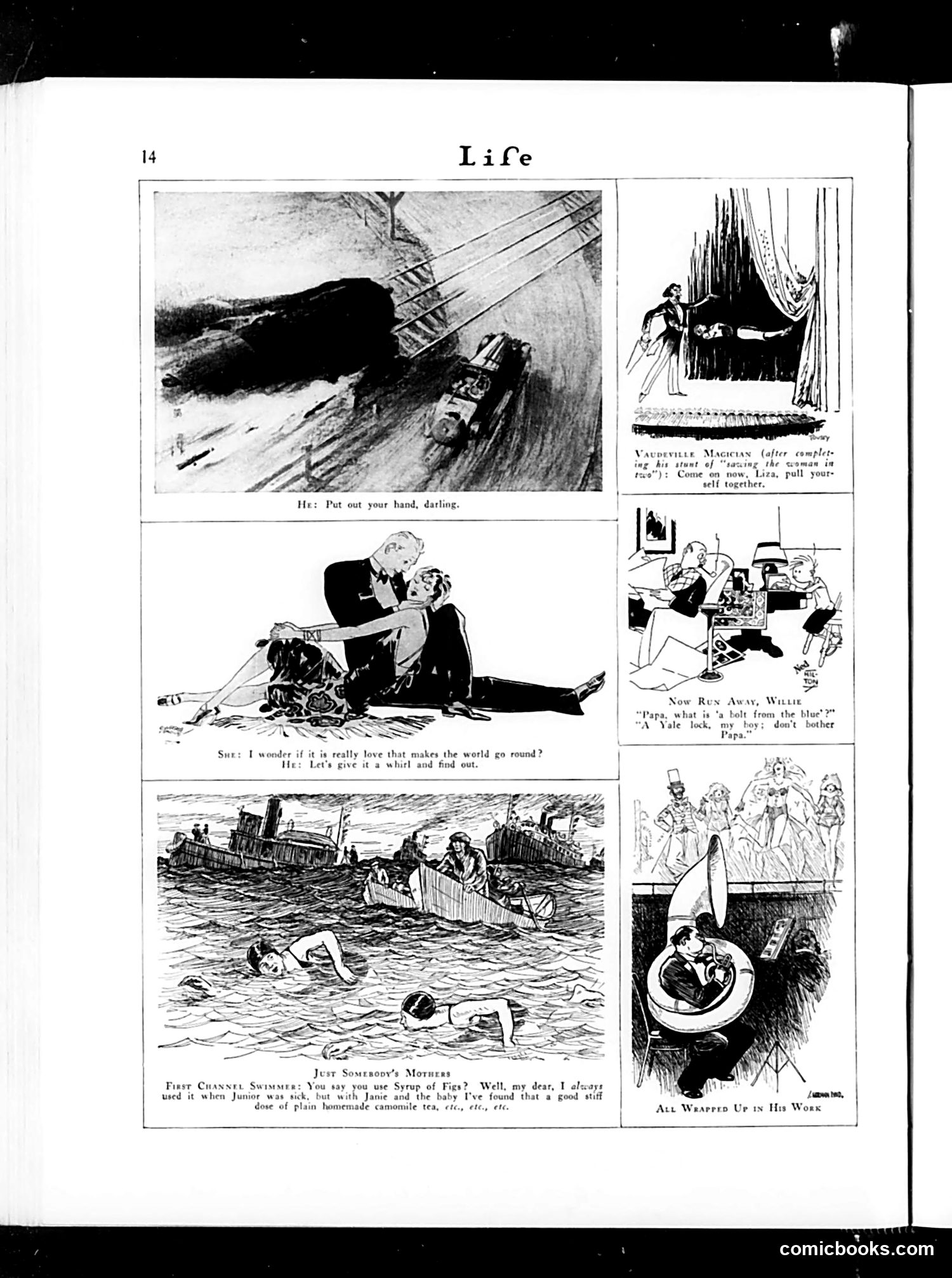
This page contains six humorous cartoons satirizing various domestic and social situations: 1. **"He: Put out your hand, darling"** — A slapstick scene where a man apparently tricks a woman into helping him with something unpleasant. 2. **"Sue: I wonder if it really love the whole world go round?"** — A couple discusses romantic philosophy while surrounded by wreckage. 3. **"Vaudeville Magician"** — A theatrical performance where the magician's illusion involves "hanging the woman in two"—likely commentary on stage trick safety or marital discord. 4. **"Now Run Away, Willie"** — A father figure with children, referencing a Yale lock. 5. **"Just Somebody's Mothers"** — Channel swimmers using syrup of figs (a laxative), satirizing health remedies and motherly advice. 6. **"All Wrapped Up in His Work"** — A final visual gag about domestic life. The humor targets marriage dynamics, parenting, and period-specific domestic products and practices.
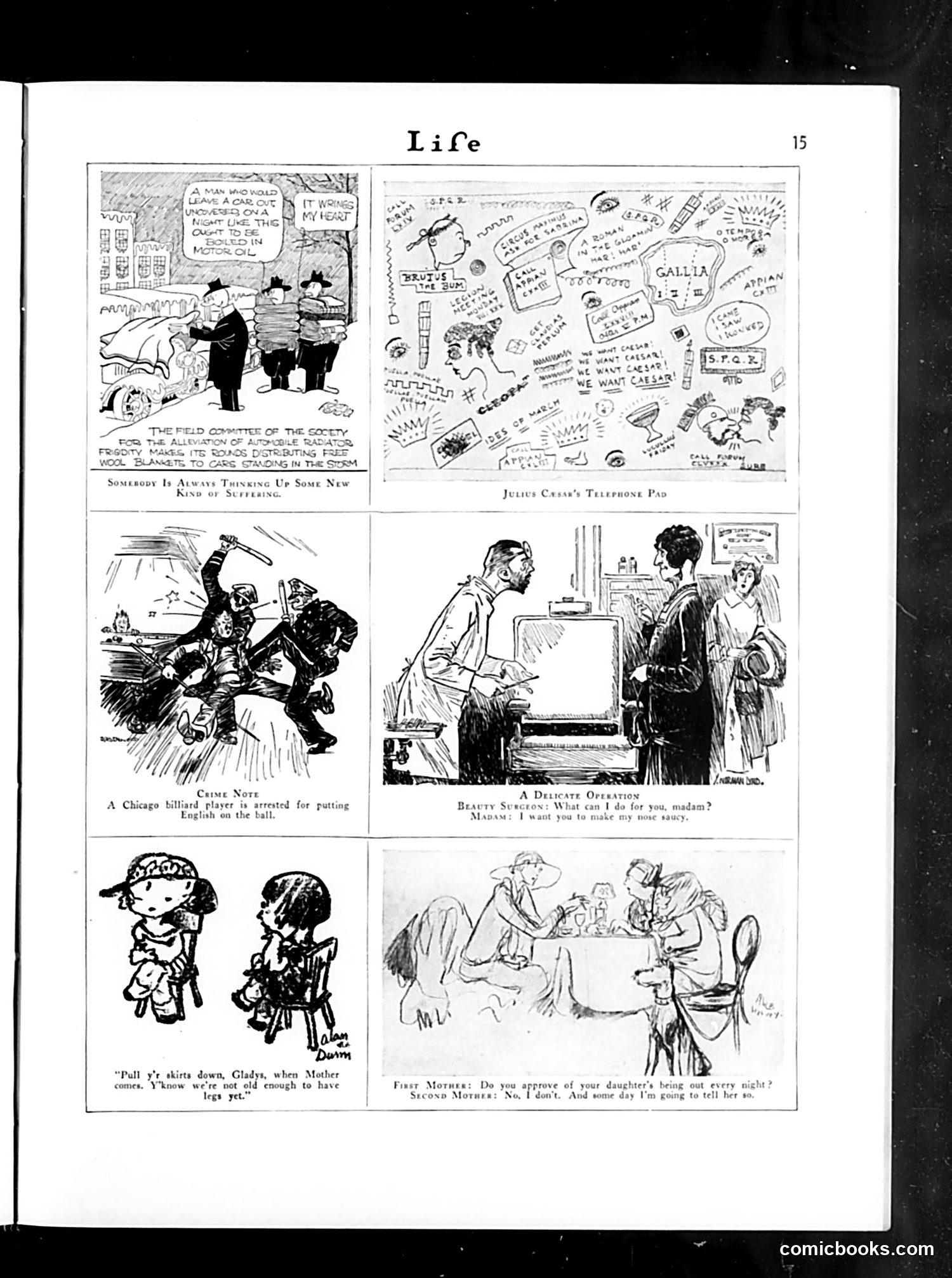
This page contains six separate satirical comics addressing early 20th-century social issues: 1. **Automobile Safety**: A society field committee distributes free wool blankets to address automobile accident injuries. 2. **Julius Caesar's Telephone Pad**: A map-style cartoon showing Caesar's conquests labeled as if territories on a phone directory—satirizing imperial ambition through modern communication metaphor. 3. **Crime Note**: A Chicago billiard player is arrested for putting English on a ball—wordplay on "English" (pool technique) versus literal meaning. 4. **Beauty Surgery**: A doctor offers to make a woman's nose "saucy." 5. **Mother and Child**: A domestic joke about leg exposure and propriety. 6. **Two Mothers**: A conversation about daughters' evening activities, with one mother threatening future disclosure. These comics satirize contemporary anxieties about technology, crime, beauty standards, and changing social morality.
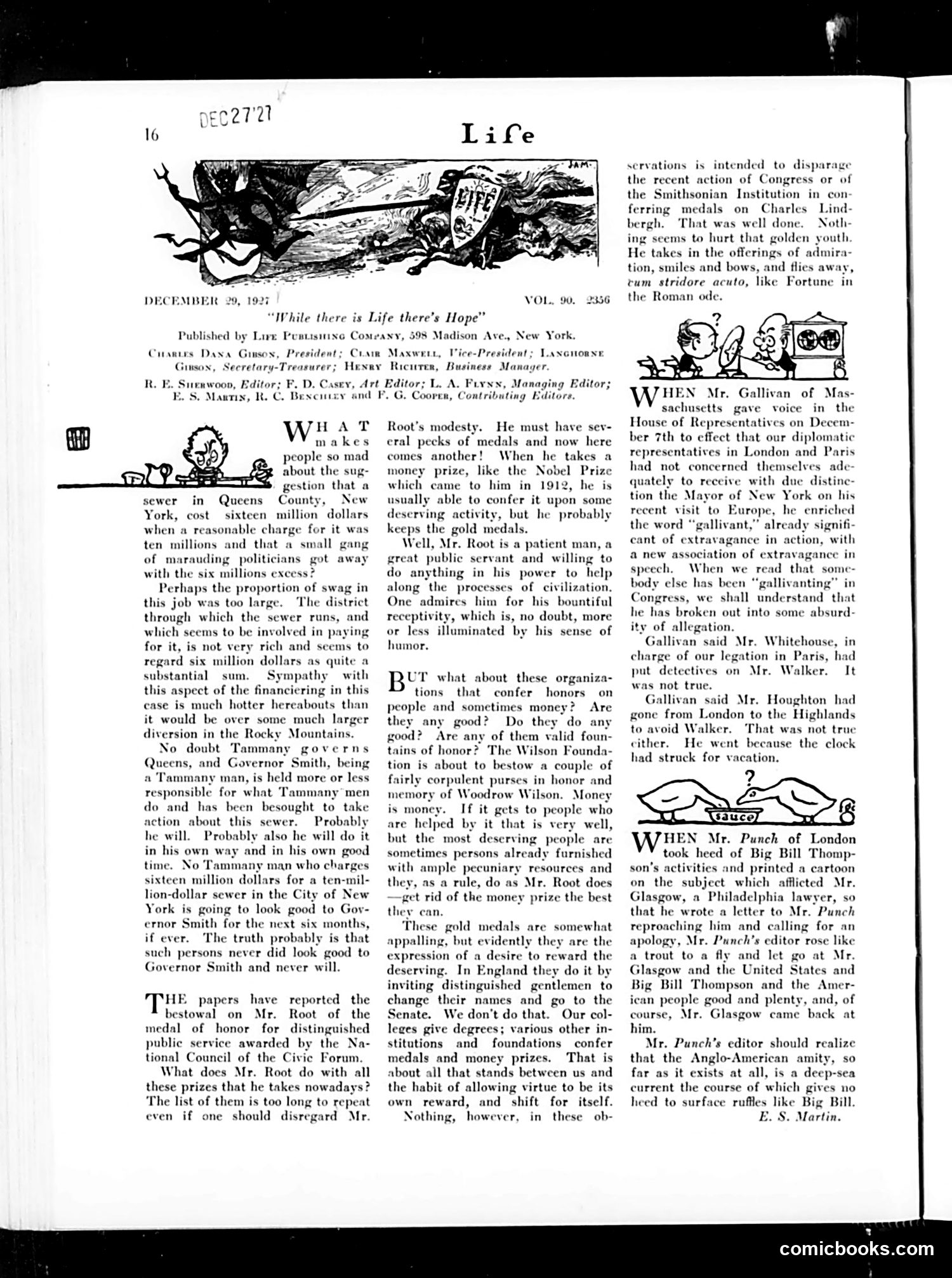
The main article critiques the awarding of medals and honors by various institutions. It questions whether organizations like the Wilson Foundation and National Council of the Fine Arts should give money prizes to already-distinguished people like Charles Lindbergh. The satire targets what the writer sees as performative virtue-signaling: wealthy institutions conferring honors rather than solving real problems. The piece contrasts this with practical needs—specifically mentioning Tammany Hall's involvement in New York's sewer system. Several anecdotes mock diplomatic absurdities, including a story about Mr. Gallivan allegedly employing detectives to shadow a delegate named Walker at a European conference, suggesting bureaucratic excess and international intrigue. The overall tone mocks institutional self-congratulation divorced from meaningful social contribution.
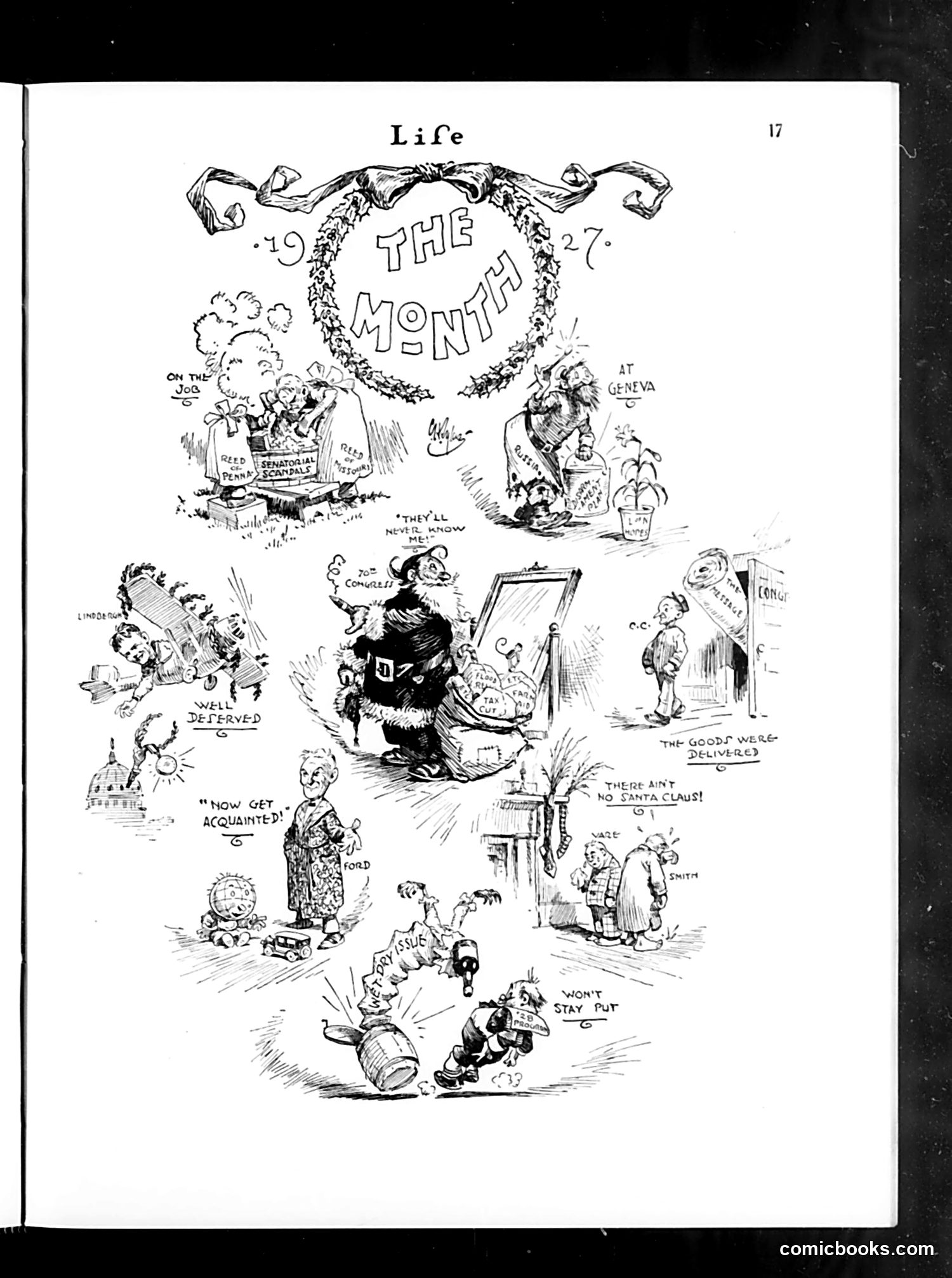
This is a satirical monthly roundup page from *Life* magazine (dated 1927, based on the visible dates "·49" and "·27"). The central wreath-framed circle contains various political and social vignettes commenting on current events. The cartoons mock contemporary figures and situations, including references to: - "On the Job" (likely political office-holding) - "At Geneva" (international negotiations) - "Well Deferred" (possibly legal or policy delays) - Various domestic scenes with commentary like "They'll never know me," "How get acquainted," and "There ain't no Santa Claus" The style is typical of *Life's* satirical approach to monthly news events, combining caricature and social commentary. Without clearer context on specific 1927 events, precise identifications remain difficult, though the overall tone critiques political pretense and broken promises.
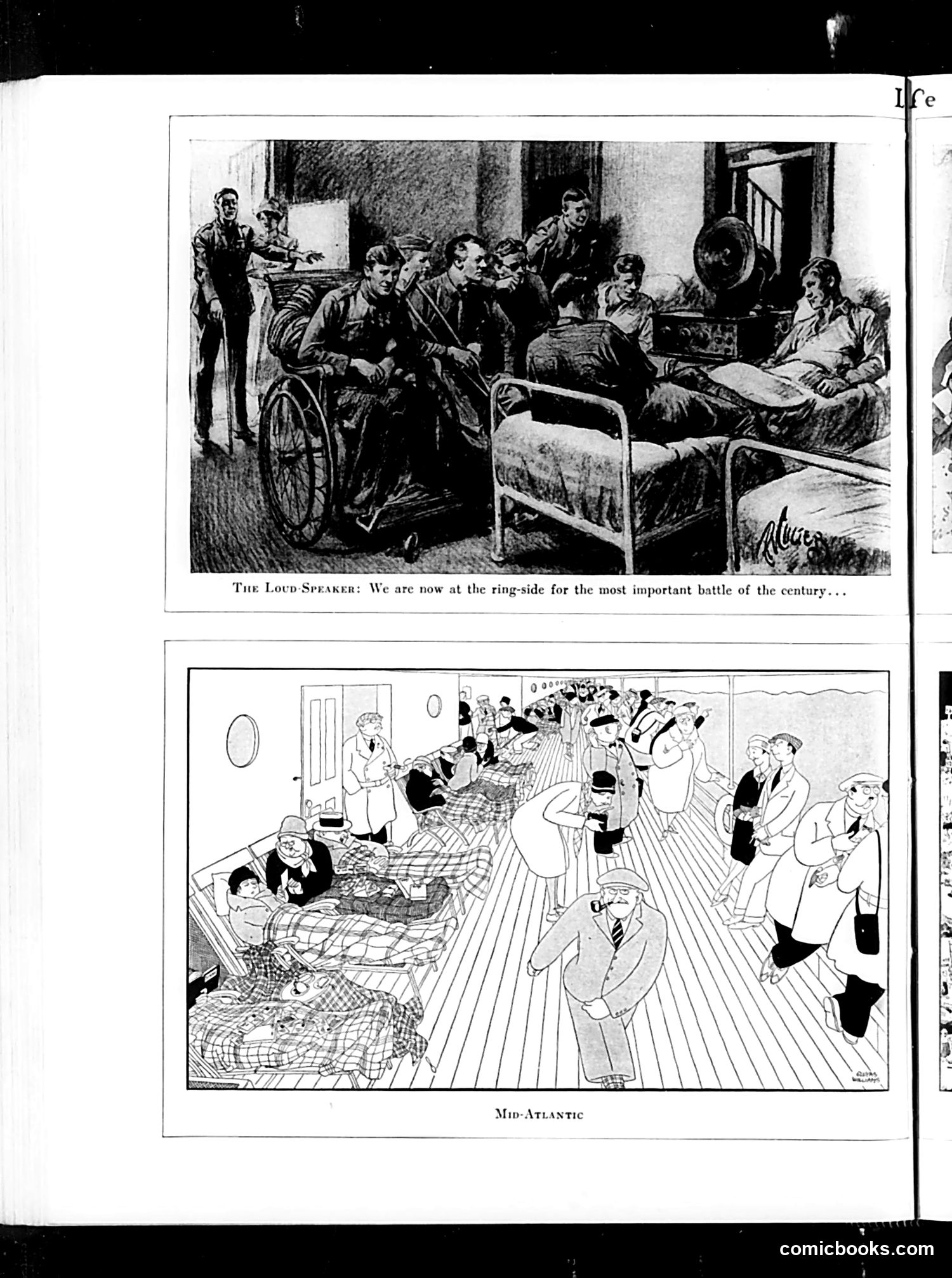
The top cartoon depicts a hospital ward scene with a "loud speaker" addressing patients, referencing "the most important battle of the century." This appears to satirize World War I—likely mocking propaganda or patriotic rhetoric being broadcast to wounded soldiers, treating their suffering as entertainment ("ring-side" viewing). The bottom cartoon, labeled "Mid-Atlantic," shows a ship's interior with passengers in bunks and standing figures. This likely references transatlantic travel during WWI, possibly satirizing civilian attitudes toward the war or the experience of crossing dangerous waters during the conflict. Both cartoons employ dark satire to critique how the war was being presented to or experienced by ordinary people—contrasting noble rhetoric with the grim realities of combat and displacement.
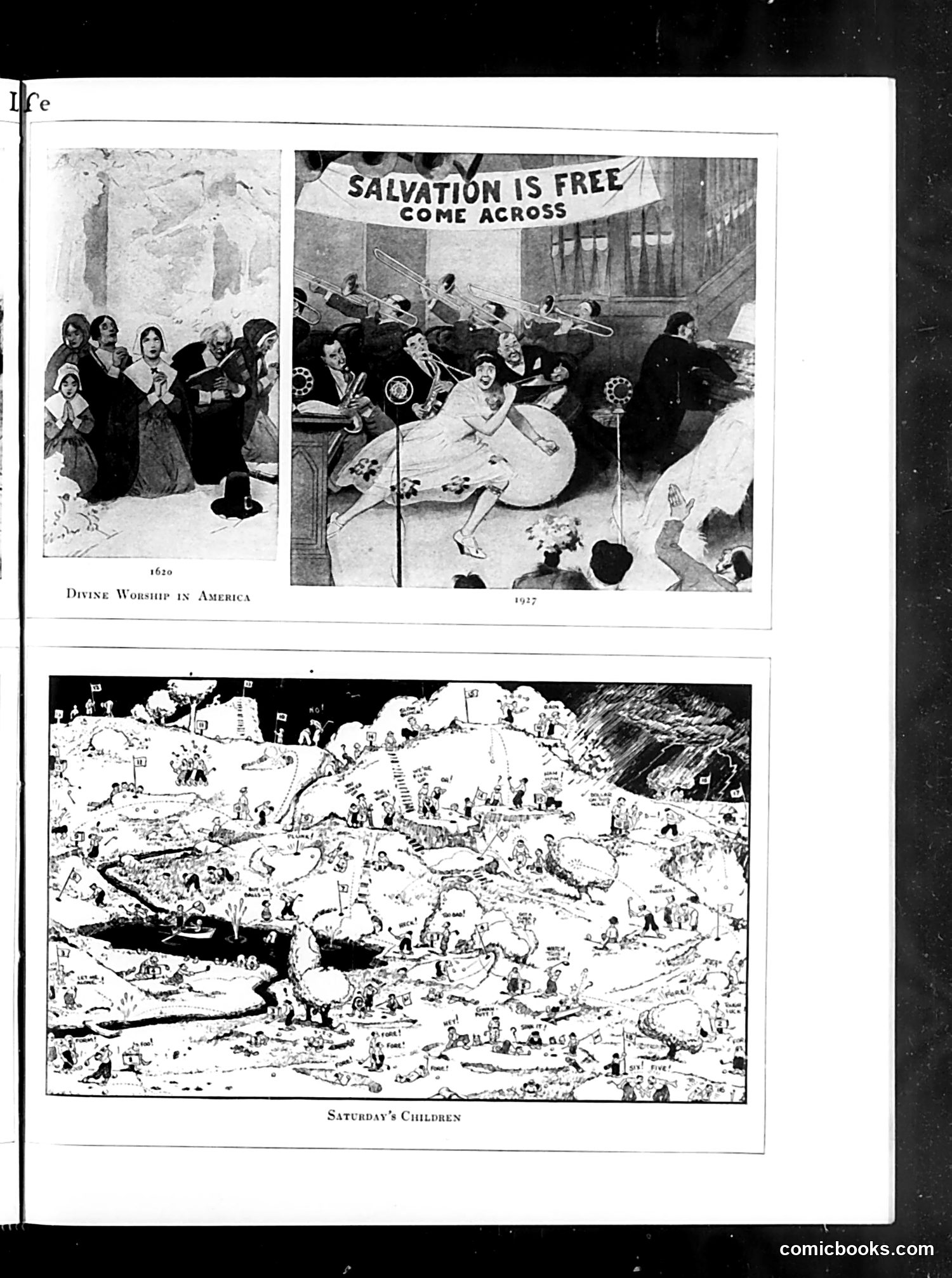
This page contrasts religious practices across American history. The top left (labeled 1620) shows "Divine Worship in America"—early colonists in winter dress, presumably Pilgrims at prayer. The right image (1927) satirizes modern religious expression, depicting a woman in a scandalously short dress dancing beneath a banner reading "Salvation is Free / Come Across," with musicians and onlookers. The phrase "come across" carries sexual innuendo. The satire critiques how American religious practice had transformed from austere Puritan devotion to Jazz Age hedonism and commercialized religion. The woman's immodest clothing and dancing represent the perceived moral decay of the 1920s. The bottom illustration, "Saturday's Children," appears to be a separate humorous scene. The overall message: American morality has drastically declined in three centuries.
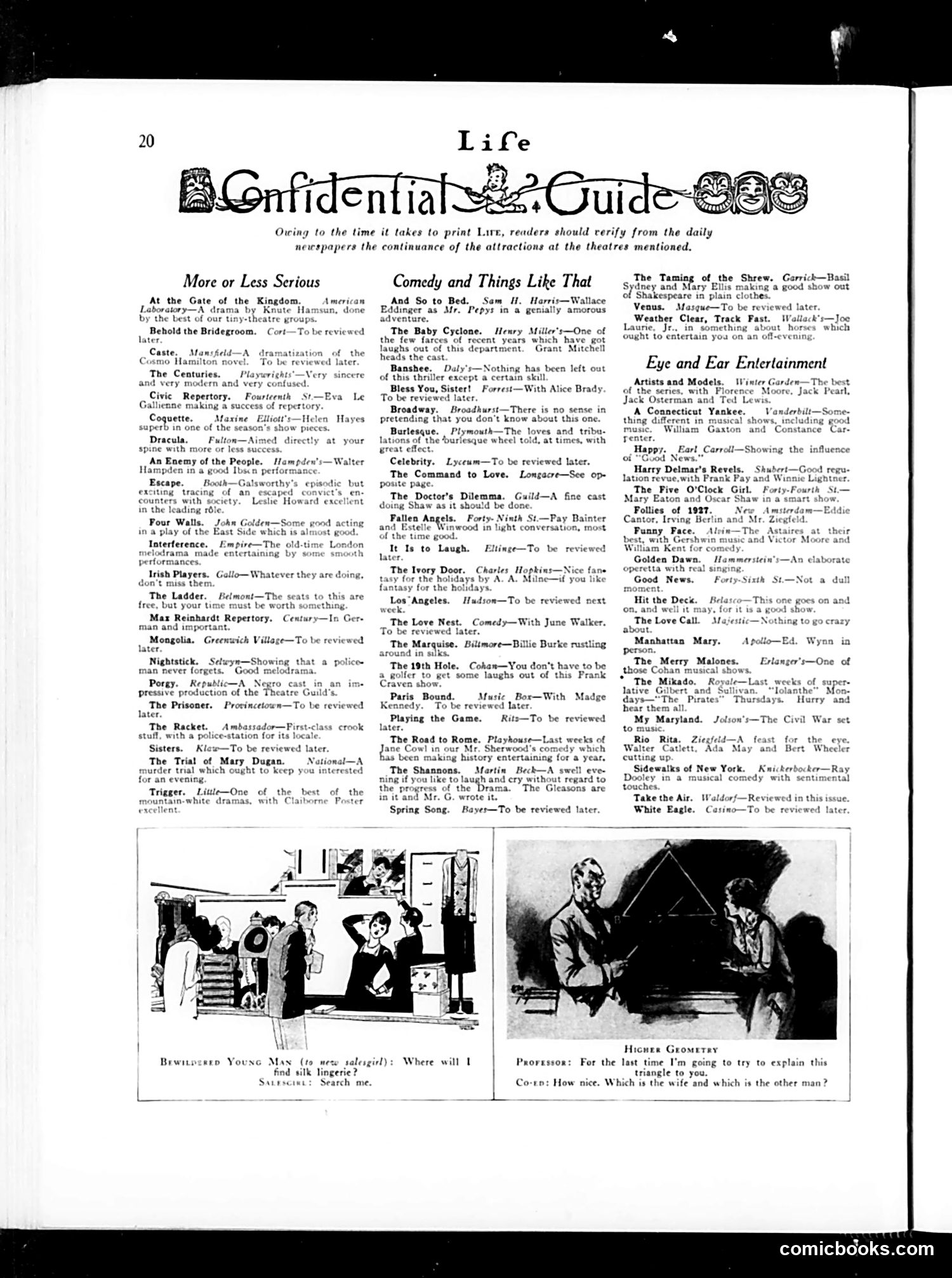
This is a **theater review/entertainment guide** page from Life magazine, listing Broadway shows and entertainments circa mid-1920s. The OCR is heavily corrupted, but the page structure is clear. ## The Cartoons: **Left cartoon**: A bewildered young man asks a salesgirl where to find silk lingerie. The joke plays on the awkwardness of a man shopping for intimate female apparel—a mildly risqué humor typical of the 1920s. His discomfort at the request is the comedic point. **Right cartoon** ("Higher Geometry"): A professor attempts to explain a triangle to a couple. The wife and husband are positioned ambiguously, and the joke hinges on the double meaning: the professor is literally teaching geometry, but the visual composition suggests a marital "love triangle" scenario. The setup mocks pretentious academic explanation of an uncomfortable social situation. Both cartoons use 1920s-era mild sexual innuendo and social awkwardness as humor—typical of Life's satirical approach to modern life and changing social mores of the Jazz Age.
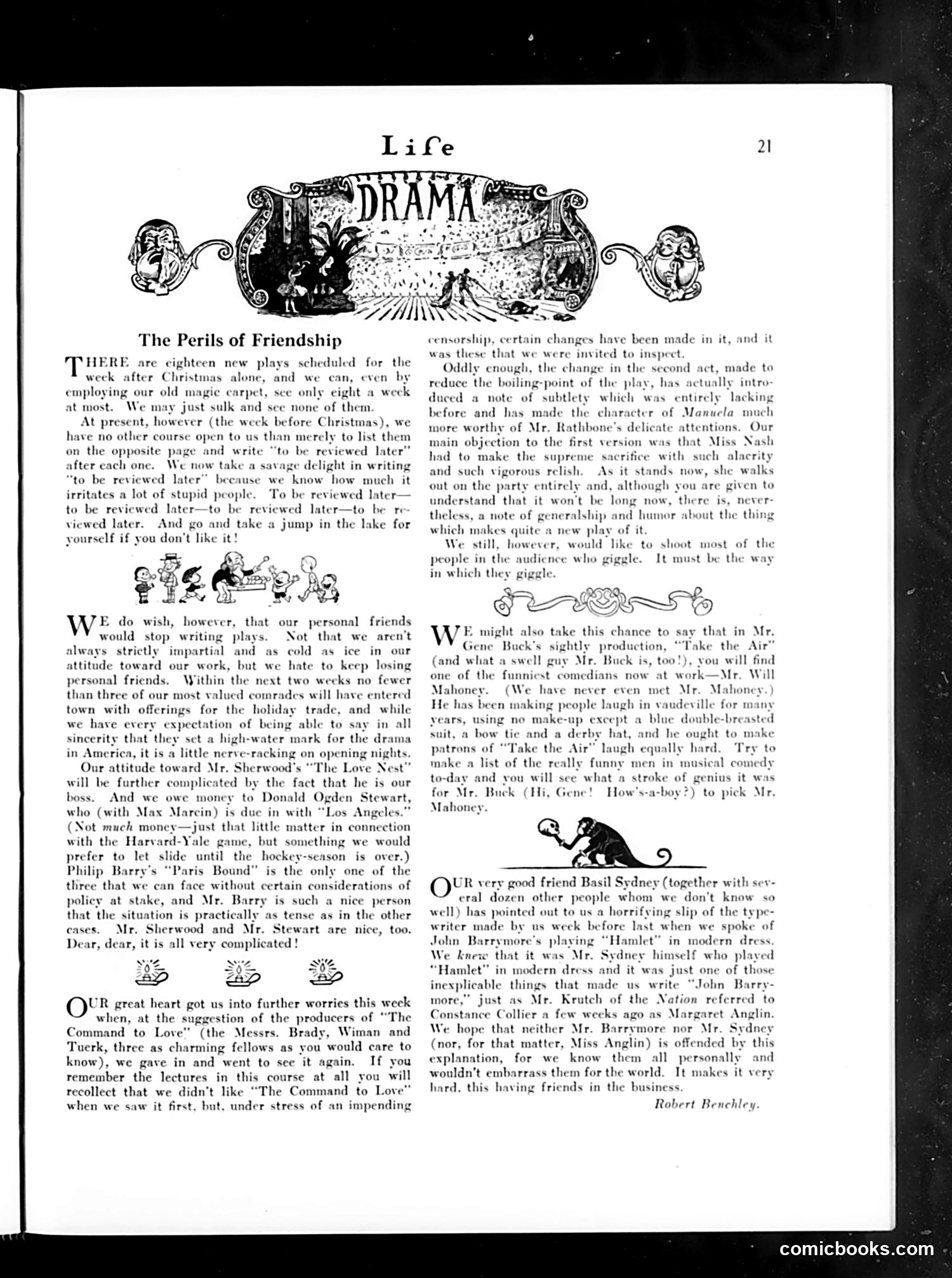
This is a theater critic's column lamenting the challenge of reviewing plays by personal friends. The author identifies three Broadway playwrights with upcoming shows: Robert Sherwood ("The Love Nest"), Donald Ogden Stewart (who co-wrote "Los Angeles" with Max Marcin—to whom the critic owes money from a Harvard-Yale bet), and Philip Barry ("Paris Bound"). The satire hinges on the conflict between professional objectivity and personal loyalty. The critic worries about maintaining impartiality while potentially damaging friendships through negative reviews, especially given financial entanglements. The repeated phrase "to be reviewed later" mocks readers bothered by postponed reviews. The column also praises Will Mahoney's comedic performance in "Take the Air" and discusses censorship-driven revisions to "The Command to Love." The small cartoon at top left (illegible in detail) likely depicts the awkwardness of this social-professional bind.
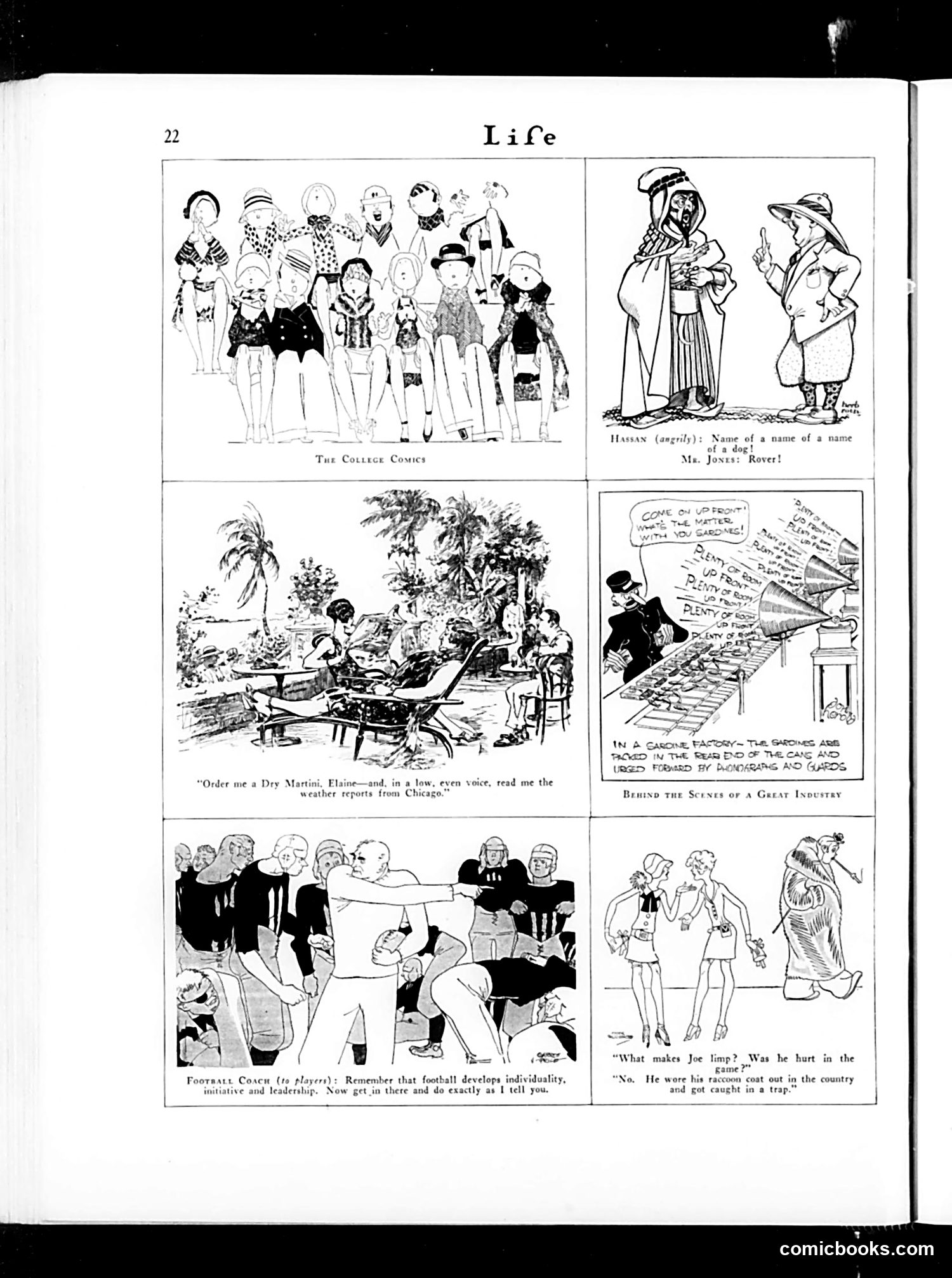
This page collects six separate cartoons satirizing early 20th-century American social life: 1. **"The College Comics"**: Mocks fashionable young people and their affected styles. 2. **Hassan/Mr. Jones exchange**: Jokes about pretentious pet-naming among the wealthy. 3. **Dry Martini/Chicago**: Satirizes wealthy sophistication—ordering cocktails while pretending indifference to mundane news. 4. **Candle Factory**: Illustrates industrial production, possibly critiquing factory labor or consumerism. 5. **Football Coach**: Ironic commentary on institutional contradiction—coaches claim to develop "individuality" and "leadership" while demanding absolute obedience and conformity. 6. **Joe's injury**: Final joke about rural simplicity contrasting with city sophistication. The page's recurring theme targets urban, affluent society's pretensions, hypocrisy, and disconnect from reality—characteristic of Life's satirical approach to American social customs and class attitudes.
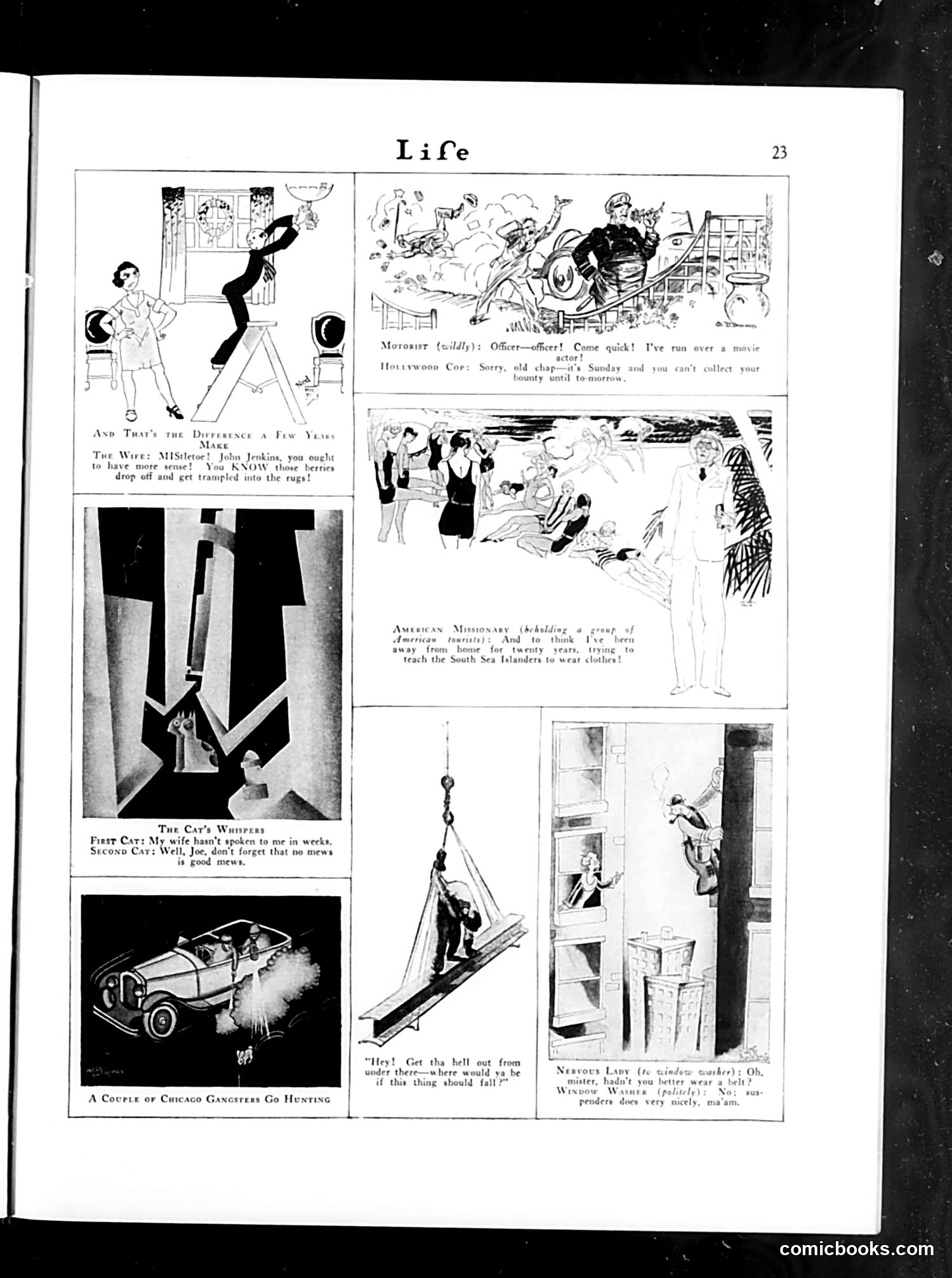
This page from *Life* magazine contains several satirical cartoons mocking early 1920s American life: **"The Cat's Whiskers"** jokes about marital discord—a husband complains his wife hasn't spoken to him in weeks, with the punchline being silence is "good news." **"A Couple of Chicago Gangsters Go Hunting"** references Prohibition-era organized crime, depicting mobsters in a vehicle during a violent encounter, with dark humor about the dangers of their lifestyle. The other cartoons satirize Hollywood pretension, missionary work, and domestic anxieties. The humor relies on period-specific references: the "cat's whiskers" slang, Chicago's notorious gangster violence during Prohibition, and silent-film industry stereotypes. Modern readers would need context about 1920s slang, Prohibition, and organized crime to fully grasp these jokes.
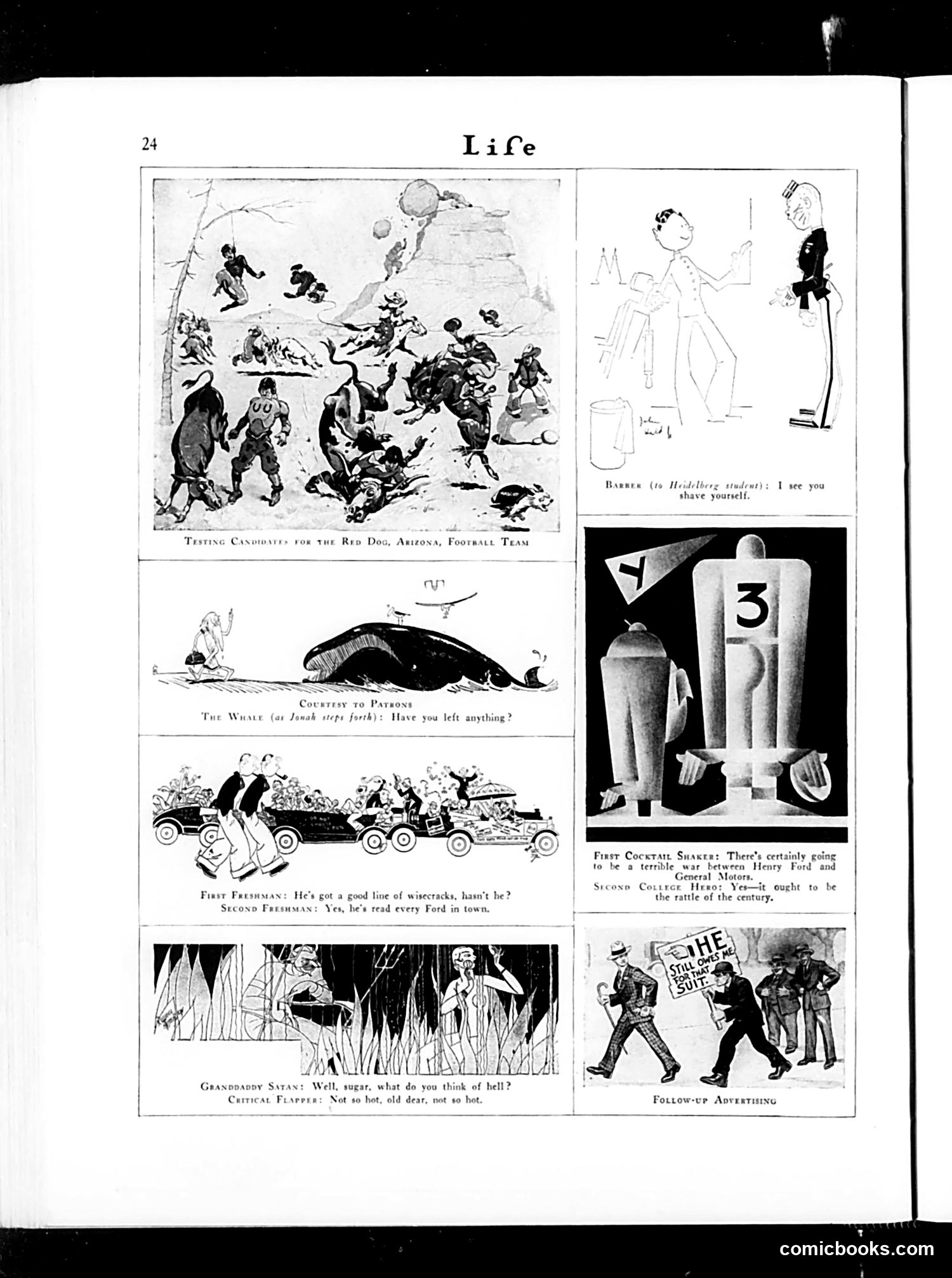
This page collects several humorous sketches satirizing early 1920s American life: **Top panels** joke about contemporary topics: testing candidates for a football team, a whale encounter, and automobiles—specifically contrasting Ford cars (referenced twice) with other vehicles, suggesting Ford's dominance in the auto market. **Middle section** features "Fifty Cocktail Shakers," satirizing Prohibition-era drinking culture by showing novelty vessels designed to disguise alcohol consumption—a jab at Americans' resourcefulness in circumventing alcohol bans. **Bottom panels** include a "Granddaddy Satan" sketch about Hell (unclear reference) and advertising follow-up. The overall tone mocks consumer culture, automotive enthusiasm (Henry Ford's celebrity status), Prohibition enforcement, and dated slang ("old dear," "sugar"). The magazine's satire targets middle-class American preoccupations and the era's social contradictions—particularly the gap between official morality and actual behavior.
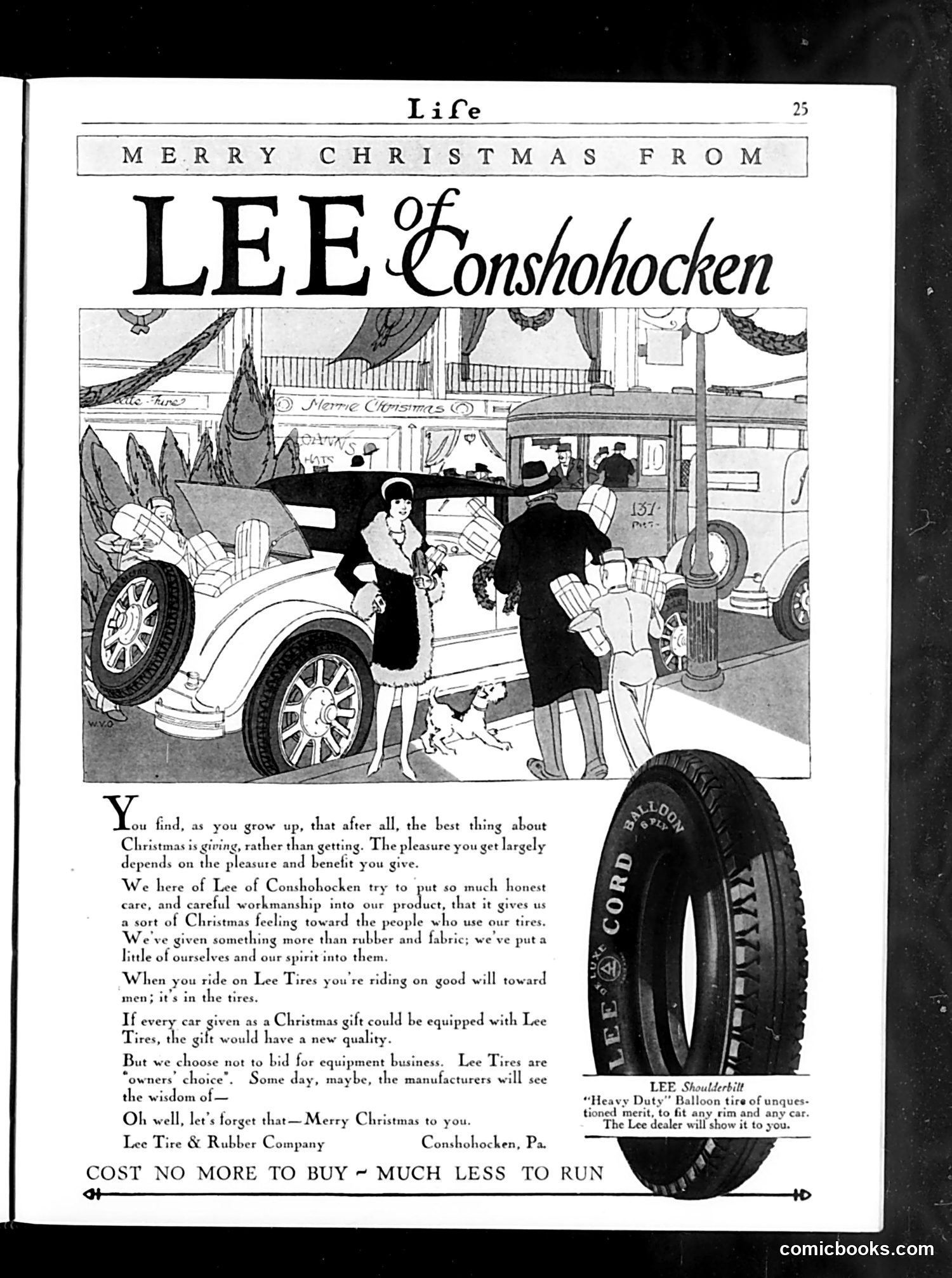
This is a **Christmas advertisement** for Lee Tires (not political satire). The page presents an idealized 1920s-30s holiday scene showing well-dressed women exchanging wrapped gifts near automobiles. The advertisement's pitch hinges on a sentimental philosophy: Christmas is better about *giving* than receiving. Lee Tires claims to embody this spirit—they've put "ourselves and our spirit" into their product, so buying Lee Tires becomes a gift of "good will toward men." The actual sales message is subtle: Lee Tires aren't chasing lucrative equipment contracts with manufacturers; they position themselves as the *owners'* choice, appealing to individual car buyers selecting their own tires as gifts or improvements. The featured "Shoulderbilt" heavy-duty balloon tire is showcased as fitting "any rim and any car." For modern readers: this reflects pre-Depression consumer culture marketing, where brands attempted emotional connection through moral philosophy rather than technical specs alone. The phrase "cost no more to buy—much less to run" emphasizes value and economy, key selling points during economic uncertainty.
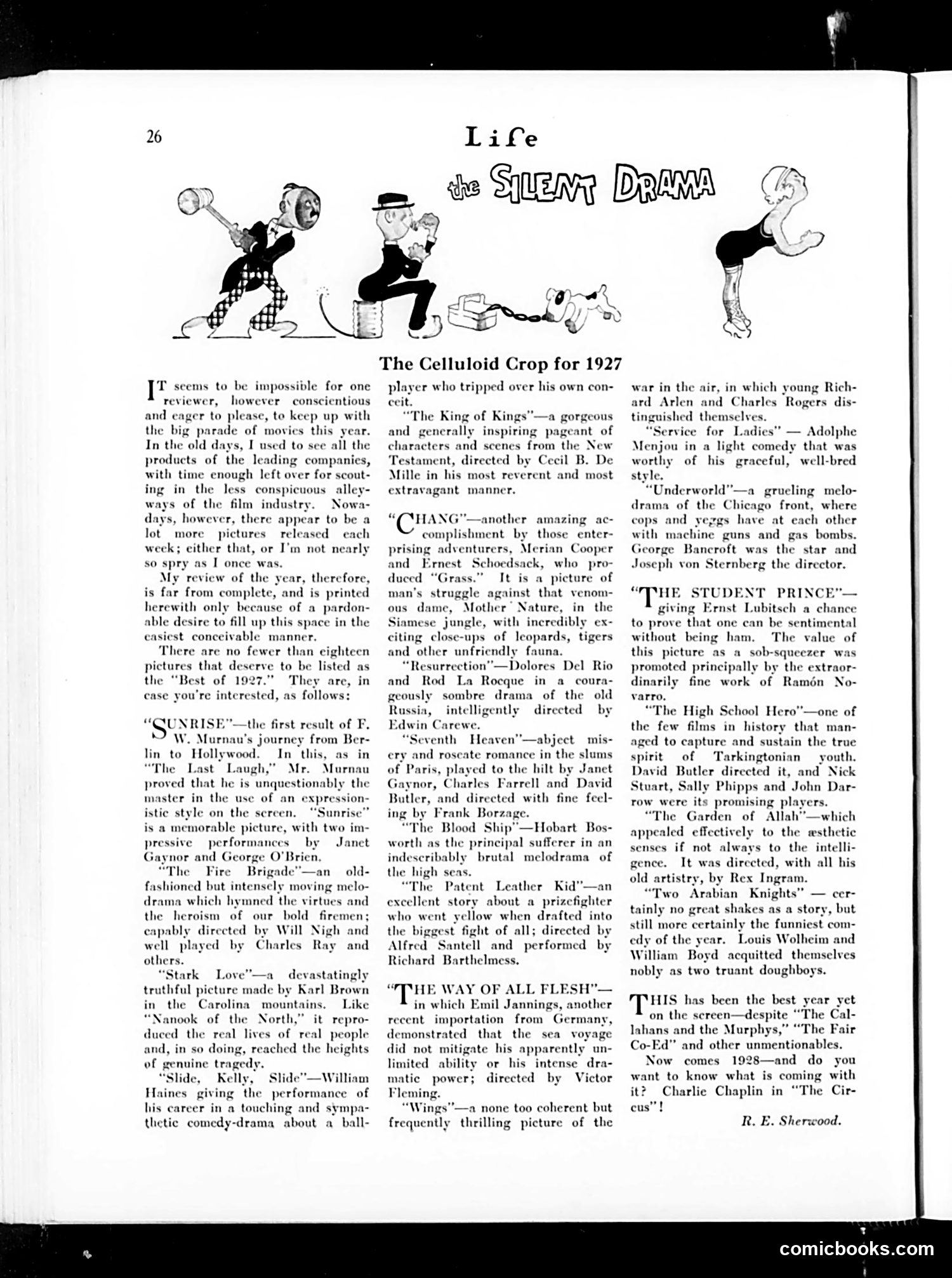
This page reviews the best films of 1927, the final year of silent cinema before "talkies" transformed the industry. The illustrated header shows physical comedy—slapstick performers with exaggerated body language—which captures silent film's reliance on visual storytelling rather than dialogue. The reviewer surveys eighteen "best" films, including *Sunrise* (F.W. Murnau's German Expressionist masterpiece), Cecil B. DeMille's biblical epic *The King of Kings*, and *Wings* (an air-combat film). Notable are references to *Underworld* (gangster drama set in Chicago) and imports like Emil Jannings's *The Way of All Flesh*. The tone is that of a conscientious but overwhelmed critic—he admits he can no longer see everything studios release, suggesting Hollywood's explosive productivity. The list emphasizes emotion and technical innovation, celebrating cinema's visual power at the medium's aesthetic peak before sound technology arrived.
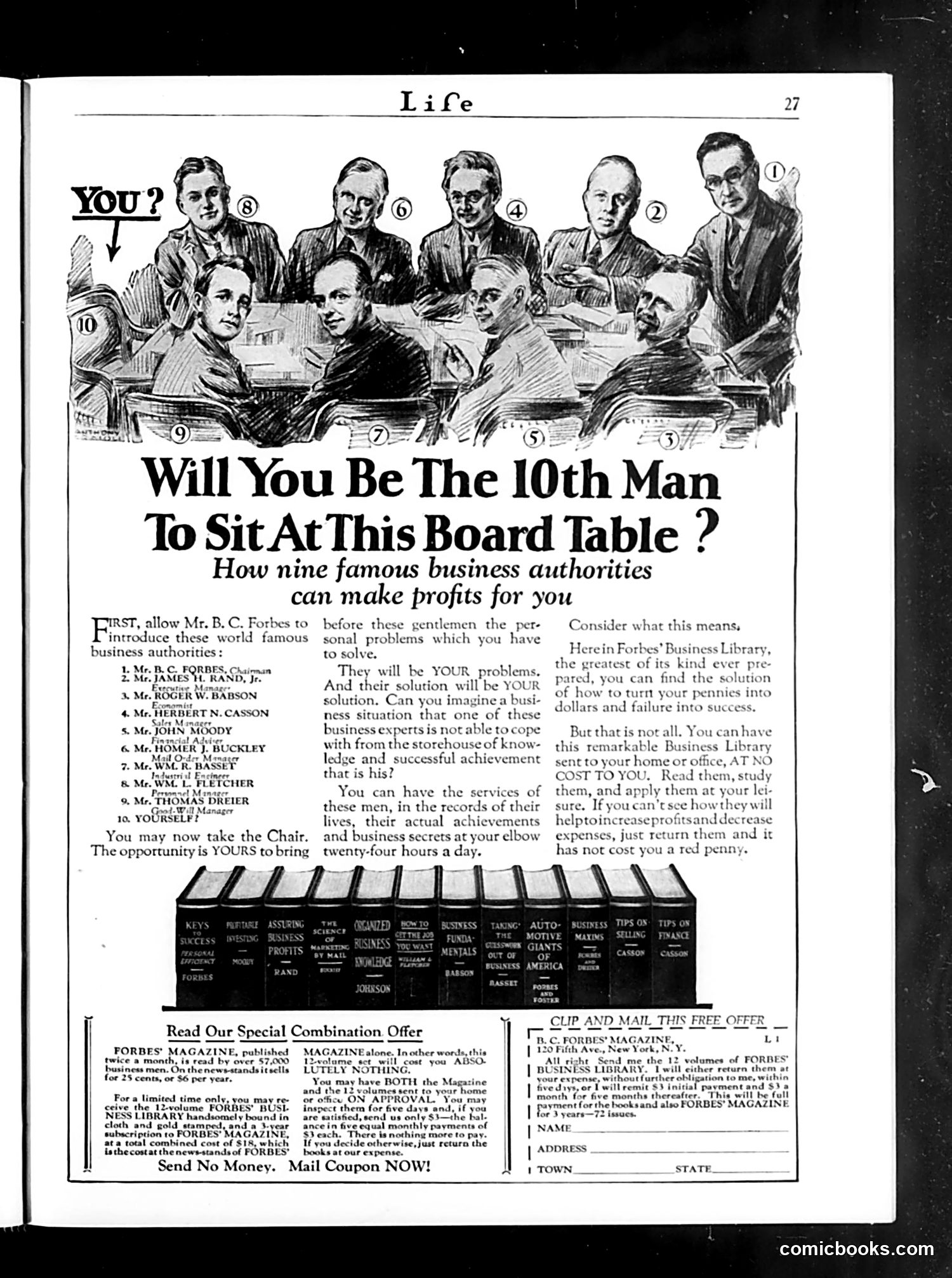
This is a **business magazine advertisement**, not political satire. *Life* here promotes Forbes' Business Library through an aspirational pitch. The page features nine portraits of actual prominent businessmen of the era (B.C. Forbes, James H. Rand Jr., and others—listed by name), presented as successful "authorities." The headline asks: "Will You Be The 10th Man To Sit At This Board Table?"—positioning the reader as a potential peer among business elites. The appeal is straightforward: purchase this 12-volume business library ($18 total, payable in installments) to access these men's "secrets" and learn how to turn "pennies into dollars and failure into success." It's essentially a self-help/business education product marketed to ambitious businessmen, promising access to proven wisdom without needing personal connections. The satirical edge *Life* typically employed is absent here—this appears to be paid advertising content, reflecting early-20th-century marketing targeting the entrepreneurial class.
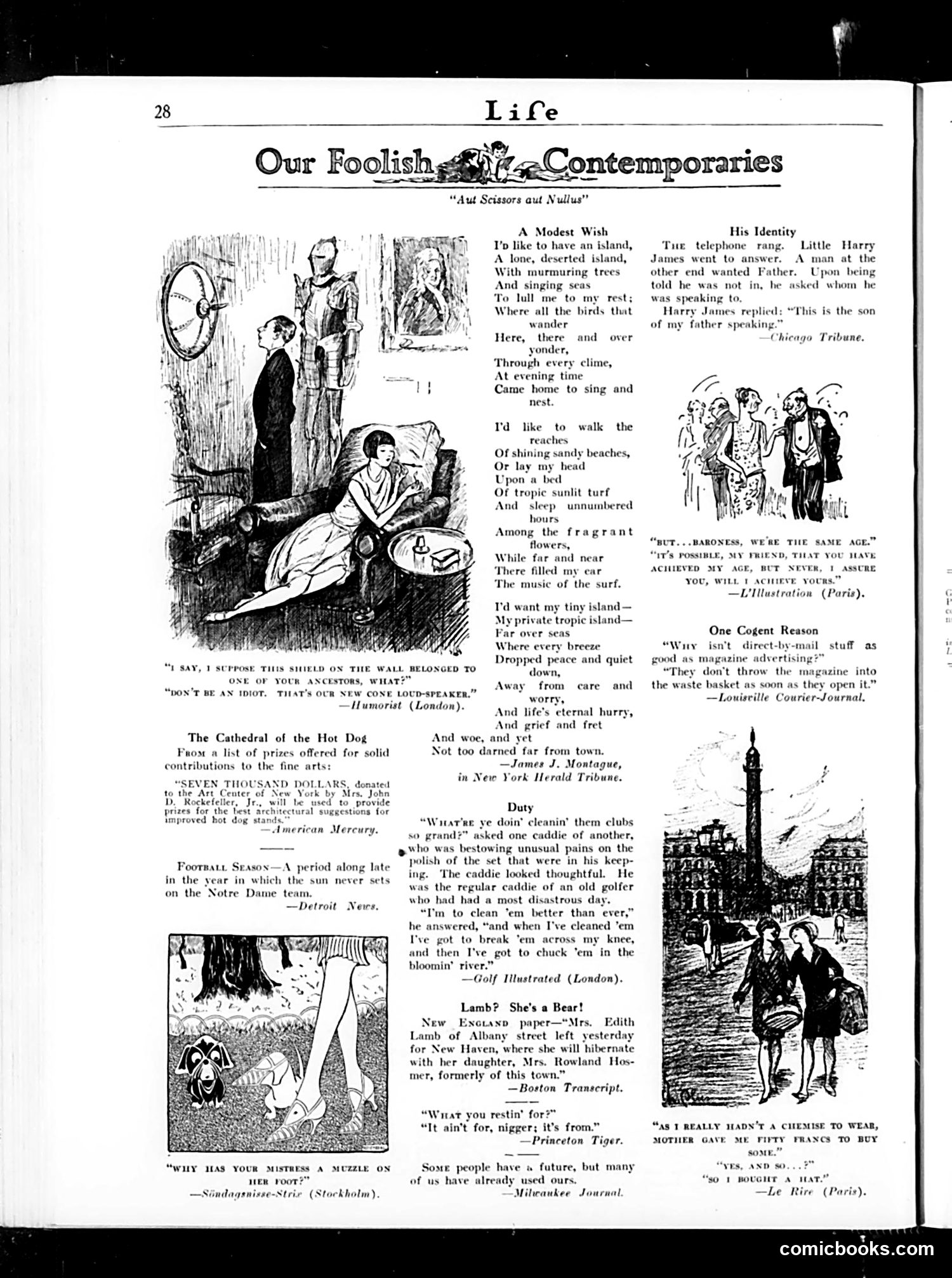
This page collects satirical short jokes and comic vignettes mocking various aspects of contemporary society. Key items include: **"Don't Be an Idiot"** - A man claims his wall belonged to ancestors; the other reveals it's actually a new cone loudspeaker—mocking pretentiousness and misidentification of modern technology. **"Cathedral of the Hot Dog"** - Satirizes the wealthy (Mrs. Rockefeller) donating vast sums for architectural suggestions while humble hot dogs dominate American culture—critiquing elite taste versus popular reality. **Golf caddie joke** - A caddie plans to clean clubs before throwing them in a river after his boss's bad game—dark humor about frustration and service work. **Various one-liners** mock class pretension, gender relations, advertising effectiveness, and modern absurdities. The tone throughout is urbane, cynical humor targeting the middle and upper classes' pretensions and the era's social contradictions—typical of Life's satirical approach in this period.
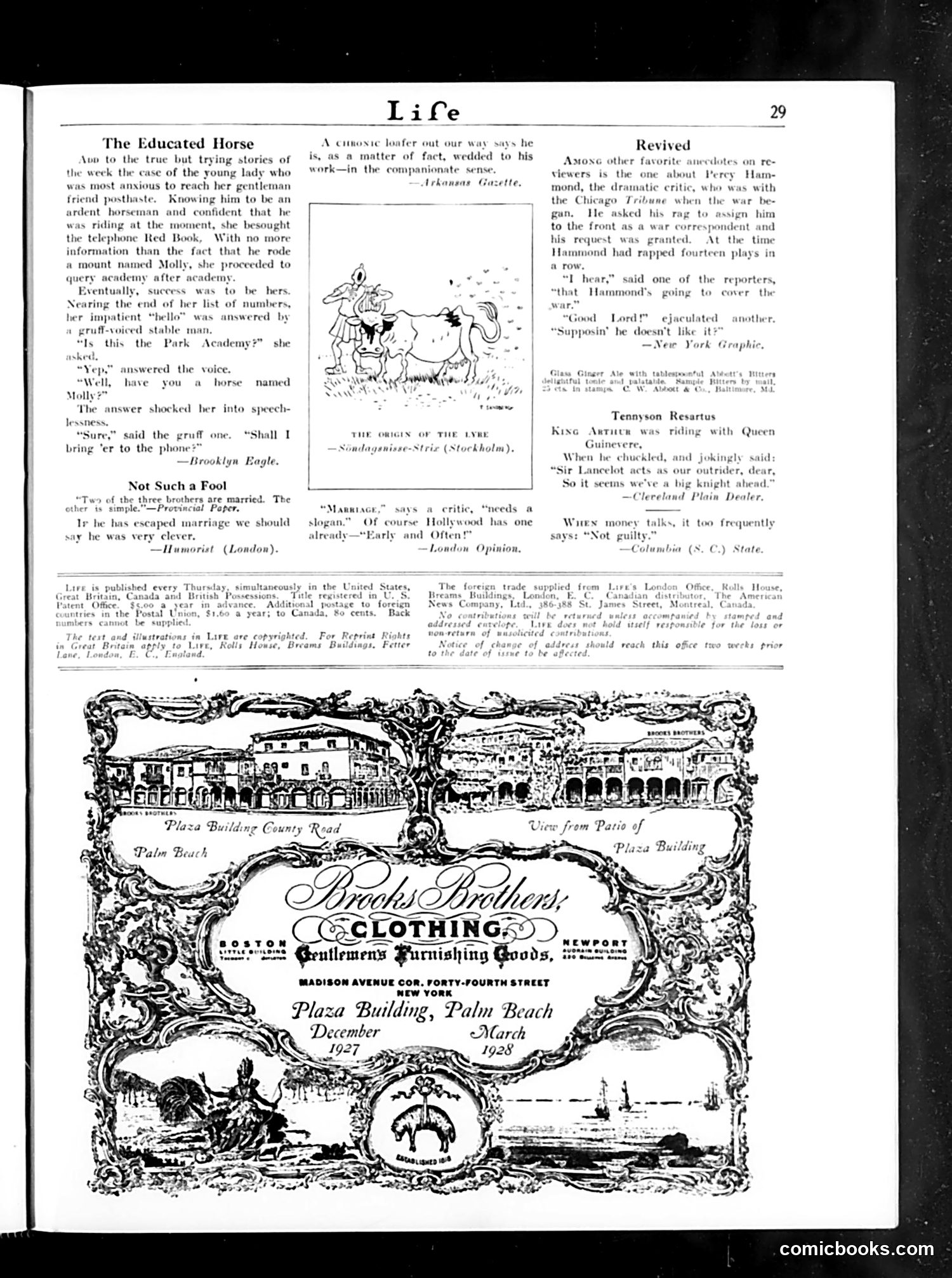
This page contains three brief humorous anecdotes typical of Life's satirical humor: **"The Educated Horse"** mocks a young woman's desperation to reach her horseman boyfriend. She calls riding academies asking for one with a horse named "Molly," expecting to locate him. A stable worker's offer to "bring 'er to the phone" reveals she's been calling stables, not social clubs—the joke being her naïveté about where wealthy gentlemen actually ride. **"Not Such a Fool"** is a one-liner suggesting that if a man has avoided marriage, he's clever—implying marriage is something to escape. **"Revived"** recounts a theater critic's anecdote about playwright Percy Hammond, who wanted to cover WWI as a correspondent. Another critic quips that Hammond "acts as our outrider, dear, / So it seems we've a big knight ahead"—a pun on "knight" (armor) and "night" (theatrical term). The page is mostly advertisements for Brooks Brothers clothing, with decorative images of Palm Beach buildings.
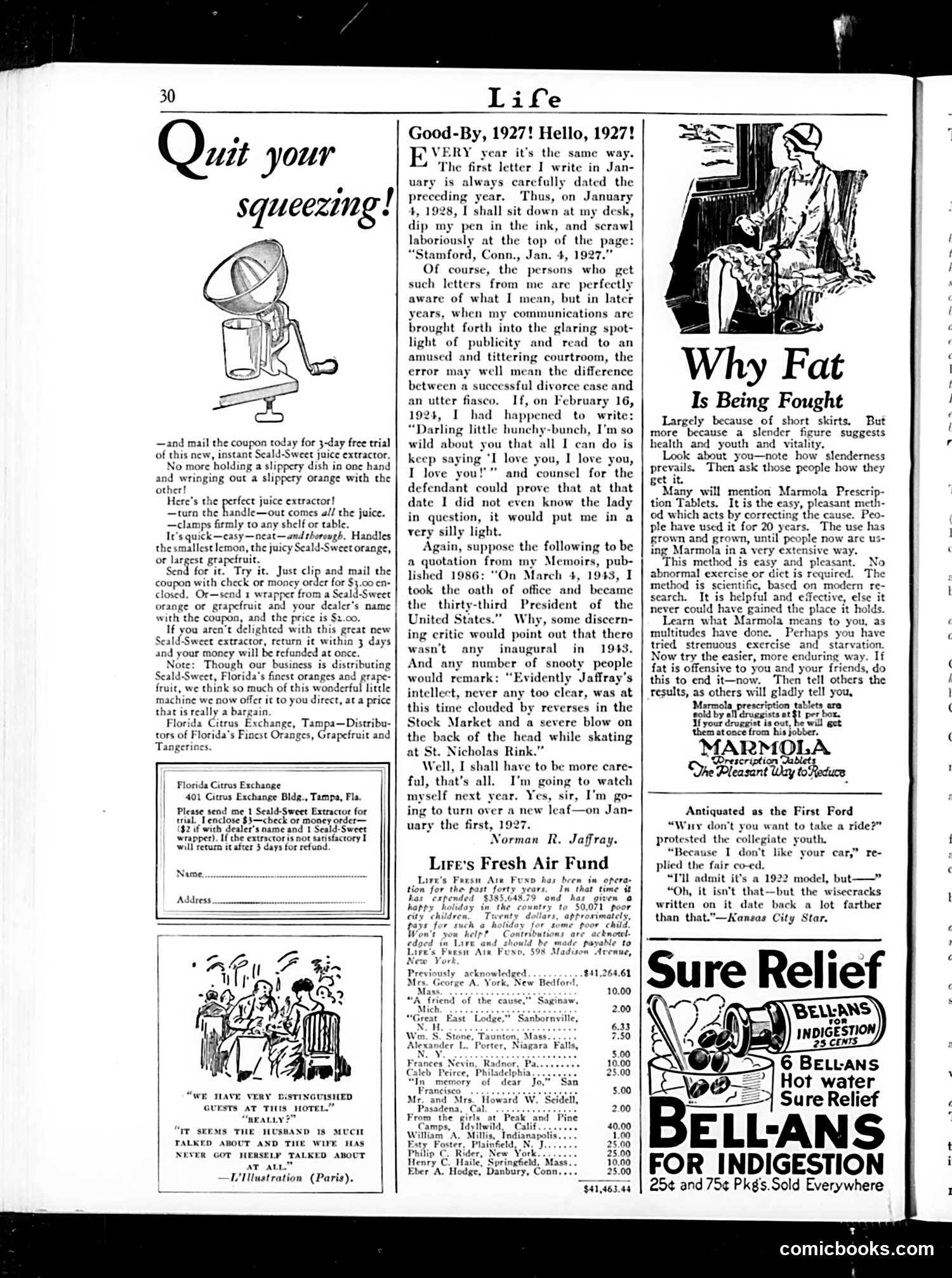
This page from *Life* magazine (circa 1927) contains three main elements: **Left Column:** A product advertisement for a Seald-Sweet juice extractor, featuring an illustration of a mechanical device designed to eliminate hand-squeezing of citrus fruits. **Center Column:** A humorous essay by Norman R. Jaffray titled "Good-By, 1927! Hello, 1927!" The author satirizes the common human error of dating letters with the previous year—a relatable New Year's anxiety. He humorously imagines future consequences: misdated love letters potentially destroying a divorce case, or a fabricated memoir claiming he became "thirty-third President" in 1943 (when no inauguration occurred), which critics would attribute to mental decline from stock market losses or a skating accident. The satire gently mocks human forgetfulness and the potential legal/historical embarrassments it creates. **Right Column:** Advertisements for Marmola (a weight-loss product) and Bellans (indigestion remedy). The page is primarily advertising-focused with one humorous essay providing light social commentary on dating errors.
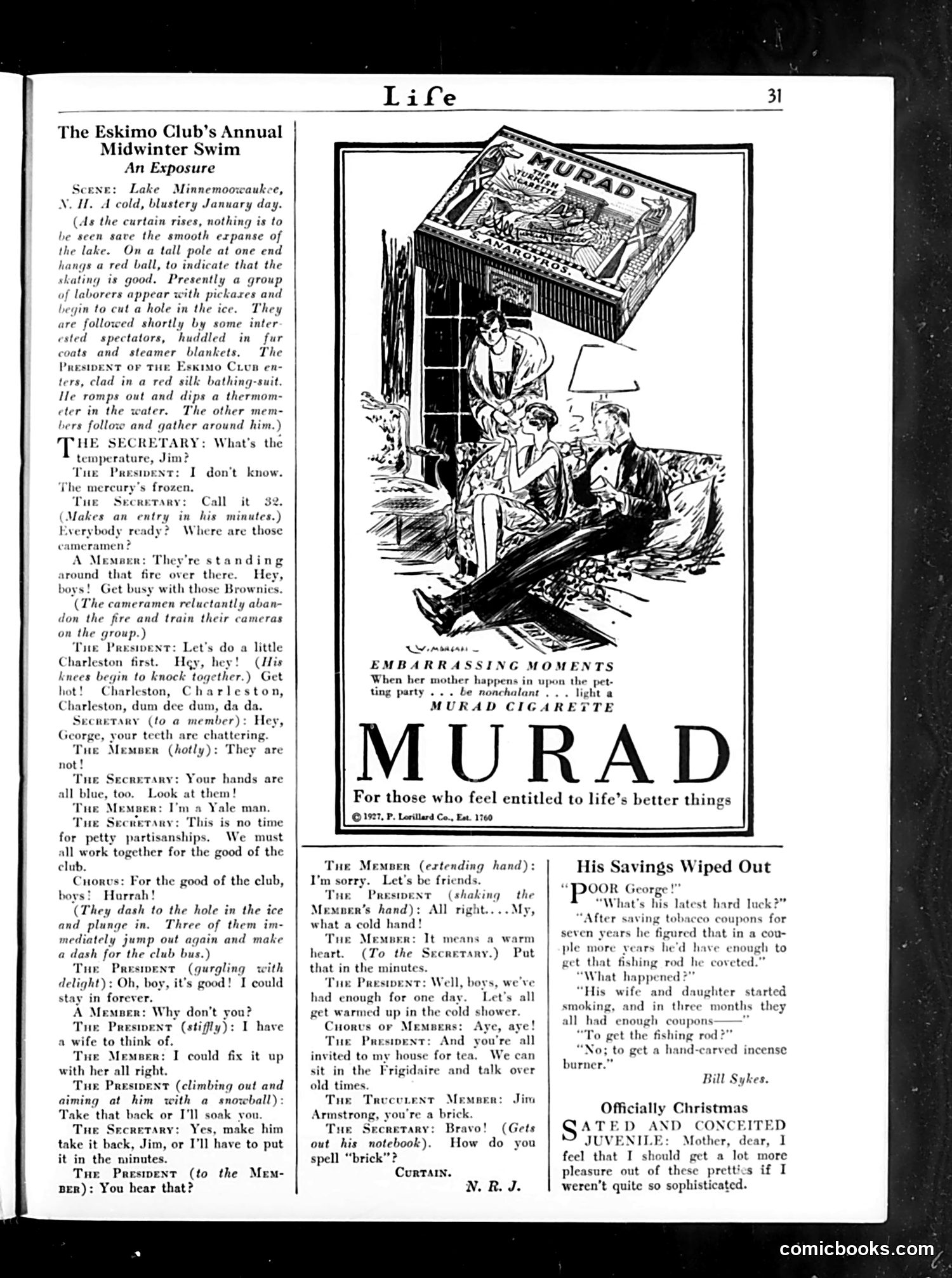
This is a satirical sketch about the Eskimo Club's winter swimming tradition at Lake Minnetonka, Wisconsin. The humor centers on the contrast between members' bravado and their physical misery. The joke: Club members gather to take a midwinter plunge through ice, performing exaggerated toughness (doing the Charleston, cracking jokes) while clearly freezing. Their teeth chatter, hands turn blue, and three immediately flee to the bus—yet the President insists he could "stay in forever," claiming only marital obligations force him out. The Secretary dutifully records everything, including a reconciliation involving a pun about "brick" (meaning both courage and the cold feeling). The satire mocks masculine posturing and club ritual: men enduring genuine suffering for tradition and appearance, while maintaining false cheerfulness for cameras and spectators. It's gentle mockery of both the foolish tradition and the social pressure to maintain dignity while clearly miserable. The accompanying advertisements (Murad cigarettes, incense burner joke) are unrelated period filler.
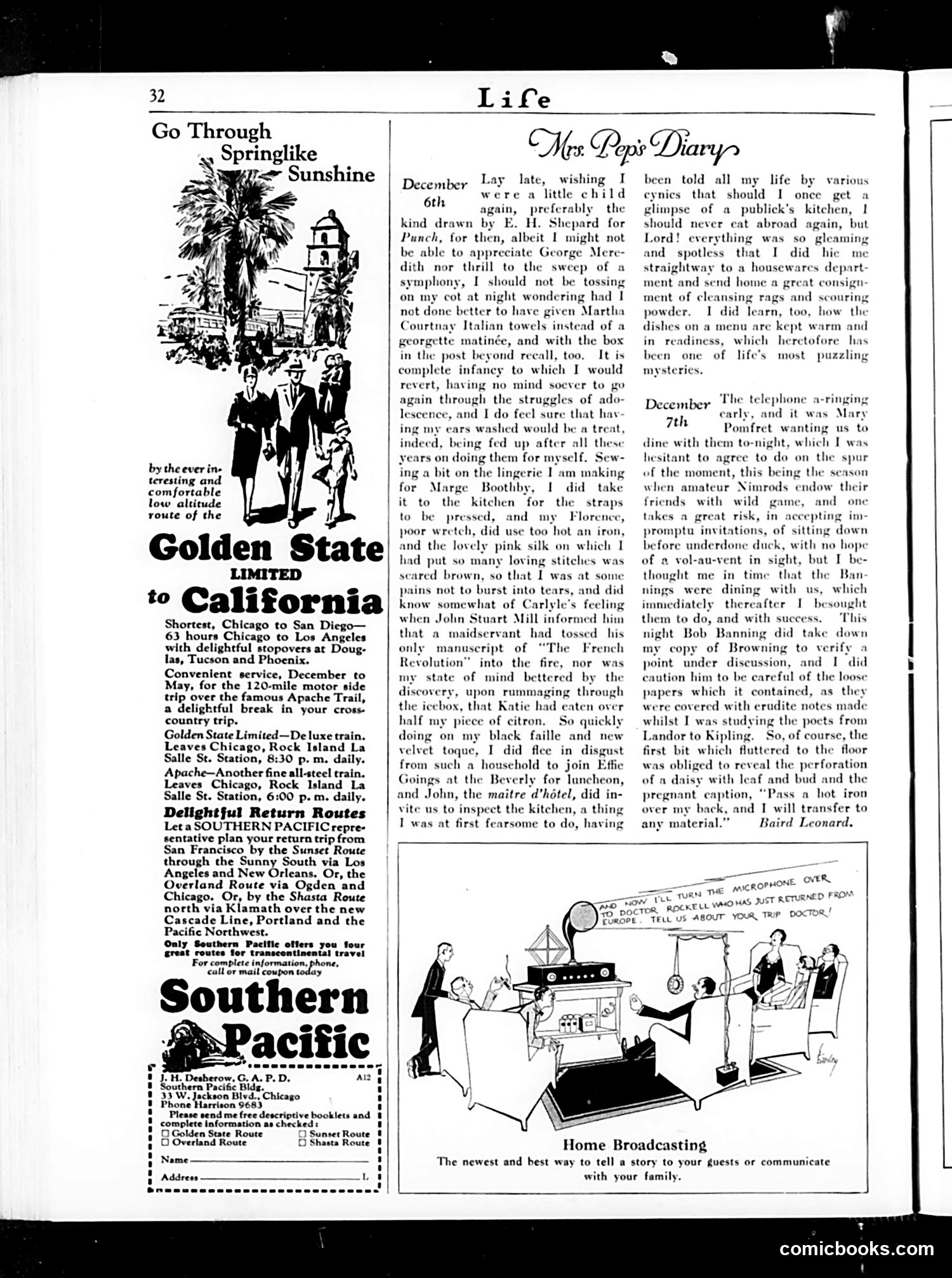
This page primarily contains **advertising** for Southern Pacific Railroad's California routes (left side) and a **society gossip column** titled "Mrs. Pop's Diary" (right side). The diary entries are satirical observations of upper-class domestic life. The December 6th entry mocks the author's anxieties over trivial matters—a ruined silk garment, a servant eating citron, fears about restaurant kitchens—while yearning for the simplicity of childhood. The tone gently ridicules how privileged people manufacture drama from minor household mishaps. The December 7th entry references holiday dinner invitations and "amateur Nimrods" (hunters) giving game as gifts—satirizing the season's social obligations and gift-giving customs. The bottom cartoon, titled "Home Broadcasting," depicts someone using a microphone to announce domestic trivia to guests, mocking how people use new technology (radio) to share mundane household news. Together, the content satirizes affluent 1920s-30s American society's preoccupations with etiquette, servants, social climbing, and consumerism.
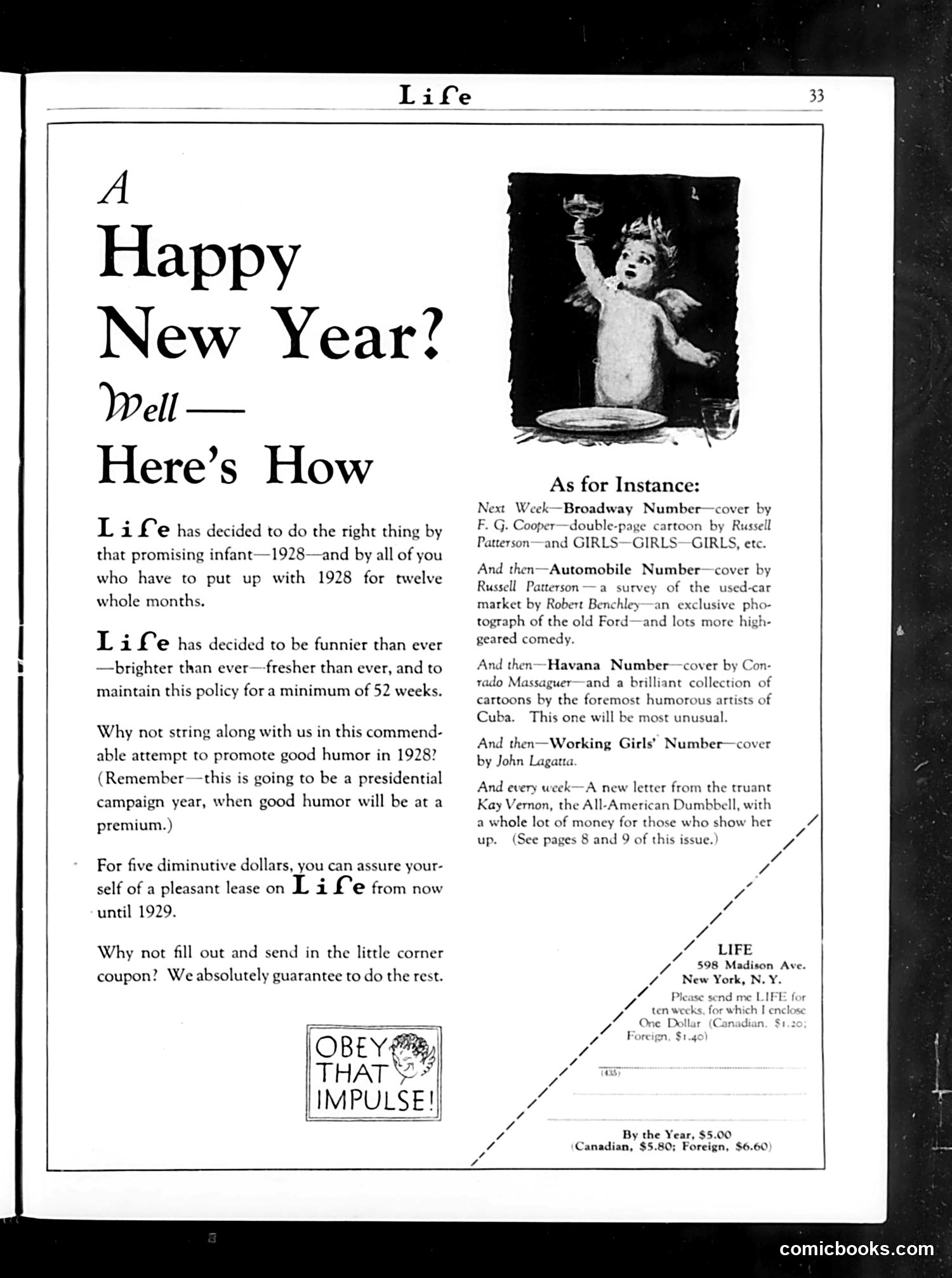
This is primarily a subscription advertisement for Life magazine, framed as a New Year's pitch to readers. The publication promises to deliver humor consistently throughout 1928—described as significant because it's a presidential election year when "good humor will be at a premium." The cherub illustration at top symbolizes the "promising infant" of 1928 itself. The "OBEY THAT IMPULSE!" caption is a lighthearted call-to-action encouraging immediate subscription. The text previews upcoming special issues (Broadway, Automobiles, Havana, Working Girls) and mentions regular features like letters from "Kay Vernon, the All-American Dumbbell"—appearing to be a recurring satirical character. The five-dollar annual subscription cost is emphasized as a bargain for weekly humor. This reflects Life's identity as a satirical humor magazine competing for readers' attention and subscription dollars during the economically prosperous late 1920s.
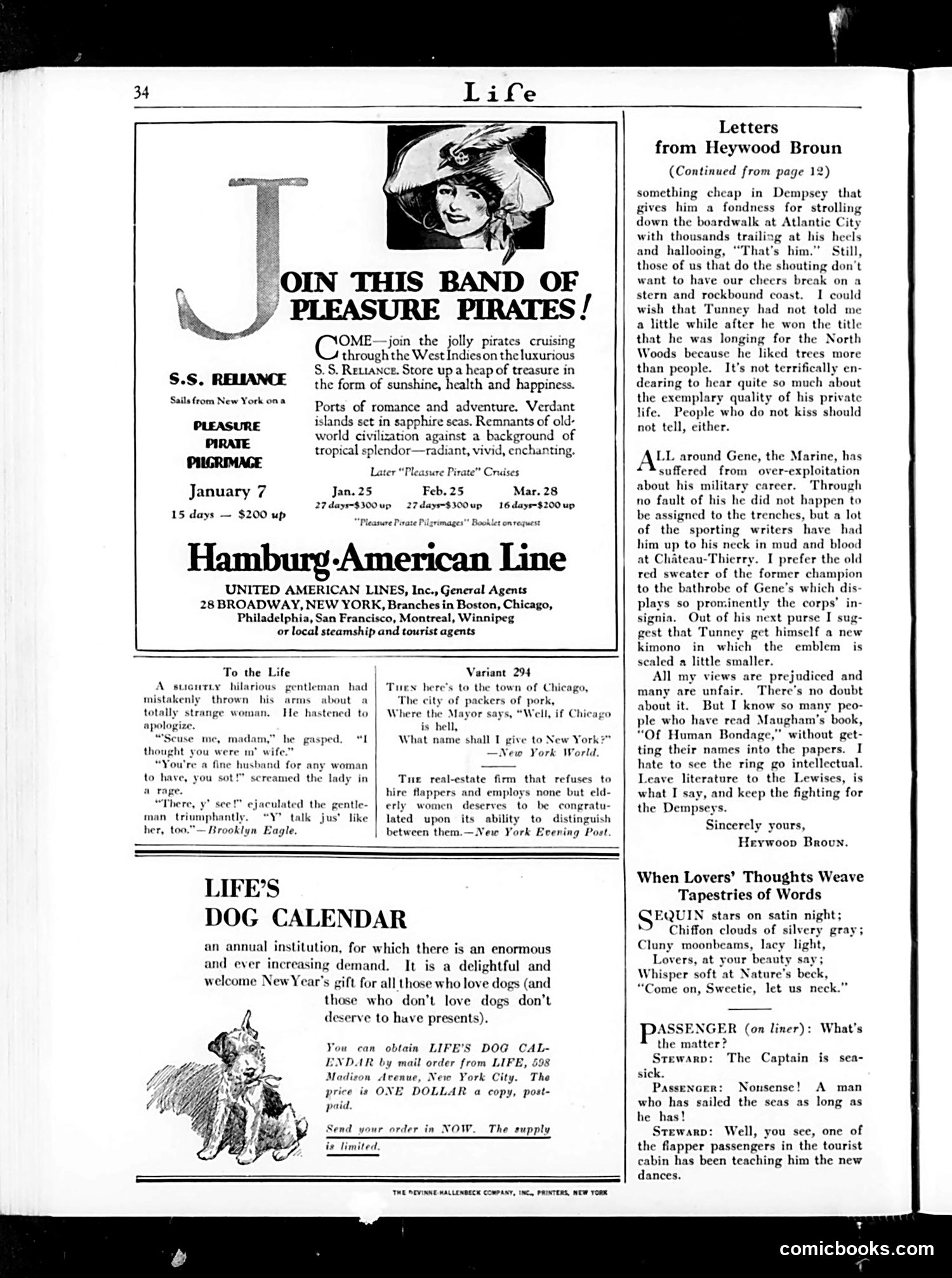
This page contains **letters and commentary from Heywood Broun**, a prominent sports columnist, discussing boxers Jack Dempsey and Gene Tunney. Broun criticizes Dempsey's showmanship (strolling Atlantic City boardwalks for attention) while finding Tunney insufferably pretentious—claiming he romanticizes nature and affecting intellectual superiority through wearing a bathrobe displaying Marine Corps insignia. The satire targets celebrity vanity: Broun mocks both fighters' performative personas outside the ring, preferring genuine athletic competition to self-aggrandizement. References to "Human Bondage" and "the Lewises" reflect contemporary literary debates. The page also includes **travel advertisements** (S.S. Reliance cruises), **humorous brief anecdotes**, and **poetry about romance**—typical Life magazine content mixing social commentary with lighter entertainment.
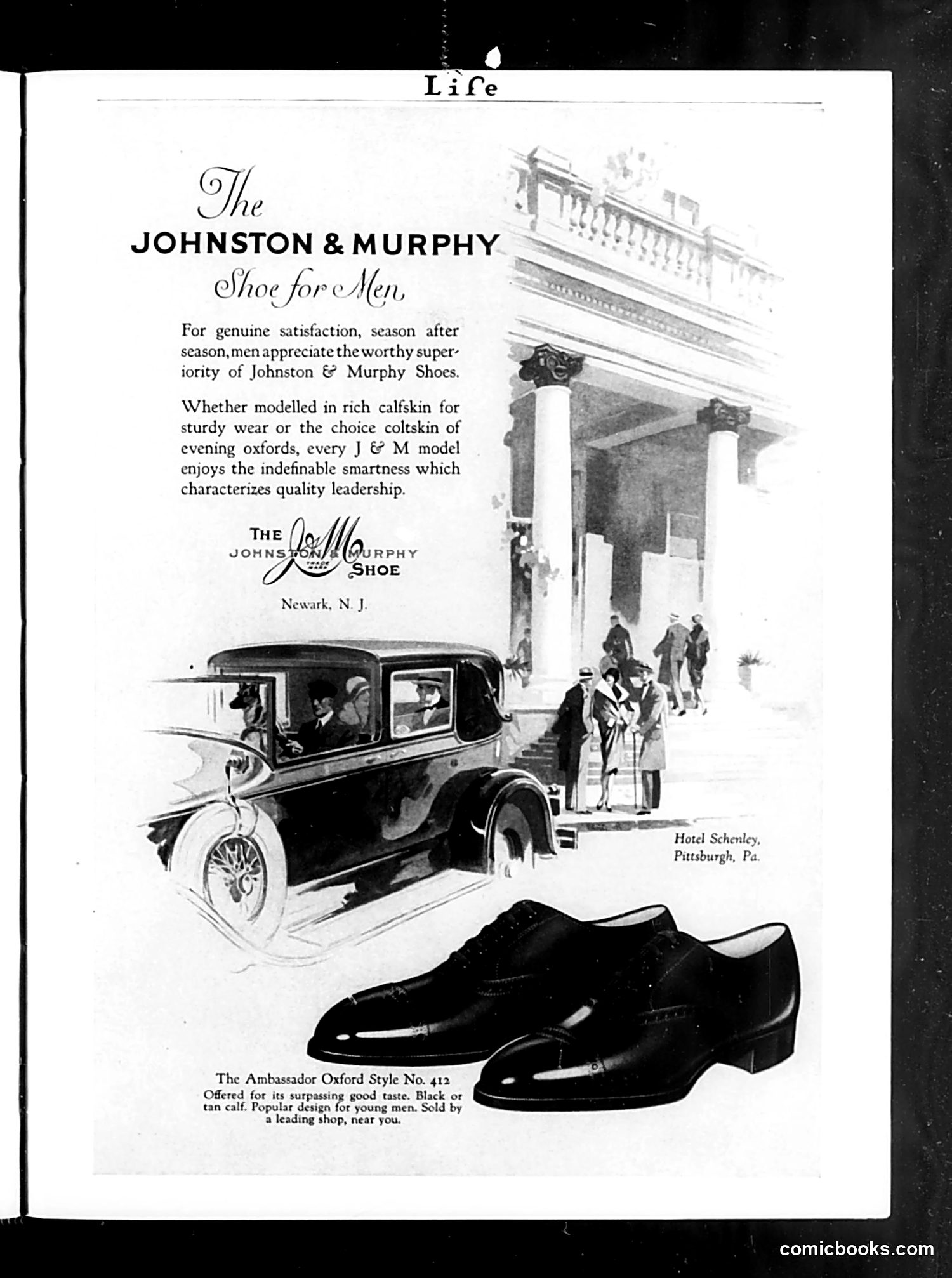
This is a vintage advertisement, not political satire. It's a Johnston & Murphy shoe company ad from Life magazine featuring their "Ambassador Oxford Style No. 412" dress shoe. The page uses a lifestyle illustration showing well-dressed men arriving at the Hotel Schenley in Pittsburgh via automobile—imagery meant to associate the shoes with sophistication and success. The ad emphasizes quality materials (calfskin, coltskin) and appeals to young professional men seeking "quality leadership" and "good taste." The vintage car and formal attire reflect 1920s-30s era fashion standards. There is no political cartoon or satire present; this is purely commercial advertising designed to promote aspirational masculinity through footwear.
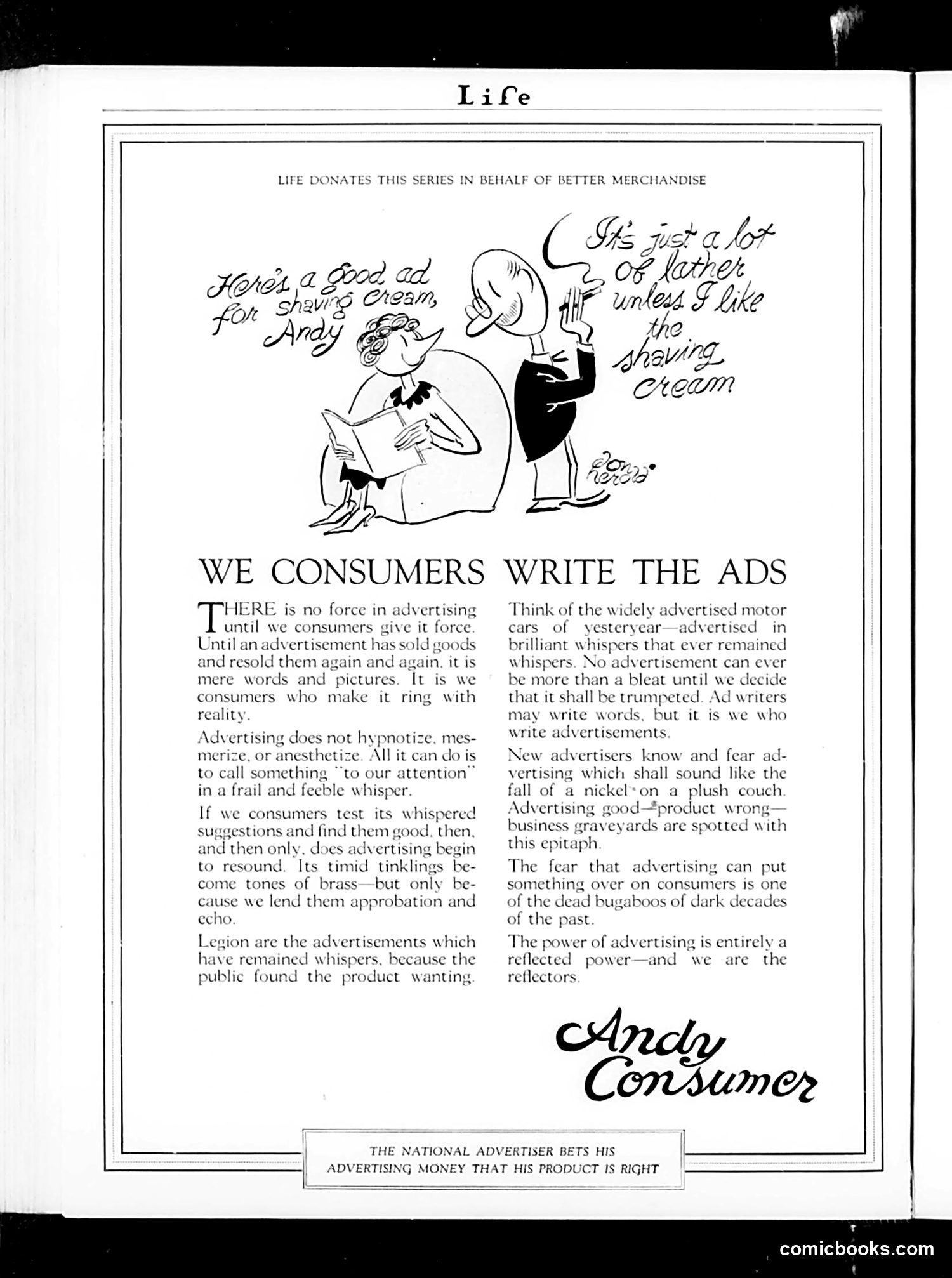
This is an advertisement/editorial essay, not a political cartoon, though it includes an illustrative cartoon at the top showing a man praising shaving cream to another man. The piece argues that **advertising has no power without consumer approval**. The author, signing as "Andy Consumer," claims that advertisements are merely "whispers" until the public validates a product through purchase and word-of-mouth. Failed products—referenced obliquely as "motor cars of yesteryear"—remain whispers regardless of how brilliantly advertised. The satire targets both **naive advertisers who fear they can deceive consumers** and the notion that advertising creates false demand. Instead, the essay insists consumers themselves determine an advertisement's success by either endorsing or ignoring it. The message serves Life magazine's stated purpose: promoting "better merchandise" by suggesting that only quality products survive consumer scrutiny. This reflects early 20th-century consumer advocacy rhetoric emphasizing buyer power.
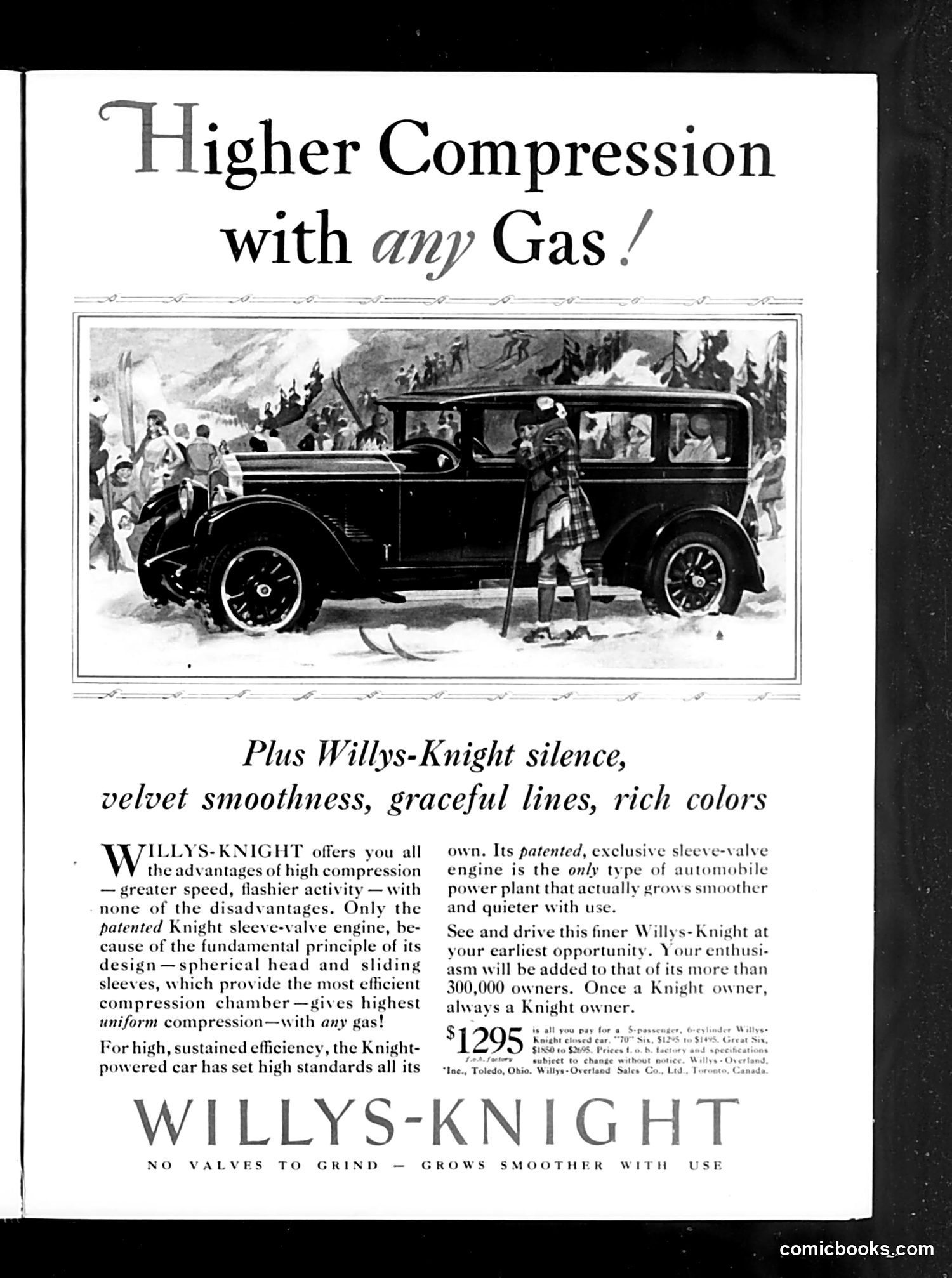
This is a **Willys-Knight automobile advertisement**, not political satire. The page promotes the Willys-Knight car's technical superiority, specifically its patented sleeve-valve engine. The illustration shows a 1920s touring car in a snowy mountain setting with fashionably dressed people, establishing the vehicle as desirable and reliable for leisure travel. The advertiser's key claims: the engine achieves "higher compression with any gas" and "grows smoother and quieter with use"—unusual advantages for the era. The tagline "No valves to grind" references a common maintenance burden of competing automobiles. At $1,295, this positioned the Willys-Knight as an upscale choice. The ad cites 300,000 existing owners to build credibility—a significant market share claim for the period. **For modern readers**: This reflects 1920s automotive marketing emphasizing mechanical innovation and luxury. The appeal to "graceful lines" and refined aesthetics shows how cars were marketed as status symbols, not mere transportation.
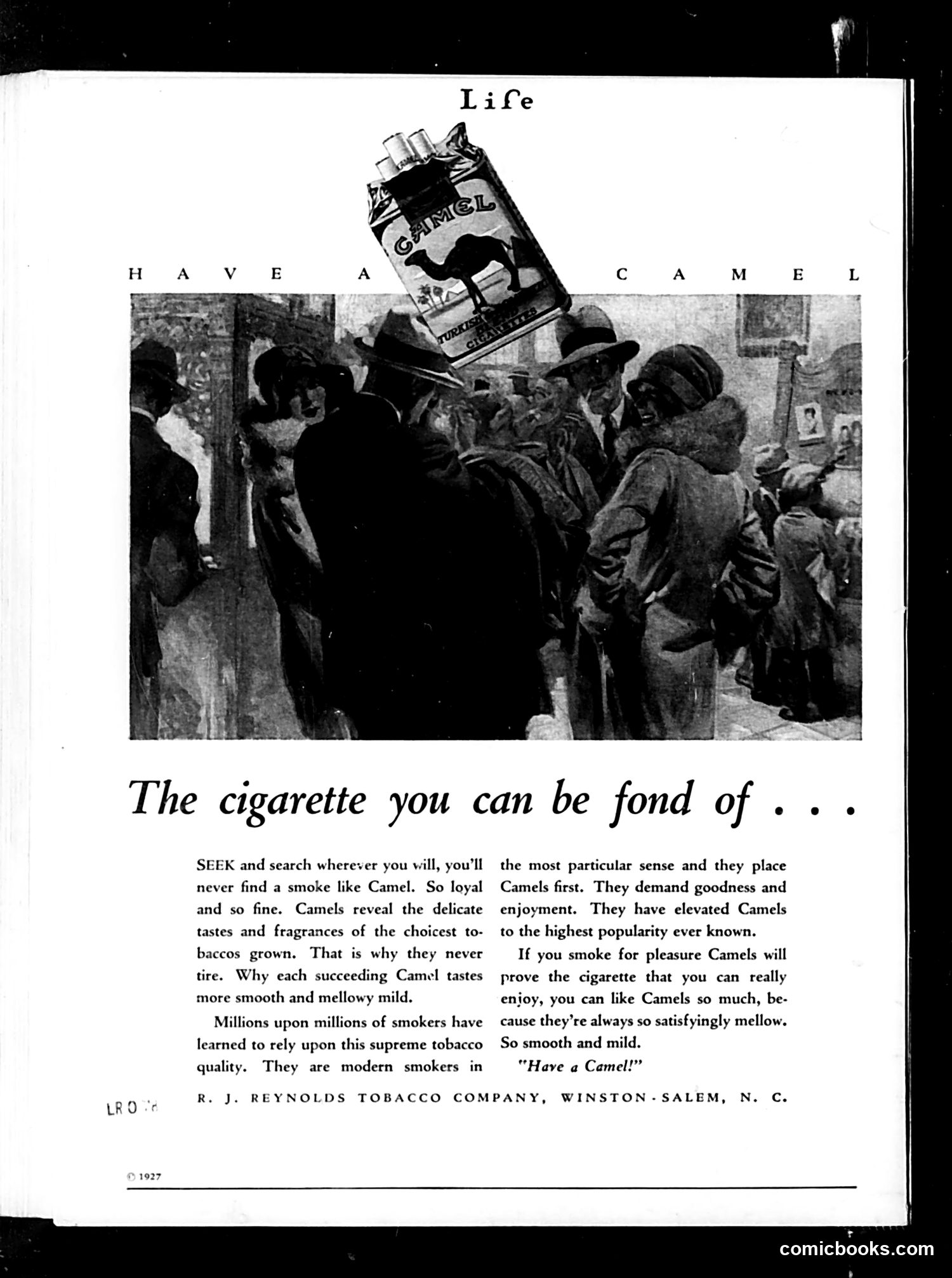
This is a **Camel cigarette advertisement**, not satire or political commentary. Dated 1927, it represents straightforward product marketing from the early tobacco advertising era. The image shows a crowd of working-class people (men in hats and coats) gathered around a giant Camel cigarette package labeled "Life"—suggesting cigarettes as desirable lifestyle products. The text emphasizes quality, smoothness, and widespread popularity among "modern smokers." **What a modern reader should know:** This advertisement predates any health warnings about smoking. Tobacco companies openly marketed cigarettes as premium consumer goods associated with sophistication and satisfaction. The phrase "Have a Camel!" was an actual slogan. The page reflects 1920s advertising conventions when such promotions faced no regulatory restrictions and appeared in mainstream magazines without controversy. The "Life" label ironically pairs cigarettes with vitality—a marketing strategy that would become deeply controversial once smoking's health dangers were scientifically established.

I can see this is a predominantly black page from what appears to be a historical publication, with minimal visible content. The image quality is very poor—extremely dark with only faint outlines and scattered light marks visible. There is a white vertical line on the left edge and a watermark reading "comicbooks.com" in the bottom right. I cannot reliably identify any cartoon figures, text, political references, or satirical content from this image. The darkness and degradation prevent me from discerning specific details that would be necessary to explain the page's meaning to a modern reader. To properly analyze this page, a clearer or higher-contrast scan would be needed.