
Life, 1927-12-29 · page 18 of 41
Life — December 29, 1927 — page 18: what you’re looking at
What you’re looking at
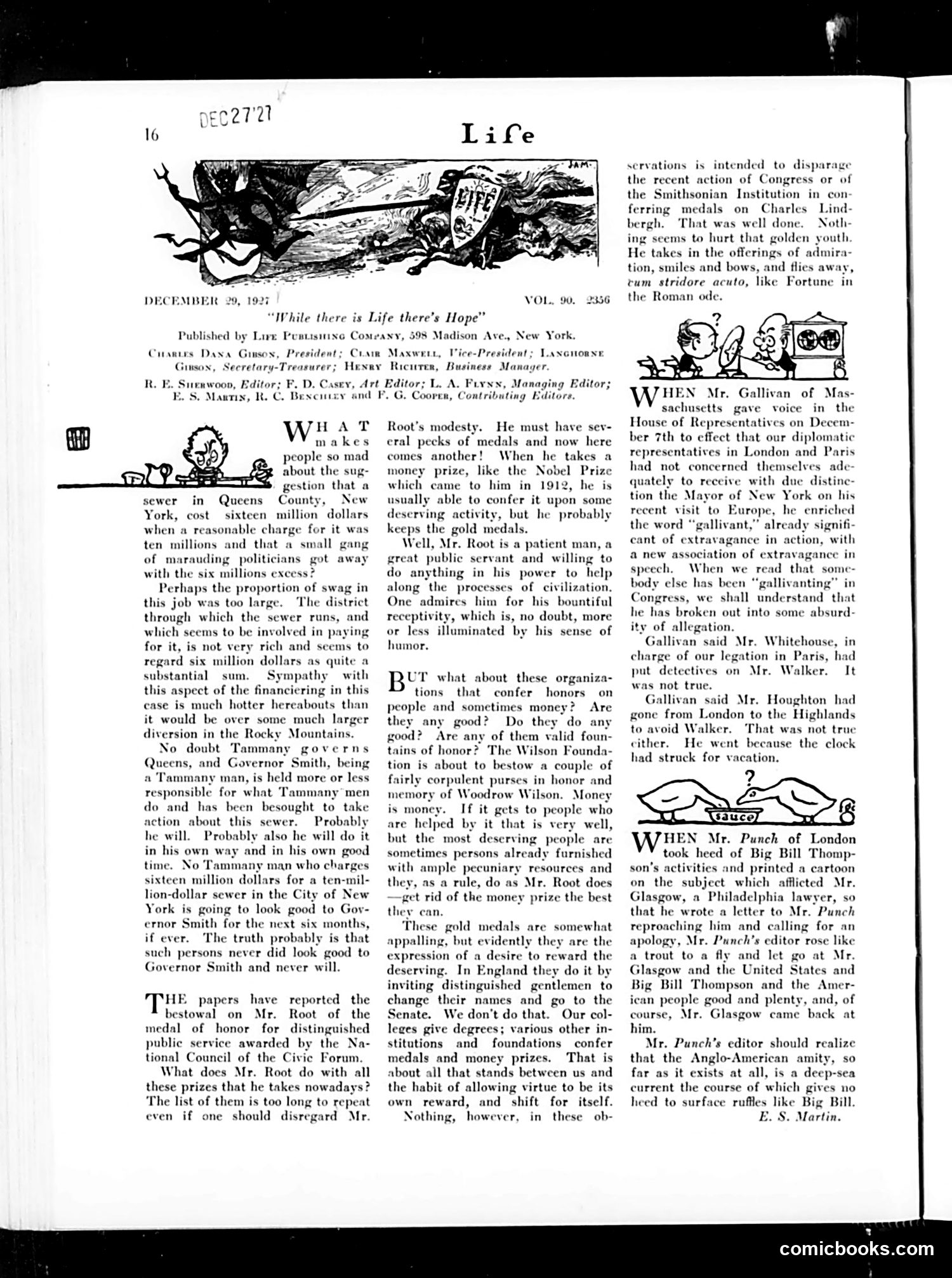
The main article critiques the awarding of medals and honors by various institutions. It questions whether organizations like the Wilson Foundation and National Council of the Fine Arts should give money prizes to already-distinguished people like Charles Lindbergh. The satire targets what the writer sees as performative virtue-signaling: wealthy institutions conferring honors rather than solving real problems. The piece contrasts this with practical needs—specifically mentioning Tammany Hall's involvement in New York's sewer system. Several anecdotes mock diplomatic absurdities, including a story about Mr. Gallivan allegedly employing detectives to shadow a delegate named Walker at a European conference, suggesting bureaucratic excess and international intrigue. The overall tone mocks institutional self-congratulation divorced from meaningful social contribution.
📄 Transcribed text from this page (OCR, searchable)
Machine-transcribed from the original scan — historical spelling and the odd misread are preserved.
DECEMBER While the Crantes Dana Ginsox, President; Crsim Maxweit, Ginsox, Seeretary-Treasurer Stiexwoon, Editor HAT makes people so mad about the sug- gestion that a County, Queens sixteen million doll: when a reasonable charge for it was ten millions and that a small gang sewer in York, cost of marauding politicians got away with the six millions excess? Perhaps the proportion of swag in this job was too large. he district through which the sewer runs, and which seems to be involved in paying for it, is not very rich and seems to regard six million dollars as quite a substantial sum. Sympathy with this aspect of the financiering in this case is much hotter hereabouts than it would be over some much larger diversion in the Rocky Mountains. No doubt mmany governs Queens, and Governor Smith, being a Tammany man, is held more or less responsible for what Tammany men do and has been besought to take action about this sewer. Probably he will. Probably also he will do it in his own way and in his own good time. No Tammany man who charges sixteen million dollars for a ten-mil- lion-dollar sewer in the y of New York is going to look good to Gov- ernor Smith for the next six months, if ever. The truth probably is that such persons never did look good to Governor Smith and never will. HE papers have reported the bestowal on Mr. Root of the medal of honor for distinguished public service awarded by the Na- tional Council of the Civic Forum. What does Mr. Root do with all these prizes that he takes nowadays? The list of them is too long to repeat Mr. even if one should disregard - is Life there's Hope” Published by Lire Puausiixe Comeany, 598 Madison Ave. New York. President Laxcnoanxe Hexay Ricurer, Business: Manager. F. D. Casey, Art Editor; L. A. Fuvxx, Managing Editor; S. Manrtix, KR. C. Bexcizy and FP, G, Cooren, Contributing Editors. Root's modesty. He must have sev- eral pecks of medals and now here comes another! When he takes a money prize, like the Nobel Prize which came to him in 1912, he is usually able to confer it upon some deserving activity, but he probably keeps the gold medals. Well, Mr. Root is a patient man, a great public servant and willing to do anything in his power to help along the processes of civilization. One admires him for his bountiful receptivity, which is, no doubt, more or less illuminated by his sense of humor. UT what about these organiza tions that confer honors on people and sometimes money? Are they any good? Do they do any good? Are any of them valid foun- tains of honor? The Wilson Founda- tion is about to bestow a couple of fairly corpulent purses in honor and memory of Woodrow Wilson. Money is money. If it gets to people who are helped by it that is very well, but the most deserving people are sometimes persons already furnished with ample pecuniary resources and they, as a rule, do as Mr. Root does get rid of the money prize the best they can. These gold medals are somewhat appalling, but evidently they are the expression of a desire to reward the deserving. In England they do it by inviting distinguished gentlemen to change their names and go to the Senate. We don't do that. Our col- leges give degrees; various other in- stitutions and foundations confer medals and money prizes. That is about all that stands between us and the habit of allowing virtue to be its own reward, and shift for itself. Nothing, however, in these ob- servations is intended to disparage the recent action of Congress or of the Smithsonian Institution in con ferring medals on Charles Lind- bergh. That was well done. Noth ing seems to hurt that golden youth He takes in the offerings of admira- tion, smiles and bows, and flies away, tum stridore acuto, like Fortune in the Roman ode. of Mas- sachusetts ga in the House of Representatives on Decem- ber 7th to effect that our diplomatic representatives in London and Paris had not concerned themselves ade- llivan voice quately to receive with due distine- tion the Mayor of New York on his nt visit to Europe, he enriched Iready signifi- n action, with ree the word “gallivant, cant of extra a new associs speech. When we body else has been “ga Congress, we shall understand that he has broken out into some absurd- ity of allegation. jallivan said Mr. Whitehouse, in charge of our legation in Paris, had put detectives on Mr. Walker. It was not true. Gallivan said Mr. Houghton had gone from London to the Highlands to avoid Walker, That was not true cither. He went because the clock had struck for vacation, HEN Mr. Punch of London took heed of Big Bill Thomp- son's activities and printed a cartoon on the subject whi Glasgow, a Philadelphia lawyer, so that he wrote a letter to Mr. Punch reproaching him and calling for an apology, Mr. Punch’s editor rose like trout to a fly and let go at Mr. lasgow and the United States and Big Bill Thompson and the Amer- ican people good and plenty, and, of course, Mr. Glasgow came back at him. Mr. Punch’s editor should realize that the Anglo-American amity, so far as it exists at all, is a deep-sea current the course of which gives no heed to surface ruffles like Big Bill. 2. S. Martin. 3 comicbooks.com