
Life, 1927-12-29 · page 14 of 41
Life — December 29, 1927 — page 14: what you’re looking at
What you’re looking at
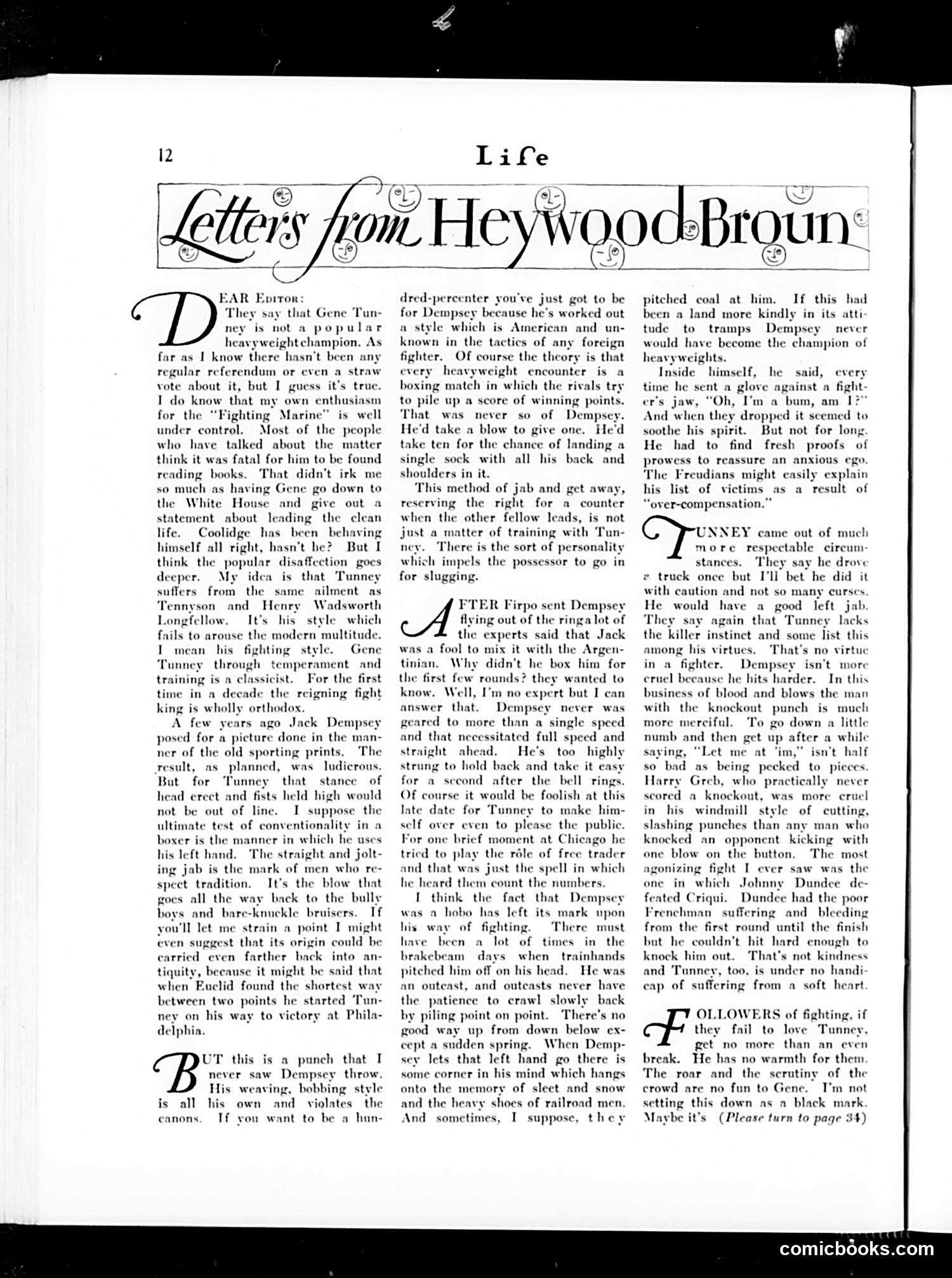
This page features a column by Heywood Broun, a prominent sports journalist and social commentator, discussing heavyweight boxing champion Gene Tunney. The letter critiques Tunney's fighting style and public persona, suggesting he's overly intellectual and literary-minded for a boxer—a departure from the expected brutish image. The writer argues Tunney lacks the "killer instinct" compared to his rival Jack Dempsey, and criticizes his attempt to appeal to refined audiences rather than traditional fight fans. There's satire about the tension between Tunney's educated, genteel image and boxing's working-class roots. The piece reflects 1920s debates about modernization, class, and whether athletes should be brutish entertainers or cultured public figures.
📄 Transcribed text from this page (OCR, searchable)
Machine-transcribed from the original scan — historical spelling and the odd misread are preserved.
EAR Eprtor: They say that Gene Tun- ney is not a popular heavyweightchampion. As as I know there hasn't been any regular referendum or even a straw vote about it, but I guess it’s true. I do know that my own enthusiasm for the “Fighting Marine” is well under control. Most of the people who have talked about the matter think it was fatal for him to be found reading books. That didn’t irk me so much as having Gene go down to the White House and give out a statement about leading the clean life. Coolidge has been behaving himself all right, hasn't he? But I think the popular disaffection goes deeper. My idea is that Tunney suffers from the same ailment as Tennyson and Henry Wadsworth Longfellow. It's his style which fails to arouse the modern multitude. his fighting styl Gene through temperament and zis a classicist. For the first ing fight A few years ago Jack Dempsey posed for a picture done in the man- ner of the old sporting prints. The result, as planned, was ludicrous. But for Tunney that stan of head erect and fists held high would not be out of line. I suppose the ultimate test of conventionality in a boxer is the manner in which he uses his left hand. The straight and jolt- ing jab is the mark of men who re- spect tradition. It's the blow that goes all the way back to the bully boys and bare-knuckle bruisers. If you'll let me strain a point T might even suggest that its origin could be carried even farther back into an- tiquity, because it might be said that when Euclid found the shortest w between two points he started Tun- ney on his way to victory at P delphia. UT this is a punch that T never saw Dempsey throw. His weaving, bobbing style is all his own and violates the Tf you want to be a hun- canons. dred-percenter you've just got to be for Dempsey because he’s worked out a style which is American and un- known in the tactics of any foreign fighter. Of course the theory is that every heavyweight encounter is a boxing match in which the rivals try to pile up a score of winning points. That was never so of Dempsey. He'd take a blow to give one. He'd take ten for the chance of landing a single sock with all his back and shoulders in it. This method of jab and get away, reserving the right for a counter when the other fellow leads, is not just a matter of training with Tun- ney. There is the sort of personality which impels the possessor to go in for slugging. FTER Firpo sent Dempsey flying out of the ringa lot of the experts said that Jack was a fool to mix it with the Argen- tinian. Why didn’t he box him for the first few rounds? they wanted to know. Well, I'm no expert but I can answer that. Dempsey never was geared to more than a single speed and that necessitated full speed and straight ahead. He's too highly strung to hold back and take it easy for a second after the bell rings. Of course it would be foolish at this late date for Tunney to make him- self over even to please the public. For one brief moment at Chicago he tried to play the réle of free trader ind that was just the spell in which he heard them count the numbers. I think the fact that Dempsey was a hobo has left its mark upon his way of fighting. There must lot of times in the ays when trainhands pitched him off on his head. He was an outcast, and outcasts never have the patience to crawl slowly back by piling point on point. There's no good way up from down below ex- pt a sudden spring. When Demp- sey lets that left hand go there is some corner in his mind which hangs onto the memory of sleet and snow and the heavy shoes of railroad men And sometimes, I suppose, the y pitched coal at him. If this had been a land more kindly in its atti tude to tramps Dempsey never would have become the champion of heavyweights. Inside himself, he said, every time he sent a glove against a fight- “Oh, I'm a bum, am | And when they dropped it seemed te soothe his spirit. But not for lor He had to find fresh proofs of prowess to reassure an anxious ego. The Freudians might easily explain his list of victims as a result of “over-compensation.” UNNEY came out of much respectable stances. They say he drove # truck once but I'll bet he did it with caution and not so man more reum. curses. He would have a good left jab They say in that Tunney lacks the killer instinct and some list this among his virtues. That's no virtue in a fighter. Dempsey isn't morc cruel because he hits harder. In this business of blood and blows the man with the knockout punch is much more merciful. To go down a little numb and then get up after a while saying, “Let me at ‘im,” isn’t half so bad as being pecked to pieces. Harry Greb, who practically never scored a knockout, was more cruel in his windmill style of cutting, ing punches than any man who ed an opponent kicking with one blow on the button. The most agonizing fight I ever saw was the one in which Johnny Dundee de- feated Criqui. Dundee had the poor Frenchman suffering and bleeding from the first round until the finish but he couldn't hit hard enough to knock him out. That's not kindness and Tunney, too, is under no handi cap of suffering from a soft heart OLLOWERS of fighting, if they fail to love Tunney, get no more than an even break. He has no warmth for them The roar and the scrutiny of the crowd are no fun to Gene. I'm not setting this down as a black mark Maybe it’s (Please turn to page comicbéoks.com