
Life, 1927-12-29 · page 38 of 41
Life — December 29, 1927 — page 38: what you’re looking at
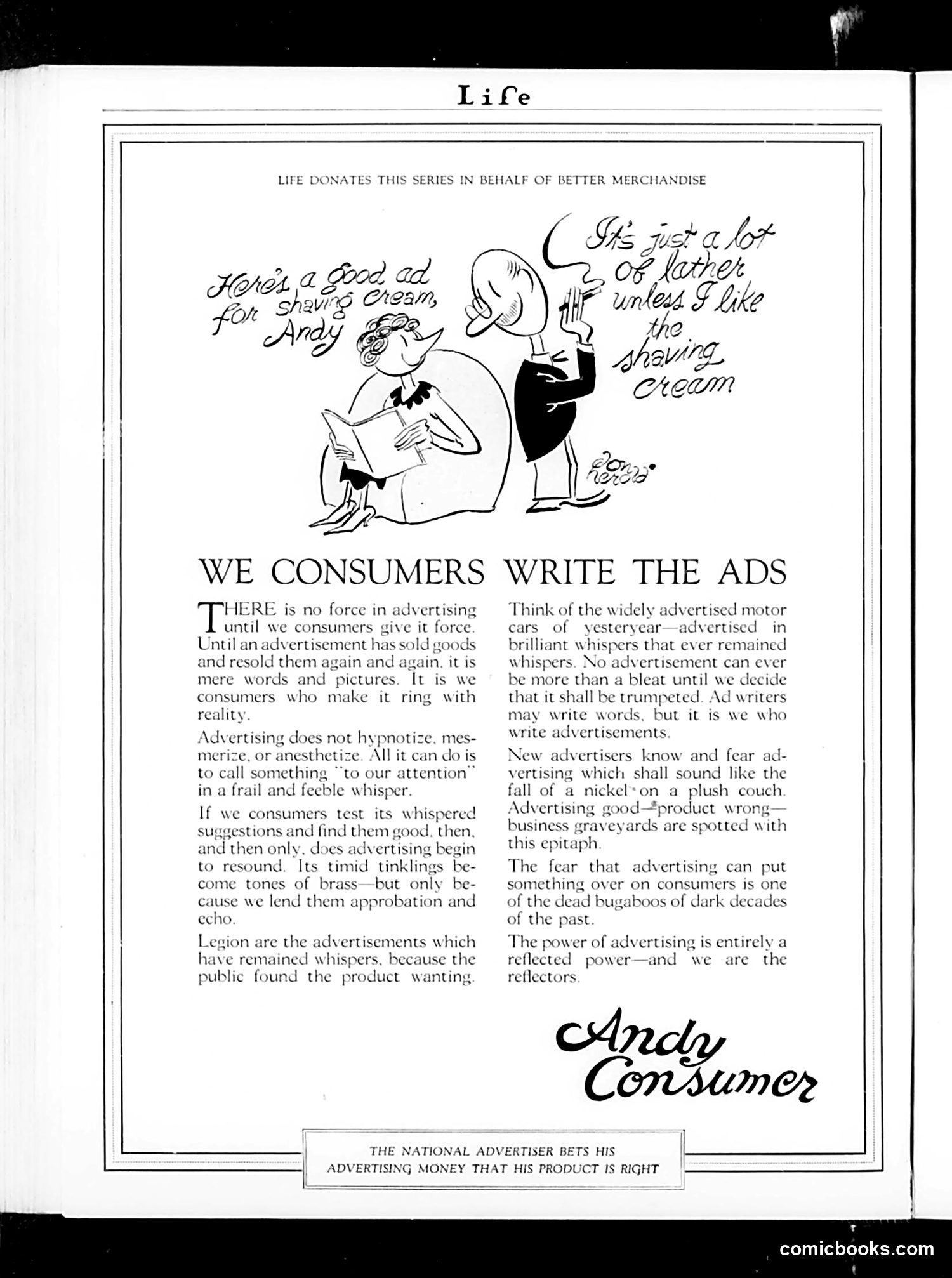
What you’re looking at
This is an advertisement/editorial essay, not a political cartoon, though it includes an illustrative cartoon at the top showing a man praising shaving cream to another man. The piece argues that **advertising has no power without consumer approval**. The author, signing as "Andy Consumer," claims that advertisements are merely "whispers" until the public validates a product through purchase and word-of-mouth. Failed products—referenced obliquely as "motor cars of yesteryear"—remain whispers regardless of how brilliantly advertised. The satire targets both **naive advertisers who fear they can deceive consumers** and the notion that advertising creates false demand. Instead, the essay insists consumers themselves determine an advertisement's success by either endorsing or ignoring it. The message serves Life magazine's stated purpose: promoting "better merchandise" by suggesting that only quality products survive consumer scrutiny. This reflects early 20th-century consumer advocacy rhetoric emphasizing buyer power.
📄 Transcribed text from this page (OCR, searchable)
Machine-transcribed from the original scan — historical spelling and the odd misread are preserved.
LIFE DONATES THIS SERIES IN BEHALF OF BETTER MERCHANDISE £e Se om uundess G. hike WE CONSUMERS WRITE THE ADS HERE is no force in advertising until we consumers give it force Until an advertisement has sold goods and resold them again and again. it is mere words and pictures. It is we consumers who make it ring with reality Advertising does not hypnotize. mes merize, or anesthetize. All it can do to call something “to our attention™ in a frail and feeble whisper. If we consumers test its whispered suggestions and find them good. then, and then only. does advertising begin to resound. Its timid tinklings be- come tones of brass—but only be- cause we lend them approbation and echo Legion are the advertisements which have remained whispers, because the public found the product wanting TIONAL ADVERTISER BETS HIS Think of the widely advertised motor cars of yesteryear—advertised in brilliant whispers that ever remained whispers. No advertisement can ever be more than a bleat until we decide that it shall be trumpeted. Ad writers may write words, but it is we who write advertisements New advertisers know and fear ad- vertising which shall sound like the fall of a nickel*on a plush couch Advertising good—product wrong business graveyards are spotted with this epitaph The fear that advertising can put something over on consumers is one of the dead bugaboos of dark decades of the past The power of advertising is entirely a reflected power—and we are the reflectors Apecly Consumer t comicbooks.com