
Life, 1927-12-29 · page 28 of 41
Life — December 29, 1927 — page 28: what you’re looking at
What you’re looking at
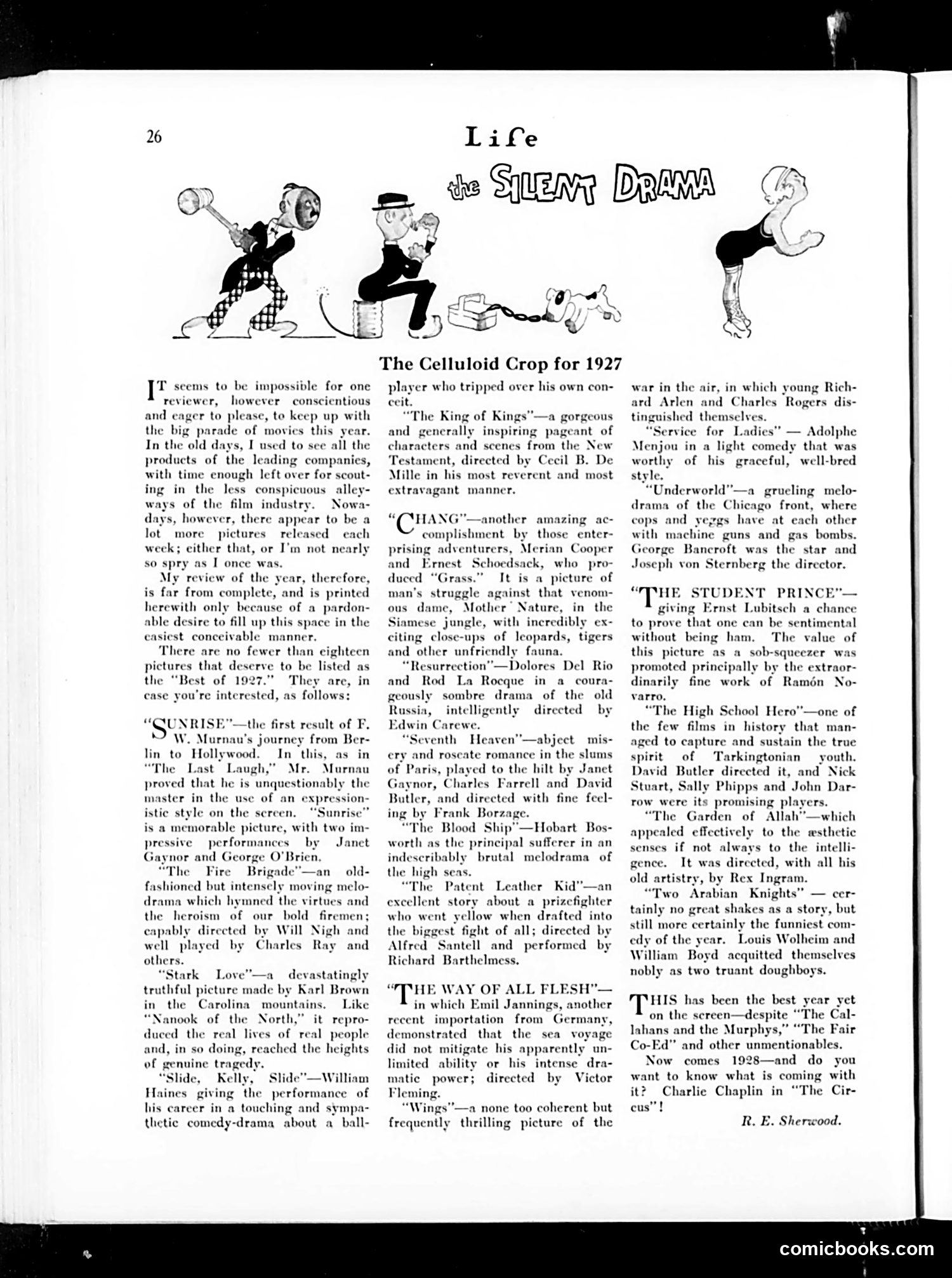
This page reviews the best films of 1927, the final year of silent cinema before "talkies" transformed the industry. The illustrated header shows physical comedy—slapstick performers with exaggerated body language—which captures silent film's reliance on visual storytelling rather than dialogue. The reviewer surveys eighteen "best" films, including *Sunrise* (F.W. Murnau's German Expressionist masterpiece), Cecil B. DeMille's biblical epic *The King of Kings*, and *Wings* (an air-combat film). Notable are references to *Underworld* (gangster drama set in Chicago) and imports like Emil Jannings's *The Way of All Flesh*. The tone is that of a conscientious but overwhelmed critic—he admits he can no longer see everything studios release, suggesting Hollywood's explosive productivity. The list emphasizes emotion and technical innovation, celebrating cinema's visual power at the medium's aesthetic peak before sound technology arrived.
📄 Transcribed text from this page (OCR, searchable)
Machine-transcribed from the original scan — historical spelling and the odd misread are preserved.
[1% seems to be impossible for one reviewer, however conscientious and eager to please, to keep up with the big parade of movies this yes In the old days, I used to see ail the products of the leading companies, with time enough left over for scout- alley- Nowa- ing in the less conspicuous ways of the film industry. days, however, there appe lot rel weck; either that, or I'm not nearly so spry as I once was. My review of the year, therefore, r from complet dis printed herewith only because of a pardon- able desire to fill up this space in the st conceivable manner. There are no fewer than eighteen pictures that deserve to be listed as the “Best of 1927." They are, in case you're interested, as follows: more pictures yea SUNRI the first result of F. W. Murnau’s journey from Ber- lin to Hollywood. In this, as in “The Last Laugh,” Mr. Murnau proved that he is unquestionably the master in the use of p istic style on the sereen. “Sunrise” is a memorable picture, with two im- use an ¢ ssion- pressive performances by Janet ynor and George O'Brien. The Fire Brigade”—an old- fashioned but intensely moving melo- drama which hymned the virtues and the heroism of our bold firemen; capably directed by Will Nigh and well played by Charles Ray and others. “Stark Love”. devastatingly truthful picture made by Karl Brown in the Carolina mountains. Like “Nanook of the North,” it repro- duced the real lives of real people and, in so doing, reached the heights of genuine tragedy, “Slide, Kelly Slide" —William Haines giving the performance of his career in a touching and sympa- thetic comedy-drama about a. ball- —a The Celluloid Crop for 1927 er who tripped over his own con- The King of Kings”—a gorgeous and generally inspiring pageant is characters and scenes from the Testament, directed by Cecil B. De Mille in his most reverent and most extravagant manner. HANG"—another amazing ac- complishment by those enter- prising adventurers, Merian Cooper and Ernest Schoedsack, who pro- duced “G It is a picture of man’s struggle against that venom- ous Mother Nature, in’ the Siamese jungle, with incredibly ex- citing close-ups of leopards, tigers and other unfriendly fauna. “Resurrection” —Dolores Del Rio ass. dame, and Rod La Rocque in a coura- geously sombre drama of the old Russia, intelligently directed — by Edwin Carewe. “Seventh Heaven"—abject _ mis- ery and roseate romance in the slums of Paris, played to the hilt by Janet Gaynor, Charles Farrell and David Butler, and directed with fine feel- ing by Frank Borzage. “The Blood Ship’—Hobart Bos- worth as the principal sufferer in an indescribably brutal melodrama of the high seas. “The Patent Leather excellent story about a prizefig ter who went yellow when drafted into the biggest fight of all; directed by Alfred Santell and performed by Richard Barthelmess. HE WAY OF ALL F in wh recent importation from demonstrated that the h Emil Jannings. € did not mitigate his apparently un- limited ability or tense dra- matic power; directed by Victor Fleming. “Wings’’—a none too coherent but frequently thrilling picture of the QO x war in the air, in which young Rich- ard Arlen and Charles ‘Rogers dis- tinguished themsely ervice for Ladies” — Adolphe Menjou in a light comedy that was worthy of his graceful, well-bred style. “Underworld”—a grueling melo- drama of the Chicago front, where cops and yeggs have at each other with machine guns and gas bombs. George Bancroft was the star and Joseph von Sternberg the director. THE STUDENT PRIN giving Ernst Lubitsch to prove that one without being ham. The value of this picture as a sob-squeezer was promoted principally by the extra dinarily fine work of Ramén varro. “The High School Hero"—one of the few films in history aged to capture and sustain the true spirit of Tarkingtonian youth. David Butler directed it, and Nick Stuart, Sally Phipps and John Dar- row were its promising players. “The Garden of Allah’—which appealed effectively to the wsthetic senses if not always to the intelli- gence. It was directed, with all his old artistry, by Rex Ingram. “Two Arabian Knights” — cer- tainly no great shakes as a story, but still more certainly the funniest com- edy of the Louis Wolheim and William Boyd acquitted themselves nobly as two truant doughboys. chance an be sentimental or No- that man- HIS has been the best year yet on the screen—despite “The Cal- lahans and the Murphy The Fair Co-Ed” and other unmentionables. Now comes 1928—and do you nt to know what is coming with Charlie Chaplin in “The Cir- cus”! R. E. Sherwood. z comicbooks.com