
A complete issue · 38 pages · 1927
Life — September 29, 1927
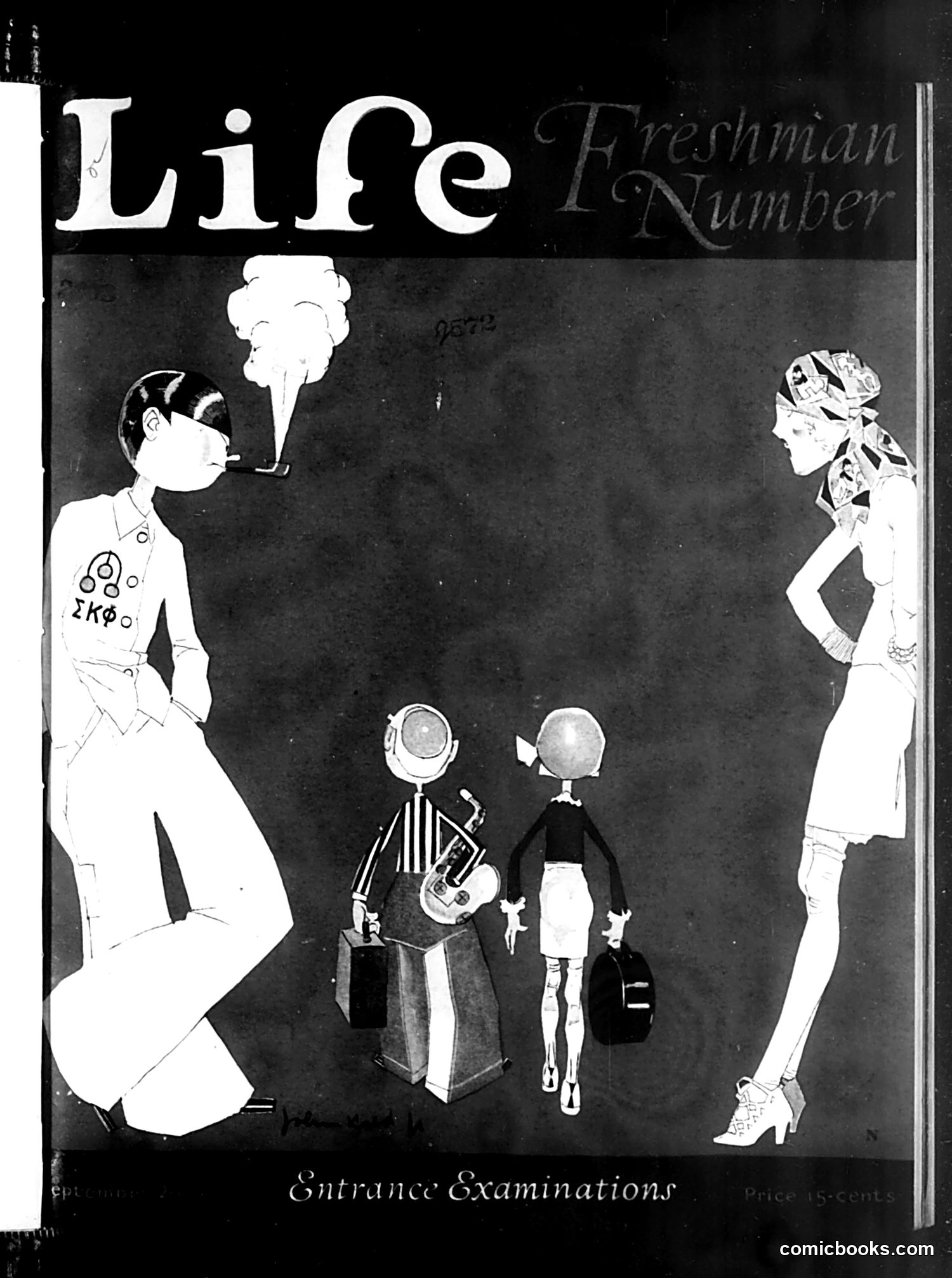
This is the cover of Life's "Freshman Number," a special issue about college entrance exams. The satire depicts two adult women (likely representing college admissions officials or examiners) observing two small children with large heads taking entrance examinations—one child carries a suitcase and musical instrument, the other carries a briefcase. The joke critiques the absurdity of rigorous college entrance requirements by showing them applied to impossibly young applicants. The exaggerated head sizes suggest either intellectual pretension or the children's unreadiness for such scrutiny. This satirizes the competitive, merit-based entrance examination system that was becoming increasingly standardized in American higher education during the early 20th century, mocking both the system's intensity and parents' ambitious expectations for their children.
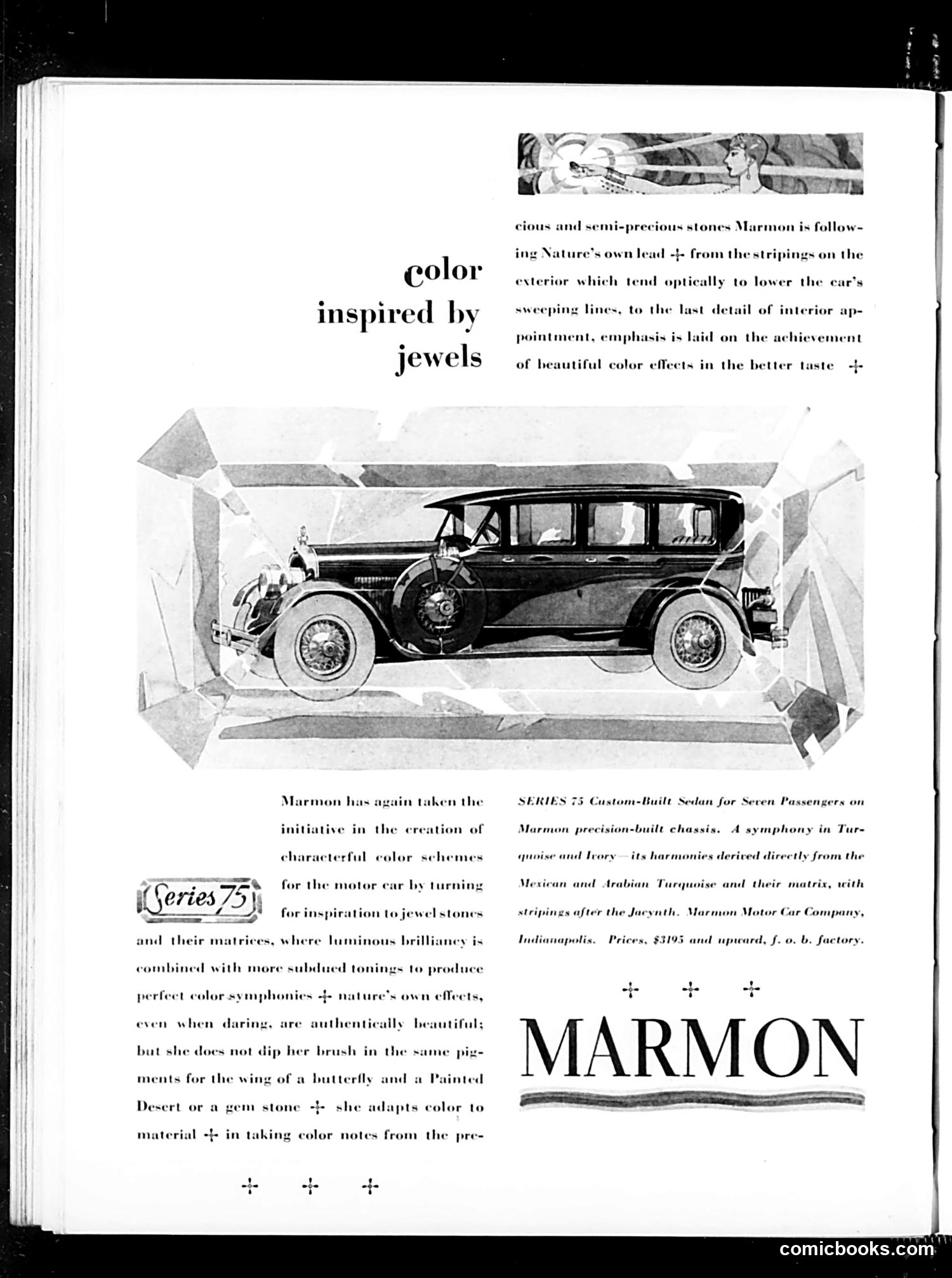
This page is **primarily an advertisement**, not a political cartoon. It promotes the Marmon Series 75 automobile, a custom-built sedan for seven passengers. The ad's creative hook is its headline: "color inspired by jewels." The text explains that Marmon's design team drew color inspiration from precious stones and gemstones—turquoise and ivory specifically mentioned—rather than conventional automotive palettes. The approach aims to create sophisticated "color symphonies" with luminous brilliance combined with subtle toning. The elegant automobile illustration dominates the layout, flanked by geometric jewel-like shapes to reinforce the jewelry metaphor. This was marketing strategy: positioning the luxury car as a refined, aesthetically sophisticated choice for wealthy buyers willing to pay $3,195 and upward (substantial money in this era).
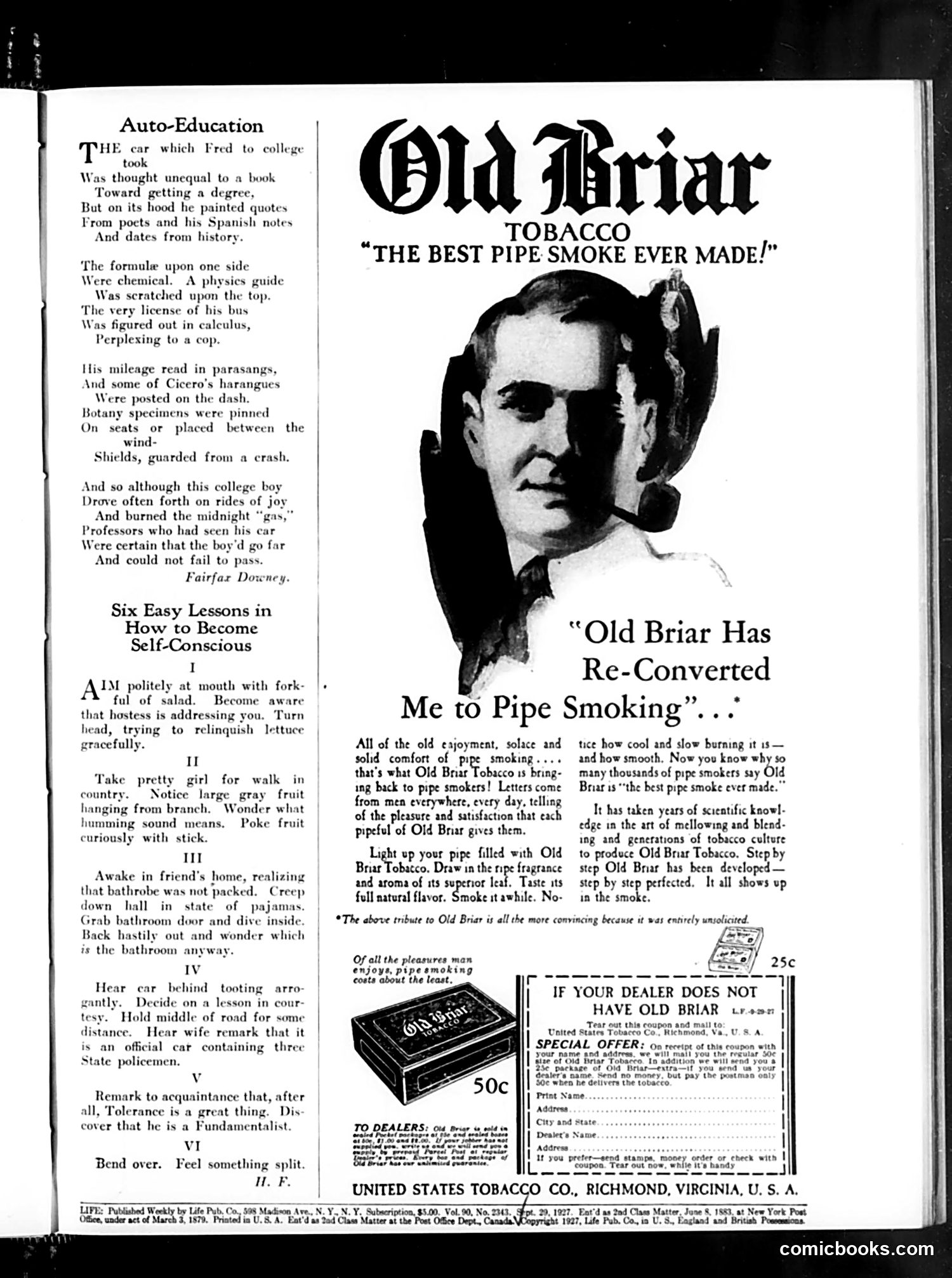
This page contains two distinct elements: **Left side:** A humorous poem titled "Auto-Education" satirizes a college student who uses his car as a mobile study aid—painting it with chemistry formulas, physics guides, history quotes, and botanical specimens. The joke mocks both the student's unconventional learning method and the chaos it causes (confusing police, endangering other drivers). The satire targets how students might use anything available to cram for exams. **Right side:** A full-page tobacco advertisement for Old Briar pipe tobacco, featuring a testimonial about returning to pipe smoking. This is primarily commercial content, not satire. The page juxtaposes social commentary with period advertising—typical of Life magazine's mixed editorial-commercial format.
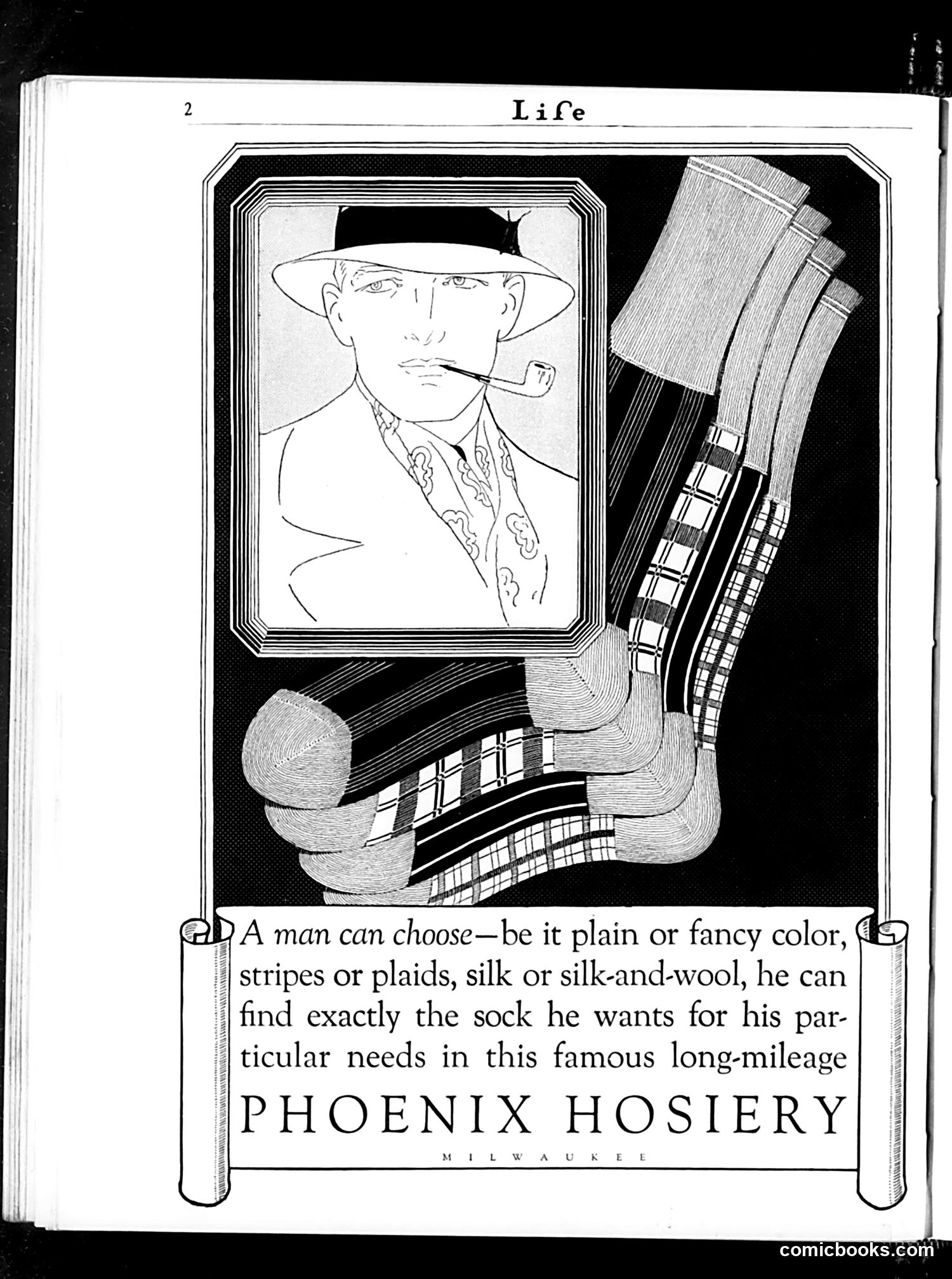
This page is primarily **advertising, not satire or political commentary**. It's a Life magazine advertisement for Phoenix Hosiery of Milwaukee. The image shows a stylized portrait of a man wearing a fedora and smoking a pipe, with decorative sock samples displayed prominently below. The advertisement emphasizes consumer choice—a man can select socks in various materials (silk, wool blends) and patterns (plain, striped, plaid) to suit his needs. The only potentially satirical element is the sophisticated, somewhat affected drawing style of the gentleman, which may gently mock fashionable male vanity of the era. However, this is primarily commercial messaging aimed at promoting product variety rather than social or political satire. The "famous long-mileage" claim emphasizes durability as a selling point.
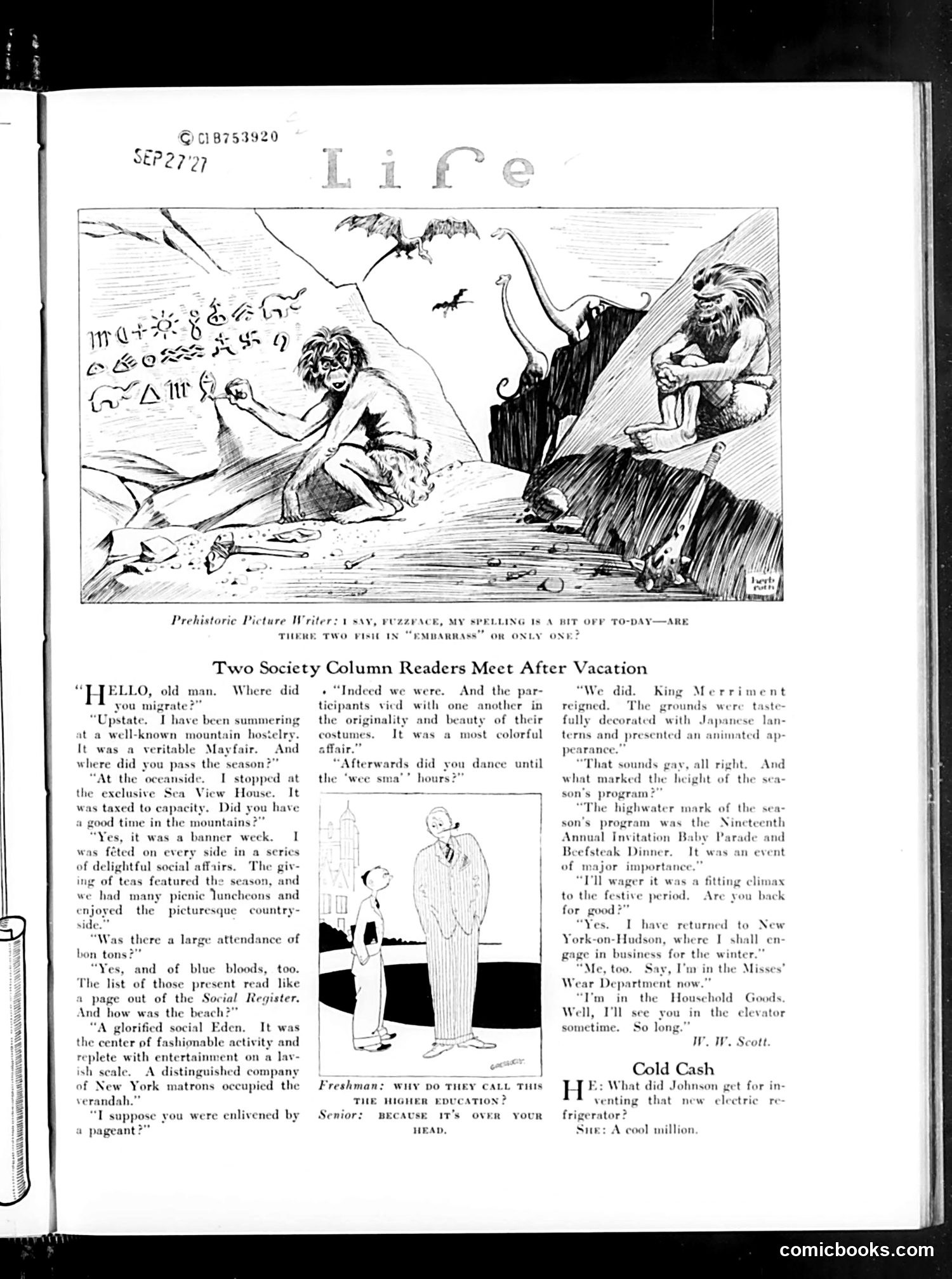
**Top Cartoon**: A prehistoric scene with cavemen. The caption reads "Prehistoric Picture Writers: I say, Puzzence, my spelling is a bit off to-day—Are there two fish in 'Embarrass' or only one?" This is a humorous anachronism—cavemen depicted as having the same concerns about spelling and grammar as modern educated people. The joke mocks pretentious worry about correct spelling by applying it absurdly to prehistory. **Below**: Two unrelated humor pieces: "Two Society Column Readers Meet After Vacation" depicts wealthy people gossiping about their summer activities at exclusive venues and social events. "Cold Cash" is a brief joke about electric refrigerators—a then-modern luxury appliance. Both reflect 1920s upper-class leisure culture and consumerism.
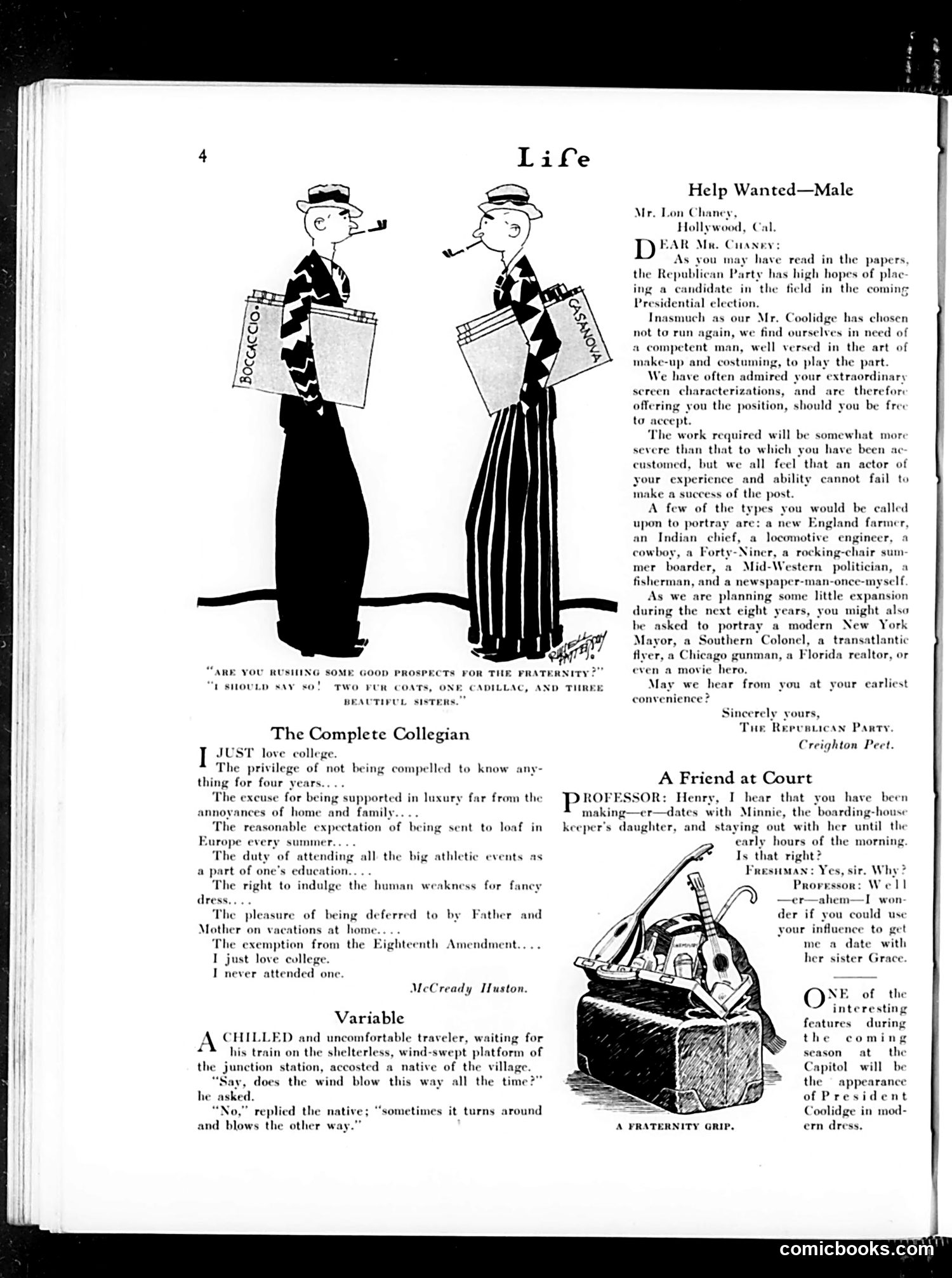
The main cartoon shows two identical figures in business attire carrying briefcases labeled "BROOKLYN" and "SOCIALISM," with the caption asking if they're "rushing some good prospects for the fraternity" and mentioning "two fur coats, one Cadillac, and three beautiful sisters." This appears to satirize **political hypocrisy**—likely targeting Brooklyn-based socialists or politicians who publicly espouse socialist ideals while privately pursuing wealth and luxury (fur coats, Cadillacs). The "fraternity" reference suggests they're recruiting others to this contradictory lifestyle. The page also contains a "Help Wanted" letter from the Republican Party seeking an actor to portray various character types for upcoming campaign purposes, and unrelated humor pieces about college life and dating. The satire targets the gap between political rhetoric and actual behavior.
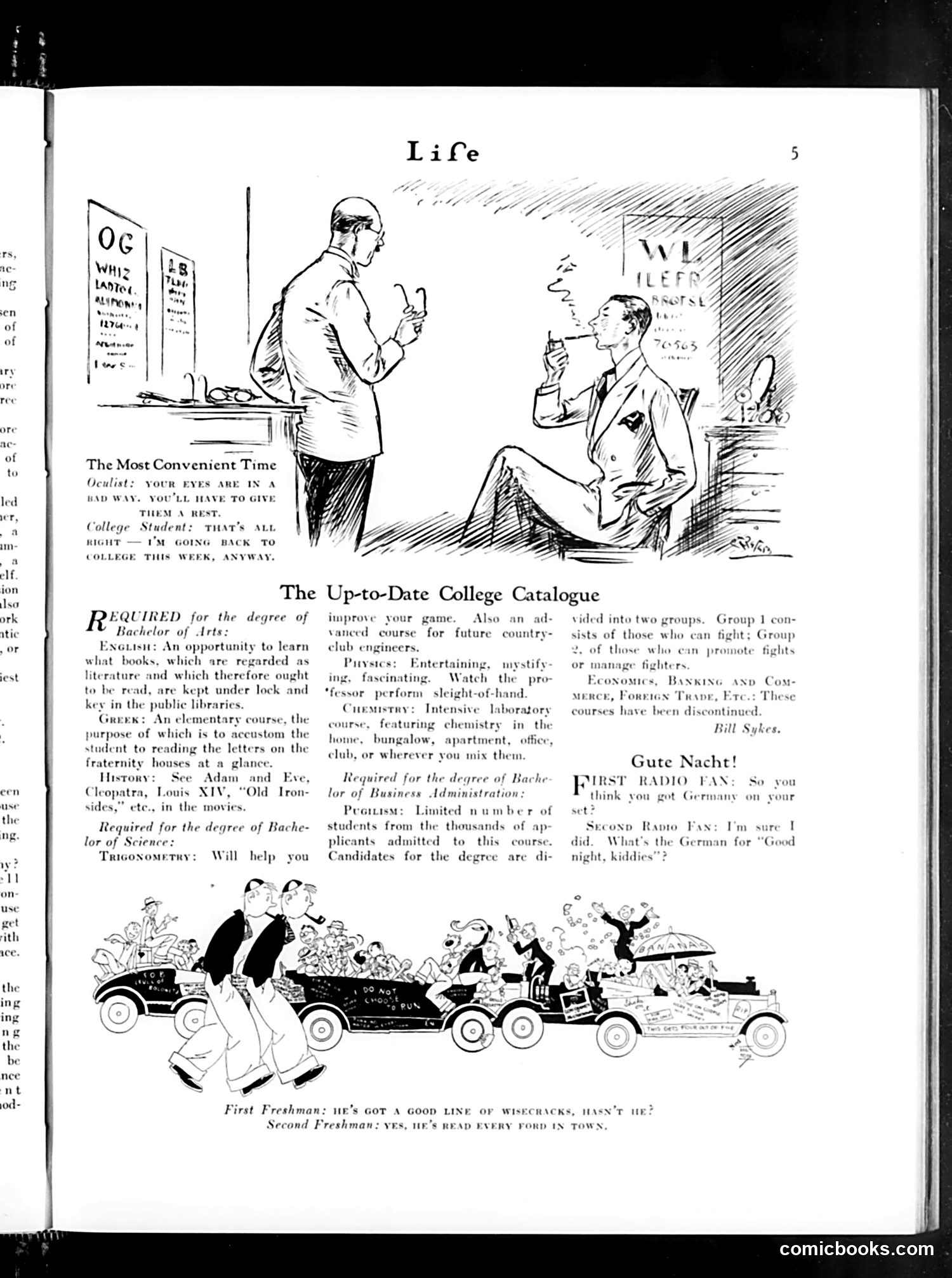
This is a satirical page from *Life* magazine featuring college-themed humor. The top cartoon mocks an optometrist's convenient scheduling advice to a college student needing an eye exam—the doctor conveniently suggests the student return during college break, allowing the doctor to avoid examining him during the busy season. The middle section humorously describes outdated college degree requirements (Latin, Greek, trigonometry, chemistry) as if they're still rigorous necessities, while noting they've actually been discontinued. The bottom cartoon jokes about Ford automobiles' ubiquity. Two freshmen discuss one student's "good line of wisecracks," while another owns "every Ford in town"—satirizing the Model T's dominance in American culture during the 1920s-early 1930s, when Ford vehicles were extraordinarily common and affordable. The satire targets educational traditions, professional inconvenience, and consumer culture.
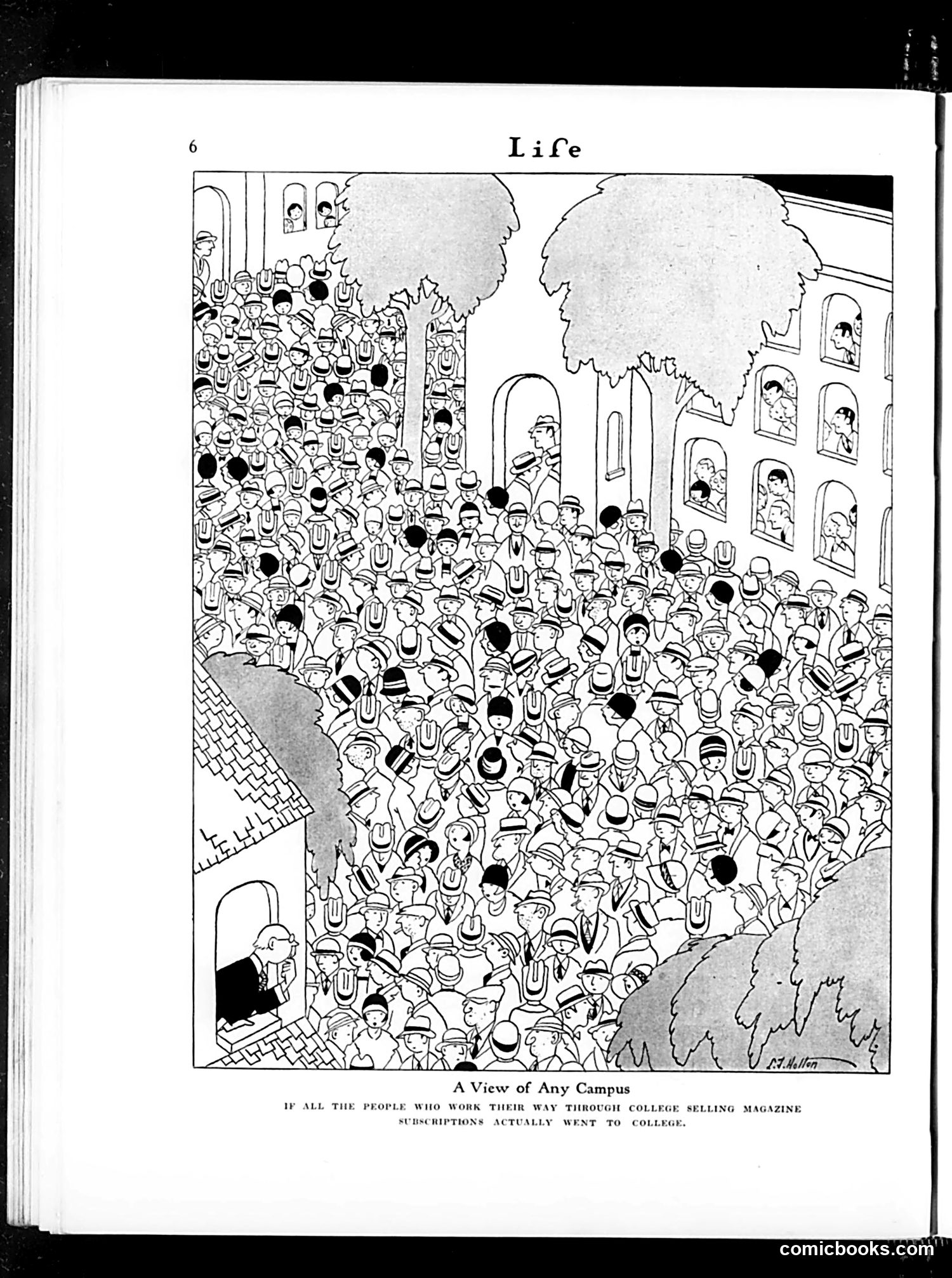
This is a satirical cartoon titled "A View of Any Campus" depicting a massive crowd of people packed into a college courtyard or campus street. The caption reads: "IF ALL THE PEOPLE WHO WORK THEIR WAY THROUGH COLLEGE SELLING MAGAZINE SUBSCRIPTIONS ACTUALLY WENT TO COLLEGE." The satire critiques the widespread practice of students selling magazine subscriptions to fund their education. By showing an impossibly dense throng of people—far exceeding any actual campus capacity—the cartoon humorously suggests that the number of students relying on subscription sales to pay for college is absurdly high. The black-filled figures emphasize the overwhelming crowd. The joke comments on both the prevalence of this fundraising method among poor students and the apparent gap between subscription-selling workers and actual college attendance rates during this era.
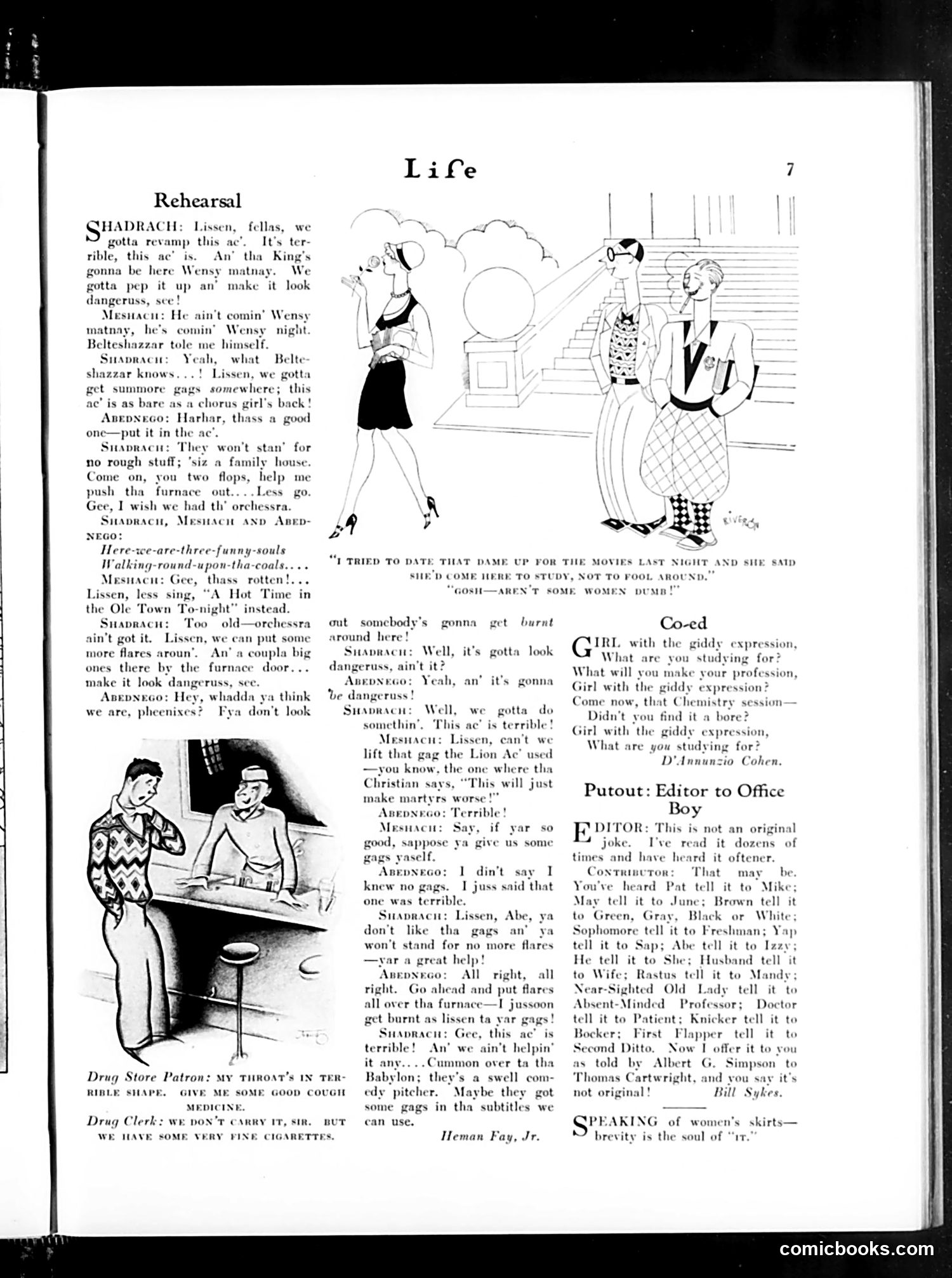
This page contains theatrical sketches and comedy pieces satirizing early 20th-century American culture. The **"Rehearsal"** section mocks theater productions, depicting backstage chaos where actors and directors struggle with a poorly-written script. The dialogue lampoons overwrought dramatic productions and incompetent playwrights. The illustration shows a **drug store scene** where a customer asks the clerk for cough medicine, but the clerk recommends cigarettes instead—satirizing dubious pharmaceutical practices and the casual promotion of tobacco as medicinal. The **"Co-ed"** poem playfully describes ambitious college girls, while **"Putout: Editor to Office Boy"** humorously traces how a joke spreads through social circles, implying the joke is so tired it's been told everywhere. The page represents *Life* magazine's trademark satirical approach to American social customs and popular entertainment.
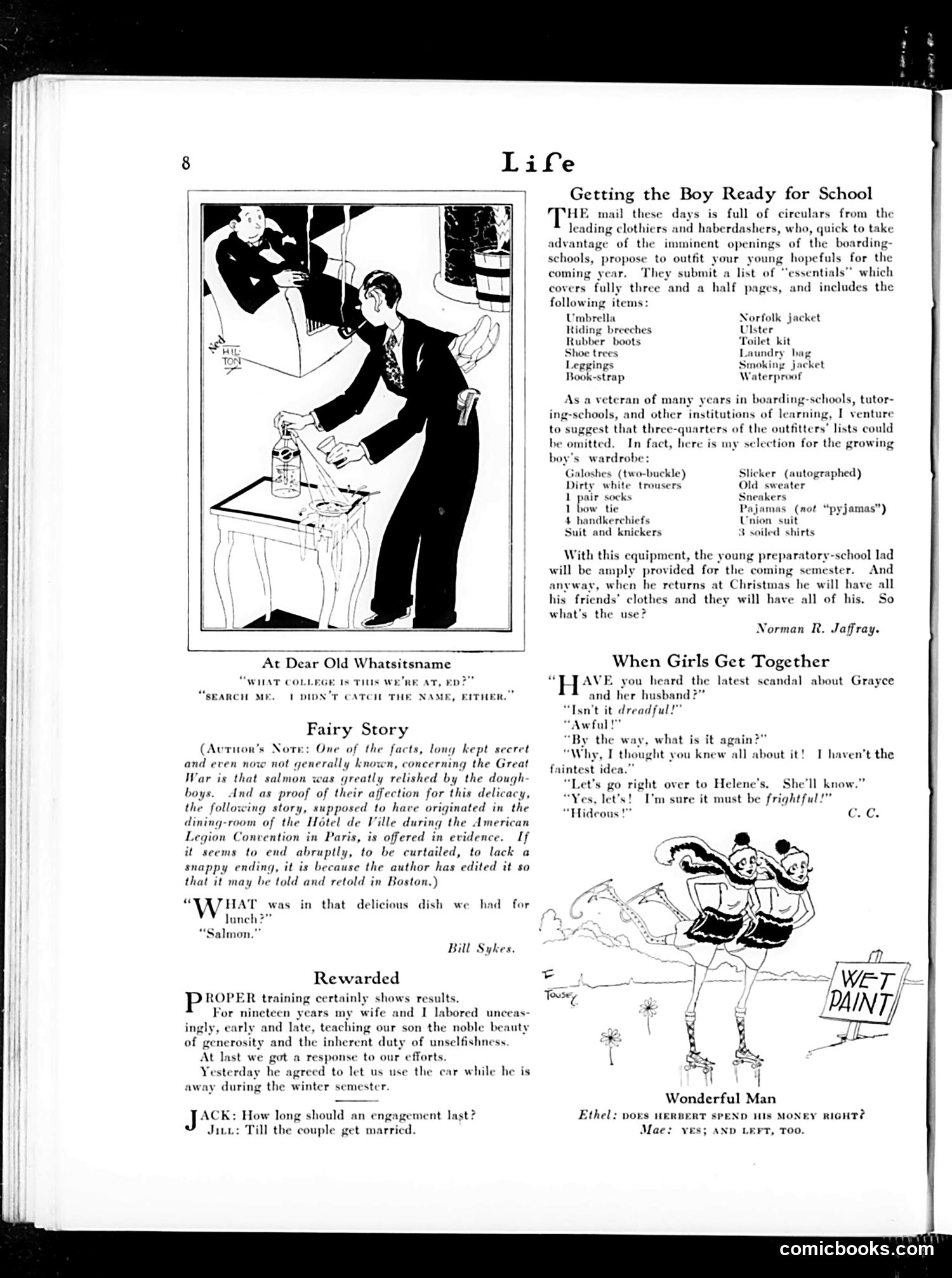
This page features domestic humor typical of early 20th-century Life magazine. The main illustration shows a father and son packing school supplies—depicting the practical chaos of preparing a child for boarding school. The accompanying article humorously lists "essentials" for school, then offers a satirical minimal wardrobe alternative, suggesting parents are oversold on expensive outfitting. Other brief pieces include "Fairy Story" (a humorous anecdote about a doughboy), "Rewarded" (a joke about marital obedience), and "When Girls Get Together" (satirizing female gossip). The "Wonderful Man" cartoon shows women's enthusiasm over a man's spending habits. The satire targets consumer excess and gender stereotypes rather than political issues—reflecting Life's focus on middle-class social commentary during this era.
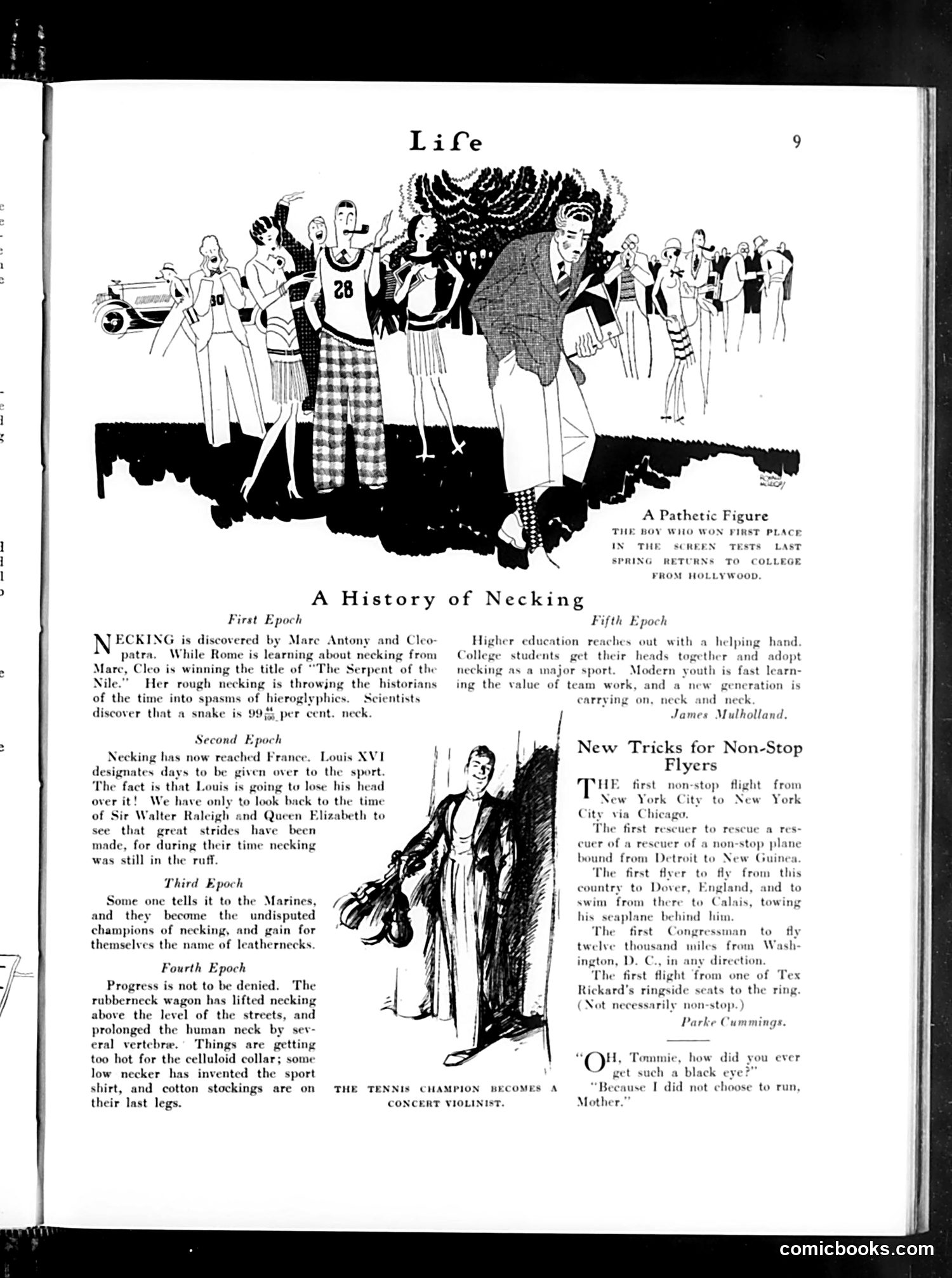
This page satirizes the social phenomenon of "necking" (romantic kissing/physical affection), tracing its cultural history from ancient Rome through modern times. The top illustration shows various figures representing different eras and social classes engaged in or discussing this behavior. The text humorously presents five "epochs" of necking's development, culminating in the "Fifth Epoch" where college students have adopted necking as a major sport, with modern youth embracing physical affection as normal team activity. The right column presents unrelated brief news items about aviation records, using the formula common to Life's satirical style—mixing genuine innovations with absurdist observations. The overall satire mocks both changing sexual mores among youth and the breathless media coverage of modern social trends, presenting necking's evolution as though it were serious historical scholarship.
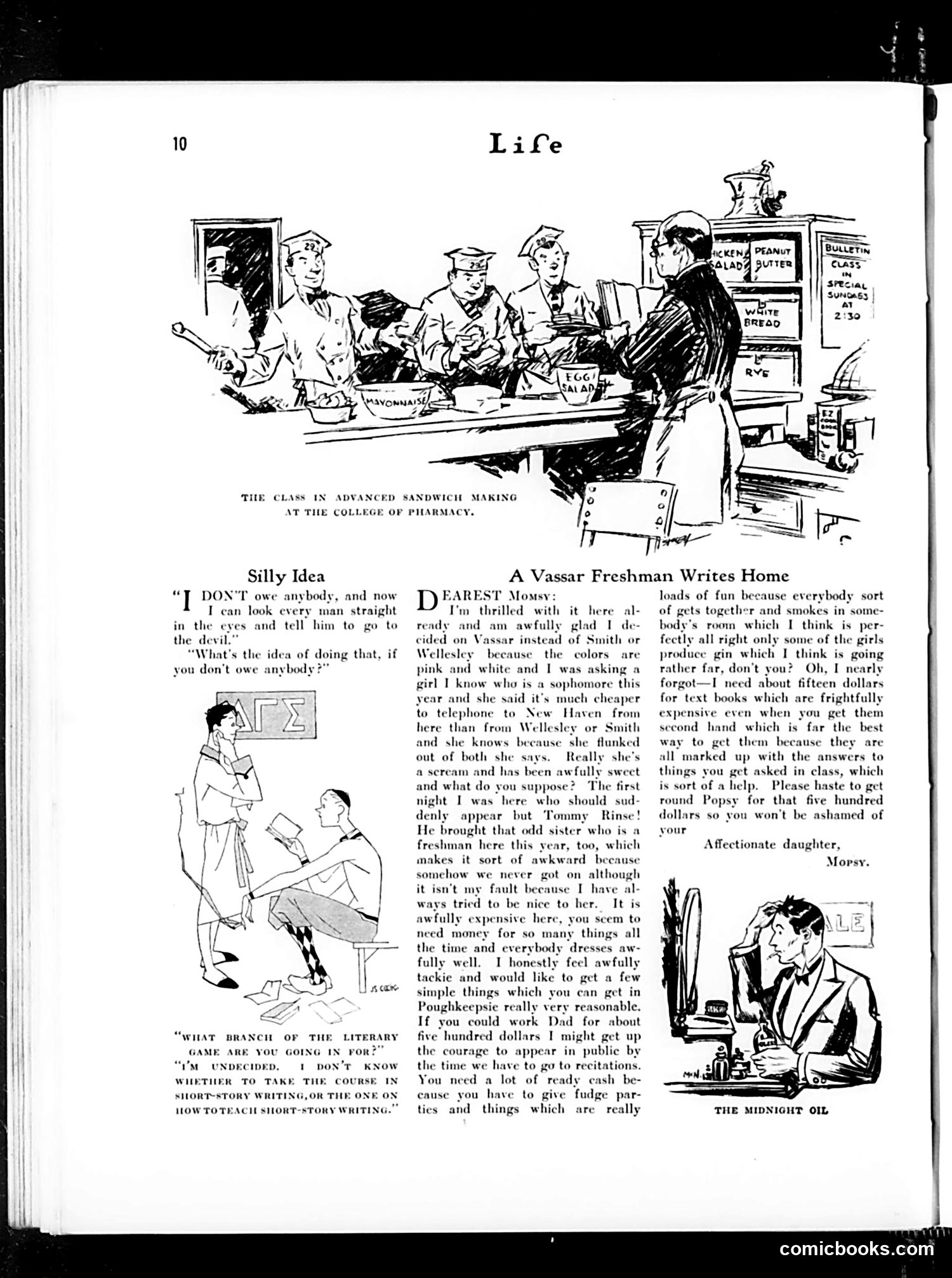
**Top illustration:** Shows a class at a College of Pharmacy learning "Advanced Sandwich Making." This satirizes the perceived decline of higher education, suggesting colleges are teaching frivolous domestic skills rather than serious academics. **"Silly Idea" cartoon:** A woman tells a man not to owe anybody money, then walk straight in their eyes and tell them to go to hell. The humor satirizes impractical financial advice—suggesting debtors simply ignore creditors through sheer audacity. **"A Vassar Freshman Writes Home":** A letter from a student asking her parents for money, complaining about textbook costs and needing cash for "fudge parties"—satirizing the casual spending habits and financial irresponsibility of wealthy college students. **"The Midnight Oil":** A tired student studying late, likely illustrating academic struggle.
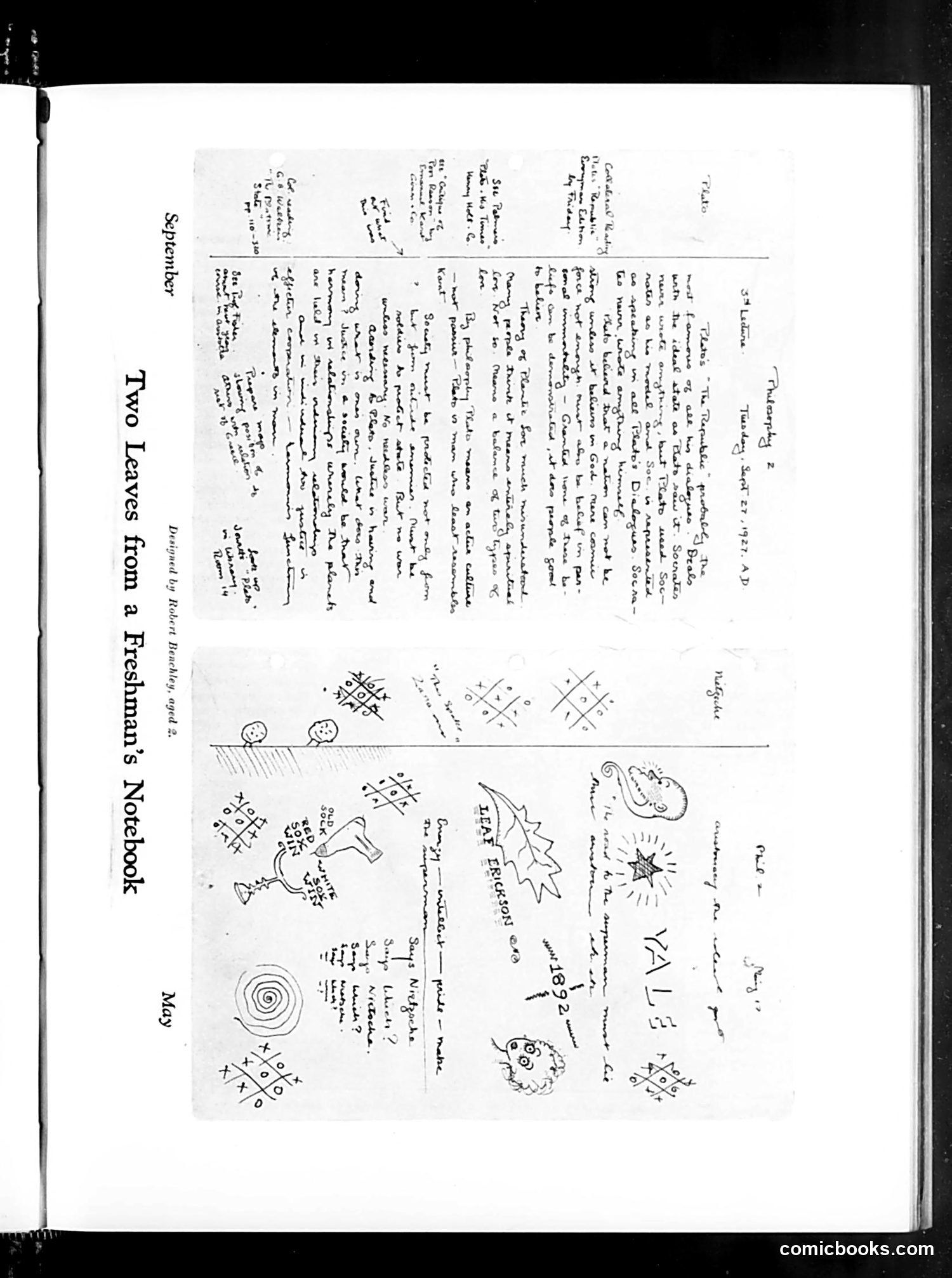
This page from *Life* magazine presents "Two Lances from a Freshman's Notebook" with satirical sketches and accompanying commentary. The cartoons appear to mock college freshmen and their social pretensions or academic struggles. The sketches include crude drawings of students in various scenarios—some appearing to engage in tic-tac-toe games, others in exaggerated poses suggesting academic difficulty or social awkwardness. The dense handwritten-style text above suggests commentary on freshman behavior, attitudes, or experiences. Without clearer legibility of the specific text and artist attribution, the exact satirical targets are difficult to determine precisely, but the overall thrust seems to lampoon the naïveté, incompetence, or social missteps typical of first-year college students—a perennial subject of *Life's* humor.
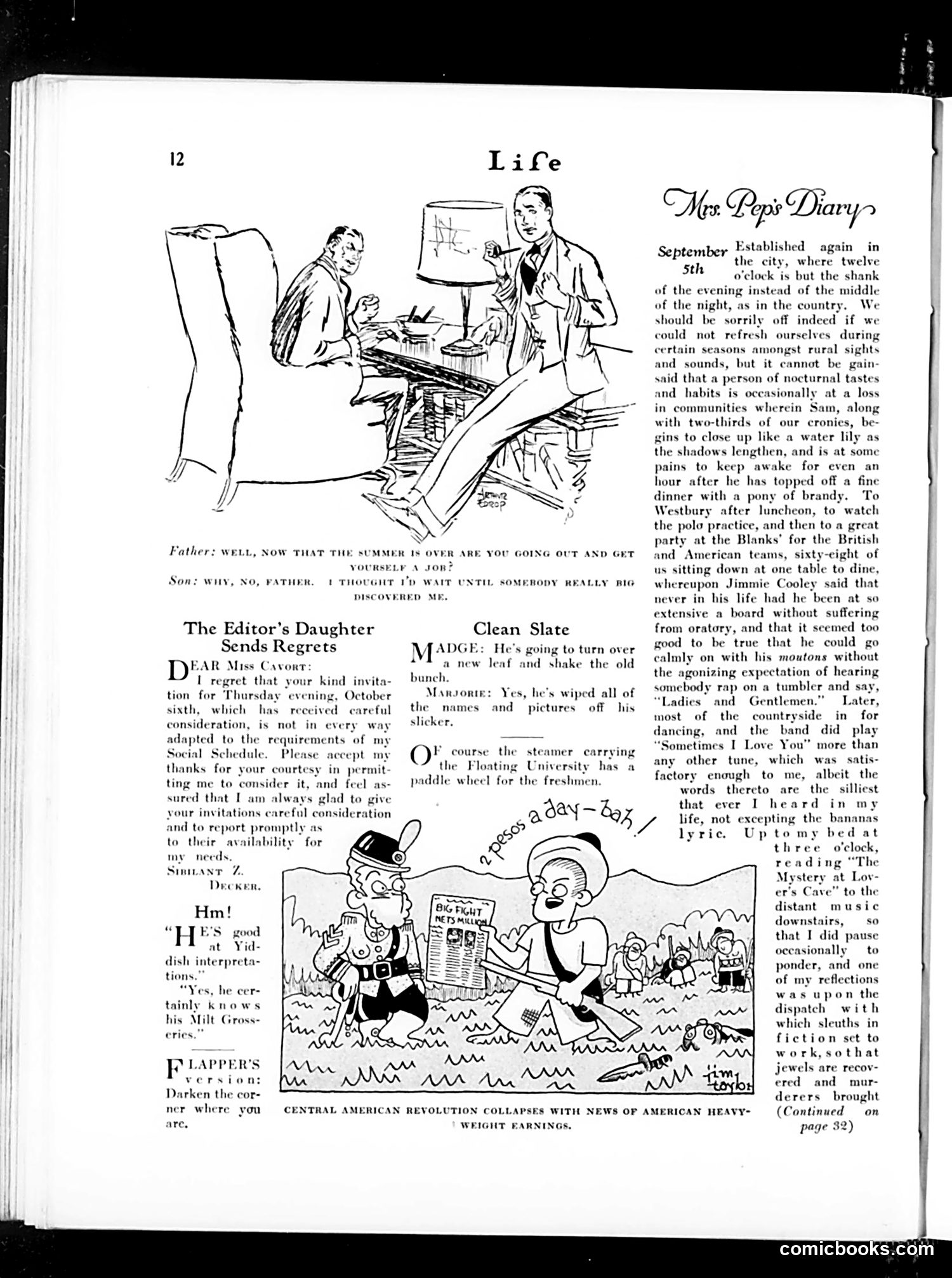
This page contains several satirical pieces typical of Life's humor. The main cartoon depicts two beach characters discussing current events—one reads a newspaper headline about "Central American Revolution Collapses with News of American Heavyweight Earnings," suggesting that American sports news overshadows serious international political events. The upper section shows "Mrs. Pep's Diary," a social commentary on urban nightlife versus rural living. Other brief humorous items include "The Editor's Daughter Sends Regrets" (social etiquette satire), "Clean Slate" (about someone erasing past indiscretions), and commentary on a college steamship's paddle wheel. The overall tone satirizes American priorities, social conventions, and leisure culture during this period.
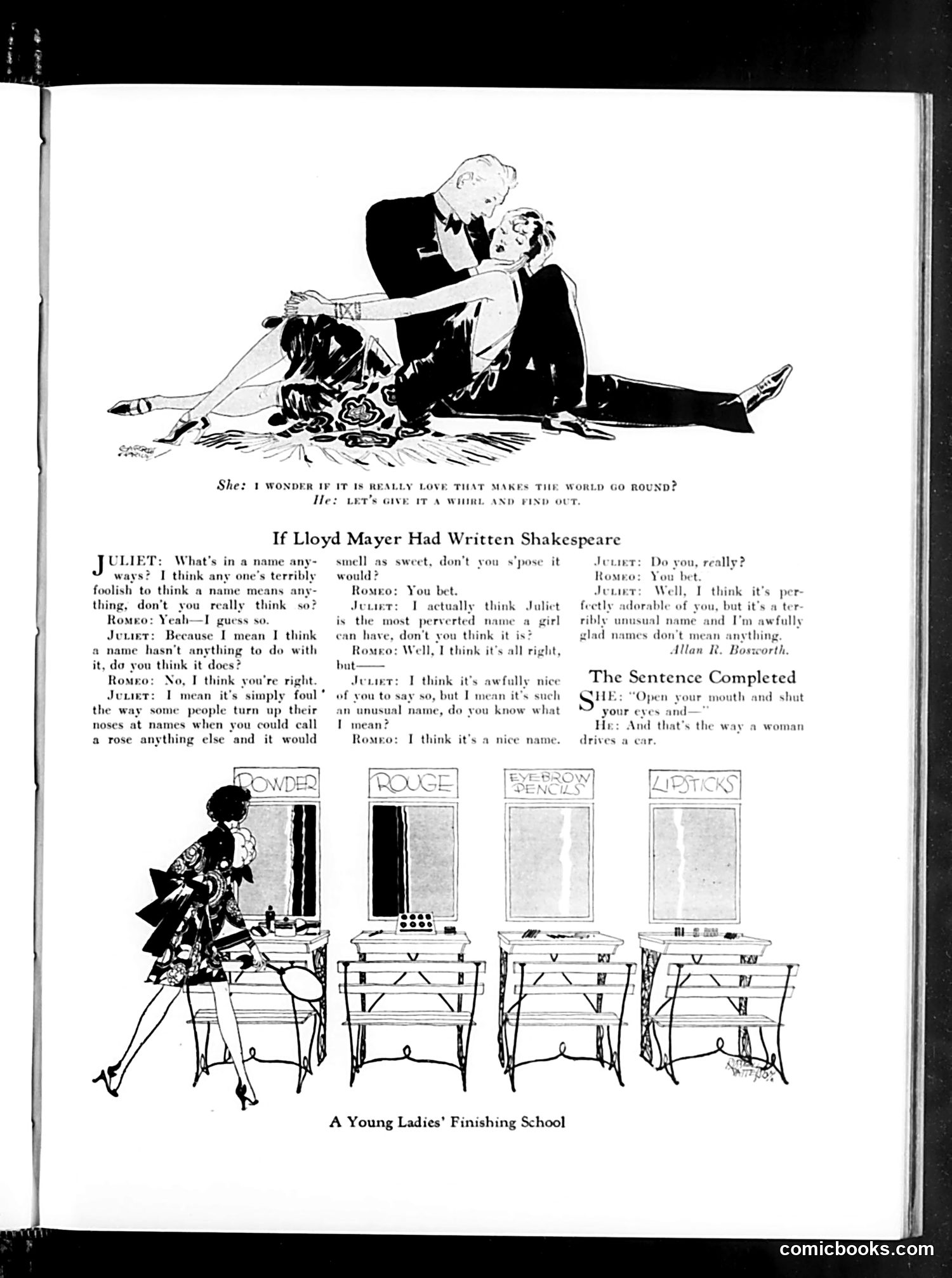
This page contains two satirical pieces mocking early 20th-century gender roles and social expectations. **Top cartoon**: A couple in formal dress enacts a parody of Romeo and Juliet, with the woman asking if love makes the world go round. The satire titled "If Lloyd Mayer Had Written Shakespeare" humorously reimagines the famous scene with pedestrian modern dialogue about names and romance—deflating Shakespeare's poetry to mundane conversation. **Bottom cartoons**: "A Young Ladies' Finishing School" depicts a woman at vanity tables labeled "Powder," "Rouge," "Eyebrow Pencils," and "Lipstick." The joke satirizes education focused narrowly on cosmetics and appearance rather than substantive knowledge. **"The Sentence Completed"**: A brief joke where a woman's tendency to "shut your eyes and mouth" supposedly makes her a good driver—mocking women drivers through gendered stereotypes. The overall theme criticizes superficial feminine education and romantic expectations of the era.
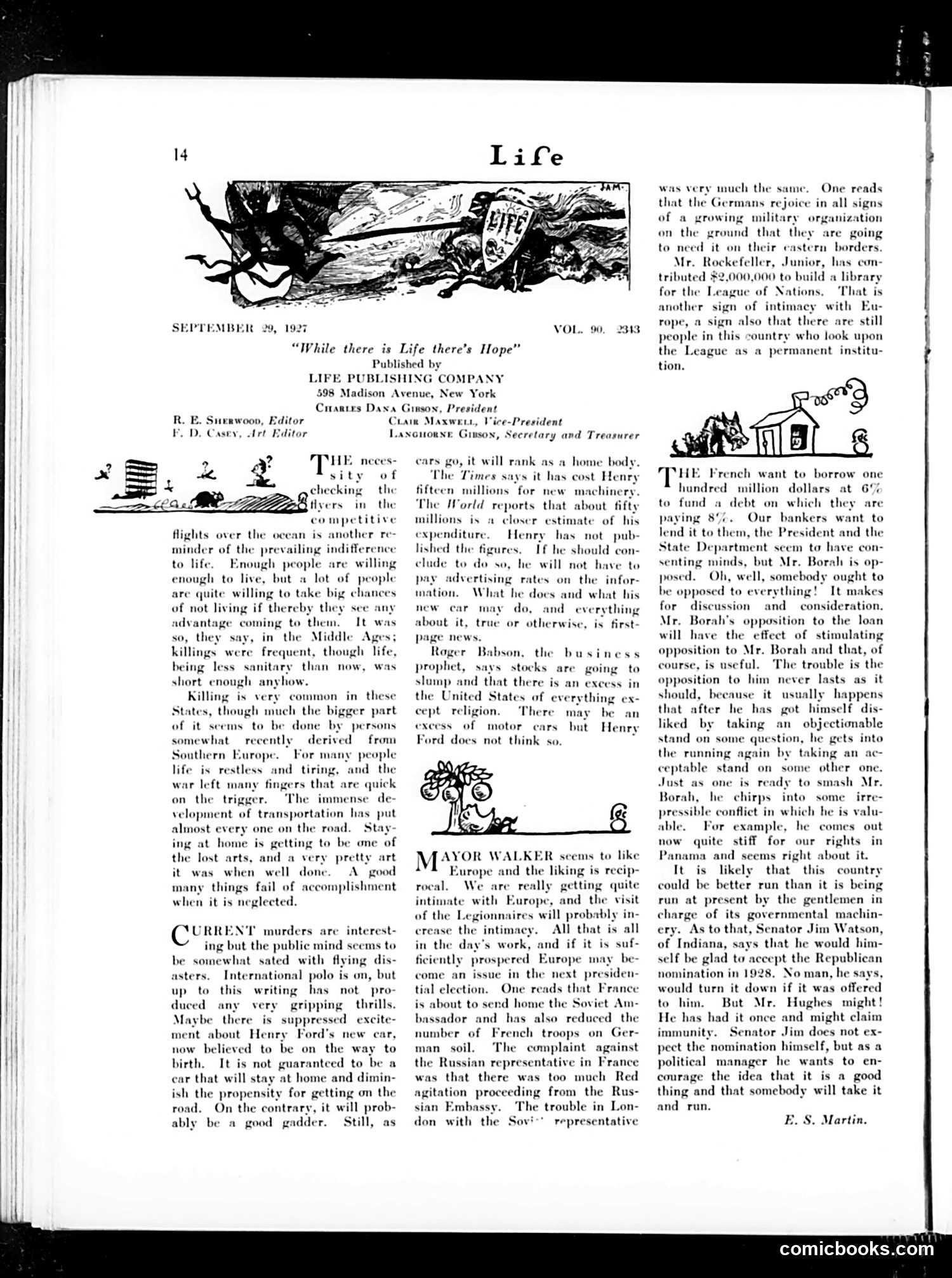
This page contains editorial commentary on current events rather than traditional cartoons. The main illustration (top left) appears to be a decorative header unrelated to the text content. The articles discuss: 1. **Henry Ford's new car**: Speculation about Ford's investment in automobile manufacturing and its economic impact. 2. **Mayor Walker and European relations**: Commentary on New York's mayor's connection to European affairs, suggesting closer diplomatic ties. 3. **Mr. Borah's opposition**: Discussion of Senator Borah's stance against a loan proposal, noting how opposition to him tends to unite his critics despite their usual disagreements. 4. **Panama situation**: Mention of political tensions regarding Panama's governance. The tone is typical of *Life*'s satirical, opinion-driven editorial style of the 1920s.
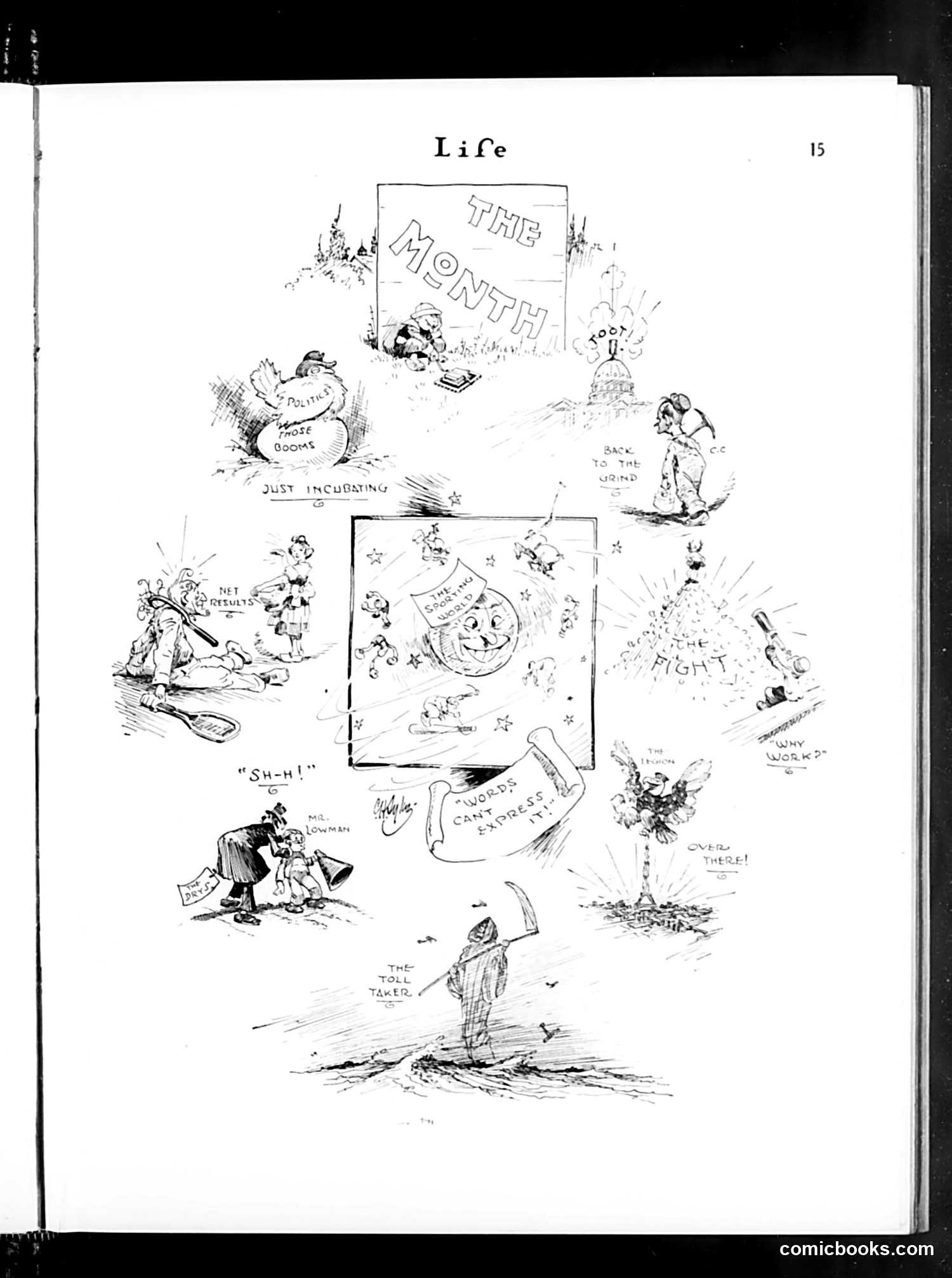
This page presents a series of satirical sketches depicting various social and political issues of the era. The central large illustration appears to show celestial or heavenly imagery with stars, suggesting commentary on idealistic promises versus reality. The surrounding vignettes mock contemporary concerns: one shows "just incubating" (political schemes), another references "the toll taker" (likely taxation or bureaucratic burden), and sketches labeled "back to the grind," "why work?", and "over there!" suggest commentary on labor, employment, and possibly wartime or post-war American conditions. The overall tone is cynical, presenting life's hardships and institutional failures through humorous caricatures. Without clear identification of specific figures, the cartoons appear to critique broader systemic issues rather than target individual politicians.
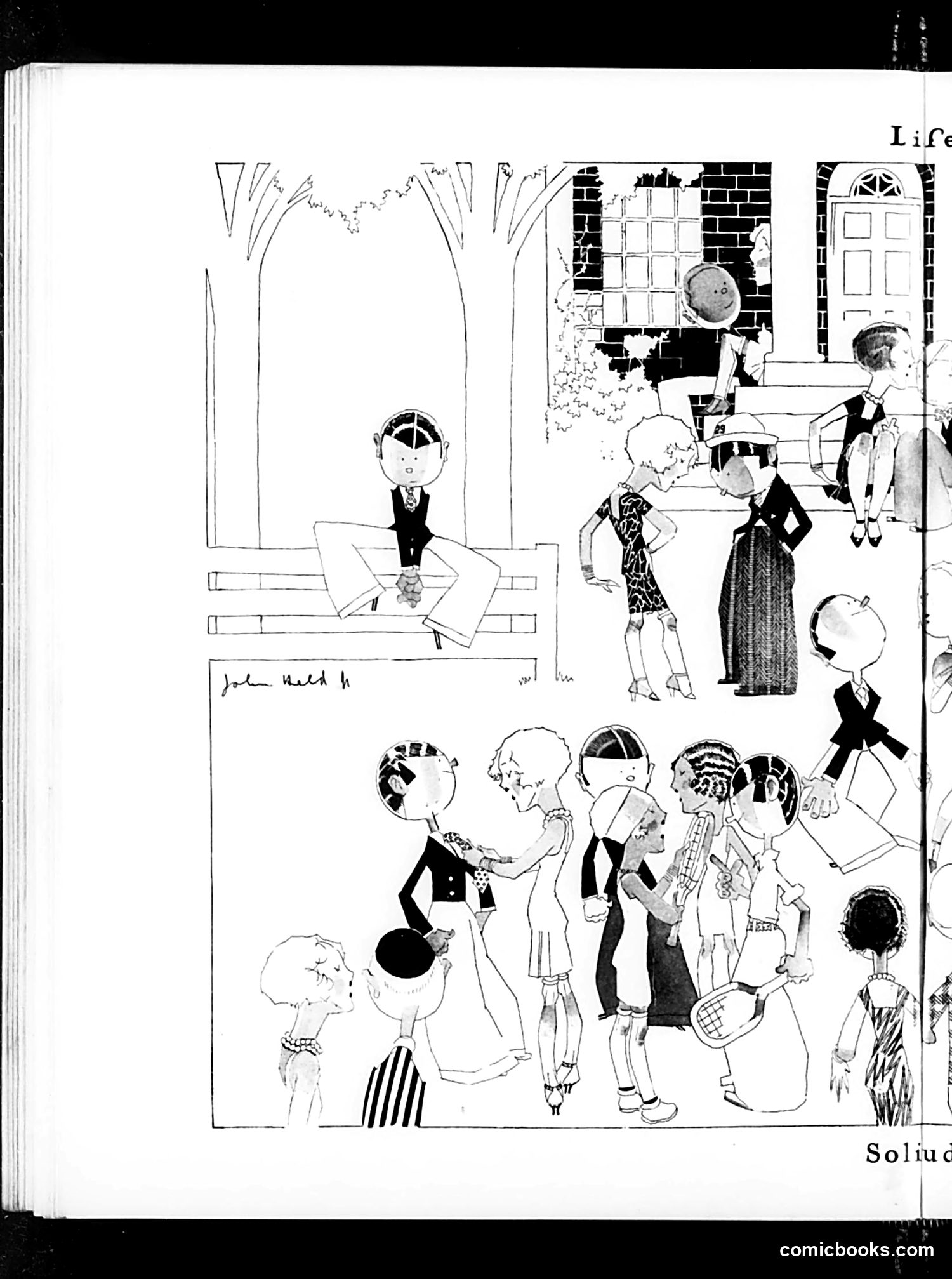
This page contains two cartoon panels depicting social scenes. The upper panel shows a solitary figure sitting on steps beneath an archway of a brick building, labeled "Jad [unclear] h" (handwritten, illegible). The lower panel depicts a group scene with multiple figures of varying ages and dress—adults and children—gathered together, some holding what appear to be balls or spheres. The figures are drawn in a 1920s-style illustration manner with distinct facial features and clothing silhouettes typical of Life magazine's satirical style. Without clearer text or context, the specific satirical target remains uncertain. The contrast between isolation (upper) and social gathering (lower) may suggest commentary on class, social inclusion, or contemporary social customs, but I cannot definitively identify the intended subjects or joke from the image alone.
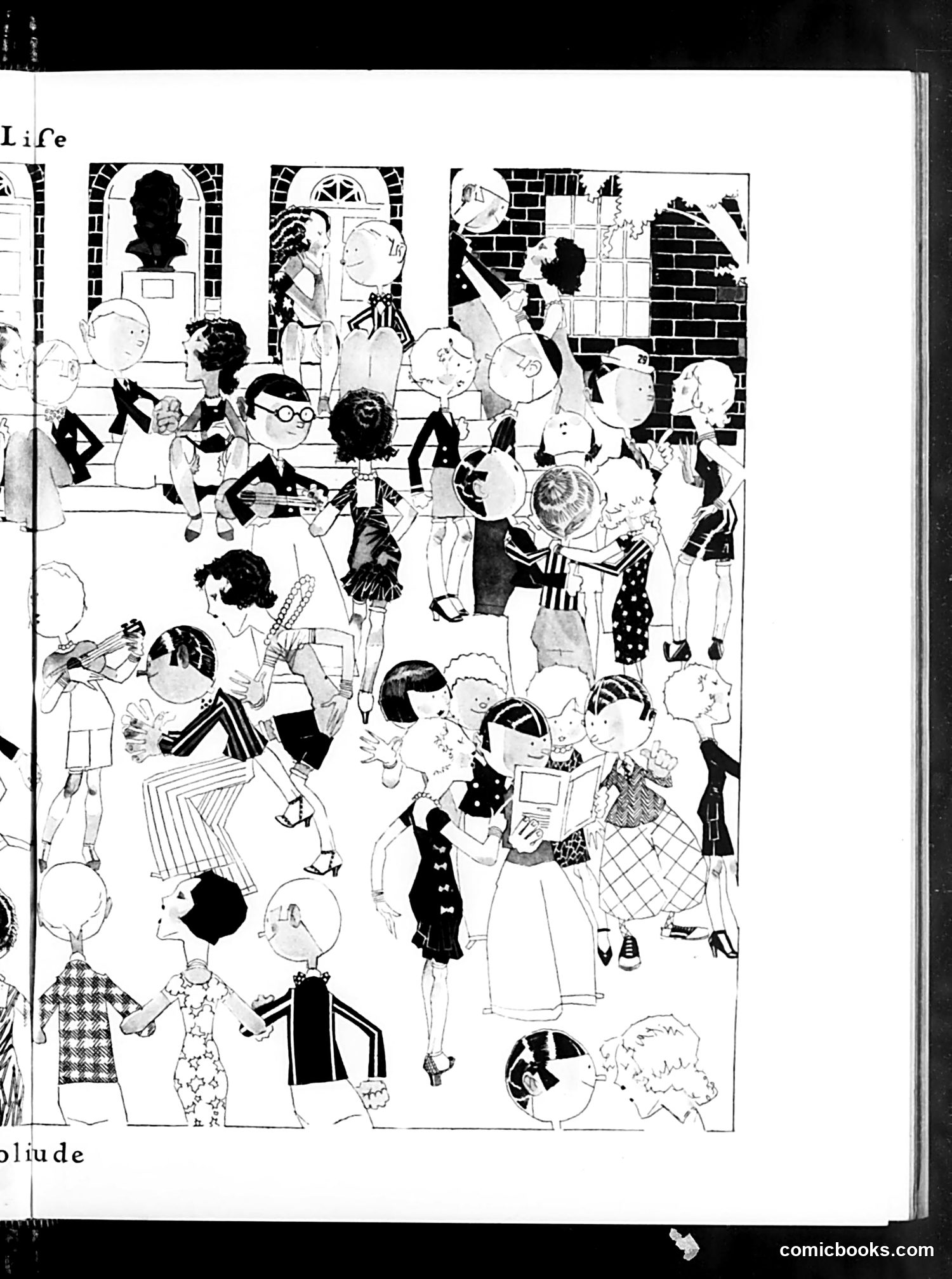
This page appears to be an illustration titled "Life" (visible at top) showing a crowded urban street scene with diverse figures - children and adults in various 1920s-1930s era clothing styles and patterns. The setting includes brick buildings and architectural details suggesting a city neighborhood. The illustration depicts social diversity through clothing variety, hairstyles, and silhouettes. Some figures wear fashionable or patterned clothing; others appear more plainly dressed. Without additional caption text visible, the precise satirical point is unclear, though it likely comments on urban social mixing, class differences, or contemporary fashion/lifestyle diversity. The artistic style is characteristic of early 20th-century American magazine illustration. The word "lude" (possibly "prelude" or "elude") appears at bottom left but its relevance is uncertain without full page context.
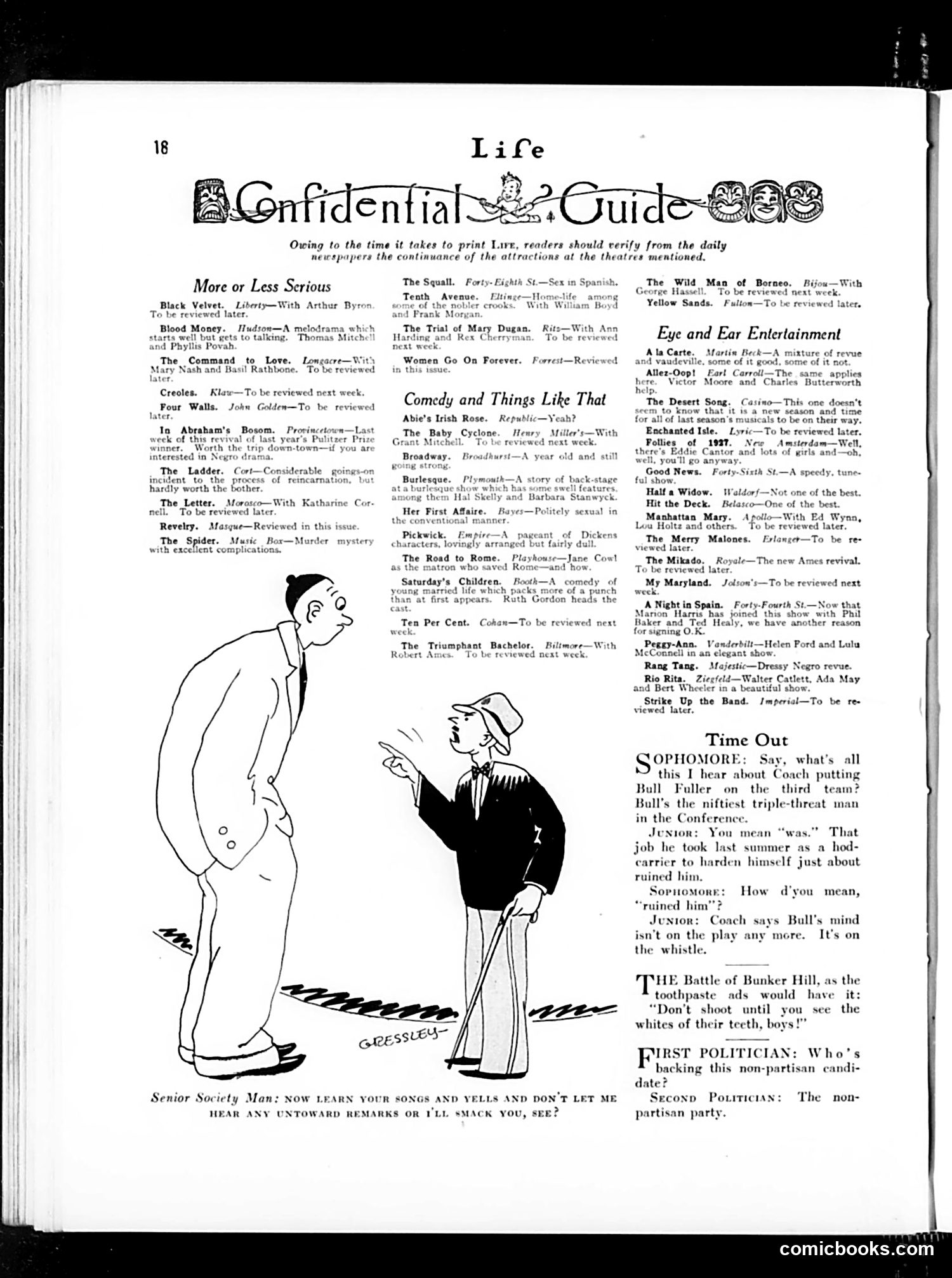
This page from *Life* magazine features theater listings and satirical commentary typical of the publication's style. **Main Cartoon**: The illustration by Cressler depicts a condescending "Senior Society Man" threatening younger students about singing and behavior, with the caption warning against "untoward remarks" under threat of violence. This satirizes pretentious, authoritarian older men enforcing social conformity through intimidation. **"Time Out" Section**: Three brief satirical vignettes mock contemporary American culture: 1. **College Sports**: A coach benches his best player because the athlete took a summer job as a hod-carrier (manual laborer), supposedly damaging his focus—satirizing how college athletics prioritizes image over genuine talent. 2. **Advertising Absurdity**: Mocks toothpaste commercials' exaggerated claims by applying their slogan to the Revolutionary War's Battle of Bunker Hill. 3. **Politics**: Two politicians discuss a "non-partisan candidate," with the second revealing it's merely "the non-partisan party"—ridiculing political hypocrisy and hollow campaign rhetoric. The page emphasizes *Life*'s satirical mission: exposing pretension, conformity pressure, and institutional absurdity in 1920s American life.
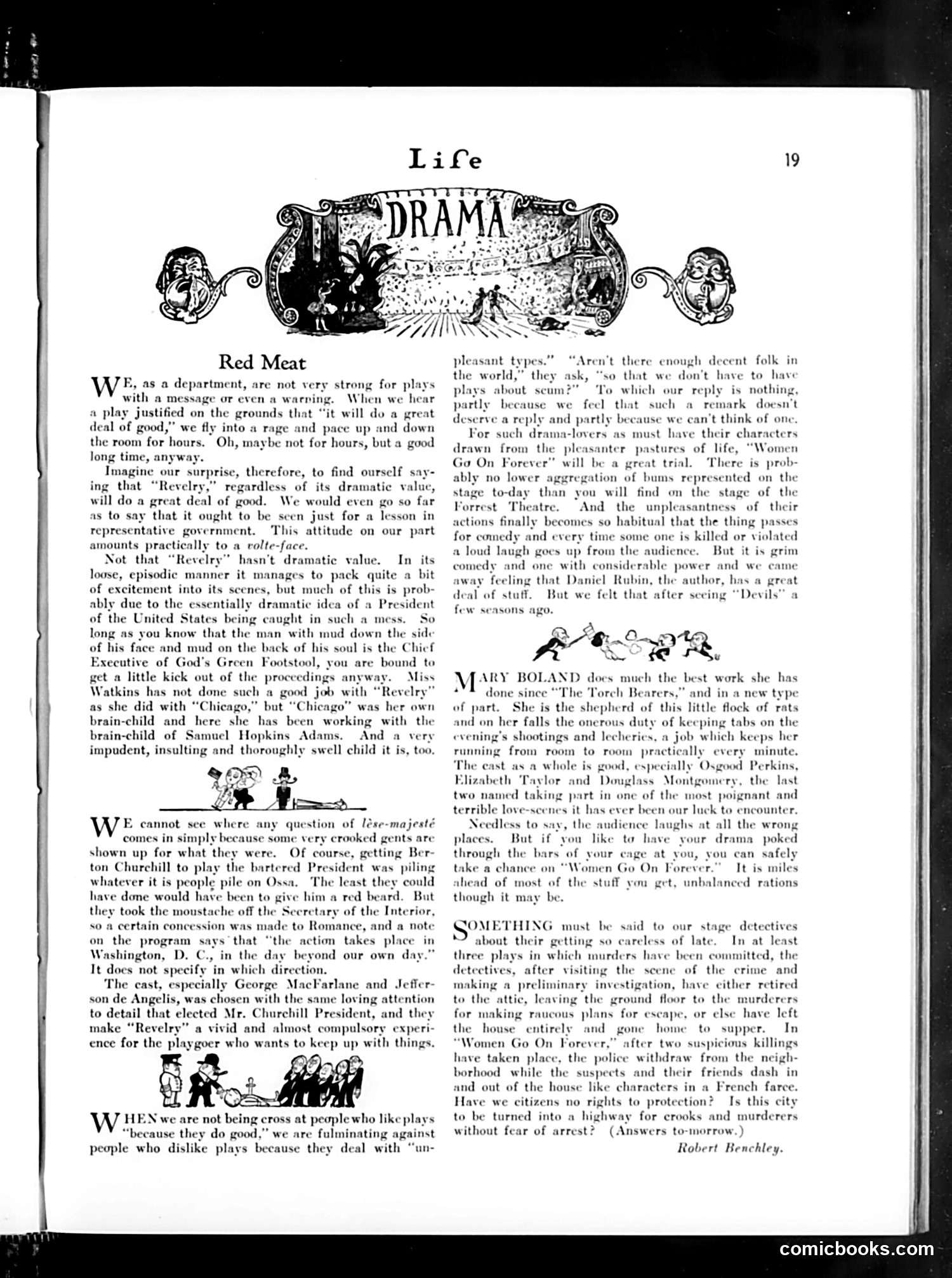
This page reviews three Broadway plays, adopting a satirical tone toward moralistic theater criticism. The main targets are: **"Revelry"** — a play based on Samuel Hopkins Adams' novel about a corrupt U.S. President caught in scandal. Life praises it *despite* disclaiming moral lessons in drama, arguing it serves as practical instruction in "representative government" (i.e., showing government corruption). The review notes the casting of Burton Churchill as the compromised President adds dramatic weight, even if the execution is uneven. **"Women Go On Forever"** and **"The Torch Bearers"** receive mentions alongside criticism of audiences who reject plays depicting "unpleasant types," considering such content morally objectionable. Life mocks this prudish stance, arguing dramatic value shouldn't depend on depicting only "decent folk." The satire targets both theater's pretension to moral edification and audiences' squeamishness about realistic portrayals of corruption and vice. The small decorative illustrations punctuate the text in period magazine style.
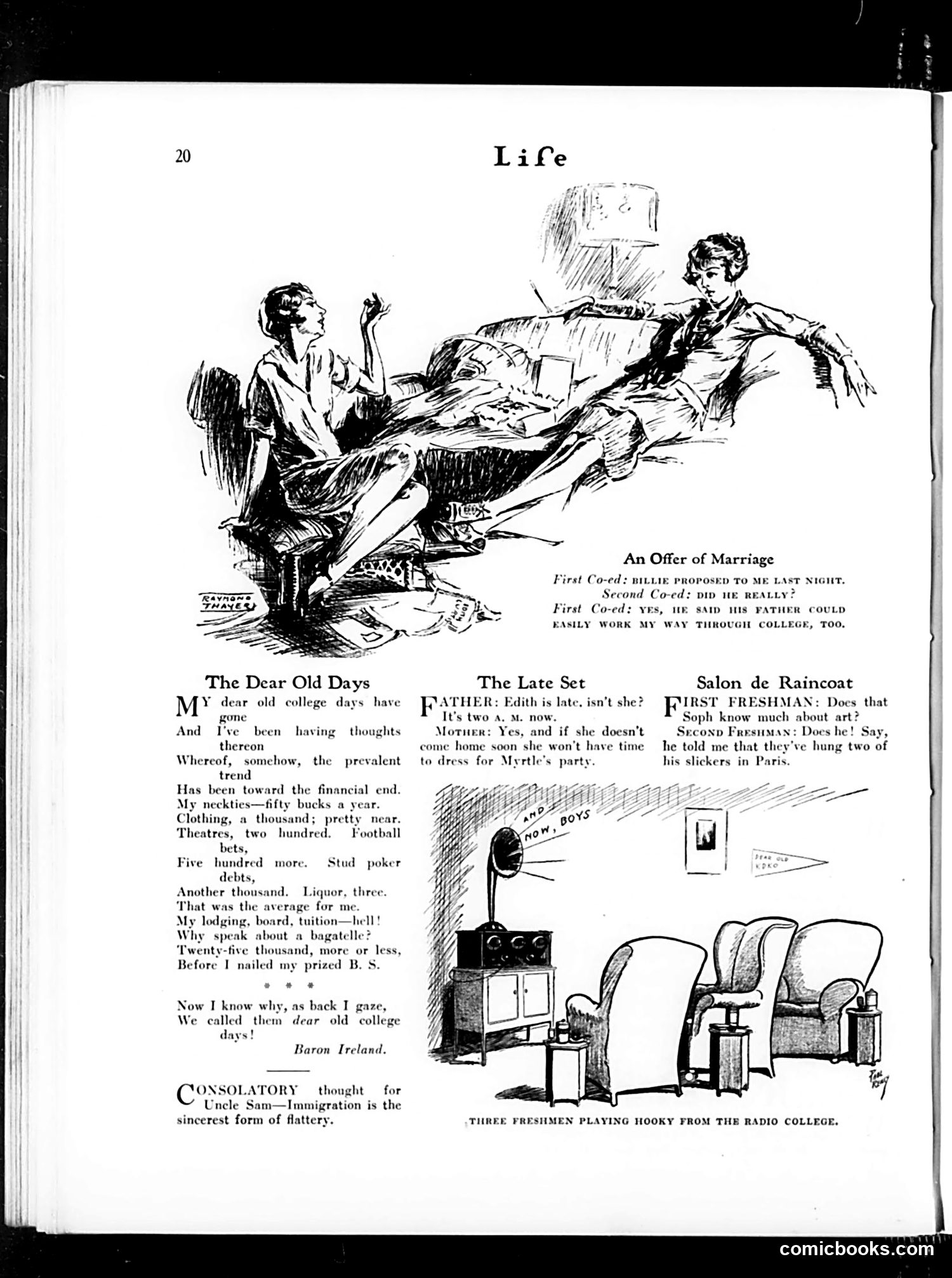
This page contains four separate humorous pieces satirizing early 20th-century American life: **"The Dear Old Days"** (Baron Ireland): A poem lamenting college expenses. The speaker ironically calls his college years "dear" because they cost enormous sums—tuition, lodging, gambling debts, alcohol, and entertainment totaling approximately $25,000-30,000. The joke is the pun on "dear" (beloved/expensive). **"An Offer of Marriage"**: A co-ed accepts a proposal only because the man's father will pay her college tuition, exposing mercenary attitudes toward marriage and the financial burden of women's education. **"The Late Set"**: Parents discuss their daughter staying out until 2 a.m.—so late she won't have time to sleep before the next party. This mocks the social whirlwind of the Jazz Age. **"Salon de Raincoat"**: A freshman jokes that his classmate hung two raincoats in Paris, calling them "art"—mocking pretentious artistic affectations and the appeal of Paris to young Americans. The "Radio College" illustration satirizes newfangled radio technology's cultural impact on youth.
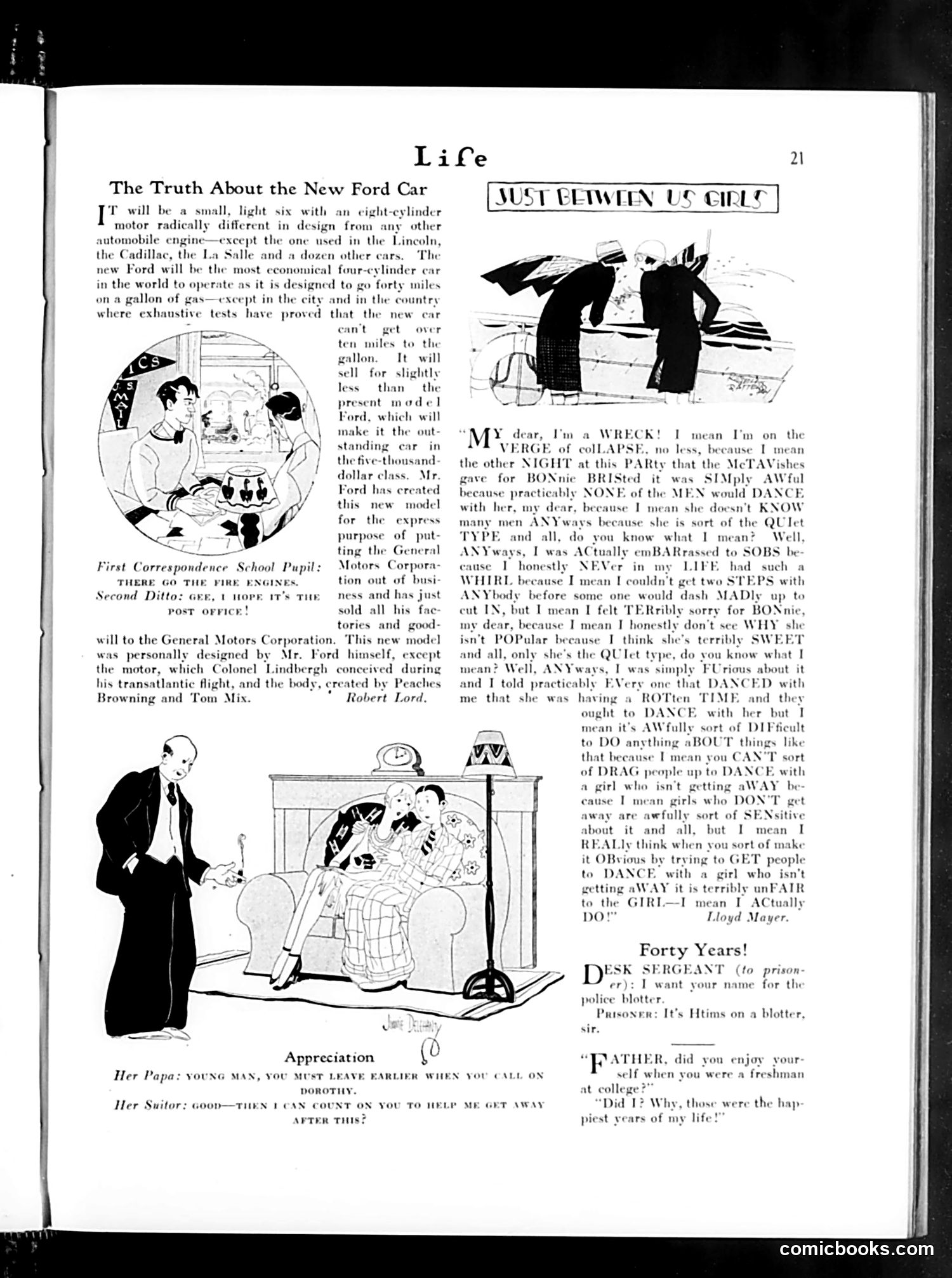
This page contains **satirical commentary on 1920s social pretense and dating culture**, presented through multiple cartoons and humorous pieces. **"The Truth About the New Ford Car"** opens with mock-serious corporate jargon that contradicts itself—claiming the Ford is simultaneously an economical four-cylinder and eight-cylinder vehicle, can achieve forty miles per gallon except when it can't. The satire mocks Ford's marketing while the attribution joke claims the car was designed by Henry Ford, Colonel Lindbergh (famous aviator), and celebrities Peaches Browning and Tom Mix—absurdly suggesting famous non-engineers created it. **"Just Between Us Girls"** satirizes shallow 1920s flapper culture through a breathlessly gossiping woman obsessing over her friend Bonnie's dating struggles, with affected speech patterns (random capitalization mimicking affected pronunciation). The humor targets superficial social anxiety about popularity and romantic attention. The remaining cartoons deal with courtship propriety ("Appreciation," "Forty Years") using standard domestic humor about dating etiquette and nostalgia for college romance. The overall tone mocks both consumer culture and affected upper-class social performance.
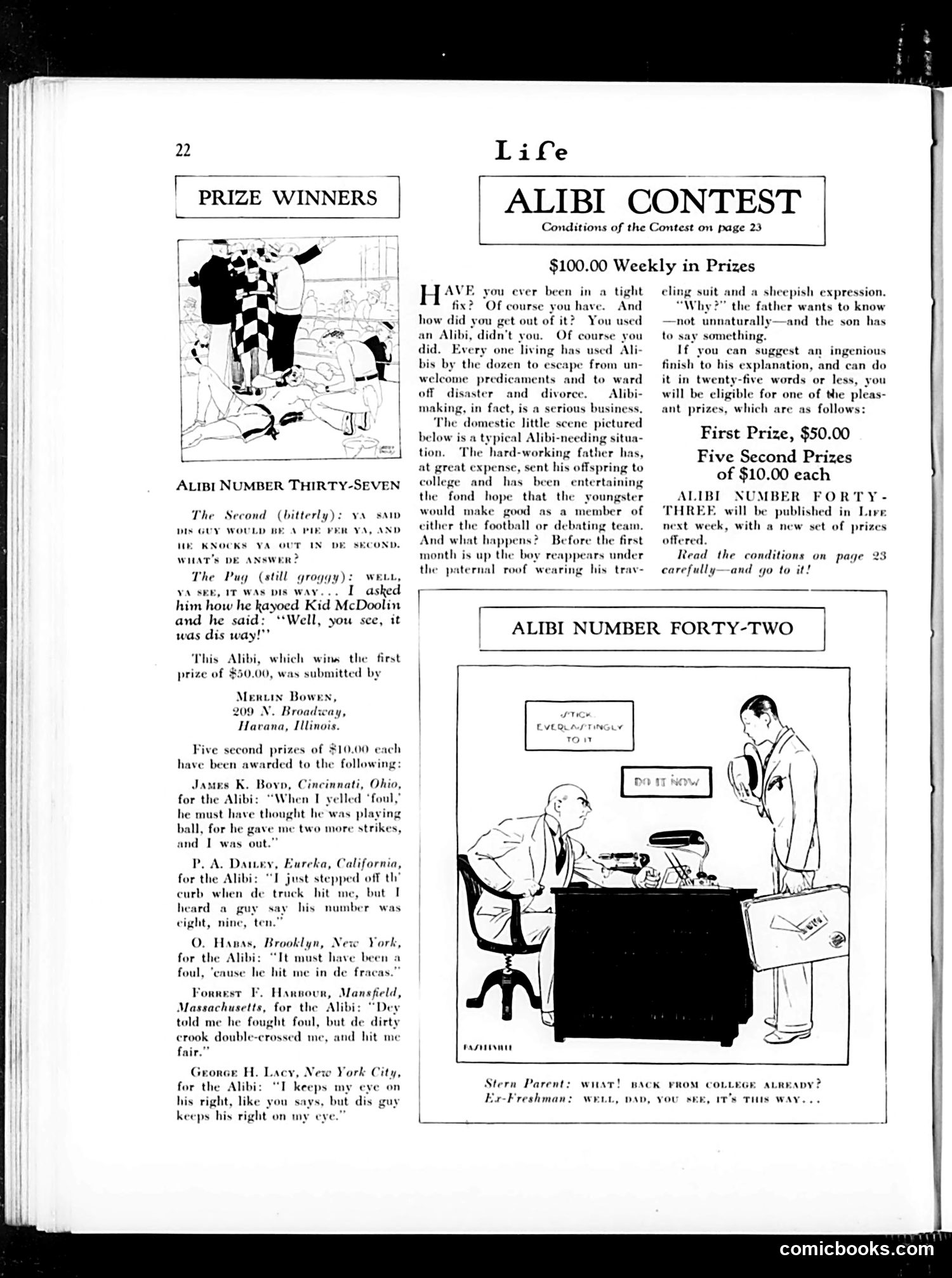
This page presents Life's "Alibi Contest," a humor feature inviting readers to submit creative excuses for common social predicaments. The cartoon (Alibi #42) illustrates a typical scenario: a college freshman caught sneaking back into his dormitory by his stern father, who has unexpectedly arrived. The joke relies on the boy's transparent excuse ("it's this way..."), implying he's fabricating a story to explain his absence or late return. The satire mocks the universal gap between parental expectations and student behavior—fathers demanding explanations, sons scrambling for believable lies. The contest format encouraged readers to submit their own humorous alibis for everyday embarrassments, reflecting 1920s-30s middle-class anxieties about propriety, parental authority, and youthful deception.
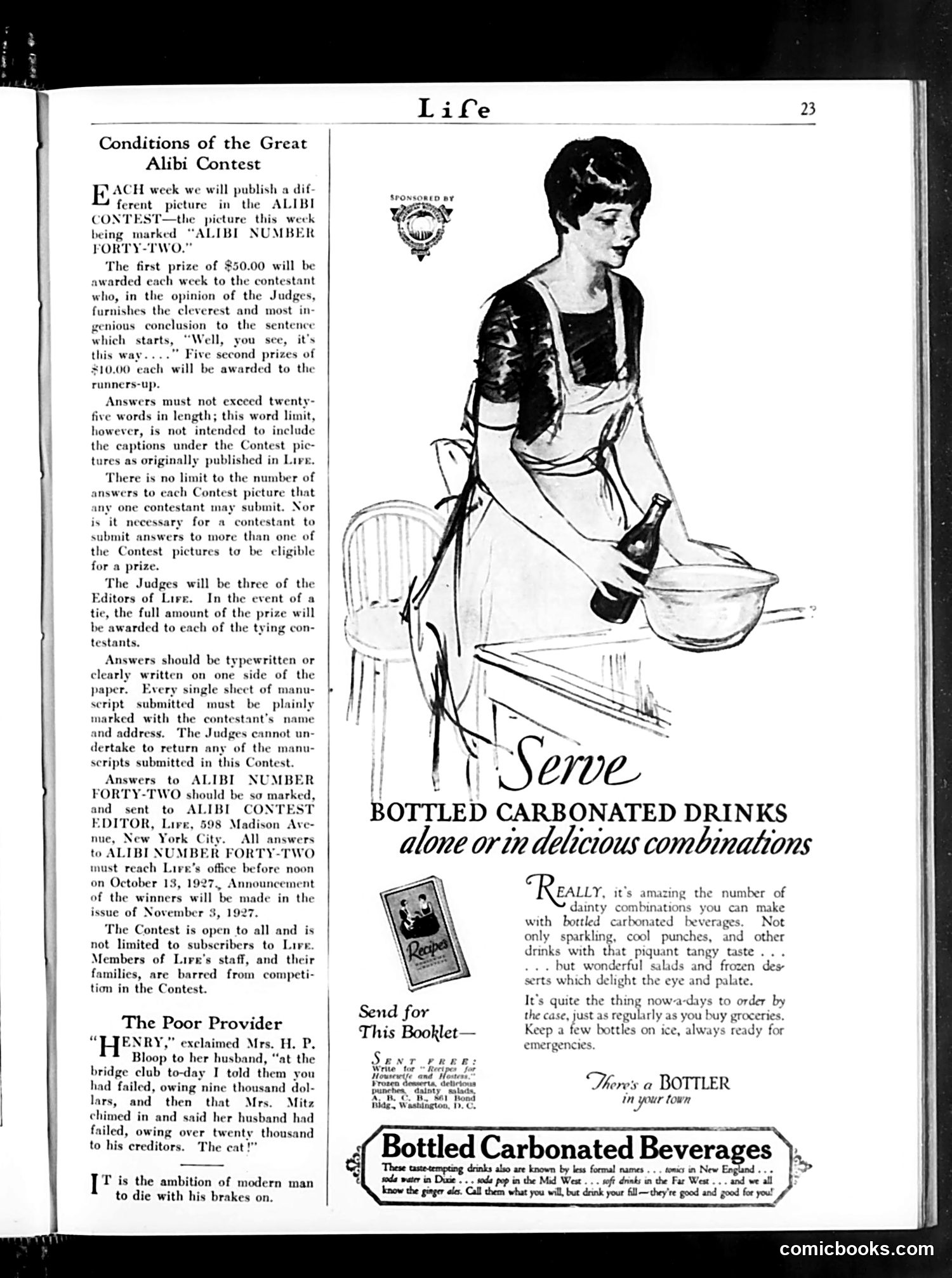
This page combines a **reader contest** with **social satire and advertising**. The main contest ("Alibi Number Forty-Two") invites readers to complete a caption for a cartoon, offering $50 weekly prizes. The cartoon itself depicts a domestic scene: a woman reporting to her husband that she's gossiped at her bridge club about his financial failure (owing $9,000), only to be outdone by Mrs. Mitz, whose husband owes over $20,000. The humor targets **1920s social pretense**—wives competing to one-up each other socially while their husbands face serious debt. The page's closing line—"It is the ambition of modern man to die with his brakes on"—satirizes masculine dignity in the face of financial ruin. The substantial advertisement for **bottled carbonated beverages** (soda) occupies significant space, reflecting the beverage industry's prominence in 1920s consumer culture and Life's reliance on advertising revenue.
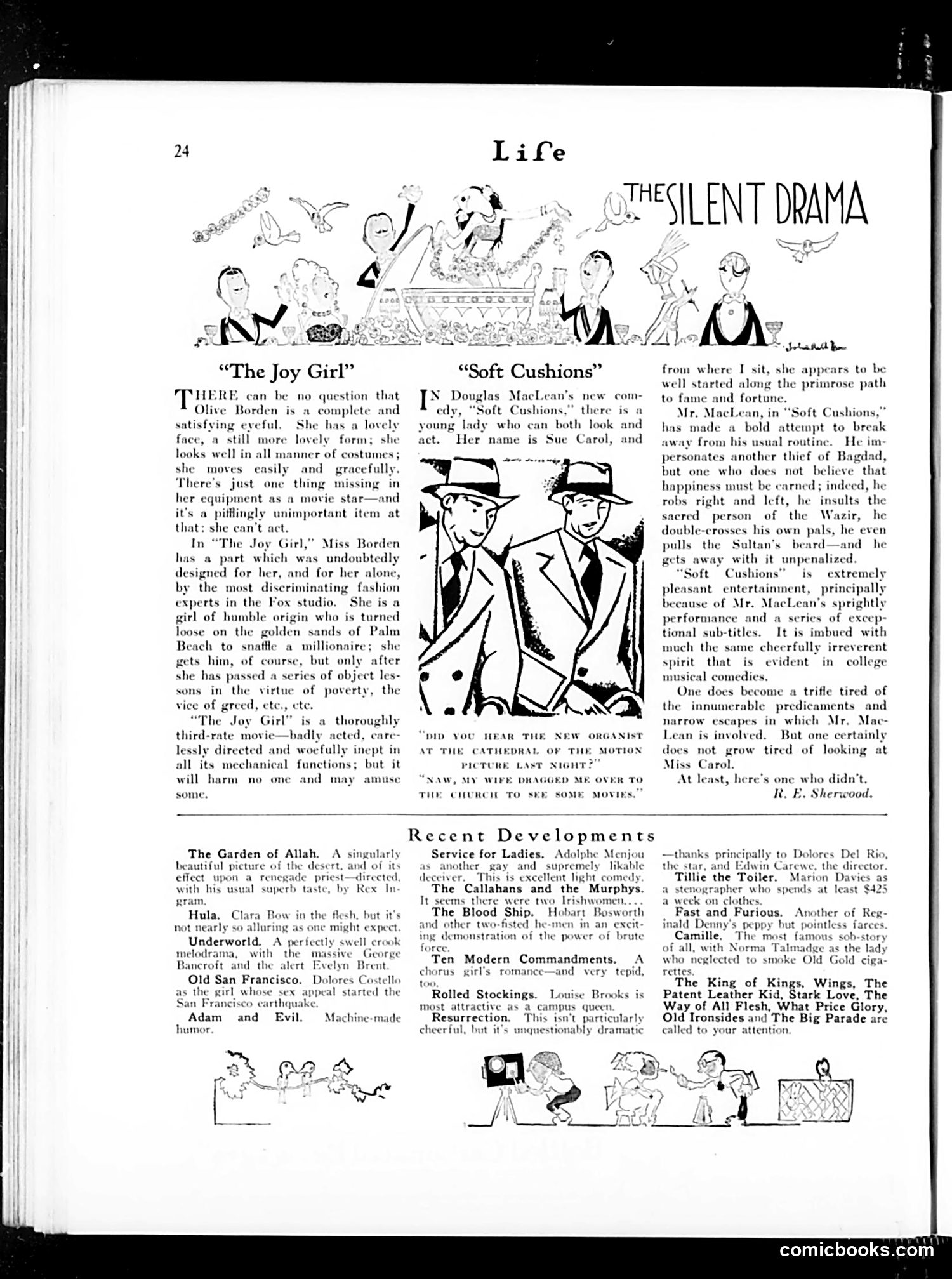
This page reviews recent silent films, with particular focus on starlet **Olive Borden** in "The Joy Girl." The critic praises her physical appearance and costuming but bluntly states she "can't act"—a harsh assessment of her performance in a film about a humble girl who seduces a millionaire at Palm Beach. The **cartoon** jokes about silent film's dominance in entertainment. A couple discusses a church organist, with the husband quipping he was dragged to "see some movies" instead—suggesting motion pictures have replaced traditional cultural activities like church attendance. The reviews of other films mention stars like **Clara Bow**, **Dolores Costello**, and **Marion Davies**, typical of 1920s cinema. Notable is the sarcastic jab at Marion Davies spending "$425 a week on clothes" as a stenographer character—likely referencing her real-life lavish lifestyle and her connection to newspaper magnate William Randolph Hearst. The page captures the Jazz Age's obsession with cinema and celebrity, while highlighting the tension between physical attractiveness and actual acting talent in early Hollywood.
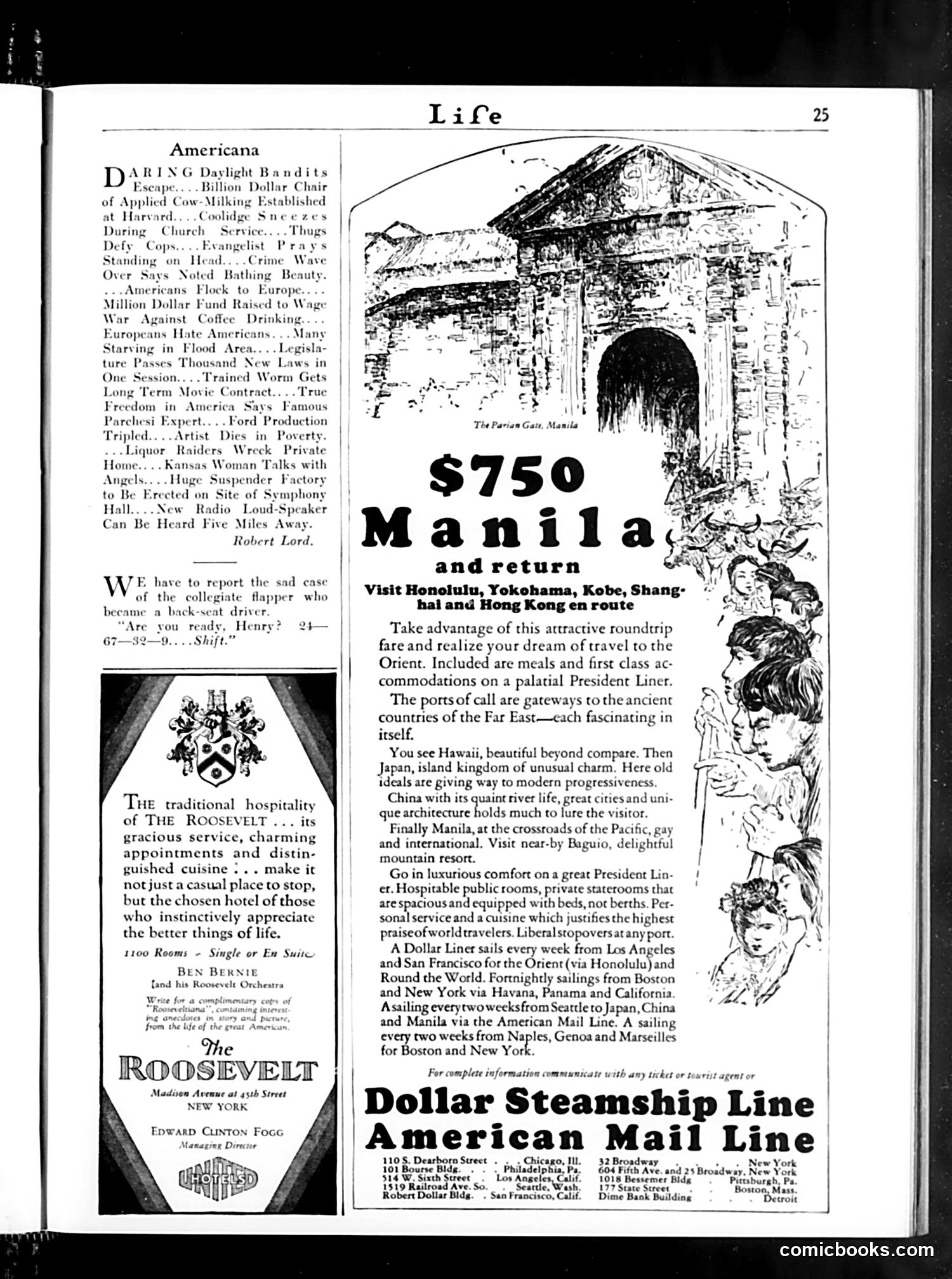
This page mixes satirical commentary with advertising. The "Americana" section by Robert Lord is a rapid-fire list of absurdist American news items—bandits escaping, Harvard establishing a "Cow-Milking Chair," President Coolidge sneezing in church, artists dying in poverty. The humor relies on juxtaposing the trivial with the serious, reflecting 1920s anxieties about modern American life: crime, commercialism, and social change. The brief anecdote about a "collegiate flapper" becoming a "back-seat driver" satirizes the independent, forward women of the Jazz Age—newly mobile and assertive, challenging traditional gender roles. The bulk of the page advertises luxury steamship travel to Asia and hotel accommodations, targeting wealthy readers. This contrasts sharply with the satirical opening, highlighting the economic divide of the era: while some Americans struggled (the starving artist), others enjoyed leisure travel to exotic destinations.
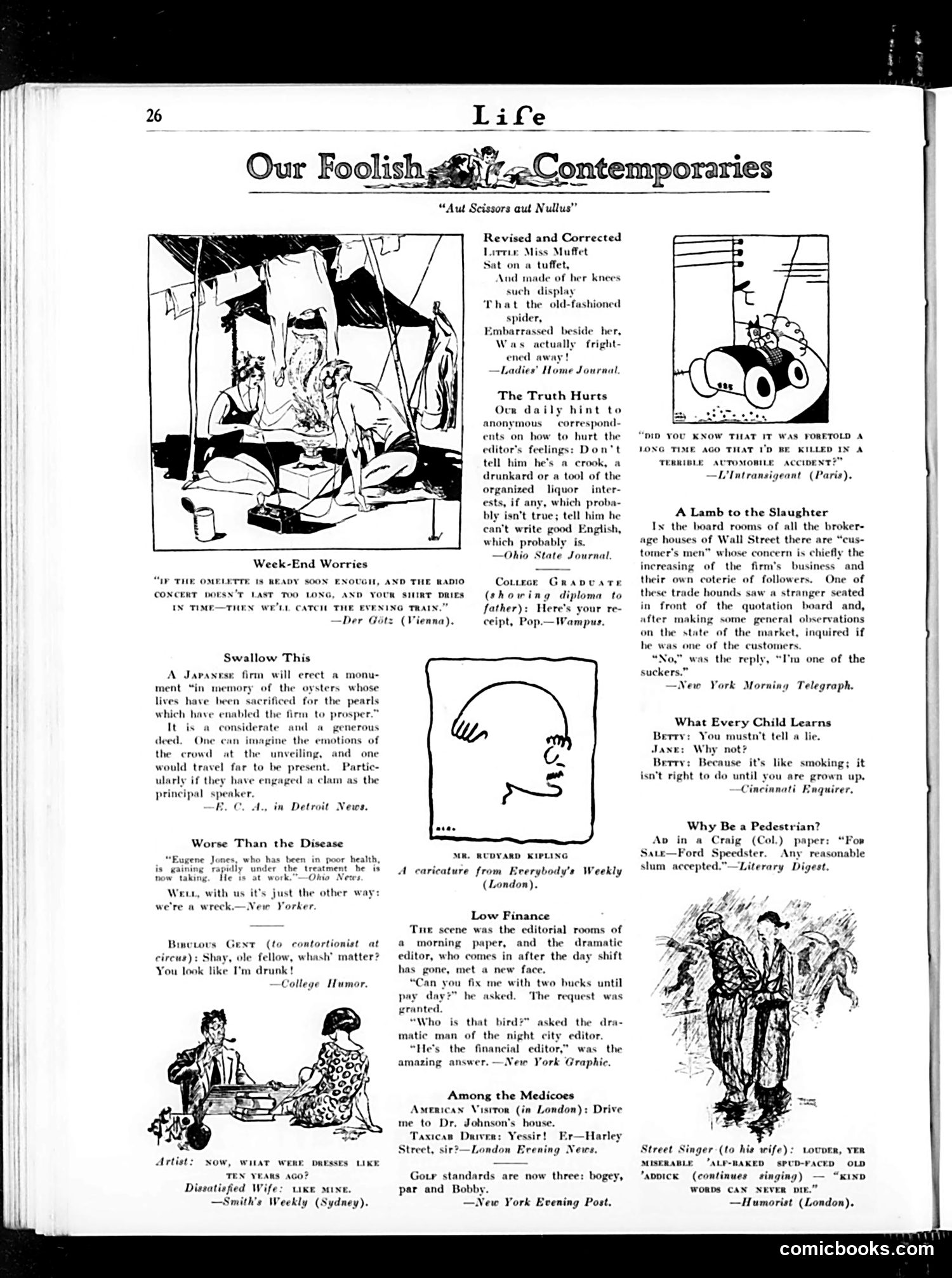
This page collects humorous anecdotes and jokes from newspapers and magazines worldwide, mocking contemporary follies. Key items include: **"Week-End Worries"**: A couple rushing through domestic tasks to catch a concert—satirizing middle-class time management anxieties. **"Swallow This"**: Mocks a Japanese firm's plan to erect an oyster-memorial for sacrificed workers, treating corporate sentimentality as absurd. **"Worse Than the Disease"**: A drunk man's self-aware complaint about his own wretchedness versus others' problems. **"The Truth Hurts"**: Advice to newspaper readers on what *won't* offend editors (calling them crooks/drunks)—ironic commentary on press sensitivity. **Rudyard Kipling caricature**: Appears as satirical illustration from London's *Everybody's Weekly*. **"Low Finance"**: A newspaper editor borrows money from the night-shift financial editor—mocking newsroom hierarchy and financial desperation. The page represents Life's formula: reprinting amusing snippets from global publications to critique contemporary society's pretensions, anxieties, and absurdities.
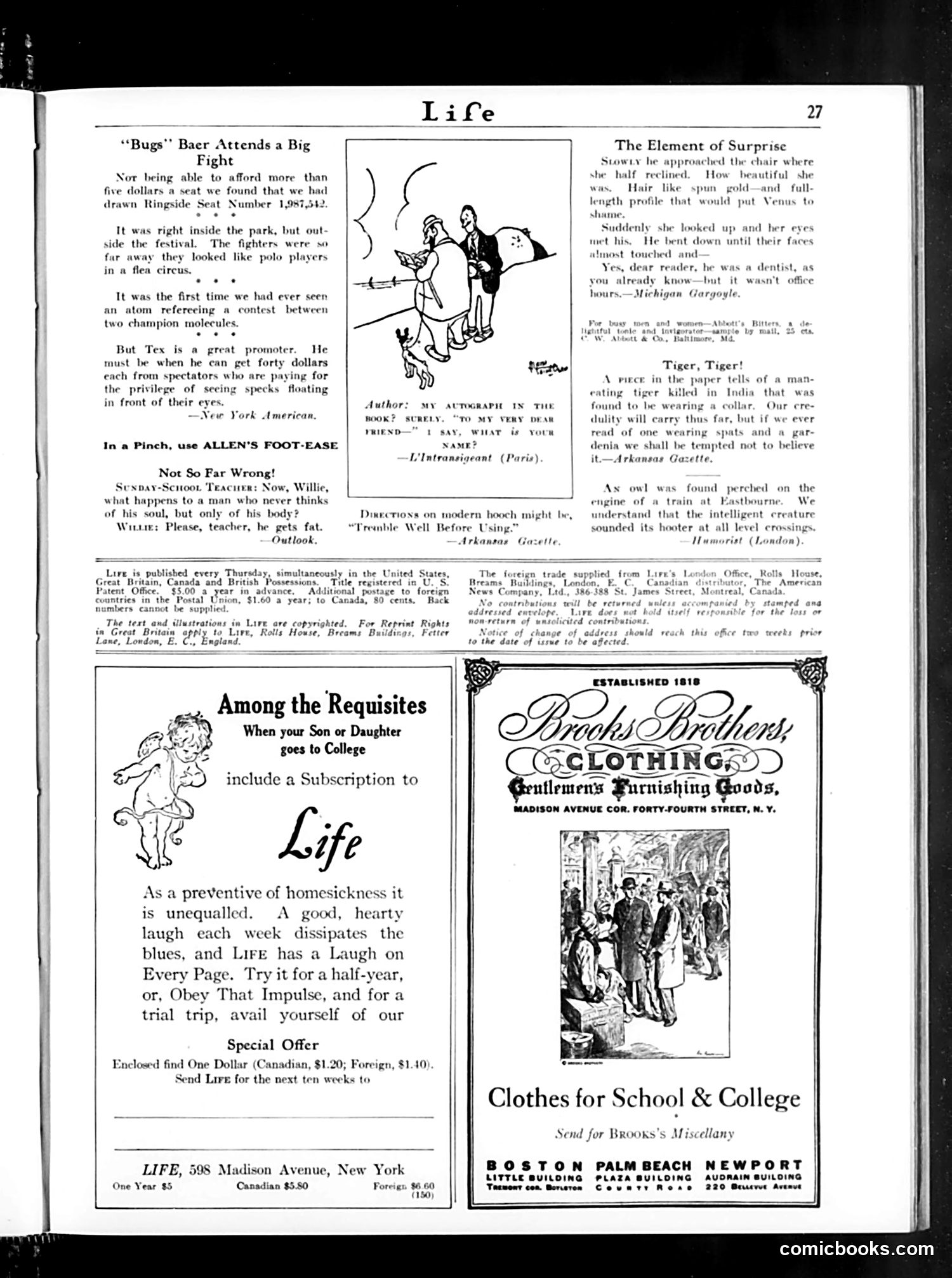
This page from Life magazine (undated, but early 20th century based on style) contains several brief humorous pieces: **"Bugs" Baer Attends a Big Fight**: A satirical piece about attending a boxing match at a large venue where the actual fighters appear impossibly distant—described as looking like "polo players in a flea circus" and comparing the referee to "an atom." The joke mocks the experience of paying for ringside seats that are actually far away, while promoter "Tex" (likely Tex Rickard, a famous fight promoter) profits from spectators paying to watch tiny distant figures. **Other humor pieces**: Brief jokes from international sources about dentistry, owls on trains, and homesickness—typical of Life's format as a humor magazine. The page is primarily **advertising**: subscription pitches for Life magazine itself and Brooks Brothers clothing. The content reflects Life's role as a satirical weekly mixing social commentary with light humor and commercial interests.
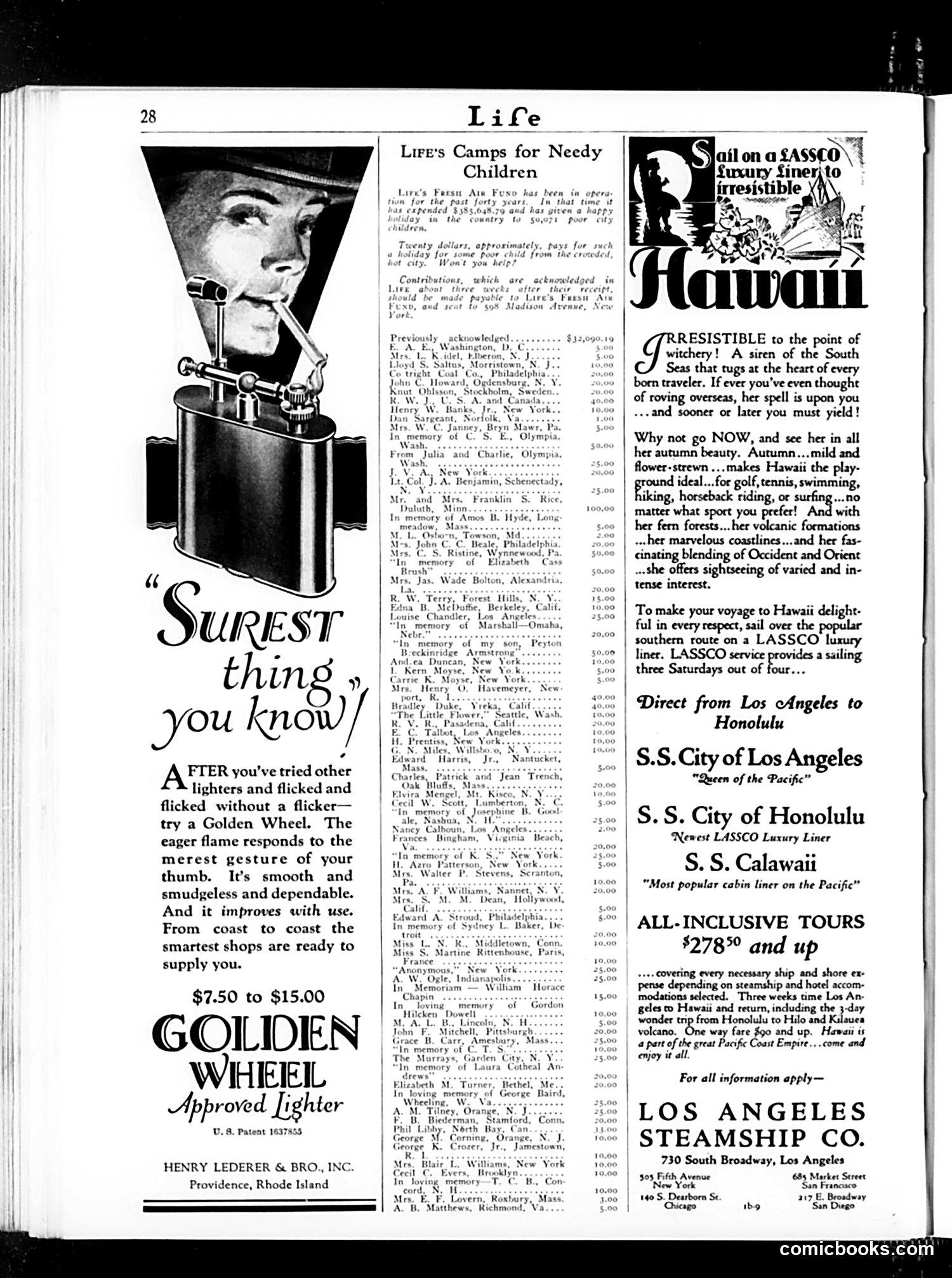
This page is **primarily advertising** with minimal editorial cartooning. The main content consists of: **Left side:** A Golden Wheel lighter advertisement featuring a stylized male face smoking. The ad emphasizes the lighter's reliability and quality, positioning it as a luxury item available in "smartest shops" for $7.50–$15.00. **Center:** Life magazine's charitable appeal for "Life's Camps for Needy Children," listing donors and amounts contributed—a fundraising initiative typical of the era. **Right side:** Large travel advertisements for Hawaiian cruises via the Los Angeles Steamship Company, marketing Hawaii as an exotic, romantic destination ("irresistible...siren of the South Seas") appealing to affluent readers. **Context for modern readers:** This represents 1920s-30s consumer culture targeting wealthy Americans, showcasing luxury goods (lighters, ocean liners) alongside philanthropic efforts. The romanticized, colonial-era framing of Hawaii reflects period attitudes toward Pacific destinations. No significant political satire appears on this page.
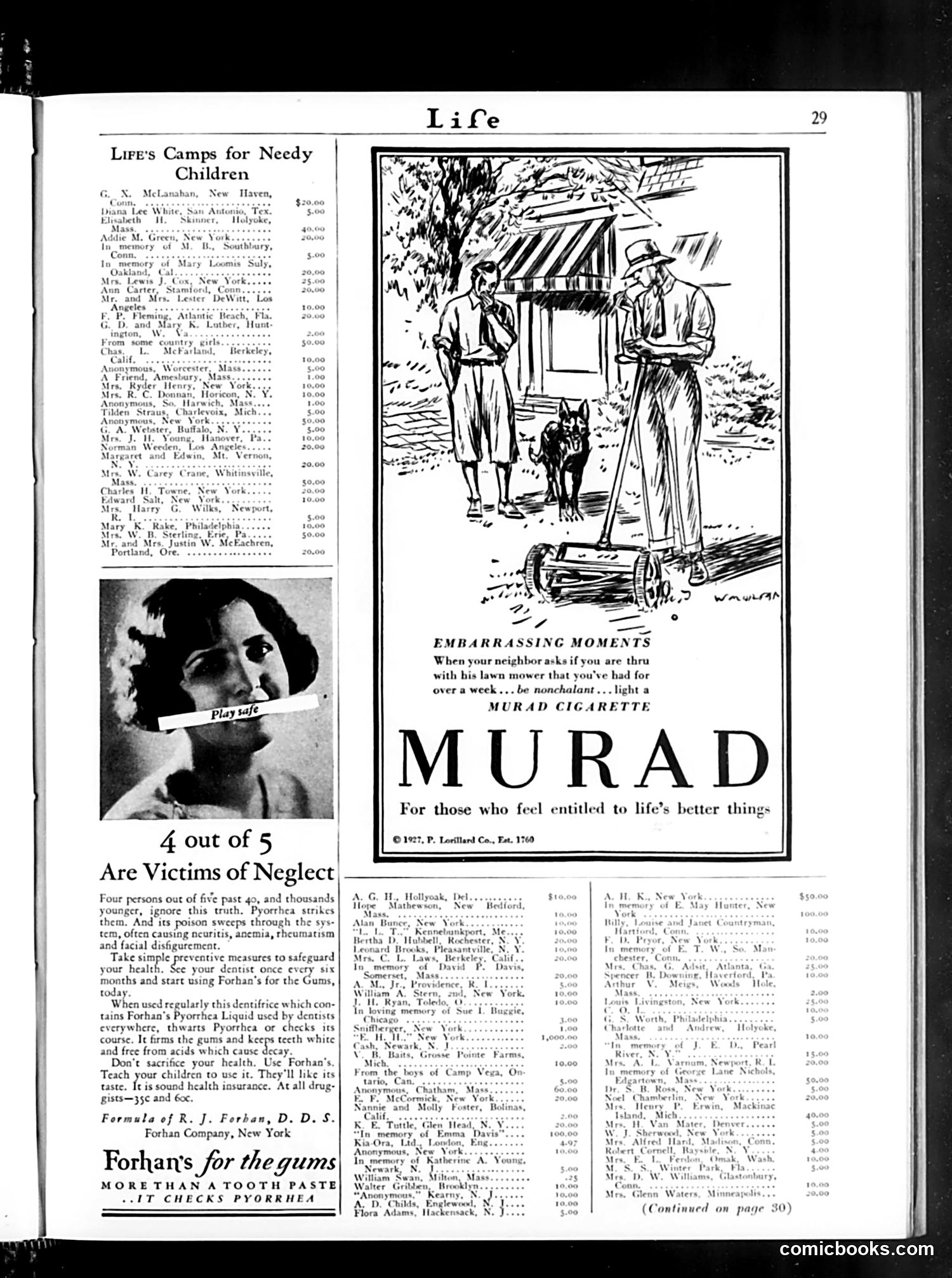
This page combines advertising with a satirical cartoon about social embarrassment. The main illustration depicts two figures discussing a borrowed lawn mower outside a garden shed, with the caption "Embarrassing Moments"—the joke being that one neighbor has kept the other's lawn mower for over a week and feels awkward returning it. The cigarette ad suggests smoking a Murad cigarette as a way to appear "nonchalant" and cover one's discomfort in such socially awkward situations. The rest of the page consists of advertisements for health products: a Forhan's toothpaste ad warning about pyorrhea (gum disease), and a list of donations to "Life's Camps for Needy Children." This juxtaposition of satirical content with earnest charitable fundraising was typical of Life magazine's format during this period (1927).
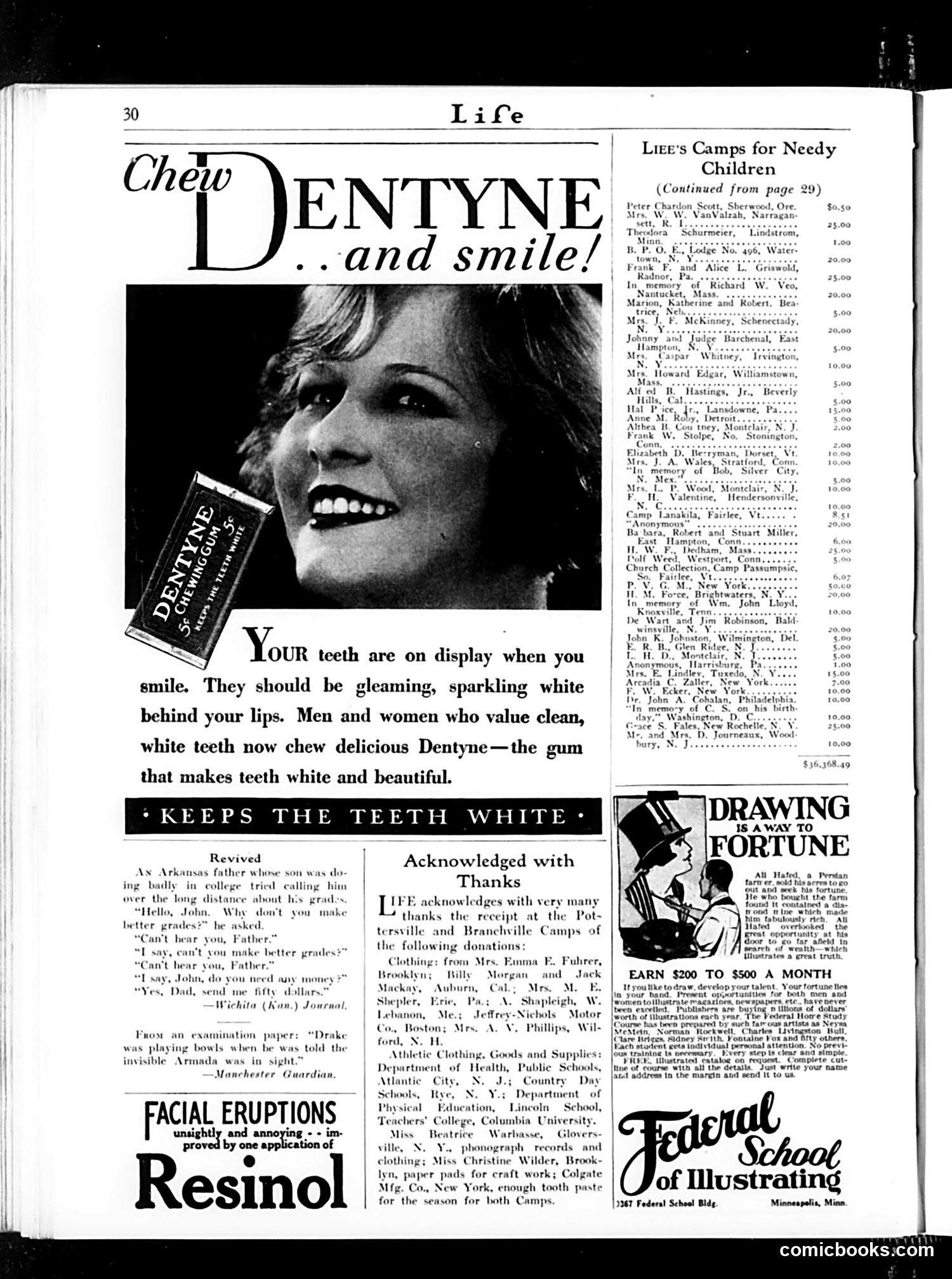
This page is primarily **advertising and acknowledgments**, not political satire. The main content includes: 1. **Dentyne Gum Advertisement** (top): Features a smiling woman promoting chewing gum as a teeth-whitening product. The copy emphasizes dental aesthetics—"gleaming, sparkling white" teeth—reflecting 1920s-30s advertising's focus on personal appearance as social currency. 2. **Small Humor Pieces**: Brief anecdotes, including one about an Arkansas father and son discussing grades, and a reference to Sir Francis Drake playing bowls when the Spanish Armada appeared—these are gentle, non-political jokes. 3. **"Acknowledged with Thanks"**: Lists donations to Life's camps for needy children—clothing and supplies from various donors and companies. 4. **Advertisements**: For Resinol (facial eruption treatment), Federal School of Illustrating, and drawing-as-fortune-making schemes. The page reflects 1920s-30s **consumer culture** and **charitable giving** rather than political commentary or satire.
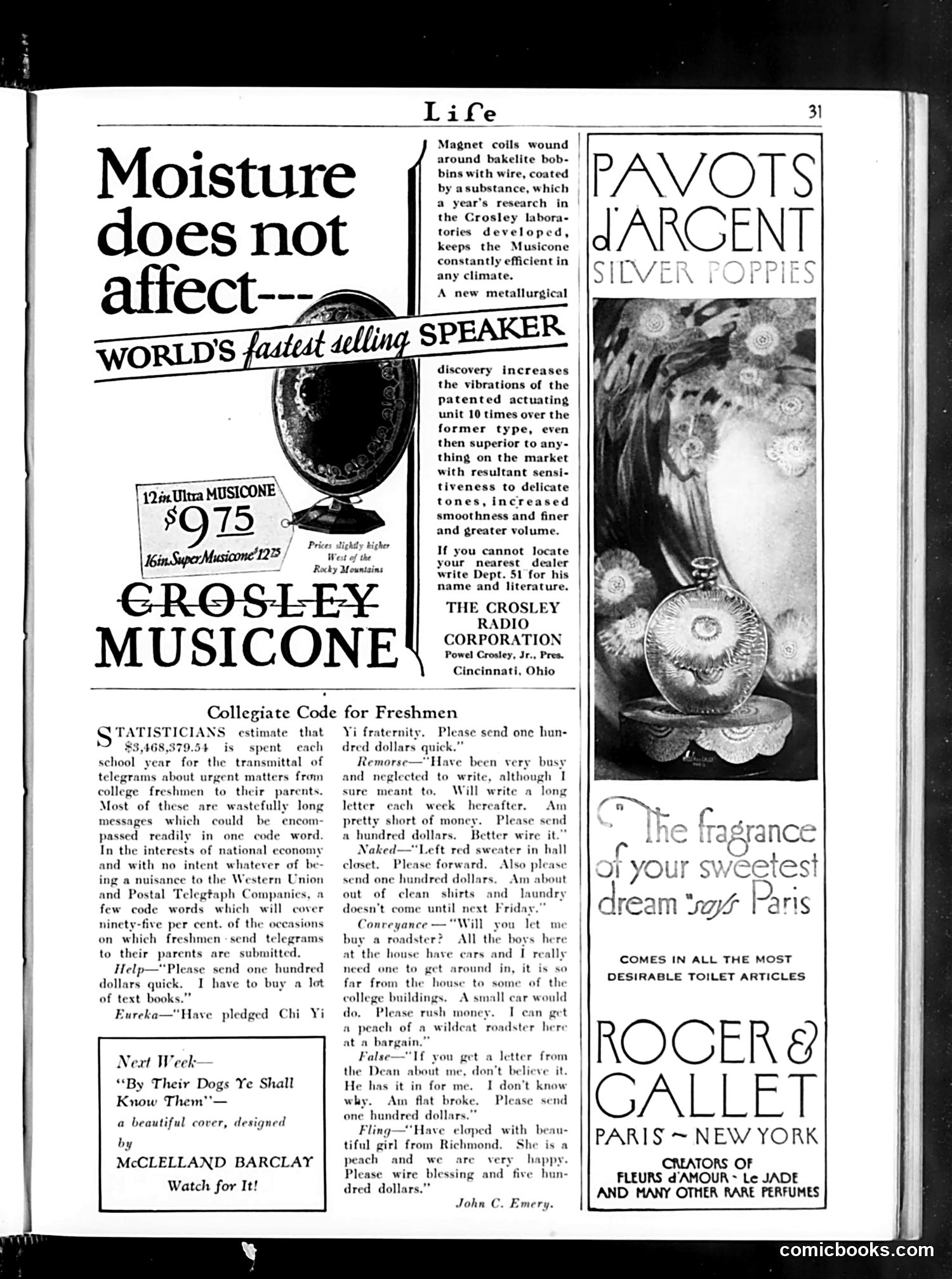
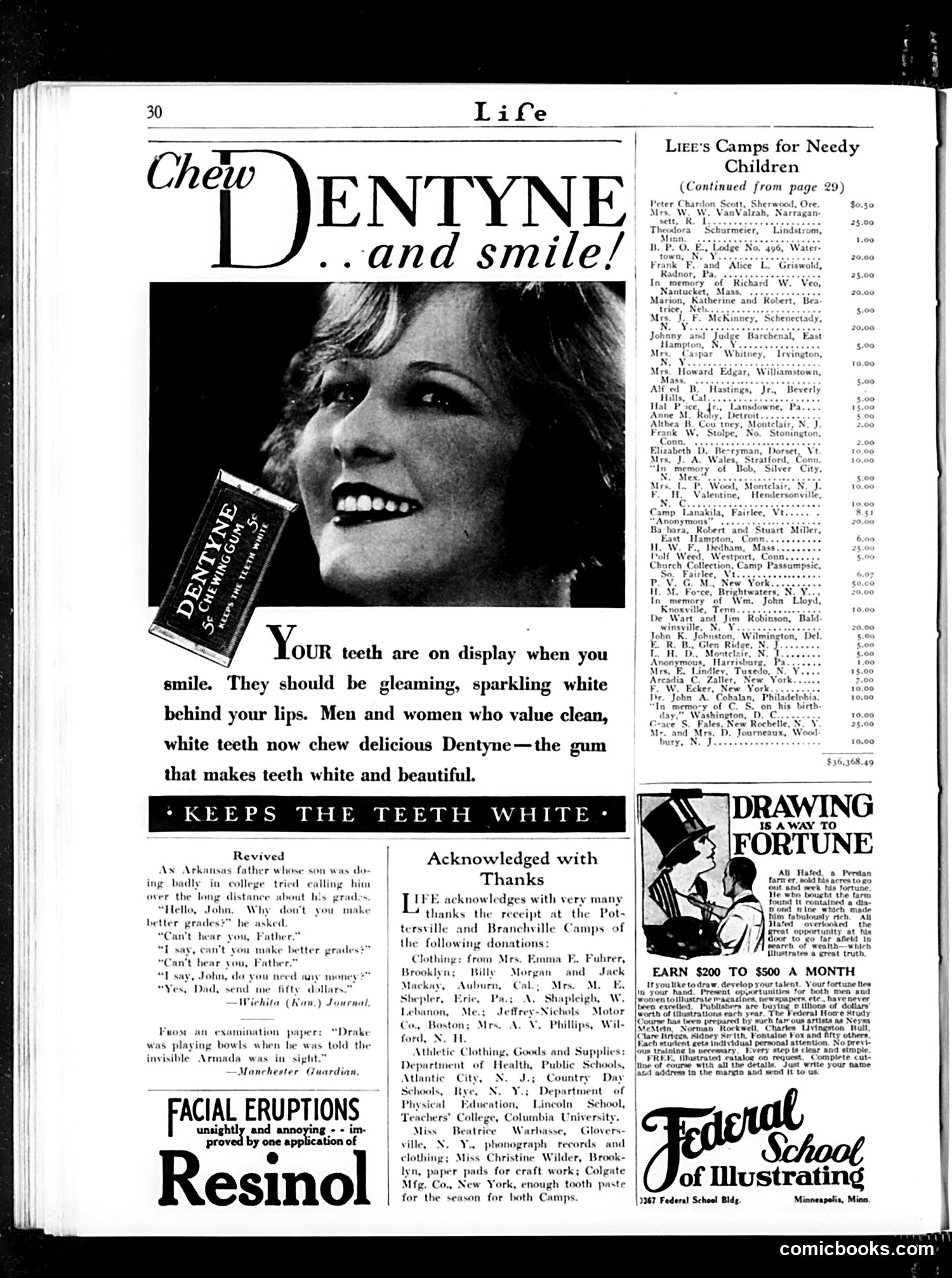
This page is primarily **advertising and announcements**, not political satire. The main content includes: **Dentyne Gum Advertisement**: A large ad featuring a smiling woman's face promoting chewing gum that "makes teeth white and beautiful"—a straightforward commercial pitch with no satirical content. **"Revived" Section**: A brief humorous anecdote about an Arkansas father calling his struggling college son, asking why he won't improve his grades. The son replies he needs fifty dollars—a lighthearted joke about parental concern versus student priorities. This references a Drake examination paper and contains a Manchester Guardian attribution, suggesting it's a reprinted joke. **Acknowledgments Section**: Lists donations to Life's camps for needy children, crediting various donors and organizations. **Other Advertisements**: For Resinol (facial product), drawing/illustration courses, and Federal School of Illustrating. The page contains **no political cartoons or satire requiring historical context**—it's a typical 1920s-30s magazine page mixing commercial ads, light humor, and charitable acknowledgments.
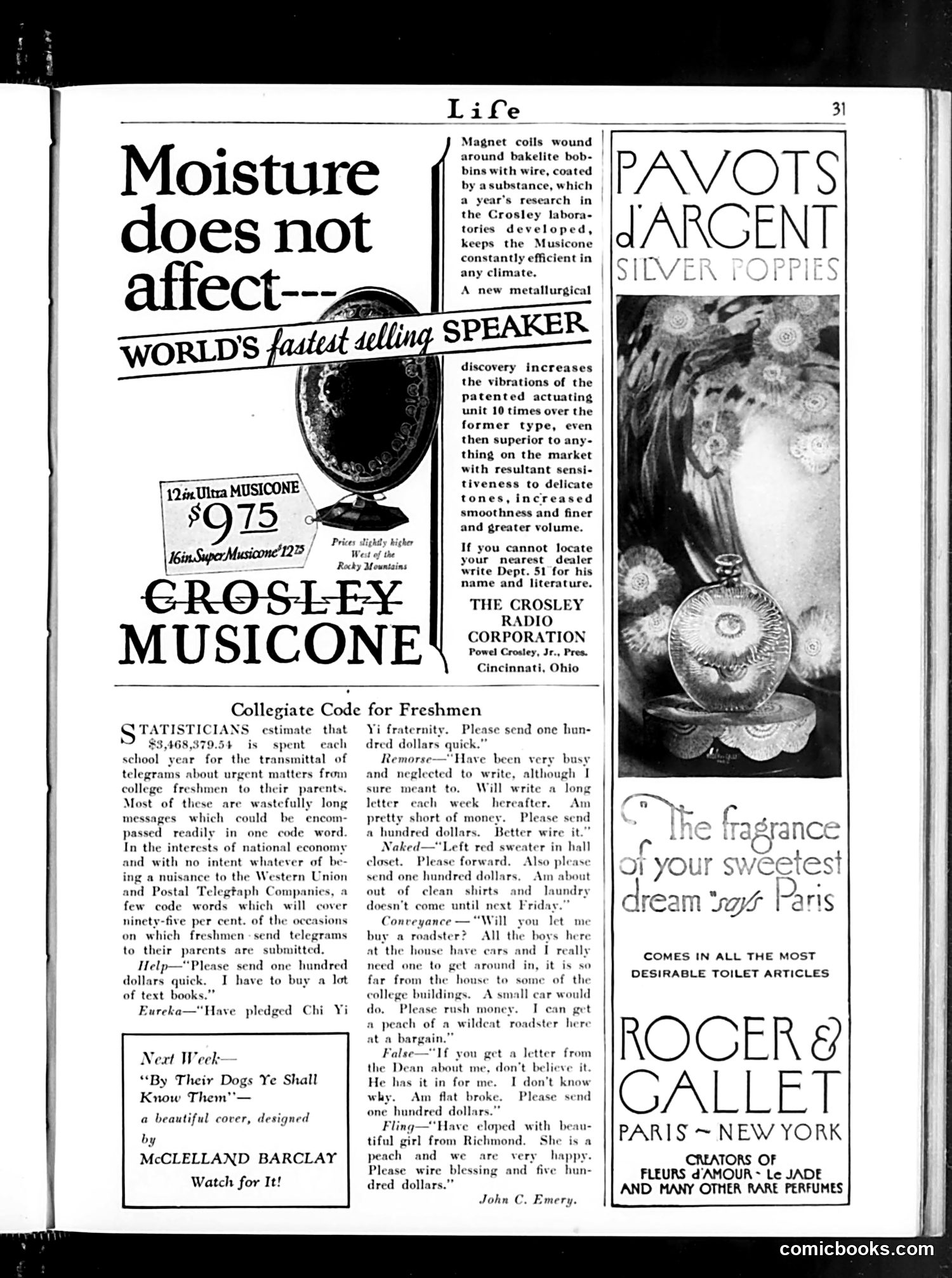
This page is primarily **advertising and humor content** rather than political satire. The main feature is a satirical "Collegiate Code for Freshmen"—a humorous guide of fake telegraph codes college students supposedly use to request money from parents. Each code word (Help, Eureka, Remorse, Naked, Conveyance, False, Fling) masks the real message: "send money." The joke targets the stereotype of wealthy college boys making frivolous or embarrassing requests—buying roadsters, replacing lost sweaters, covering up Dean's complaints, even elopements—all requiring parental cash bailouts. This reflects **1920s-30s anxieties about youth spending and parental responsibility**, poking fun at both wasteful college culture and parents' inevitable capitulation to their sons' demands. The page also contains three advertisements: Crosley Musicone radios, Roger & Callet Paris perfume, and a teaser for next week's Life cover by McClelland Barclay. The Crosley ad uses pseudo-scientific language about magnetic coils and metallurgical discoveries—typical marketing hyperbole of the era.
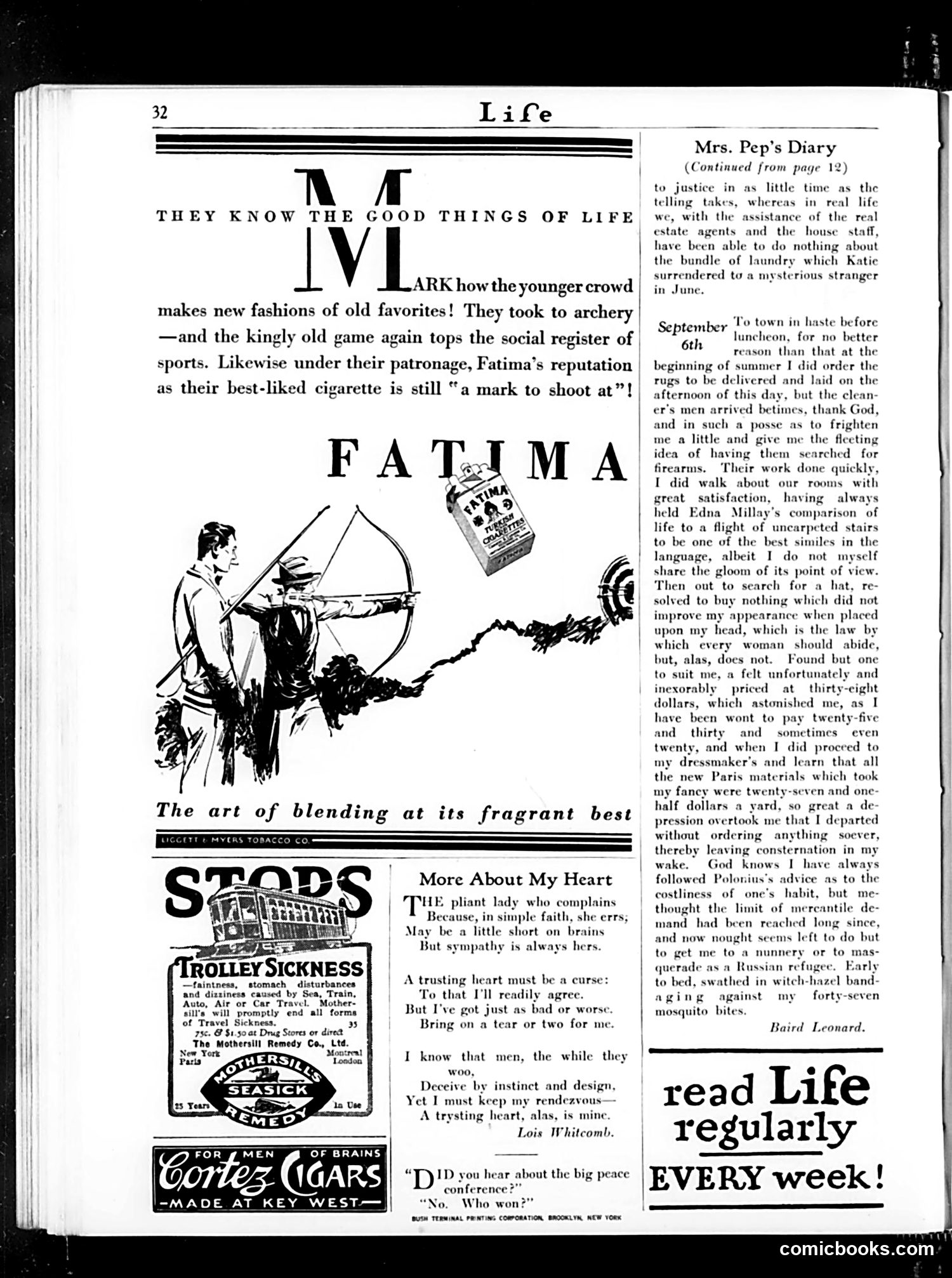
This page combines advertising with lifestyle content typical of Life magazine's satirical approach to American society. **Main Content:** The large "Fatima" cigarette advertisement features two figures engaged in archery—a fashionable "new" leisure activity among the younger wealthy crowd. The ad sarcastically notes that archery has become "a mark to shoot at" in the social register, playing on Fatima cigarettes' reputation as their preferred brand. **Sidebar Content:** "Mrs. Pep's Diary" is a humorous first-person account of a socialite's shopping expedition in September, chronicling her frustration with inflated post-war prices for household goods, textiles, and fashion. Her exasperation at costs ("thirty dollars" for hats, "twenty-seven and one-half dollars a yard" for fabric) reflects genuine economic anxiety of the period. **Poetry Section:** Three short poems about romantic disappointment and female vulnerability appear below. The page satirizes upper-class frivolity (archery fads, expensive shopping) while documenting real economic pressures of the 1920s.
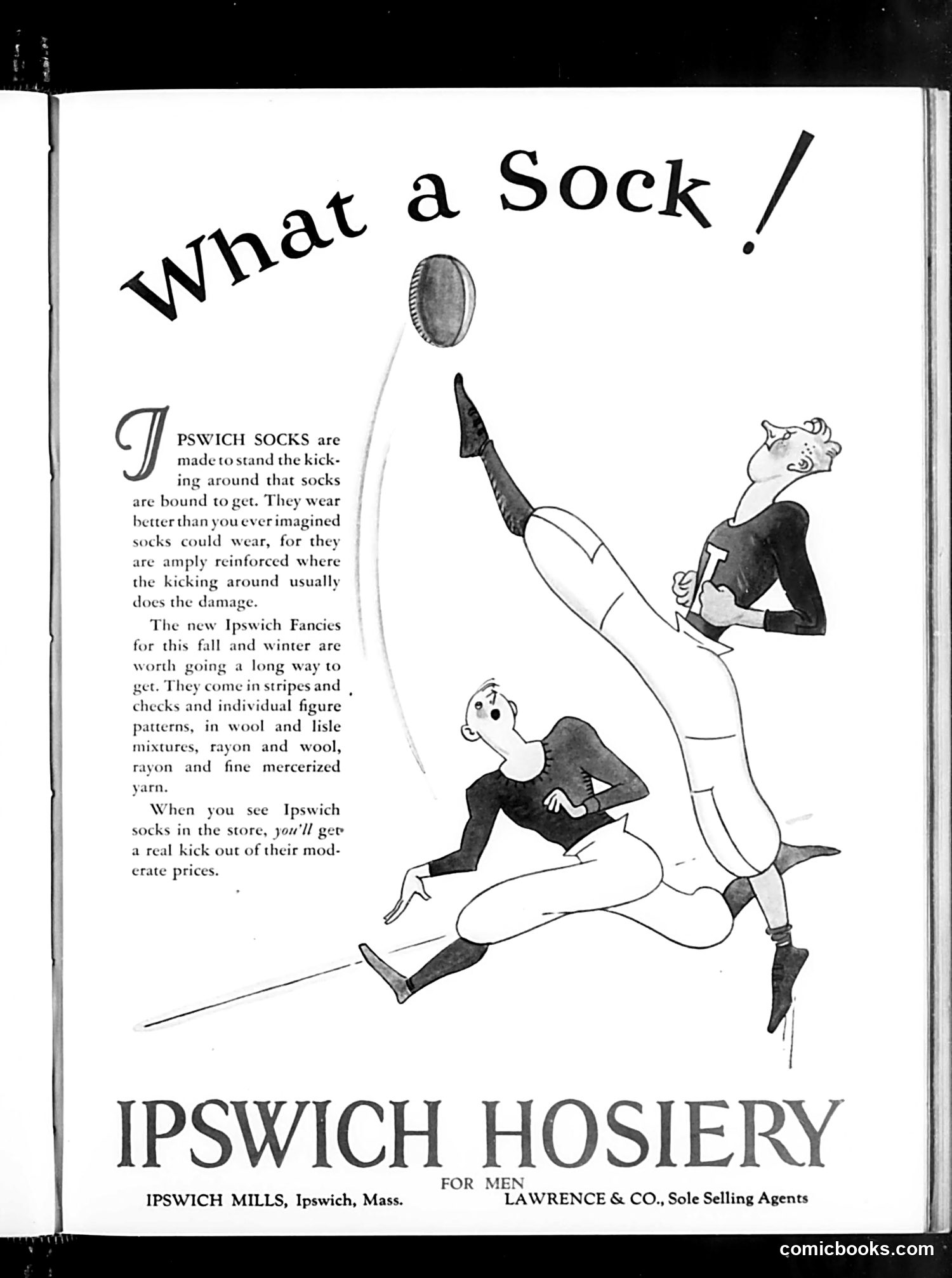
This is a **full-page advertisement**, not satire or political commentary. It's an Ipswich Hosiery ad for men's socks from an early 20th-century issue of *Life* magazine. The humor is purely **wordplay-based advertising**: the headline "What a Sock!" and repeated references to socks getting "kicked around" and "kicking" are puns. The illustration shows two men literally kicking a giant sock between them like a football, visually literalizing the sock-kicking metaphor. The ad's selling point is practical: Ipswich socks are reinforced in high-wear areas because regular socks get damaged from rough use. The copy emphasizes durability, style options (stripes, checks, patterns), and "moderate prices." This represents typical early 20th-century advertising strategy: combining visual humor, puns, and product benefits to catch readers' attention in magazine pages.
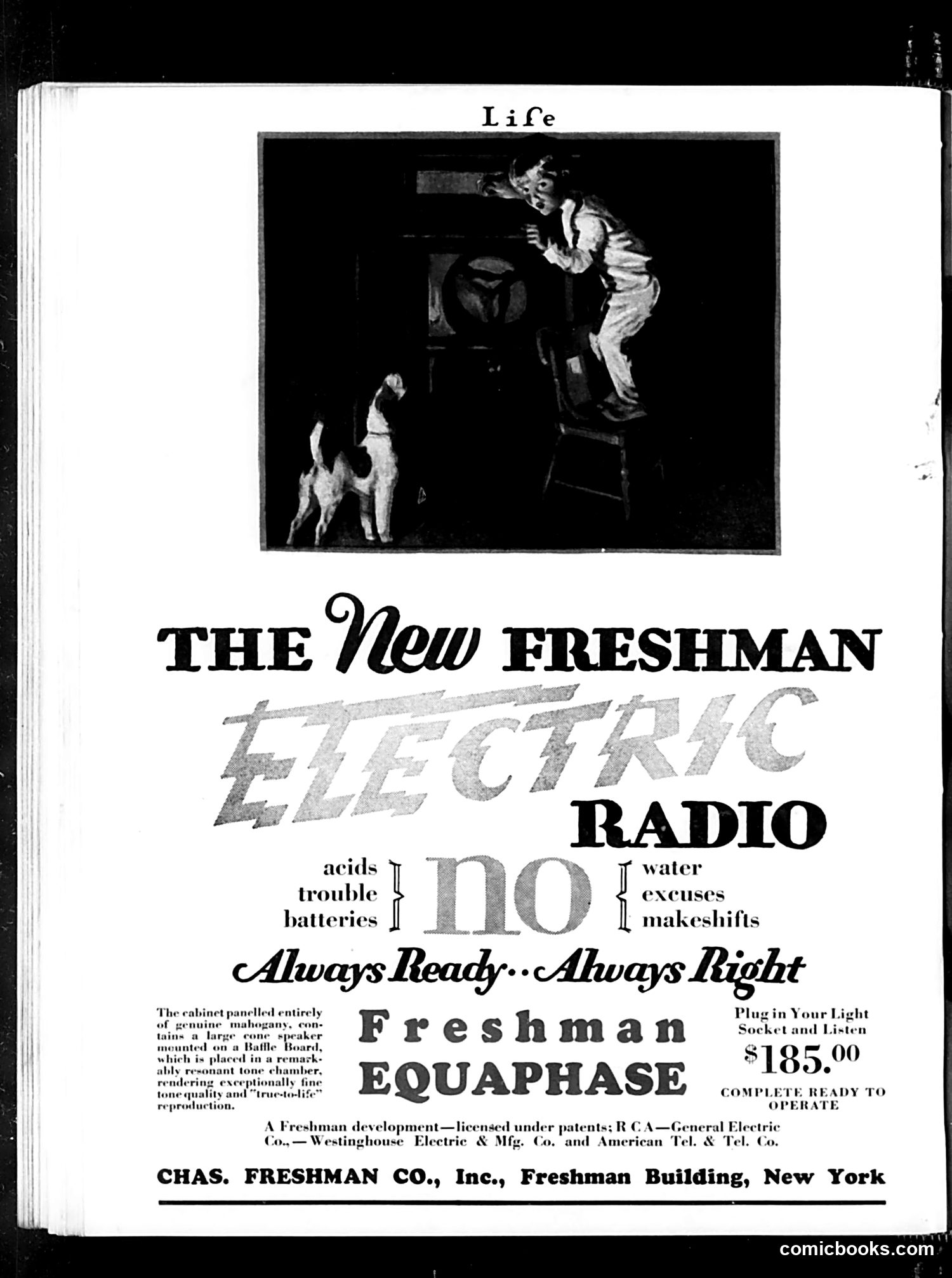
This is primarily a **product advertisement**, not political satire. The page advertises the Freshman "Equaphase" electric radio, priced at $185.00, complete and ready to operate. The illustration shows a child and dog looking at what appears to be a radio cabinet—a domestic scene emphasizing the product's appeal to household consumers. The tagline "Always Ready...Always Right" and the claims that it has "no acids trouble batteries water excuses makeshifts" highlight the radio's reliability compared to earlier models that required battery maintenance. The text notes this is a "Freshman development" licensed by major electronics companies (RCA, General Electric, Westinghouse, AT&T), indicating the competitive landscape of 1920s radio manufacturing. The Freshman company manufactured radios in New York. This represents early commercial radio advertising targeting middle-class home consumers during the rapid expansion of consumer electronics in the post-WWI era.