
A complete issue · 40 pages · 1927
Life — September 15, 1927
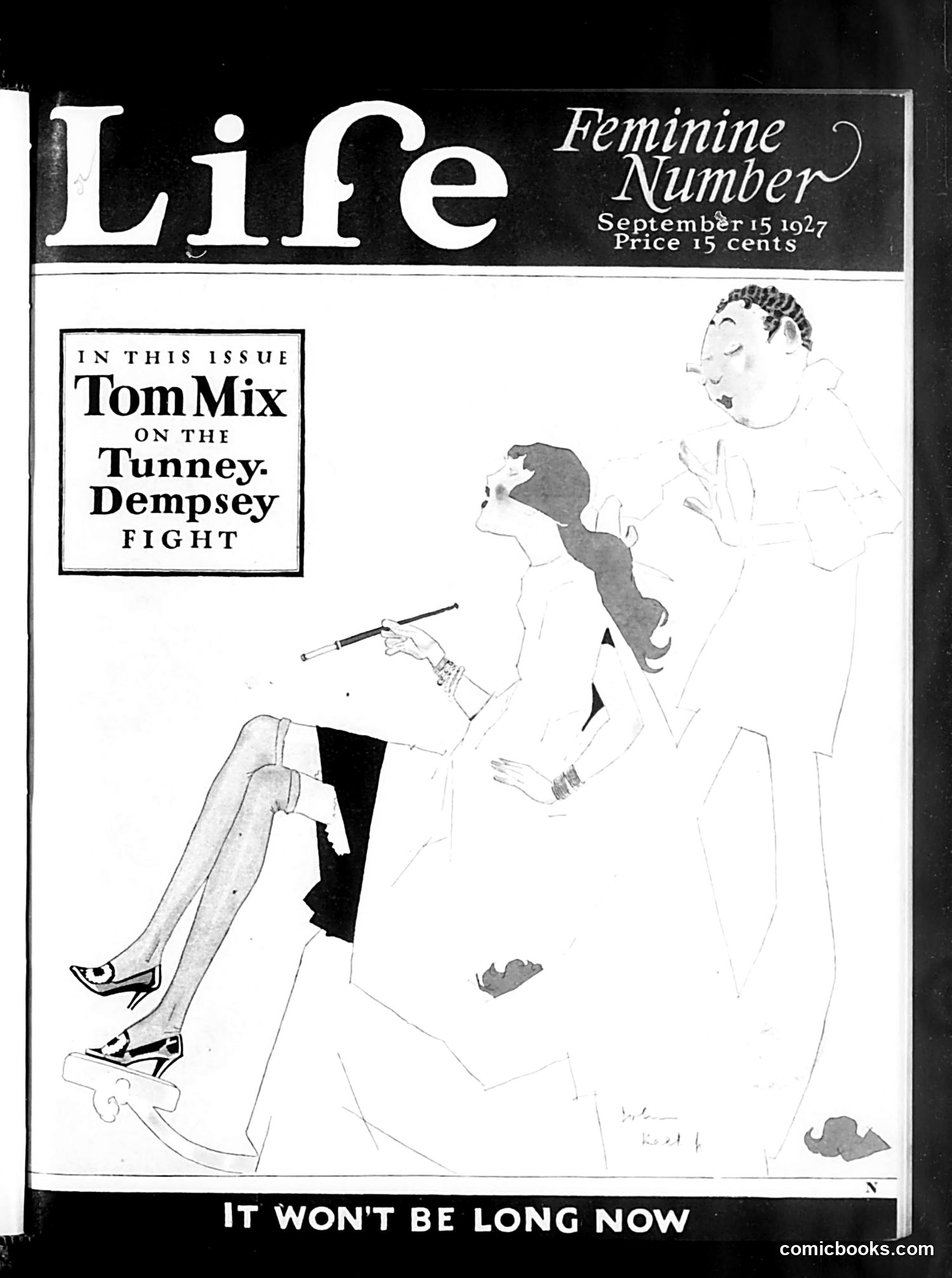
This is Life's "Feminine Number" cover featuring a satirical illustration about the Tunney-Dempsey boxing match. The image shows a woman in a negligee, holding a syringe, appearing to inject a man (likely representing one of the boxers). Two other male figures observe the scene. The satire likely mocks the intense public fascination with the heavyweight championship fight between Gene Tunney and Jack Dempsey—specifically suggesting that women were so captivated by the bout that they'd resort to extreme measures (the injection metaphor) to influence its outcome or secure attendance. The caption "It Won't Be Long Now" references the imminent fight date. This cover satirizes 1920s popular culture obsession with boxing and the unusual interest shown across gender demographics.
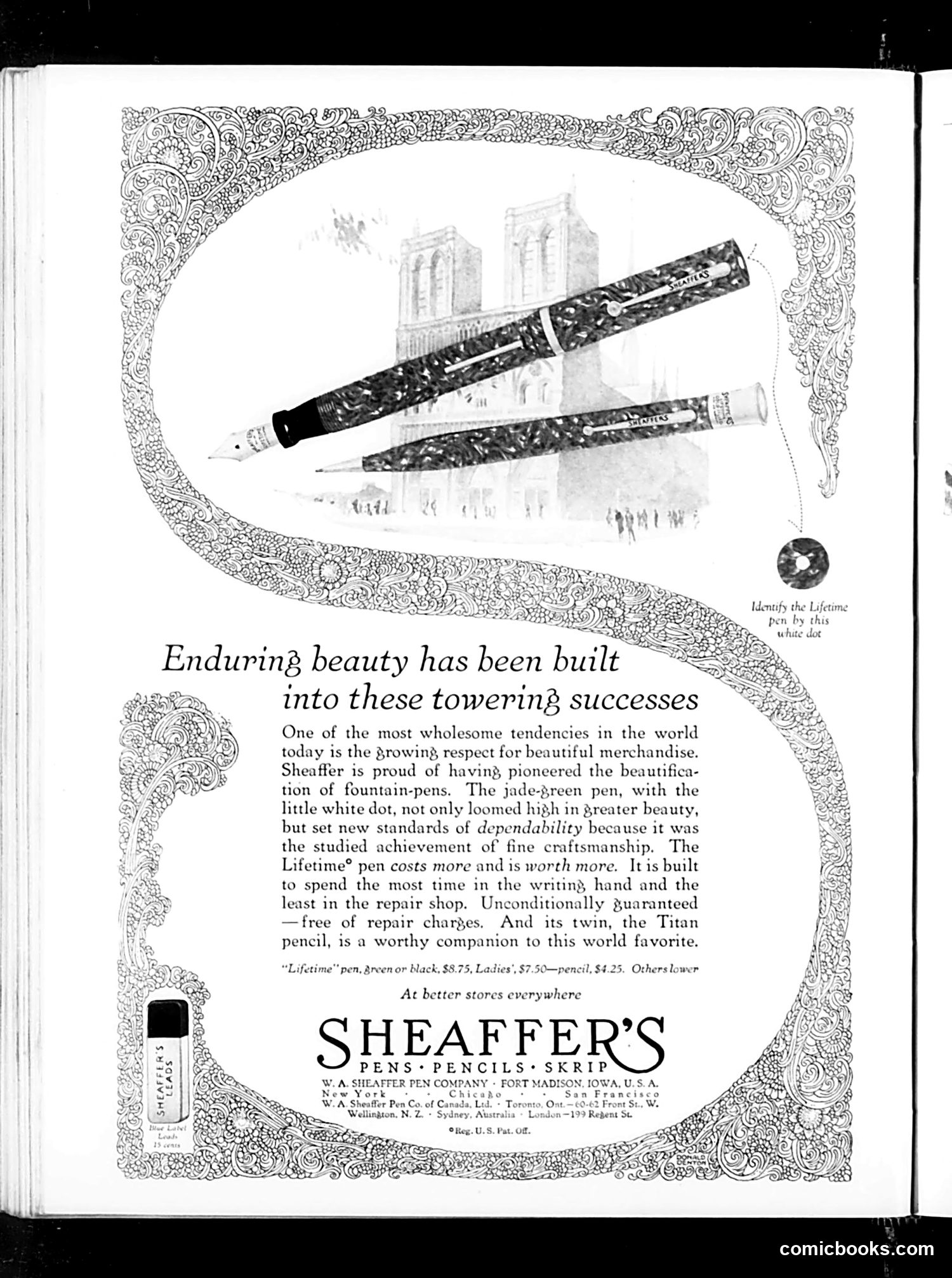
This is **not a political cartoon or satire**—it's a straightforward **advertisement for Sheaffer's fountain pens and pencils**, circa early 20th century. The page features two decorative pens displayed against a faded photograph of what appears to be a Gothic cathedral (likely Notre-Dame, given the twin towers). The ornate border is purely decorative, typical of period advertising design. The text promotes Sheaffer's "Lifetime" pen as a luxury product combining beauty with dependability and superior craftsmanship. It emphasizes the pen's durability, unconditional repair guarantee, and pairing with the "Titan" pencil. Pricing and retail information are included at bottom. This represents vintage commercial marketing rather than editorial satire or political commentary.
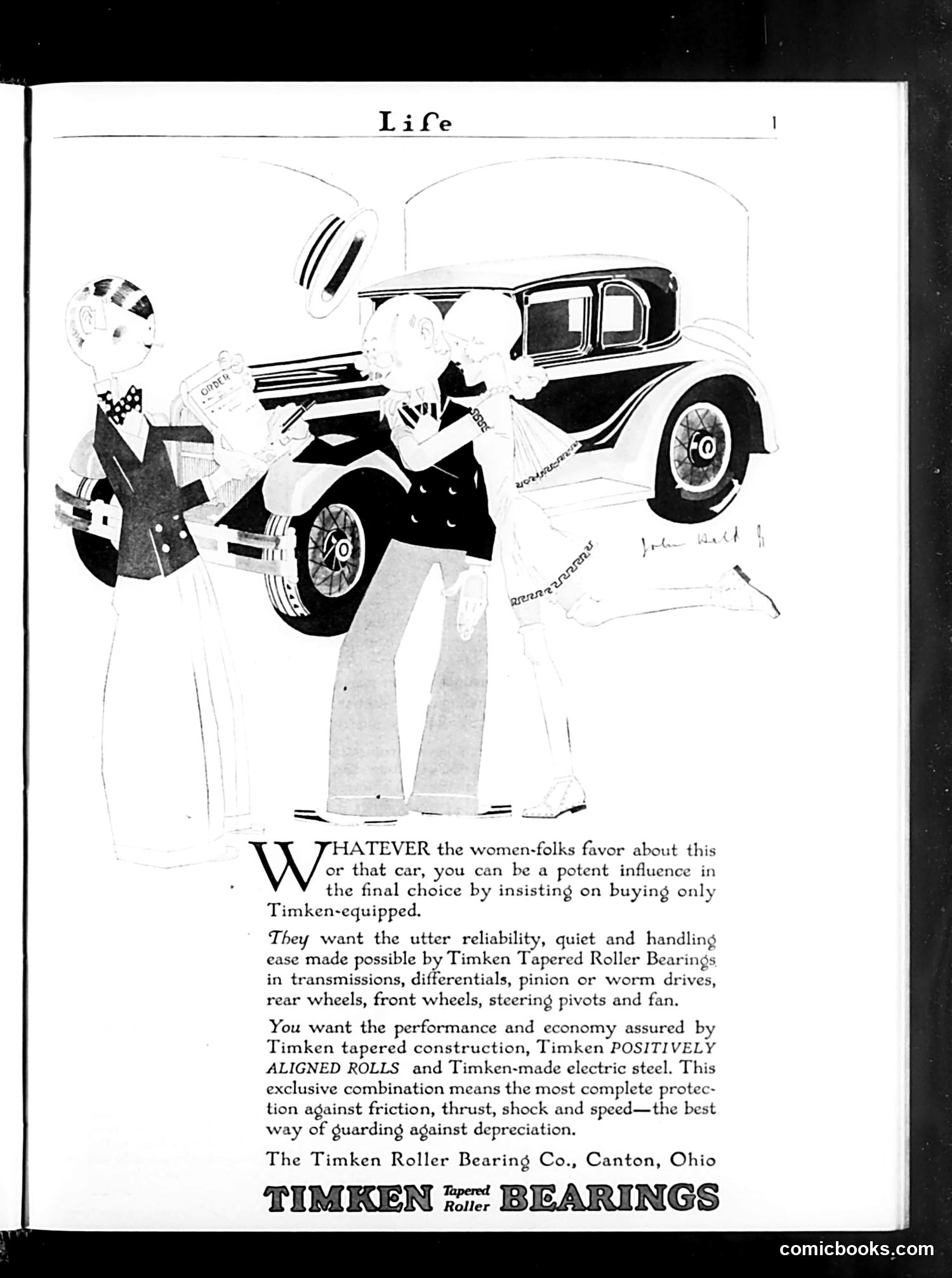
This page is primarily a **Timken Roller Bearings advertisement**, not satire or political commentary. The illustration shows two women examining an automobile, with a man presenting it to them. The ad's humor is genteel rather than satirical: it suggests that women influence car-purchasing decisions, and that a savvy man can sway their choice by emphasizing technical reliability—specifically Timken bearings. The text appeals to both "women-folks" (who allegedly prioritize reliability and ease of handling) and "you" (the male reader/decision-maker), promising that Timken components ensure performance, economy, and protection against depreciation. This reflects early 1900s gender assumptions: women as consumers whose preferences could be managed through appeals to practical concerns, while maintaining the conceit that men retain ultimate purchasing authority.
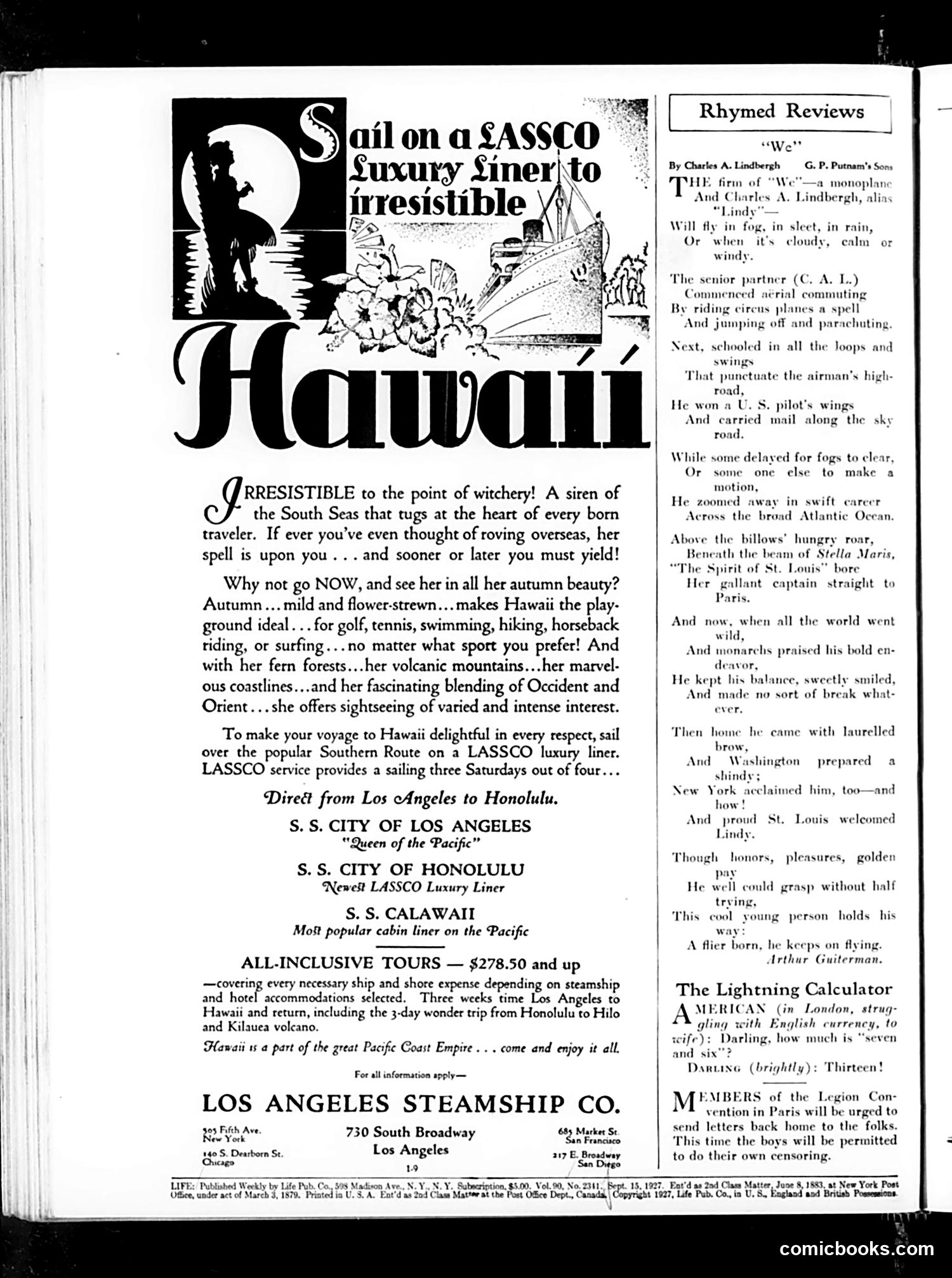
This page is primarily **commercial advertising** rather than political satire. The dominant content is a LASSCO (Los Angeles Steamship Company) advertisement promoting luxury cruises to Hawaii, featuring three steamships: the *City of Los Angeles*, *City of Honolulu*, and *Caluaii*. The right side contains "Rhymed Reviews"—light verse commentary, including a poem about "Lindy" (likely Charles Lindbergh, the famous aviator) making a transatlantic flight, and brief humorous exchanges titled "The Lightning Calculator" and a note about the Legion Convention in Paris. The illustration shows a silhouetted figure gazing at a ship—romantic imagery selling the Hawaii voyage to 1920s readers. This is period travel marketing, not political commentary.
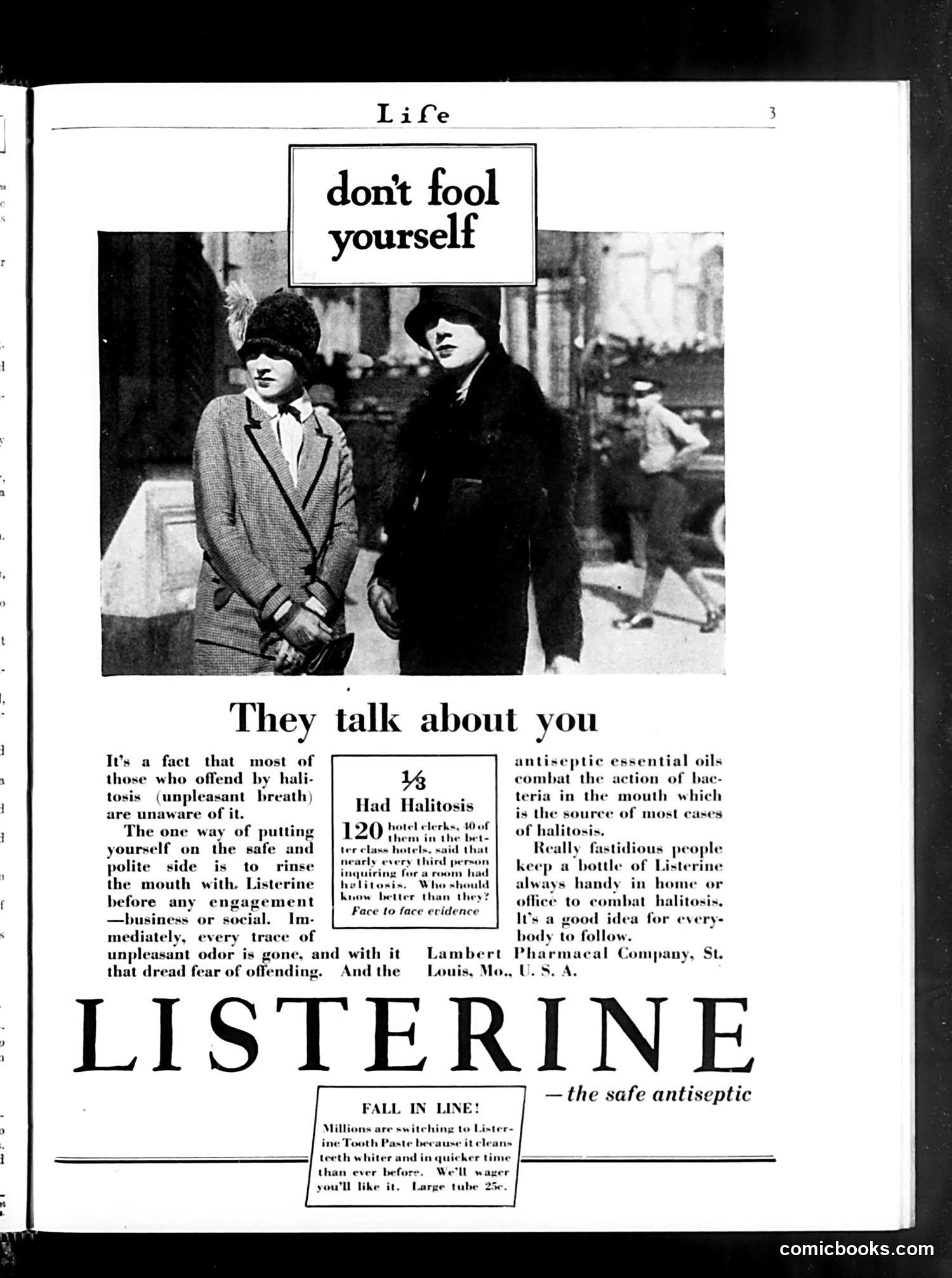
This is primarily a **Listerine advertisement** disguised as editorial content—a common early 20th-century marketing technique. The page mocks people with halitosis (bad breath) through the photograph of two women on a street. The caption "don't fool yourself / They talk about you" suggests that people with bad breath are socially ridiculed behind their backs. The ad argues that Listerine mouthwash is "the safe antiseptic" solution. A boxed statistic claims "1/3 Had Halitosis" among hotel clerks, implying the problem is widespread and socially damaging. The satire targets social anxiety and embarrassment rather than any political figure. It's a fear-based sales pitch: use Listerine or face social humiliation. This reflects Depression-era advertising that weaponized shame to sell products.
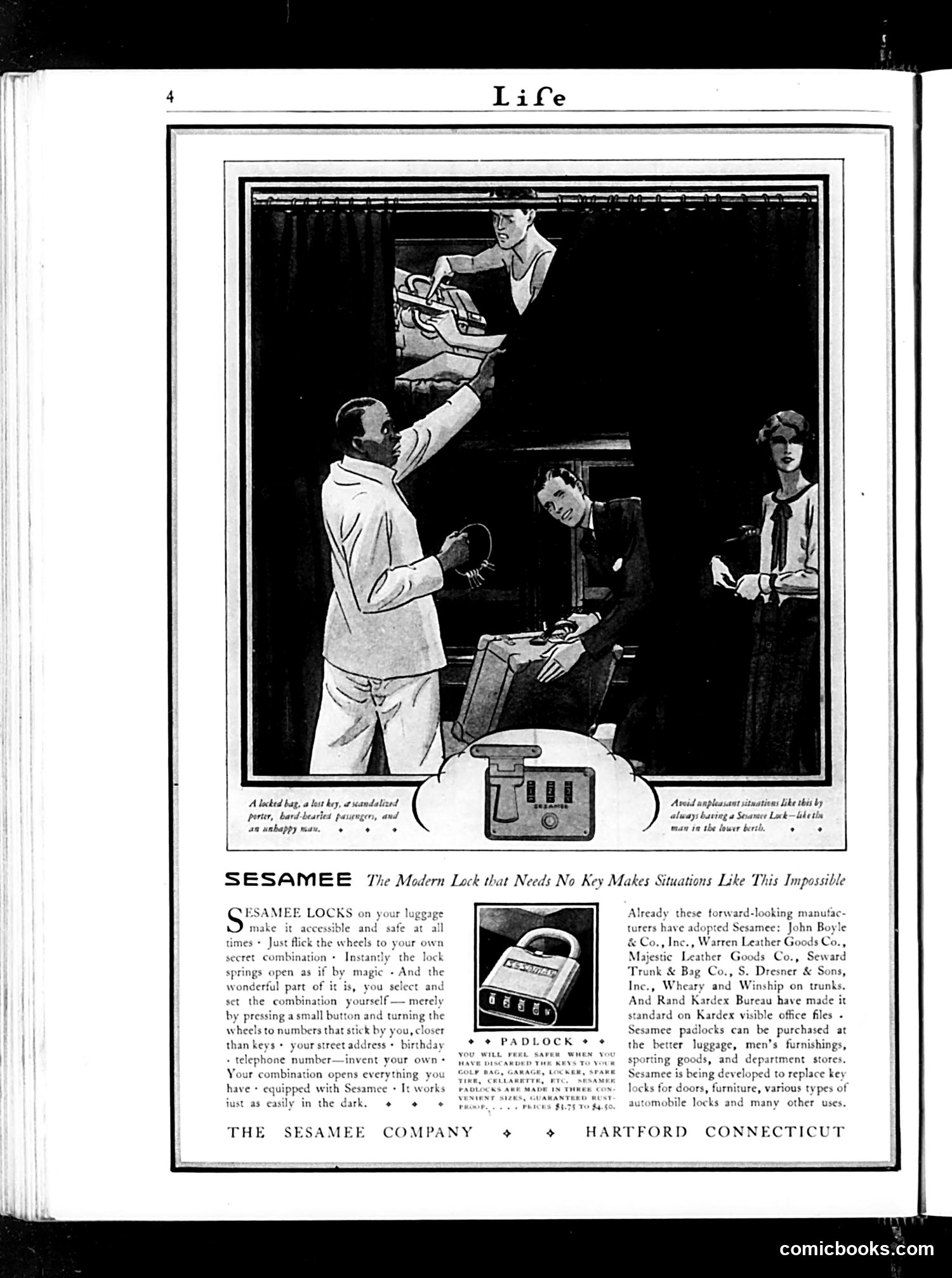
This page is primarily an **advertisement for Sesamee locks**, not political satire. The illustration depicts a comedic scenario about luggage security: a porter juggling multiple suitcases while passengers watch anxiously. The caption notes the "unpleasant situations" of lost luggage—a common travel problem of the era. The ad emphasizes Sesamee's convenience: a combination lock requiring no key, operated by pressing a button and turning dials. The text lists manufacturers already using Sesamee on trunks and luggage. The humor relies on relatable anxiety about travel rather than political commentary. It's a straightforward product advertisement leveraging everyday concerns about baggage safety to promote the lock's reliability and ease of use.
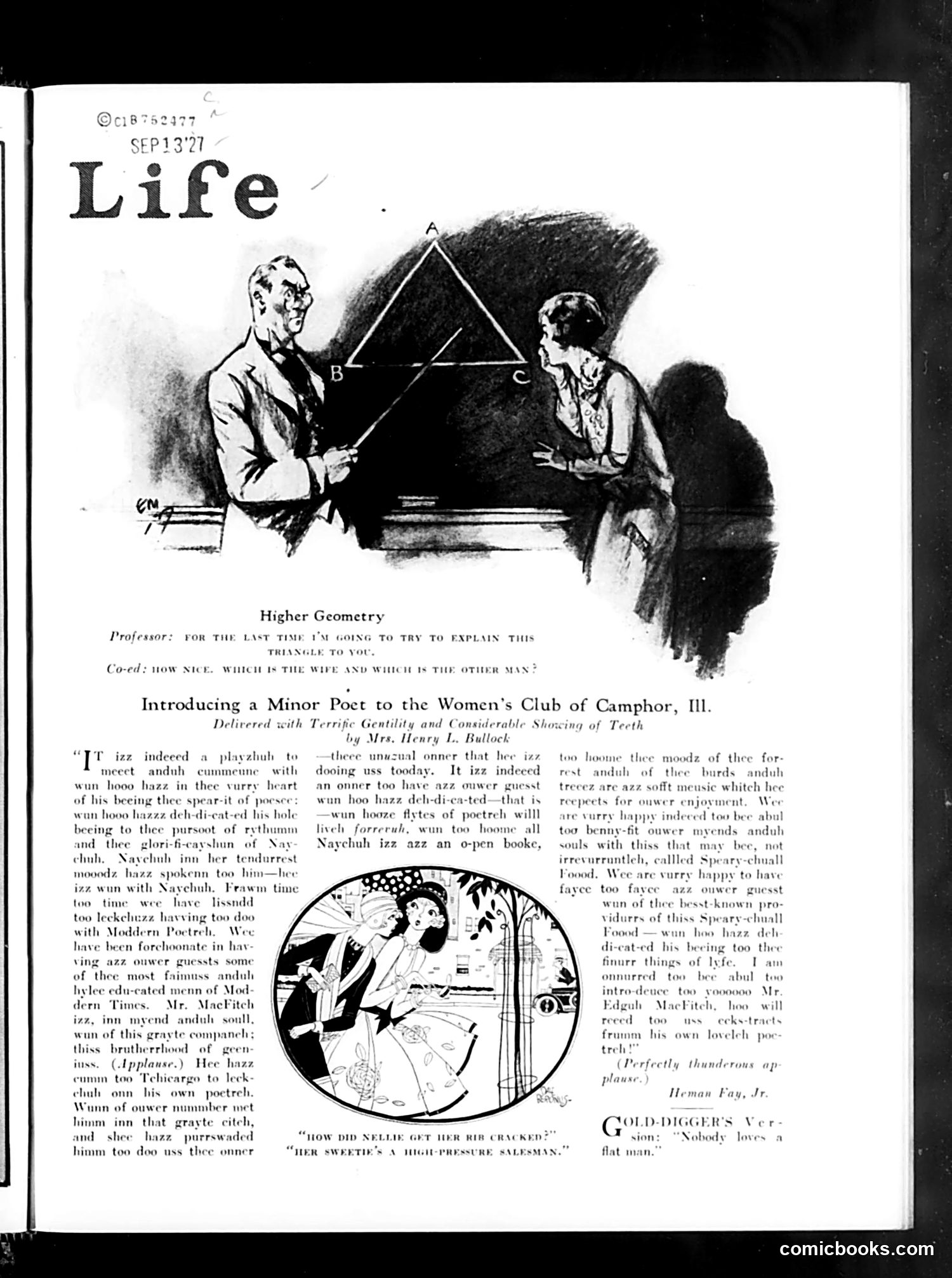
**Top Cartoon - "Higher Geometry":** A professor attempts to explain a triangle to a woman, apparently his wife. The joke plays on double meaning: the professor claims he's explaining geometry, but the caption hints at infidelity—asking which figure is "the wife and which is the other man?" This satirizes academic pretense used as cover for romantic entanglements. **Bottom Illustration - "How Did Nellie Get Her Rib Cracked?":** Depicts a woman injured by a "high-pressure salesman," likely a reference to aggressive salesmen of the era. The accompanying text introduces a minor poet to a women's club, suggesting satire of artistic pretension and amateur poetry readings popular among women's social clubs of the 1920s.
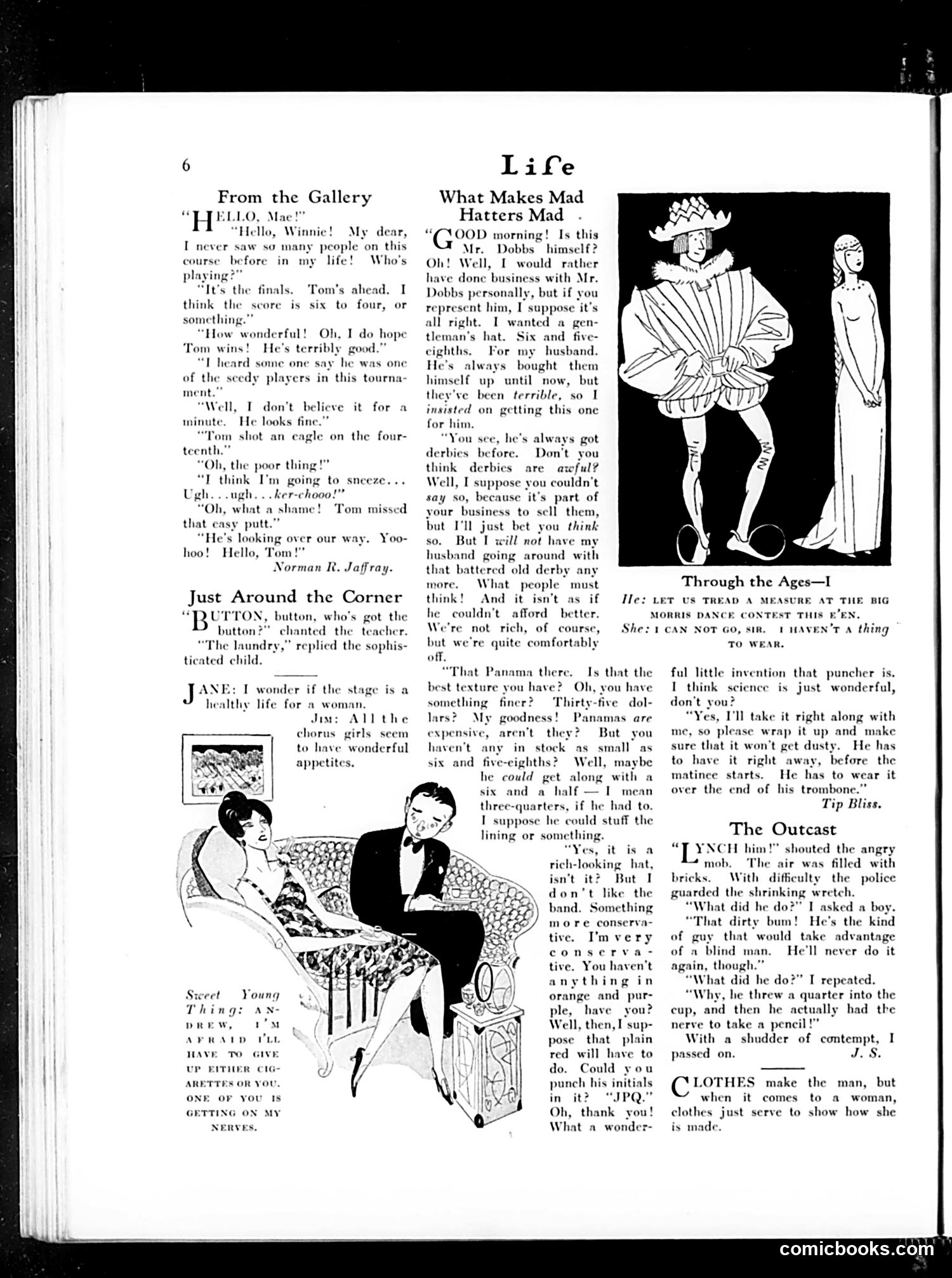
This page contains several short humorous sketches typical of *Life* magazine's satirical style: **"From the Gallery"** mocks tennis spectators' overwrought enthusiasm—someone sneezes and is mistaken for cheering. **"Just Around the Corner"** features "Button" being scolded by a teacher for saying the laundry is "all wet"—a pun on outdated slang. **"What Makes Mad Hatters Mad"** satirizes a husband's obsession with buying expensive Panama hats despite his wife's objections. The joke hinges on the wife's exasperation with his wasteful hobby. **"The Outcast"** describes a boy being shunned for theft—he stole a quarter to buy pencils, apparently considered dishonorable. **"Through the Ages"** shows period costumes, likely contrasting historical dress with modern fashion standards. The overall tone reflects 1920s-era social commentary on class, propriety, and gender dynamics.
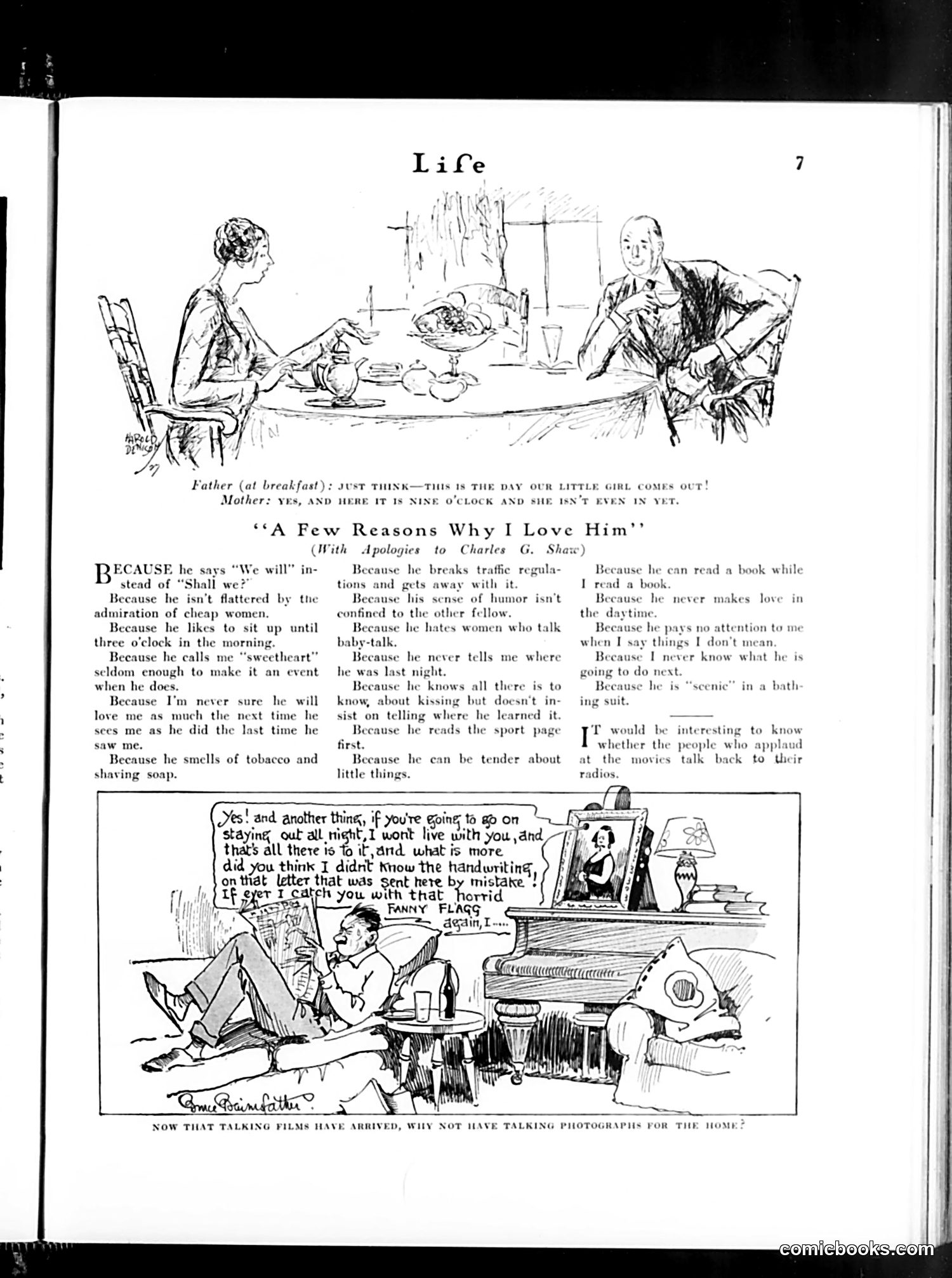
This page contains two satirical pieces about romantic relationships and courtship: **Top illustration**: A breakfast scene where a father comments on their daughter's impending debut ("coming out") into society at nine o'clock, implying early marriage prospects. **"A Few Reasons Why I Love Him"**: A humorous list of backhanded compliments about a male suitor—he says "we will" instead of "I shall," isn't flattered by cheap women, and notably "reads the sport page first." The satire mocks both women's lowered expectations in romance and men's indifference to their partners' interests. **Bottom cartoon**: By Fontney Flagg, depicts a couple at the movies. The woman complains about his handwriting on a note, sarcastically suggesting talking pictures might lead to "talking photographs for the home"—satirizing the recent arrival of sound films (talkies) and humorously proposing an unwanted domestic equivalent.
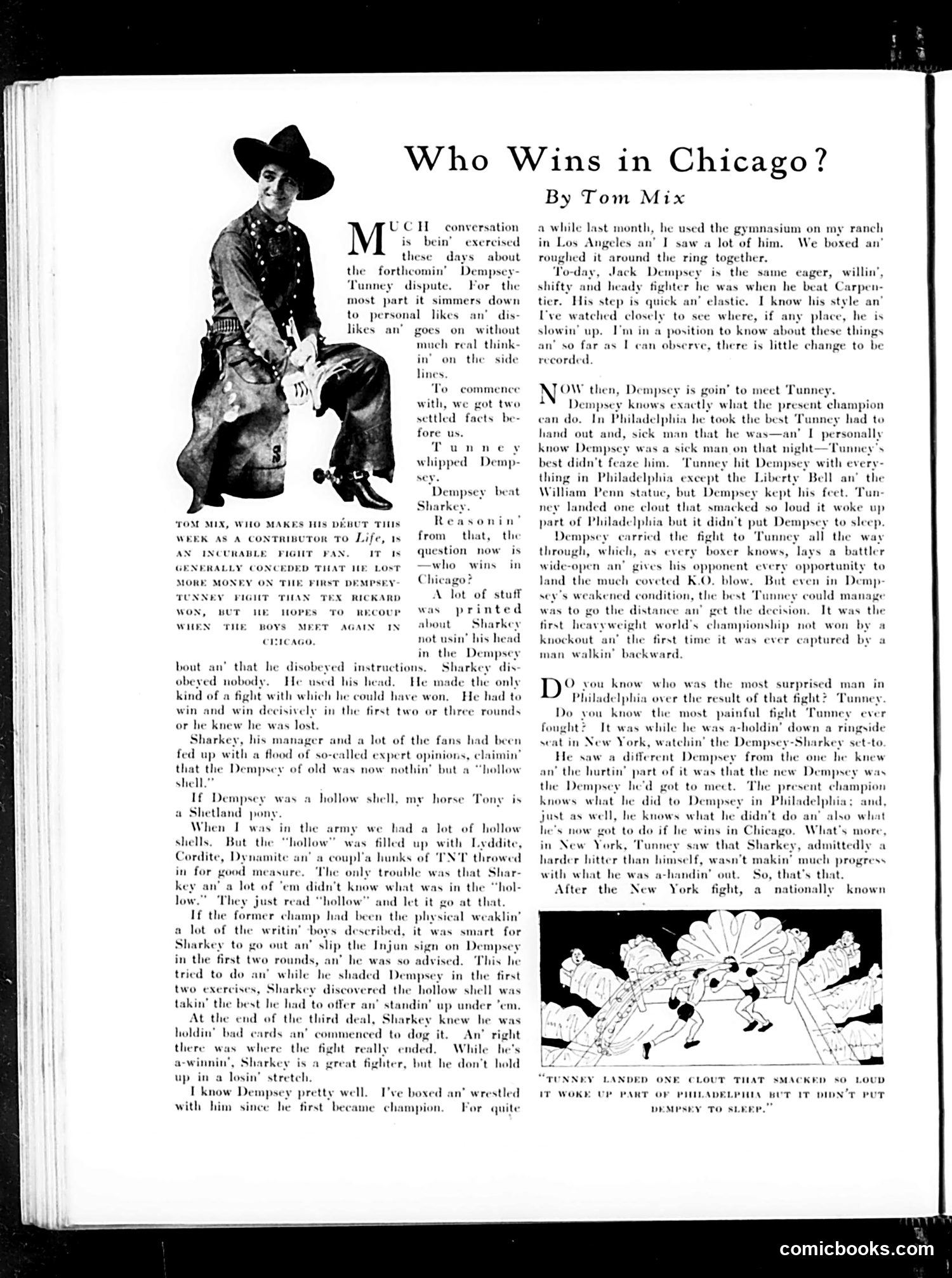
This article by Tom Mix (a famous Western film star of the era, shown in the cowboy portrait) discusses the upcoming boxing match between heavyweight champions Jack Dempsey and Gene Tunney. Mix analyzes their fighting styles, comparing Dempsey's aggressive approach to Tunney's technical skill and speed. The piece references their Philadelphia fight where Tunney defeated Dempsey, and anticipates their upcoming Chicago rematch. Mix suggests Tunney's superior conditioning and boxing technique may overcome Dempsey's raw power, though he acknowledges Dempsey remains dangerous. The cartoon illustration shows Tunney landing a knockout blow so forceful it literally launches Dempsey out of the ring, humorously exaggerating the fight's impact on Philadelphia.
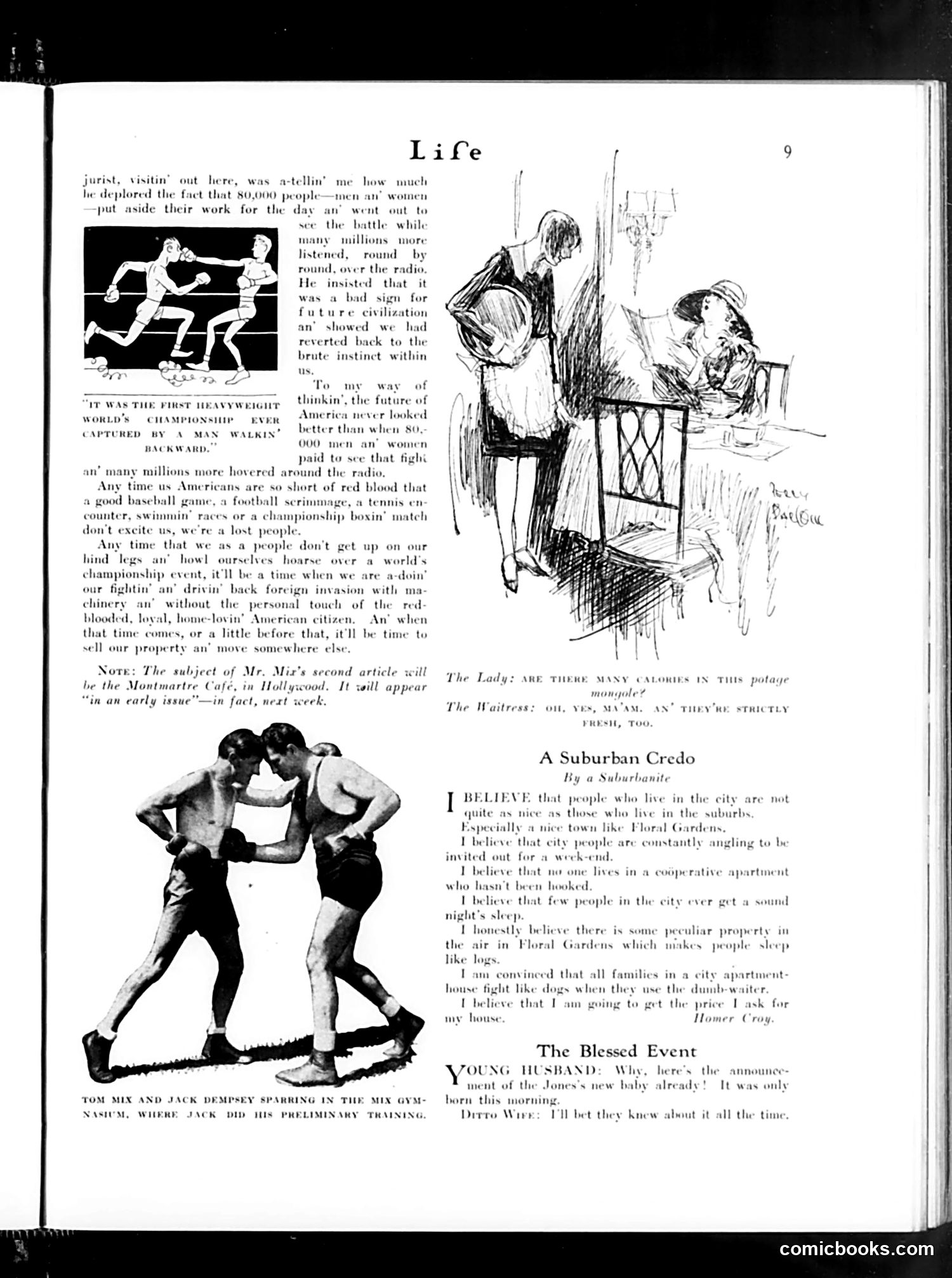
The page contains three distinct pieces: 1. **Top left**: A boxing illustration captioned about "the first heavyweight world's championship ever attended by a Nazi salesman." The text criticizes how 50,000 people abandoned their work to watch a boxing match on radio, suggesting this reflects poorly on American civilization. The satire mocks both mass entertainment obsession and Nazi-era priorities. 2. **Top right**: A sketch of a waitress and customer discussing "calories in this potage" and fresh ingredients—appears to be light domestic humor about restaurant dining. 3. **Bottom section**: Two pieces—"A Suburban Credo" (satirizing suburban life's peculiarities like apartment living complaints) and "The Blessed Event" (a domestic humor dialogue about a new baby). The Tom Mix/Jack Dempsey boxing photo caption references preliminary training. The page emphasizes American social satire from the interwar period.
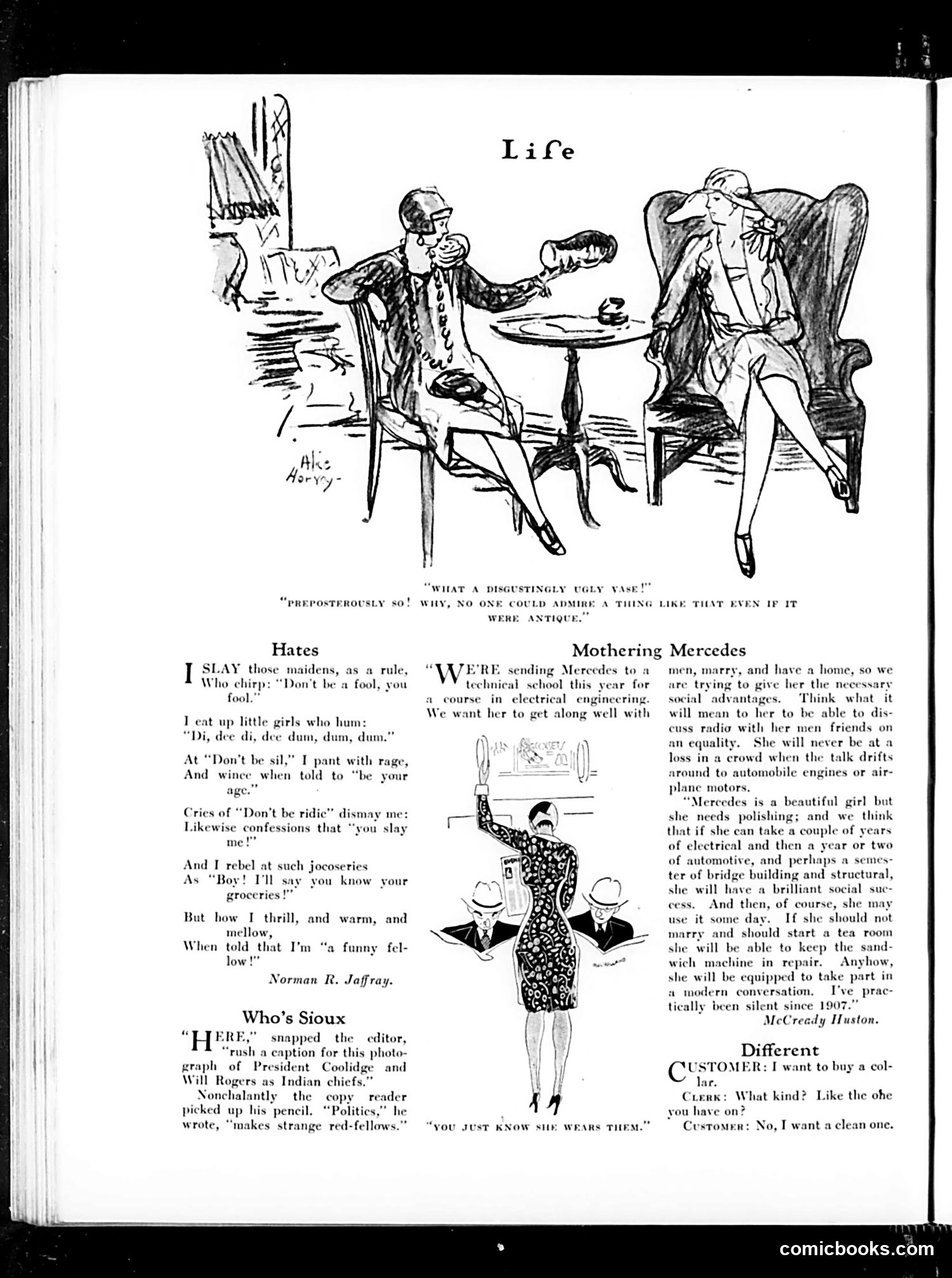
This page contains three separate satirical pieces from Life magazine: 1. **Top cartoon "Life"**: Two well-dressed figures discuss an ugly vase, with one saying "no one could admire a thing like that even if it were antique" — satire on pretentious aesthetes who value objects solely for their age or claimed artistic merit. 2. **"Hates"** (poem by Norman R. Jaffray): Satirizes annoying social behaviors — girls who hum "di, die, die, dum," people who say "don't be sil," and those dismissing youthful exuberance as foolish. 3. **"Mothering Mercedes"**: Mocks upper-class mothers' plans to send their daughters to technical schools (electrical engineering), predicting the daughters will abandon education for marriage, socializing, and ultimately opening a tea room — satirizing women's limited professional prospects and expectations in this era.
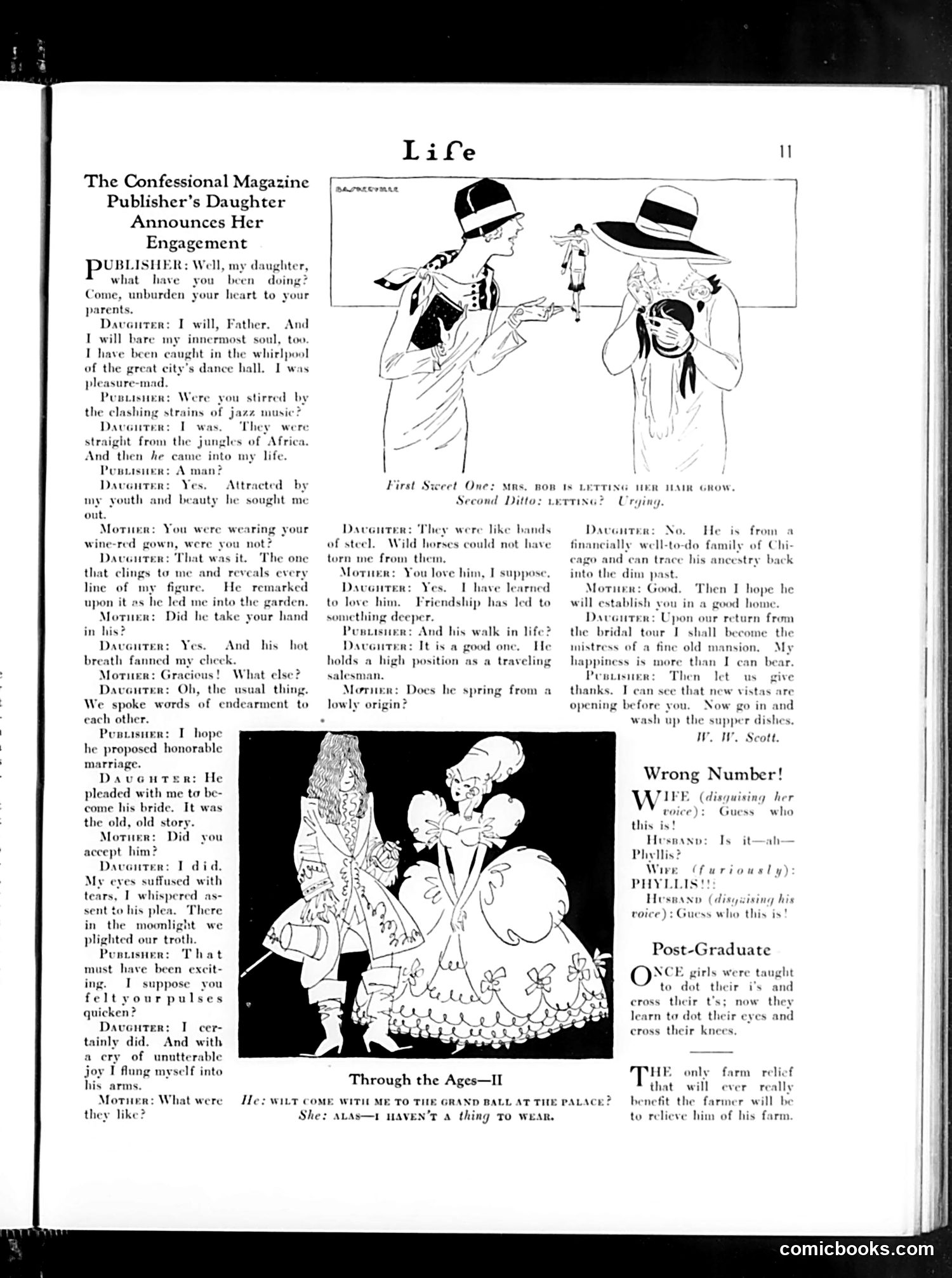
This page contains three satirical pieces typical of early 20th-century Life magazine humor: 1. **"The Confessional Magazine Publisher's Daughter"**: A dialogue satirizing young women's behavior and expectations. The daughter confesses to attending jazz dances and meeting an African man, shocking her conventional father. The satire targets both the "modern" flapper generation and parental anxiety about changing social norms. 2. **"Through the Ages—II"**: A cartoon mocking courtship rituals across historical periods, showing elaborate dress and social pretense. 3. **"Wrong Number!" and "Post-Graduate"**: Brief comedic sketches about marital misunderstandings and farm relief policy. The overall tone reflects 1920s anxieties about modernization, youth culture, and changing social conventions, particularly regarding women's independence and interracial contact.
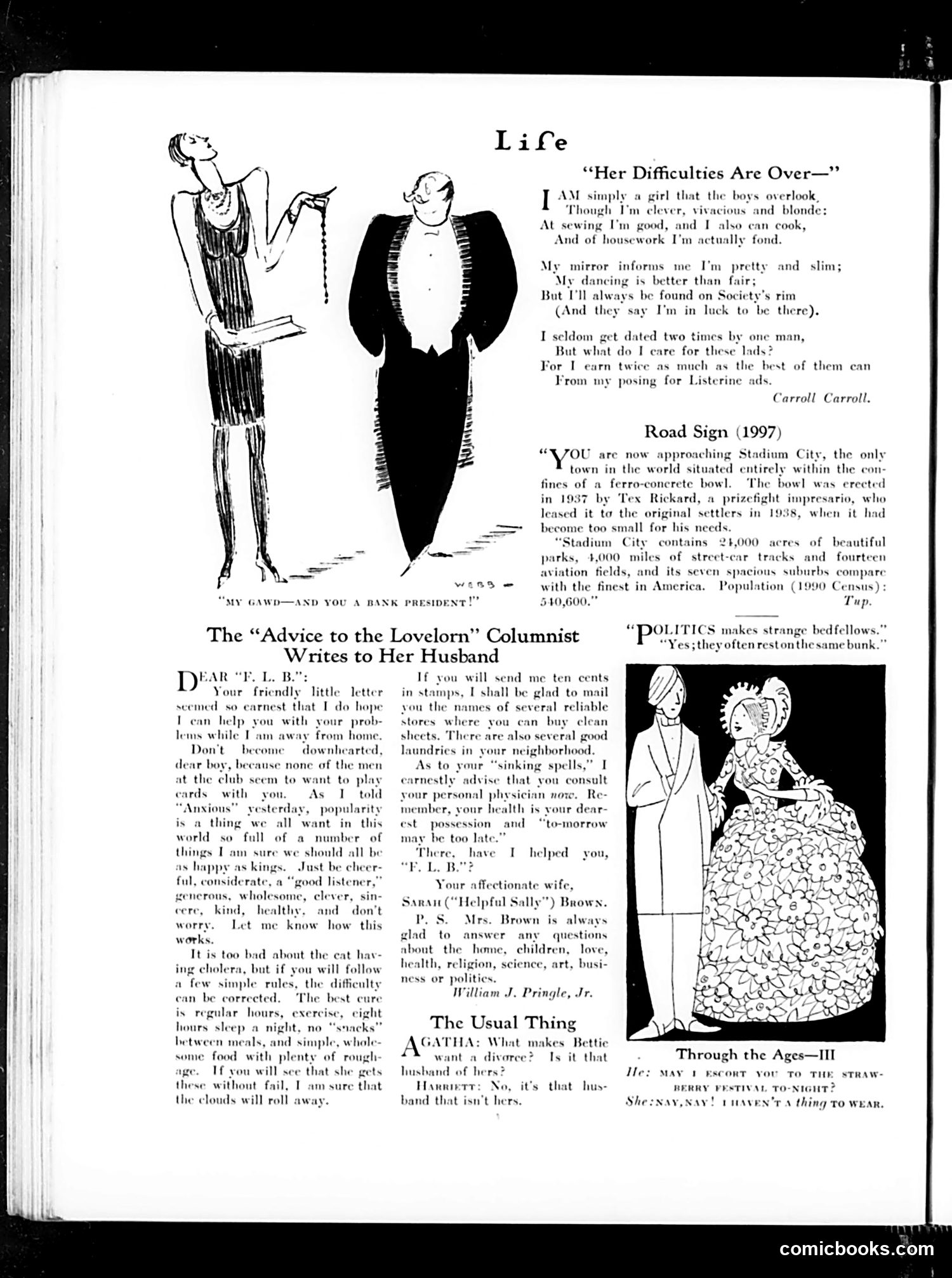
This page contains satirical advice columns and humor typical of early-20th-century Life magazine. The top illustration shows two figures: a thin, elegantly-dressed woman and a portly man in formal wear, captioned "MY GAMP—AND YOU A BANK PRESIDENT!" The joke appears to mock the woman's presumption or the man's pretension regarding financial status. The "Advice to the Lovelorn" column provides tongue-in-cheek marriage guidance, while "The Usual Thing" presents a brief comedic dialogue between characters named Agatha and Harriett about divorce. The illustrations use exaggeration and caricature typical of the era's satirical style. Without publication date confirmation from the image, the specific social references remain somewhat unclear, though the humor targets romantic relationships and marital expectations of the period.
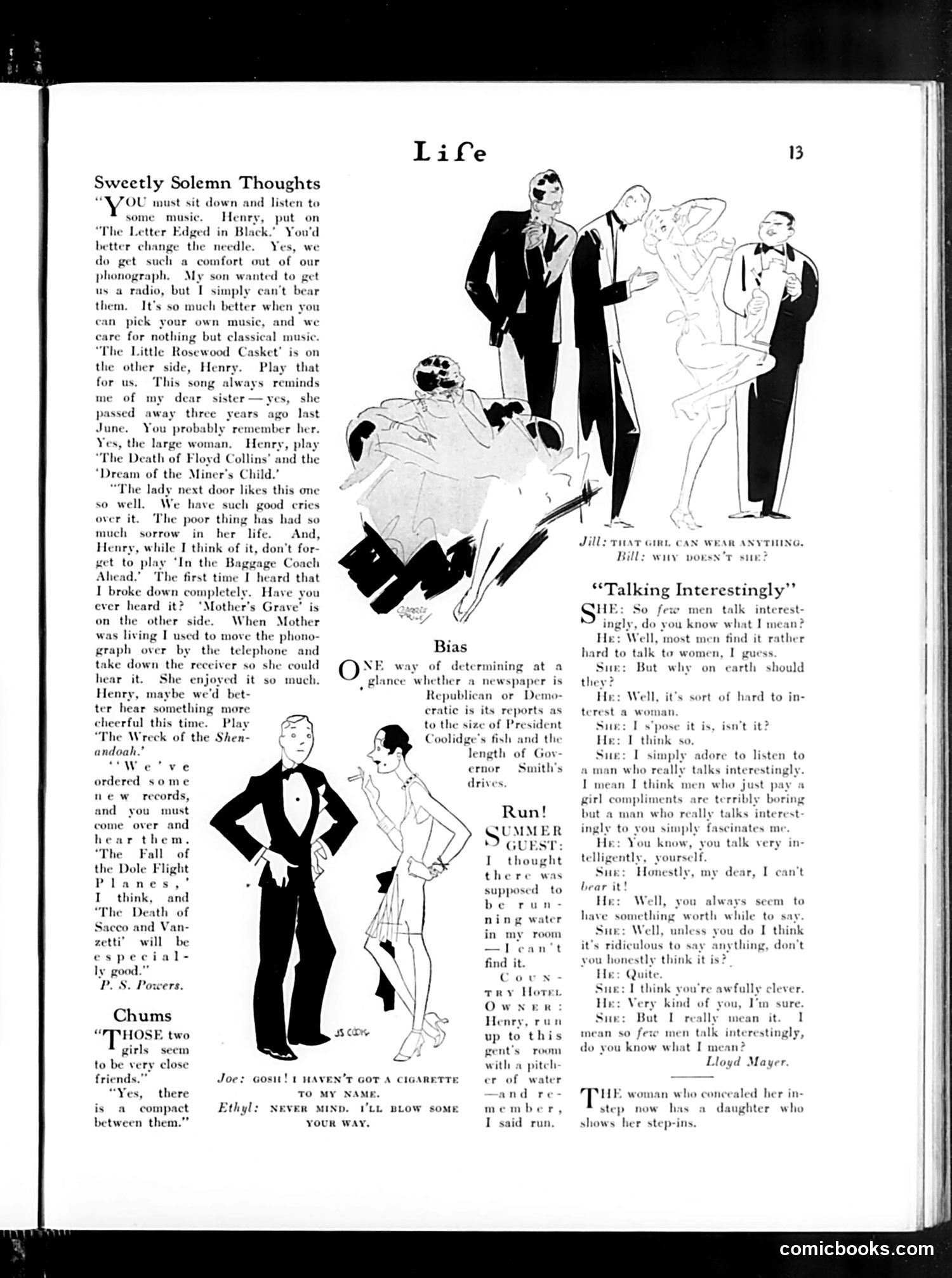
This page contains humorous sketches and dialogue about social etiquette and relationships, typical of Life's satirical content. **"Sweetly Solemn Thoughts"** presents a monologue about classical music preferences over phonographs and radio, referencing specific pieces like "The Little Rosewood Casket" and "The Death of Floyd Collins"—popular sentimental songs of the era. **"Bias"** satirizes newspaper editorial stance, showing how Republican or Democratic papers report the same events differently. **"Run!"** depicts a hotel owner's concern about water in his room—a bathroom humor joke. **"Chums"** shows two girls with a compact romantic relationship. **"Talking Interestingly"** features a dialogue about what makes men attractive conversationalists to women, concluding that men who listen interest women more than those who merely compliment. The illustrations use period-appropriate styling typical of 1920s-30s Life magazine humor.
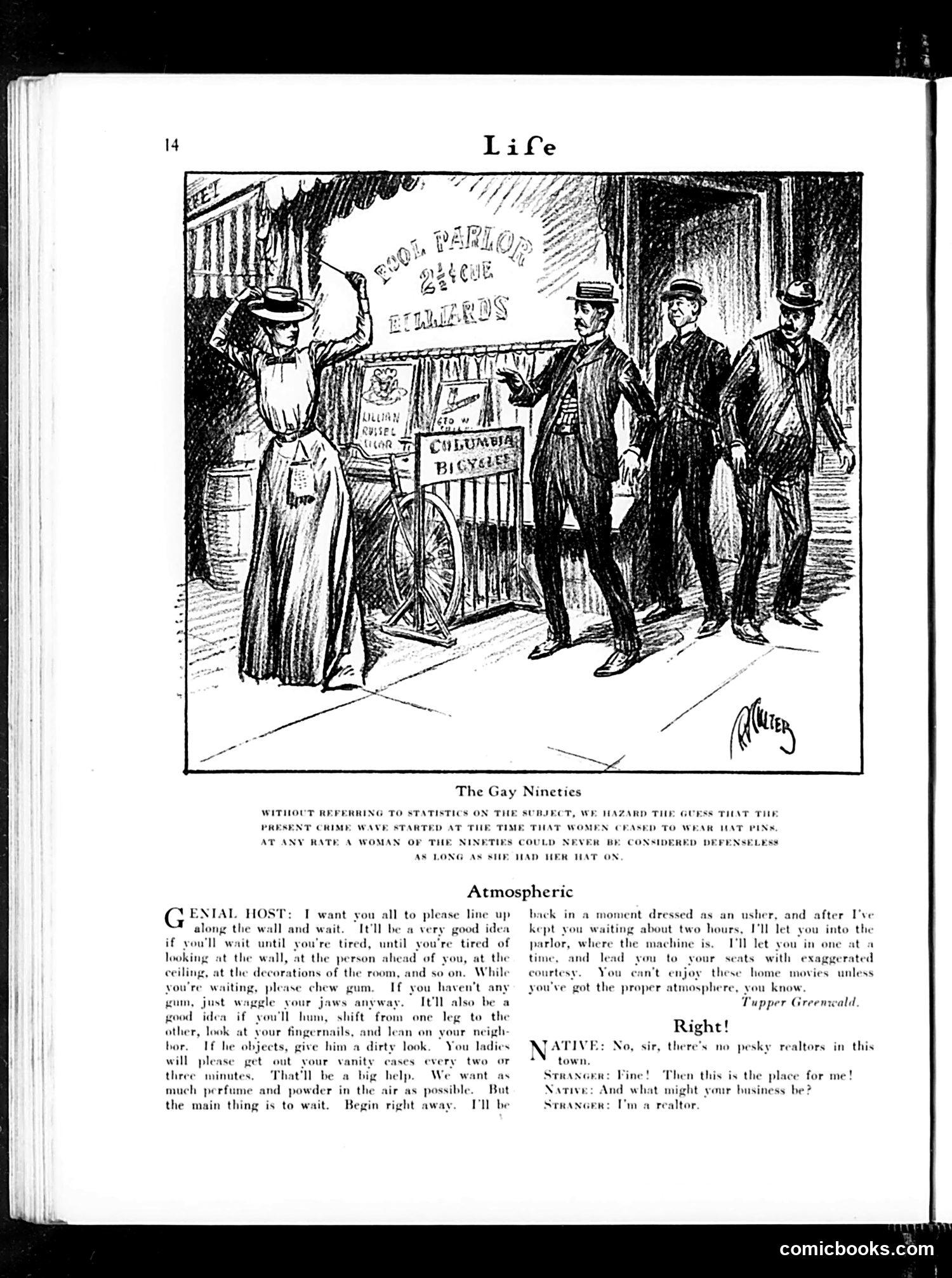
This cartoon satirizes 1890s fashion, specifically the requirement that respectable women wear hats in public. The caption—a tongue-in-cheek commentary on crime statistics—claims that women couldn't be considered "defenseless" as long as they wore hats, suggesting the hat itself was their weapon or protection. The illustration shows a well-dressed woman pointing assertively at three men outside what appears to be a bicycle shop (note the "Columbia Bicycle" sign). The woman's prominent hat and commanding posture suggest she's the dominant figure in this interaction. The humor targets Victorian-era gender norms and the absurdity of attributing women's safety to millinery fashion rather than actual social change. It's satirizing both the era's strict dress codes and the statistical claims used to justify them.
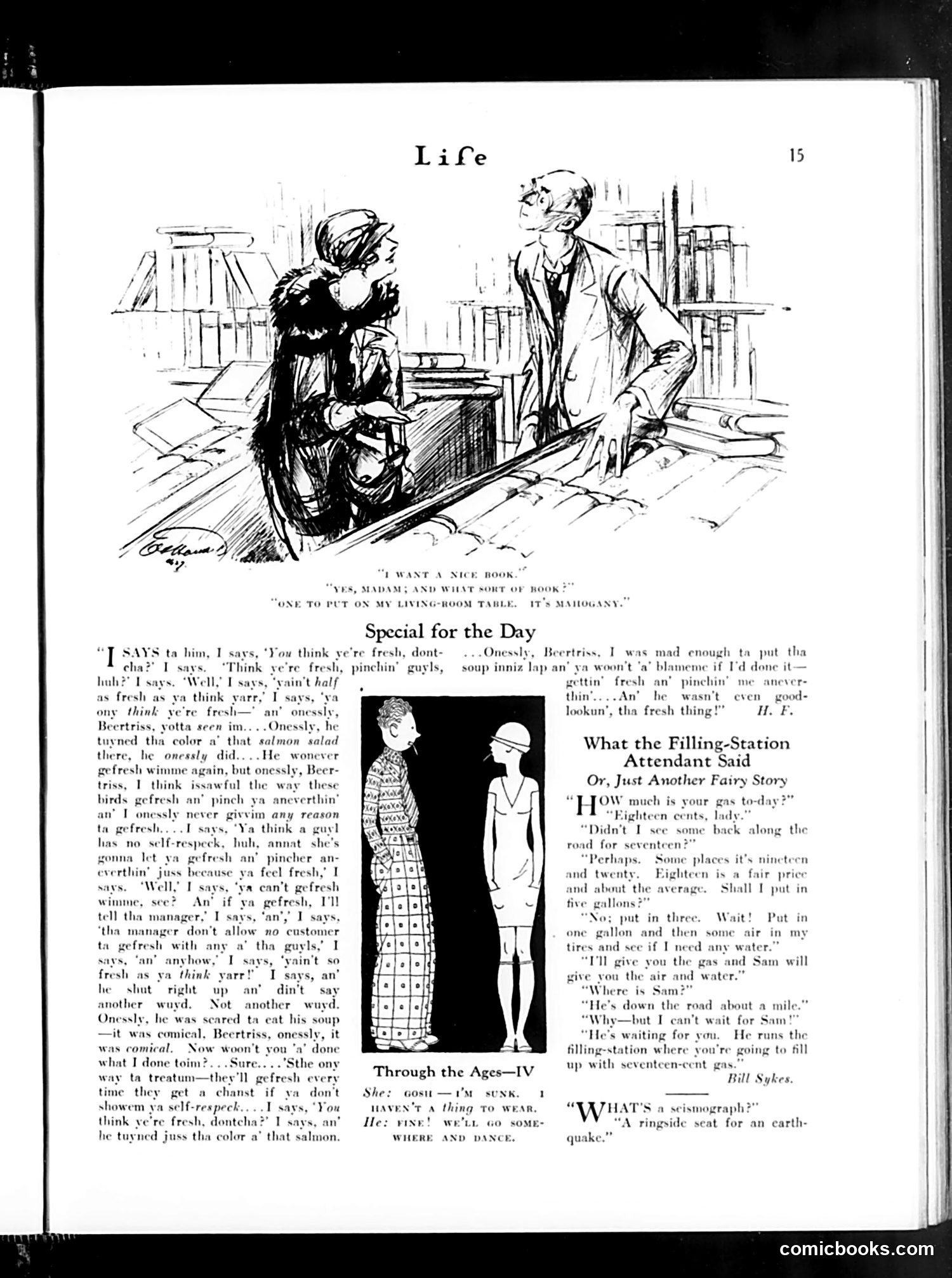
This page contains three distinct humorous pieces typical of early-20th-century satirical magazines: 1. **Top cartoon**: A woman asks a bookseller for "a nice book" suitable for her living room table, preferring mahogany furniture. The joke mocks pretentious home decorating—prioritizing how books look over their content. 2. **"Special for the Day"**: A dialogue satirizing aggressive sales tactics. A customer and salesman debate whether "fresh" goods (likely produce) are actually fresh, with the salesman using circular logic and dismissive attitudes toward customer concerns. It critiques deceptive retail practices. 3. **"Through the Ages—IV"**: A fashion illustration contrasting historical dress with modern attire, labeled with period-appropriate dialogue about dancing and formality—likely commenting on changing social conventions. The overall theme: consumerism, sales manipulation, and social pretension.
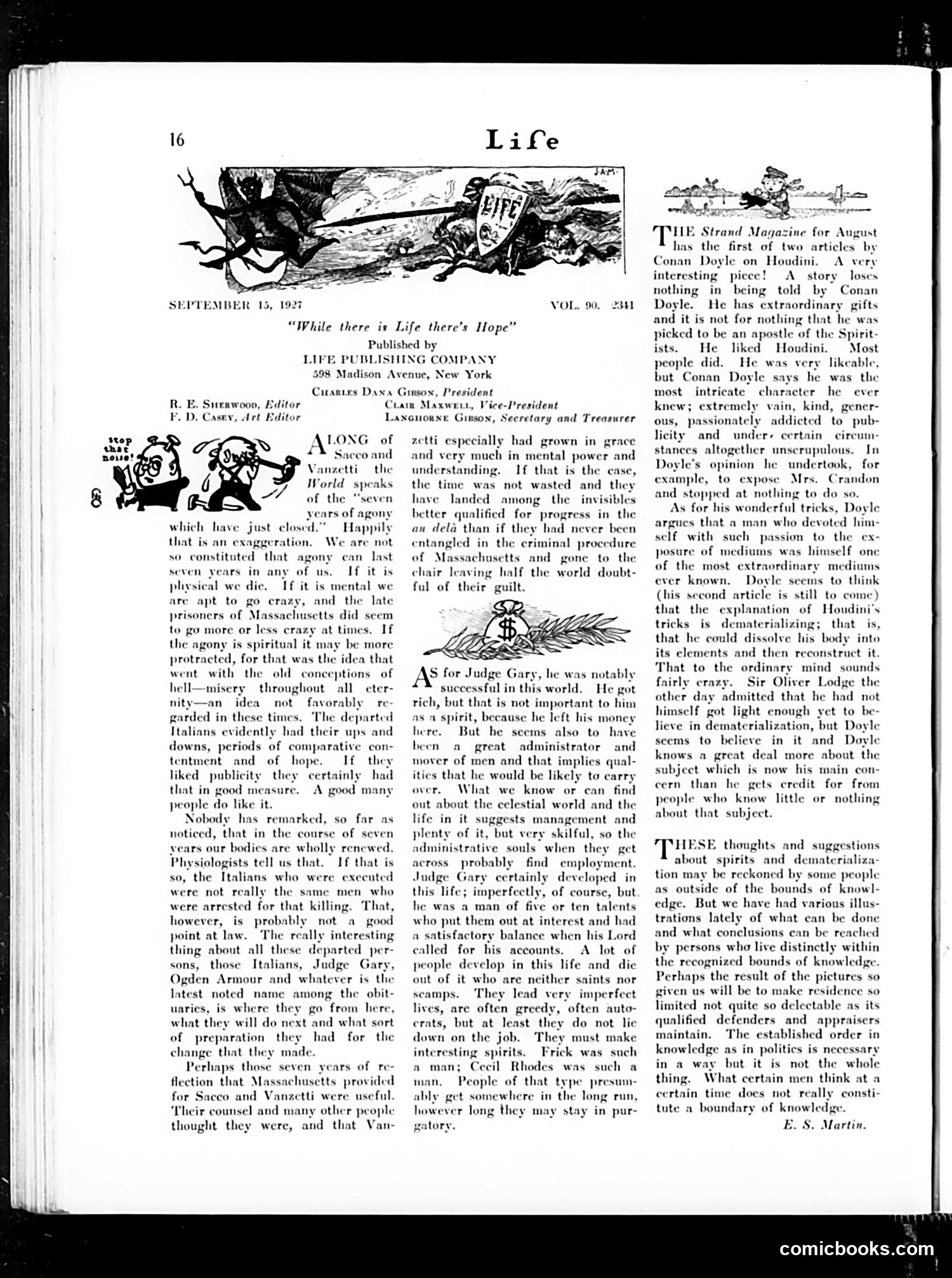
This page contains an editorial article by E.S. Martin discussing spiritualism and mediums, particularly referencing Houdini (the famous magician and spiritualist debunker). The article mentions Conan Doyle's articles on Houdini from The Strand Magazine. The masthead illustration shows a skeleton or death figure, labeled "LIFE," appearing to flee or escape—likely a visual metaphor for the magazine's satirical approach. The article argues against belief in spiritualist mediums, suggesting that people claiming supernatural powers are either deluded or fraudulent. It uses examples like Judge Gary to illustrate how intelligent people can be fooled. The piece advocates for rational skepticism while acknowledging the human desire to believe in an afterlife—a timely debate during the 1920s spiritualism craze.
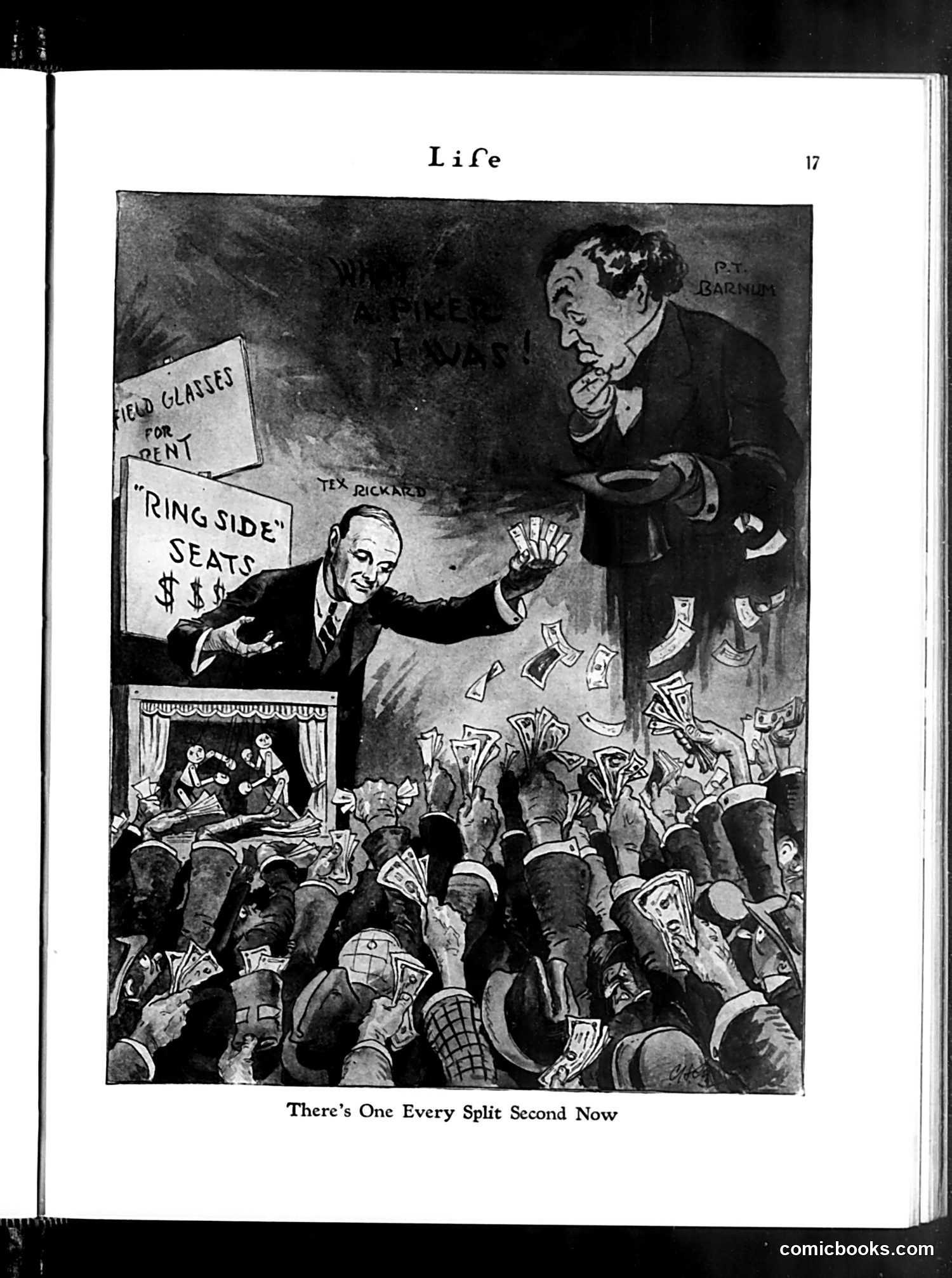
This Life magazine cartoon satirizes ticket scalping at theatrical performances. The image shows two figures—labeled "P.T. Barnum" (the famous showman) and "Tex Rickard" (a prominent boxing promoter)—standing above a crowd throwing money into the air. A sign advertises "Field Glasses for Rent" and "'Ring Side' Seats" at inflated prices. The caption "There's One Every Split Second Now" suggests the explosive growth of scalping and price gouging. The cartoon mocks how promoters exploit audiences' eagerness to attend popular events by charging excessive prices for poor viewing positions. The raining money symbolizes the public's willingness to overpay. This reflects early 20th-century frustration with scalpers' profit-taking from entertainment venues.
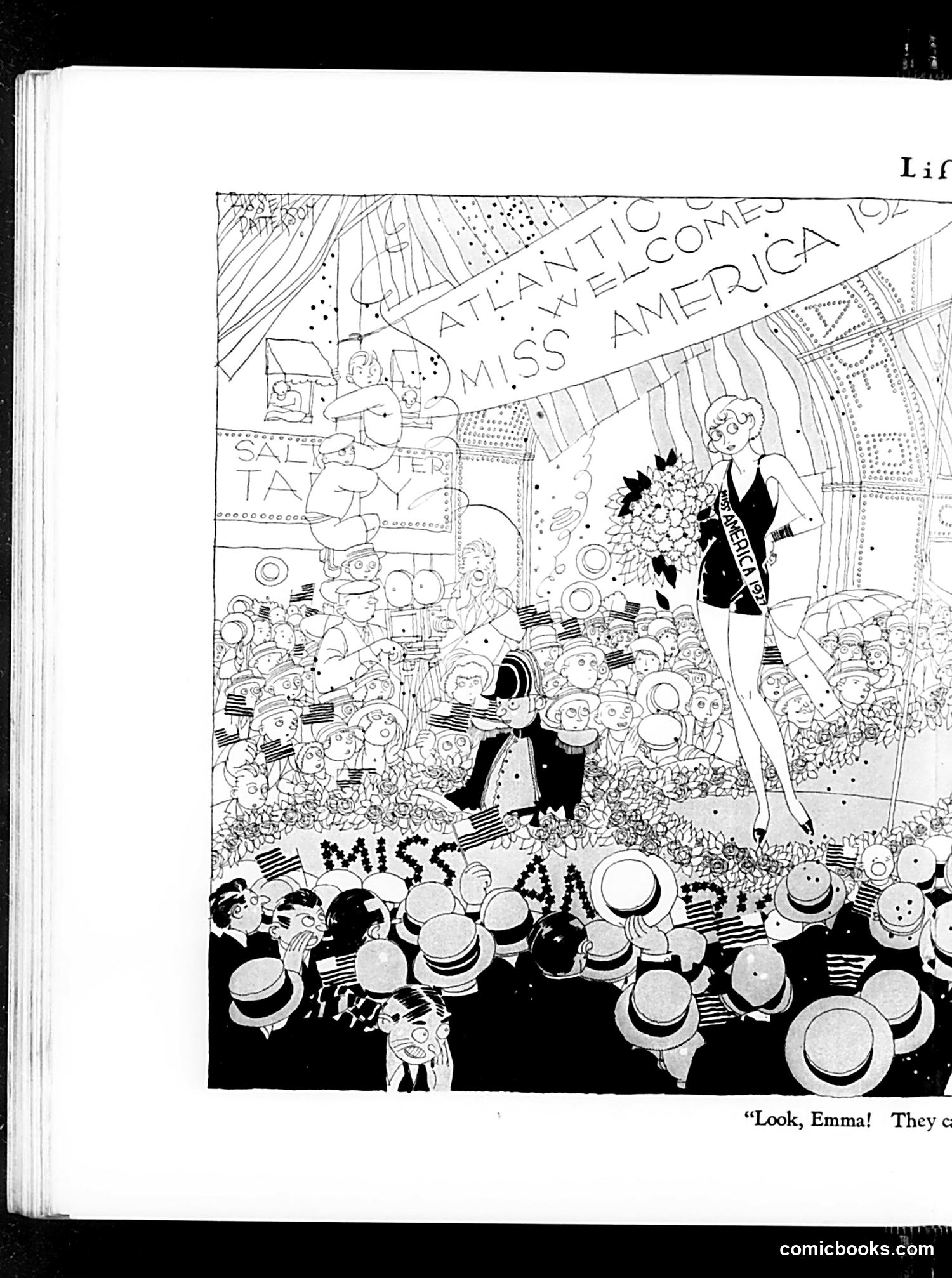
This illustration satirizes the **Miss America pageant**, depicting the crowning of a beauty queen aboard what appears to be the ocean liner *SS America*. The scene shows a glamorous woman in an evening gown holding flowers, wearing a sash, positioned before a massive crowd of admirers holding American flags and wearing formal attire. The satire likely mocks the **commercialization and spectacle of American beauty pageants**, portraying them as extravagant, nationalistic celebrations that attract enormous crowds and media attention. The architectural detail and scale emphasize how the pageant transforms an ordinary woman into a celebrated public figure. The caption beginning "Look, Emma!" suggests commentary on the event's cultural prominence and public fascination with beauty contests during this era of American popular entertainment.
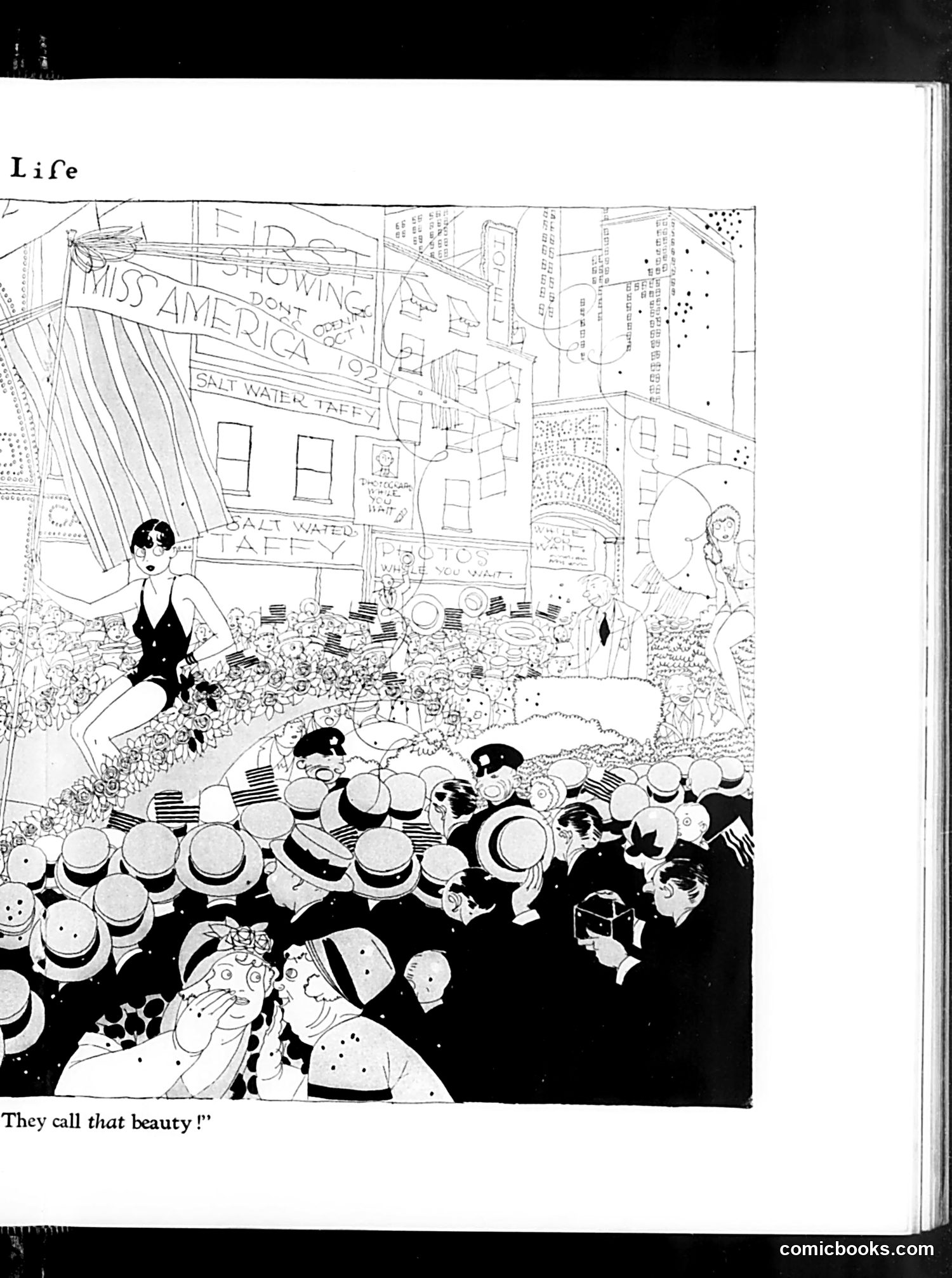
This Life magazine cartoon satirizes American beauty standards and consumerism, likely from the 1920s-1930s based on the style. The image depicts a bathing beauty pageant or public spectacle at what appears to be "Miss America" (visible on signage). A woman in a swimsuit poses prominently while crowds of men in hats watch, many holding American flags. The caption "They call that beauty!" conveys sarcastic criticism—suggesting the editorial view that reducing women to physical display for mass consumption and male approval represents a shallow, degrading conception of beauty. The packed crowd and commercial staging emphasize how beauty has become a commodified spectacle rather than something meaningful. This reflects intellectual critique of American consumer culture and objectification common in satirical publications of that era.
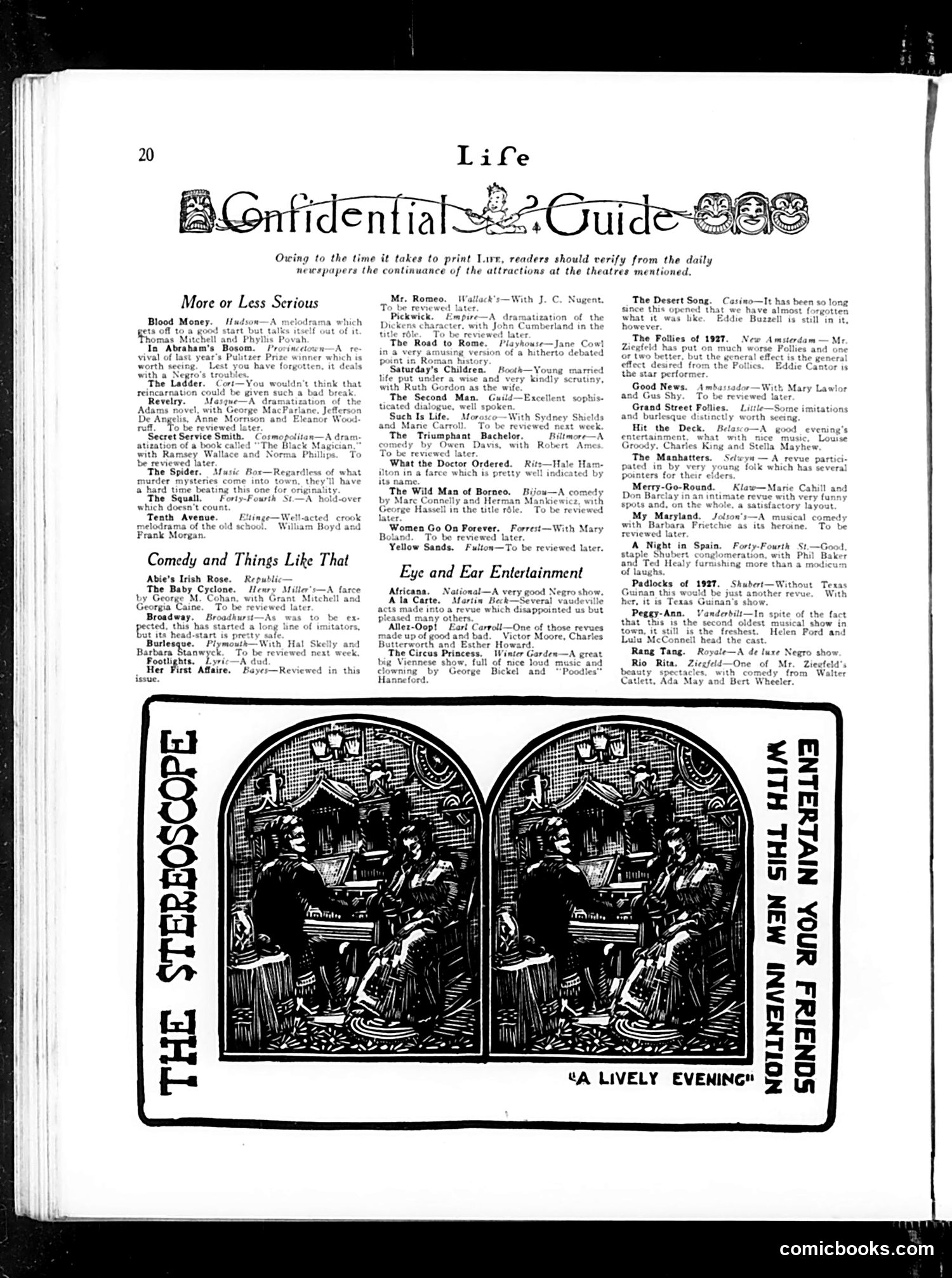
This page is primarily a **theater listings and review guide** for Broadway shows, not a political cartoon. The content consists of: 1. **Theater reviews** organized by category ("More or Less Serious," "Comedy and Things Like That," "Eye and Ear Entertainment"), briefly describing current productions with performer names and venues. 2. **A single advertisement** at the bottom—a stereoscope card image labeled "A Lively Evening," promoting stereoscopic entertainment as a novelty home attraction. The text encourages readers to "entertain your friends with this new invention." The stereoscope was an optical device popular in the late 19th-early 20th centuries that created 3D visual effects. This ad represents period technology marketing rather than satire. **No political cartoon or social commentary appears on this page.** It's a straightforward entertainment section typical of Life magazine's practical reader content from this era.
This is a theater review of George Ransome Gregg's play "Three Times Three" at the Blease Theatre. The critic praises the work as revolutionary for its handling of sex and servant problems—specifically by *ignoring* them entirely, which the writer presents as groundbreaking satire. The review highlights specific characters: Dick Weston (a useless bachelor friend wearing a blue turtleneck instead of a cutaway), butler Jervis (Swedish, silent), and various stock characters. The satire mocks both the play's simplicity and theater conventions generally—the author appears to be making fun of the play's pretensions while simultaneously celebrating its boldness in breaking with melodramatic tradition. The small cartoons illustrate dramatic moments. This is primarily theatrical criticism using humor and irony to dissect early 20th-century American stage conventions.
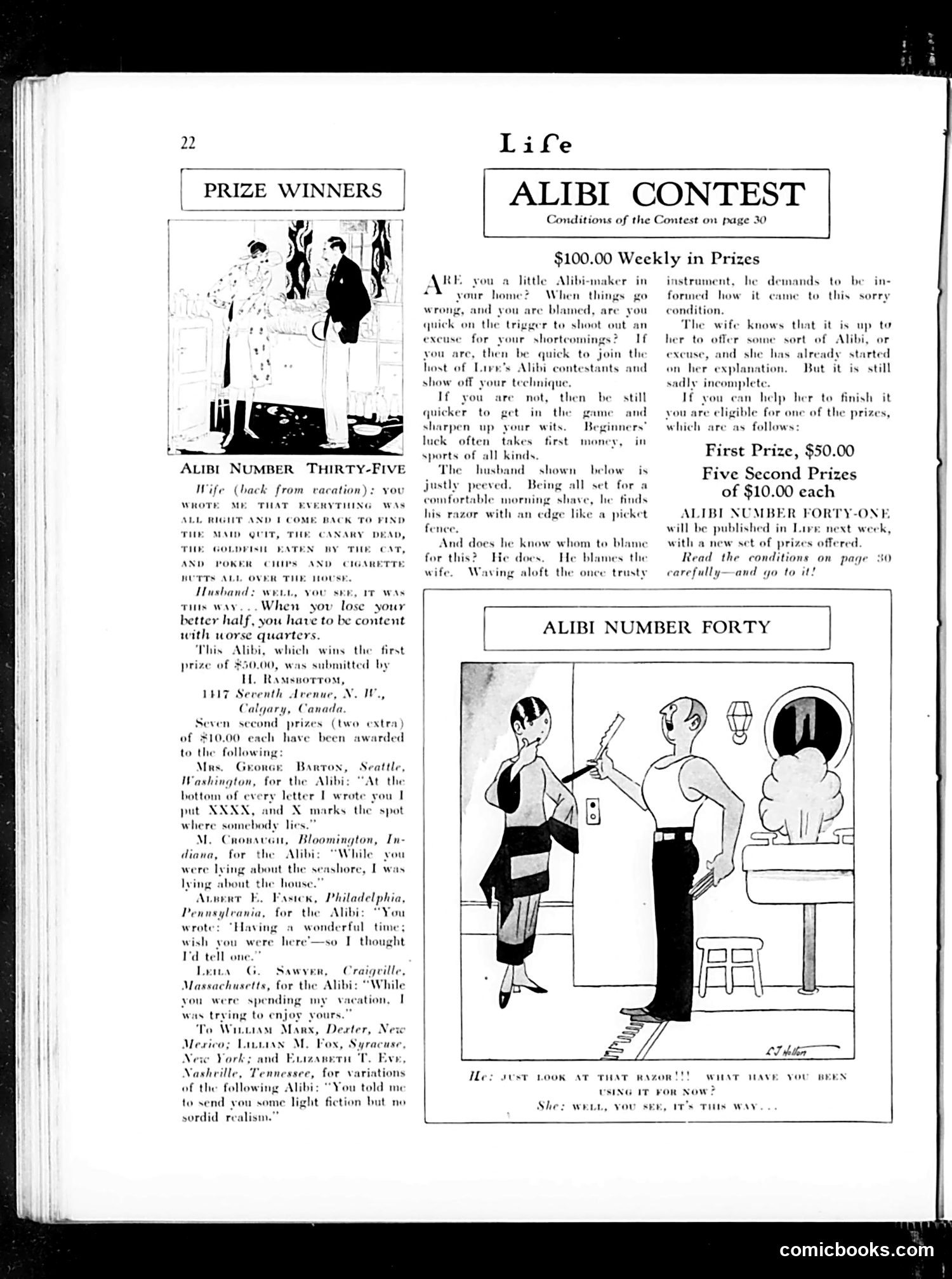
This page features Life magazine's humorous "Alibi Contest," inviting readers to submit creative excuses for everyday domestic mishaps. The cartoon depicts a husband discovering his razor has become dull, and his wife must fabricate an explanation for the damage. The contest reflects 1920s-30s domestic humor, playing on marital tensions—particularly the stereotype of wives being blamed for household problems. The cartoon's joke hinges on the wife needing to invent a plausible (or cleverly implausible) excuse for misusing her husband's grooming tool. The winning alibis submitted by readers demonstrate the contest's appeal: they're punny excuses for spouses' absences or misbehavior during vacations. This captures period attitudes about marriage as a comedic battleground of mutual blame and wit, where success means crafting the most entertaining excuse rather than accepting responsibility.
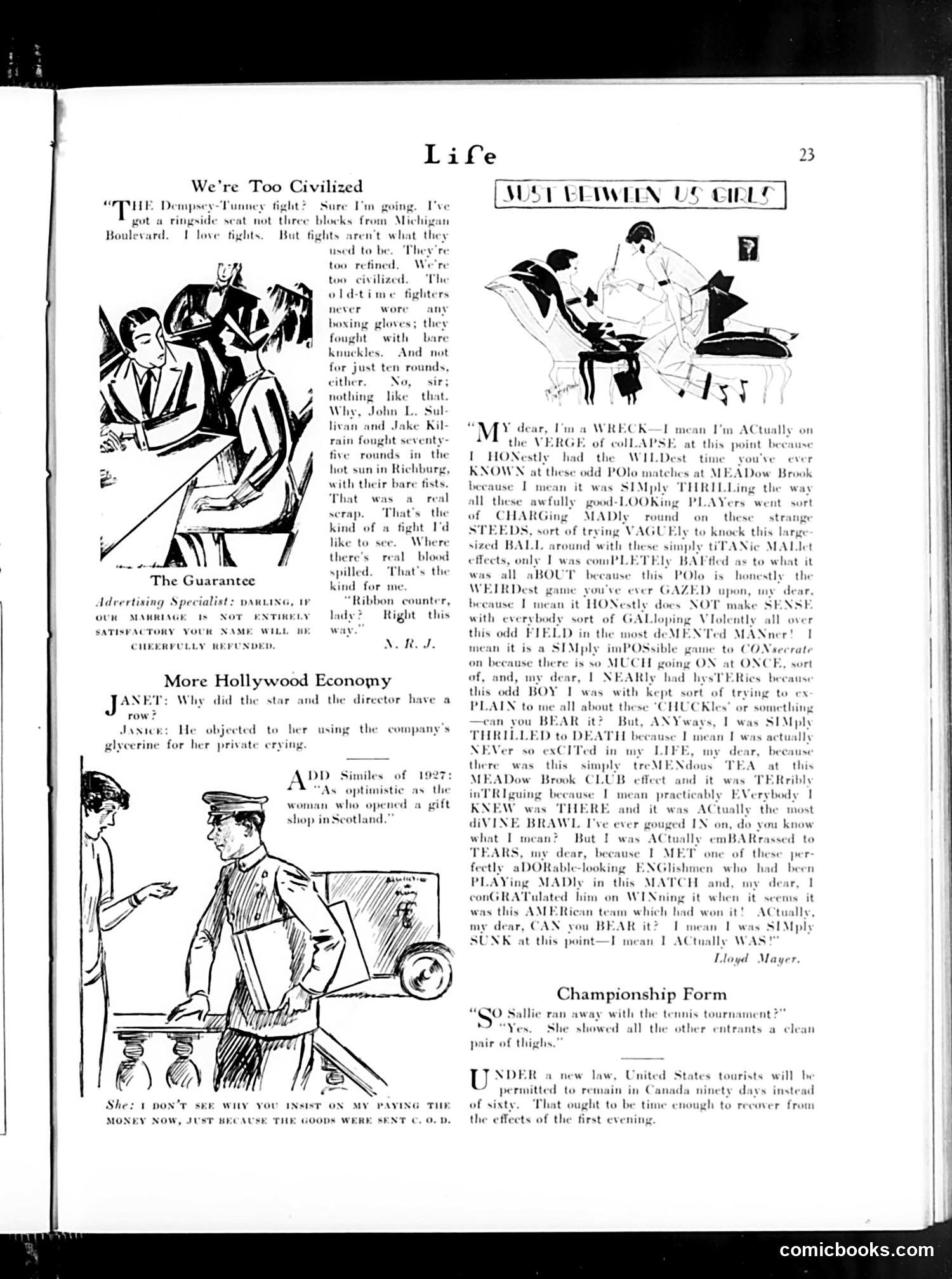
This page contains three satirical pieces mocking 1920s social pretension and changing customs: **"We're Too Civilized"** depicts a man nostalgic for bare-knuckle boxing, contrasting old fighters like John L. Sullivan with modern "refined" boxing rules. The satire targets those romanticizing a rougher past while modern society has become too rule-bound and safe. **"More Hollywood Economy"** jokes about studio cost-cutting—a director objecting to a star using company glycerine for personal crying. The accompanying cartoon shows a Scottish shopkeeper, referencing the period's common ethnic stereotypes. **The remaining content** includes a rambling first-person account of polo matches (appearing to mock verbose, name-dropping social climbers), a brief joke about tennis, and a commentary on U.S.-Canadian tourism policies. The overall tone reflects Jazz Age satire: mocking nostalgia for simpler times, poking fun at Hollywood excess, and gently satirizing upper-class social rituals and speech patterns characteristic of the era.
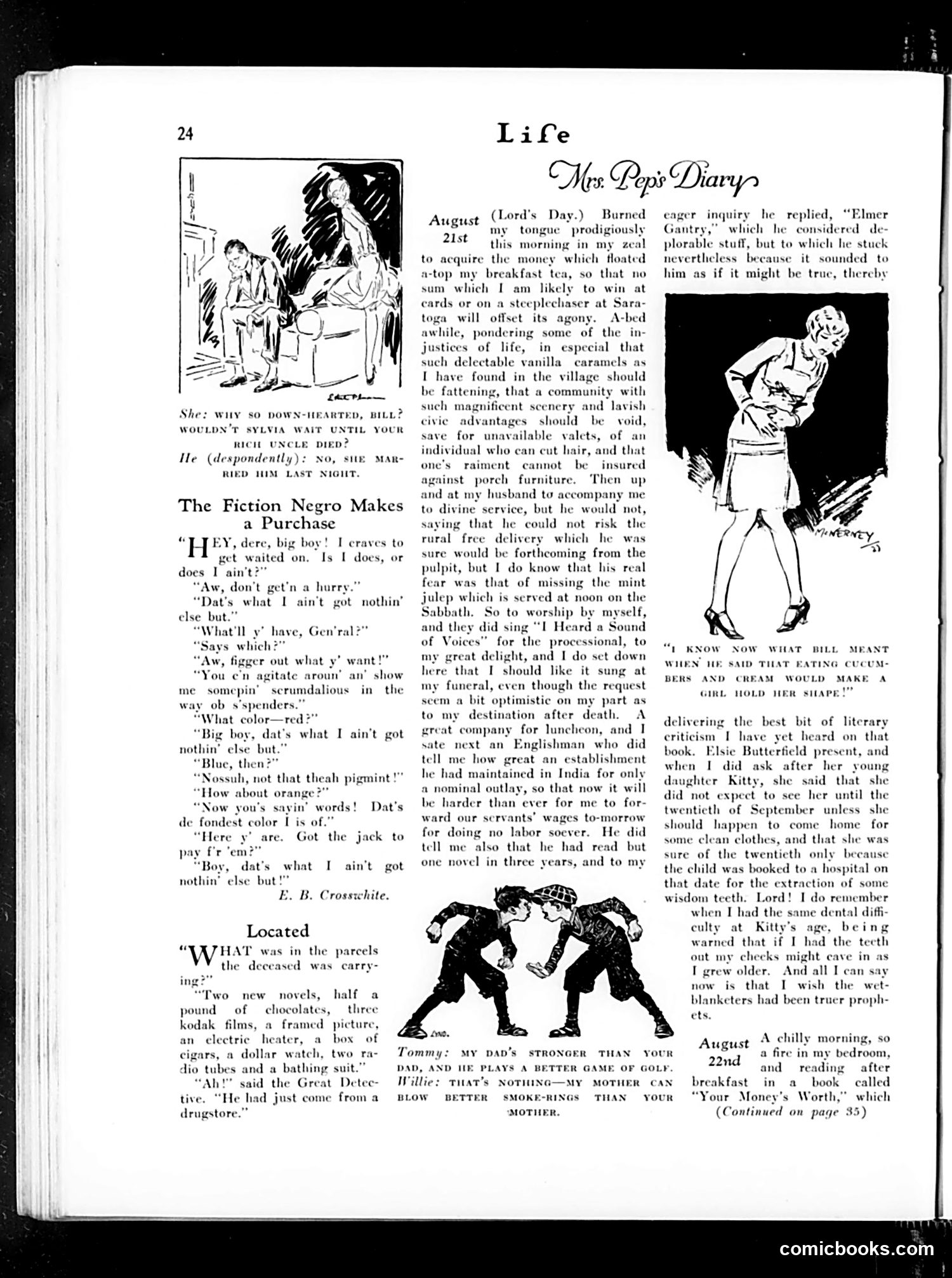
This page contains several distinct satirical pieces typical of early 20th-century *Life* magazine: **"The Fiction Negro Makes a Purchase"** depicts a racist caricature of a Black customer shopping for suspenders, using exaggerated dialect ("dere," "y'," "suh"). The joke relies on stereotyping—the character supposedly wants only one color, contradicting himself repeatedly. This reflects the era's casual, dehumanizing racial mockery common in mainstream American humor. **"Mrs. Pep's Diary"** (August 21-22) is a satirical domestic commentary narrated by a snobbish, gossipy woman. She complains about burnt tongue, servants, fattening candy, and recounts a tedious Englishman's boasts about his Indian estate. The satire targets upper-class affectation and privilege—her concerns are trivial yet treated as profound. **Other sections** include brief humorous dialogues about inheritances and detective work, plus comparative jokes about parenthood. The overall tone mocks both racial stereotypes and bourgeois pretension—hallmarks of *Life*'s satirical approach during this period.
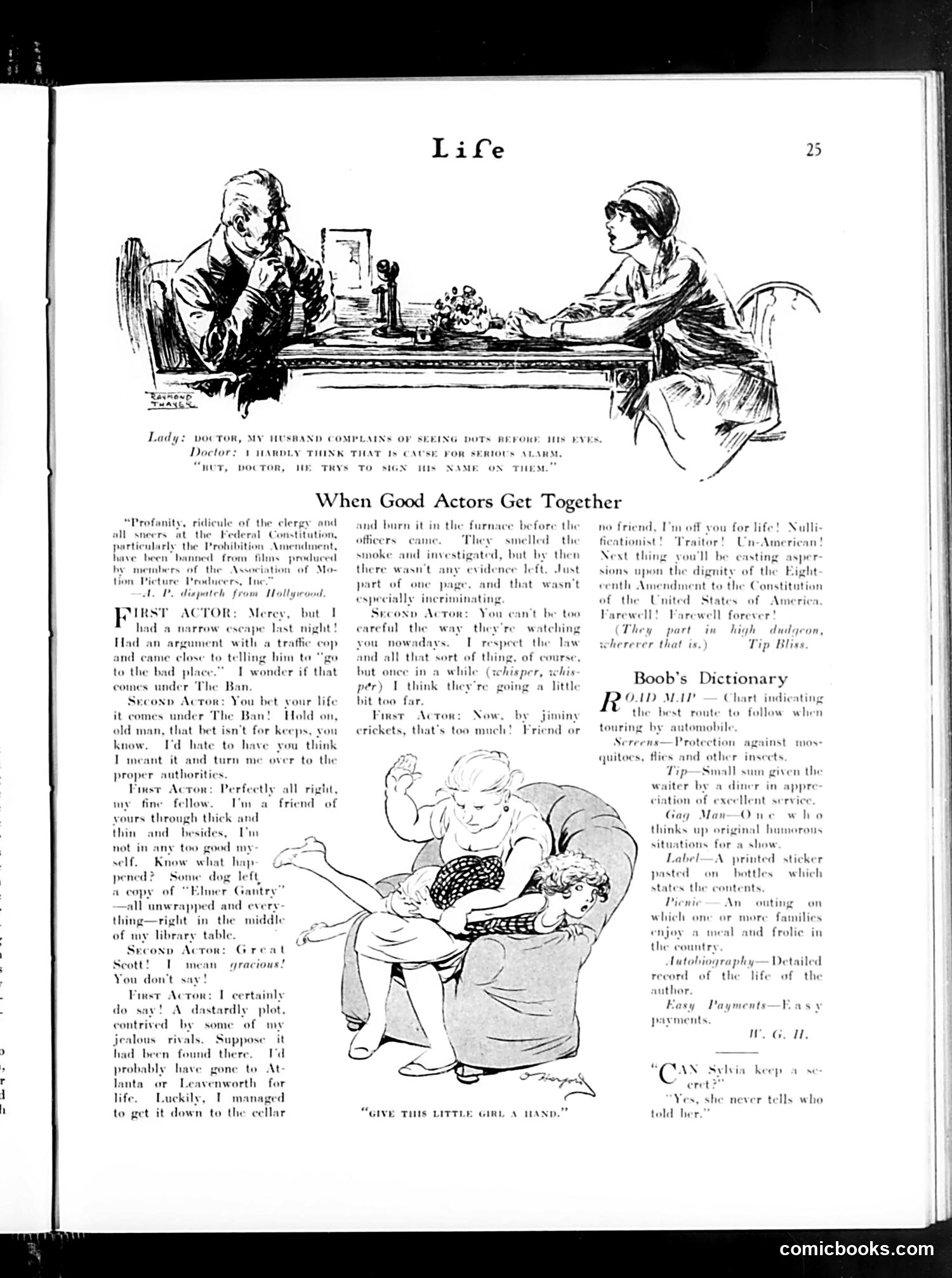
This page satirizes Hollywood's new film censorship codes (the Motion Picture Association's ban on profanity, religious mockery, and Prohibition criticism). **The Main Cartoon:** Two actors discuss narrowly avoiding censorship violations. One confesses to nearly cursing at a traffic cop; the other admits to burning a copy of "Elmer Gantry" (a novel famous for attacking organized religion) before authorities could find it. When the second actor suggests the censorship rules go "too far," the first actor dramatically denounces him as a "traitor" and "un-American"—mocking how absurdly the industry polices speech and how quickly colleagues turn on each other over perceived political disloyalty. **The Joke:** The satire exposes the hypocrisy: actors themselves violated the rules and feared consequences, yet enforced them zealously on others. The overreaction to mild dissent about censorship itself demonstrates the rules' oppressive nature. **Context:** This reflects actual 1920s-30s Hollywood censorship and the broader cultural anxiety about Prohibition, religious criticism, and perceived un-American sentiment during this period.
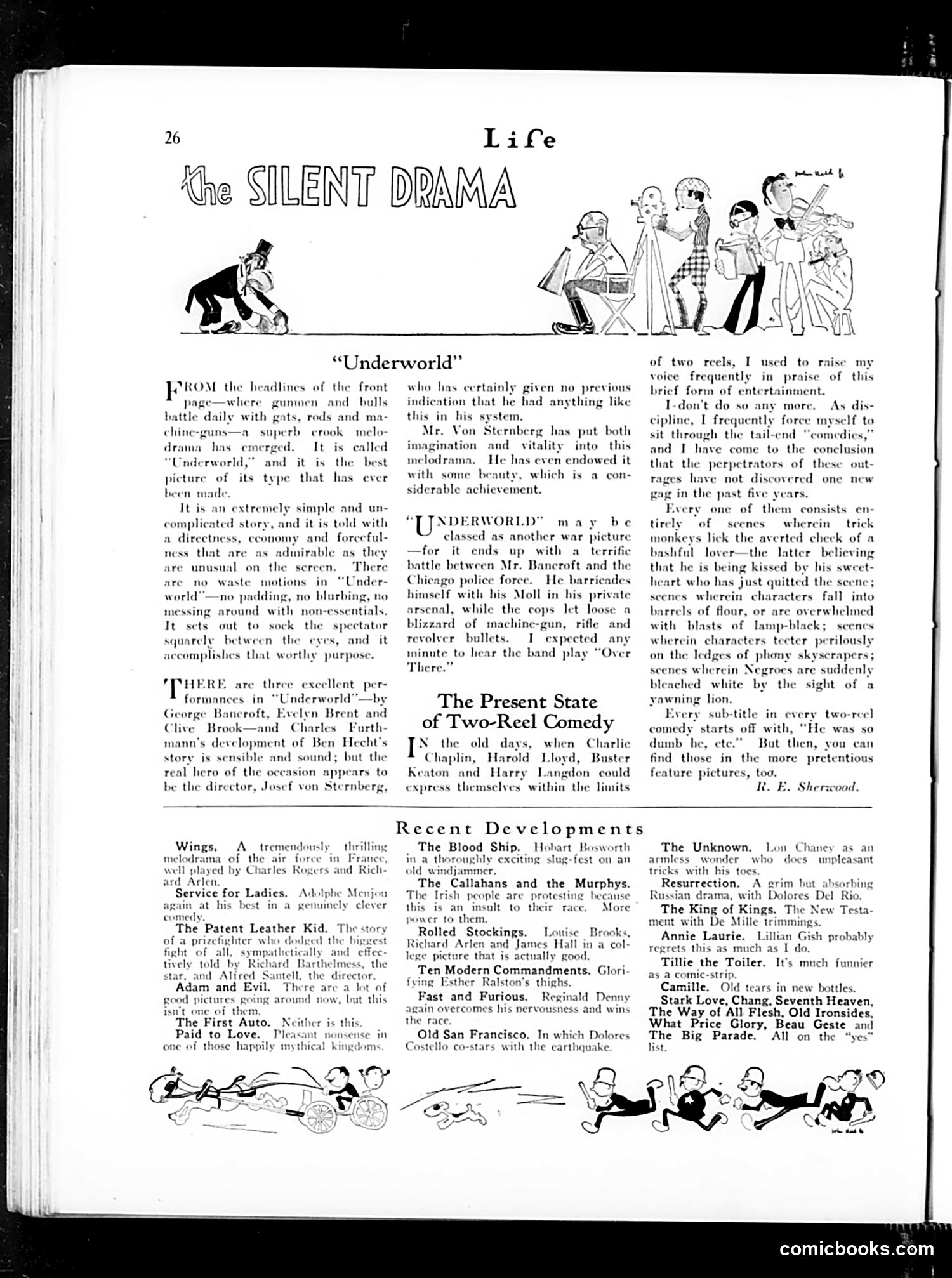
This page reviews contemporary silent films, primarily discussing **"Underworld,"** a gangster drama directed by Josef von Sternberg. The review praises the film's stark simplicity—featuring gunfights, machine guns, and a climactic battle between gangster Bancroft and Chicago police in his private arsenal. The director receives credit for injecting "imagination and vitality" into what is essentially a crime melodrama. The second section critiques the decline of **two-reel comedies**. The author laments that since the golden age of Chaplin, Lloyd, Keaton, and Langdon, comedians have exhausted their gags: trick monkeys kissing bashful lovers, slapstick with flour barrels and lamp-black, characters teetering on fake skyscraper ledges, and racial humor involving "Negroes" turning white from fright. The reviewer concludes these tired formulas haven't produced anything new in five years. The page reflects 1920s cinema tastes and period attitudes, particularly the casual racial stereotyping considered acceptable entertainment.
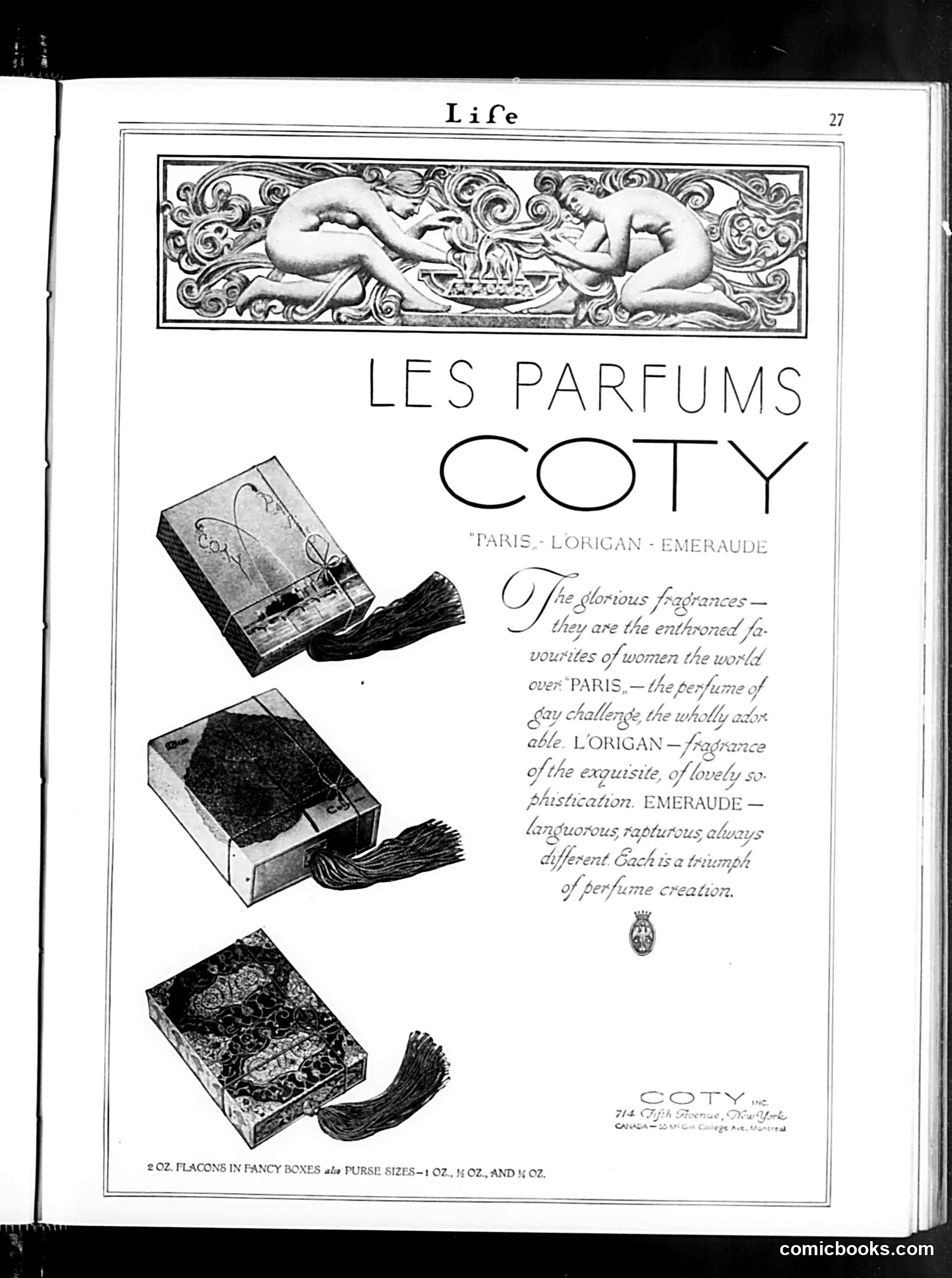
This is primarily a **perfume advertisement**, not a political cartoon. The page features "Les Parfums Coty," a French fragrance brand with three products: Paris, Lorigan, and Emeraude. The decorative header shows classical cherubs in an ornamental style typical of early 20th-century luxury advertising. Below are images of three perfume bottles in decorative boxes with tassels. The advertisement's text emphasizes these as "the enthroned favourites of women the world over" and highlights Paris's prestige. It's positioned in *Life* magazine's advertising section, using aspirational language and classical imagery to market luxury goods to affluent readers. This reflects the era's marketing strategy: associating French perfume with sophistication and feminine elegance.
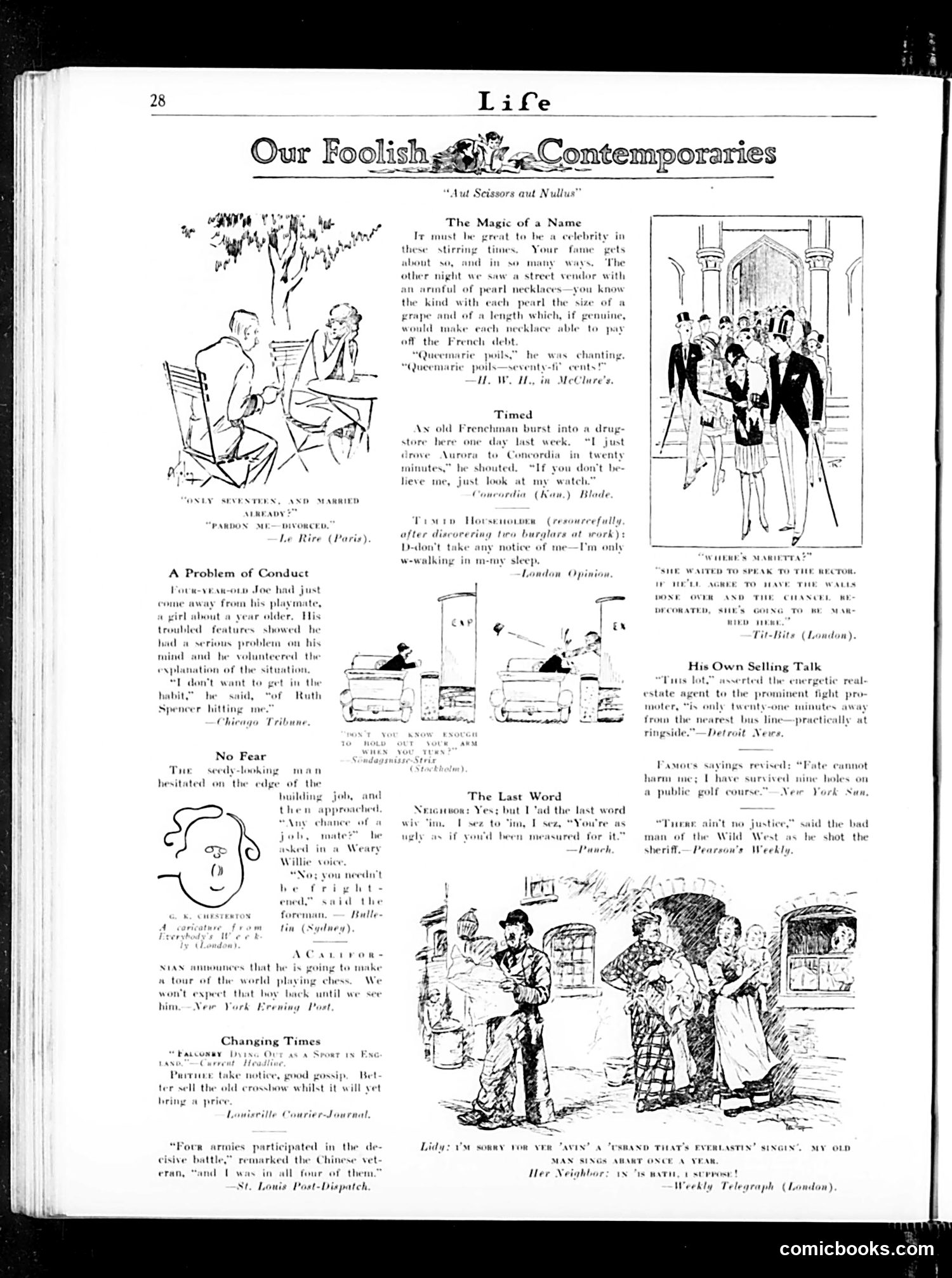
This page collects humorous anecdotes mocking contemporary social types and situations. The satirical pieces mock: **"The Magic of a Name"**: A street vendor hawking cheap pearl necklaces uses a fancy French name ("Quemarie poils") to inflate their worth, suggesting Americans' gullible fascination with French-sounding products. **"A Problem of Conduct"**: A young man seeks advice about hitting an older playmate who bothered him—the joke being about establishing proper social conduct among boys. **"Timed"**: An old Frenchman brags he can drive from Aurora to Concordia in twenty minutes by pointing to his watch—absurdist humor about lying and braggadocio. **"No Fear"**: A suicidal man hesitates before jumping, worried about his reputation rather than actual death—dark humor about misplaced priorities. **"The Last Word"**: A woman claims superiority over her husband by getting the final word in an argument. The cartoons mock vanity, pretension, marital bickering, and foolish contemporary behavior through brief comic sketches typical of early-20th-century American humor magazines.
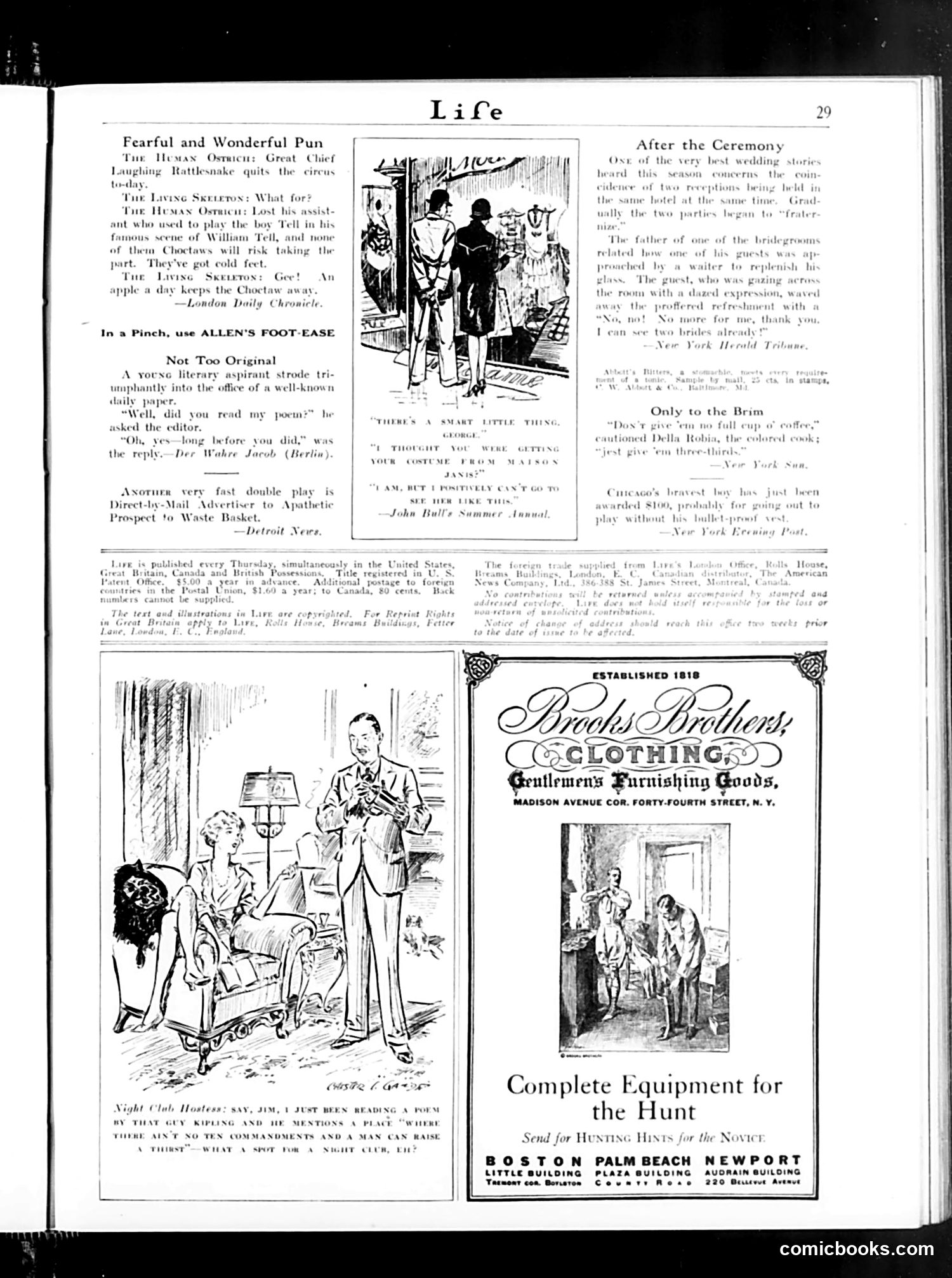
This page contains several brief humorous anecdotes and advertisements typical of *Life* magazine's format. **"Not Too Original"** mocks a young poet whose work an editor has already read—implying the poem was plagiarized or unoriginal. The joke is the editor's dismissive response. **"Night Club Hostess"** appears to be a cartoon about a club hostess mentioning a location where "there ain't no ten commandments and a man can raise a thirst"—satirizing speakeasy culture during Prohibition, when illegal bars marketed themselves as lawless spaces free from moral constraints. The page is primarily filled with **period advertisements** for Brooks Brothers clothing and hunting equipment, reflecting 1920s consumer culture. The remaining text snippets reference literary aspirations and wedding etiquette, maintaining *Life*'s satirical tone about modern American social conventions. Overall, this is a typical early-twentieth-century humor magazine page blending short jokes with advertising.
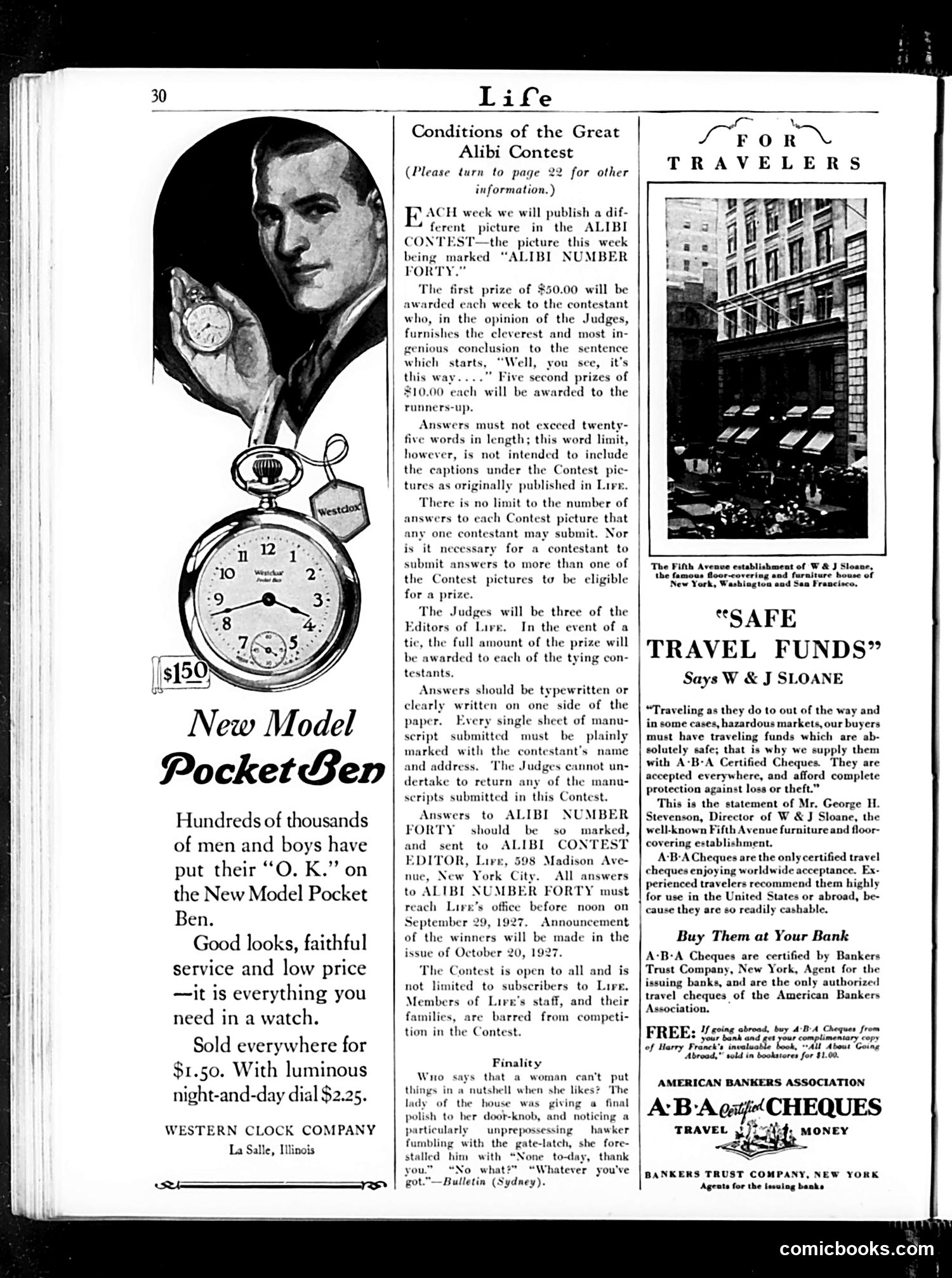
This page is primarily **advertising and contest information** rather than political satire. The left side advertises the "New Model Pocket Ben" watch ($1.50) from Western Clock Company—an inexpensive, practical timepiece marketed toward everyday men and boys. The center and right contain contest rules for *Life* magazine's "Great Alibi Contest," where readers submitted witty conclusions to incomplete sentences (this week: "Well, you see, it's this way...") for cash prizes. The contest appears lighthearted wordplay competition. Below is a brief anecdote about a woman dismissing a door-to-door salesman with quick wit—humorous domestic humor typical of the era. The right side advertises traveler's cheques from W & J Sloane and the American Bankers Association—financial safety products for the traveling public of the 1920s. This is essentially a magazine page mixing consumer goods ads with reader engagement contests; no political cartoon or satire is present.
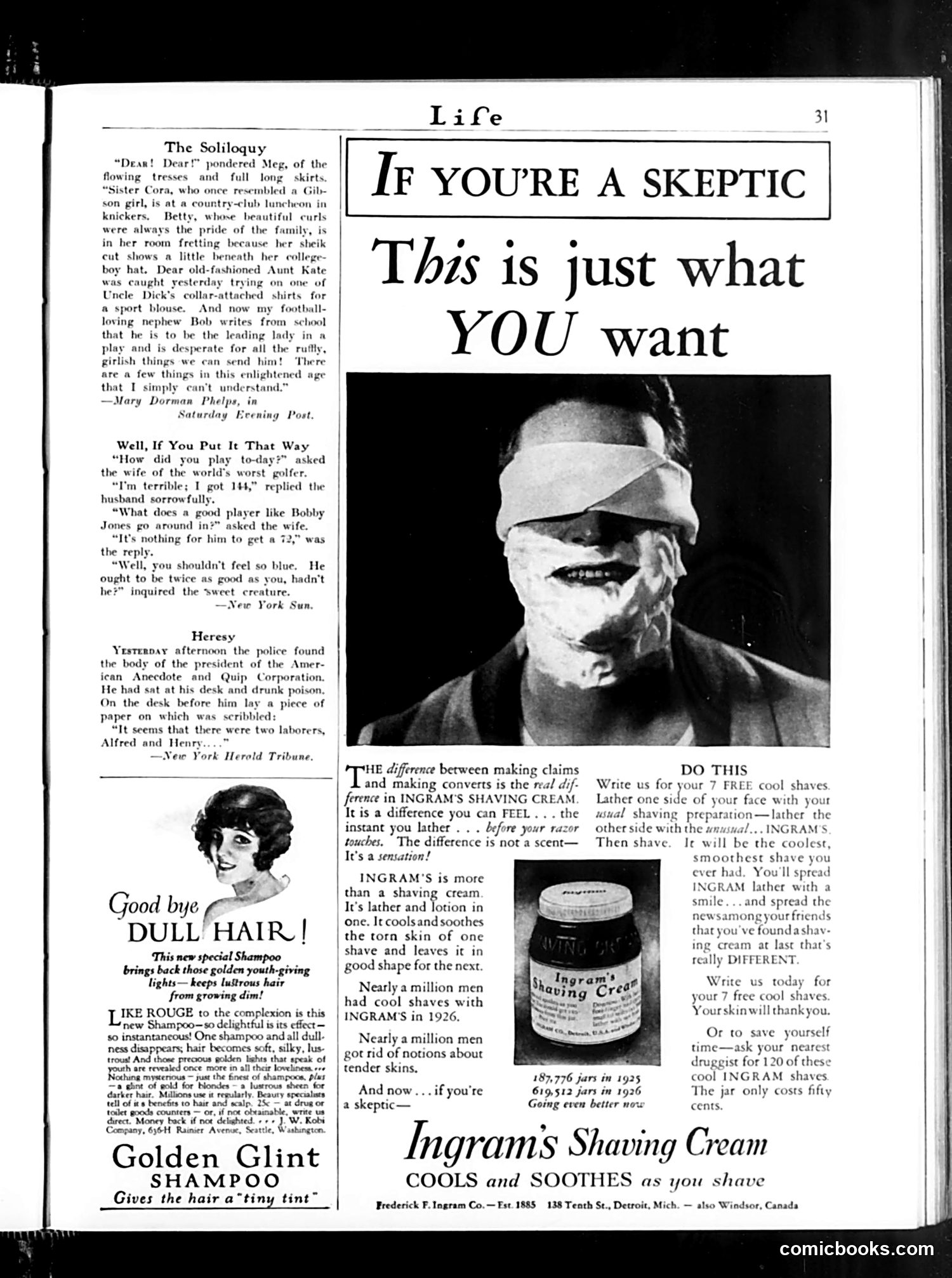
This is a **Life magazine page mixing humor with advertising**, typical of 1920s American magazines. The **three jokes** at top mock social absurdities: women questioning why their fashionable relatives now wear boyish clothes and short hair; a golfer's wife suggesting his score should match Bobby Jones'; and a suicide note that's anticlimactic (the anecdote corporation president dies before delivering a punchline). The **large cartoon image** shows a blindfolded man—likely representing a "skeptic" consumer—to illustrate the advertisement's central claim: that Ingram's Shaving Cream *feels* noticeably different, not just smells different. The **advertising dominates**: Golden Glint Shampoo promises to restore "golden lights" to dull hair (appealing to youth), while Ingram's Shaving Cream emphasizes sensation over scent, even offering a free-sample challenge. The statistics ("187,776 jars in 1925") suggest consumer trust through popularity. **Context**: This reflects 1920s consumer culture where magazine advertising used psychological appeals and comparative marketing to differentiate similar products.
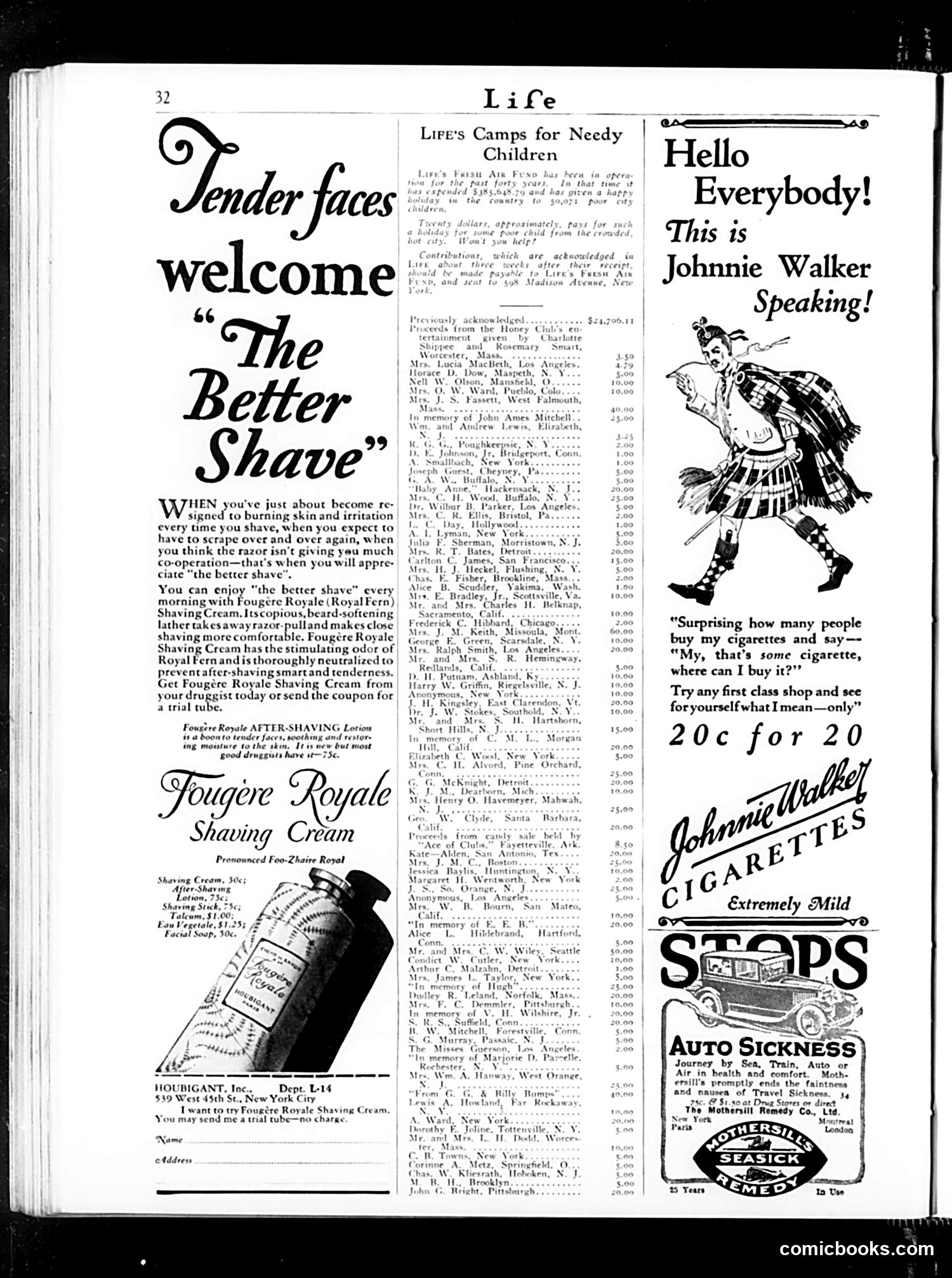
This page is primarily **advertising**, not political satire. The dominant content features three product ads: 1. **Fougère Royale Shaving Cream** (left): A standard grooming product advertisement emphasizing close shaving and skin comfort—typical early 20th-century copy. 2. **Johnnie Walker Cigarettes** (right): Features a cartoon Scotsman in traditional dress as the brand mascot, using the familiar "Johnnie Walker Speaking!" format. The ad highlights word-of-mouth appeal and affordability (20 cigarettes for 20 cents). 3. **Mothersill's Remedy** (lower right): Advertises treatment for motion sickness from sea, train, auto, or air travel. The center column lists **Life's Camps for Needy Children**—donors contributing to charitable holiday camps for poor children, suggesting this was a fundraising appeal issue. There is **no political cartoon or satire** on this page. It represents typical Life magazine advertising from the pre-1930s era.
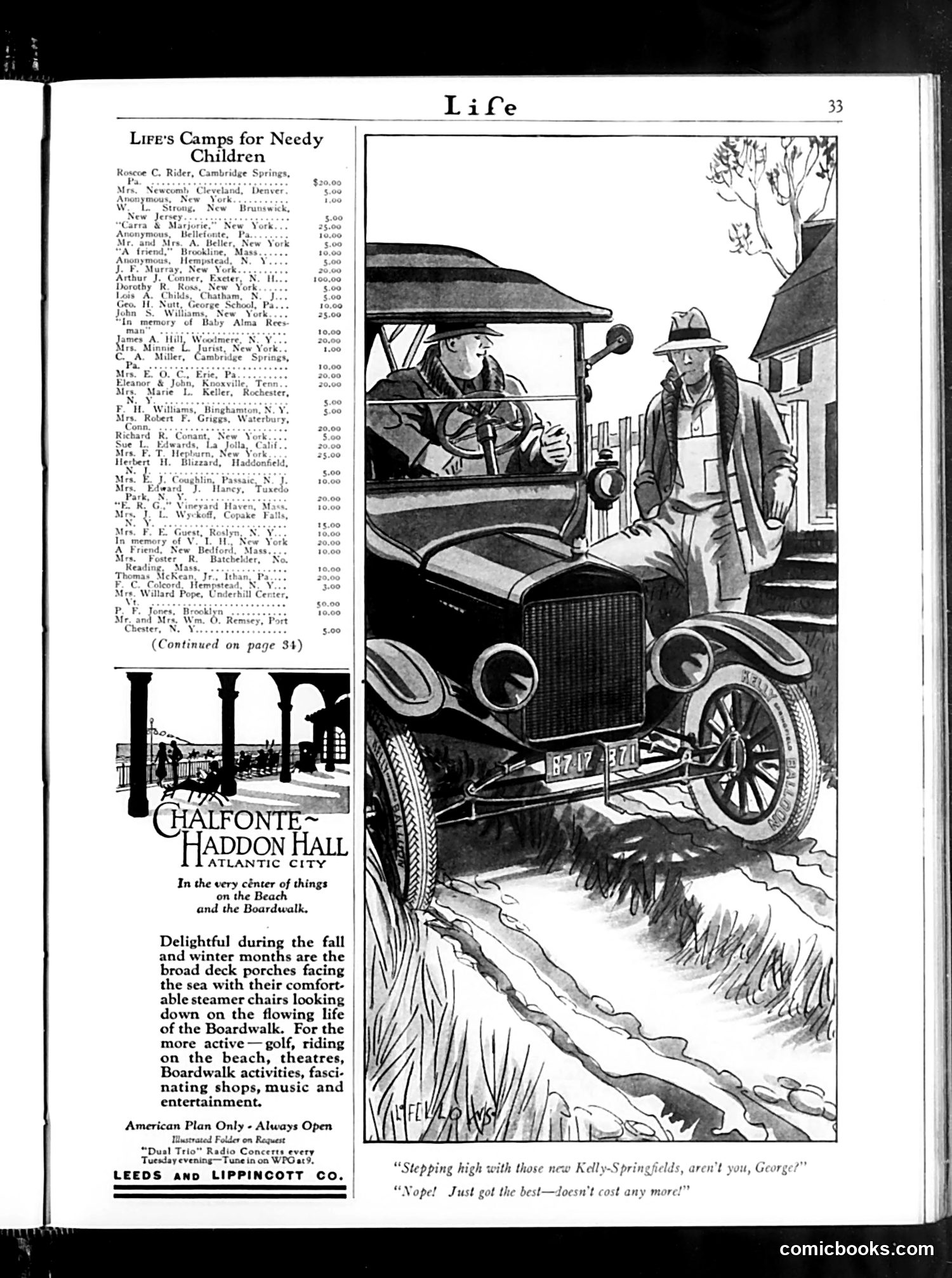
This page is primarily a **charitable fundraiser and hotel advertisement** rather than political satire. The upper left lists donors to "Life's Camps for Needy Children"—a charitable initiative. The amounts shown (ranging from $1 to $250) indicate contributions to summer camps for underprivileged children. The main illustration is a **car advertisement** disguised as humor. Two men discuss a new automobile with "Kelly-Springfields" tires. One says he got "the best—doesn't cost any more!" This is classic early-20th-century advertising: positioning a product (the car and its tires) as good value while suggesting social mobility and modernity. The Chalfonte-Haddon Hall advertisement promotes an Atlantic City hotel. **Modern context**: This reflects a pre-Depression era when Life magazine mixed charitable appeals with consumer advertising, suggesting prosperity and progress. The "stepping high" phrase plays on aspirational middle-class values—owning a nice car signaled success.
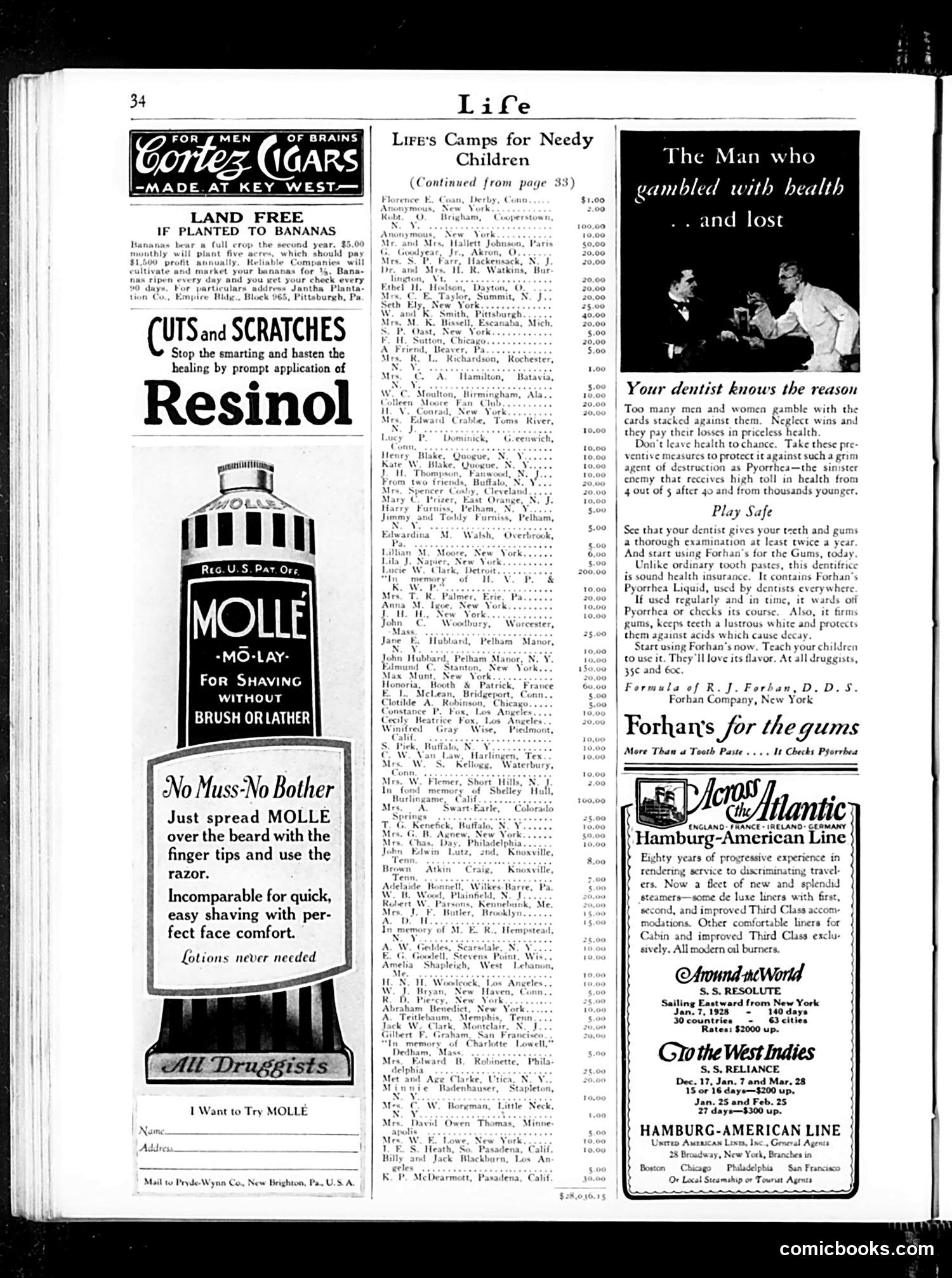
This page is primarily **advertising**, not satire or political commentary. It contains commercial advertisements typical of 1920s Life magazine: **Main Advertisements:** - Cortez Cigars (Key West-made) - Resinol (a healing salve for cuts) - Mollé shaving cream - Forhan's toothpaste (emphasizing prevention of pyorrhea, a gum disease) - Hamburg-American Line (cruise ship travel) **Notable Context:** The Forhan's ad is the most substantive editorial content, promoting dental health awareness—a genuine public health concern of the era. The cruise line ads reflect the 1920s leisure travel boom for affluent Americans. The page also continues a list of donors to "Life's Camps for Needy Children" from page 33, showing the magazine's charitable interests. **There is no political cartoon or satirical content on this page.** It represents standard interwar American magazine advertising and philanthropy promotion.
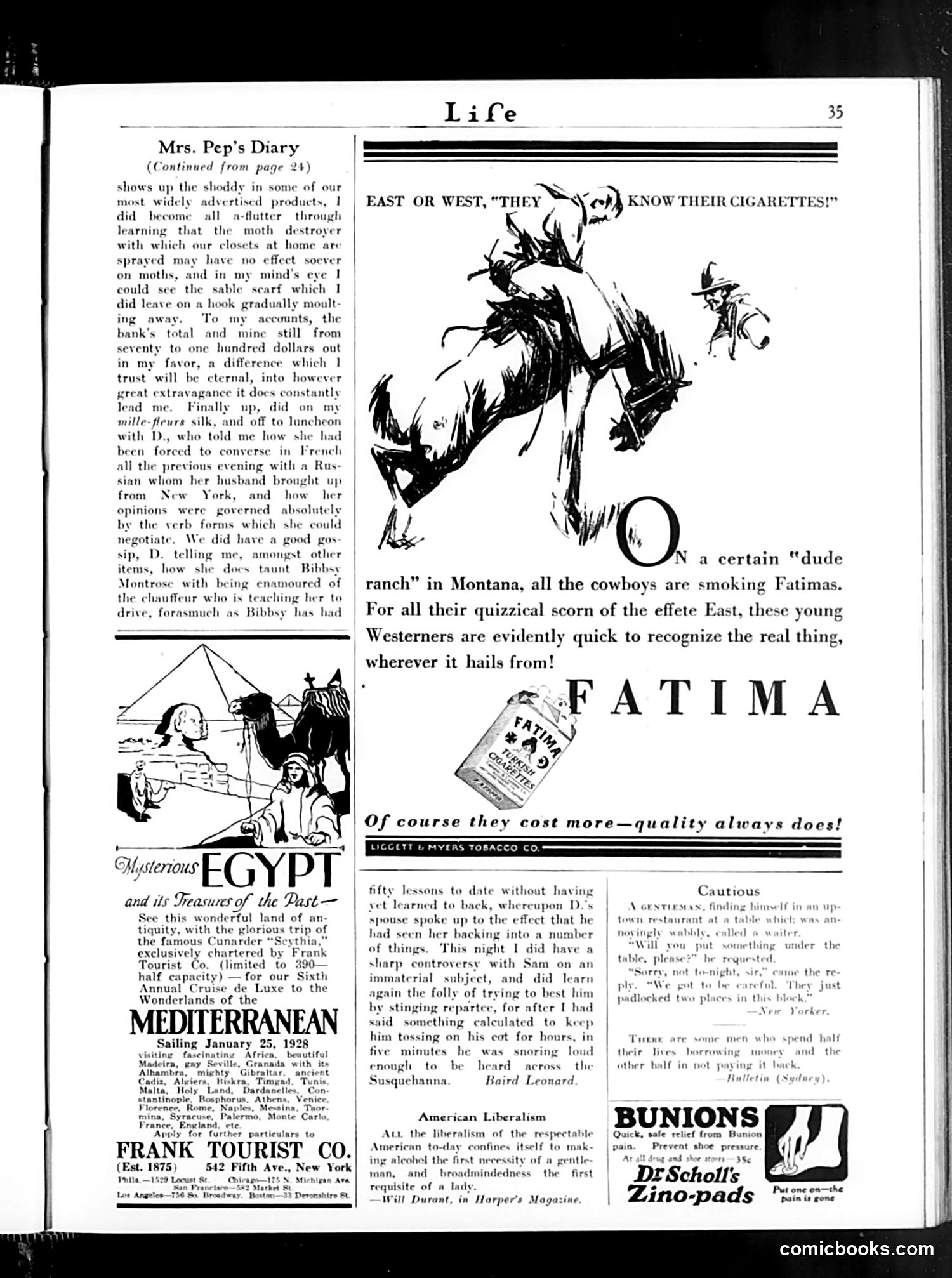
This page contains satirical diary entries and advertisements typical of 1920s Life magazine. **Mrs. Pep's Diary** mocks upper-class women's concerns: moth-eaten fur scarves, trivial social gossip (including a dig at "Bibbsy Montrose" flirting with her chauffeur), and marital spats over witty repartee. The humor targets wealthy society women's preoccupations and their husbands' ego. **"Dude Ranch" Fatima Cigarettes Ad**: This advertisement satirizes Western cowboys as pretentious poseurs. The joke suggests these supposedly tough, frontier-scorn cowboys actually smoke expensive "effete East" cigarettes—undermining their claims to rugged authenticity. It's gentle mockery of affected masculinity and regional snobbery. **Remaining Content**: A cruise advertisement to Egypt/Mediterranean and a brief quote on American liberalism complete the page alongside product ads for bunion relief. The page exemplifies Life's satirical approach: poking fun at upper-class affectation, gender stereotypes, and consumer culture through diary humor and clever advertising placement.
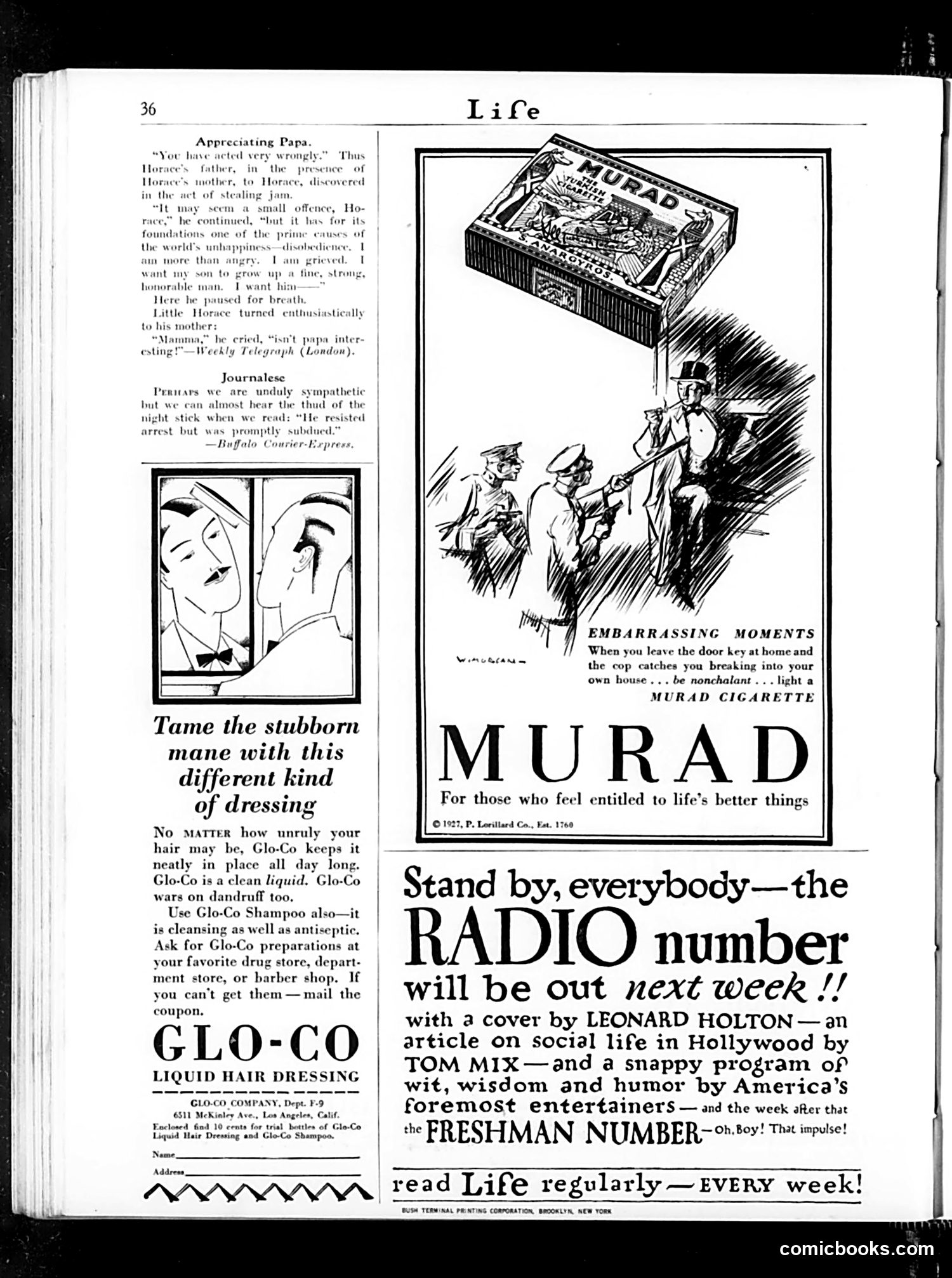
This page mixes editorial content with advertisements typical of 1920s Life magazine. **"Appreciating Papa"** is a brief humor piece about a father lecturing his son on moral virtue and obedience. The son's takeaway—that papa is "interesting"—satirizes how children miss the earnest point of parental lectures, finding entertainment in the delivery rather than the message. **"Journalese"** appears to be a short commentary on newspaper writing style, though the OCR text is too corrupted to extract clear meaning. **"Embarrassing Moments"** is a humorous advertisement for Murad cigarettes, suggesting that smoking (appearing nonchalant) helps one escape awkward social situations—here, being caught breaking into your own house by a police officer. The page also advertises **Glo-Co hair dressing** and promotes upcoming issues of Life magazine featuring Leonard Holton cover art and Tom Mix. The overall tone is lighthearted and satirical, typical of Life's humor-focused format during the Jazz Age.
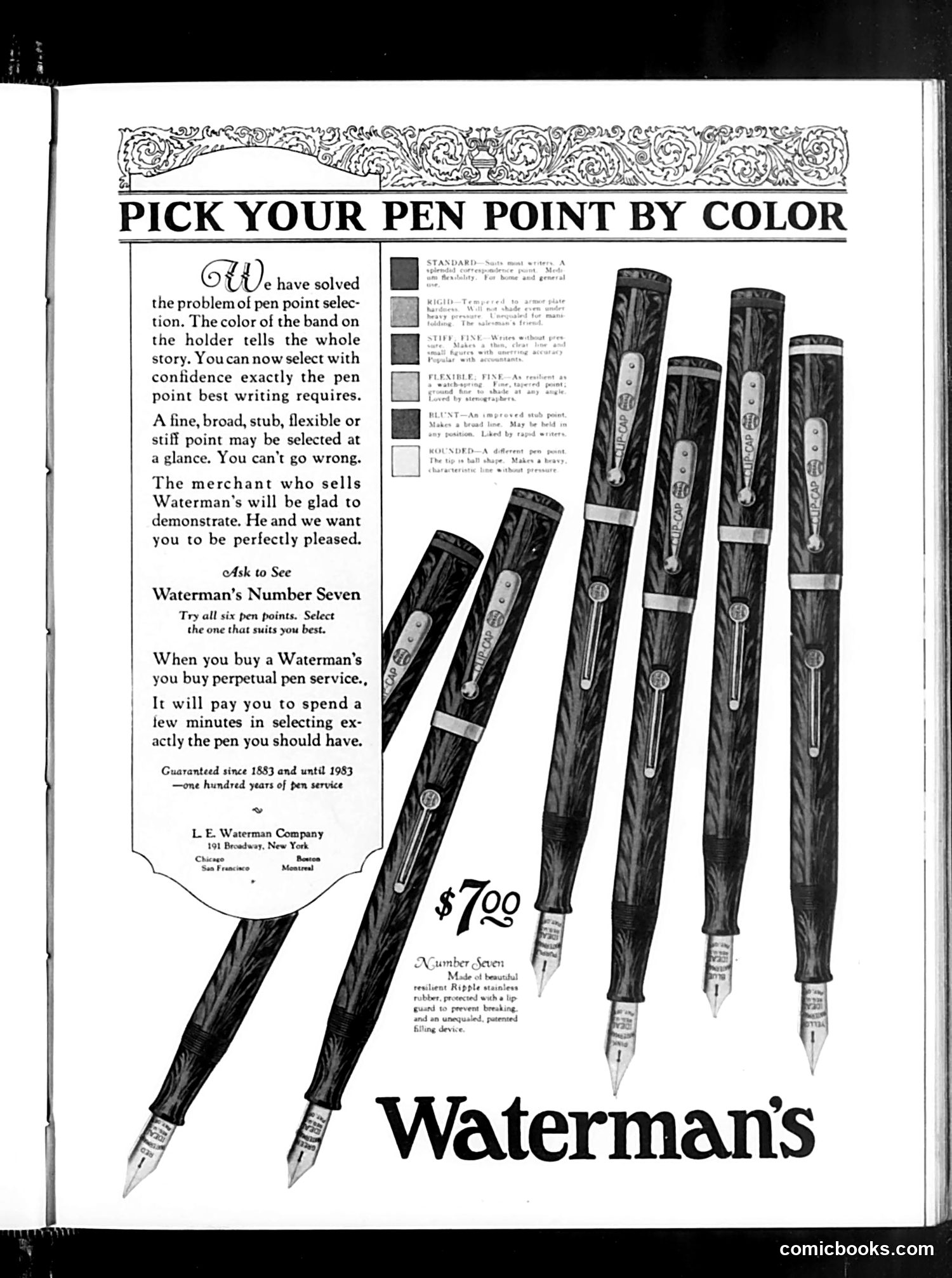
This is **not a cartoon or satire**—it's a straightforward **product advertisement** for Waterman's fountain pens, a major American pen manufacturer. The page promotes the "Number Seven" model ($7.00) and its key selling point: colored bands on pen holders that indicate different nib types (fine, broad, stub, flexible, stiff). This color-coding system solved a genuine consumer problem—customers couldn't easily identify which pen point they needed before purchase. The ad emphasizes quality and longevity ("Guaranteed since 1883 and until 1983—one hundred years of pen service"), appeals to merchants to demonstrate the product, and encourages customers to try all six point options. The multiple pen images showcase the visual distinction the colored bands provide. This reflects the era when fountain pens were premium everyday writing instruments requiring careful selection, and when manufacturers competed on both functionality and guaranteed durability.
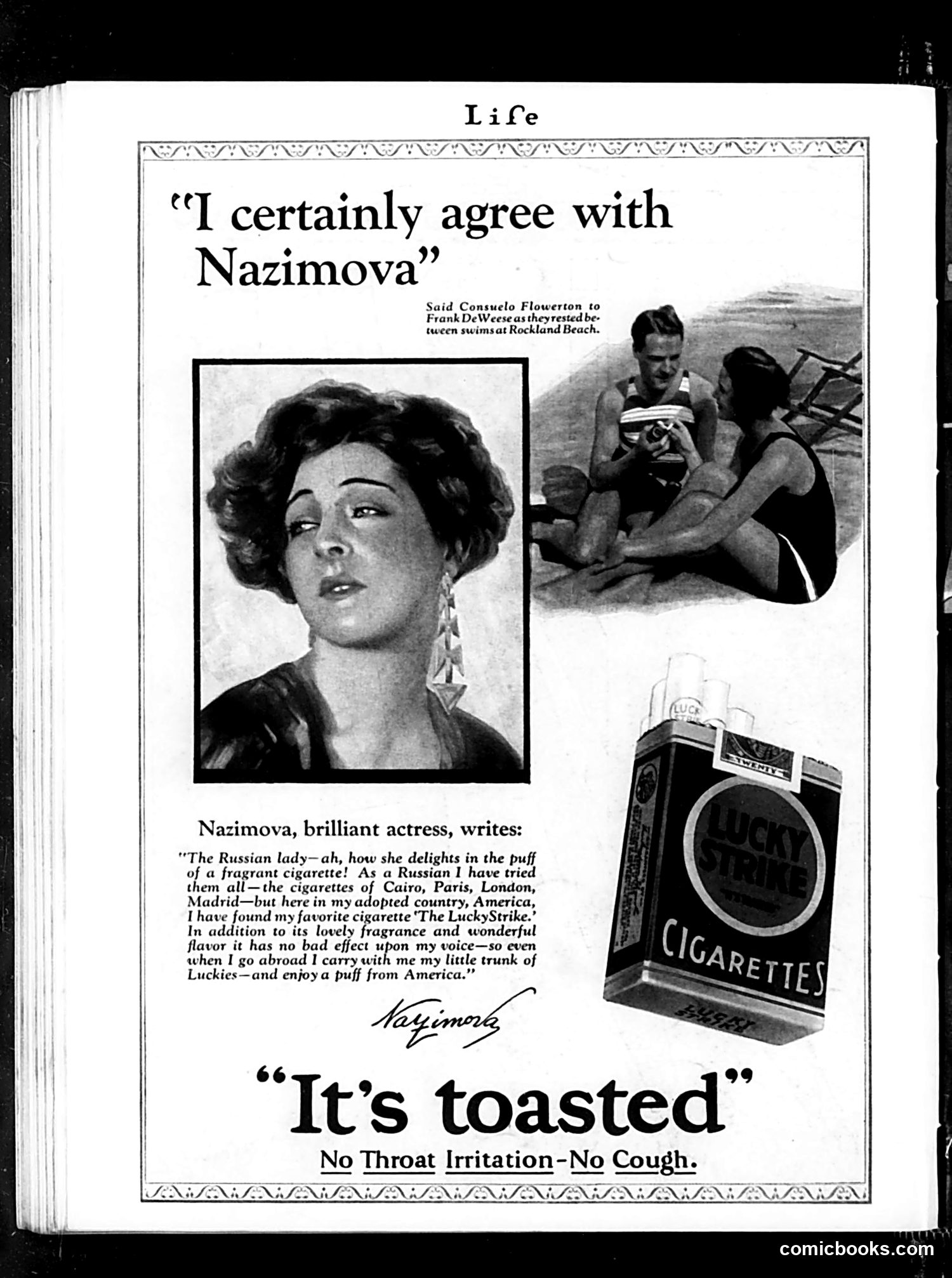
This is a **cigarette advertisement** disguised as editorial content, featuring Russian-American actress Alla Nazimova endorsing Lucky Strike cigarettes. **The Setup:** The page opens with a framing device—two beachgoers (Consuelo Flowerton and Frank DeWeese) agreeing with "Nazimova," leading into her testimonial. This creates false authority by attributing the pitch to a real, famous actress. **The Appeal:** Nazimova's quoted endorsement emphasizes: - Exotic sophistication (she's tried cigarettes worldwide) - Voice protection for performers (a key health claim of the era) - American superiority ("favorite...here in my adopted country") **The Satire/Irony (for modern readers):** The ad's claim of "No Throat Irritation—No Cough" appears absurd today; we now know cigarettes cause exactly these problems. The "toasting" process was a marketing invention with no proven health benefit. The endorsement by a professional voice-user was deliberately calculated to suggest safety—a practice now illegal in advertising. This exemplifies early 20th-century celebrity endorsement marketing before tobacco regulations existed.