
Life, 1927-09-15 · page 28 of 40
Life — September 15, 1927 — page 28: what you’re looking at
What you’re looking at
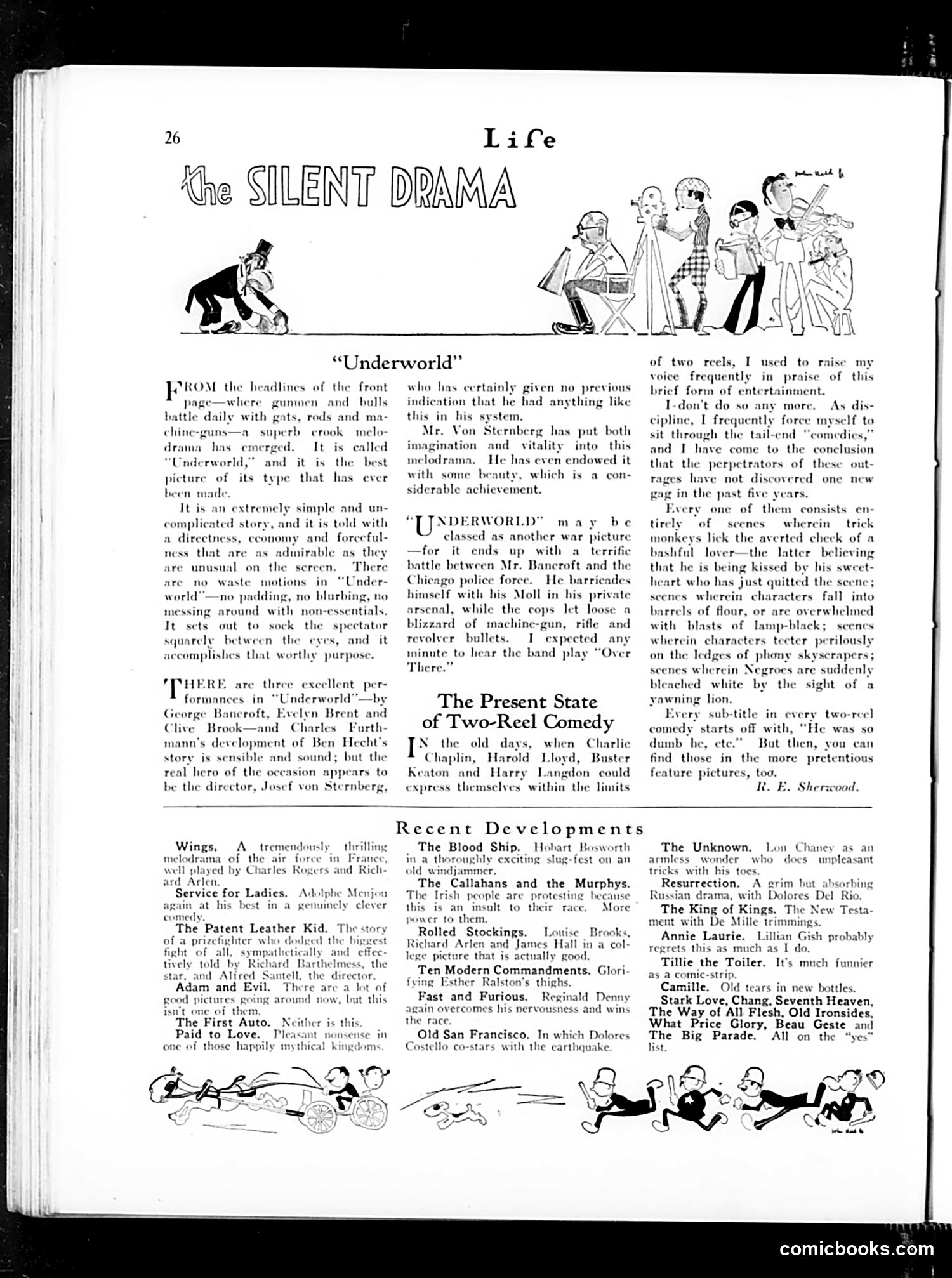
This page reviews contemporary silent films, primarily discussing **"Underworld,"** a gangster drama directed by Josef von Sternberg. The review praises the film's stark simplicity—featuring gunfights, machine guns, and a climactic battle between gangster Bancroft and Chicago police in his private arsenal. The director receives credit for injecting "imagination and vitality" into what is essentially a crime melodrama. The second section critiques the decline of **two-reel comedies**. The author laments that since the golden age of Chaplin, Lloyd, Keaton, and Langdon, comedians have exhausted their gags: trick monkeys kissing bashful lovers, slapstick with flour barrels and lamp-black, characters teetering on fake skyscraper ledges, and racial humor involving "Negroes" turning white from fright. The reviewer concludes these tired formulas haven't produced anything new in five years. The page reflects 1920s cinema tastes and period attitudes, particularly the casual racial stereotyping considered acceptable entertainment.
📄 Transcribed text from this page (OCR, searchable)
Machine-transcribed from the original scan — historical spelling and the odd misread are preserved.
26 Life ‘he SILENT DRAMA “Underworld” }ekom the headlines of the front page—where bulls battle daily with gats, rods and ma- chine-guns—a superb crook gunmen and emerged. It is called it is the best that has drama has “Underworld,” and picture of its type ever been made. It iy an extremely simple and un- ind it is told with and forceful- as they complicated story a direct 5 ynomy ness that are as admirable are unusual on the There waste “Under- no padding, no blurbing, no messing around with non-essentials. It sets out to sock the squarely between the accomplishes that worthy purpose. sereen, are no motions in world” spects eyes, and YHERE are formances in three excellent. per- “Underworld’’—by George Bancroft, vn Brent and Clive Brook—and Charles Furth- mann’s development of Ben Hecht's story and sound; but the real hero of the o »pears to be the director, Josef von Sternberg, is sensible pasion who has certainly given no previous indication that he had anything like this in his sys! Mr. Von Sternbe erg has put both vitality into this He has even endowed it beauty, which is a con- imagination and melodrama. with some siderable achievement. NDERWORLD” may be classed as another war picture r it ends up with a_ terrific attle between Mr. Bancroft and the Chicago police force. He barricades himself with his Moll in his private arsenal, while the let loos blizzard of machine-gun, rifle and revolver bullets. I expected any minute to hear the band play “Over There.” cops The Present State of Two-Reel Comedy N the old days, when Chaplin, Harold Lloyd, Buster Keaton and Harry Langdon could express themselves within the Charlie limits. of two reels, I used to voice frequently in’ praise brief form of entertainment. raise my of this As dis- inyself to I-don't do so any more. cipline, I frequently fore sit through the tail-end “comedies,” and I have come to the conclusion that the perpetrators of these out- rages have not discovered one new gag in the past five years. of them consists en- tirely “of scenes wherein — trick monkeys lick the averted cheek of a bashful lover—the latter believing that he is being kissed by his sweet- heart who has just quitted the scene; fall into barrels of flour, or are overwhelmed with blasts of lamp-black; wherein characters teeter perilous on the ledges of phony skyscraper scenes wherein Negroes are suddenly bleached white by the sight of a yawning lion. Every sub-title in every comedy starts off with, “He dumb he, ete.” But then, you can find those in the more pretentious feature pictures, too. R. E. Every one scenes wherein characters scenes two-reel was so Sherwood, thrilling France id Rich- Wings. A__ tremendously melodrama of the air fo well played by Charles Rogers 3 ard Arlen. Service for Ladies. Adolphe at his best in a genuinely clever Menjou The Patent Leather Kid. | ighter who d I, sympathetic tively told by Richard DB; star, and Alfred Santell, the ¢ Adam and Evil. There good pictures going around now, isn't one of them. The First Auto. Nx Paid to Love. Pleasant 1 one of those happily mythical kit ‘but this Recent Developments The Blood Ship. Hobart Bosworth in a thoroughly exciting slug-fest on an windjammer. The Callahans and the Murphys. The Irish people are protesti this is an insult to their power to them, oued Stockings. Louis Rich: Arlen and James Hall i in a cc lege a ¢ that is actually good. Ten Modern Commandments. Glori fying Esther Ralston’s thighs. Fast and Furious. Reginald Denny again overcomes his nervousness and wins the race. wold San Francisco, In which Dolores Ilo co-stars with the earthquake. g because race. More The Unknown. armless we r tricks with Resurrection. A grim but absorbing Russian drama, with Dolores Del Rio, The King of Kings. The New Testa- ment with De Mille trimmings. Annie Laurie. Lillian Gish probably regrets this as much as I do, Tillie the Toiler. as a comic-strip. Camille. Old tears in new bottles. Stark Love, Chang, Seventh Heaven, The Way of All Flesh, Old Ironsides, What Price Glory, Beau Geste anid fhe Big Parade. All on the “yes” ist. Chaney as an unpleasant his toes. It's much funnier uy comicbooks.com