
Life, 1927-09-15 · page 18 of 40
Life — September 15, 1927 — page 18: what you’re looking at
What you’re looking at
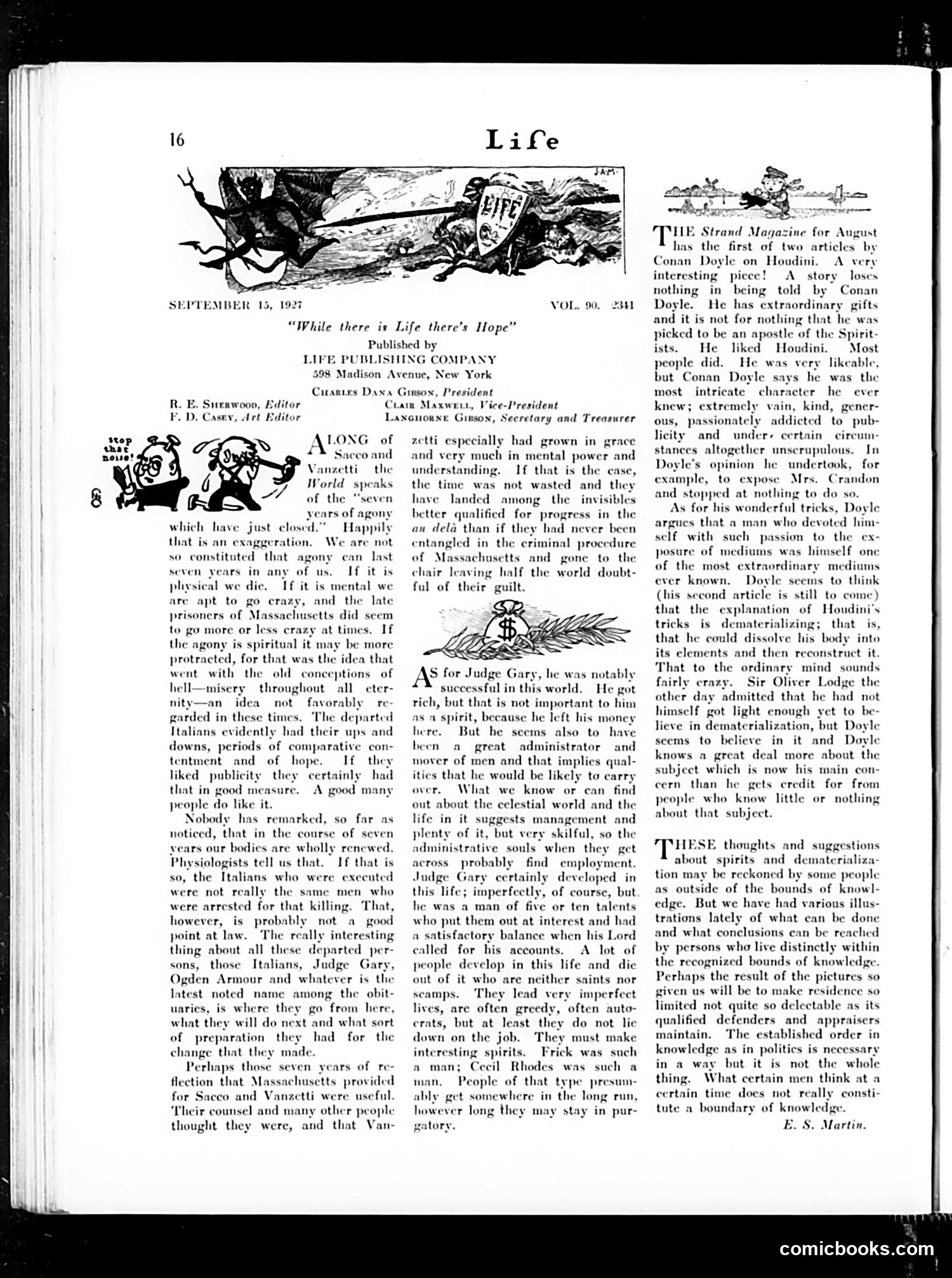
This page contains an editorial article by E.S. Martin discussing spiritualism and mediums, particularly referencing Houdini (the famous magician and spiritualist debunker). The article mentions Conan Doyle's articles on Houdini from The Strand Magazine. The masthead illustration shows a skeleton or death figure, labeled "LIFE," appearing to flee or escape—likely a visual metaphor for the magazine's satirical approach. The article argues against belief in spiritualist mediums, suggesting that people claiming supernatural powers are either deluded or fraudulent. It uses examples like Judge Gary to illustrate how intelligent people can be fooled. The piece advocates for rational skepticism while acknowledging the human desire to believe in an afterlife—a timely debate during the 1920s spiritualism craze.
📄 Transcribed text from this page (OCR, searchable)
Machine-transcribed from the original scan — historical spelling and the odd misread are preserved.
SEPTEMBER 15, 1927 VOL, 90, 2341 “While there is Life there’s Hope” Published by LIFE PUBLISHING COMPANY 598 Madison Avenue, New York Citantes Dawa Grnso Cram Maxwe Laxcuoaye R. E. Snerwoon, Editor PF. D. Casry, Art Editor of Sacco and Vanzetti the World speaks of the * years of agony have just closed.” Happily san exaggeration. We are not so constituted that agony can last years in any of us. If it is physical we die. Tf it is mental we are apt to go crazy, and the late prisoners of Massachusetts did seem to go more or less crazy at times, If the agony is spiritu may be more protracted, for that was the idea that went with the old conceptions of hell—misery throughout all eter- nity—an idea not favorably re Jed in these times. The departed Italians evidently had their ups and downs, periods of comparative con- tentment and of hope. If they liked publicity they certainly had that in good measure. A good many people do like it. Nobody has remarked, so far as noticed, that in the course of seven ars our bodies are wholly renewed. siologists tell us that. If that is so, the Italians who were executed were not really the same men who were arrested for that killing. That, however, is probably not a good point at law. The really interesting thing about all these departed per- sons, those Italians, Judge Gary, Ogden Armour and whatever is the latest noted name among the obit- uarics, is where they go from here, what they will do next and what sort of preparation they had for the change that they made. rhaps those seven years of re- ion that Massachusetts provided nd Vanzetti were useful. € a y other people thought they were, and that Van- seven seve) . President , Vice-President jimson, Secretary and Treasurer zetti especially had grown in grace and very much in mental power understanding. If that is the the time was not wasted and th have landed among the invisibi better qualified for progress in th au dela than if they had never be entangled in the criminal procedure of Massachusetts and gone to the chair leaving half the world doubt- ful of their guilt. ASS for Judge Gary, he was notably successful in this world. He got rich, but that is not important to him 1s a spirit, because he left his money he But he seems also to have been a great’ administrator and mover of men and that implies qual- ities that he would be likely to carry over. What we know or can find out about the celestial world and the life in it suggests management and plenty of it, but very skilful, so the idministrative souls when they across probably — find Judge Gary certainly developed in this life; imperfectly, of course, but he was a man of five or ten talents who put them out at interest and had a satisfactory balance when his Lord called for his accounts. A lot of people develop in this life and die out of it who are neither saints nor mps. They lead very imperfect lives, are often greedy, often auto- crats, but at least they do not lie down on the job. They must make interesting spirits. Frick was such a man; Cecil Rhodes was such a man, People of that type presum- ably get somewhere in the long run, however long they may stay in pur- gatory. so oy a wee ae Tue Strand Magazine for August has the first of two articles by Conan Doyle on Houdini. A very interesting picce! A_ story nothing in being told by Conan Doyle. He has extraordin, gifts and it is not for nothing that he was picked to be an apostle of the Spirit- ists. He liked Houdini people did. He was very likeable, but Conan Doyle says he was the most intricate character he ever knew; extremely vain, kind, gener- ous, passionately addicted to pub- licity and undere certain cireum- Itogether unscrupulous. In opinion he undertook, for ample, to expose Mrs. Crandon and stopped at nothing to do so. As for his wonderful tricks, Doyle argues that a man who devoted him- self with such passion to the ex- posure of mediums was himself one of the most extraordinary mediums ever known. Doyle seems to think (his second article is still to come) that the explanation of Houdini’s tricks is dematerializing; that is, that he could dissolve his body into its elements and then reconstruct it. That to the ordinary mind sounds fairly ¢ Sir Oliver Lodge the other day admitted that he had not himself got light enough yet to be- lieve in dematerialization, but Doyle seems to believe in it and Doyle knows a great deal more about the subject which is now his main con- cern than he gets credit for from people who know little or nothing about that subject. loses TPHESE thoughts and suggestions about spirits and dematerializa- tion may be reckoned by some people as outside of the bounds of know]- edge. But we have had various illus- trations lately of what can be done and what conclusions can be reached by persons who live distinctly within the recognized bounds of knowledge. Perhaps the result of the pictures so given us will be to make residence so limited not quite so delectable as its qualified defenders and appraisers maintain. The established order in knowledge as in politics is necessary in a way but it is not the whole thing. What certain men think at a certain time does not really consti- tute a boundary of knowledge. E. S. Martin. comicbooks.com i