
Life, 1927-09-15 · page 23 of 40
Life — September 15, 1927 — page 23: what you’re looking at
What you’re looking at
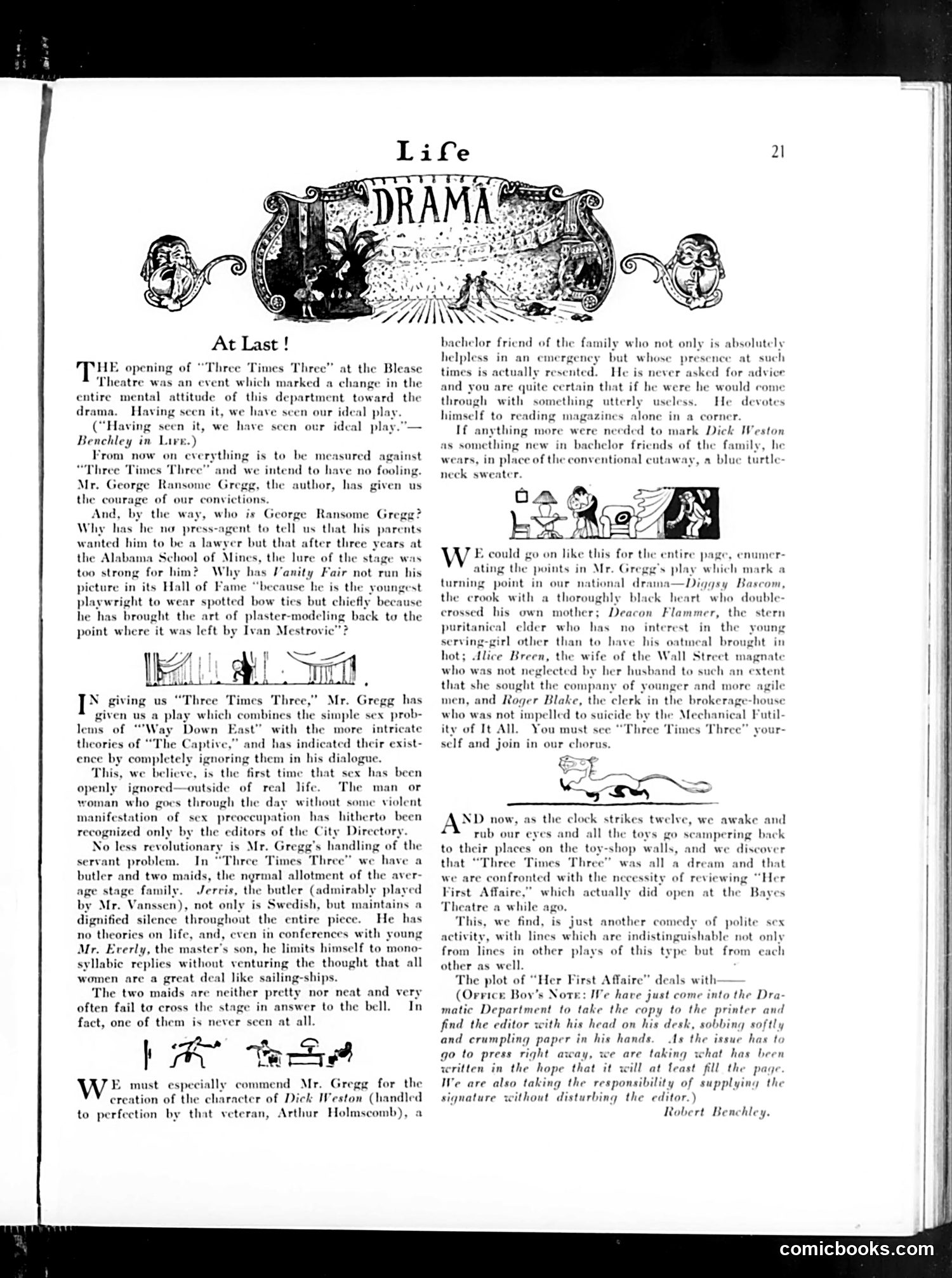
This is a theater review of George Ransome Gregg's play "Three Times Three" at the Blease Theatre. The critic praises the work as revolutionary for its handling of sex and servant problems—specifically by *ignoring* them entirely, which the writer presents as groundbreaking satire. The review highlights specific characters: Dick Weston (a useless bachelor friend wearing a blue turtleneck instead of a cutaway), butler Jervis (Swedish, silent), and various stock characters. The satire mocks both the play's simplicity and theater conventions generally—the author appears to be making fun of the play's pretensions while simultaneously celebrating its boldness in breaking with melodramatic tradition. The small cartoons illustrate dramatic moments. This is primarily theatrical criticism using humor and irony to dissect early 20th-century American stage conventions.
📄 Transcribed text from this page (OCR, searchable)
Machine-transcribed from the original scan — historical spelling and the odd misread are preserved.
HE opening of “Three Times Three” at the Blease Theatre was an event which marked a change in the entire mental attitude of this department toward the drama. Having scen it, we have scen our ideal y (“Having seen it, we have seen our ideal play. Benchley in Lave.) From now on eve “Three Times Thre Mr. George the courage of our convictions. And, by the Ransome Gregg? Why has he no press-agent to tell us that his parents wanted him to be a lawyer but that after three years at the Alabama School of Mines, the lure of the stage too strong for him? Why has Vanity Fair not ran his picture in its Hall of Fame “because he is the playwright to wear spotted bow ties but chiefl he has brought the art of plaster-modeling | point where it was left by Ivan Mestrovic I* giving us “Three Times Three given us a play which combines the simple sex prob- lems of “’Way Down East” with the more intricate ries of “The Captive,” and has indicated their exist- e by completely ignoring them in his dialogue. This, we believe, is the first time that sex has been openly ignored—outside of real life. The man or woman who goes through the day without some violent manifestation of sex preoccupation has hitherto been recognized only by the editors of the City Directory. No less revolutionary is Mr. Gregg’s handling of the servant problem. In “Three Times Three” we have a butler and two maids, the ngrmal allotment of the aver- age stage family. Jervis, the butler (admirably played by Mr. Vanssen), not only is Swedish, but maintains a dignified silence throughout the entire piece. He has no theories on life, and, even in conferences with young Mr. Ererly, the master’s son, he limits himself to mono- syllabic replies without venturing the thought that all women are a great deal like sailing-ships. The two maids are neither pretty nor neat and very often fail to cross the stage in answer to the bell. In fact, one of them is never seen at all. | must especially commend Mr. Gregg for the ion of the character of Dick Weston (handled to perfection by that veteran, Arthur Holmscomb), a ything is to be measured against and we intend to have no fooling. Ransome Gregg, the author, has given us way, who is George was youngest bachelor friend of the helpless in an emergency but whose presence at times is actually resented. He is never asked for advice and you are quite certain that if he were he would come through with something utte rly useless. He himself to reading magazines alone in a corner. If anything more were needed to mark Dick Weston as something new in bachelor friends of the family, he wears, in place of the conventional cutaway, a blue turtle- neck sweater. family who not only is absolutely such devotes on like this for the entire page, enumer- ints in Mr. Gregg’s play which mark a V 7 E could ¢ ating the 1 turning point in our national drama—Diggsy Bascom, the crook with black heart who double- crossed his Deacon Flammer, the puritanical elder who has no interest in. the serving-girl other than to have his oatmeal brought in hot; Alice Breen, the wife of the Wall Street who was not neglected by her husband to such an extent that she sought the company of younger and more agile men d Roger Blake, the clerk in the brokerage-house who was not impelled to suicide by the Mechanical Futil- ity of It All, You must see ‘Three Times Three” self and join in our chorus. a thoroughly own mother; stern young senate your- as the clock strikes twelve, we rub our eyes and all the toys go scampering back to their pl: ND now, awake and i discover and that “Her Bayes s on the toy-shop walls, and we that “Three Times Three” was all we are confronted with the necessity of reviewing First Affaire,” which actually did open at the Theatre a while ago. This, we find, is just another comedy o lite sex activity, with lines which are indistinguishable not only from lines in other plays of this type but from each other as well. The plot of “Her First Affaire” deals with (Orricre Boy's Note: We have just come into the Dra- matic Department to take the copy to the printer and find the editor with his head on his desk, and crumpling paper in his hands has te go to press right away, we are taking what has been written in the hope that it will at feast fill the page We are also taking the responsibility of supplying the editor.) Robert Benchley. a dream sobbing softly As the issue signature without disturbing the comicbooks.com