
A complete issue · 36 pages · 1927
Life — September 8, 1927
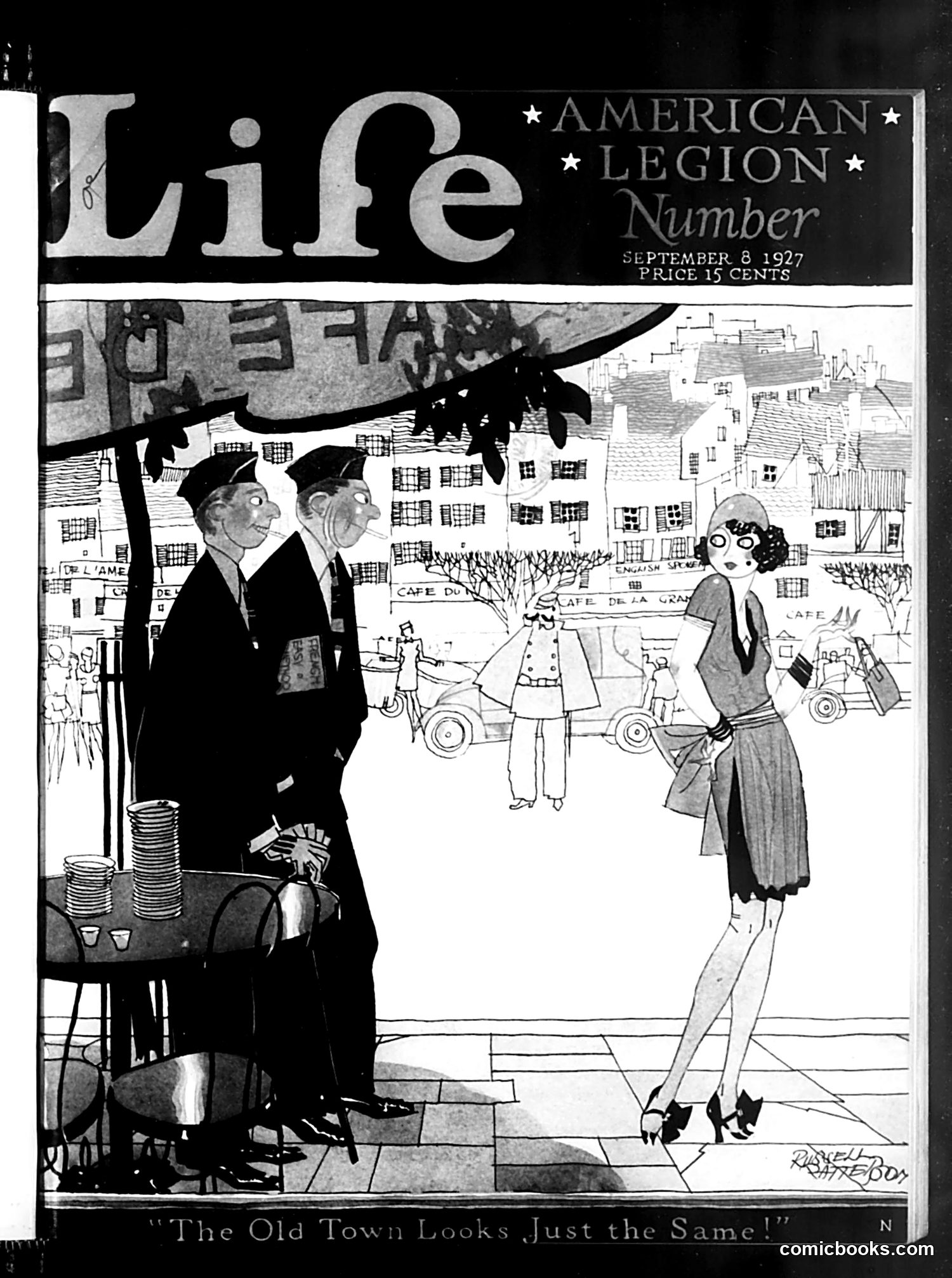
This September 1927 Life magazine cover satirizes the contrast between modern urban development and nostalgic sentimentality. Two well-dressed men in suits—appearing to be returning visitors or tourists—stand beneath an umbrella observing a bustling European town square (suggested by "Cafe" signs and French-style architecture). The caption's irony is the joke: despite the men's claim that "the old town looks just the same," the scene behind them shows clear modernization—automobiles, contemporary fashion, busy commercial activity, and updated architecture. The satire mocks people's selective nostalgia and inability to perceive actual social and technological change happening around them, or their denial of progress. The stylishly-dressed woman passing by represents the modern era they're overlooking.
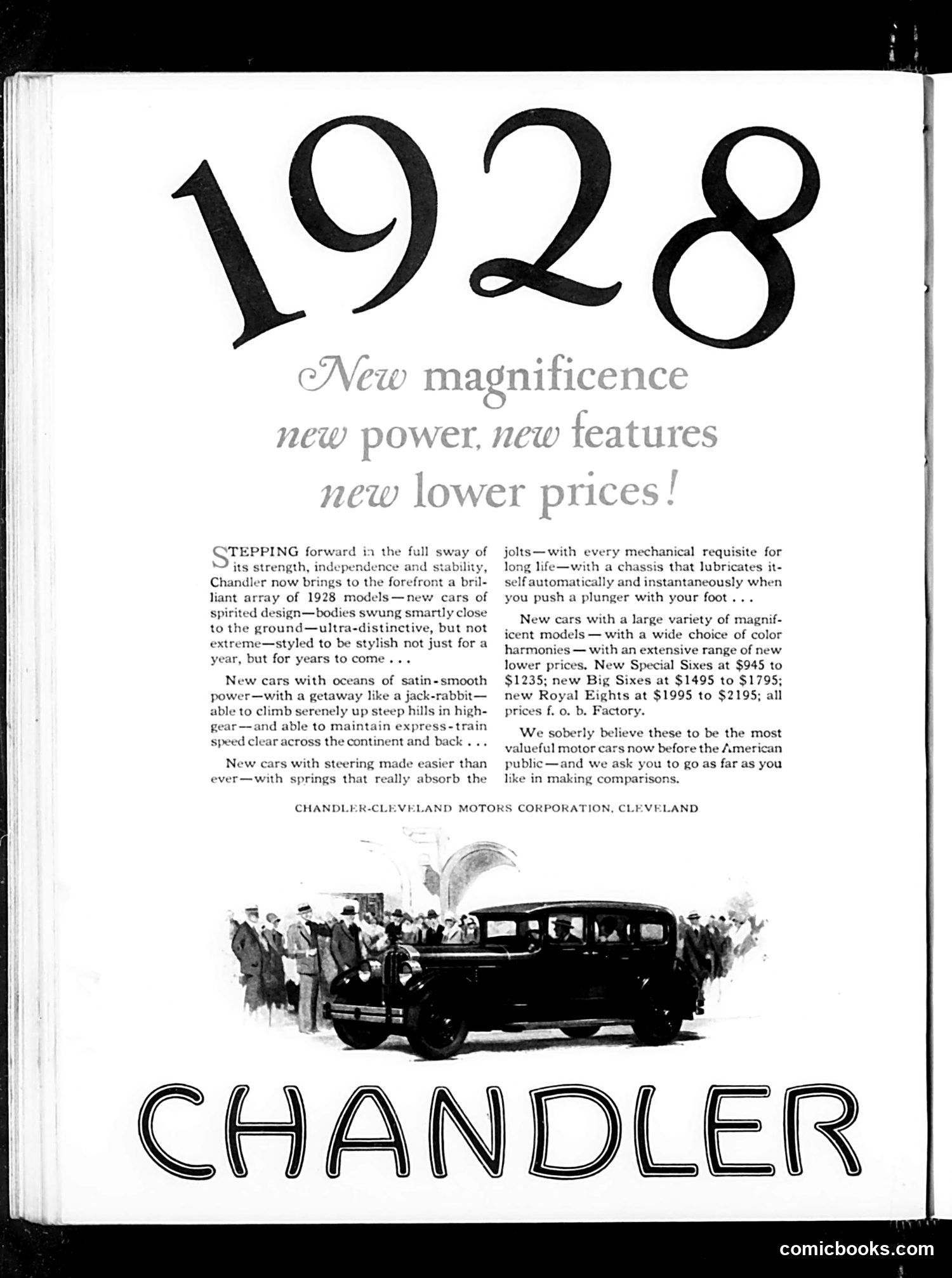
This is a straightforward automobile advertisement, not political satire. Chandler-Cleveland Motors Corporation advertised their 1928 car models with claims of "new magnificence," enhanced mechanical features, and reduced prices. The ad lists specific models—Special Sixes at $1,235, Big Sixes at $1,495-$1,795, and Royal Eights at $1,995-$2,195—positioning them as affordable luxury vehicles. The accompanying illustration shows the car surrounded by well-dressed customers and onlookers, emphasizing the automobile's appeal to middle and upper-class buyers. This reflects the 1920s automotive boom, when car ownership expanded dramatically and manufacturers competed intensely on features, styling, and price. The ad's tone suggests optimism about consumer purchasing power during this pre-Depression prosperity period.
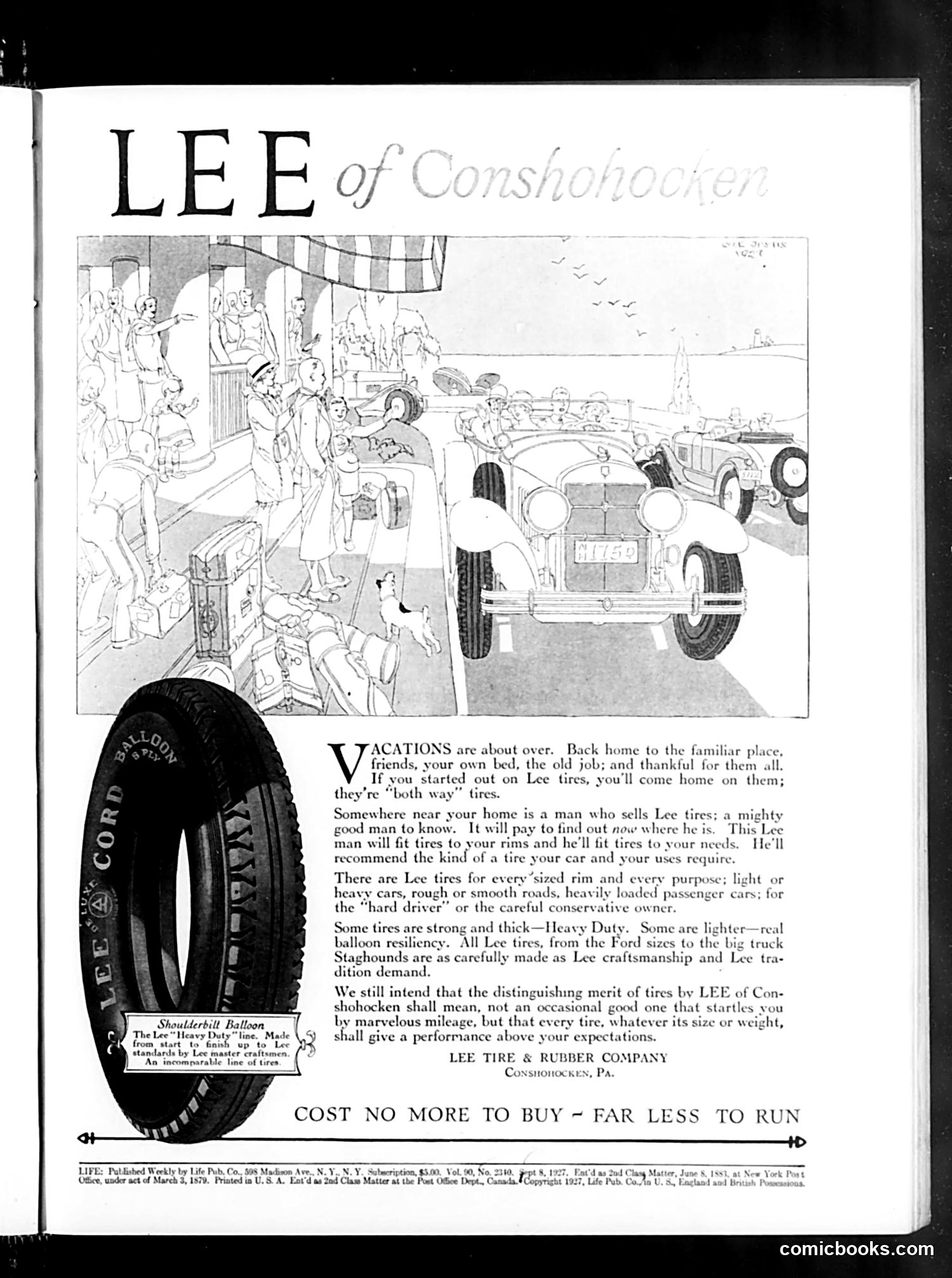
This is primarily a **tire advertisement**, not political satire. The page promotes Lee Tire & Rubber Company tires from Conshohocken, Pennsylvania. The illustration depicts a vacation scene: people returning home from holiday ("vacations are over. Back home to the familiar place..."), with vintage automobiles prominently featured. The ad emphasizes Lee tires' reliability for both "both way" travel. The image of the "Shoulderkill Balloon" tire on the left demonstrates the tire's construction quality and durability. The advertisement's tagline—"COST NO MORE TO BUY—FAR LESS TO RUN"—promises economic value. This reflects 1920s consumer culture: the growing automobile market and manufacturers' marketing strategies targeting middle-class drivers concerned about tire reliability and cost-effectiveness for leisure travel.
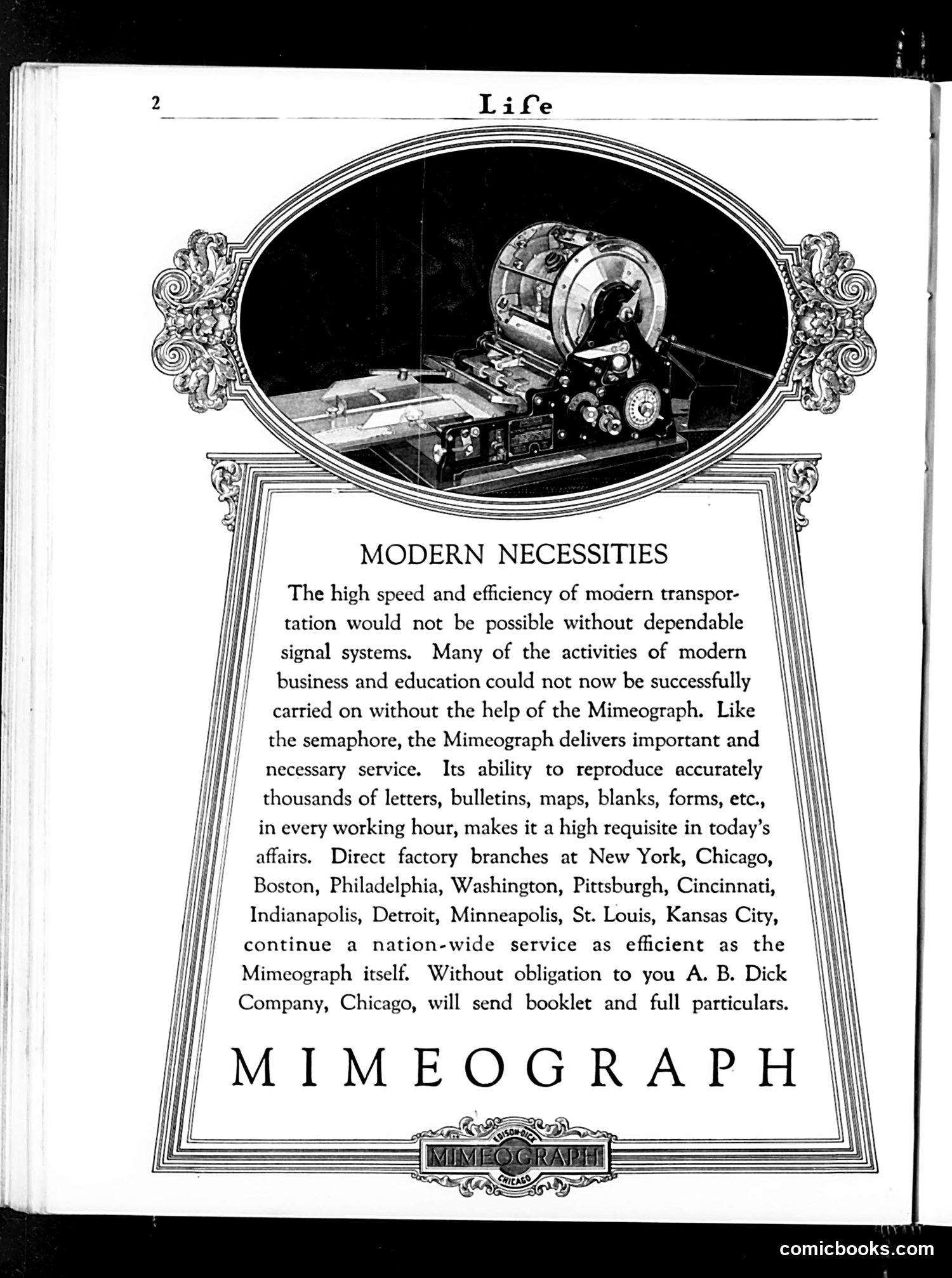
This page is **primarily an advertisement**, not satire or editorial content. It's a promotional piece for the Mimeograph machine, published in *Life* magazine. The ad emphasizes the Mimeograph as a "modern necessity" for business and education, comparing it to the semaphore (a signaling system) as essential infrastructure. The ornate illustration shows the machine itself—a mechanical device for mass-producing documents. The ad lists A.B. Dick Company's factory branches across major American cities, positioning the Mimeograph as a nationwide service. The context suggests this dates to the early-to-mid 20th century, when mimeograph machines were genuinely transformative office technology, enabling rapid document duplication before photocopiers existed. There is no cartoon or political satire present on this page.
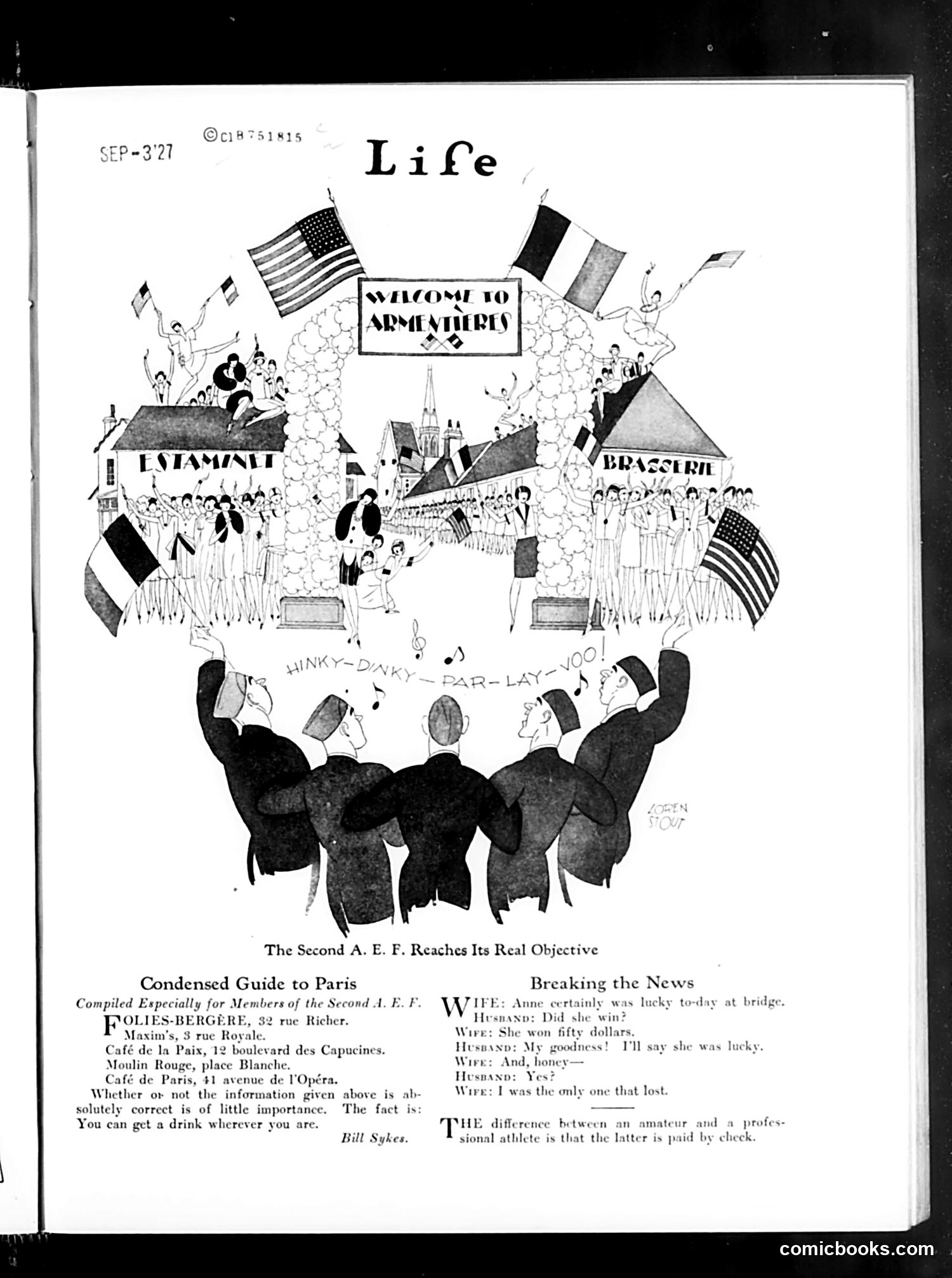
This Life magazine page satirizes the A.E.F. (American Expeditionary Forces) in post-WWI France. The central illustration depicts American soldiers observing European culture—labeled locations include "Estaminet" (French tavern) and "Brasserie"—with French and American flags. The caption "Welcome to Armentieres" references a famous WWI song. The satire mocks soldiers discovering Parisian entertainment and vices. "Hinky-Dinky-Parlay-Voo" (corrupted French slang from the song) emphasizes cultural confusion. The bottom section, "Breaking the News," contains a joke about a wife's infidelity—suggesting soldiers' absent minds wandered to home troubles. The "Condensed Guide to Paris" listing bars implies the A.E.F.'s "real objective" was leisure rather than military purpose—satirizing post-war occupation priorities and soldiers' focus on drinking establishments.
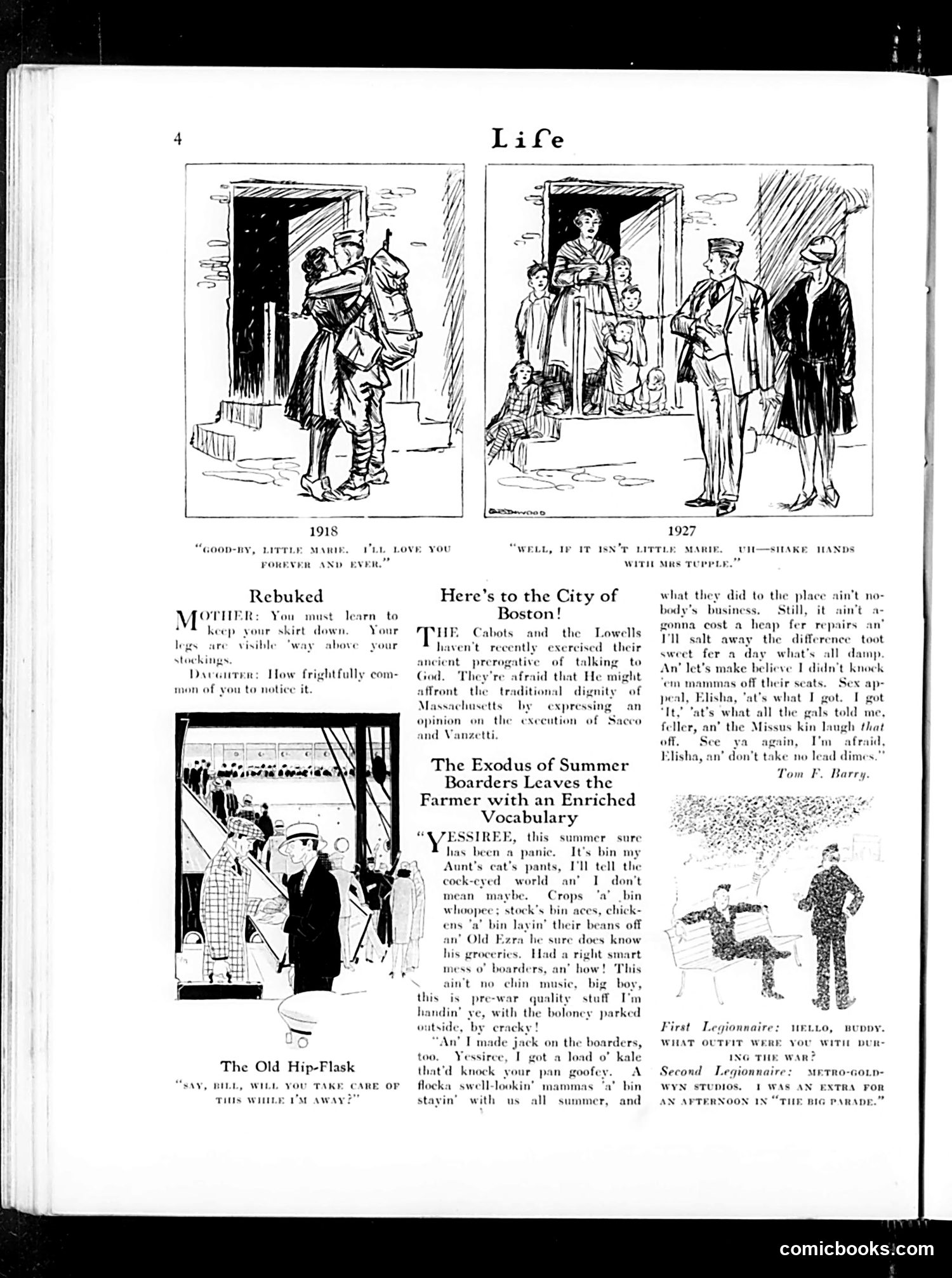
This page contrasts two moments across nine years of American history. The top panels show a soldier's farewell in 1918 (WWI era) versus a casual 1927 encounter with "Mrs Tupple," satirizing how quickly wartime sentiment faded into peacetime indifference. The "Rebuked" sketch mocks maternal prudishness about women's hemlines—a recurring 1920s controversy as skirts rose dramatically, shocking older generations. "Here's to the City of Boston" references the Lowell family's religious conservatism and the Sacco-Vanzetti executions (1927), a controversial case dividing American opinion. "The Exodus of Summer Boarders" humorously catalogs rural/rustic speech patterns—the farmer's colorful dialect contrasting with city visitors' sophistication. These pieces collectively reflect 1920s social tensions: changing gender norms, class differences, and generational conflict.
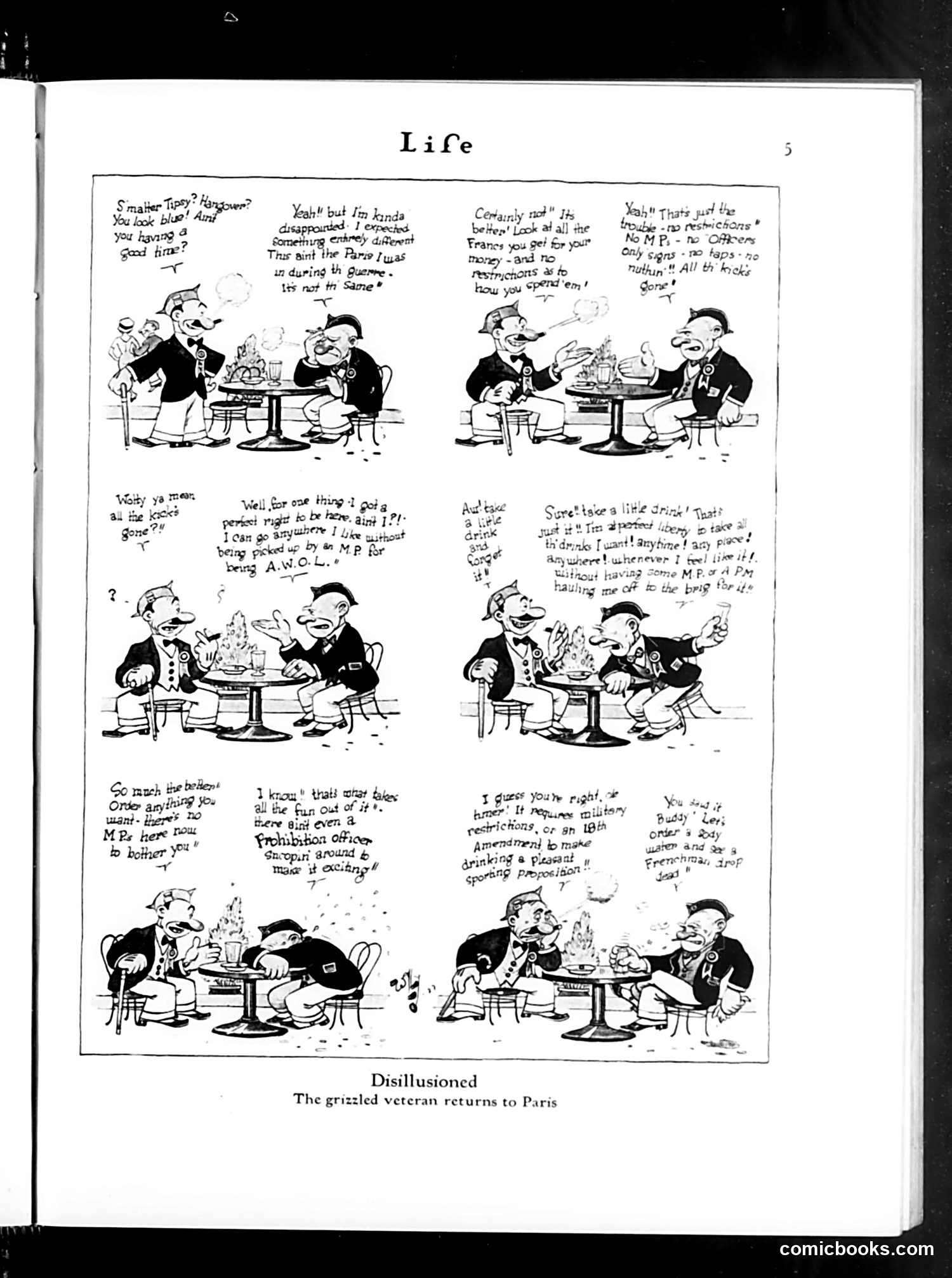
This comic strip satirizes an American WWI veteran's disappointed return to Paris. The soldier arrives expecting the romantic, sophisticated France he'd imagined, but encounters reality instead. The dialogue reveals his complaints: France lacks the amenities he expected, Parisians seem indifferent, and military restrictions prevent him from enjoying himself freely. He references the 18th Amendment (Prohibition), suggesting alcohol was unavailable—a key disappointment. The satire targets both the veteran's naive expectations and post-war disillusionment. American soldiers had romanticized Paris during wartime; this comic deflates those fantasies, showing how reality failed to match propaganda or imagination. The grizzled appearance emphasizes his worn-down state, suggesting war itself had already damaged his capacity for romance or pleasure.
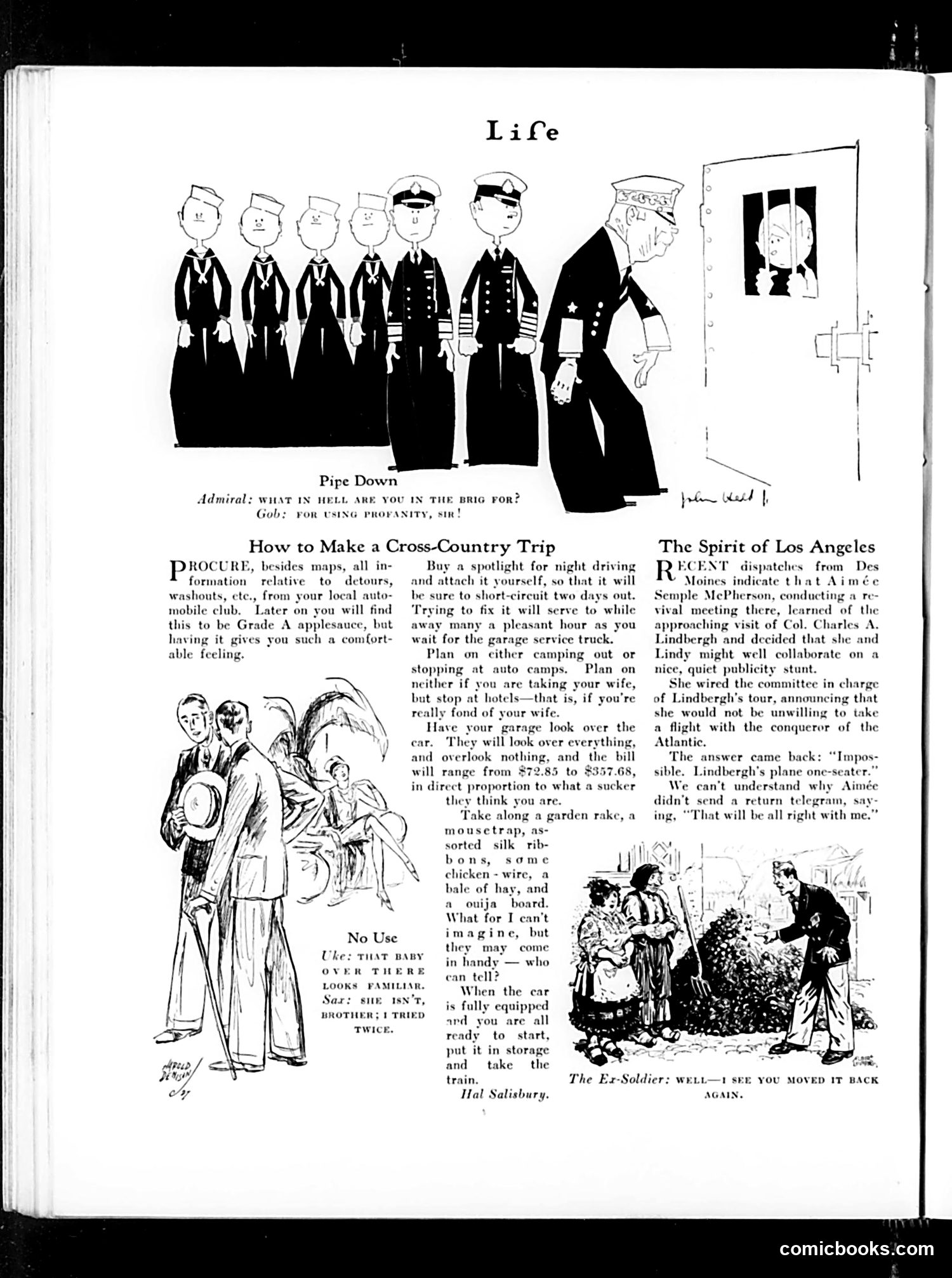
This page contains three unrelated satirical pieces typical of Life's early 20th-century humor: 1. **"Pipe Down"**: A naval cartoon mocking an admiral's profanity among junior officers, with the punchline criticizing his hypocrisy. 2. **"No Use"**: A domestic humor sketch about a man holding a baby, with the joke being that the baby resembles his brother—implying paternity doubt or family resemblance jokes common to the era. 3. **"How to Make a Cross-Country Trip" and "The Spirit of Los Angeles"**: Practical satire about automobile travel advice (then novel) mixed with a gossipy anecdote about Aimee Semple McPherson, a famous evangelist, and Charles Lindbergh. The "ex-soldier" reference suggests post-WWI dating. The page reflects 1920s concerns: automobiles as emerging technology, naval discipline, and celebrity culture.
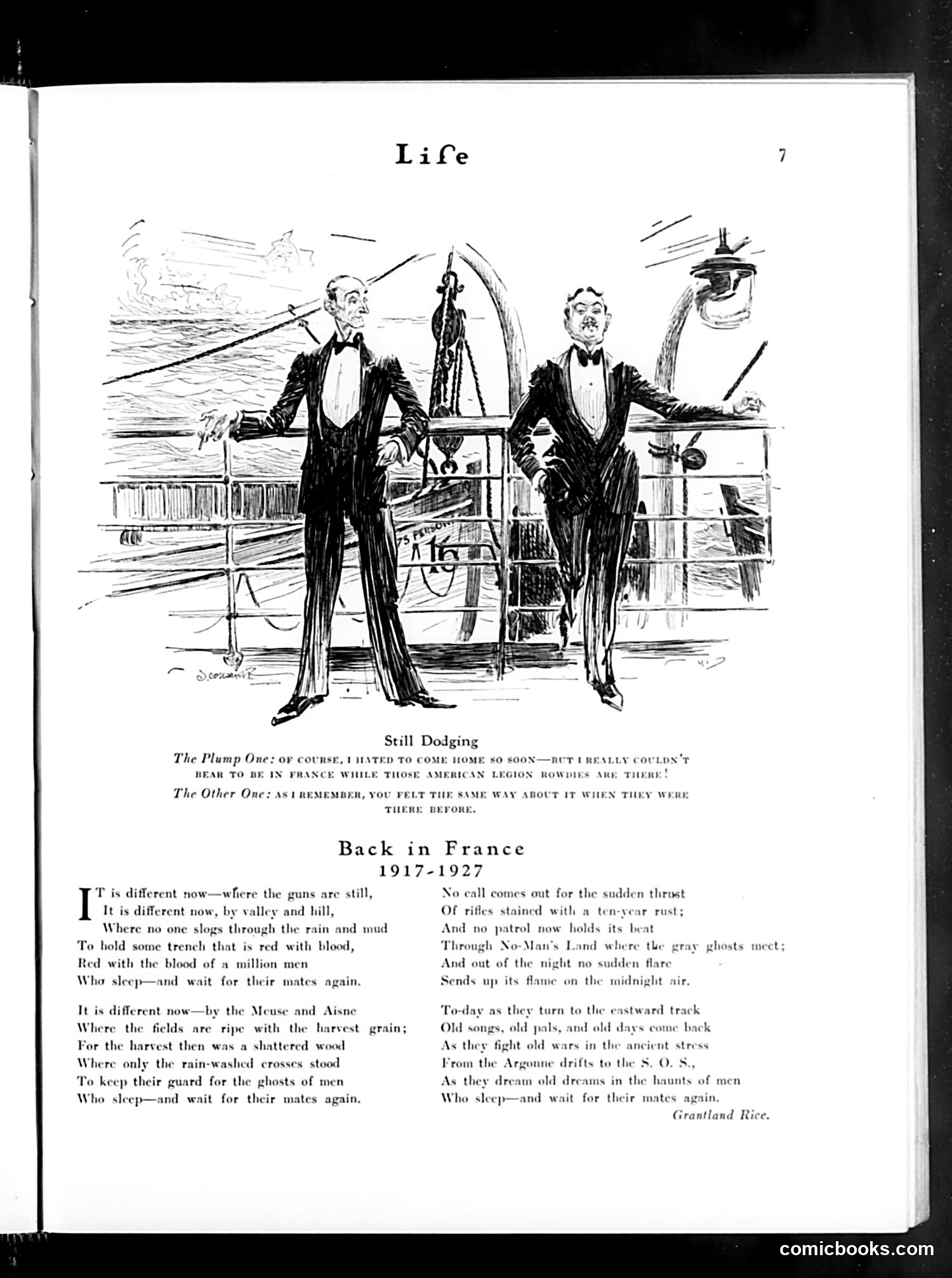
The cartoon "Still Dodging" depicts two well-dressed men on a ship's deck, one holding what appears to be a fish. The dialogue references "The Plump One" complaining about returning home soon because "American Legion rowdies are there," while "The Other One" reminds him he felt similarly about being in France. This satirizes wealthy or prominent figures who avoided military service during WWI (1917-1927, per the page heading). "Still Dodging" suggests these men are evading consequences or accountability. The poem "Back in France" below contrasts peaceful post-war conditions with wartime realities, emphasizing those who died waiting for comrades who never returned—a pointed critique of draft-dodgers' cowardice versus soldiers' sacrifice.
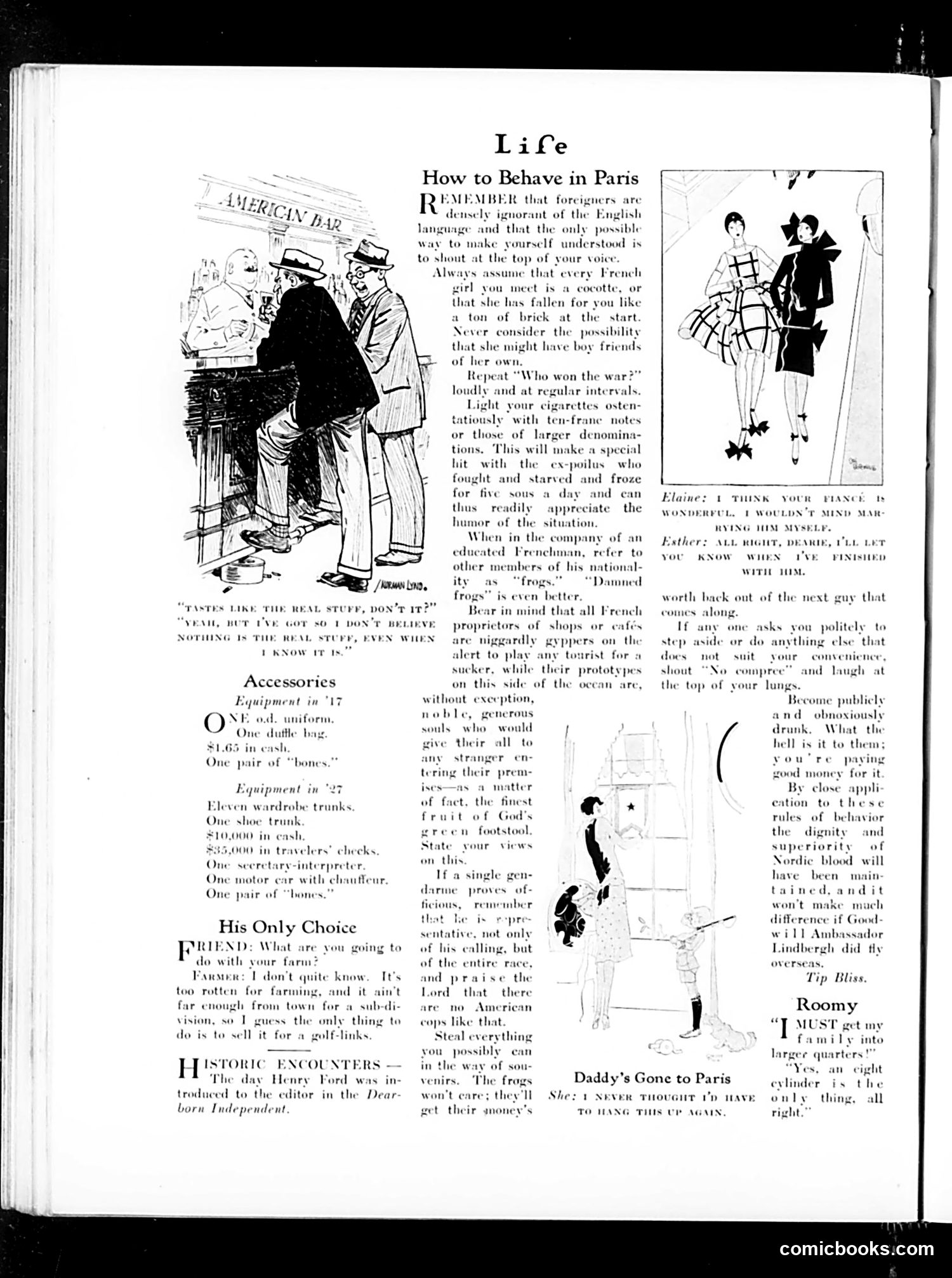
This page satirizes American tourists in 1920s Paris. The main cartoon shows three American men at an "American Bar," with one saying he doesn't believe "nothing is the real stuff, even when I know it." The accompanying article mocks American visitors' behavior: shouting to communicate, assuming French women are "coquettes," repeatedly asking "Who won the war?" (referencing American WWI involvement), and lighting cigarettes ostentatiously. The satire targets American arrogance and cultural ignorance abroad. The "Accessories" section humorously lists expensive travel gear required, implying wealth without sophistication. The overall message ridicules loud, boastish Americans who visit Paris while remaining oblivious to French culture and manners.
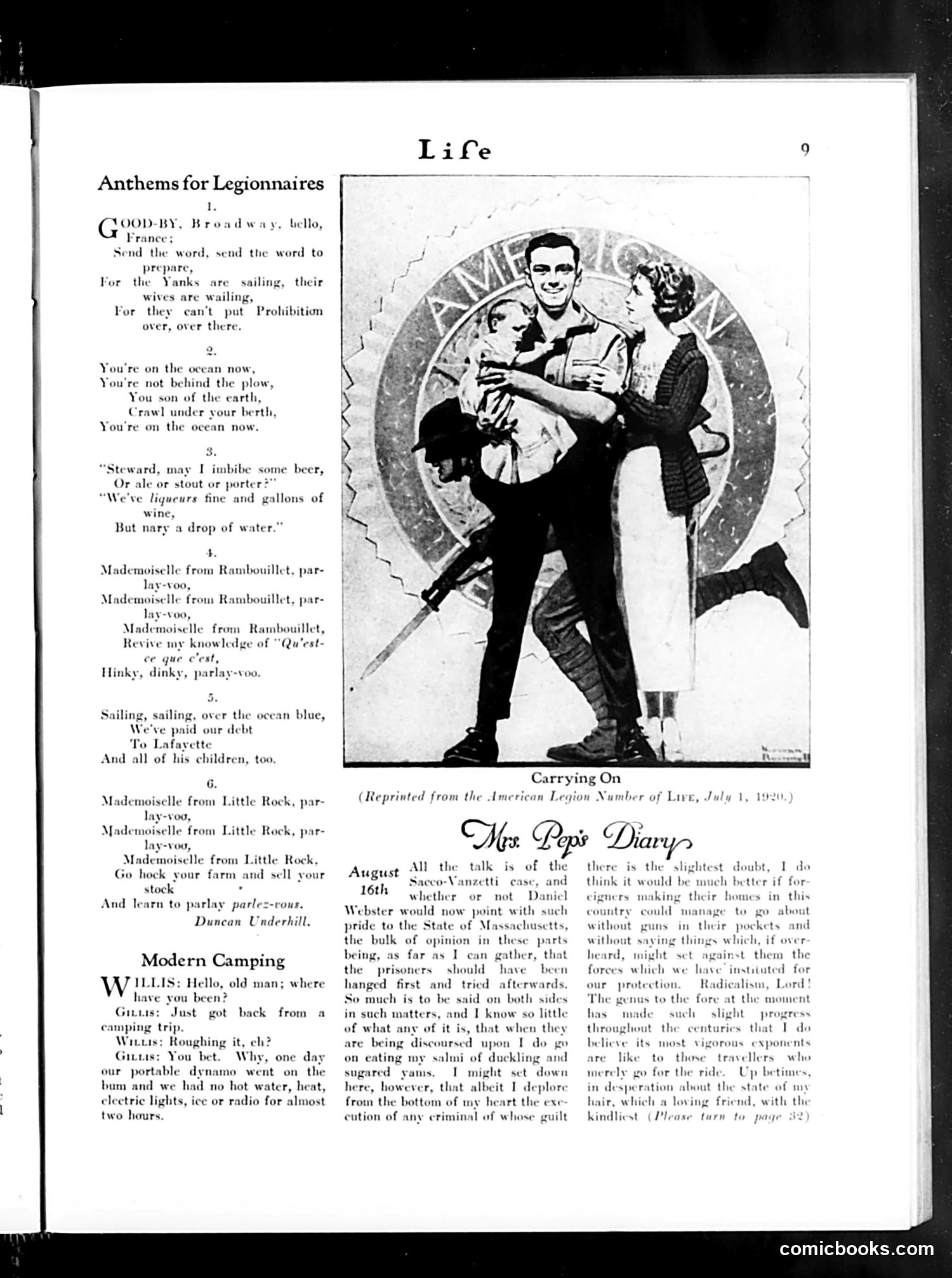
The central illustration depicts a man in military uniform holding a child while an attractive woman embraces him—a domestic scene titled "Carrying On." The caption notes it's reprinted from the American Legion Number of *Life*. The page includes "Anthems for Legionnaires"—patriotic verses about soldiers sailing home from WWI, references to Prohibition ("they can't put Prohibition over"), and drinking songs about wine and beer. A section called "Modern Camping" humorously describes Willis and Gillis's portable camping setup with a dynamo for electricity. "Mrs. Pep's Diary" discusses the Sacco-Vanzetti case, expressing concern about anarchism and radicalism in post-war America, advocating for vigilant protection against dangerous ideologies. Overall, the page reflects 1920s post-WWI anxieties: soldier homecoming, Prohibition debates, and Red Scare fears.
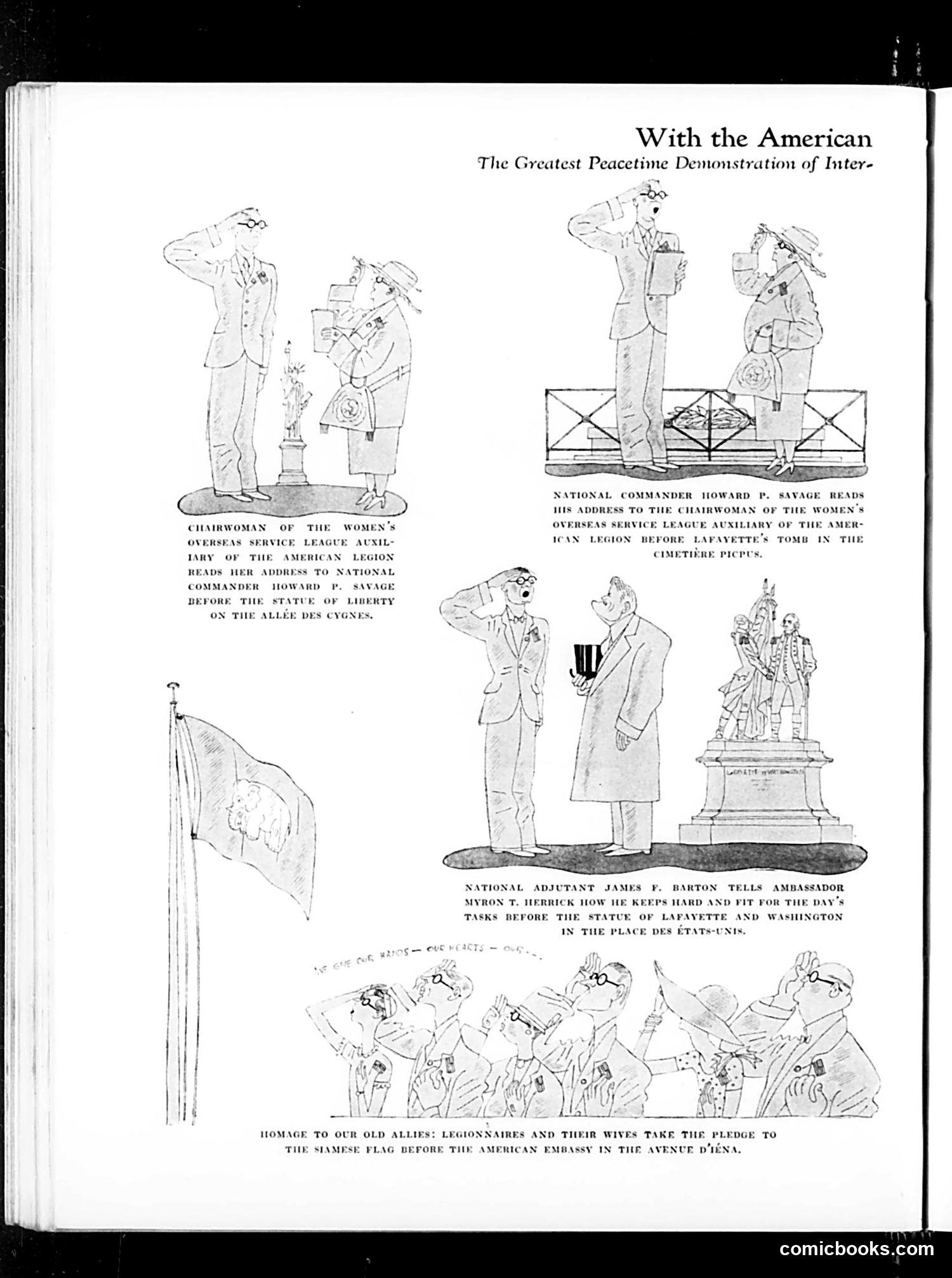
This page celebrates American-French military cooperation during World War I. The illustrations depict official ceremonies honoring the alliance: The top panels show the **Chairwoman of the Women's Overseas Service League** addressing National Commander Howard P. Savage before the Statue of Liberty, and Savage reciprocating by addressing the Women's League at Lafayette's tomb in Paris. The middle section shows **National Adjutant James F. Barton** briefing Ambassador Myron T. Herrick before the Lafayette and Washington statues in the Place des États-Unis (Paris). The bottom panel depicts French and American legionnaires and their wives pledging allegiance to the Siamese flag before the American Embassy in the Avenue d'Iéna (Paris). The satire appears gentle—humorously exaggerating the diplomatic formality and ceremonial excess of wartime alliance-building rather than mocking the alliance itself.
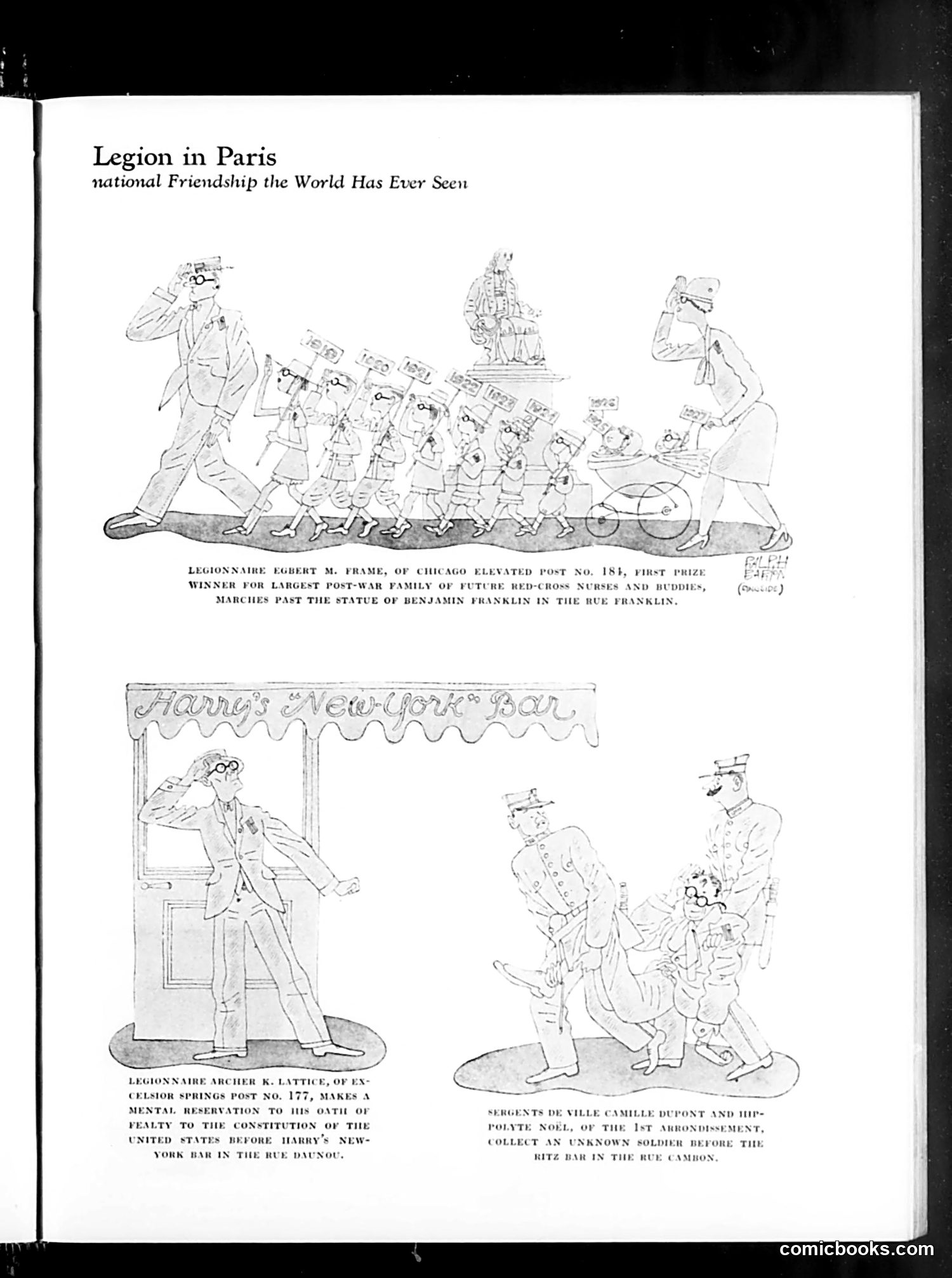
This page satirizes the American Legion's post-war presence in Paris. The top cartoon shows Legion members from Chicago marching past the Benjamin Franklin statue—a joke about American veterans abroad treating Paris like a tourist attraction. The bottom cartoons mock specific Legion posts' activities: one legionnaire makes a "mental reservation" about the U.S. Constitution at Harry's New York Bar, while sergeants from the 1st Arrondissement collect an "unknown soldier" at the Ritz Bar. The satire targets the Legion's behavior in Paris—suggesting members were more interested in drinking and carousing at American-style establishments than in serious international fellowship. The phrase "greatest friendship" is therefore ironic, mocking their actual conduct.
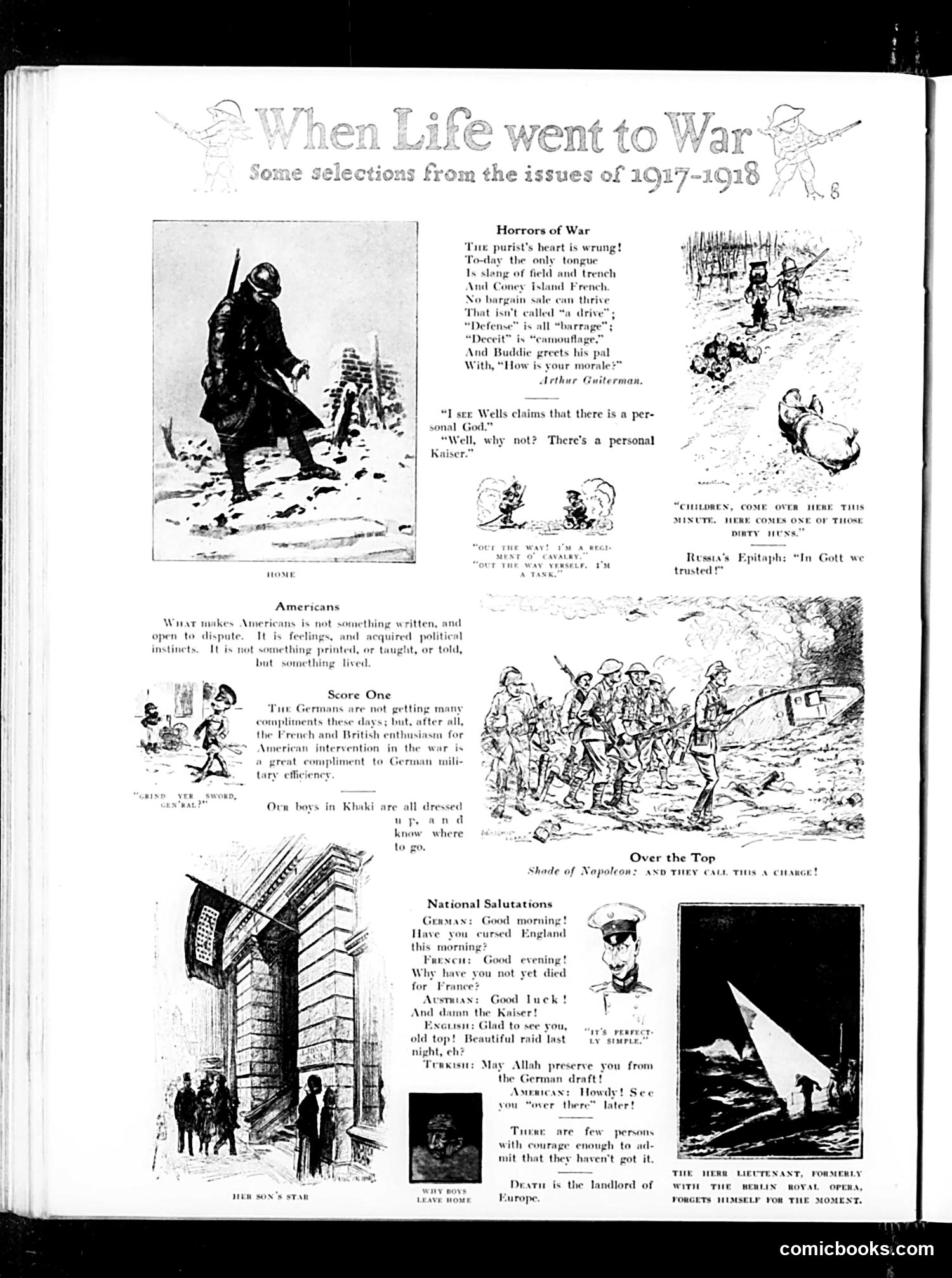
This page collects satirical cartoons and commentary from Life magazine's WWI coverage. The content mocks both enemy and allied nations: **"Horrors of War"** ridicules soldiers' slang and trench culture, presenting cynical battlefield humor. **"Americans"** celebrates American participation, contrasting it with European exhaustion. **"Score One"** mocks German military confidence, suggesting French and British resilience. **"Over the Top"** depicts soldiers charging—a notorious WWI tactic causing massive casualties. **"National Salutations"** presents stereotypical greetings from various allied nations (German, French, Austrian, Turkish, etc.), each expressing dark humor about their war situations. The cartoons use exaggeration and irony to process the war's brutality while maintaining morale for American readers newly engaged in the conflict. The overall tone blends patriotic encouragement with gallows humor about combat realities.
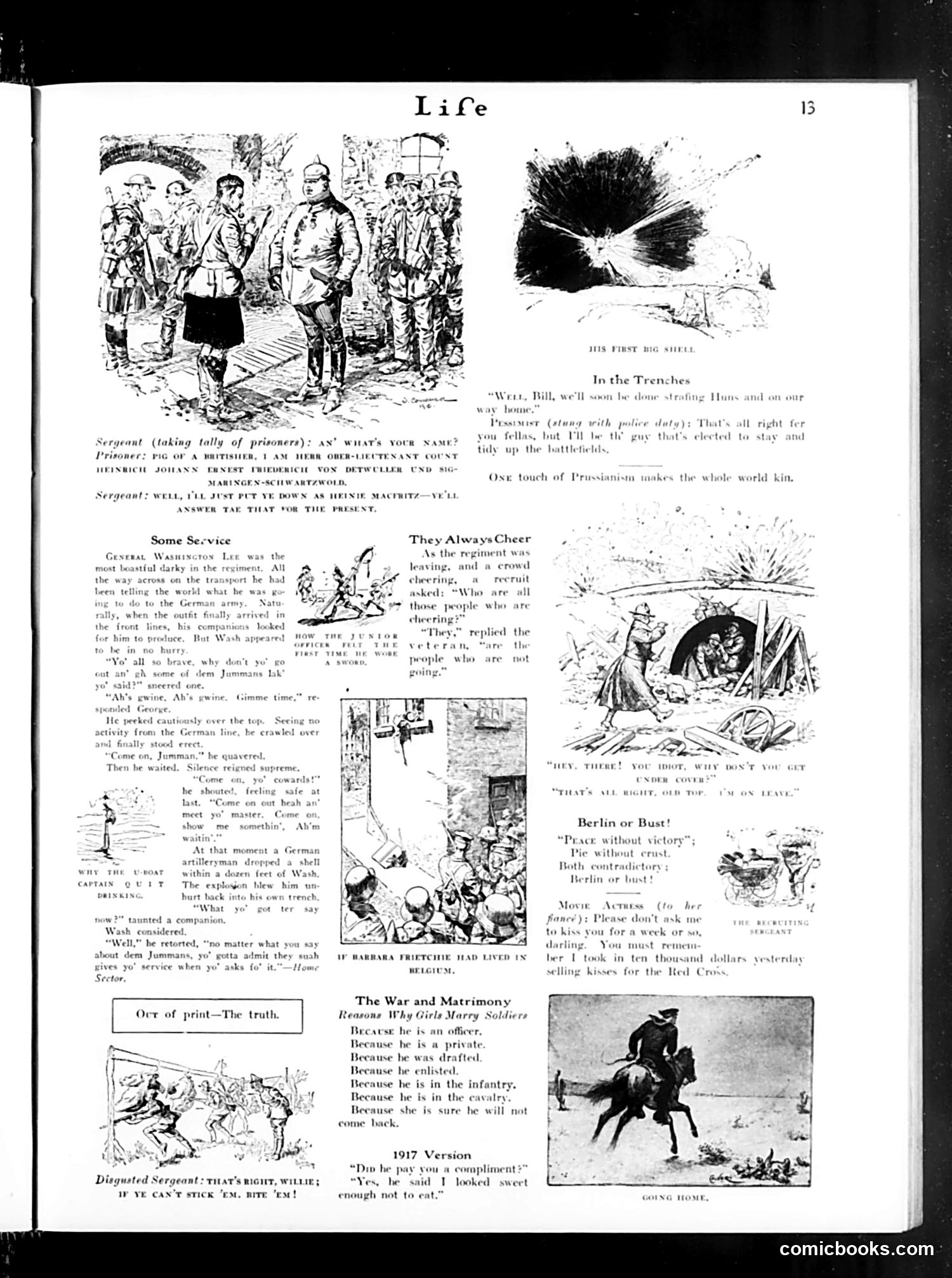
This WWI-era satirical page mocks military life and German culture through several sketches. The top cartoon shows a sergeant interrogating a German prisoner, with dialect humor in the dialogue. "Some Service" depicts soldiers' experiences in the trenches, while "They Always Cheer" jokes about recruitment morale. A sketch labeled "If Barbara Fritchie Had Lived in Belgium" references the Civil War poem to satirize German conduct in occupied Belgium—a real point of Allied propaganda about German atrocities. "The War and Matrimony" section humorously lists reasons girls marry soldiers, ending with the dark joke that she'll never see him again ("because she is sure he will not come back"). The overall tone combines dark humor about trench warfare casualties with anti-German sentiment typical of American WWI propaganda.
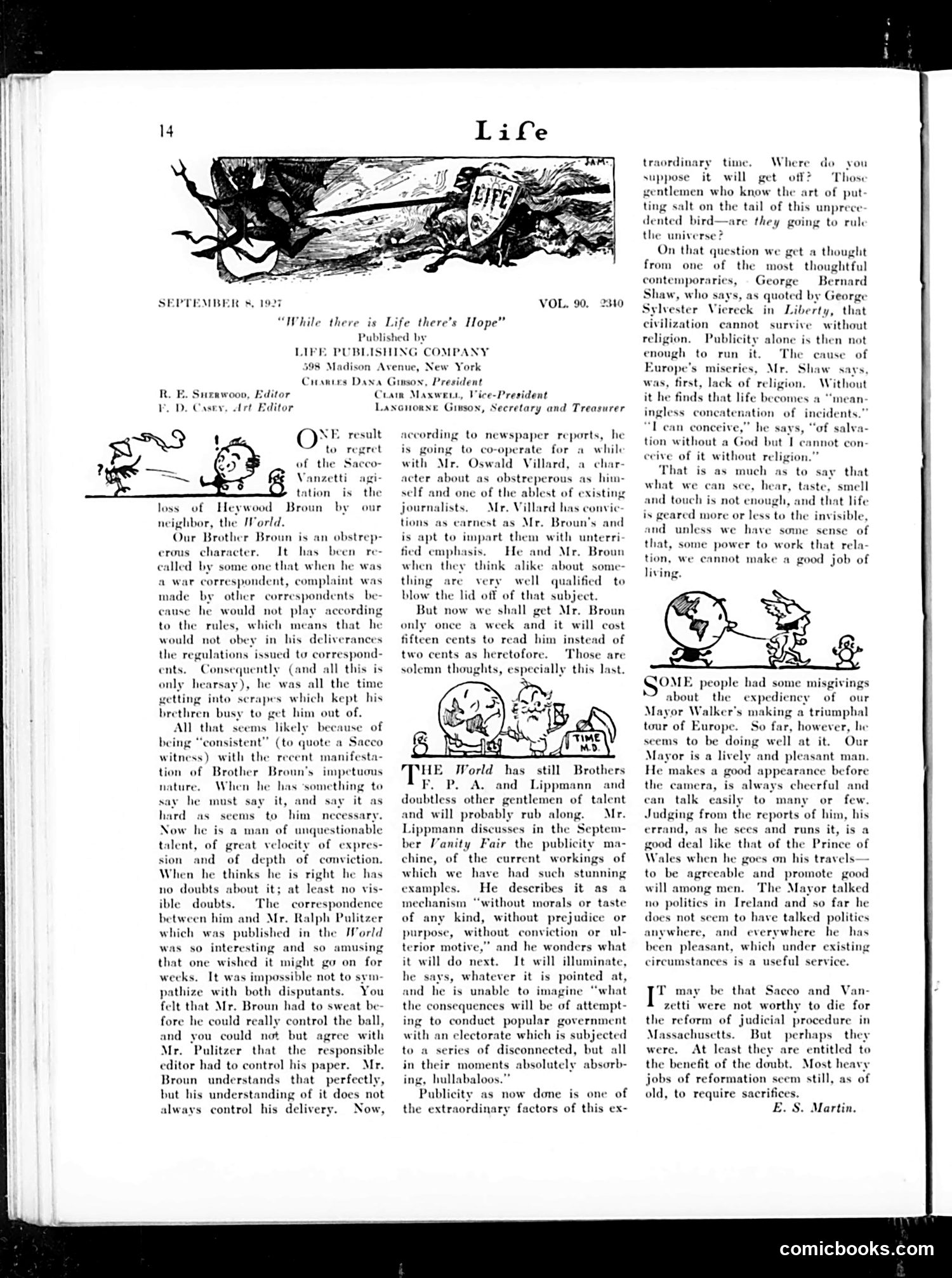
This page discusses the loss of Heywood Broun, a prominent journalist and war correspondent, from the *Vanity Fair* magazine staff. The editorial notes tension between Broun and management over editorial control and compliance with publication rules. The cartoons appear to be humorous illustrations accompanying commentary about publication politics and management disputes—typical satirical content for *Life* magazine's era. The page also references Mayor Walker's European tour, George Bernard Shaw's views on civilization and religion, and debates about F.P.A. and Lippmann as writers of talent. The overall tone critiques both journalistic freedom and the arbitrary nature of editorial decisions during this period of American journalism.
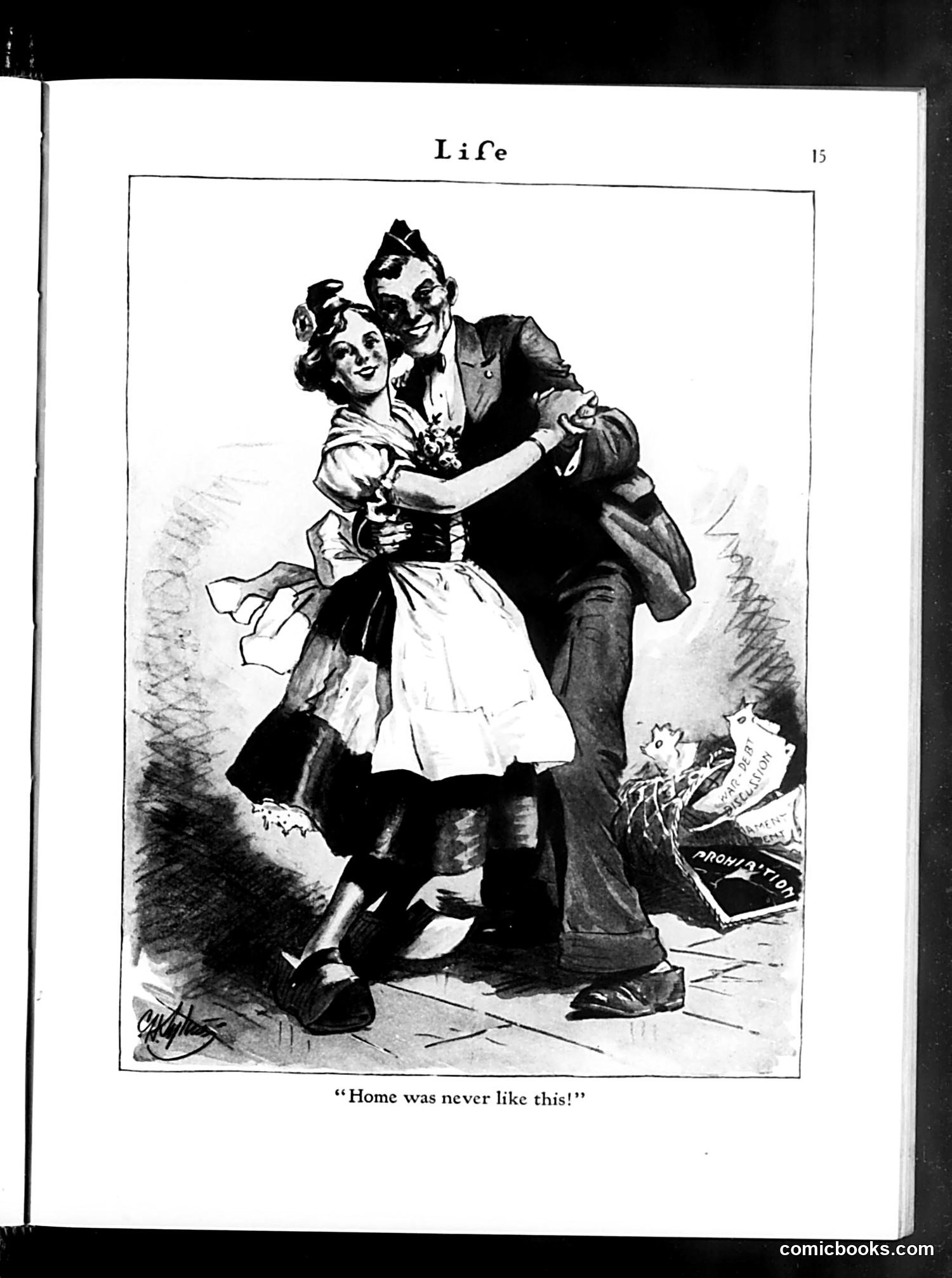
This *Life* magazine cartoon depicts a couple in an affectionate embrace, with the man appearing somewhat rakish or disreputable in appearance. The caption's wry observation suggests marital humor—the implication being that domestic life at home lacks the excitement or romance the couple is experiencing in this moment, likely in a setting outside the home (possibly a nightclub or similar venue, given the era's visual style). The satire targets mid-century American marriage expectations: the gap between idealized domestic bliss and actual married life's mundanity. The woman's delighted expression and the man's confident demeanor suggest they're enjoying an illicit or thrilling encounter, making the joke a commentary on how marriages can become routine or uninspiring compared to romantic excitement elsewhere.
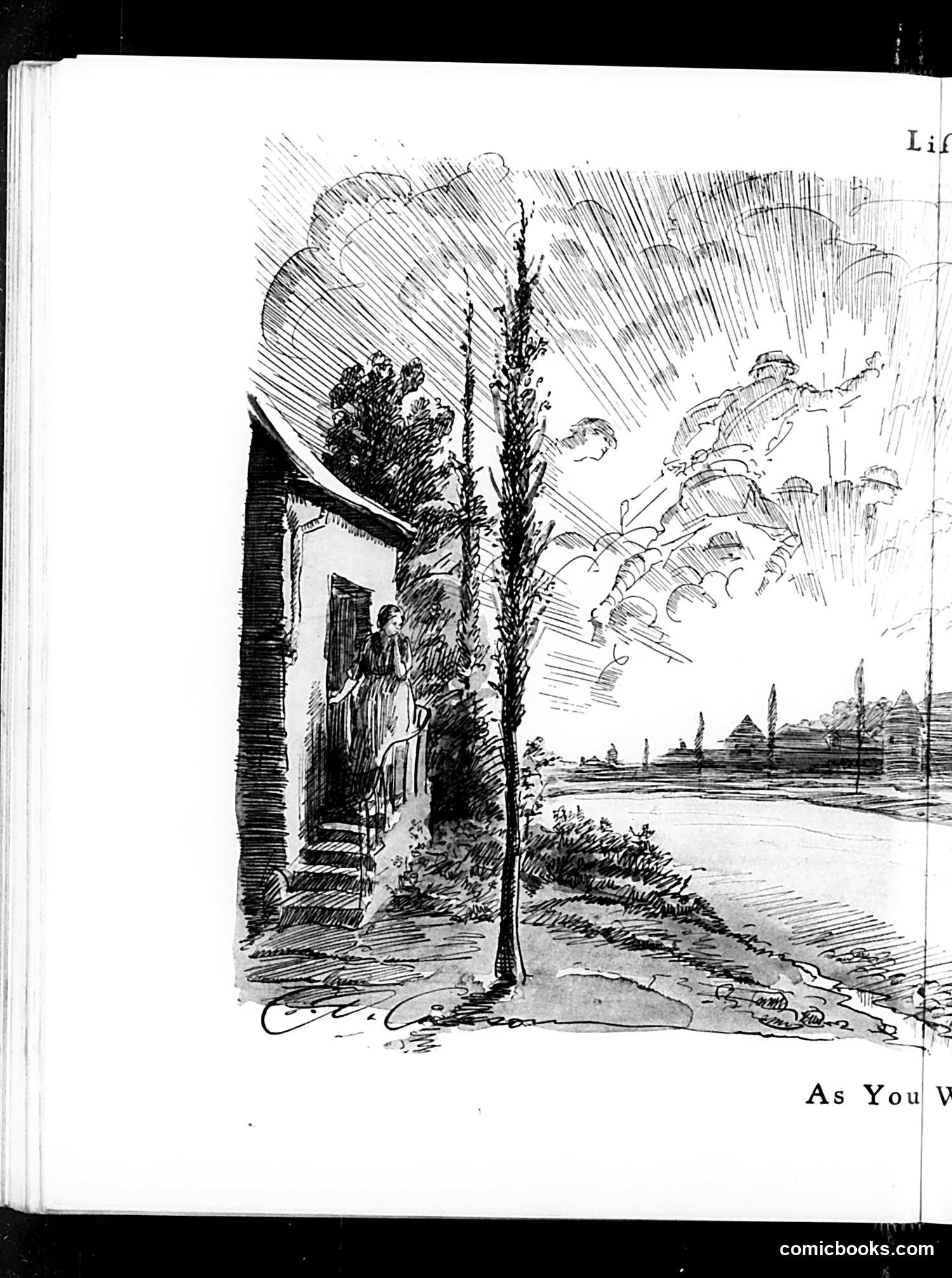
This page shows an ink sketch of a colonial-era building with a figure standing nearby, palm trees, and what appears to be a waterfront landscape in the background. The partial text visible reads "Life" at top and "As You W[ill]" at bottom, suggesting this is a chapter opening or section divider from the satirical magazine *Life*. The artistic style and setting suggest this may be illustrating a historical narrative or colonial-themed story, possibly related to American or tropical colonial history given the architecture and vegetation. However, without the complete text or caption, I cannot definitively identify what specific political or social satire is intended. The image alone appears to be atmospheric illustration rather than explicit political commentary.
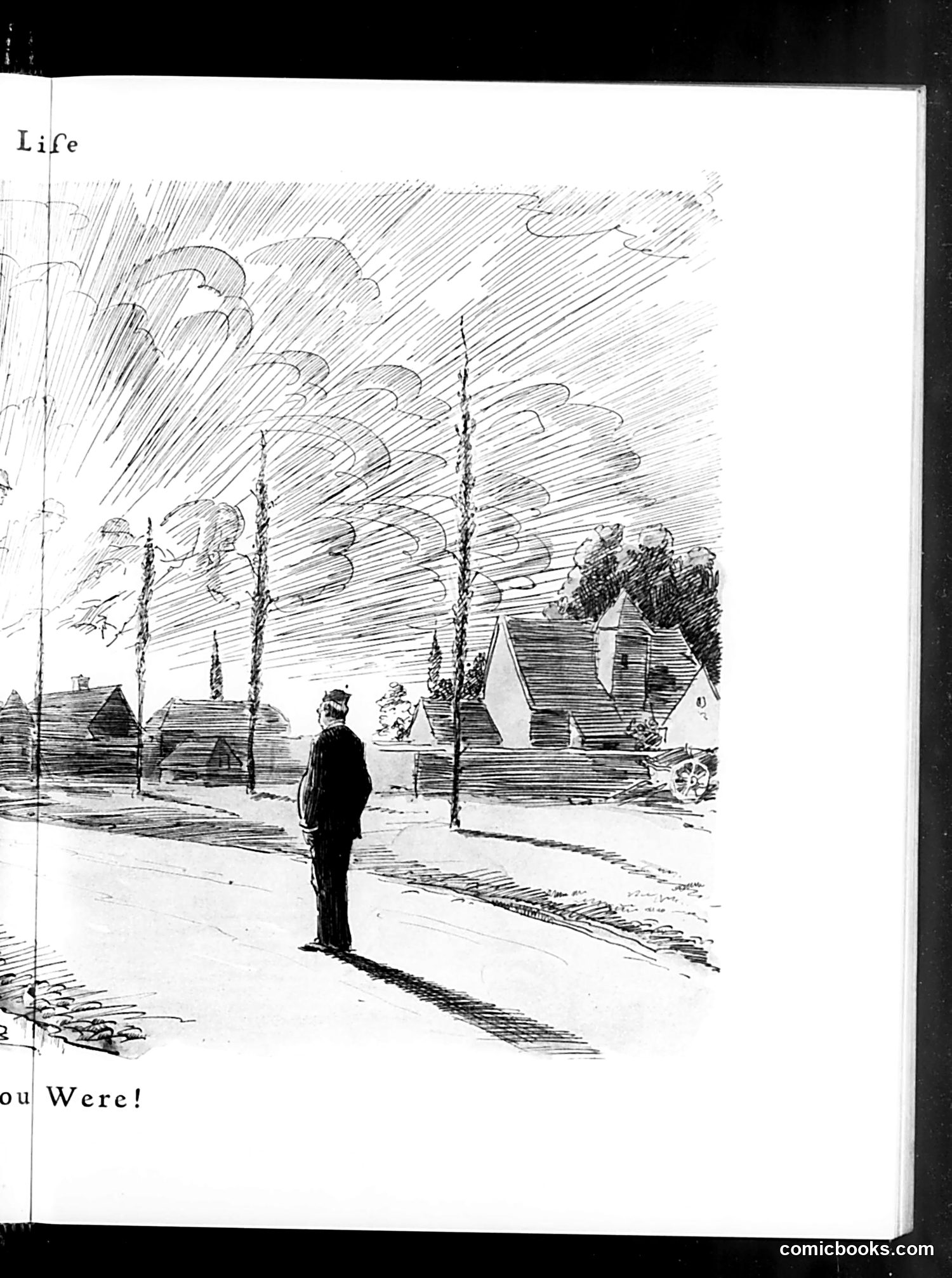
This page shows a single ink sketch titled "Life" depicting a solitary figure in dark clothing standing in a rural village setting, facing houses and bare trees. The incomplete text at bottom reads "ou Were!" suggesting this is part of a larger caption or headline. The sketch's satirical point appears to hinge on the contrast between the title "Life" and the desolate, lonely scene—emphasizing emptiness or absence rather than vitality. The figure's isolated stance and the sparse landscape suggest themes of isolation, abandonment, or disillusionment about human existence or rural American life. Without the complete caption text, the specific social or political critique remains unclear, though the melancholic tone indicates social commentary rather than humor.
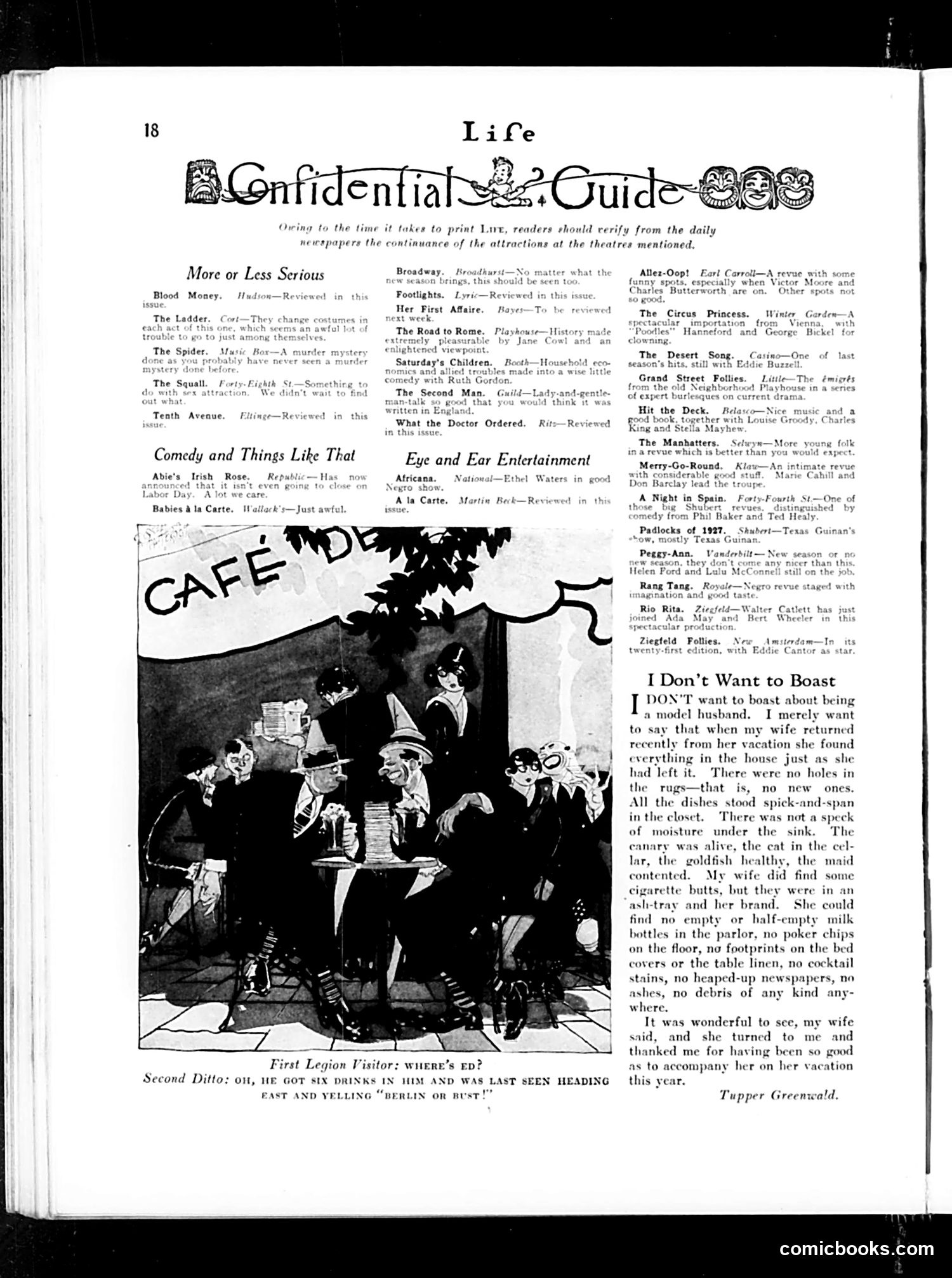
This page combines theater reviews with a humorous essay and a satirical cartoon about domestic life. The main cartoon, titled "First Legion Visitor," depicts a lively café scene with multiple figures in 1920s attire. The caption's joke—"Where's Ed? Oh, he got six drinks in him and was last seen heading east and yelling 'Berlin or bust!'"—satirizes post-WWI travel enthusiasm and perhaps the escapist impulses of the Jazz Age, when Americans were increasingly vacationing abroad. The essay "I Don't Want to Boast" is gentle domestic satire. A husband humorously claims to be a "model husband" by describing how he maintained perfect household order during his wife's vacation—no mess, pets thriving, everything spotless. The twist: his wife thanks him for accompanying her *on her vacation*, revealing the joke is self-deprecating; he's bragging about basic competence while missing that he was absent the entire time. Both pieces mock 1920s American life—travel culture and gender expectations around domestic management.
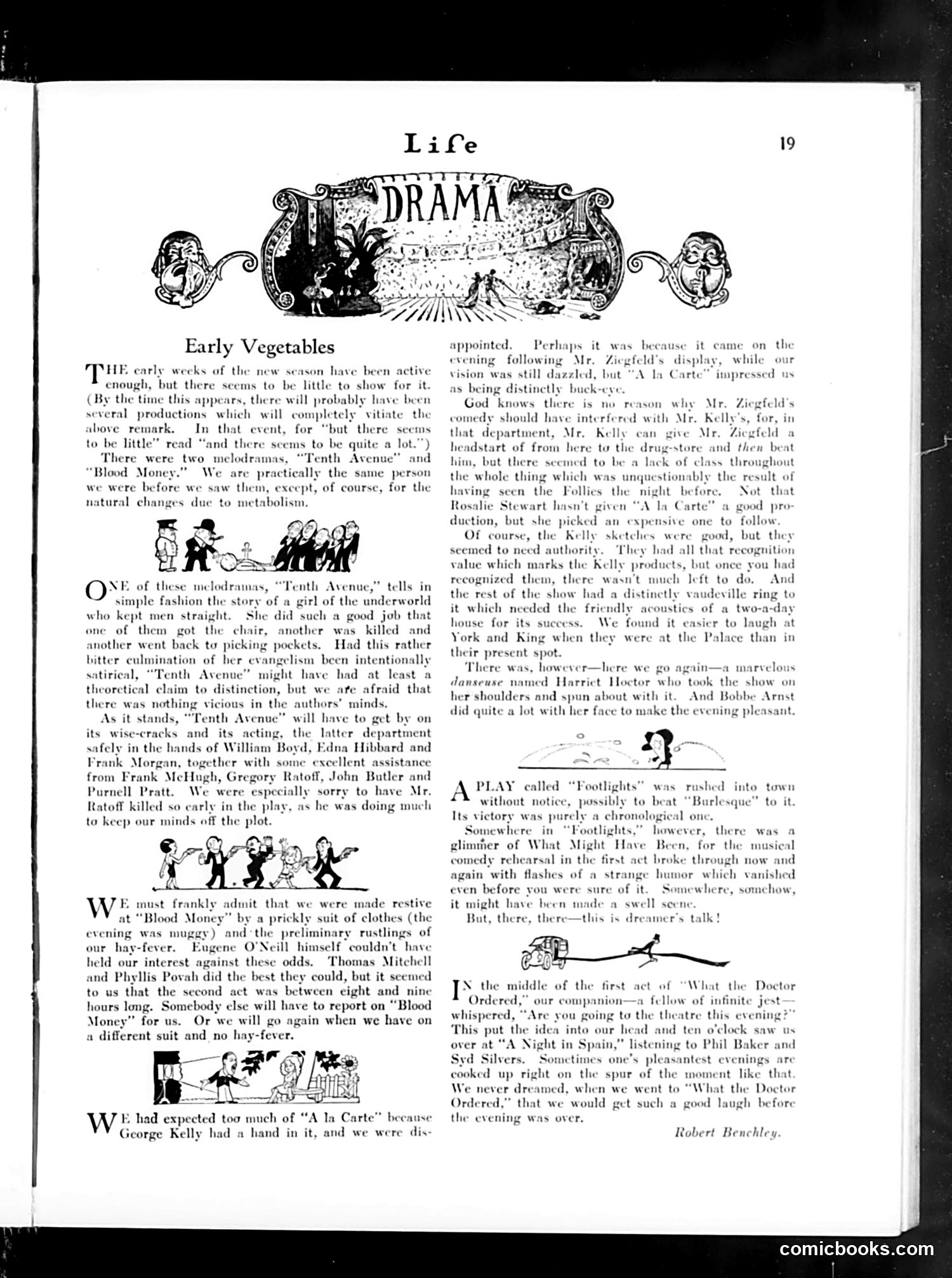
This is a theater criticism column reviewing several Broadway productions. The author critiques melodramas "Tenth Avenue" and "Blood Money" as dramatically inert despite competent acting. They found "Tenth Avenue" particularly frustrating—its tragic ending seemed unintentional rather than purposefully satirical. The review of "A la Carte" suggests the show suffered from poor timing: it followed Florenz Ziegfeld's lavish "Follies" the previous evening, leaving audiences' expectations inflated. Though George Kelly contributed and performer Rosalie Stewart was capable, the production lacked cohesion and felt more like vaudeville than a polished comedy. The column praises dancer Harriet Hoctor as the evening's highlight. "Footlights," rushed to theaters without advance notice, is dismissed as hastily produced, though it contained glimmers of potential theatrical merit.
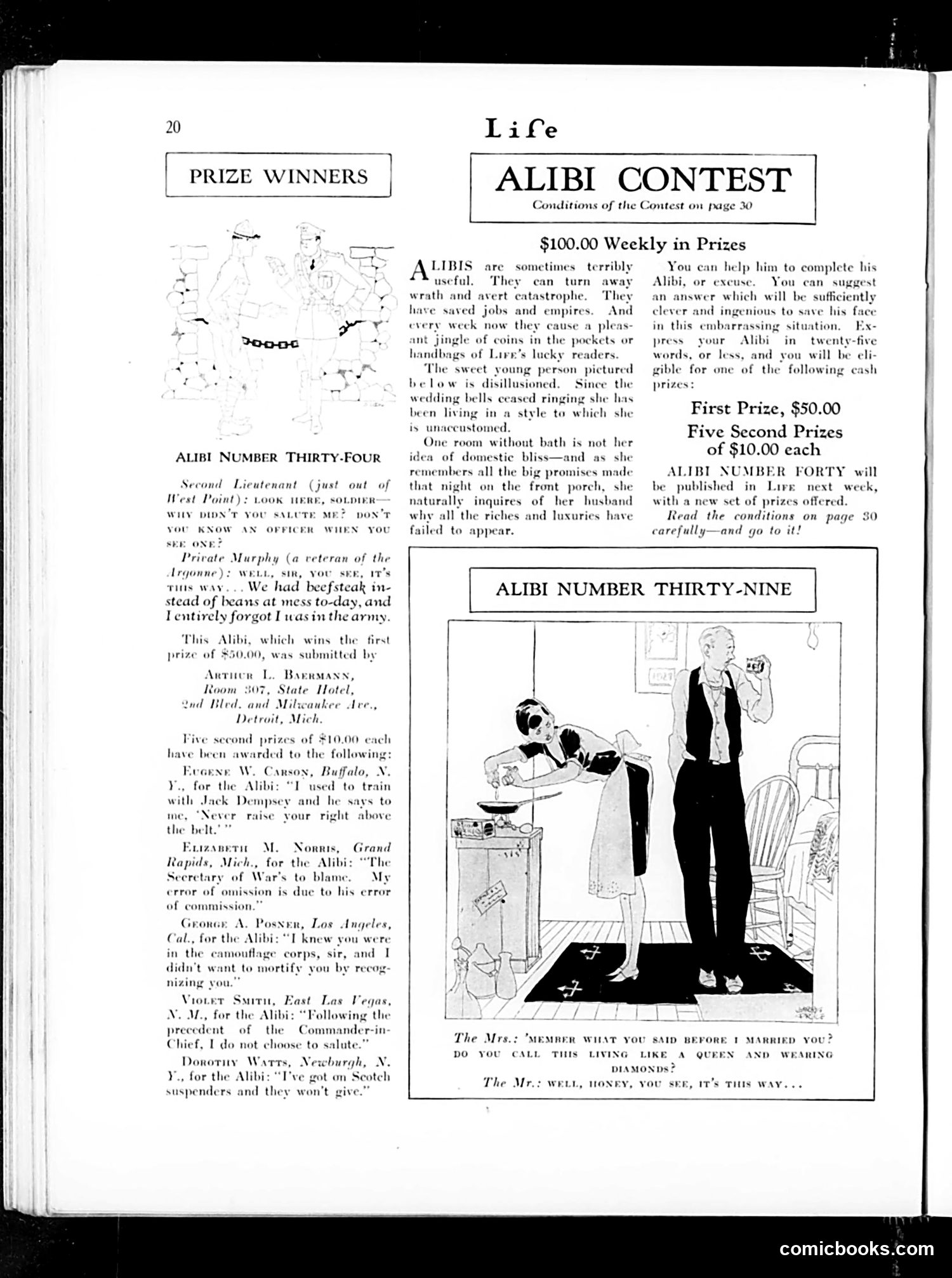
This page presents Life's weekly "Alibi Contest," a humor feature inviting readers to submit clever excuses. The contest awards $100 in weekly prizes for the best fictional explanations to embarrassing situations. **Alibi #34** depicts a newly married woman confronting her husband (a Second Lieutenant) about their reduced circumstances. She expected luxury ("a queen and wearing diamonds") but instead lives in a shabby one-room apartment. The soldier's alibi—submitted by a Private Murphy—humorously claims he forgot he was in the army because the mess served beefsteak instead of beans, momentarily confusing his military status. **Alibi #39** shows the winning entry, featuring a young woman's disillusionment after marriage. Her husband offers vague excuses for their poverty, suggesting it's "this way." The contest satirizes post-WWI marriage disappointments and the gap between romantic promises and reality. Readers submit witty alibis explaining social awkwardness or domestic failures, making personal embarrassment into entertainment. This reflects 1920s humor conventions emphasizing clever wordplay over contemporary sensibilities.
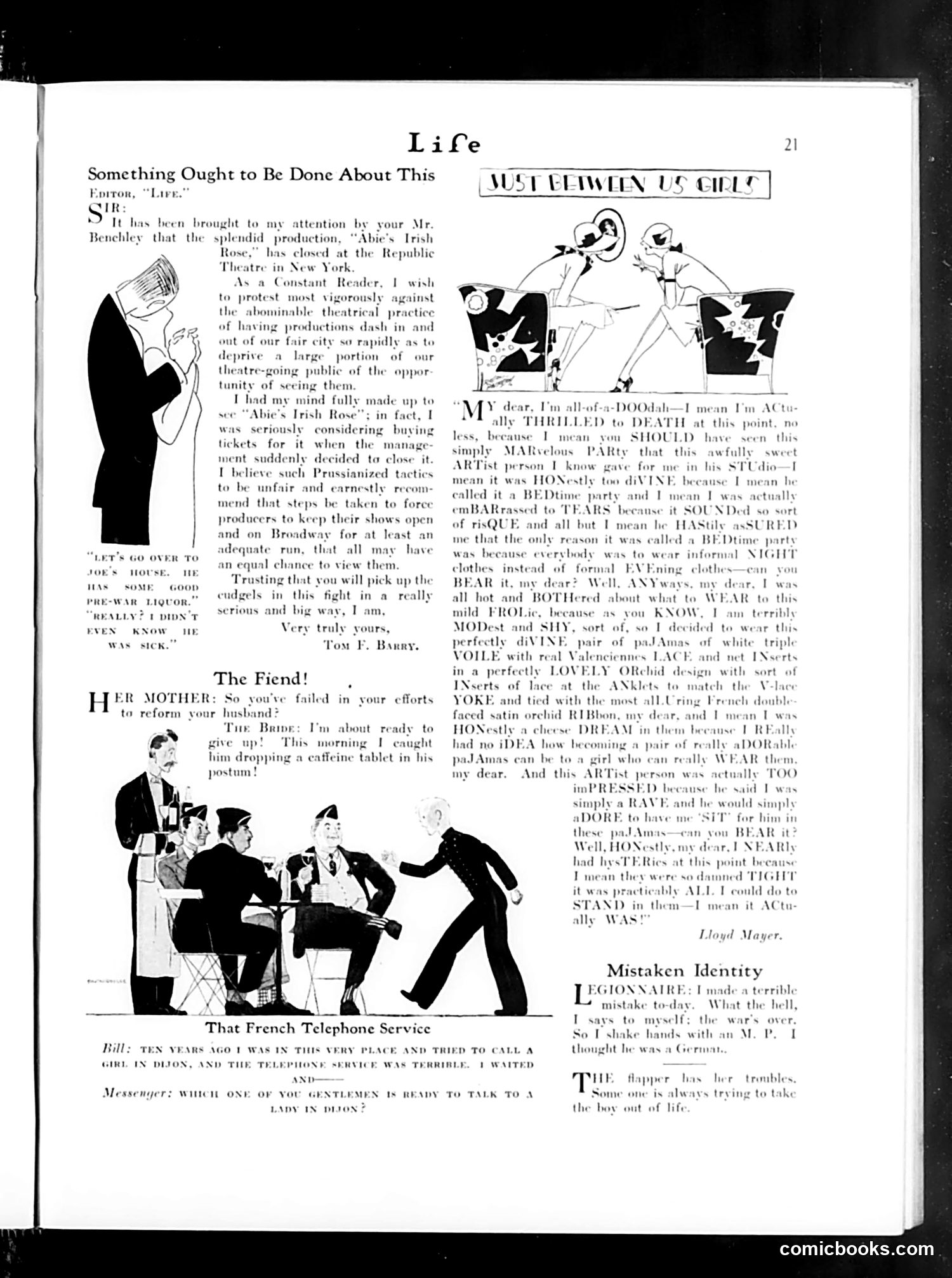
This page contains three satirical pieces typical of 1920s Life magazine humor: 1. **"Something Ought to Be Done About This"**: A letter protesting that Broadway shows close too quickly, depriving theater-goers of chances to see them. The satire mocks theatrical scheduling complaints. 2. **"The Fiend!"**: A domestic humor cartoon showing a wife attempting to reform her husband's caffeine habit by secretly replacing his coffee with Postum (a caffeine-free substitute). The joke plays on the era's health-fad consciousness and marital "reform" attempts. 3. **"That French Telephone Service"**: A joke about poor telephone service in France, referencing pre-WWI frustrations. 4. **The unnamed flapper monologue** (center-right): Satirizes flapper culture through exaggerated account of attending a "bedtime party" in artistic circles, with overwrought descriptions of her pajamas. The humor targets the pretentiousness and moral ambiguity of Jazz Age bohemian socializing. 5. **"Mistaken Identity"**: A brief joke about a Legionnaire mistaking someone for a German soldier post-WWI. These pieces reflect 1920s concerns: theater culture, domestic life, post-war attitudes, and flapper excess.
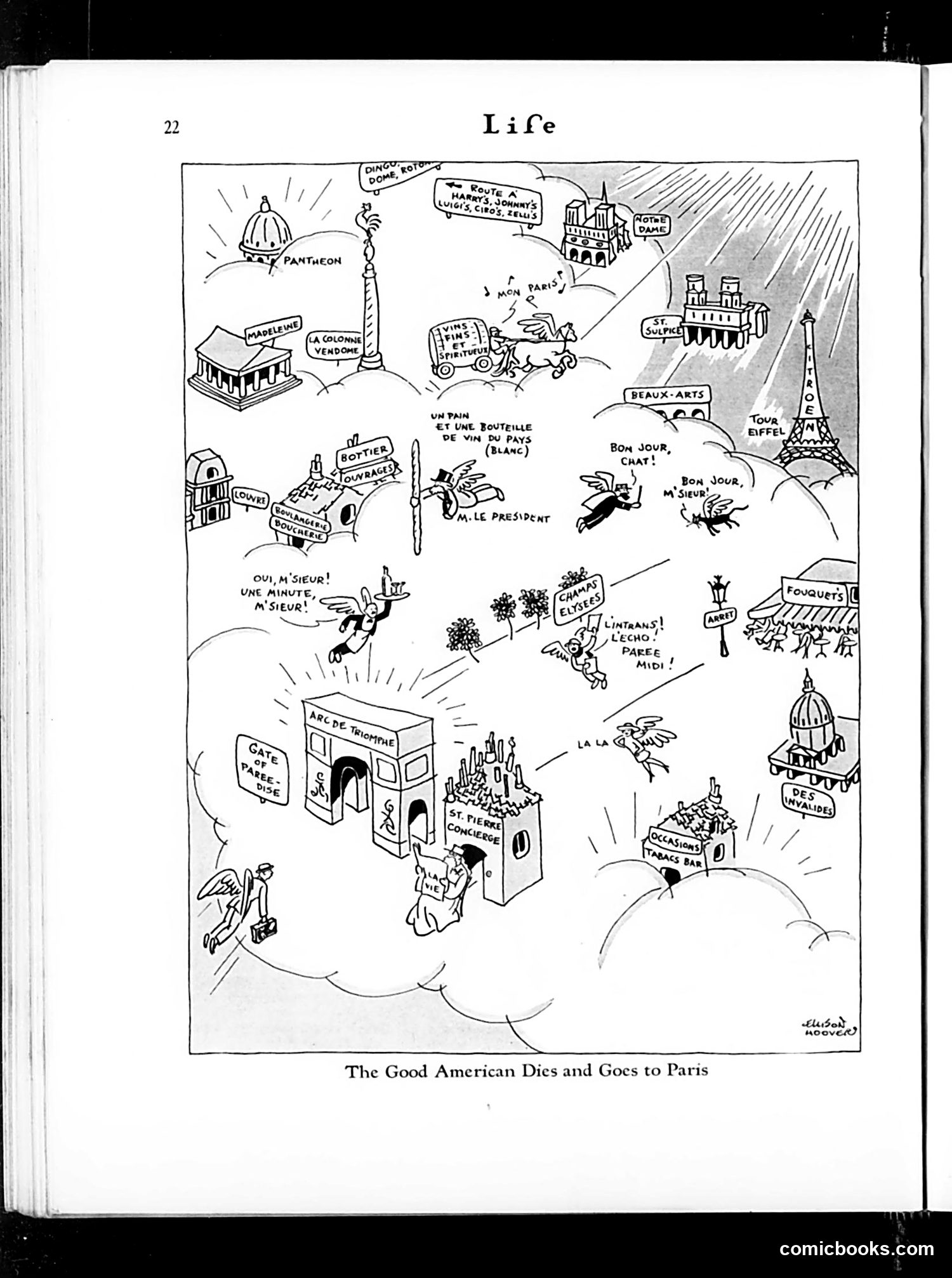
This cartoon satirizes an American's heaven-fantasy of Paris. The deceased American tourist ascends through clouds encountering iconic Parisian landmarks and stereotypical French experiences: the Panthéon, Notre-Dame, Eiffel Tower, cafés, wine bottles, and various monuments labeled in French. The joke plays on the American fascination with Paris as the epitome of culture and sophistication during the early 20th century. Characters speak French phrases ("Bon jour," "M'sieur," "Une minute"). The cartoon mocks both American reverence for European refinement and the clichéd American-in-Paris fantasy—suggesting that for this "good American," death and Paris are interchangeable bliss. The satire targets American cultural pretension and Francophilia of the era.
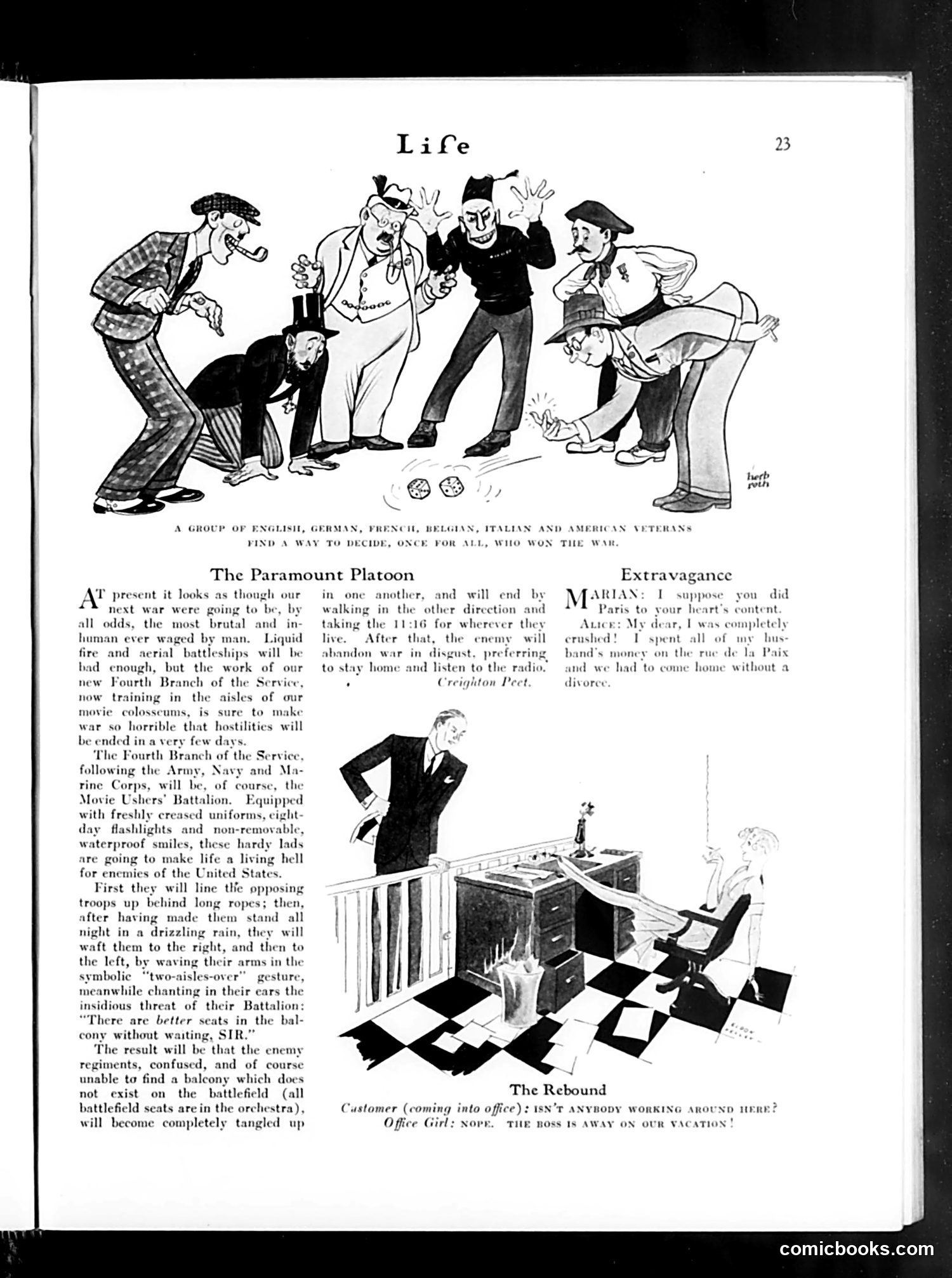
**Top Cartoon: "The Paramount Platoon"** This satirizes post-WWI absurdity. Five veterans from different nations (England, Germany, France, Belgium, Italy, America) roll dice to decide who "won" the war—suggesting the actual outcome was so ambiguous and devastating that chance seems as valid as military victory. The joke mocks the futility of the conflict. **"The Paramount Platoon" Article** Satirizes Hollywood's militarization. It proposes a new "Fourth Branch" of armed forces: movie theater ushers trained as soldiers. The satire suggests their tactics—roping up troops, directing them with useless gestures—would confuse enemies so thoroughly that war would end in chaos. It's dark comedy about filmmaking's growing influence on American culture post-WWI. **Bottom Comics** "Extravagance": A Paris socialite spent her husband's money frivolously; "The Rebound": An office girl claims the boss is on vacation when a customer arrives—suggesting employees shirking work during absence. All content reflects 1920s anxieties about war's meaninglessness, popular entertainment, and post-war social behavior.
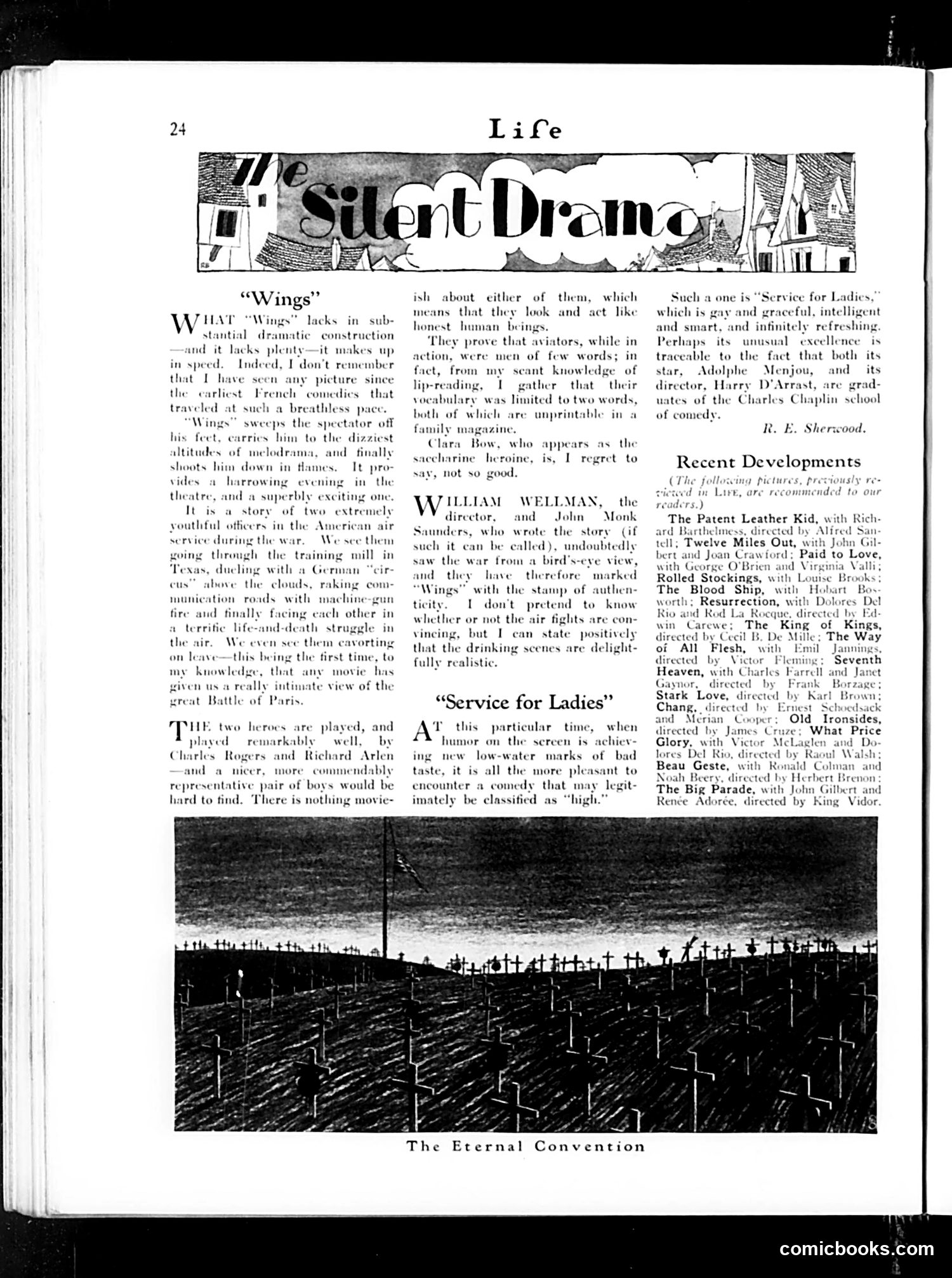
This is a film criticism page from Life magazine reviewing recent movies, primarily silent films from the mid-1920s. The main content discusses "Wings," a World War I aviation drama about two American pilots in combat and on leave. The reviewer praises its authentic depiction of air combat and drinking scenes, and commends actors Charles Rogers and Richard Arlen's naturalistic performances. A secondary review covers "Service for Ladies," praising it as intelligent comedy featuring Adolphe Menjou and director Harry D'Arrast (both associated with Charlie Chaplin's comedic style). The page concludes with a "Recent Developments" section—essentially a capsule listing of current film releases including "The Big Parade," "The King of Kings," and "Beau Geste," naming stars and directors. This reflects the silent film era when Life served as a major arbiter of cinema taste for educated readers.
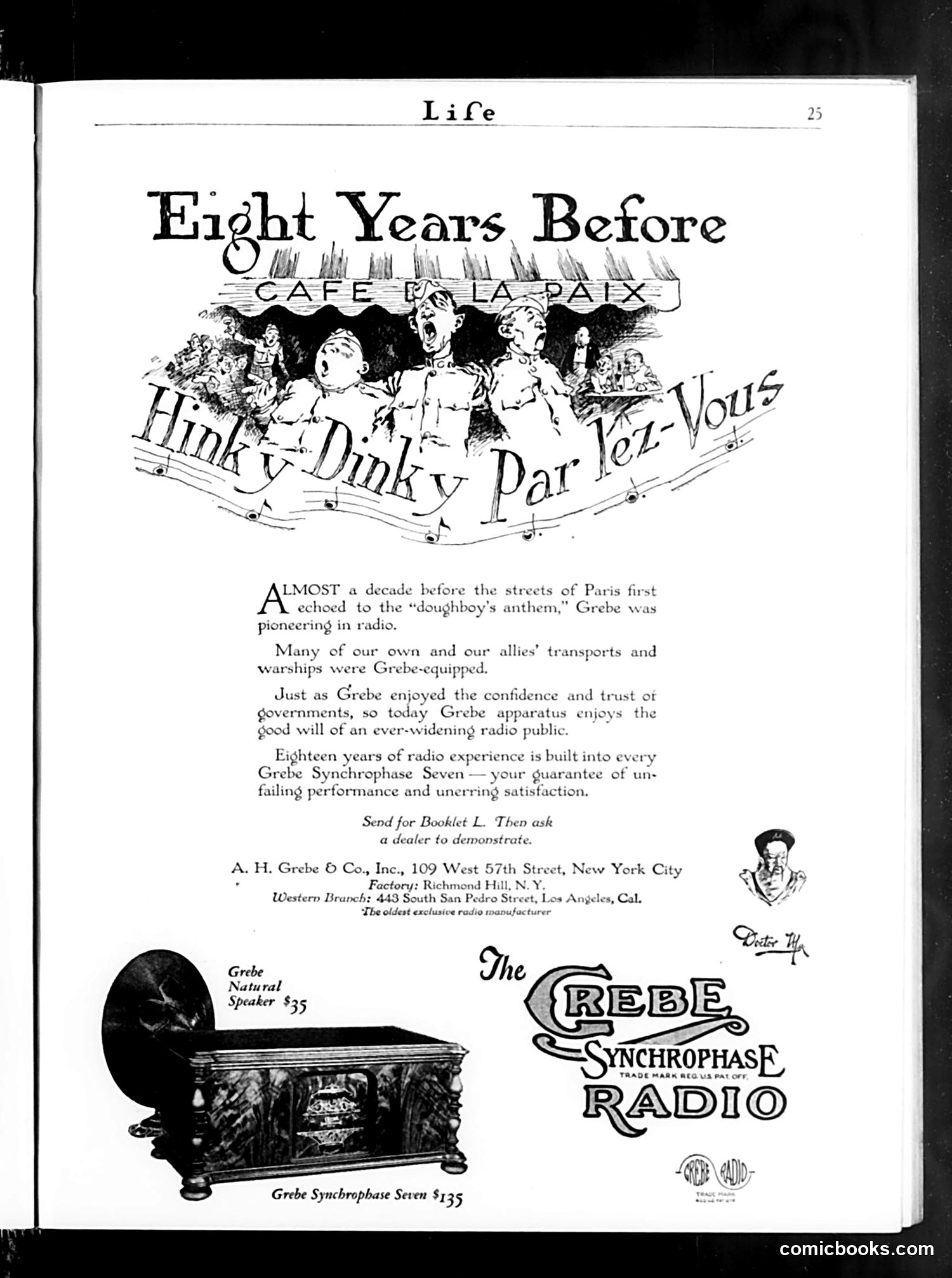
This is primarily a **radio equipment advertisement**, not satire. It's a Grebe company ad for their Synchrophase Seven radio receiver ($135). The headline "Eight Years Before" references Grebe's claim to have pioneered radio technology approximately eight years before American entry into World War I (the "doughboy's anthem" reference). The decorative illustration shows children at a Parisian café, evoking a pre-war European setting. The ad's pitch emphasizes **patriotic credibility**: Grebe equipment was allegedly used by Allied governments and military transports during WWI, establishing the company as trustworthy and reliable for civilian consumers. This was common post-war marketing—associating commercial products with military success to build consumer confidence. The small illustration shows the ornate wooden radio receiver ($135) and natural speaker ($35). This is straightforward product promotion exploiting wartime nostalgia and patriotism, not political commentary or satire.
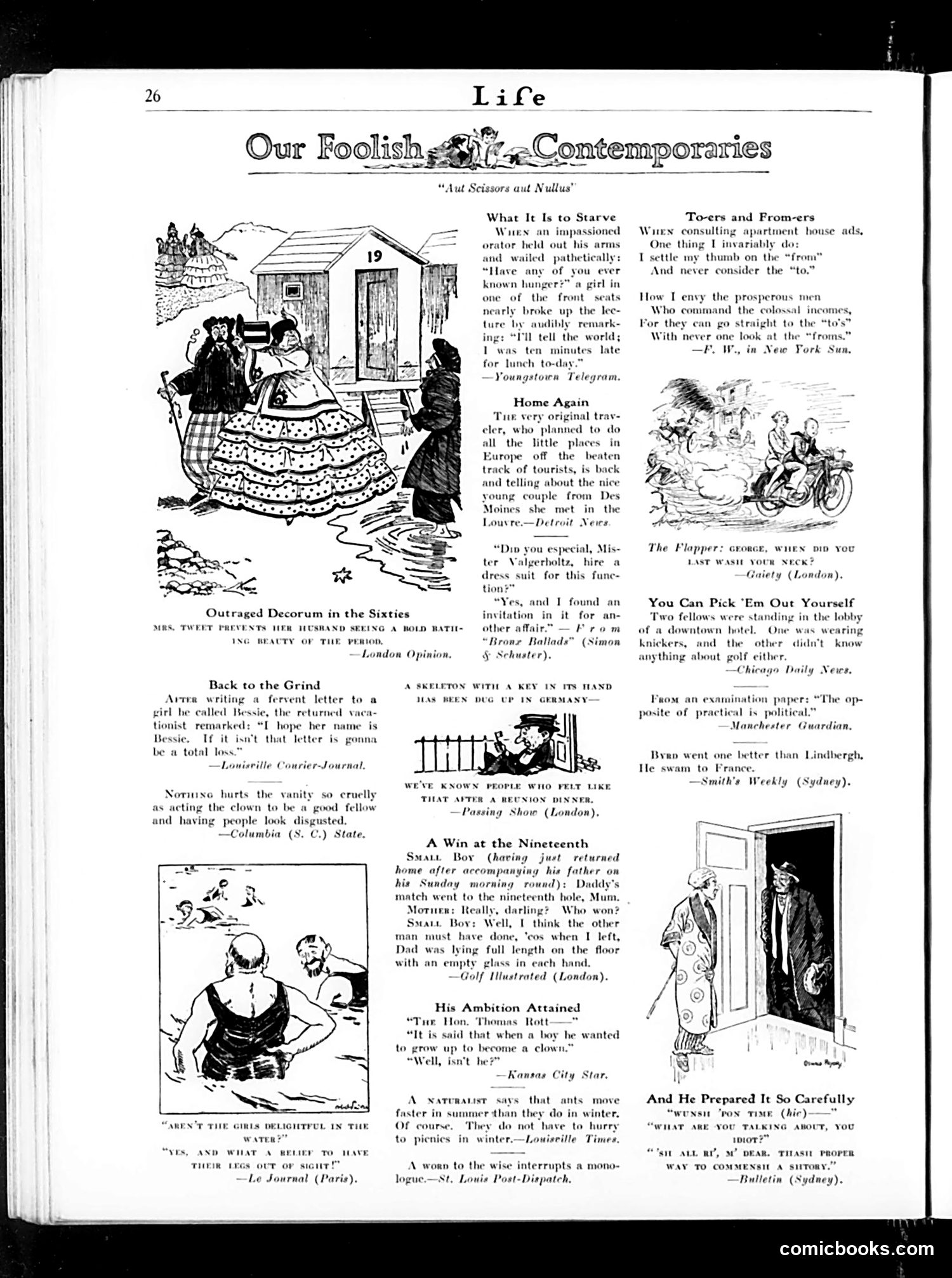
This page collects humorous anecdotes and jokes from international newspapers, satirizing social pretensions and human folly across the 1920s-30s era. **Key satirical targets:** - **"Outraged Decorum in the Sixties"**: Mocks Victorian prudishness—a woman shields her husband from seeing women's legs, treating them as scandalous. - **"Back to the Grind"**: Ridicules romantic naïveté; a man writes passionate letters without confirming his beloved's real name. - **Travel snobbery**: Mocks pretentious tourists who avoid beaten paths, only to encounter ordinary people from home. - **Golf culture**: Satirizes golf obsession and the wealthy leisure class (the child's father lies drunk after losing at the "nineteenth hole"). - **Class anxiety**: "To-ers and From-ers" lampoons apartment-hunters' status-consciousness about "from" versus "to" addresses in New York. **Overall tone**: Gentle mockery of middle-class pretension, romantic delusion, and modern manners across multiple cultures, drawn from contemporary newspaper humor columns.
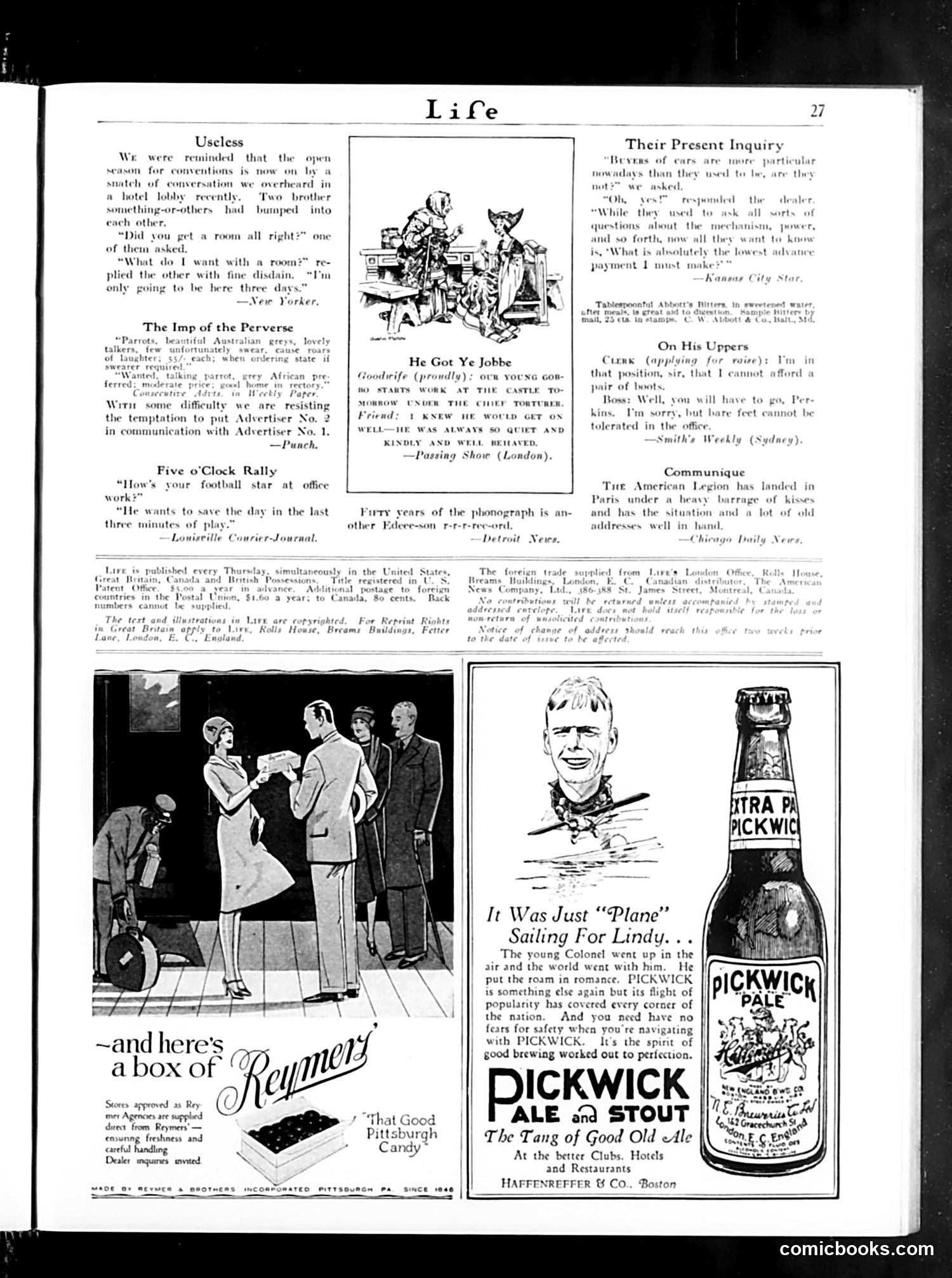
This page contains several short humor pieces and advertisements typical of 1920s Life magazine: **The cartoons** appear to be brief comedic scenarios: one depicts hotel guests discussing room rates with comic indifference; another shows a domestic worker proudly noting her employer's quiet behavior; a third features an office worker wanting to "save the day" in football's final minutes. **"It Was Just 'Plane' Sailing for Lindy"** references Colonel Lindbergh's 1927 transatlantic flight, which captivated the nation. The ad uses his fame to market Pickwick Pale Ale, arguing the beer's reliability mirrors aviation safety—a clever advertising strategy capitalizing on contemporary celebrity and technological achievement. **The Reymers candy and Pickwick advertisements** dominate the lower portion, representing typical Life magazine monetization. The humor throughout relies on understated, deadpan American wit characteristic of 1920s satirical magazines—brief setups with ironic punchlines about everyday situations rather than explicit political commentary.
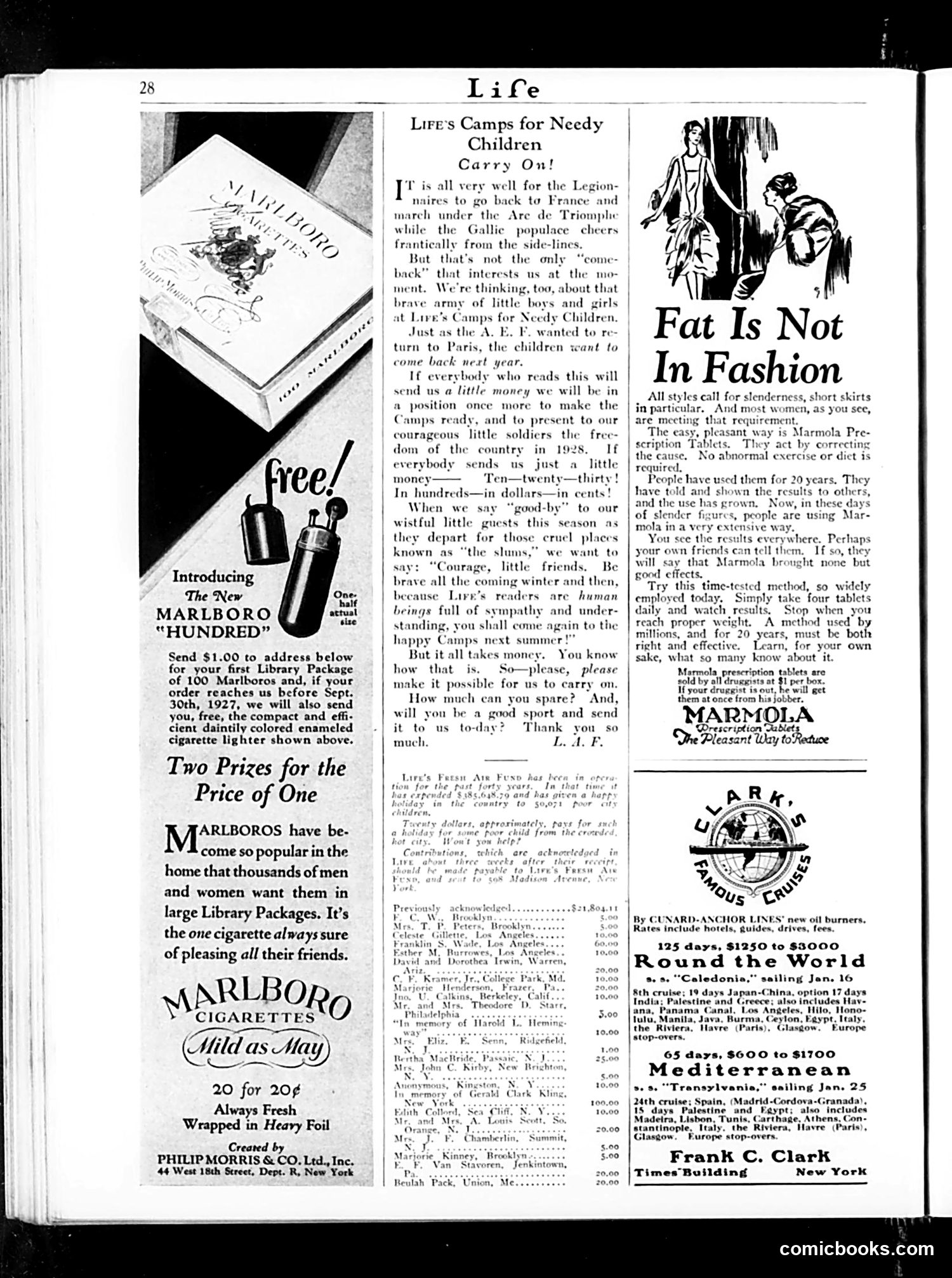
This page mixes editorial content with advertisements typical of 1920s Life magazine. **"Fat Is Not In Fashion"** (right column) promotes Marmola prescription tablets for weight loss. The accompanying illustration shows a woman in fashionable 1920s dress—the text notes that current style demands slenderness and short skirts. Marmola, sold by druggists, claims 20 years of proven results. The pitch emphasizes that millions use it and that stopping the tablets once you reach "proper weight" proves its safety and effectiveness—a common advertising strategy of the era. **"Life's Camps for Needy Children"** (center) is a fundraising appeal referencing the recent American Expeditionary Forces' return from World War I France. The magazine compares the soldiers' homecoming to children returning to Life's summer camps for poor urban children. It solicits reader donations (ten, twenty, thirty cents to dollars) to fund 1928 camp operations. **Marlboro Cigarettes advertisement** (left) introduces their "Hundred" Library Package—100 cigarettes for $1.00—with a free enamel lighter if ordered before September 30, 1927.
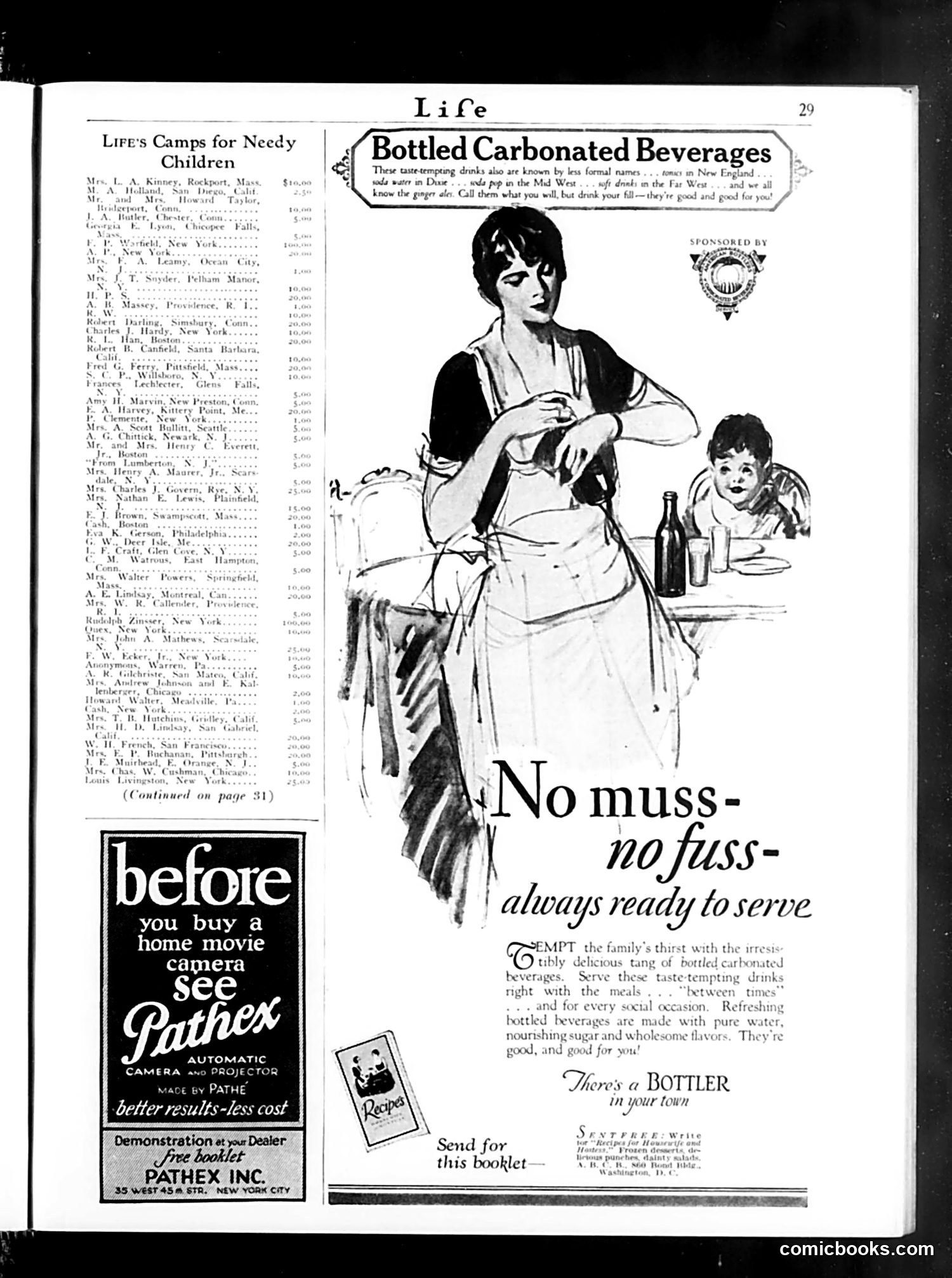
This is primarily an **advertising page** rather than satirical content. The page contains two main advertisements: 1. **Bottled Carbonated Beverages ad** (center/right): Features an illustration of a woman serving drinks to a child, promoting carbonated beverages as convenient, refreshing, and always ready to serve. The "no muss—no fuss" tagline emphasizes convenience for busy households. 2. **Pathex Camera ad** (lower left): Promotes a home movie camera and projector, urging readers to see a demonstration before purchasing. The left column appears to be a **charitable notice** for "Life's Camps for Needy Children" with a donor list and contributions. **For modern readers**: This reflects early-to-mid 20th century consumer culture emphasizing convenience and domestic leisure. The gender presentation (woman as server) is typical of the era's advertising. The carbonated beverage promotion shows these drinks weren't yet ubiquitous luxuries but marketed products. There is no obvious political satire on this particular page.
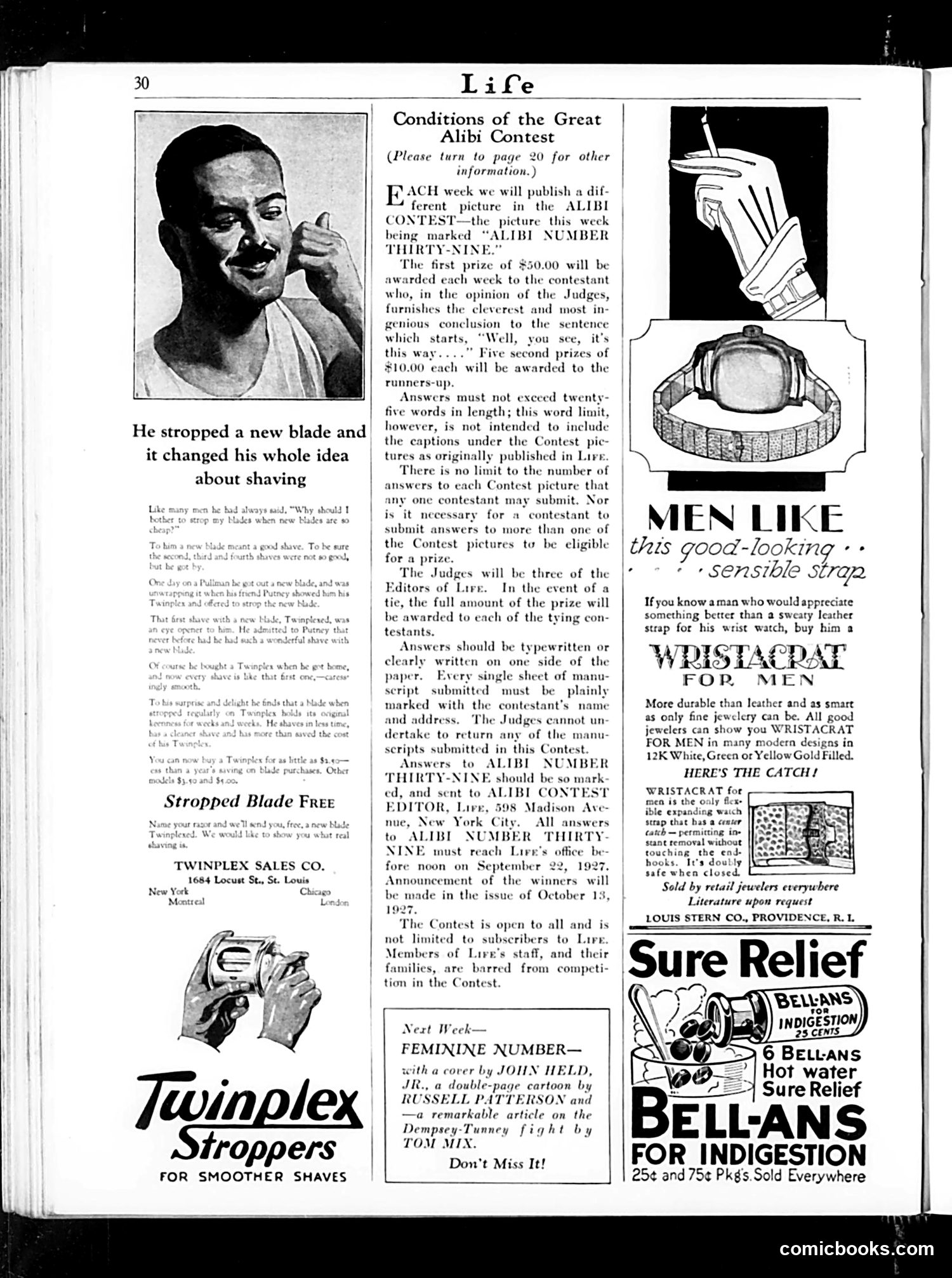
This page is primarily **advertising**, with a secondary content section featuring Life's "Alibi Contest." The main visual element is a shaving advertisement for Twinplex Stropper razors, featuring a man's face with the caption "He stropped a new blade and it changed his whole idea about shaving." This is straightforward product advertising—the implicit joke is that using this stropper dramatically improves one's shaving experience. The center section announces Life's weekly "Alibi Contest," where readers submit humorous captions (max 25 words) to ambiguous cartoon situations, competing for $50 weekly prizes. "Alibi NUMBER THIRTY-NINE" is the current week's puzzle picture (not clearly visible here). The right side contains additional advertisements: Wristacrat watches for men and Bellans indigestion relief tablets—typical 1920s consumer products. The "Next Week" teaser promises a "Feminine Number" with cover art by John Held, suggesting gendered editorial content.
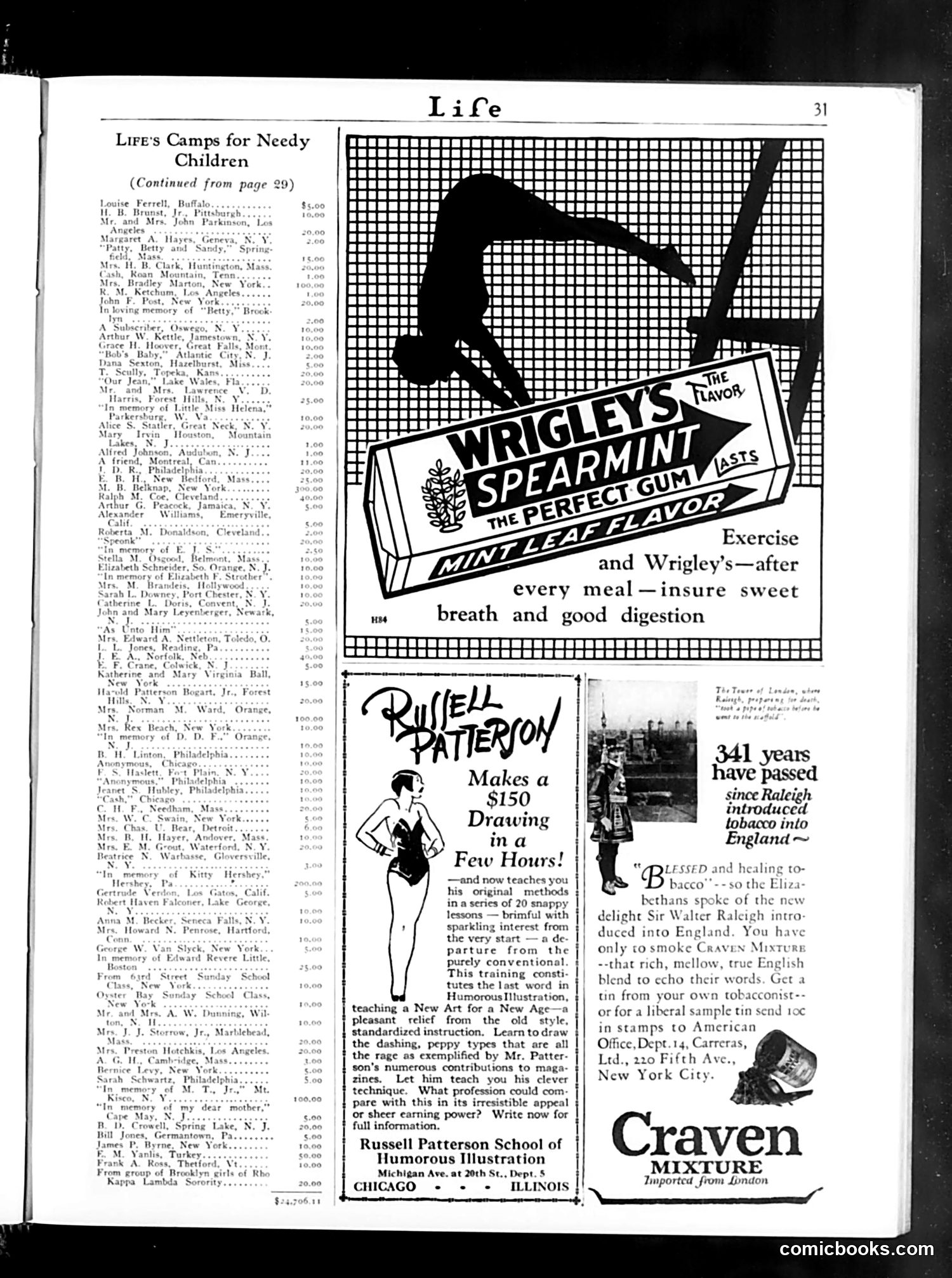
This page is primarily **advertising** rather than editorial content or political cartoons. The main advertisements are: 1. **Wrigley's Spearmint Gum** - A standard product ad promoting fresh breath and digestion after meals. 2. **Russell Patterson's School of Humorous Illustration** - An instructional ad encouraging readers to learn cartooning from Patterson, emphasizing drawing "dashing, peppy types" in a modern style rather than conventional methods. It promises lucrative earning potential. 3. **Craven Mixture Tobacco** - A British tobacco ad playing on historical nostalgia, referencing Sir Walter Raleigh's introduction of tobacco to England 341 years prior, positioning their blend as authentically English. The page also contains a continued charitable listing for "Life's Camps for Needy Children" with donor contributions. There are **no political cartoons or satire** on this page—it's a standard magazine advertising section typical of 1920s publications.
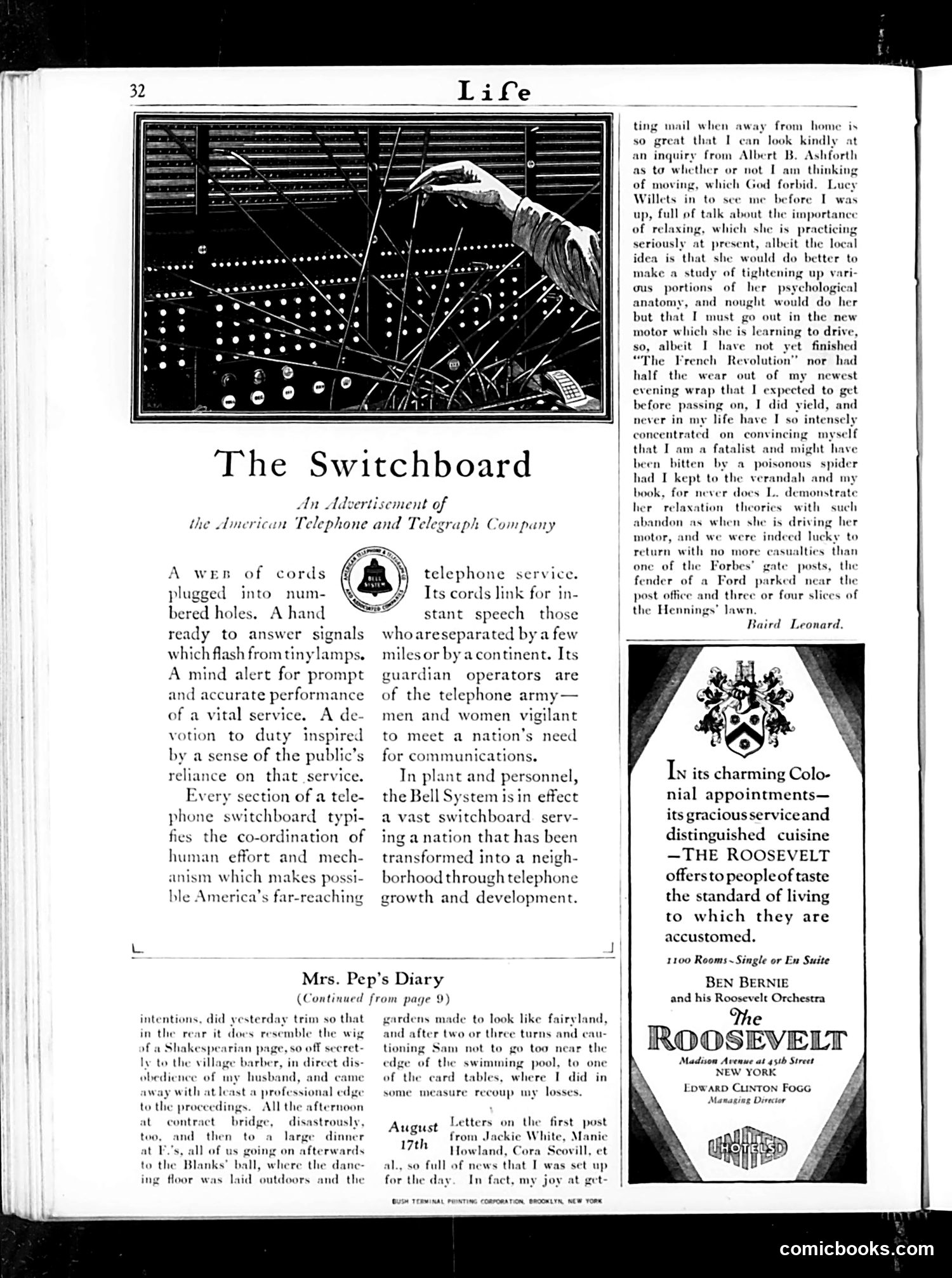
This page combines a corporate advertisement with satirical society journalism. **The Switchboard**: AT&T's full-page ad celebrates telephone infrastructure—the switchboard operators and cord systems enabling long-distance communication. It's presented as patriotic infrastructure serving the nation, depicting the telephone as transforming America into a connected "neighborhood." This is straightforward corporate messaging from the early 20th century. **Mrs. Pep's Diary**: A humorous gossip column (continued from earlier) documenting upper-class social minutiae—a woman's unauthorized haircut visit to the barber, contract bridge games, a garden ball, receiving mail while traveling. The humor relies on depicting frivolous concerns and social anxieties of wealthy women. The entry mentioning Lucy Willets's dangerous new motor-car driving is the sharpest comic bit: the narrator fears being poisoned by spiders more than Lucy's reckless driving. The page also includes ads for The Roosevelt hotel and Ben Bernie's orchestra, typical of Life magazine's advertising model.
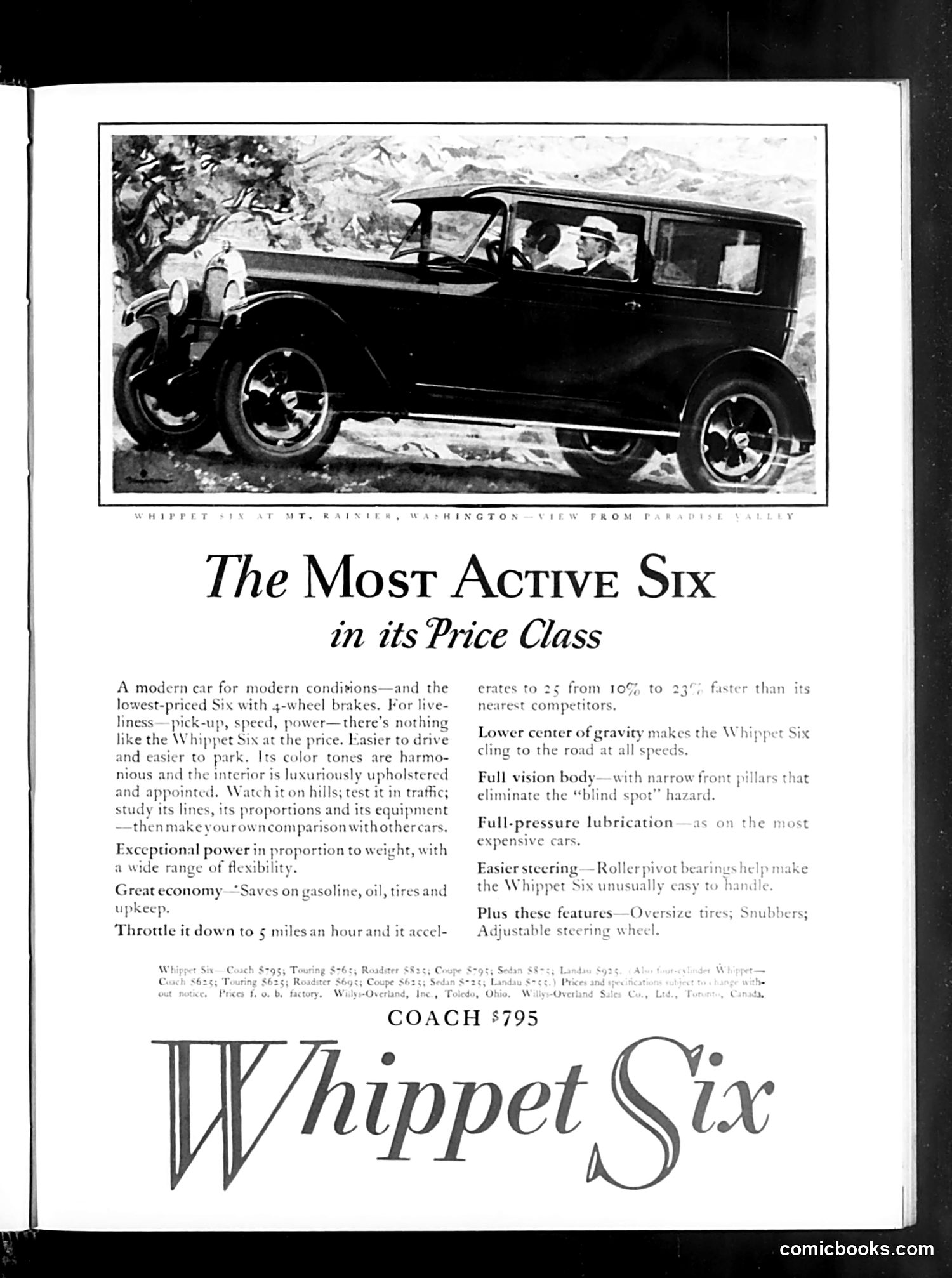
This is **not a cartoon or satire**—it's a straightforward automobile advertisement for the Whippet Six, a budget-friendly car manufactured by Coach. The page promotes the vehicle as "the most active six in its price class," emphasizing practical features for 1920s consumers: four-wheel brakes, fuel economy, easy handling, and a lower center of gravity for road stability. The image shows the car in a scenic mountain setting with passengers, a common advertising approach to suggest aspirational lifestyle. The text highlights competitive advantages—acceleration, steering ease, and affordability at $795 for the Coach model—targeting middle-class buyers seeking modern automobile features without premium pricing. This represents typical period advertising positioning a reliable, practical vehicle against more expensive competitors.
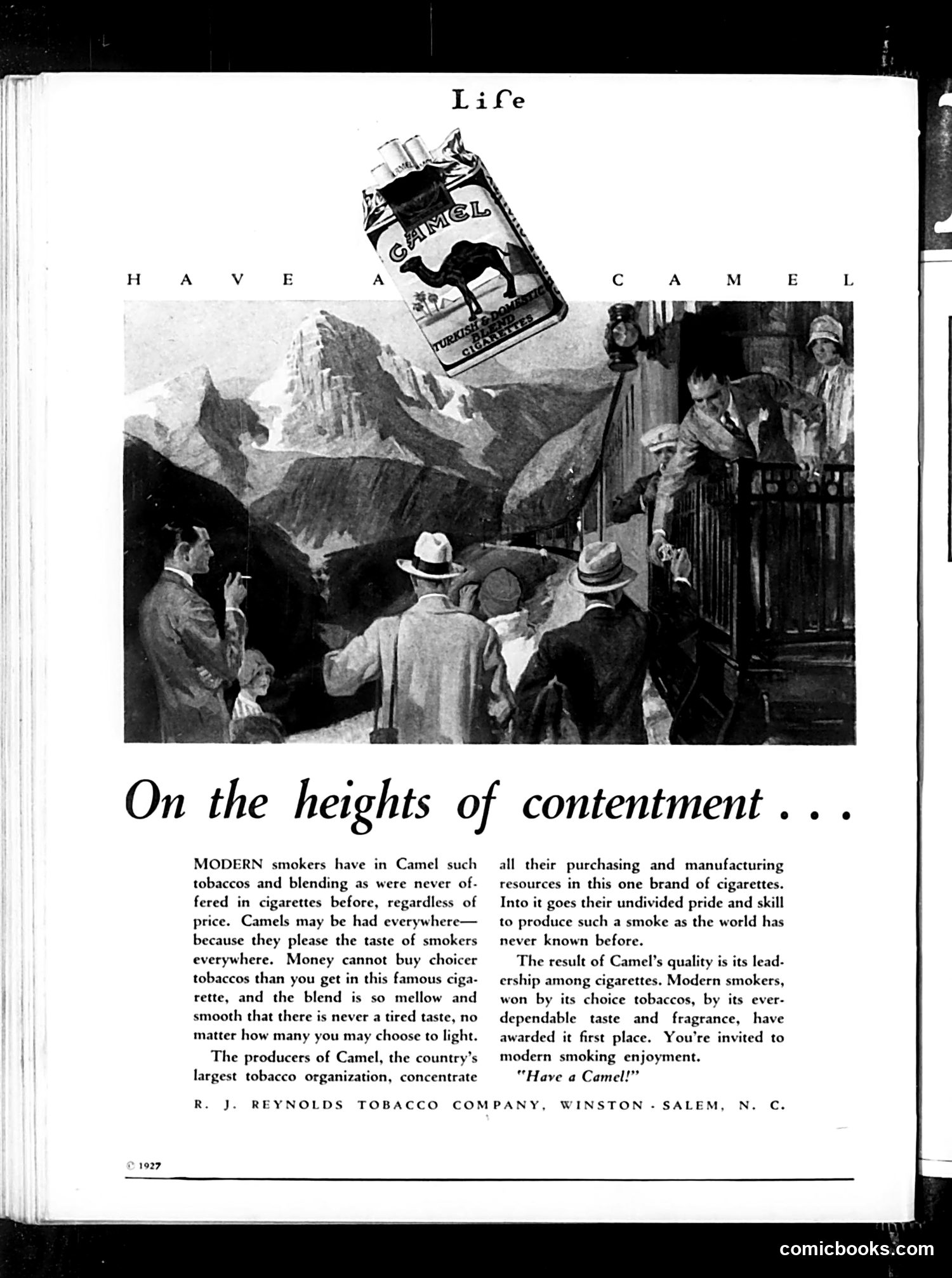
This is a 1927 **Camel cigarette advertisement**, not political satire. The page features a dramatic illustration of mountaineers at high altitude beneath a giant Camel cigarette pack floating in the sky. The imagery uses the mountaineering metaphor literally: climbers reaching "the heights of contentment" through smoking Camels. This was typical 1920s advertising rhetoric—cigarettes were marketed as markers of modern sophistication and achievement. The text emphasizes Camel's supposedly superior quality, blending, and market dominance. The phrase "Have a Camel!" became the brand's famous slogan. **Why modern readers miss context**: Early-20th-century cigarette ads aggressively marketed smoking as healthful and aspirational, before tobacco's serious health risks were widely acknowledged or regulated. The mountaineering imagery suggests conquest, achievement, and elevated status—all deployed to sell an addictive product now understood as harmful.