
Life, 1927-09-08 · page 16 of 36
Life — September 8, 1927 — page 16: what you’re looking at
What you’re looking at
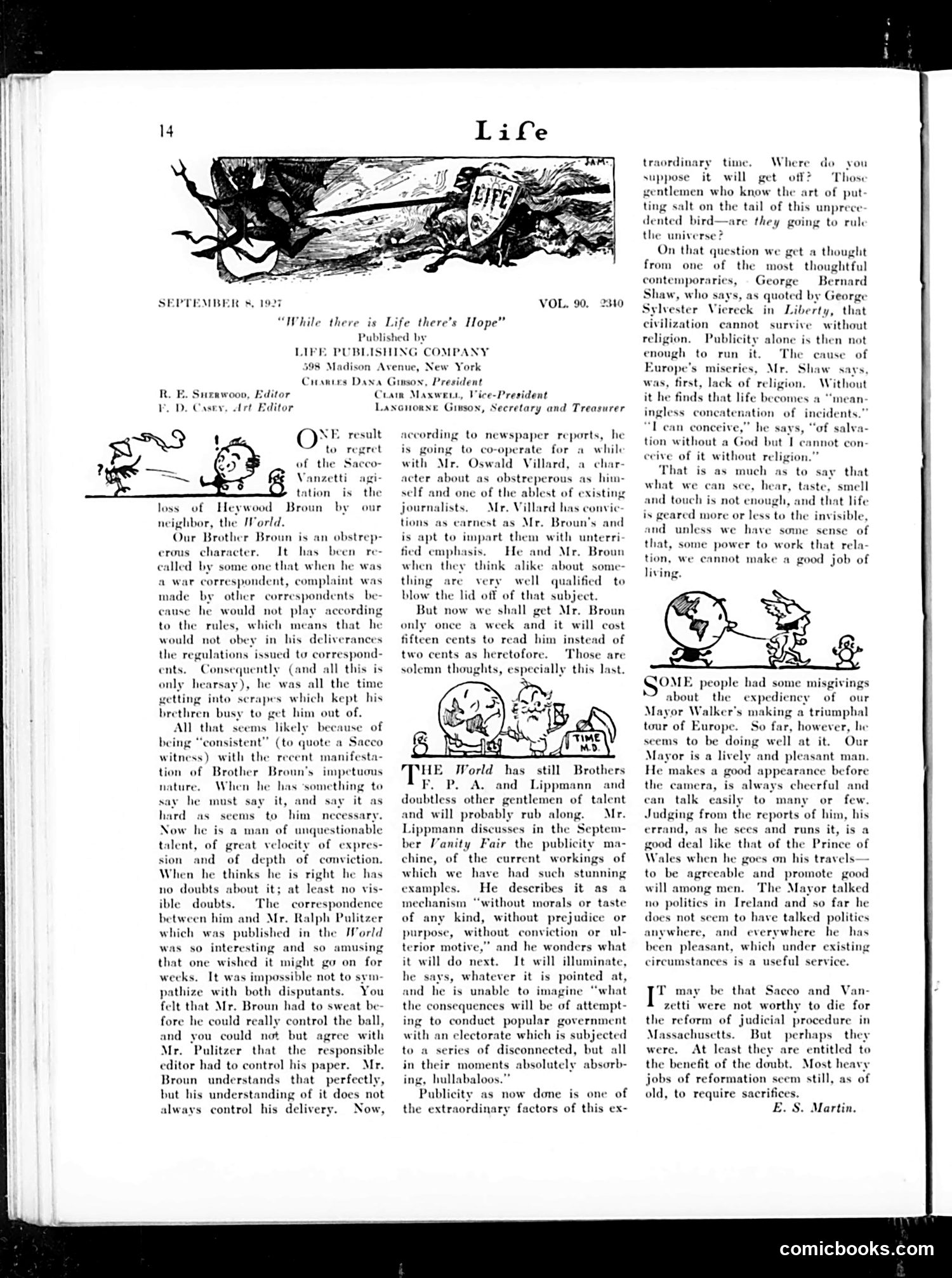
This page discusses the loss of Heywood Broun, a prominent journalist and war correspondent, from the *Vanity Fair* magazine staff. The editorial notes tension between Broun and management over editorial control and compliance with publication rules. The cartoons appear to be humorous illustrations accompanying commentary about publication politics and management disputes—typical satirical content for *Life* magazine's era. The page also references Mayor Walker's European tour, George Bernard Shaw's views on civilization and religion, and debates about F.P.A. and Lippmann as writers of talent. The overall tone critiques both journalistic freedom and the arbitrary nature of editorial decisions during this period of American journalism.
📄 Transcribed text from this page (OCR, searchable)
Machine-transcribed from the original scan — historical spelling and the odd misread are preserved.
SEPTEMBER &, 1927 VOL, 90. 2310 “While there is Life there’s Hope” Published by LIFE PUBLISHING COMPANY 598 Madison Aven New York Crantes Dana Ginson, President R. E. Surrawooo, Editor b.D. Casey, rt Editor ( NE. result to regret of the Sacco- Vanzetti tation is the sof Heywood Broun by neighbor, the orld. Our Brother Broun is an obstrep- crous character. It has been re- called by some one that when he was a war correspondent, complaint was made by cause he would not play according to the rules, which means that he our other correspondents bi would not obey in his deliverances the regulations issued to correspond- ents. Consequently (and all this is only hearsay), he was all the time tting into scrapes which kept his brethren busy to get him out of. All that seems likely because of being “consistent” (to quote a Sacco witness) with the recent manifesta- tion of Brother Broun’s impetuous When he must say nature. has ‘something to say he it, and say it as hard as him Now he is a man of unquestionable talent, of great velocity of expres- nd of depth of conviction. When he thinks he is right he has no doubts about it; at least no vis- ible doubts. The correspondence between him and Mr. Ralph Pulitzer which was published in the World was so interesting and so amusing that one wished it might go on for weeks. It was impossible not to sym pathize with both disputants. You felt that Mr. Broun had to sweat be fore he could really control the ball, and you could not but agree with Mr. Pulitzer that the responsible editor had to control his paper. Mr. Broun understands that perfectly, but his understanding of it does not always control his delivery. Now, seems to necessary. Cram Maxwent, Vie Lancnorxe Ginsox, Secretary and Treasurer resident according to newsp: ping ver reports, he to co-operate for a Mr. Oswald Villard, a char- acter about as obstreperous as him- self and one of the ablest of existing Mr. Villard has convic tions as earnest as Mr. Broun's and is apt to impart them with unterri fied emphasis. He and Mr. Broun when they think alike about some- thing are very well qualified to blow the lid off of that subject. But now we shall get Mr. Broun only once a week and it will cost fifteen cents to read him instead of two cents as heretofore. Those are solemn thoughts, especially this last. while with journalists. World still Brothers and Lippmann and THE ry P. A, doubtless other gentlemen of talent and will probably rub along. Mr. Lippmann discusses in the Septem- ber Vanity Fair the publicity ma- chine, of the current workings of which we have had such stunning examples. He describes it as a mechanism “without morals or taste of any kind, without prejudice or purpose, without conviction or ul- terior motive,” and he wonders what it will do next. It will illuminate, he says, whatever it is pointed at, and he is unable to imagine “what the consequences will be of attempt- ing to conduct popular government with an electorate which is subjected to a series of disconnected, but all in their moments absolutely absorb- ing, hullabaloos.”” Publicity as now done is one of the extraordinary factors of this ex- traordinary time. Where suppose it will get off? — Thos gentlemen who know the art of put ting salt on the tail of this unprece dented bird the universe are they go On that question we get a thought from one of the most thoughtful contemporaries, | George Shaw, who says, as quoted by George Sylvester Viereck in Liberty, tho civilization cannot survive without religion. Publicity alone is then not enough to run it. The Europe's miseries, Mr. Shaw says, was, first, lack of religion. Without it he finds that life becomes a “mean ingless concatenation of cause of incidents.” “can conceive,” he says, “of salva- tion without a God but I cannot con ceive of it without religion.” That is as much as to say that what we can see, hear, taste, smell and touch is not enough, and that life is geared more or less to the invisible, ind unless we have some sense of that, some power to work that rela- tion, we cannot make a good job of living. R QOME people had some mis; “J about the expediency of Mayor Walker's making a triumphal tour of Europe. So far, however, he seems to be doing well at it. Our Mayor is a lively and pleasant man. He makes a good appearance before nera, is always cheerful and alk easily to many or few. Judging from the reports of him, his errand, as he sees and runs it, is a good deal like that of the Prince of Wales when he goes on his travels to be agreeable and promote good will among men. The Mayor talked no politics in Ireland and so far he does not scem to have talked politics anywhere, and everywhere he has been pleasant, which under existing circumstances is a useful service. ings our T may be that Sacco and Van- zetti were not worthy to die for the reform of judicial procedure in Massachusetts. But perhaps they were. At least they are entitled to the benefit of the doubt. Most heavy jobs of reformation seem still, as of old, to require sacrifices. E. S. Martin. comicbooks.com