
Life, 1927-09-08 · page 21 of 36
Life — September 8, 1927 — page 21: what you’re looking at
What you’re looking at
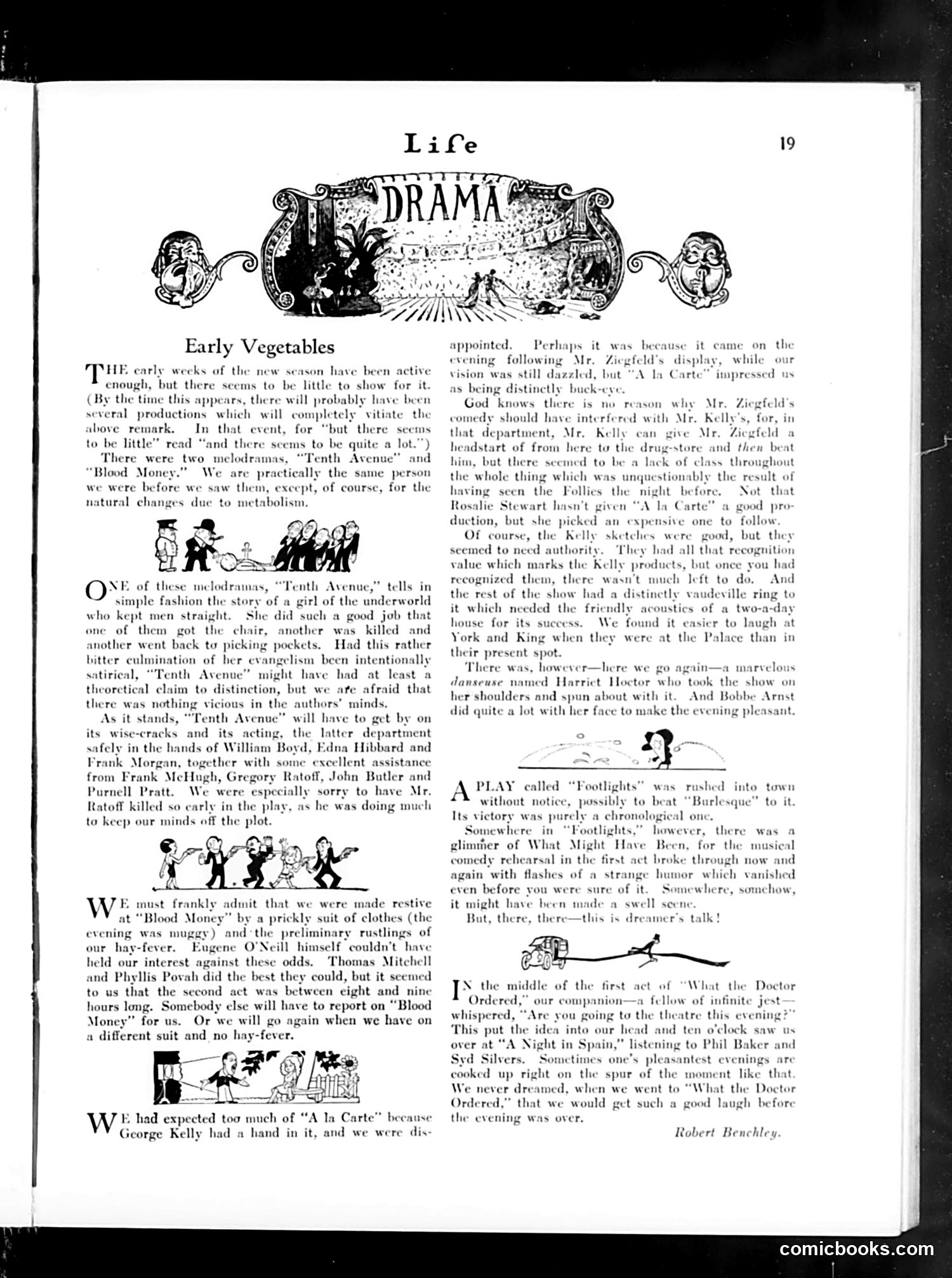
This is a theater criticism column reviewing several Broadway productions. The author critiques melodramas "Tenth Avenue" and "Blood Money" as dramatically inert despite competent acting. They found "Tenth Avenue" particularly frustrating—its tragic ending seemed unintentional rather than purposefully satirical. The review of "A la Carte" suggests the show suffered from poor timing: it followed Florenz Ziegfeld's lavish "Follies" the previous evening, leaving audiences' expectations inflated. Though George Kelly contributed and performer Rosalie Stewart was capable, the production lacked cohesion and felt more like vaudeville than a polished comedy. The column praises dancer Harriet Hoctor as the evening's highlight. "Footlights," rushed to theaters without advance notice, is dismissed as hastily produced, though it contained glimmers of potential theatrical merit.
📄 Transcribed text from this page (OCR, searchable)
Machine-transcribed from the original scan — historical spelling and the odd misread are preserved.
Early Vegetables THE arly weeks of the been active enough, but there seems to be little to show for it (By the time this appears, there will probably have been several productions which will completely vitiate the In that event, for “but there to be little” read “and there seems to be quite a lot.) There were two melodramas, “Tenth Avenue” and “Blood Money.” We are practically the same person new season have sbove rem. seems we were before we saw them, except, of course, for the natural changes due to metabolism. 99. fox NE of these melodramas, enth Avenue,” tells in simple fashion the story of a girl of the underworld who kept men straight. good job that one of them got the chair, another was killed and another went back to picking pockets. Had this rather bitter culmination of her evangelism been intentionally > did suc satirical, “Tenth Avenue” might have had at least a theoretical claim to distinction, but we afe afraid that there was nothing vicious in the authors’ minds. As it stands, “Tenth Avenue” will have its wise-cracks and its acting, the safely in the hands of William Boyd, Edna Hib! Frank Morgan, together with some excellent assistance from Frank Mel , Ratoff, John Butler and Purnell Pratt. We were B ecially sorry to have Mr. Ratoff killed so carly in the play, as he was doing much to keep our minds off the plot. to get by on latter dep: admit that we were made restive * by a prickly suit of clothes (the evening was muggy) andthe preliminary rustlings of our hay-fever. ugene O'Neill himself couldn't have held our interest against these odds. Thomas Mitchell and Phyllis Povah did the best they could, but it seemed to us that the second act was between eight and nine hours long. Somebody else will have to report on “Blood Money” for us. Or we will go again when we have on a different suit and no hay . S Sy Mile W E: had expected too much of “A Ta Carte” George Kelly had a hand in it, and we were dis must frankly “Blood Mone y Wh: because appointed. Perhaps it was because it came on the evening following Mr. Zicgfeld’s display, vision was still dazzled, but “A la Carte” distinctly buck ws there is no while as bei God kr comedy should have that department, Mr, headstart of from here h but there why Mr. Ziegfeld's interfered with Mr. Kelly's, for, in Kelly can give Mr. Ziegfeld a tu the drug then beat seemed to be a lack of class throughout reason store and the whole thing which was unquestionably the result of having seen the Follies the night be Not that “A la Carte” a an expensive one to Rosalie Stewart hasn't duction, but she picked Of course, the Kelly sketches were good, but they seemed to need authority. They had all that recognition value which marks the Kelly products, but once you had recognized them, there left to do. And the rest of the show had a distinctly vaudeville ring to it which needed the friendly a two-a-day riven id pro wasn't much house for its success. We found it easier to laugh at York and King when they were at the Palace than in their present spot. There was, however—here we go again—a marvelous named Harriet Hoctor who took the show on her shoulders and spun about with it. And Bobbe Arnst did quite a lot with her face to make the evening pleasant. danseuse A PLAY called “Footlights” was rushed into town without notice, possibly to beat “Burlesque” to it Its victory was purely a chronological one. Somewhere in ‘“Footlights,” however, there was a glimmer of What Might Have Been, for the musical comedy rehearsal in the first act broke through now and again with flashes of humor which vanished even before you were been made 1 strange sure of it. Somewhere, somehow, it might have a swell scene But, there, there—this is dreamer’s talk! FJ (Bi; N the middle of the first act of “What the Doctor Ordered,” our companion—a fellow of infinite jest whispered, you going to the theatre this evening? This put the idea into our head and ten o'clock saw us over at “A Night in Spain,” listening to Phil Baker and ometimes one’s pleasantest evenings arc oked up right on the spur of the moment like that We never dreamed, when we went to “What the Doctor Ordered,” that we would get such a good laugh before the evening was over. Robert Benchley comicbooks.com