
A complete issue · 38 pages · 1927
Life — July 21, 1927
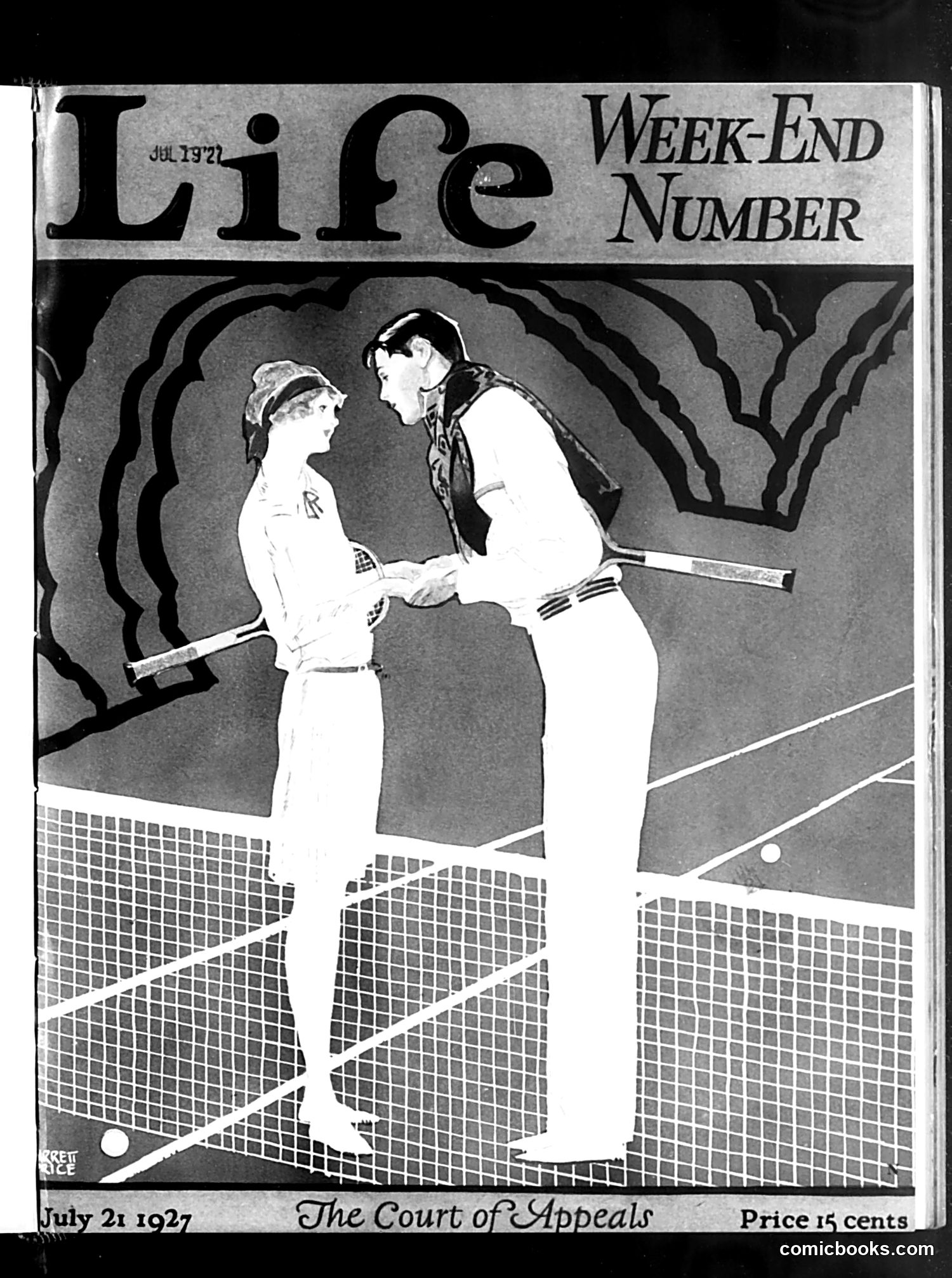
This cover satirizes tennis culture of the 1920s. Two fashionably dressed players stand at the net on a tennis court, holding rackets and appearing to have a conversation rather than play. The title "The Court of Appeals" is a pun: while "court" literally refers to the tennis court, it plays on the legal phrase "court of appeals." The satire likely mocks the social scene surrounding 1920s tennis—suggesting that the sport served as much as a venue for flirtation and social interaction among the wealthy as for actual athletic competition. The elegant dress and stylized poses emphasize leisure and fashion over sport, typical of Life's satirical commentary on upper-class social pretensions during this era.
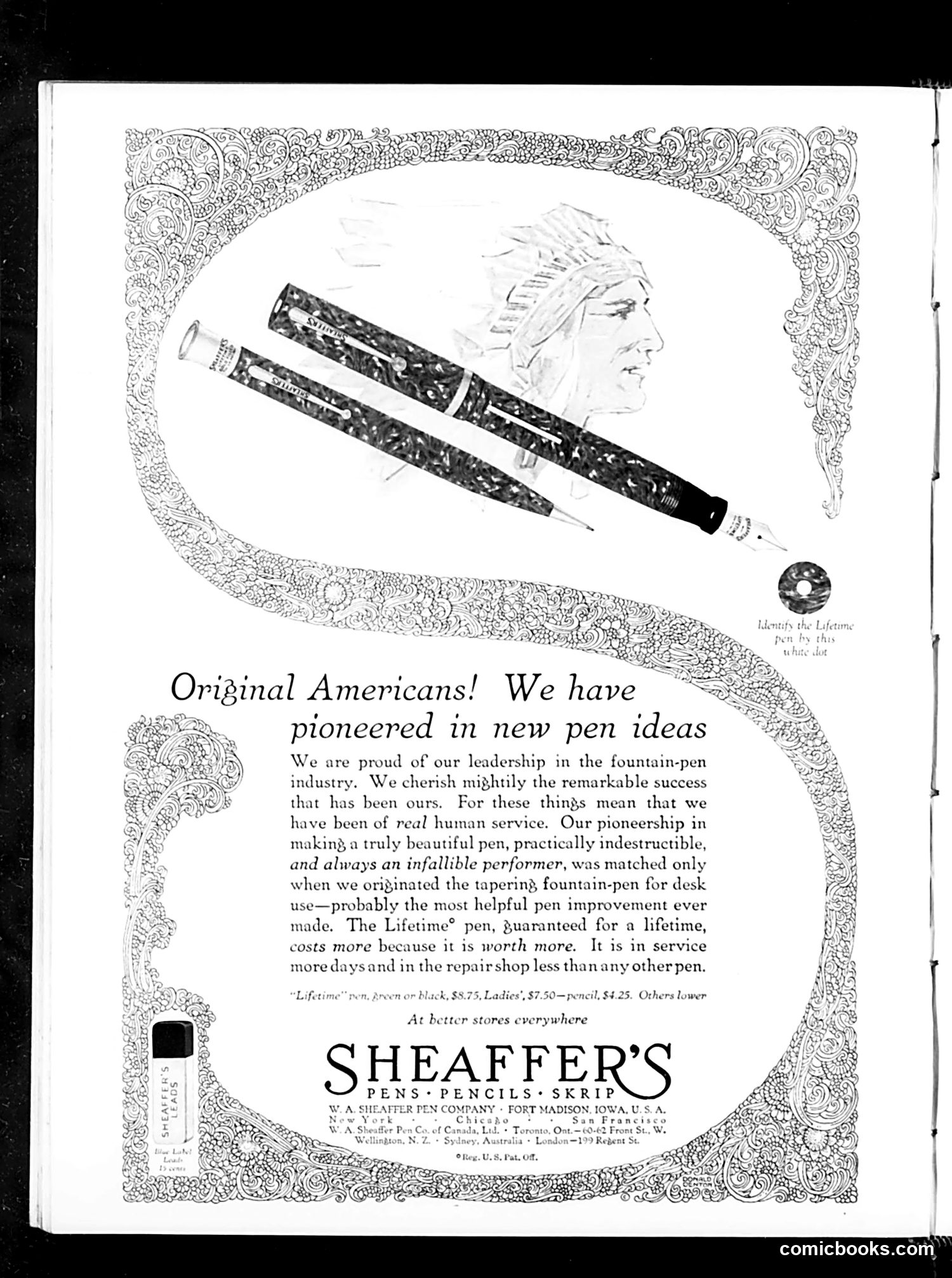
This page is primarily a **Sheaffer's pen advertisement**, not political satire. The decorative border and layout are typical of early 20th-century ads in *Life* magazine. The image shows a **Native American profile** (likely representing a generic "Original American") alongside Sheaffer fountain pens. The ad's text claims that Sheaffer pens represent American innovation and leadership in pen manufacturing—hence the reference to "Original Americans! We have pioneered in new pen ideas." The Native American imagery appears to be using a conventional ethnic stereotype common in period advertising to symbolize "American" identity and originality, though this usage would be considered offensive today. The page is essentially a commercial product advertisement rather than editorial content with satirical intent.
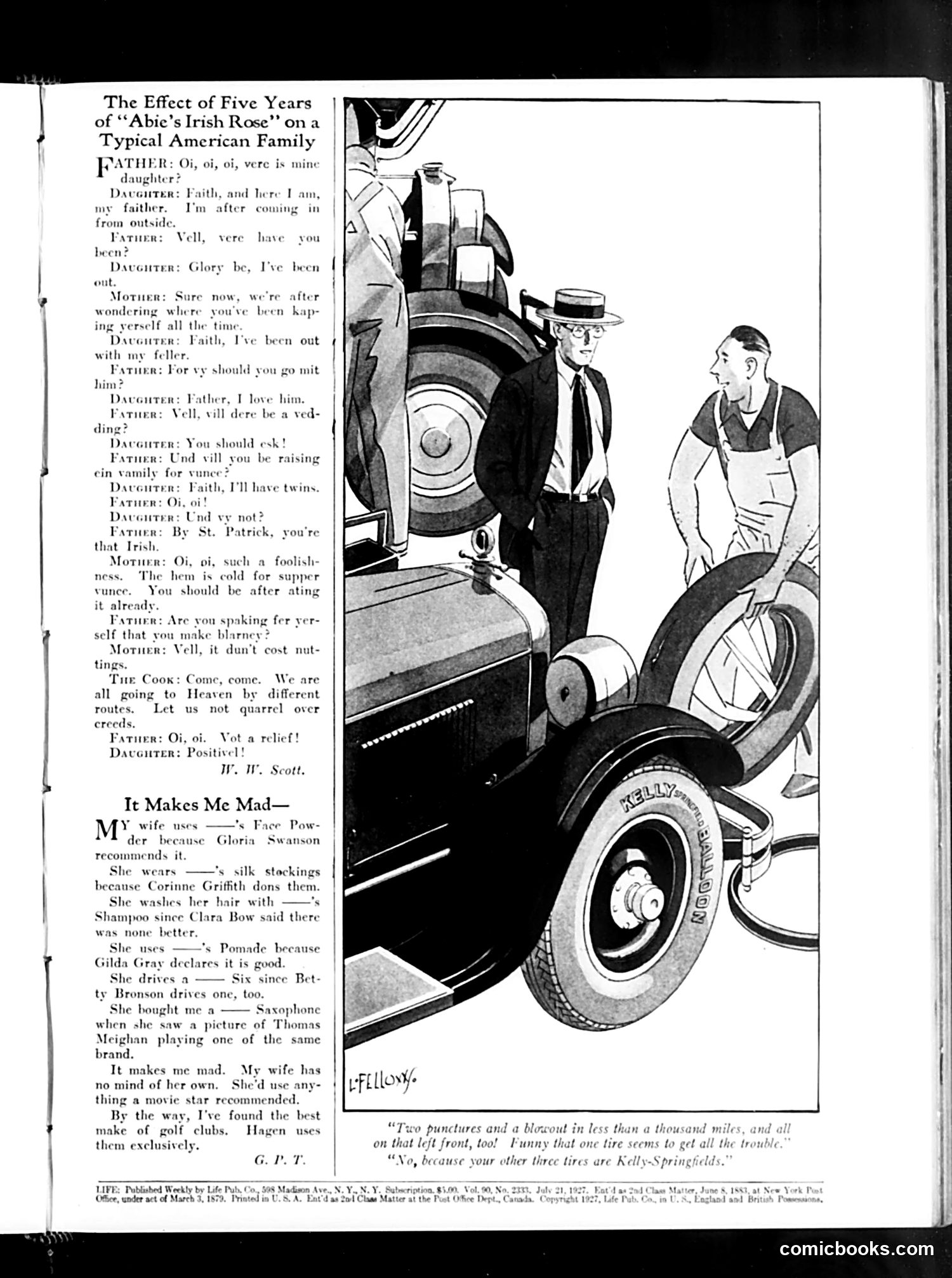
This 1927 *Life* magazine page contains two satirical pieces about American consumer culture and advertising influence. **"The Effect of Five Years of 'Abie's Irish Rose'"** (top left): A comedic dialogue mocking how Irish and Jewish families, depicted through stereotypical dialect, have become intertwined through popular entertainment. The humor targets how mass media shapes real life. **"It Makes Me Mad"** (bottom): A husband complains that his wife mindlessly imitates celebrities' product endorsements—using the same face powder as Gloria Swanson, stockings because Corinne Griffith wore them, etc. He's frustrated that she has "no mind of her own" and will use anything a movie star recommends. Both pieces satirize 1920s consumer culture's dependence on celebrity marketing and Hollywood's outsized influence on ordinary Americans' purchasing decisions and lifestyles.
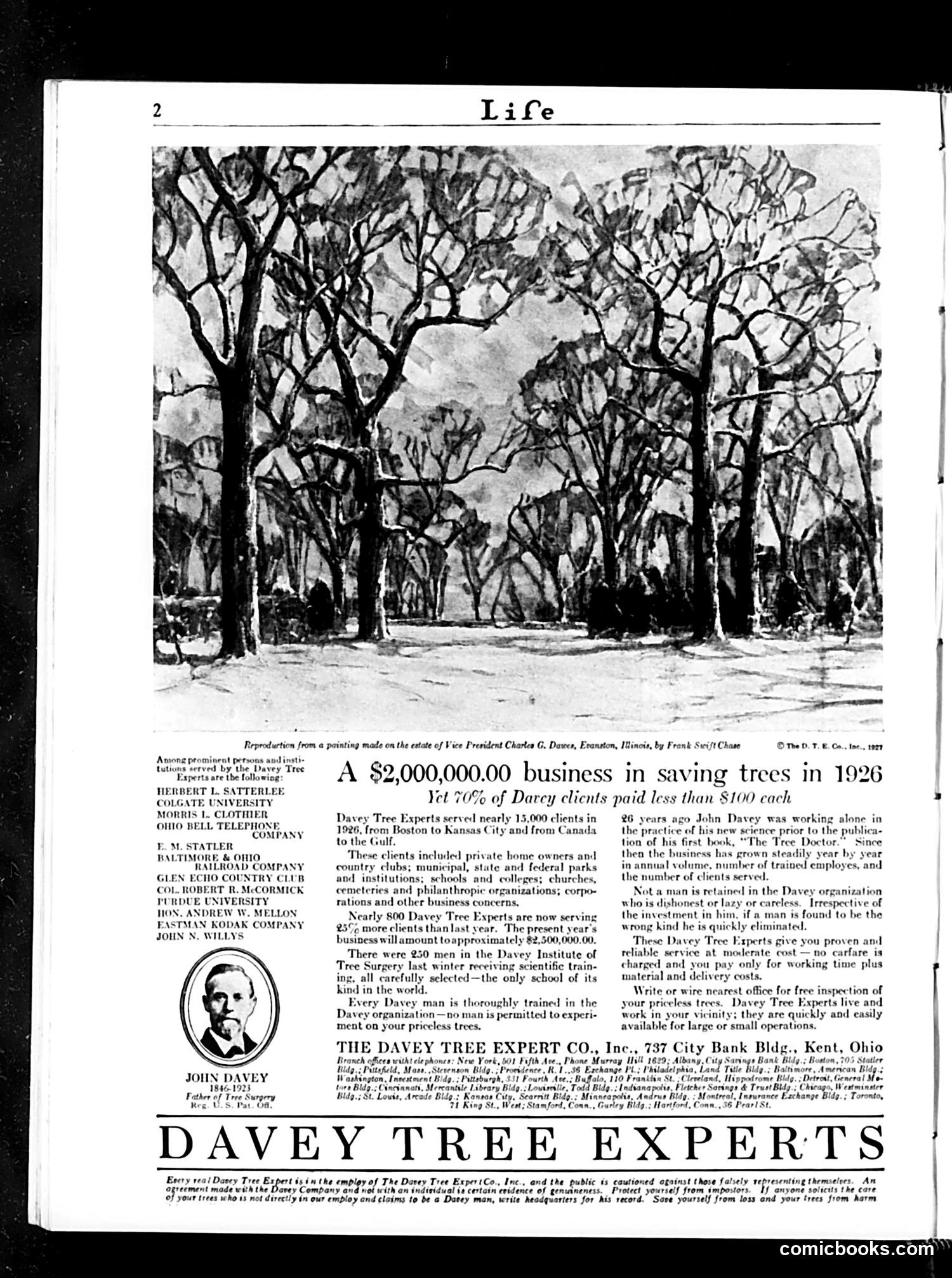
This page is **primarily an advertisement**, not political satire. It promotes the Davey Tree Expert Co., a tree service business based in Kent, Ohio, founded by John Davey (pictured). The advertisement claims the company generated $2,000,000 in business in 1926 by serving nearly 13,000 clients—"70% of Davey clients paid less than $100 each." The text emphasizes the company's legitimacy: trained arborists, scientific methods, and geographic reach across North America. The scenic photograph shows bare trees lining a path, presumably illustrating the kind of tree work performed. There is **no political cartoon or satire here**—this is straightforward commercial advertising from the 1920s designed to establish the Davey company's credibility and scale to potential customers.
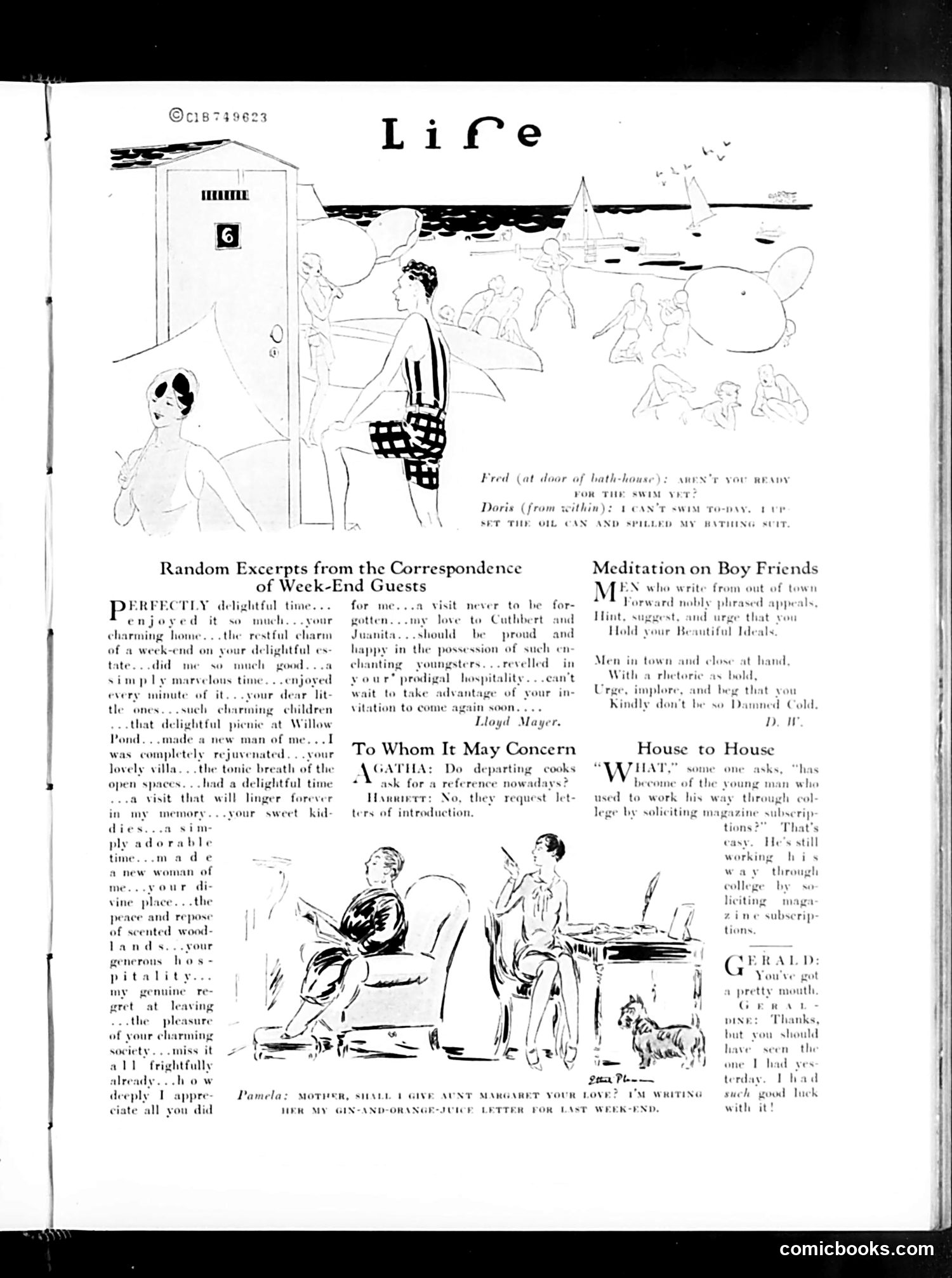
This page contains satirical humor columns and social commentary typical of 1920s Life magazine. The main sections include: **"Random Excerpts from Week-End Guests"** mocks the tedious nature of hosting visitors—poking fun at guests who overstay welcome and hosts who feel obligated to entertain. **"Meditation on Boy Friends"** offers tongue-in-cheek advice to women about men, suggesting they're unreliable and recommending women remain independent ("don't be so Damned Cold"). **"To Whom It May Concern"** addresses workplace matters, with "GATHA" asking about cook references. **"House to House"** discusses a young man supporting himself through magazine subscriptions while in college—likely commentary on enterprising youth or economic hustle during the era. The cartoon illustrations depict domestic scenes with period-appropriate dress and furnishings. Overall, the page reflects 1920s social anxieties about courtship, hospitality, and economic independence.
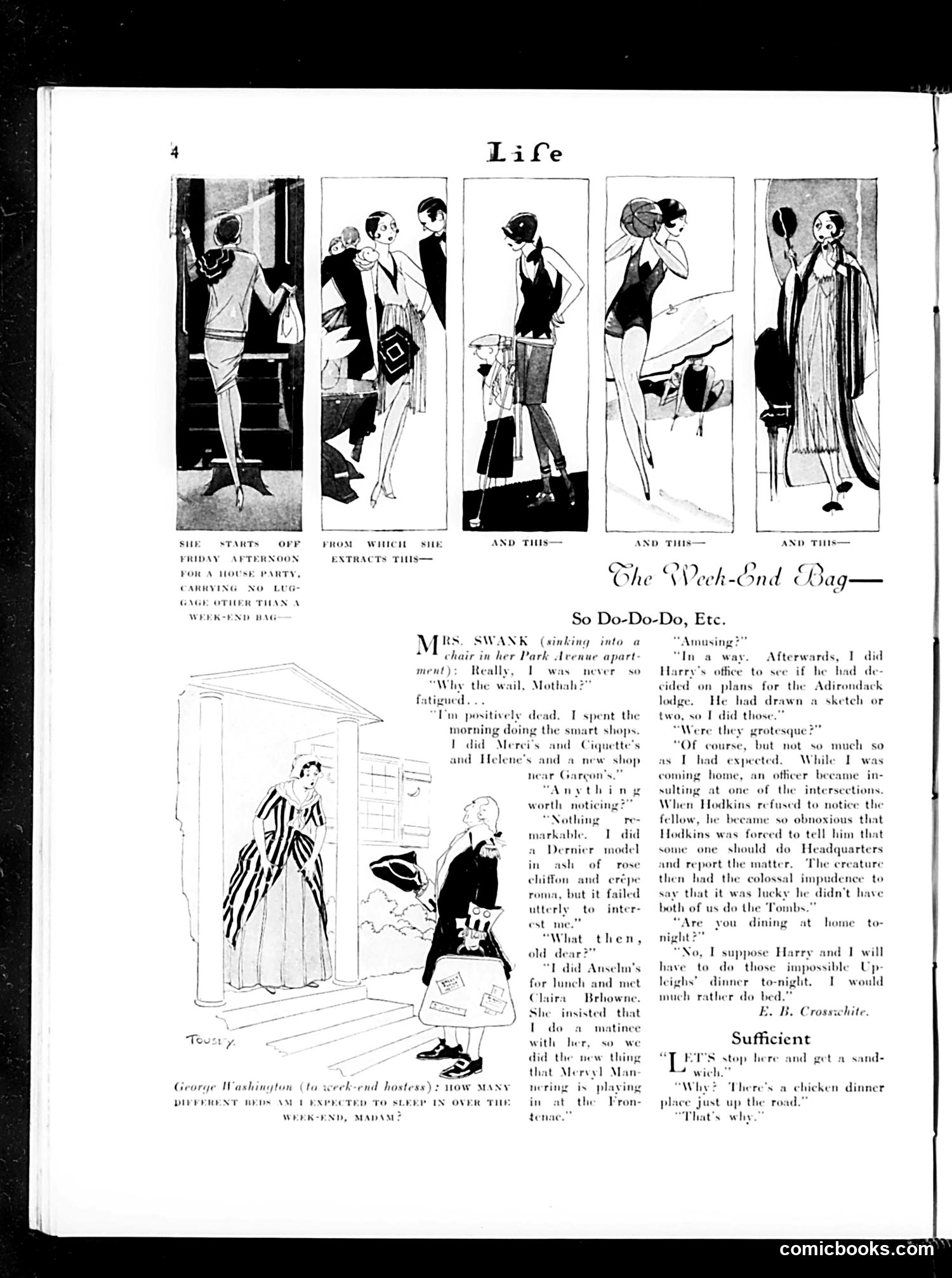
This page satirizes women's weekend social activities and fashion during the 1920s Jazz Age. The top panel shows five sequential illustrations of a woman preparing for a Friday afternoon house party, each featuring a different outfit extracted from her week-end bag. The accompanying text humorously documents her social itinerary: shopping at department stores (Macy's, Oppenheim's, etc.), encountering an "obnoxious" fellow named Hodkins, attending a matinee, and dining out. The bottom illustration depicts George Washington as a bewildered week-end host, captioned with a joke about how many different beds he'd need to accommodate all the changing social obligations modern women juggle. The satire mocks both the frenetic pace of women's social lives and the wardrobe demands of keeping up appearances during the era's leisure culture.
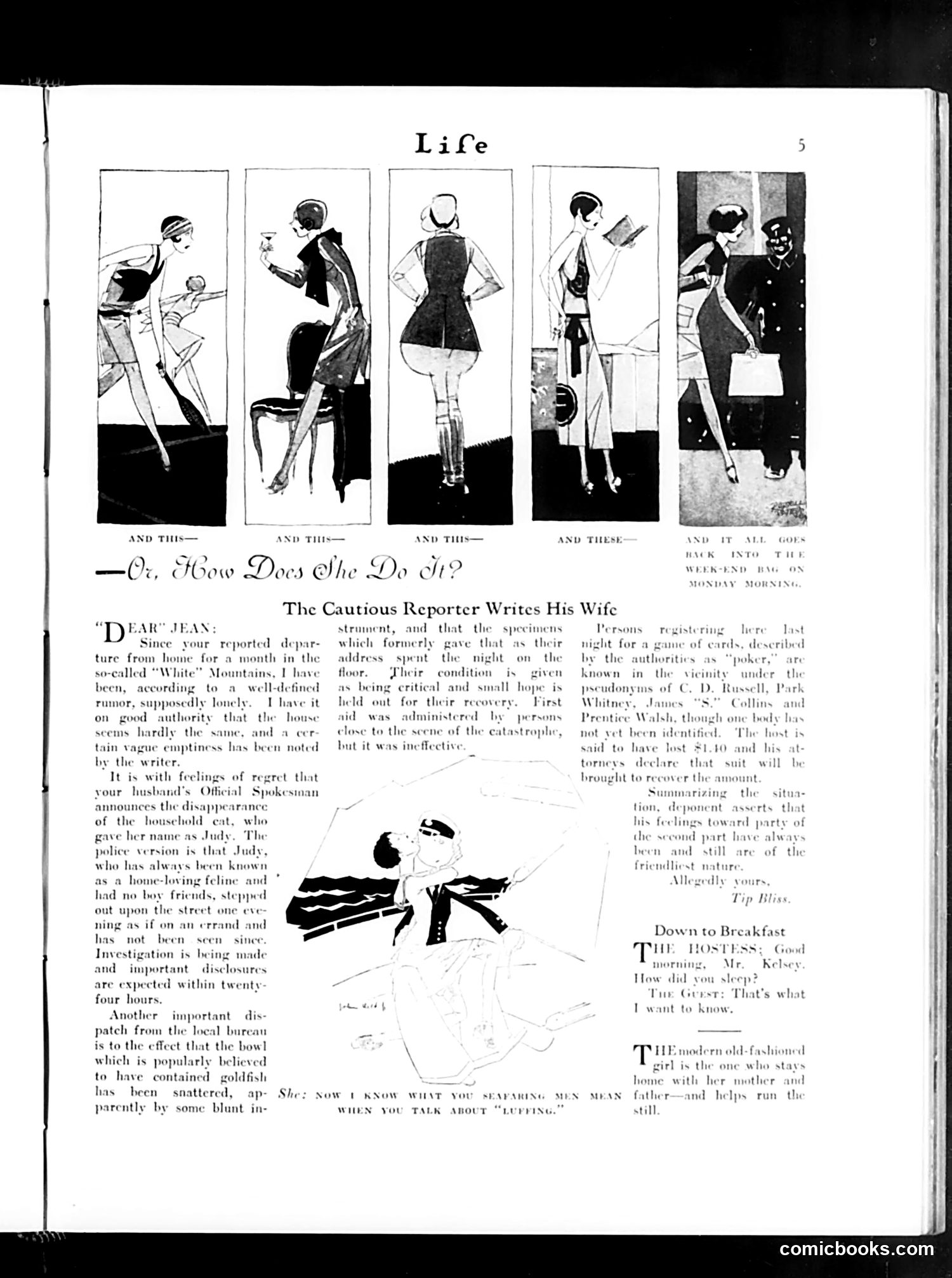
This page satirizes 1920s women's social lives and domesticity. The five panel illustrations at top show a woman in various fashionable poses—golfing, socializing, reading, and attending social events—captioned "O, How Does She Do It?" The satire targets the "modern woman" juggling leisure activities and household duties. Below, "The Cautious Reporter Writes His Wife" presents a humorous letter about investigating a missing household cat named Judy. The joke concerns a scattered bowl of goldfish, suggesting domestic chaos and incompetence. A cartoon illustration shows a couple in conversation about "petting." The "Down to Breakfast" section continues light domestic humor about modern married life, with the hostess asking about sleep and the guest deflecting with questions—typical satirical commentary on 1920s social pleasantries and gender roles.
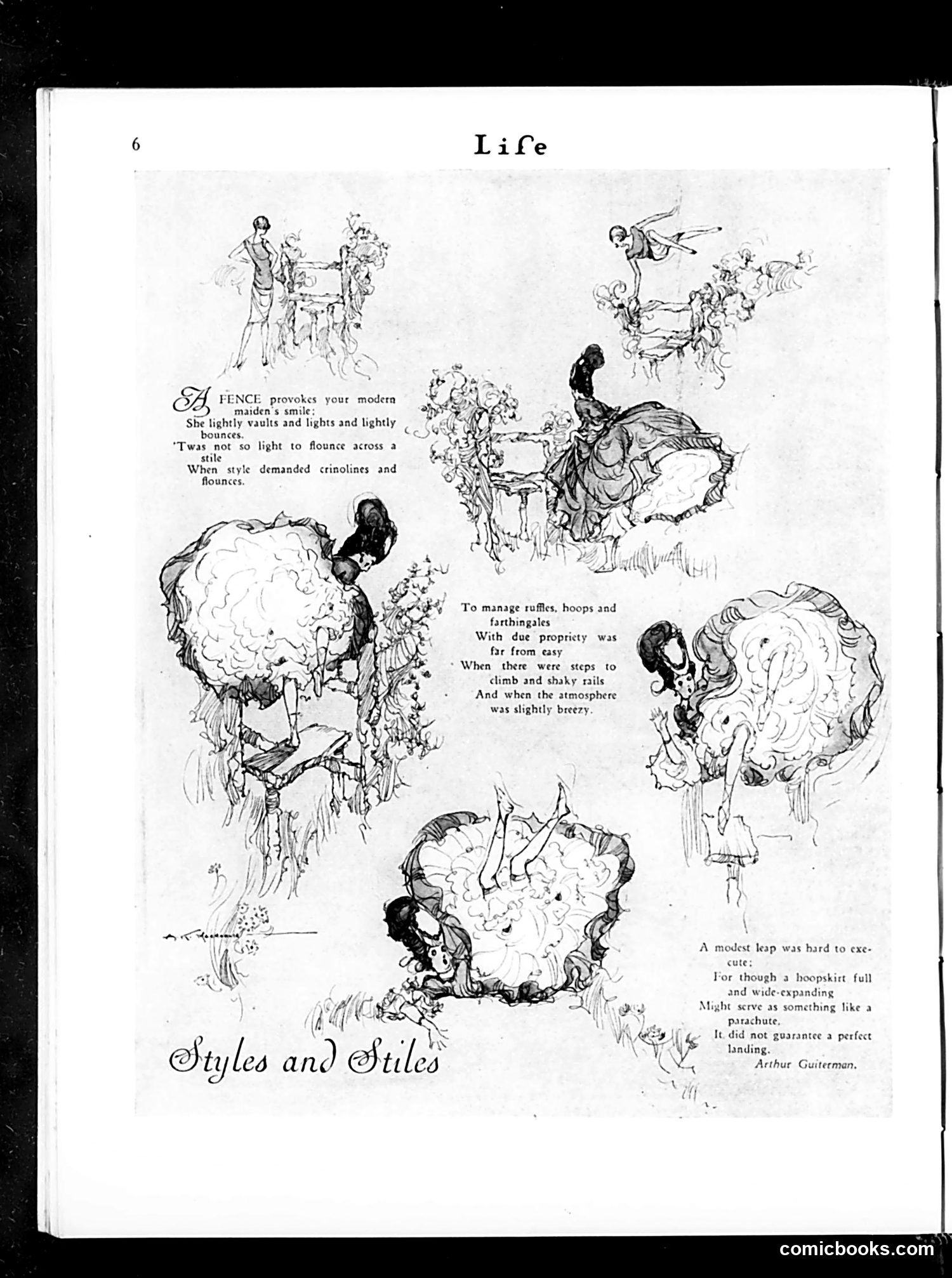
This page features satirical illustrations by an artist (signature appears present) depicting women performing equestrian stunts on horseback, labeled "Styles and Stiles." The accompanying text mocks the fashion and athleticism of horseback riding, particularly women's participation in what appears to be circus or exhibition-style riding. The humor targets the contrast between feminine fashion ideals ("modern maiden's smile," "lightly vaults") and the physical demands and dangers of these stunts. References to "ruffles, hoops and farthingales" suggest the impracticality of Victorian-era women's clothing for such athletic pursuits. The Arthur Guiterman quote about using a hoopskirt as a parachute reinforces the absurdist satire about fashion limitations during adventurous activities. The overall message critiques the tension between constrictive women's fashion and emerging athletic independence.
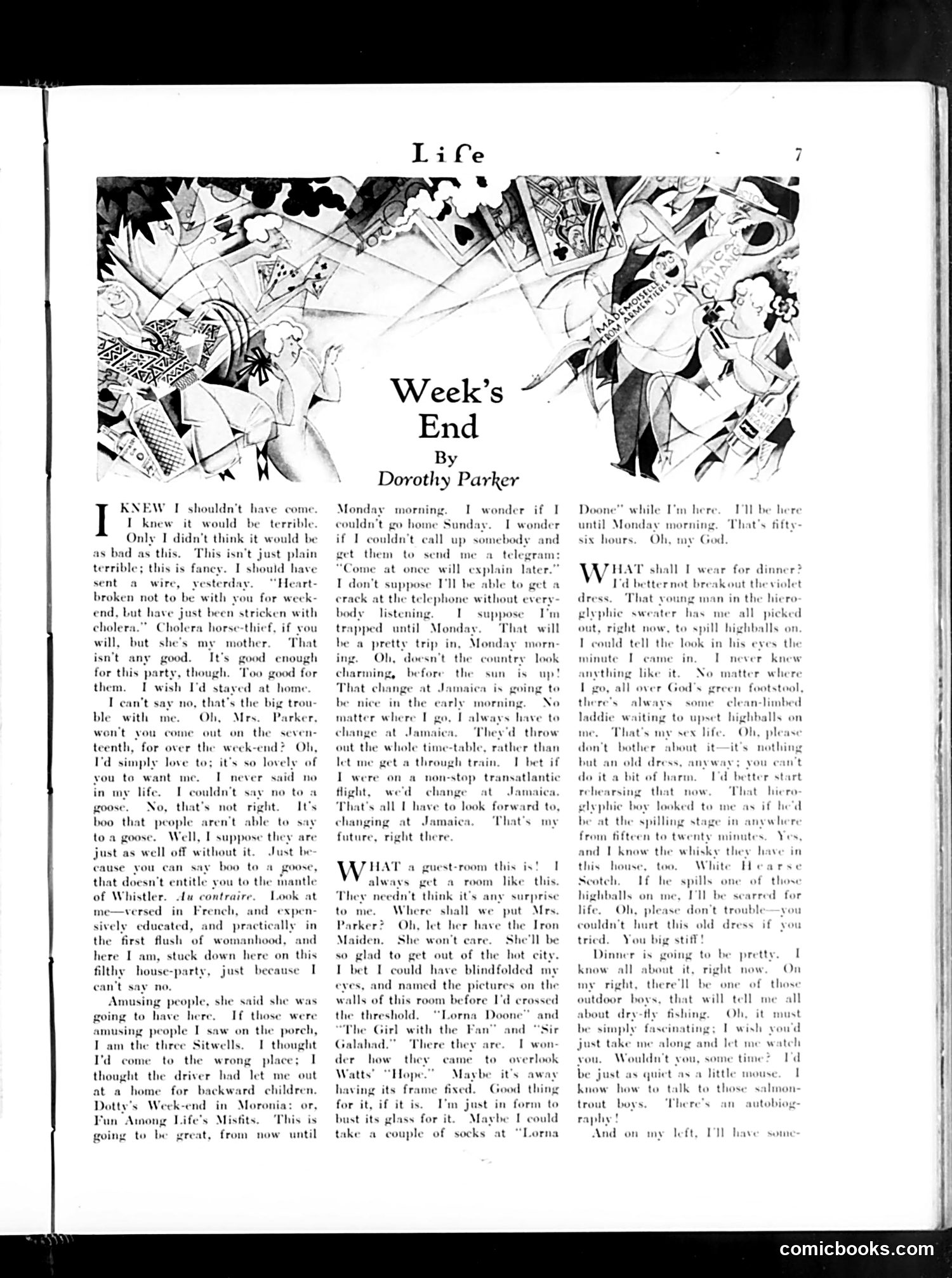
This is a satirical short story, not a political cartoon. The illustration shows a chaotic scene with playing cards, theatrical masks, and elegantly dressed figures in a decorative border—suggesting the glamorous but frivolous social world Parker is satirizing. The text depicts a wealthy woman fretting over trivial weekend plans: what to wear to dinner, managing guests, arranging a country trip, and navigating domestic staff. Parker's satire mocks the self-centered anxieties of upper-class leisure culture, where women obsess over social appearances and minor domestic dramas while remaining oblivious to larger concerns. The ornate, busy illustration reinforces the visual excess and superficiality of this world—a classic Parker critique of wealthy idleness disguised as witty, breathless narration.
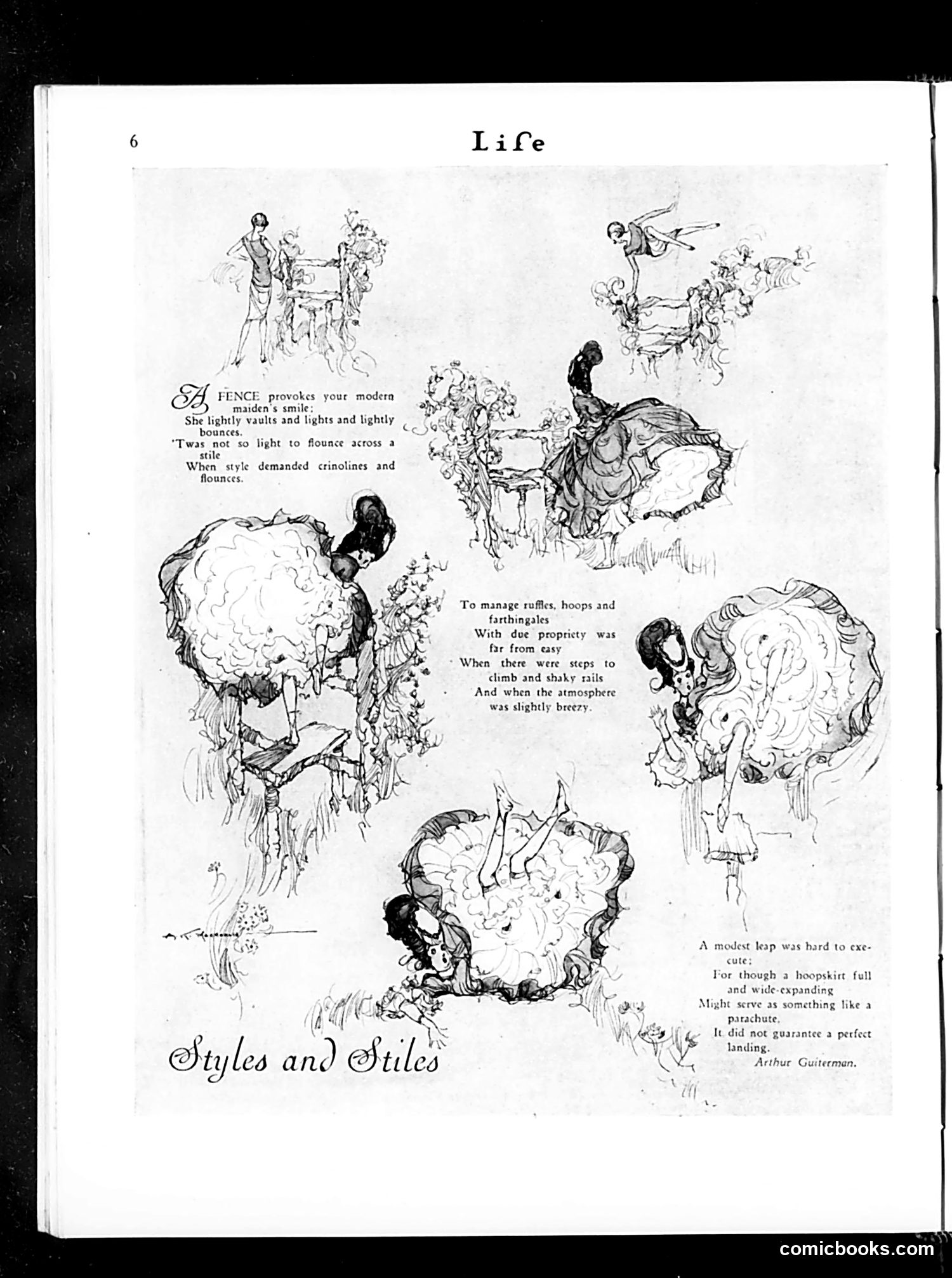
This page features humorous equestrian illustrations by Arthur Guiterman, satirizing women's horseback riding fashions and techniques of the era. The sketches depict women attempting various riding styles over fences and obstacles, with exaggerated, awkward postures. The text mocks the challenges women faced in riding while wearing the restrictive clothing and undergarments required by Victorian/early 20th-century fashion—particularly the voluminous skirts, corsets, and bustles visible in the drawings. The humor derives from the impracticality of these garments for athletic pursuits like jumping fences and managing ruffles and "farthingales." The final quote about "hoopskirk falls" and unpredictable landings pokes fun at the fundamental incompatibility between fashionable dress and functional horsemanship for women.
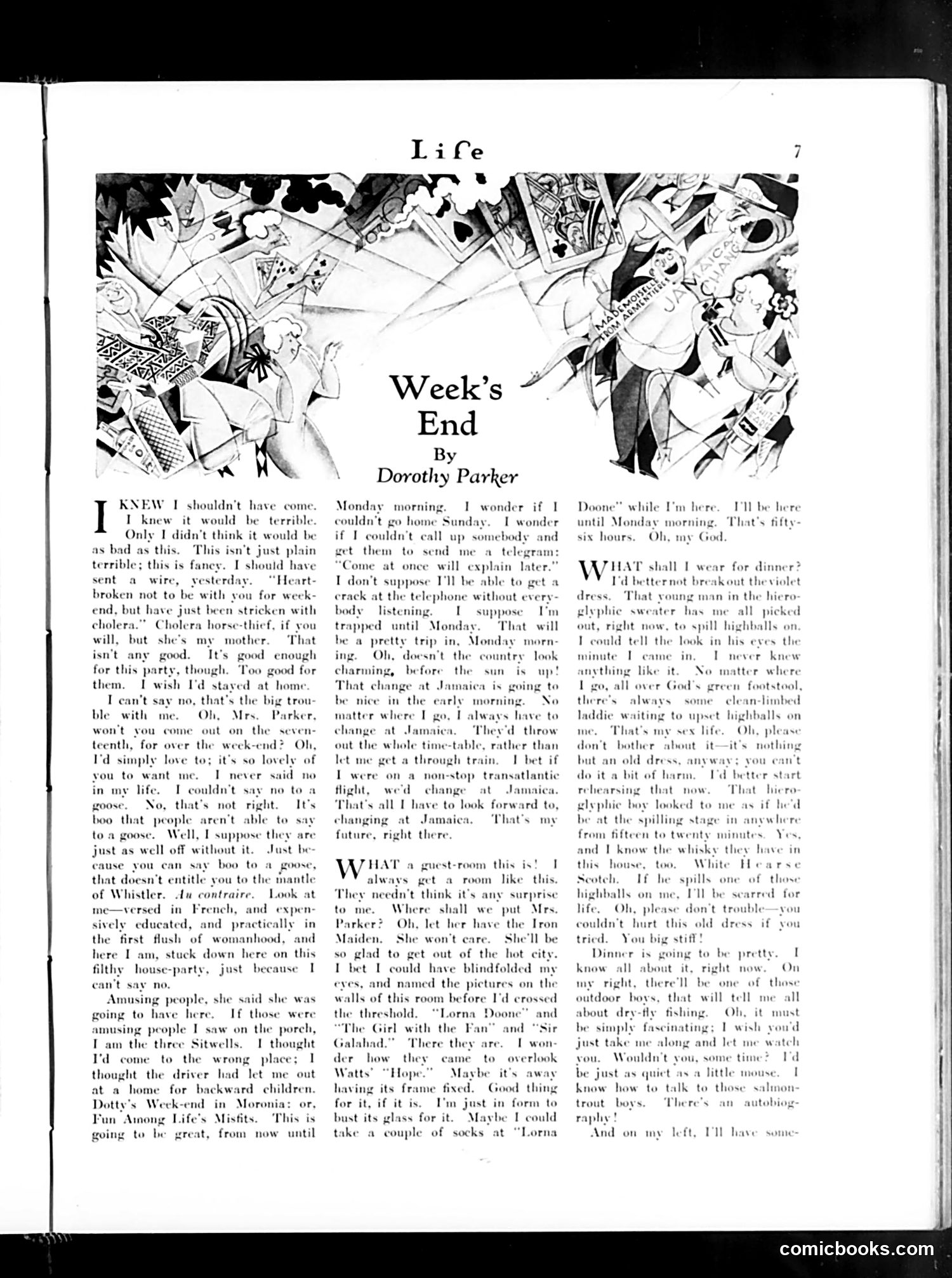
This page from *Life* magazine features "Week's End," a short story by Dorothy Parker. The illustration shows a chaotic scene with playing cards, cocktail glasses, and fashionably dressed figures scattered about—visual symbols of leisure, gambling, and the urban social scene of the 1920s-30s era. The story itself is satirical social commentary. The narrator, a woman, expresses anxiety about weekend plans—worrying about appropriate dress, hosting duties, and maintaining social appearances. Parker captures the superficiality and exhaustion of maintaining upper-class social obligations. References to Jamaica, houseguests, and complaints about "country" versus city life reflect concerns of wealthy Americans during this period. The satire targets the performative nature of leisure-class life and women's particular burden in maintaining domestic and social facades.
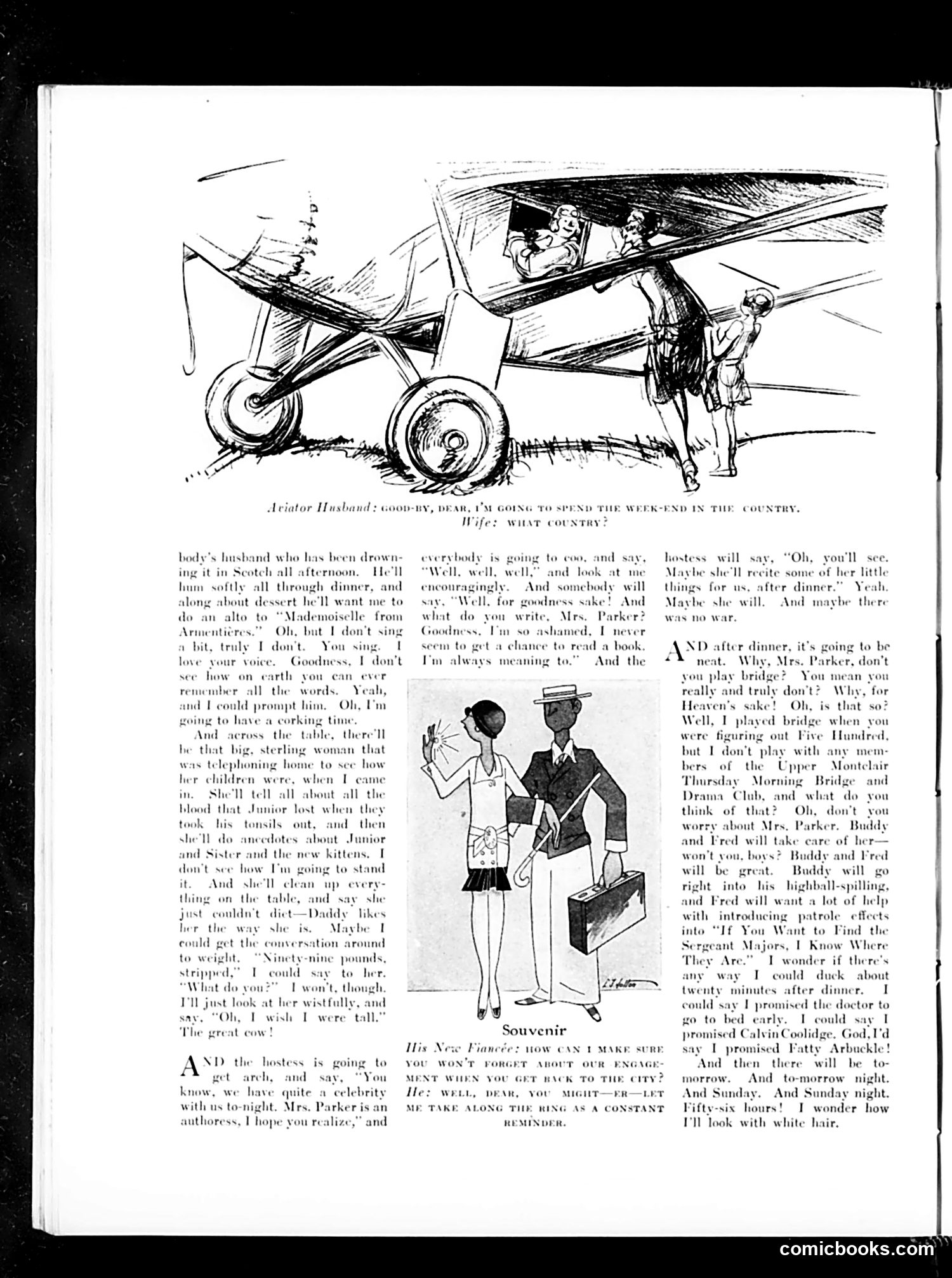
This page contains a satirical narrative comic about marital dynamics during the early aviation era. The top sketch shows an aviator (pilot) saying goodbye to his wife before a weekend trip to the country. The humor centers on **gender roles and the anxieties of early flight**. The wife worries obsessively about her husband's safety in what was then an extremely dangerous activity. The husband dismisses her concerns, focusing instead on mundane domestic matters—children, dinner, bridge games—that the wife considers trivial compared to mortal danger. The satire targets **both spouses**: the husband's casual disregard for legitimate safety fears, and the wife's preoccupation with social schedules and entertaining when her spouse faces life-threatening risk. The "souvenir" illustration of the couple preparing to travel comments on how normalized aviation had become among the wealthy, despite its genuine perils.
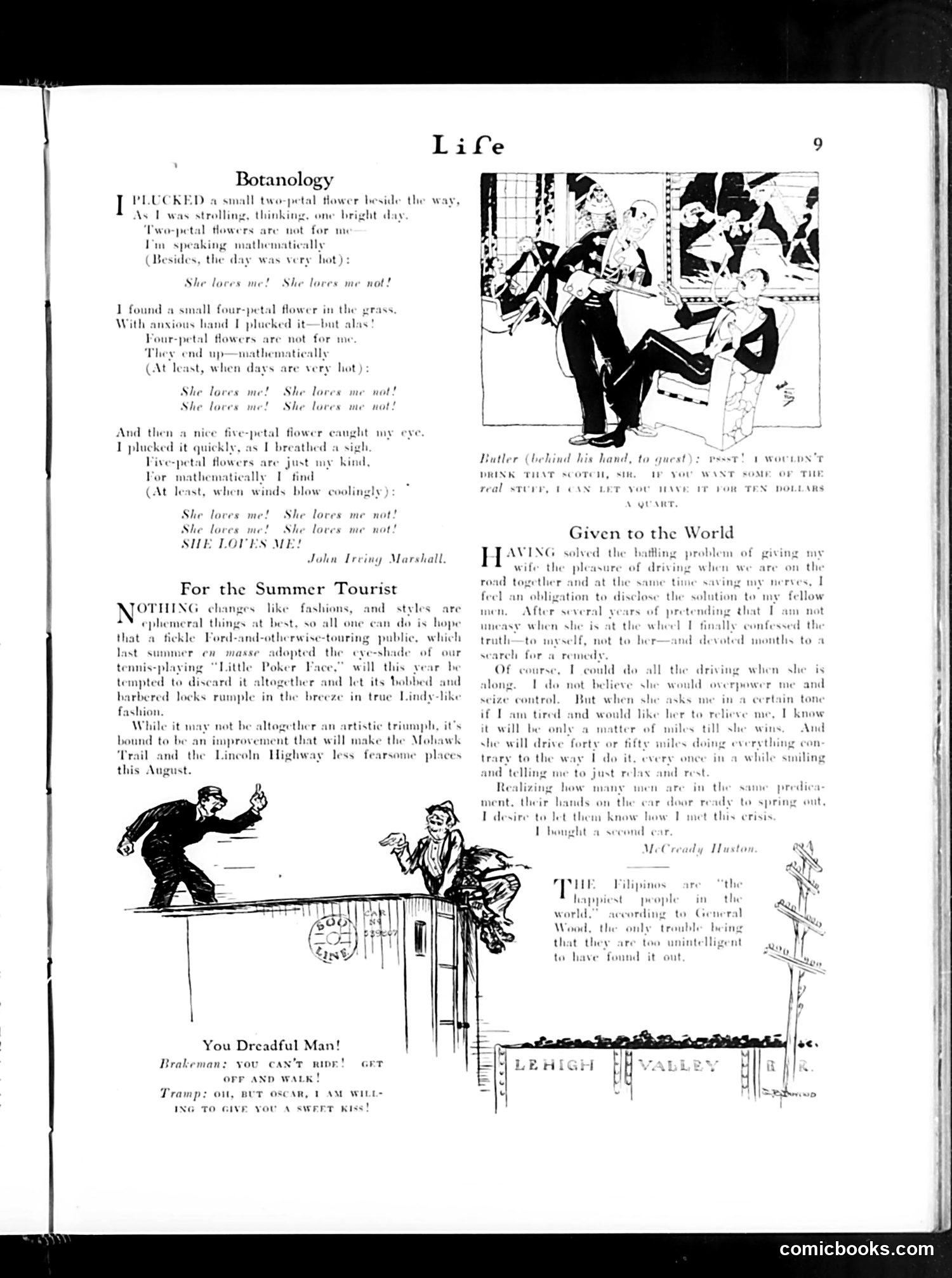
This page contains several satirical pieces typical of early 20th-century Life magazine humor: **"Botanology"** by John Irving Marshall is a humorous poem about plucking flowers while deciding "She loves me, she loves me not"—a playful take on romance and indecision. **"For the Summer Tourist"** mocks the fashion choices of vacationers, suggesting women adopt "eye-shades" and Mohawk Trail-inspired clothing to fit summer resort culture. The accompanying cartoon shows two men on a train—one appears to be a conductor or authority figure stopping a vagrant or hobo. **"Given to the World"** describes solving a marital problem: the author's wife's anxiety while driving. The piece satirizes gender stereotypes about women drivers. **"You Dreadful Man!"** is a brief cartoon joke about a boatman and tramp with romantic undertones. The page emphasizes period concerns about fashion, tourism, and gender roles.
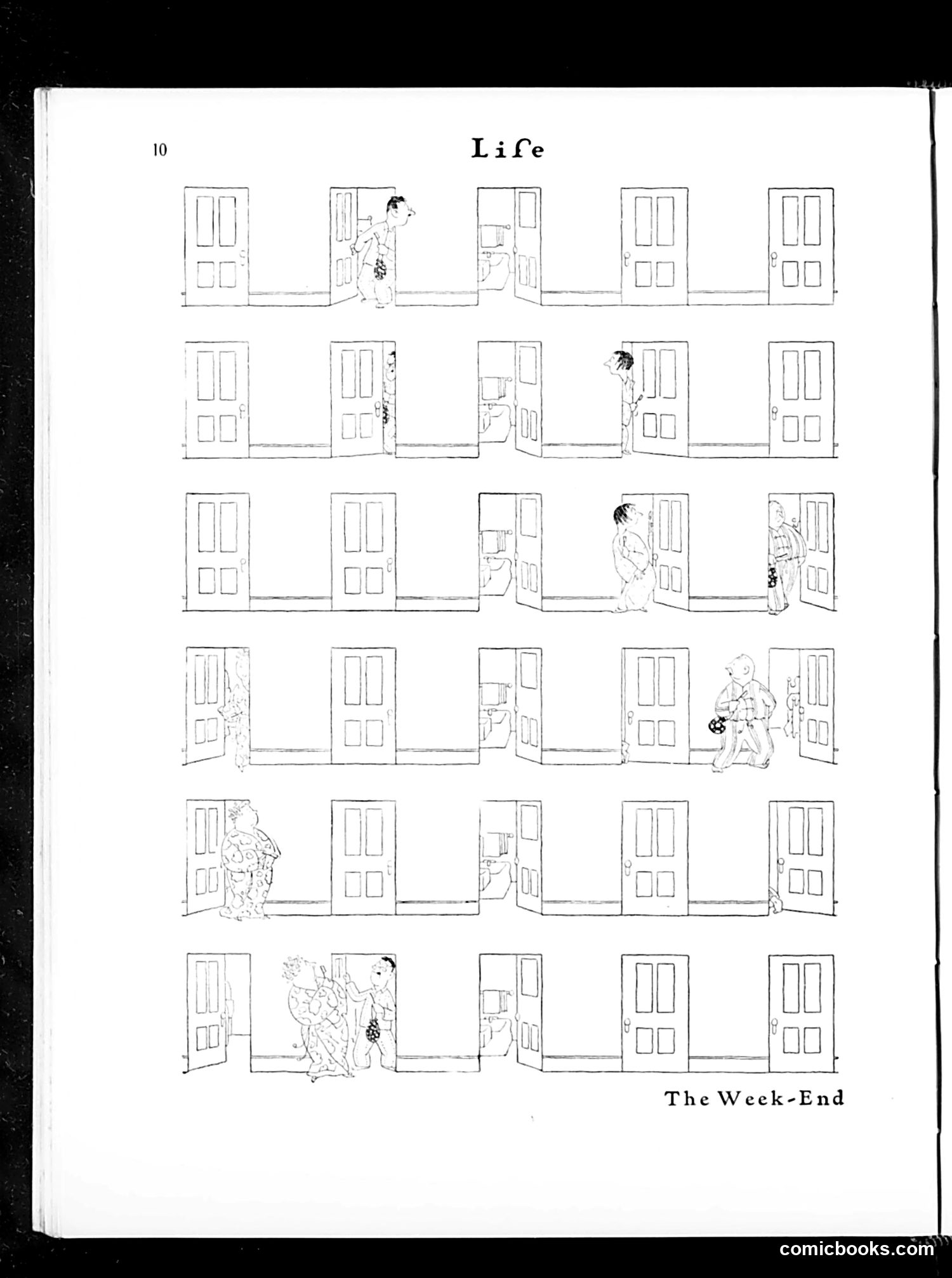
This six-panel comic strip satirizes the contrasting behavior of the same man during weekdays versus weekends. During the workweek (top panels), he appears as a respectable businessman—professional, composed, moving through corridors of doors with purpose and decorum. By the weekend (bottom panels), his demeanor transforms dramatically. He becomes disheveled, wild-haired, and increasingly chaotic—shown leaving homes in disarray, appearing intoxicated or unhinged, and generally abandoning all propriety. The satire targets the hypocrisy of respectable society: the buttoned-up professional man who transforms into an uncontrolled hedonist once freed from work obligations. It mocks both his pretense during the week and his loss of restraint on weekends, suggesting the facade of respectability conceals a far less dignified reality.
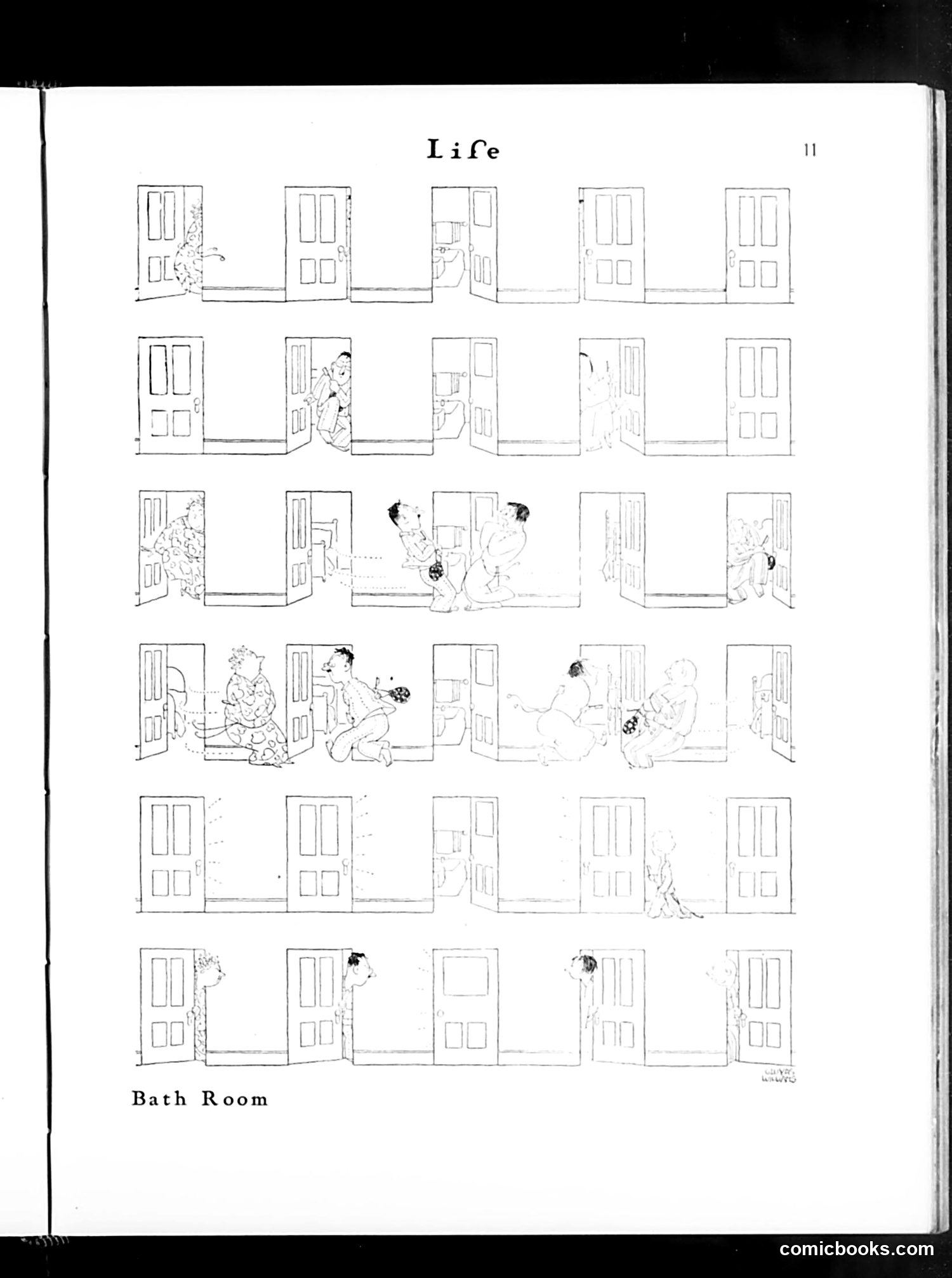
This page from *Life* magazine presents a six-panel sequential comic titled "Bath Room" depicting domestic bathroom humor. The strip shows various figures (appearing to be family members) moving through doorways and bathroom spaces in increasingly chaotic situations. The satire appears to target the common household frustration of bathroom access and scheduling—a relatable domestic conflict. The progression suggests escalating comic chaos as multiple people attempt to use or access the bathroom simultaneously, with physical comedy and exaggerated poses emphasizing the absurdity. The humor relies on visual slapstick and the universal experience of bathroom congestion in homes with multiple occupants, making it a straightforward domestic comedy rather than political satire.
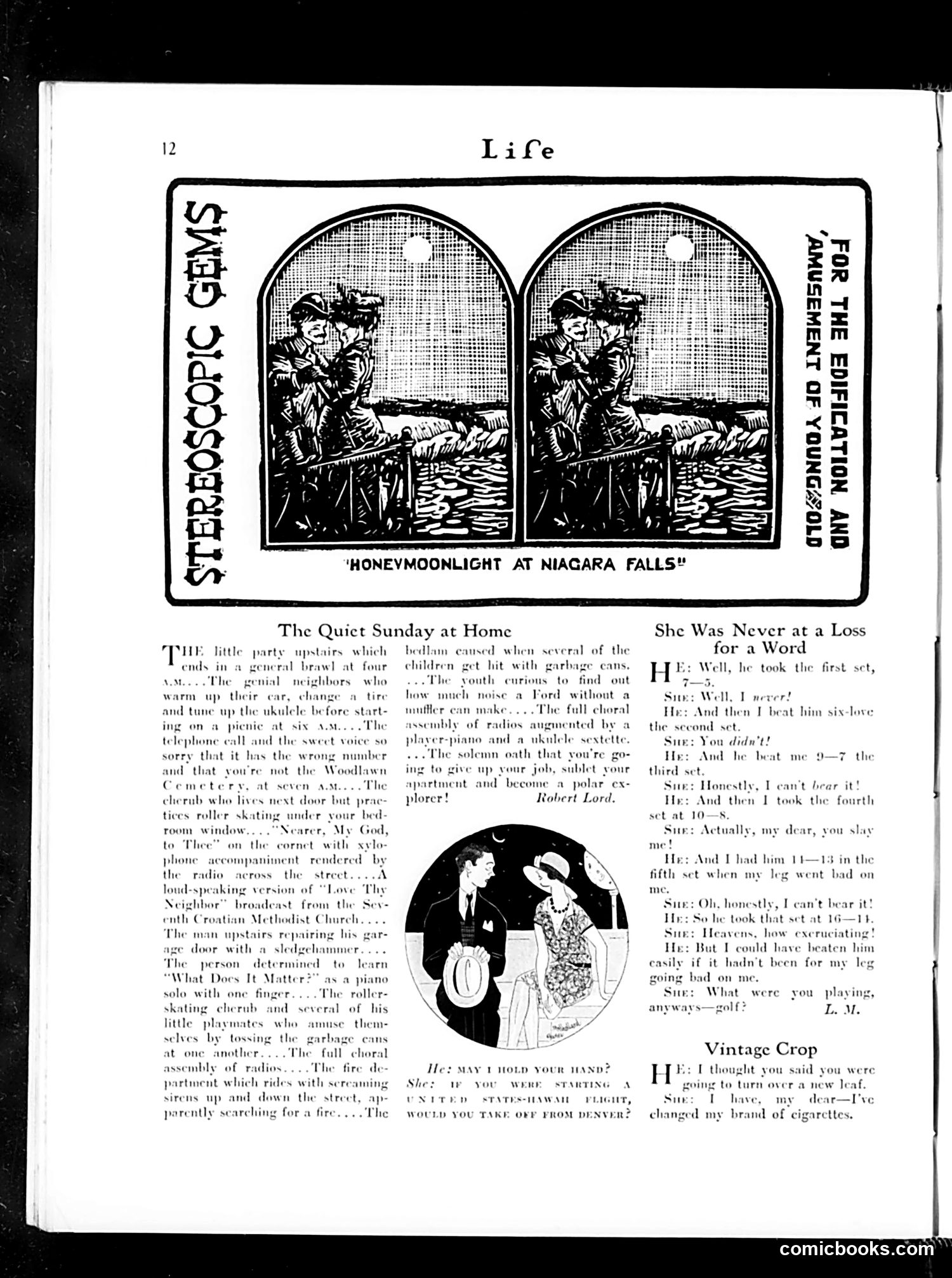
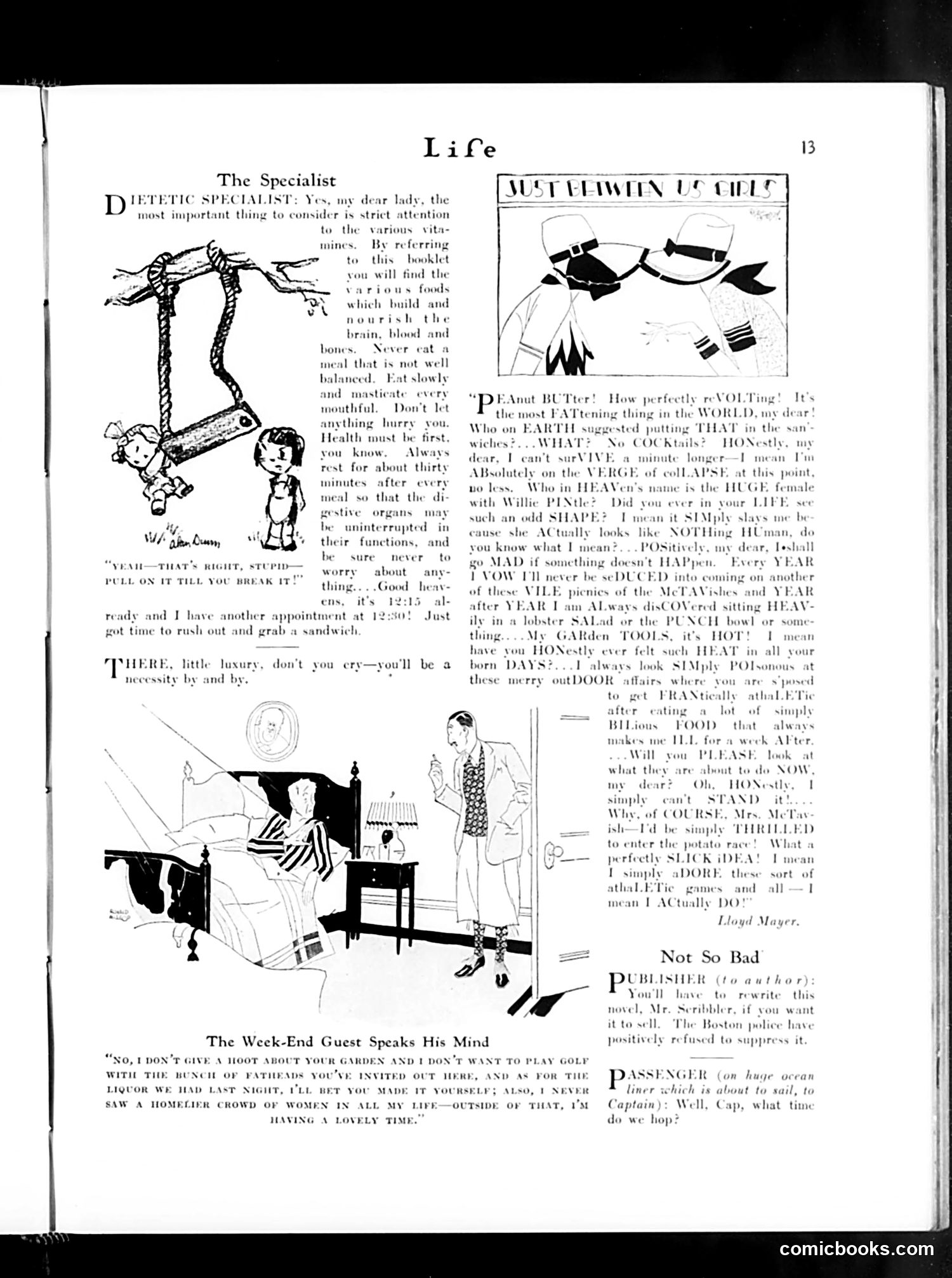
This page contains three satirical pieces mocking early 20th-century social pretensions: **"The Specialist"** features a dietician lecturing about vitamins and nutrition, satirizing the era's new obsession with scientific eating. The cartoon ridicules both the expert's pomposity and people's anxiety about food health. **"Masterpieces in Life"** (top right) appears to mock avant-garde modern art through crude drawings, likely referencing contemporary artistic movements considered pretentious. **"The Week-End Guest Speaks His Mind"** depicts a wealthy visitor complaining about his hosts' leisure activities—golf, drinking, and socializing. The satire targets upper-class ennui and performative sophistication. **"Not So Bad"** (bottom) offers brief humorous exchanges about writing novels and ocean travel. Overall, the page satirizes American upper-class affectations, pseudo-scientific trends, and social pretension.
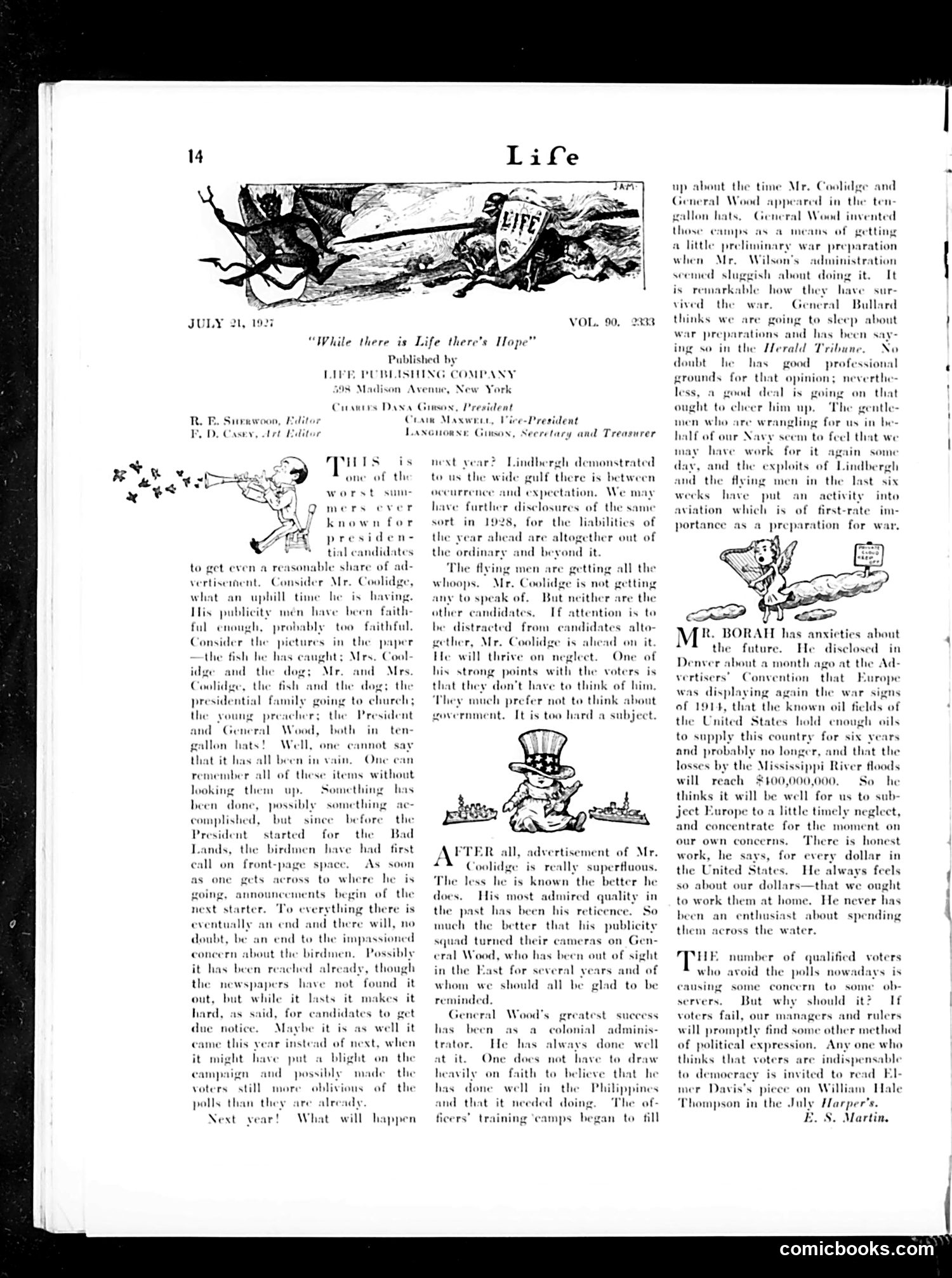
This page contains editorial commentary on the 1925 presidential race, likely critiquing candidates' advertising strategies. The text references "Mr. Coolidge" and "General Wood" as presidential candidates competing for voter attention through aggressive publicity campaigns. The cartoon illustrations appear to mock the candidates' self-promotion efforts—one shows a figure with a megaphone or announcement device, suggesting candidates are "shouting" their virtues rather than quietly demonstrating competence. The satirical point seems to be that excessive campaign advertising reveals weakness; truly qualified leaders shouldn't need such loud self-promotion. The commentary criticizes candidates for relying on flashy publicity rather than substantive accomplishments or character, a recurring theme in 1920s political satire about modern campaign techniques.
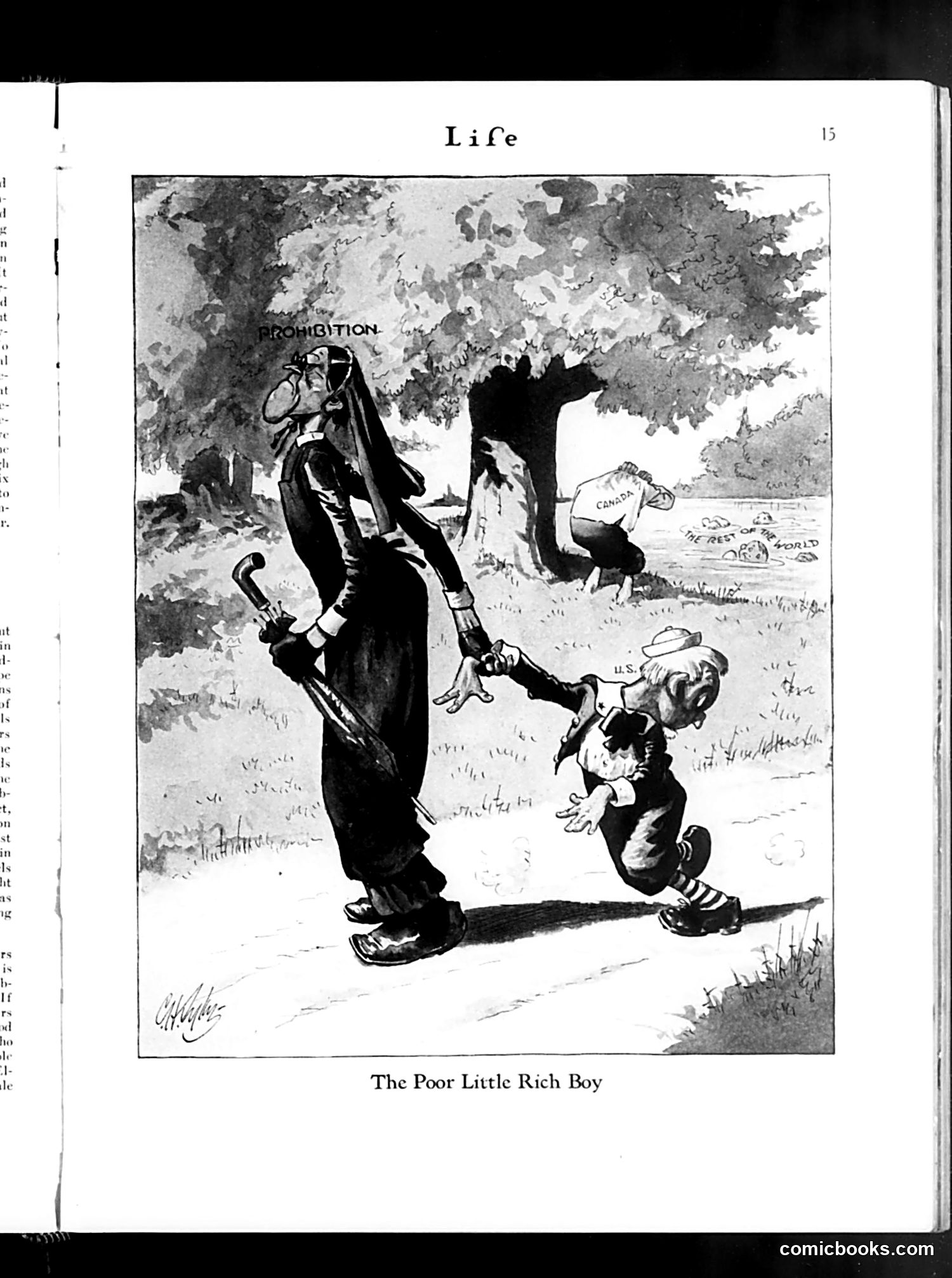
This satirical cartoon depicts **Prohibition**—labeled at the top—as a tall, skeletal figure in dark robes resembling Death or a grim reaper, wielding a large hook. The figure menaces a small, well-dressed boy (the "rich boy") who appears vulnerable despite his fine clothing and hat. The satire suggests that Prohibition, despite being intended as moral reform, has become a destructive force that harms even the wealthy and privileged. The "poor little rich boy" is ironically unable to escape Prohibition's consequences through his wealth or status. This likely critiques how the alcohol ban affected all social classes, while suggesting its enforcement was arbitrary and harmful—a common anti-Prohibition argument in the 1920s-early 1930s.
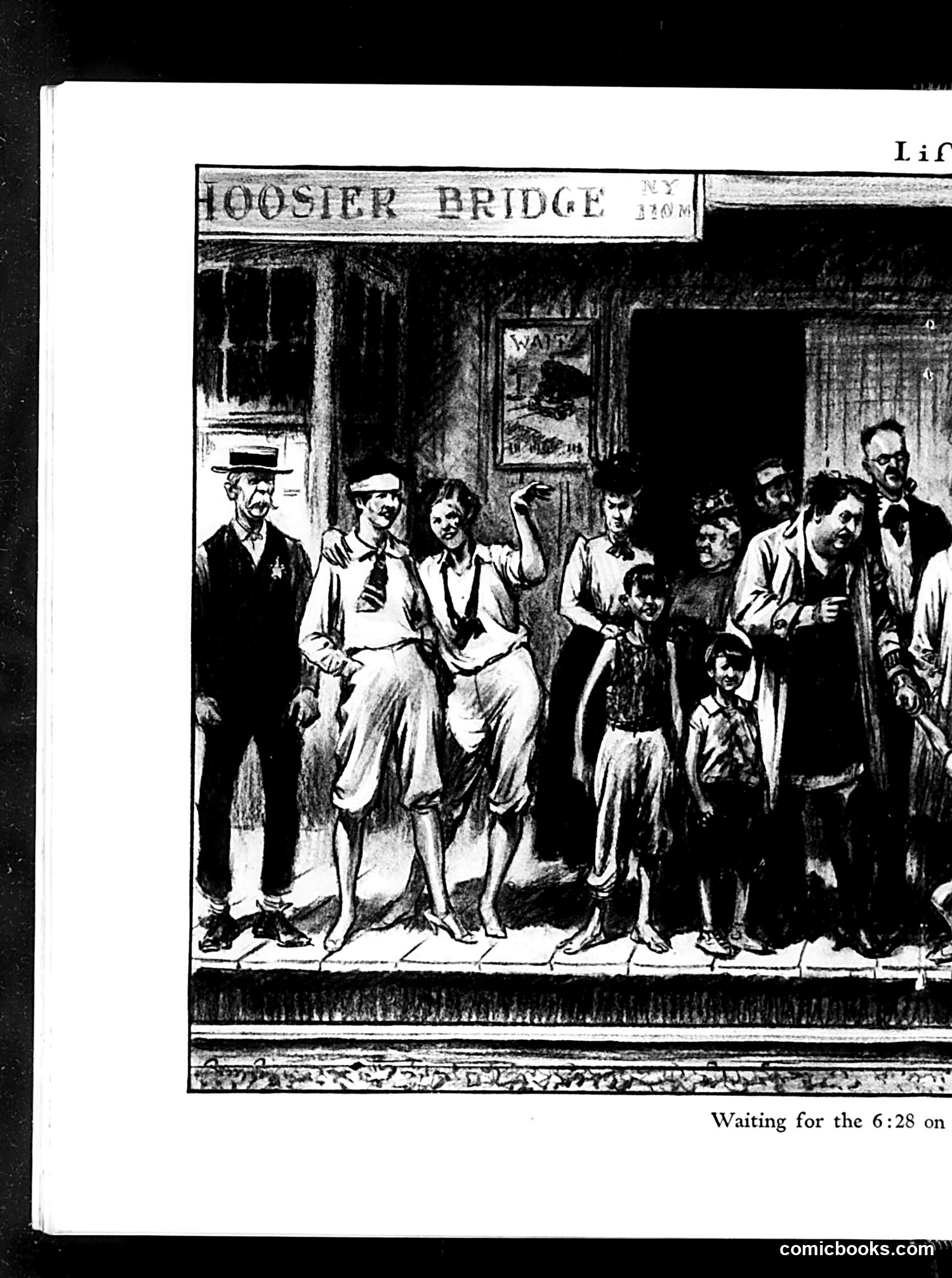
This appears to be a satirical cartoon depicting a group of ordinary people—men, women, and children of various social classes—gathered at a train station called "Hoosier Bridge," apparently waiting for a 6:28 train departure. The satire likely targets **late 19th or early 20th-century American small-town life** and the social dynamics of different classes forced into close proximity in public spaces. The diverse group (from formally-dressed gentleman on left to working-class figures and children) suggests commentary on social stratification or the democratizing effect of public transportation. Without additional context about the specific *Life* issue date, the exact satirical point remains unclear, though the composition emphasizes the awkward social mixing inherent in shared public spaces.
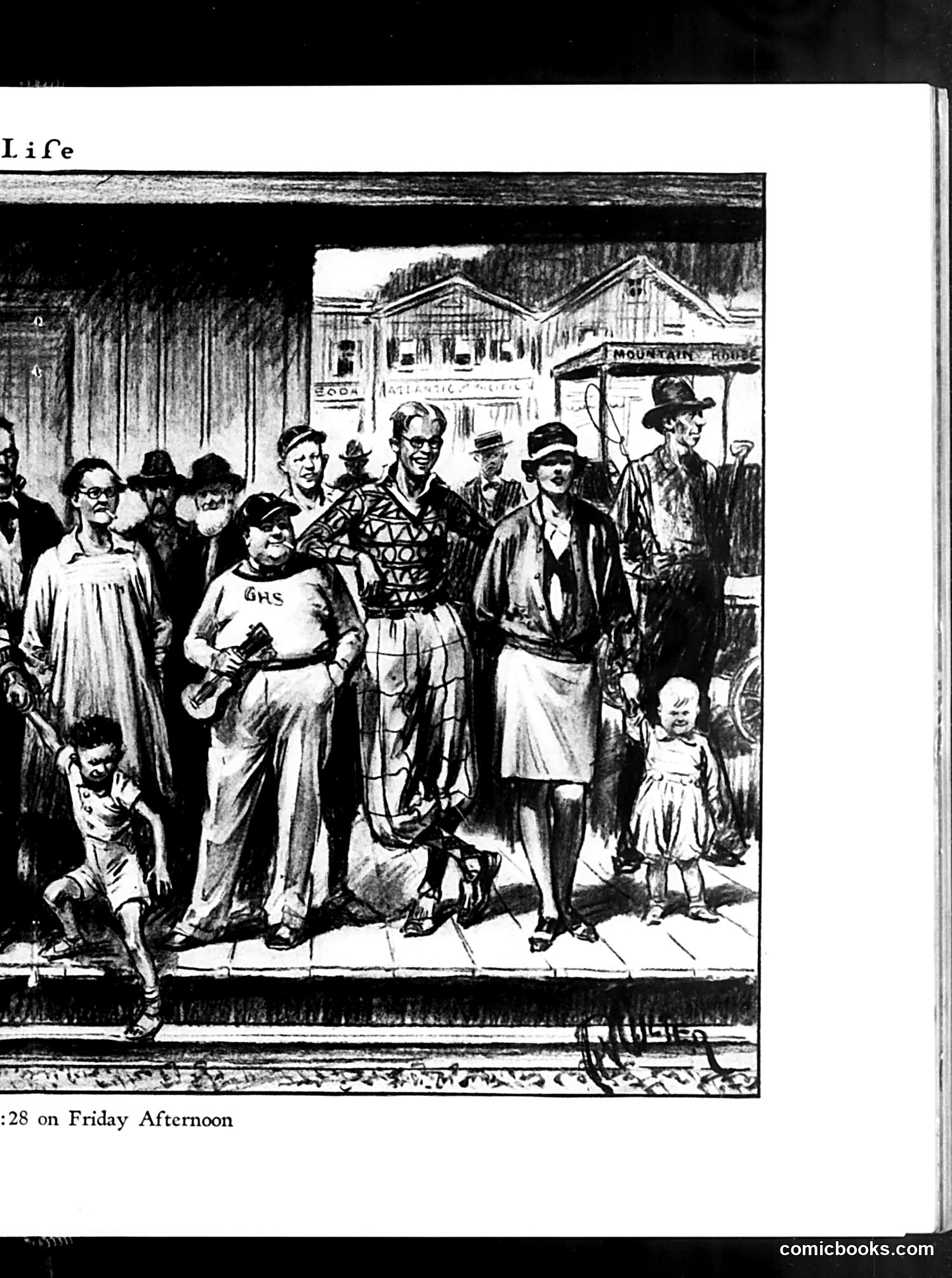
This appears to be a satirical illustration from *Life* magazine depicting a street scene, likely from the early-to-mid 20th century based on the art style and clothing. The cartoon shows a diverse group of people (men, women, and children) gathered outside what appear to be small commercial establishments, including a "Mountain House" and a "Soda" shop. The figures wear period hats and casual attire typical of working-class Americans. The specific satirical point is unclear from the visible text fragment (":28 on Friday Afternoon"), which provides only a partial caption. Without more context or a complete caption, I cannot definitively identify who these figures represent or what social/political commentary the cartoon intends. The scene might satirize economic conditions, social gathering habits, or urban/small-town American life, but this requires the full caption to determine accurately.
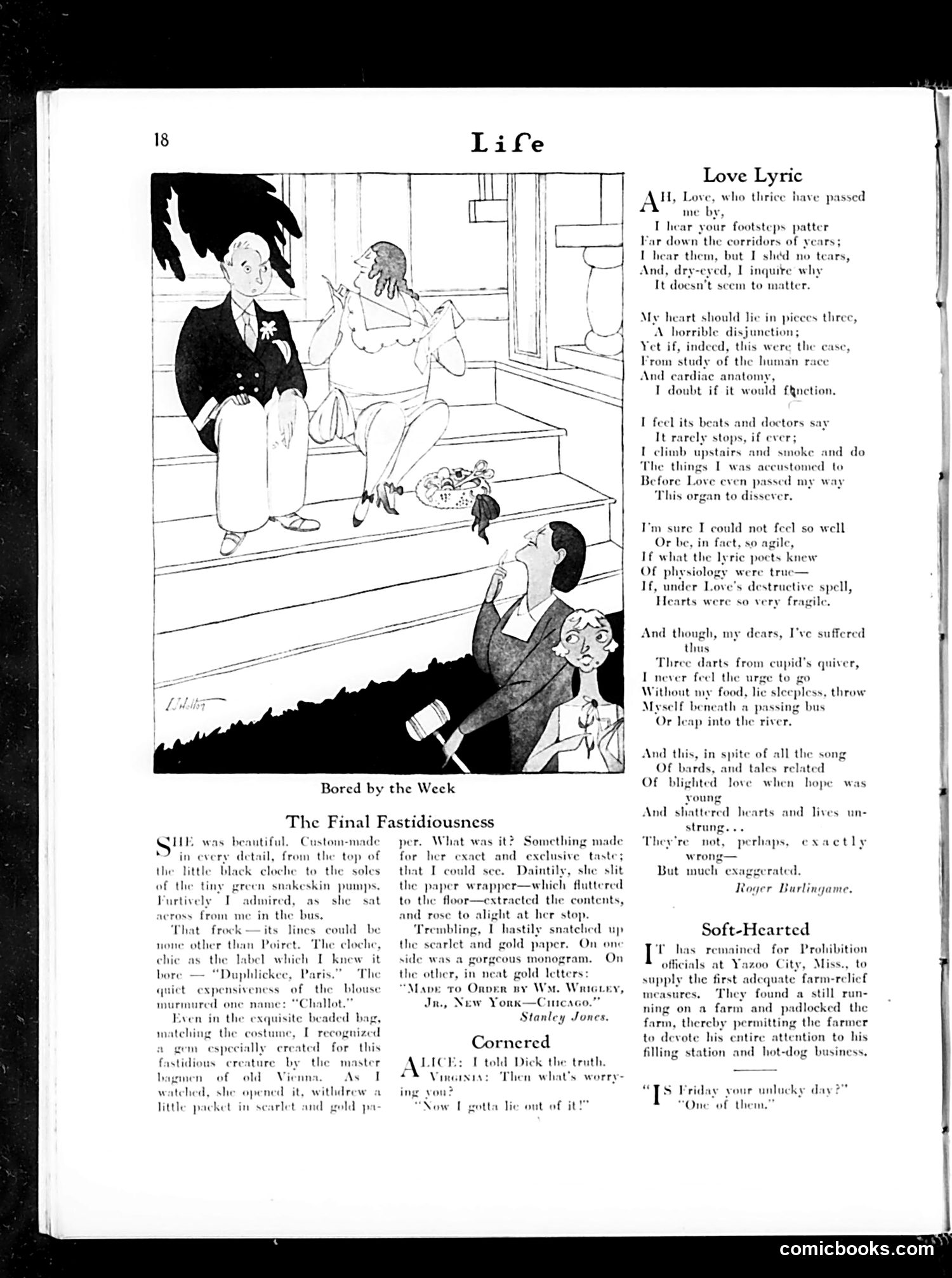
This page contains three satirical pieces typical of 1920s Life magazine humor: **"Bored by the Week"** (top cartoon): A man observes an impeccably dressed woman on a bus—her outfit meticulously designed by famous fashion houses (Poiret, a renowned couturier). The joke's punchline: she pulls from her elegant beaded bag a packet of Wrigley's chewing gum, a mass-produced American product. The satire mocks the contradiction between pretentious European fashion affectation and ordinary American consumer goods—highlighting the gap between aristocratic pretense and everyday reality. **"Cornered"** and **"Soft-Hearted"**: Brief humor pieces about romantic deception and Prohibition enforcement. **"Love Lyric"**: A poem by Roger Burlingame mocking Romantic literature's exaggerated claims about love's physical effects on the heart, using medical logic to debunk poetic conventions. The page satirizes 1920s consumer culture, fashion snobbery, and literary sentimentality—characteristic of Life's educated, urbane readership.
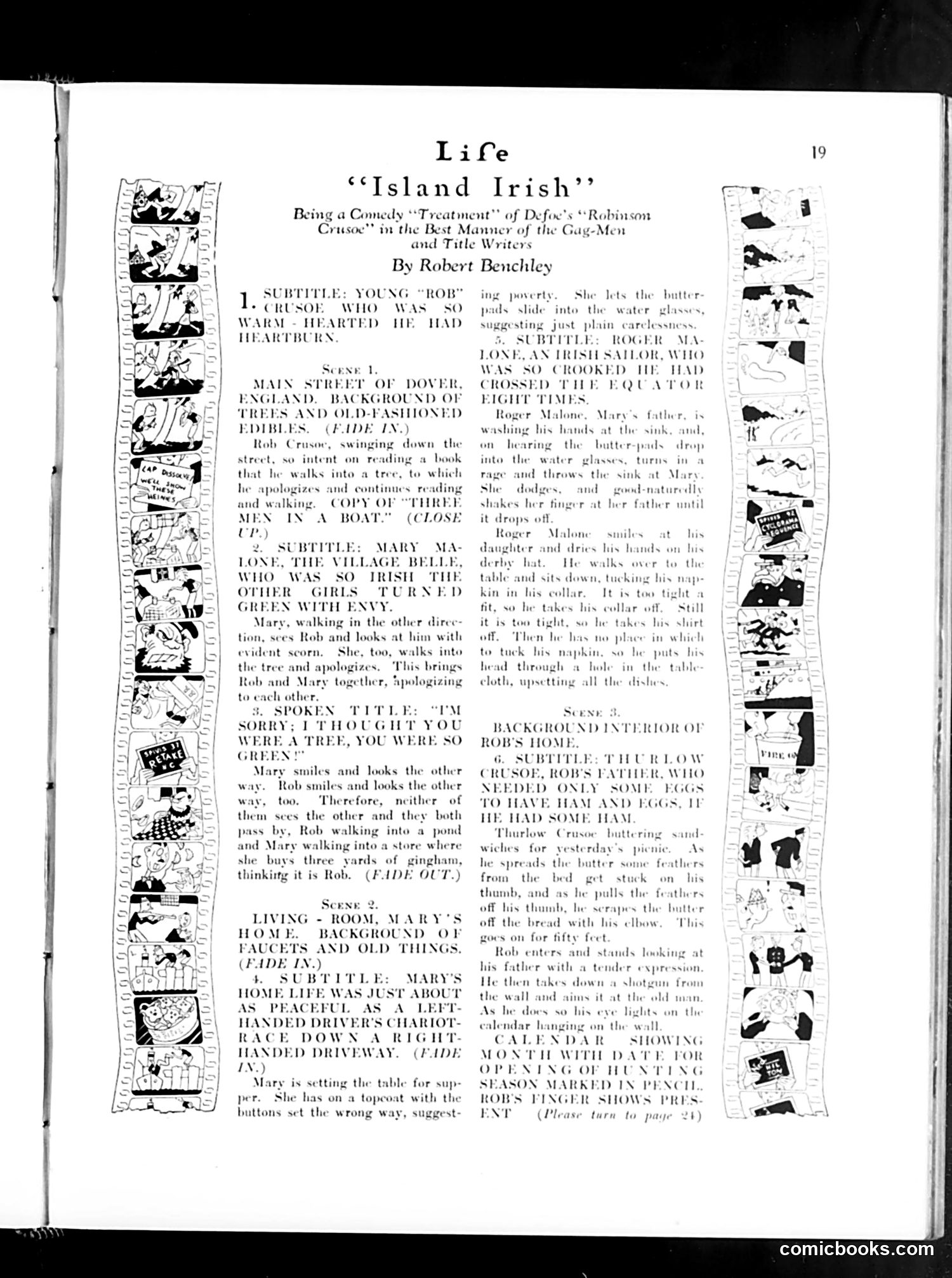
This page presents a multi-scene comedic treatment of *Robinson Crusoe* by Robert Benchley, styled as a silent film scenario with intertitles and sight gags. The humor relies on **Irish ethnic stereotypes** popular in 1920s American comedy: characters are absurdly clumsy and accident-prone. Young Rob walks into a tree while reading; Mary is so "Irish" other girls turn "green with envy"; her father Roger is "so crooked he crossed the equator eight times"; her grandfather needs only eggs to have ham and eggs (implying poverty and simplicity). The jokes are physical and pun-based ("you were so green"). The satire targets both the source material's adventure narrative and the conventions of silent film comedy and slapstick—the format itself parodies how gag-writers and title-card writers translated literature into silent comedies. The exaggerated character descriptions mock how ethnic humor was deployed in entertainment of this era.
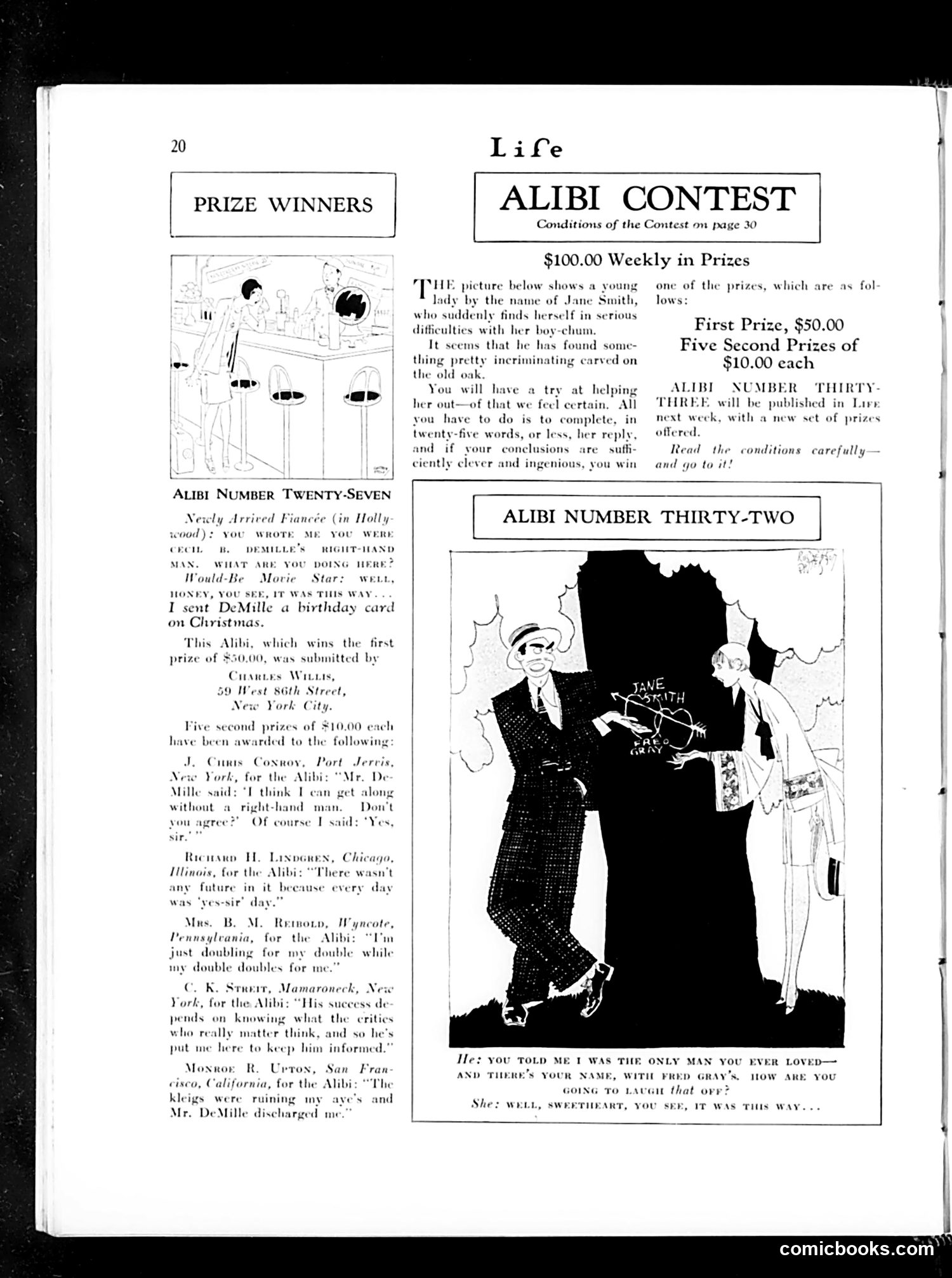
This page features Life magazine's "Alibi Contest," a humor competition where readers submit witty excuses for awkward situations. The main cartoon (Alibi Number Thirty-Two) shows a man confronting his romantic rival: he's discovered another man's name carved on a tree alongside his sweetheart's, and demands an explanation. The joke is that the woman must provide a clever alibi—a plausible excuse for the incriminating evidence. The caption sets up her predicament: she's caught red-handed. The page also shows winning alibis from previous contests, including one involving Cecil B. DeMille (a famous Hollywood director of the era). These demonstrate the contest's appeal: readers competed to create the most ingenious explanations for compromising situations, often playing on contemporary references like Hollywood culture and romantic mishaps. The $100 weekly prize ($50 first place, five $10 second prizes) indicates this was an active, popular feature readers participated in regularly.
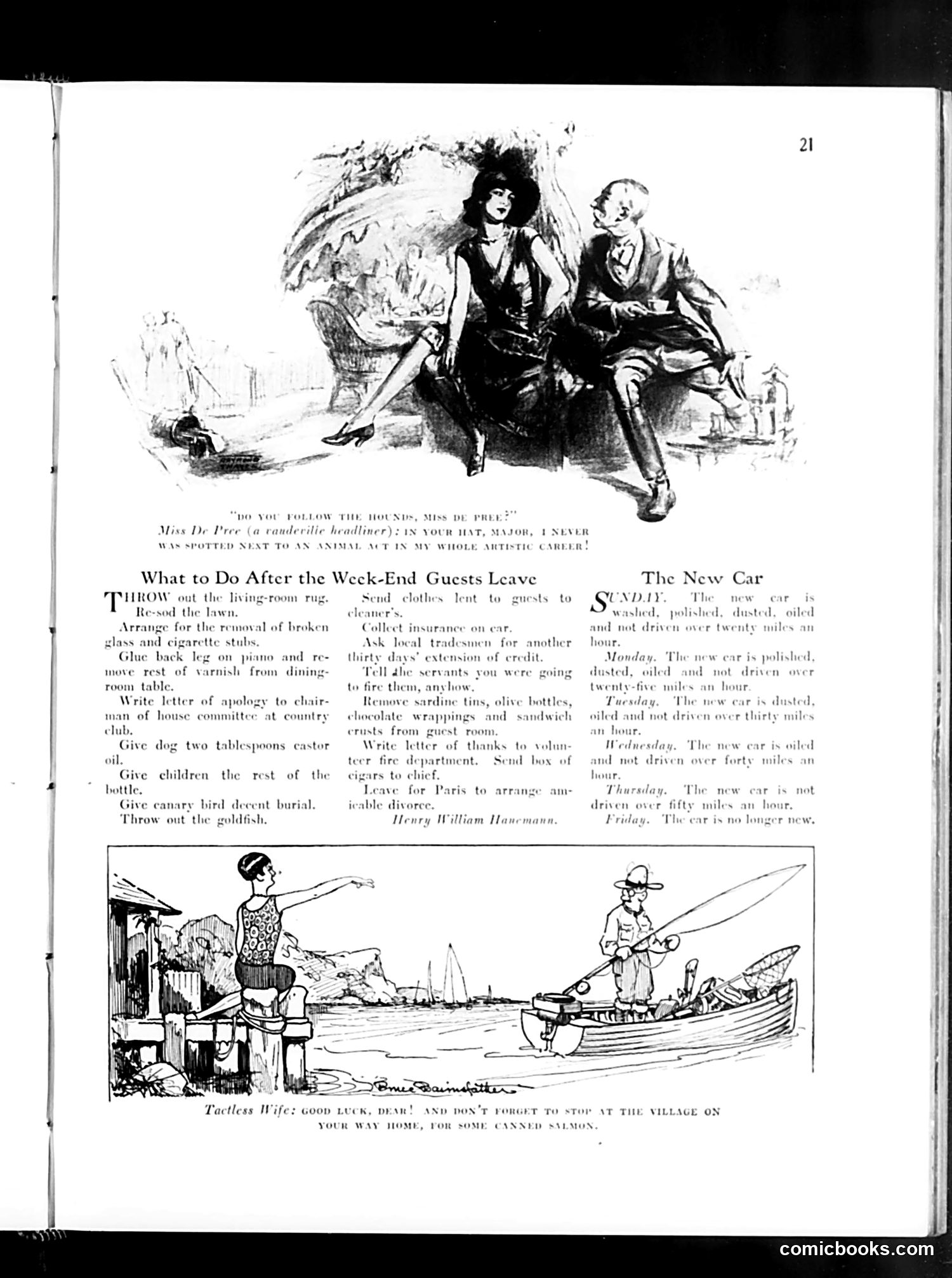
This page contains two separate satirical pieces typical of early 20th-century American humor magazines. **Top cartoon:** Shows "Miss De Pree," identified as a vaudeville performer, being asked by a "Major" if she follows fox hunting. She responds that she's never been "spotted next to an animal" in her entire artistic career—a joke about her stage performances and possibly her social pretensions, implying she avoids anything unglamorous. **"What to Do After Week-End Guests Leave":** A humorous list of domestic disasters guests create: destroyed furniture, broken items, unpaid bills requiring credit extensions, and necessary apologies to country clubs. The dark comedy suggests wealthy hosts must endure considerable expense and damage from entertaining. **"The New Car" section:** A satirical week-long progression where a new automobile is progressively damaged through use—polished Sunday, dusty by Wednesday, driven over forty miles Thursday, and completely worn by Friday ("no longer new"). **Bottom cartoon:** A wife bids her husband farewell before fishing, reminding him to buy canned salmon on the way home—implying he'll catch nothing.
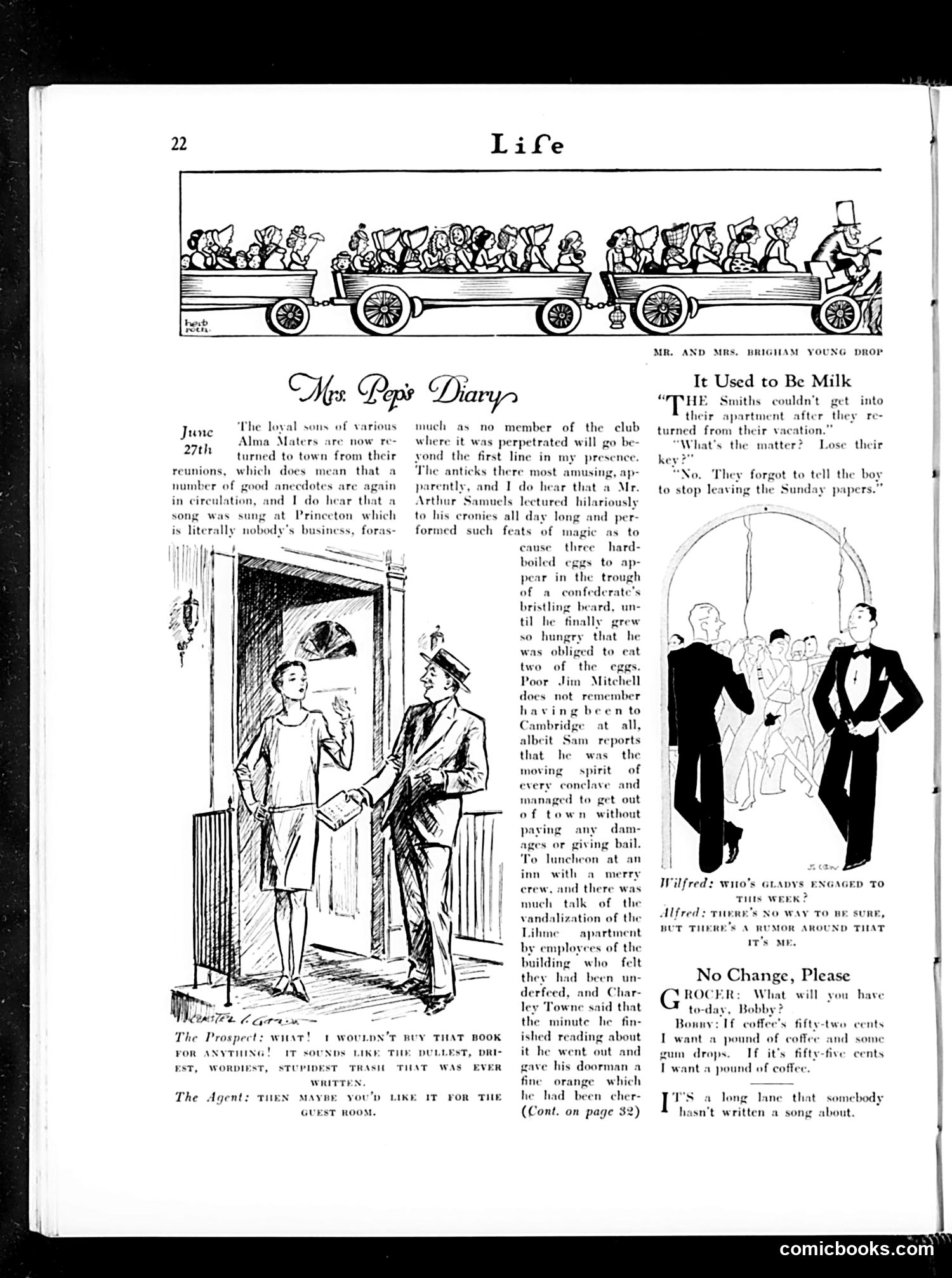
This page contains three separate humorous pieces satirizing early 20th-century American social life: **"Mrs. Pep's Diary"** mocks college alumni reunions—specifically Princeton—where nostalgic graduates swap increasingly absurd anecdotes. The satire targets pompous storytelling and elaborate pranks (like a professor making boiled eggs appear in someone's beard). **"Mr. and Mrs. Brigham Young Drop It"** jokes about a couple forgetting their apartment key upon returning from vacation. The punchline—that they forgot to tell their boy to stop leaving Sunday newspapers—suggests the newspapers were piling up visibly, embarrassing them before neighbors. **"No Change, Please"** depicts a grocer and young customer haggling over coffee prices that fluctuate by mere cents, with the boy adjusting his order based on tiny price differences—satirizing penny-pinching during economically uncertain times. The cartoons collectively mock class pretension, domestic anxiety, and economic anxiety among middle-class Americans.
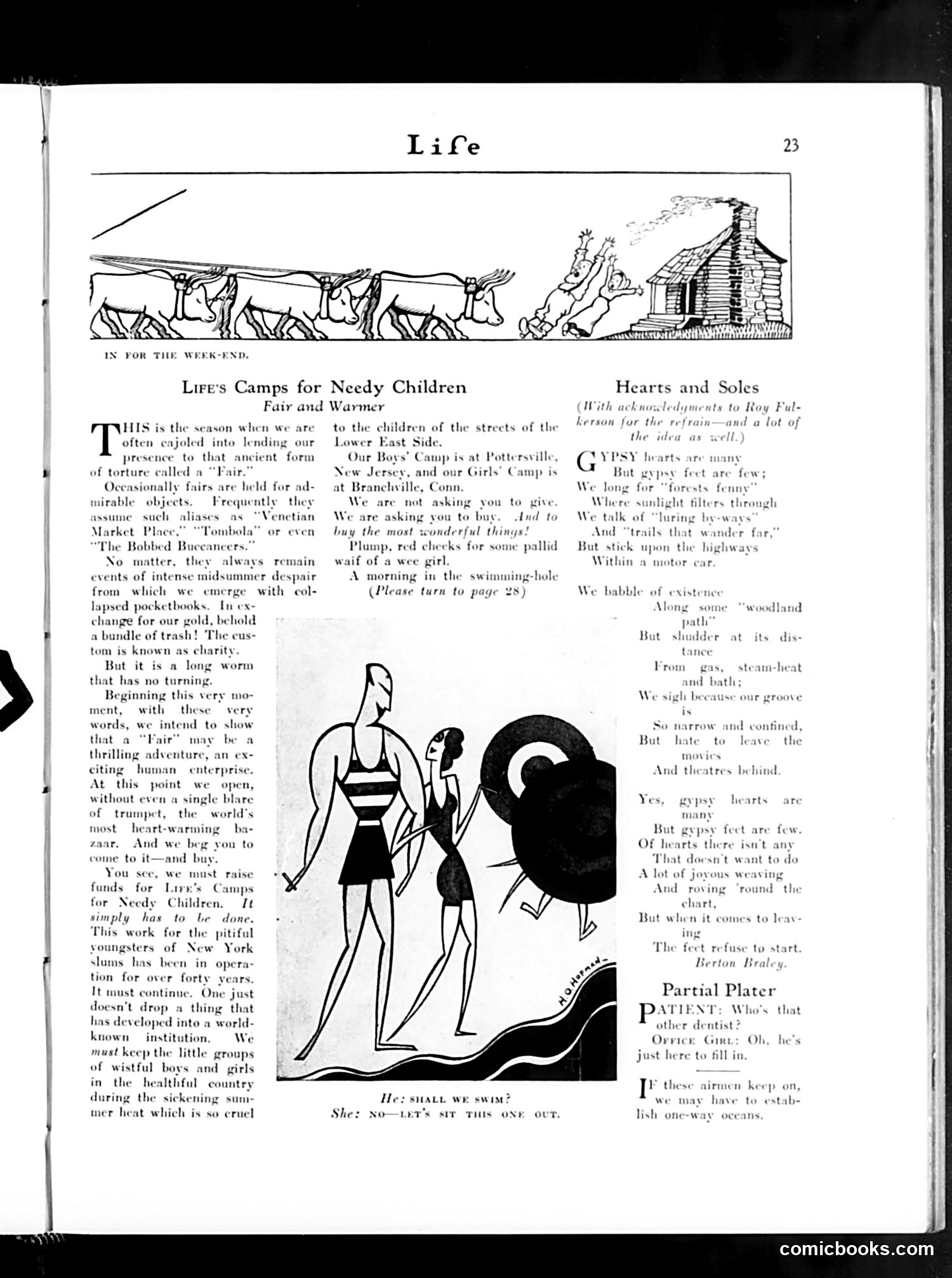
This page promotes **Life Magazine's charitable camps for poor New York City children**, combining serious social advocacy with light humor. The main article solicits donations for Life's boys' and girls' summer camps (operating 40+ years) serving Lower East Side slum children. It frames charitable fundraising fairs as entertainment rather than obligation—a "thrilling adventure" rather than tedious obligation. The appeal emphasizes the camps' necessity: providing urban poor children relief from brutal summer heat through swimming and countryside exposure. The cartoon below shows a couple at a beach; she suggests swimming, he deflects ("Let's sit this one out"), illustrating typical leisure-time reluctance—a gentle contrast to the earnest camp advocacy above. The "Hearts and Soles" poem uses wordplay (gypsy hearts vs. feet that won't roam) and the "Partial Plater" joke about dentists are filler content typical of the era's magazines—light entertainment padding around advocacy.
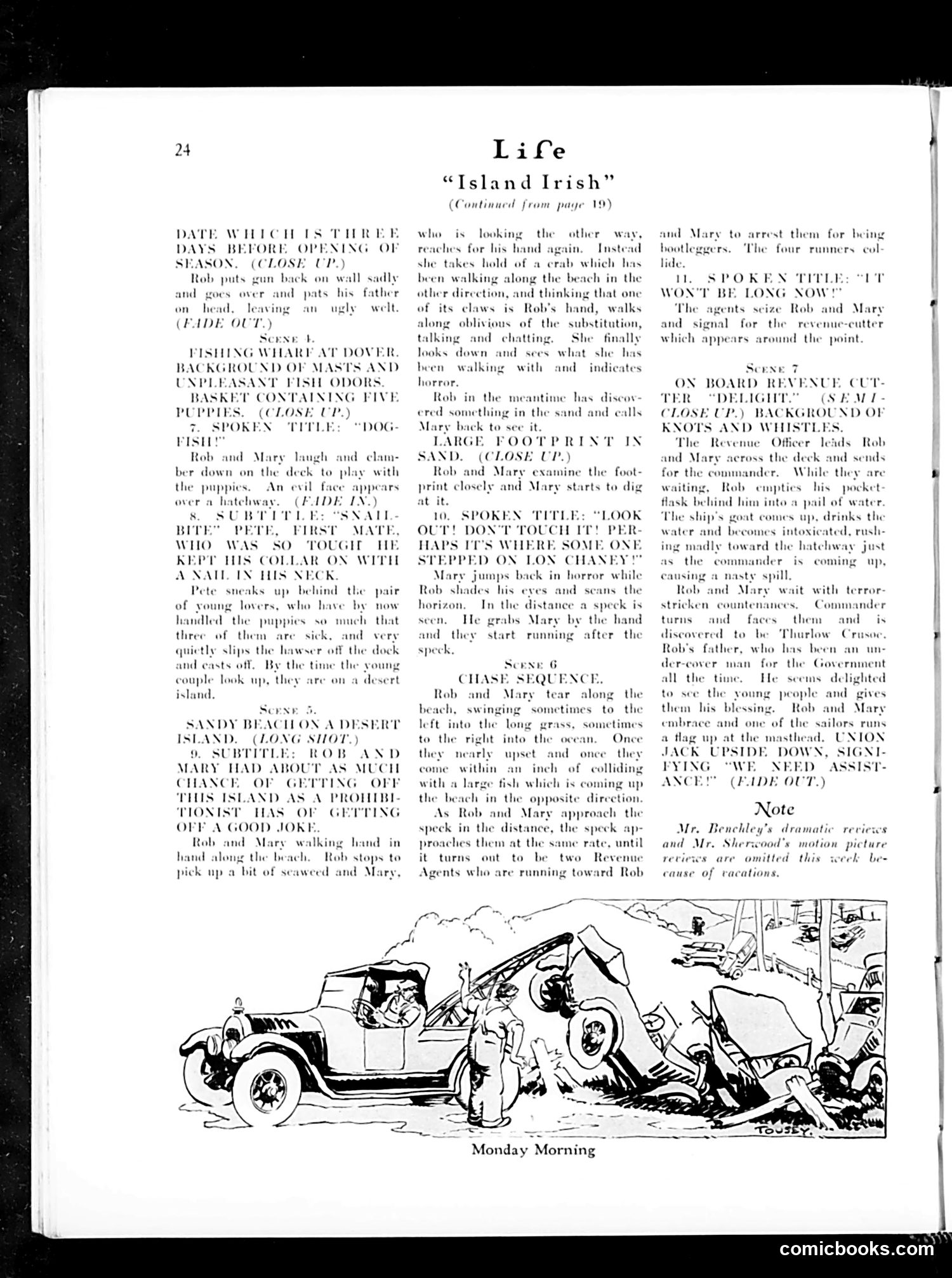
This page describes a silent film comedy scenario (not a political cartoon). The narrative follows Rob and Mary, young lovers who are accidentally marooned on a desert island when a mischievous first mate named "Snail-Bite" Pete casts off their boat. The humor relies on physical comedy and sight gags typical of 1920s silent film: Mary grabs a crab thinking it's Rob's hand; they discover a large footprint and joke it might belong to Lon Chaney (a famous horror actor); they flee from Revenue Agents (Prohibition enforcement officers) in a chase sequence. The twist ending reveals Rob's father has been working undercover for the government all along and commands the revenue cutter that captures them. The final gag shows a Union Jack flag raised upside-down—a distress signal—apparently because the ship's goat, drunk from Rob's hidden flask, causes chaos. The satire targets Prohibition enforcement and bootlegging culture of the era.
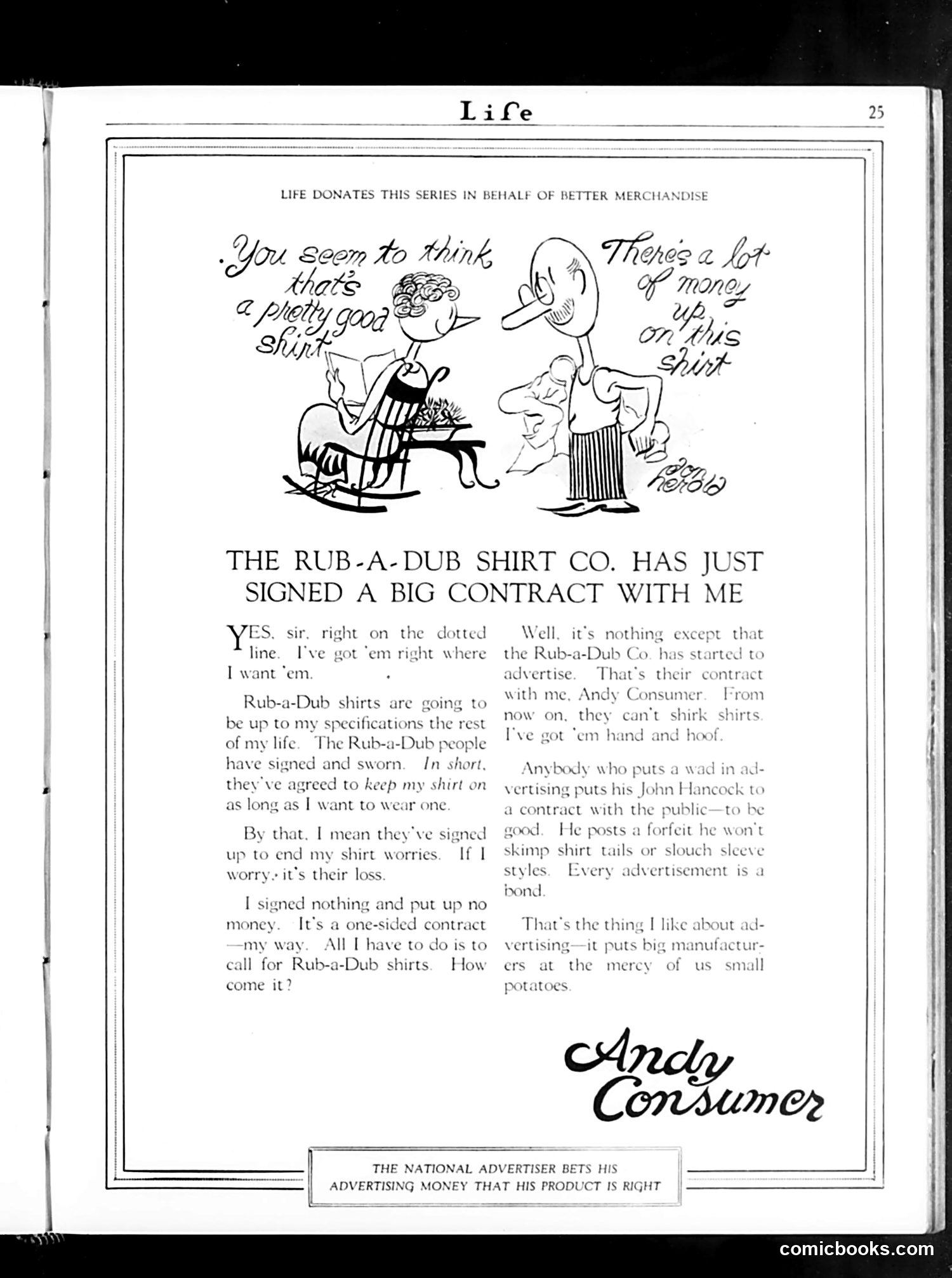
This satirical piece by Andy Consumer mocks advertising claims and corporate accountability. The cartoon depicts two figures negotiating a shirt contract: one representing Andy Consumer (the everyman) and another representing the Rub-a-Dub Shirt Company. The satire operates on irony: Andy claims the company has signed a binding contract ensuring his shirts will meet specifications for life, requiring *them* to absorb all loss if products fail—yet Andy himself signed nothing and invested no money. He frames this as a one-sided deal favoring him. The underlying point critiques advertising's implicit promises. Andy argues that when companies advertise, they essentially bet their money that products work as claimed, creating a public contract. Life magazine's caption reinforces this: advertisers should be held accountable for their promises. The satire suggests manufacturers make grand claims they may not honor, while consumers bear actual risk—inverting Andy's boastful scenario to reveal the real power imbalance.
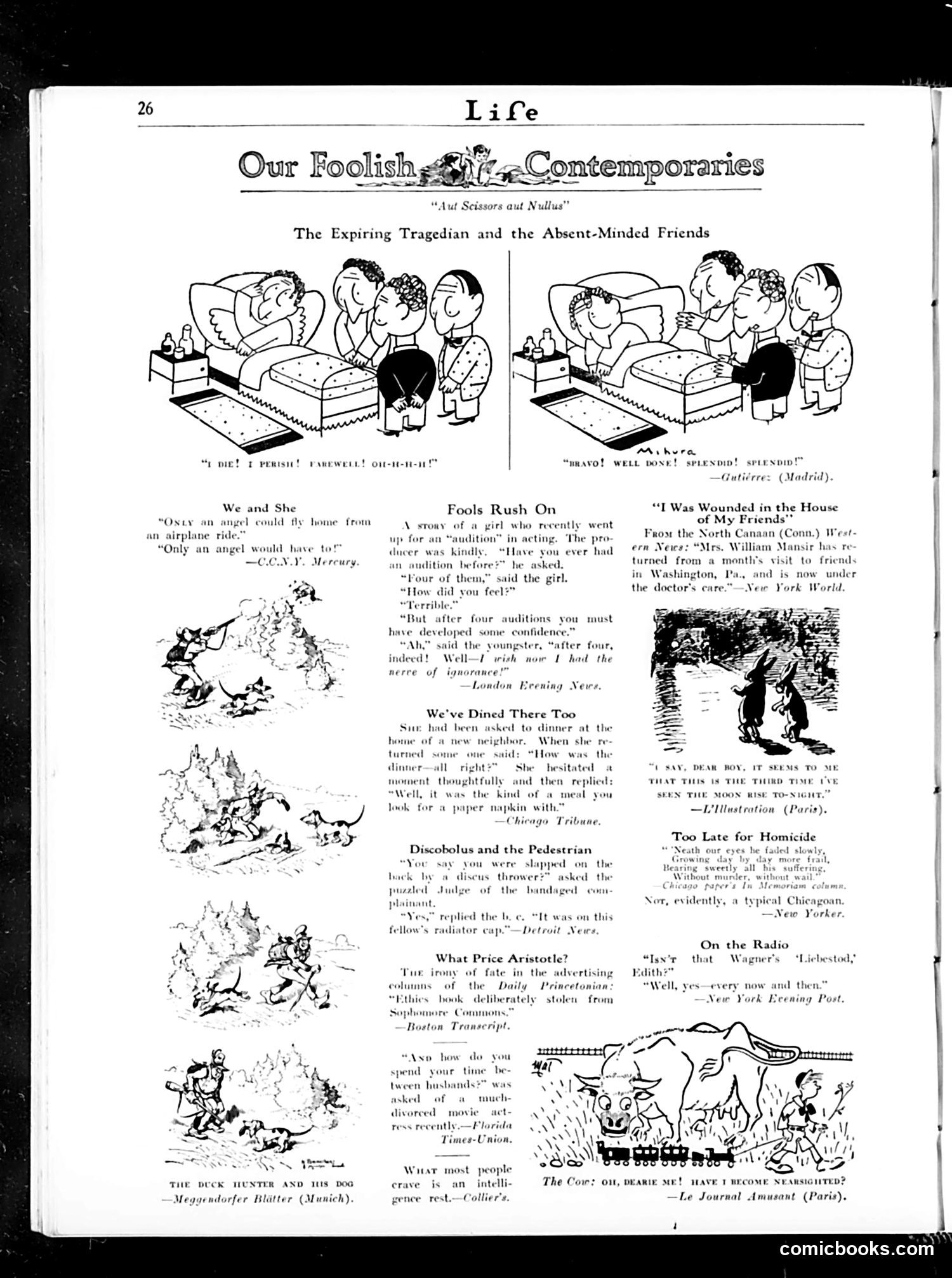
This page collects brief humorous anecdotes from newspapers and magazines, mocking social pretension and absurdity. Key examples: **"We and She"**: A woman claims only an angel would endure an airplane ride with her husband—implying marital discord. **"Fools Rush On"**: A girl auditioning for acting roles admits four failures have destroyed her confidence, contradicting the producer's claim that repetition builds nerve. **"We've Dinned There Too"**: A woman describes a dinner at a new neighbor's as requiring a "paper napkin"—suggesting cheap, poor-quality service. **"Discobolus and the Pedestrian"**: A pedestrian struck by a discus claims it hit the thrower's radiator cap, creating absurd legal confusion about liability. **"What Price Aristotle"**: A newspaper advice column ironically advertises "How to spend time between husbands"—mocking both romantic instability and the newspaper's obliviousness. The page satirizes middle-class social anxieties, marital strain, and the human tendency toward self-deception and pretense.
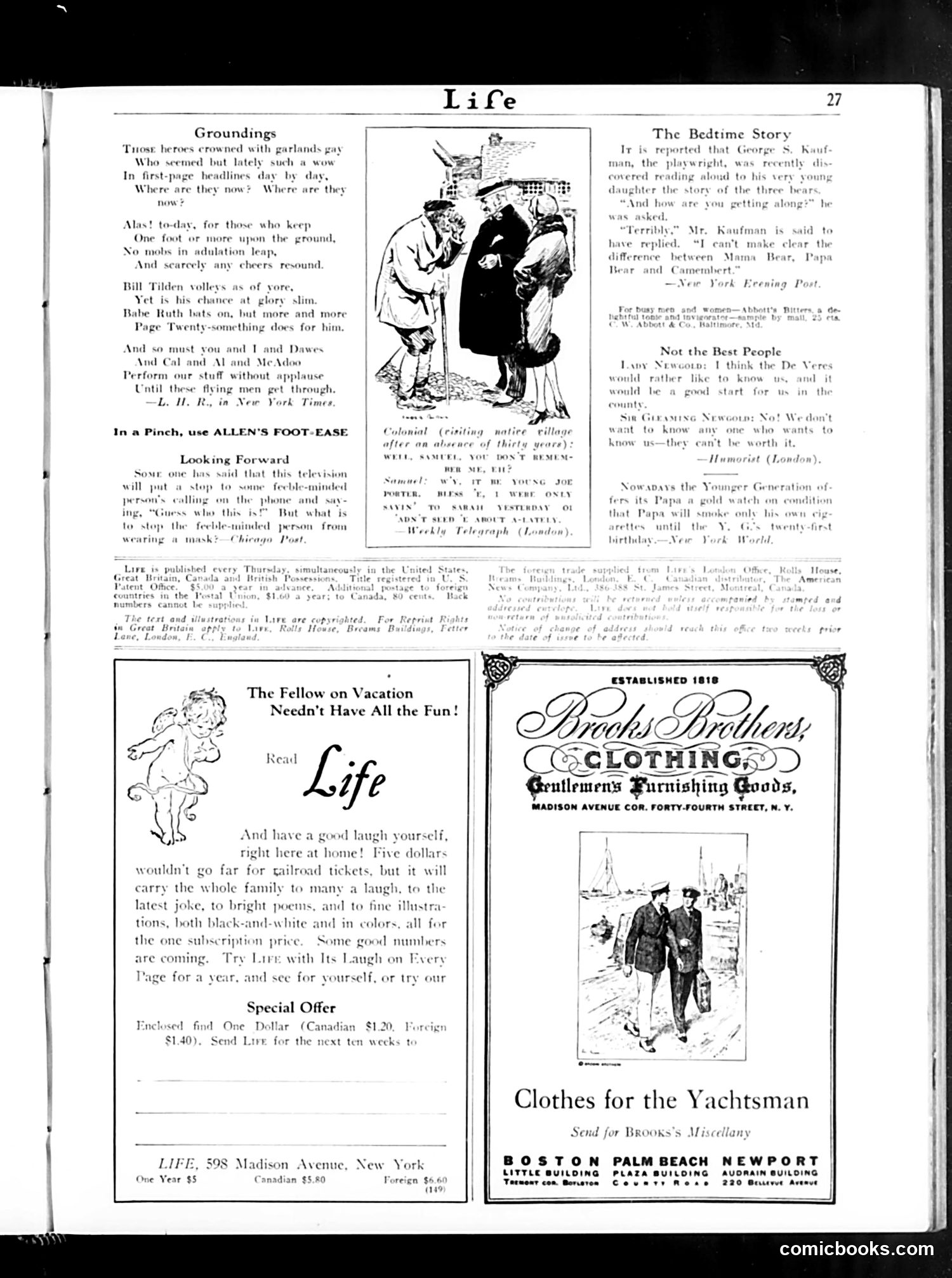
The "Groundings" poem satirizes the fleeting nature of celebrity and public attention. It references famous athletes and politicians—Bill Tilden (tennis star), Babe Ruth (baseball), and figures like Dawes, Coolidge ("Cal"), and McAdoo—who dominated headlines but have since faded from public consciousness. The joke is that these once-celebrated heroes are now forgotten ("Where are they now?"), while only aviators ("flying men") currently command public adoration. This reflects the 1920s fascination with aviation as a modern marvel. The satire suggests that fame is temporary and that public interest constantly shifts to the next sensation. The remainder of the page consists primarily of **advertisements** (Allen's Foot-Ease, Life magazine subscriptions, Brooks Brothers clothing) and brief humorous anecdotes unrelated to the main poem's theme. The page is typical of Life's mixed format combining satirical content with commercial notices.
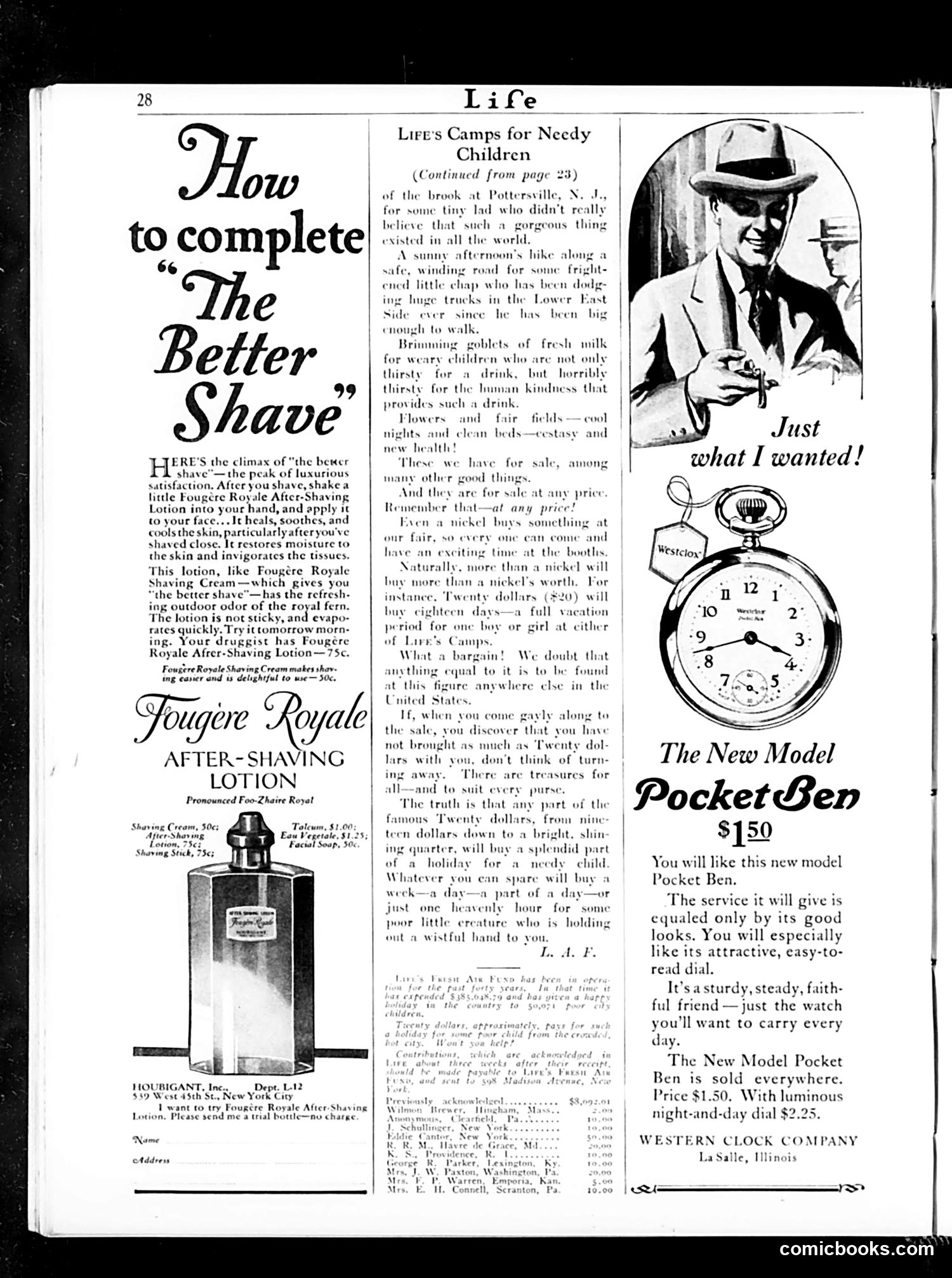
This page consists primarily of **advertisements**, not political cartoons or satire. **Left side:** A Fougère Royale After-Shaving Lotion ad emphasizing luxury and refinement, with language about "the peak of luxurious satisfaction" and "the royal fern." **Center:** An article about Life magazine's camps for needy children (continued from page 23), describing charitable activities—hikes, fresh milk, and vacation time for poor children from the Lower East Side. It's a fundraising appeal asking readers to donate ("a nickel buys something"). **Right side:** Two product advertisements—one for a Weston "Pocket Ben" pocket watch ($1.50) and another showing a man in a hat holding what appears to be a cigarette lighter or similar item, with the caption "Just what I wanted!" The page reflects early-to-mid 20th-century magazine content: luxury goods advertising alongside charitable causes, targeting middle-class readers. There is no political satire or cartoon commentary visible.
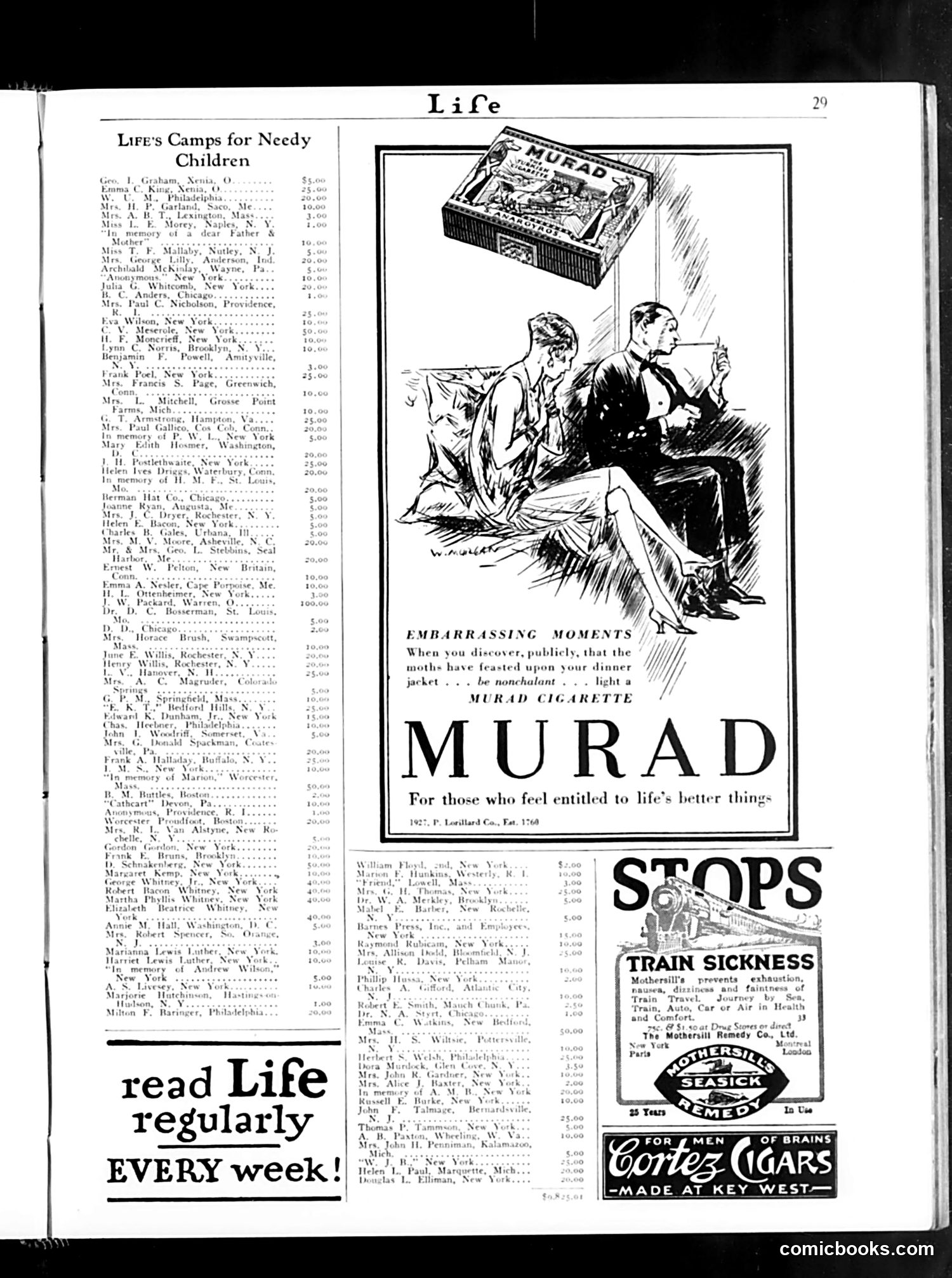
This page is primarily a **fundraising list** for "Life's Camps for Needy Children," displaying donor names and contributions—a charitable initiative typical of the magazine's public service role. The main cartoon illustrates "Embarrassing Moments," a recurring humor feature. It depicts a social scenario where a well-dressed man discovers moths have eaten holes in his dinner jacket during a formal event. The joke's appeal relies on the contrast between his composed, nonchalant demeanor and the mortification such a discovery would cause. This reflects early 20th-century anxieties about maintaining respectable appearances in polite society. The page also features period advertisements, notably **Murad Cigarettes** ("for those who feel entitled to life's better things") and **Seasick Remedy**, products typical of the 1920s-era magazine marketplace. No specific political satire is present on this page—it's primarily charitable/social commentary combined with consumer advertising and gentle humor about etiquette and social embarrassment.
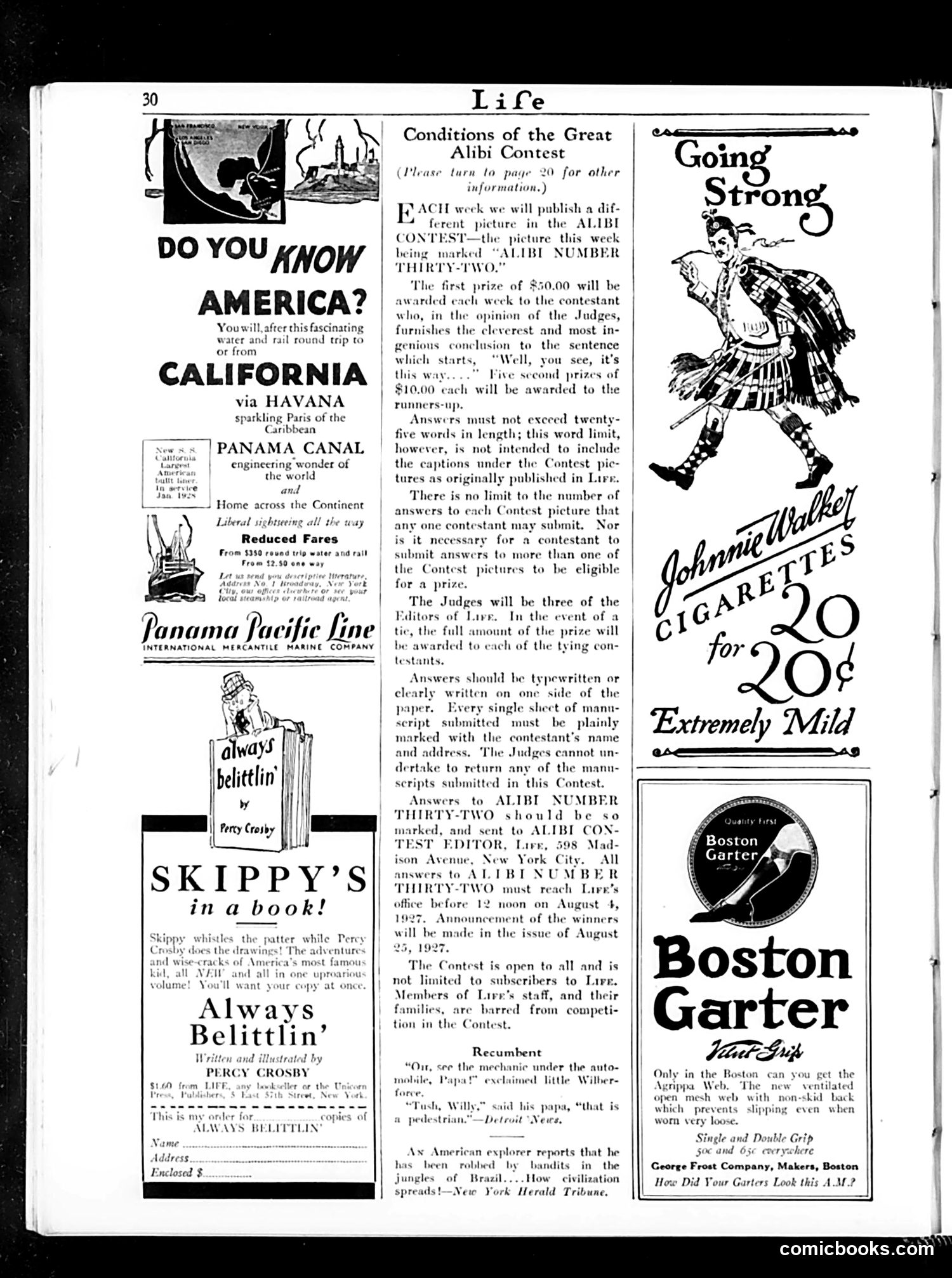
This page is primarily **advertising and contest announcement** rather than political satire. The main content announces Life's "Alibi Contest," a weekly competition where readers submit humorous written conclusions to cartoon captions—this week's image being "Alibi Number Thirty-Two." The advertisements include: - **Panama Pacific Line**: promoting discounted cruises to California via Havana and the Panama Canal - **Skippy in a Book**: promoting a collection of Percy Crosby's comic strip - **Johnnie Walker Cigarettes**: a vintage tobacco ad - **Boston Garter**: hosiery advertisement The **"Going Strong"** illustration appears to be the week's alibi contest image—a figure in Scottish dress—though the actual cartoon isn't clearly visible in this reproduction. The page also includes a humorous brief: "Recumbent," a joke about a father explaining to his son why mechanics hide under automobiles (not to avoid pedestrians, but because the father misunderstands the question). There is **no significant political satire** on this page—it's standard 1920s magazine content mixing humor contests, travel promotion, and consumer goods.
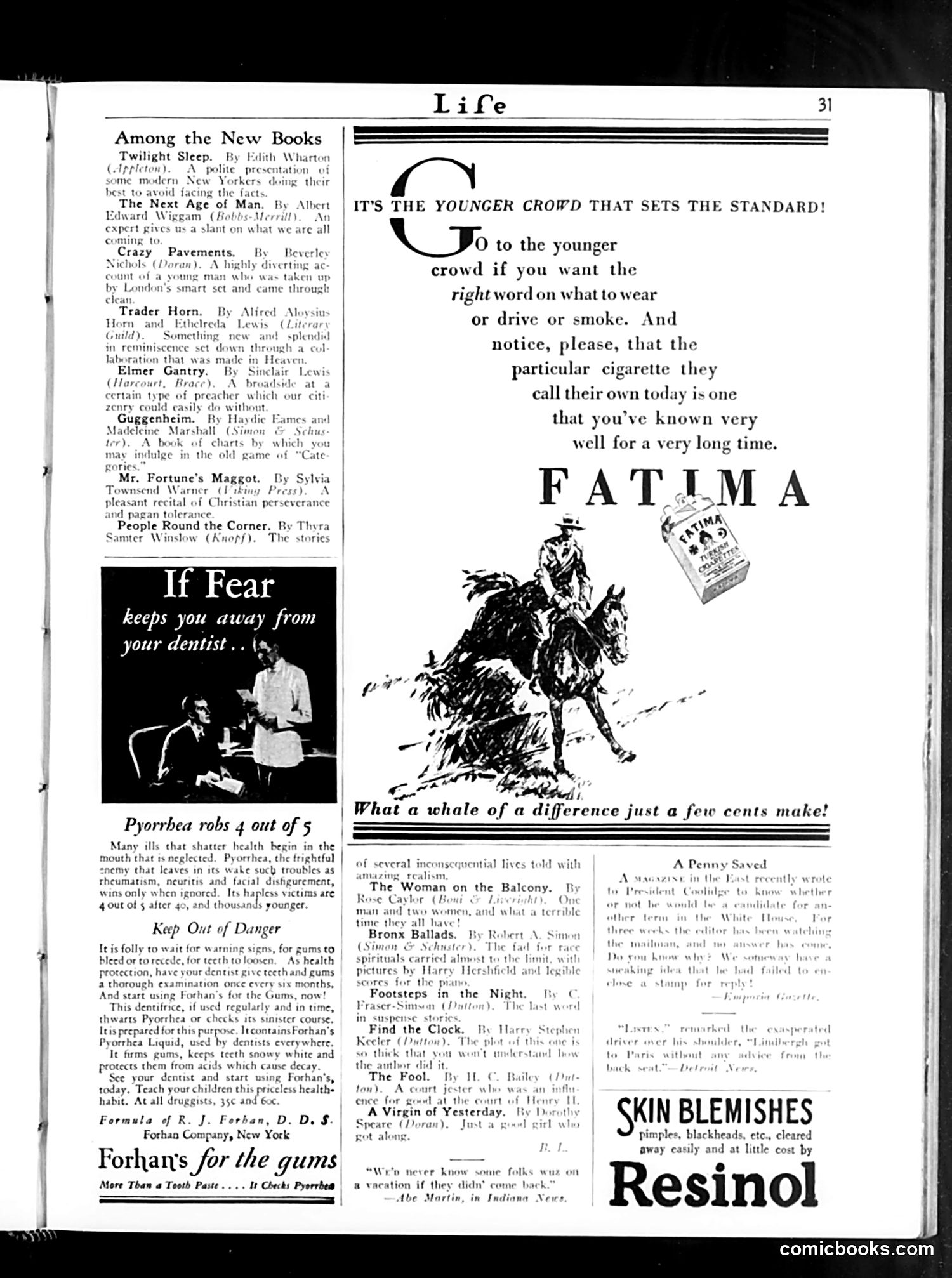
This page is primarily advertising. The main cartoon shows a cowboy on a bucking horse, illustrating a Fatima cigarette ad that appeals to younger consumers by claiming they set fashion and lifestyle standards—including what cigarettes to smoke. The ad's pitch is that Fatima is "a cigarette they call their own today" but is "one that you've known very well for a very long time"—positioning it as both trendy and established. The cowboy imagery evokes rugged masculinity and American frontier tradition. The surrounding content includes book reviews and dental health ads (Forhan's for pyorrhea treatment). The overall page reflects 1920s-era advertising that targeted youth while leveraging nostalgia, and openly promoted cigarettes without health warnings—practices now prohibited. The casual cigarette advertising alongside family health advice is starkly at odds with modern standards.
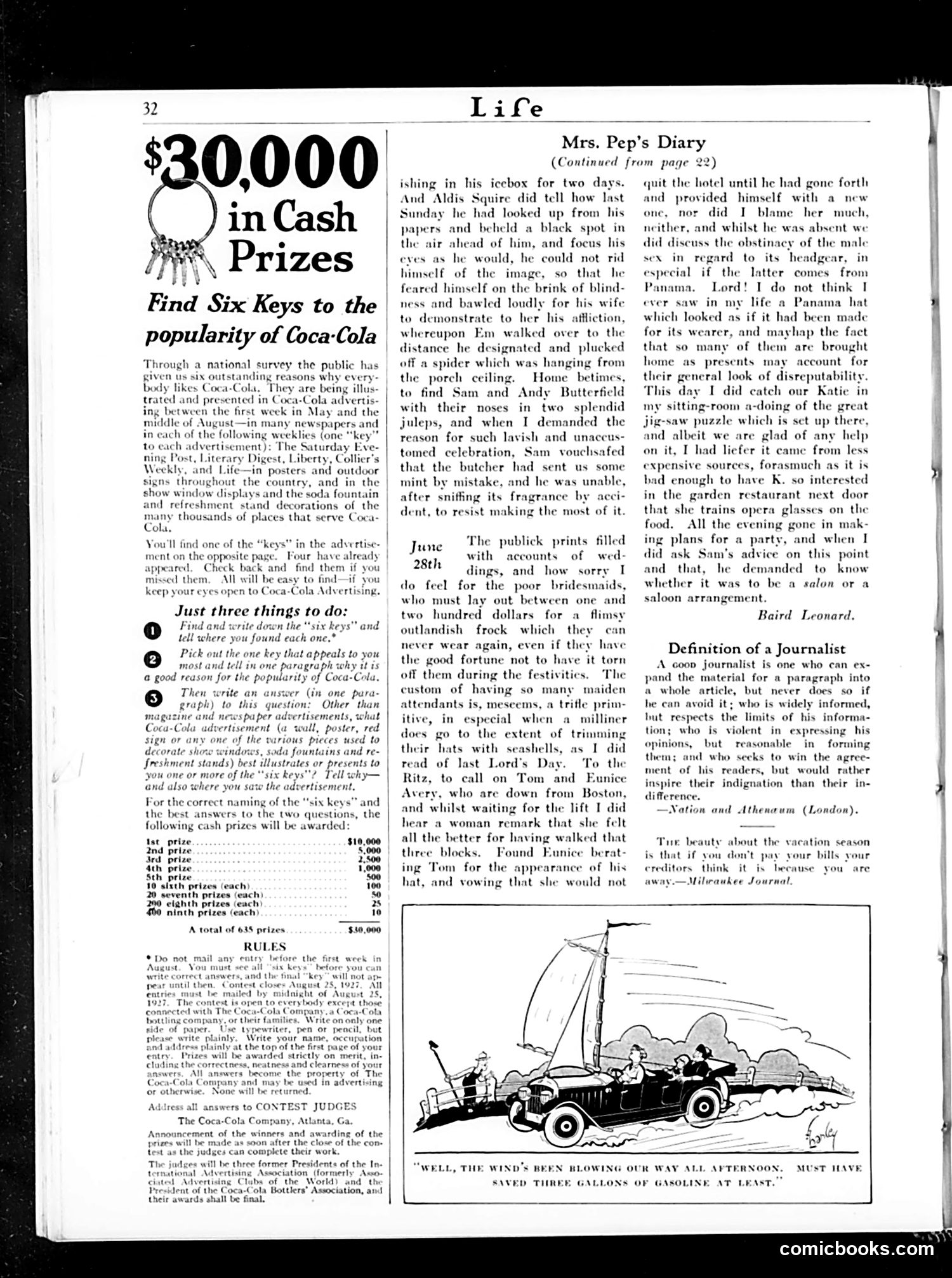
This page contains two distinct elements: **The Coca-Cola Advertisement Contest** (top half): A substantial promotional campaign offering $30,000 in cash prizes for readers to identify "six keys" explaining Coca-Cola's popularity across major publications. This reflects the 1920s advertising boom and Coca-Cola's aggressive marketing strategy during this era. **Mrs. Pep's Diary** (bottom half): A serialized humor column continuing from page 22. The June 28th entry satirizes wedding culture—specifically mocking the expense and impracticality of bridesmaids' dresses (costing $100-200, which was substantial in 1927) that cannot be reworn. The diarist also gently ridicules masculine stubbornness and women's domestic authority over men's appearance. **The Cartoon**: Shows a car with blown-away sail/canopy losing gasoline, with the caption joking they've "saved three gallons of gasoline at least"—likely satirizing fuel economy concerns or mechanical mishaps of era automobiles. The page exemplifies Life's mixed content: advertising, serialized domestic humor targeting female readers, and visual comedy.
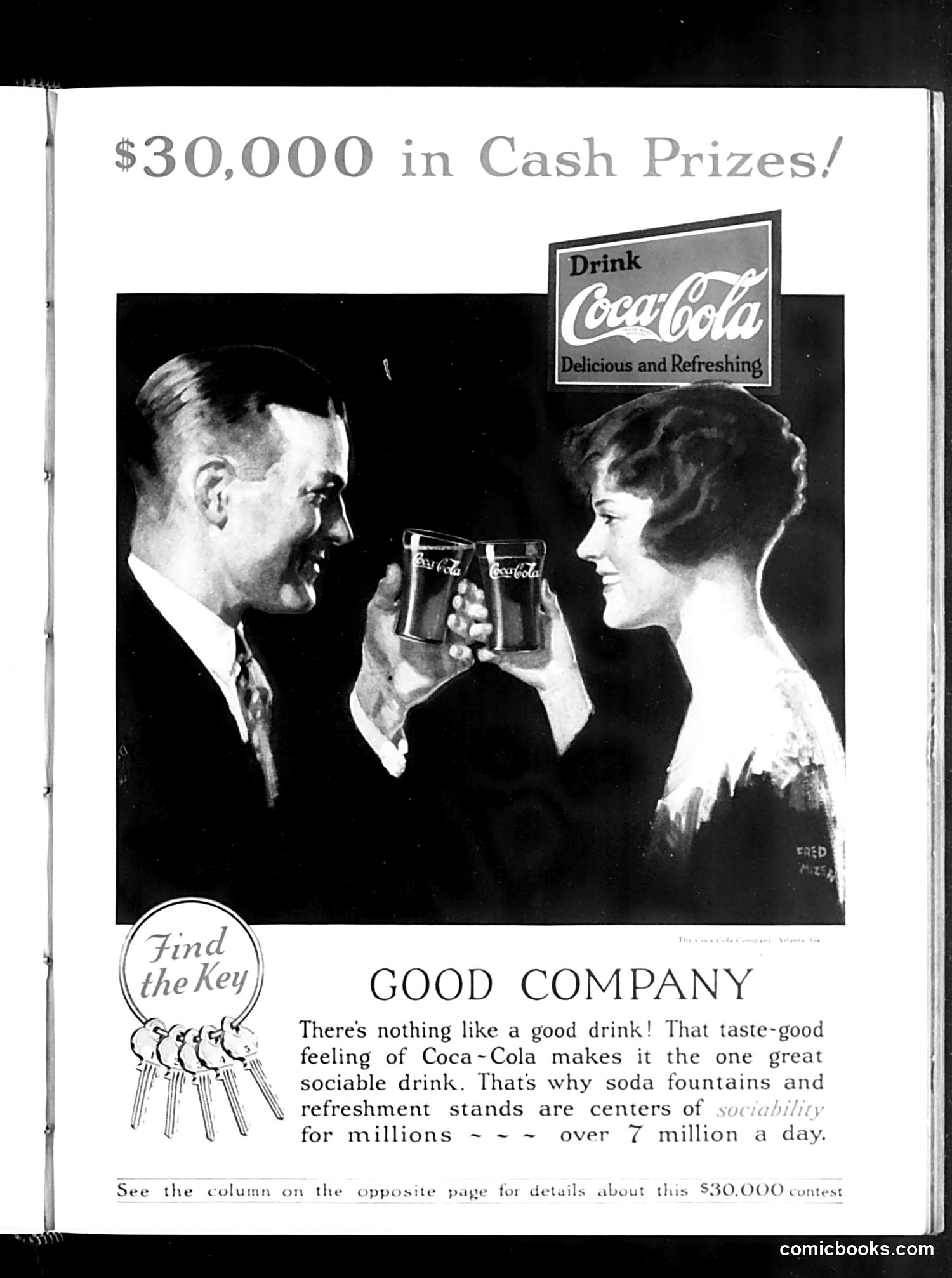
This is a Coca-Cola advertisement, not political satire. It promotes a $30,000 cash prize contest. The image shows a well-dressed couple toasting with Coca-Cola bottles, emphasizing the drink as a social beverage. The "Good Company" headline suggests Coca-Cola facilitates sociability. A "Find the Key" contest element appears in the lower left corner. The ad claims soda fountains are "centers of sociability" serving millions daily. This reflects early-to-mid 20th-century marketing emphasizing social occasions and consumer spending during America's consumer culture expansion. The formal attire and styling suggest this targets middle-class aspirations around leisure and companionship.
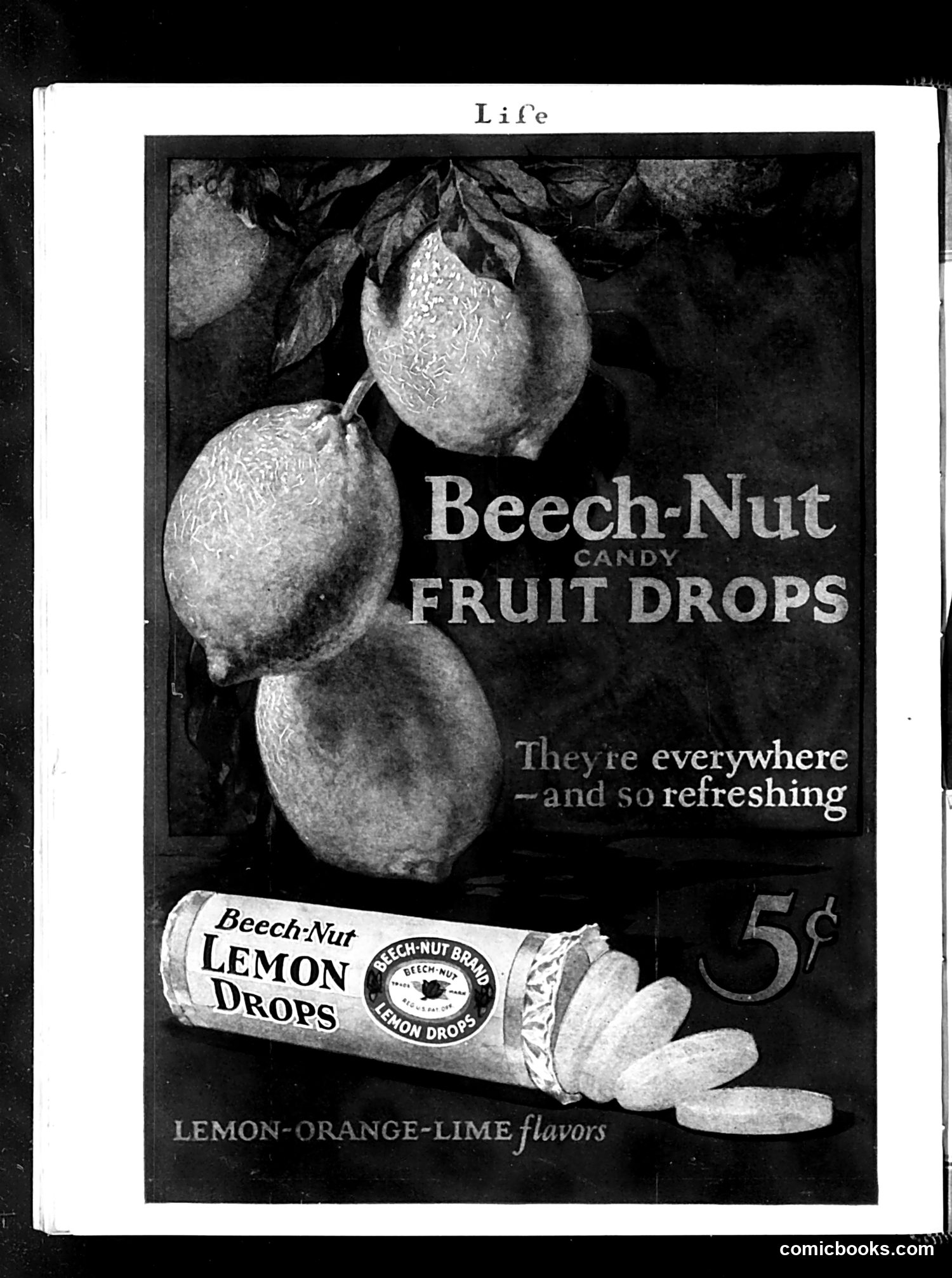
This is a **product advertisement**, not political satire or editorial content. It promotes Beech-Nut brand Fruit Drops candy, specifically their Lemon Drops variety, priced at 5 cents. The ad features photographs of actual fruit (appears to be citrus or similar round fruits) on a branch at the top, and below shows the product packaging with several candy drops displayed. The marketing message emphasizes availability ("everywhere") and refreshing quality, appealing to consumers with the tagline about lemon-orange-lime flavors. This is straightforward mid-20th century advertising—no cartoon, no political commentary, and no satire. The page header "Life" indicates it appeared in Life magazine, where advertisements filled pages alongside editorial content.