
A complete issue · 40 pages · 1927
Life — July 14, 1927
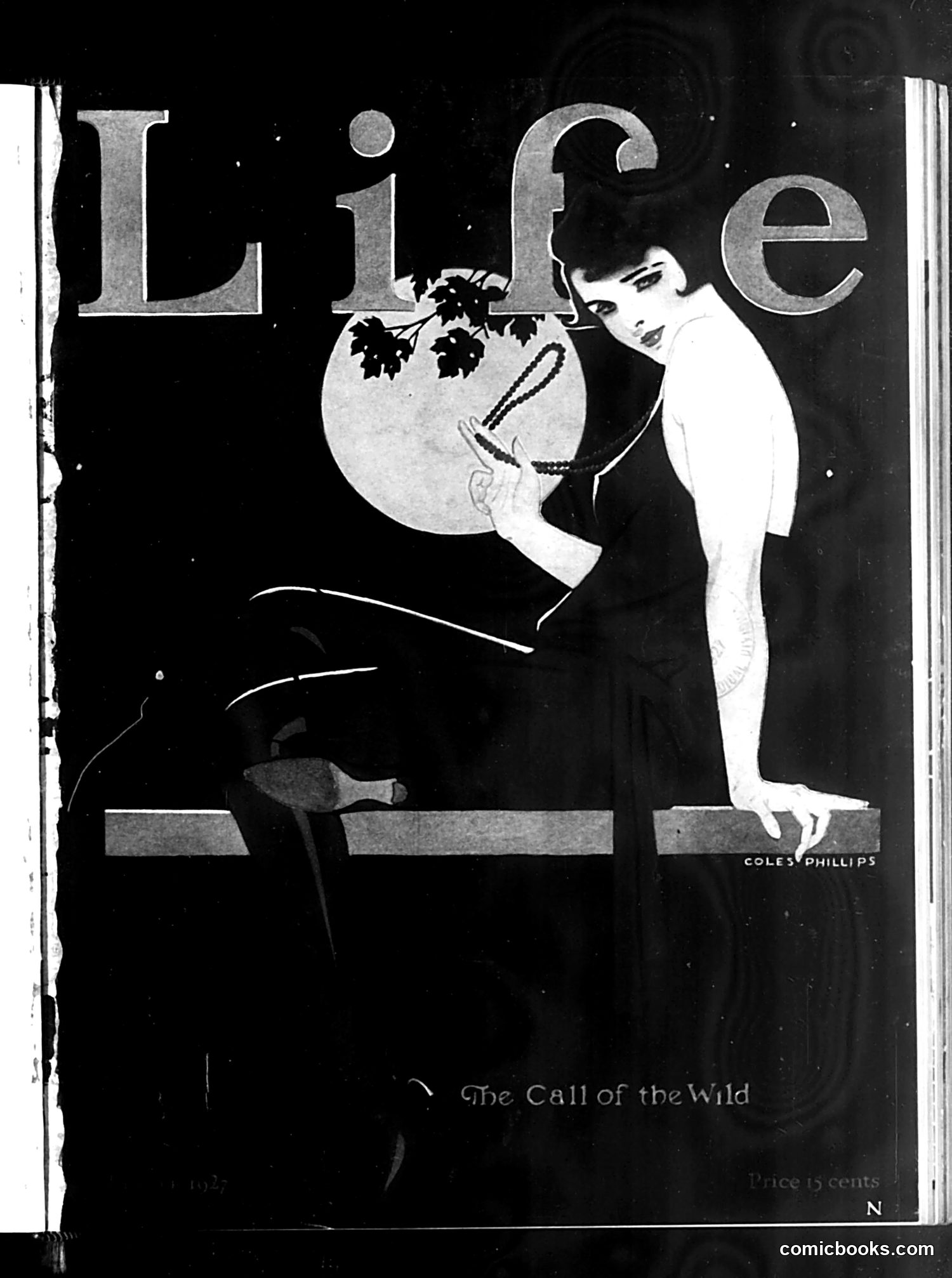
This is a Life magazine cover (price 15 cents) featuring artwork by Coles Phillips, a prominent illustrator of the early 20th century. The cover shows a stylized woman in profile holding a decorative bowl or vessel with grape vines, titled "The Call of the Wild." The image appears to be literary or cultural commentary rather than political satire. The woman's elegant, modern appearance contrasts with the "wild" reference, likely commenting on contemporary tensions between civilization and nature, or perhaps suggesting themes of temptation or desire. The art deco styling and sophisticated design are characteristic of Life's aesthetic during this era, appealing to middle and upper-class readers interested in arts and culture.
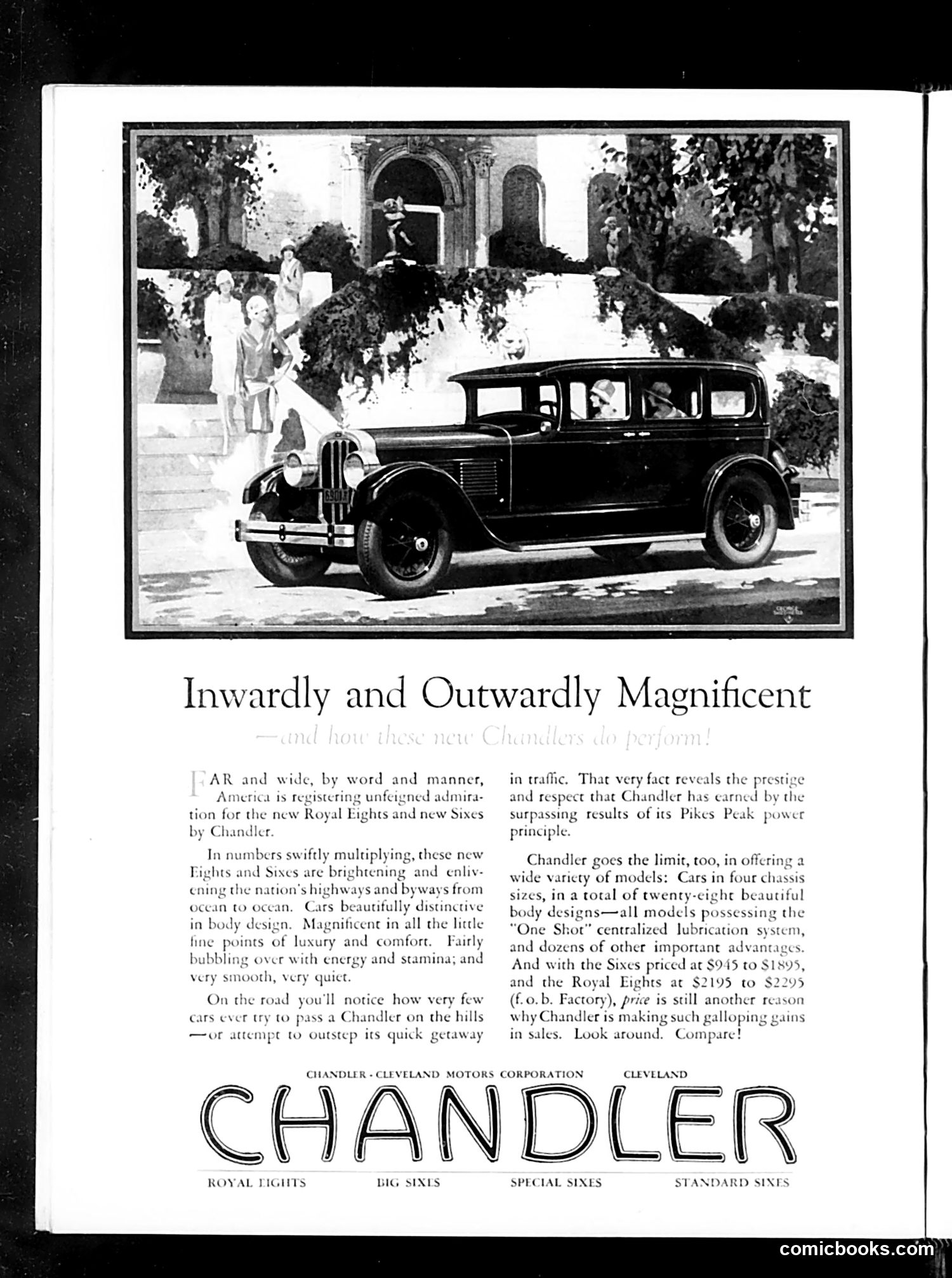
This is **not a satirical cartoon page**—it's a straightforward automobile advertisement for Chandler automobiles from the Cleveland Motors Corporation. The image shows a 1920s luxury car displayed in an elegant garden setting with well-dressed pedestrians in the background. The ad uses the phrase "Inwardly and Outwardly Magnificent" to emphasize both the car's aesthetic design and mechanical performance. The advertising text highlights Chandler's competitive advantages: smooth, quiet operation; distinctive body design; the "Pikes Peak power principle"; centralized lubrication; and pricing ($945-$2,295) positioned as reasonable for the quality offered. The ad concludes with a direct competitive appeal: "Look around. Compare!" This represents typical 1920s luxury automobile marketing targeting affluent buyers.
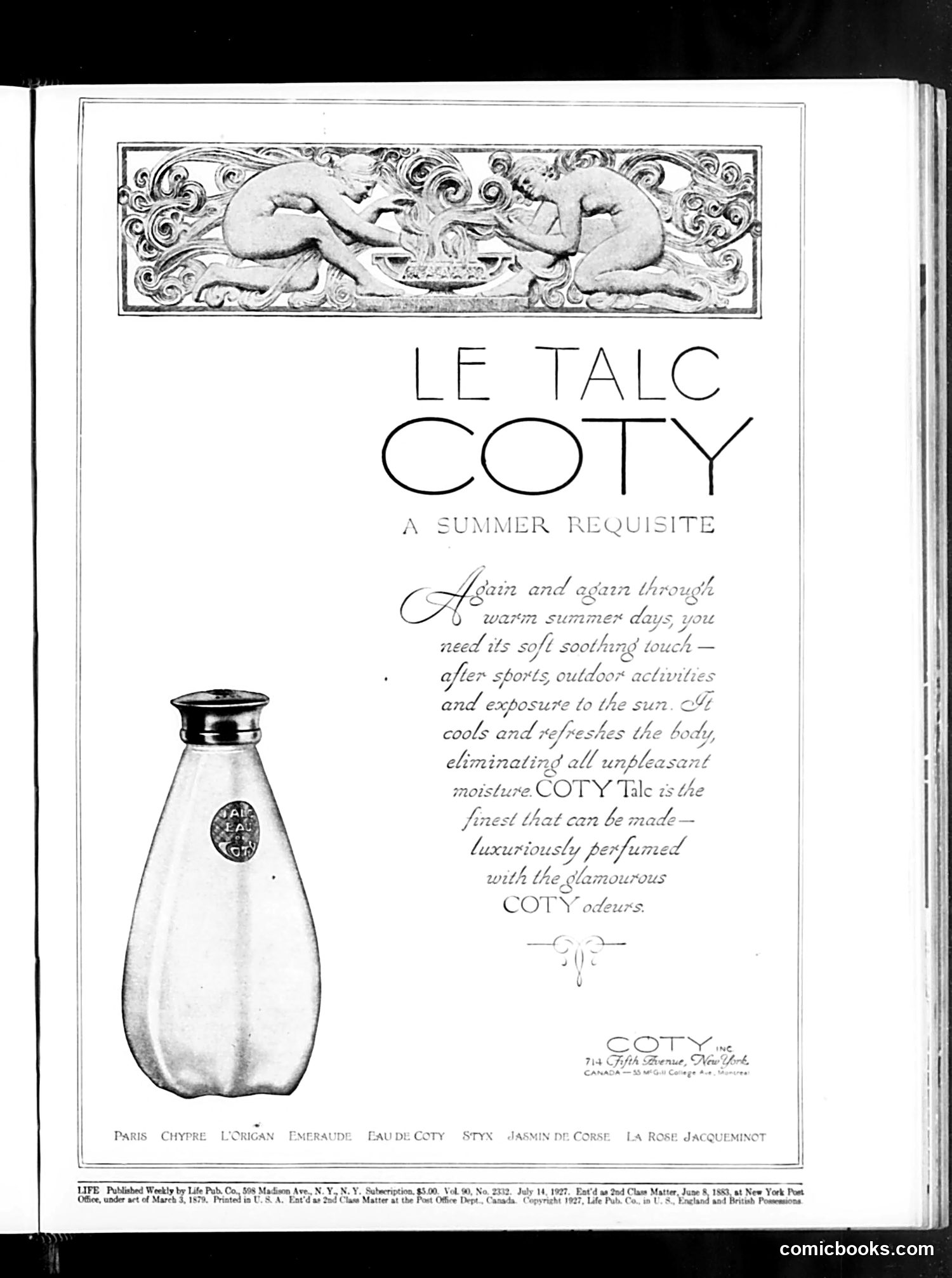
This page is primarily an advertisement for Coty talcum powder, not a political cartoon. The ad features a decorative classical header showing cherubs and ornamental scrollwork, followed by a large teardrop-shaped talc bottle with the Coty label. The text describes Le Talc Coty as "a summer requisite," promoting it as a cooling, refreshing product for hot weather that eliminates moisture after outdoor activities and sun exposure. It emphasizes the powder's luxurious perfuming with "glamorous Coty odeurs." The footer lists various Coty fragrance products including Paris, Chypre, L'Origan, Émeraude, and others. This is a straightforward cosmetics advertisement from the 1920s era targeting women consumers, with no satirical or political content.
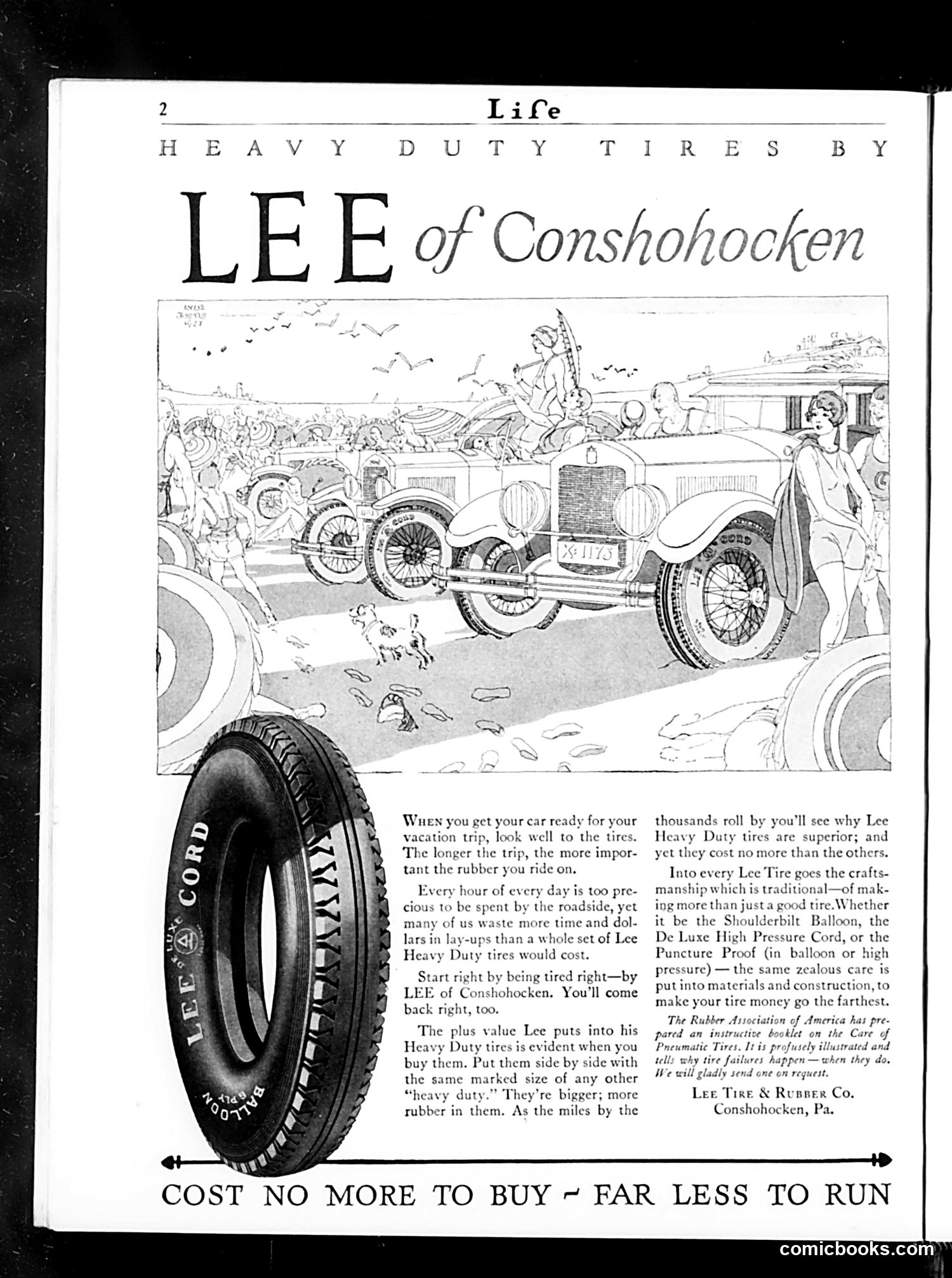
This is **not political satire or a cartoon**—it's a straightforward **automobile tire advertisement** from Life magazine. The page promotes "Lee of Conshohocken" heavy-duty tires. The illustration depicts a 1920s-era car at what appears to be a social gathering or vacation destination, surrounded by well-dressed people and other vehicles. The advertisement's argument is purely commercial: Lee Heavy Duty tires are superior to competitors because they contain more rubber and cost no more to purchase, despite being "far less to run." The text emphasizes durability for long vacation trips and compares the tires' quality against other branded options. The slogan "Cost No More to Buy — Far Less to Run" was the sales pitch. There is no political or satirical content—this is period advertising for a Pennsylvania tire manufacturer.
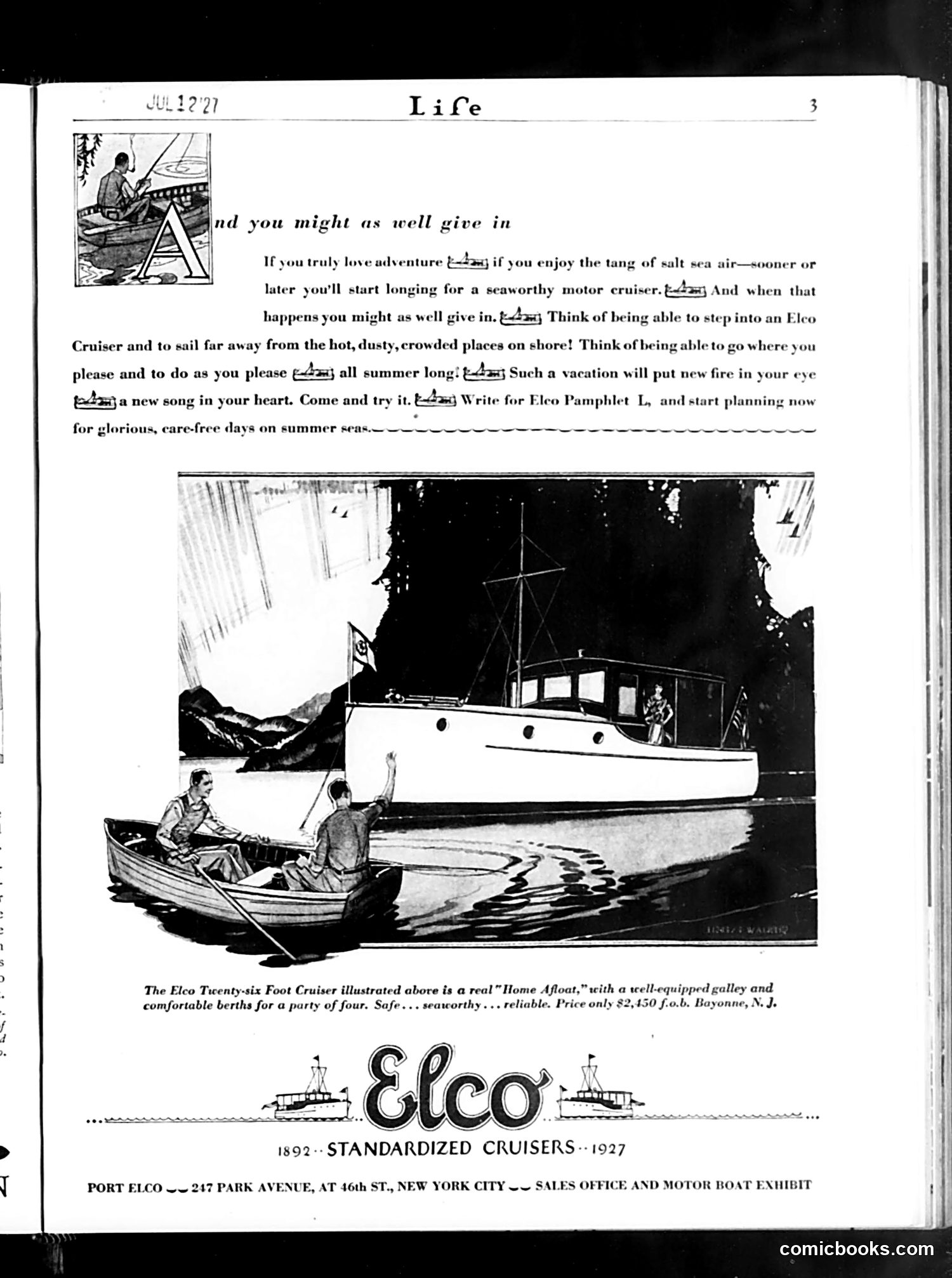
This page is **primarily an advertisement**, not political satire. It promotes Elco motor cruisers, a boat manufacturer operating since 1892. The ad uses an illustrated narrative: text at top encourages readers who love adventure and sea air to consider purchasing an Elco cruiser for summer vacation. The central image shows a small rowboat with two men approaching a larger Elco motor yacht anchored nearby, visualizing the aspirational lifestyle being sold. The accompanying text emphasizes luxury features—"well-equipped galley and comfortable berths"—and appeals to desire for freedom: "go where you please and to do as you please all summer long." The company's address in New York City and tagline "Standardized Cruisers" suggests mass-production marketing to middle-to-upper-class consumers seeking recreational boating.
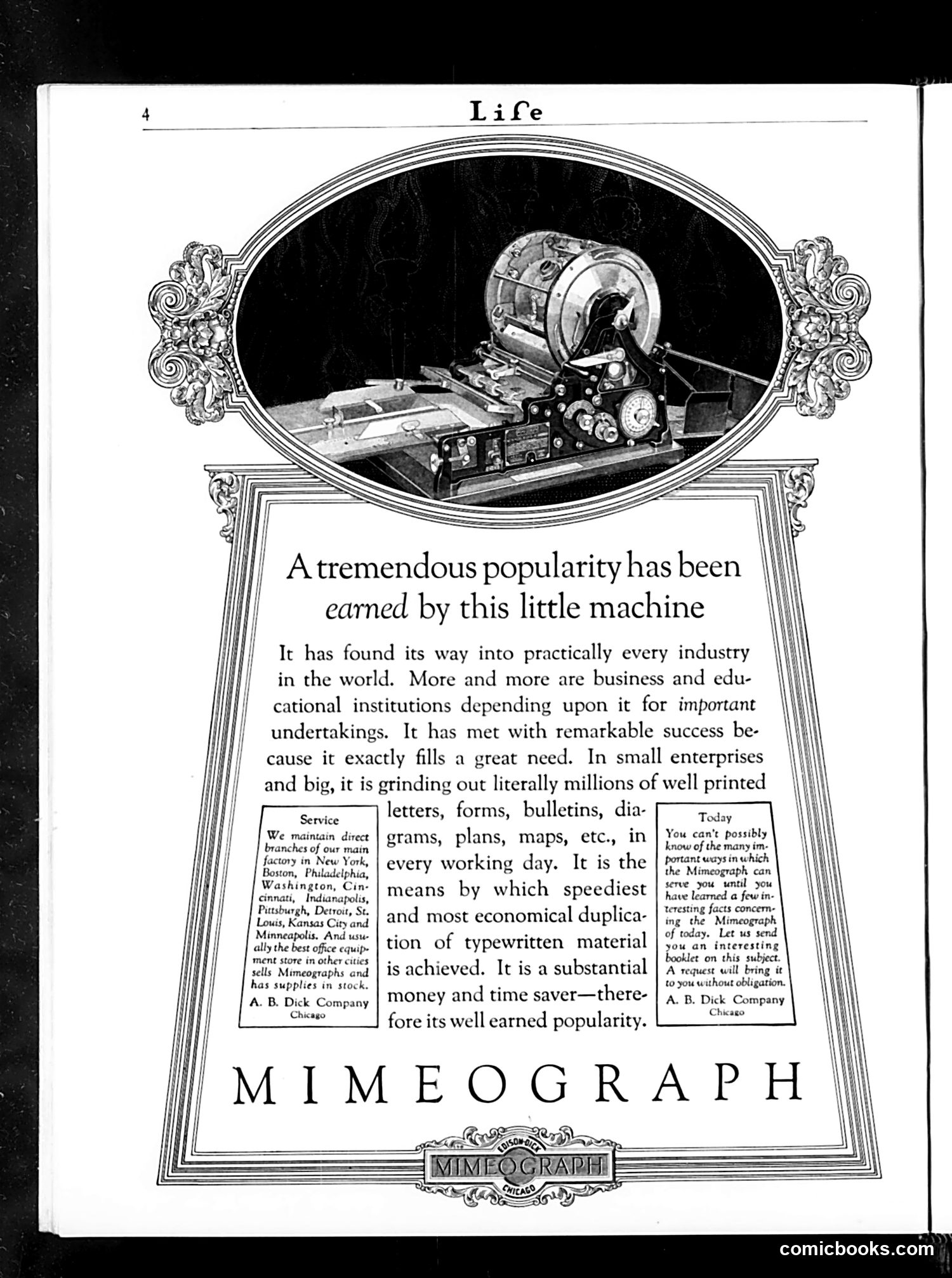
This is primarily **advertising copy, not satire or political commentary**. The page promotes the Mimeograph, a duplicating machine made by the A.B. Dick Company of Chicago. The advertisement claims the device has achieved "tremendous popularity" by filling a genuine business need: producing "millions of well printed letters, forms, bulletins, diagrams, plans, maps, etc." in offices daily. It emphasizes the machine as "the speediest and most economical duplication of typewritten material" and a "money and time saver." The ornate framing and "Life" magazine placement lend prestige to the product. Two sidebar testimonials from business locations (New York, Boston, Philadelphia, etc.) and an invitation to request more information comprise the sales pitch. There is no political content or satire present—this is straightforward early 20th-century product marketing.
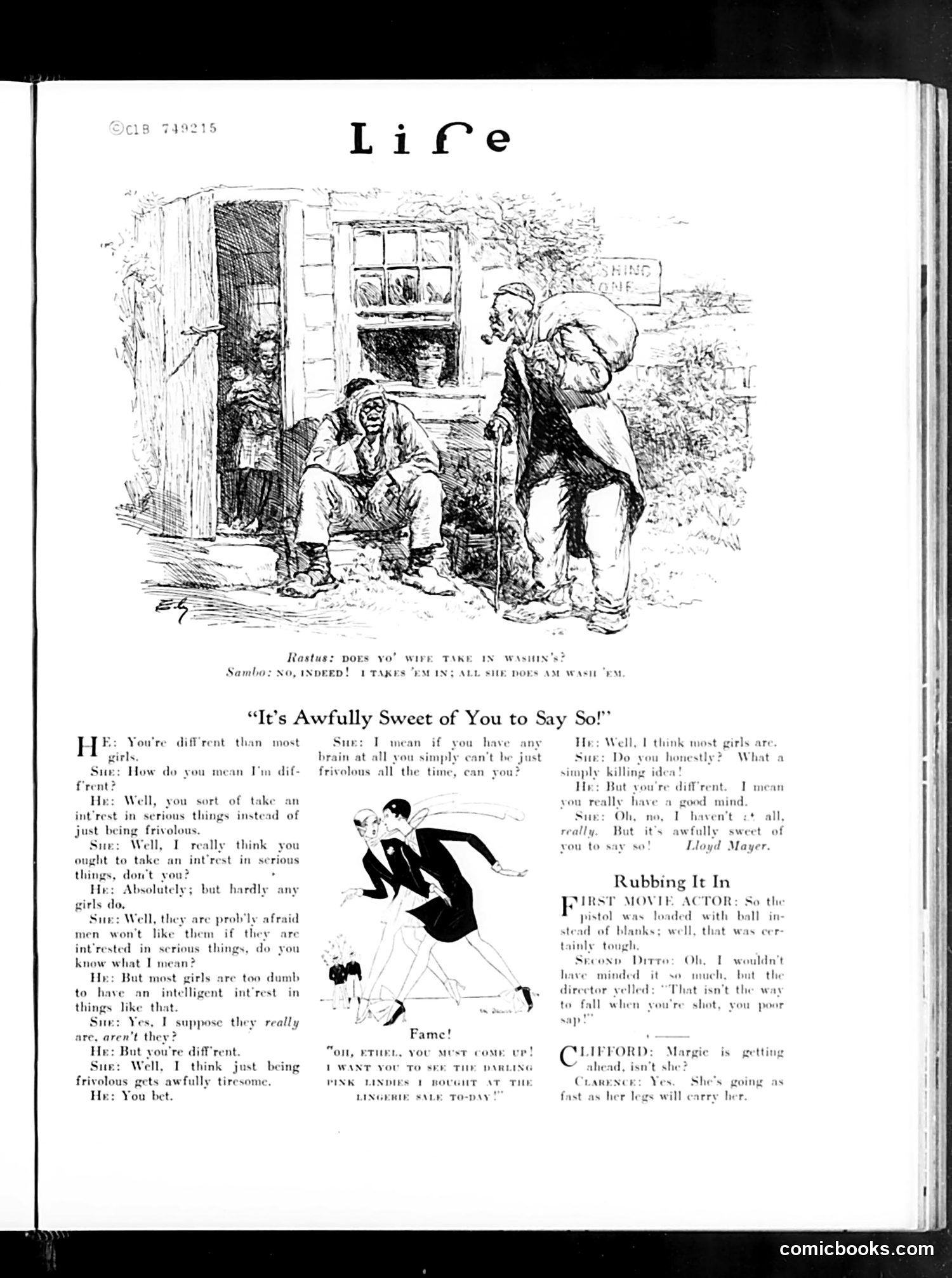
This page from *Life* magazine contains three distinct humor pieces satirizing social conventions and entertainment industry practices circa the early 20th century. The top sketch depicts a working-class dialogue about domestic washing routines, poking fun at colloquial speech patterns. "It's Awfully Sweet of You to Say So!" presents a conversation between a man and woman debating whether women should pursue intellectual interests rather than frivolous pursuits—satirizing contemporary debates about women's education and gender roles. "Rubbing It In" mocks silent film production through actors' dialogue about realistic prop use (loaded pistols vs. blanks). "Fame!" and the "Clifford" anecdote appear to ridicule entertainment industry absurdities and social climbing. Overall, the page satirizes working-class speech, gender expectations, and the pretensions of show business.
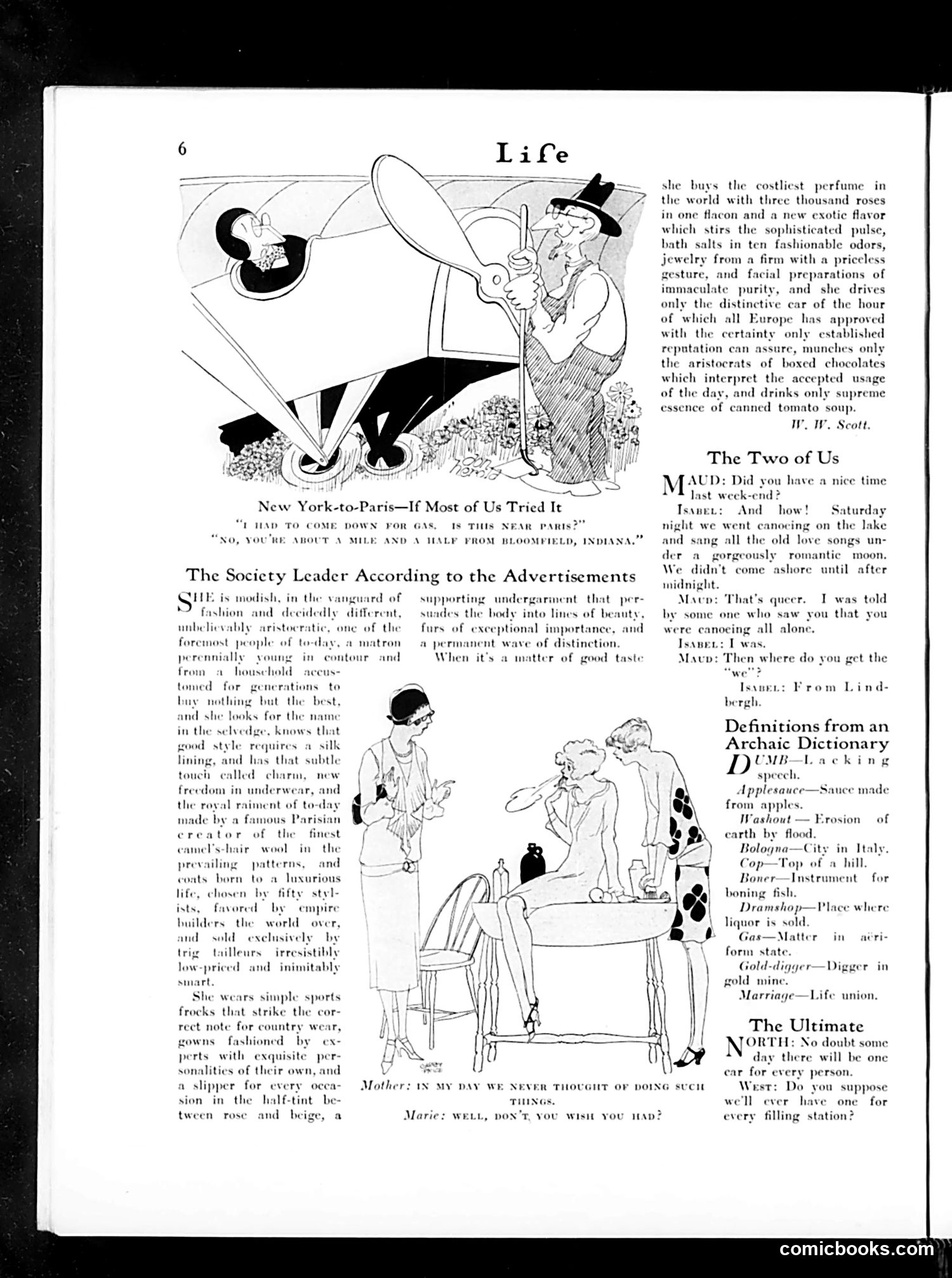
This page satirizes wealthy, fashion-obsessed society women of the early 20th century. The top cartoon, "New York-to-Paris—If Most of Us Tried It," mocks the pretensions of the ultra-rich by contrasting their luxurious lifestyles with ordinary Americans from small towns like Bloomfield, Indiana. "The Society Leader According to the Advertisements" describes a woman who buys only the finest luxuries—expensive perfume, exclusive jewelry, and French fashion—while maintaining an air of effortless sophistication. The accompanying illustration shows her among other wealthy women. The satire targets how advertisements shape and define social status, suggesting that "good taste" and distinction are manufactured concepts sold to the wealthy to justify their consumption and maintain class distinctions.
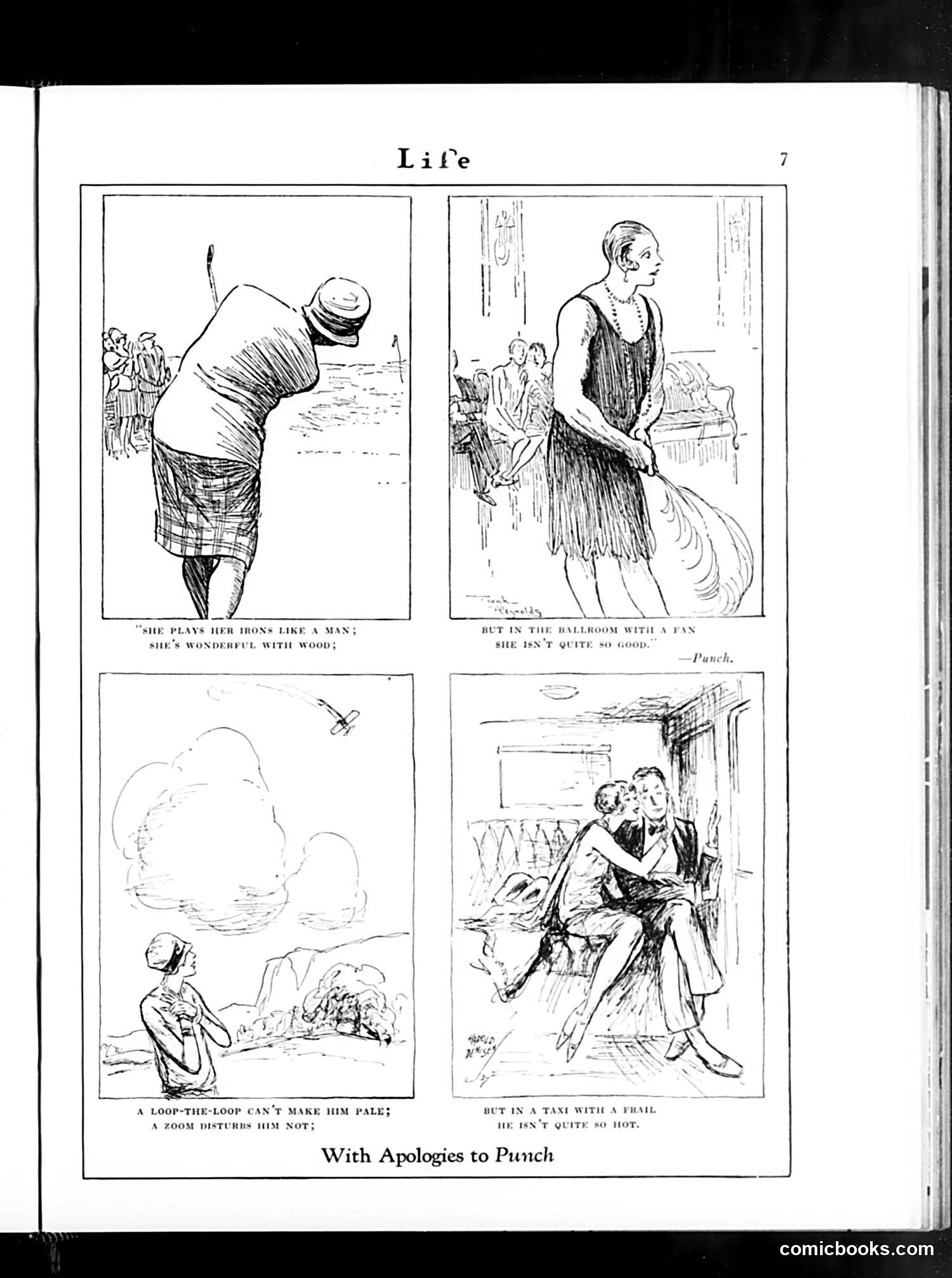
This page parodies social gender dynamics through four comic panels. The top left shows a woman playing golf with the caption "She plays her irons like a man; she's wonderful with wood"—mocking praise that backhanded compliments women's athletic abilities by comparing them to men. The remaining panels contrast a woman's competence in traditionally "masculine" activities (golf, aviation) with her supposed incompetence in traditionally "feminine" social situations (ballroom dancing with a fan, riding in a taxi). Each caption undercuts her abilities: she's "not quite so good" at dancing and "isn't quite so hot" in taxis. The satire targets the era's contradictory expectations—women praised for masculine pursuits yet expected to fail at feminine ones. The credit "With Apologies to Punch" indicates this mimics British satirical style.
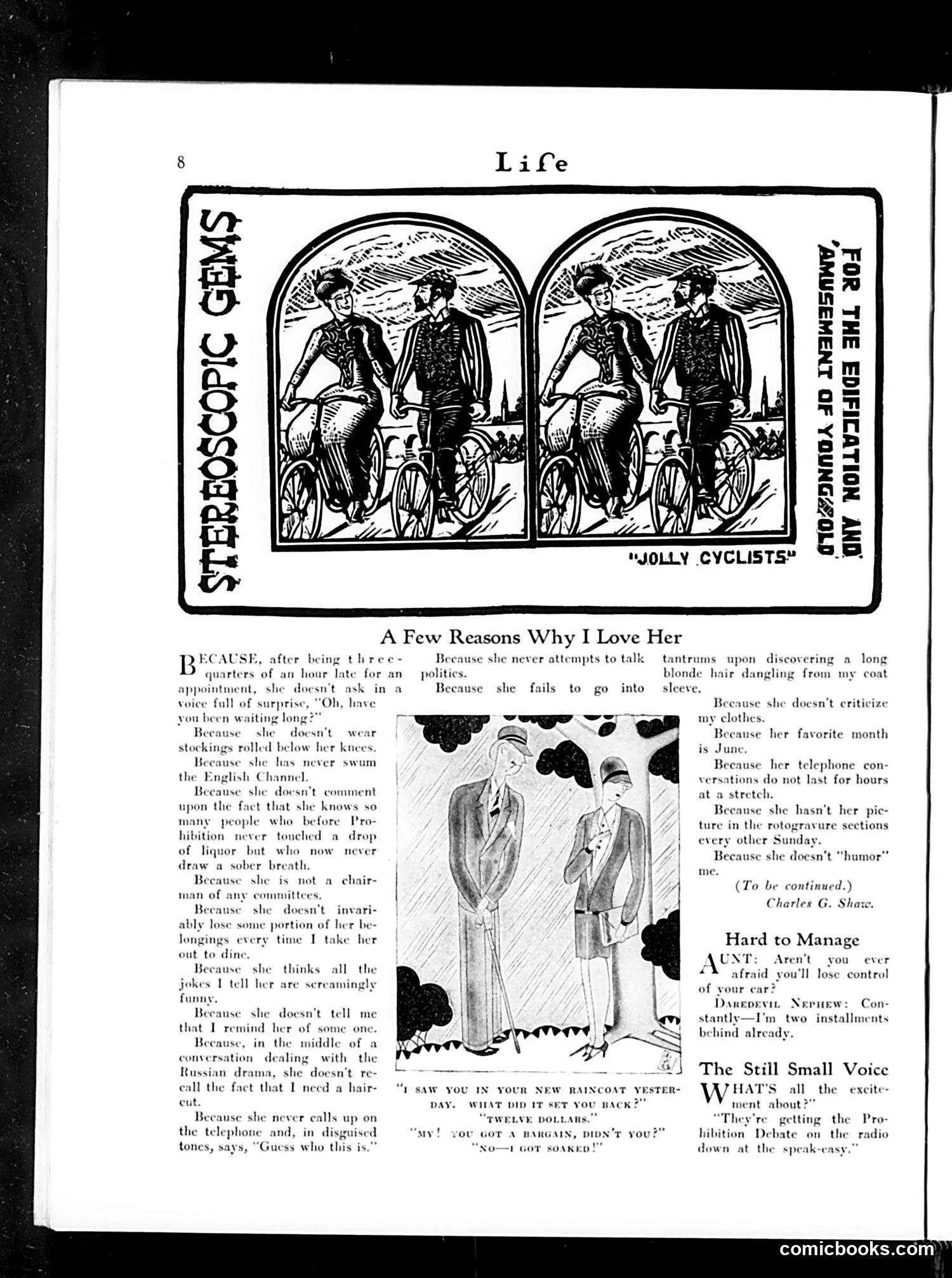
**Stereoscopic Images ("Jolly Cyclists")**: The paired illustrations are stereoscopic cards—a popular Victorian/early 20th-century viewing format requiring a special viewer to create 3D effects. The image shows two identical scenes of a man and woman riding bicycles together, meant to appear three-dimensional when viewed properly. **Social Context**: The bicycle was a revolutionary technology enabling women's independence and mobility. The "jolly cyclists" represent modern romance and courtship freed from Victorian parlor constraints. **"A Few Reasons Why I Love Her"**: This humorous essay by Charles G. Shaw celebrates a woman who defies social expectations—she doesn't wear restrictive clothing, doesn't gossip about politics, doesn't criticize, and maintains independence. The satire critiques both excessive female stereotypes and celebrates emerging women's liberation in the early 20th century.
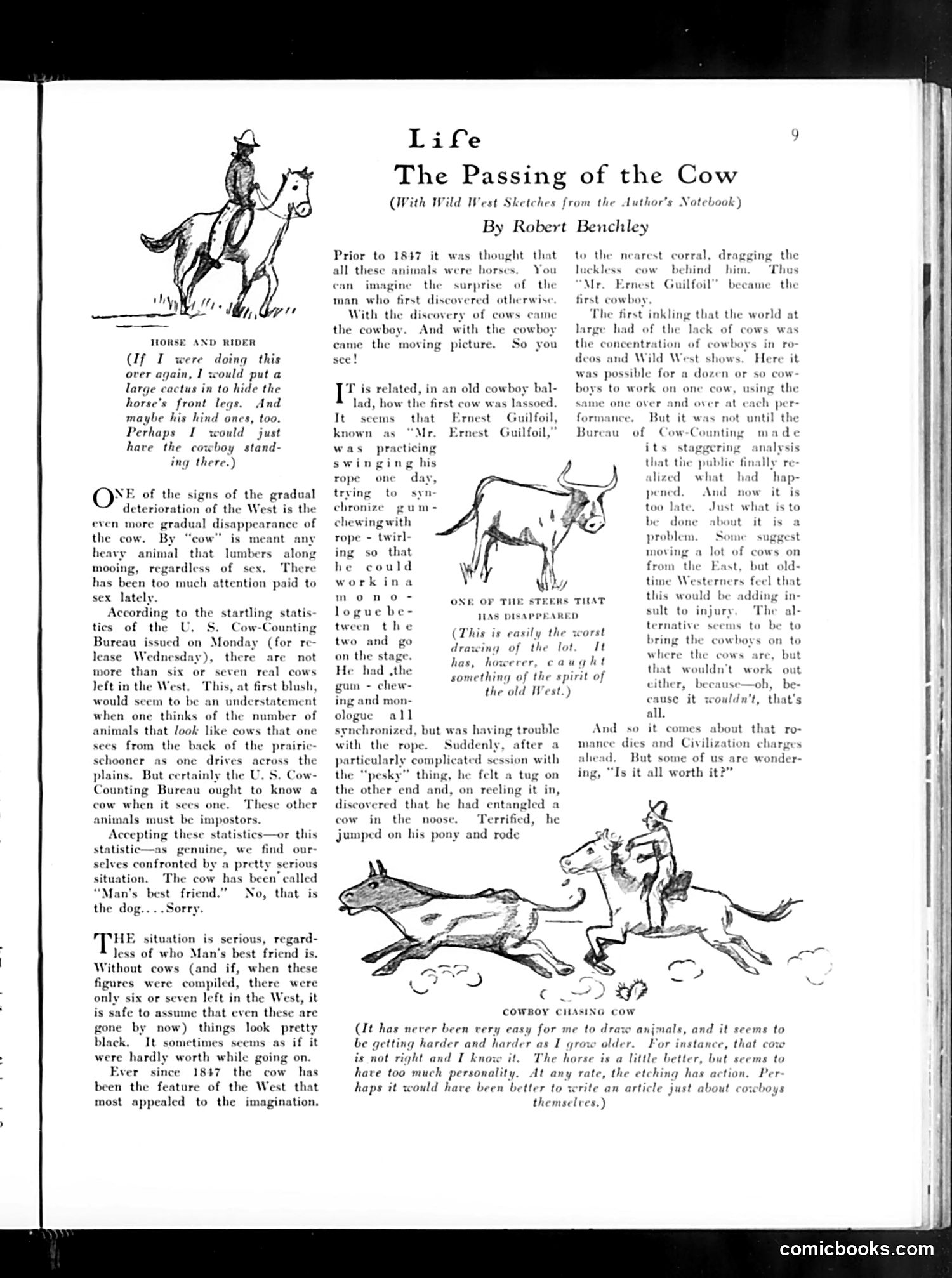
This article by Robert Benchley laments the disappearance of cattle from the American West. The text notes that prior to 1817, all animals were thought to be horses; the discovery of cows led to the "cowboy." The sketches illustrate a practical problem: a cowboy attempting to lasso a cow that has become entangled in rope. The accompanying caption humorously acknowledges the difficulty—the artist admits drawing animals is increasingly hard as he grows older, and this particular cow "is not right" and the horse "has too much personality." The satire critiques the romanticization of Western life while acknowledging real logistical challenges of ranching. Benchley uses gentle humor to comment on the West's decline and changing mythology during the early 20th century.
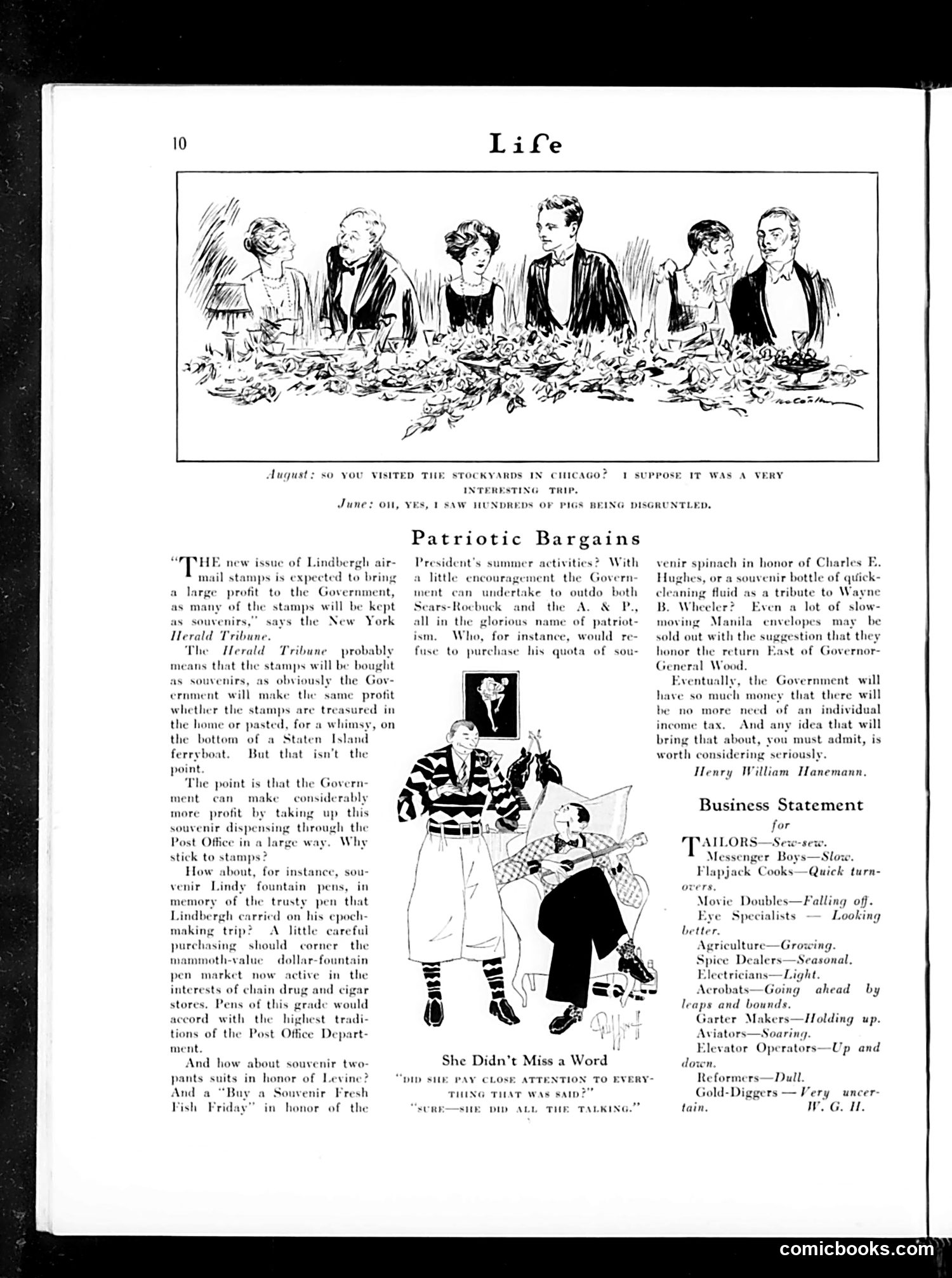
This satirical article mocks the U.S. Government's plan to profit from selling Lindbergh memorabilia and other "patriotic" souvenirs to the public—a scheme the author finds absurd and greedy. The top cartoon shows well-dressed diners surrounded by fallen leaves, illustrating the text's opening dialogue about visiting Chicago stockyards—an apparent metaphor for slaughter or waste. The main cartoon depicts Uncle Sam eagerly hawking souvenirs, with the caption "She Didn't Miss a Word"—suggesting Americans will buy anything patriotic without question. The satire criticizes using national pride as a commercial marketing tool and warns against individual income taxes to fund such schemes. The "Business Statement" lists declining occupations (tailors, messenger boys, etc.), implying economic hardship makes patriotic consumption impractical.
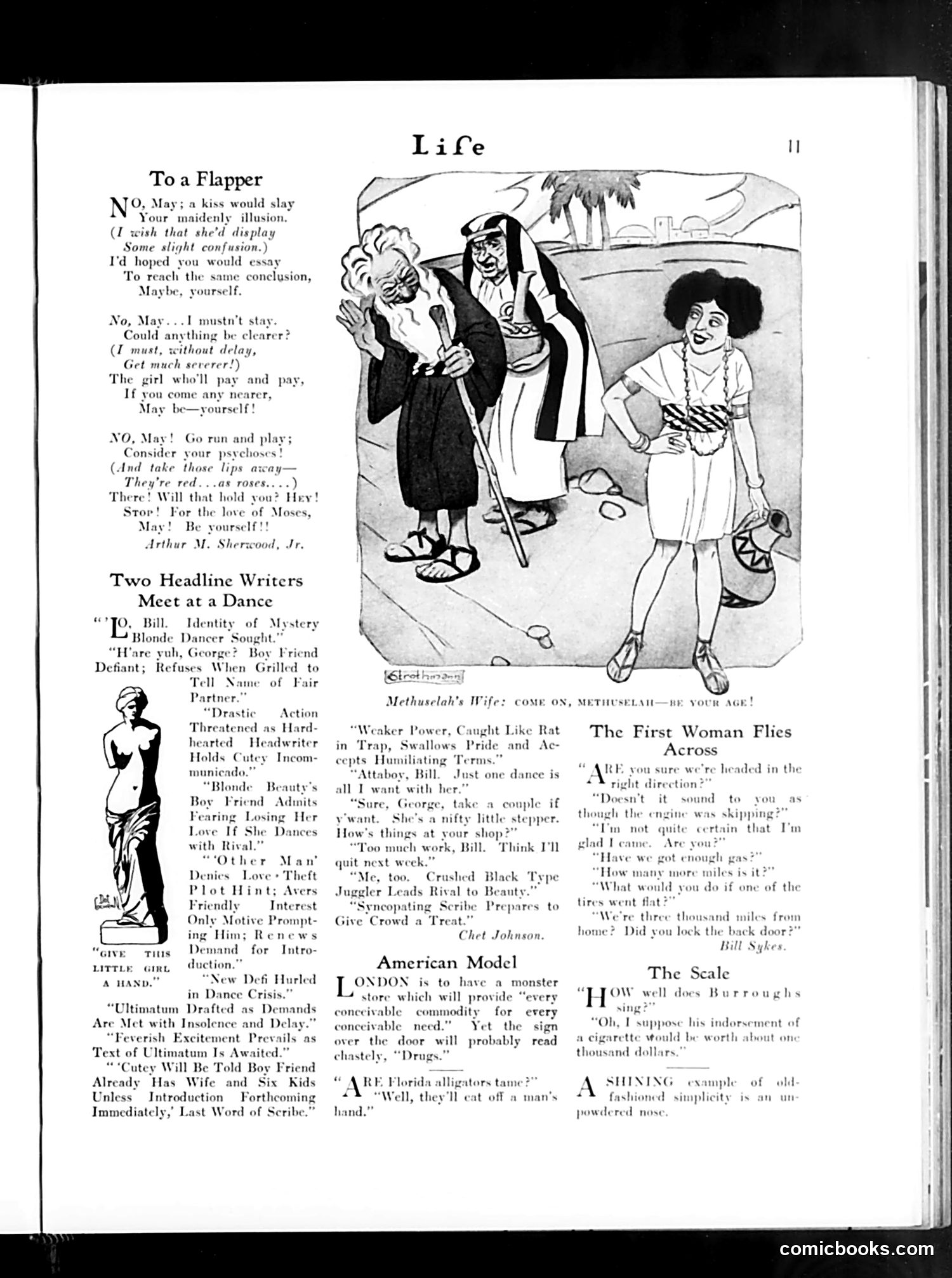
The main cartoon depicts a beach scene where a nun (identified by her habit) encounters a flapper—a young woman in the modern 1920s style with short hair and revealing dress. The caption reads "METHUSELAH'S WIFE: COME ON, METHUSELAH—BE YOUR AGE!" This satirizes the generational clash of the Jazz Age. The nun represents old-fashioned morality and religious conservatism, while the flapper embodies the modern, liberated woman rejecting Victorian standards. The joke suggests the nun is ancient and outdated, urging her companion (representing tradition itself) to "act his age"—ironically meaning to modernize. The satire mocks both older generations' shock at changing social mores and the flapper's bold departure from convention.
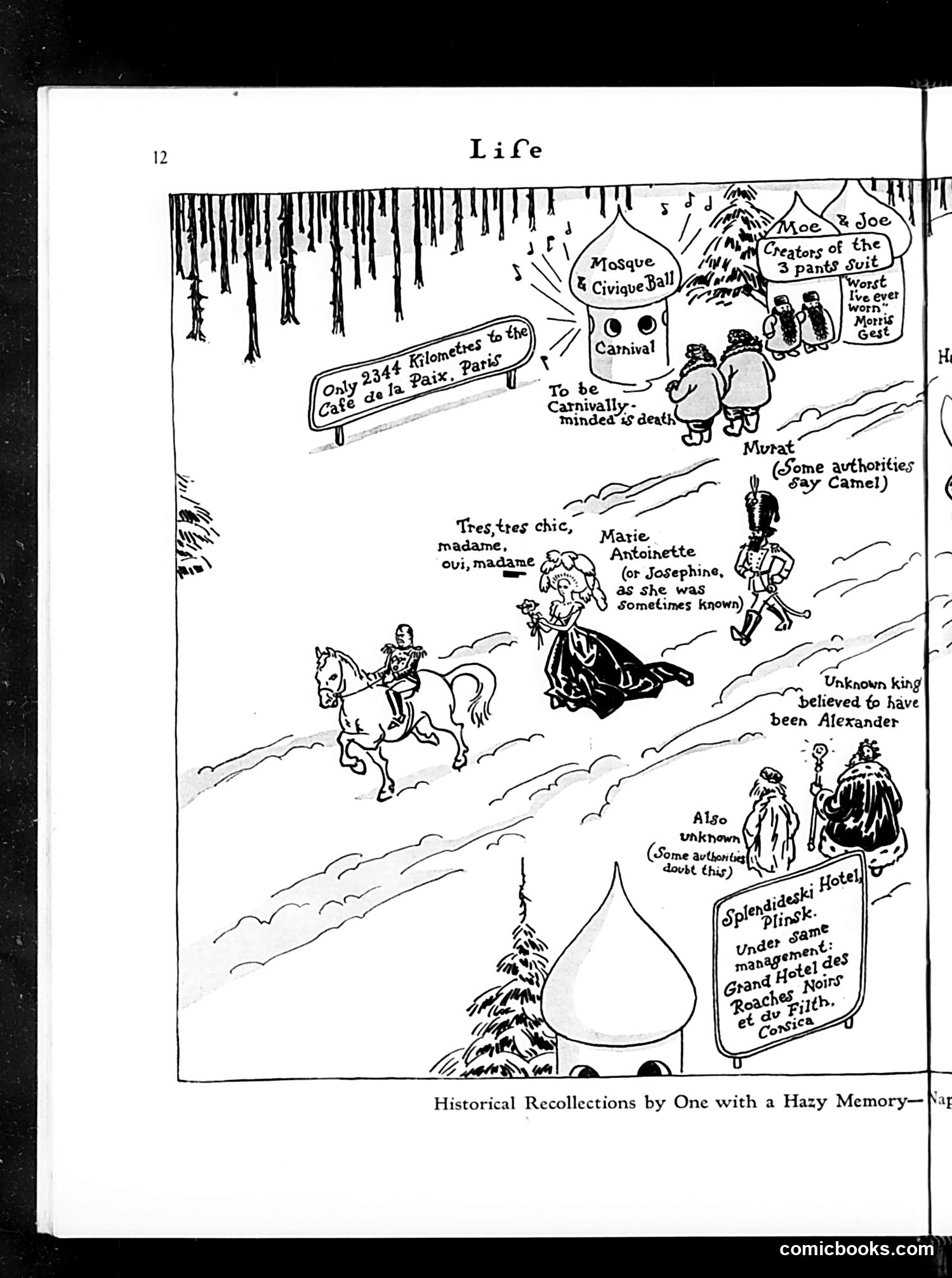
This satirical cartoon mocks unreliable historical accounts, particularly about exotic travel and celebrity encounters. The cartoon shows a snowy Alpine setting where the narrator claims to have met Marie Antoinette (labeled "or Josephine, as she was sometimes known") and various mysterious figures, including "Unknown king believed to have been Alexander" and an "Unknown king (Some authorities doubt this)." The humor lies in the narrator's vague, contradictory recollections—confusing identities, uncertain dates ("Only 2344 kilometres to the Cité de la Paix, Paris"), and dubious claims of witnessing historical figures and legendary animals like a camel in the Alps. The cartoon satirizes unreliable memoirs and the human tendency to embellish or misremember historical encounters.
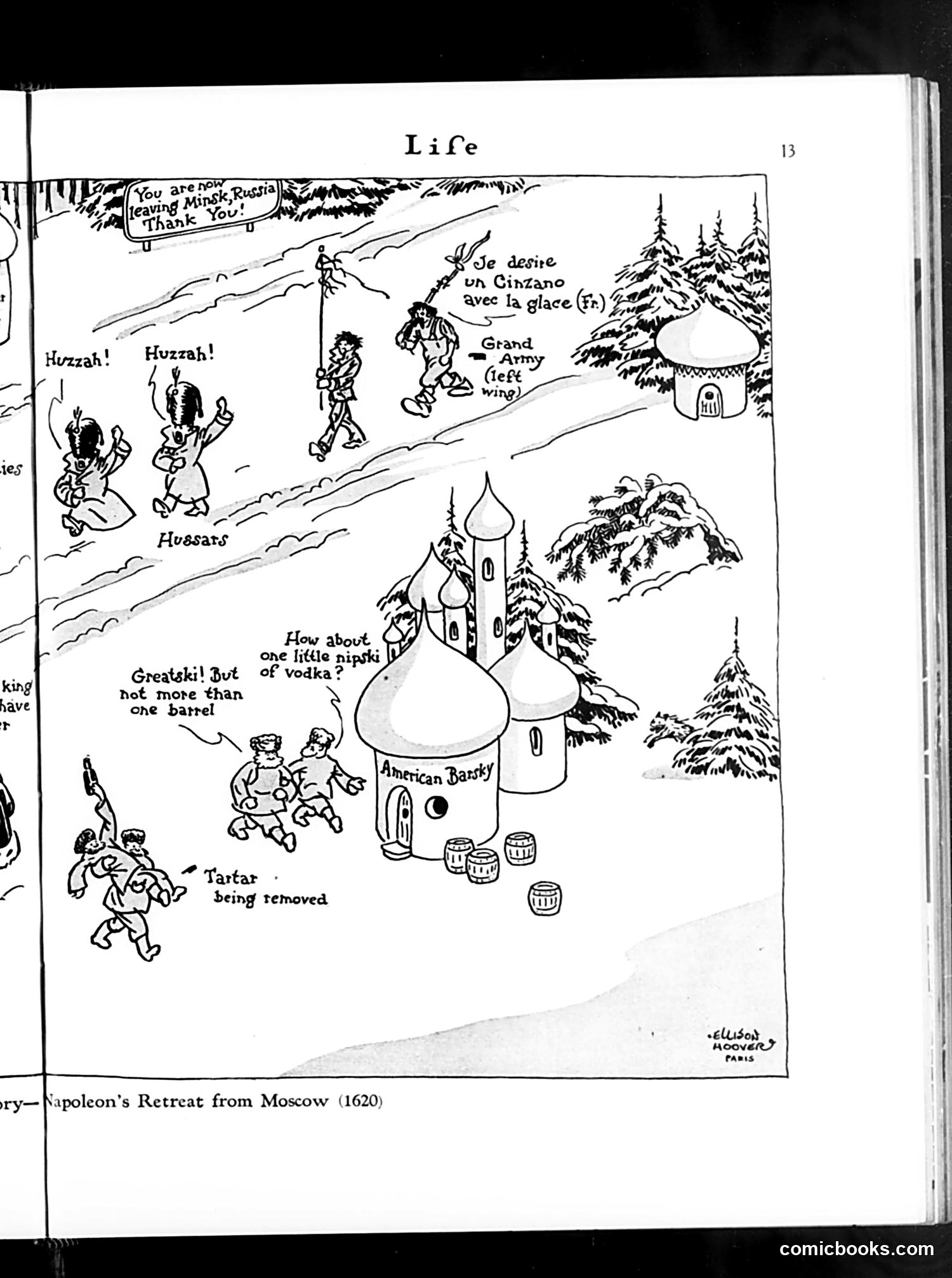
This is a satirical cartoon depicting Napoleon's disastrous 1812 retreat from Moscow as a comedic Russian winter scene. The cartoon shows: **The joke:** The caption dates it "(1620)"—an obvious error meant to mock the historical confusion or suggest this retreat is ancient history. **Key elements:** Russian soldiers celebrate ("Huzzah!"), while French forces trudge through snow. A Russian Orthodox church labeled "American Brandy" sits absurdly in the landscape, surrounded by barrels. Figures called "Hussars" and "Tartars" populate the scene, with one labeled "Tartar being removed." **The satire:** The anachronistic "American Brandy" label appears to mock either American commercial expansion or the incongruity of finding American goods in Russia. The overall tone trivializes Napoleon's catastrophic military failure through crude humor and distorted Russian imagery.
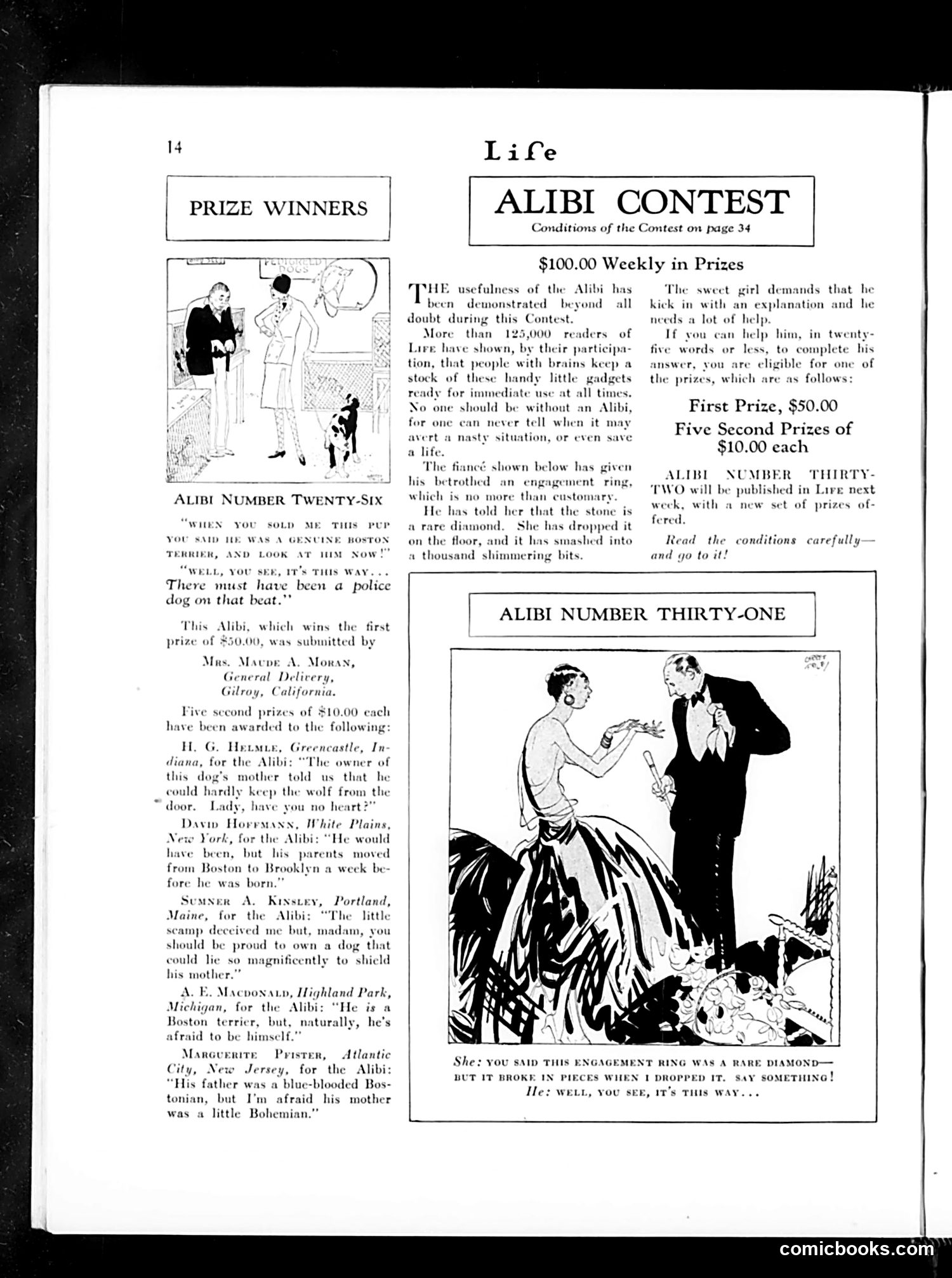
This page presents an **Alibi Contest**—a humorous competition where readers submit creative excuses for everyday situations. The top cartoon (Alibi Number Twenty-Six) shows a man confronted by his wife about a torn dress, claiming "There must have been a police dog on that beat!" The larger cartoon (Alibi Number Thirty-One) depicts a man in formal wear caught by a woman in an elaborate ball gown amid scattered diamonds and jewels. His excuse: the engagement ring he gave her was genuine, but when it broke and scattered into pieces, he claims "it's this way"—implying the destruction wasn't his fault. The contest invited readers to submit humorous alibis (excuses), offering $100 in weekly prizes. This reflects early 20th-century humor focused on domestic mishaps and marital misadventures.
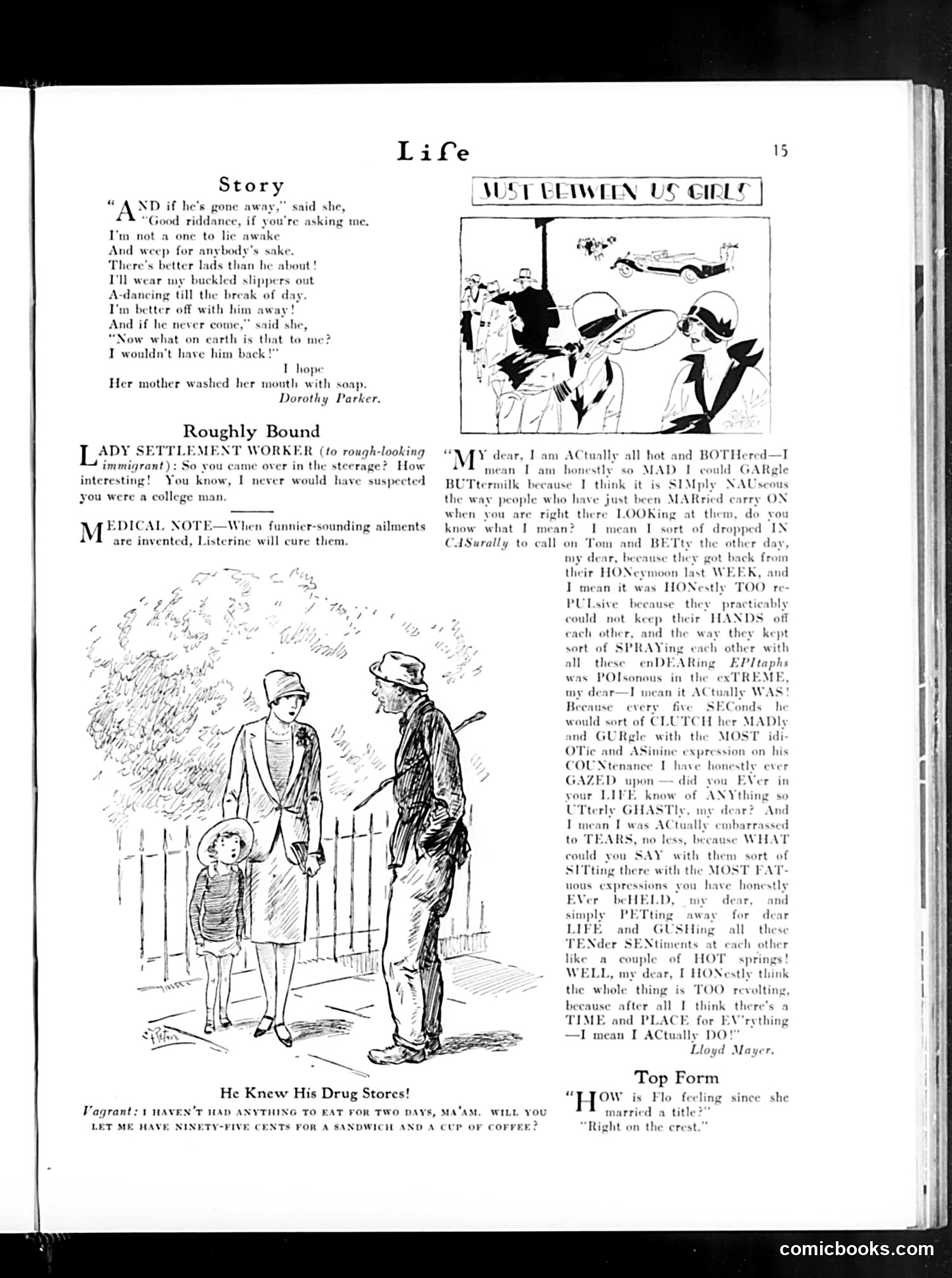
This cartoon satirizes a vagrant (homeless man) negotiating with what appears to be a druggist or shopkeeper. The vagrant hasn't eaten in two days and asks for a sandwich and coffee for ninety-five cents—a modest request. The joke's irony: the vagrant demonstrates shrewd knowledge of where to find cheap food, suggesting drugstores were common places working-class people obtained inexpensive meals, likely at soda fountains or lunch counters that many pharmacies operated. The satire targets economic hardship during what appears to be the early 20th century, when poverty forced people to navigate survival with limited resources. The vagrant's specific knowledge of affordable prices becomes an oddly competent survival skill amid destitution—a darkly humorous commentary on Depression-era desperation.
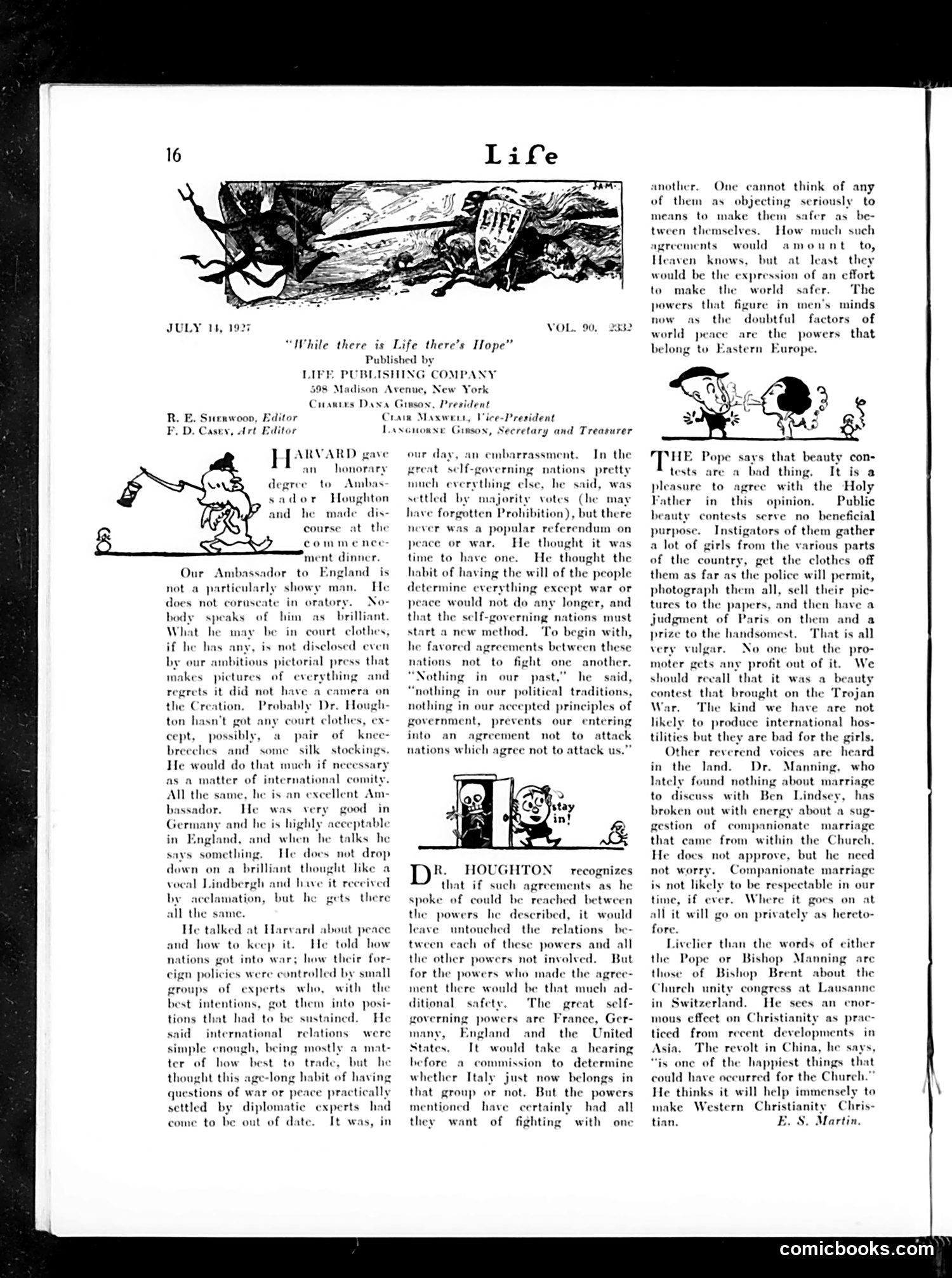
This page satirizes diplomatic efforts to prevent war through international agreements. The main article discusses Harvard's Ambassador to England presenting a peace proposal based on nations signing non-aggression pacts rather than relying on military force. The cartoons mock this idealistic approach. One shows a figure (likely representing diplomatic optimism) naively pushing for peace agreements. The satire suggests such diplomatic initiatives are ineffective—that nations pursuing peace through paper agreements while maintaining military capabilities is contradictory. The text references France, Germany, England, and the United States as key powers needing agreement, reflecting post-WWI concerns about European stability. The cartoons imply diplomats lack practical understanding of how nations actually operate regarding war and peace.
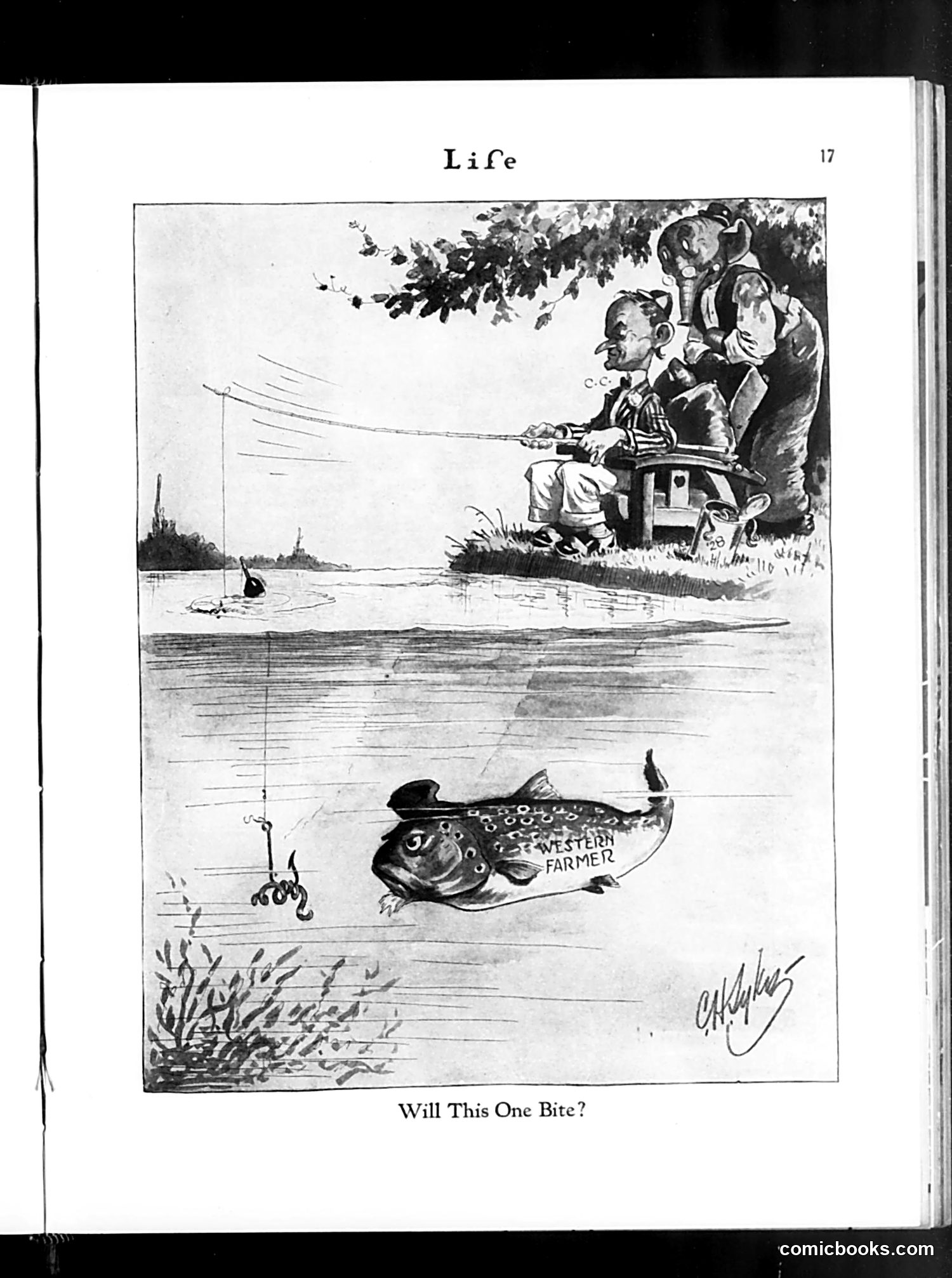
This cartoon depicts two well-dressed men fishing from a riverbank, with one holding a fishing rod while the other observes. Beneath the water swims a large fish labeled "WESTERN FARMER." The title "Will This One Bite?" suggests the fishermen are attempting to "catch" or manipulate the Western farmer, likely as voters or political support. This appears to be political satire about competing interests—possibly politicians or special interests—trying to hook Western farmers for votes or support during an election cycle. The humor lies in the predatory metaphor: will the farmer take the bait? The cartoon critiques how politicians view rural voters as targets to be manipulated rather than constituents with genuine interests.
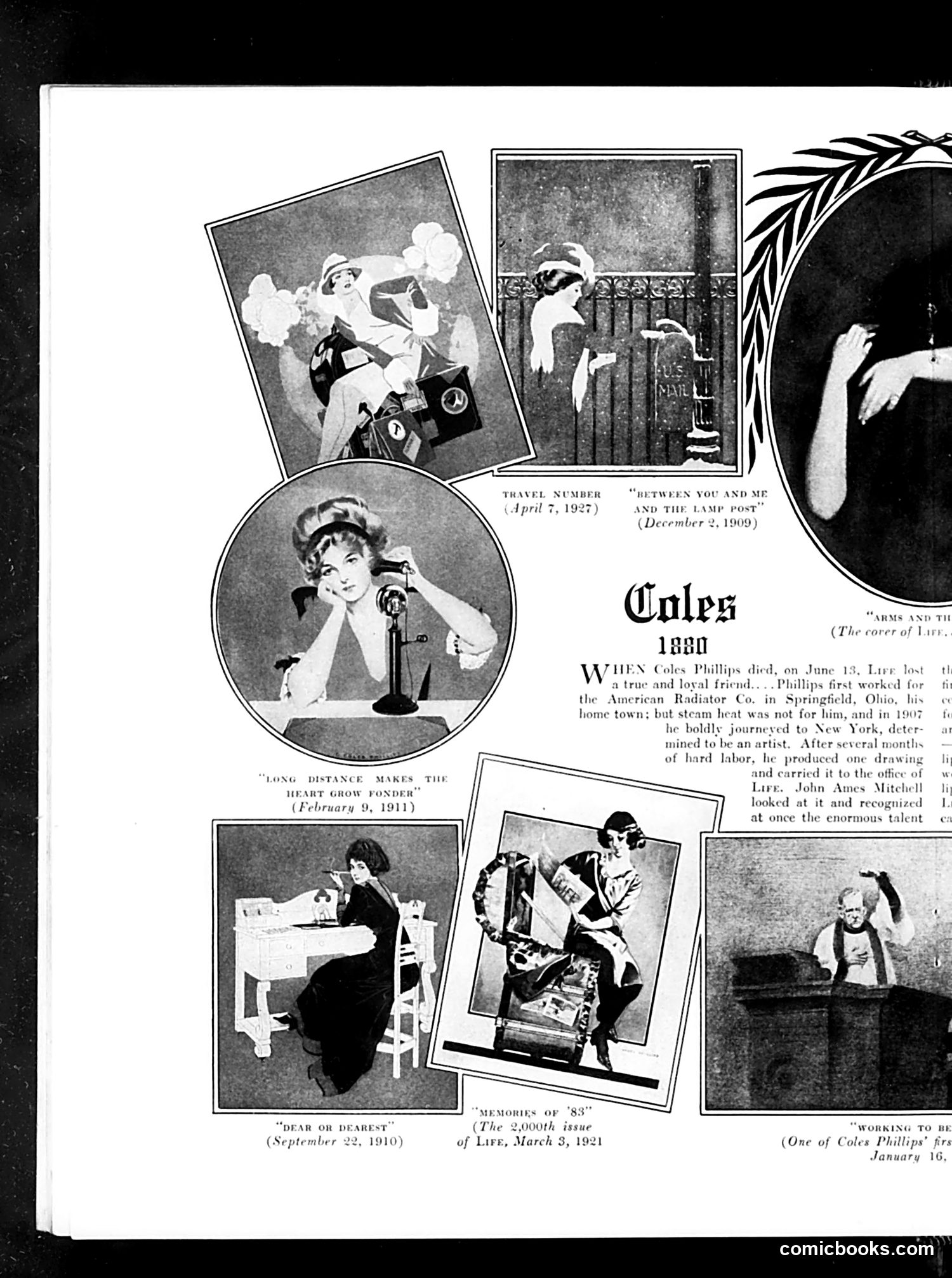
This is a **retrospective of illustrator Coles Phillips' work** for *Life* magazine, published around 1880 (likely the issue date or a commemorative feature). The page showcases Phillips' distinctive illustration style across several *Life* covers and features, dating from 1909-1927. The accompanying text explains that Phillips died on June 13 and had been a loyal contributor to the magazine. It recounts his origin story: after working an unsatisfying job in Ohio, he moved to New York in 1907 determined to be an artist, produced one drawing, and showed it to *Life*'s editor John Ames Mitchell, who "recognized at once the enormous talent." The individual illustrations demonstrate Phillips' **signature aesthetic**: elegant, fashionably-dressed figures (primarily women) in stylized poses, often using bold negative space and Art Deco-influenced composition. These were characteristic of early 20th-century magazine illustration and helped define the visual language of *Life* during this era. This is essentially a **tribute/memorial page** celebrating a significant contributor to the publication.
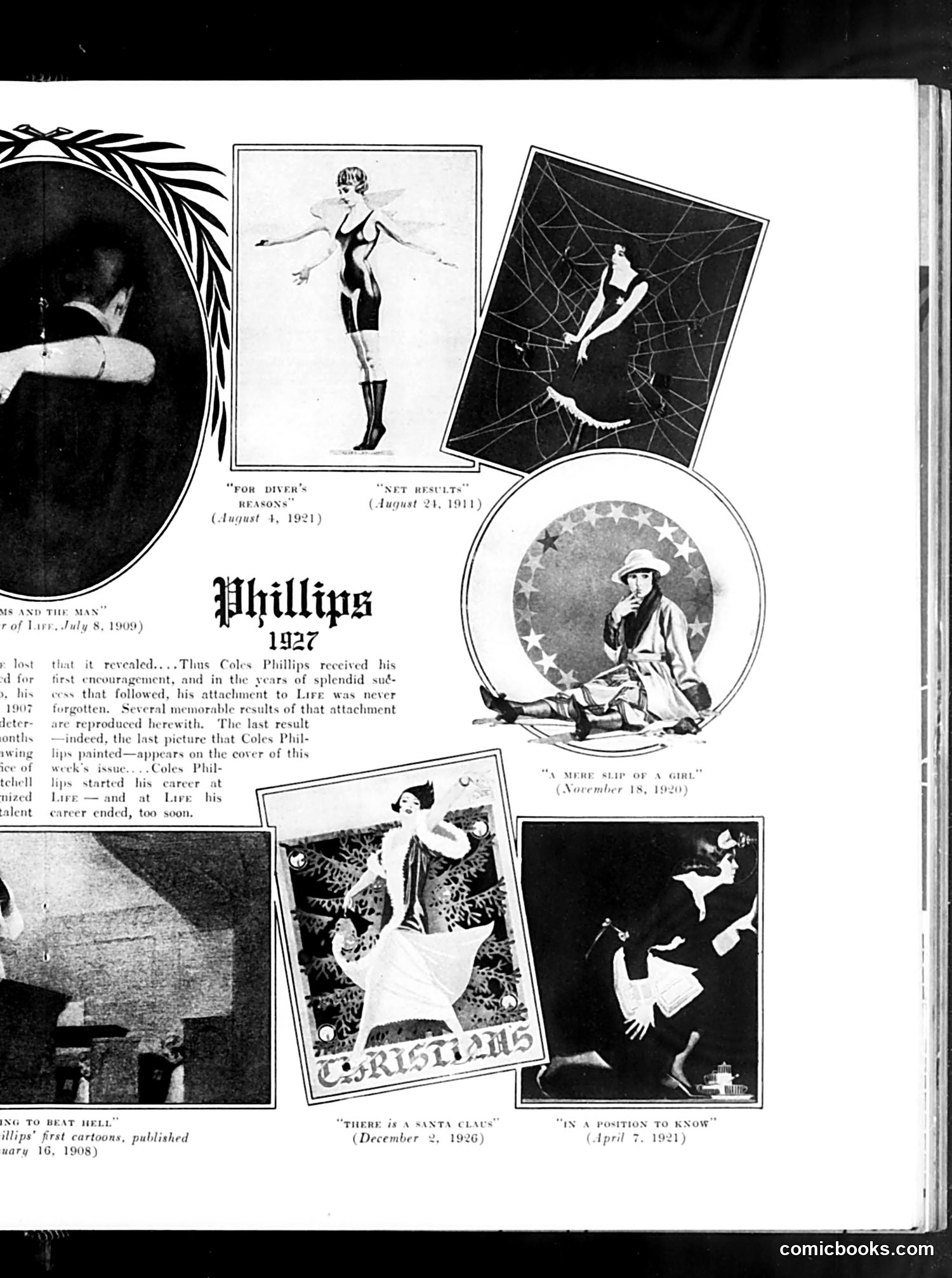
This page celebrates **Coles Phillips**, an illustrator whose career at *Life* magazine spanned from 1908 until his early death. The layout reproduces several of his notable works from the magazine, each labeled with publication dates ranging from 1908 to 1926. Phillips specialized in stylized fashion illustrations and satirical cartoon art typical of early 20th-century *Life*. The images show fashionable women in various scenarios—diving, in evening wear, posed dramatically—reflecting the magazine's focus on contemporary society and style. The text indicates Phillips received his "first encouragement" from *Life* and remained attached to the publication throughout his career. The piece is essentially a tribute, noting that the final reproduced image was "the last picture that Coles Phillips painted" before his career "ended, too soon"—suggesting his premature death. The page functions as a retrospective of his contributions to the magazine's visual identity.
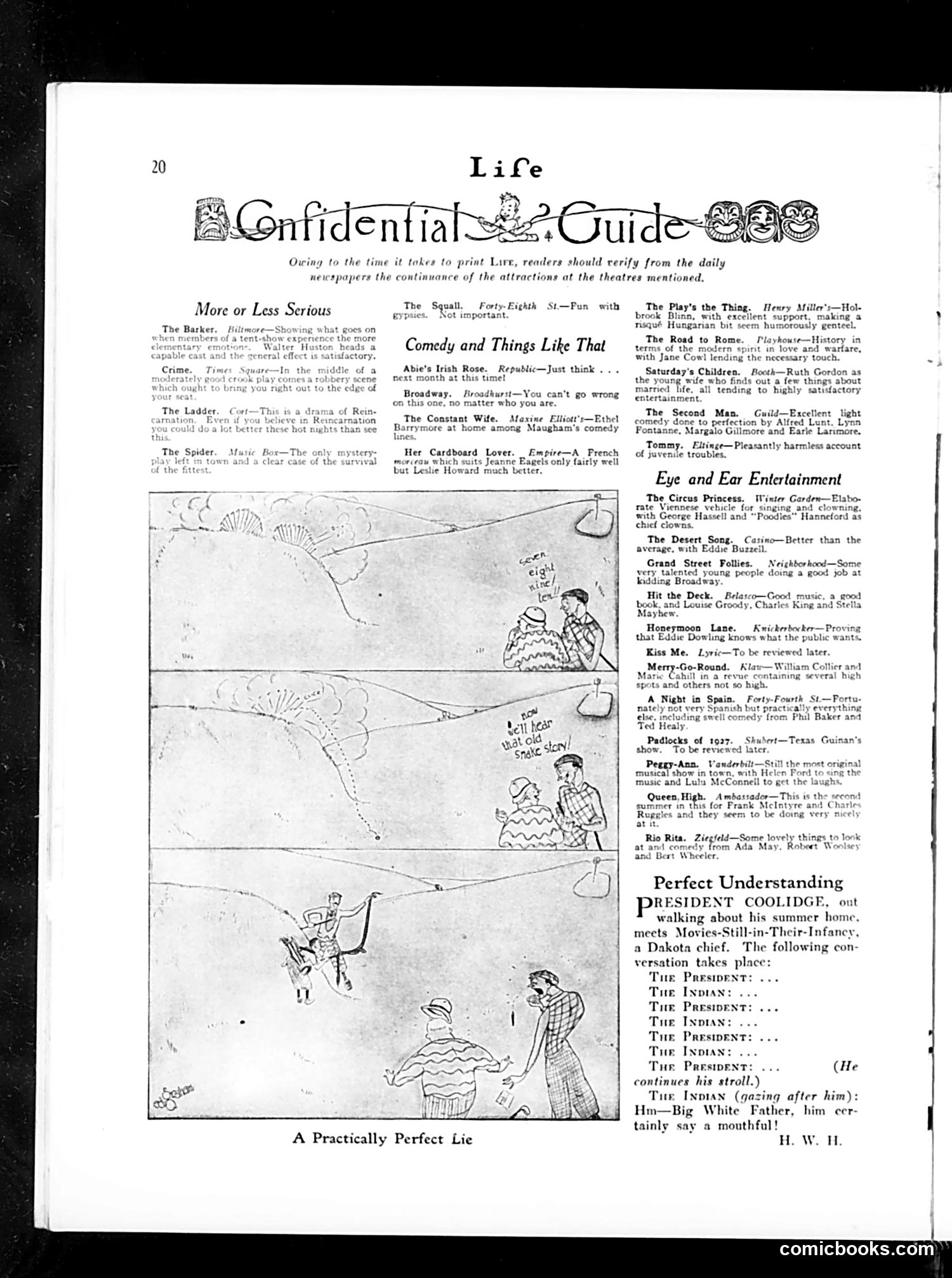
This page combines theater reviews with political satire. The main cartoon, "A Practically Perfect Lie," depicts President Calvin Coolidge encountering a Native American ("Dakota chief") during a summer walk. Their one-sided conversation—where Coolidge speaks (text not fully visible) while the Indian responds only with "Hm—Big White Father, him certainly say a mouthful!"—satirizes Coolidge's famous taciturn nature. The joke is the ironic reversal: Coolidge was known for saying very little, yet the Indian suggests he spoke at great length. The upper portion lists current Broadway shows and other entertainments in a gossipy review format typical of Life's satirical theater criticism. The cartoons scattered throughout appear to illustrate various comedies and theatrical attractions available to readers. The satire targets both Coolidge's reputation for brevity and, perhaps, period stereotypes about Native American speech patterns.
This page is a humorous critical essay on Broadway's 1926-27 theatrical season by Robert Benchley. The satire targets both the theater industry and the magazine's own critical methods. **Main jokes:** 1. **The "non-attendance record"**: Benchley admits he slept through or skipped many plays, yet must review them anyway—mocking both his own laziness and critics' pretensions to expertise. 2. **"High Hatty" complaint**: He ridicules the show's silly title, suggesting Broadway producers lack imagination. 3. **The statistics dodge**: He cites *Variety* trade paper data showing only 3-to-1 odds a Broadway play succeeds, then ironically notes the season was surprisingly "clean" (lacking sexual content)—contrasting Broadway's reputation for scandal with actual innocuousness. 4. **The cartoons** (illustrated figures throughout) provide visual comedy supporting his written mockery of theater-going culture. The piece satirizes how critics manufacture authority through selective data while admitting ignorance—a timeless critique of critical pretense.
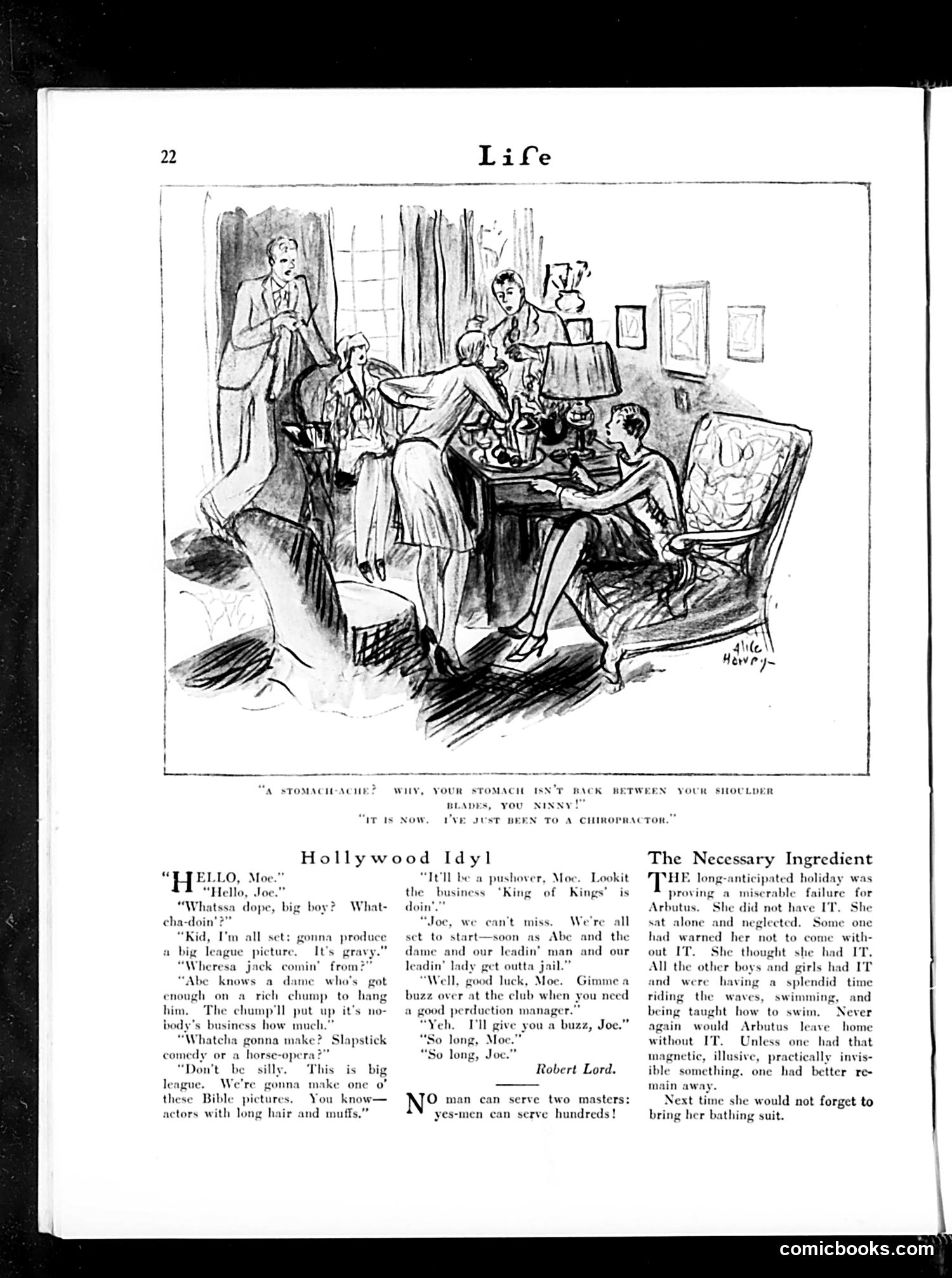
**The Main Cartoon (top):** A satirical commentary on Hollywood's cynicism during the silent film era. Two producers discuss making a "big league picture"—specifically a Bible picture with "actors with long hair and muffs" (wigs). The joke exposes the opportunistic nature of the industry: they plan to cast people currently "outta jail," secure financing by blackmailing a wealthy man ("Abe knows a dame who's got enough on a rich chump to hang him"), and treat the entire enterprise as a guaranteed moneymaker ("gravy"). The satire targets Hollywood's moral bankruptcy and its willingness to exploit both Biblical subject matter and criminals for profit. **The Side Story ("The Necessary Ingredient"):** A lightweight humorous piece about a girl named Arbutus who ruins her holiday by forgetting her bathing suit—"IT." The repeated emphasis on mysterious "IT" is the joke's mechanism, playing on period slang where "it" meant sex appeal or magnetism. Here it's literally just... a bathing suit. Light satirical commentary on vanity and social anxiety. Both pieces mock contemporary American culture—one seriously (Hollywood corruption), one frivolously (social pretension).
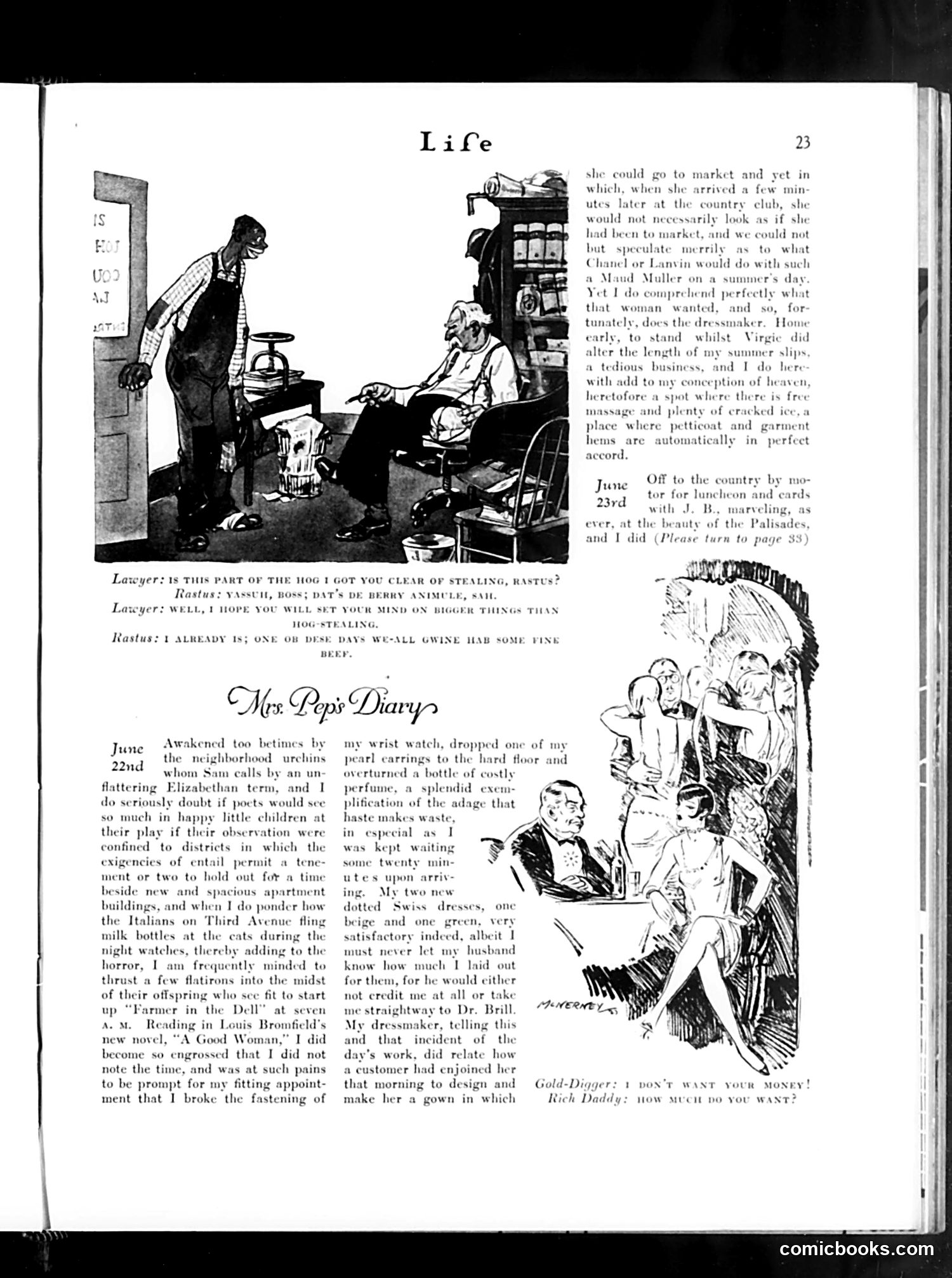
This page contains two distinct satirical pieces from Life magazine: **The Lawyer/Rastus cartoon** employs racist blackface stereotypes common to early 20th-century American humor. It depicts a Black man ("Rastus") in a legal proceeding about hog-stealing, with the lawyer encouraging him toward "bigger things"—which Rastus interprets as stealing beef instead. The "joke" relies entirely on racial caricature and the stereotype of Black criminality, reflecting deeply offensive attitudes of the era. **"Mrs. Pep's Diary"** satirizes wealthy women's frivolous concerns: broken earrings, expensive perfume accidents, designer dress costs hidden from husbands, and anxiety about appearing fashionable while shopping. It mocks upper-class materialism and domestic vanity through exaggerated attention to trivial matters. Both pieces reflect 1920s Life magazine's mix of social satire targeting the affluent and crude racial humor that was considered acceptable entertainment at the time.
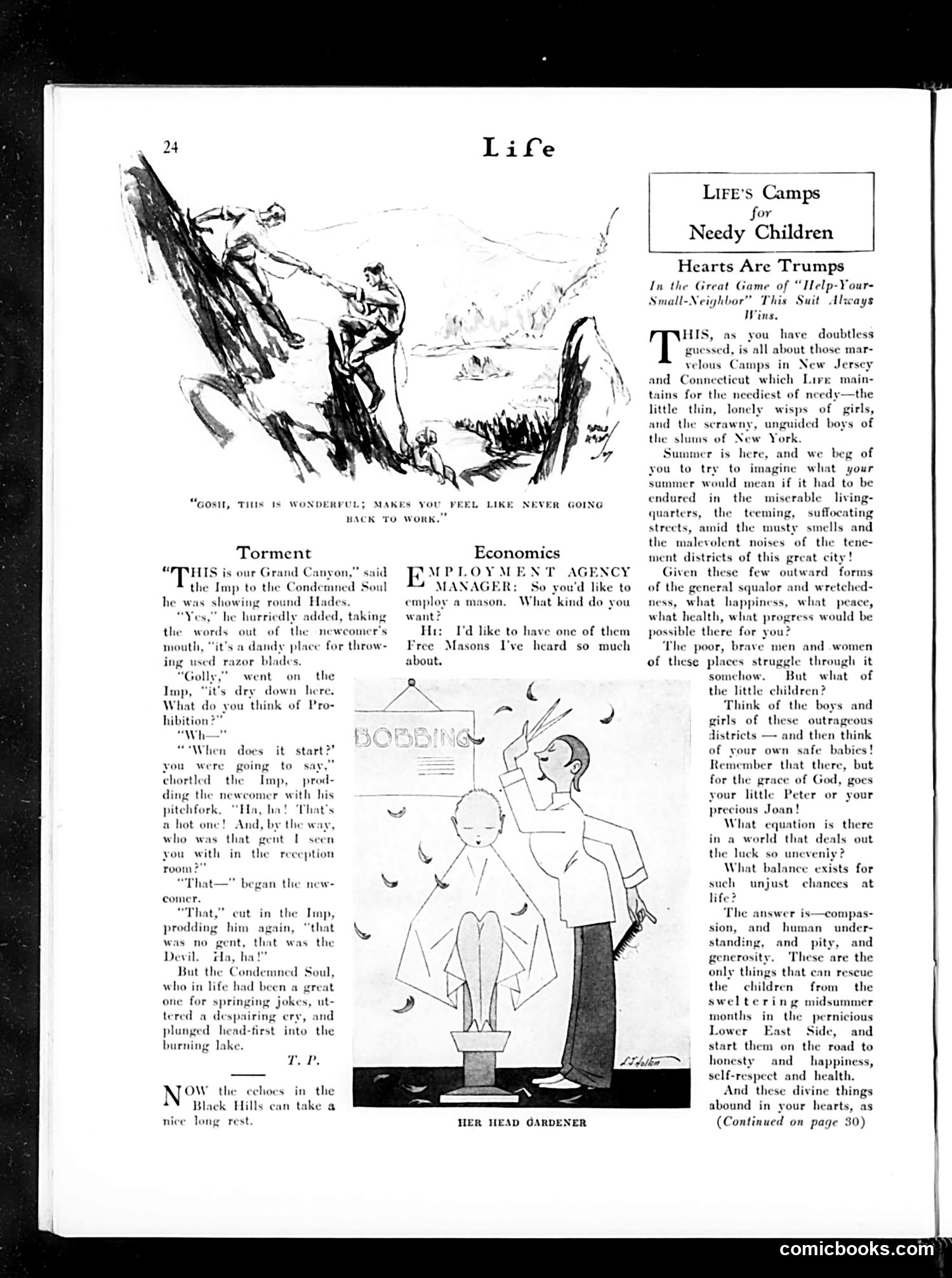
This page contains three satirical pieces reflecting early 20th-century American concerns: **"Torment"** (top left): A dialogue between an Imp and a damned soul touring Hell, satirizing Prohibition. The joke hinges on the newcomer's predictable response—he's about to ask "When does Prohibition start?" The punchline mocks both Prohibition's unpopularity and the Devil's sardonic awareness of human desires. **"Economics"** (center): An employment agency manager interviews a worker seeking a "Free Mason." The satire targets either labor exploitation or unclear job qualifications—the manager's aggressive "prodding" suggests workplace abuse. **"Life's Camps for Needy Children"** (right): A lengthy editorial-style piece advocating for summer camps for poor children in New York slums. It appeals to wealthy readers' compassion, contrasting affluent children's safety with urban poverty. The illustration "Her Head Gardener" (bottom) shows a woman tending children like plants—a metaphor for nurturing disadvantaged youth. The page blends humor with social advocacy typical of *Life* magazine's reformist stance.
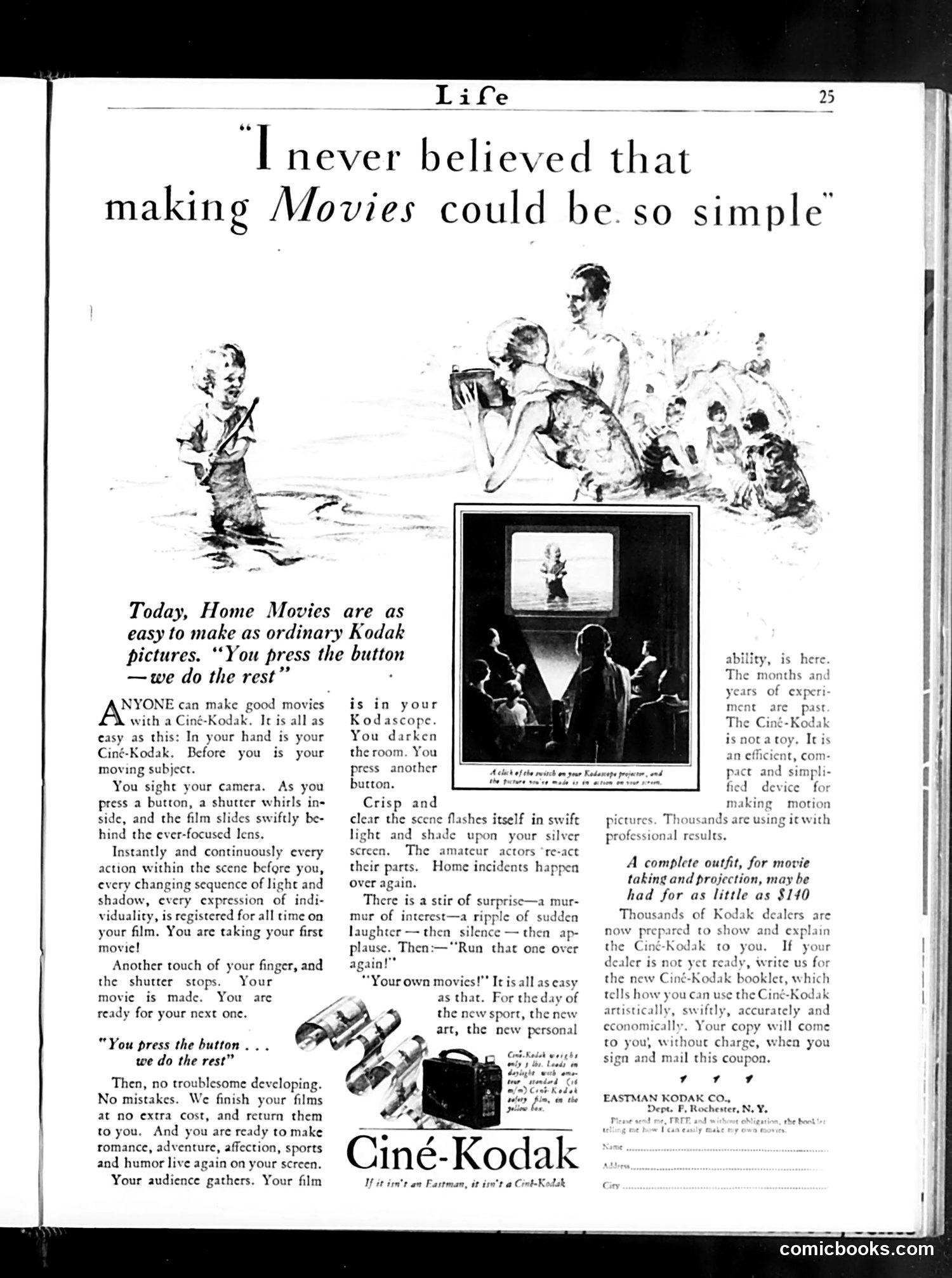
This is primarily a **Kodak advertisement** for the Ciné-Kodak home movie camera, not a political cartoon. The page promotes consumer home filmmaking technology to a general audience. The illustrations show **ordinary people** (families, amateur actors) operating the simple camera and projecting their homemade films for friends and family—emphasizing accessibility and ease of use. The repeated slogan "You press the button—we do the rest" (Kodak's famous advertising phrase) stresses that no technical expertise is required. The social context: this represents **1920s consumer culture** when home movie cameras were becoming commercially available luxuries for middle-class Americans. The advertisement markets filmmaking as democratic entertainment—families can now create their own "romance, adventure, affection, sports and humor" content, a novel idea at the time. There is **no satire here**—this is straightforward product marketing celebrating technological democratization of what had previously been professional territory. The page aims to convince readers that movie-making is now as simple as still photography.
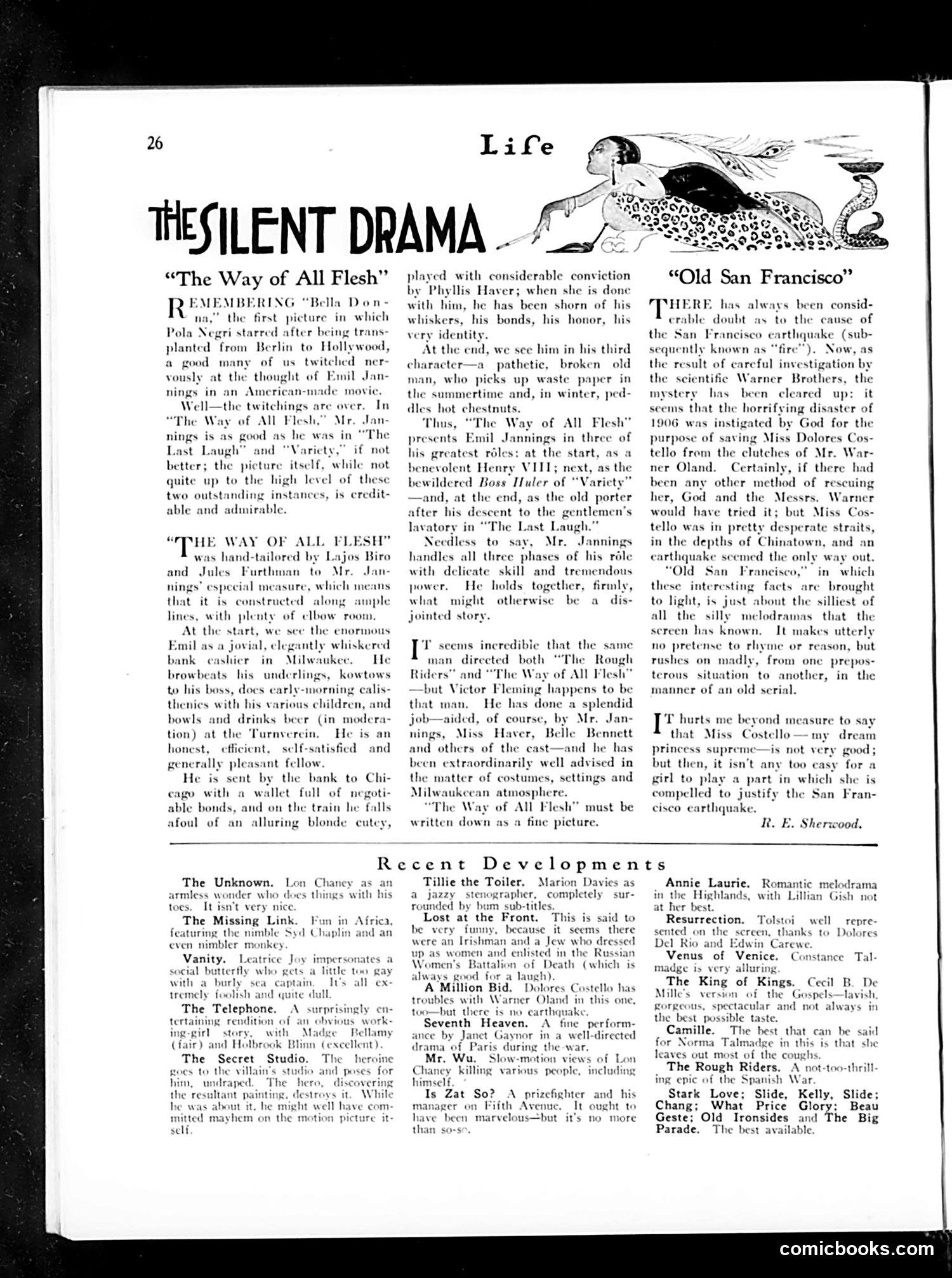
This page reviews two silent films. "The Way of All Flesh" stars Emil Jannings, a German actor recently imported to Hollywood. The reviewer praises his performance as a respectable Milwaukee banker who is seduced by a blonde woman, loses his money and dignity, and ends up a destitute old man collecting waste paper. The film showcases Jannings in three contrasting roles—a Henry VIII-type authority figure, a bewildered victim, and a broken vagrant. "Old San Francisco" is mocked for its absurd plot: the film attributes the 1906 San Francisco earthquake to divine intervention by God, staged specifically to rescue actress Dolores Costello from villain Warner Oland's clutches. The reviewer sarcastically suggests this was God's preferred rescue method, when presumably other options existed. The satire targets the film's ridiculous melodramatic plotting.
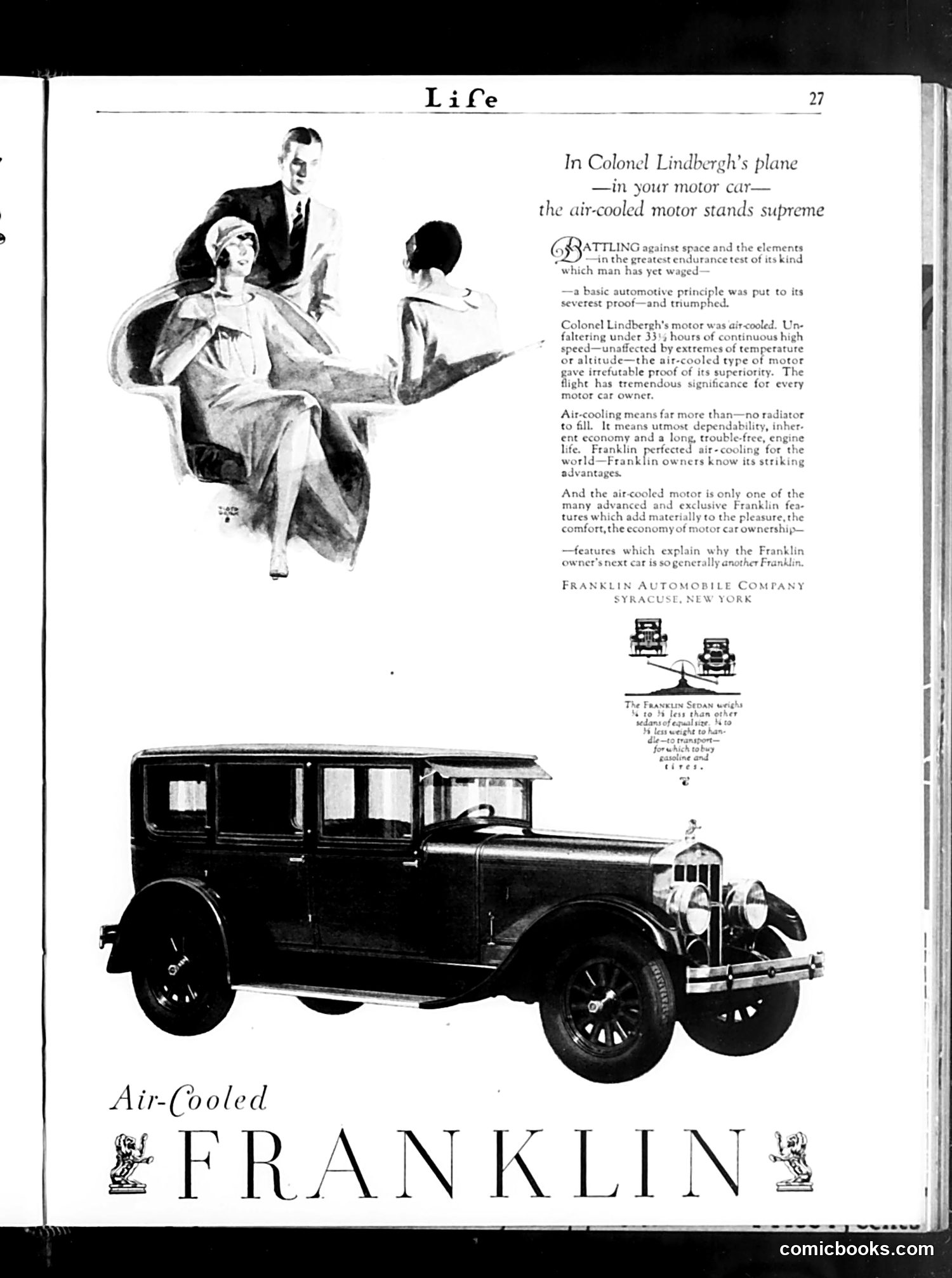
This is primarily a **Franklin automobile advertisement**, not political satire. The page references **Colonel Charles Lindbergh**, the famous aviator who completed the first solo transatlantic flight in 1927. The ad claims Franklin's air-cooled motor technology, proven reliable in Lindbergh's aircraft during his historic flight, is equally superior in Franklin automobiles. This is a marketing strategy: associating the car with cutting-edge aviation technology and Lindbergh's celebrated achievement to suggest reliability and innovation. The illustration shows fashionably dressed people admiring the automobile—typical 1920s advertising imagery emphasizing luxury and modernity. There is no satire here; it's straightforward product promotion leveraging contemporary aviation fame.
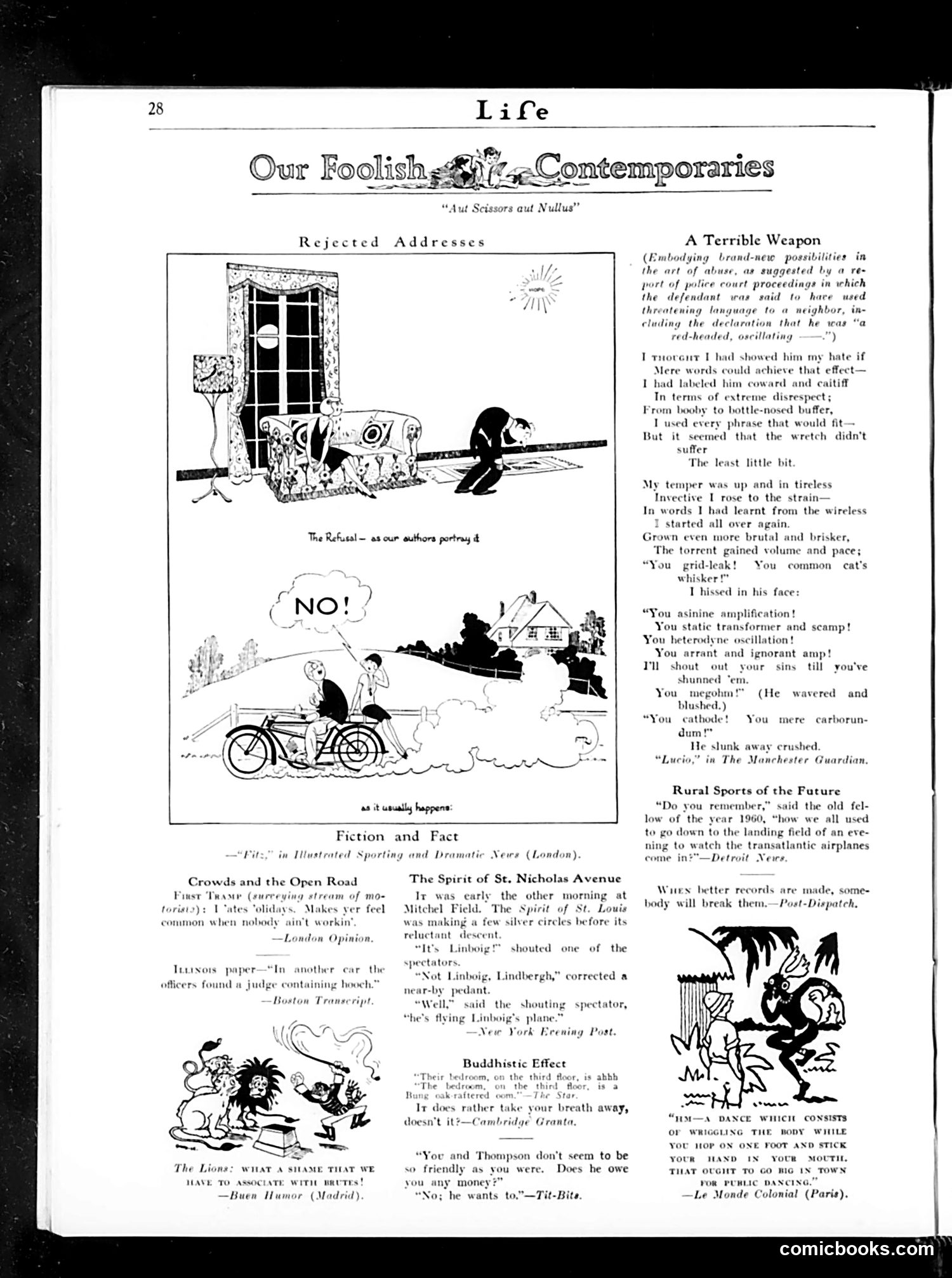
This page collects short humorous pieces satirizing contemporary foibles. Key items: **"The Spirit of St. Nicholas Avenue"**: Mocks public ignorance about Lindbergh's transatlantic flight (likely 1927), where spectators mispronounce "Lindbergh" as "Linboig," and one defends the error pedantically. **"A Terrible Weapon"**: A poem satirizing radio/wireless terminology ("cathode," "megohm," "heterodyne oscillation") being weaponized as insults—mocking how modern jargon creates the *appearance* of sophisticated abuse while remaining meaningless. The victim remains unharmed because the words are absurd. **"Rural Sports of the Future"**: Predicts aviation tourism will replace traditional countryside activities—an early satire of how technology transforms leisure. The cartoons and shorter quips (from international papers credited) all target contemporary absurdities: technological change, linguistic pretension, social hypocrisy. This was Life's standard format: lightweight, accessible social commentary aimed at educated urban readers.
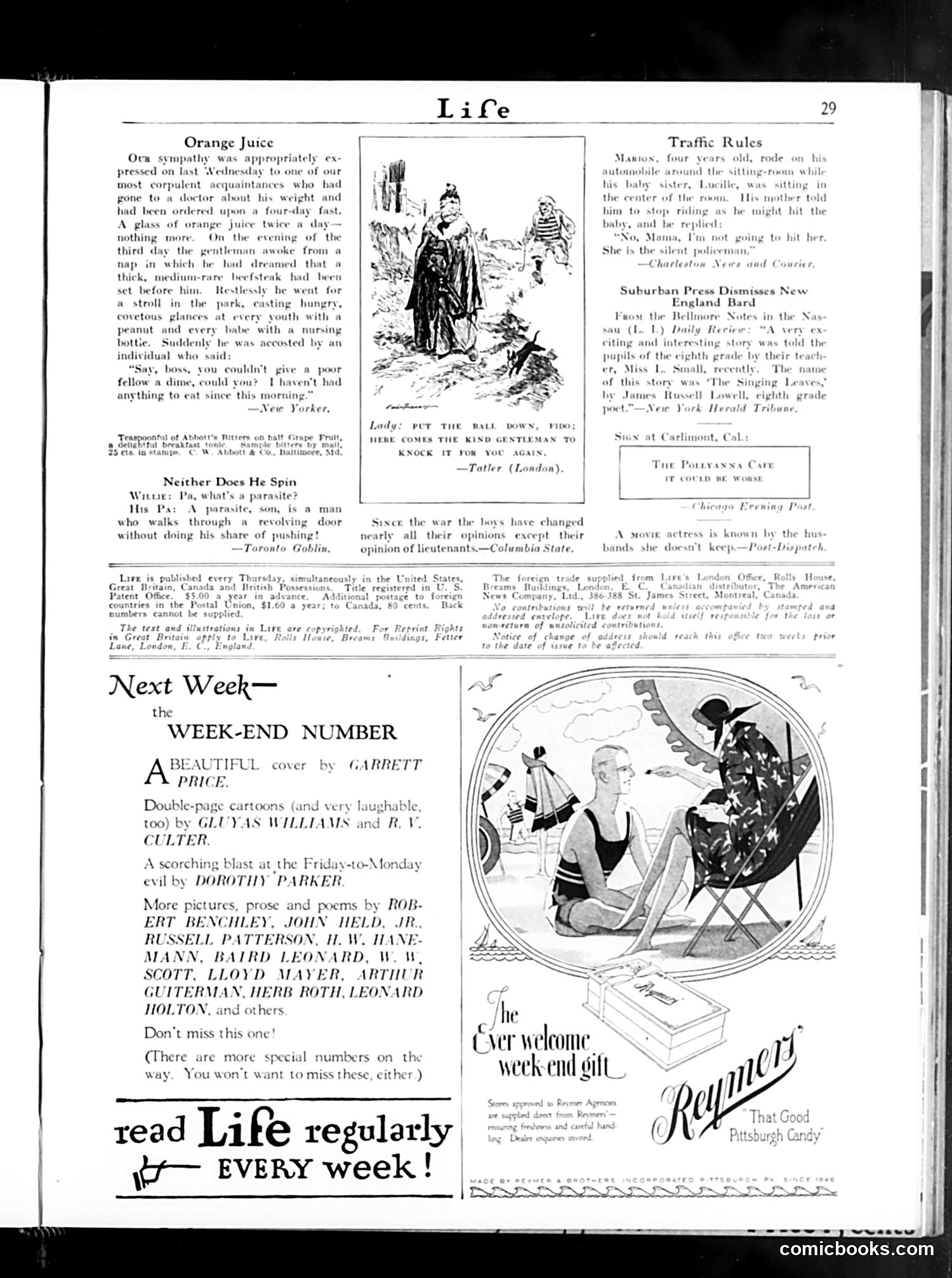
This page contains several short humor pieces typical of Life's satirical style: **"Orange Juice"** mocks a wealthy man on a strict diet. A fasting gentleman, weakened by hunger, encounters a poor beggar asking for money. The irony is that the starving rich man can't help the genuinely poor one—the satire targets class hypocrisy and the suffering imposed by fad dieting among the wealthy. **"Neither Does He Spin"** is a brief dialogue joke. A father explains that a parasite is "a man who walks through a revolving door without doing his share of pushing." This puns on the economic definition of parasites while making a comment about freeloaders and social responsibility. Both pieces use wordplay and situational irony typical of 1920s-30s American humor magazines. The page also advertises next week's "Week-End Number" with contributions from prominent writers and cartoonists of the era.
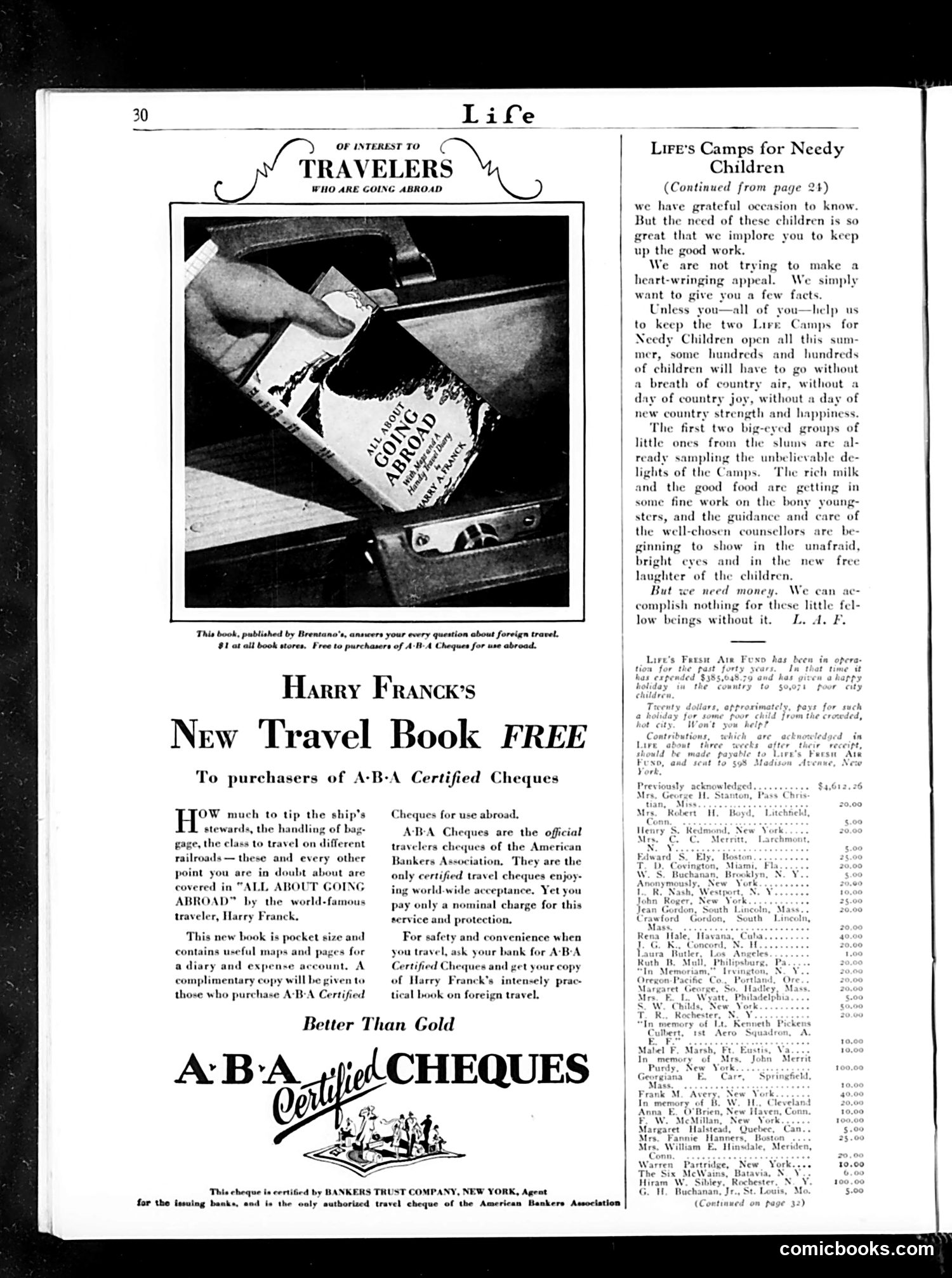
This page is primarily **advertising and fundraising**, not satire or political commentary. The left side promotes Harry Franck's travel guide and ABA Certified Cheques (traveler's checks)—financial products marketed as safer than carrying cash abroad. The image shows a guidebook being packed into luggage. The right column shifts to a serious charitable appeal for "Life's Camps for Needy Children"—apparently summer camps run by *Life* magazine for poor urban children. The text argues passionately that without donations, "hundreds and hundreds of children" will miss out on country air and healthy food. It's emotionally pitched ("heart-wringing") but claims to avoid melodrama, simply presenting "facts." The contributor list at bottom shows donations from wealthy donors. **Context**: This reflects 1920s Progressive-era philanthropy, when magazines like *Life* positioned themselves as civic institutions sponsoring charitable causes for underprivileged children. The juxtaposition—luxury travel advice alongside pleas for poor children—reveals era attitudes toward wealth and social responsibility.
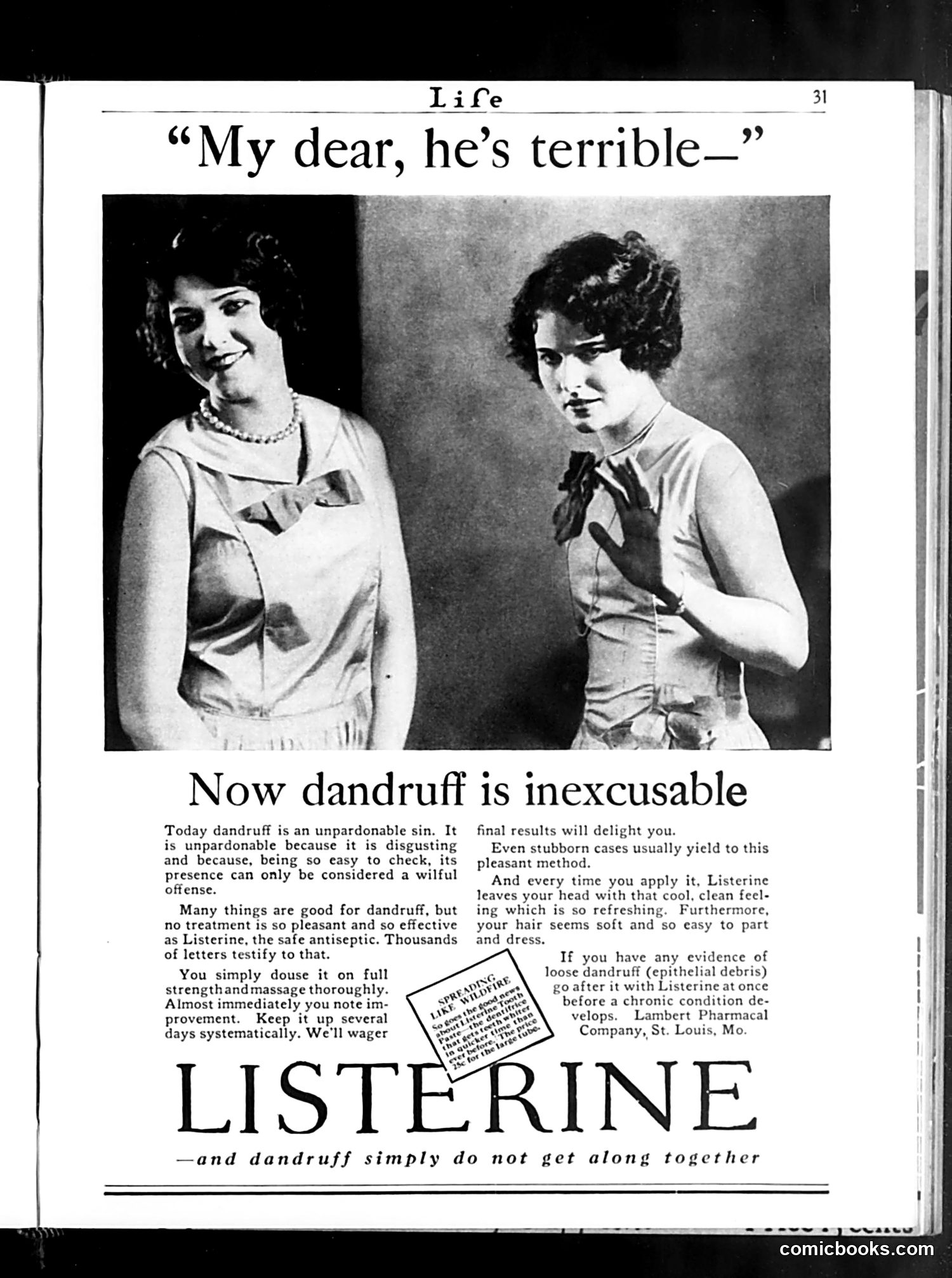
This is a **Listerine advertisement**, not a political cartoon. The page uses social satire to sell mouthwash by positioning dandruff as a moral failing rather than a medical condition. The image shows two women in 1920s dress; the woman on the left (smiling) is gossiping about the woman on the right, saying "My dear, he's terrible—" The implication is that the man in question has dandruff, presented as a social disgrace so severe it warrants harsh judgment. The ad's rhetoric treats dandruff as "an unpardonable sin" and "wilful offense"—deliberately moralizing a scalp condition to shame readers into buying the product. This reflects early 20th-century advertising's strategy of creating anxiety about personal hygiene to drive consumption. For modern readers, the stark contrast is notable: today dandruff is recognized as a common, largely harmless condition, while the ad treats it as a character flaw worthy of social ostracism.
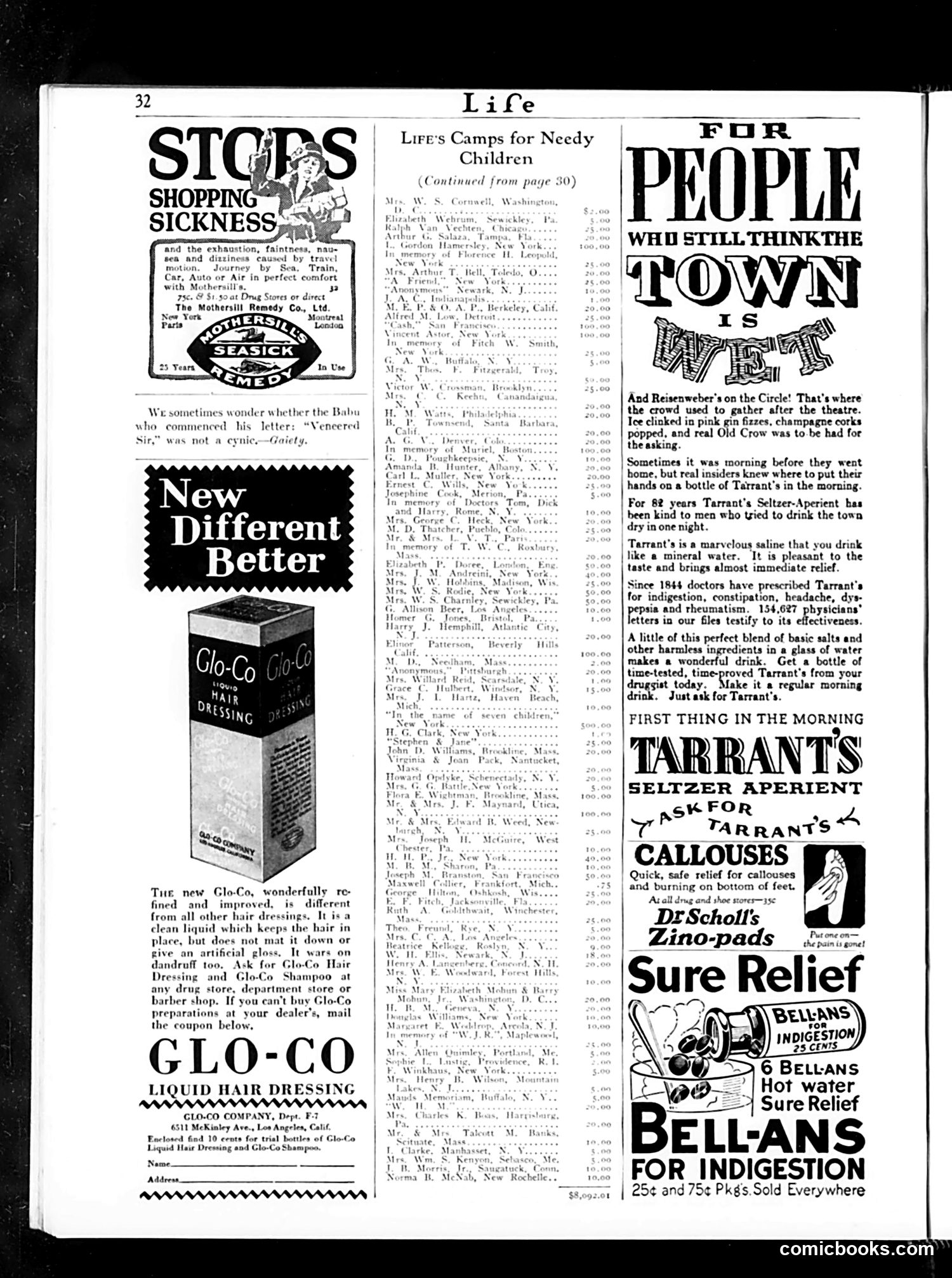
This page is primarily **advertising**, not political satire or comics. It contains multiple patent medicine and consumer product advertisements typical of early 20th-century magazines. Notable content includes: **Mothersill's Remedy** — a nausea/travel sickness remedy **Glo-Co** — a liquid hair dressing product **Tarrant's Seltzer-Aperient** — a saline laxative/digestive aid heavily marketed with nostalgic references to pre-Prohibition nightlife (Reisenberger's restaurant, "pink gin fizzes," Old Crow whiskey) **Dr. Scholl's Zino-pads** — corn/callous relief **Bellans** — indigestion remedy The **sole editorial content** is a brief humor snippet at top-left: a joke about an Indian ("Babu") addressing someone sarcastically as "Venerated Sir," suggesting he's being cynical rather than respectful. The page reflects **1920s-era advertising conventions**: heavy reliance on patent medicines, references to bygone Prohibition-era socializing, and therapeutic claims that would face modern FDA restrictions. This is a commercial, not satirical, document.
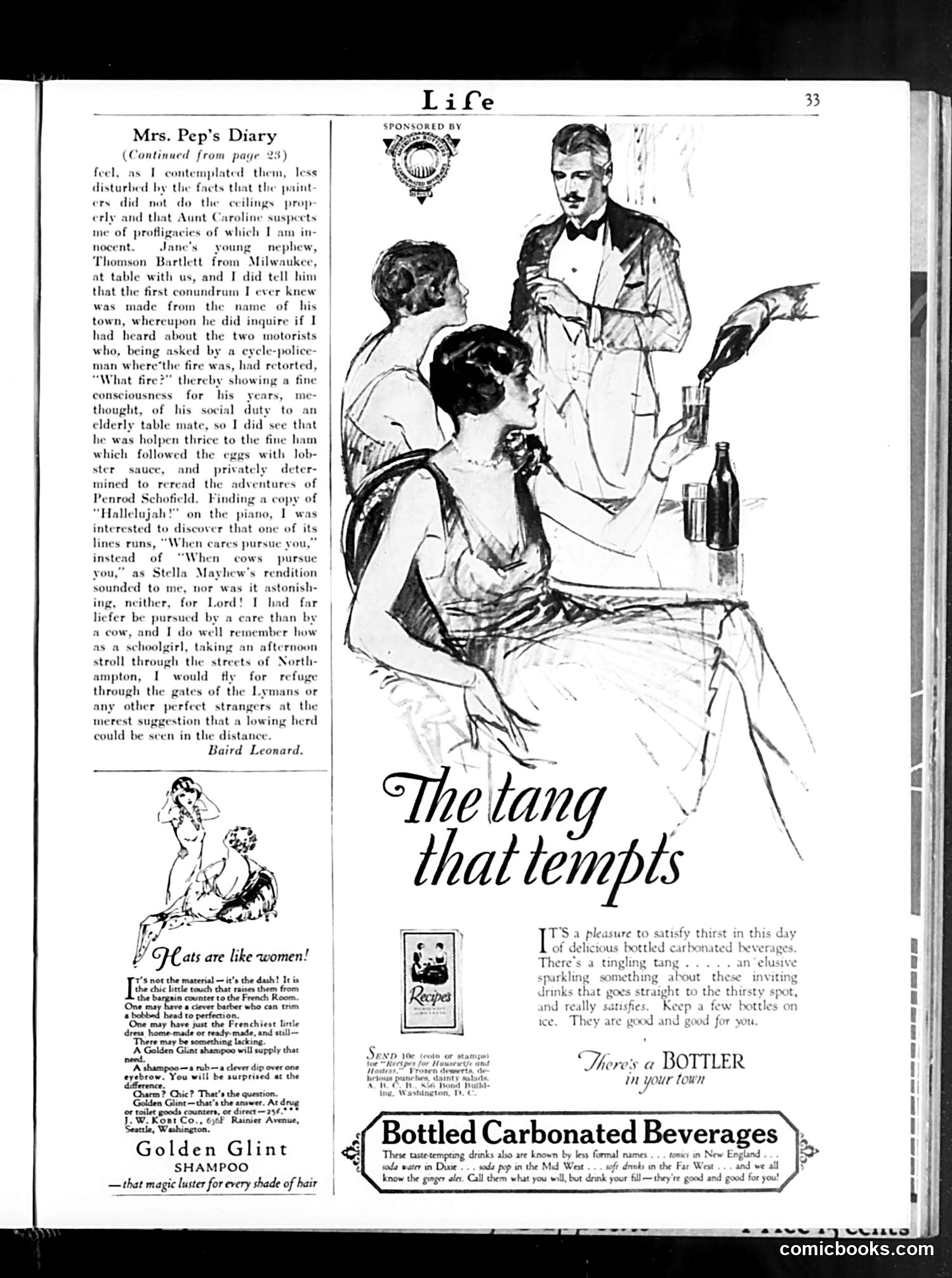
This page contains **Mrs. Pep's Diary**, a serialized humor column about upper-middle-class domestic life. The excerpt mocks genteel anxiety: the narrator frets over improperly painted ceilings and aunt Caroline's suspicions of impropriety, while simultaneously praising a young guest's witty dinner conversation and obsessing over childhood cow-phobia. The satire targets **pretentious social performance**—the diary reveals how arbiters of taste worry endlessly about propriety while their concerns are often trivial or contradictory. The page is otherwise dominated by **period advertisements**: Golden Glint shampoo (promising elegance through grooming) and bottled carbonated beverages (ginger ales, "soda pop," etc.), which were novelty luxury items in this era. The small cartoon "Cats are like women!" offers obvious gender humor typical of 1920s magazine fare, without deeper satire.
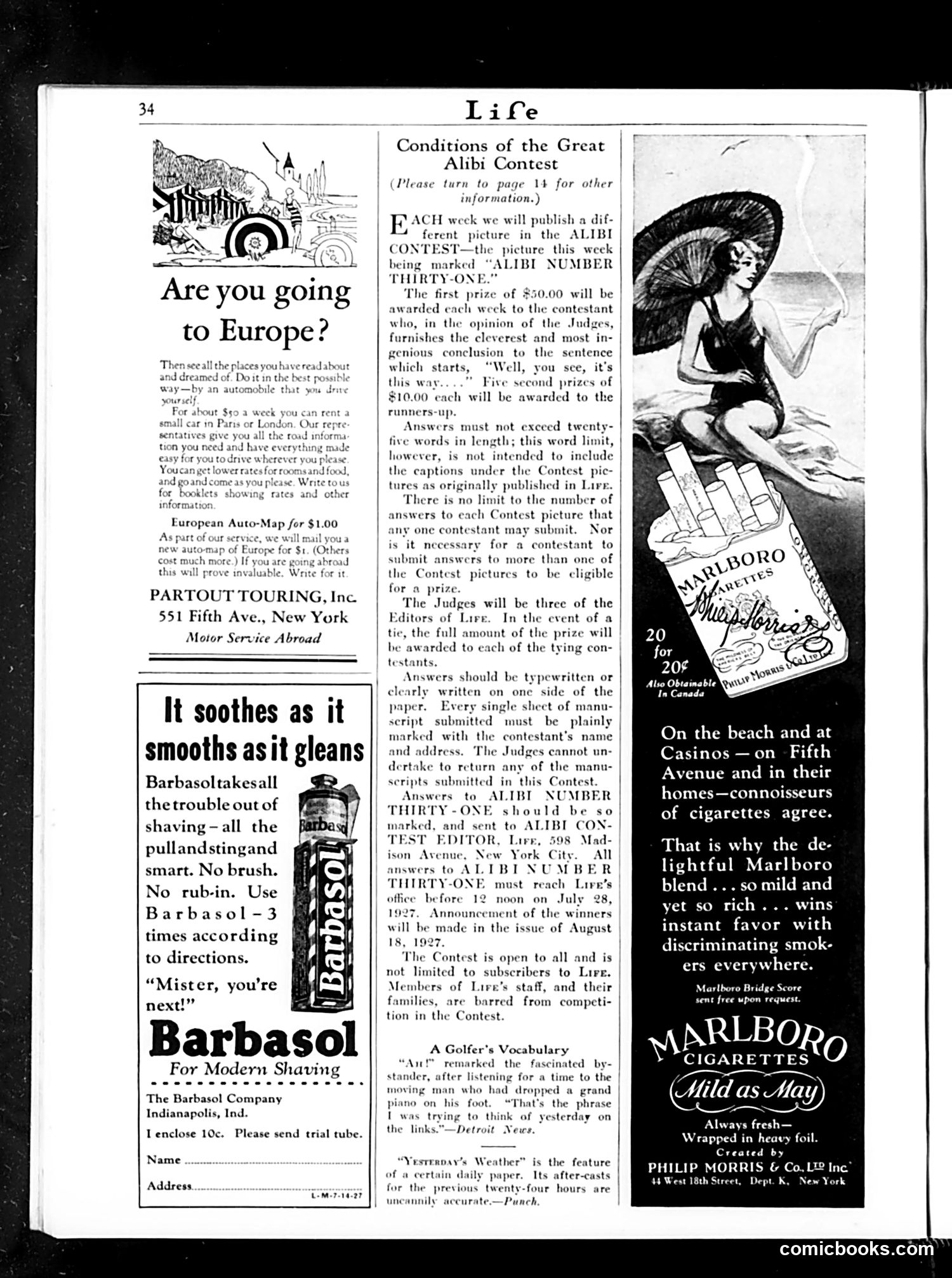
This page is primarily **advertising and contest information** rather than editorial satire or political commentary. The main content features: 1. **Travel/Auto Advertisements**: Parlourist Touring (European travel) and a European Auto-Map for motorists 2. **Barbasol Shaving Cream Ad**: Humorously promises shaving "without brush," "pull," or "sting"—positioning itself as modern convenience 3. **The Alibi Contest**: Life's weekly creative writing competition where readers submit humorous "alibis" to explain cartoon situations (completing "Well, you see, it's this way..."). Winners receive $50 weekly, with $10 second prizes 4. **Marlboro Cigarettes Ad**: Features an illustration of a woman at the beach, marketing cigarettes as refined and luxurious 5. **Minor Humor Items**: Including "A Golfer's Vocabulary" joke about creative cursing The page reflects **1927 American consumer culture**—automobiles, modern grooming products, leisure activities, and smoking as aspirational lifestyle markers. There is no political satire visible; this is a typical commercial magazine page mixing ads with reader engagement contests.
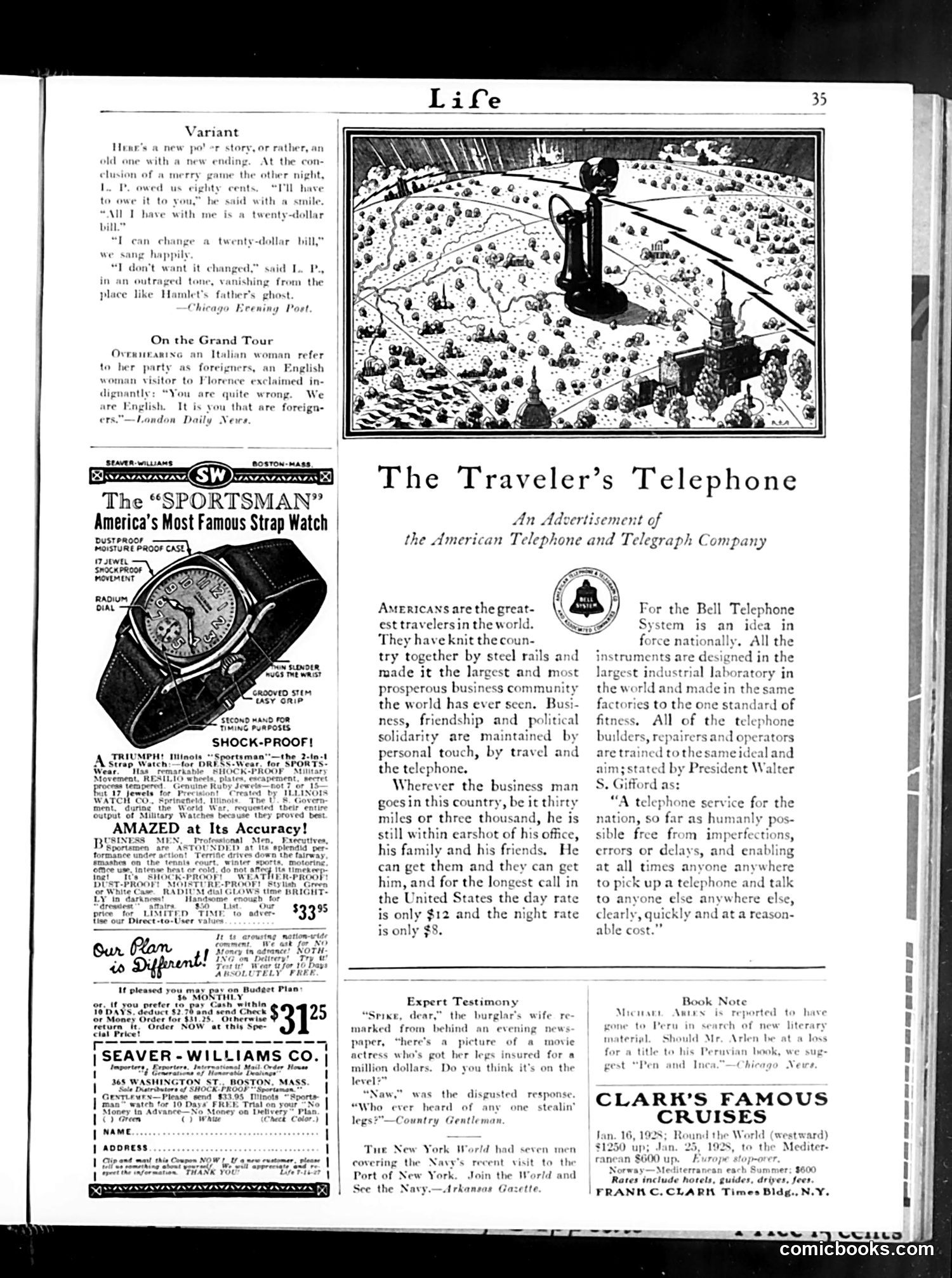
This page contains **primarily advertisements** rather than political satire. The main content includes: **"The Traveler's Telephone"** — an AT&T advertisement promoting long-distance calling as essential to American business and travel. It emphasizes that businessmen can stay connected to offices and families from anywhere in the country at reasonable rates ($12 day/$8 night for lengthy calls). This reflects early 20th-century enthusiasm for telephone technology as a modernizing force binding the nation together. **Supporting content** includes: - The "Sportsman" watch advertisement (shock-proof, for timing purposes) - Clark's Famous Cruises travel advertisement - Brief humorous anecdotes in the "Variant" and "On the Grand Tour" sections (mild jokes about money and cultural attitudes toward foreigners) - Small items on burglar humor and book notes The page reflects **1920s consumer culture**: advertisements dominate, promoting travel, communications technology, and luxury goods to an upwardly mobile American audience. There is minimal political satire—this is a commercial publication focused on selling products and experiences to readers.
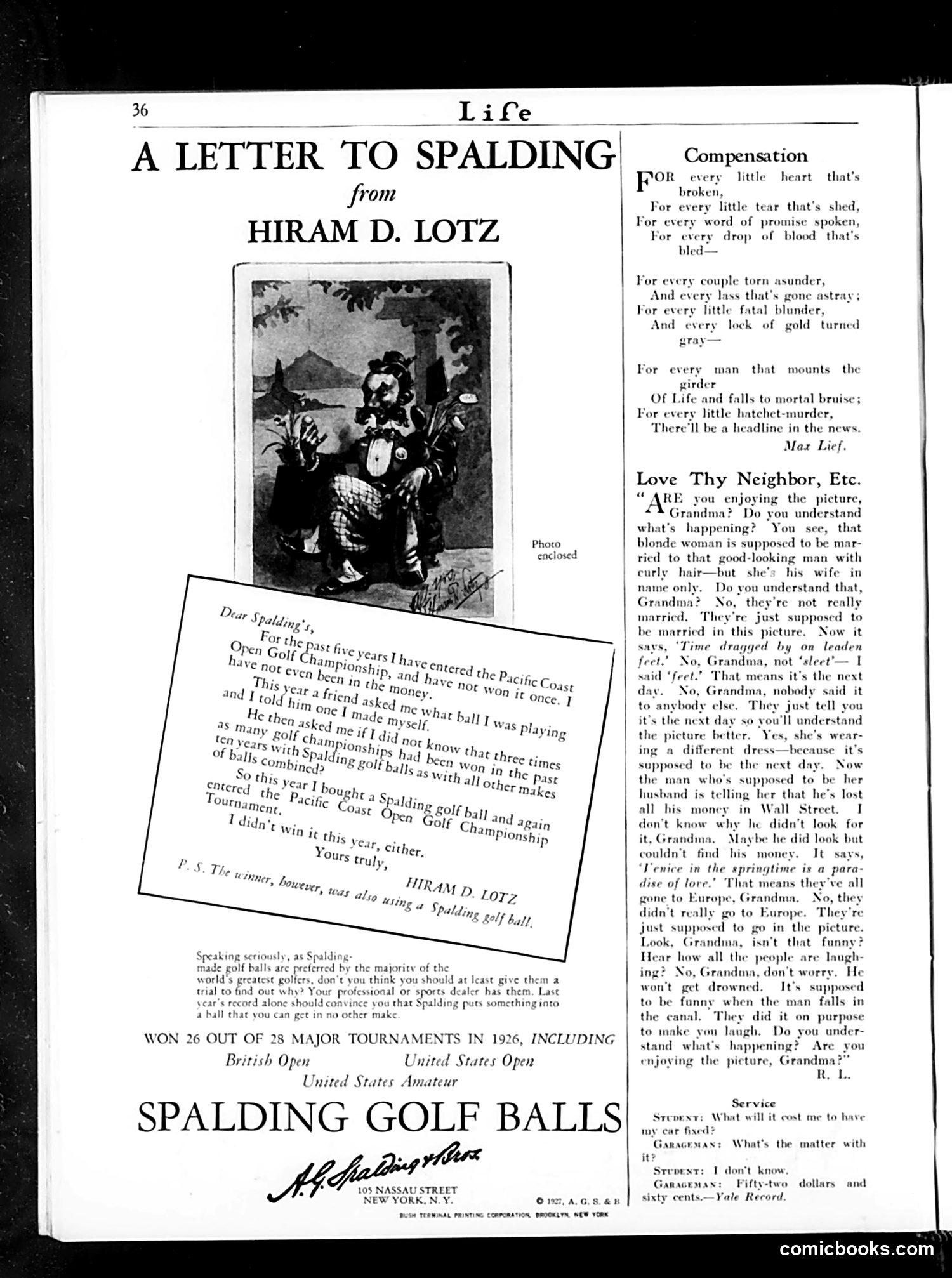
This page contains **Spalding Golf Ball advertising** disguised as editorial content, alongside unrelated humor pieces. ## Main Content: **"A Letter to Spalding"** is a **testimonial advertisement** from "Hiram D. Lotz," claiming he's entered Pacific Coast Open Golf Championships for five years without winning, implying he needs better equipment. The letter urges readers to try Spalding balls because they're "preferred by the majority of the world's greatest golfers." The advertisement emphasizes that Spalding won 26 of 28 major tournaments in 1926. ## Side Content: **"Compensation"** is a cynical poem listing life's tragedies (broken hearts, deaths, infidelities) as trade-offs for newspaper headlines—satirizing how society consumes human suffering as entertainment. **"Love Thy Neighbor, Etc."** humorously depicts a grandmother struggling to understand a movie plot, with the narrator patiently explaining melodramatic conventions (affairs, financial ruin, slapstick accidents). **"Service"** presents a brief joke about car repair costs. The page demonstrates how 1920s magazines blended advertising with editorial content, often indistinguishably.
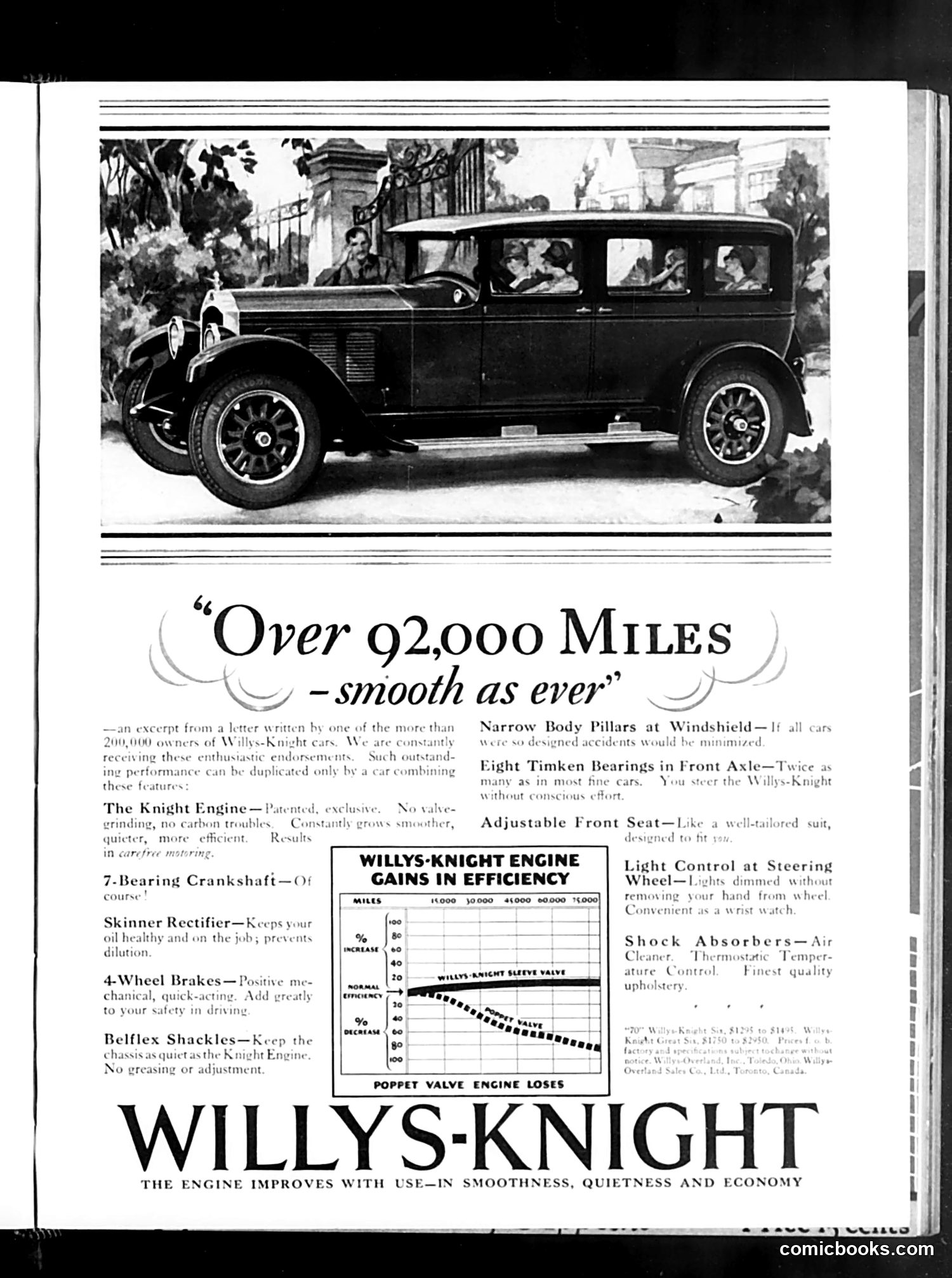
This is a **Willys-Knight automobile advertisement**, not a political cartoon. The page promotes the Willys-Knight car's features and engine superiority to a modern reader unfamiliar with early automotive history. The advertisement emphasizes that the Willys-Knight engine "improves with use" in smoothness, quietness, and economy. A chart compares the Willys-Knight's "Safety Valve" performance favorably against a "Poppet Valve Engine," showing the competitor's efficiency declining with mileage while Willys-Knight maintains performance. The car photo shows a substantial sedan with multiple passengers visible through windows, emphasizing its family capacity and comfort features—narrow windshield pillars, adjustable front seats, shock absorbers, and light controls. The headline quotes an owner's letter claiming over 92,000 miles of smooth operation, using customer testimonials as credibility markers typical of early automotive advertising appeals.
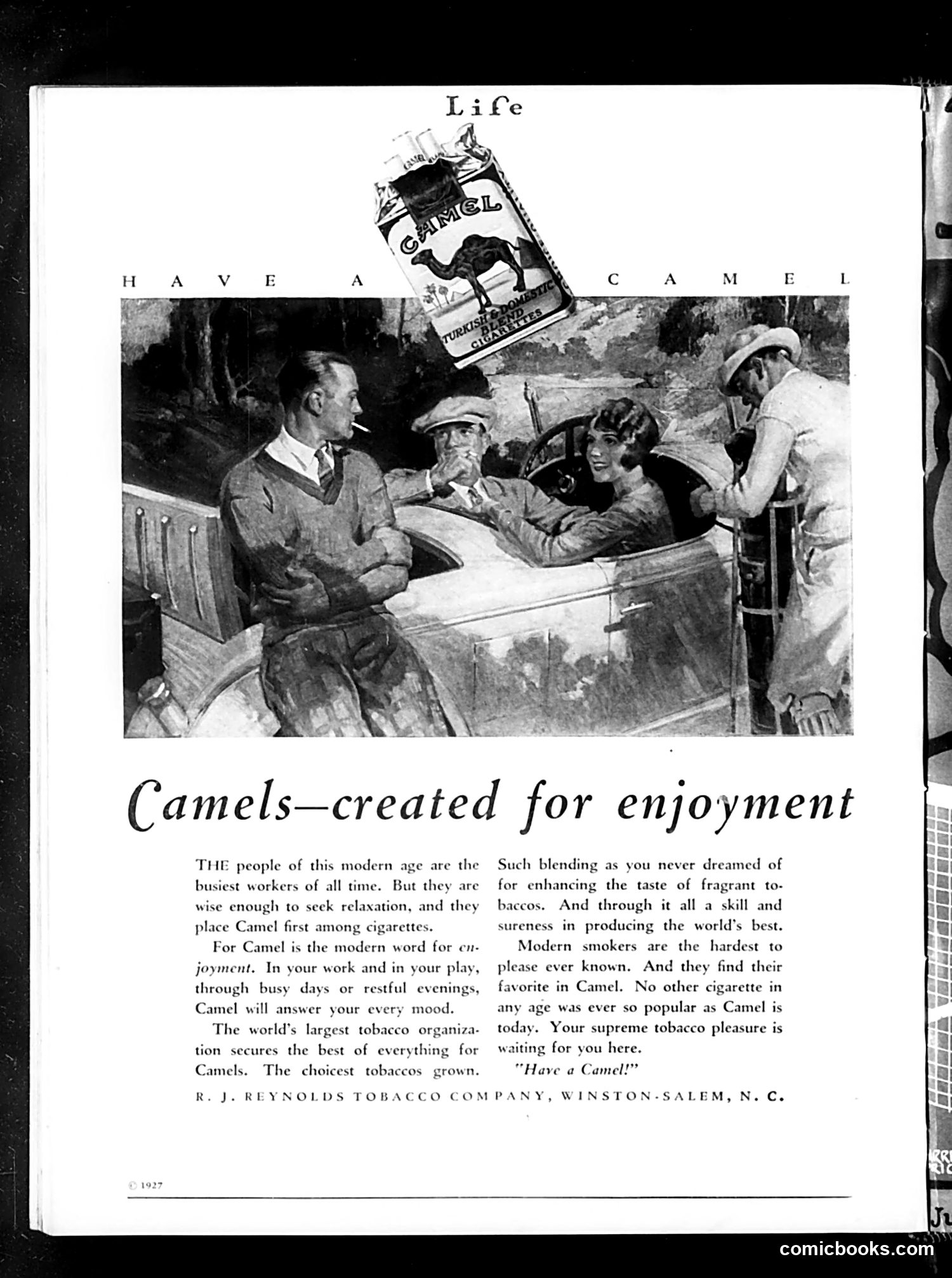
This is a **Camel cigarette advertisement**, not satirical content. The page shows a 1927 ad from Life magazine featuring an illustration of well-dressed people relaxing in an automobile. The ad's appeal targets "modern" professionals seeking stress relief—a key marketing angle of the era. The phrase "Camel is the modern word for enjoyment" positions smoking as essential to leisure and sophistication. **What a modern reader should know:** This predates health warnings and cigarette regulation. The ad assumes cigarettes are a social good associated with relaxation and success. The "busy workers of all time" framing justifies smoking as necessary downtime. The claim that Camels are "the hardest to please ever known" uses reverse psychology—suggesting discriminating smokers prefer this brand. By today's standards, this normalizes and glamorizes a deadly product without any health disclaimers.