
Life, 1927-07-14 · page 11 of 40
Life — July 14, 1927 — page 11: what you’re looking at
What you’re looking at
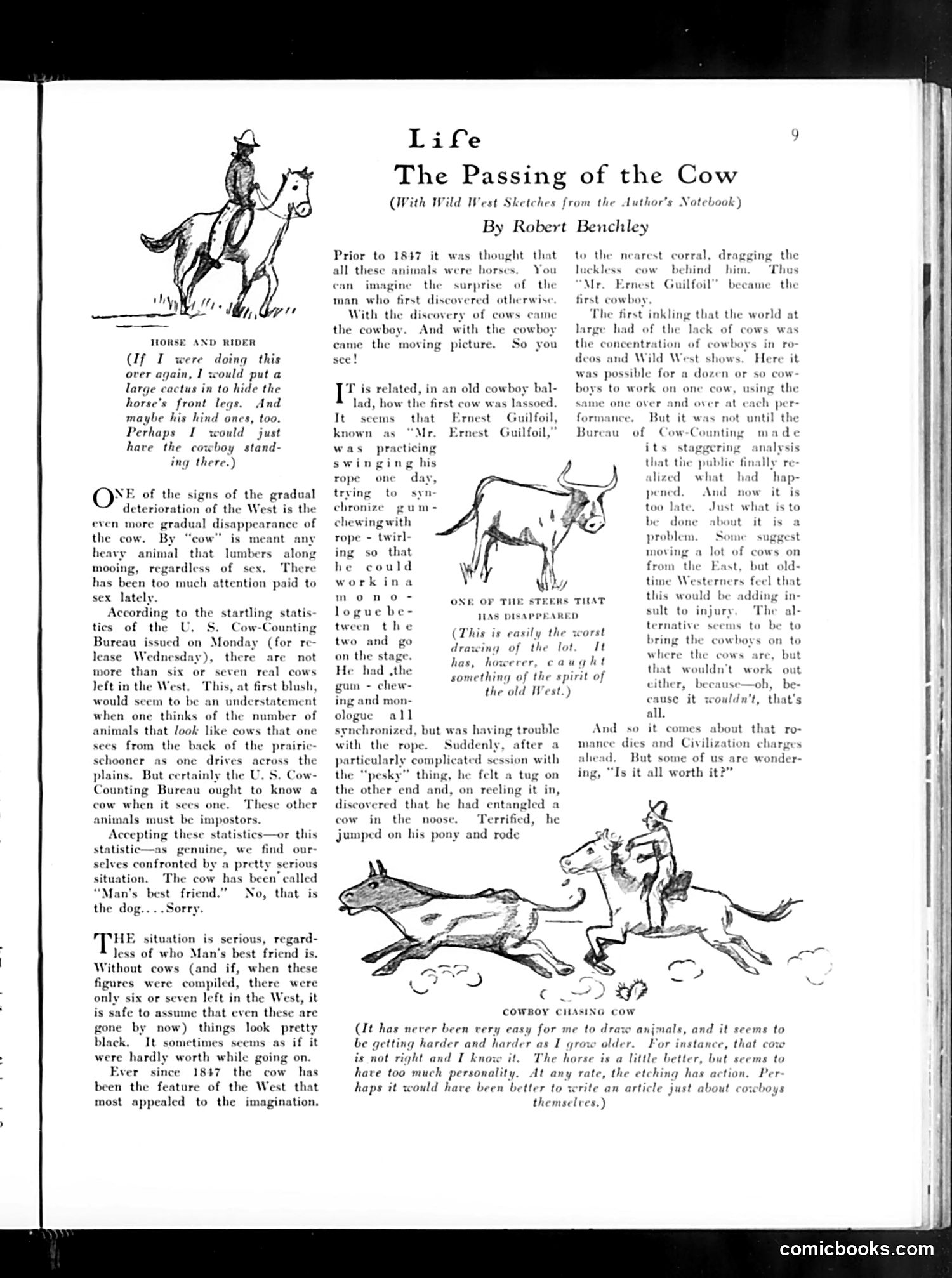
This article by Robert Benchley laments the disappearance of cattle from the American West. The text notes that prior to 1817, all animals were thought to be horses; the discovery of cows led to the "cowboy." The sketches illustrate a practical problem: a cowboy attempting to lasso a cow that has become entangled in rope. The accompanying caption humorously acknowledges the difficulty—the artist admits drawing animals is increasingly hard as he grows older, and this particular cow "is not right" and the horse "has too much personality." The satire critiques the romanticization of Western life while acknowledging real logistical challenges of ranching. Benchley uses gentle humor to comment on the West's decline and changing mythology during the early 20th century.
📄 Transcribed text from this page (OCR, searchable)
Machine-transcribed from the original scan — historical spelling and the odd misread are preserved.
HORSE AND RIDER (If I were doing this over again, I would put a large cactus in to hide the horse's front legs. And maybe his hind ones, too. Perhaps I would just have the cowboy stand- ing there.) O* ~ of the signs of the gradual deterioration of the West is the even more gradual disappearance of the cow. By “cow” is meant any heavy animal that lumbers along mooing, regardless of sex. There has been too much attention paid to sex lately. According to the startling stati tics of the U. Cow-Counting Bureau issued on Mond (for re- lease Wednesday), there are not more than six or seven real cows left in the West. This, at first blush, would scem to be an understatement when one thinks of the number of animals that look like cows that one sees from the back of the prairie- schooner as one drives across the plains. But certainly the U Counting Bureau ought to know a cow when it sees one. These other animals must be impostors. Accepting these statisties—or this statistic—as genuine, we find our- selves confronted by a pretty serious situation. The cow has been’ called “Man's best friend.” No, that is the dog... .Sorry. THE situation is serious, regard- less of who Man's best friend is. Without cows (and if, when these figures were compiled, there were only six or seven left in the West, it is safe to assume that even these are gone by now) things look pretty black. It sometimes seems as if it were hardly worth while going on. Ever since 1847 the cow has been the feature of the West that most appealed to the imagination. Life The Passing of the Cow (With Wild West Sketches from the Author's Notebook) By Robert Benchley Prior to that all these can man who first discovered ot With the discovery of cows came And with the cowboy came the moving picture. see! 1847 it animals were was thought horses. imagine the surprise of the cowboy. So you I’ . is related, in an old cowboy bal- lad, how the first cow was lassoed that Ernest Guilfoil, “Mr. Ernest Guilfoil, practicing It seems known as was swinging his rope one trying to chronize day, syn gum- chewing with rope - twirl- that he could workina mono - logue be- the and go ing so tween two on the stage. He had ,the gun - chew- ing and mon- all srnchronized, but was having trouble with the rope. Suddenly, after a particularly complicated session with the “pesky” thing, he felt a tug on the other end and, on reeling it in, discovered that he had entangled a cow in the Terrified, he jumped on his pony and rode drawing of the has, however, ologue noose. COWBOY CHASING ONE OF THE STEERS THAT WAS DISAPPEARED (This is easily the worst lot caught something of the spirit of the old West.) to the luckless cow Mr. Ernest first cowboy The first inkling that the world at large had of the lack of the concentration of cowboys in ro deos and Wild West shows. Here it was | or so cow- corral, dragging the behind him. TI Guilfoil” became the neare cows was ssible for zen boys to work on one cow, using the same one over and over at each per- But it was not until the Cow-Counting its st that the public finally re- fo nee. Bureau of made ering analysis what had pened. And too late, Just what is to be done abo: it a lized hap- now it is problem. So: 1 lot of cows on from the East, but old- time Westerners feel that this would be sult to injury moving adding in- The al- ternative seems to be to It bring the cowboys on to where the cows are, but that wouldn't work out either, because—oh, be- cause it wouldn't, that's all. And so it comes about that ro- mance dies and Civilization charges ahead, But some of us are wonder- ing, “Is it all worth it cow (It has never been very easy for me to draw anjmals, and it seems to be getting harder and harder as I grow older. is not right and I know it. The horse is a little For instance, that cow better, but seems to have too much personality, At any rate, the etching has action, Per haps it would have been better to wri an article just about cowboys themselves.) comicbooks.com