
Life, 1927-07-14 · page 23 of 40
Life — July 14, 1927 — page 23: what you’re looking at
What you’re looking at
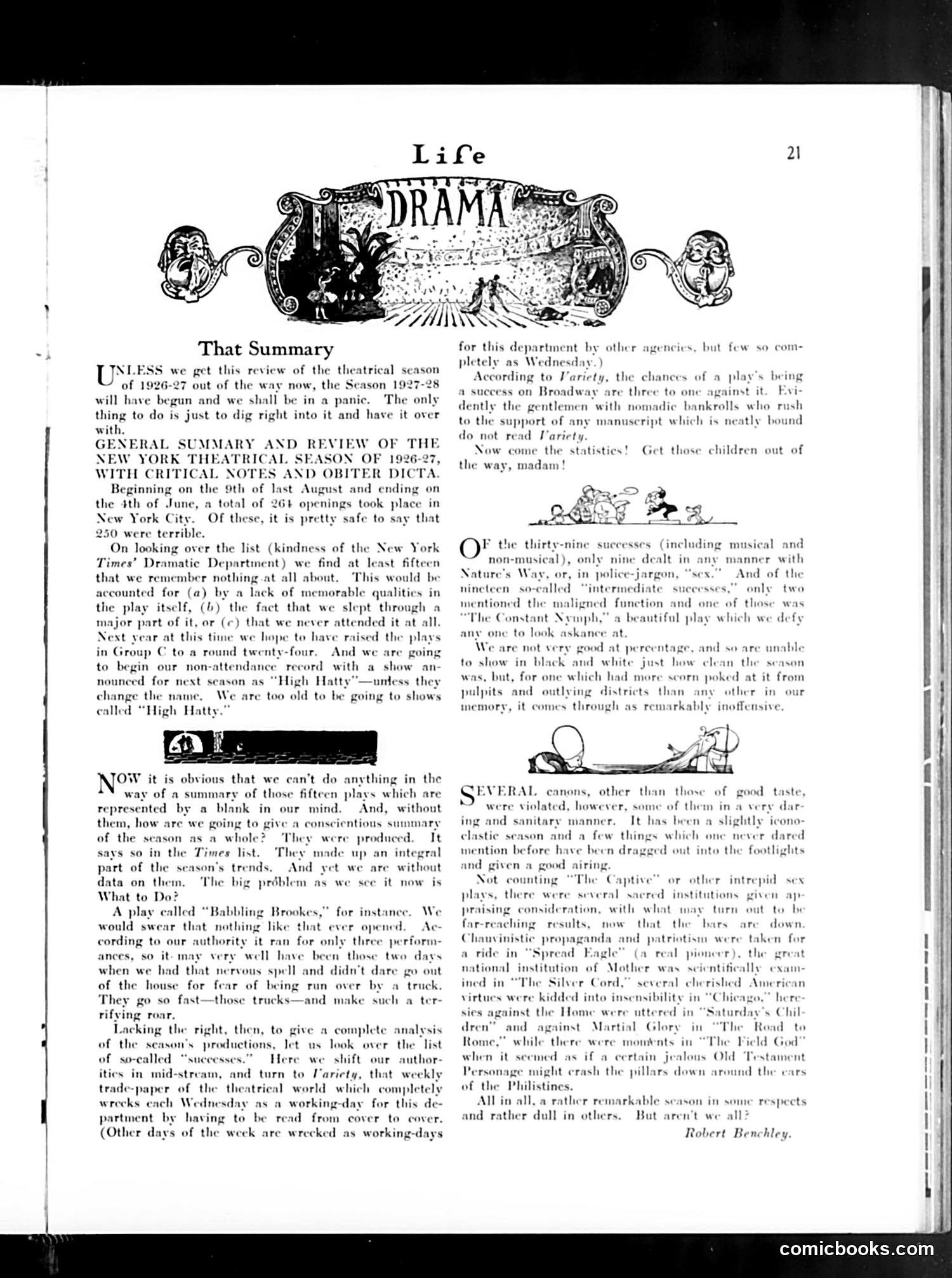
This page is a humorous critical essay on Broadway's 1926-27 theatrical season by Robert Benchley. The satire targets both the theater industry and the magazine's own critical methods. **Main jokes:** 1. **The "non-attendance record"**: Benchley admits he slept through or skipped many plays, yet must review them anyway—mocking both his own laziness and critics' pretensions to expertise. 2. **"High Hatty" complaint**: He ridicules the show's silly title, suggesting Broadway producers lack imagination. 3. **The statistics dodge**: He cites *Variety* trade paper data showing only 3-to-1 odds a Broadway play succeeds, then ironically notes the season was surprisingly "clean" (lacking sexual content)—contrasting Broadway's reputation for scandal with actual innocuousness. 4. **The cartoons** (illustrated figures throughout) provide visual comedy supporting his written mockery of theater-going culture. The piece satirizes how critics manufacture authority through selective data while admitting ignorance—a timeless critique of critical pretense.
📄 Transcribed text from this page (OCR, searchable)
Machine-transcribed from the original scan — historical spelling and the odd misread are preserved.
em That Summary INLE we get this review of the theatrical season 7 of 1926-27 out of the way now, the will have begun and we shall be in a panic. The only thing to do is just to dig right into it and have it over with, NERAL SUMMARY AND REVIEW OF THE NEW YORK THEATRICAL SEASON OF 19 WITH CRITICAL NOTES AND OBITER DIC Beginning on the 9th of last August and ending on the 4th of June, a total of openings took place New York City. Of these, it is pretty safe to say that ) were terrible. On looking over the list (kindness of the New York Times’ Dramatic Department) we find at least fifteen that we remember nothing-at all about. This would be accounted for (a) by a lack of memorable qualities in the play itself, (b) the fact that we slept through a major part of it, or (c) that we never attended it at all. Next year at this time we hope to have raised the plays in Group C to a round twenty-four. And we ¢ to begin our non-attendance record with a » going wane nounced for next season as “High Hatty"—untess they change the name. We are too old to be going to shows called “High Hatty.” OW it is obvious that we can't do anything in the way of a summary of those fifteen plays which are represented by a blank in our mind. And, without them, how we going to give a conscientious summary of the season as a whe They were produced. It says so in the Times list. ‘They i made up part of the season’s trends. And yet we are without data on them. The big problem as we see it now is What to Do? A play called “Babbling Brookes,” for instance. We would swear that nothing like that ever openc Ac cording to our authority it ran for only three perform- ances, so it: may very well have been those two days when we had that nervous spell and didn't dare go out of the house for fear of being run over by a truck. They go so fast—those tracks—and make such a ter- rifying roar. Lacking the right, then, to give a complete analysis of the sease productions, let us look over the list of so-called “successes.” Here we shift. our author- itics in mid-stream, and turn to Mariety, that weekly trade-paper of the theatrical world which completed) wrecks each Wednesday as a working-day for this ¢ partment by having to be read from cover to (Other days of the week are wrecked as working-day for this department by other agencies, but few so com pletely as Wednesday.) According to Variety, the chances of a play's being a success on Broadway are three to one against it. Evi- dently the gentlemen with nomadic bankrolls who rush to the support of any manuscript which is neatly bound do not read Variety »w come the statistics! Get those children out of the way, madam! F the thirty-nine successes (including musical and non-musical), only nine dealt in any manner with Nature's Way, or, in police-jargon, “sex.” And of the nineteen so-called “intermediate successes,” only two d funetion ar mentioned the malign f those was Phe Constant Nymph,” a beaut any one to look askance at We are not very good at percentage, and so are unable me ul play which we defy to show in black and white just how clean the season was, but, for one which had dat it from pulpits and outlying districts than any other in our © scorn po memory, it comes through as remarkably inoffensive SEVERAL canons, other than those of good taste, nN ing and sanitary manner. It has been a slightly icono- ever dared footlights clastic season and a few thir which one mention before have been dragged out into tl and given a good airing. Not ¢ plays, there were several sacred institutions inting “The Captive’ or other intrepid) sex en ap praising consideration, with what may turn out to be far-reaching results, now that the bars are down Chauvinistic propaganda and patriotism were taken for a ride in “Spread Eagle” (a real pioneer) national institution of Mother was scientifically exau the great ined in “The Silver Cord,” several cherished American virtues were kidded into insensibility in “Chicago,” here inst the Home were uttered in “Saturday's Chil id against’ Martial Glory in’ “The Road to while there were moments in “The Field God sies ag dren’ Rome, when it seemed as if a certain jealous Old Testament Personage might crash the pillars down around the ears of the Philistines. Allin all, a rather remarkable season in some respects and rather dull in others. But aren't we all? Robert Benchley. comicbooks.com