
Life, 1927-07-14 · page 18 of 40
Life — July 14, 1927 — page 18: what you’re looking at
What you’re looking at
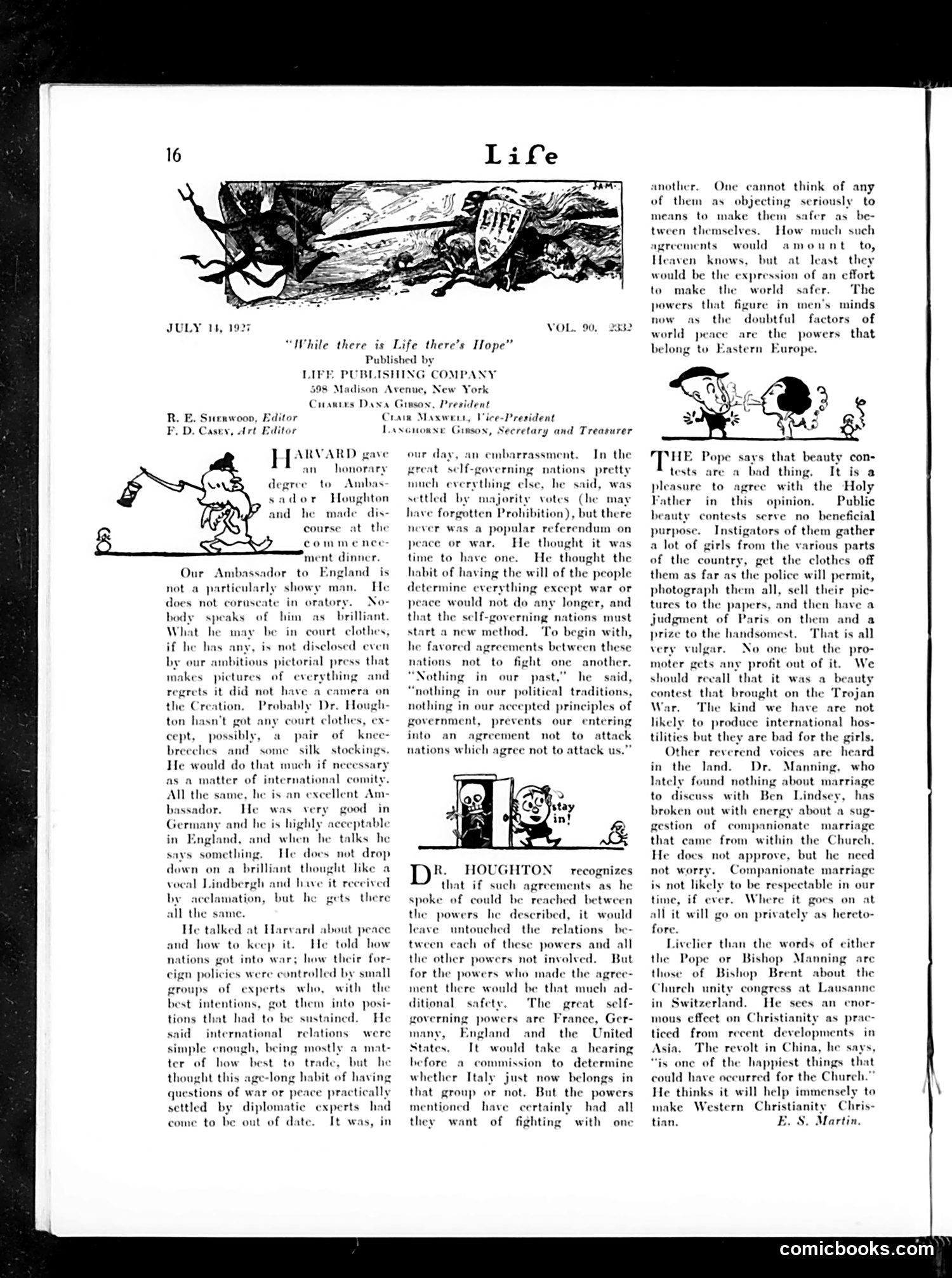
This page satirizes diplomatic efforts to prevent war through international agreements. The main article discusses Harvard's Ambassador to England presenting a peace proposal based on nations signing non-aggression pacts rather than relying on military force. The cartoons mock this idealistic approach. One shows a figure (likely representing diplomatic optimism) naively pushing for peace agreements. The satire suggests such diplomatic initiatives are ineffective—that nations pursuing peace through paper agreements while maintaining military capabilities is contradictory. The text references France, Germany, England, and the United States as key powers needing agreement, reflecting post-WWI concerns about European stability. The cartoons imply diplomats lack practical understanding of how nations actually operate regarding war and peace.
📄 Transcribed text from this page (OCR, searchable)
Machine-transcribed from the original scan — historical spelling and the odd misread are preserved.
JULY 14, 1927 “While there is Life there’s Hope’ Published by LIFE PUBLISHING COMPANY 598 Madison Cuanirs Dawa R. E. Suerwoon, Editor F. D. Casey, Art Editor FPABVarD gave in honorary Ambas sador Houghton and he made course at the commence ment dinner. Our Ambassador to England is not a particularly showy man. He does not coruscate in oratory. No- body speaks of him as_ brilliant What he in court clothes, if he has any, is not disclosed even degree to may be by our ambitious pictorial press that makes pictures of everything and regrets it did not have a camera on the Creation, Probably Dr. Hough- ton hasn't got any court clothes, ex- cept, possibly, a pair of _knee- breeches and silk stocking He would do that much if necessary as a matter of international comity. All the same, he is an excellent Am- bassador. He Germany and he is highly acceptable in England, and when he talks he says something. He does not drop a brilliant thought like a nd have it received but he there some was very good. in down on vocal Lindberg by acclamation, all the same. He talked at Harvard about peace and how to keep it. He told how nations got into war; how their for- cign policies were controlled by small groups of who, with the best intentions, got them into posi- tions that had to be sustained. He gets experts said international relations were simple enough, being mostly a mat- ter of best to trade, but he thought this age-long habit of having questions of war or peace practically settled by diplomatic experts had It was, in how come to be out of date. Avenue, New York nson, President Craim Maxwent, Vice-President L.ascnouxe Ginson, Secretary and Treasurer In the great self-governing nations pretty much everything else, he said, was settled by majority votes (he may have forgotten Prohibition), but there never was a popular referendum on peace or war. He thought it was time to have one. He thought the habit of having the will of the people determine everything except war or peace would not do any longer, and that the self-governing nations must start a new method. To begin with, he favored agreements between these nations not to fight one another. “Nothing in our past,” he said, “nothing in our political traditions, nothing in our accepted principles of government, prevents our entering into an agreement not to attack nations which agree not to attack us.”” our day, an embarrassment. R. HOUGHTON that if such agreements as he spoke of could be reached between the powers he described, it would leave untouched the relations be- tween each of these powers and all the other powers not involved. But for the powers who made the agree- ment there would be that much ad- ditional safety. The great self- governing powers are France, Ger- ingland and the United It would take a hearing before a commission to determine whether Italy just now belongs in that group or not. But the powers mentioned have certainly had all they want of with one recognizes fighting another. One cannot think of any of them as objecting seriously to means to make them safer as be- tween themselves. How much such igreements would amount to, Heaven but at least they would be the expression of an effort to make the world safer. The powers that figure in men's minds now as the doubtful factors of world peace are the powers that belong to Eastern Europe. knows, TTPHE Pope says that beauty con- tests are a bad thing. It is a pleasure to agree with the Holy Father in this opinion. Public beauty contests serve no beneficial purpose. Instigators of them gather a lot of girls from the various parts of the country, get the clothes off them as far as the police will permit, photograph them all, sell their pic- tures to the papers, and then have a judgment of Paris on them and a prize to the handsomest. That is all very vulgar. No one but the pro- moter gets any profit out of it. We I that it was a beauty contest that brought on the Trojan War. The kind we have are not likely to produce international hos- tilities but they are bad for the girl: Other reverend voices are heard in the land. Dr. Manning, who lately found nothing about marriage to discuss with Ben has broken out with energy about a sug- gestion of companionate marriage that came from within the Church. He docs not approve, but he need not worry. Companionate marri: is not likely to be respectable in our time, if ever, Where it ull it will go on privately as hercto- fore. Livelier than the words of either the Pope or Bishop Manning are those of Bishop Brent about the Church unity congress at Lausanne in Switzerland. He sees an enor- mous effect on Christianity as prac- ticed from recent developments in A The revolt in China, he says, “is one of the happiest things that could have occurred for the Church.” He thinks it will help immensely to make Western Christianity Chris- tian. E. 8. Martin. should ree Lindsey, goes on at comicbooks.com