
A complete issue · 38 pages · 1927
Life — April 14, 1927
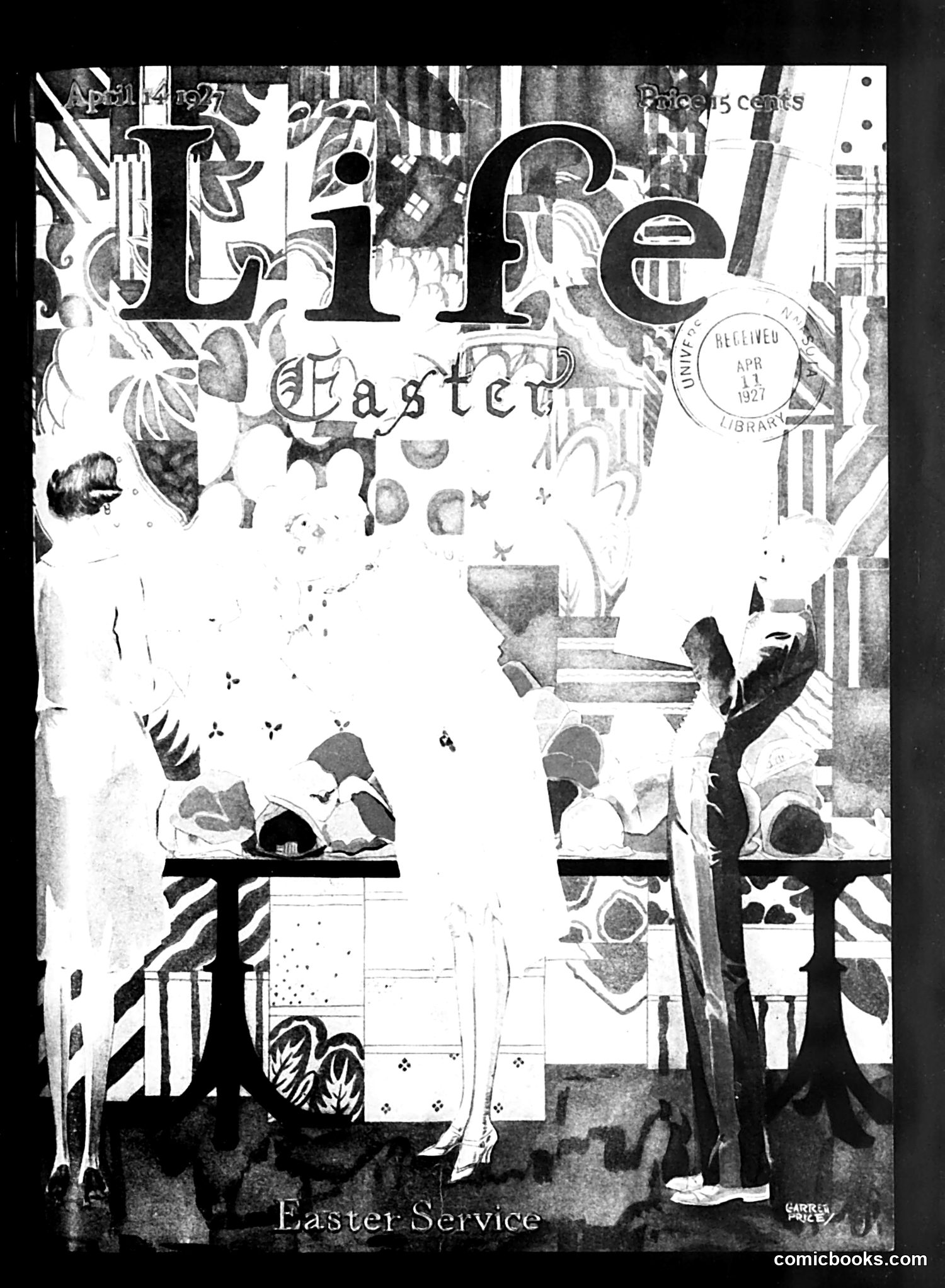
This is a **Life magazine cover from April 14, 1927** (price 15 cents), themed around "Easter Service." The illustration depicts a church interior scene during Easter worship. Two figures are shown—one kneeling in prayer at what appears to be a pew with striped cushioning, another standing. The ornate decorative background includes Easter lilies and religious imagery typical of church holiday observances. The satire appears gentle rather than biting: Life was likely commenting on the social pageantry of Easter services—the formal dress, elaborate floral decorations, and ceremonial aspects of holiday worship. The cartoon style suggests mild humor about how Easter functioned as both spiritual observance and fashionable social event in 1920s American society.
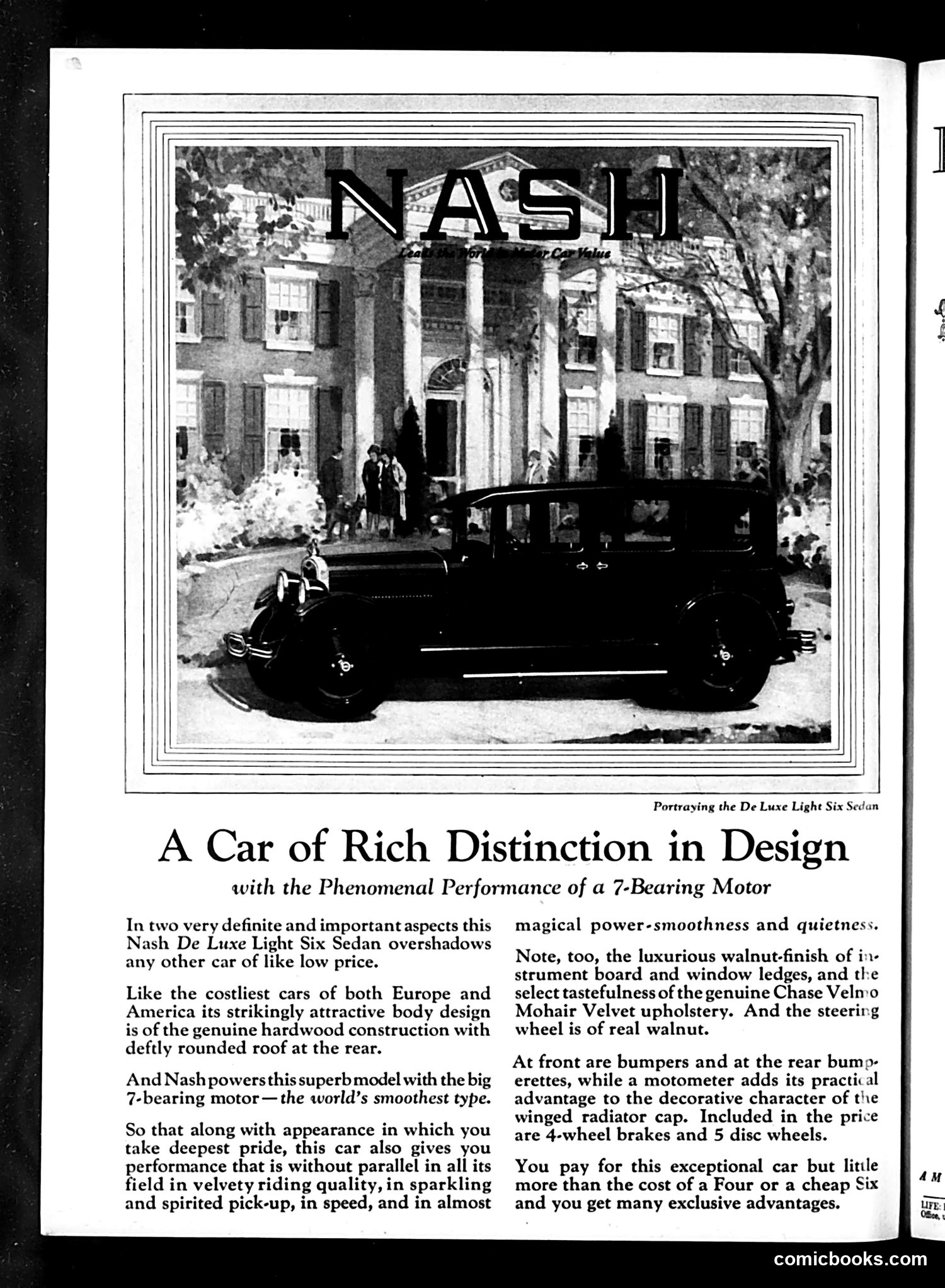
This is not a cartoon or satirical content—it's a **automobile advertisement**, specifically for the Nash De Luxe Light Six Sedan. The page promotes the car's design elegance and performance features, particularly its "7-bearing motor" (described as "the world's smoothest type"). The image shows a luxury sedan parked in front of what appears to be a classical mansion, positioning the vehicle as a status symbol for wealthy buyers. The advertisement emphasizes that despite the car's quality and exclusivity, it costs only slightly more than cheaper models. This represents straightforward **commercial advertising** rather than political or social satire. It's a typical example of 1920s-era automobile marketing that used aspirational imagery and architectural grandeur to appeal to affluent consumers.
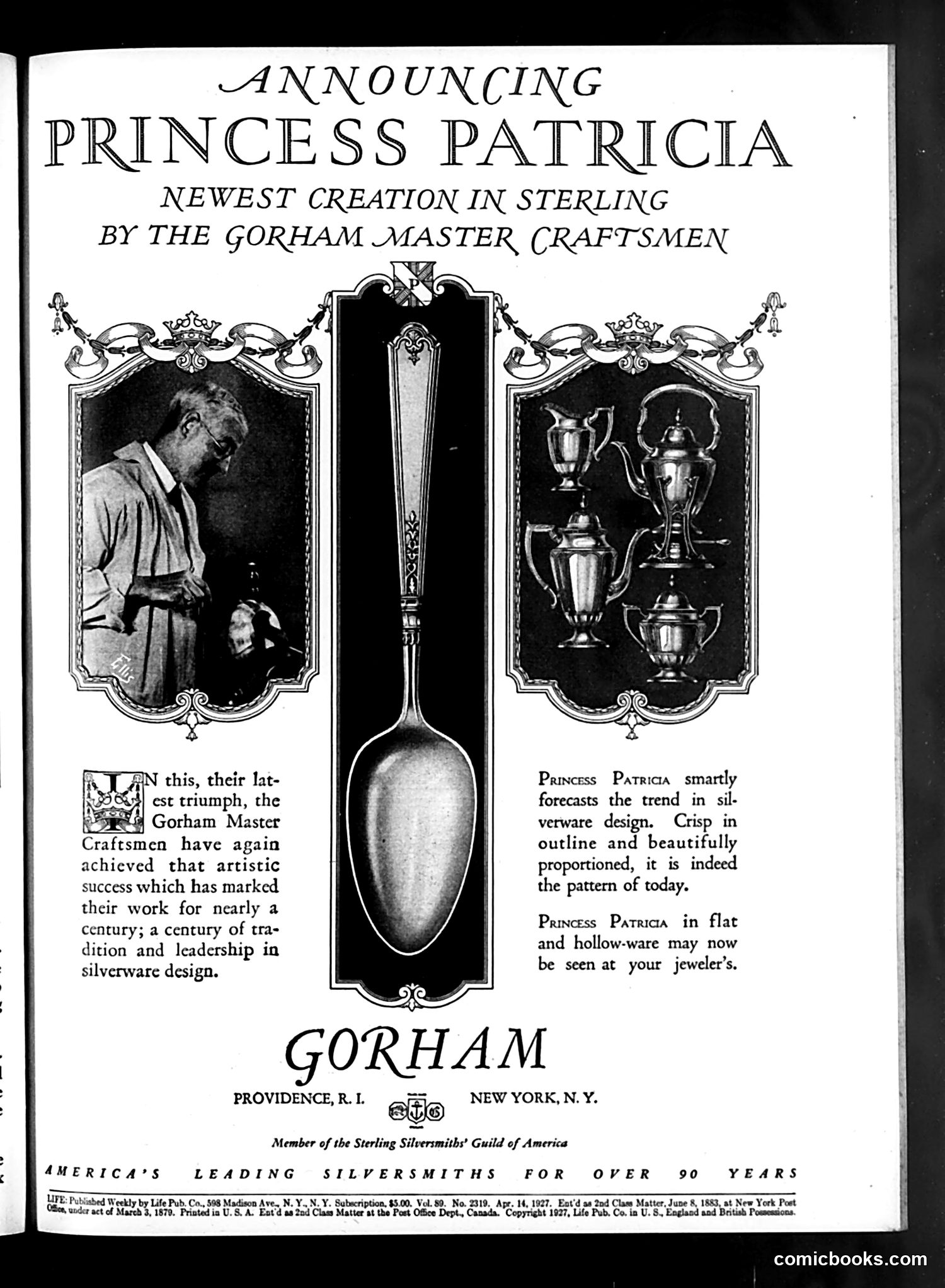
This is not a political cartoon but rather **a vintage advertisement** for Gorham silverware, specifically their "Princess Patricia" pattern. The page announces a new sterling silver design created by Gorham Master Craftsmen. It features three images: a craftsman at work (left), a close-up of a spoon (center), and displayed serving pieces (right). The ad emphasizes Gorham's century-long tradition in silverware design and positions the Princess Patricia pattern as modern and elegantly proportioned—"the pattern of today." The content is purely commercial, targeting wealthy consumers interested in fine tableware. There is no satire, political commentary, or social critique present. This appears to be from Life magazine's advertising section rather than editorial content.
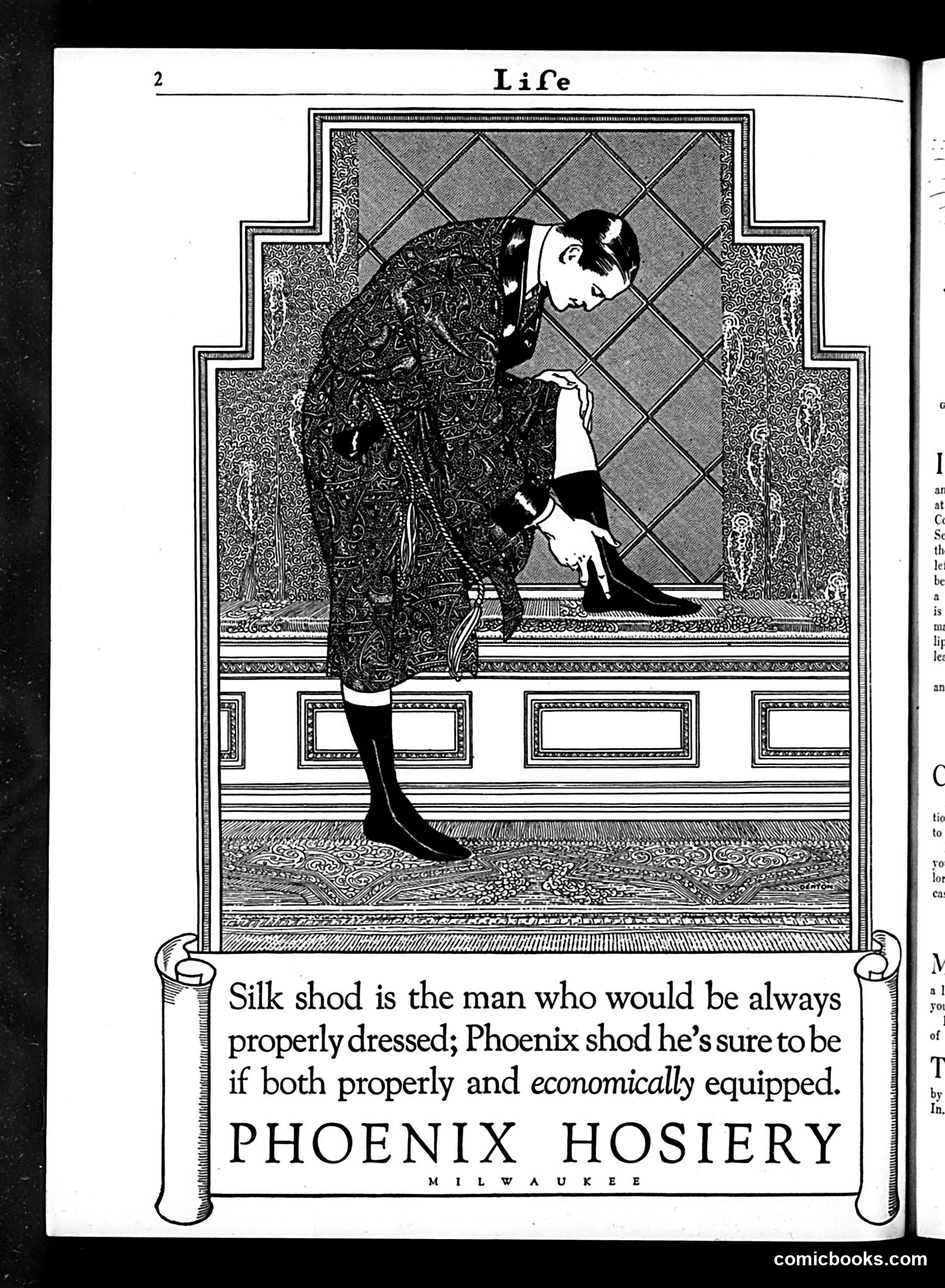
This page is **primarily an advertisement** for Phoenix Hosiery of Milwaukee, not political satire. The illustration depicts a fashionably dressed man in an elegantly furnished interior, shown from approximately waist-down to emphasize his hosiery. The ad's tagline plays on contemporary concerns about proper appearance and economic prudence: "Silk shod is the man who would be always properly dressed; Phoenix shod he's sure to be if both properly and *economically* equipped." The humor is gentle and aspirational rather than satirical—it suggests that Phoenix brand socks allow men to achieve fashionable elegance without extravagant expense. The art deco styling and interior design indicate this targets affluent or aspirational readers of *Life* magazine during the early-to-mid twentieth century.
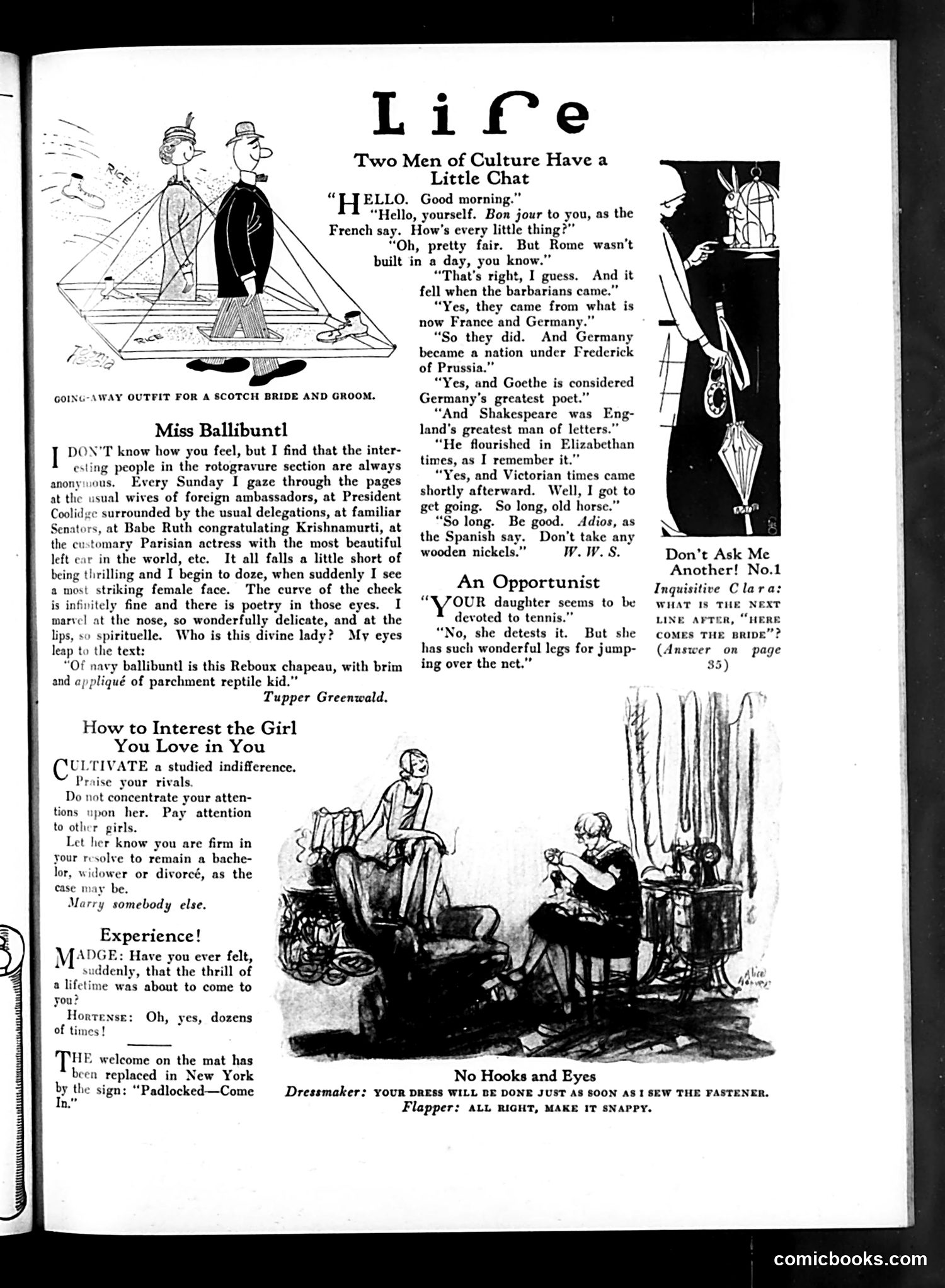
This page contains several satirical pieces targeting early 20th-century social conventions: **"Two Men of Culture"** mocks pretentious intellectuals discussing history and literature superficially—referencing Goethe, Shakespeare, and historical figures like Frederick of Prussia while dropping French phrases ("Bon jour"). The humor lies in their shallow, name-dropping conversation. **"Miss Ballibuntl"** by Tupper Greenwald satirizes readers obsessed with society pages and foreign ambassadors, describing an unnamed woman's striking beauty in overwrought, ridiculous terms—mocking both the subject and society magazine culture. **"How to Interest the Girl You Love"** and **"An Opportunist"** offer absurdist dating/courtship advice, characteristic of Life's humorous advice-column parodies. **"No Hooks and Eyes"** appears to joke about dress fasteners and practicality. The overall tone ridicules upper-class pretension and social rituals.
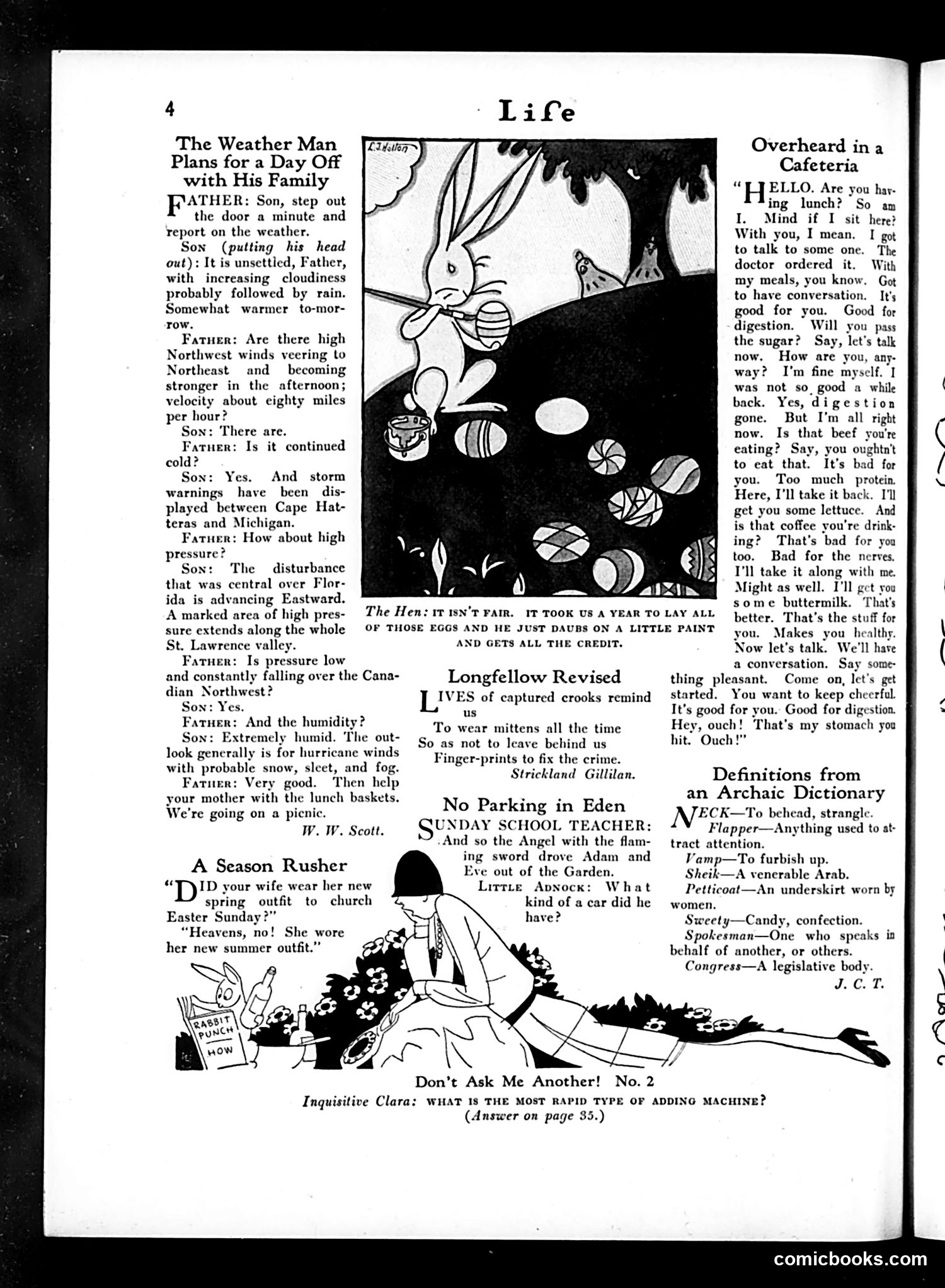
This page contains several humorous sketches satirizing everyday American life, likely from the 1920s-1930s based on the style. **"The Weather Man Plans a Day Off"** mocks the detailed, technical jargon weather forecasters use while delivering uncertain predictions—a timeless complaint about meteorology. **"A Season Rusher"** jokes about a woman purchasing an entire new summer wardrobe for church on Easter, satirizing conspicuous consumption and seasonal fashion obsession among the middle class. **"Longfellow Revised"** offers witty reinterpretations of classic poetry, while **"Definitions from an Archaic Dictionary"** provides humorous alternative definitions of words. The **"Overhead in a Cafeteria"** section captures a recognizable modern anxiety: unsolicited health and dietary advice from a chatty acquaintance during lunch. Overall, the page gently ridicules recognizable social behaviors and American consumer culture.
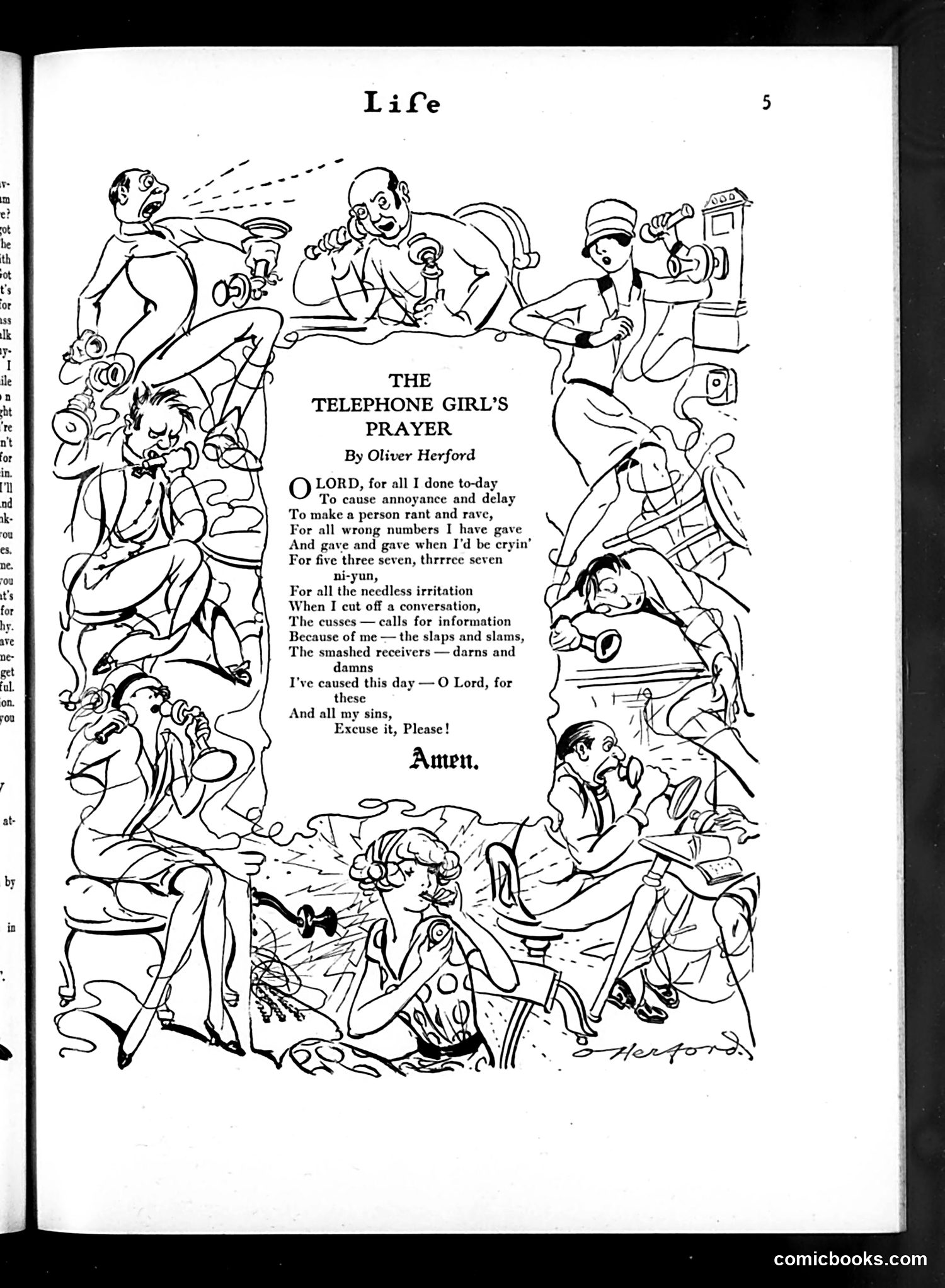
This humorous poem by Oliver Herford satirizes the daily frustrations experienced by telephone operators—primarily women employed by telephone companies. The illustrated prayer catalogs their job-related complaints: connecting wrong numbers, dealing with rude callers who "rant and rave," disconnecting conversations accidentally, and enduring verbal abuse ("cusses," "slaps and slams," "smashed receivers"). The whimsical border illustration depicts operators amid chaos—tangled cords, distressed callers, and mayhem—visually emphasizing the stressful, demanding nature of the work. The satire gently mocks both the operators' predicament and the telephone system's frustrations, while the prayer format transforms workplace grievances into dark comedy. This reflects early-20th-century awareness of difficult working conditions for female telephone operators.
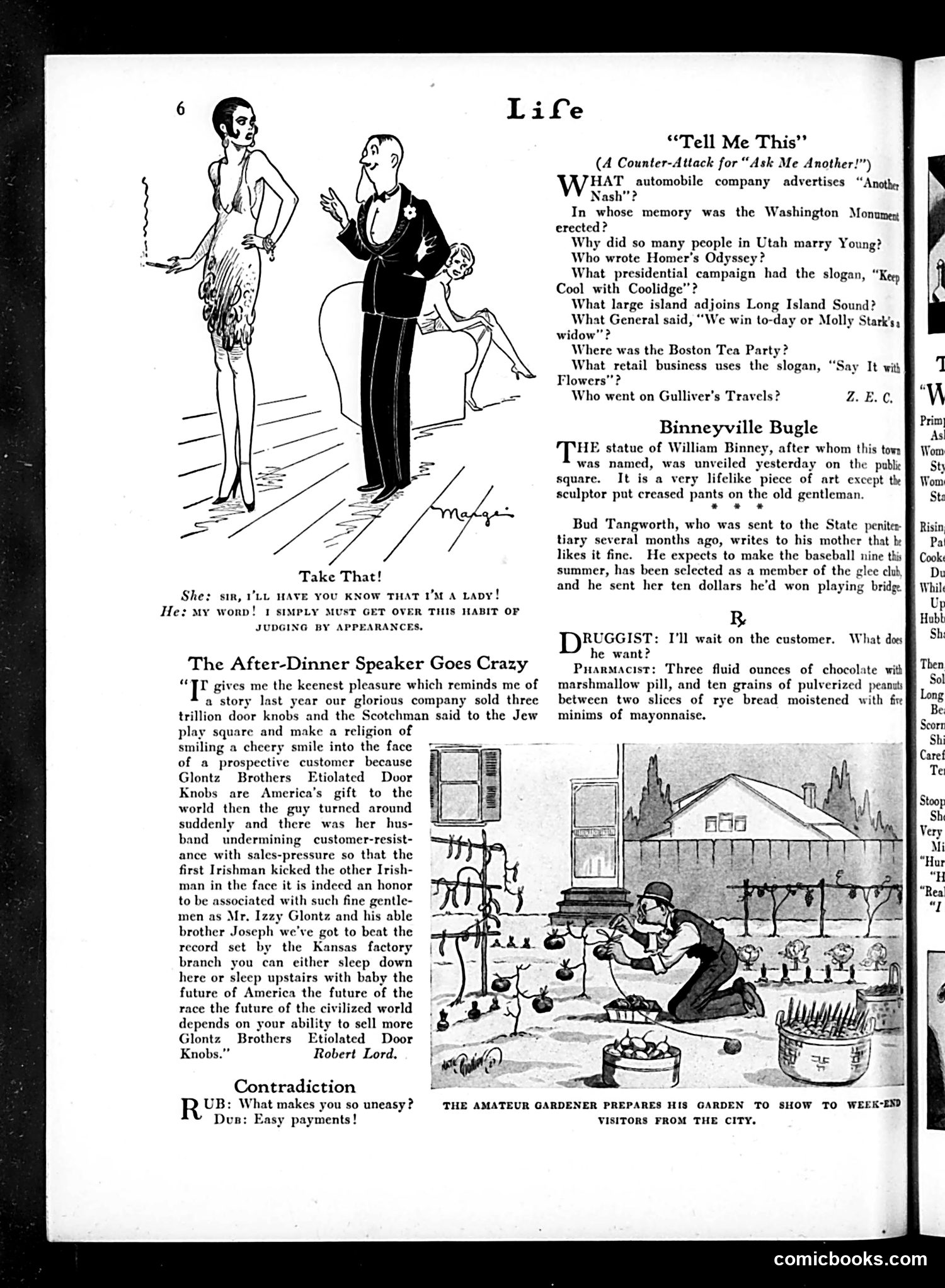
The top cartoon depicts a woman in a revealing dress confronting a formal gentleman. Her caption reads: "She: SIR, I'LL HAVE YOU KNOW THAT I'M A LADY! / He: MY WORD! I NEVER WOULD HAVE GUESSED IT FROM THE HABIT OF JUDGING BY APPEARANCES." **The satire:** This joke mocks both parties—the woman's provocative clothing contradicts her claim to respectability, while the man's assumption that appearance determines status reflects period class anxieties. It satirizes how both men and women judged each other by superficial presentation rather than actual character, a common theme in 1920s Life magazine humor about modern social pretensions and the changing roles of women in post-WWI America.
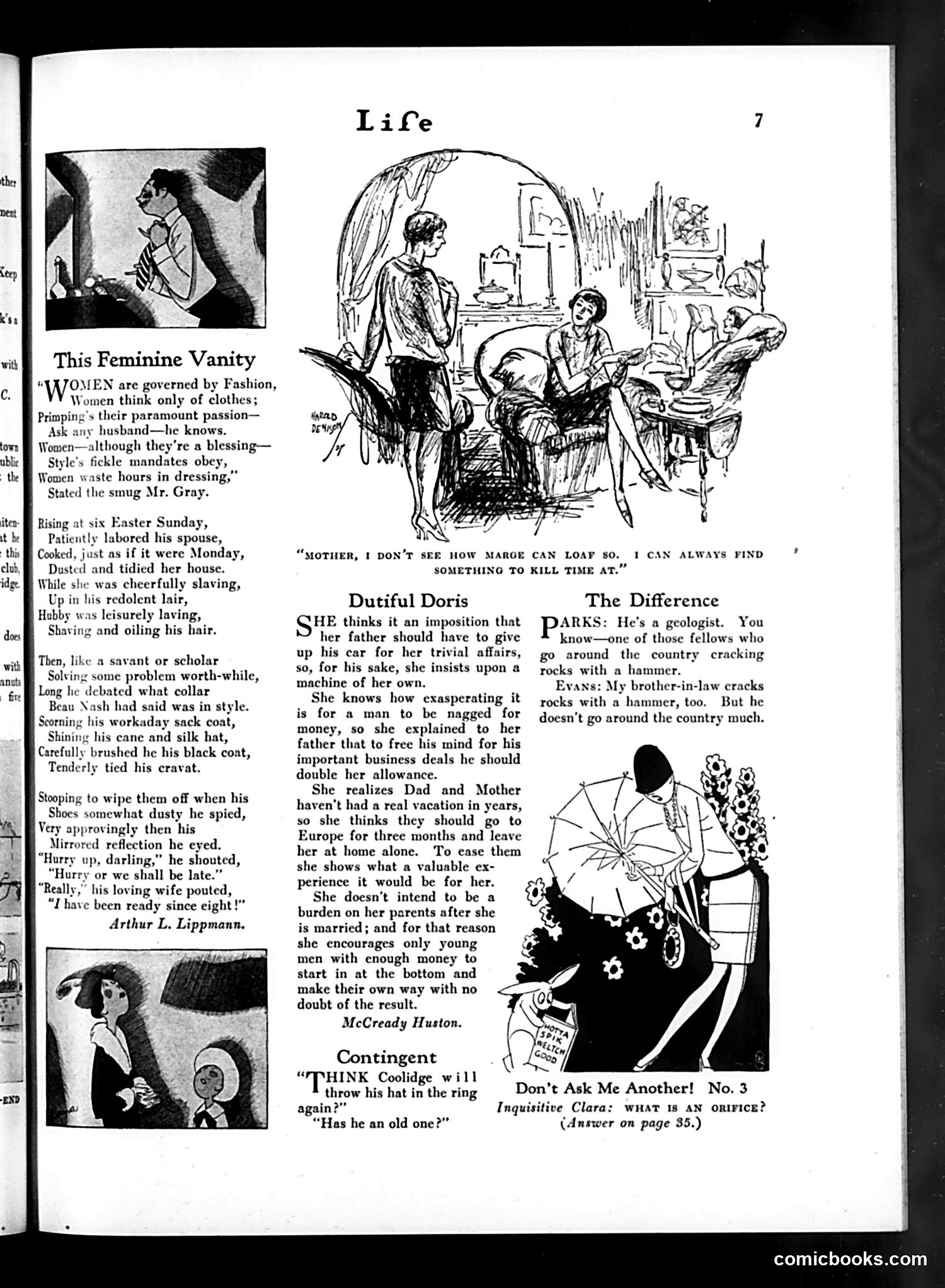
This page presents satirical commentary on gender roles and women's behavior in the early 20th century. **"This Feminine Vanity"** mocks women's preoccupation with fashion and appearance, claiming they think only of clothes while men handle serious matters. The poem by Arthur L. Lippmann describes a husband meticulously grooming himself. **"Dutiful Doris"** satirizes a woman who insists her father finance her leisure activities and pushes her parents toward European vacations so she can remain independent at home—critiquing both female entitlement and reluctance to marry. **"The Difference"** presents a gender joke: men and women behave identically (both crack rocks with hammers), suggesting women's supposed differences are illusory. The cartoons collectively ridicule women's vanity, manipulation of parents, and the gap between claimed versus actual gender distinctions.
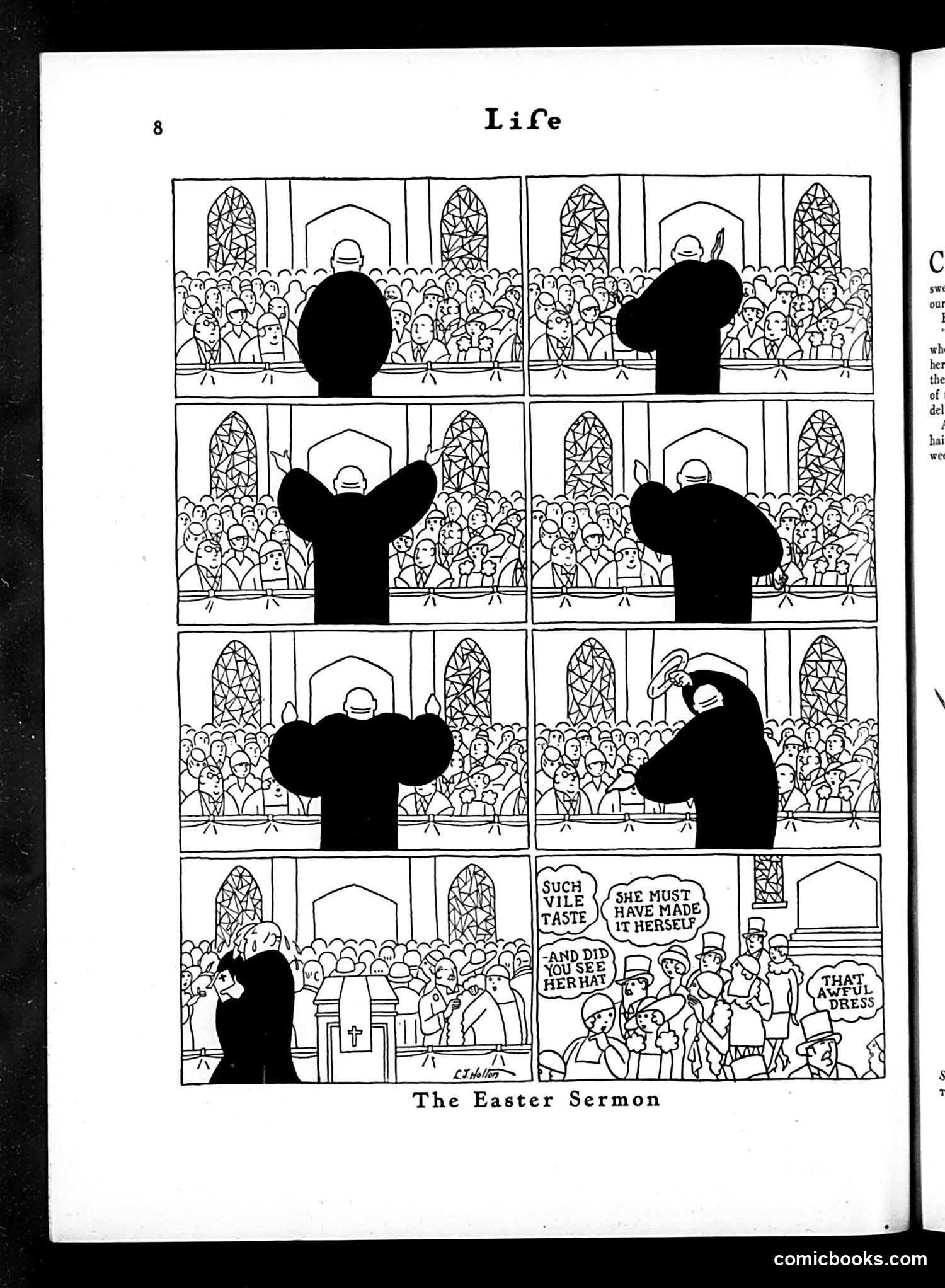
This comic strip satirizes a preacher's Easter sermon performance. The silhouetted figure (the preacher) is shown progressively escalating his dramatic gestures across four panels—from standing calmly, to raising arms, to gesturing expansively, to full theatrical display. The final panel reveals the joke: onlookers comment "Such vile taste" and note "She must have made it herself," while another asks about the preacher's hat. The satire targets not the religious content but the preacher's **ostentatious performance style**—his theatrical delivery is so overwrought that observers focus entirely on his dramatic gestures and fashion rather than the sermon's spiritual message. The cartoon critiques superficial religiosity and performative piety, mocking both the preacher's vanity and those distracted by appearances.
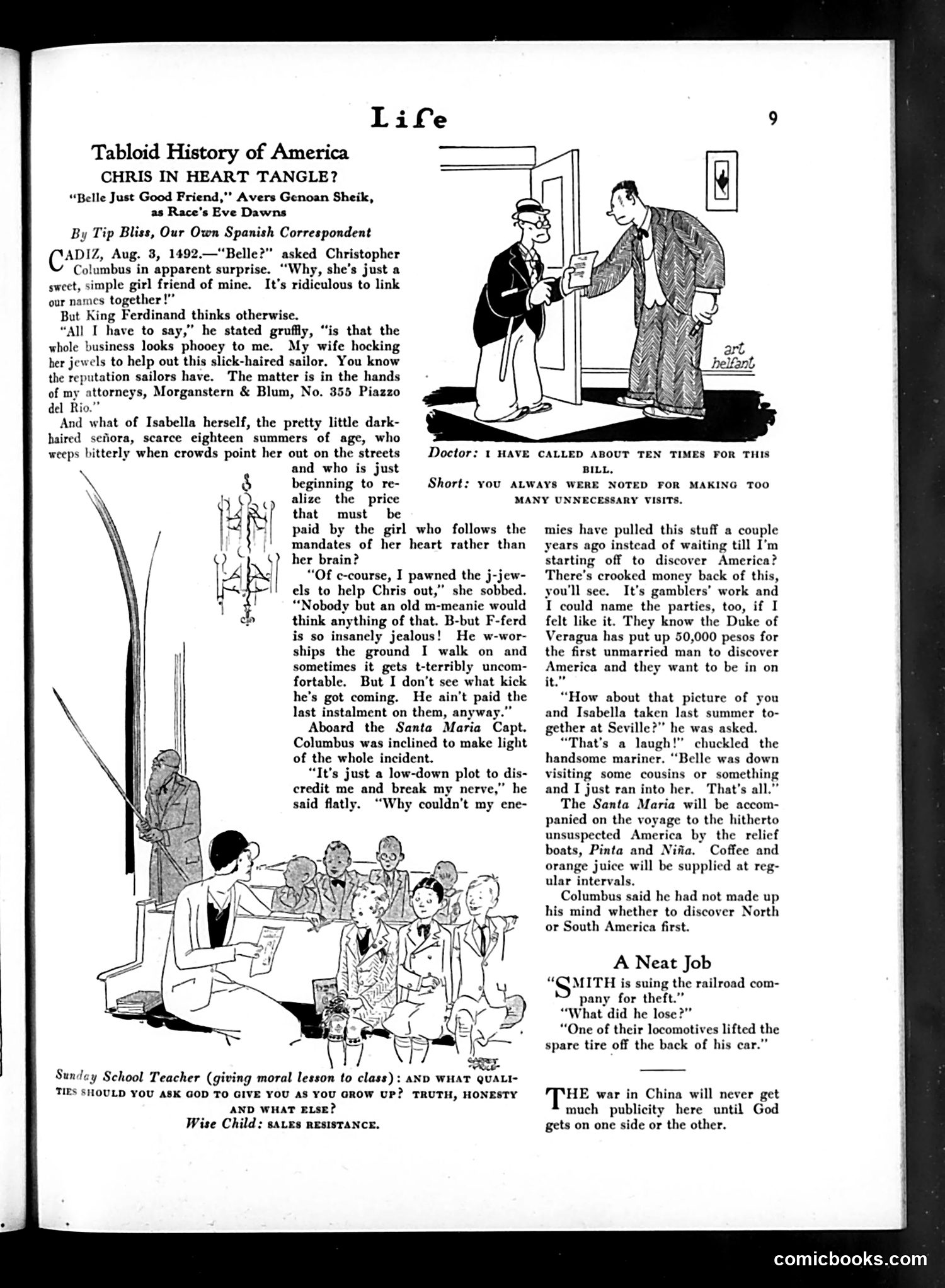
This page contains satirical pieces about Christopher Columbus and early exploration. The main article, "Tabloid History of America," presents a humorous fictional dispute over Columbus's romantic involvement with "Belle," supposedly a girl in Cadiz. King Ferdinand allegedly objects, hiring lawyers to discredit the relationship and protect his investment in Columbus's voyage. The satire mocks sensationalist tabloid journalism by treating historical figures as gossip subjects. It ridicules how reputations—particularly women's—were controlled by powerful men like Ferdinand, and suggests Columbus's expedition was partly motivated by scandal management rather than pure exploration. The accompanying illustrations show a schoolteacher giving moral lessons and Columbus at sea, reinforcing the contrast between historical mythology and satirical reality.
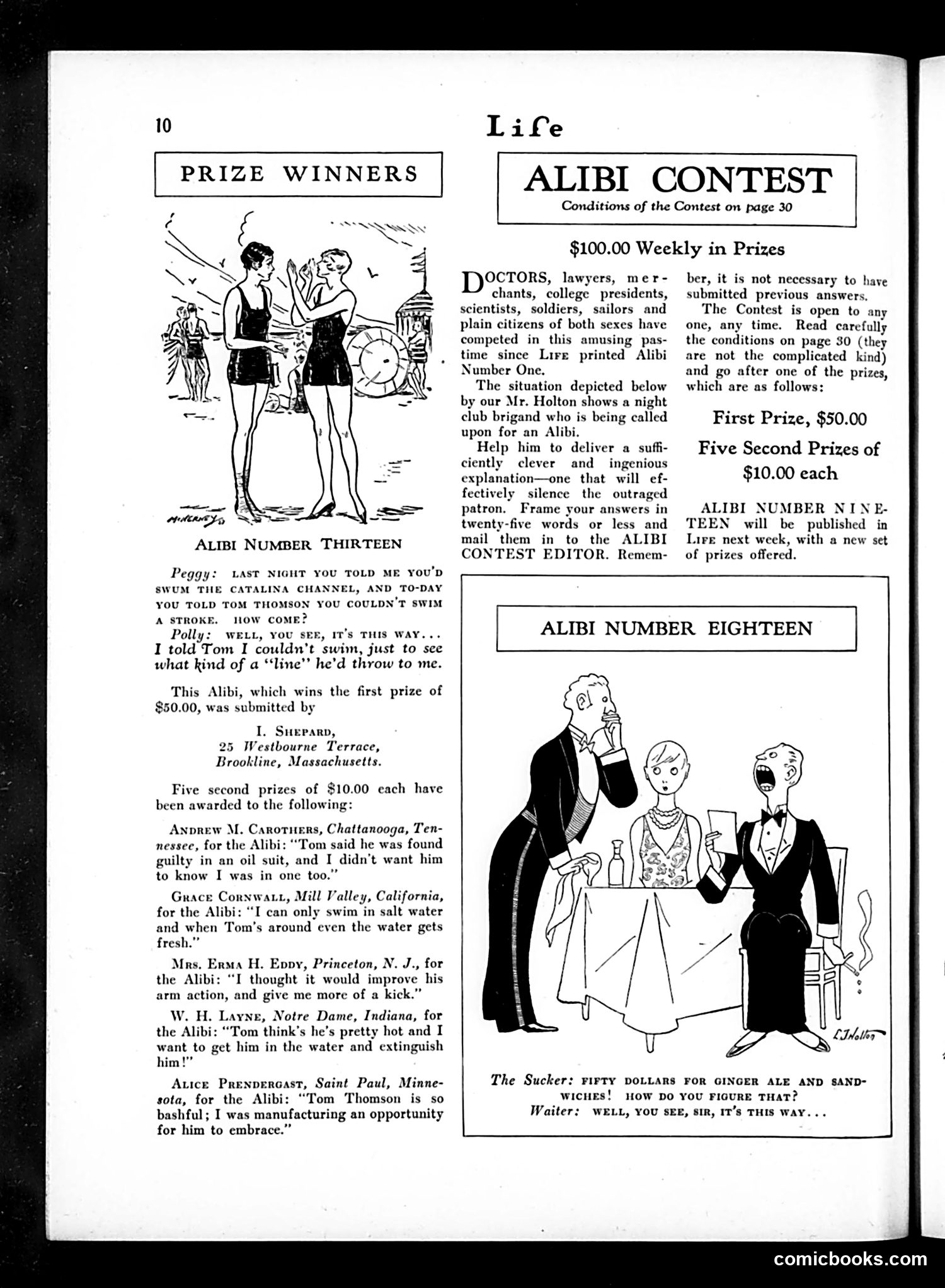
This page features Life's "Alibi Contest," a humorous puzzle where readers submit creative excuses to explain awkward social situations. **Alibi Number Thirteen** (left): Shows two women in conversation. The winning entry (by I. Shepard of Massachusetts) addresses why someone claimed they could swim the Catalina Channel yesterday but couldn't swim a stroke today—the alibi being they didn't want Tom to know they could swim. **Alibi Number Eighteen** (right): Depicts a dining scene where someone must explain ordering fifty dollars' worth of ginger ale and sandwiches. The joke hinges on creating a plausible excuse for this extravagant order. These contest entries satirize the everyday social excuses people make to cover embarrassing contradictions or suspicious behavior—a relatable form of 1920s-era humor that prizes clever, inventive explanations.
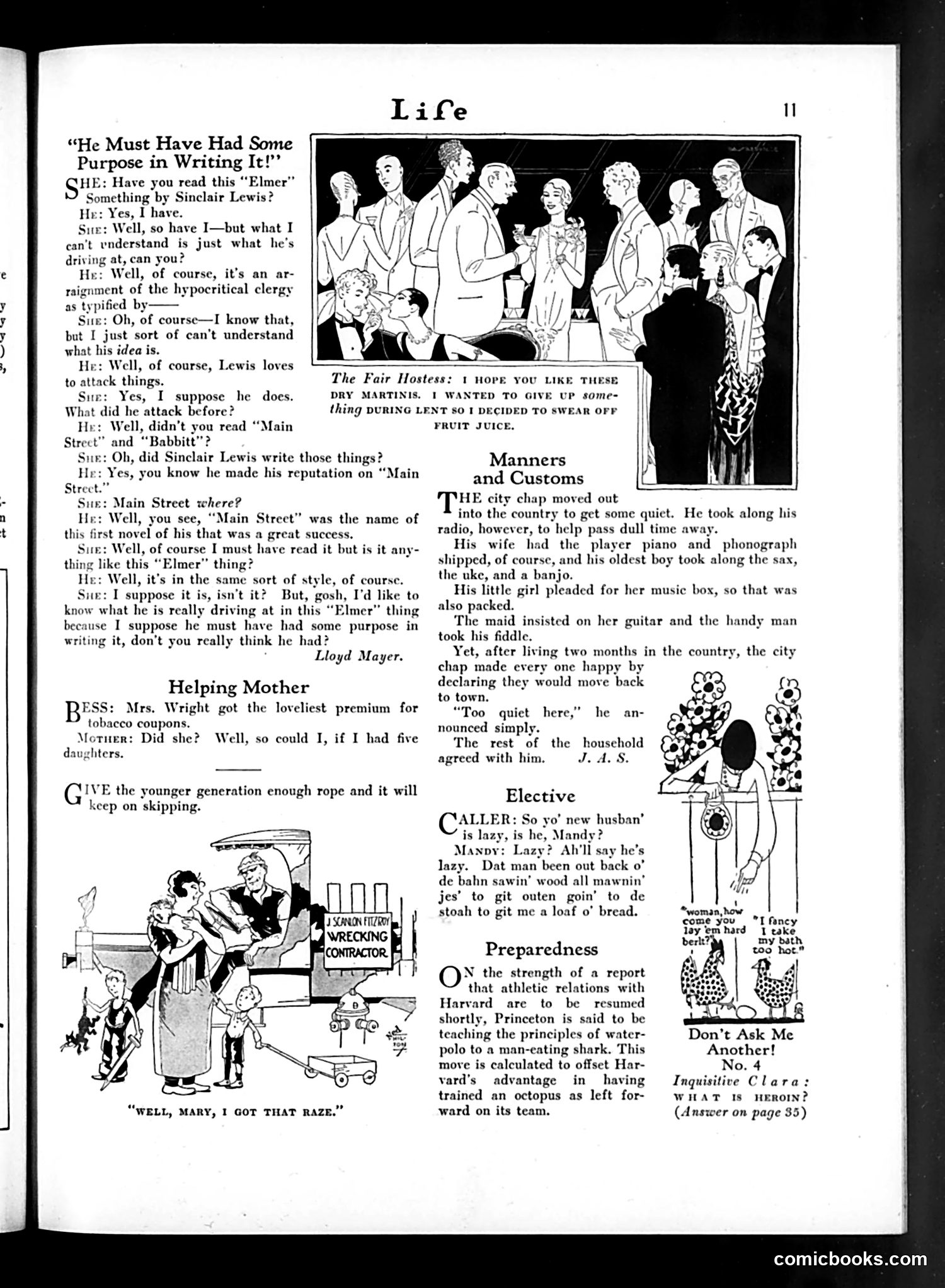
This page contains several humorous sketches satirizing American social customs and domestic life, likely from the 1920s-30s era based on style and references. **"He Must Have Had Some Purpose in Writing It"** mocks Sinclair Lewis's literary ambitions through a dialogue questioning whether his novel "Elmer" has real meaning or is merely an attack on clergy hypocrisy. **"Helping Mother"** depicts a woman getting a tobacco-coupon premium, joking that she could obtain five daughters' worth of goods—commentary on consumer culture and large families. **"Manners and Customs"** describes an urban family relocating to the countryside with modern entertainment (radio, phonograph, saxophone) but finding country life unexpectedly preferable to city noise. The remaining sections contain brief domestic humor and wordplay typical of the era's satirical magazine format.
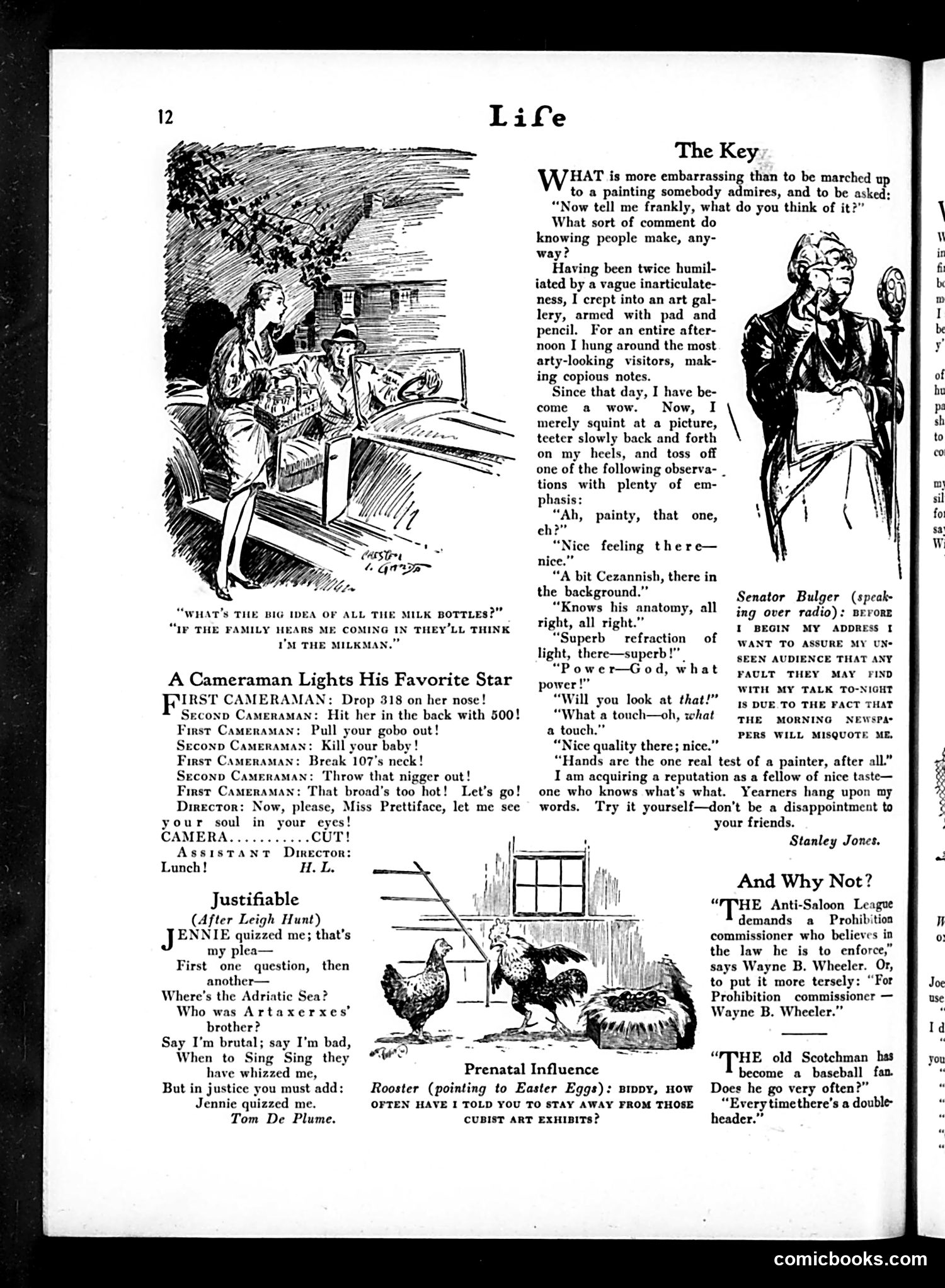
This page contains several humorous short pieces satirizing early 20th-century social pretensions and cultural attitudes. **"The Key"** mocks art-world affectation—the author describes becoming an "art wow" after being humiliated at a gallery, now offering vapid criticisms to impress others. The satire targets how people adopt insider jargon ("Cezannish," "superb refraction of light") without genuine understanding, hoping to seem cultured. **"A Cameraman Lights His Favorite Star"** is a slapstick film-industry joke about a cameraman giving contradictory, absurd directions to an actress during filming. Other pieces include **"Justifiable"** (a brief poem about being quizzed), and **"Prenatal Influence,"** where a rooster claims to have coached eggs to avoid cubist art exhibits—a jab at avant-garde modernism as ridiculous and unnatural. The overall theme: mocking cultural pretension, artistic pretense, and intellectual affectation.
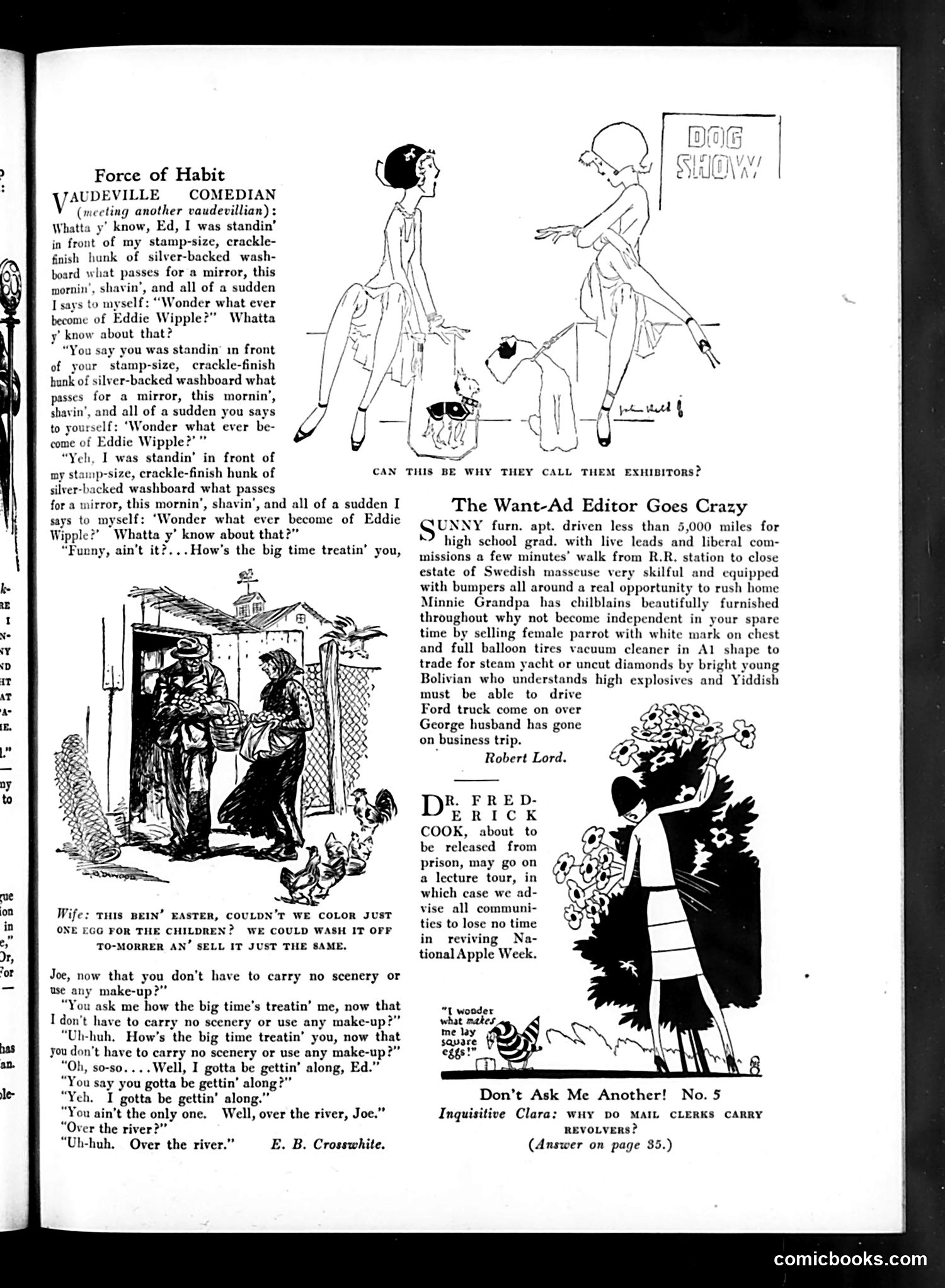
This page contains three separate satirical pieces typical of Life's humor: 1. **"Force of Habit"** (top left): A Vaudeville comedian's monologue about mistaking a washboard for a mirror—a joke playing on repetitive stage routines and how habit makes performers see familiar props everywhere. 2. **"The Want-Ad Editor Goes Crazy"** (center): Satirizes absurd classified ad requests, mocking the desperation of Depression-era job seekers offering increasingly ridiculous services and trade goods (like vacuum cleaners or uncut diamonds). 3. **"Don't Ask Me Another!"** (bottom right): A visual gag where a woman questions her husband about Easter egg coloring logistics, then an illustration shows a man overwhelmed by an avalanche of flowers or chaos—suggesting marital exasperation with endless questions. All employ slapstick humor and everyday domestic/workplace frustrations typical of 1920s-30s American comedy.
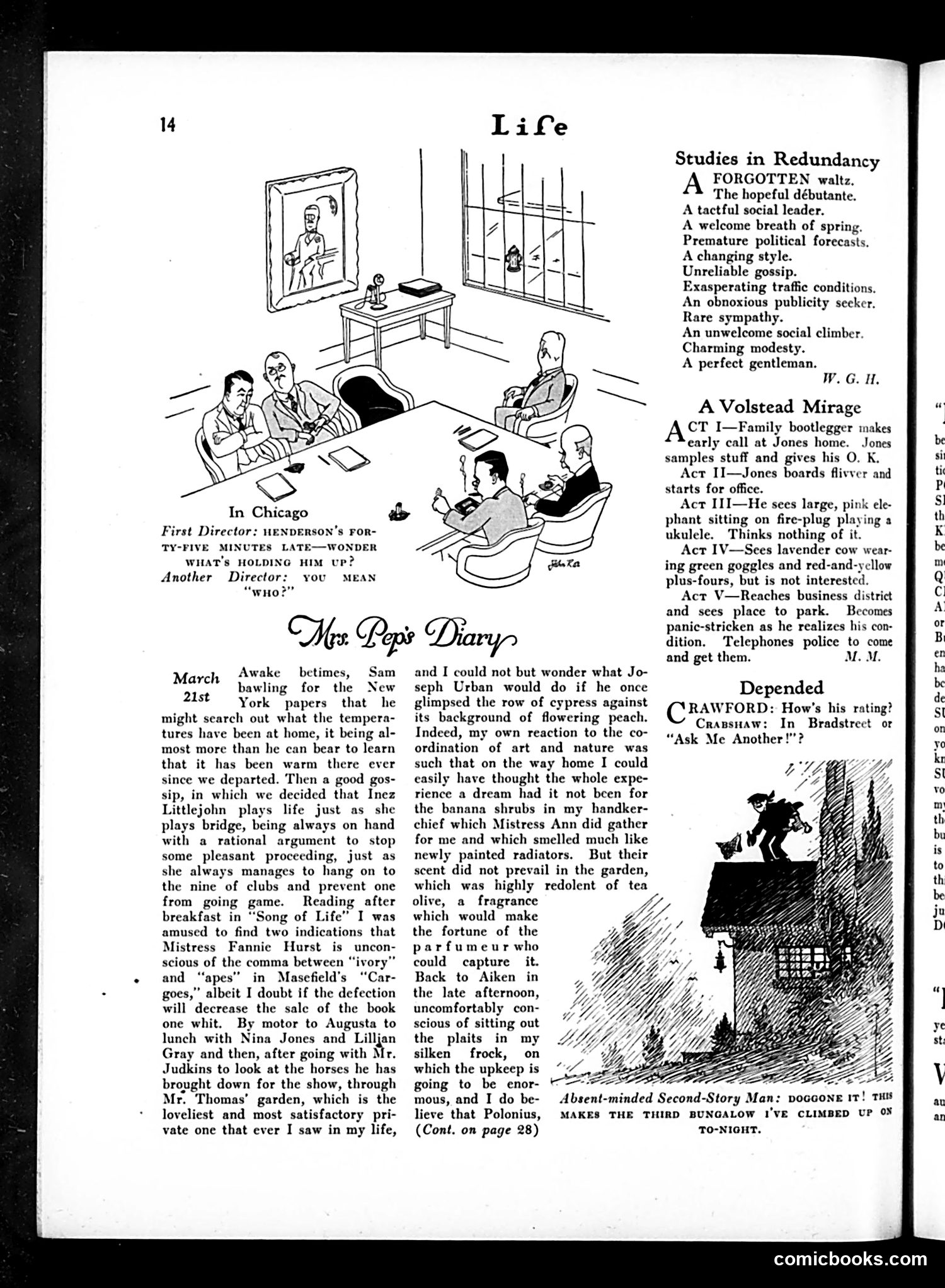
This page contains three distinct pieces: 1. **"In Chicago"** cartoon: Shows five men in an office/basement setting around what appears to be a large hole or pit. The caption references Henderson's "forty-five minutes late" and someone asking "what's holding us up?" This appears to be satirizing bureaucratic delays or inefficiency, though the specific context is unclear. 2. **"Mrs. Pep's Diary"** (March 21st): A longer diary entry describing the author's observations of New York weather, art, and social life, written in the upper-class voice typical of Life's satirical humor about society. 3. **"A Volstead Mirage"** and other short pieces: Comic sketches about Prohibition-era situations and social mishaps. The page exemplifies Life's characteristic satirical approach to American middle and upper-class life.
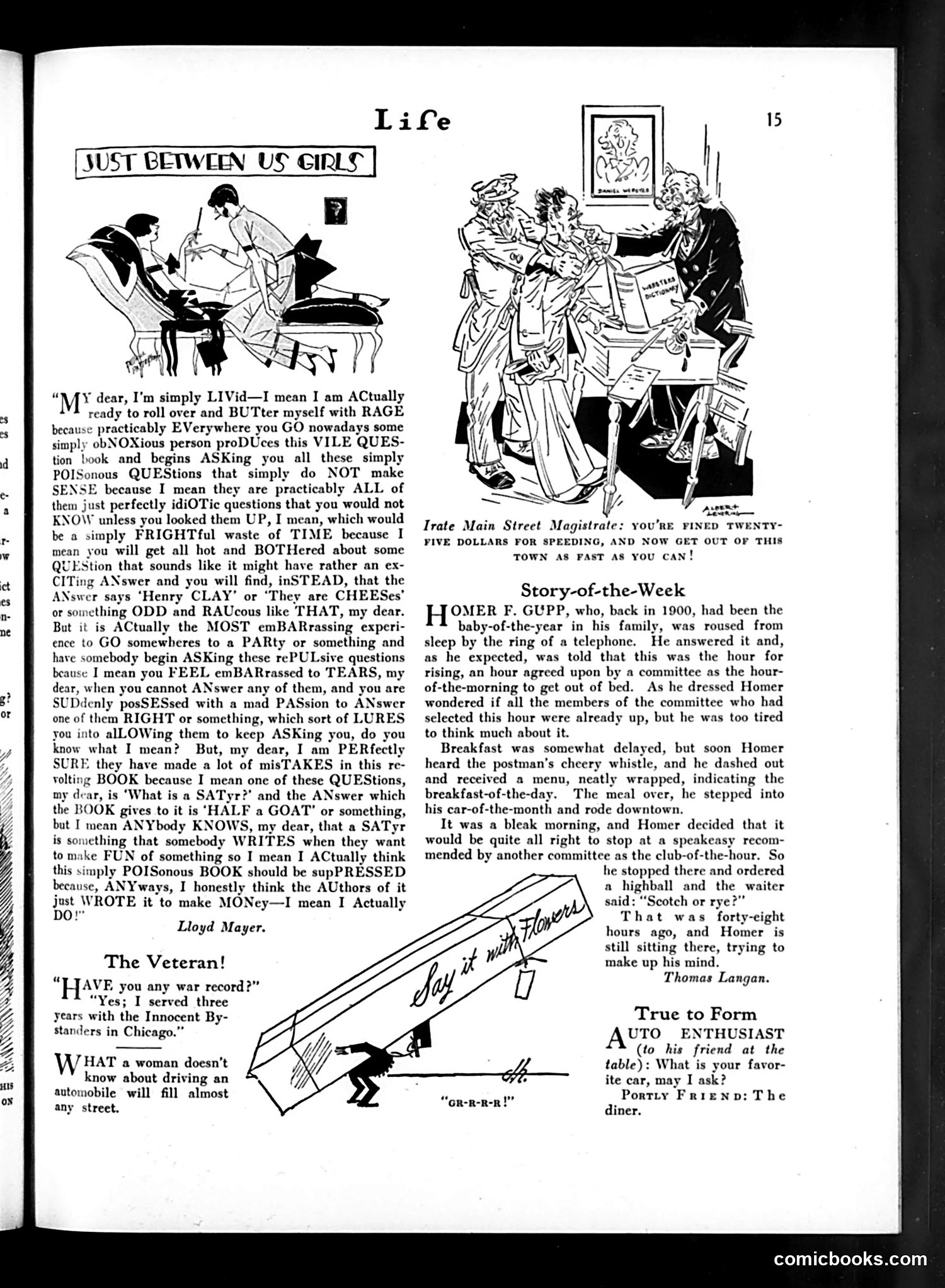
This page from *Life* magazine contains several humor pieces satirizing early 20th-century social behaviors: **"Just Between Us Girls"** mocks women who ask endless, annoying questions in social situations, embarrassing themselves and others by lacking self-awareness. The writer (Lloyd Mayer) criticizes how these women don't recognize their questions are foolish or waste everyone's time. **"Story-of-the-Week"** humorously recounts Homer G. Cupp missing a committee meeting due to oversleeping, then spending his day trying to decide what to order at a speakeasy—likely satirizing Prohibition-era drinking culture and indecision. **"The Veteran"** is a brief joke about a woman's ignorance of automobiles, playing on gender stereotypes about women drivers. **"True to Form"** appears incomplete but references a diner conversation about favorite cars.
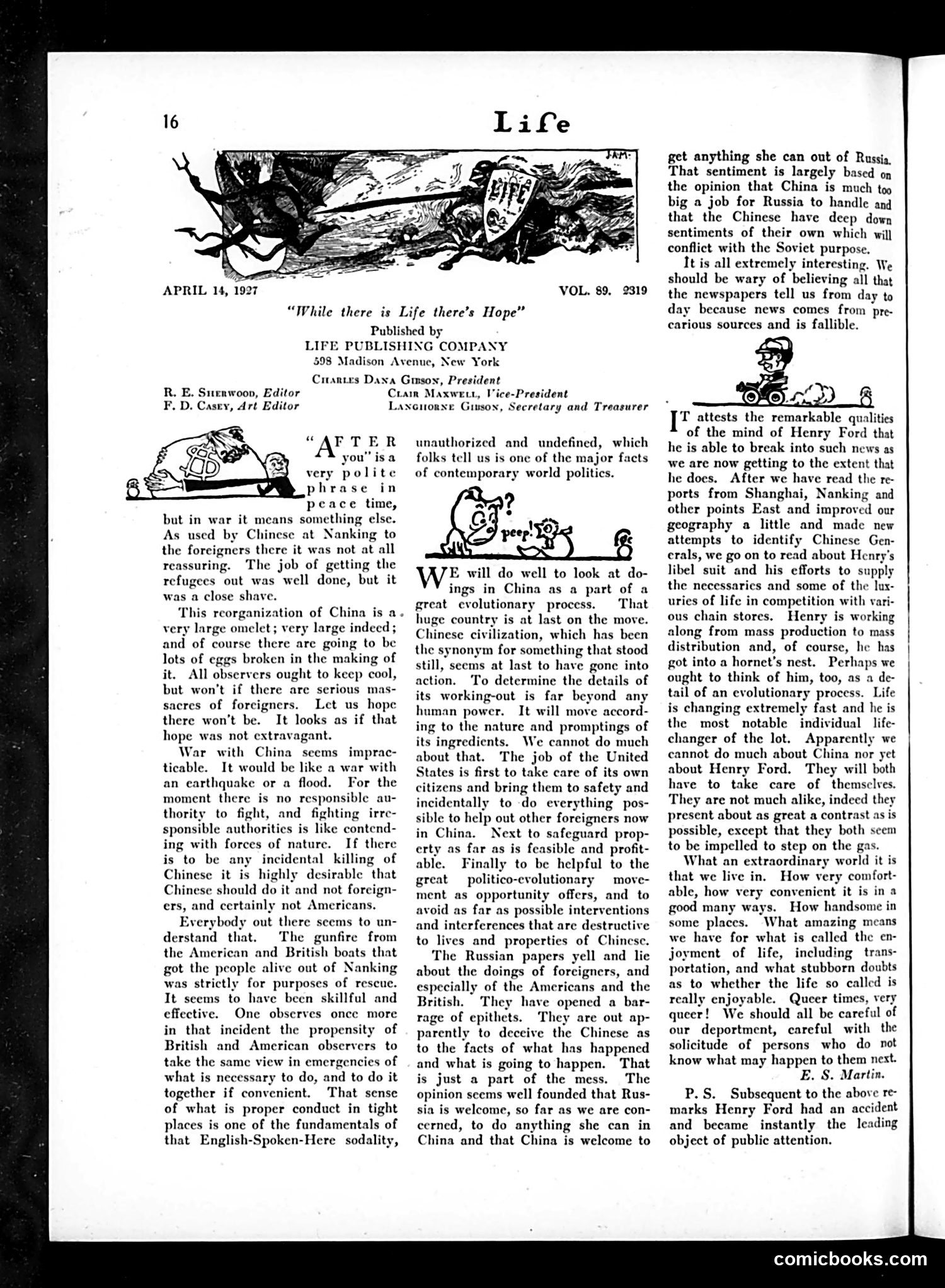
This page contains editorial commentary on China's political turmoil rather than traditional satirical cartoons. The small illustration shows a figure labeled "PEEP" observing events—likely representing Western (particularly American) observers watching China's "evolutionary process." The text discusses foreigners' roles in China during its civil conflict, mentioning American and British rescue efforts and Russian propaganda. It criticizes newspaper accounts as unreliable and references Henry Ford's accident becoming a public distraction. The central point: the author warns against trusting foreign press reports about China, advocates Western neutrality in Chinese affairs, and cautions against accepting sensationalized news. The tone suggests skepticism toward both Russian claims and Western interventionism during China's Nationalist-Communist conflicts of the 1920s.
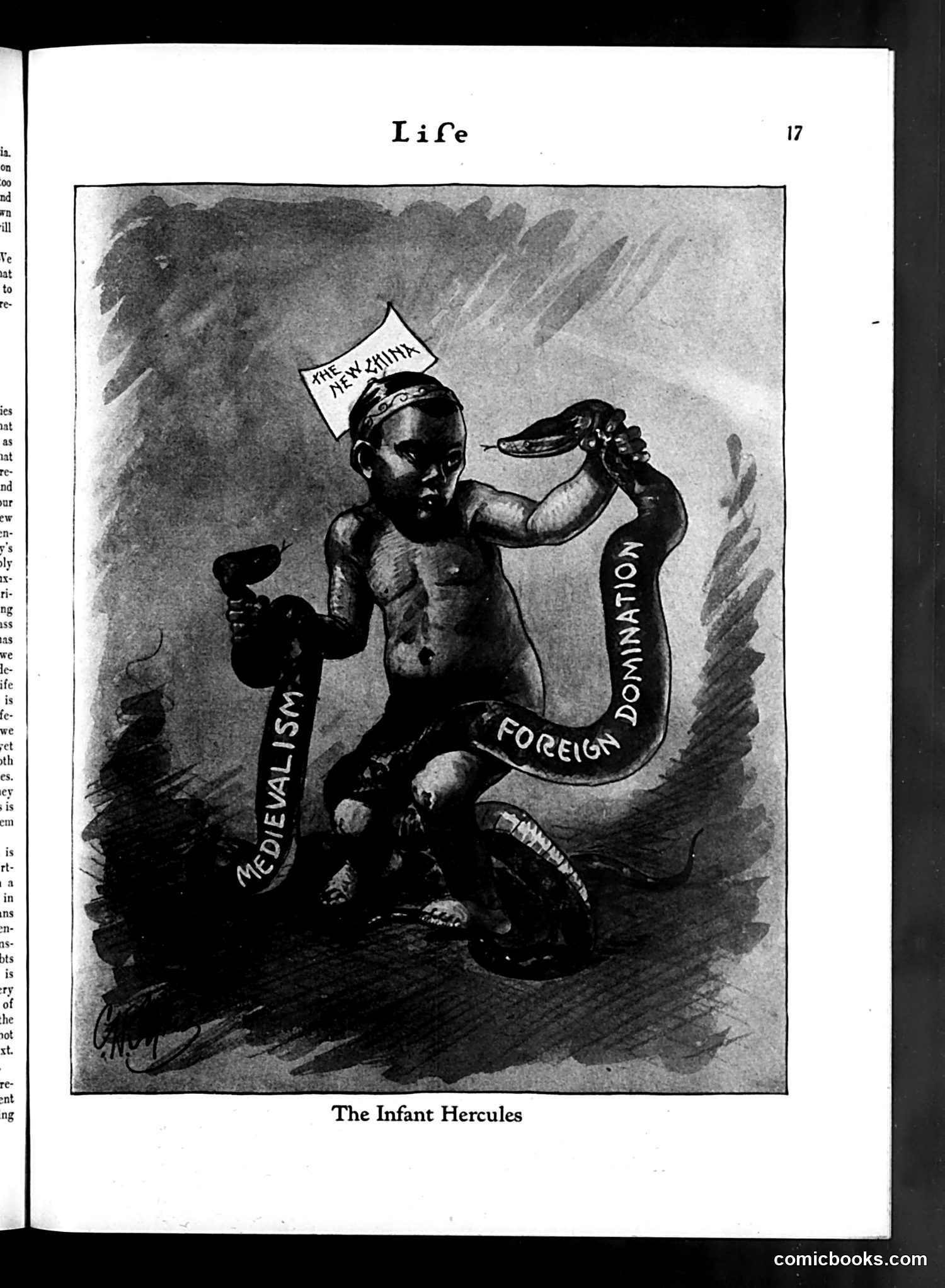
This political cartoon depicts an infant (representing America or American power) wrestling with serpents labeled "Medievalism," "Foreign Domination," and what appears to be additional threats. The infant wears a paper crown marked "The New China," suggesting the cartoon comments on American influence or intervention in China. The reference is to the classical myth of infant Hercules strangling serpents in his cradle—a symbol of overcoming great obstacles through inherent strength. The satire appears to celebrate American power confronting foreign and antiquated forces, though the specific historical context regarding China policy would require additional dating to fully clarify the cartoon's exact commentary on American imperialism or diplomatic efforts.
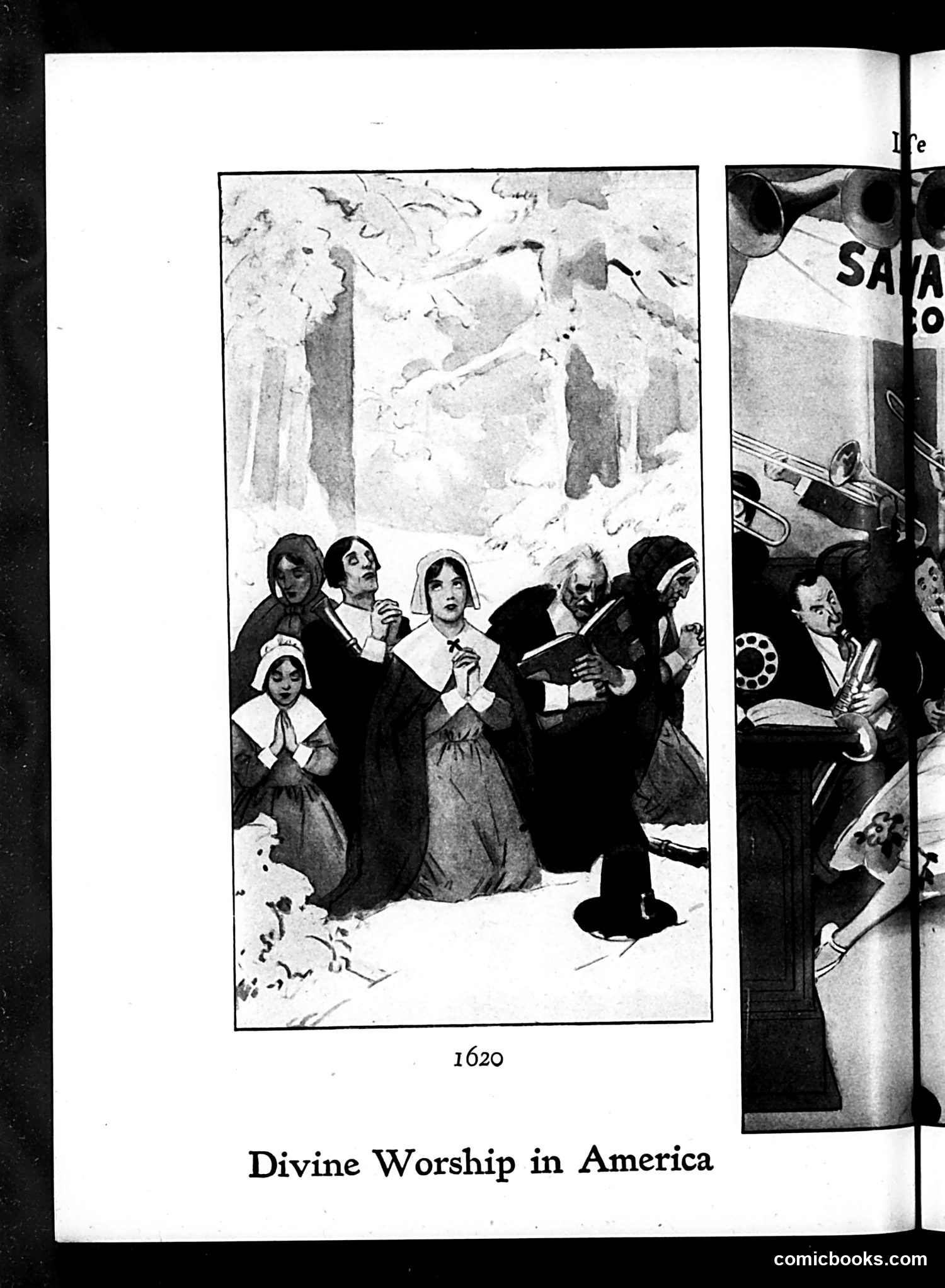
This satirical illustration depicts early American colonial religious practice, dated to 1620 (likely referencing the Pilgrims' arrival). The image shows a group of colonists in period dress gathered in prayer or worship in a snowy wilderness setting, with crude structures visible in the background. The satire appears to contrast the *idealized* narrative of pious colonists establishing religious freedom with the *actual* harsh conditions and struggles they faced. By pairing the romantic historical date "1620" with the title "Divine Worship in America," the cartoonist likely critiques how American religious history is mythologized—presenting devout settlers engaged in noble spiritual practice while overlooking the realities of their difficult circumstances, or possibly mocking the gap between religious rhetoric and actual behavior in American society.
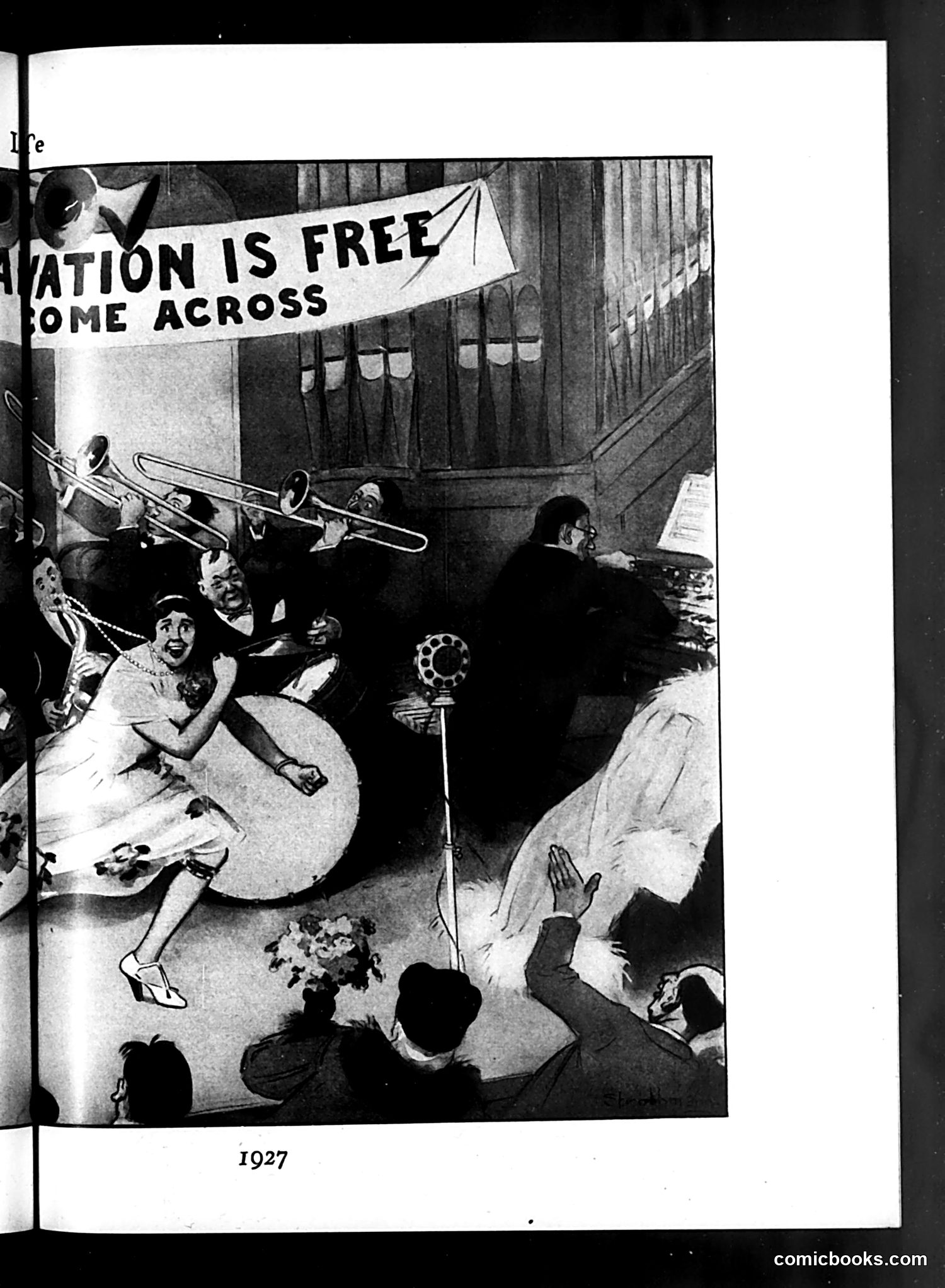
This satirical illustration depicts a jazz-age celebration with the banner "AVIATION IS FREE / COME ACROSS" visible above. The scene shows musicians with brass instruments and a woman in a light-colored dress, suggesting a speakeasy or nightclub setting during Prohibition. The "aviation is free" message likely references Lindbergh's famous 1927 transatlantic flight, which had occurred earlier that year and captured public imagination. The joke appears to satirize how Americans were celebrating this achievement while simultaneously engaged in illegal drinking during Prohibition—the irony being that while aviation represented freedom and progress, citizens were breaking laws in speakeasies. The cartoon mocks the contradictions of the era's values.
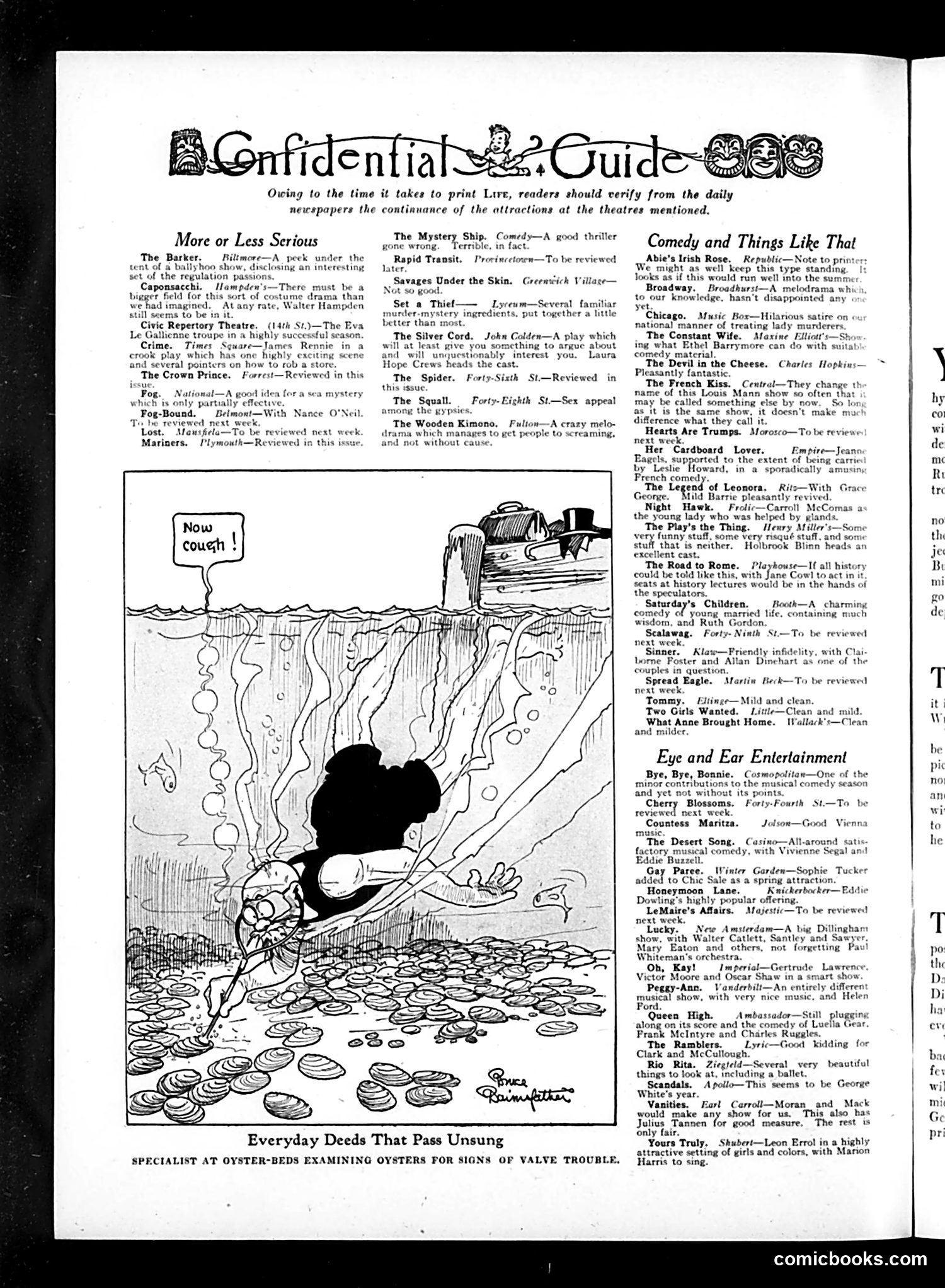
This page is primarily a **theater review guide** for New York City productions, not a political cartoon. The dominant illustration—captioned "Everyday Deeds That Pass Unsung"—is a humorous editorial cartoon depicting an oyster specialist examining oysters for valve trouble, sitting atop a massive pile of oysters while saying "Now cough!" The joke satirizes **underappreciated, unglamorous labor**: the oyster inspector performs essential but invisible work that nobody celebrates, much like countless other workers. The "cough" suggests testing the oyster's health through an absurd, personified method—treating the oyster as if it were a patient. The surrounding text lists Broadway shows with brief, witty reviews (mostly positive). Shows like *Abie's Irish Rose* and *The Road to Rome* are noted as crowd-pleasers. This format was typical of *Life* magazine's entertainment coverage during the 1920s, offering theatergoers quick assessments of current productions. There is **no political content** on this page—it's pure entertainment journalism and light satire about working-class dignity.
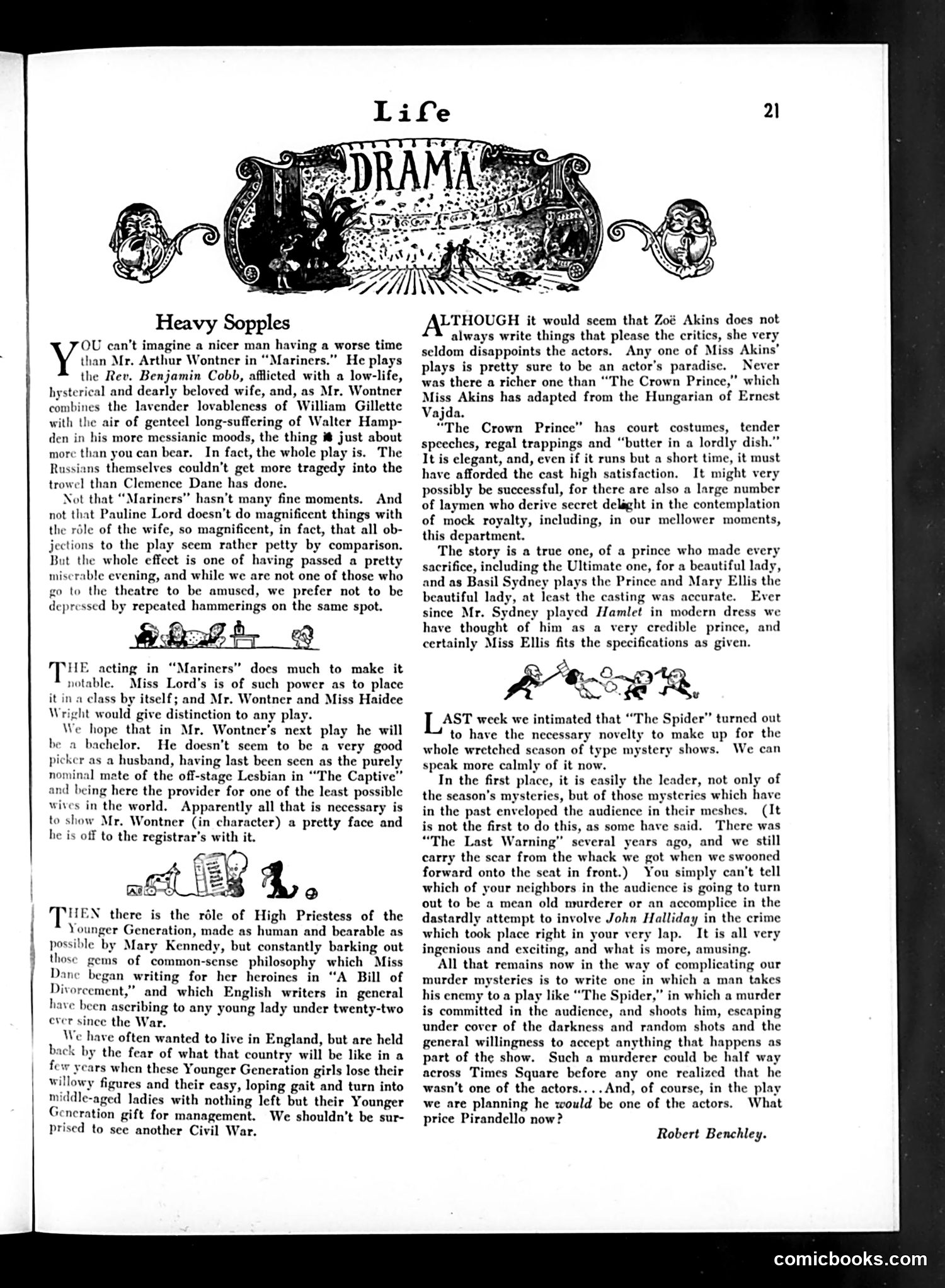
This page contains theater reviews from Life magazine's drama section, circa 1920s-30s. The content critiques several Broadway productions: **"Mariners"** stars Arthur Wontner as a suffering clergyman and Pauline Lord as his difficult wife. The reviewer praises Lord's powerful performance but finds the overall play depressingly tragic. **"The Crown Prince,"** adapted from Hungarian playwright Ernest Vajda, features elaborate court costumes and romance. The reviewer considers it elegant entertainment, noting audiences enjoy mock royalty spectacles. The page includes satirical commentary on "Younger Generation" characters—stock figures in contemporary plays spouting trendy philosophy about modernity and social change. The reviewer humorously warns that these girls, once they age and lose their "willowy figures," will become insufferable middle-aged busybodies, potentially sparking "another Civil War." The satire targets both playwrights' formulaic character types and audiences' appetite for romantic escapism.
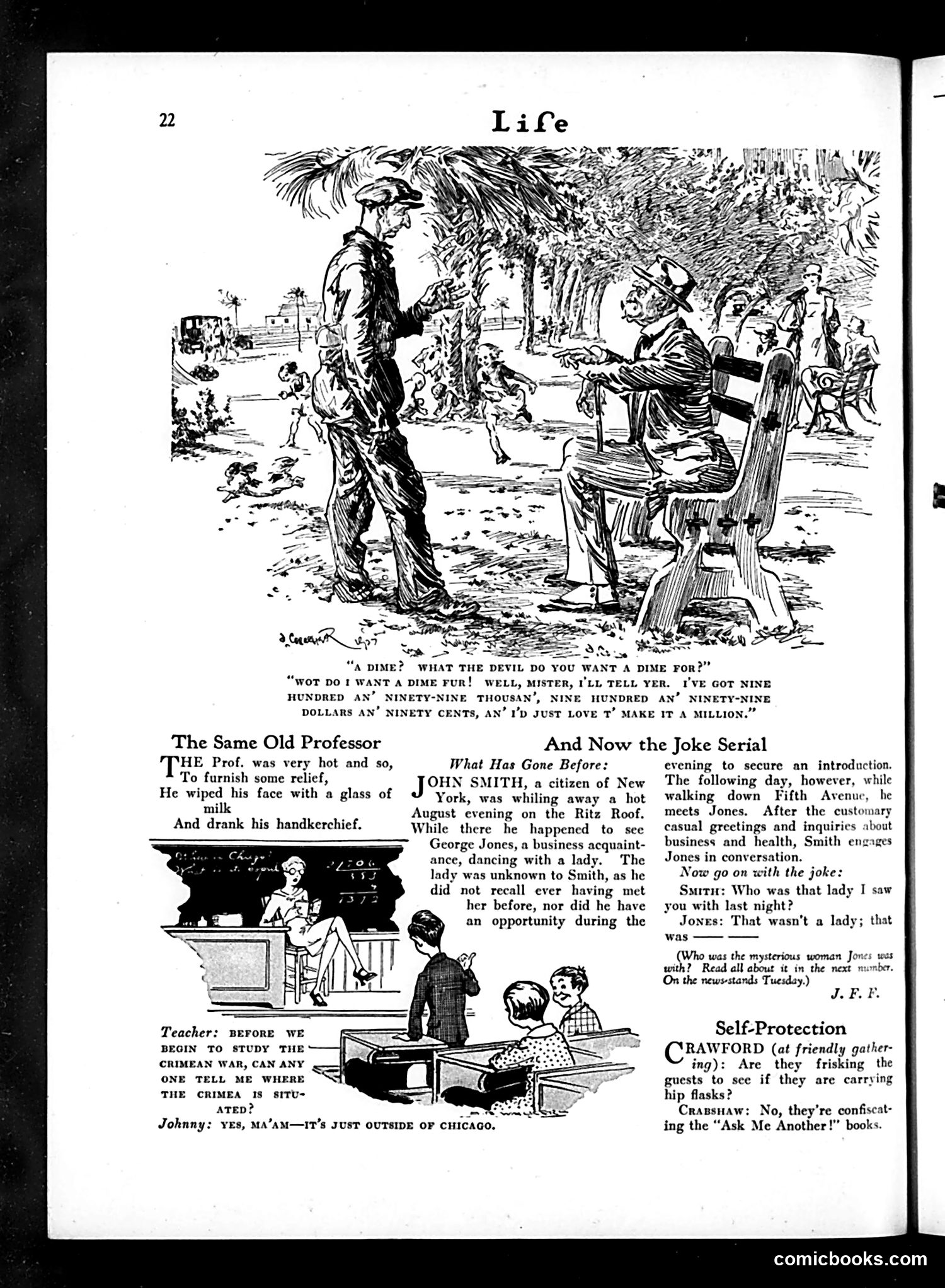
This page contains three unrelated humor pieces typical of early 20th-century Life magazine: **Top cartoon**: A street scene satirizing American wealth-accumulation obsession. A shabby man requests a dime from a well-dressed gentleman. The punchline reveals the man already has $999,990.99 and wants the dime merely to round his fortune to a million—mocking both the relentless pursuit of round-number wealth and the absurdity of penny-pinching among the nearly-rich. **"The Same Old Professor"**: A nonsensical joke where a hot professor wipes his face with a glass of milk, then drinks his handkerchief—playing on absurdist humor common to the era. **"And Now the Joke Serial"**: An ongoing serialized joke about a man asking another about a mysterious woman. This format was a Life magazine feature, with readers invited to guess the punchline before next week's reveal. **"Self-Protection"**: A brief gag about Prohibition-era hip flasks and the popularity of "Ask Me Another!"—an apparently trendy quiz book guests might carry. These represent typical satirical humor of the period: wordplay, social observation, and gentle mockery of contemporary concerns.
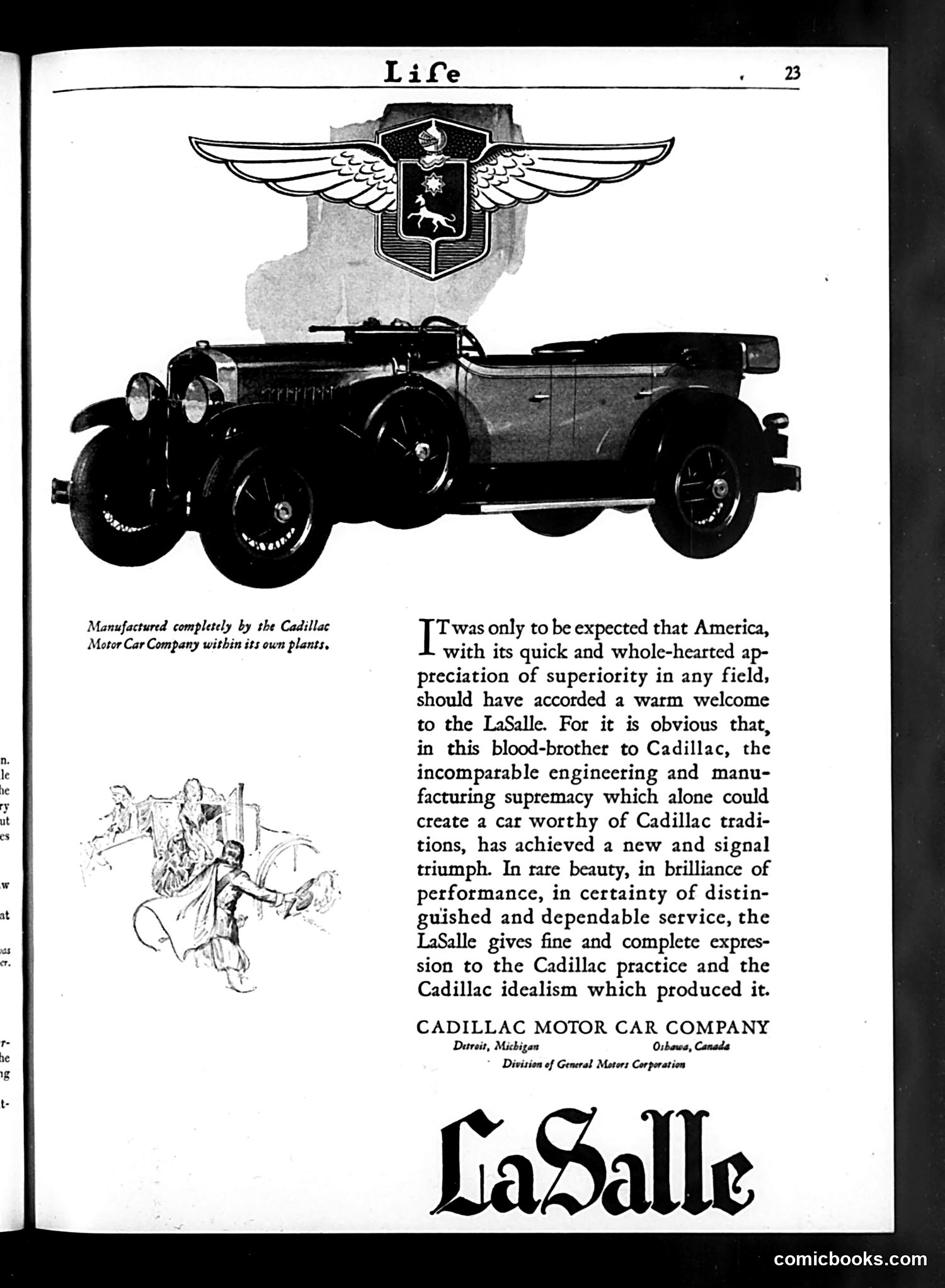
This is **not a cartoon or satire**—it's a straightforward **automobile advertisement** for the LaSalle, a luxury car manufactured by Cadillac Motor Car Company (a General Motors division). The page features a detailed illustration of the LaSalle automobile and uses flowery, grandiose language to position it as an American triumph in automotive engineering. The small decorative illustration on the left (showing classical figures) is purely ornamental design, not political commentary. The text emphasizes that America should welcome the LaSalle because it represents American manufacturing superiority and Cadillac's engineering excellence. This reflects 1920s-era advertising rhetoric celebrating American industrial achievement and luxury consumer goods. There is no satire here—this is period advertising presenting the car's prestige and quality as self-evident facts worthy of national pride.
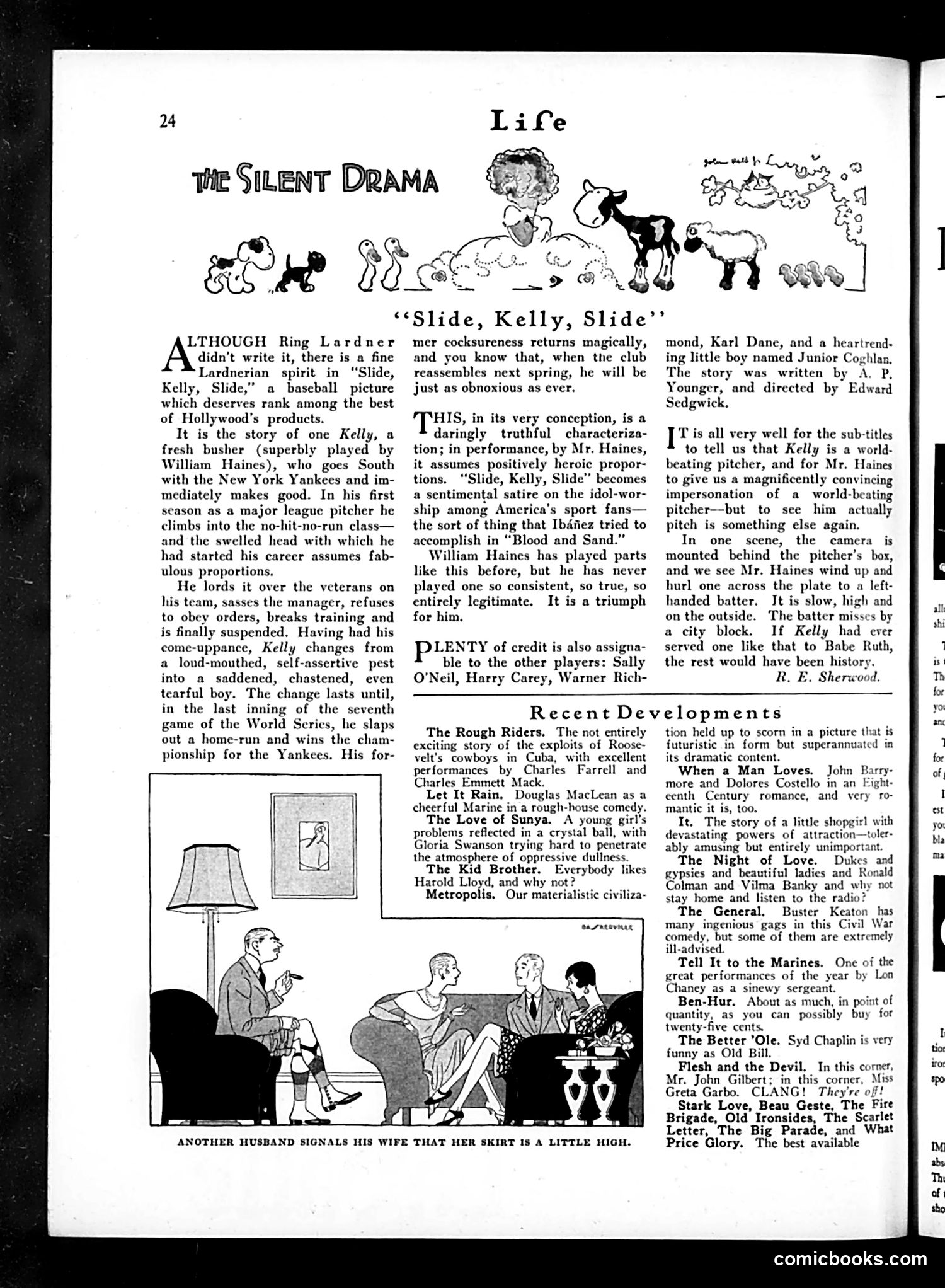
This page reviews a 1916 silent film about a cocky young baseball pitcher named Kelly (played by William Haines) who joins the New York Yankees. The film satirizes American sport-fan culture and idol-worship: Kelly becomes arrogant after early success, defies his manager, and must be humbled before redemption arrives when he hits a championship-winning home run in the World Series. The review praises the film's "sentimental satire" and Haines's performance as genuinely convincing. However, it mocks one scene where the camera catches Haines's actual pitching—the throw is comically slow and high, nowhere near realistic for a world-class pitcher. The critic jokes that even Babe Ruth wouldn't have missed such a terrible pitch. The page also lists other recent film releases in brief, typical of entertainment trade journalism from this era.
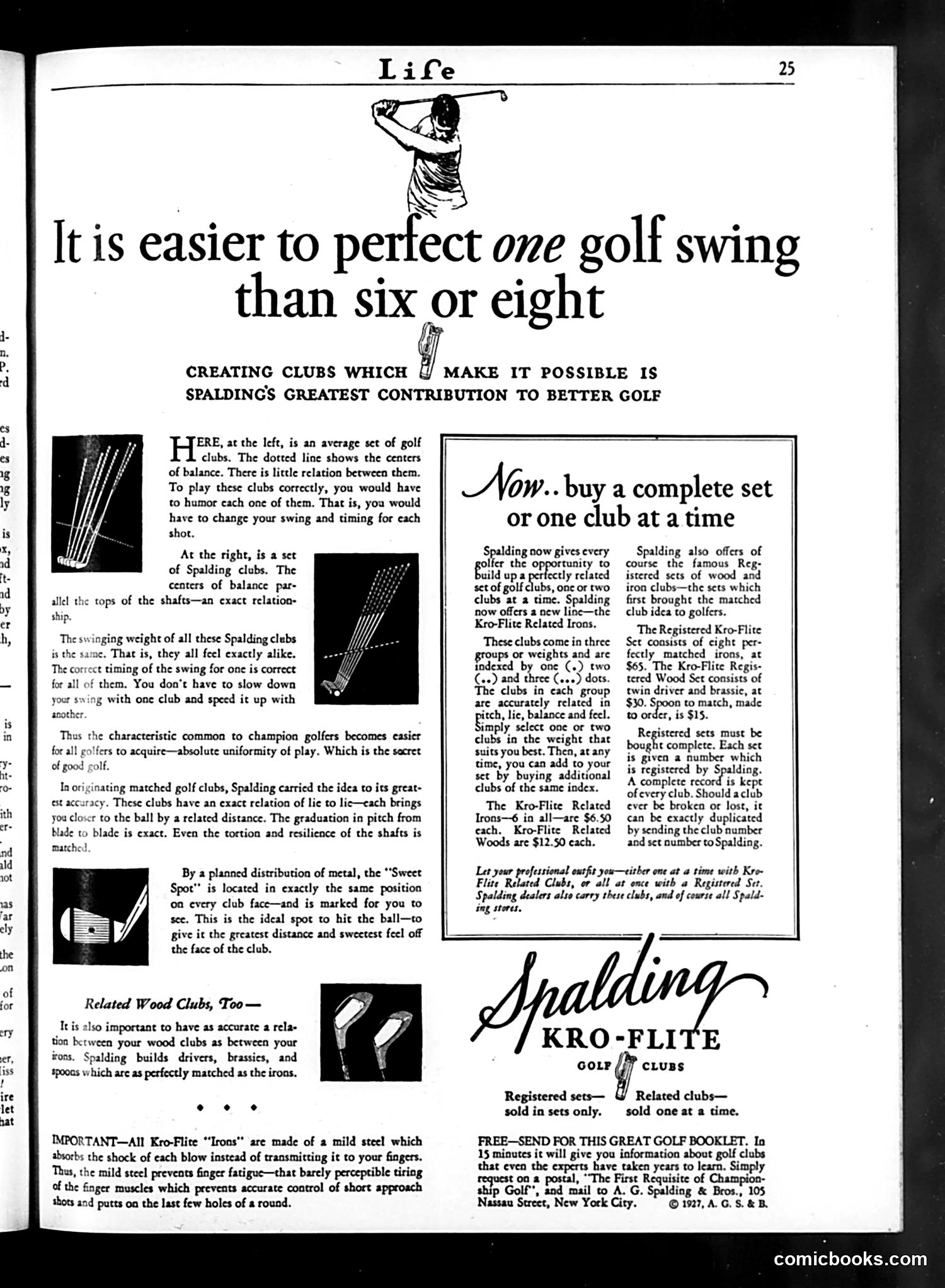
This is primarily a **product advertisement**, not a political cartoon. It appears in *Life* magazine (circa 1927, based on the copyright mark) promoting Spalding's "Kro-Flite" golf clubs. **The "Point":** The ad argues that Spalding's innovation—matched golf clubs with perfectly aligned centers of balance—solves a fundamental problem in golf. Standard club sets (shown left) require golfers to adjust their swing for each club; Spalding's matched sets (right) maintain consistent "feel" across all clubs, allowing uniform play. **Key Claims:** - Matched clubs eliminate the need to alter swing timing between shots - This uniformity is "the secret of good golf"—the characteristic shared by champion golfers - The innovation includes the "Sweet Spot" (marked on each club face) and shock-absorbing steel **Marketing Strategy:** The ad emphasizes affordability and flexibility—buyers can purchase one club at a time rather than complete expensive sets, making matched clubs accessible to average golfers. This reflects 1920s consumer culture: selling a technical innovation as democratizing access to excellence.
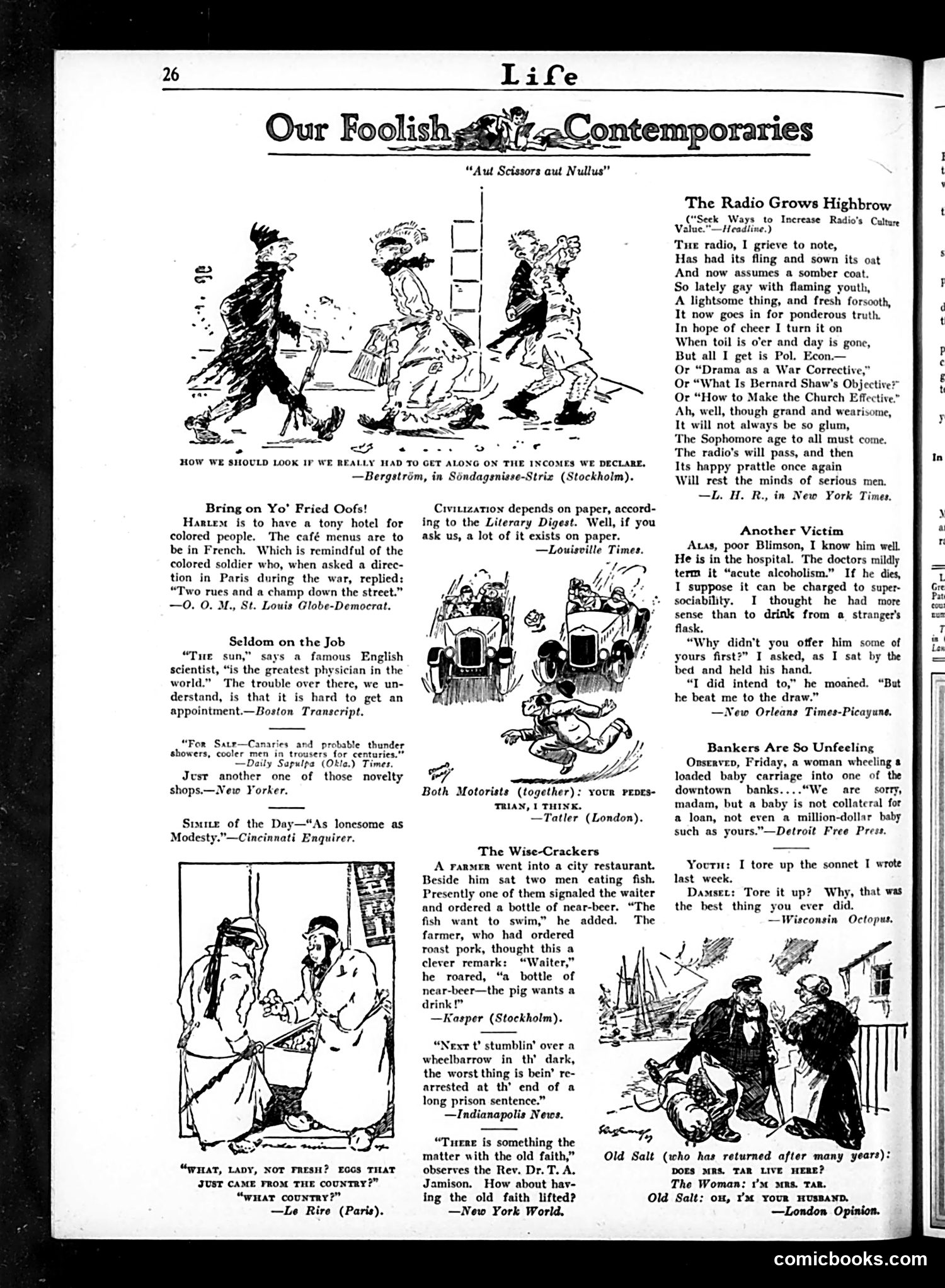
This page collects brief satirical jokes and cartoons mocking contemporary society and human folly. Key pieces include: **"The Radio Grows Highbrow"** — A poem lamenting that radio, once entertainment for casual listening, now broadcasts tedious educational content ("Pol. Econ," "Drama as a War Corrective," Bernard Shaw discussions). The satire suggests both radio's pretentious drift toward serious programming and society's misguided belief this represents cultural improvement. **"The Wise-Crackers"** — A farmer at a restaurant hears diners joke that ordered beer is "for the fish to swim." The farmer attempts the same joke about his pork order, appearing foolish rather than clever. **Various one-liners** mock: British sun-worship despite lack of sunshine; absurd newspaper classifieds; motorists blaming pedestrians; and bankers' refusal to accept a baby as loan collateral. The cartoons depict everyday social awkwardness—including one about tax declarations versus actual spending habits. The overall theme: poking fun at modern pretension, miscommunication, and human absurdity across social classes.
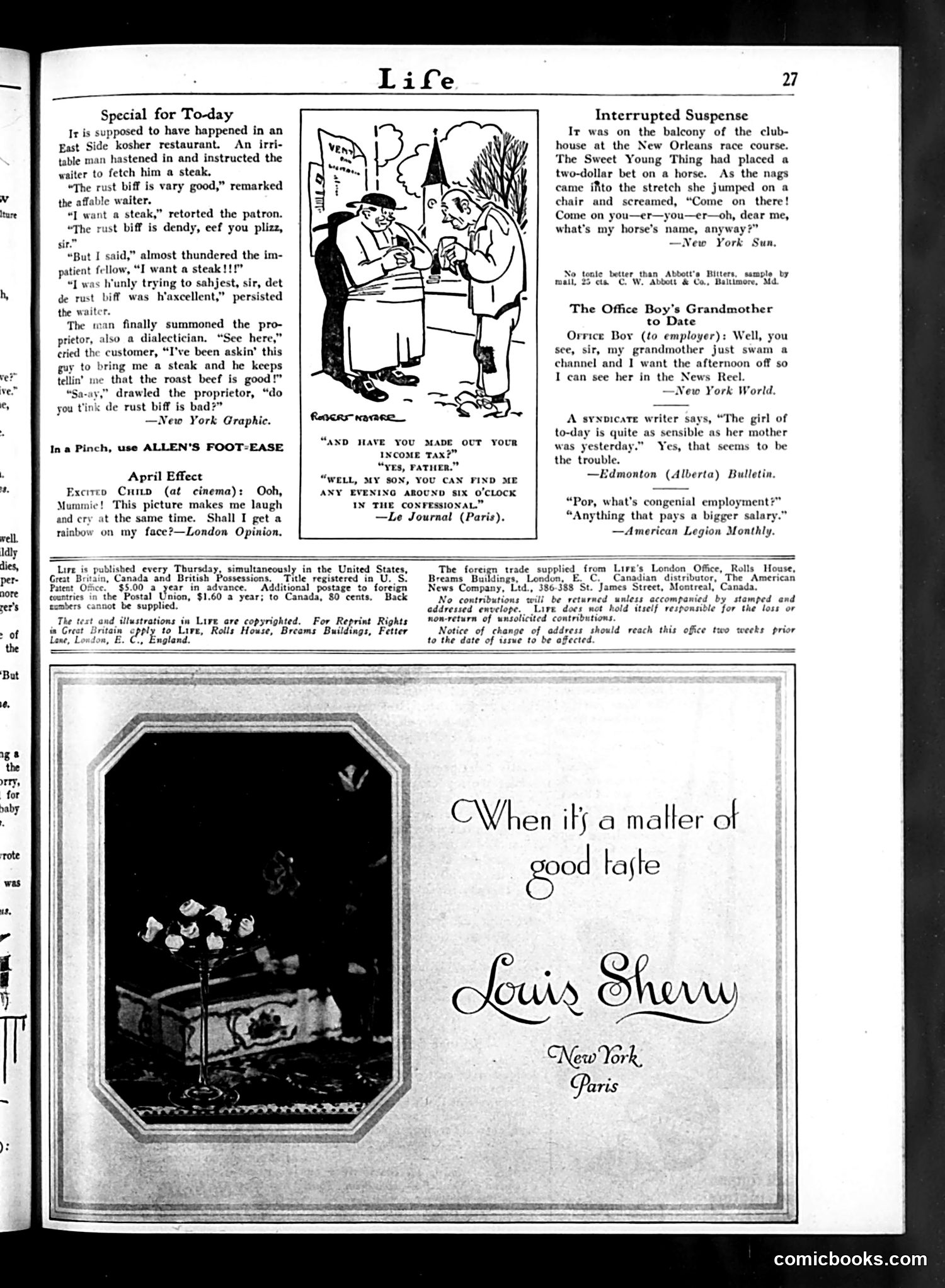
This page contains several brief satirical humor pieces typical of early 20th-century American magazines: **"Special for To-day"** mocks Yiddish-accented speech patterns common in East Side (immigrant Jewish) restaurants. The joke relies on stereotypical dialect humor—a waiter repeatedly misunderstands or ignores a customer's request for steak, insisting on "rust biff" (roast beef). The humor targets both the accent and perceived stubbornness. **"And Have You Made Out Your Income Tax?"** (from a Paris publication) makes a topical joke: a son confesses to his father in church that he's been working on his income tax return—implying it's a sin requiring confession, commentary on tax burden frustration. **"Interrupted Suspense"** jokes about a woman at a horse race so emotionally invested she can't remember her own horse's name mid-race. **"The Office Boy's Grandmother"** plays on changing times: an office boy wants time off because his grandmother swam the English Channel—a reference to modern female achievement that would have seemed remarkable and amusing to period readers. These are lighthearted, topical humor pieces reflecting 1920s-era concerns and social attitudes.
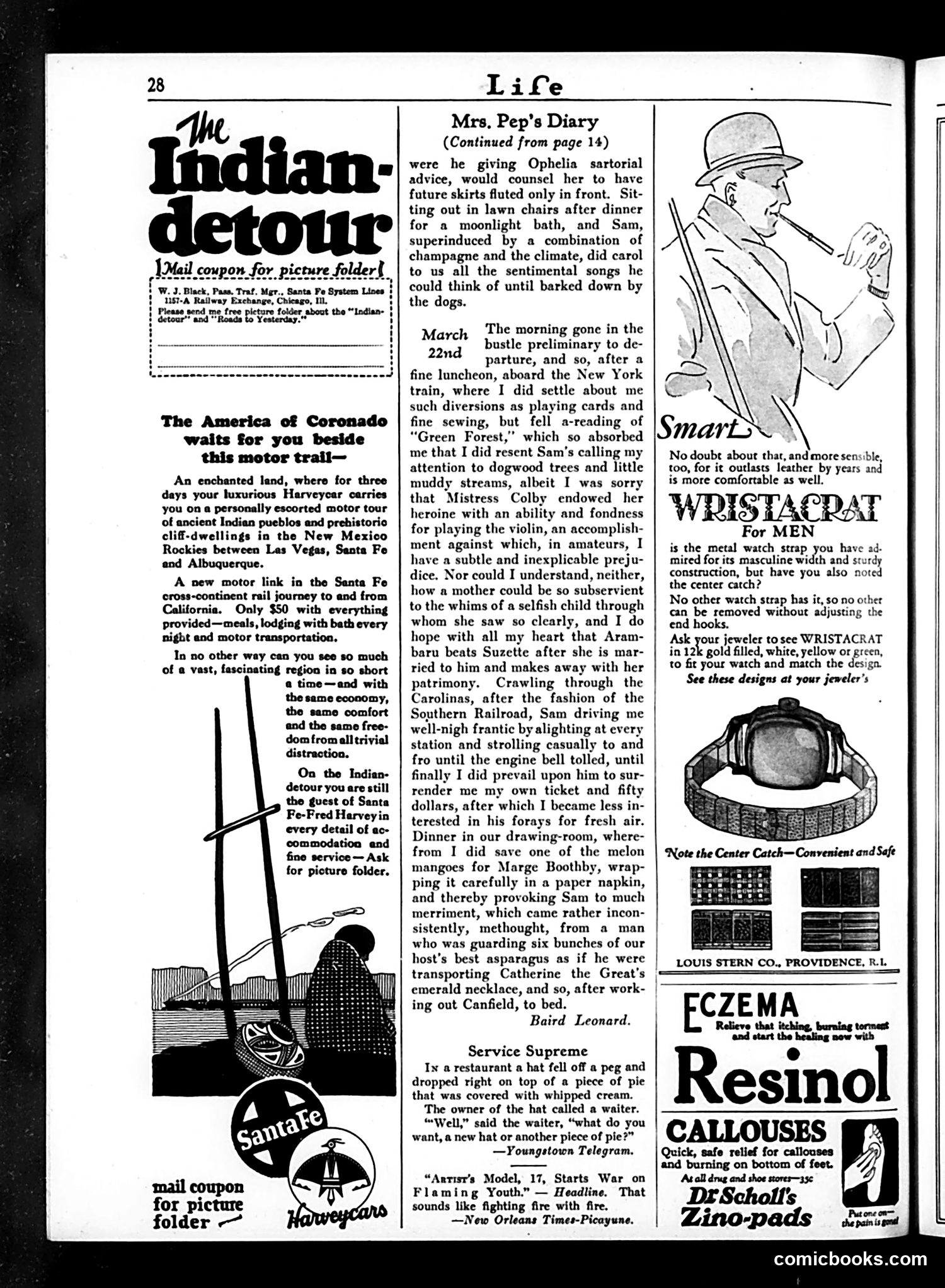
This page contains **Mrs. Pep's Diary**, a serialized humor column about a woman's travels. The excerpt mocks upper-class affectations: Mrs. Pep obsessively documents trivial social observations (criticizing another woman's violin playing as "amateur," hoarding melon mangoes, resenting her husband's train stops). The humor relies on her overwrought, pretentious language and petty concerns—she's portrayed as tediously self-important. The page also includes brief **joke fillers** at bottom, typical of Life's satirical format: a waiter's wisecracks and a headline pun about youth ("fighting fire with fire"). The left column advertises the **Santa Fe Railway's "Indian-detour"**—a motorized tourist experience visiting Native American pueblos and cliff-dwellings. This reflects early-20th-century tourism commodifying Indigenous culture as "enchanted" spectacle for affluent travelers. The right side contains **product advertisements** (Wristwatch, Resinol, Zino-pads), standard magazine filler of the era.
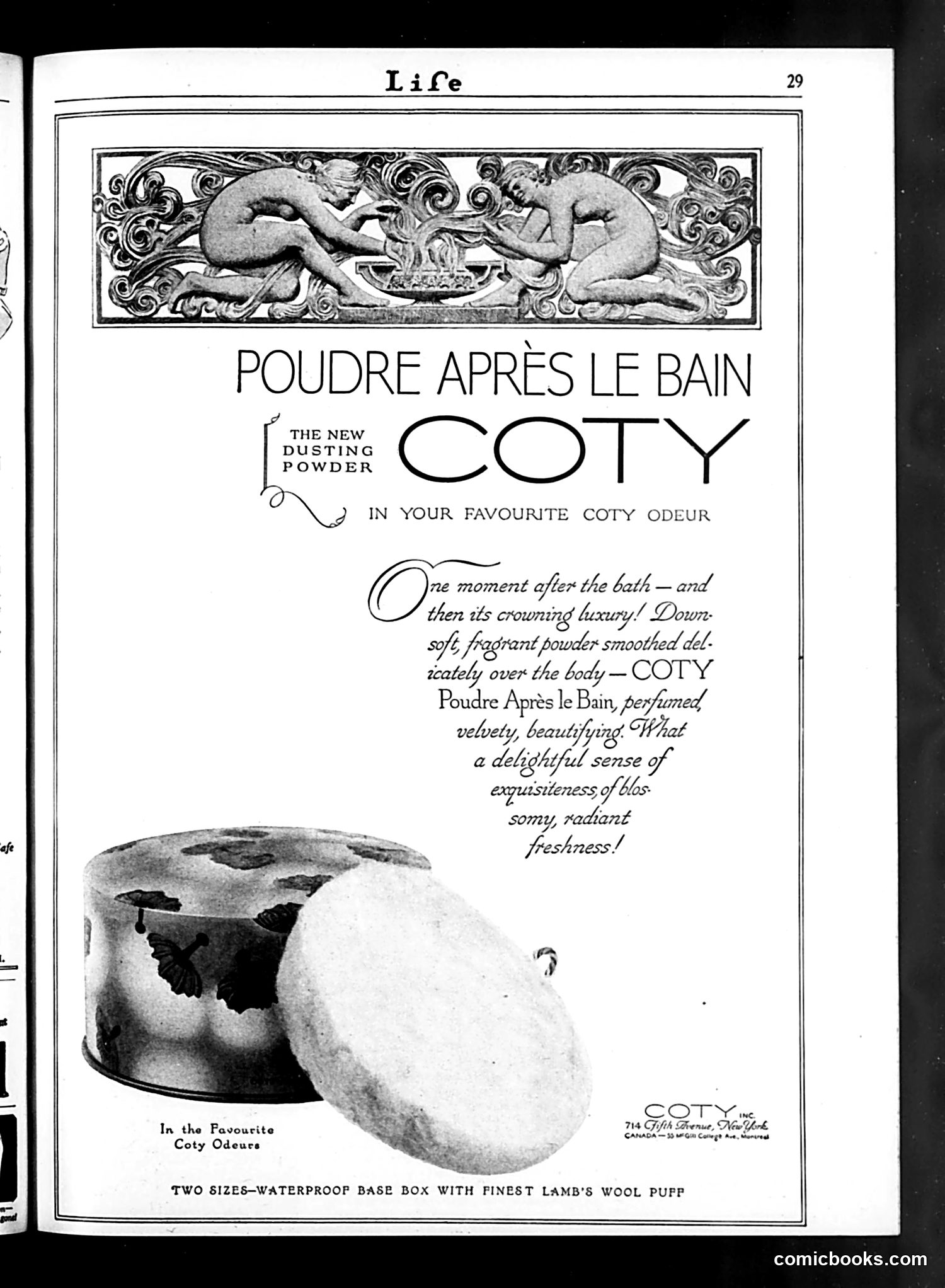
This is **not a cartoon or satire** — it's a straightforward **advertisement** for Coty dusting powder, a real cosmetics brand. The decorative header depicts classical cherubs in an ornamental design, typical of luxury product advertising of the era. The French phrase "Poudre Après le Bain" (powder after the bath) emphasizes elegance and sophistication. The ad promotes a post-bath beauty ritual, describing the powder as "perfumed, velvety, beautifying" with "exquisiteness" and "freshness." The product image shows a round powder box with a puff applicator. This appears in *Life* magazine's advertising section. While *Life* was known for satire and humor in editorial content, this page contains only commercial promotion — no political commentary, caricature, or joke is present. It's simply a period beauty product advertisement targeting affluent female readers.
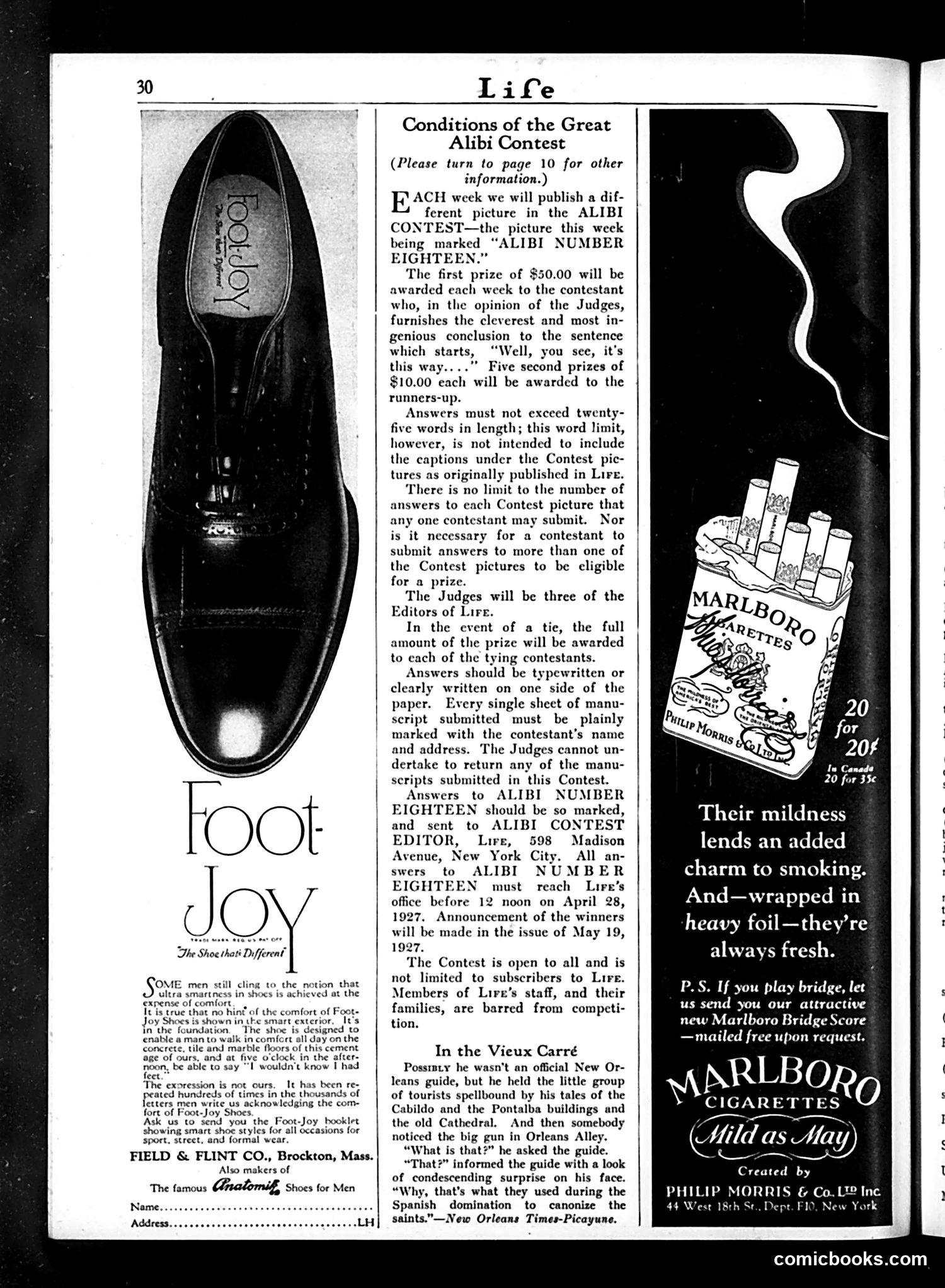
This page contains mostly **advertisements and contest information**, not political satire. The main content is Life magazine's "Alibi Contest" (Alibi #18)—a weekly reader-participation contest where contestants submit humorous endings to incomplete sentences beginning "Well, you see, it's this way...." The winning answer receives $50; runners-up get $10 each. Answers are limited to 25 words and must arrive by April 28, 1927. The left side advertises **Foot-Joy shoes**, emphasizing comfort despite smart appearance—a common 1920s sales pitch playing on male anxieties about footwear. At bottom right is a **Marlboro cigarettes advertisement**, noting their mildness and freshness when wrapped in foil. This predates Marlboro's famous mid-century rebrand to masculinity. The brief anecdote "In the Vieux Carré" is a joke: a fake New Orleans tour guide mistakes a cannon for a device used to "canonize saints" during Spanish rule—a pun on "cannon/canonize."
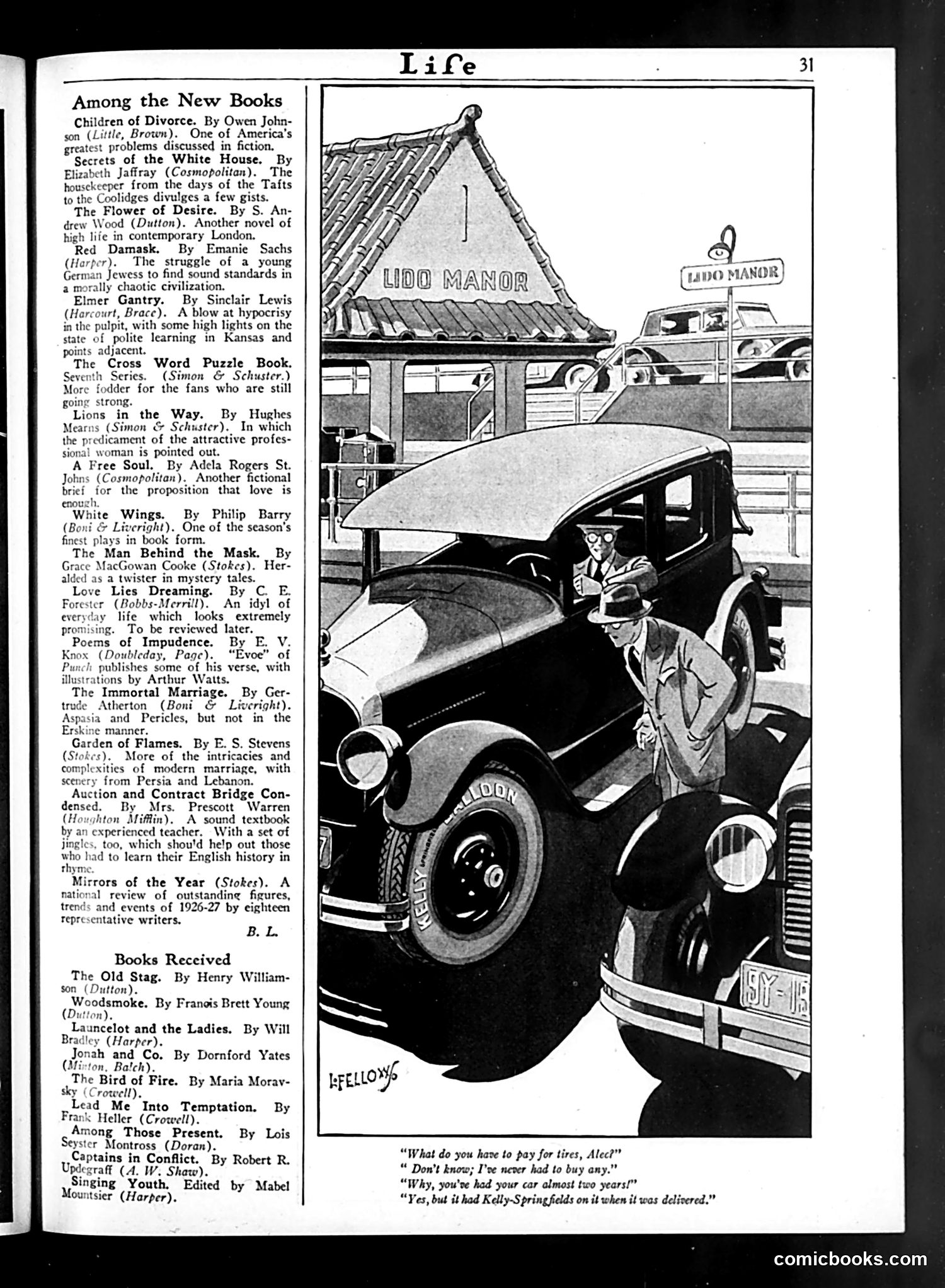
This is a single-panel cartoon satirizing tire durability and auto marketing claims. A man inquires about his friend's tire costs; the friend reveals he's never purchased replacement tires in nearly two years of car ownership. The punchline explains the tires were "Kelly-Springfields" brand—implying exceptional longevity. The joke functions as **advertising disguised as humor**. By presenting the product claim through dialogue rather than direct endorsement, Life presents the tire's durability as established fact worthy of comedic surprise. This reflects 1920s marketing practices where manufacturers placed ads in magazines using humor and celebrity endorsements to build brand reputation. The cartoon appears alongside book reviews, suggesting Life positioned itself as sophisticated entertainment for literate consumers—an audience advertisers targeted through subtle product placement rather than overt commercials.
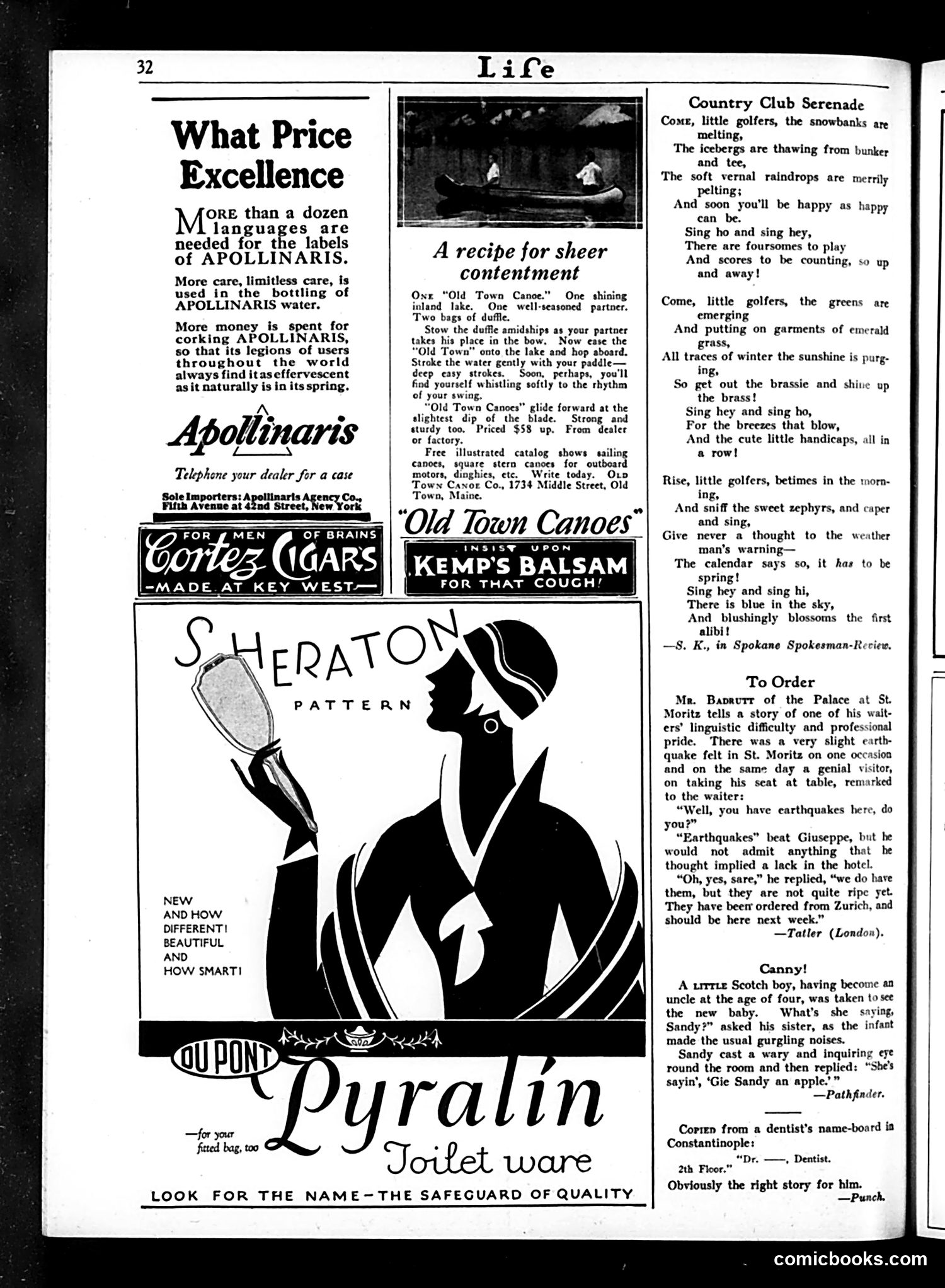
This page is primarily **advertising and light humor**, not political satire. The main content includes: **Advertisements** dominate the left side: Apollinaris sparkling water, Old Town Canoes, Corvet cigars, Kemp's Balsam cough remedy, and Pyralin toilet ware (the Sheraton pattern). The Sheraton illustration shows a stylized 1920s woman with a hand mirror—typical Art Deco advertising imagery. **Right side content** consists of: - "Country Club Serenade": a whimsical poem celebrating spring golf season - Three brief humorous anecdotes: 1. A waiter in St. Moritz denying earthquakes out of professional pride 2. A Scottish child's cunning response to his newborn sister 3. A Constantinople dentist's peculiar office sign These are gentle, observational humor pieces without political commentary—typical of Life magazine's satirical approach to everyday social situations and human nature rather than current events.
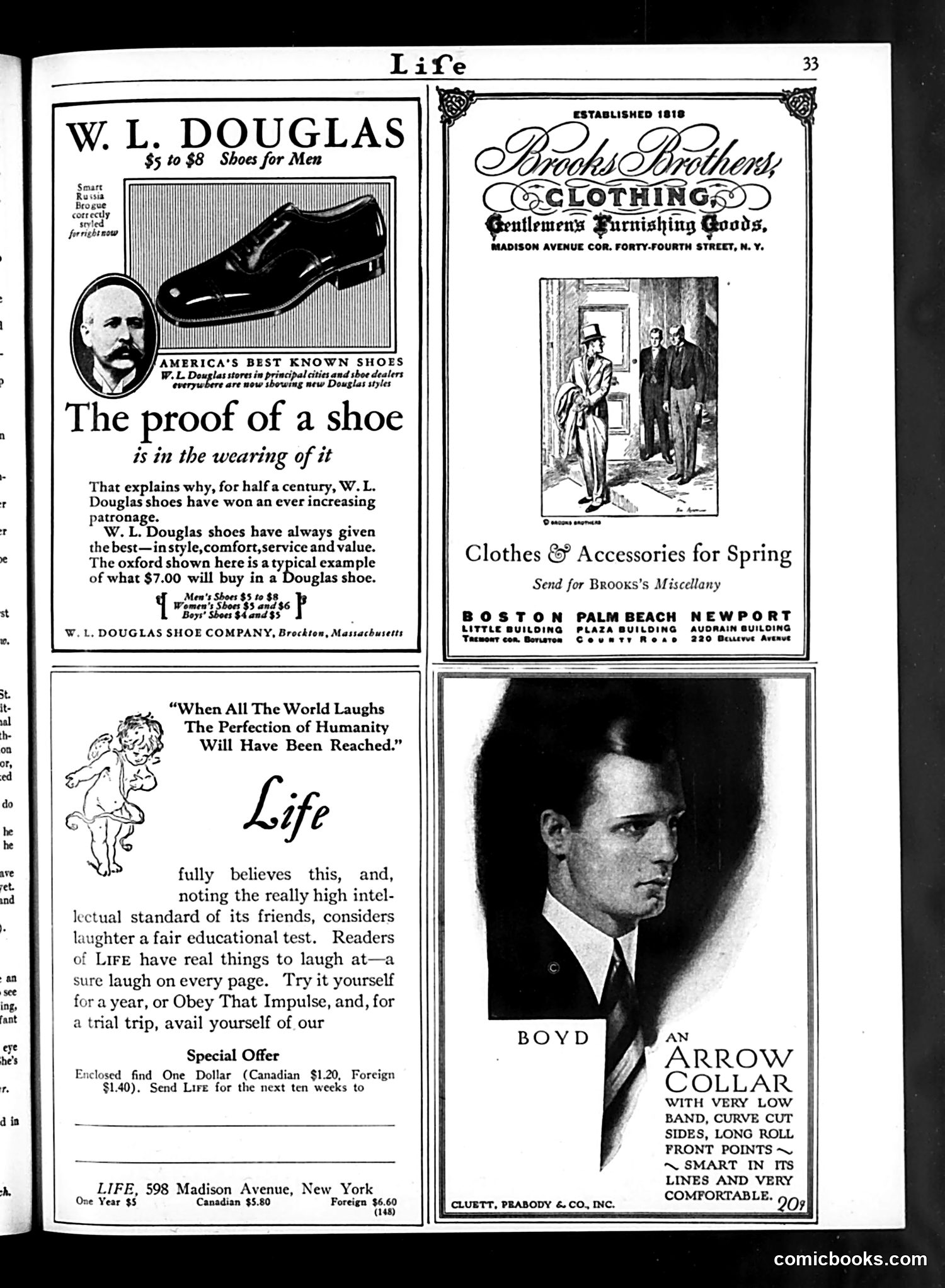
This page is primarily **advertisements** interspersed with a magazine subscription pitch—not satirical content. The ads feature: 1. **W.L. Douglas Shoes**: A men's shoe company advertisement emphasizing durability ("proof of a shoe is in the wearing of it"), with a portrait of the founder/brand ambassador. 2. **Brooks Brothers Clothing**: A gentlemen's furnishing goods advertisement showing well-dressed men, targeting affluent customers. 3. **Boyd Arrow Collar**: A shirt collar advertisement highlighting design features (low band, curve cut, comfort). 4. **Life Magazine subscription offer**: The publication promotes itself as a humor magazine with "real things to laugh at—a sure laugh on every page," using the aphorism "When All The World Laughs / The Perfection of Humanity / Will Have Been Reached" to position laughter as an intellectual virtue. The page reflects early 20th-century consumer culture targeting middle-to-upper-class men, with emphasis on quality, style, and gentlemanly appearance.
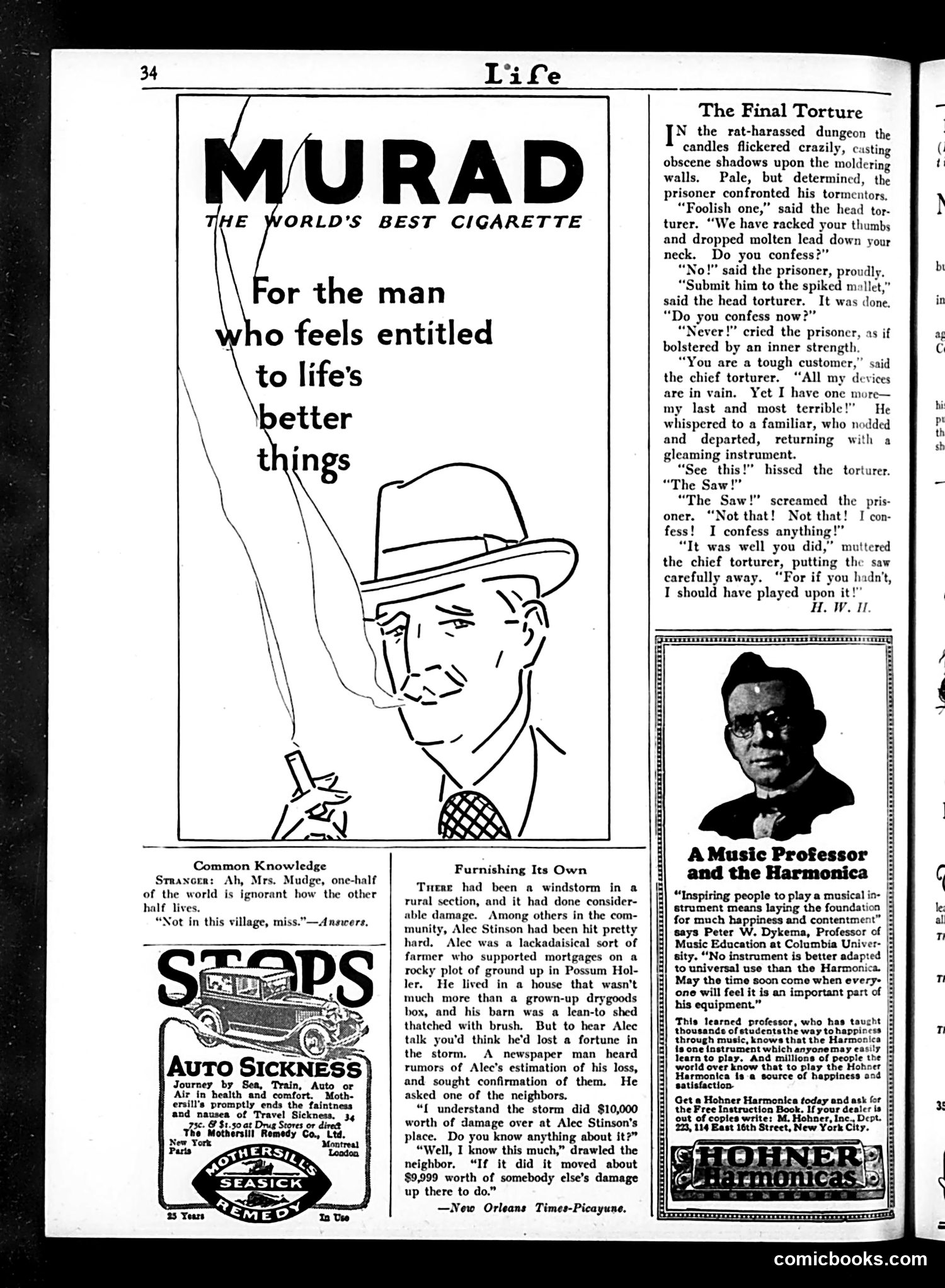
This page contains **advertisements and humorous anecdotes** rather than political cartoons. The main **Murad cigarette ad** uses aspirational messaging typical of early 20th-century tobacco marketing—targeting men who consider themselves entitled to "life's better things," with an illustration of a distinguished gentleman smoking. Below are three unrelated humor pieces: 1. **"Common Knowledge"** - a brief joke about villagers knowing each other's business 2. **"Furnishing Its Own"** - a rural anecdote from the *New Orleans Times-Picayune* where a farmer exaggerates storm damage claims; the joke's punchline reveals his loss was inflated by $9,999 worth of someone *else's* damaged property blown onto his land 3. **"The Final Torture"** - a darkly comedic story where a prisoner withstands medieval tortures but breaks when threatened with a saw being *played as a musical instrument* The page also includes period advertisements for travel sickness remedies and Hohner harmonicas. The content reflects early 20th-century magazine humor: wordplay, rural stereotypes, and absurdist jokes.
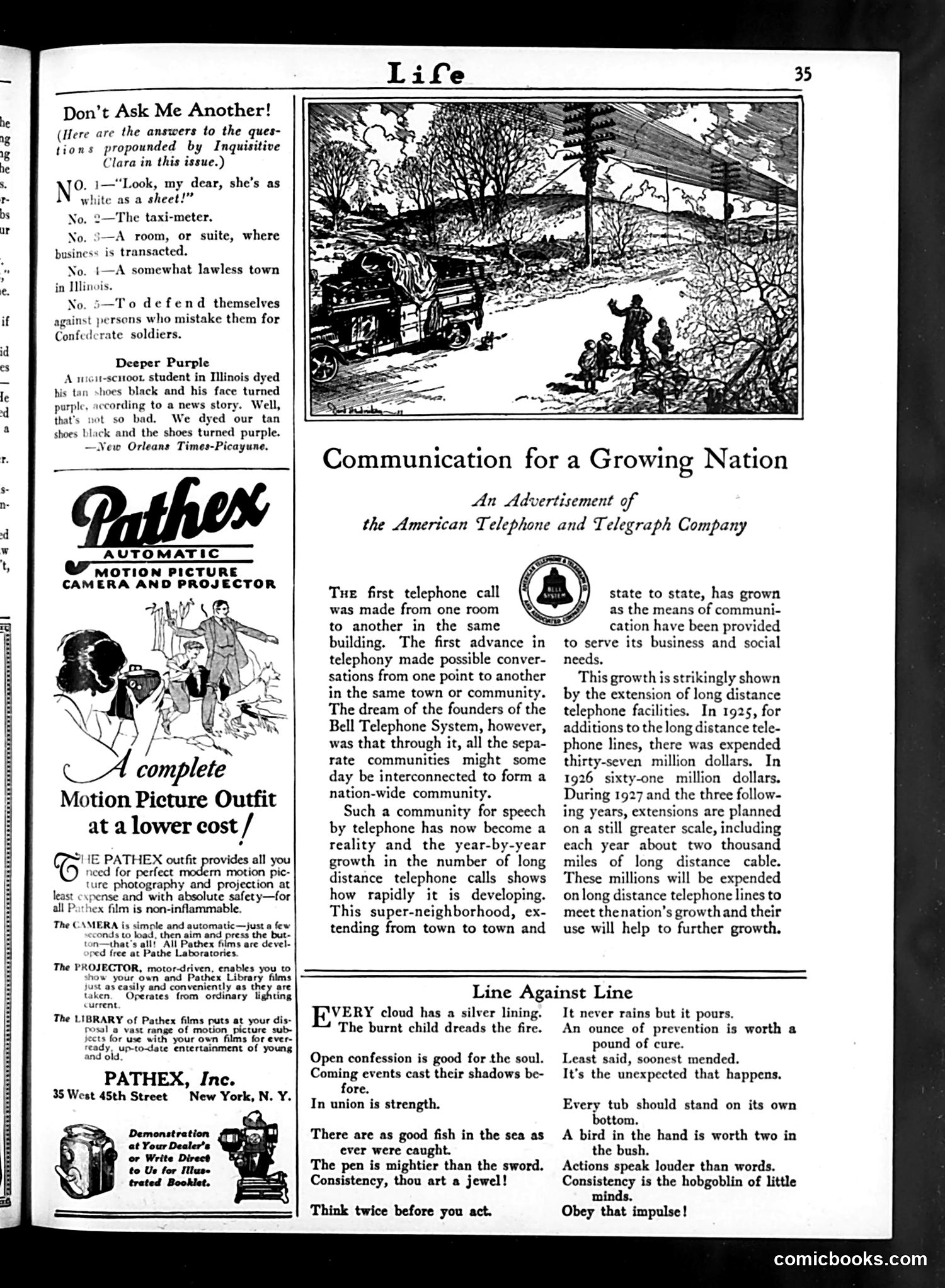
This page contains three distinct elements: a humorous Q&A column, advertising, and aphorisms. **"Don't Ask Me Another!"** presents comedic answers to reader questions, including a joke about a student in Illinois who dyed his shoes black; they turned purple instead. The humor references a Civil War-era anecdote about dyed Confederate uniforms. **Pathex Advertisement** promotes an affordable home motion picture camera and projector system, reflecting 1920s consumer interest in emerging film technology for domestic use. **AT&T Advertisement** celebrates telephone infrastructure expansion as nation-building, claiming that long-distance telephone networks—requiring tens of millions in investment—connect communities into a unified "nation-wide community." This corporate messaging frames infrastructure spending as progress and patriotic growth. **"Line Against Line"** juxtaposes contradictory proverbs (e.g., "every cloud has a silver lining" vs. "it never rains but it pours"), highlighting how traditional wisdom often contradicts itself—gentle social satire typical of Life magazine's wit.
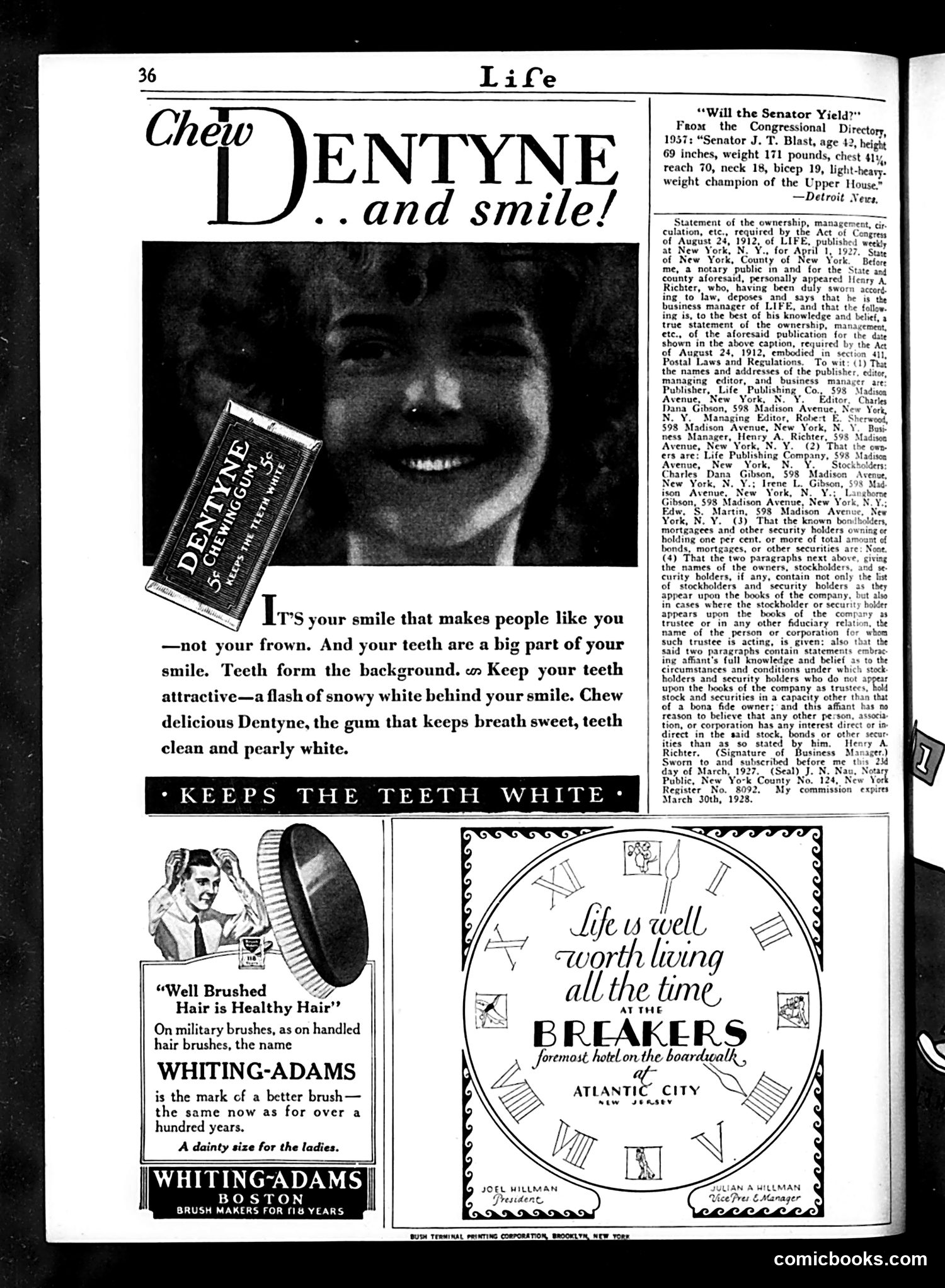
This page features a satirical cartoon mocking heavyweight politicians in Congress. The headline quotes a senator named "J. T. Blast" from a fictional 1957 Congressional Directory, describing him using boxing measurements (height, weight, chest, reach, bicep) rather than legislative credentials—treating him as a physical specimen rather than an intellectual leader. The joke targets the brute-force approach of powerful senators who dominate debate through sheer intimidation and volume rather than reasoned argument. By framing a senator as a "light-heavyweight champion of the Upper House," Life ridicules the era's tendency toward personality-driven politics and suggests Congress was becoming a contest of physical dominance rather than substantive policymaking. The satire reflects Progressive-era concerns about political corruption and the need for meritocratic, intellectual governance.