
Life, 1927-04-14 · page 26 of 38
Life — April 14, 1927 — page 26: what you’re looking at
What you’re looking at
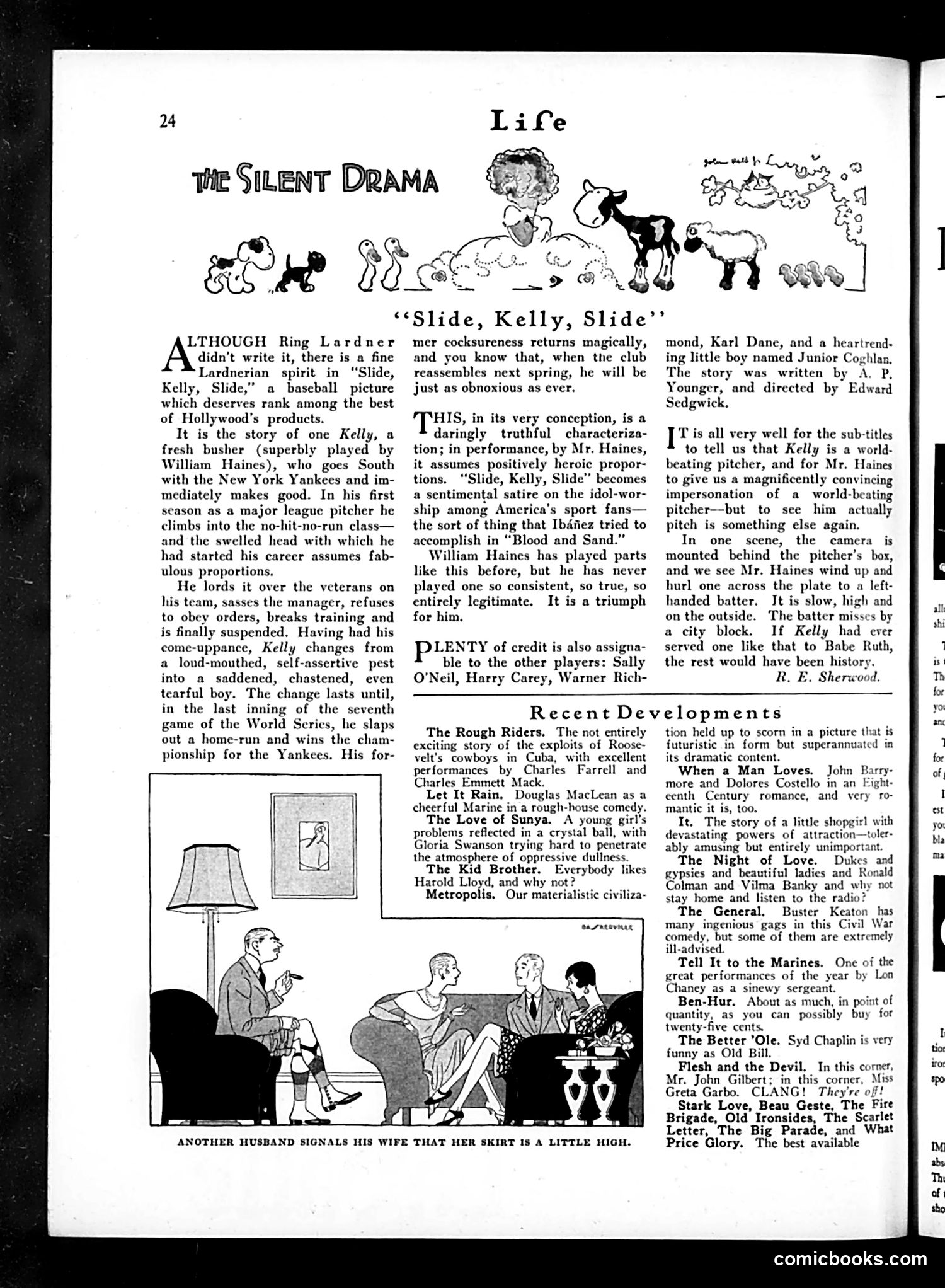
This page reviews a 1916 silent film about a cocky young baseball pitcher named Kelly (played by William Haines) who joins the New York Yankees. The film satirizes American sport-fan culture and idol-worship: Kelly becomes arrogant after early success, defies his manager, and must be humbled before redemption arrives when he hits a championship-winning home run in the World Series. The review praises the film's "sentimental satire" and Haines's performance as genuinely convincing. However, it mocks one scene where the camera catches Haines's actual pitching—the throw is comically slow and high, nowhere near realistic for a world-class pitcher. The critic jokes that even Babe Ruth wouldn't have missed such a terrible pitch. The page also lists other recent film releases in brief, typical of entertainment trade journalism from this era.
📄 Transcribed text from this page (OCR, searchable)
Machine-transcribed from the original scan — historical spelling and the odd misread are preserved.
The SitentT DRAMA “Slide, Kelly, Slide didn’t write it, there is a fine Lardnerian spirit in “Slide, Kelly, Slide,” a baseball picture which deserves rank among the best of Hollywood's products. It is the story of one Kelly, a fresh busher (superbly played by William Haines), who goes South with the New York Yankees and im- mediately makes good. In his first season as a major league pitcher he climbs into the no-hit-no-run class— and the swelled head with which he had started his career assumes fab- ulous proportions. He lords it over the veterans on his team, sasses the manager, refuses to obey orders, breaks training and ALTHOUGH Ring Lardner mer cocksureness returns magically, and you know that, when the club reassembles next spring, he will be just as obnoxious as ever. THs, in its very conception, is a daringly truthful characteriza- tion; in performance, by Mr. Haines, it assumes positively heroic propor- tions. “Slide, Kelly, Slide” becomes a sentimental satire on the idol-wor- ship among America’s sport fans— the sort of thing that Ibdiiez tried to accomplish in ‘Blood and Sand.” William Haines has played parts like this before, but he has never played one so consistent, so true, so entirely legitimate. It is a triumph for him. mond, Karl Dane, and a heartrend- ing little boy named Junior Coghlan, The story was written by A. P, Younger, and directed by Edward Sedgwick. I? is all very well for the sub-titles to tell us that Kelly is a world- beating pitcher, and for Mr. Haines to give us a magnificently convincing impersonation of a world-beating pitcher—but to see him actually pitch is something else again. In one scene, the camera is mounted behind the pitcher's box, and we see Mr. Haines wind up and hurl one across the plate to a left- handed batter. It is slow, high and on the outside. The batter misses by is finally suspended. Having had his a city block. If Kelly had ever * come-uppance, Kelly changes from LENTY of credit is also assigna- served one like that to Babe Ruth, ; a loud-mouthed, self-assertive pest ble to the other players: Sally the rest would have been history. is into a saddened, chastened, even O'Neil, Harry Carey, Warner Rich- R. E. Sherwood. Th tearful boy. The change lasts until, for in the last inning of the seventh game of the World Series, he slaps out a home-run and wins the cham- Recent Developments The Rough Riders. The not entirely tion held up to scorn in a picture that is zi 7, £3 . exciting story of the exploits of Roose- futuristic in form but superannuated in 7 pionship for the Yankees. His for- velt's cowboys in Cuba, with excellent its dramatic content. for performances by Charles Farrell and When a Man Loves. John Barry- of | Charles Eat MSC fact! more and Dolores Costelio in an Fight et It Rain. Douglas MacLean asa eenth Century romance, and very ro- cheerful Marine in a rough-house comedy. mantic it is, too. est The Love of Sunya. A young girl's It. The story of a little shopgirl with yo problems reflected in a crystal ball, with devastating powers of attraction—toler- hh Pig cap pools A cil le emp gel eigen P Ss . ¢ Night of Love. Dukes The Kid Brother. Everybody likes gypsies and beautiful ladies and Ronald Harold Lloyd, and why not? Colman and Vilma Banky and why not Metropolis. Our materialistic civiliza~ stay home and listen to the radio? The General, Buster Keaton has earacevnnn many ingenious gags in this Civil War comedy, but some of them are extremely ill-advised. Tell It to the Marines. One of the great performances of the year by Lon Chaney as a sinewy sergeant. Ben-Hur. About as much, in point of quantity, as you can possibly buy for twenty-five cents. I The Better ‘Ole. Syd Chaplin is very ; funny as Old Bill. hae Flesh and the Devil. In this corner, kor Mr. John Gilbert; in this corner, Miss So Greta Garbo. CLANG! They're of Stark Love, Beau Geste, The Fire Brigade, Old sronsides, The Satie etter, e Bi; ‘arade, an ANOTHER HUSBAND SIGNALS HIS WIFE THAT HER SKIRT 18 A LITTLE HIGH. Price Glory. The best available ™ abs Th of she comicbooks.com