
Life, 1927-04-14 · page 28 of 38
Life — April 14, 1927 — page 28: what you’re looking at
What you’re looking at
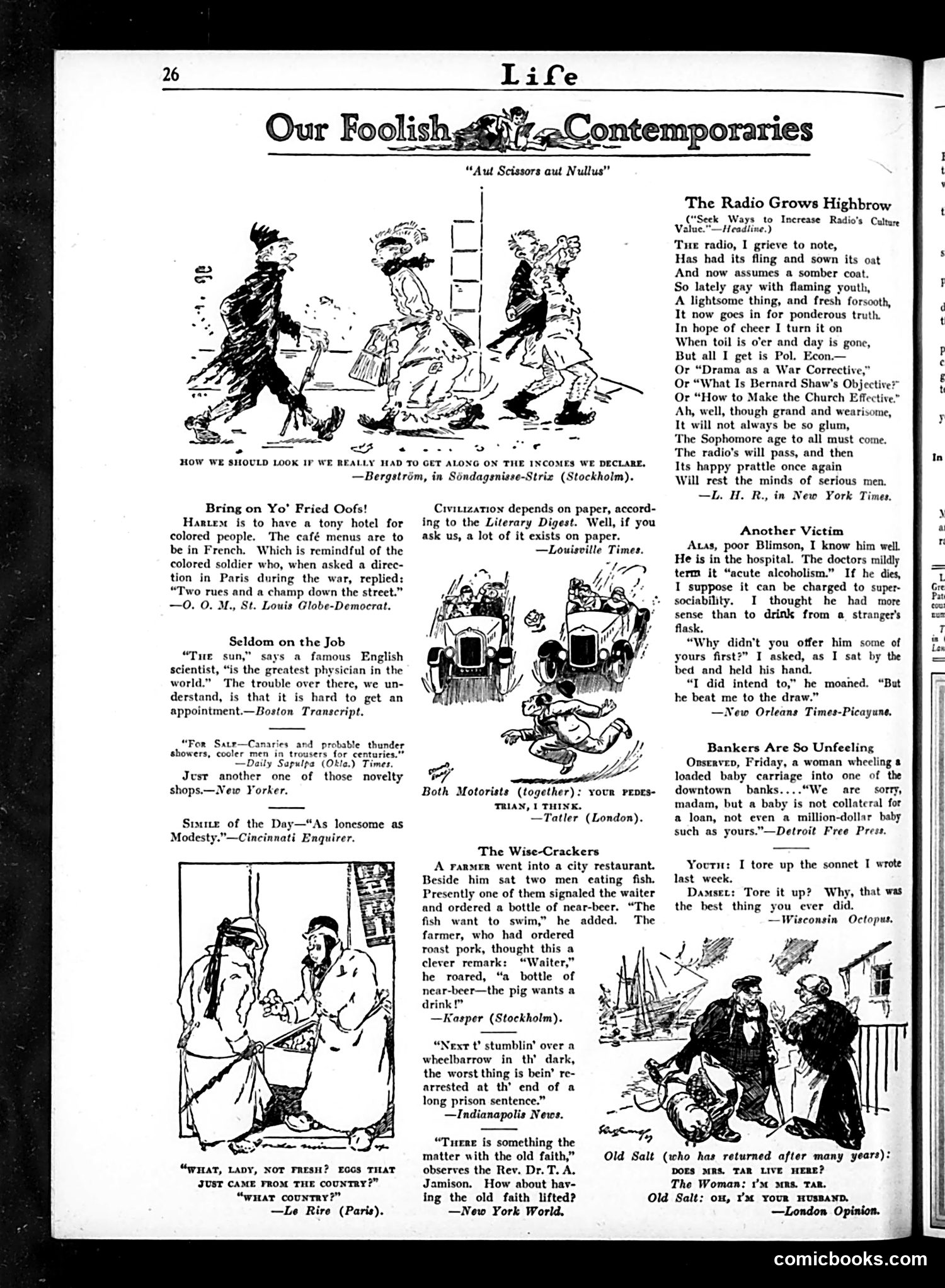
This page collects brief satirical jokes and cartoons mocking contemporary society and human folly. Key pieces include: **"The Radio Grows Highbrow"** — A poem lamenting that radio, once entertainment for casual listening, now broadcasts tedious educational content ("Pol. Econ," "Drama as a War Corrective," Bernard Shaw discussions). The satire suggests both radio's pretentious drift toward serious programming and society's misguided belief this represents cultural improvement. **"The Wise-Crackers"** — A farmer at a restaurant hears diners joke that ordered beer is "for the fish to swim." The farmer attempts the same joke about his pork order, appearing foolish rather than clever. **Various one-liners** mock: British sun-worship despite lack of sunshine; absurd newspaper classifieds; motorists blaming pedestrians; and bankers' refusal to accept a baby as loan collateral. The cartoons depict everyday social awkwardness—including one about tax declarations versus actual spending habits. The overall theme: poking fun at modern pretension, miscommunication, and human absurdity across social classes.
📄 Transcribed text from this page (OCR, searchable)
Machine-transcribed from the original scan — historical spelling and the odd misread are preserved.
- <a < HOW WE SHOULD LOOK IF WE REALLY HAD TO GET ALONG ON THE INCOMES WE DECLARE. —Bergstrim, in Séndagsnisse-Striz (Stockholm). Bring on Yo" Fried Oofs! Hartex is to have a tony hotel for colored people. The café menus are to be in French. Which is remindful of the colored soldier who, when asked a direc- tion in Paris during the war, replied: “Two rues and a champ down the street.” —O. 0. M., St. Louis Globe-Democrat. Seldom on the Job “Tue sun,” says a famous English scientist, “is the greatest physician in the world.” The trouble over there, we un- derstand, is that it is hard to get an appointment.—Boston Transcript. “For Satr—Canaries and probable thunder showers, cooler me: trousers for centuries.” —Daily Sapulpa (Okle,.) Times. Jvsr another one of those novelty shops.—New Yorker. Simmtxz of the Day—*As lonesome as Modesty.”—Cincinnati Enquirer. “WHAT, LADY, NOT FRESH? EGGS THAT JUST CAME FROM THE COUNTRY?” “war country?” —Le Rire (Paris). Civitzzation depends on paper, accord- ing to the Literary Digest. Well, if you ask us, a lot of it exists on paper. —Louisville Times. y Both Motorists (together): youn reprs- ‘TRIAN, | THINK. —Tatler (London). The Wise-Crackers A ranmer went into a city restaurant. Beside him sat two men eating fish. Presently one of them signaled the waiter and ordered a bottle of near-beer. “The fish want to swim,” he added. The farmer, who had ordered roast pork, thought this a clever remark: “Waiter,” he roared, “a bottle of near-beer—the pig wants a drink!” —Kasper (Stockholm). “Next t’ stumblin’ over a wheelbarrow in th’ dark, the worst thing is bein’ re- arrested at th’ end of a long prison sentence.” —Indianapolis News. “Turne is something the matter with the old faith,” observes the Rev. Dr. T. A. Jamison. How about hav- ing the old faith lifted? —New York World. The Radio Grows Highbrow ('Seck Ways to Increase Radio's C Value."—Headline.) Peas Tue radio, I grieve to note, Has had its fling and sown its oat And now assumes a somber coat. So lately gay with flaming youth, A lightsome thing, and fresh forsooth, It now goes in for ponderous truth. In hope of cheer I turn it on When toil is o'er and day is gone, But all I get is Pol. Econ.— Or “Drama as a War Corrective,” Or “What Is Bernard Shaw's Objective?” Or “How to Make the Church Effective.” Ah, well, though grand and wearisome, It will not always be so glum, ‘The Sophomore age to all must come. The radio's will pass, and then Its happy prattle once again Will rest the minds of serious men. —L. H. R., in New York Times. Another Victim Atas, poor Blimson, I know him well. He is in the hospital. The doctors mildly term it “acute alcoholism.” If he dies, I suppose it can be charged to super- sociability. I thought he had more sense than to drink from a stranger's flask, “Why didn’t you offer him some of yours first?” I asked, as I sat by the bed and held his hand. “I did intend to,” he moaned. “But he beat me to the draw.” —New Orleans Times-Picayune. Bankers Are So Unfeeling Onstrven, Friday, a woman wheeling 8 loaded baby carriage into one of the downtown banks....“We are sorry, madam, but a baby is not collateral for a loan, not even a million-dollar baby such as yours."—Detroit Free Press. Youtn: I tore up the sonnet I wrote last week. Damset: Tore it up? Why, that was the best thing you ever did. —Wisconsin Octopus. Old Salt (who has returned after many year: DOES MRS. TAR LIVE HERE? The Woman: 1’ >ms. TAR. Old Salt: ou, Ym YouR HUSBAND, —London Opinion. ais P ¢ g te comicbooks.com