
A complete issue · 44 pages · 1926
Life — October 21, 1926
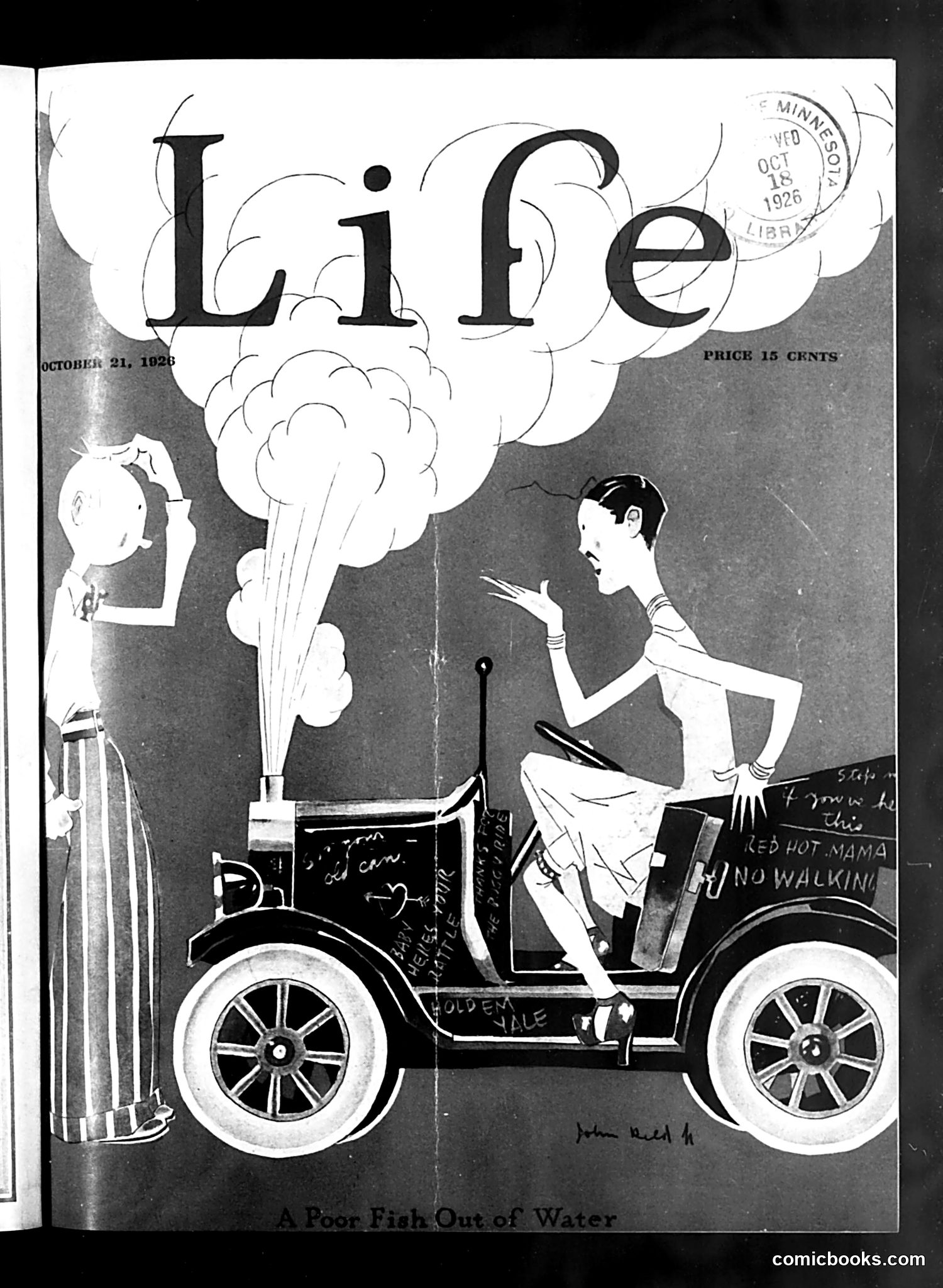
This satirical cover depicts a flapper-era woman in a car being stopped by a traffic policeman, with the title "Life" emerging as massive exhaust clouds. The caption reads "A Poor Fish Out of Water." The cartoon mocks 1920s automobile culture and perhaps excessive driving or reckless motorists. The woman's fashionable appearance (bobbed hair, modern dress) and confident demeanor suggest satire about the "new woman" of the Jazz Age—independent, driving her own vehicle, defying traditional expectations. The policeman's presence indicates she's being stopped, possibly for traffic violations. The "poor fish out of water" phrase suggests criticism of someone acting inappropriately or out of place, though whether that targets the woman or the policeman remains unclear from the image alone. The exhaust clouds dominate the composition, emphasizing automobile pollution as a modern urban problem.
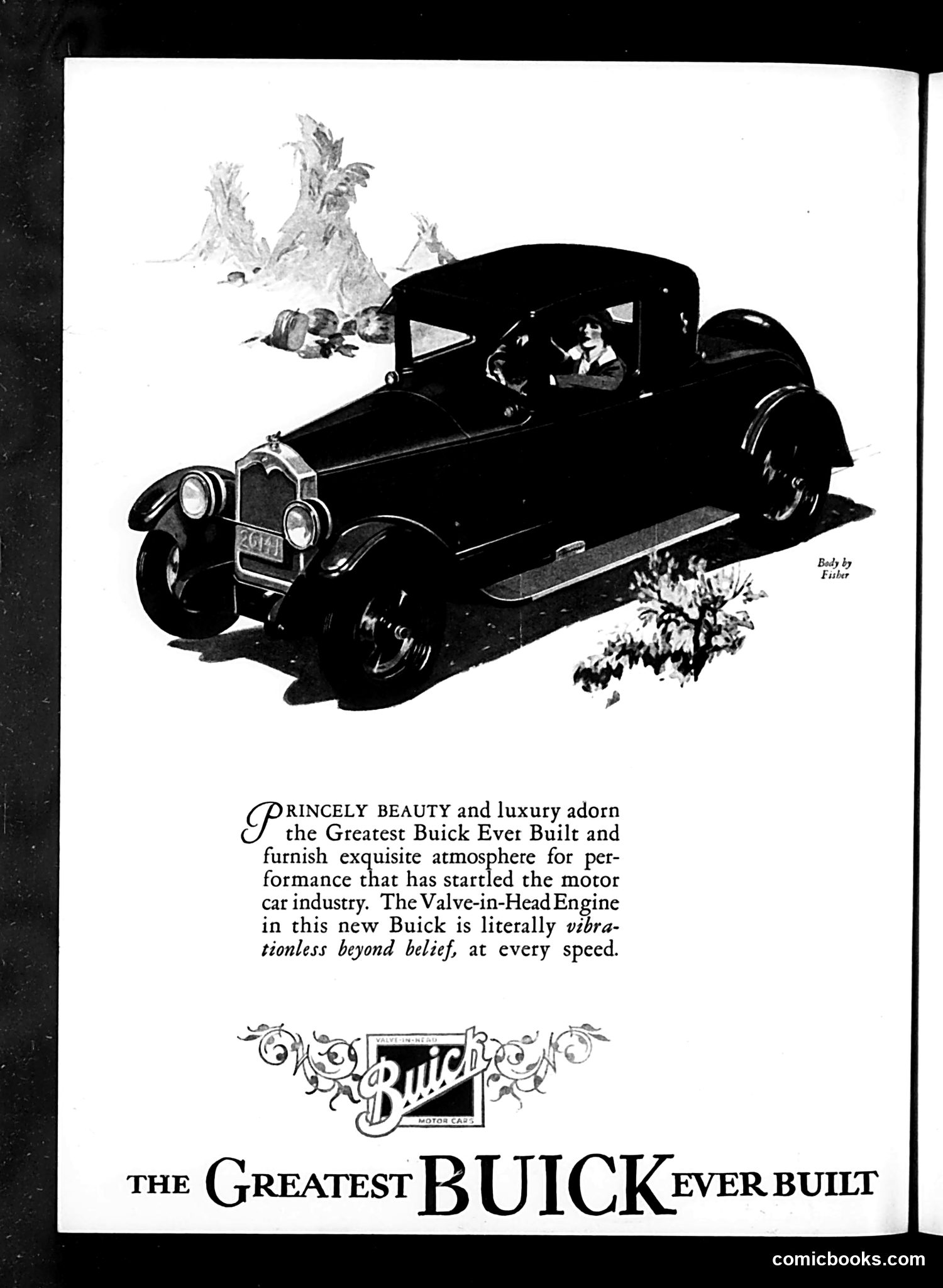
This page is **primarily an advertisement**, not editorial satire. It advertises a Buick automobile, emphasizing "princely beauty and luxury" and featuring a Valve-in-Head Engine described as "vibrationless beyond belief, at every speed." The illustration shows a well-dressed driver in a luxury car from what appears to be the 1920s era. The tagline "The Greatest Buick Ever Built" is the main message. There is no political cartoon or satirical content here. The page represents straightforward automotive marketing typical of early 20th-century magazine advertising, targeting affluent consumers who valued elegance and mechanical performance. The artistic style and claims reflect period advertising conventions.
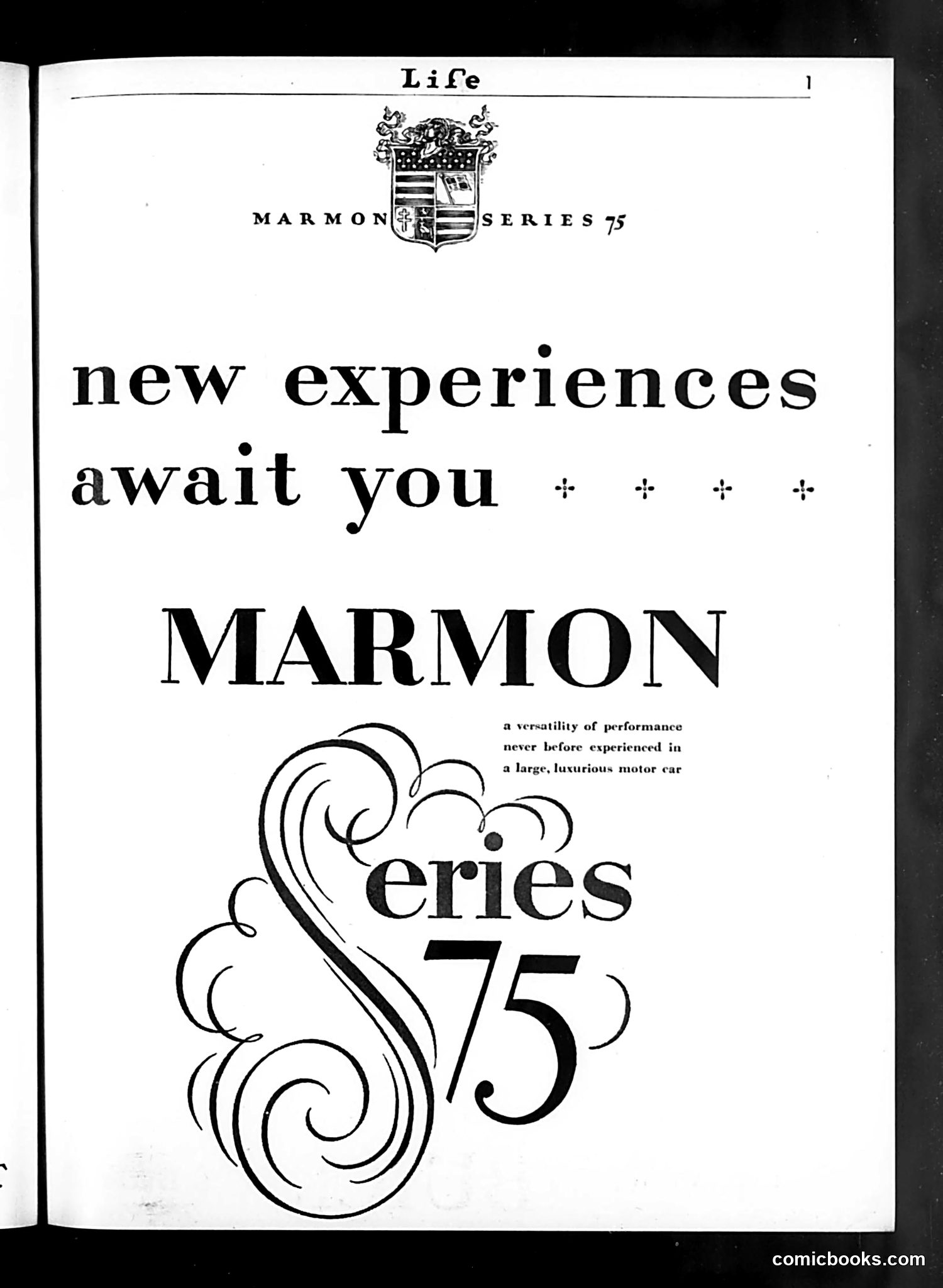
This is an advertisement, not a satirical cartoon. It promotes the Marmon Series 75 automobile, a luxury car manufactured by the Marmon Motor Car Company. The page uses elegant Art Deco typography and decorative flourishes typical of 1920s-30s advertising design. The headline "new experiences await you" emphasizes the car's appeal as a status symbol offering novel driving sensations. The small text promises "a versatility of performance never before experienced in a large, luxurious motor car"—positioning the Series 75 as combining both power and comfort, qualities rarely combined in vehicles of that era. This is straightforward product advertising rather than satire or political commentary. It targets wealthy consumers interested in high-end automobiles.
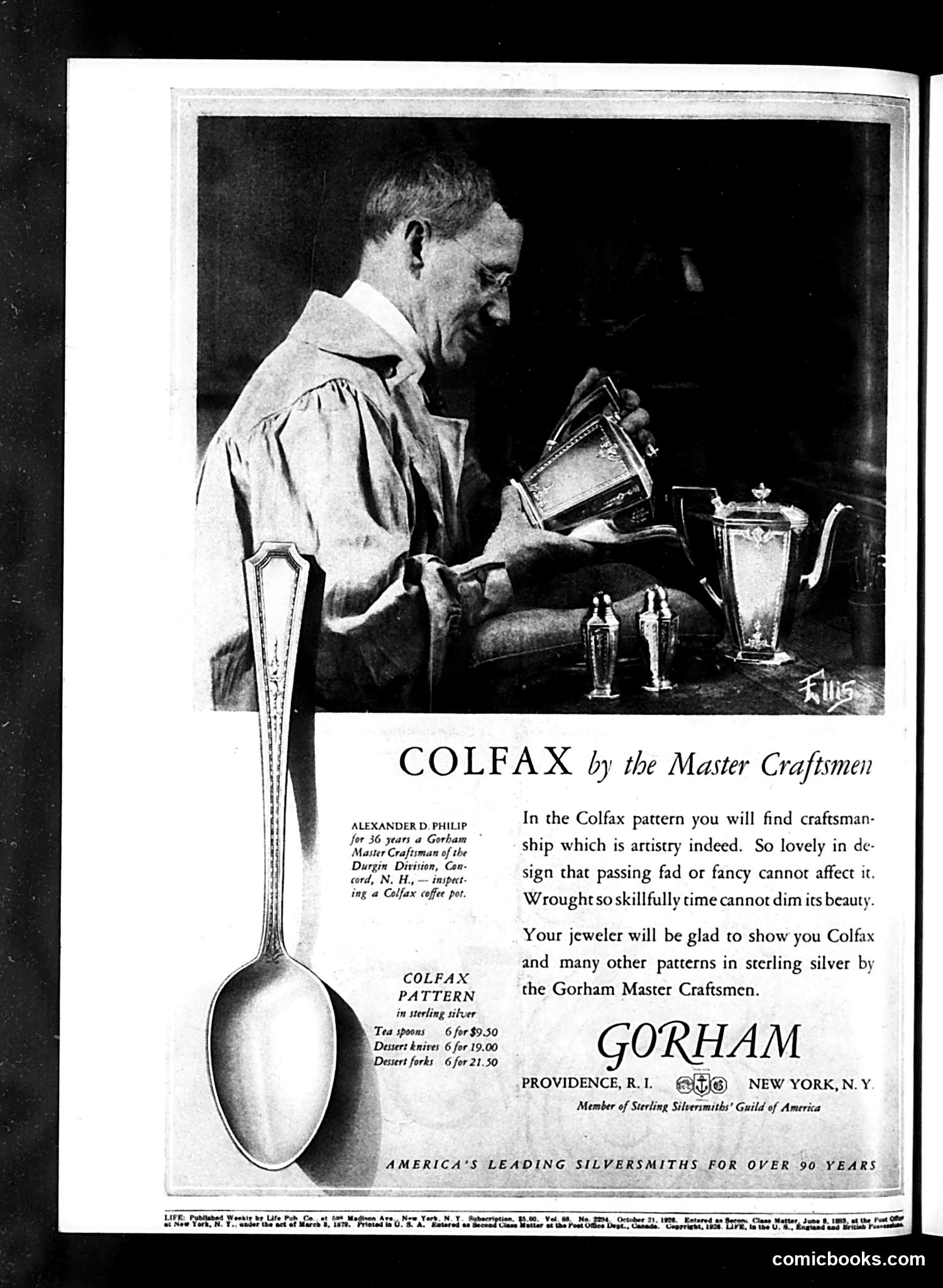
This is not a political cartoon or satire—it's a **straightforward advertisement** for Gorham silverware, specifically their "Colfax" pattern of sterling silver flatware. The image shows an older craftsman examining a ornate serving piece, demonstrating Gorham's claim to quality craftsmanship. The ad identifies him as "Alexander D. Philip for 36 years a Gorham Master Craftsman," lending credibility through his experience. The text emphasizes that the Colfax pattern's design is timeless—elegant enough to resist changing fashions. Gorham positions itself as "America's leading silversmiths for over 90 years," targeting affluent consumers seeking heirloom-quality flatware. This represents typical early-20th-century luxury advertising strategy: associating products with skilled artisanship and permanence.
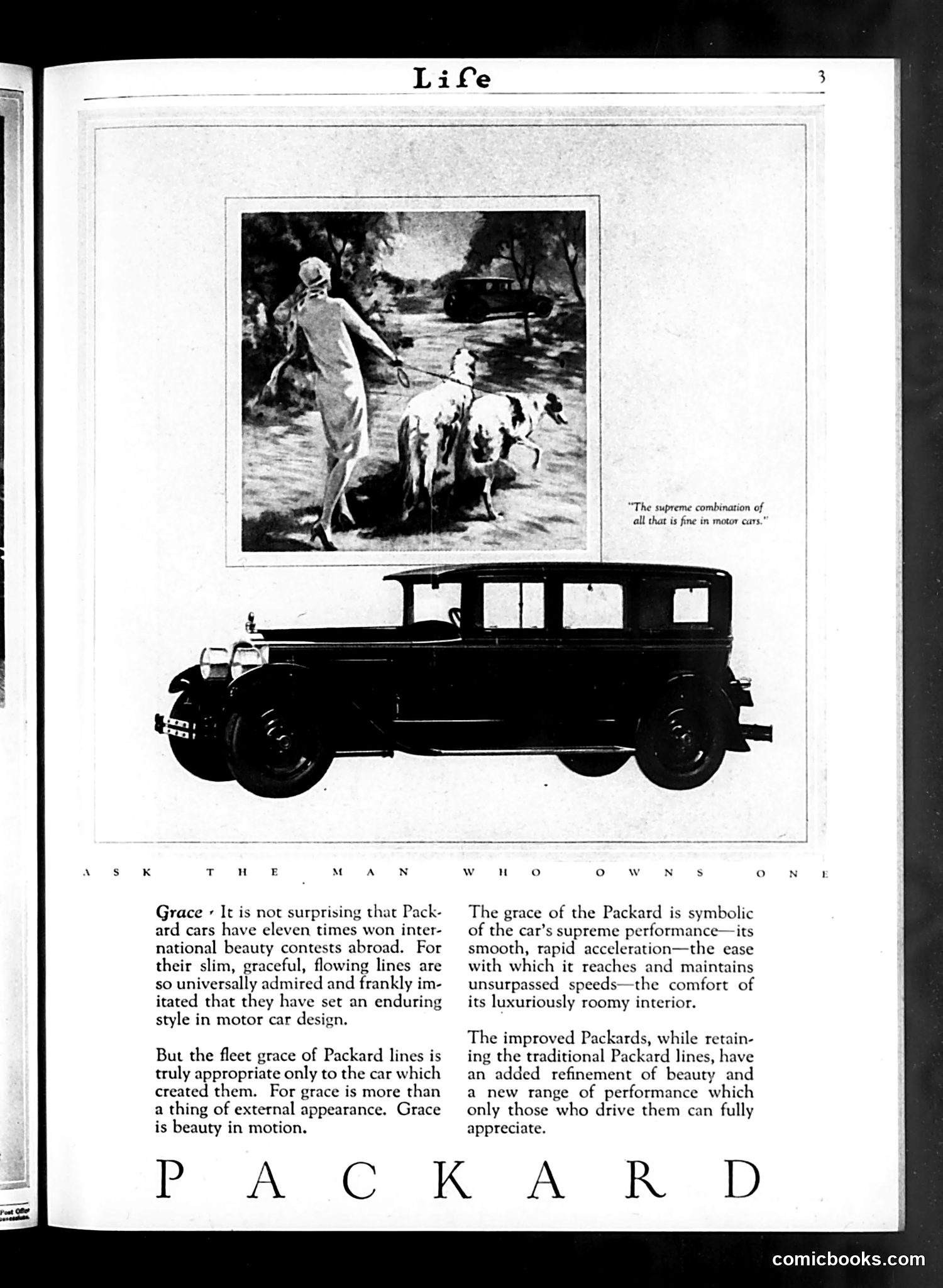
This is primarily a **Packard automobile advertisement**, not satire or political commentary. The page features a photograph of a woman and man by a riverbank with the quote "The supreme combination of all that is fine in motor cars," paired with a side-view illustration of a Packard automobile. The accompanying text discusses Packard's "grace" and design philosophy, arguing that the car's "graceful, flowing lines" represent beauty in motion. It emphasizes Packard's international design awards and claims the brand represents superior performance and luxury. **This is advertising copy**, not a political cartoon. The only "figure" is the generic couple used to associate the Packard with lifestyle aspirations typical of 1920s-era luxury car marketing.
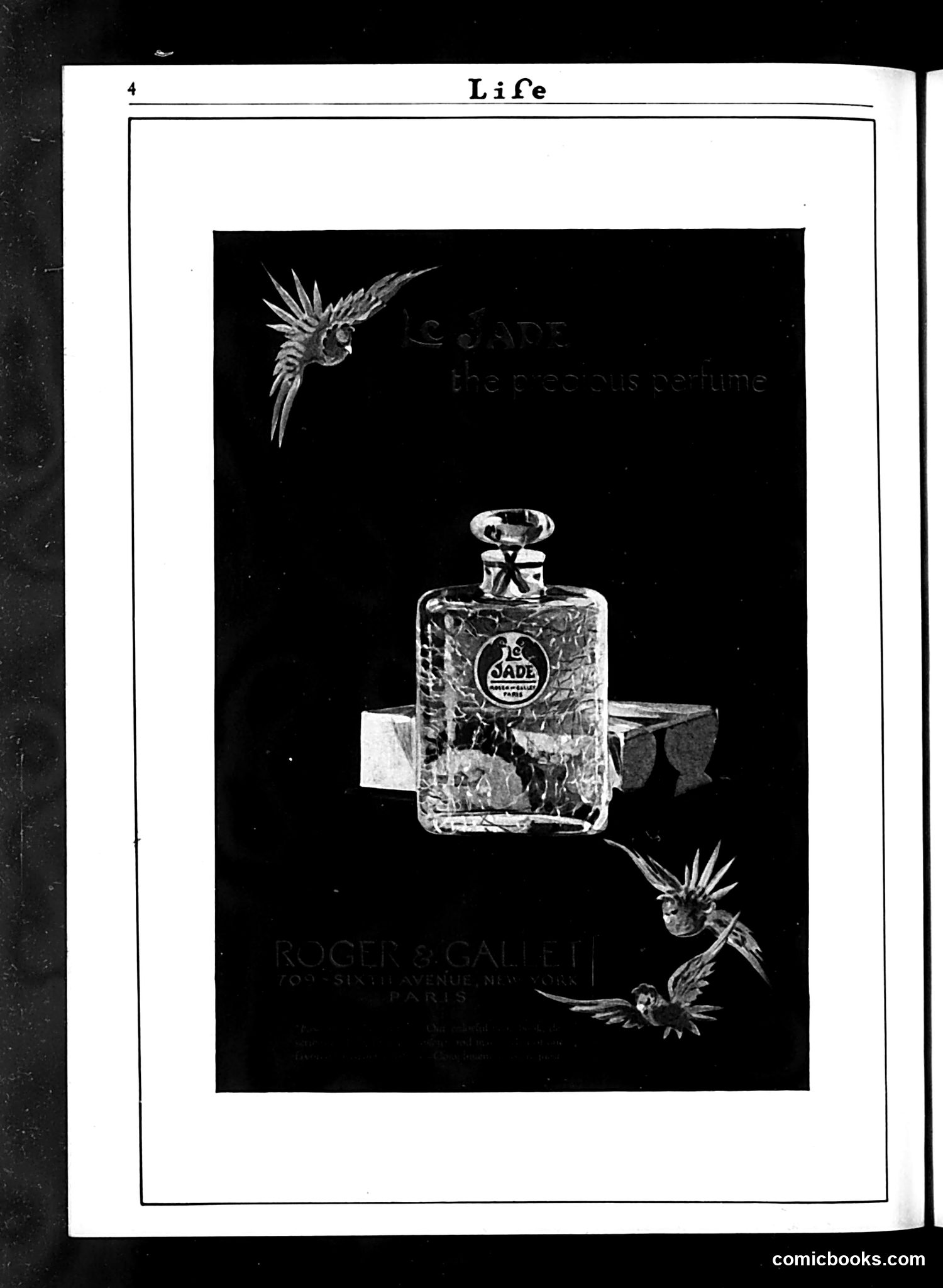
This page is primarily an **advertisement**, not a political cartoon. It features a luxury perfume bottle labeled "JADE" with the tagline "the precious perfume" at the top. The product is manufactured by **Roger & Gallet**, a Paris-based perfume house (address visible at bottom). The decorative elements—stylized birds with elaborate plumage flanking the bottle—are purely aesthetic, emphasizing luxury and exoticism. The black background and elegant presentation are typical of high-end cosmetic advertising from this era. There is no political satire or social commentary present. This is straightforward commercial advertising designed to appeal to Life's affluent readership through imagery of sophistication and refinement.
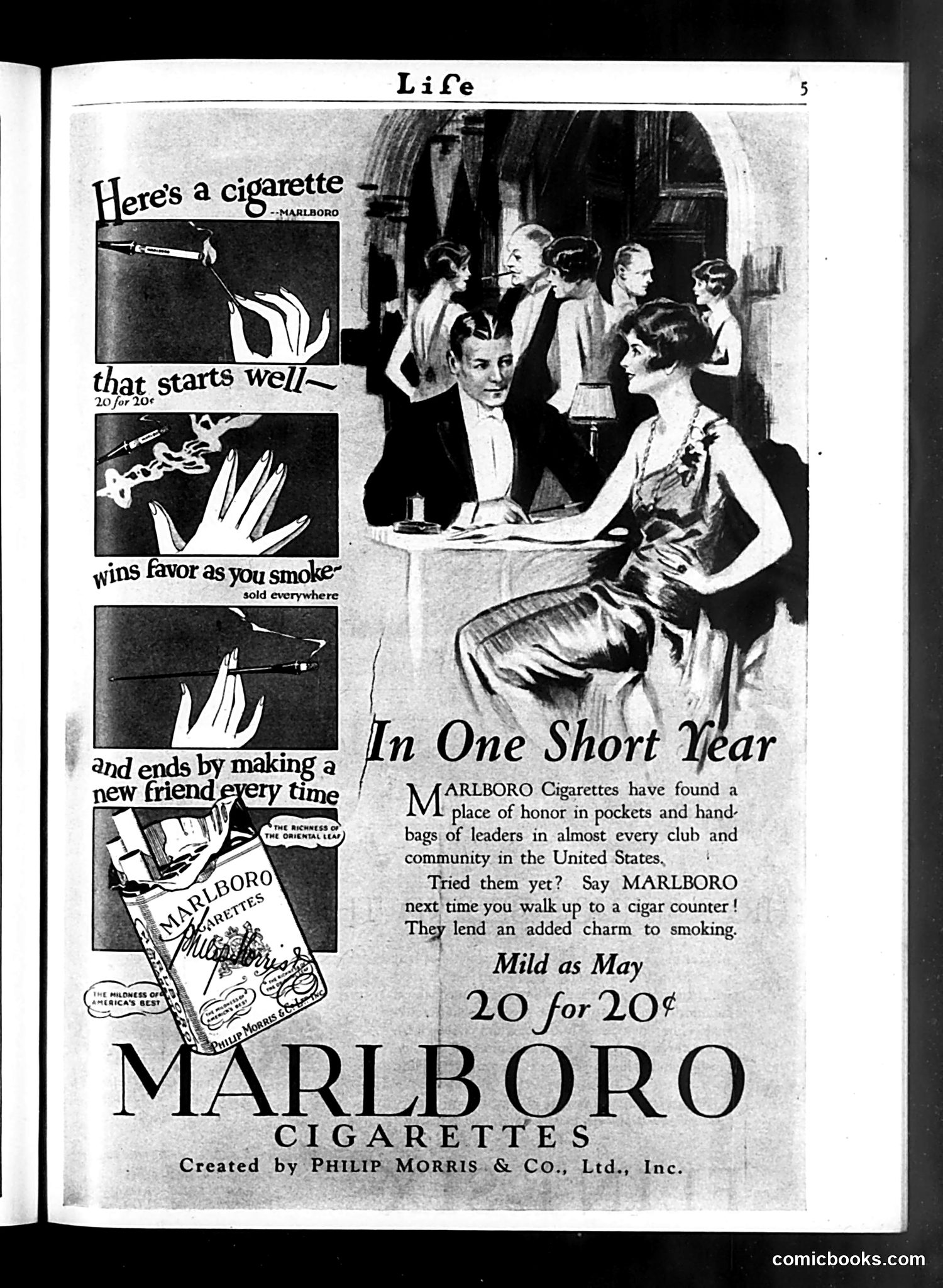
This is a **Marlboro cigarette advertisement**, not satire or political commentary. The page shows a social scene where well-dressed people at what appears to be an upscale gathering are smoking. The ad's messaging emphasizes that Marlboro cigarettes "start well," "win favor as you smoke," and "end by making a new friend every time"—claims about the product's social appeal and quality. The slogan "Mild as May" and price "20 for 20¢" are highlighted. The central image depicts smoking as a socially prestigious activity associated with sophistication and social bonding. This represents typical mid-20th century cigarette marketing before health warnings, when advertisements openly promoted smoking's social benefits without acknowledging health risks.
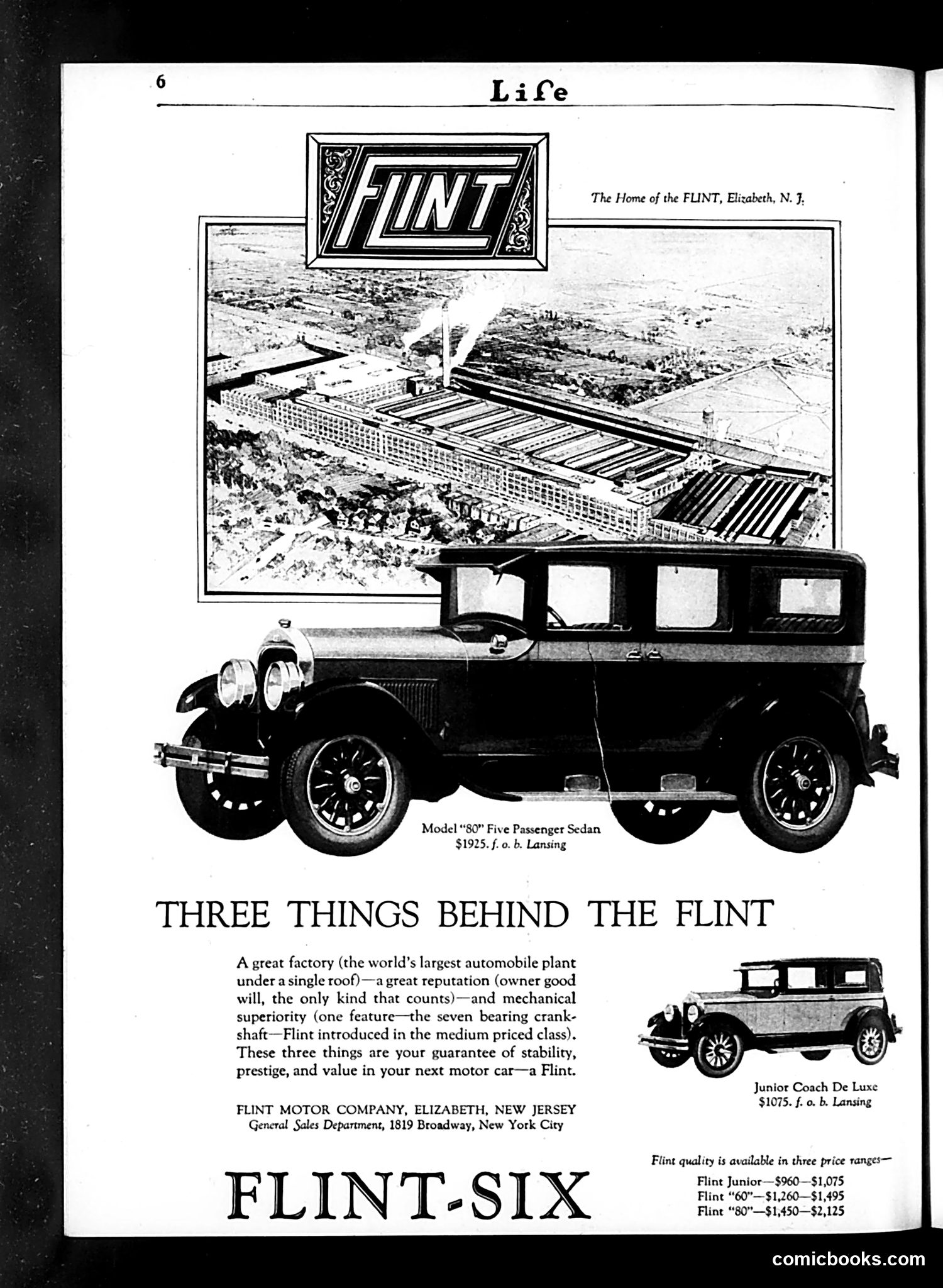
This is **primarily an advertisement**, not satire or political commentary. The page promotes the Flint Motor Company's automobiles in Elizabeth, New Jersey. The ad highlights "Three Things Behind the Flint": a large factory (claimed as "the world's largest automobile plant under a single roof"), the company's reputation, and mechanical superiority—specifically a seven-bearing crankshaft. Two car models are pictured with prices ($1,075-$1,925), positioned as mid-range vehicles offering "stability, prestige, and value." The aerial factory photograph serves as visual proof of manufacturing scale. This was typical 1920s automobile marketing, emphasizing industrial capacity and engineering features to build consumer confidence during the competitive early auto industry era.
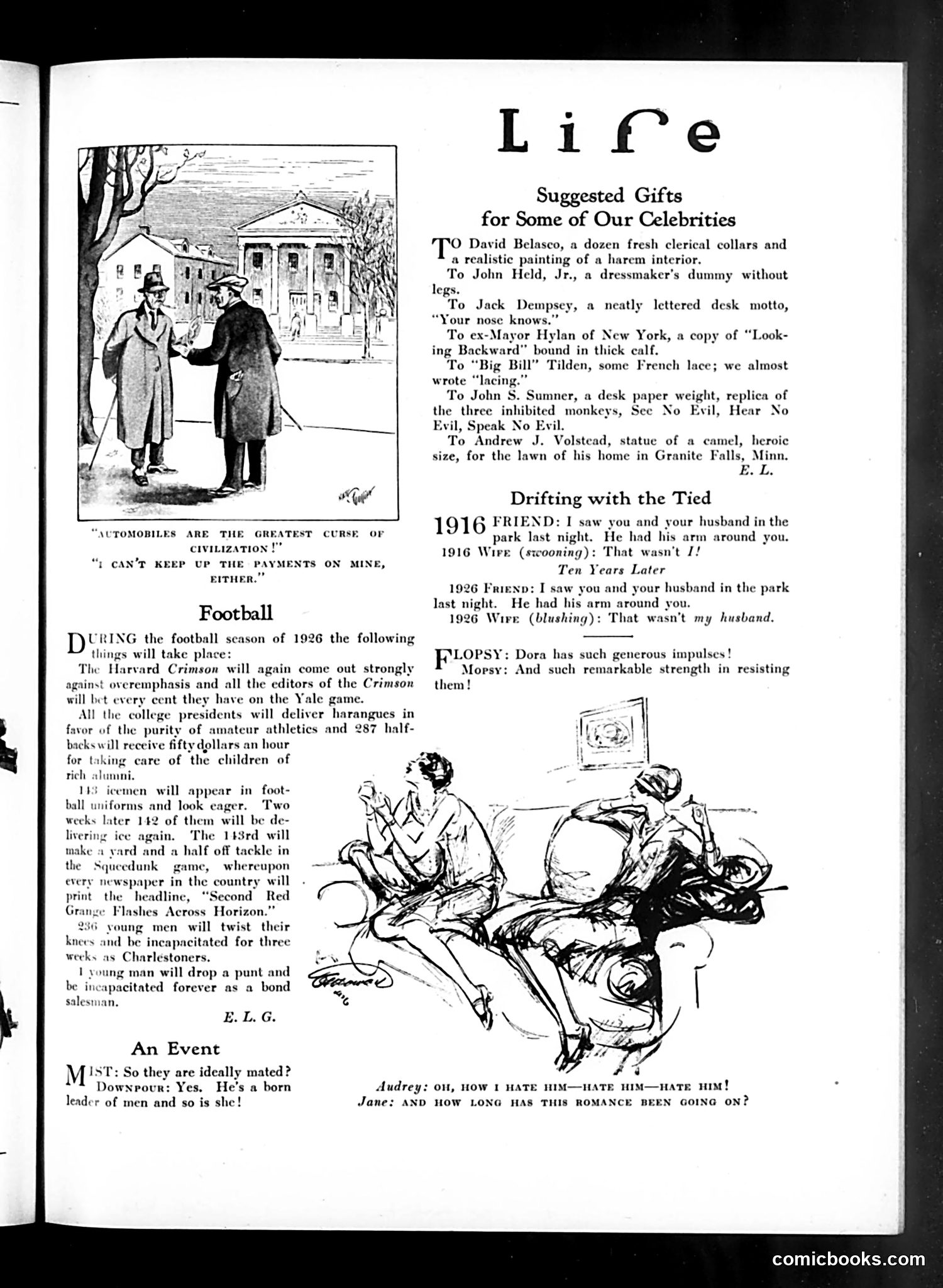
This page contains three distinct satirical pieces: 1. **"Automobiles Are the Greatest Curse of Civilization"** (top cartoon): Two men discuss payment obligations, suggesting cars create financial hardship for owners. 2. **"Football"** (middle section): A satirical prediction that Harvard will defeat Yale and discusses absurd consequences—players becoming incapacitated, newspapers printing sensational headlines ("Second Red Orange Flashes Across Horizon"), and young men being permanently disabled as "bond salesmen." 3. **"Drifting with the Tied"** and **"Flopsy"** (bottom): Humorous anecdotes about infidelity and character observations. The satire mocks early 1920s American anxieties: automobile debt, college football's excessive hype, and romantic entanglements. The football section particularly ridicules how seriously Americans took sports and the media's sensationalism around games.
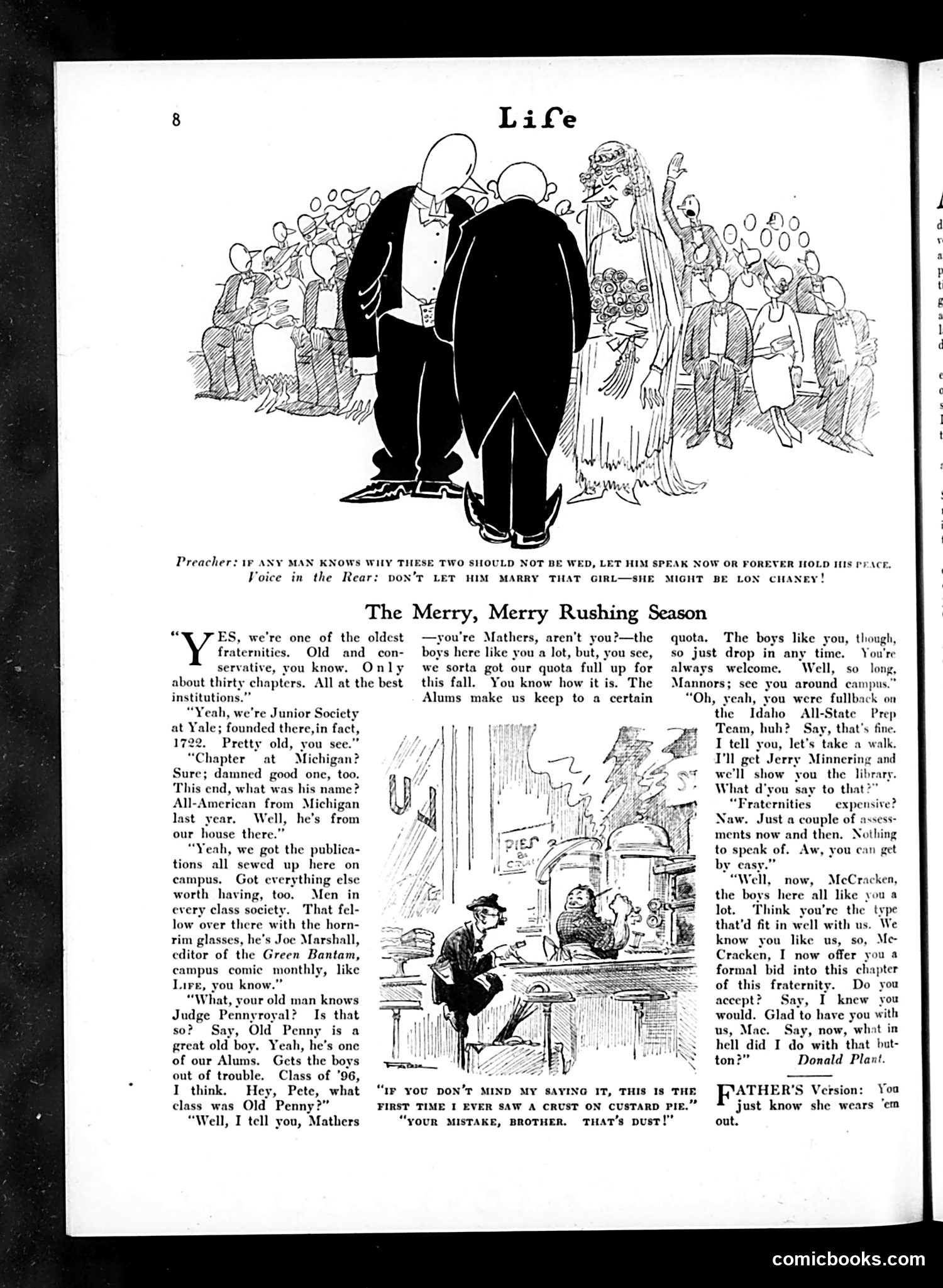
The top cartoon depicts a wedding ceremony with the caption challenging anyone to object to the union—a traditional "speak now or forever hold your peace" moment. The bride appears to be "Lon Chaney" (likely referring to the famous silent-film actor), suggesting satirical commentary on celebrity marriages. Below, "The Merry, Merry Rushing Season" discusses college fraternity recruitment. Two characters debate fraternity membership, with one boasting about his chapter's prestige and alumni connections. The dialogue mocks fraternity culture's pretentiousness—their emphasis on social status, exclusivity, and inflated self-importance. The cartoon and text together satirize both the formal absurdity of weddings and the competitive, status-conscious nature of 1920s college Greek life.
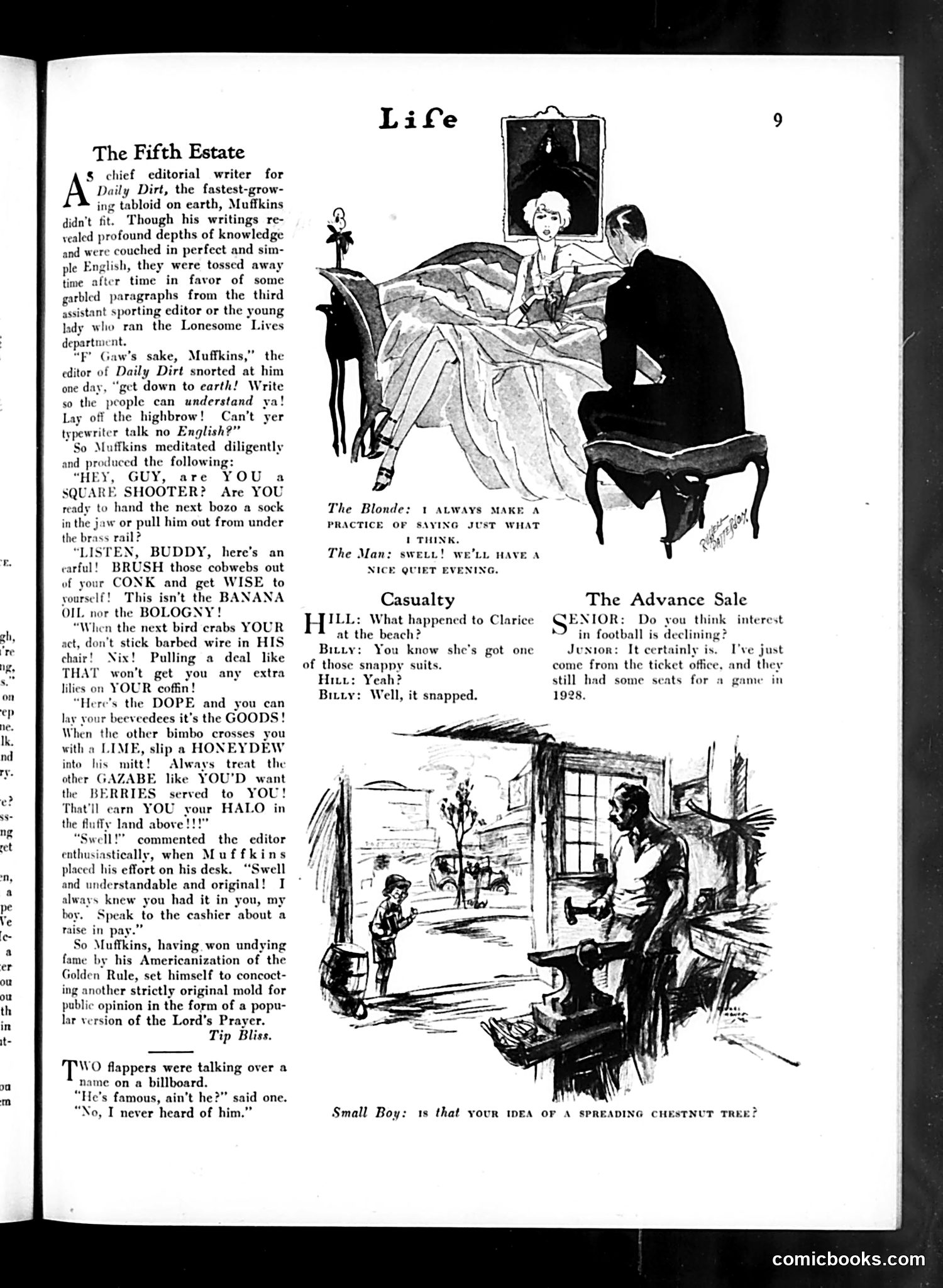
This page contains three separate satirical pieces mocking journalistic mediocrity and social awkwardness: **"The Fifth Estate"** ridicules a tabloid editor named Muffkins who produces dumbed-down, sensationalist content. The editor dismisses sophisticated writing in favor of crude language ("CONK," "BANANA OIL") targeting working-class readers. The satire critiques how tabloids deliberately eschew intelligence to maximize readership. **"Casualty" and "The Advance Sale"** are brief comedic dialogues about beach mishaps and football ticket sales—lightweight humor typical of the era's magazine filler. **"Tip Bliss"** features a two-liner about flapper culture and celebrity gossip. The illustrations complement these texts with period-appropriate line drawings. Overall, the page satirizes both sensationalist journalism and the trivial concerns of 1920s popular culture.
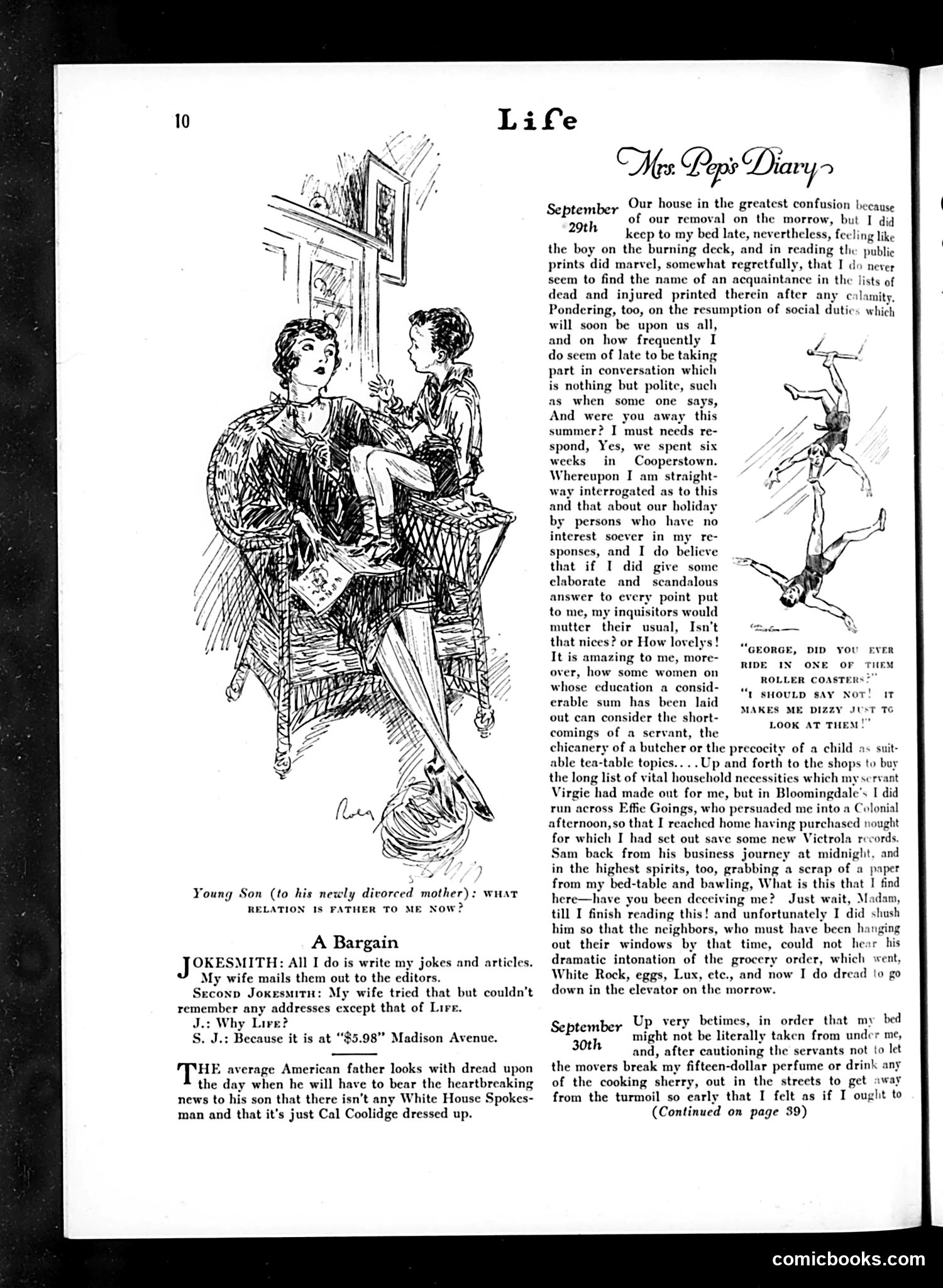
This page features two distinct satirical pieces: **Mrs. Peps' Diary** is a humorous diary entry about moving day chaos and social obligations. The accompanying sketch shows a woman with a child, illustrating domestic life struggles. **"A Bargain"** is a brief joke exchange between a jokesmith and his wife about his profession. He claims he only writes jokes and articles; his wife notes she can't remember any addresses except "Lire" (appearing to reference the magazine's location). The final punchline references Cal Coolidge, the U.S. President at the time, suggesting the jokesmith's work lacks originality—his content is merely "Cal Coolidge dressed up." The bottom section contains commentary about American fathers' anxiety regarding news delivery and domestic responsibilities, offering social satire about 1920s family life and gender roles.
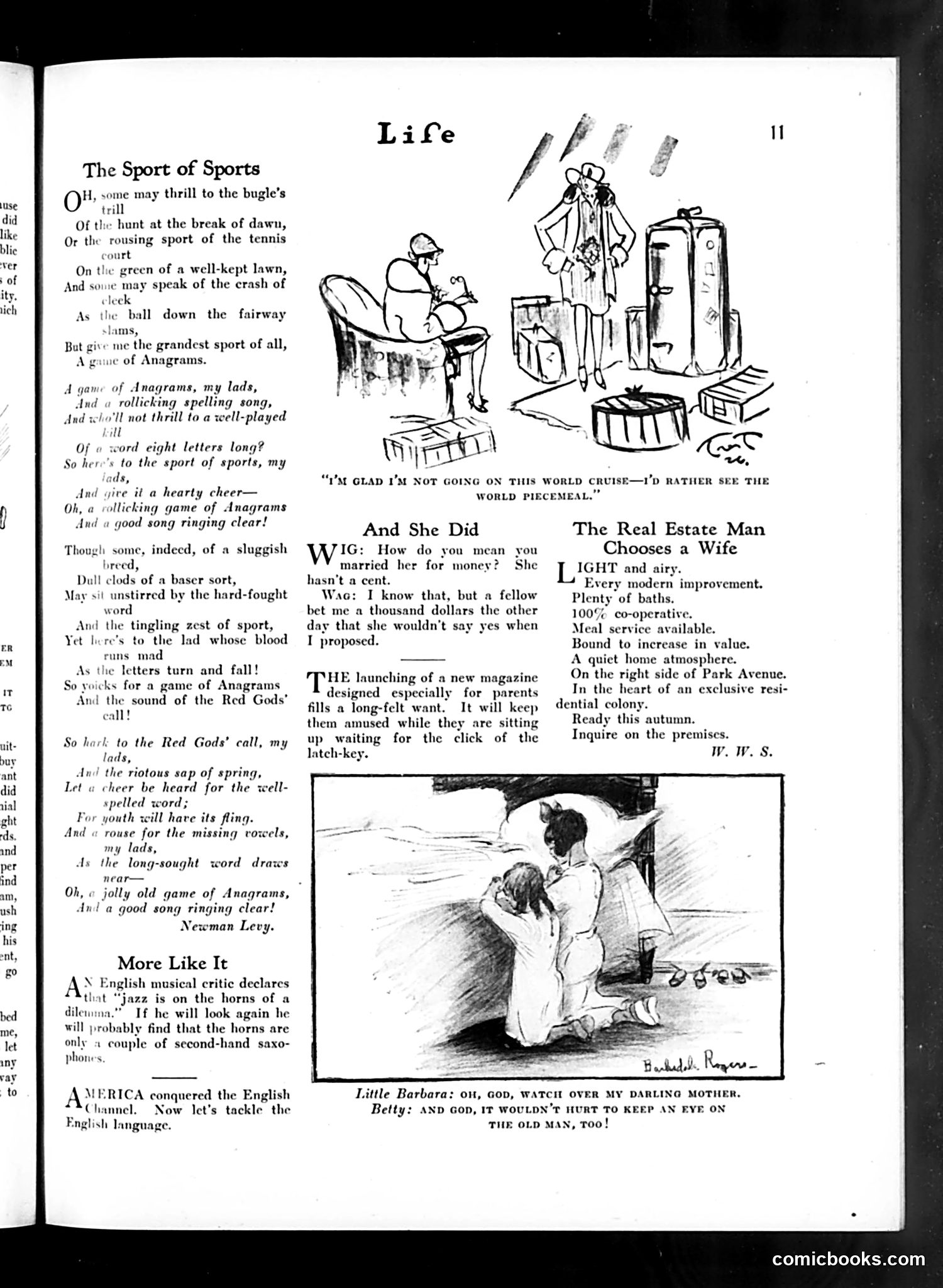
This page contains three separate satirical pieces: **"The Sport of Sports"** (poem by Newman Levy): Celebrates anagrams as the ultimate parlor game—more thrilling than hunting, golf, or polo. The satire targets leisure-class entertainment and the obsessive word-puzzle culture of the era. **"And She Did"** (dialogue): A brief joke about a woman who refused a marriage proposal until the man offered money, then immediately accepted. It satirizes mercenary attitudes toward matrimony. **"The Real Estate Man Chooses a Wife"** (advertisement parody): Lists desirable wife qualities using real-estate terminology ("light and airy," "co-operative," "bound to increase in value"), mocking both aggressive real-estate marketing and reductive attitudes toward women. The page illustration depicts a domestic scene, likely supporting one of these themes about marriage or courtship.
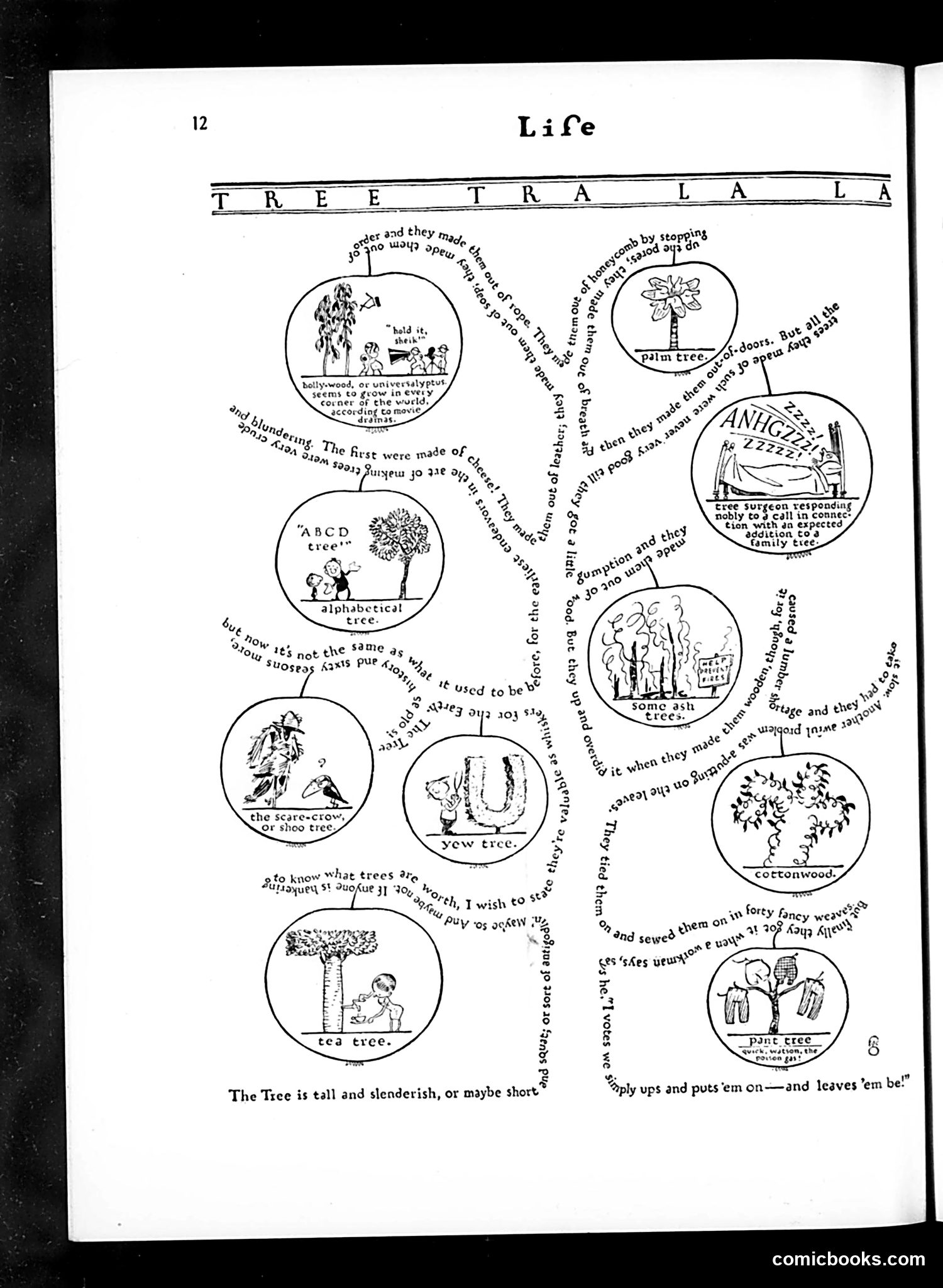
This page is a whimsical illustrated essay about trees, organized as a visual directory. Each circular vignette depicts a different tree type with humorous descriptions: - **Hollywood/Universal tree**: Where movie extras come from - **ABCD tree**: For teaching children the alphabet - **Scarecrow tree**: Self-explanatory - **Yew tree**: A pun on the letter "U" - **Tea tree**: Where tea grows - **Palm tree**, **Antique**, **Ash trees**, **Cottonwood**, and **Pant tree** complete the sequence The satire is gentle, relying on visual puns (yew/U) and absurdist humor about tree origins. Rather than political commentary, this appears to be lighthearted wordplay targeting readers familiar with tree taxonomy while playing with language. The style suggests early-to-mid 20th century comic sensibility.
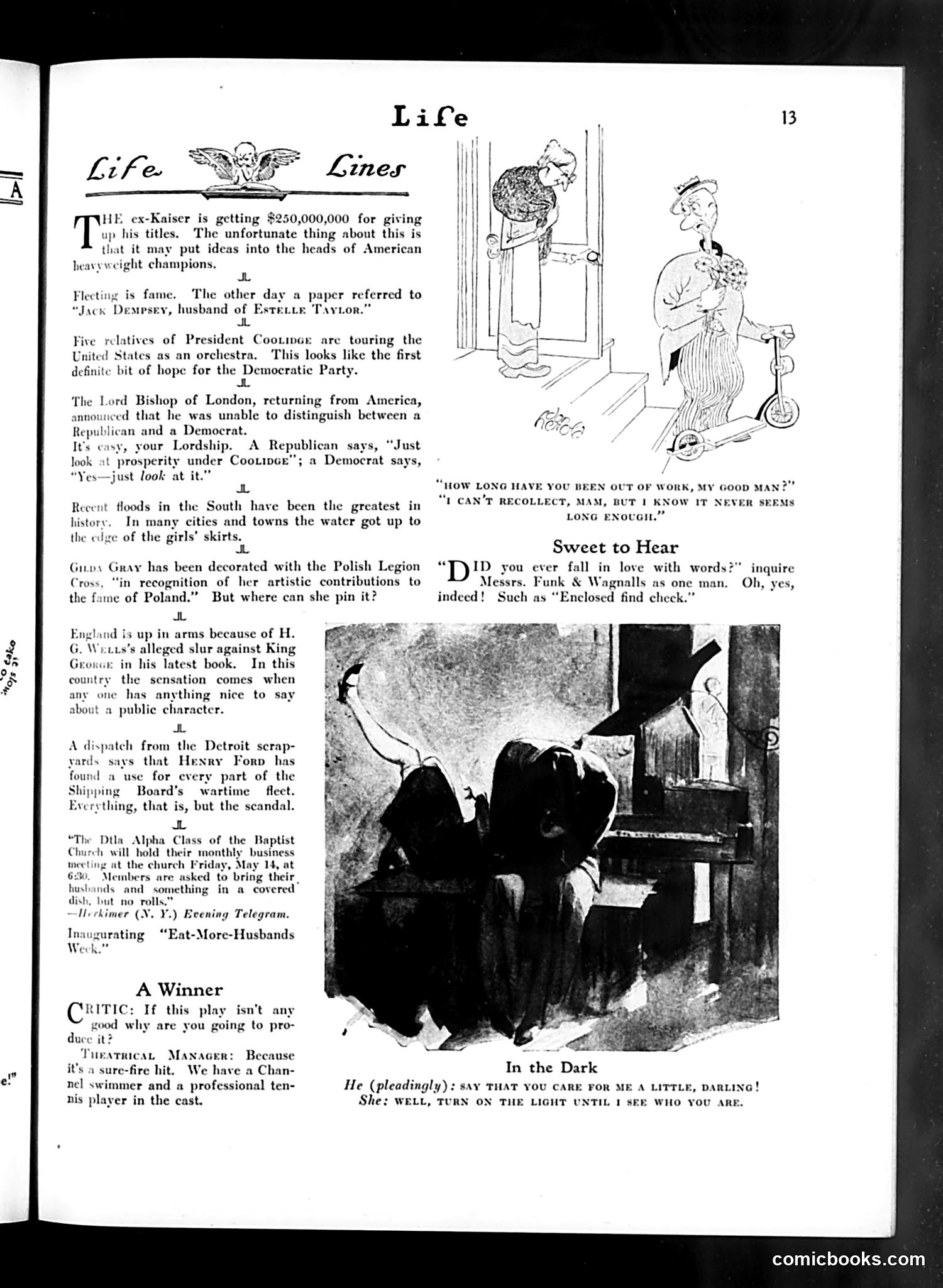
This page contains satirical commentary and cartoons from Life magazine's "Life Lines" humor section. The top cartoon depicts a man who appears wealthy or portly, holding a globe, speaking with another man. The caption references "how long have you been out of work, my good man?" and notes the speaker "can't recollect" when work seemed "long enough"—satirizing wealth disparity and the speaker's obliviousness to working-class hardship. Below, the "Sweet to Hear" section includes a photograph-based cartoon titled "In the Dark," showing an intimate couple scene. The dialogue parodies romantic clichés: he pleadingly says they should care for each other in darkness; she responds pragmatically, asking him to turn on the light so she can identify him—mocking sentimental romance with practical skepticism. The page primarily consists of brief satirical news items mocking politicians, celebrities, and social institutions of the era.
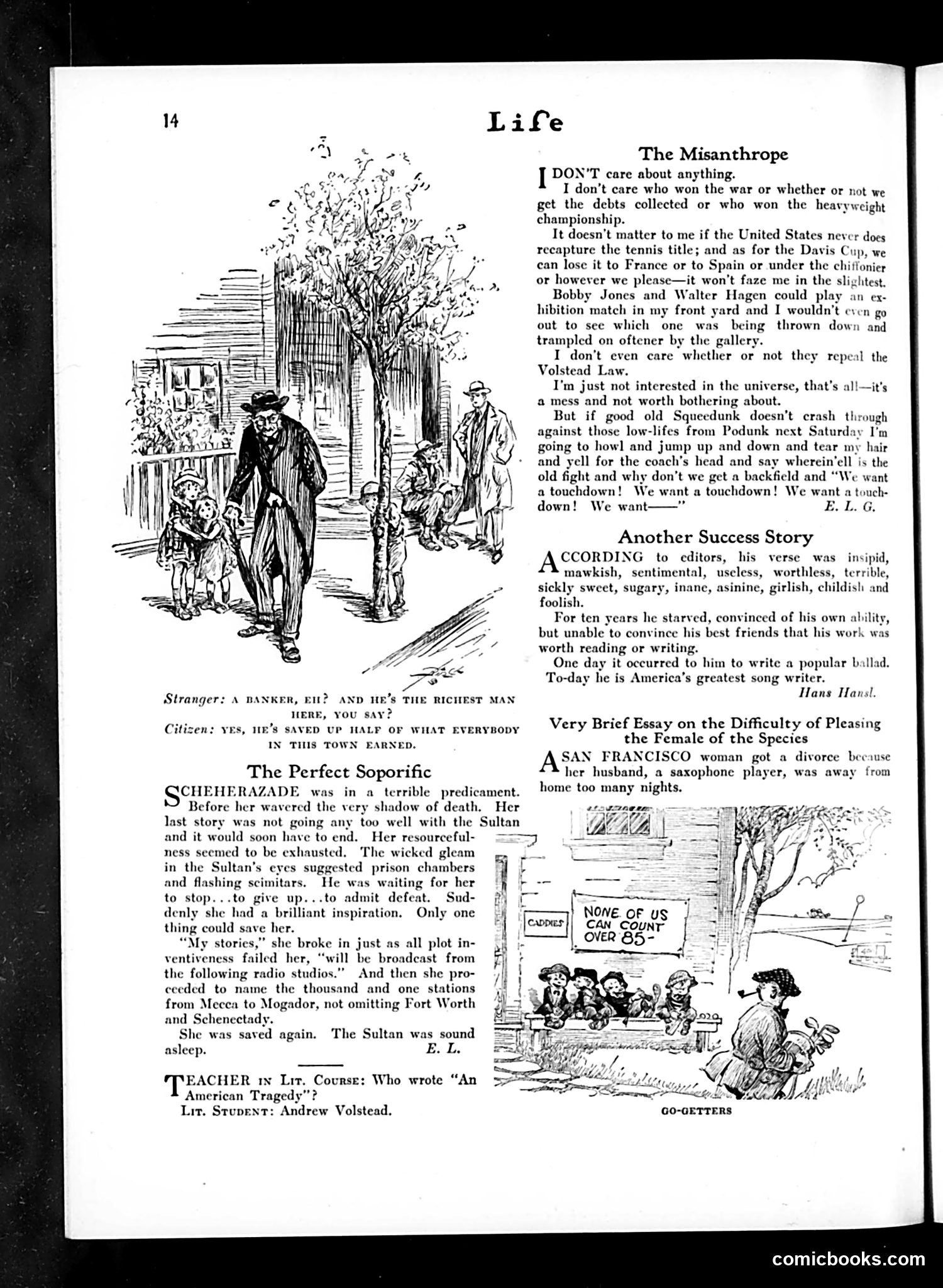
This page contains three satirical pieces: **"The Misanthrope"** features a cynical letter from someone dismissing major American sporting events (Davis Cup tennis, heavyweight boxing championship) as meaningless, contrasting with their genuine passion for a local football game between Podunk and another town. **"The Perfect Sapoific"** mocks the story of Scheherazade from *One Thousand and One Nights*, suggesting her radio broadcasts saved her by boring the Sultan to sleep—satirizing the tedious nature of radio content. **"Another Success Story"** ironically celebrates someone whose verse was deemed worthless for ten years, now suddenly America's greatest songwriter—mocking sudden, undeserved literary success. The bottom cartoon, "Go-Getters," shows vagrants unable to "count over 50," likely satirizing the period's economic struggles or homelessness.
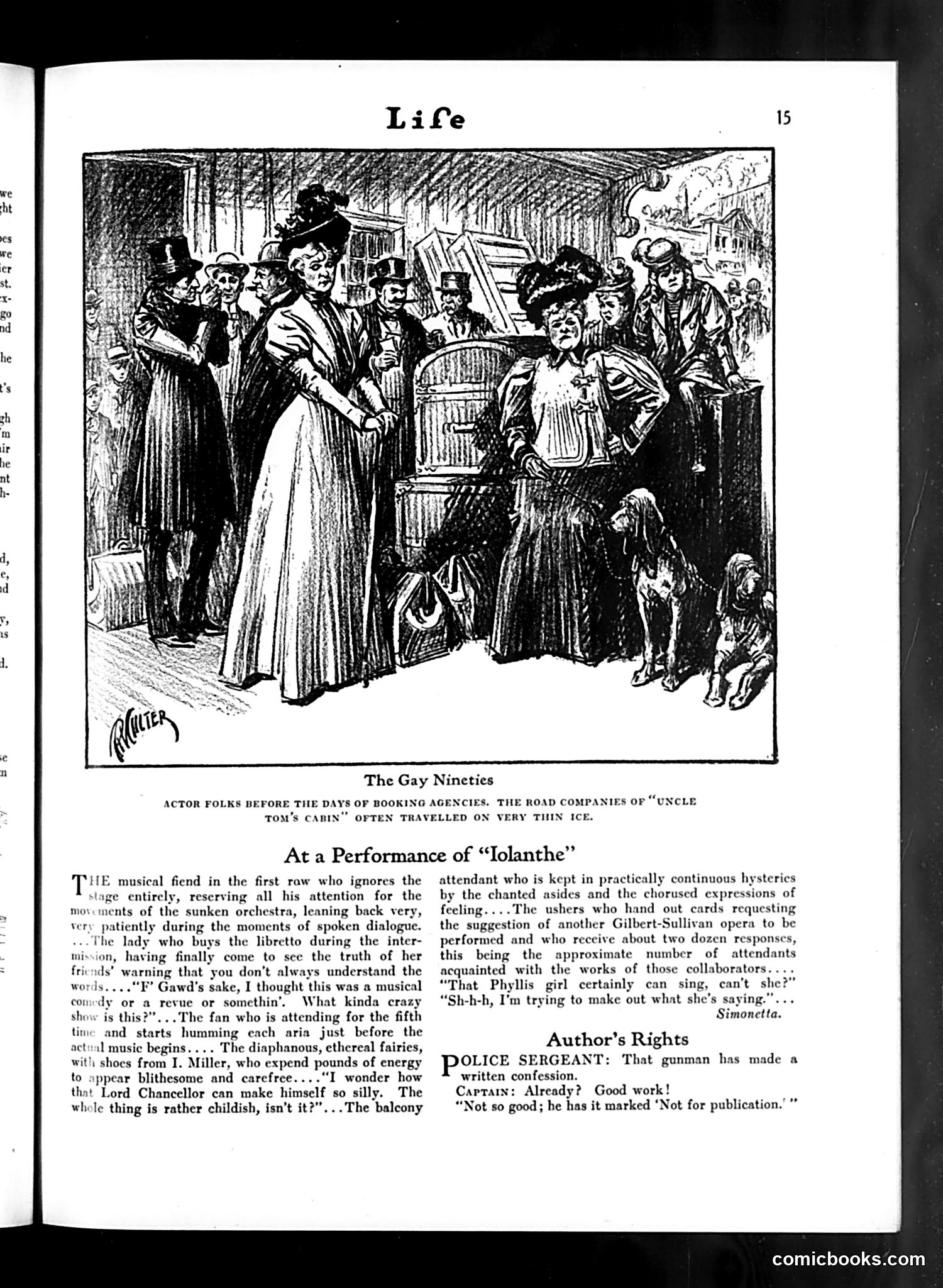
**The top cartoon** depicts a crowded theater scene labeled "The Gay Nineties," showing actors and theater folk from the 1890s before modern booking agencies existed. The caption notes that road companies touring "Uncle Tom's Cabin" traveled on "very thin ice"—likely satirizing the precarious financial conditions of theatrical touring companies during that era. **Below**, the "Iolanthe" piece mocks audience members at a Gilbert & Sullivan opera performance. It ridicules a distracted front-row patron ignoring the stage to focus on the orchestra, and includes snippy dialogue about another attendee's singing ability. The humor targets pretentious theater-goers and their affected behavior during performances.
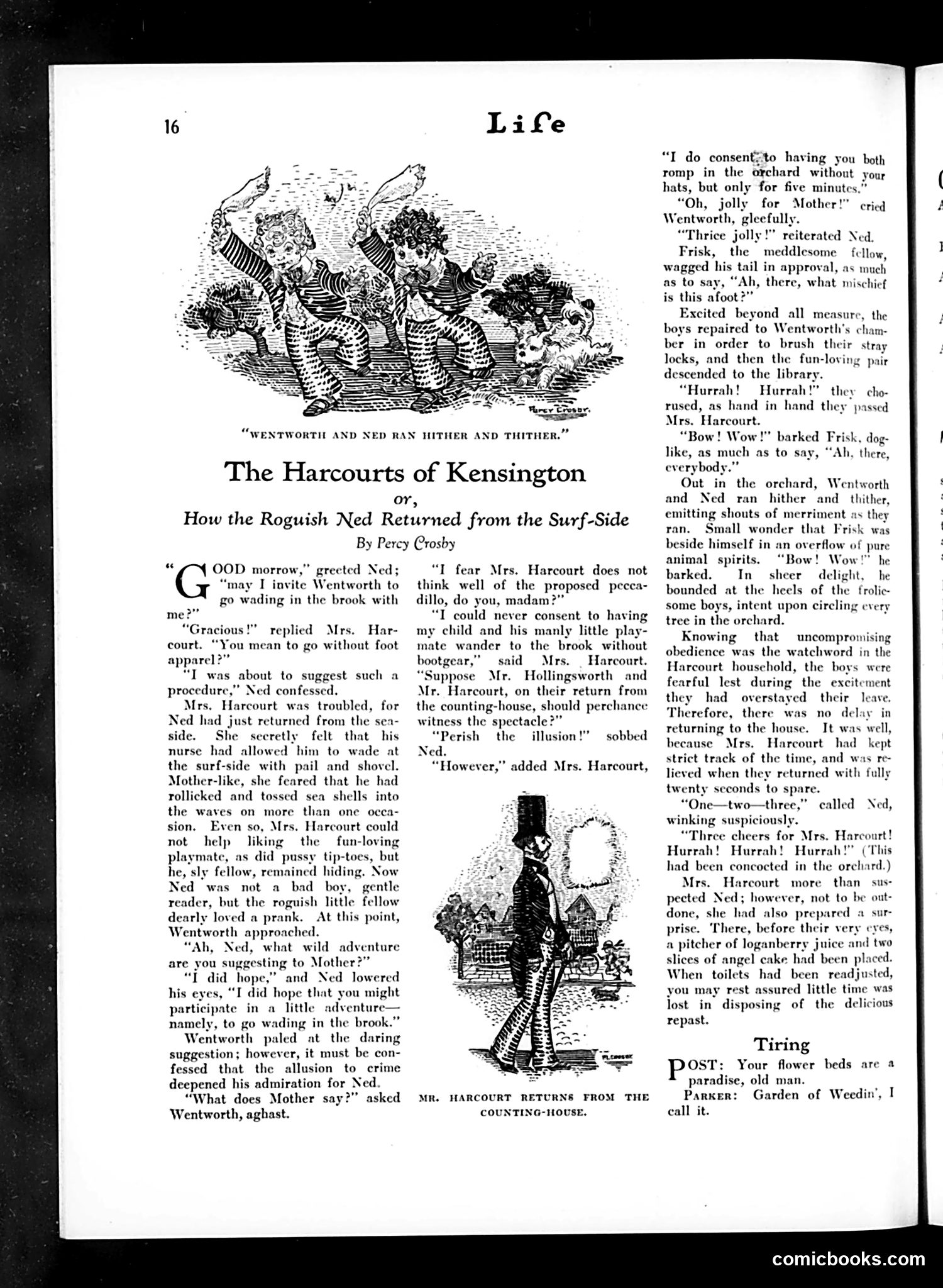
This page contains a short story by Percy Crosby titled "How the Roguish Ned Returned from the Surf-Side." The narrative concerns Mrs. Harcourt refusing to let her son Wentworth go on an adventure with the mischievous Ned Frisk without proper supervision—specifically requiring hats. The children subsequently sneak away to the orchard and library anyway. The accompanying illustrations depict the children in period dress (striped clothing) engaged in playful mischief. Rather than political satire, this appears to be domestic humor about childhood disobedience and parental anxiety—a common theme in early 20th-century magazine fiction aimed at middle-class readers. The tone is lighthearted and moralistic rather than satirical.
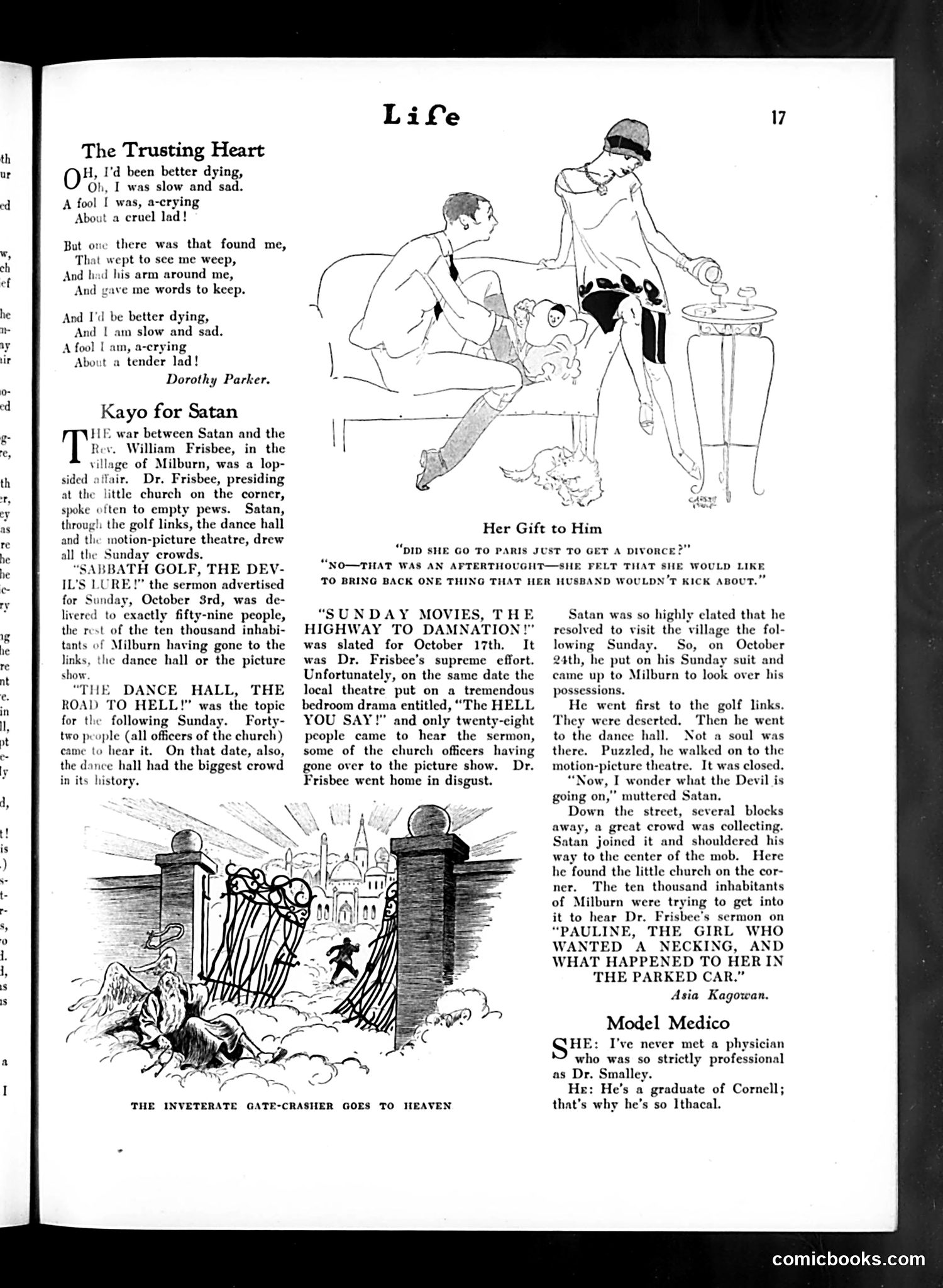
This page contains three satirical pieces satirizing religious hypocrisy and morality: **"Kayo for Satan"** mocks a real religious controversy in Milburn, New Jersey. Dr. Frisbee's church organized competing Sunday events (a golf outing, dance hall, and motion-picture theater showing "The Road to Hell") on the same day as a rival sermon on "Pauline, the Girl Who Wanted a Reckless Ride." The satire suggests the church inadvertently promoted worldly temptations while claiming moral authority. Satan reportedly "rejoiced" at this confusion of values. **"Her Gift to Him"** depicts domestic life with a cynical caption about divorce. **"Model Medico"** offers brief comedic dialogue about a physician's pretense. The overall theme critiques how institutions claiming moral guidance often undermine their own messages through hypocrisy and misplaced priorities.
This page contains editorial commentary rather than political cartoons. The main articles critique contemporary British and American writers for moral laxity. **Key References:** The editor attacks H.G. Wells for deliberately courting scandal by including himself (thinly disguised) as an immoral character in his new novel, and for publicly criticizing King George III. The piece notes that while Americans (specifically Arkansans) may question monarchy, England values it as "a personification of an idea." **The Satire:** The editor contrasts modern writers like Wells, Kipling, and Dean Inge—who generate publicity through social criticism and moral irreverence—with Victorian authors who at least "approved morality and even religion." The piece questions whether literature promoting moral relativism serves society's interests, asking pointedly: "How is this world going to be cleaned up?" A brief item discusses Henry Ford's five-hour workday, suggesting reduced factory demand. The tone is conservative, defending traditional morality and social institutions against what the editor sees as nihilistic modernism.
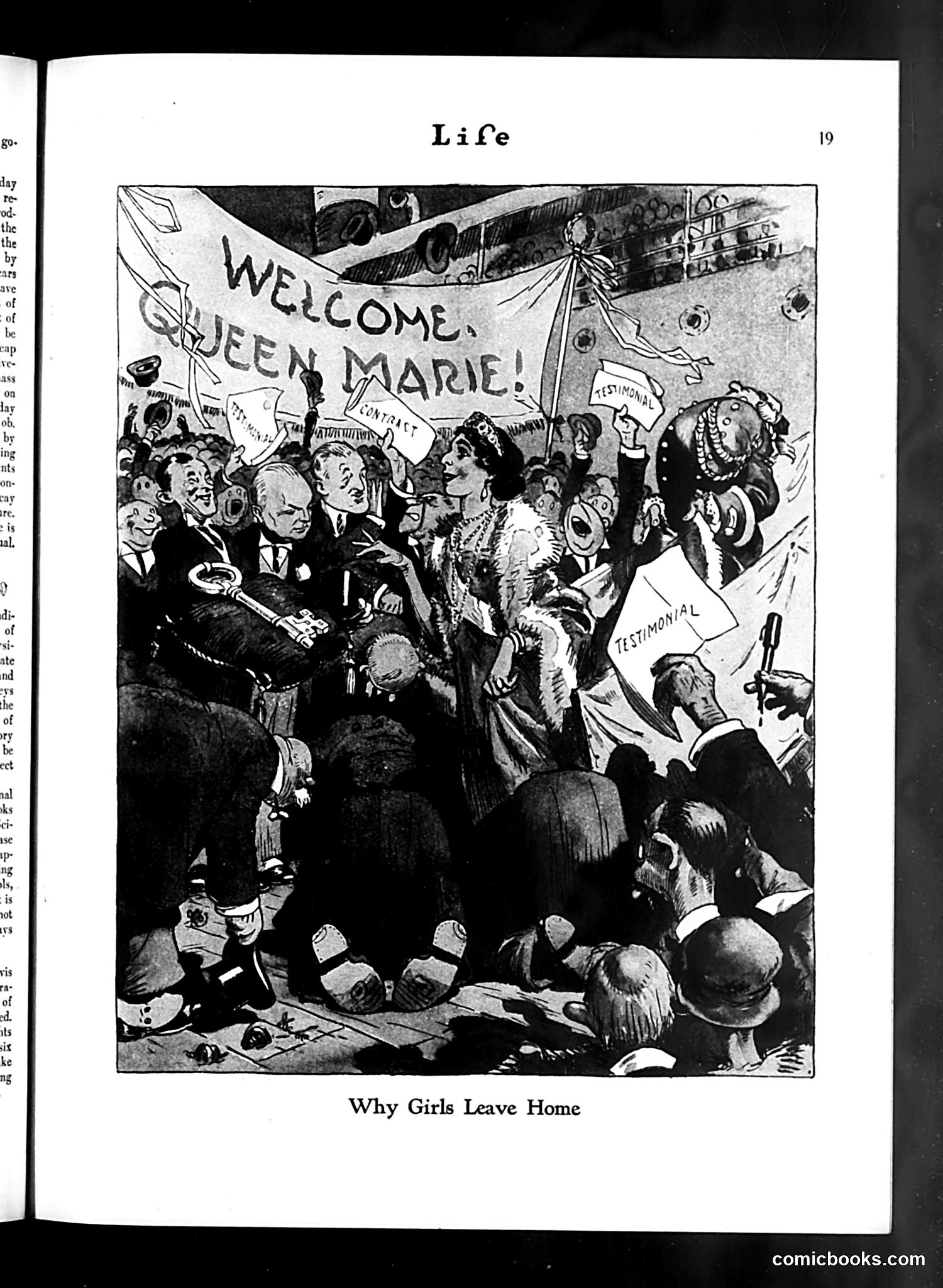
This satirical illustration depicts a grand public welcome for "Queen Marie"—likely Queen Marie of Romania, who made a highly publicized American tour in the 1920s. The cartoon shows enthusiastic crowds, military officials, and dignitaries greeting her with banners and testimonials. The satire's point appears to be social commentary on why young women abandon their households: the glamour, excitement, and attention associated with public life and celebrity. By contrasting the drab domesticity implied in the title against the spectacular pageantry of the royal welcome, the cartoon suggests girls are lured away by the allure of adventure, recognition, and a wider world beyond home duties. The exaggerated crowd and ornate reception underscore this contrast between ordinary domestic life and extraordinary public spectacle.
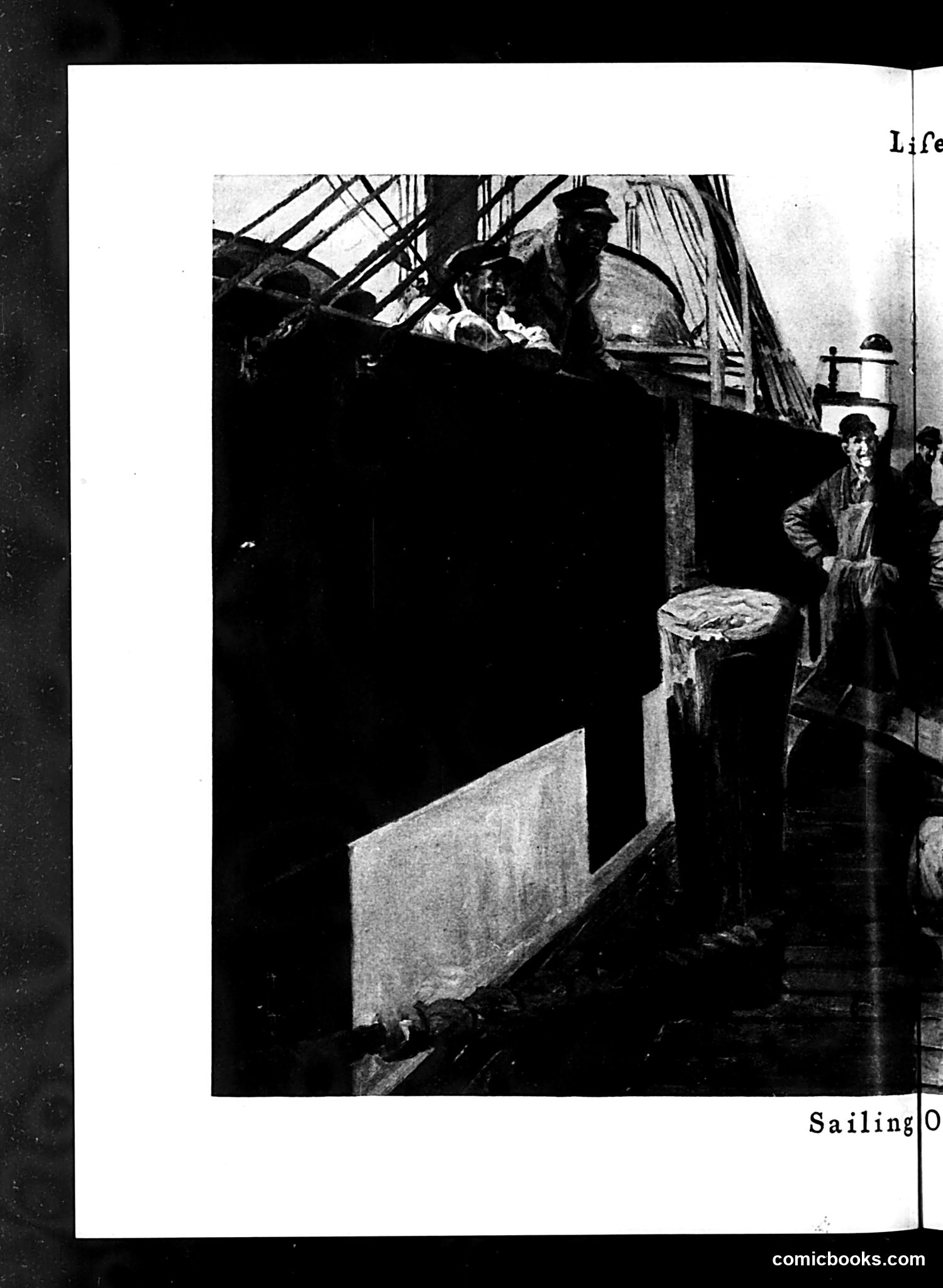
This page appears to be from Life magazine's "Sailing" section, showing what looks like a maritime or nautical scene. The black and white photograph depicts several men in period clothing (appearing to be early 20th century based on their hats and suits) standing near what appears to be ship infrastructure or rigging. One figure stands prominently on the right with hands on hips in a commanding pose. However, without clearer context or caption text visible in the image, I cannot definitively identify the specific figures, the exact political or social reference being satirized, or the intended joke. The page header reads "Life" and "Sailing" but the OCR text only shows a website attribution. More visible text or captions would be needed to explain the satire accurately.
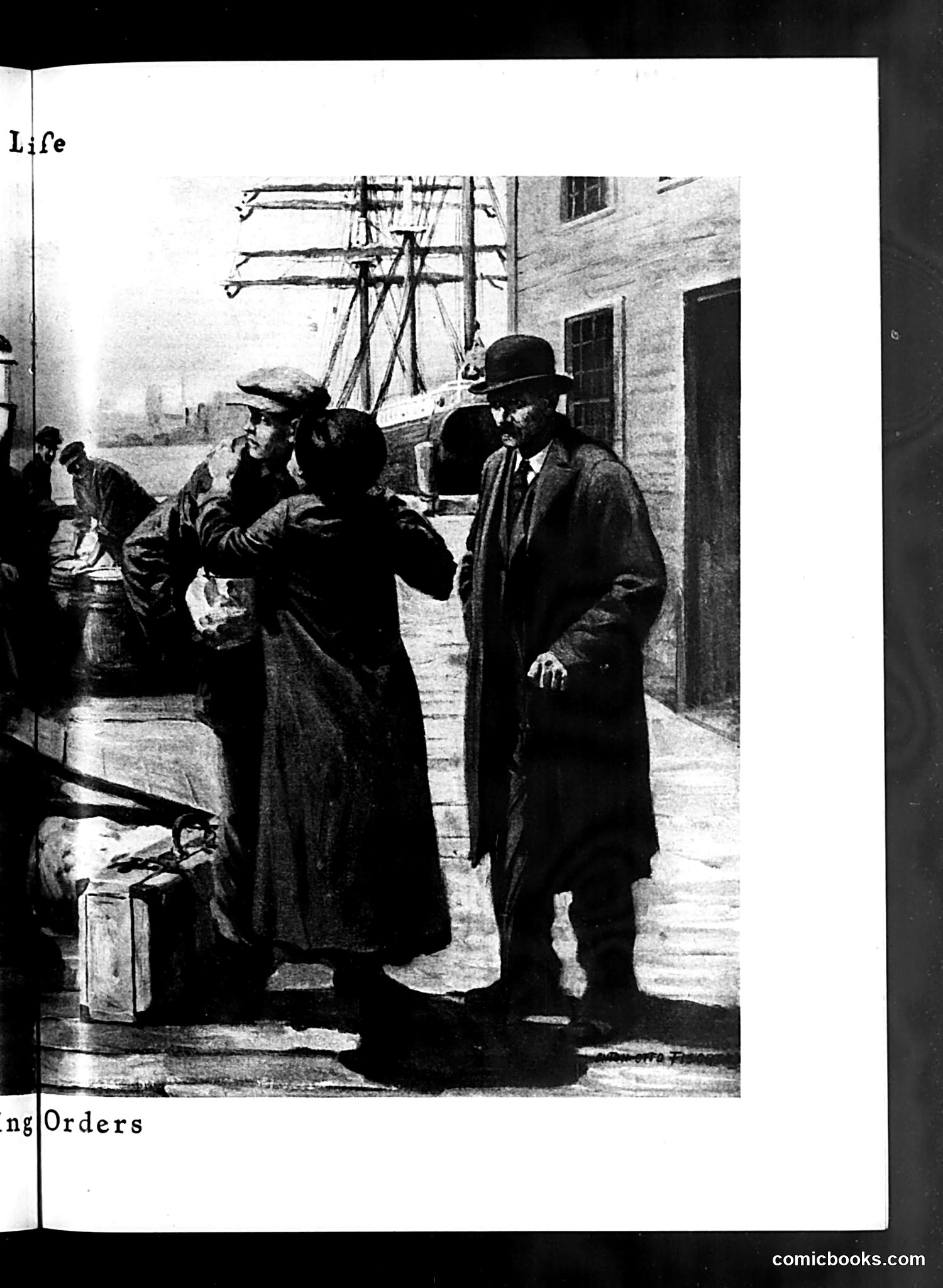
This black and white photograph shows people at what appears to be a dock or port, with a sailing ship visible in the background. The page header reads "Life" and partial text at bottom suggests "Orders." The image depicts what appears to be early 20th-century immigration or emigration, showing figures in period clothing (long coats, hats) gathered near luggage at a waterfront. Given *Life* magazine's satirical mission, this likely comments on contemporary immigration issues or emigration policies of the era. However, without clearer caption text or additional context visible on this page, I cannot definitively identify specific political figures being caricatured or pinpoint the exact satirical target. The image appears documentary in nature rather than obviously cartoonish, making the intended satirical commentary unclear from the visual alone.
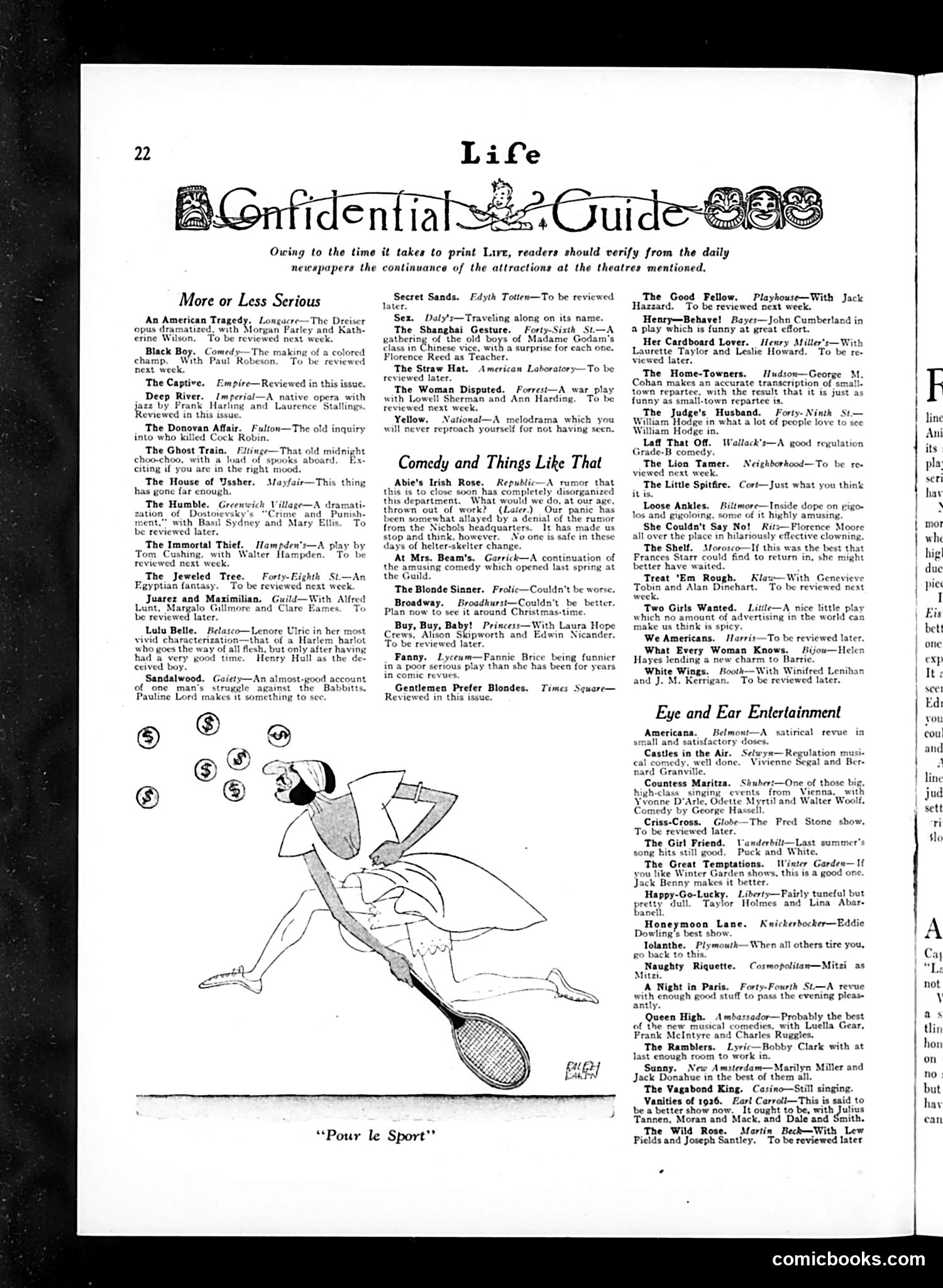
This page reviews Broadway theatrical productions, a standard Life magazine feature. The cartoon titled "Pour le Sport" depicts a woman playing tennis in an exaggerated, comedic pose—her body contorted awkwardly mid-swing, with her tennis racket prominently featured. The satire targets the "modern woman" of the 1920s Jazz Age. The cartoon mocks women's newfound participation in sports and athletic activities, which represented changing social norms. The absurdly exaggerated pose suggests ridicule of women attempting "masculine" pursuits like competitive tennis. The woman's ungainly form—with legs splayed and body twisted unnaturally—implies women were physically unsuited for such activities, a common sexist trope of the era. The overall effect is satirical commentary on social anxieties surrounding women's expanding roles and independence during the 1920s, presented through physical comedy and caricature.
This page contains theater criticism from Life's drama section. The critic reviews three Broadway plays: **"Gentlemen Prefer Blondes"** — The critic acknowledges this Anita Loos adaptation is hugely popular but admits it's "not a great comedy," merely "highly effective entertainment." He praises actress June Walker's performance in the lead role of Lorelei, calling her an "expert actress," and notes G.P. Huntley's comedic talents make it "funny." **"The Captive"** — This French import about female same-sex attraction receives serious critical praise as genuine drama, not sensationalism. The critic defends the play against potential moral objections, warning readers not to dismiss it based on its "theme." **"Deep River"** — The musical is critiqued as having lovely but uninspiring music despite elaborate voodoo choruses meant to thrill audiences. The reviews represent 1920s Broadway sophistication—defending artistic merit while dismissing pulp, and notably defending a controversial play about lesbian themes as legitimate theater rather than scandal.
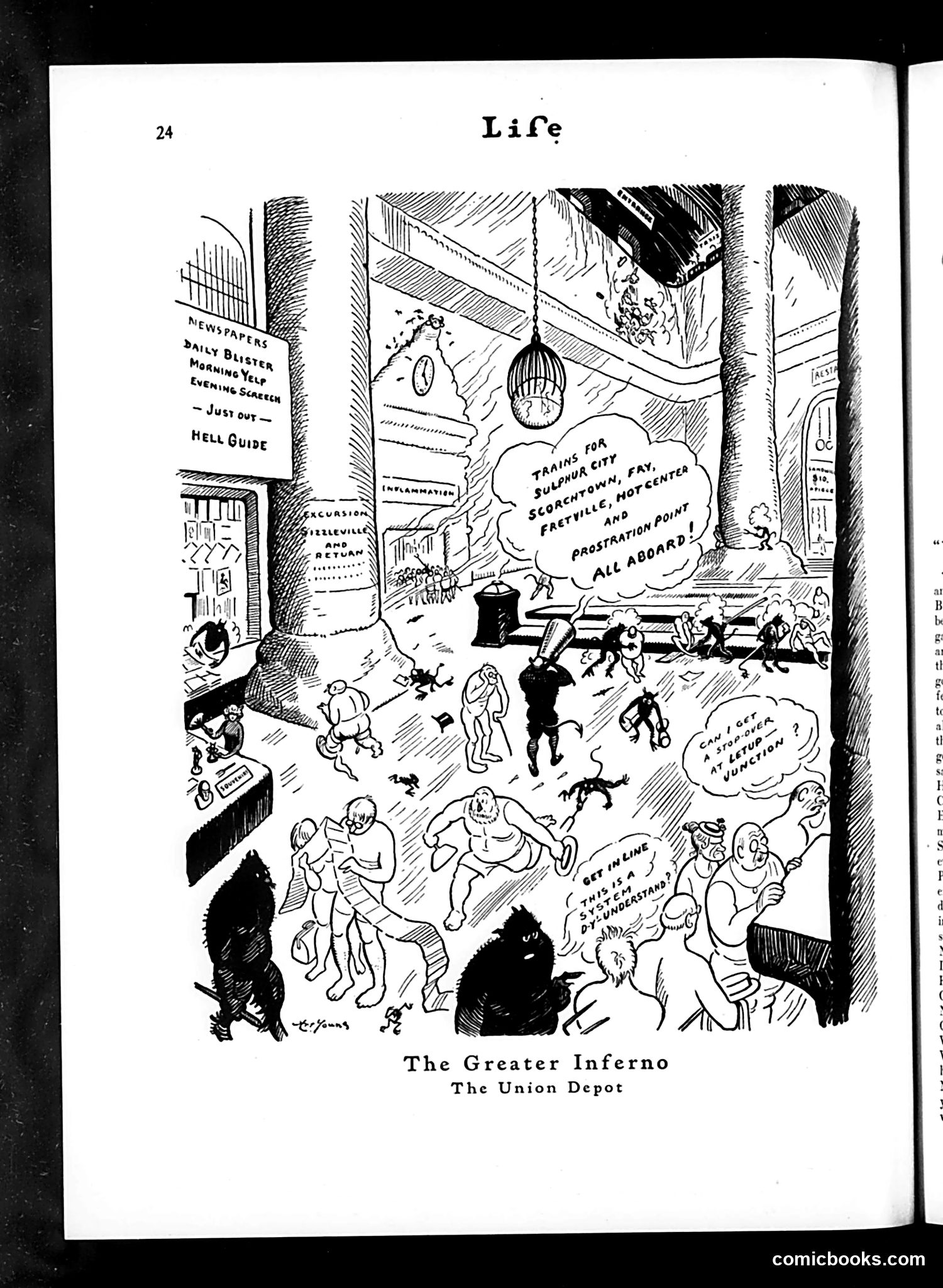
This is a satirical cartoon titled "The Greater Inferno" depicting chaos at the Union Depot (a major transportation hub). The scene shows a crowded, frenzied train station with numerous figures in disarray. Speech bubbles reference various destinations: "Rains Par City, Sulphur City, Scrotchtown, Frettville, Hot Center and Prostration Point" — all fictional hellish-sounding places, extending Dante's "Inferno" metaphor to modern travel. The cartoon satirizes the chaotic experience of using busy train stations, portraying it as infernal suffering. A sign lists various newspapers and publications, suggesting this reflects contemporary urban life. The satire mocks both the crowded, stressful conditions travelers endured and the sensationalist media covering such public spectacles. This captures early 20th-century anxieties about modernization and mass transit.
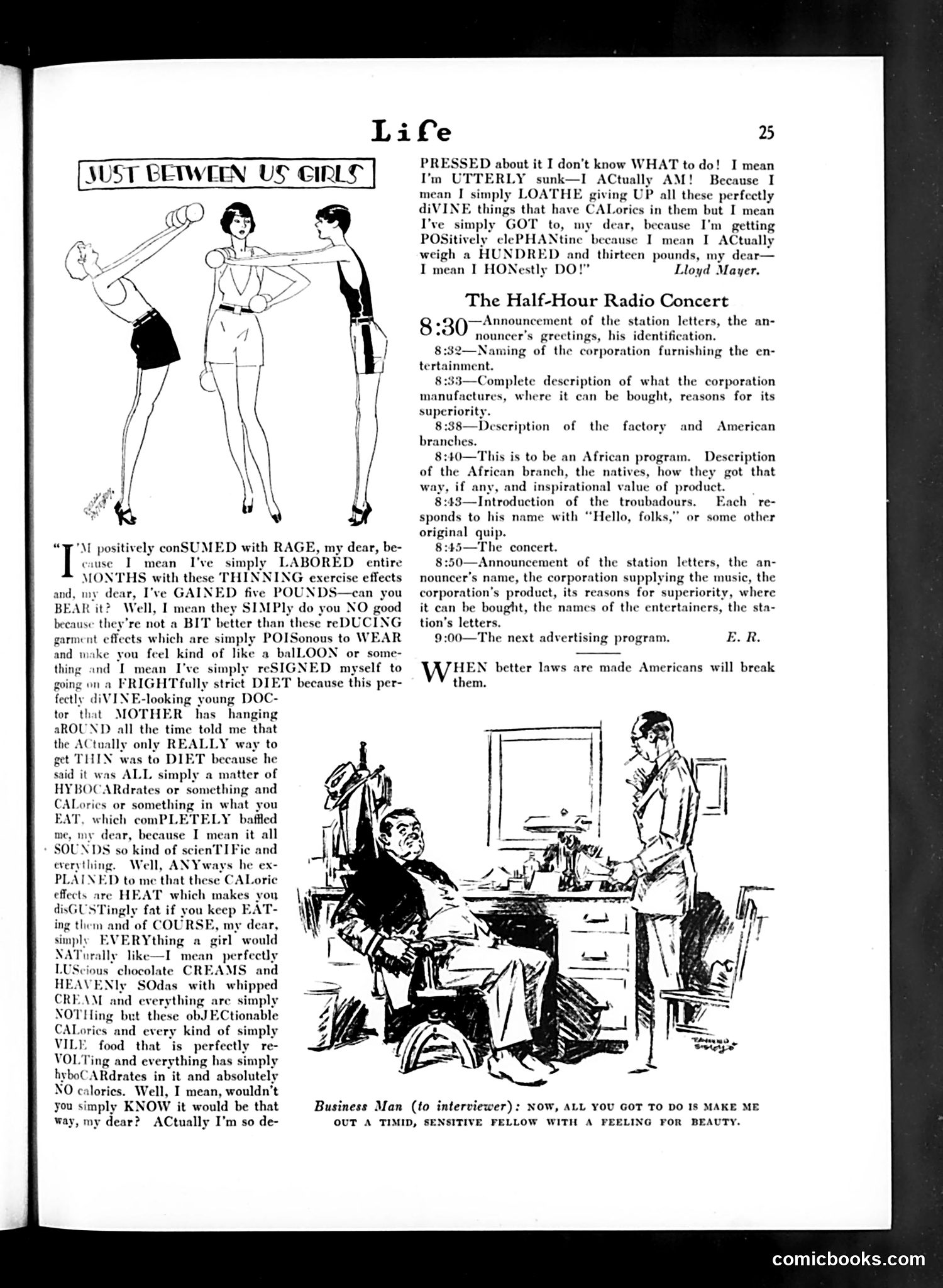
This 1920s *Life* page satirizes two distinct targets: **"Just Between Us Girls"** (left): A young woman complains obsessively about dieting and weight—she's gained five pounds despite months of "thinning exercises" and now must give up foods with calories. The satire mocks the era's intense diet culture and the pseudo-scientific language women absorbed ("carbohydrates," "calories") while remaining confused about actual nutrition. The exaggerated capitalization and breathless tone parody how women discussed these trivial concerns as life-or-death crises. **The Radio Concert Schedule** (right): Lists a corporate-sponsored radio program's half-hour structure, which is almost entirely advertising and corporate messaging (8:30-8:50) with only 5 minutes of actual concert (8:45). The satire exposes how commercial radio prioritized relentless product promotion over entertainment. **The Bottom Cartoon**: A businessman asks an interviewer to portray him as "timid" and sensitive with "a feeling for beauty"—satirizing corporate image-laundering and the gap between business ruthlessness and desired public personas.
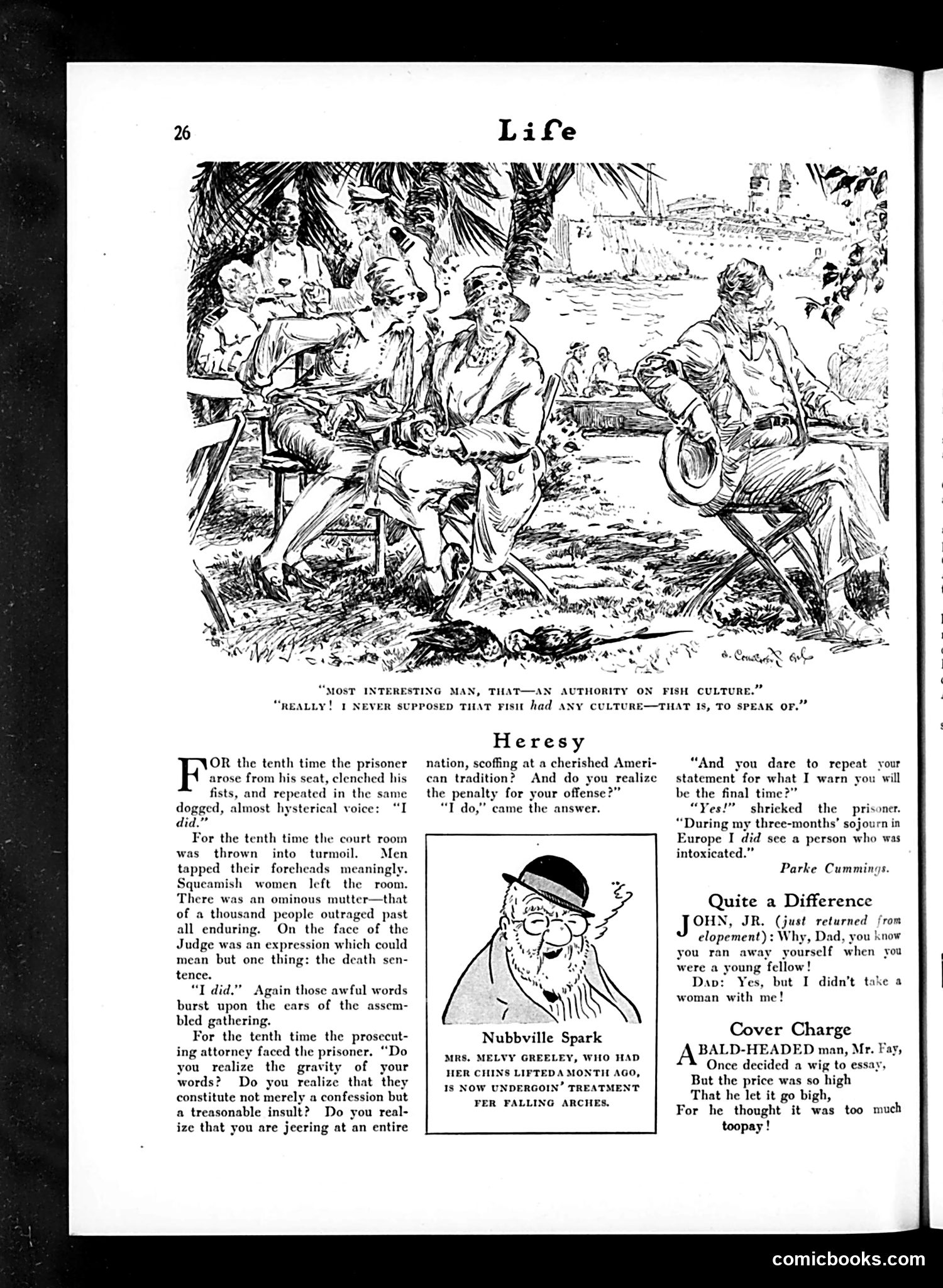
This page contains three satirical pieces: **Main Story: "Heresy"** depicts a courtroom trial where a prisoner is sentenced to death for the treasonous crime of claiming he saw an intoxicated person during a three-month stay in Europe. The satire mocks Prohibition-era America's extreme devotion to temperance as a "cherished American tradition"—so sacred that denying its universal success becomes heresy worthy of execution. The joke is that the prisoner's statement (that intoxication exists) is treated as seditious rather than simply observational. **"Nubbville Spark"** is a local gossip item about Mrs. Melvy Greeley undergoing cosmetic chin surgery followed by arch treatment—poking fun at vanity and the physical consequences of beauty procedures. **"Quite a Difference"** and **"Cover Charge"** are brief humorous anecdotes: one about generational differences in elopement, the other a pun about a bald man finding wigs too expensive. The top illustration shows a beach scene with people socializing, accompanying a fish-culture joke about whether fish have "culture."
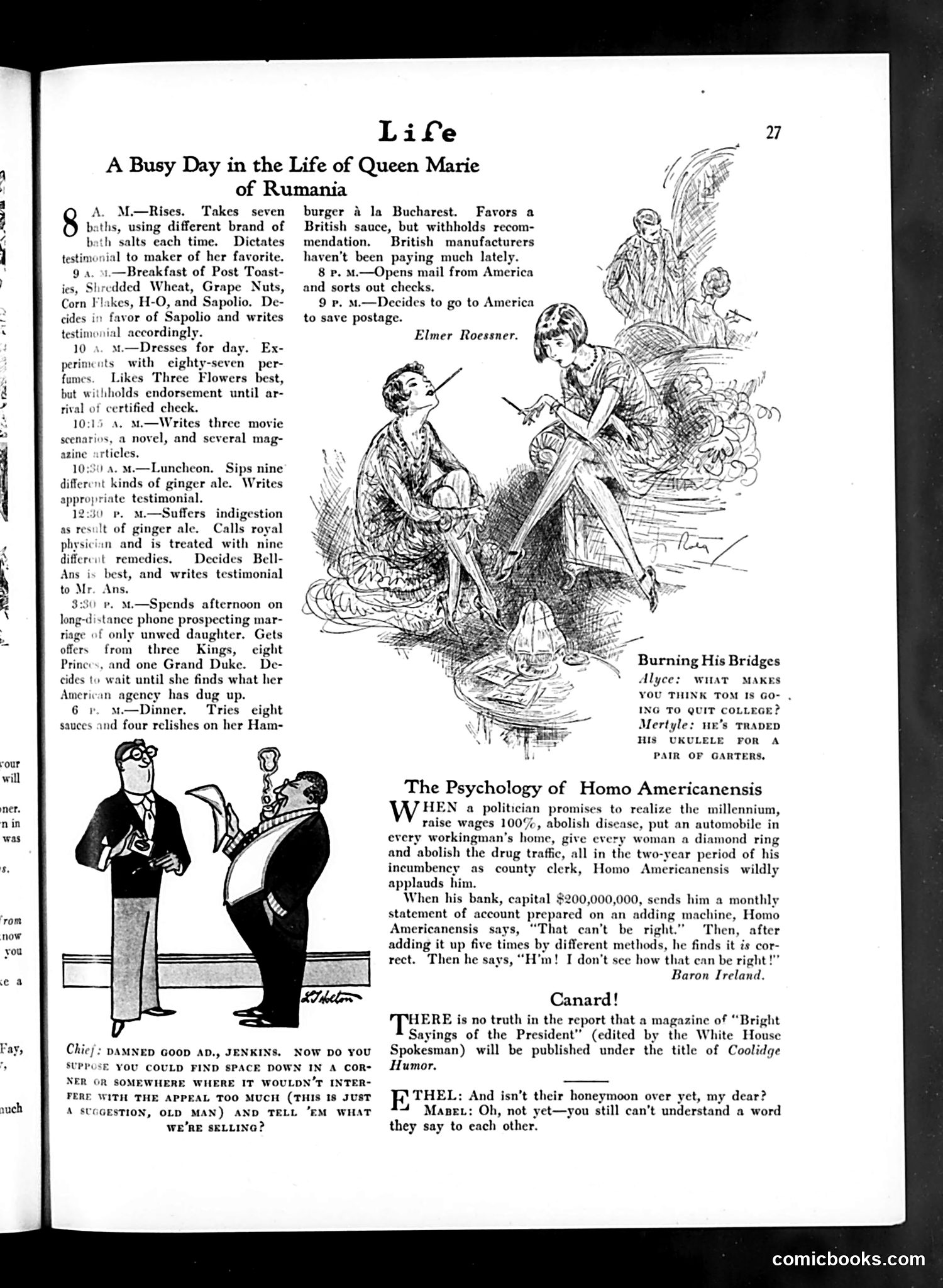
This page contains film reviews from Life magazine's "The Silent Drama" column, primarily discussing three movies: **"Tin Gods"** stars Thomas Meighan in a dramatic departure from his usual light comedies. The reviewer praises Meighan's emotional performance and notes strong support from actress Renée Adorée. **"The Fighting Marine"** is a serial starring Gene Tunney (the heavyweight boxing champion) before his rise to fame. The reviewer finds Tunney stiff and awkward on screen, comparing him unfavorably to Red Grange's athletic screen presence. The piece critiques film serials generally for excessive title cards explaining the plot. **"By Way of Reply"** is a response to a reader who accused the critic (R.E. Sherwood) of only praising dead actors. Sherwood defends himself by citing a positive 1920 review of Rudolph Valentino in "The Four Horsemen of the Apocalypse." The page reflects 1920s cinema culture, when athletic celebrities were frequently cast in films regardless of acting ability.
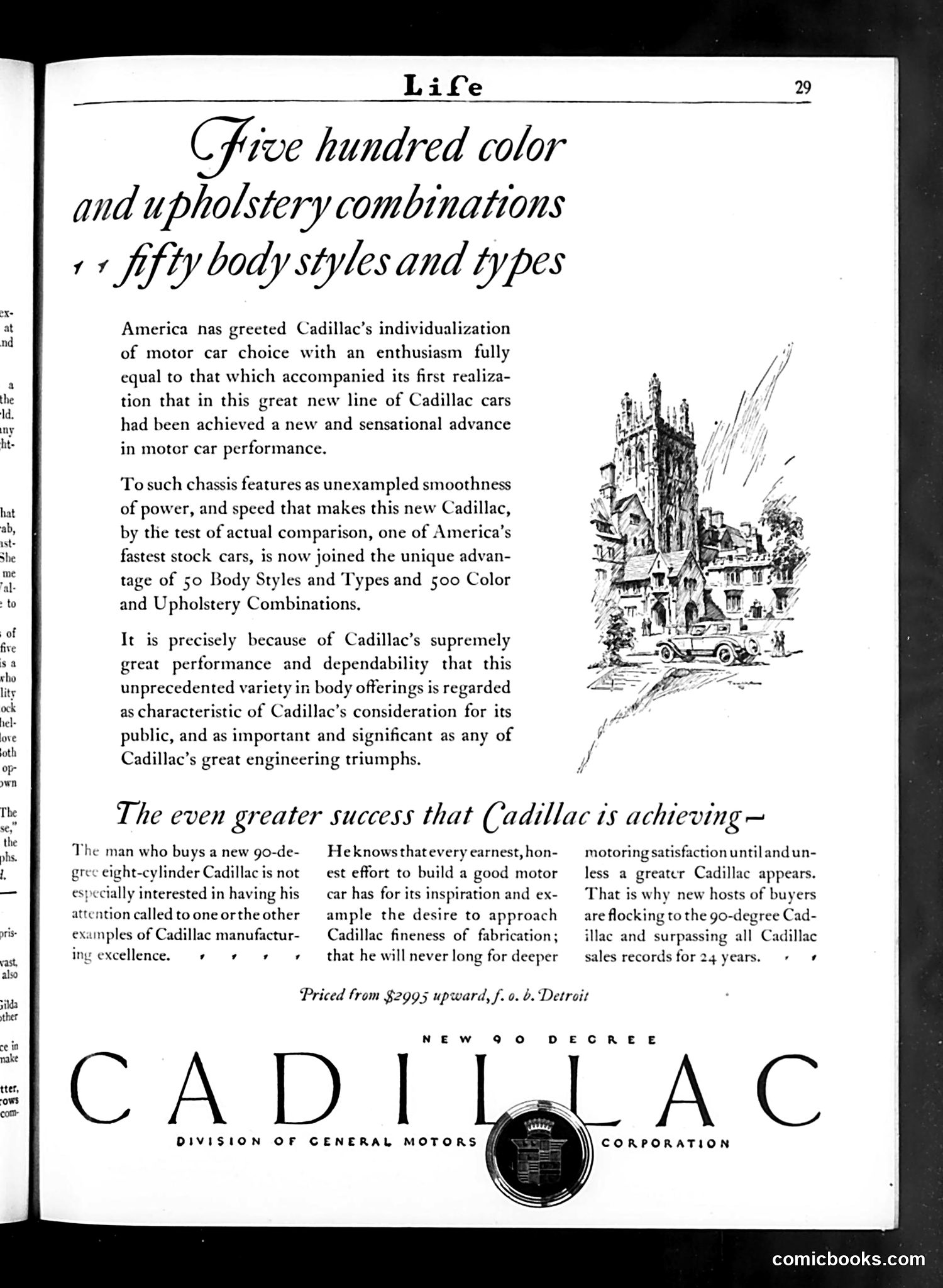
This is **primarily a Cadillac automobile advertisement**, not satire or political commentary. The page appears in *Life* magazine's advertising section circa the 1920s-1930s. The content celebrates Cadillac's new "90-Degree" model's customization options: 500 color/upholstery combinations and 50 body styles. The accompanying sketch depicts an elegant European cathedral or mansion, suggesting luxury and refinement—visual branding meant to associate the car with sophistication and status. The text argues that offering such variety reflects Cadillac's engineering excellence and customer consideration. It implies that buyers seeking a "90-degree eight-cylinder Cadillac" understand quality and won't settle for lesser vehicles. The small illustration showing a Cadillac in a grand European setting serves aspirational messaging: owning this car elevates one's status and taste. This is straight advertising copy, not satire—typical of *Life's* high-end ad content aimed at wealthy readers.
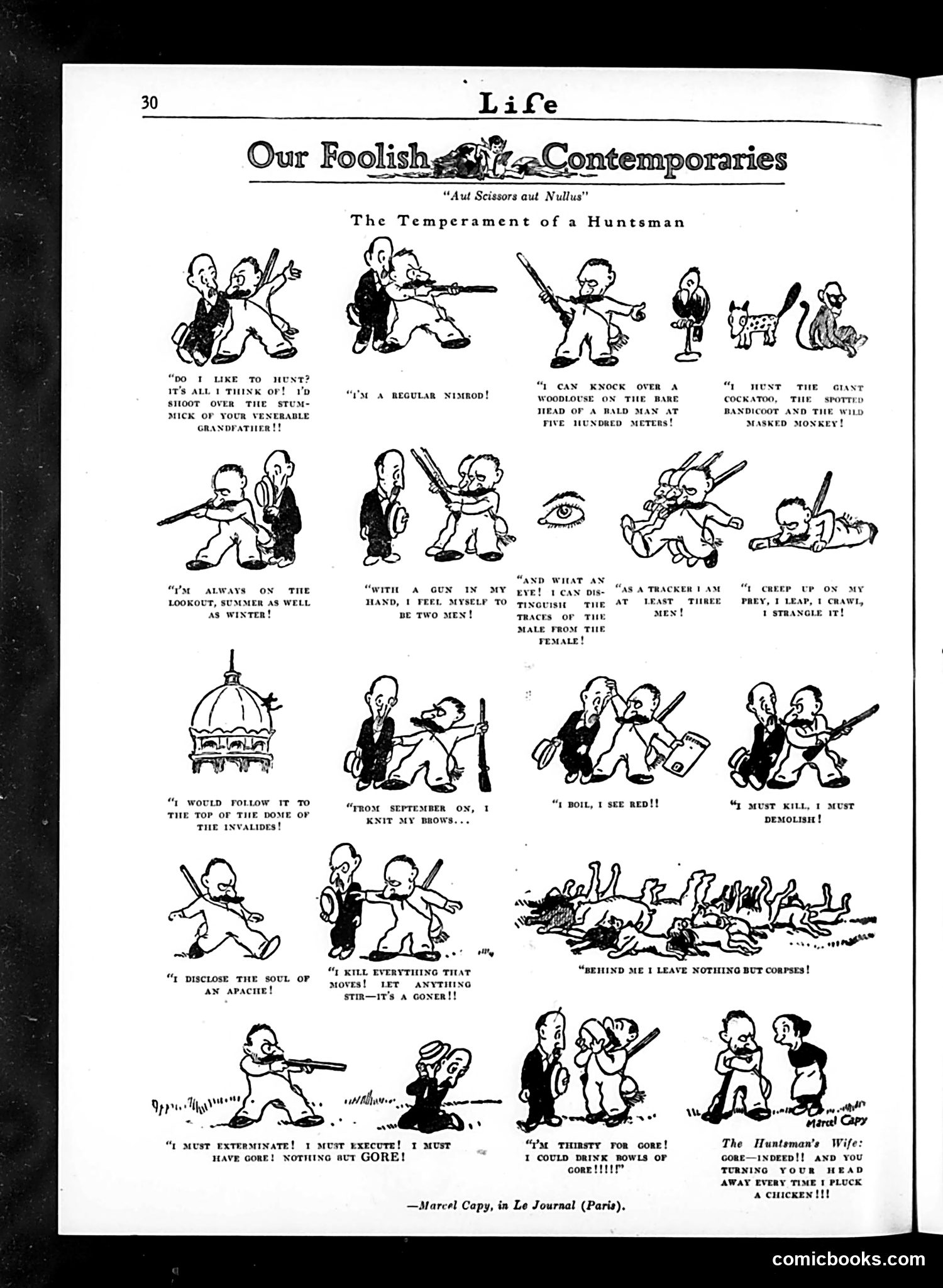
This satirical comic by French artist Marcel Caby mocks an obsessive huntsman whose violent rhetoric spirals absurdly. The character boasts of killing exotic animals (cockatoos, monkeys, woodlouse) and claims superhuman tracking abilities, but his language becomes increasingly bloodthirsty and unhinged—culminating in demands for "nothing but gore." The joke appears to satirize extreme hunting culture or possibly a specific contemporary figure known for excessive hunting rhetoric. The final panel undercuts his grandiose claims: his wife reveals he's terrified of plucking chickens and demands her blood-thirsty fantasies while avoiding actual gore. The epigraph "Aut Scissors aut Nullus" (roughly "scissors or nothing") suggests editorial mockery of French attitudes. This likely references early-20th-century European debates over hunting, militarism, or masculine posturing, though the specific political target remains unclear without additional context.
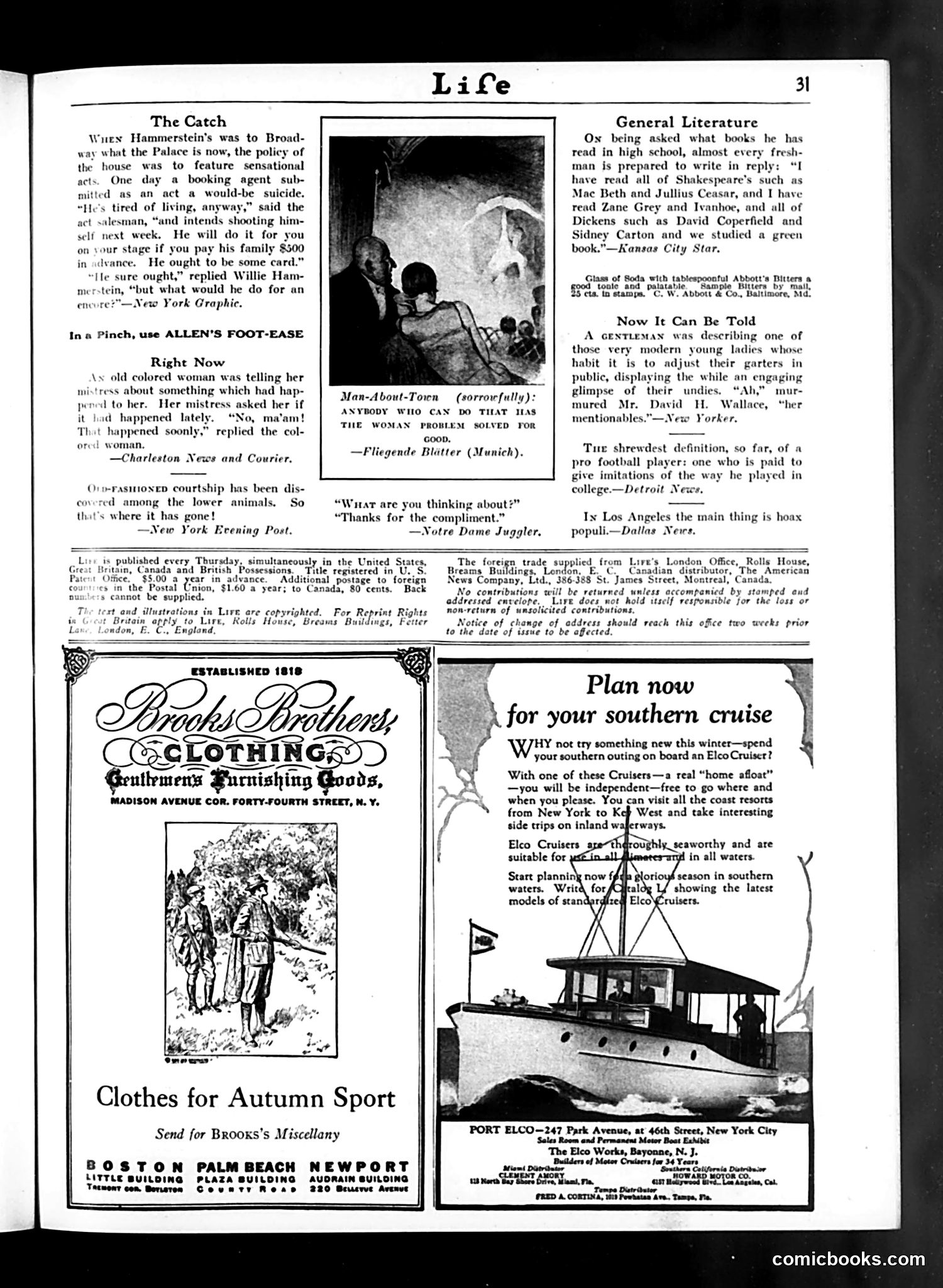
This page from *Life* magazine is primarily a humor and satire publication featuring short jokes and quips rather than political cartoons. The central cartoon depicts a "Man-About-Town" solving "the woman problem for good"—likely referring to women's public behavior or social conventions of the era. The jokes reflect 1920s social attitudes: one mocks a Black woman's grammar ("soonly" instead of "soon"), another satirizes modern young women adjusting garters publicly, and a third jokes about pro football players as frauds. There's also commentary on college students' literary knowledge being superficial. The page is dominated by advertisements (Brooks Brothers clothing, Elco Cruisers) typical of the magazine's format. The humor is lightweight social observation rather than substantive political satire—reflecting *Life*'s role as a magazine of genteel, middle-class American comedy focused on contemporary manners and morality.
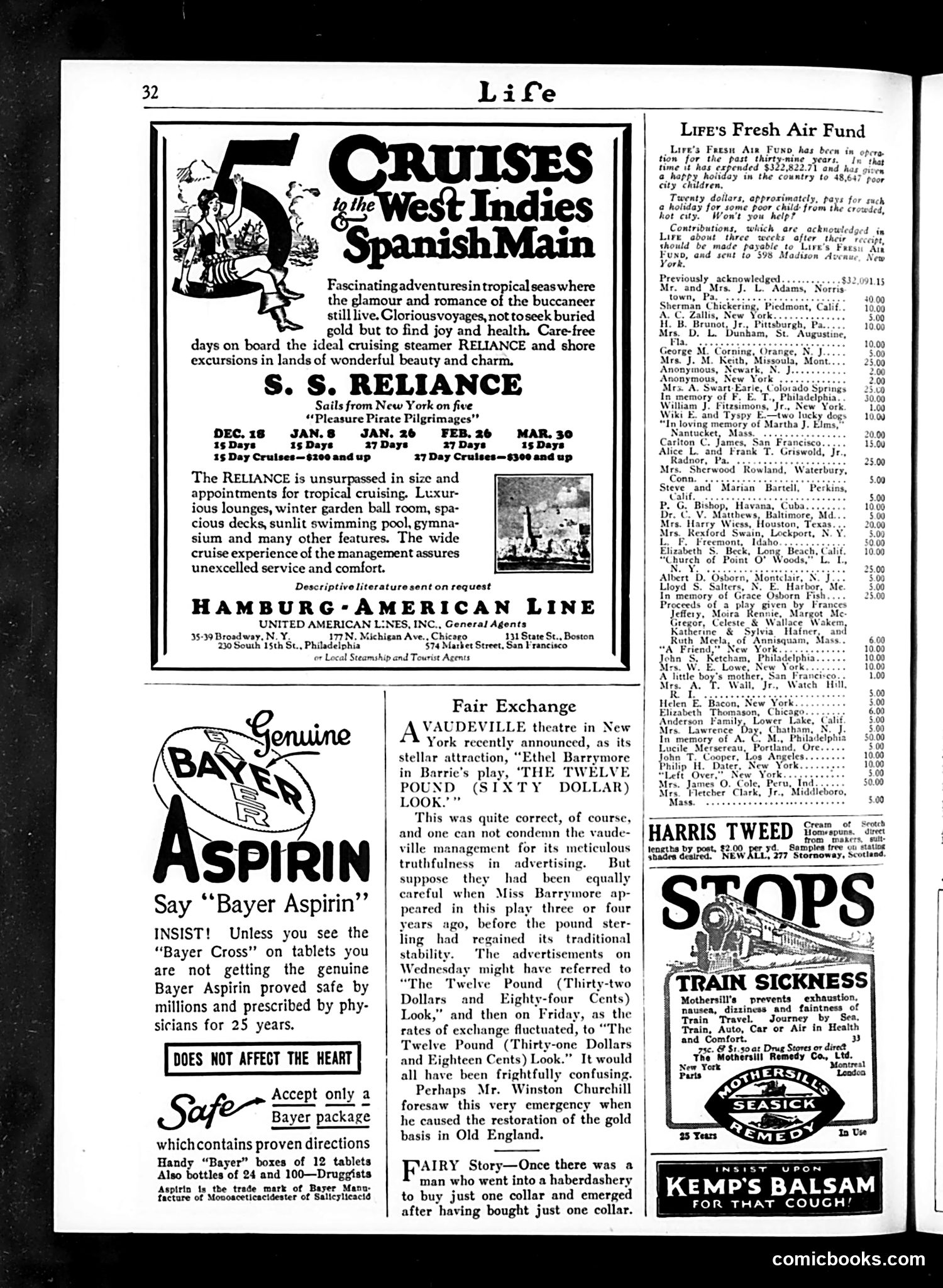
This page is primarily **advertisements and charity notices**, not political cartoons. The main content includes: **Cruise Advertisement**: A large ad for S.S. Reliance Caribbean cruises via Hamburg-American Line, featuring illustrations of romantic tropical adventure ("Pleasure Pirate Pilgrimages"). **"Fair Exchange" Column**: A brief satirical piece about Ethel Barrymore's play "The Twelve Pound (Sixty Dollar) Look." The joke concerns British currency fluctuation—the play's title referenced pounds sterling, but its dollar value changed as exchange rates shifted. When the play ran years earlier, "twelve pounds" equaled thirty-two dollars eighty-four cents; now it's sixty dollars. The satire mocks the vaudeville theater's literal, awkwardly-precise advertising of the changing monetary value. **Charity Notice**: Life's Fresh Air Fund, providing country holidays for poor city children (established 39 years prior). **Product Ads**: Bayer Aspirin, Harris Tweed fabric, Mothersill's (seasickness remedy), Kemp's Balsam cough medicine. The page reflects 1920s consumer culture and philanthropic causes rather than political satire.
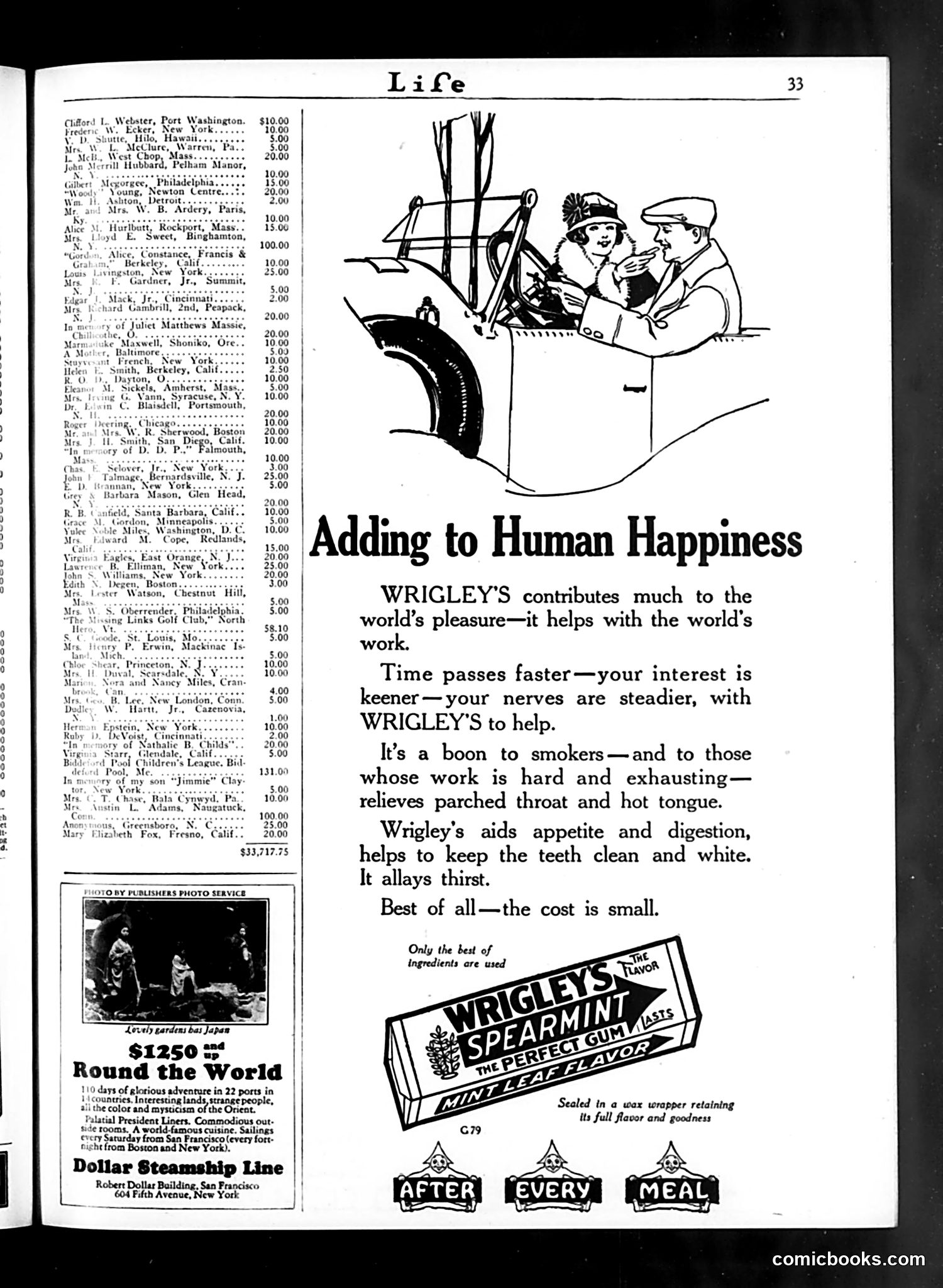
This page is primarily **advertising**, not satire. It features a Wrigley's chewing gum advertisement ("Adding to Human Happiness") occupying the right two-thirds of the page. The ad's illustration shows two working men (one appears to be a laborer or driver) sharing gum, emphasizing gum's supposed benefits: steadier nerves, faster time passage, relief for smokers and hard workers, and improved digestion and teeth. The ad's claims reflect **early 20th-century patent-medicine style marketing**—making broad health and mood benefits from a simple product. Modern readers would find this exaggerated; today's advertising standards prohibit such unsubstantiated health claims. The left side contains a charitable donations list and a Dollar Steamship Line advertisement for a $1,250 world cruise. The cartoon illustration (top right) appears to be decorative rather than satirical—simply showing the gum's user appeal to working-class Americans. There is no political satire evident on this page.
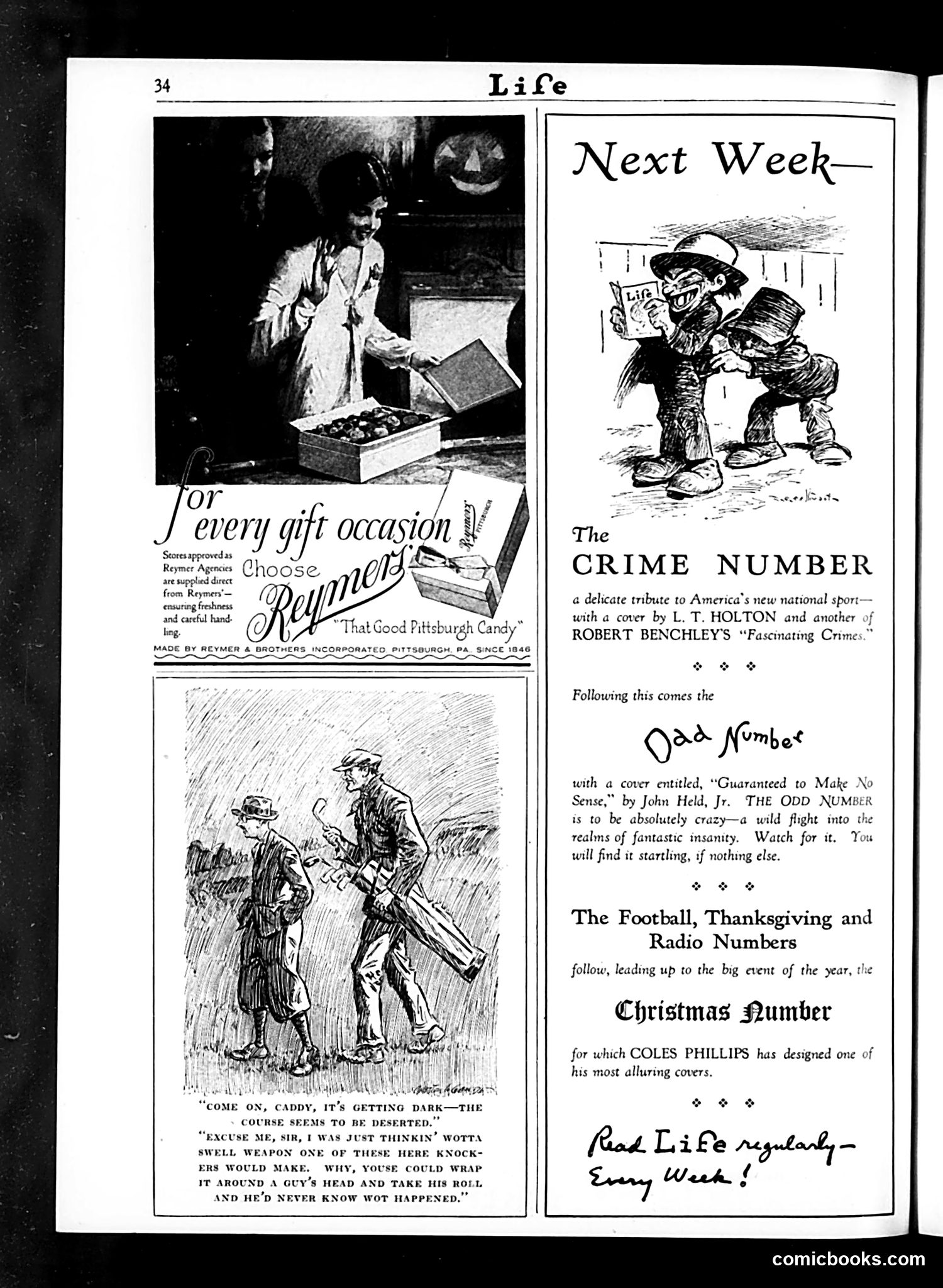
This page mixes advertising with editorial promotion. The left side advertises **Reymer's Pittsburgh candy** with a photograph of a child examining a gift box—a straightforward commercial appeal to holiday gift-giving. Below that is a **golf cartoon** depicting two caddies, one explaining to the other how a golf club could be used as a weapon for robbery. The humor relies on working-class characters discussing criminal violence casually—typical of early 20th-century "lowbrow" comedy that treated crime as darkly comic material. The right side previews upcoming **Life magazine issues**, including a "Crime Number" (apparently celebrating crime as entertainment), an "Odd Number" promising absurdist humor, and eventual holiday issues. This reflects Life's satirical approach: treating serious social problems like crime and urban violence as material for sophisticated mockery rather than moral concern. The overall page exemplifies how early Life magazine positioned itself—mixing consumer culture, working-class stereotypes, and darkly comedic treatments of social ills as entertainment for educated readers.
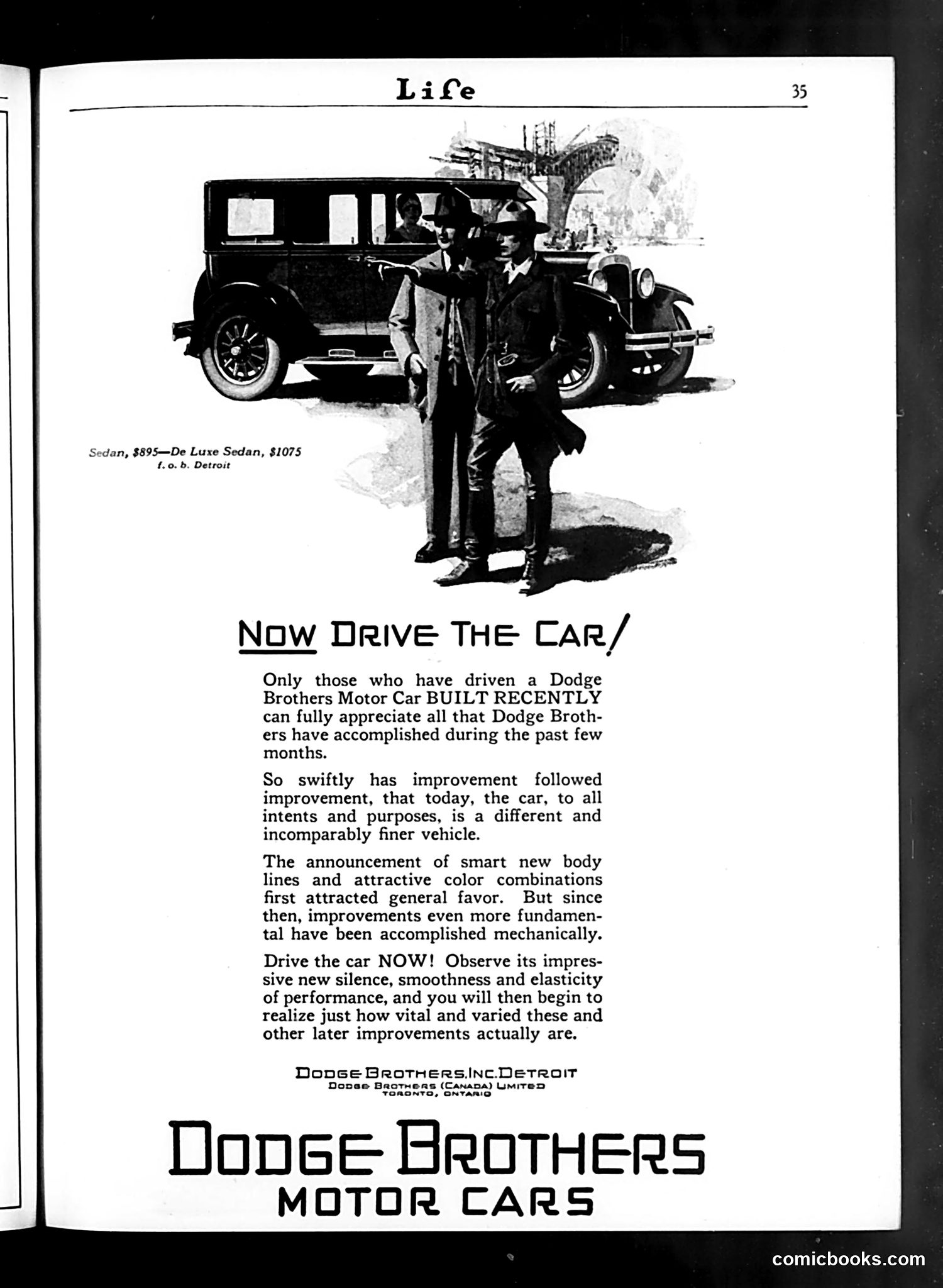
This is **not a cartoon or satire** — it's a straightforward automobile advertisement from *Life* magazine (page 35). The image shows two well-dressed men in suits examining a Dodge Brothers sedan, with the vehicle displayed prominently behind them. The ad promotes recent mechanical and design improvements to Dodge Brothers automobiles, emphasizing that the car has been substantially redesigned and improved. Prices listed are $895 for a standard sedan and $1075 for a De Luxe model, f.o.b. Detroit. The text urges potential customers to test-drive the vehicle to experience its "new silence, smoothness and elasticity of performance." This was typical 1920s automotive advertising, highlighting manufacturing advances and encouraging consumer engagement through direct experience of the product. The page represents commercial rather than editorial content.
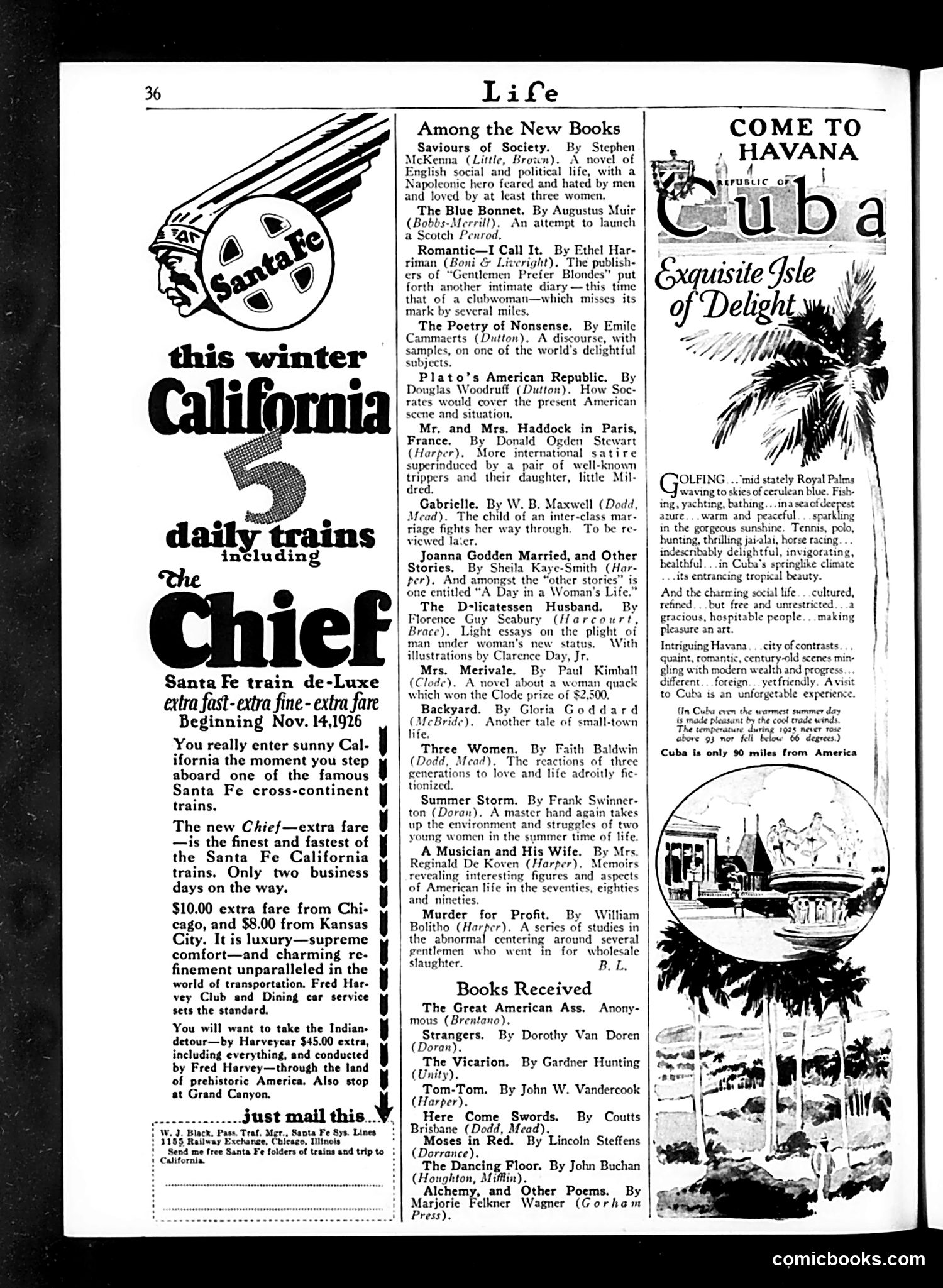
This page is primarily **advertising and book reviews**, not political satire. The main advertisement promotes the Santa Fe Railway's new "Chief" train to California, emphasizing luxury travel ("extra fast-extra fine-extra fare") beginning November 14, 1926. A secondary ad promotes travel to Havana, Cuba, highlighting golf, yachting, and social activities—Cuba being a popular destination for wealthy Americans during Prohibition. The bulk of the page lists contemporary book reviews and new releases from 1926, including novels about social life, satirical works (notably Donald Ogden Stewart's satirical travel narrative), and memoirs. One reviewed title, "Gentlemen Prefer Blondes," references the recent bestseller that reflected 1920s attitudes toward women and romance. The page reflects **1920s consumer culture**: leisure travel, modern transportation, and literary entertainment for the affluent. There is **no clear political cartoon or satire**—this is a standard Life magazine features page from the Jazz Age era.
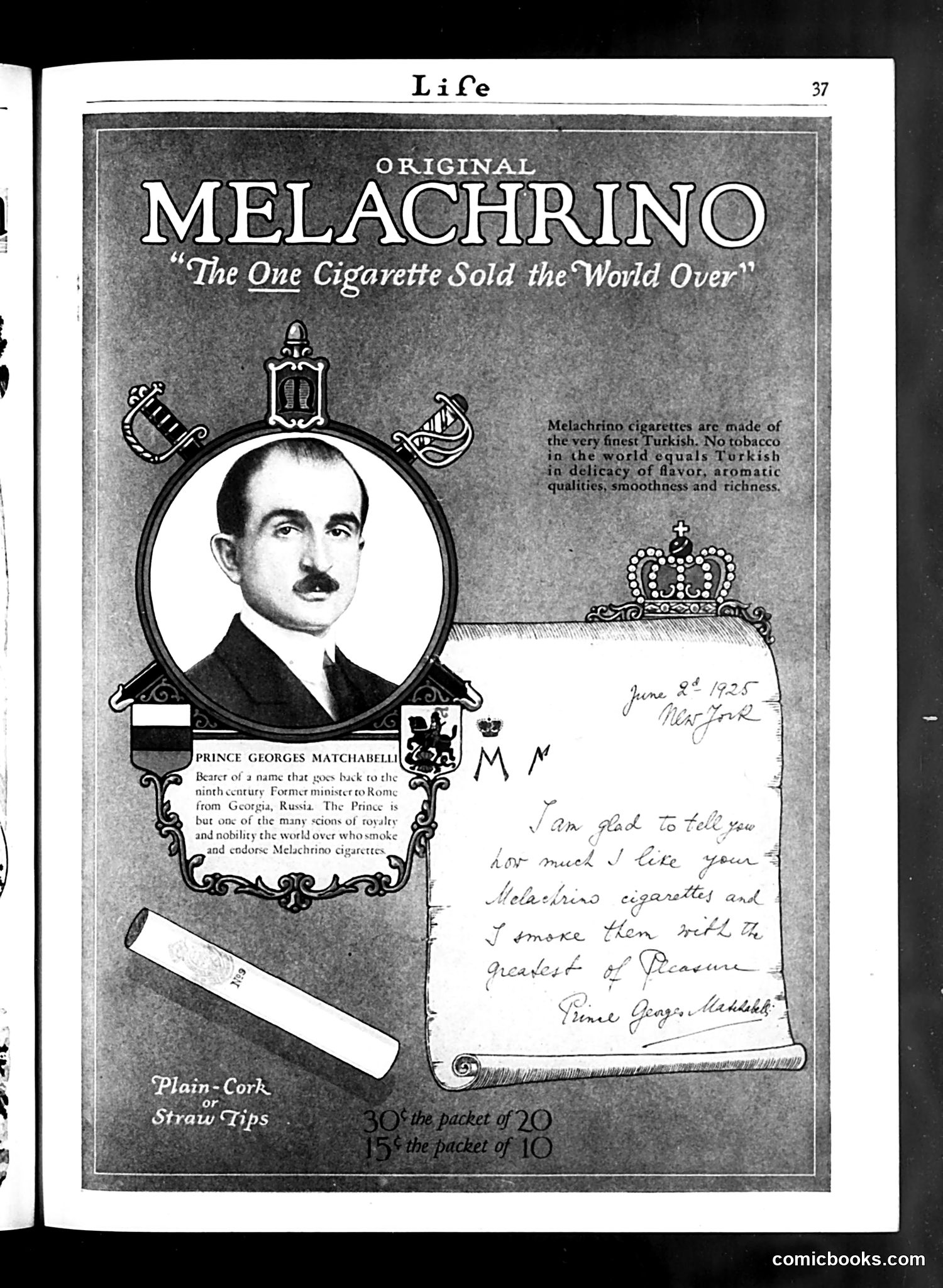
This is a **cigarette advertisement**, not satire. It features Prince Georges Matchabelli, a Georgian-Russian nobleman with historical credentials (ninth-century lineage, former minister to Rome). The ad's appeal is straightforward: it uses aristocratic prestige to endorse Melachrino Turkish cigarettes, claiming they represent superior quality and refinement. The handwritten note from the Prince (dated June 24, 1925) serves as testimonial, stating he smokes them "with the greatest of pleasure." For modern readers, this illustrates how early 20th-century advertising leveraged European nobility as celebrity endorsers—a status symbol suggesting that smoking these cigarettes connected consumers to aristocratic taste and sophistication. The ad contains no satirical critique; *Life* magazine simply carried luxury advertising alongside editorial content.
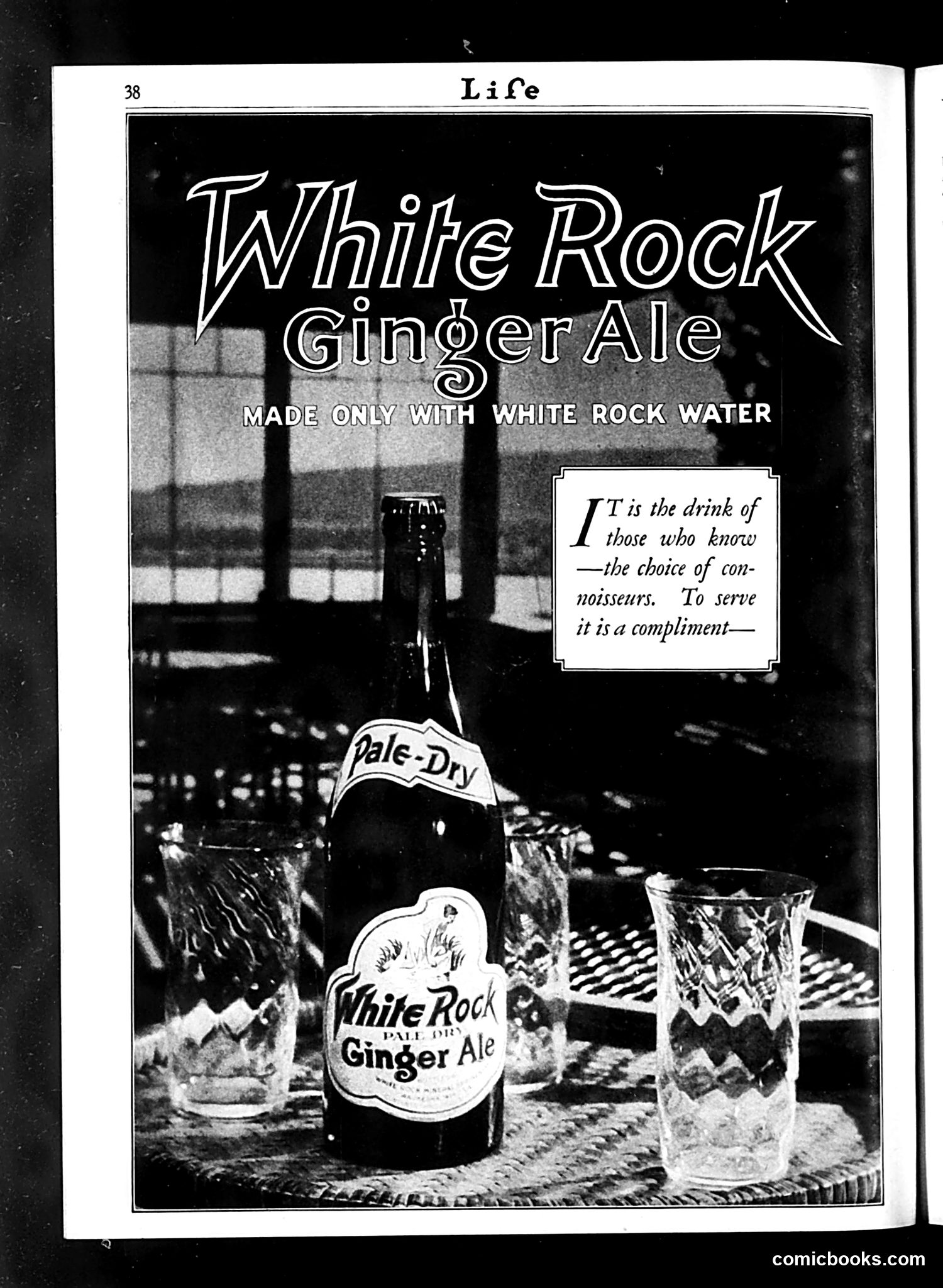
This is a **product advertisement**, not political satire. It promotes White Rock brand ginger ale, emphasizing that it's "made only with White Rock water." The ad targets affluent consumers by claiming the beverage is "the drink of those who know—the choice of connoisseurs," suggesting serving it demonstrates refined taste and hospitality. The elegant presentation—a bottle surrounded by ice-filled glasses on what appears to be fine glassware—reinforces this upscale positioning. The "Pale-Dry" label visible on the bottle indicates the product's specific variety. This represents typical early-to-mid 20th century beverage marketing strategy: associating a mundane product with sophistication and social status to justify premium pricing.
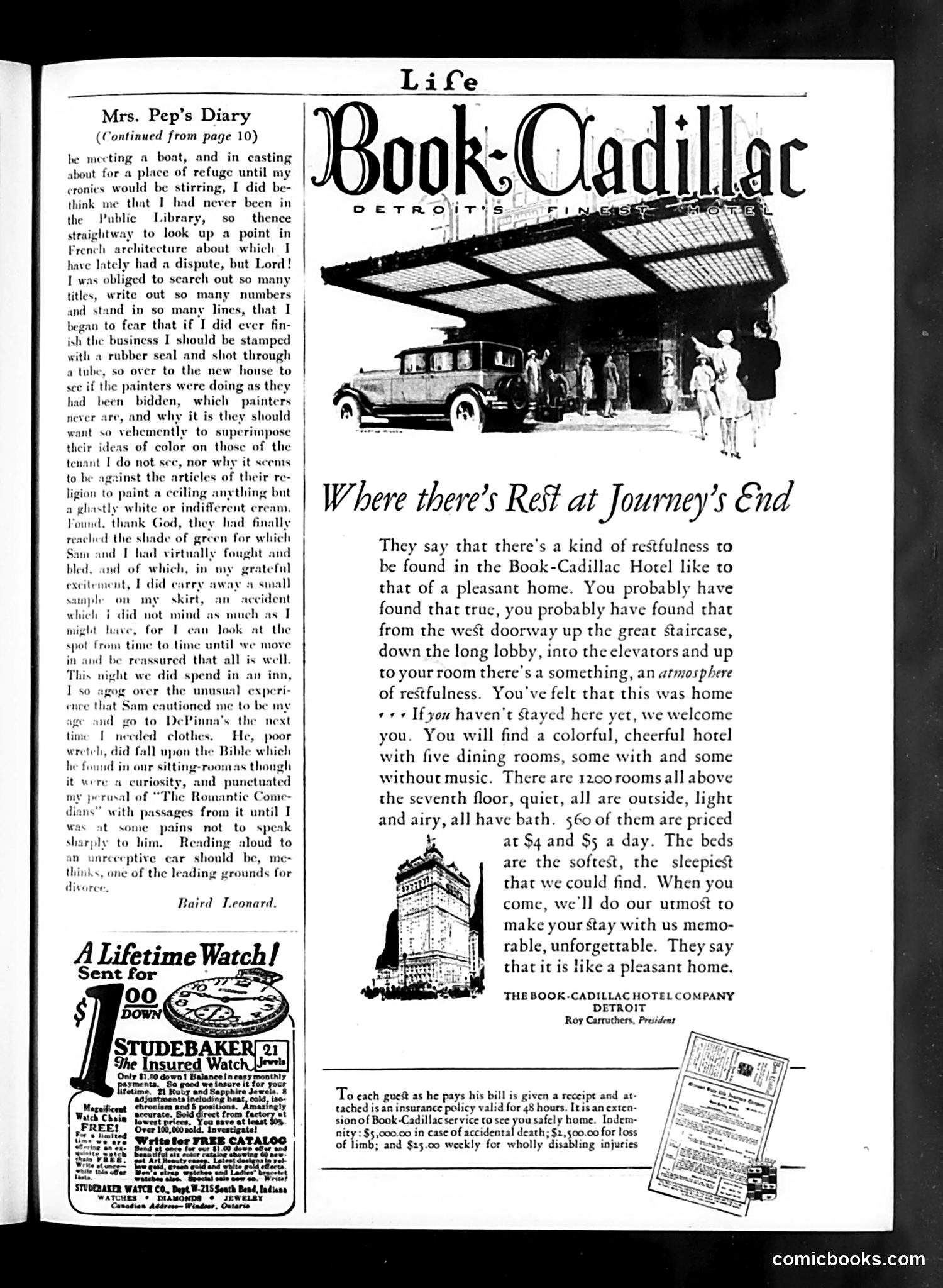
This page contains no political cartoon. Instead, it features: **Left side:** A continuation of "Mrs. Pep's Diary"—a humorous society column by Baird Leonard describing a wealthy woman's day visiting the Public Library (frustrated by bureaucracy), inspecting house painters, and her husband reading the Bible aloud at an inn. The tone is light domestic satire about upper-class life. **Center/Right:** A large advertisement for the **Book-Cadillac Hotel in Detroit**, emphasizing comfort, affordability ($4-$5 per day), and amenities. The ad uses homey language ("like a pleasant home") and includes an illustration of the hotel entrance with guests arriving by car. **Bottom left:** An advertisement for a Studebaker watch ($1 down, lifetime guarantee). **Bottom right:** Insurance policy details for hotel guests (accidental death/injury coverage). This is primarily an **advertising page** with supporting editorial content—typical of Life magazine's business model.
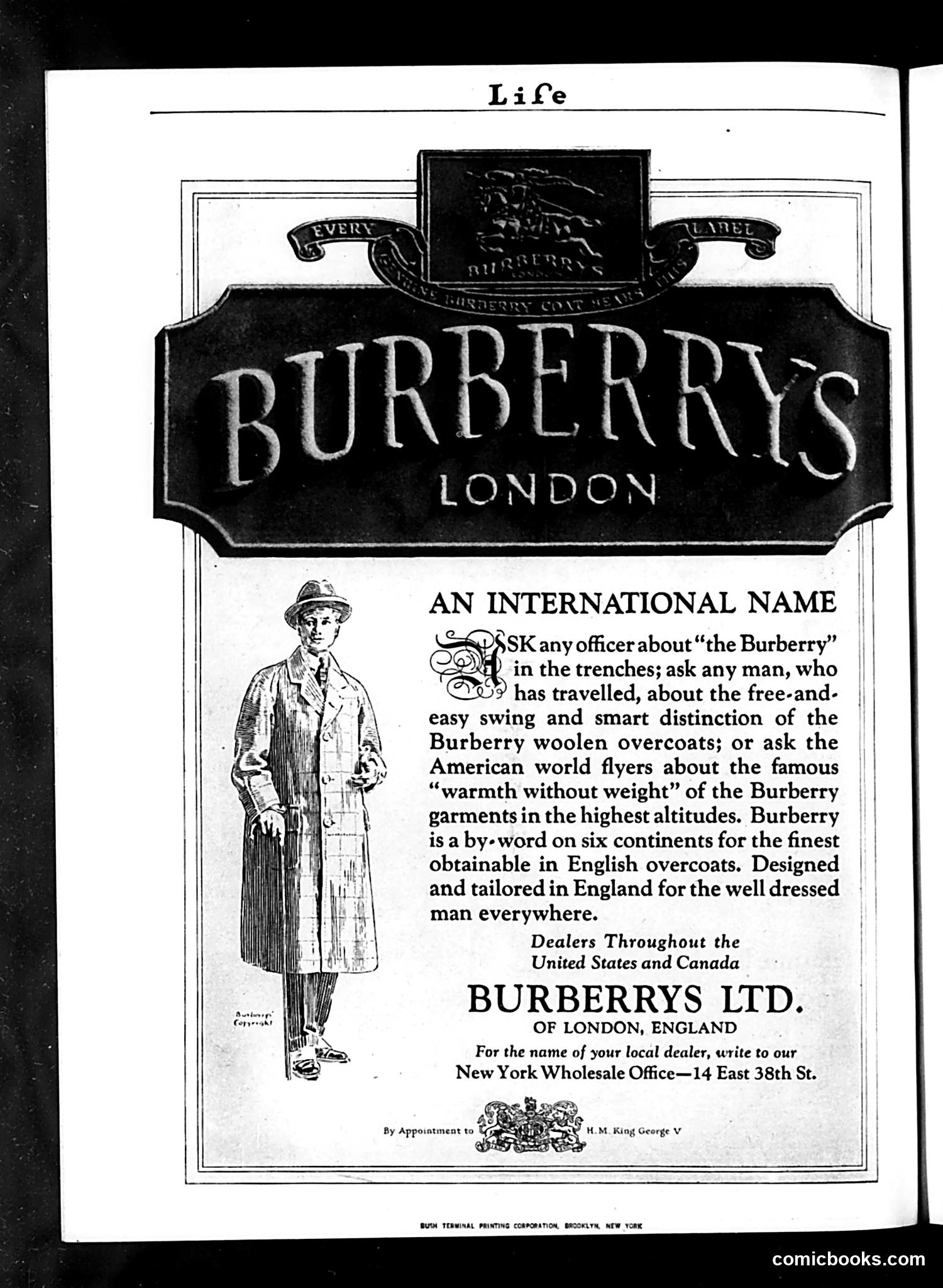
This is primarily a **vintage advertisement**, not political satire or cartoon. It promotes Burberrys overcoats to American readers, likely during or shortly after World War I (references to "trenches" and "flyers" suggest this era). The ad appeals to masculine authority and prestige: it cites military officers in WWI trenches, travelers worldwide, and American aviators as endorsers of the brand's quality and "warmth without weight." The illustration shows a well-dressed man in a Burberrys coat—the aspirational ideal. The "international name" claim emphasizes that this English luxury brand is recognized globally as the standard for fine overcoats. The royal warrant at bottom ("By Appointment to...H.M. King George V") reinforces prestige. **For modern readers**: This uses early 20th-century advertising techniques—celebrity/authority endorsement and patriotic/masculine imagery—to position an expensive British import as essential for the discerning American man.
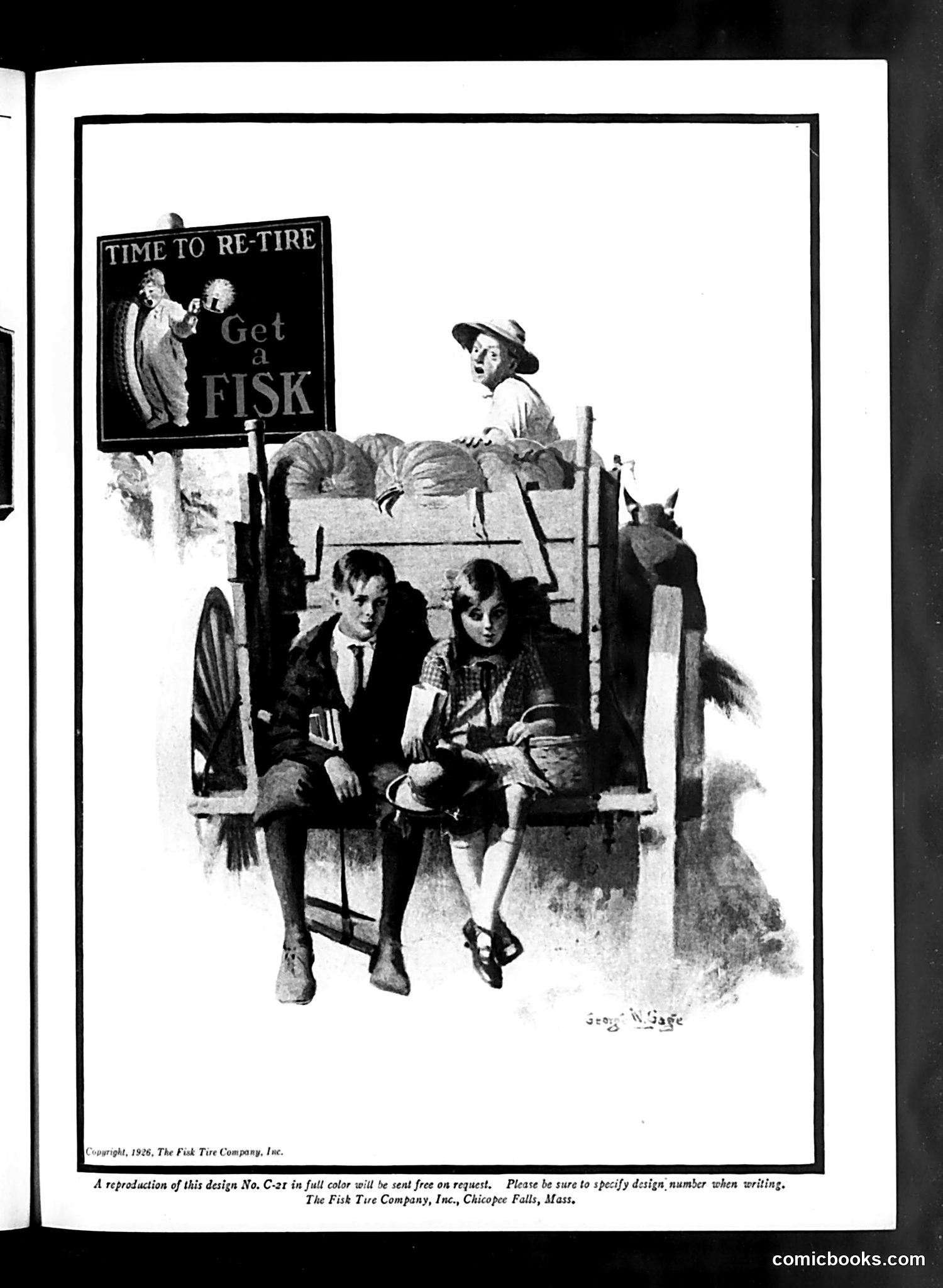
This is a 1926 **Fisk Tire Company advertisement**, not editorial satire. The design plays on the phrase "time to re-tire"—a pun on purchasing replacement tires. The imagery shows a young couple sitting in a farm wagon loaded with produce, while a farmer stands above holding a sign. The visual joke suggests that even rural workers need reliable tires for their vehicles. The couple appears content, implying Fisk tires enable practical, worry-free transportation. The advertisement targets middle-class Americans during the automotive boom of the 1920s, emphasizing that tire replacement was a normal, necessary consumer expense. There's no political commentary—this is purely commercial messaging designed to normalize tire purchases across different social classes.
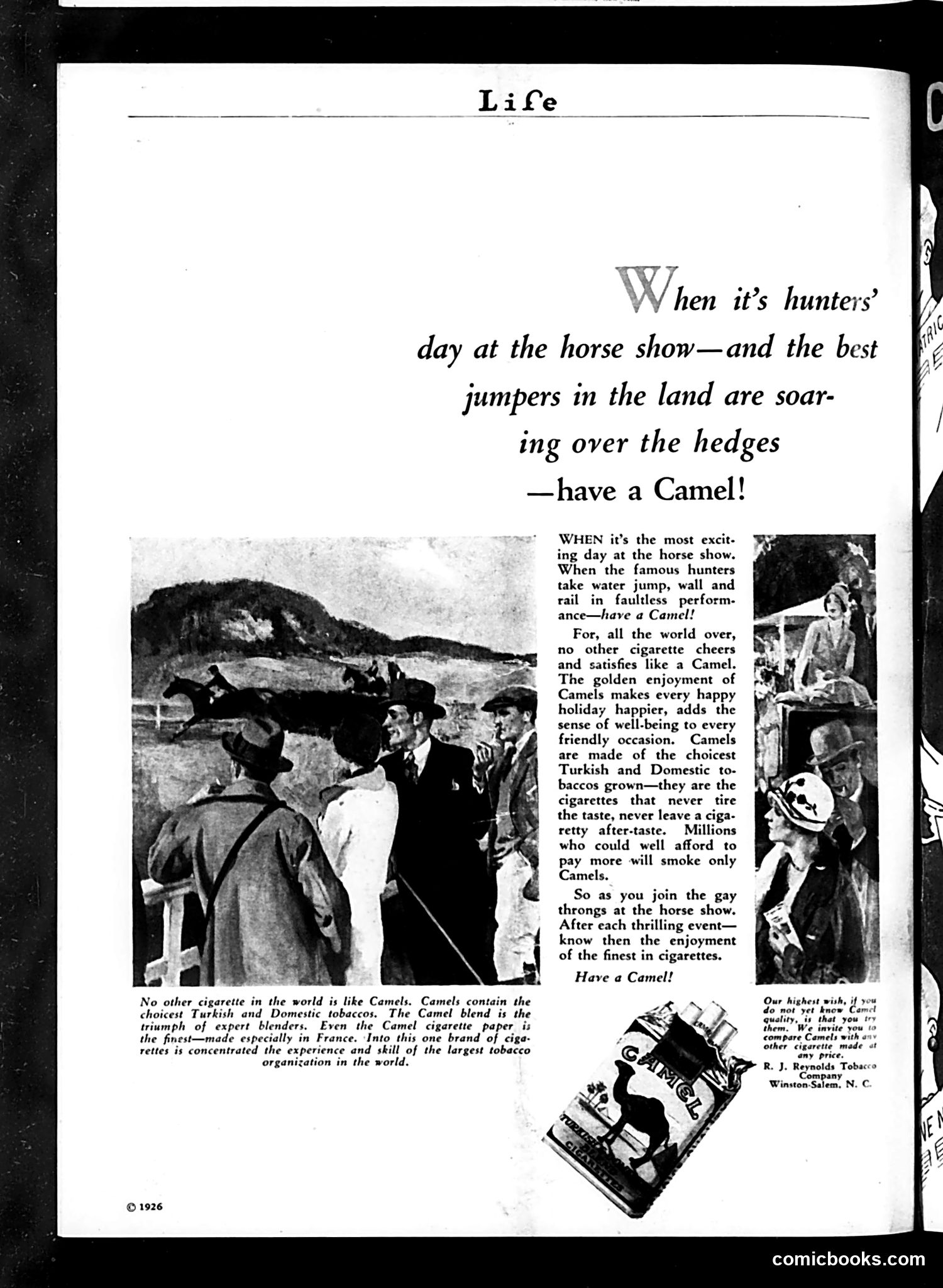
This is primarily a **cigarette advertisement**, not political satire. It depicts a scene at an upper-class horse show—a prestigious sporting event featuring equestrian jumping competitions. The ad associates Camel cigarettes with leisure, wealth, and refined entertainment. The advertisement targets affluent readers by linking smoking to the glamorous world of "hunters' day" and competitive horseback riding. The messaging suggests that sophisticated people enjoy Camels during exciting social occasions. Key claims made: Camels use "choicest Turkish and Domestic tobaccos," feature paper made in France, and represent "the finest in cigarettes." The ad appeals to status-conscious smokers, implying that wealthy individuals who "could well afford to pay more will smoke only Camels." This reflects 1920s advertising practices before cigarette health warnings existed. The normalization of smoking at upscale social events was typical marketing strategy of the era.