
Life, 1926-10-21 · page 25 of 44
Life — October 21, 1926 — page 25: what you’re looking at
What you’re looking at
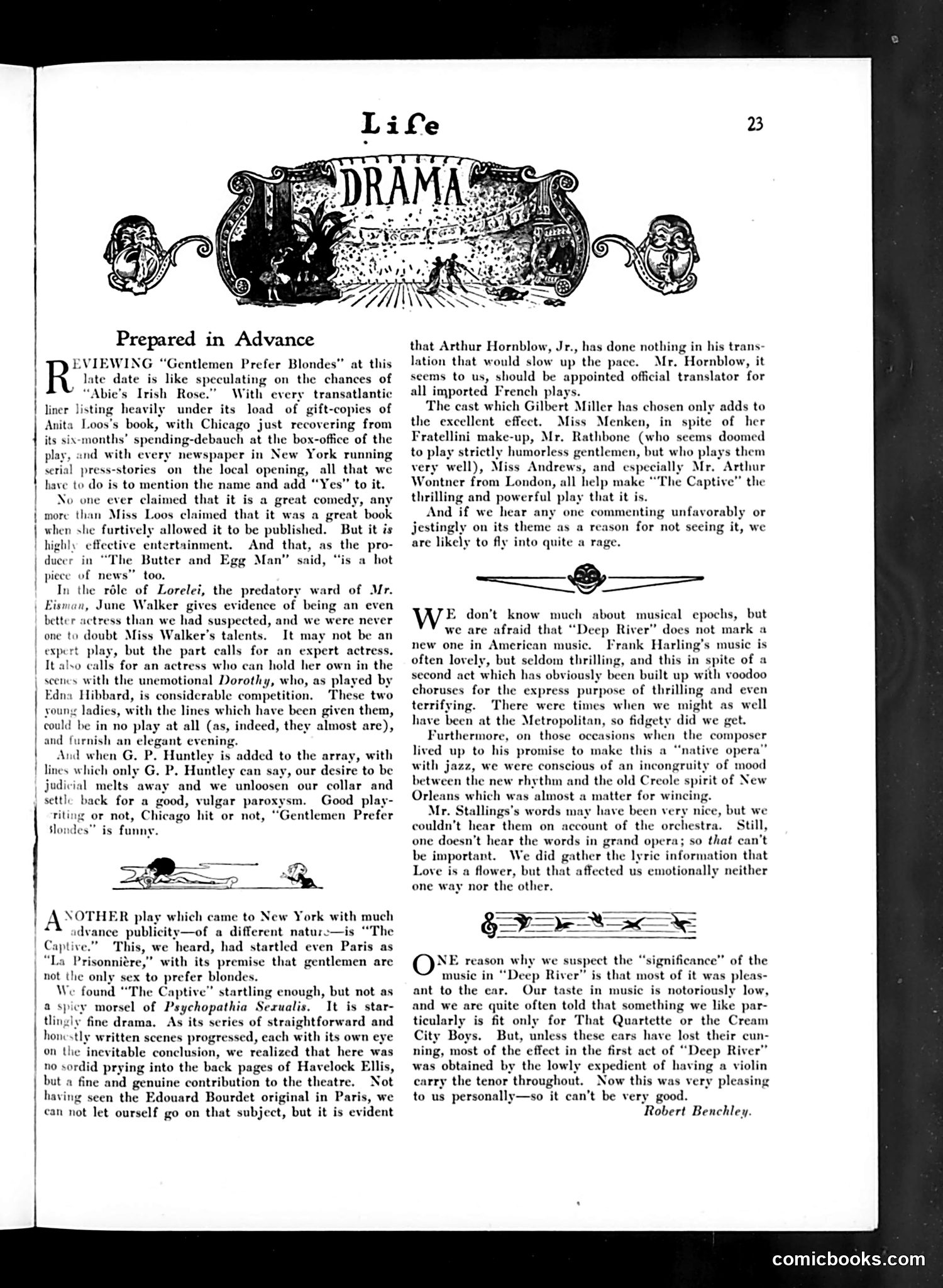
This page contains theater criticism from Life's drama section. The critic reviews three Broadway plays: **"Gentlemen Prefer Blondes"** — The critic acknowledges this Anita Loos adaptation is hugely popular but admits it's "not a great comedy," merely "highly effective entertainment." He praises actress June Walker's performance in the lead role of Lorelei, calling her an "expert actress," and notes G.P. Huntley's comedic talents make it "funny." **"The Captive"** — This French import about female same-sex attraction receives serious critical praise as genuine drama, not sensationalism. The critic defends the play against potential moral objections, warning readers not to dismiss it based on its "theme." **"Deep River"** — The musical is critiqued as having lovely but uninspiring music despite elaborate voodoo choruses meant to thrill audiences. The reviews represent 1920s Broadway sophistication—defending artistic merit while dismissing pulp, and notably defending a controversial play about lesbian themes as legitimate theater rather than scandal.
📄 Transcribed text from this page (OCR, searchable)
Machine-transcribed from the original scan — historical spelling and the odd misread are preserved.
Prepared in Advance EVIEWING “Gentlemen Prefer Blondes” at this R late date is like speculating on the chances of “Abie’s Irish Rose.” With every transatlantic liner listing heavily under its load of gift-copies of Anita Loos’s book, with Chicago just recovering from its six-months’ spending-debauch at the box-office of the play, and with every newspaper in New York running serial press-stori on the local opening, all that we have to do is to mention the name and add “Yes” to it. | No one ever claimed that it is a great comedy, any more than Miss Loos claimed that it was a great book when she furtively allowed it to be published. But it is highly effective entertainment. And that, as the pro- | ducer in “The Butter and Egg Man” said, “is a hot piece of news” too, In the réle of Lorelei, the predatory ward of Mr. | Eisman, June Walker s evidence of being an even better actress than we had suspected, and we were never one to doubt Miss Walker’s talents. It may not be an expert play, but the part calls for an expert actress. al for an actress who can hold her own in the scenes with the unemotional Dorothy, who, as played by Edna Hibbard, is considerable competition. These two young ladies, with the lines which have been given them, could be in no play at all (as, indeed, they almost are), and furnish an elegant evening. And when G. P. Huntley is added to the array, with lines which only G. P, Huntley can say, our desire to be judicial melts away and we unloosen our collar and settle back for a good, vulgar paroxysm. Good play- riting or not, Chicago hit or not, “Gentlemen Prefer slo is funny. i> A SOTHER play which came to New York with much ** advance publicity—of a different naturc—is “The ’ This, we heard, had startled even Paris as Prisonnitre,” with its premise that gentlemen are not the only sex to prefer blondes. We found ‘The Captive” startling enough, but not as a spicy morsel of Psychopathia Serualis. It is star- tlingly fine drama, As its series of straightforward and honestly written scenes progressed, each with its own eye on the inevitable conclusion, we realized that here was no sordid prying into the back pages of Havelock Ellis, but a fine and genuine contribution to the theatre. Not having seen the Edouard Bourdet original in Paris, we can not let ourself go on that subject, but it is evident that Arthur Hornblow, Jr., has done nothing in his trans- lation that would slow up the pace. Mr. Hornblow, it seems to us, should be appointed official translator for all imported French plays. The cast which Gilbert Miller has chosen only adds to the excellent effect. Miss Menken, in spite of her Fratellini make-up, Mr. Rathbone (who seems doomed to play strictly humorless gentlemen, but who plays them very well), Miss Andrews, and especially Mr. Arthur Wontner from London, all help make “The Captive” the thrilling and powerful play that it is And if we hear any one commenting unfavorably or jestingly on its theme as a reason for not seeing it, we are likely to fly into quite a rage. —__ & —— WE don’t know much about musical epochs, but we are afraid that “Deep River” does not mark a new one in American music. Frank Harling’s music is often lovely, but seldom thrilling, and this in spite of a second act which has obviously been built up with voodoo choruses for the express purpose of thrilling and even terrifying. There were times when we might as well have been at the Metropolitan, so fidgety did we get. Furthermore, on those occasions when the composer lived up to promise to make this a “native opera” with jazz, we were conscious of an incongruity of mood between the new rhythm and the old Creole spirit of New s’s words may have been very nice, but we couldn't hear them on account of the orchestra. Still, one doesn’t hear the words in grand opera; so that can't be important. We did gather the lyric information that Love is a flower, but tha one way nor the other. NE reason why we suspect the “significance” of the music in “Deep River” is that most of it was pleas- ant to the car, Our taste in music is notoriously low, and we are quite often told that something we like par- ticularly is fit only for That Quartette or the Cream City Boys. But, unless these ears have lost their cun- ning, most of the effect in the first act of “Deep River” was obtained by the lowly expedient of having a violin carry the tenor throughout. Now this was very pleasing to us personally—so it can’t be very good. Robert Benchley. comicbooks.com