
Life, 1926-10-21 · page 20 of 44
Life — October 21, 1926 — page 20: what you’re looking at
What you’re looking at
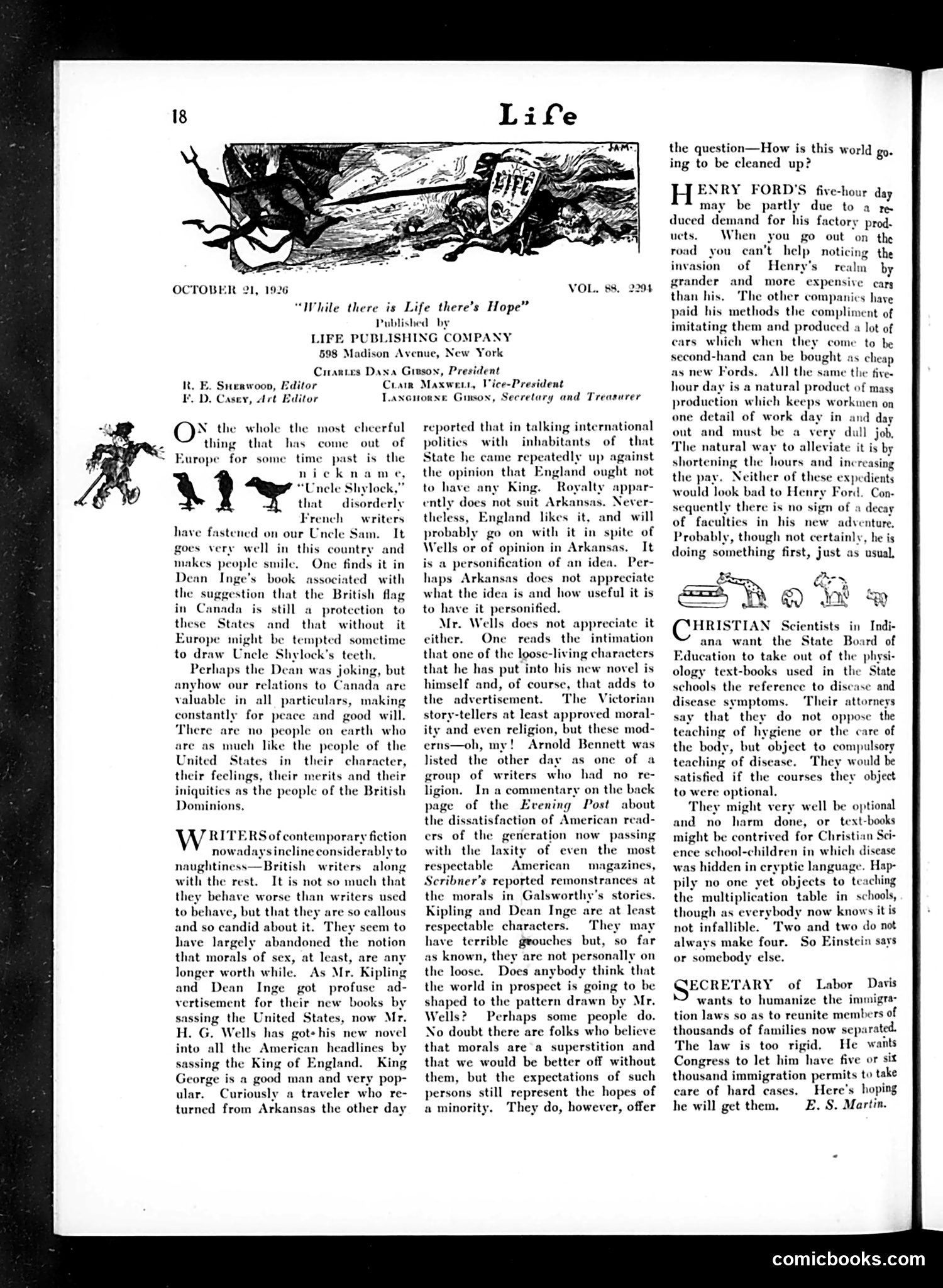
This page contains editorial commentary rather than political cartoons. The main articles critique contemporary British and American writers for moral laxity. **Key References:** The editor attacks H.G. Wells for deliberately courting scandal by including himself (thinly disguised) as an immoral character in his new novel, and for publicly criticizing King George III. The piece notes that while Americans (specifically Arkansans) may question monarchy, England values it as "a personification of an idea." **The Satire:** The editor contrasts modern writers like Wells, Kipling, and Dean Inge—who generate publicity through social criticism and moral irreverence—with Victorian authors who at least "approved morality and even religion." The piece questions whether literature promoting moral relativism serves society's interests, asking pointedly: "How is this world going to be cleaned up?" A brief item discusses Henry Ford's five-hour workday, suggesting reduced factory demand. The tone is conservative, defending traditional morality and social institutions against what the editor sees as nihilistic modernism.
📄 Transcribed text from this page (OCR, searchable)
Machine-transcribed from the original scan — historical spelling and the odd misread are preserved.
OCTOBER 21, 1926 “While there is Life there’s Hope” Published by LIFE PUBLISHING COMPANY 598 Madison Avenue, New York Cranes Dasa Greson, Presi Ciam Maxw T.axcuoan Kt. E. Suerwoon, Editor PF. D. Casey, Art Editor the whol O thing that Europe for some t nickname “Unele Shylock,” that disorderly French — writers have fastened on our Uncle Sam. It goes very well in this country and makes people smile. One finds it in Dean Inge’s book associated with the suggestion that the British flag in Canada is still a protection to States and that without it Europe might be tempted sometime to draw Uncle Shylock’s teeth. Perhaps the Dean was joking, but anyhow our relations to Canada are valuable in all particulars, making constantly for peace and good will. There are no people on earth who are as much like the people of the United States in their character, their feelings, their merits and their iniquitics as the people of the British Dominions. the most cheerful come out of past is the these RITERS of contemporary fiction nowadaysincline considerably to naughtiness—British with the rest. writers along It is not so much that behave worse than writers used » but that they are so callous and so candid about it. They seem to have largely abandoned the notion that morals of sex, at least, are any longer worth while. As Mr. Kipling and Di Inge got profuse ad- vertisement for their new books by sassing the United States, now Mr. H. G. Wells has gots his new novel into all the Amer headlines by sassing the King of England. King George is a good man and very pop- ular. Curiously a traveler who re- turned from Arkansas the other day lent 1, Vice-President msox, Secretary and Treasurer reported that in talking international polities with inhabitants of that State he came repeatedly up against the opinion that England ought not to have any King. Royalty appar- ently does not suit Arkansas. Never- theless, England likes it, and will probably go on with it in spite of Wells or of opinion in Arkansas. It is a personification of an idea. Per- haps Arkansas does not appreciate what the idea is and how useful it is to have it personified. Mr. Wells does not appreciate it either. One reads the intimation that one of the loose-living characters that he has put into his new novel is himself and, of course, that adds to the advertisement. The Victorian story-tellers at least approved moral- ity and even religion, but these mod- erns—oh, my! Arnold Bennett was listed the other day as one of a group of writers who had no re- ligion. In a commentary on the back age of the Evening Post about » dissatisfaction of American read- ers of the generation now passing with the laxity of even the most respectable American — magazines, Scribner’s reported remonstrances at the morals in Galsworthy’s stories. Kipling and Dean Inge are at least respectable characters. They may have terrible grouches but, so as known, they are not personally on the loose. Does anybody think that the world in prospect is going to be shaped to the pattern drawn by Mr. Wells? Perhaps some people do. No doubt there are folks who believe that morals are a superstition and that we would be better off without them, but the expectations of such persons still represent the hopes of a minority. They do, however, offer the question—How is this world go- ing to be cleaned up? ENRY FORD'S five-hour day m be partly due to a re duced demand for his factory prod- ucts. When you go out on the road you can’t help noticing the of Henry's realm by and more expensive cars than his. The other companies haye paid his methods the compliment of imitating them and produced a lot of cars which when they come to be second-hand can be bought as cheap as new Fords. All the same the five- hour day is ural product of mass production which keeps workmen on one detail of work day in and day out and must be a very dull job, The natural way to alleviate it is by shortening the hours and increasing the pay. Neither of these expedients would look bad to Henry Ford. Con- sequently there is no sign of a decay of faculties in his new adventure, Probably, though not certainly, he is doing something first, just as usual, ) = RA ns CHRISTIAN Scientists in Indi- ana want the State Board of Education to take out of the physi- ology text-books used in the State schools the reference to disease and disease symptoms. ‘Their attorneys that they do not oppose the teaching of hygiene or the care of the body, but object to compulsory teaching of disease. They would be satisfied if the courses they object to were optional. They might very well be optional and no harm done, or text-books might be contrived for Christian Sci- ence school-children in which disease s hidden in cryptic language. Hap- pily no one yet objects to teaching the multiplication table in schools, though as everybody now knows it is not infallible. Two and two do not always make four. So Einstein says or somebody else. ECRETARY of Labor Davis wants to humanize the immigra- tion laws so as to reunite members of thousands of families now separated. The law is too rigid. He wants Congress to let him have five or sit thousand immigration permits to take care of hard cases. Here's hoping he will get them. — E. S. Martin. comicbooks.com