
A complete issue · 41 pages · 1926
Life — September 2, 1926
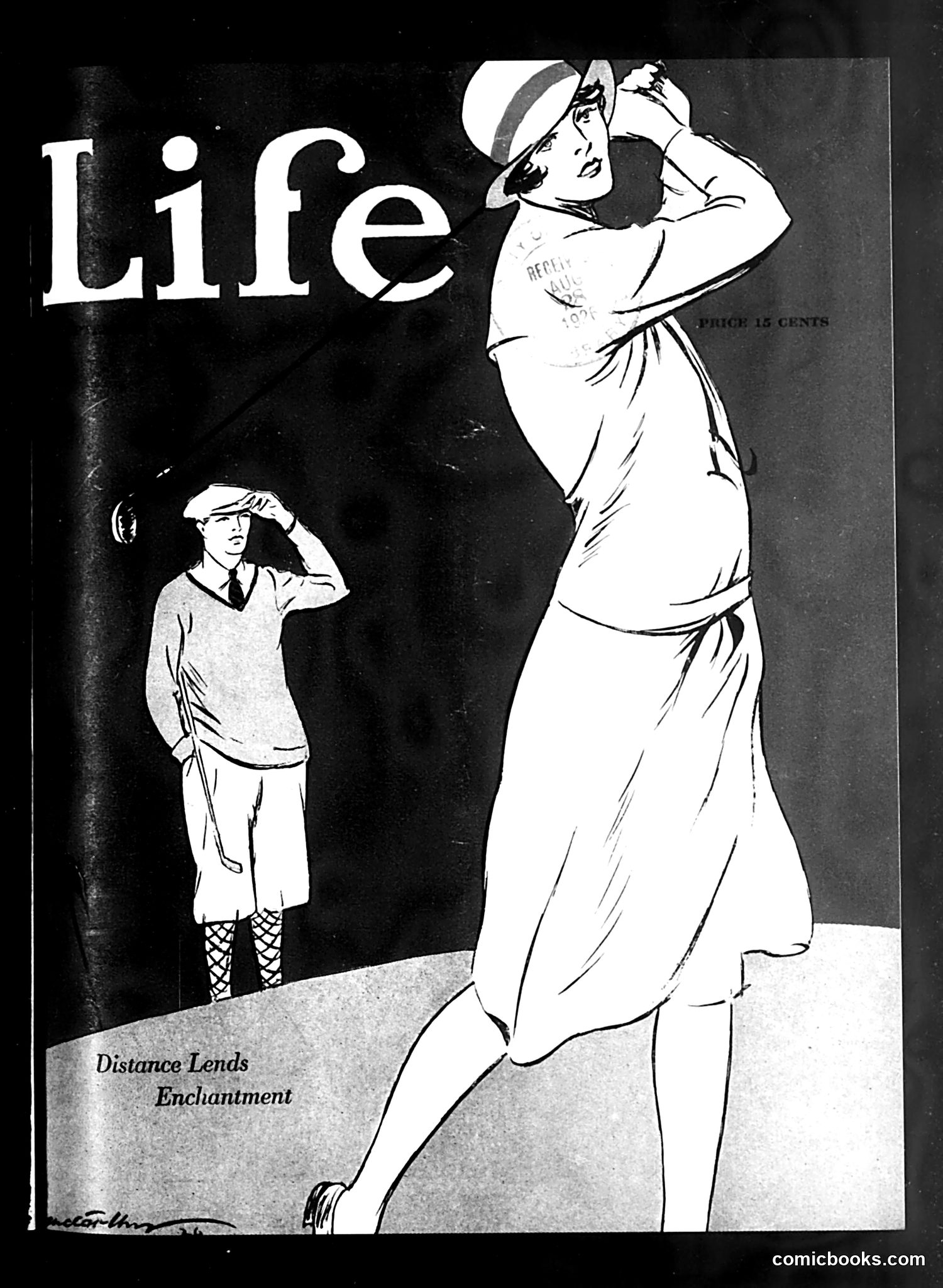
This appears to be a vintage Life magazine cover (price 15 cents) featuring an optical illusion or "distance lends enchantment" visual joke. The image uses perspective to create a humorous effect: a small boy in the foreground appears tiny compared to a woman in the background, who seems enormously large. The caption "Distance Lends Enchantment" suggests the satire concerns how perception changes based on distance—likely commenting on how something (or someone) appears more attractive or impressive from afar than up close. This was a common visual gag in early 20th-century publications. The fancy hat and dress on the woman, contrasted with the boy's modest attire, may suggest class differences or the contrast between idealized versus everyday appearances.
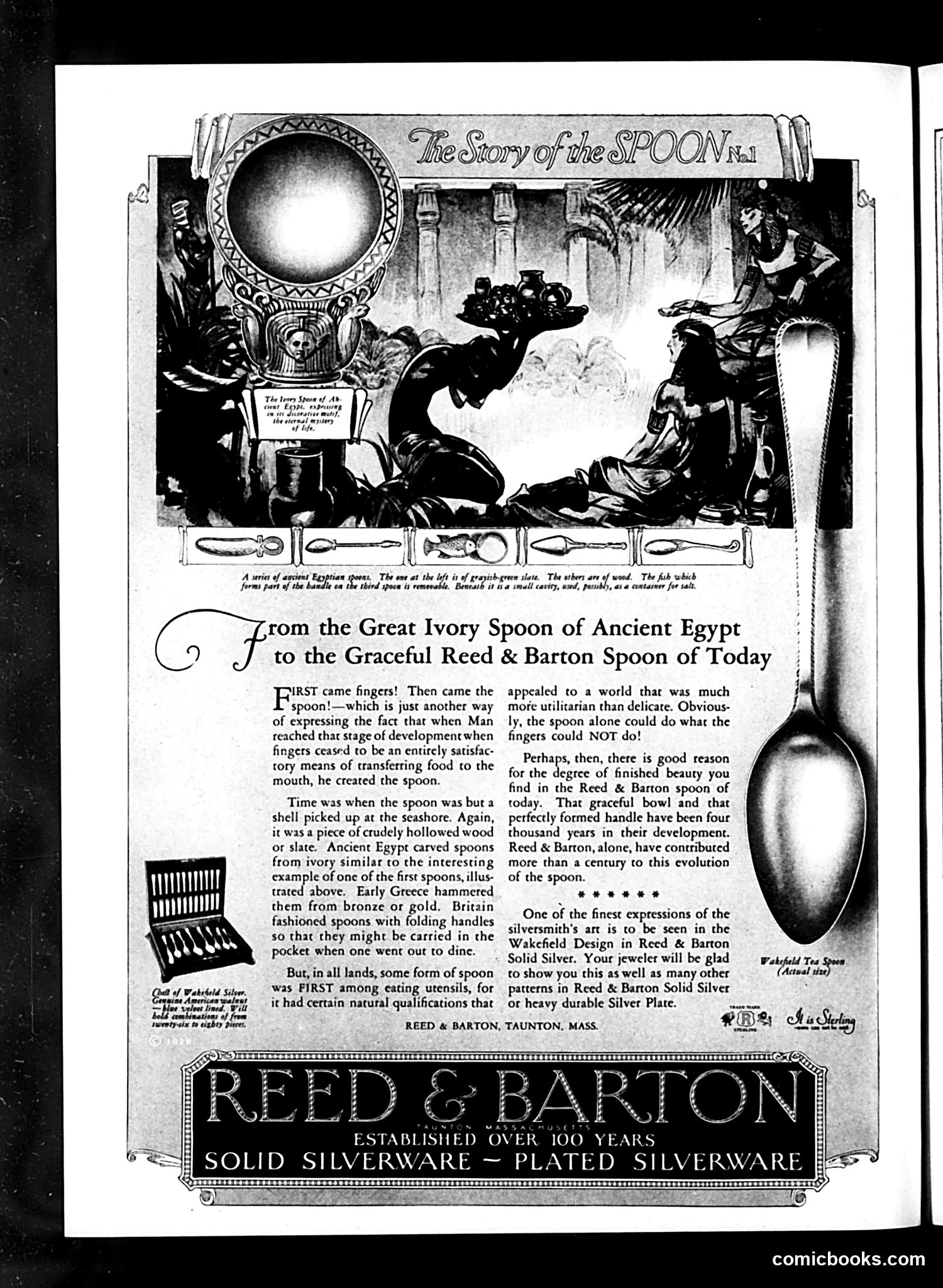
This page is primarily **advertising, not satire or political commentary**. The top illustration titled "The Story of the SPOON No.1" is a decorative historical narrative showing the evolution of spoons from ancient Egypt to modern times. It depicts figures in Egyptian dress presenting ornate spoons, with scholarly illustrations of various spoon designs below. The text celebrates this progression "from the Great Ivory Spoon of Ancient Egypt to the Graceful Reed & Barton Spoon of Today," positioning the advertiser's product as the culmination of thousands of years of refinement. The page is an **advertisement for Reed & Barton silverware** (Taunton, Massachusetts), using historical romance and evolutionary narrative to market their spoons as sophisticated, refined products—a common advertising strategy of the era.
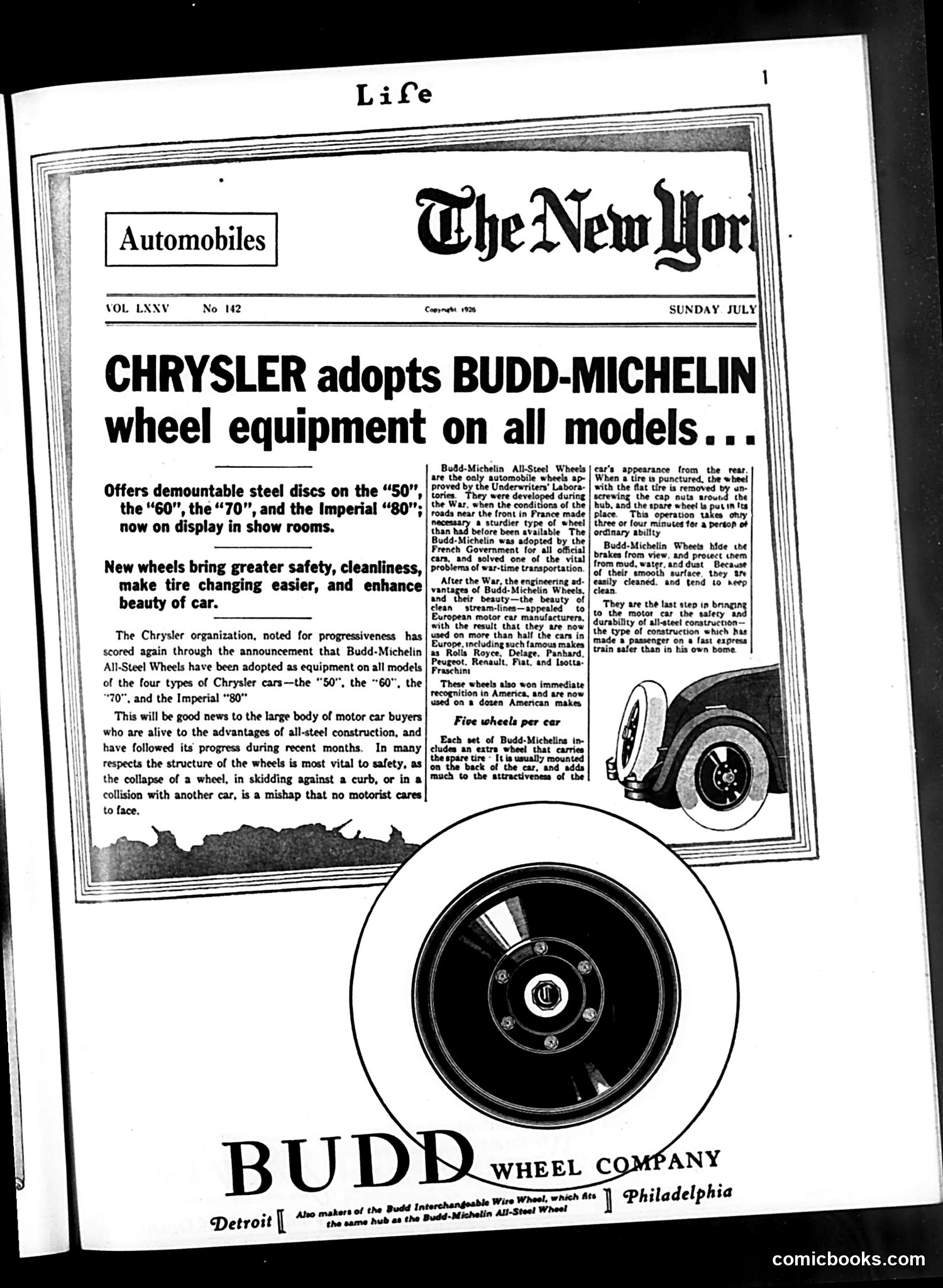
This page is primarily **an advertisement**, not a political cartoon. It announces Chrysler's adoption of Budd-Michelin all-steel wheels across its car models (the "50," "60," "70," and Imperial "80"). The ad emphasizes practical benefits: improved safety, easier tire-changing, and enhanced durability. It notes these wheels were already used by Rolls Royce, Delage, and other quality manufacturers, and were adopted by the French government for military transport during World War I. The imagery shows the wheel design and mentions "five wheels per car" as standard equipment. The Budd Wheel Company, based in Detroit and Philadelphia, is credited as manufacturer. This represents typical 1920s automotive advertising highlighting engineering innovations as competitive advantages.
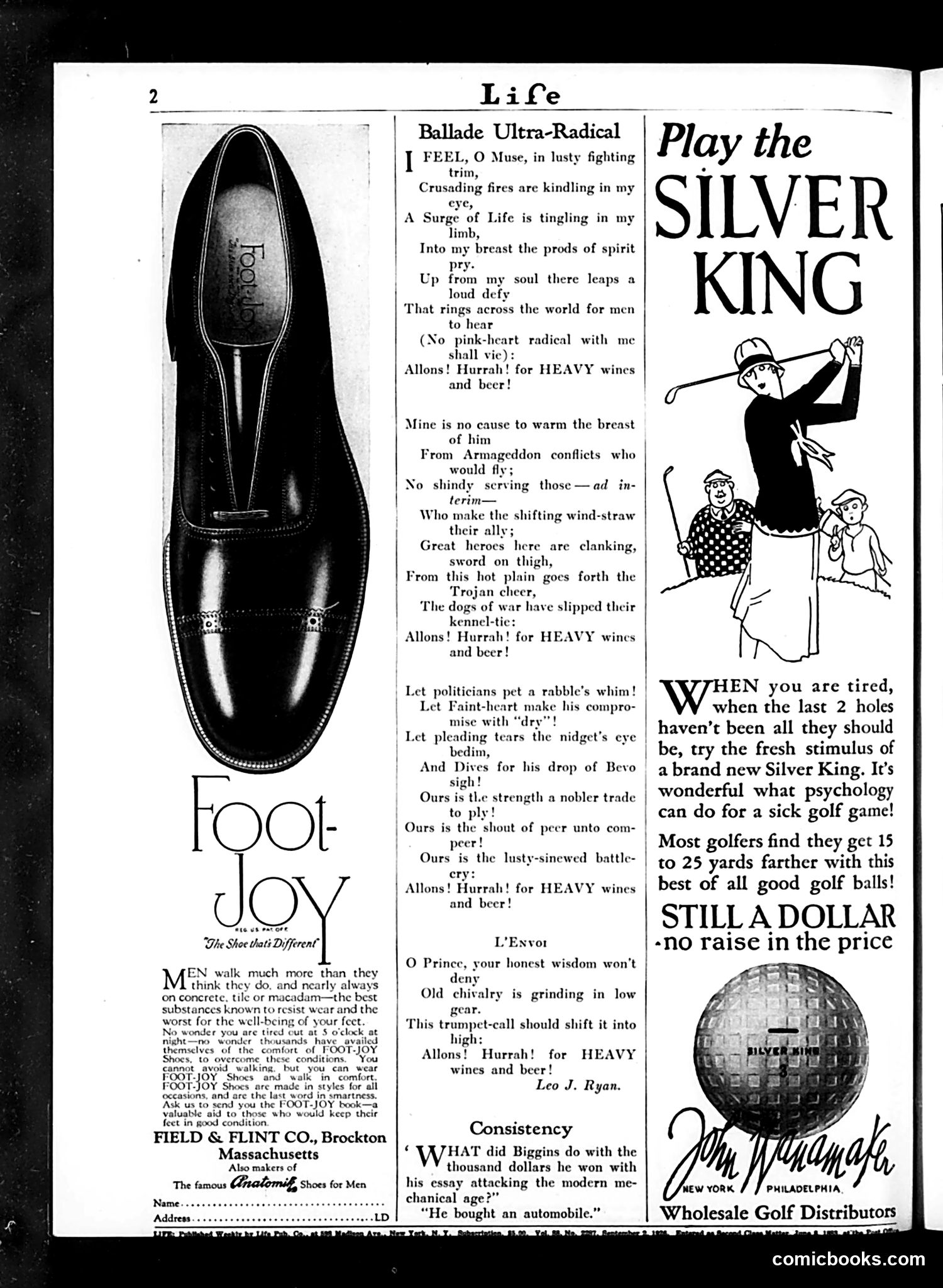
This page is primarily **advertising**, not political commentary. The left side advertises **Foot-Joy shoes** for men, emphasizing comfort for walking and concrete surfaces—practical concerns for urban workers. The copy suggests these shoes prevent foot problems from regular wear. The right side advertises **Silver King golf balls**, using humor to appeal to golfers. The illustration shows a golfer with two spectators; the ad claims the balls travel 15-25 yards farther, promising psychological benefit ("what psychology can do for a sick golf game!"). At bottom, **John Wanamaker** (Philadelphia-New York department store) is listed as a wholesale distributor. The center contains a poem titled "Ballade Ultra-Radical" by Leo J. Ryan, celebrating drinking and patriotism—fairly typical jingoistic verse for the era, though the exact historical moment is unclear from this page alone.
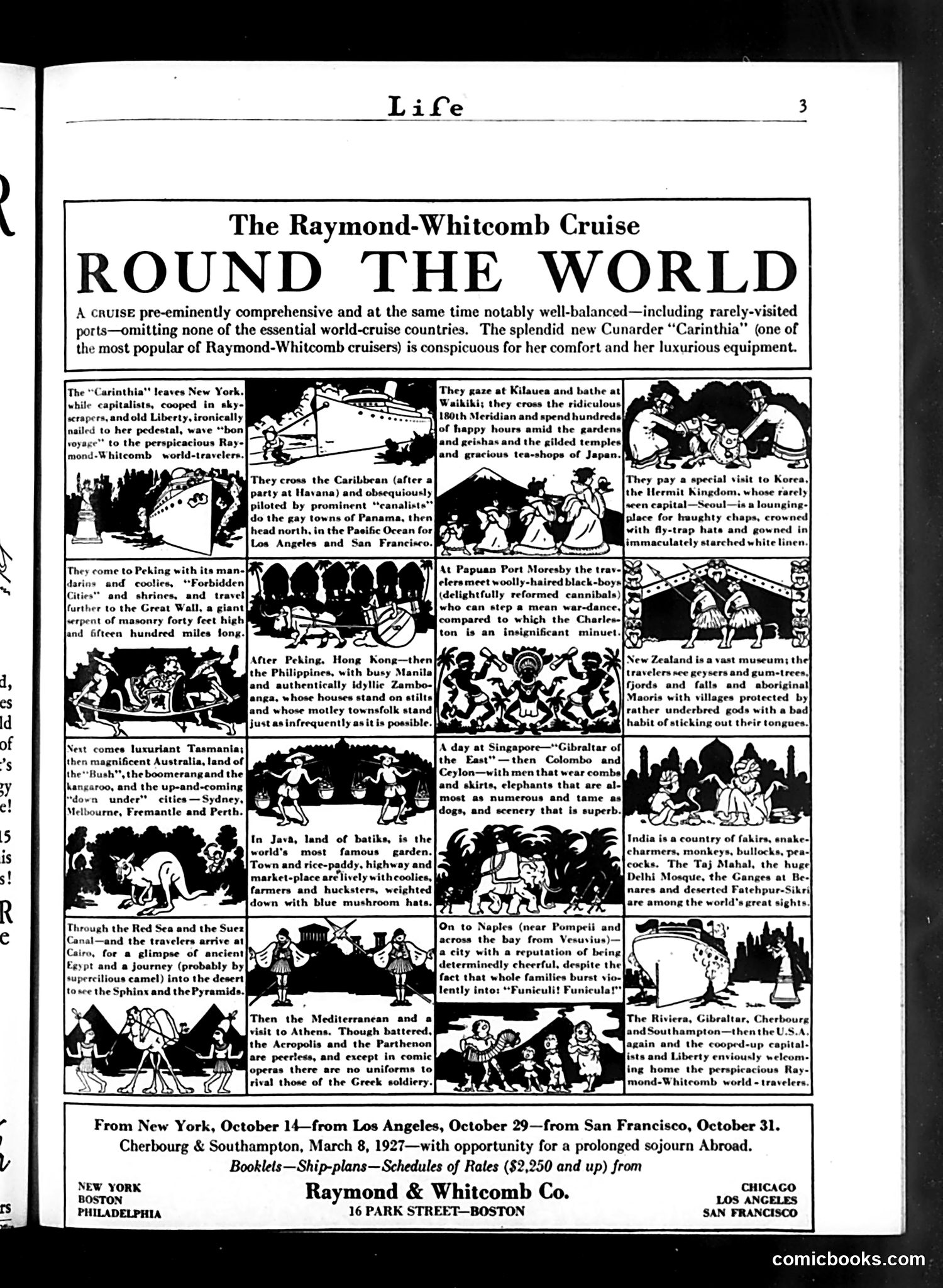
This is primarily **advertising content**, not satire or political commentary. It's a Raymond & Whitcomb cruise advertisement for their "Carinthia" ship offering a round-the-world voyage. The page uses illustrated vignettes depicting tourist destinations and activities: passengers visiting temples in Japan, observing colonial architecture, encountering indigenous peoples in New Zealand and Java, visiting historical sites near Naples and the Mediterranean, and viewing exotic animals and markets. The illustrations reflect **early 20th-century tourist attitudes**, presenting non-Western peoples and cultures as spectacles for Western consumption. Indigenous groups are depicted in stereotypical, often condescending ways typical of 1920s travel marketing. This is a straightforward cruise advertisement targeting wealthy American travelers, departing October 1926 from New York, Los Angeles, and San Francisco.
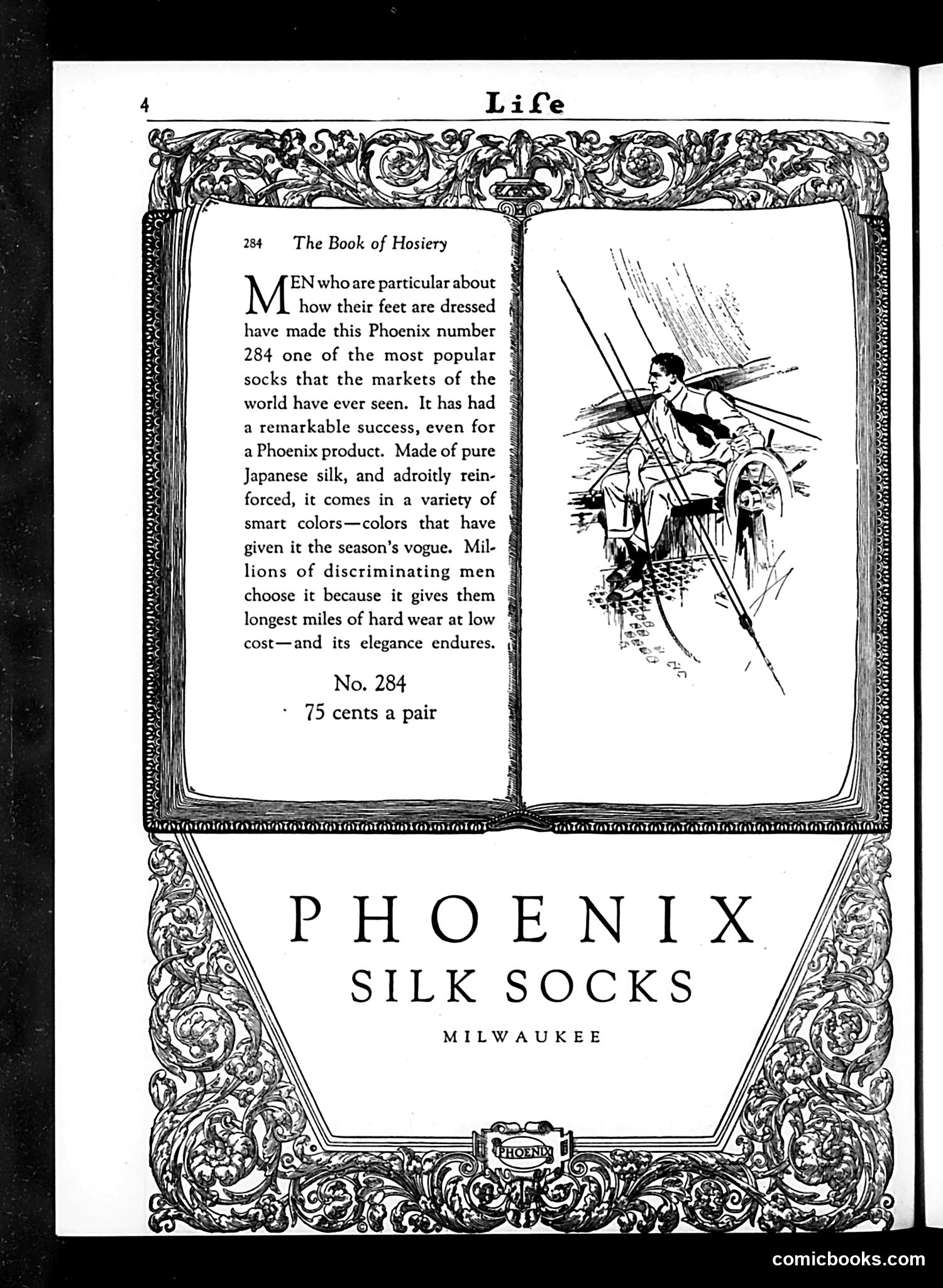
This page is primarily **advertising, not satire or editorial content**. It's an advertisement for Phoenix Silk Socks from Milwaukee, appearing in *Life* magazine's advertising section. The text describes Phoenix No. 284 socks as a popular product made from pure Japanese silk, marketed toward men who care about quality footwear. The ad emphasizes durability and elegance at 75 cents per pair. The illustration shows a man on a bicycle—a common sight in early 20th-century America—likely meant to demonstrate the socks' durability during active use. There is no political cartoon or satire here; this is straightforward commercial advertising using an action scene to convey the product's reliability and appeal to discriminating consumers.
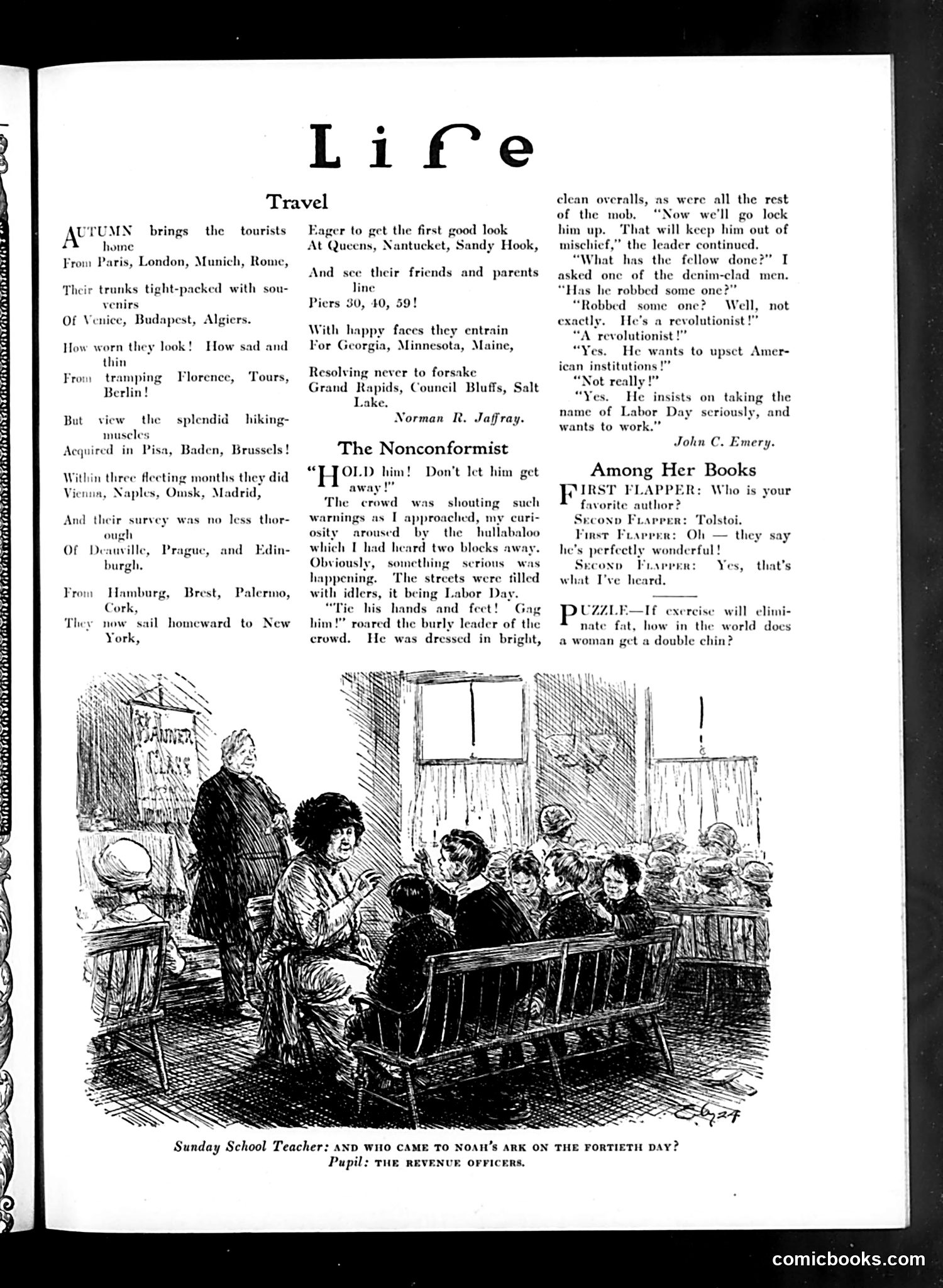
This page from *Life* magazine contains travel poetry, a short story titled "The Nonconformist," and a satirical cartoon at the bottom. **The Cartoon:** Titled "Sunday School Teacher: AND WHO CAME TO NOAH'S ARK ON THE FORTIETH DAY?" with the caption "Pupil: THE REVENUE OFFICERS." The joke targets **revenue officers** (federal tax collectors/Prohibition agents) through a child's innocent misunderstanding. During Prohibition era America, revenue officers were widely resented for enforcing unpopular alcohol laws. By having a Sunday school pupil unwittingly associate them with Noah's flood—a biblical catastrophe—the cartoon satirizes how unpopular and unwelcome these officers were perceived to be in American society. The humor relies on the child's accidental wisdom revealing public sentiment.
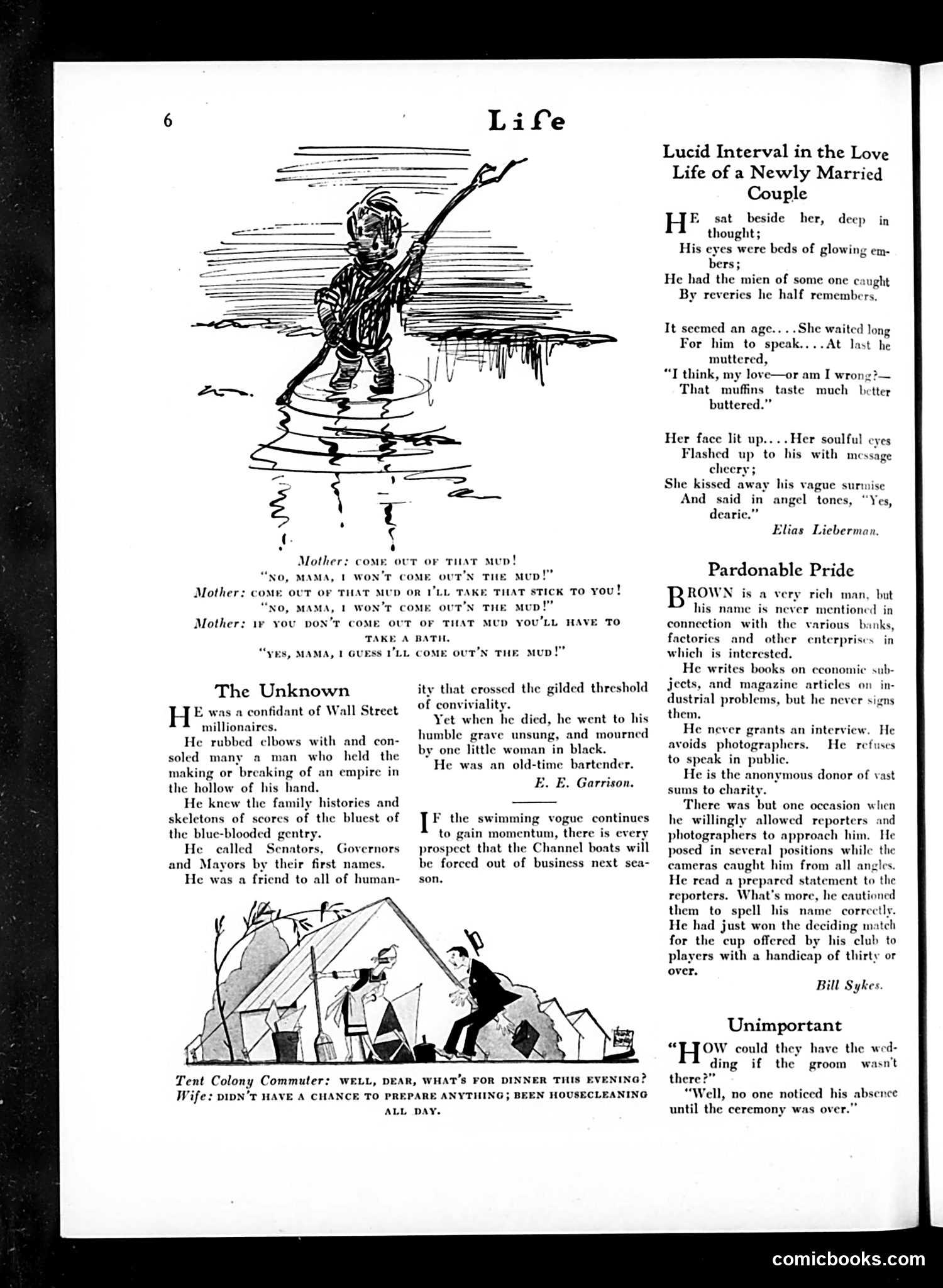
This page contains several short humorous pieces typical of early 20th-century Life magazine: **"The Unknown"** satirizes wealthy Wall Street financiers and their social prominence—senators, governors, and mayors who are actually hollow and empty, known only through family histories. **"Tent Colony Commuter"** is a domestic humor cartoon showing a husband asking his wife about dinner while she's been housecleaning all day. The joke is the oblivious contrast between his expectation of a meal and her exhausted reality. **"Lucid Interval in the Love Life of a Newly Married Couple"** depicts romantic newlyweds with sentimental poetry attributed to Elias Lieberman about buttered muffins—gently mocking how mundane domestic concerns intrude on romantic idealization. **"Pardonable Pride,"** **"Unimportant,"** and other brief pieces mock wealthy social pretension and marital absurdities—typical Life magazine satire of the era.
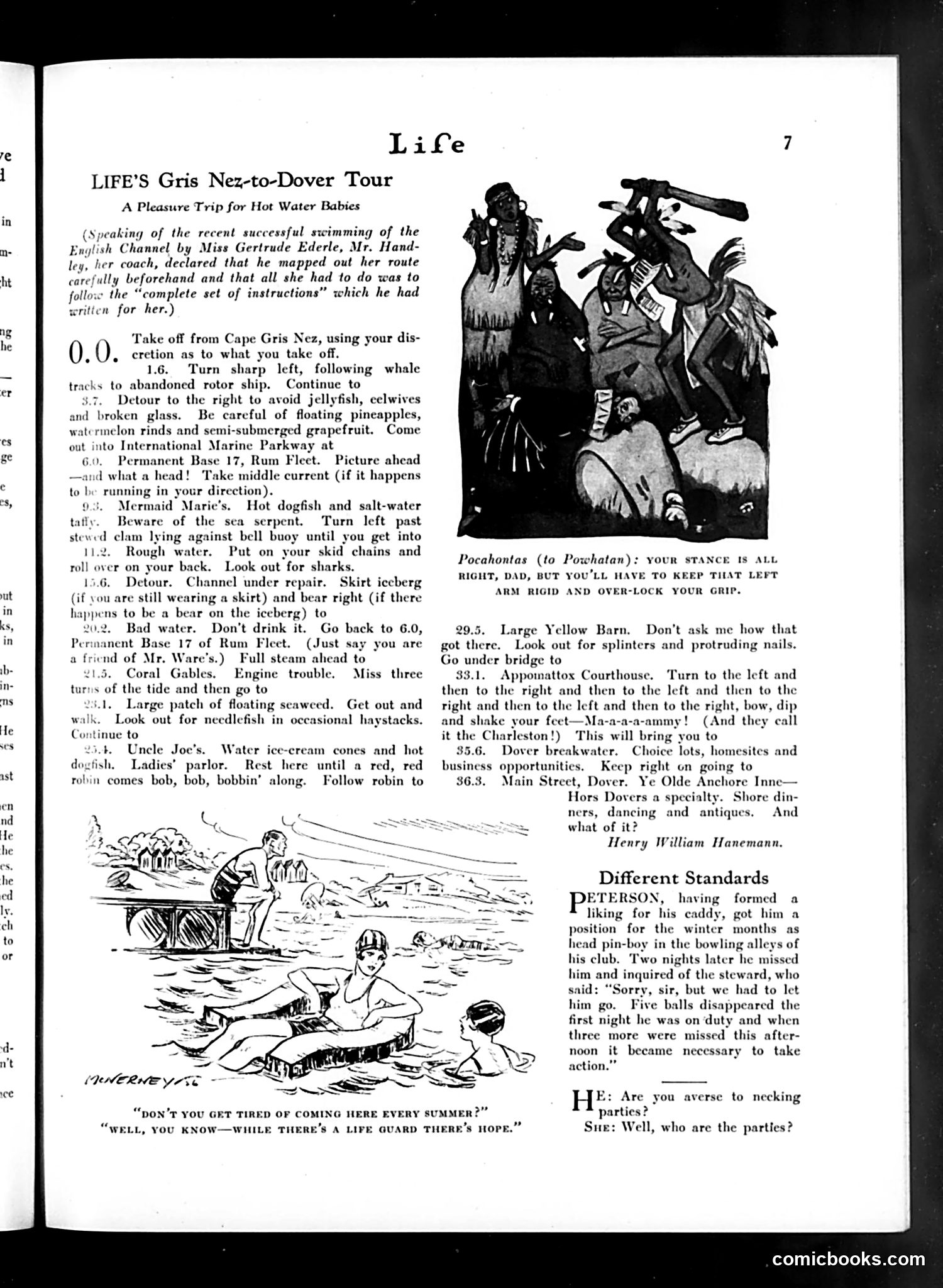
This page contains a humorous travel guide titled "LIFE'S Gris Nez-to-Dover Tour: A Pleasure Trip for Hot Water Babies," referencing the recent English Channel swimming achievement by Miss Gertrude Ederle and Mr. Handley. The satirical article provides absurdist "instructions" for an imaginary swimming route, mixing genuine geographical references (Cape Gris Nez, Dover, Mermaid Marie's) with fabricated dangers (jellyfish, mermaids, sea serpents, sharks, bears on icebergs). Two illustrations depict swimmers in comedic situations. The lower cartoon shows beachgoers and includes dialogue about lifeguards and hope, likely mocking the perceived dangers swimmers face. The satire mocks both the swimming craze sparked by Ederle's achievement and the sensationalized media coverage of such feats.
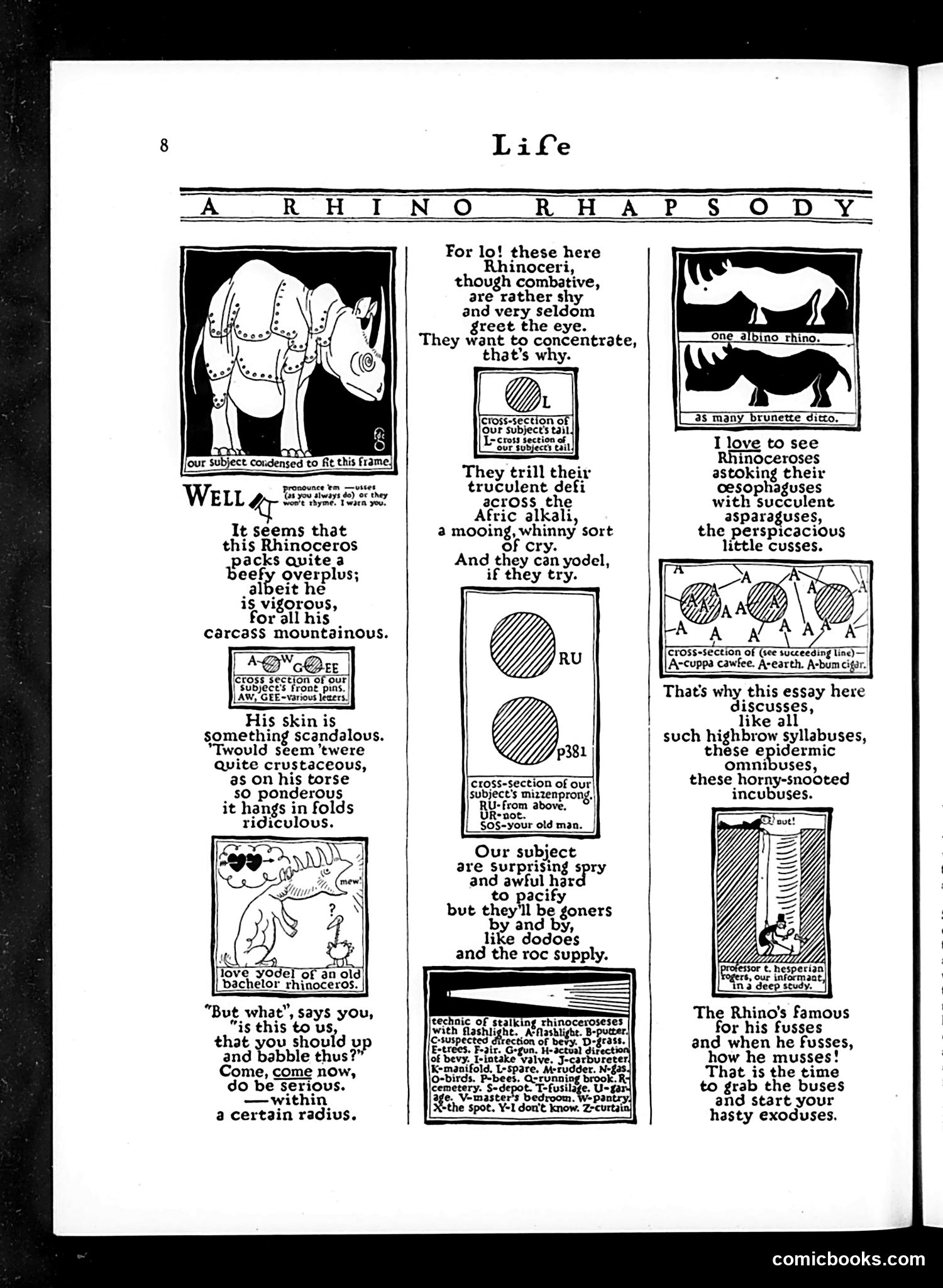
This is a humorous essay-illustrated page mocking rhinoceroses' anatomy and behavior. The satire uses faux-scientific language and anatomical diagrams to comically describe the rhino as: - Physically awkward: thick, crusty skin hanging in folds - Behaviorally absurd: shy despite being "combative," making "mooing, whinny" cries - Equipped with ridiculous features: the famous "fussed" tusks and busses (mouths) The cartoons show cross-sections of rhino physiology with exaggerated labels, including reproductive anatomy ("cuppa clause") and parasitic infections. The tone mimics pseudo-academic writing—using pretentious scientific terminology for a deliberately trivial subject. The humor comes from treating the ordinary rhino as if it's a bizarre, baffling creature worthy of scholarly dissection, inverting expectations about what deserves serious analysis.
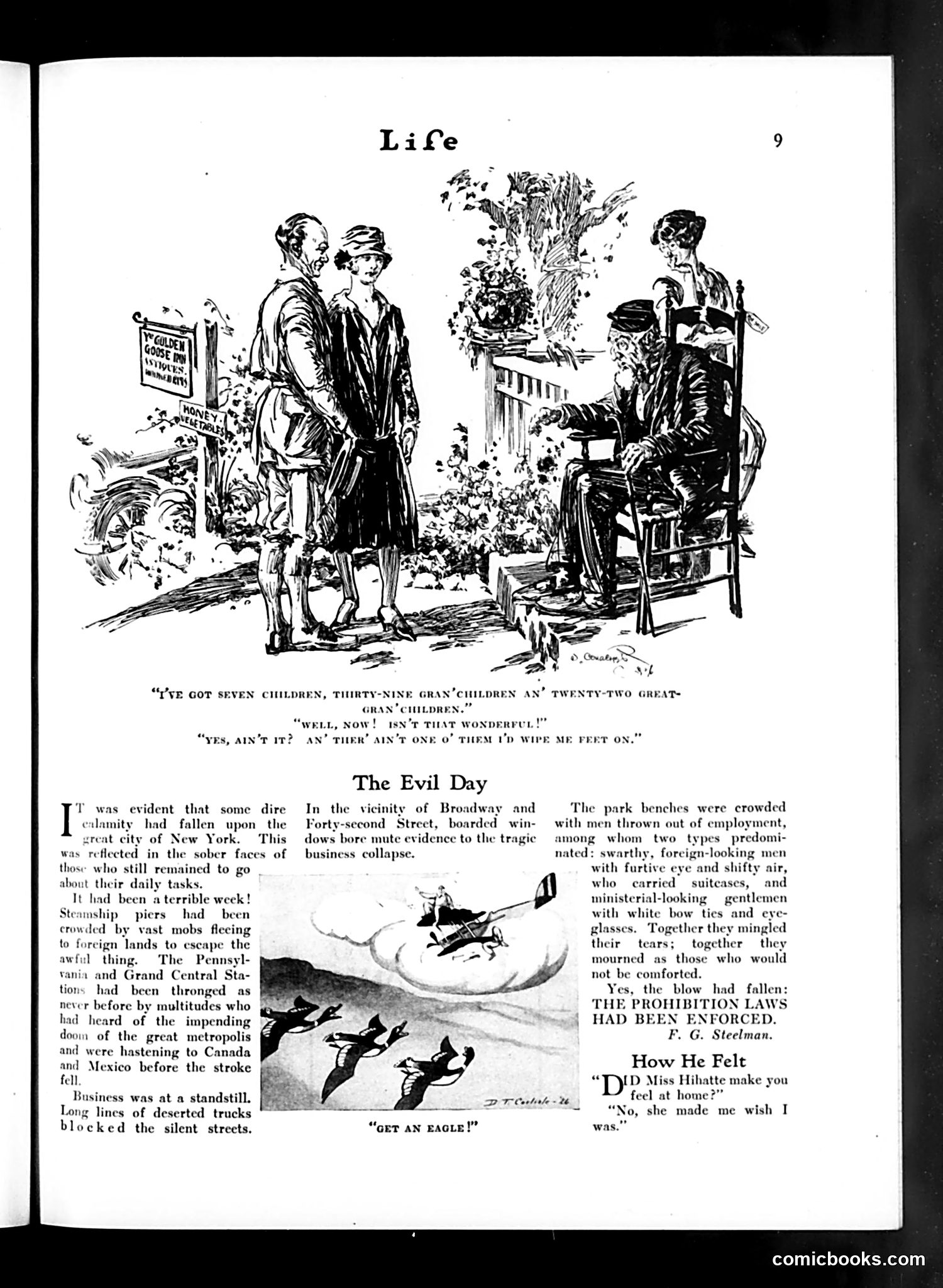
This page contains two satirical pieces from *Life* magazine: **Top Cartoon:** A domestic humor sketch about large families. An elderly man boasts about his descendants—seven children, thirty-nine grandchildren, and twenty-two great-grandchildren—while a woman responds sarcastically that none of them would wipe her feet on her. **"The Evil Day":** A serious article about New York's financial collapse (likely referencing a banking crisis or economic crash). It describes unemployed men crowding park benches and closed businesses. The accompanying illustration shows figures falling from the sky, captioned "GET AN EAGLE!"—likely a political reference to Franklin D. Roosevelt's New Deal programs (the eagle being a New Deal symbol). The page contrasts light domestic humor with grave economic commentary, typical of *Life*'s satirical approach to American social issues.
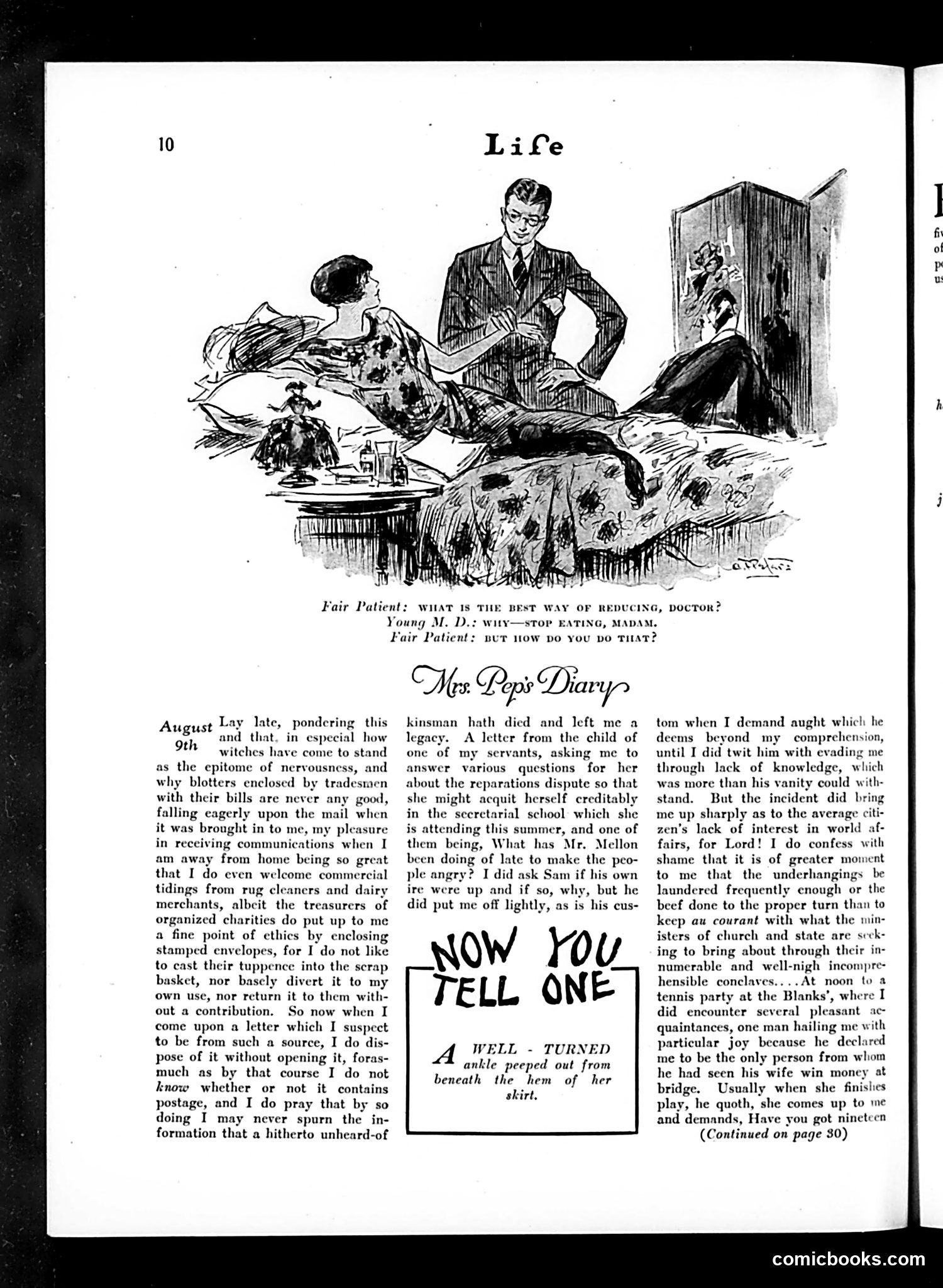
This page contains a medical humor cartoon titled "Fair Patient: What is the Best Way of Reducing, Doctor?" The joke presents a doctor advising a woman patient to "stop eating, madam" as weight-loss advice, while the fair patient asks "but how do you do that?" The cartoon satirizes the era's simplistic medical guidance on weight reduction—essentially prescribing the obvious solution (eat less) without practical help. The humor lies in the gap between the doctor's unhelpful directive and the patient's reasonable question about *how* to actually achieve it. Below is "Mrs. Pepys Diary," a humorous column mimicking Samuel Pepys' famous diary, discussing social observations and gossip from the writer's day, including encounters at tennis parties and bridge games. The page represents typical early 20th-century satirical magazine content blending medical and social commentary.
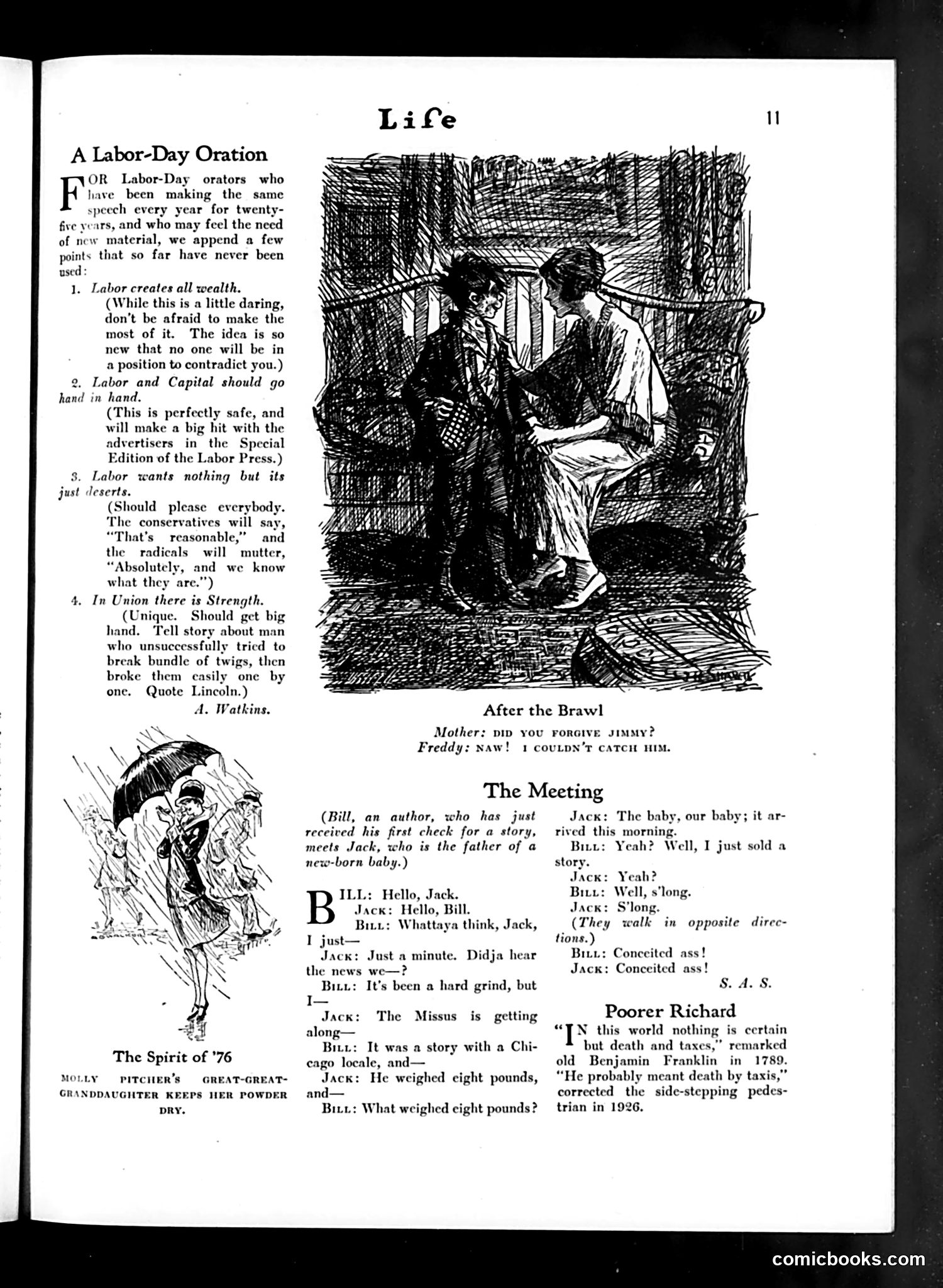
This page contains Labor Day satirical content. The top section, "A Labor-Day Oration," presents four tongue-in-cheek labor movement talking points that Life's editors mock as naive or radical—arguing labor creates wealth, capital and labor should cooperate, labor wants only fair rewards, and union solidarity is powerful. The two illustrated cartoons support this satirical tone. "After the Brawl" depicts a violent domestic scene—a mother and child after conflict, captioned with dialogue about forgiving "Jimmy." "The Spirit of '76" shows a disheveled figure, mocking revolutionary fervor. The remaining content includes "The Meeting" (a dialogue between Bill and Jack about a newborn and sold story) and "Poorer Richard" (a Benjamin Franklin quip about death and taxes, updated to reference 1926 traffic deaths). The satire targets both labor radicalism and contemporary social concerns.
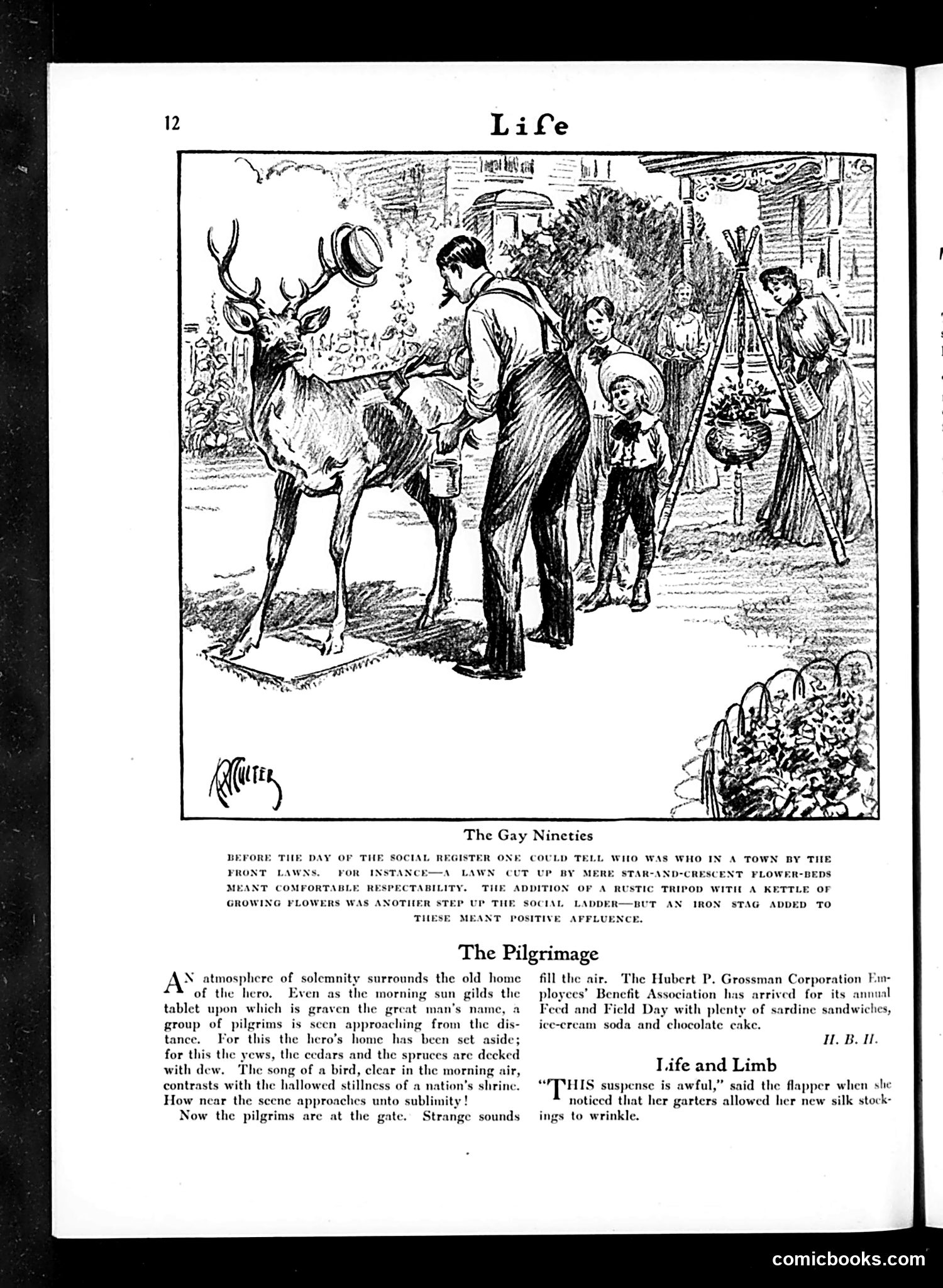
This page contains a satirical illustration titled "The Gay Nineties," depicting an iron stag in a domestic garden setting. According to the caption, the image mocks late-19th-century social pretension: lawn ornaments like decorative stags and flower beds were status symbols that indicated wealth and respectability. The "iron stag" represents this artificial affluence—a cheap, gaudy decoration meant to suggest prosperity. The accompanying text sections discuss "The Pilgrimage" (likely a literary reference) and "Life and Limb" (a brief anecdote about garters). The page satirizes how outward decorative displays could mask genuine social standing, a common theme in period satire about Victorian and Gilded Age materialism and social climbing.
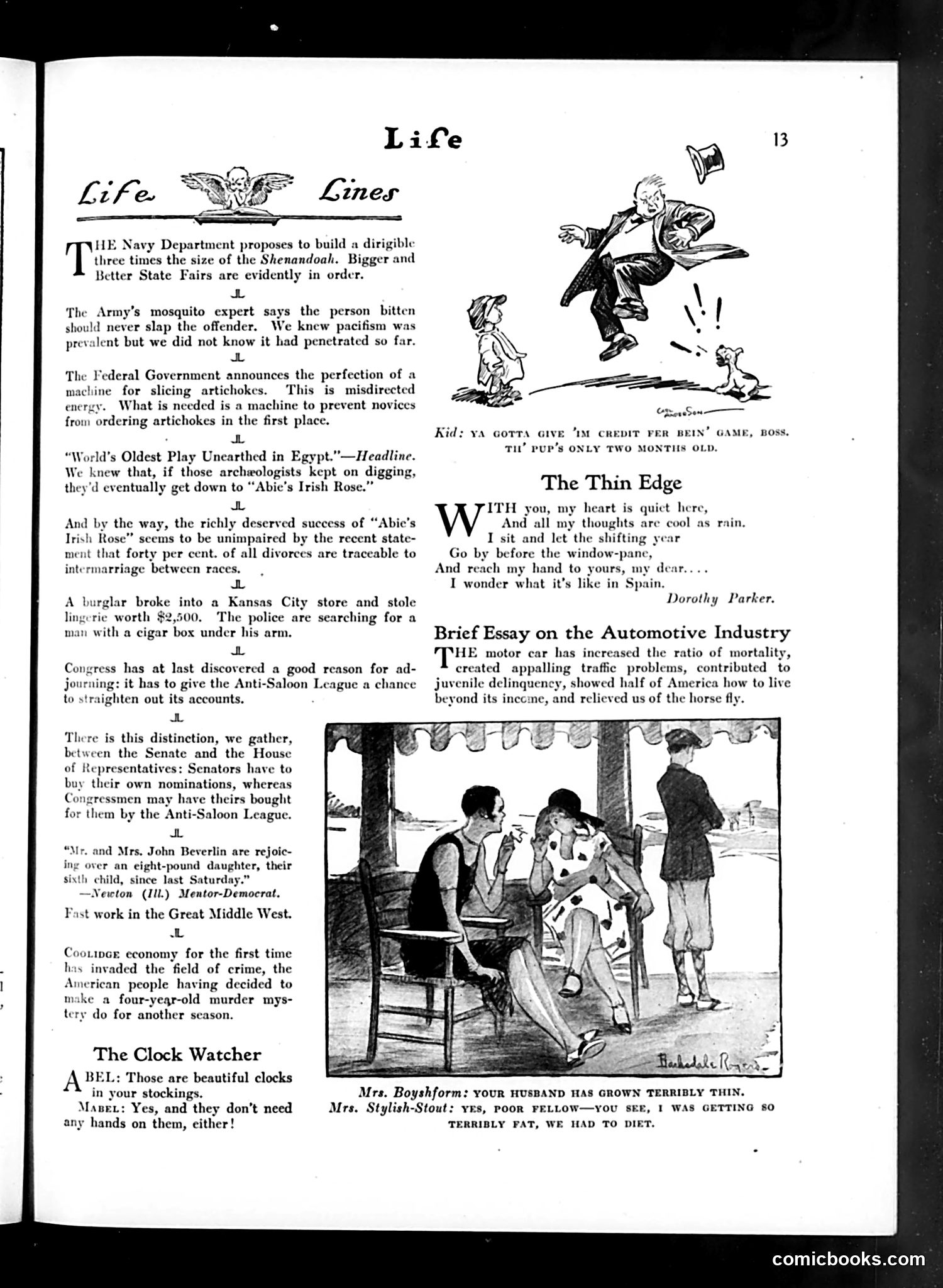
The page contains several brief satirical items and one cartoon. The main cartoon depicts a woman telling her husband he has "grown terribly thin" while she admits to dieting after getting "so terribly fat." The satire targets domestic life and gendered expectations around appearance and body weight during this era. The "Life Lines" section above includes short jokes and social commentary—mocking government inefficiency (an artichoke-slicing machine), archaeological obsession, and Congressional dysfunction. "The Thin Edge" is a poem about longing and distance, while "Brief Essay on the Automotive Industry" sardonically notes that cars have increased mortality, crime, delinquency, and other social problems while eliminating horses. The overall tone is characteristic of Life's satirical approach to American social and political issues.
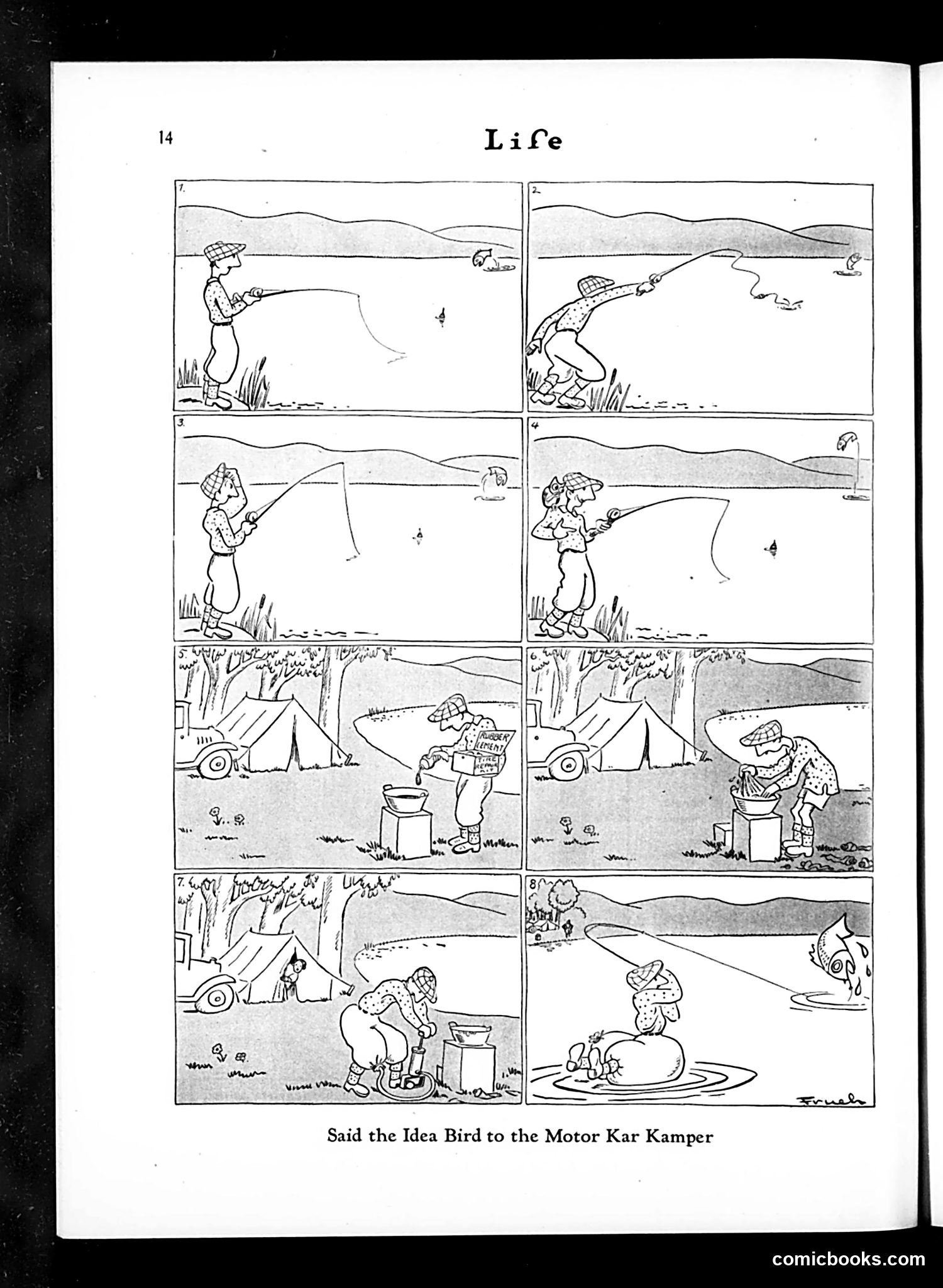
This eight-panel comic strip satirizes motor camping—an emerging recreational trend where Americans traveled in early automobiles with camping equipment. The narrative follows a fisherman's outing that escalates absurdly: he begins fishing peacefully (panels 1-4), then sets up camp (panels 5-6), and finally ends up in increasingly chaotic situations, culminating in him being swept away in water (panels 7-8). The "Idea Bird" reference suggests the comic mocks the romanticized notion of camping promoted to motorcar owners. The humor targets the contrast between leisure fantasies and practical reality—the camper's expedition devolves from serene fishing into disaster, satirizing both the motor camping fad and overconfident recreational adventurers of the era.
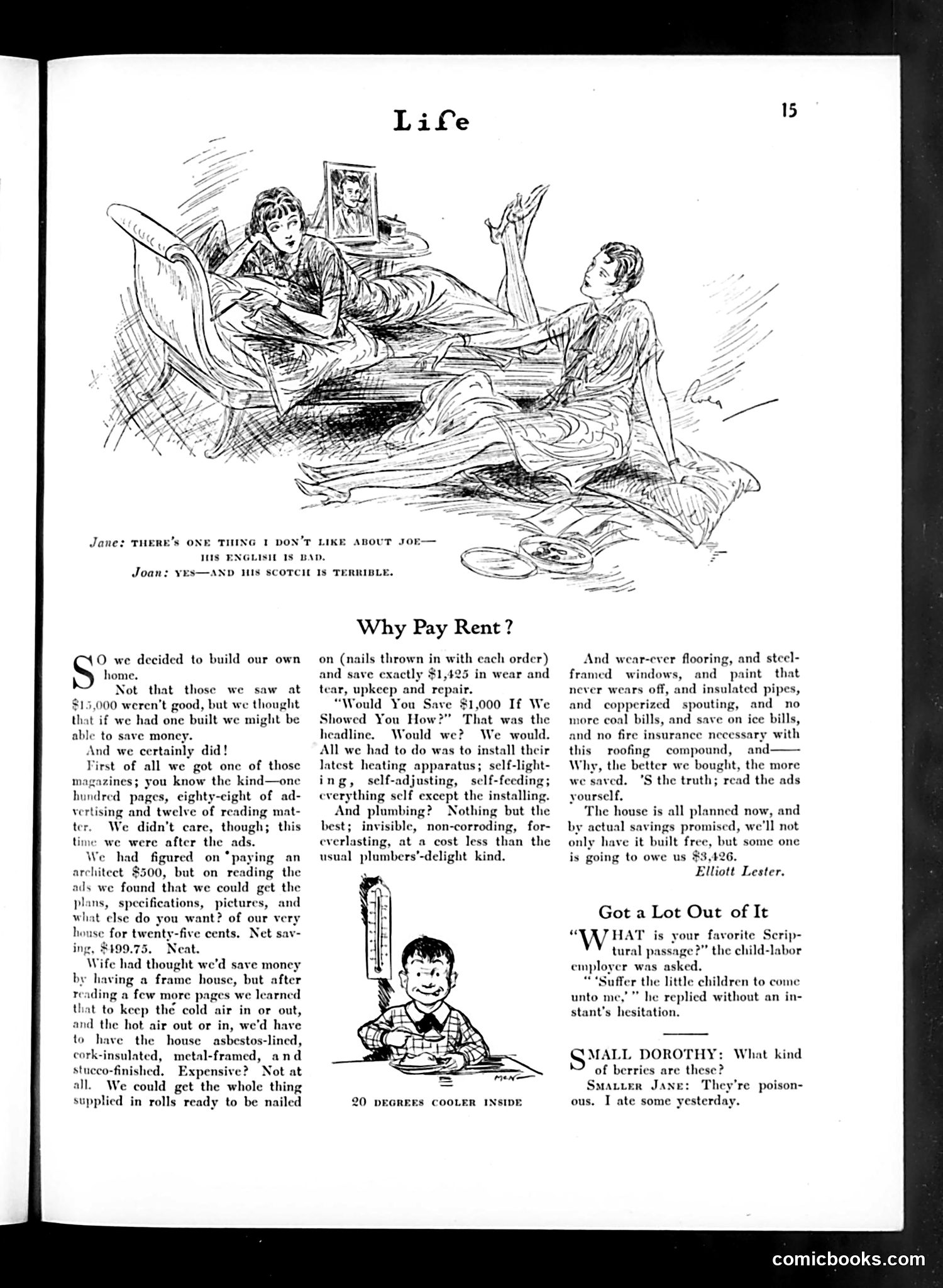
**Top Cartoon:** An illustrated scene showing two people in casual conversation. Jane complains about "Joe" and his poor English, while Joan responds that "his Scotch is terrible"—a double meaning joke about both his accent and his whiskey quality. **Main Article: "Why Pay Rent?"** This satirizes the early 20th-century home-ownership movement. The author describes how they purchased plans and specifications for a cheap prefabricated house ($500 architect fee, materials for $99.75), expecting savings. However, unexpected costs—asbestos lining, insulation, proper roofing—mounted significantly. The satire mocks the false economy of "budget" home construction and the misleading advertising promising affordable housing. **Small Illustrations:** Include a child-labor joke and a poisoned-berry anecdote, typical of Life's satirical humor format.
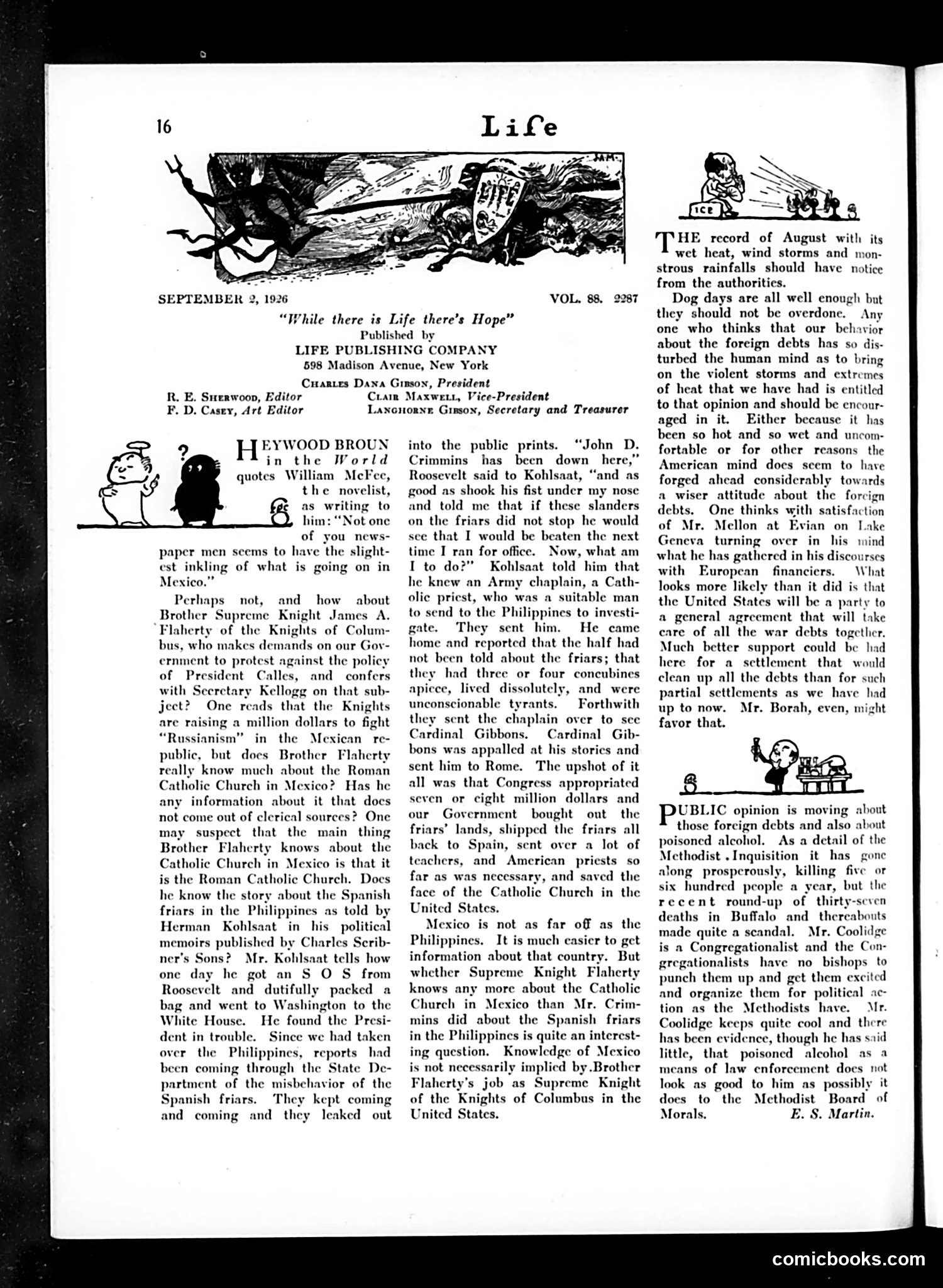
The page contains two editorial cartoons and commentary on contemporary issues. The **top cartoon** depicts a chaotic scene with a figure labeled "Death" confronting what appears to be a boxer or fighter, illustrating the article's discussion of extreme heat and violent storms in August—warning about excessive "Dog days." The **bottom cartoon** shows a figure at a desk surrounded by papers and bottles, likely satirizing alcohol prohibition enforcement and its ineffectiveness. The accompanying text by E.S. Martin critiques poisoned alcohol deaths in Buffalo, suggesting that anti-alcohol crusaders' methods have proven counterproductive and morally questionable—a commentary on Prohibition's unintended consequences and the Methodist Board of Morals' involvement in enforcement campaigns. Both pieces reflect 1920s anxieties about government overreach and public health failures.
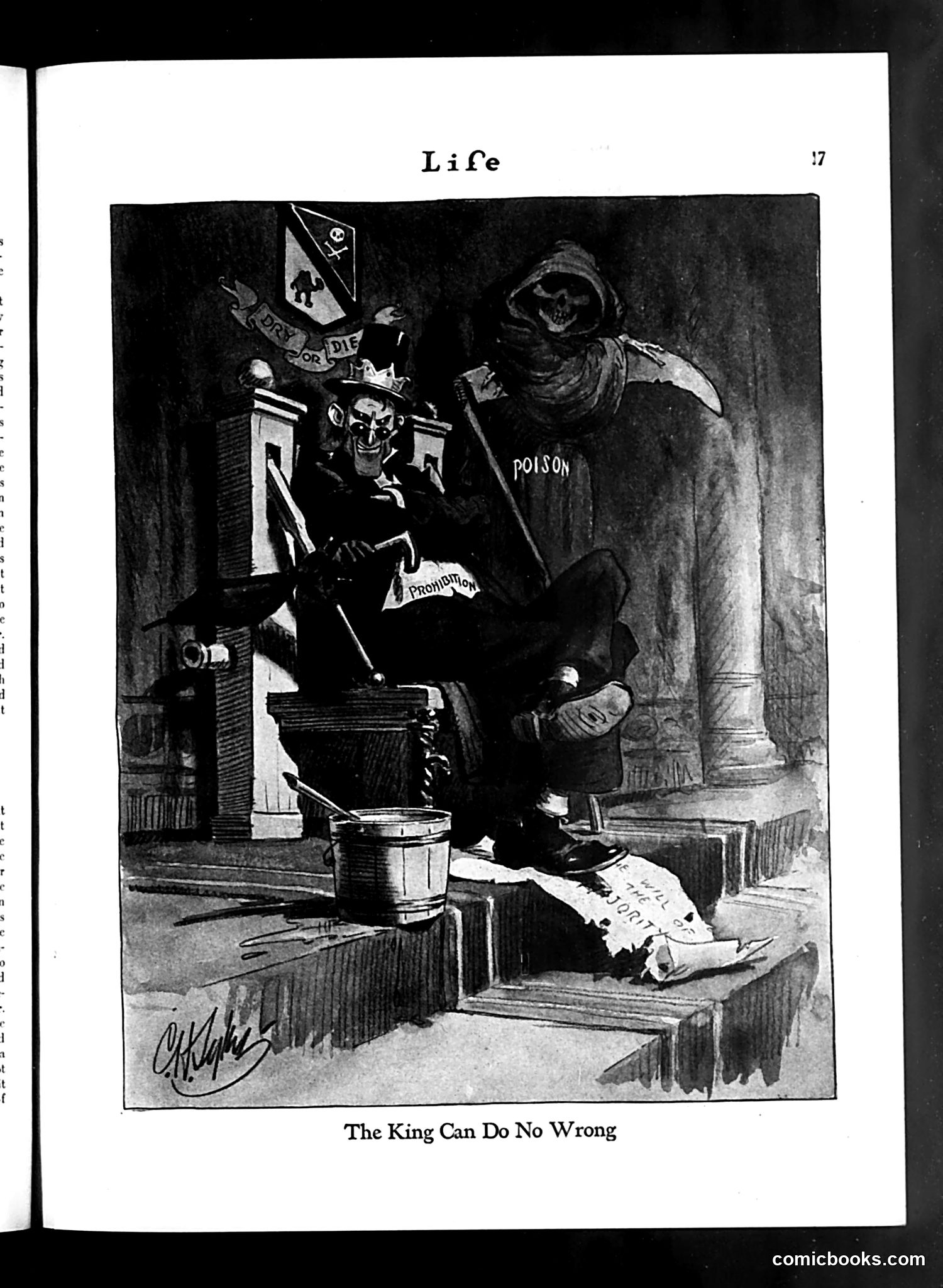
This political cartoon satirizes governmental immunity or autocratic authority. The central figure appears to be a skeletal "Death" or grim reaper character wearing a crown, labeled "PROHIBITION," operating what looks like a poison distribution mechanism or still. The figure on the right represents a common citizen or subject who has received poisoned liquor, now dead or dying on the ground. The satire critiques Prohibition-era policies: the government (represented as the unchecked "King") distributes or permits poisonous alcohol while claiming immunity from responsibility for resulting deaths. The title mocks the legal doctrine that "the king can do no wrong," suggesting the government faces no accountability for harm caused by its policies, despite citizens dying from contaminated bootleg liquor during Prohibition.
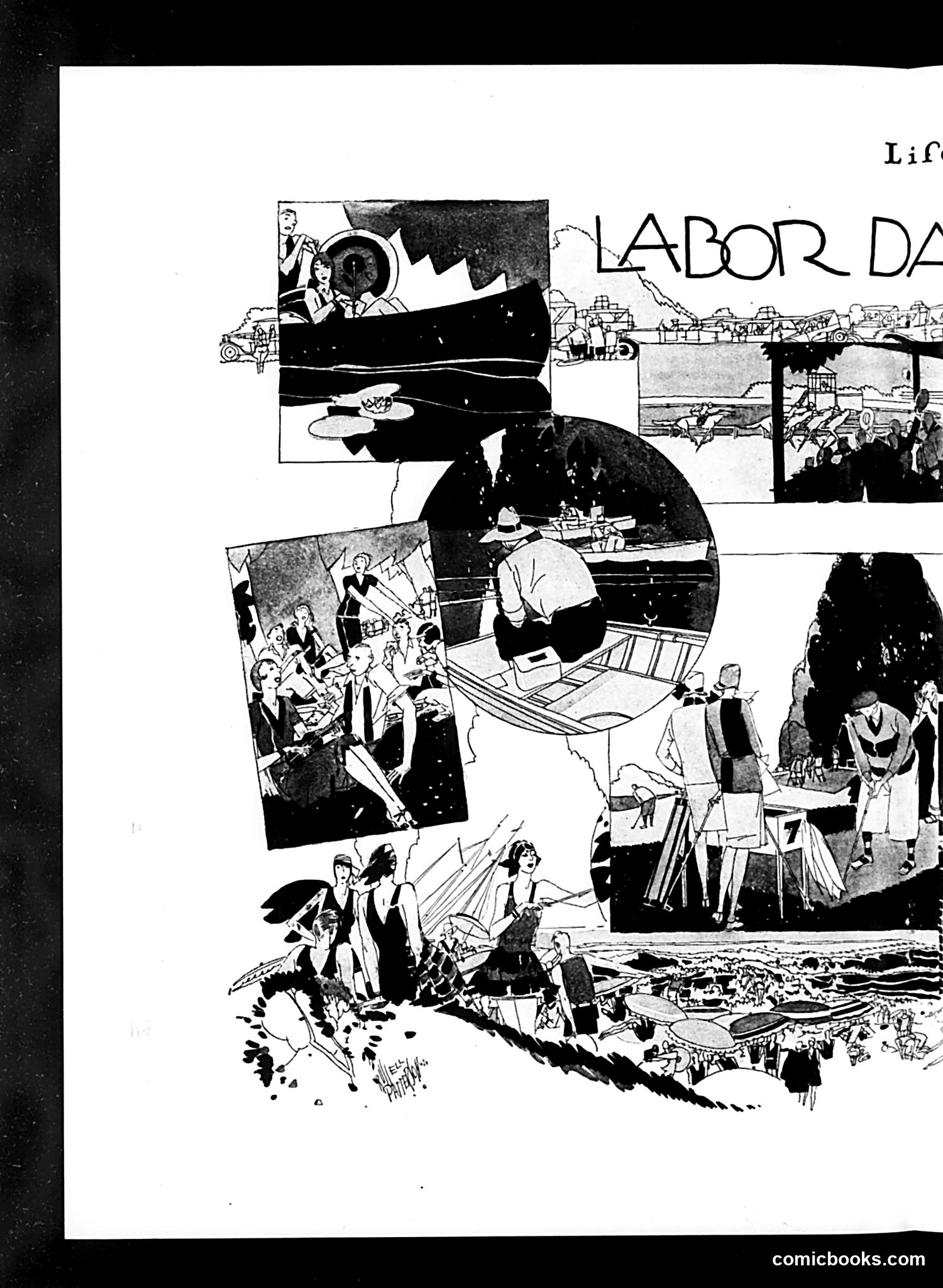
This Life magazine page features a "Labor Day" theme (visible in the header text). The collage-style illustration depicts various scenes of workers and leisure activities, likely contrasting labor with celebration or rest. The images show: - Industrial/factory scenes (top) - People dining and socializing - Beach or recreational scenes (bottom) - A large circular vignette of someone working The satire appears to celebrate Labor Day while depicting the contrast between workers' daily labor and their moments of leisure or celebration. The composition suggests commentary on American working-class life—showing both the industrial/labor aspects and the recreational activities workers might enjoy on their designated holiday. The exact political message is unclear without additional text, but it reflects early-to-mid 20th century American attitudes toward labor and holidays.
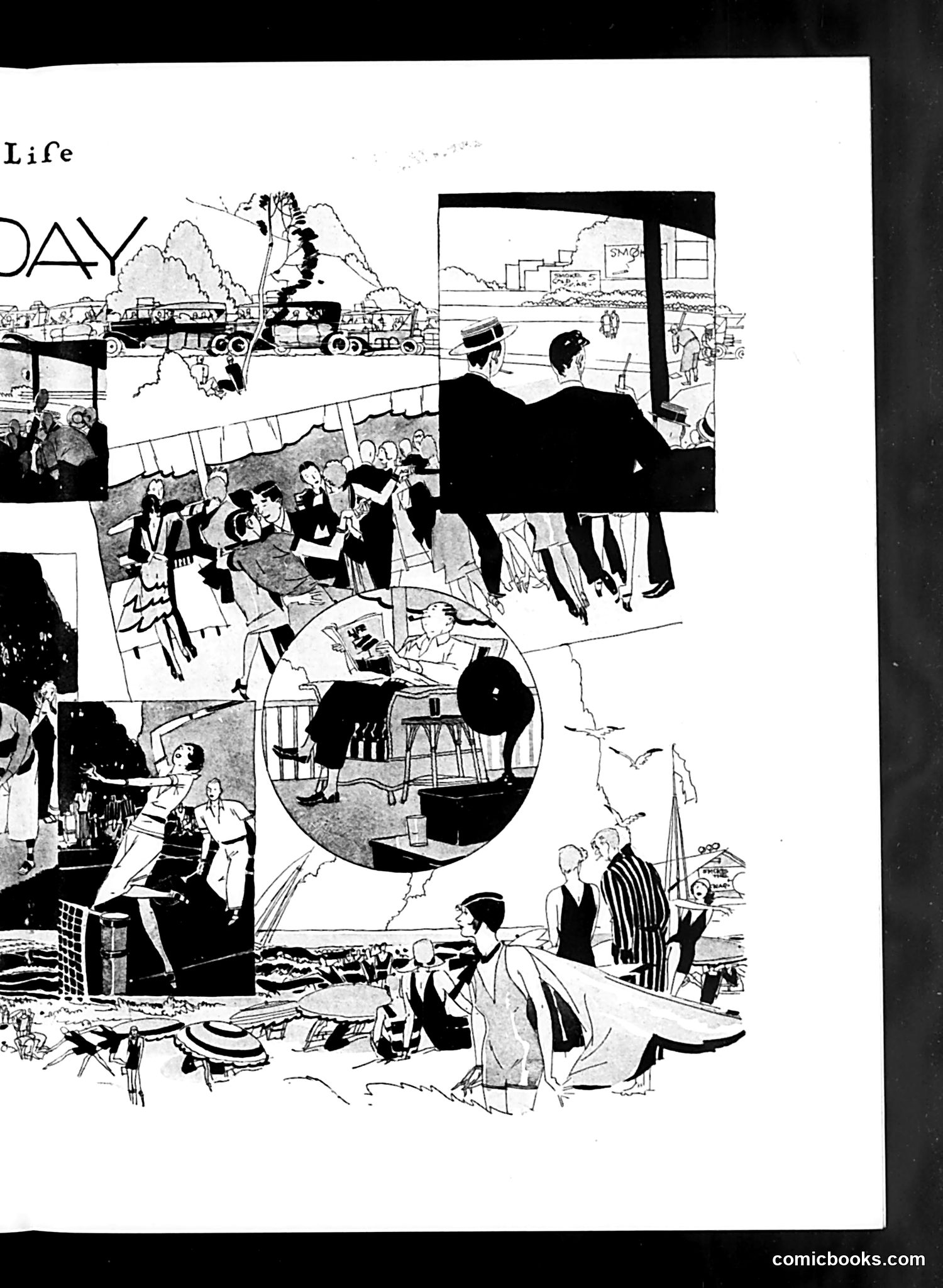
This page presents a collage depicting various leisure and social activities of what appears to be early-to-mid 20th century American life. The word "DAY" is partially visible, suggesting this may illustrate "a day in the life." The illustrations show people engaged in diverse pastimes: amusement parks with rides, crowds at public venues, dining and socializing indoors, beach activities, and entertainment. The style uses bold black-and-white linework typical of period satirical illustration. Without clearer OCR text, the specific satirical point remains unclear—whether this celebrates American prosperity and leisure culture or critiques conspicuous consumption and entertainment excess. The comprehensive nature of the scenes suggests commentary on how Americans spent their free time during this era.
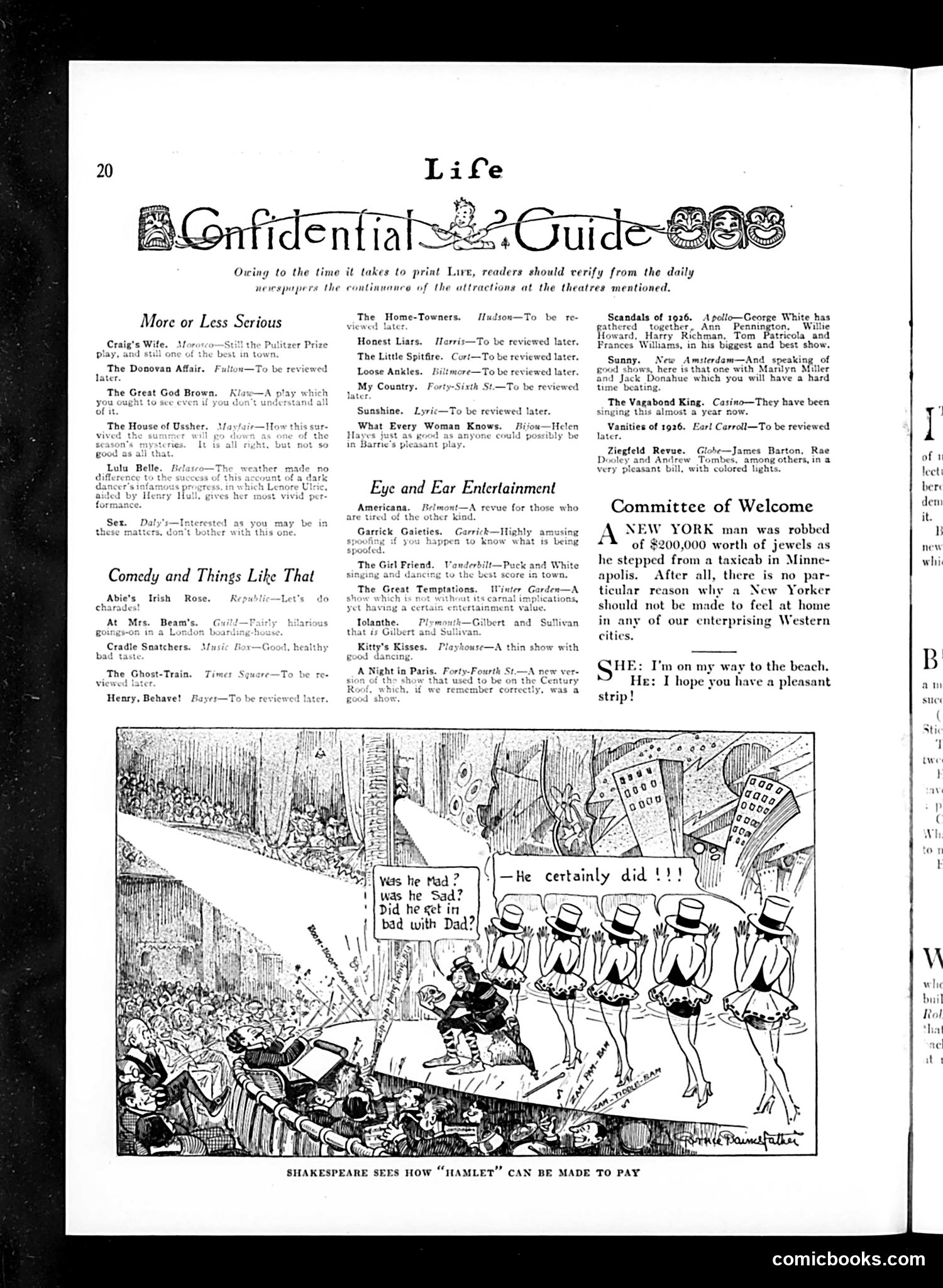
This page from *Life* magazine (a satirical publication, not the photo magazine) showcases theatrical reviews and entertainment commentary typical of the 1920s. **The Main Cartoon:** The bottom illustration satirizes commercialization of Shakespeare. It depicts Shakespeare observing a modern theatrical adaptation where "Hamlet" has been transformed into a burlesque-style show. The setup shows chorus girls in a line with the caption "He certainly did!!!" responding to questions about whether the character "was he Mad? was he Sad? Did he get in bad with Dad?" **The Satire:** The joke mocks how Broadway producers strip classical literature of its serious meaning, reducing Shakespeare's tragedy to vaudeville-style entertainment featuring scantily-clad dancers. The implication is that "making it pay" means sensationalizing high art for commercial profit rather than preserving its intellectual integrity. **Supporting Content:** The page reviews actual 1926 Broadway shows, noting several feature revues and comedies—many apparently focused on spectacle and dancing rather than serious drama, supporting the cartoon's critique.
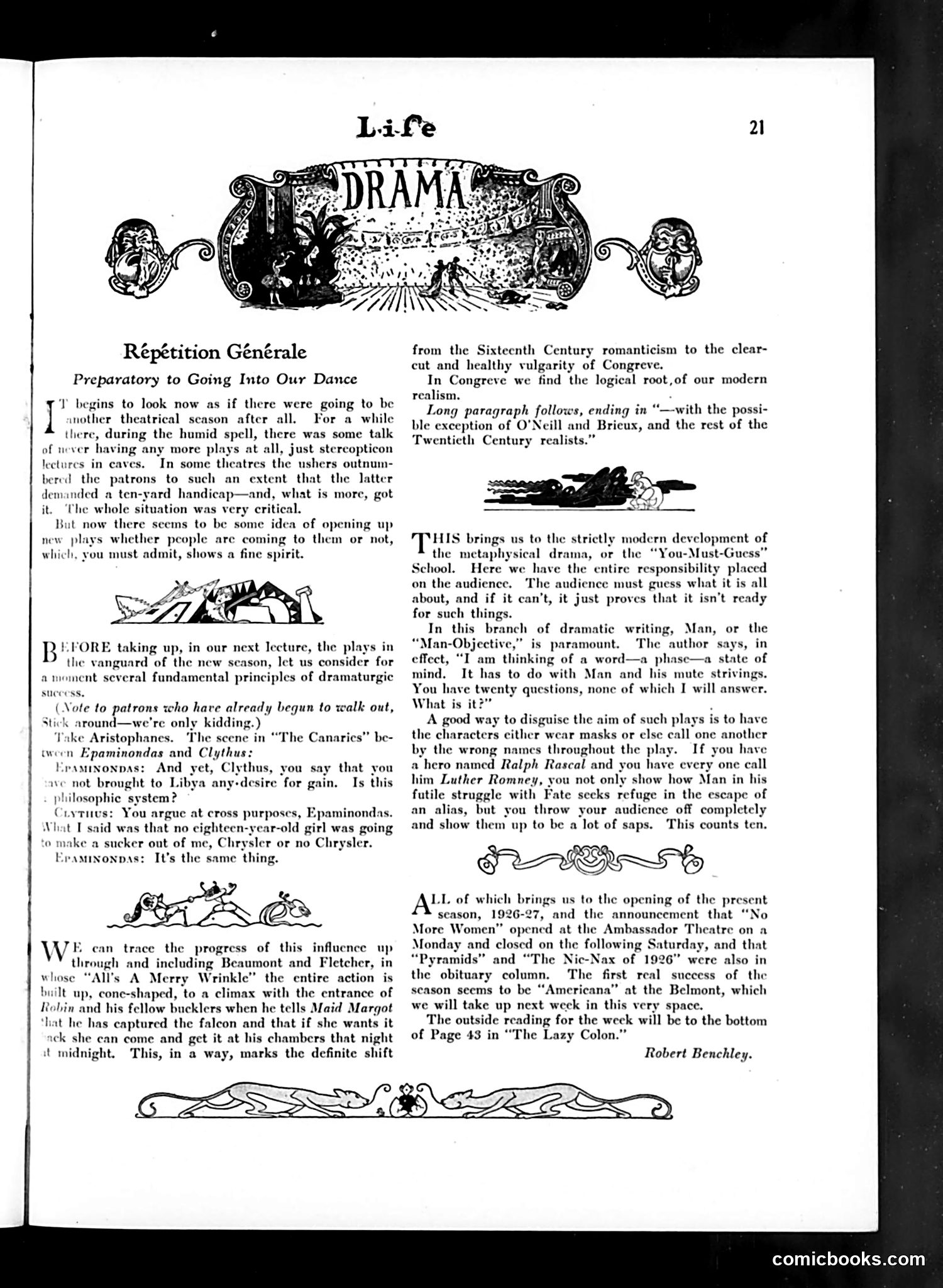
This is Robert Benchley's satirical column about the 1926-27 theatrical season. Benchley mocks the pretentiousness of avant-garde "metaphysical drama"—plays designed to confuse audiences rather than entertain them. He ridicules the "You-Must-Guess School" of playwriting, where authors deliberately obscure meaning through masks, wrong character names, and obscure symbolism. The joke: if audiences can't understand the play, the playwright claims the audience "isn't ready for such things"—blaming spectators for the work's incomprehensibility. The fake classical references (Aristophanes, Beaumont and Fletcher) and absurd plot summaries parody how modernist dramatists justify their opacity using literary history and philosophical language. Benchley contrasts this with successful shows like "Americana" at the Belmont Theatre, suggesting that clear, engaging drama beats pretentious obscurity. The column satirizes 1920s theatrical avant-gardism as intellectual posturing.
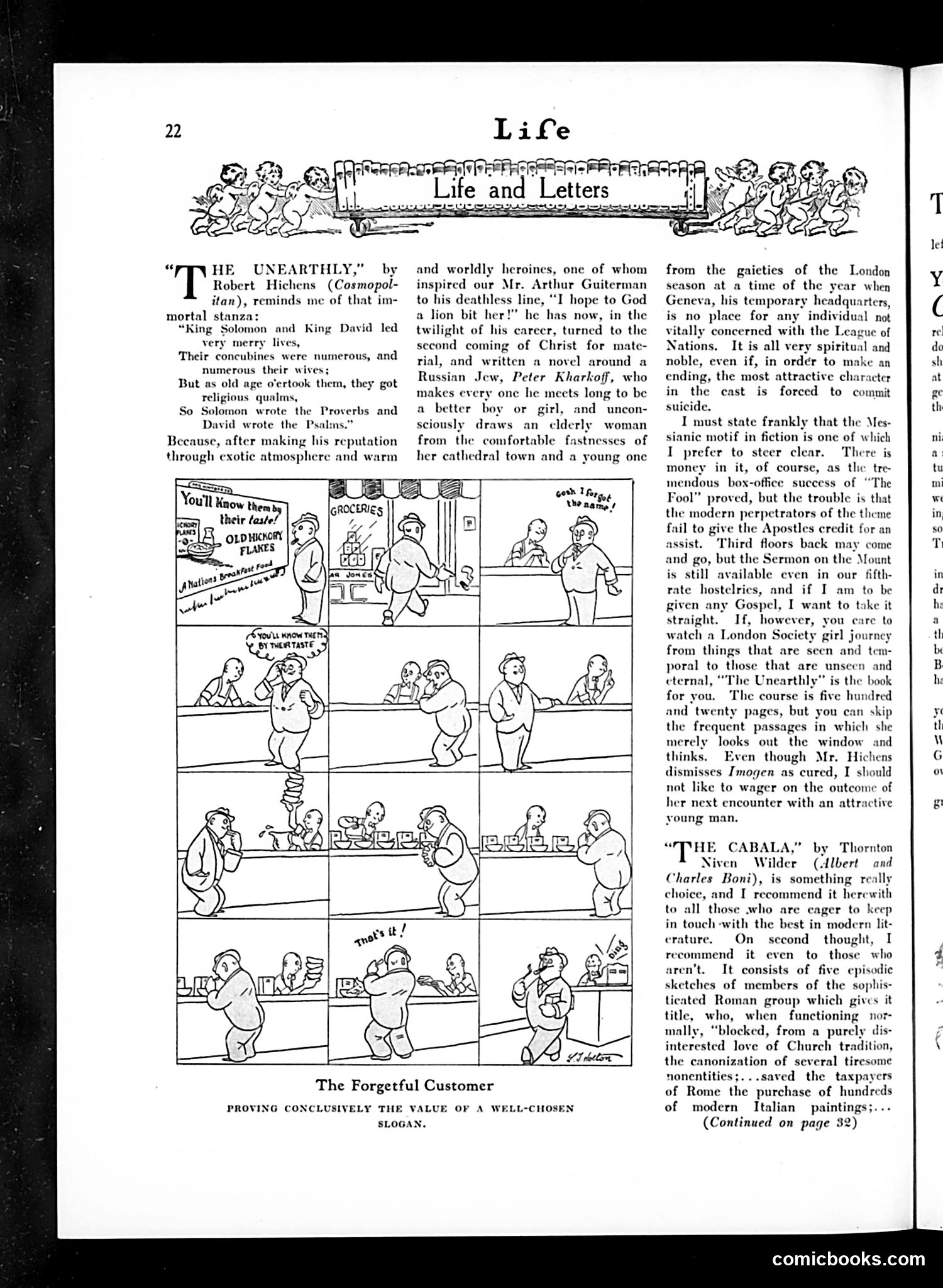
This comic strip satirizes the effectiveness of advertising slogans through repetition. The cartoon depicts a grocer's customer who repeatedly forgets items despite seeing the store's prominent slogan displayed above the counter. The humor lies in the irony: the slogan—presumably meant to help customers remember what they need—instead becomes a running joke about human forgetfulness. Each panel shows the customer entering, leaving, and returning multiple times, apparently unable to retain their shopping list despite the visual reminder. The caption "proving conclusively the value of a well-chosen slogan" is tongue-in-cheek mockery. The strip suggests that even clever advertising cannot overcome basic human absent-mindedness. This reflects early 20th-century skepticism about whether commercial messaging could truly influence consumer behavior, poking fun at advertising's grandiose claims about persuasion and memory retention. The joke targets both consumer behavior and advertising industry pretensions.
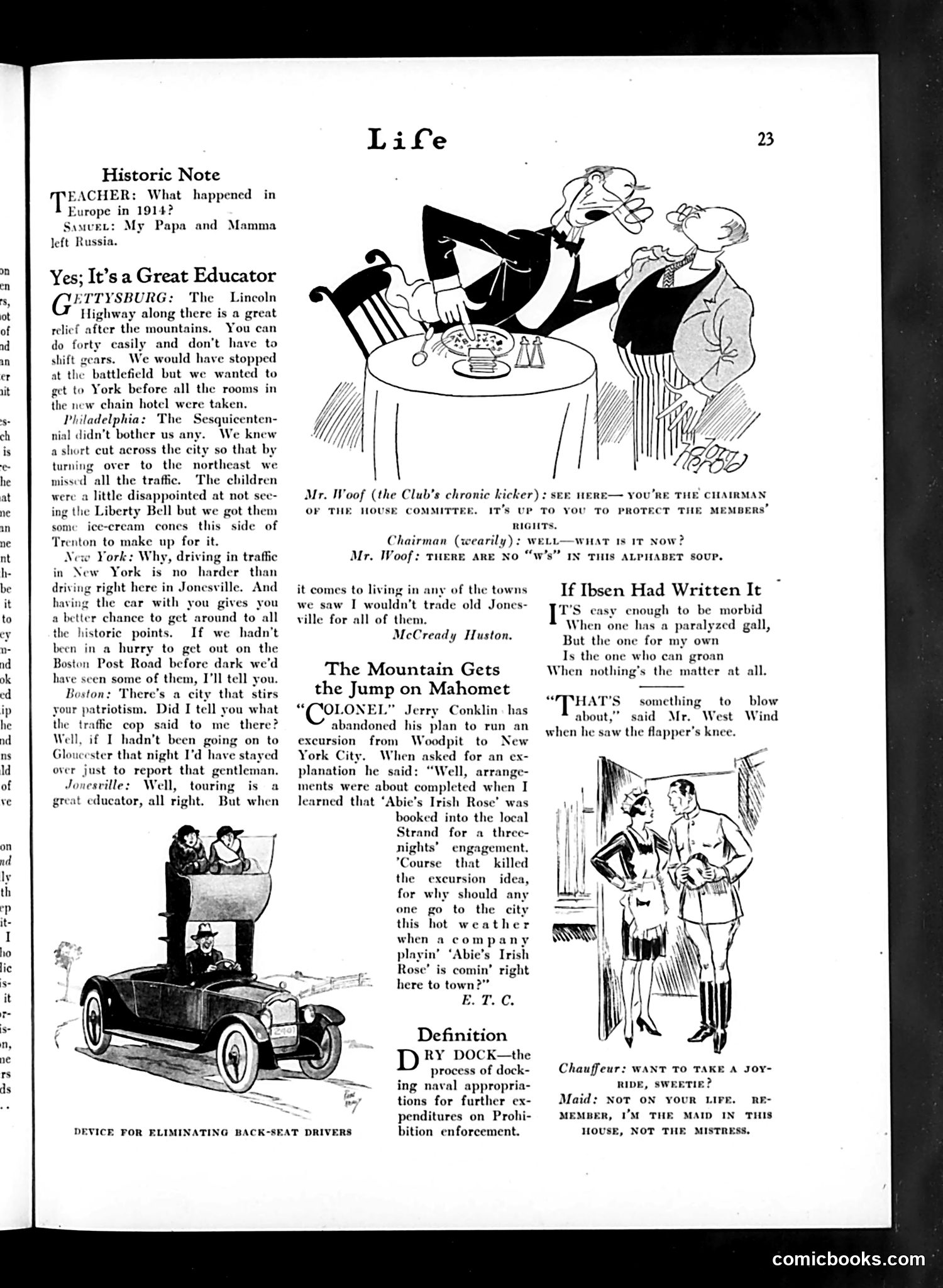
This satirical page mocks American car culture and tourism. The main article "Yes; It's a Great Educator" features people from various cities bragging about cross-country driving trips, but they reveal they've *missed* actual historical sites (battlefields, the Liberty Bell, Boston landmarks) while rushing between towns or stuck in traffic. The joke: cars promised freedom and education, but tourists were too hurried or distracted to appreciate anything. The left cartoon shows a "device for eliminating back-seat drivers"—a car contraption to silence nagging passengers, satirizing the common complaint about backseat driving. Other brief humor includes: a prohibition-era joke about "dry dock" (cutting naval budgets for alcohol enforcement), a mock-Ibsen poem about chronic complainers, and a maid rejecting a chauffeur's advances since she's staff, not a society woman. The page satirizes American materialism, tourism superficiality, and automotive culture's failure to deliver promised cultural enlightenment.
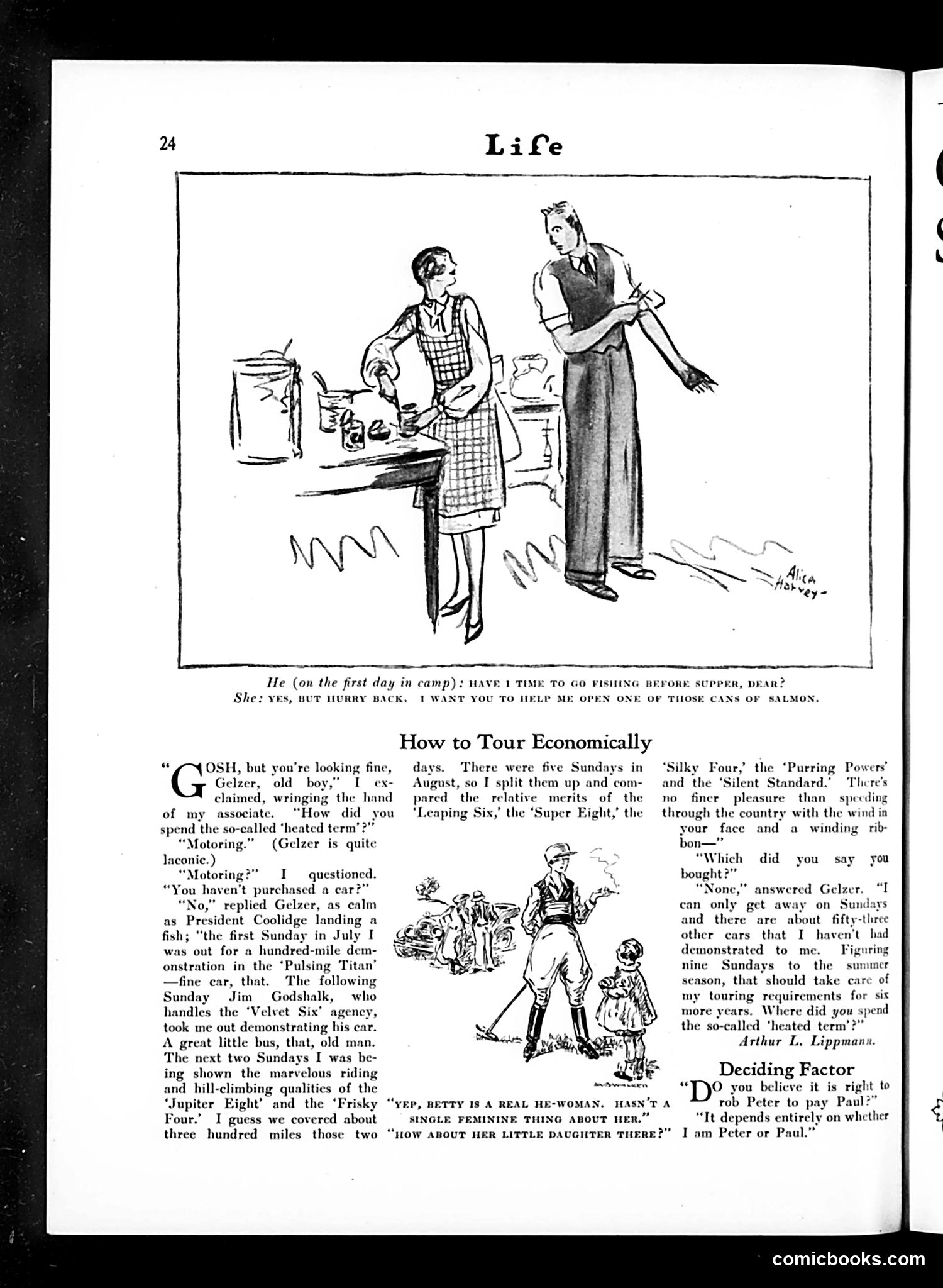
This page contains two satirical pieces about 1920s American consumer culture. **"How to Tour Economically"** mocks the automobile industry's aggressive marketing. Gelzer claims he's "touring economically" by accepting free demonstration rides from car agencies—yet he's spent all five Sundays in August being driven around in different models ('Velvet Six,' 'Jupiter Eight,' 'Frisky Four,' etc.). The joke: he's covered 300 miles without buying anything, and estimates he'll need six more years of Sundays to finish test-driving all available cars. It satirizes both car dealers' relentless sales tactics and consumers' gullibility about "free" experiences. **"Deciding Factor"** is a brief joke about moral relativism: when asked if robbing Peter to pay Paul is justified, the answer depends entirely on whether you're Peter or Paul—exposing how people rationalize self-interest as principle. The top cartoon shows a woman on the first day of camp asking her husband to help open salmon cans instead of letting him fish, illustrating domestic priorities conflicting with leisure.
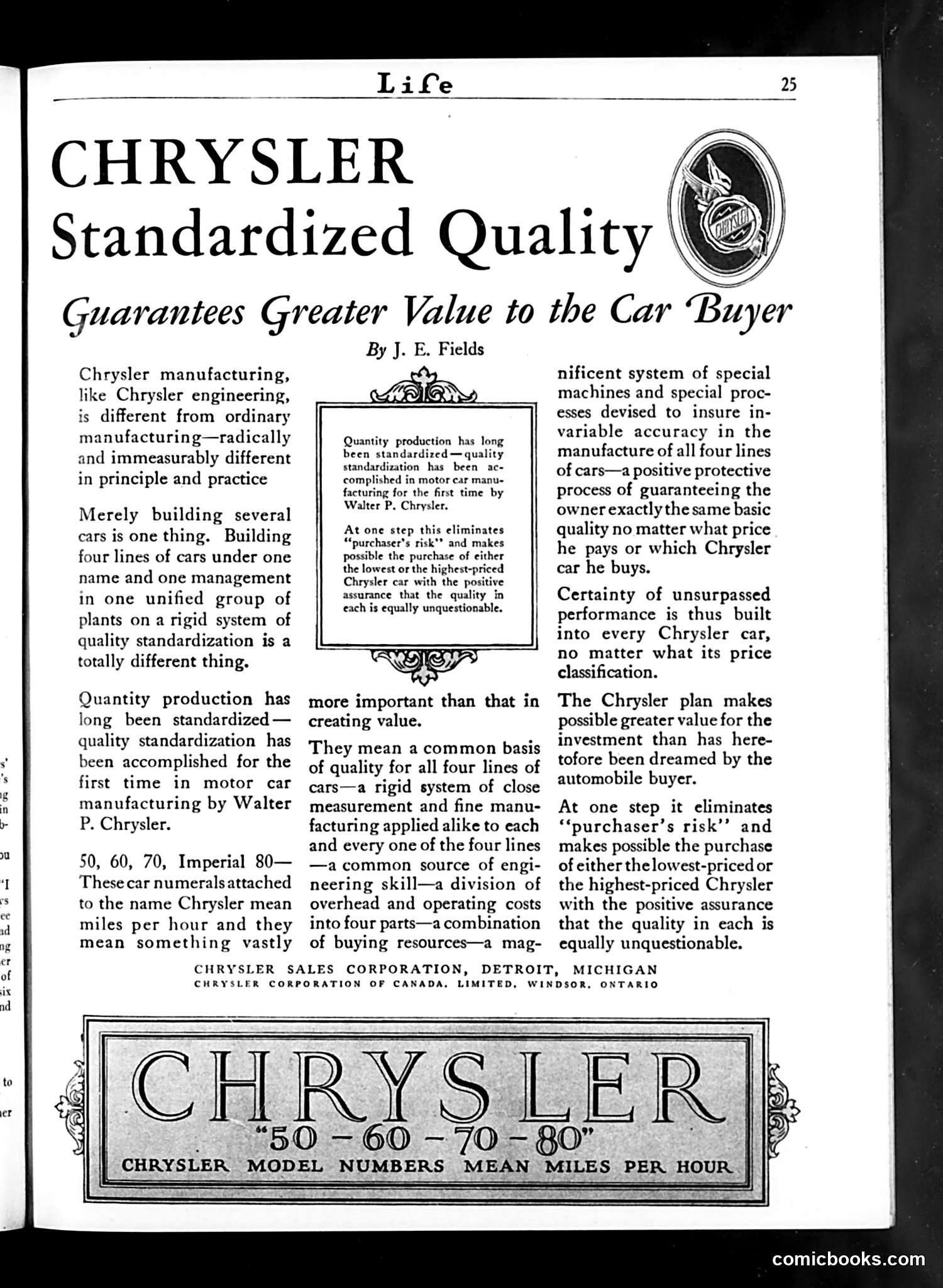
This is primarily a **Chrysler automobile advertisement**, not satire or political commentary. It appears in Life magazine (page 25) and promotes Chrysler's manufacturing innovation under founder Walter P. Chrysler. The ad's central claim is that Chrysler pioneered "quality standardization" in car manufacturing—ensuring consistent quality across four different car lines (50, 60, 70, and Imperial 80 models, named for their speed capabilities). The text argues this eliminates "purchaser's risk," meaning buyers of cheaper Chrysler models receive the same quality assurance as those buying premium versions. The highlighted boxed quote emphasizes that standardized quality in production was accomplished "for the first time" by Chrysler. This was genuine industrial marketing—the company distinguishes itself from competitors by claiming uniform quality control across its entire product range, offering better value at all price points. No cartoon or caricature is present; this is straightforward corporate advertising using rhetorical emphasis and design elements typical of 1920s-era trade publications.
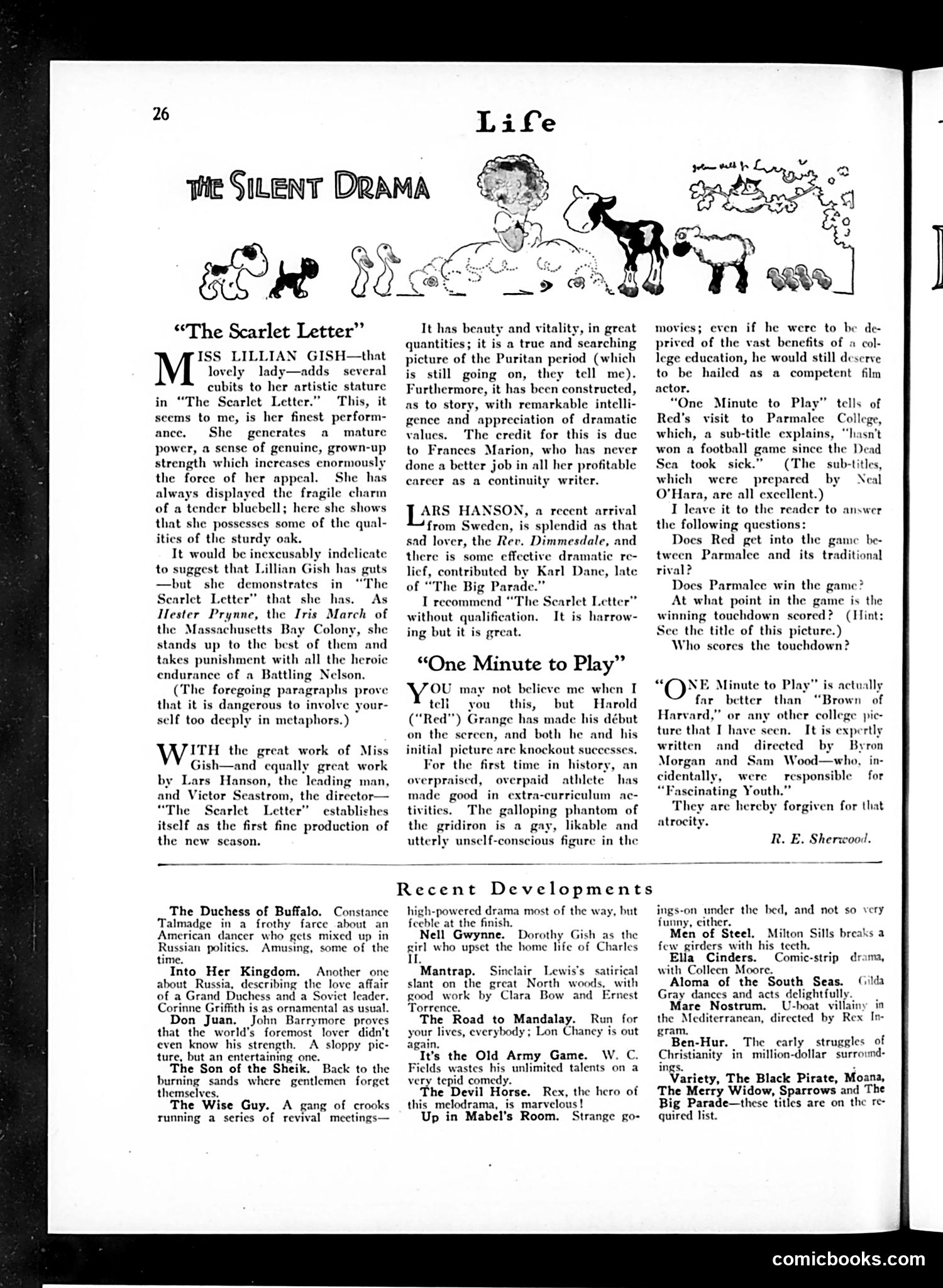
This page from *Life* magazine reviews three silent films. The masthead cartoon at top shows animals—likely representing different film types or studios—a visual pun on "the silent drama." The main reviews critique: 1. **"The Scarlet Letter"** — Praising actress Lillian Gish's mature performance in this Nathaniel Hawthorne adaptation, calling it the season's finest production. 2. **"One Minute to Play"** — Reviewing football star Harold "Red" Grange's film debut. The critic expresses surprise that an "overpraised, overpaid athlete" actually succeeded in movies, calling him "a gay, likable and utterly unselfconscious figure." This reflects 1920s skepticism about athletes transitioning to entertainment. 3. Other films briefly noted include Russian-themed pictures and John Barrymore's "Don Juan." The tone is witty and satirical—typical of *Life's* sophisticated film criticism. The reviewer R.E. Sherwood playfully poses unanswered questions about "One Minute to Play's" plot to intrigue readers.
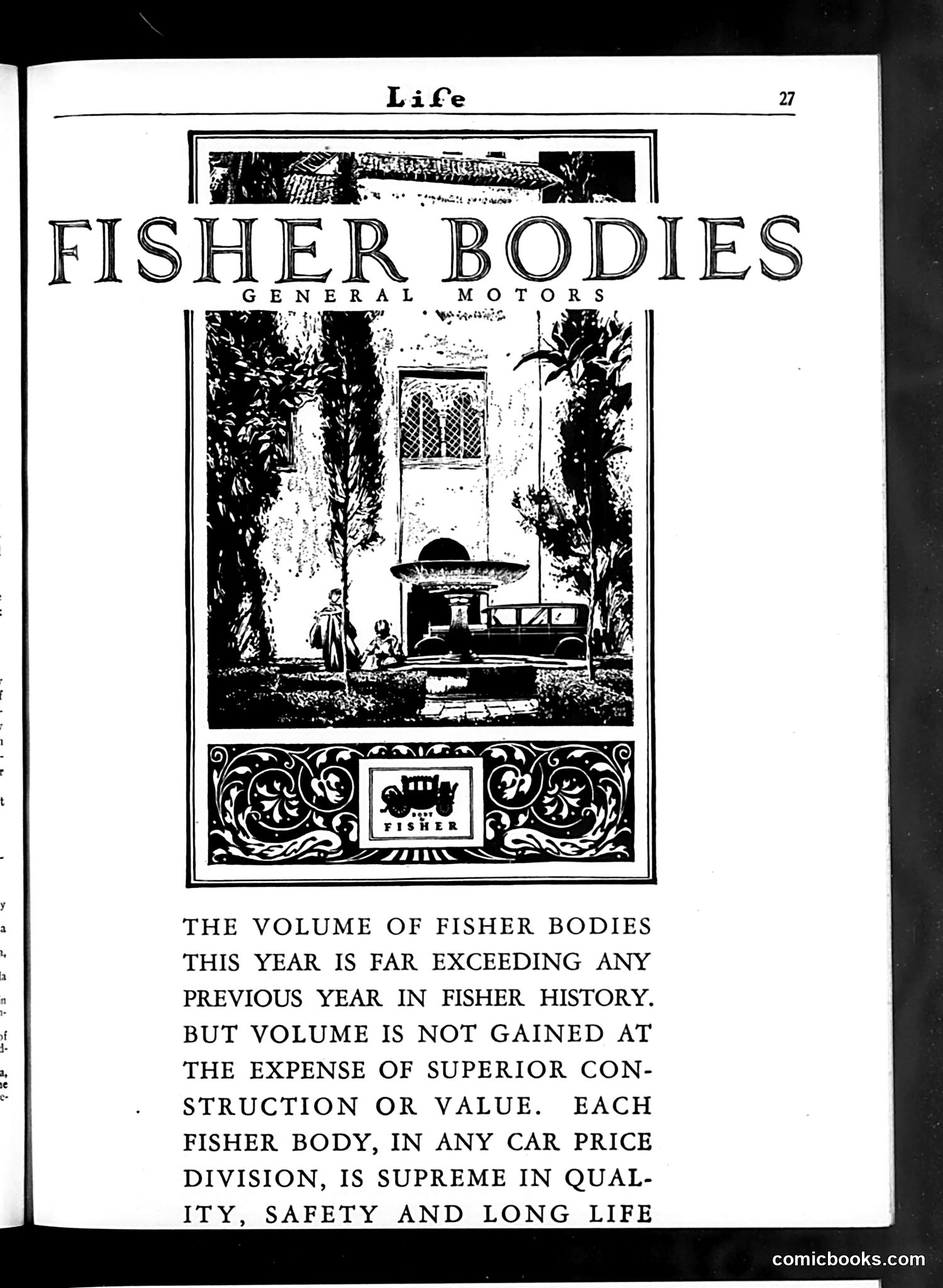
This is a **full-page advertisement** for Fisher Bodies, a General Motors division that manufactured car bodies. There is no political satire or cartoon here. The ad claims Fisher Bodies achieved record production volume while maintaining quality standards. It features an illustration of an elegant car parked in a Spanish colonial-style courtyard with ivy-covered walls, emphasizing luxury and prestige. The decorative border below includes the Fisher company logo (a coach). The text reassures consumers that increased manufacturing volume didn't compromise craftsmanship—each Fisher body allegedly excels in quality, safety, and durability across all price ranges. This was standard automotive advertising rhetoric of the era, addressing potential consumer concerns about mass production quality.
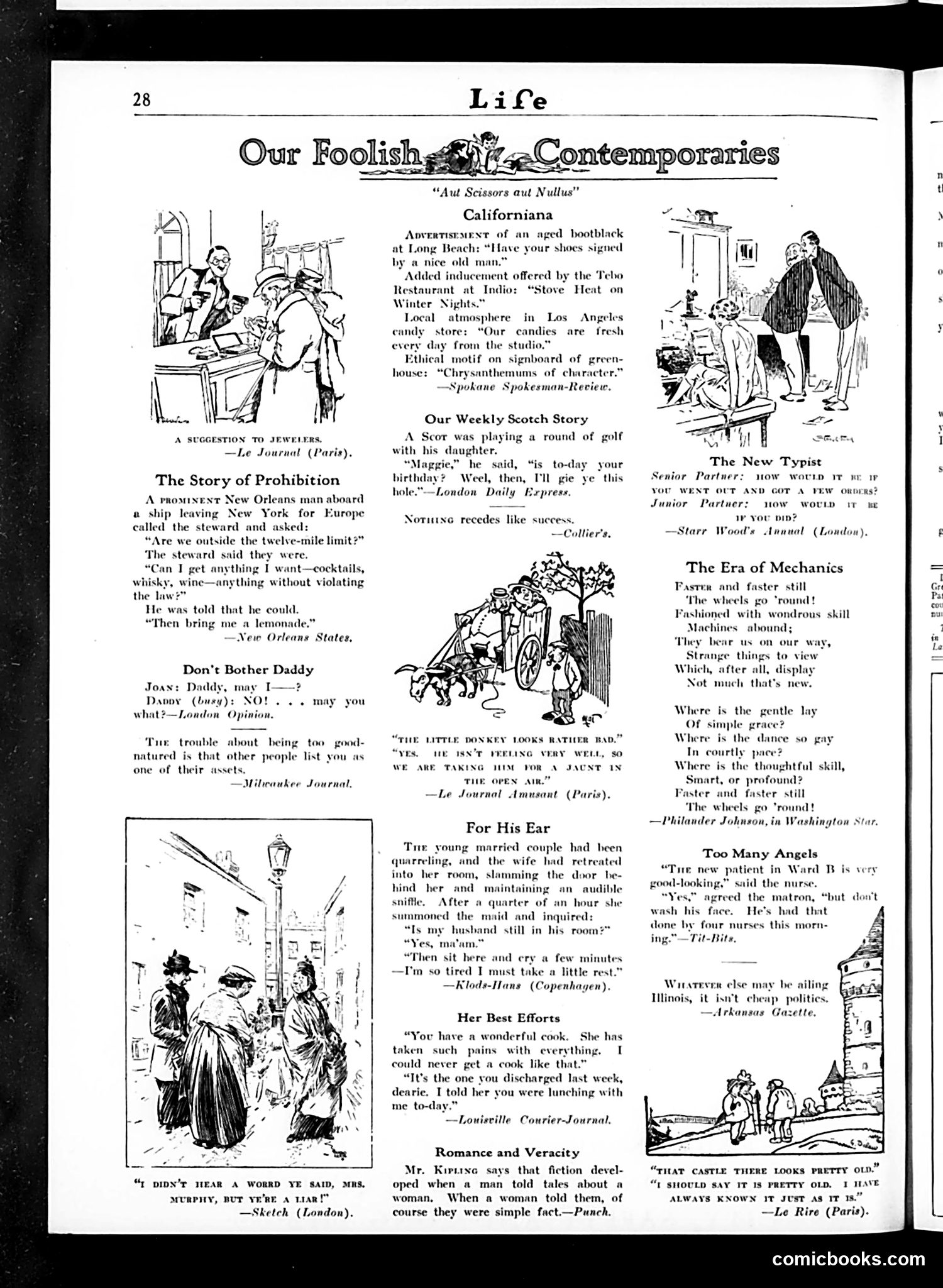
This is a collection of brief humorous anecdotes and cartoons typical of 1920s satirical magazines. Key themes: **Prohibition humor**: A New Orleans man asks for a lemonade once outside the twelve-mile limit—mocking the absurdity of Prohibition laws that Americans circumvented by traveling offshore. **Gender/marriage jokes**: Multiple pieces mock marital dynamics ("Don't Bother Daddy," "For His Ear") reflecting contemporary domestic tensions. **Class and labor**: A typist and nurse are portrayed as naive workers; a bootblack advertises his services with faux-prestige language. **Modernization skepticism**: "The Era of Mechanics" laments that technological progress hasn't brought genuine cultural advancement—a common 1920s anxiety about industrialization displacing traditional arts and craftsmanship. **International flavor**: The page reprints jokes from European sources (Paris, London, Copenhagen), reflecting Life's cosmopolitan readership. The cartoons are simple line drawings accompanying these brief, pun-heavy jokes—typical of the magazine's format.
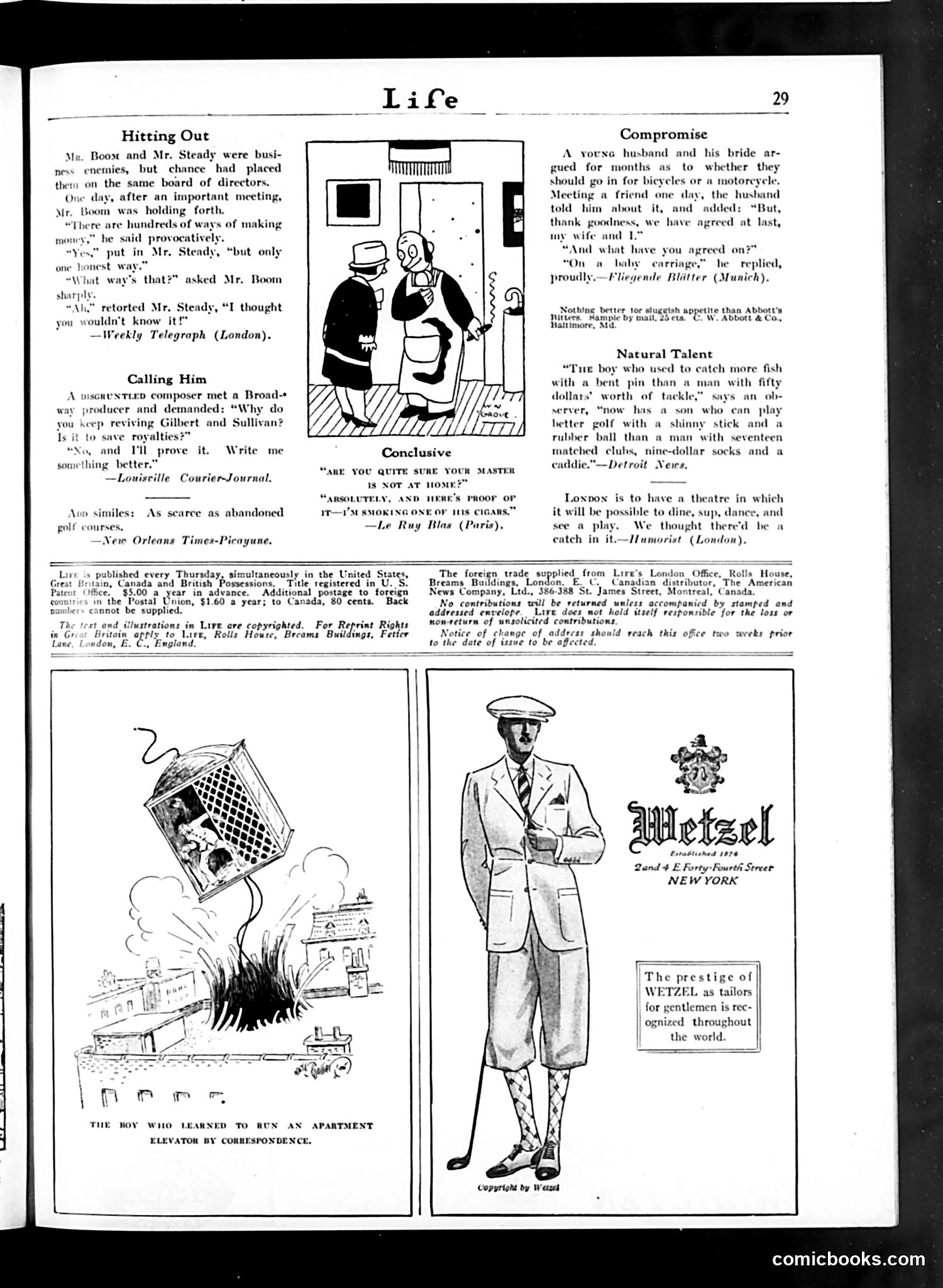
This page contains several brief humorous anecdotes and advertisements typical of *Life* magazine's satirical format. **"Hitting Out"** presents a business-world joke: two rival directors debate honest business practices. Mr. Steady claims there's only one honest way; when asked what it is, he says Mr. Boom wouldn't know it anyway—implying Boom is fundamentally dishonest. **"Calling Him"** mocks a Broadway producer for constantly reviving Gilbert and Sullivan operettas, suggesting it's to avoid paying royalties to contemporary composers. **"Compromise"** jokes about a young couple who argued over bicycles versus motorcycles, then "compromised" by buying a baby carriage instead—a gentle satire on marital negotiation. **"Natural Talent"** humorously contrasts a boy's fishing skill with cheap equipment against his son's superior golf ability despite expensive gear, suggesting innate talent trumps investment. **"Conclusive"** is a brief French quote about a master's cigar quality. The page also features a Wetzel tailoring advertisement and a cartoon about a boy learning to operate an apartment elevator by mail correspondence.
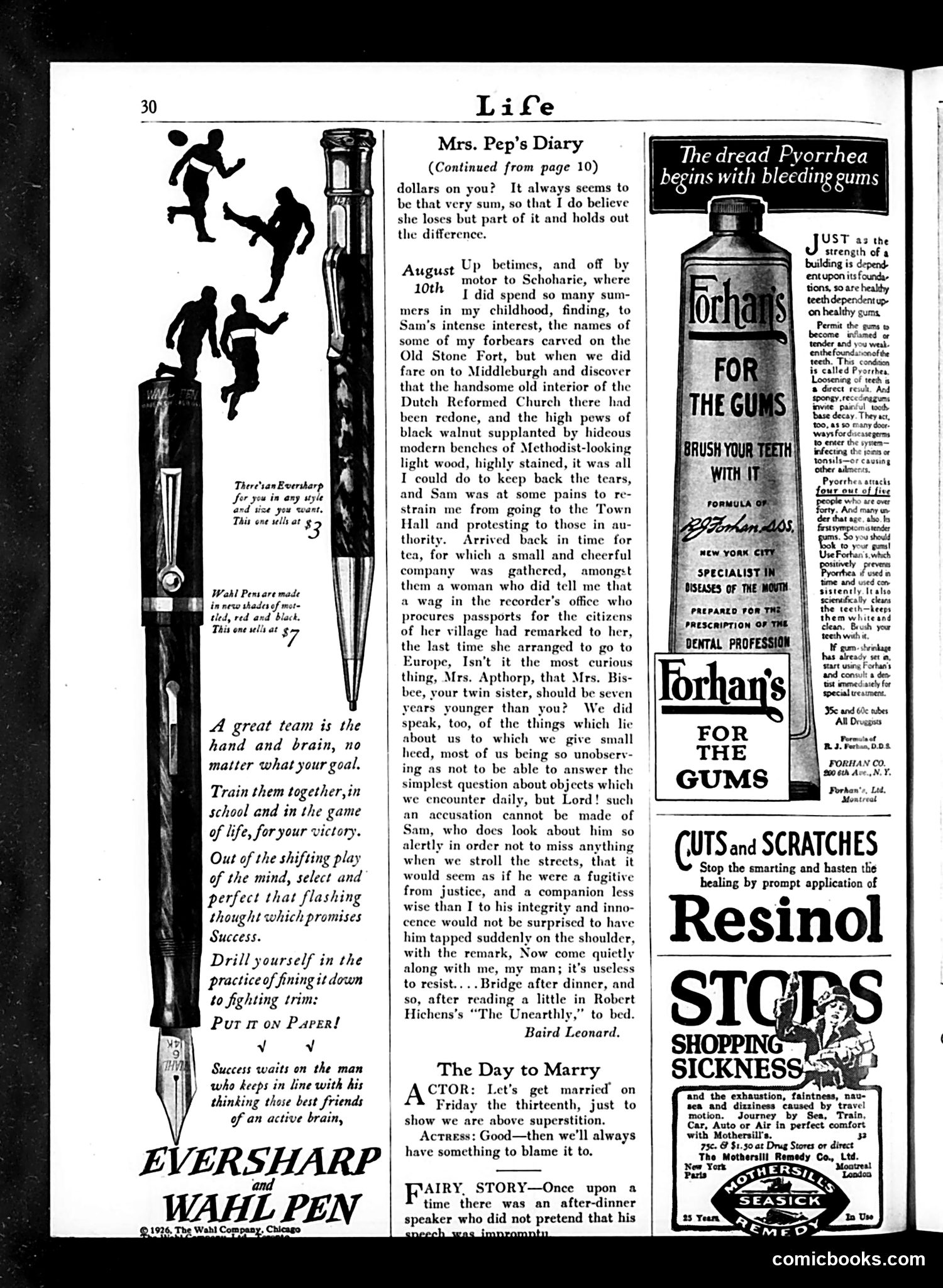
This page mixes editorial content with period advertising (circa 1920s-1930s). **Left side**: Advertisement for Eversharp and Wahl pens, using inspirational rhetoric about "hand and brain" working together for success. The silhouettes show young people in active poses, emphasizing vitality and ambition—common messaging for writing instruments marketed to educated professionals. **Center**: "Mrs. Pep's Diary" continues a serialized domestic narrative about an upper-class woman visiting childhood locations and socializing. The diary format was popular light reading. Notable: discussion of passport processing and a joke about twin sisters' apparent age difference—reflecting early 20th-century travel concerns and casual sexism about women's aging. **"The Day to Marry"** brief joke: An actress and actor plan a Friday the 13th wedding to prove they're not superstitious, but the actress quips they'll need *something* to blame their marriage problems on—cynical humor about matrimonial regret. **Right side**: Medical advertisements for Forhan's gum treatment and Resinol salve, plus Mothersill's seasickness remedy—typical patent medicine marketing of the era. The page reflects leisure-class concerns: travel, romance, refined domesticity, and consumer products promising health and success.
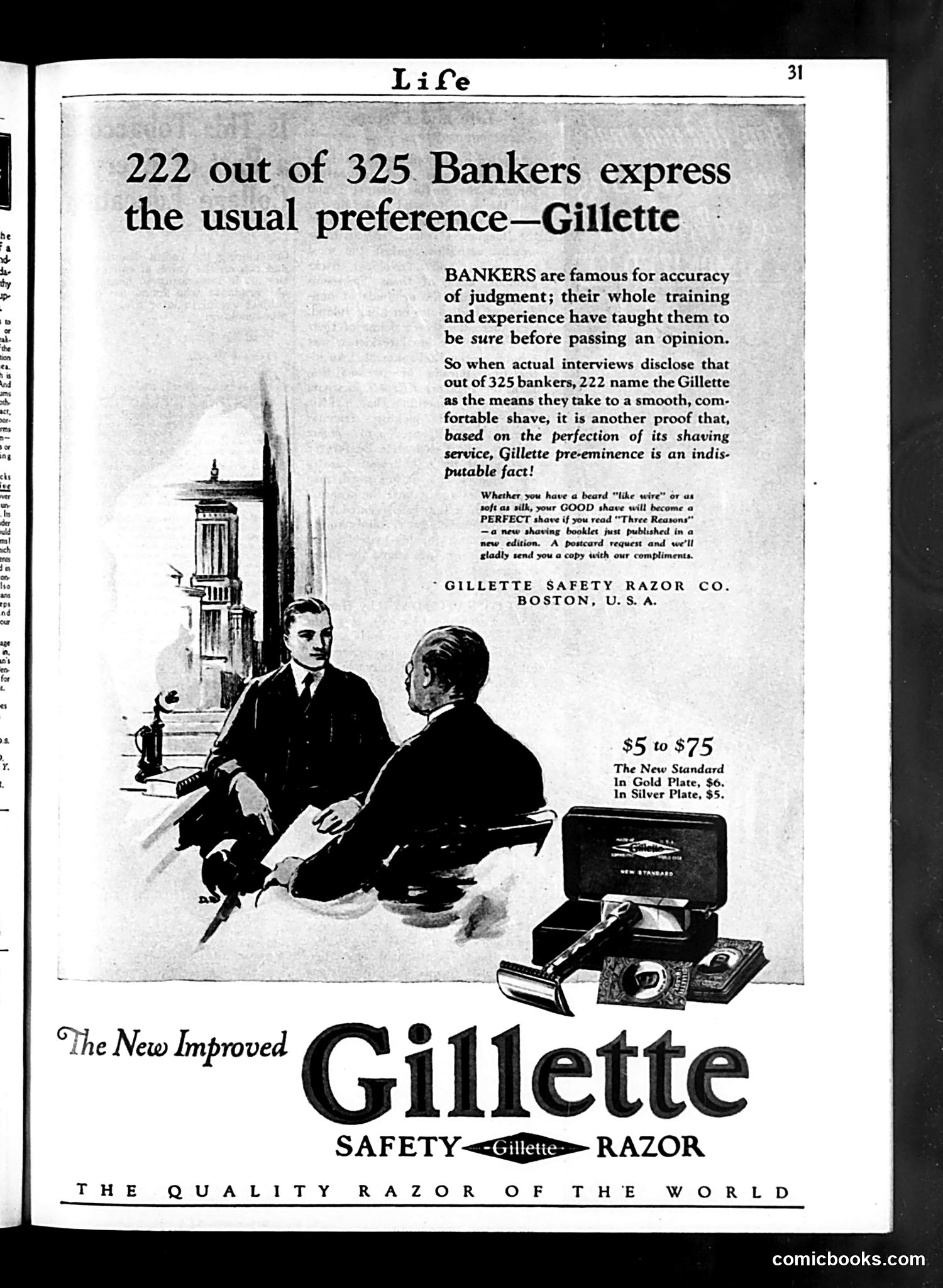
This is a **Gillette Safety Razor advertisement**, not satire or a political cartoon. It appears in Life magazine (likely 1920s-30s based on style). The ad uses a credibility strategy: it claims that 222 out of 325 bankers prefer Gillette razors. The logic is that bankers are known for careful judgment and accuracy, so their preference endorses the product's quality. The illustration shows two well-dressed businessmen in conversation—likely representing bankers—discussing the razor in a professional office setting. The displayed razor set at bottom-right shows pricing ($5-$75 depending on plating). The appeal is to aspirational middle-class masculinity: if prestigious bankers trust Gillette for a "smooth, comfortable shave," ordinary men should too. This is straightforward **product endorsement advertising** leveraging professional authority, not political commentary or humor. The "New Improved" Gillette branding suggests the company is marketing an updated model.
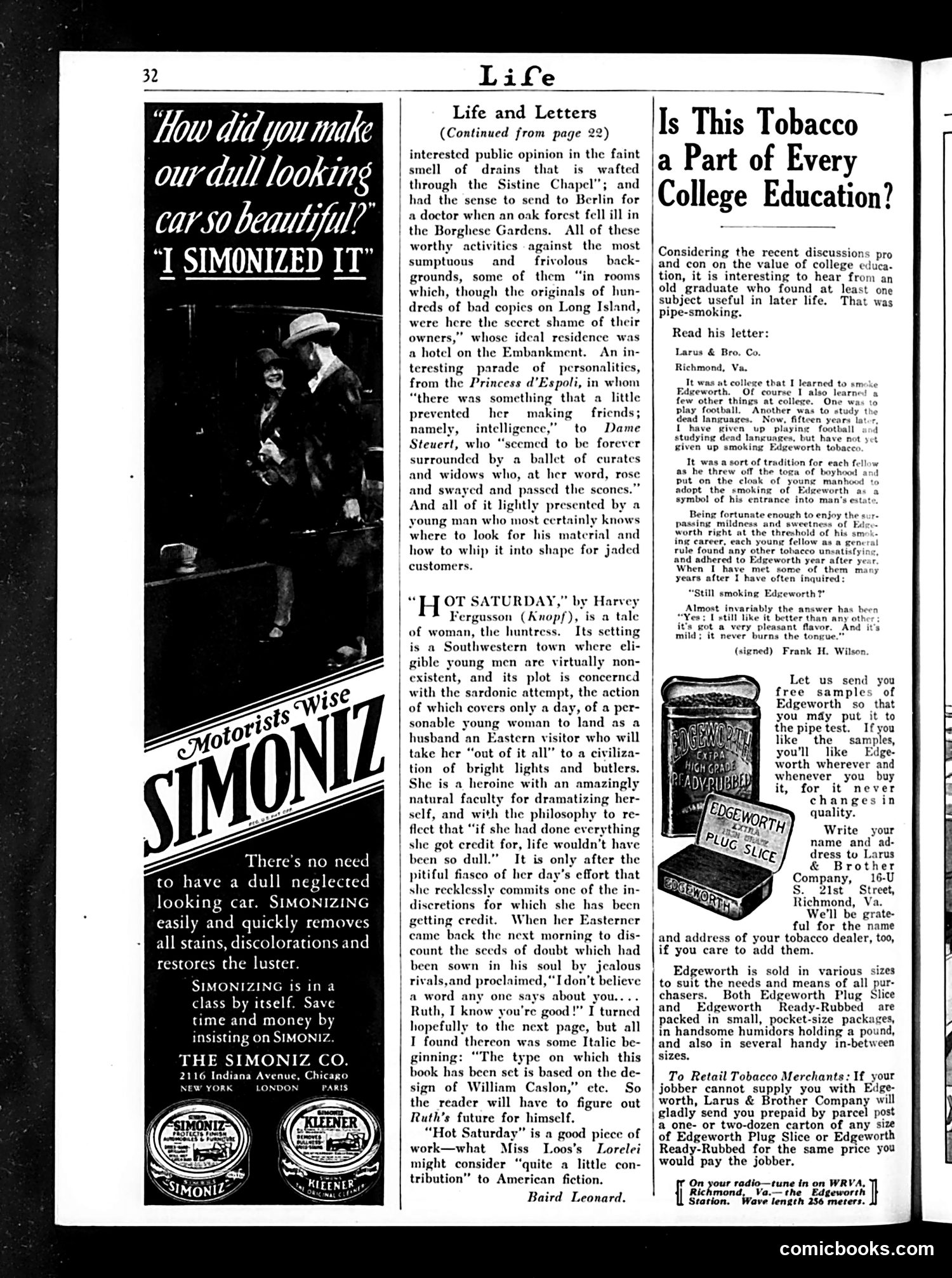
This page contains primarily **advertisements**, not political satire. The main visual element is a **Simoniz car wax advertisement** featuring a well-dressed man examining a gleaming automobile. The ad uses a before/after rhetorical format ("How did you make our dull looking car so beautiful?" / "I SIMONIZED IT") to promote the product's transformative powers. The page also includes **literary reviews** by Baird Leonard discussing recent novels, and a remarkable **tobacco advertisement disguised as reader mail**. A supposed college graduate writes to Larus & Bro. tobacco company claiming pipe-smoking with their "Edgeworth" brand was the most useful thing he learned in college—more valuable than football or languages. This satirizes both college education's questionable value and aggressive early 20th-century advertising tactics that fabricated "authentic" consumer testimonials.
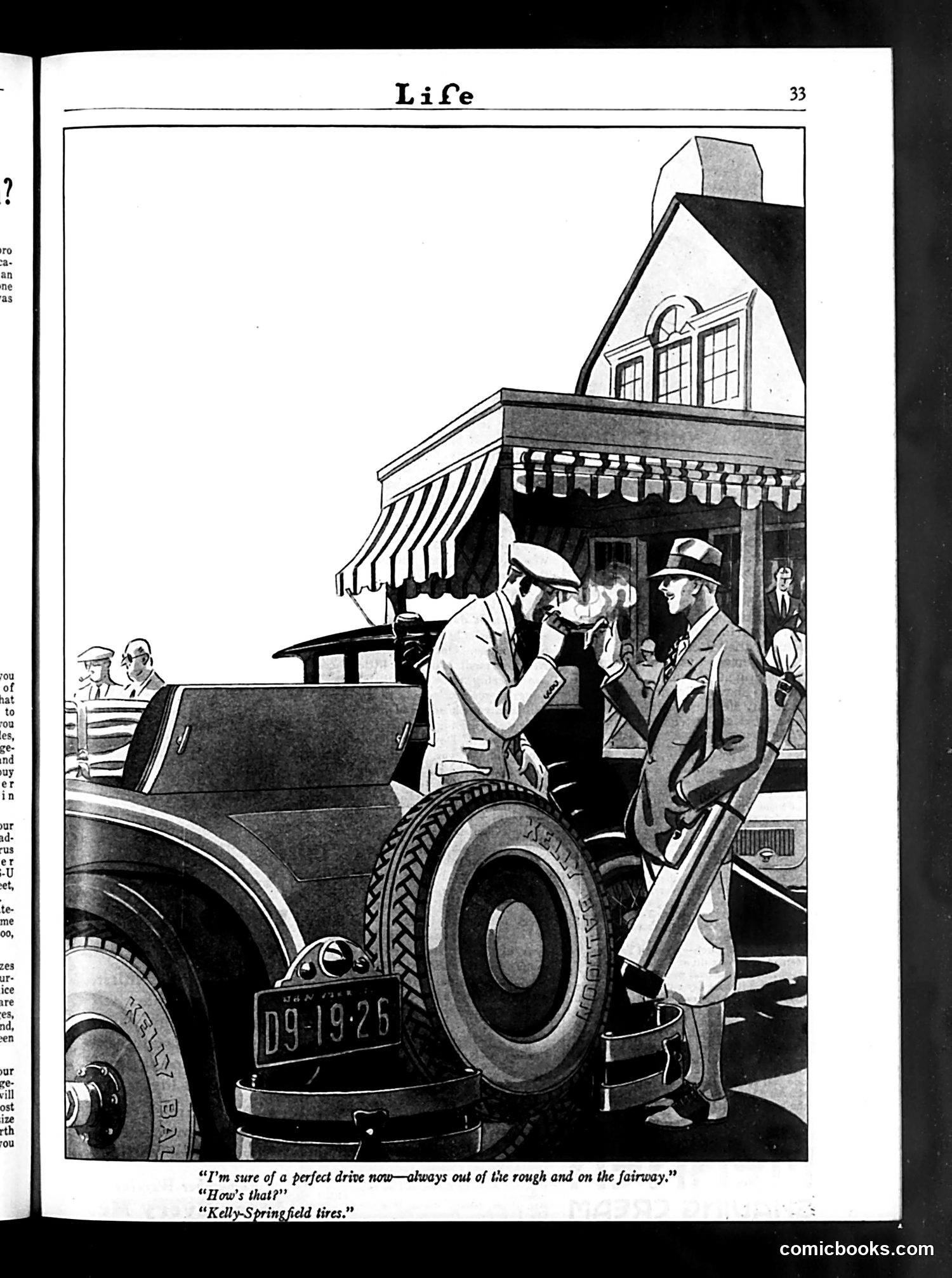
This is a 1920s automobile advertisement disguised as a comic illustration. Two well-dressed men stand beside a car (license plate D9-19-25, dating it to 1925). One man boasts about achieving "perfect drives" on the golf course, and when asked how, he credits "Kelly-Springfield tires." The joke is a visual pun: "drive" refers both to golf drives and automobile driving. By switching contexts mid-conversation, the ad humorously suggests that Kelly-Springfield tires provide such reliable traction and control that they guarantee perfect golf performance—absurd, of course, but memorable advertising. The gag relies on 1920s prosperity and the newly car-obsessed American culture, where automobiles symbolized modernity and leisure activities like golf. The illustration's clean Art Deco style and the men's fashionable attire emphasize aspirational consumer culture of the era.
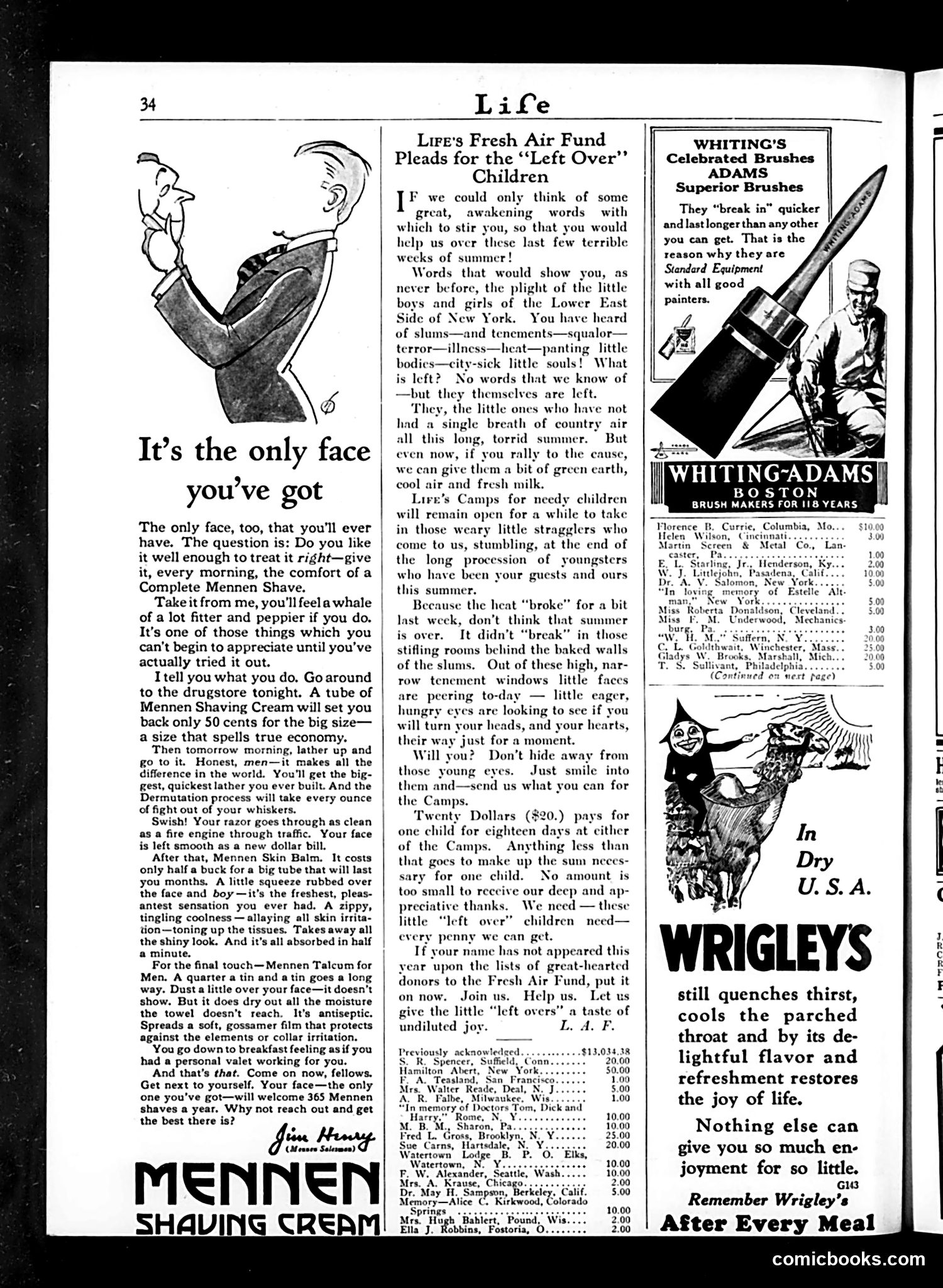
This page combines **advertising** with a **social welfare appeal**. The left side features a **Mennen Shaving Cream advertisement** using humor: a caricatured man's face dominates, with the pitch that shaving properly is essential self-care. The text emphasizes masculinity and personal grooming as moral virtue. The center contains **Life magazine's Fresh Air Fund appeal**, which addresses a real social crisis: poor children on New York's Lower East Side trapped in tenement housing during hot summers without access to nature or fresh air. The Fund provided camp stays costing $20 per child for 18 days. The language is emotionally manipulative—describing "city-sick little souls" with "hungry eyes"—designed to guilt affluent readers into donating. **The satire**: Life juxtaposes a luxury personal-care product advertisement (targeting affluent men) with pleas for desperately poor children. The contrast implicitly critiques American priorities: men spend freely on grooming while vulnerable children lack basic health and comfort. This was typical Progressive Era social criticism in Life magazine.
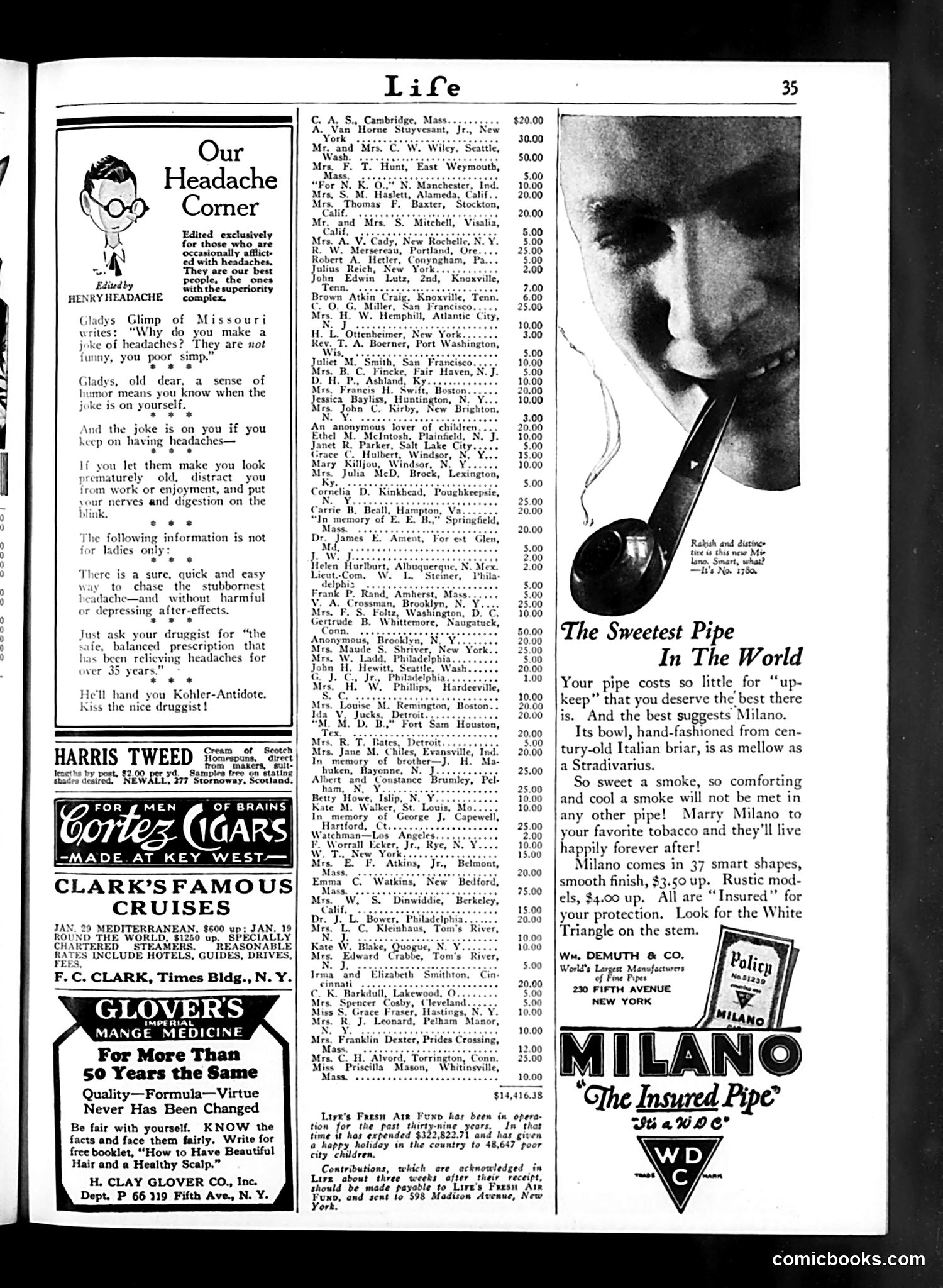
This page features a satirical advice column edited by "Henry Headache" targeting readers who suffer from headaches and possess "superiority complex." The humor relies on ironic contradiction: the column claims to help headache sufferers, but actually mocks them. When reader "Gladys Glimp" complains that headaches aren't funny, the editor turns the joke against her, suggesting that people who can't laugh at their own afflictions lack a sense of humor—implying headache sufferers are humorless and self-pitying. The column then promotes "Kohler-Antidote," a purported cure available from druggists, typical of early 20th-century patent medicine advertising. The satire targets both chronic complainers (who lack humor about their condition) and the era's abundant quack remedies promising quick fixes. The page also includes numerous ads for products like Harris Tweed, cigars, and Milano pipes—representative of how Life magazine funded itself through advertising while mocking consumer culture.
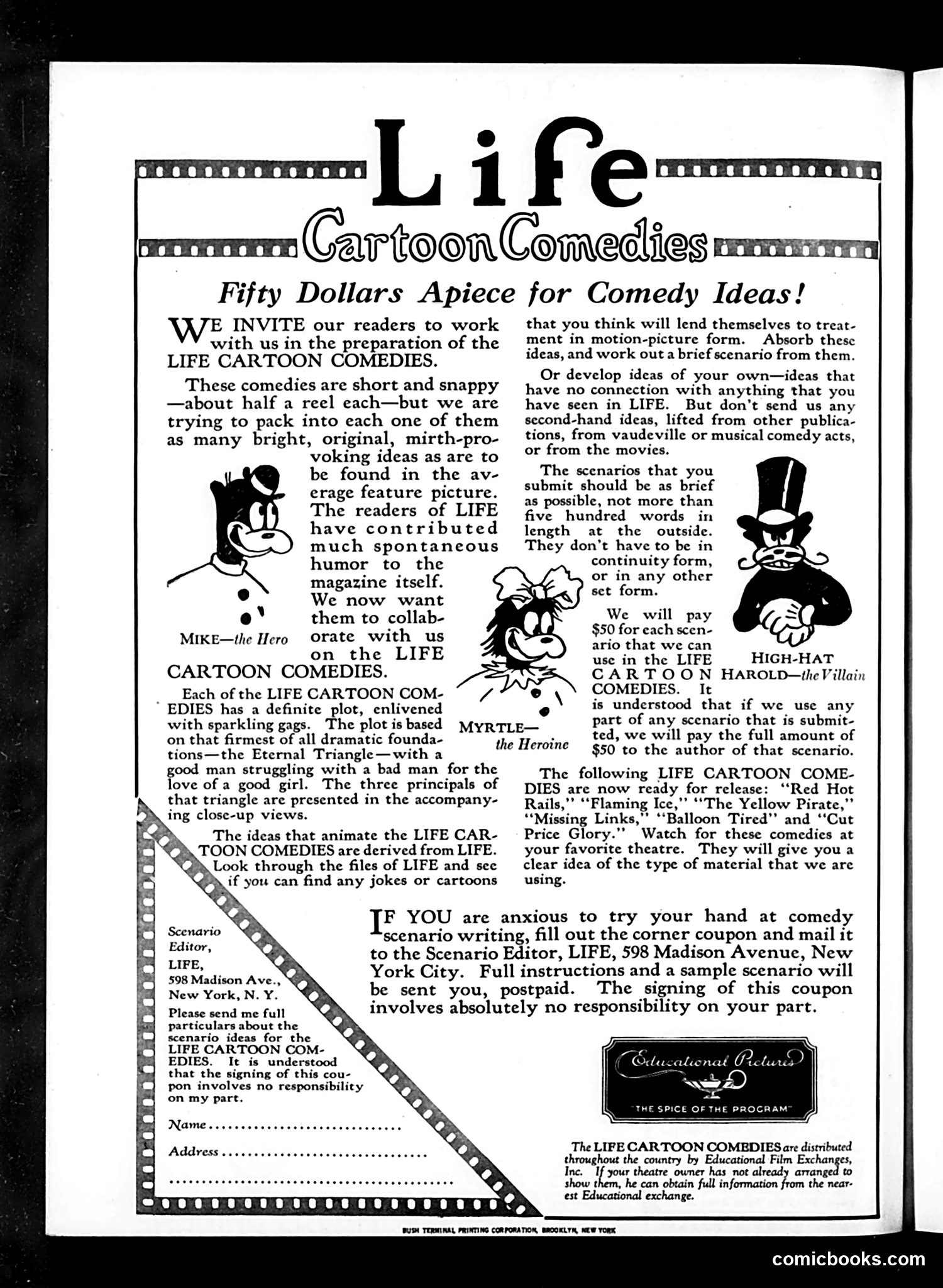
This is primarily an **advertisement/call for submissions**, not satirical content. Life magazine is soliciting comedy scenario ideas from readers for their "Life Cartoon Comedies"—short animated films (about half a reel each) distributed by Educational Film Exchanges. The page features three cartoon character archetypes representing the "Eternal Triangle" plot formula: **Mike** (the hero), **Myrtle** (the heroine), and **High-Hat Harold** (the villain). These generic stock characters embody the basic dramatic structure Life was using for their comedies. Life offers **$50 per usable scenario**—substantial payment for the era—and invites readers to either adapt jokes from Life's own files or submit original ideas (maximum 500 words). The tone is enthusiastic about democratizing comedy writing, appealing to readers' creativity while maintaining editorial control. The cartoons are stylistically simple, typical of early silent-film era animation aesthetics.
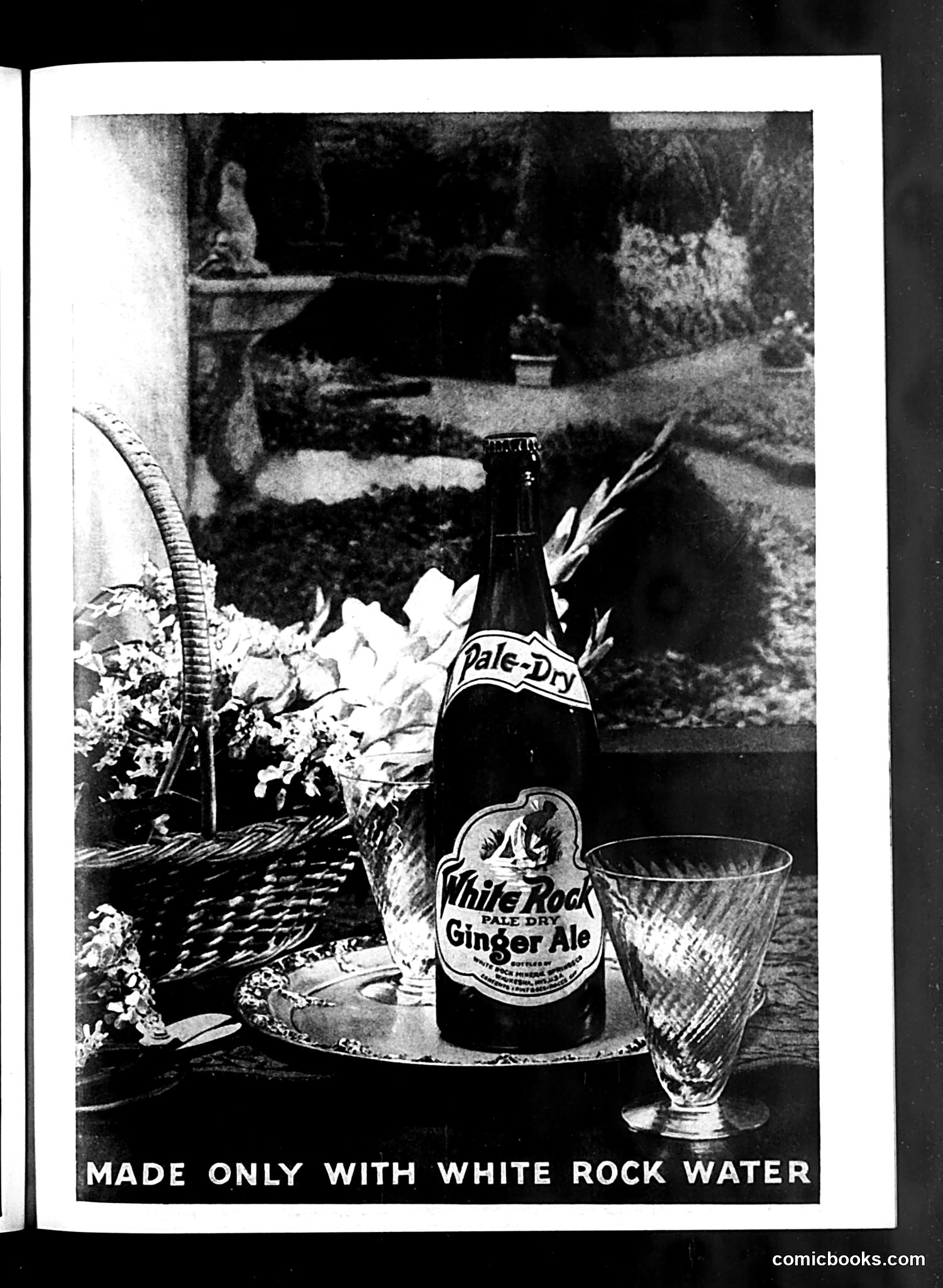
This is a **product advertisement** for White Rock Ginger Ale, not political satire or a cartoon. The image shows a bottle of "White Rock Ginger Ale" alongside a "Pale-Dry" bottle, displayed in an elegant garden setting with flowers, a basket, and a drinking glass. The advertisement's tagline—"MADE ONLY WITH WHITE ROCK WATER"—emphasizes the product's purity and quality ingredient. This was typical marketing language for beverages in the early-to-mid 20th century, when claiming superior water sources was a common sales pitch. The sophisticated, romanticized garden setting was designed to suggest refinement and appeal to middle-to-upper-class consumers during an era when such products represented luxury and good taste.
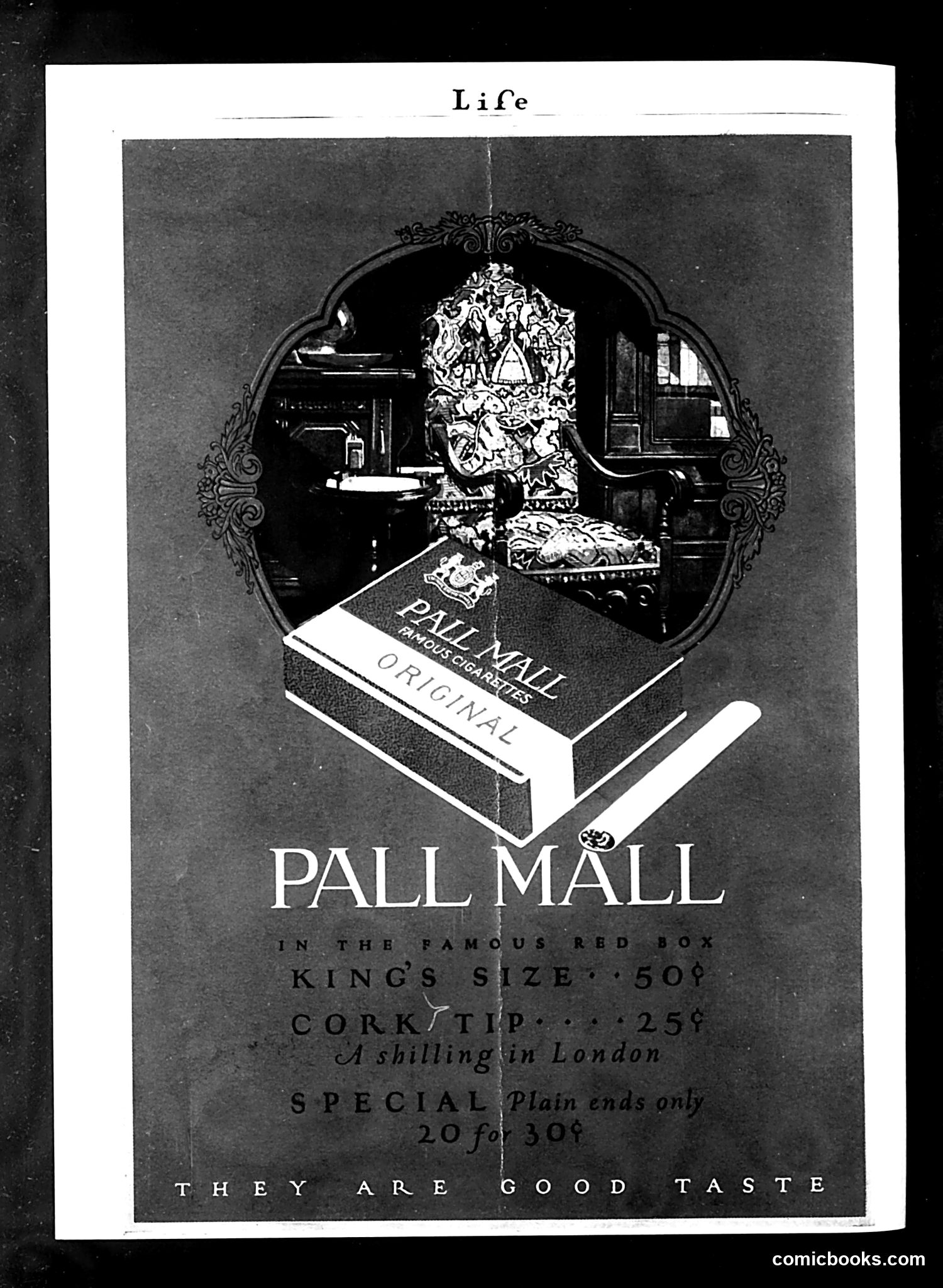
This is a **cigarette advertisement**, not political satire or editorial content. The page promotes Pall Mall cigarettes, featuring an ornate circular vignette showing an elegant interior (fireplace, furniture, windows) emerging from a red cigarette box. For modern readers: This represents mid-20th century cigarette marketing that emphasized **luxury and refined taste**—positioning smoking in wealthy, cultured domestic settings. The prices (50¢ King's Size, 25¢ Cork/Tip, special 20 for 30¢) and "A shilling in London" suggest international distribution during a period when tobacco advertising freely associated cigarettes with sophistication and good living, before widespread health warnings. The tagline "They are good taste" makes the sales pitch explicit.

I can see this is a very dark, low-contrast image from what appears to be a historical Life magazine page. The image quality is too poor for me to make out specific cartoon details, caricatures, text, or satirical content with confidence. While the OCR text confirms this is from comicbooks.com and references Life magazine, I cannot reliably identify: - The figures or caricatures depicted - The political or social references - The intended satirical message or joke - The historical context To provide accurate analysis following your rules, I would need a clearer image where the artwork and any accompanying text are legible. I cannot responsibly guess at identities or meanings when the source material is this unclear.