
Life, 1926-09-02 · page 2 of 41
Life — September 2, 1926 — page 2: what you’re looking at
What you’re looking at
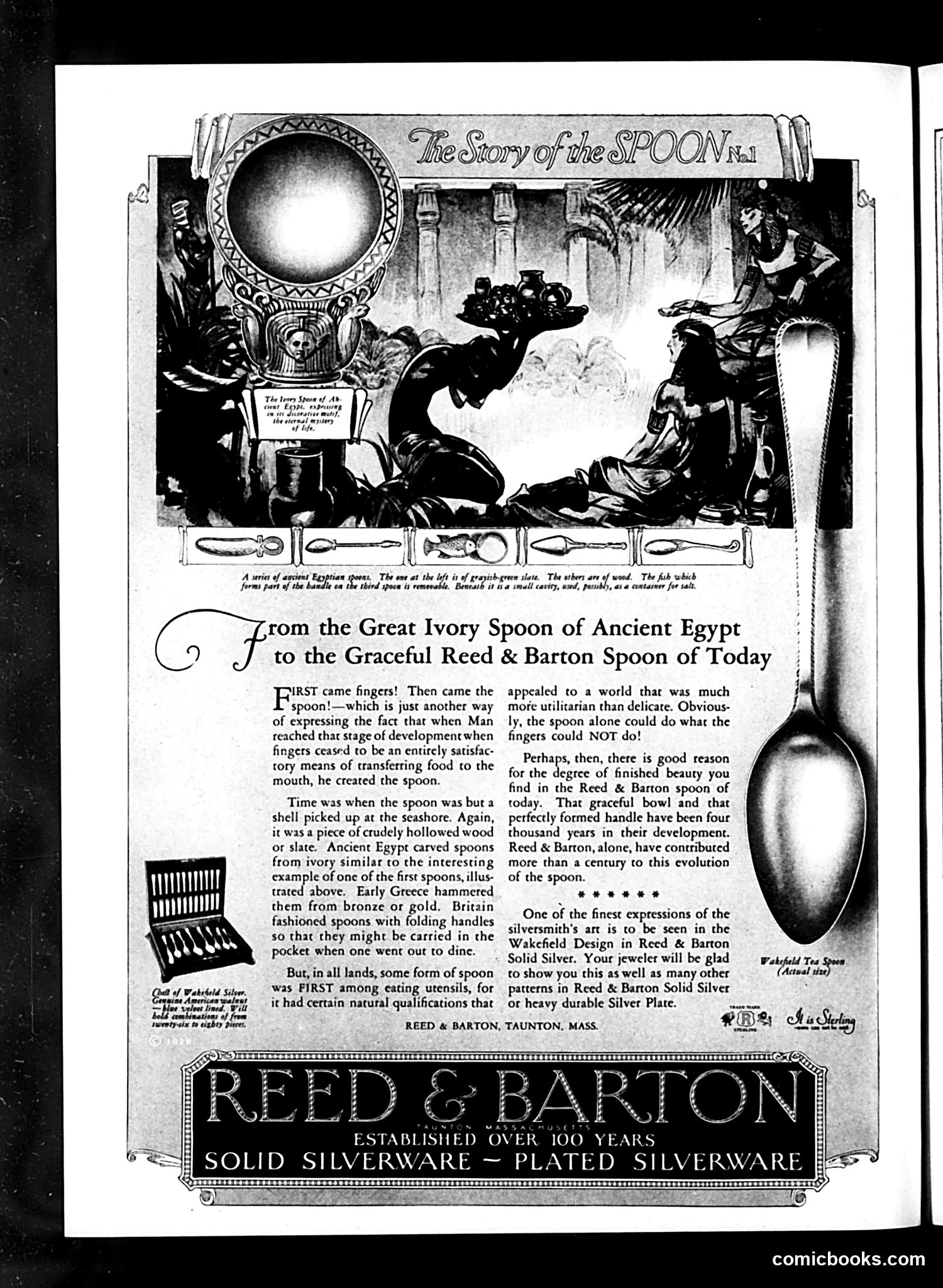
This page is primarily **advertising, not satire or political commentary**. The top illustration titled "The Story of the SPOON No.1" is a decorative historical narrative showing the evolution of spoons from ancient Egypt to modern times. It depicts figures in Egyptian dress presenting ornate spoons, with scholarly illustrations of various spoon designs below. The text celebrates this progression "from the Great Ivory Spoon of Ancient Egypt to the Graceful Reed & Barton Spoon of Today," positioning the advertiser's product as the culmination of thousands of years of refinement. The page is an **advertisement for Reed & Barton silverware** (Taunton, Massachusetts), using historical romance and evolutionary narrative to market their spoons as sophisticated, refined products—a common advertising strategy of the era.
📄 Transcribed text from this page (OCR, searchable)
Machine-transcribed from the original scan — historical spelling and the odd misread are preserved.
‘alo ear | nN nut A ti forms pelt of the bate on le on the third spoon is | eas came fingers! Then came the spoon!—which is just another way of expressing the fact that when Man reached that stage of development when fingers ceased to be an entirely satisfac- tory means of transferring food to the mouth, he created the spoon. Time was when the spoon was but a shell picked up at the seashore. Again, it was a piece of crudely hollowed wood or slate. Ancient Egypt carved spoons from ivory similar co the interesting example of one of the first spoons, illus- trated above. Early Greece hammered them from bronze or gold. Britain fashioned spoons with folding handles so that they might be carried in the pocket when one went out to dine. But, in all lands, some form of spoon was FIRST among eating utensils, for it had certain natural qualifications that REED & BARTON, TAUNTON, MASS. ae —- pst. The ome at the left is of Bra isb-greem slate. ae les are of wood. The fsb which rom the Great Ivory Spoon of Ancient Egypt to the Graceful Reed & Barton Spoon of Today appealed to a world that was much more utilitarian than delicate. Obvious- ly, the spoon alone could do what the fingers could NOT do! Perhaps, then, there is good reason for the degree of finished beauty you find in the Reed & Barton spoon of today. That graceful bowl and that perfectly formed handle have been four thousand years in their development. Reed & Barton, alone, have contributed more than a century to this evolution of the spoon. ee ee ee One of the finest expressions of the silversmith’s art is to be seen in the Wakefield Design in Reed & Barton Solid Silver. Your jeweler will be glad to show you this as well as many other patterns in Reed & Barton Solid Silver or heavy durable Silver Plate. #5% ) = am ( i y comicbooks.com