
Life, 1926-09-02 · page 23 of 41
Life — September 2, 1926 — page 23: what you’re looking at
What you’re looking at
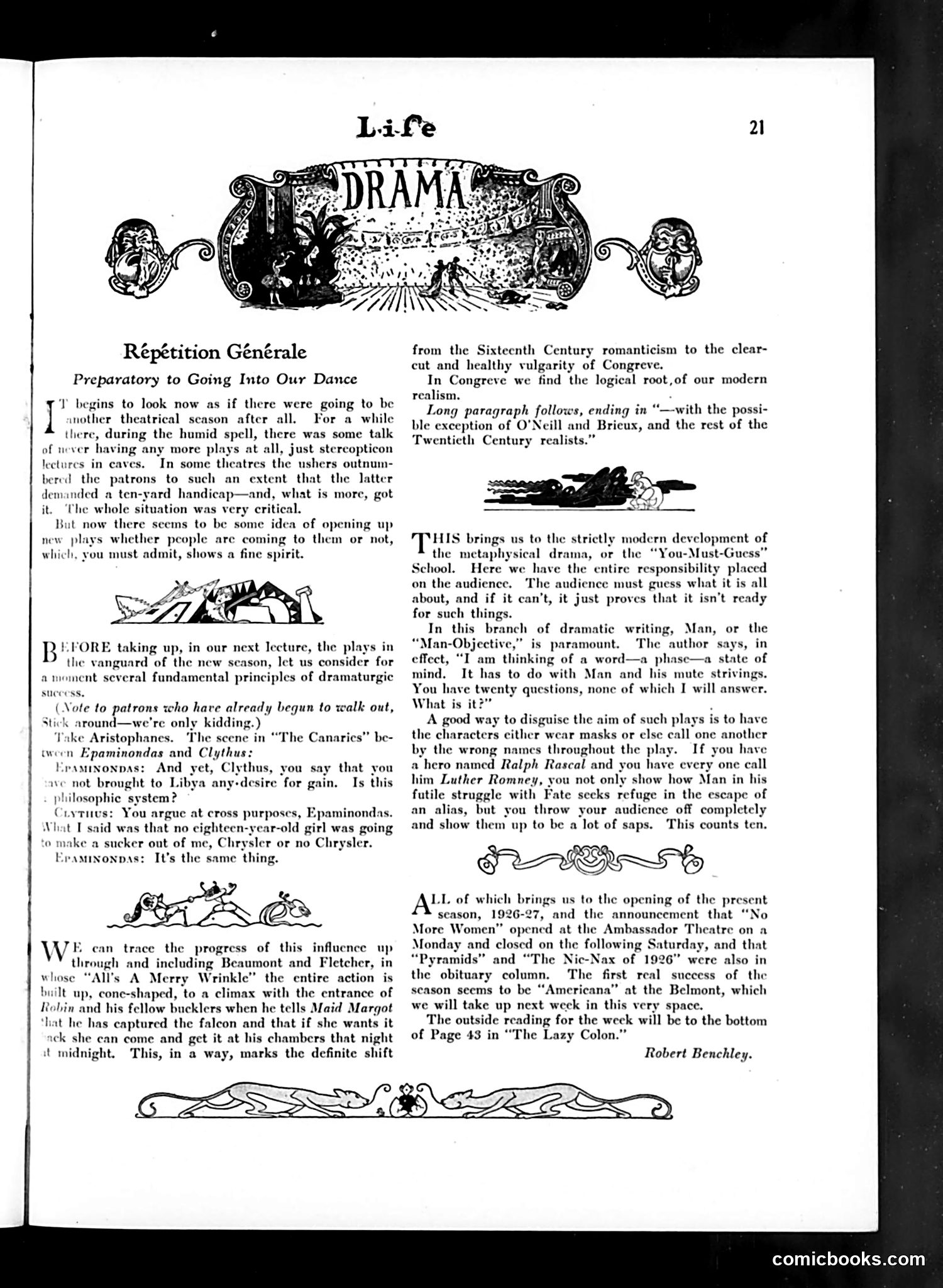
This is Robert Benchley's satirical column about the 1926-27 theatrical season. Benchley mocks the pretentiousness of avant-garde "metaphysical drama"—plays designed to confuse audiences rather than entertain them. He ridicules the "You-Must-Guess School" of playwriting, where authors deliberately obscure meaning through masks, wrong character names, and obscure symbolism. The joke: if audiences can't understand the play, the playwright claims the audience "isn't ready for such things"—blaming spectators for the work's incomprehensibility. The fake classical references (Aristophanes, Beaumont and Fletcher) and absurd plot summaries parody how modernist dramatists justify their opacity using literary history and philosophical language. Benchley contrasts this with successful shows like "Americana" at the Belmont Theatre, suggesting that clear, engaging drama beats pretentious obscurity. The column satirizes 1920s theatrical avant-gardism as intellectual posturing.
📄 Transcribed text from this page (OCR, searchable)
Machine-transcribed from the original scan — historical spelling and the odd misread are preserved.
Répétition Générale Preparatory to Going Into Our Dance nother theatrical season after all. For a while there, during the humid spell, there was some talk of never having any more plays at all, just stercopticon lectures in caves. In some theatres the ushers outnum- bered the patrons to such an extent that the latter demanded a ten-yard handicap—and, what is more, got it. ‘Che whole situation was very critical. But now there seems to be some idea of opening up new plays whether people are coming to them or not, which, you must admit, shows a fine spirit. i begins to look now as if there were going to be B FORE taking up, in our next lecture, the plays in the vanguard of the new season, let us consider for a moment several fundamental principles of dramaturgic success. (Note to patrons who have already begun to walk out, Stick around—we're only kidding.) ‘Take Aristophanes. ‘The scene in “ tween Epaminondas and Clythus: Epamtnonpas: And y ‘lythus, you say that you we not brought to Liby sire for gain. Is philosophic system? Crytuus: You argue at cross purposes, Epaminondas. What T said was that no cighteen-year-old girl was going to make a sucker out of me, Chrysler or no Chrysler. Evaminonpas: It's the same thing. he Canaries” be- W E can trace the progress of this influence up through and including Beaumont and Fletcher, in whose “All's A Merry Wrinkle” the entire action is built up, cone-shaped, to a climax with the entrance of Robin and his fellow bucklers when he tells Maid Margot ‘hat he has captured the falcon and that if she wants it ack she can come and get it at his chambers that night ut midnight. This, in a way, marks the definite shift from the Sixteenth Century romanticism to the clear- cut and healthy vulgarity of Congreve. In Congreve we find the logical root,of our modern realism. Long paragraph follows, ending in “—with the possi- ble exception of O'Neill and Bricux, and the rest of the Twentieth Century realists.” THis brings us to the strictly modern development of the metaph 1 drama, or the “You-Must-Guess” School. Here we have the entire responsib’ on the audience. The audience must guess what it is all about, and if it can’t, it just proves that it isn’t ready for such things. In this branch of dramatic writing, Man, or the “Man-Objective,” is paramount. The author says, in effect, “I am thinking of a word—a phase—a state of mind. It has to do with Man and his mute strivings. You have twenty questions, none of which I will answer. What is ‘ A good way to disguise the aim of such plays is to have the characters cither wear masks or else call one another by the wrong names throughout the play. If you have a hero named Ralph Rascal and you have every one call him Luther Romney, you not only show how Man in his futile struggle with Fate seeks refuge in the escape of an alias, but you throw your audience off completely and show them up to be a lot of saps. This counts ten. SRALORE FY Alt of which brings us to the opening of the present season, 1926-27, and the announcement that “No More Women” opened at the Ambassador Theatre on a Monday and closed on the following Saturday, and that “Pyramids” and “The Nic-Nax of 1926” were also in the obituary column. The first real success of the season seems to be “Americana” at the Belmont, which we will take up next week in this very space. The outside reading for the week will be to the bottom of Page 43 in “The Lazy Colon.” Robert Benchley. CSS OES comicbooks.com