
A complete issue · 44 pages · 1926
Life — May 27, 1926
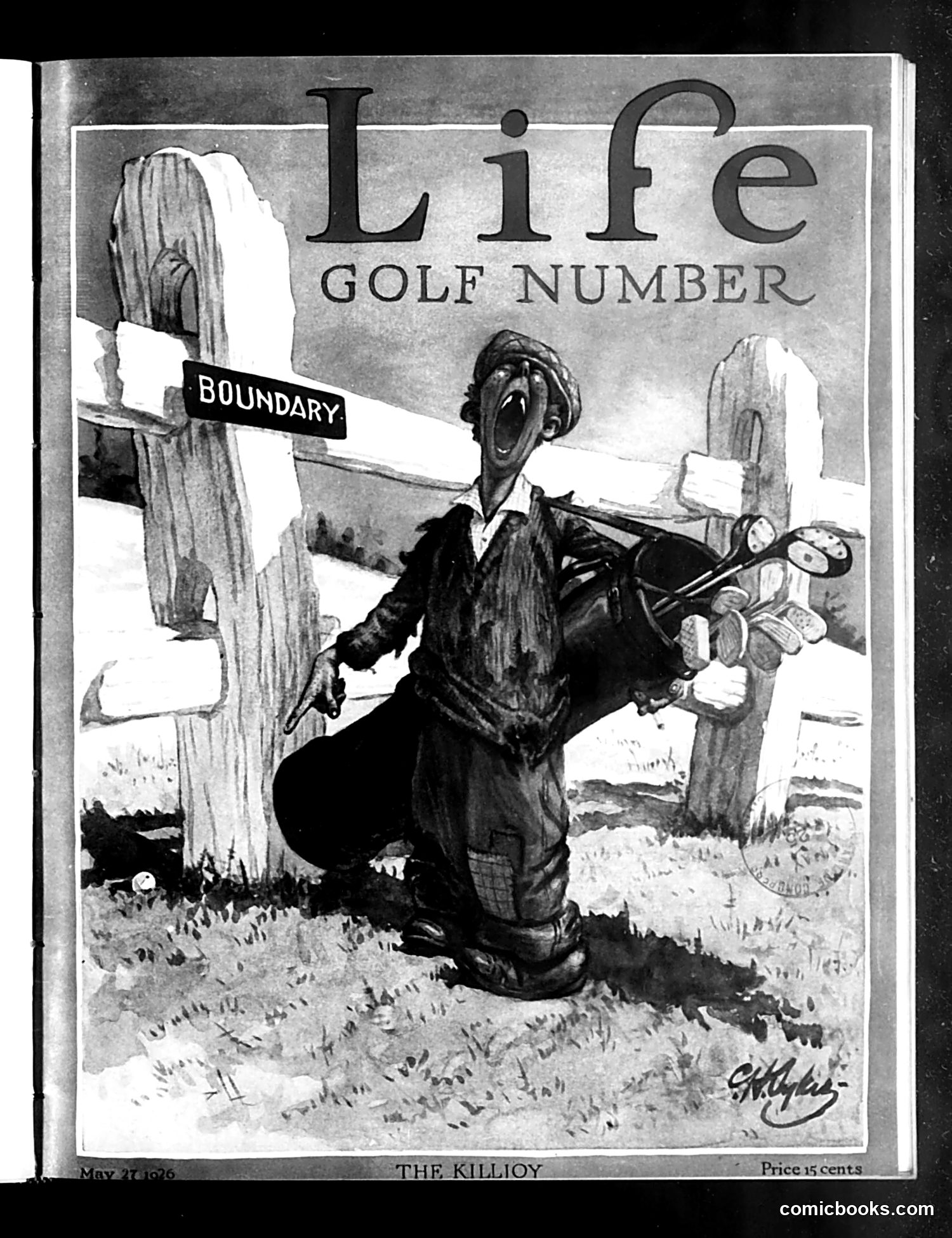
This is Life's "Golf Number" cover (dated May 21, 1925, price 15 cents). The illustration depicts a golfer in obvious distress at the boundary of a golf course, with his arms raised in anguish and mouth open as if shouting. He holds a golf club, and there's a "BOUNDARY" marker visible. The satire appears to target the frustration of amateur golfers—specifically the common experience of hitting a ball out of bounds, which costs the player penalty strokes. The exaggerated emotional response humorously captures the disappointment and anger many weekend golfers feel when their shot goes awry at the course boundary. This reflects golf's popularity as a leisure activity among middle and upper-class Americans in the 1920s.
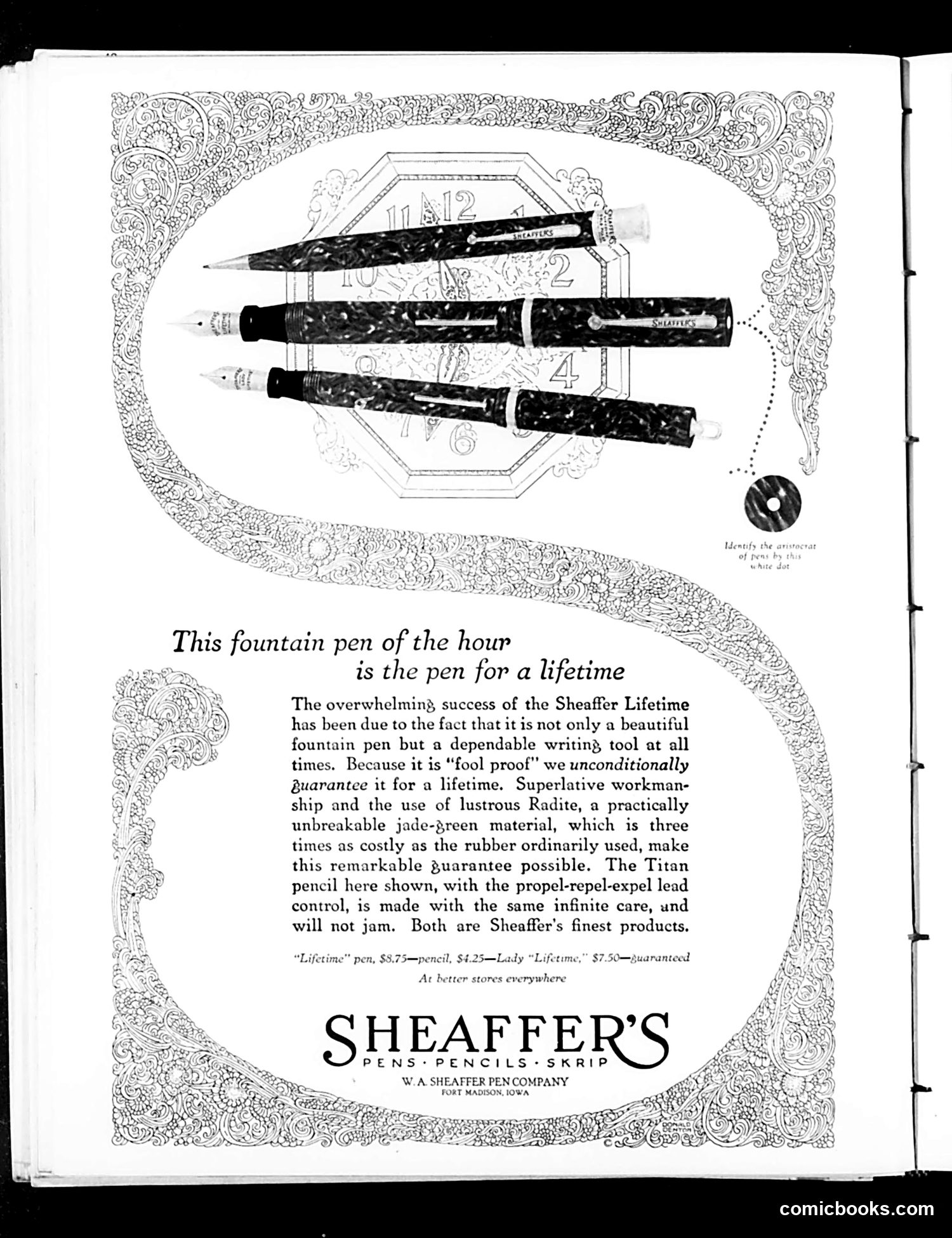
This page is **primarily an advertisement**, not satire or political commentary. It promotes Sheaffer's "Lifetime" fountain pens and pencils, manufactured by W.A. Sheaffer Pen Company in Fort Madison, Iowa. The ad emphasizes the product's durability and reliability through the headline "This fountain pen of the hour is the pen for a lifetime." The image shows three writing instruments arranged diagonally. The marketing pitch highlights that Sheaffer offers an "unconditional guarantee" for life, attributes this to superior craftsmanship and materials (specifically "lustrous Radite," described as unbreakable jade-green material), and positions the pens as dependable tools rather than mere luxury items. Pricing is listed at $8.75 for the pen and $1.25 for the pencil. This is a straightforward product advertisement typical of early-to-mid 20th century magazine marketing.
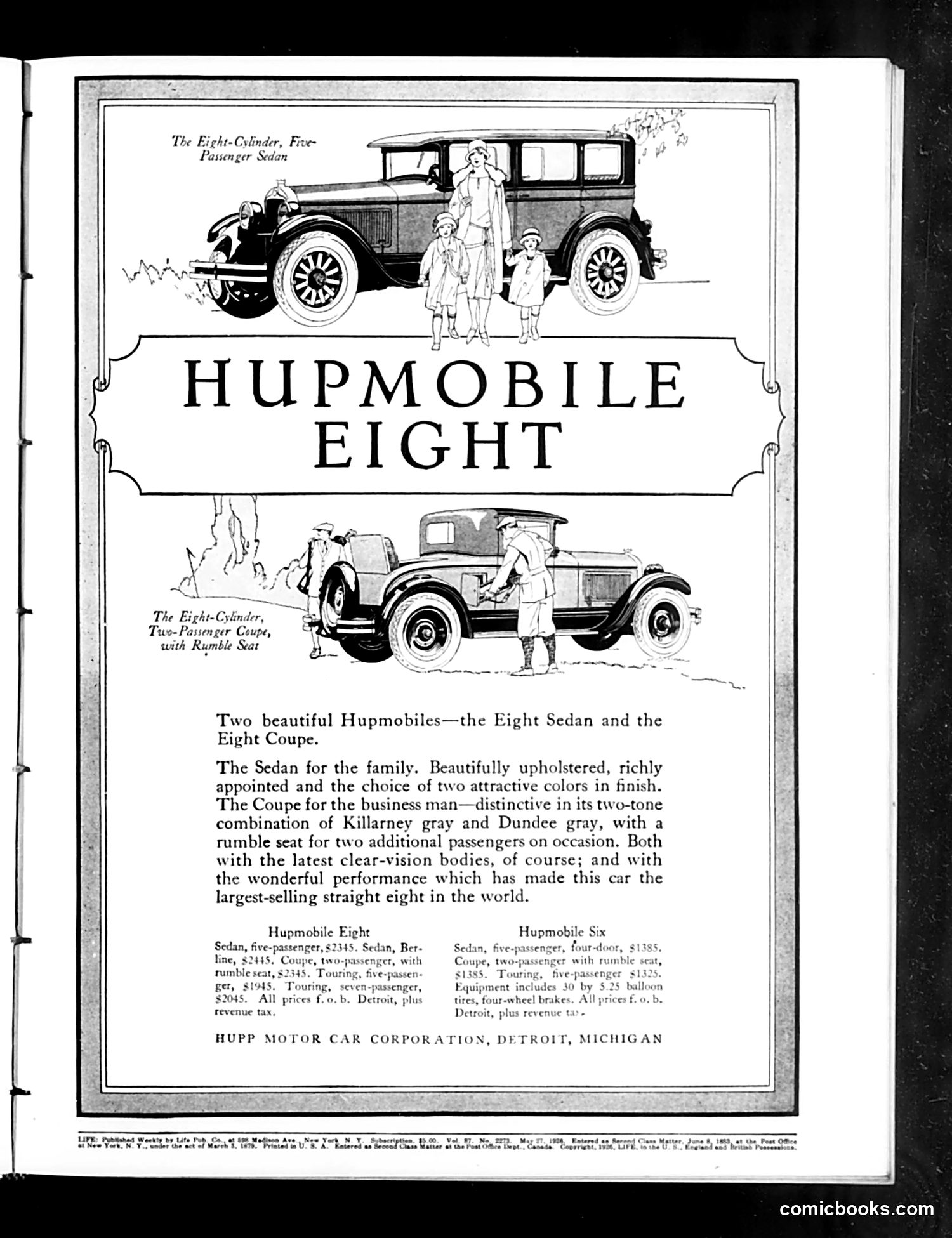
This page is **not satire or political commentary**—it's a straightforward automobile advertisement from *Life* magazine for the Hupmobile Eight, manufactured by Hupp Motor Car Corporation in Detroit, Michigan. The ad showcases two car models: the Eight Sedan (for families) and the Eight Coupe (for businessmen). It emphasizes the vehicles' features: attractive upholstery, color options, rumble seats for extra passengers, and "clear-vision bodies." The text promotes the Hupmobile Eight as "the largest-selling straight eight in the world." The illustrations depict well-dressed passengers—including women and children—with the vehicles, a common marketing strategy targeting middle and upper-class buyers in what appears to be the 1920s era.
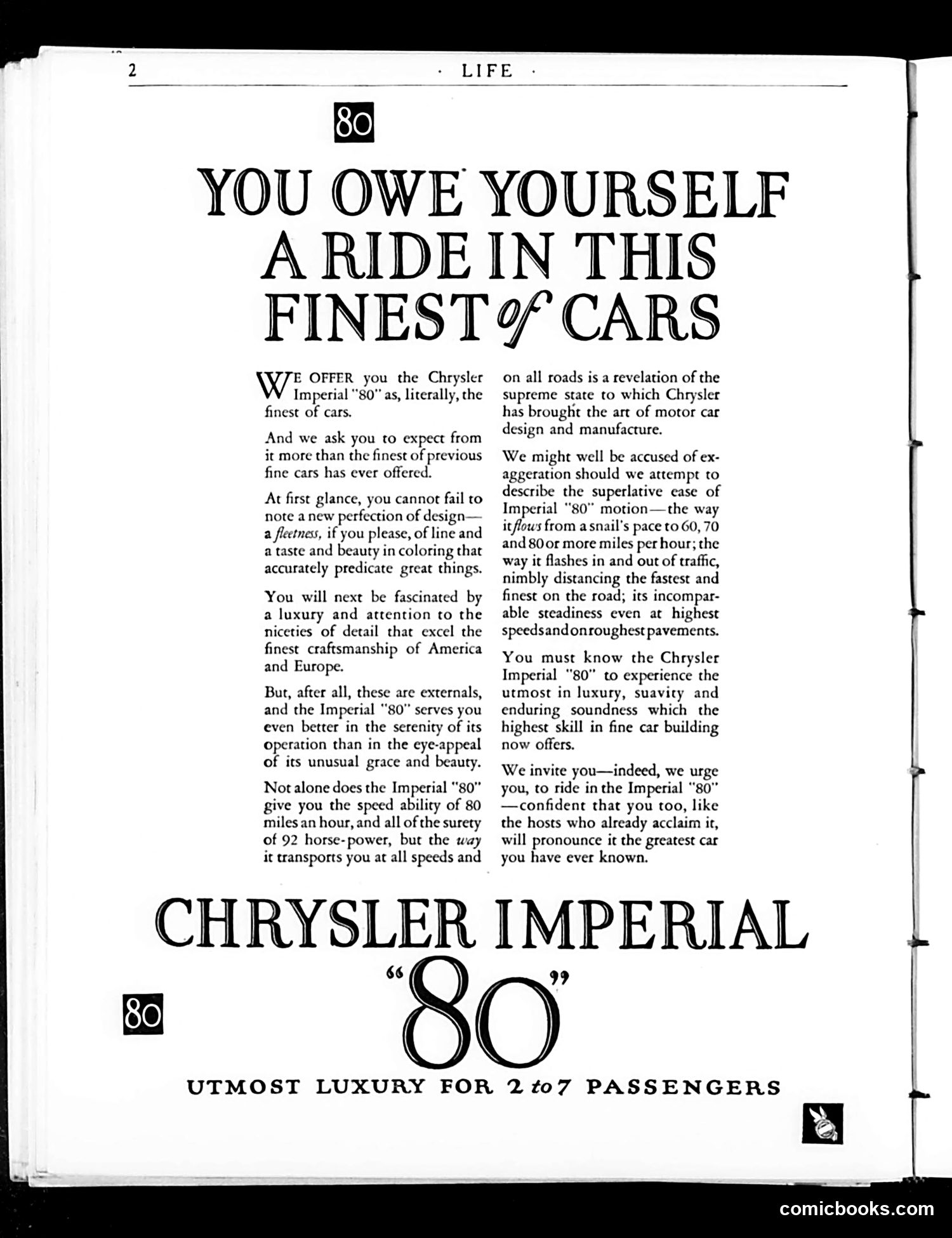
This is **not a cartoon or satire page** — it's a straightforward automobile advertisement for the Chrysler Imperial "80" model, appearing in Life magazine. The ad uses persuasive marketing language typical of 1920s luxury car advertising, emphasizing: - Design elegance ("flatness" and "line") - Performance (80 horsepower, speeds up to 80 mph) - Craftsmanship quality - Capacity (2-7 passengers) - Smoothness and steadiness on roads The dramatic typography and full-page layout reflect period advertising conventions. There is no political or social satire here — this is commercial promotion aimed at affluent readers. The phrase "You owe yourself a ride" is simply a sales appeal encouraging test drives.
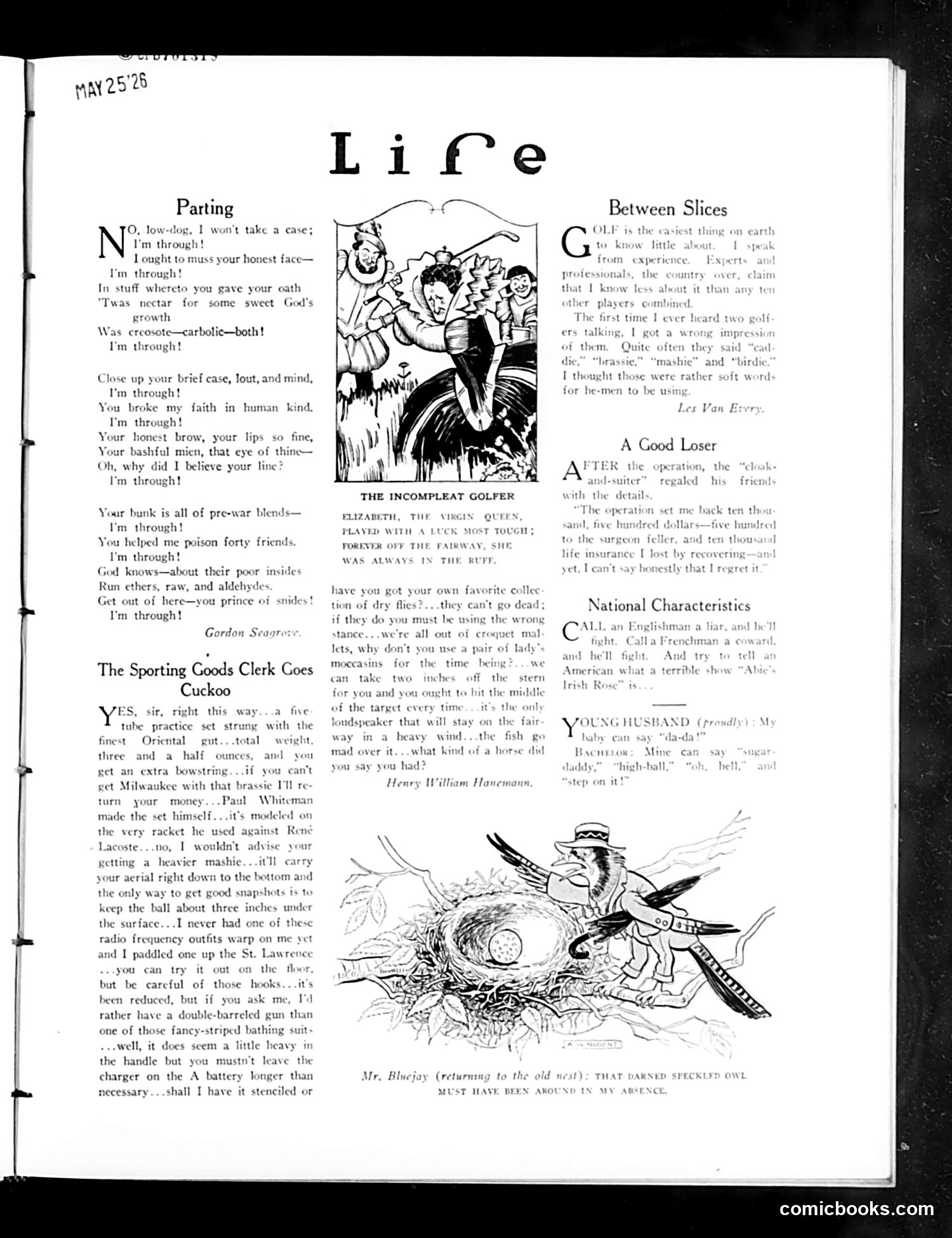
This page contains several short satirical pieces typical of Life's humor format: **"Parting"** is a goodbye poem to someone leaving, with references to golf and sports. **"The Sporting Goods Clerk Goes Cuckoo"** describes a salesman's enthusiastic pitch about golf equipment, apparently mocking overzealous retail salesmanship and golf's popularity during the 1920s. **"Between Slices"** contains golf anecdotes and terminology, suggesting Life's readers were largely middle-class golfers familiar with the sport's culture and language. **"National Characteristics"** stereotypes English and American national traits—English people as liars, Americans as crude. The illustration of "Mr. Bhanjay (returning to the old nest)" depicts a speckled owl, accompanying a humorous nature note. Overall, the page reflects 1920s leisure culture, particularly golf's prominence among the magazine's affluent readership.
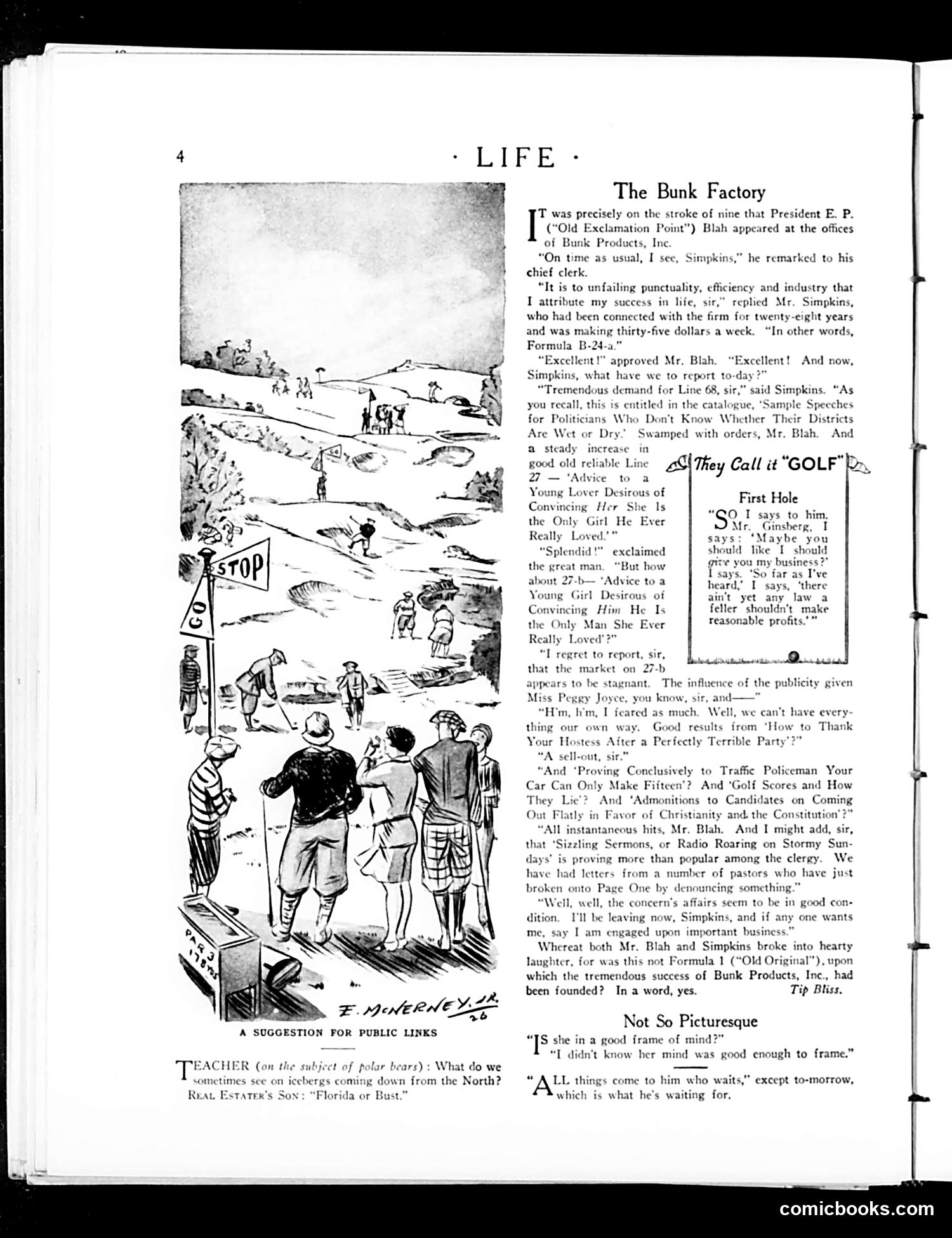
**Main Cartoon ("A Suggestion for Public Links"):** The large illustration depicts a golf course scene with a "STOP" sign, showing golfers and what appears to be chaotic traffic conditions. The title suggests satire about creating public golf links, but the cartoon seems to mock this by showing golf and street traffic awkwardly mixed—implying such a facility would be impractical or dangerous. **"The Bunk Factory" Story:** This satirical piece mocks corporate management speak. President Blah uses jargon like "Formula B-24-a" and discusses vague business concepts. The satire targets executive pretension and meaningless corporate rhetoric that obscures actual business problems. **Smaller jokes/quotes:** Brief quips about golf, business advice, and relationships appear throughout, typical of Life's miscellaneous humor format. The page exemplifies 1920s-era satire targeting business culture and leisure activities.
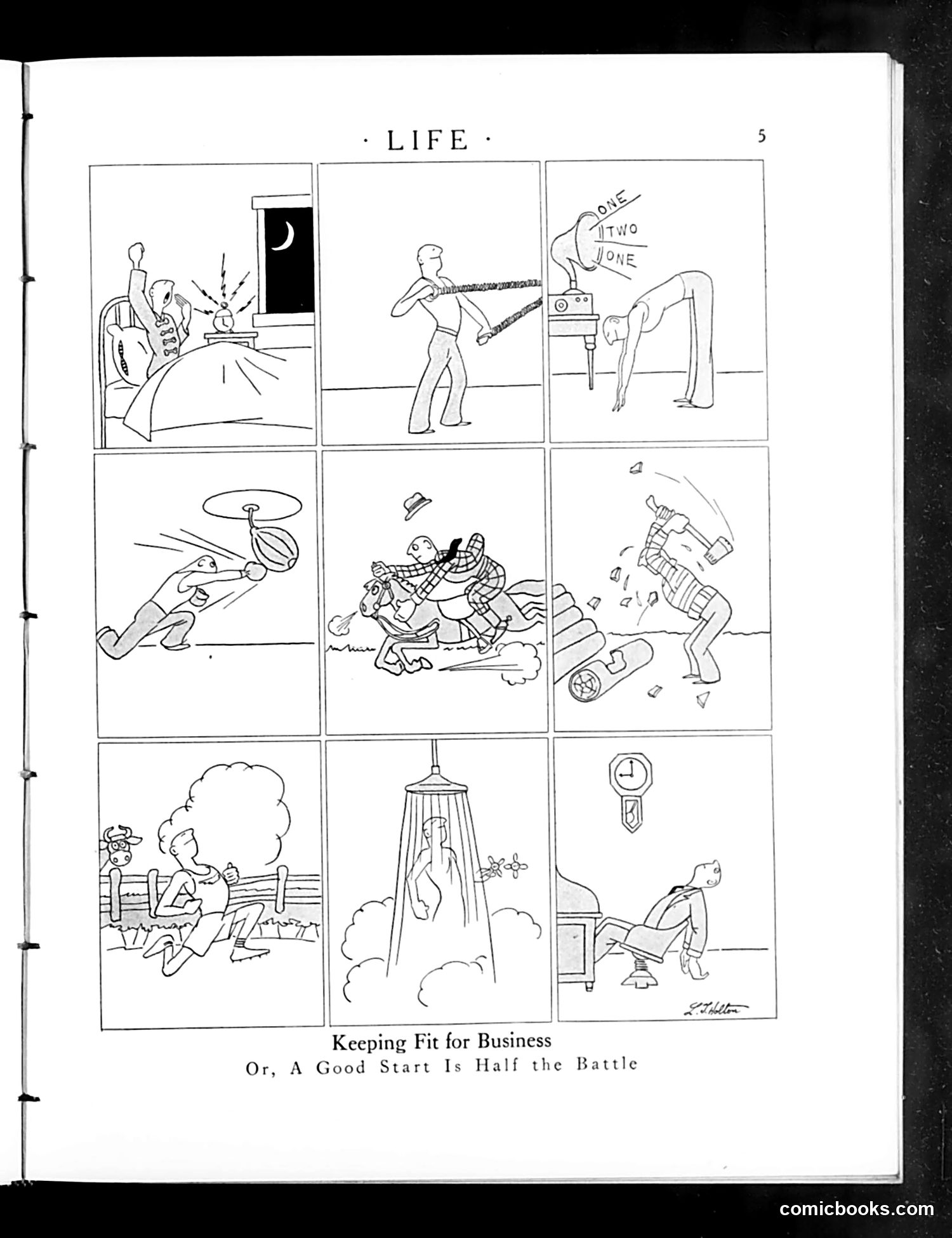
This nine-panel comic satirizes the disconnect between health advice and actual lifestyle. The title "Or, A Good Start Is Half the Battle" suggests that maintaining fitness is supposedly essential for business success. The comic follows a businessman through increasingly absurd scenarios: waking to an alarm, exercising with determination, then progressively abandoning discipline—collapsing from exertion, being knocked down, falling apart while assembling things, relaxing by a fence, taking a shower, and finally reclining exhausted by a clock. The satire targets the era's business culture and self-help rhetoric promoting "fitness," while mocking how actual businessmen fail to maintain such regimens. The joke: good intentions about health quickly crumble under real-world pressures and laziness.
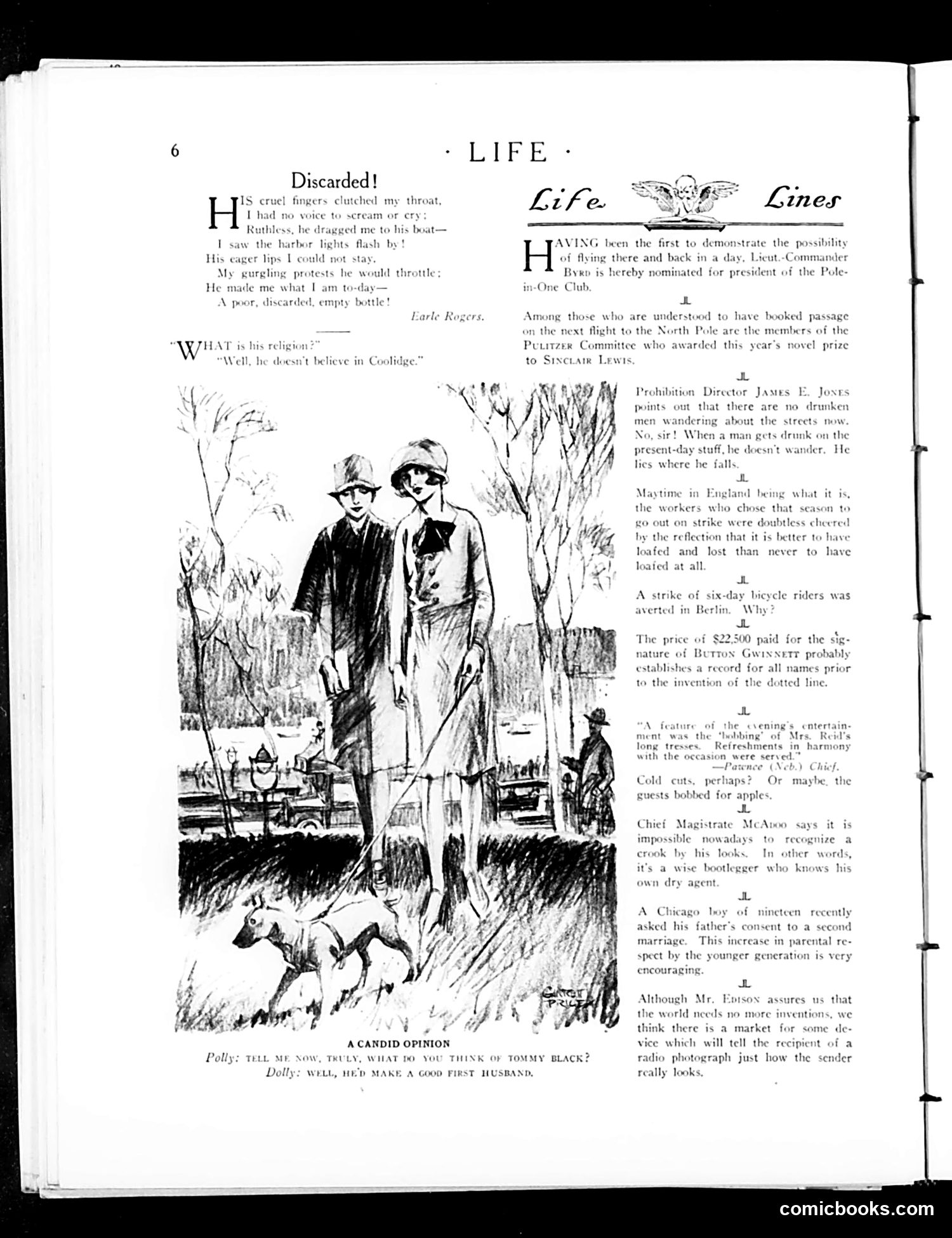
This cartoon depicts two well-dressed men in conversation about marriage prospects. The dialogue reads: "Tell me now, Truely, what do you think of this idea of Tommy Black?" / "Well, he'd make a good first husband." The satire targets the era's marriage customs and divorce attitudes. The joke implies that remarriage was becoming common enough that selecting a "first husband" (with the expectation of future husbands) seemed reasonable to society women. This reflects early 20th-century anxieties about changing social values—specifically, women's increasing independence, relaxed divorce standards, and shifting attitudes toward matrimony. The cartoon mocks both female autonomy and the apparent casualness with which marriage was being treated.
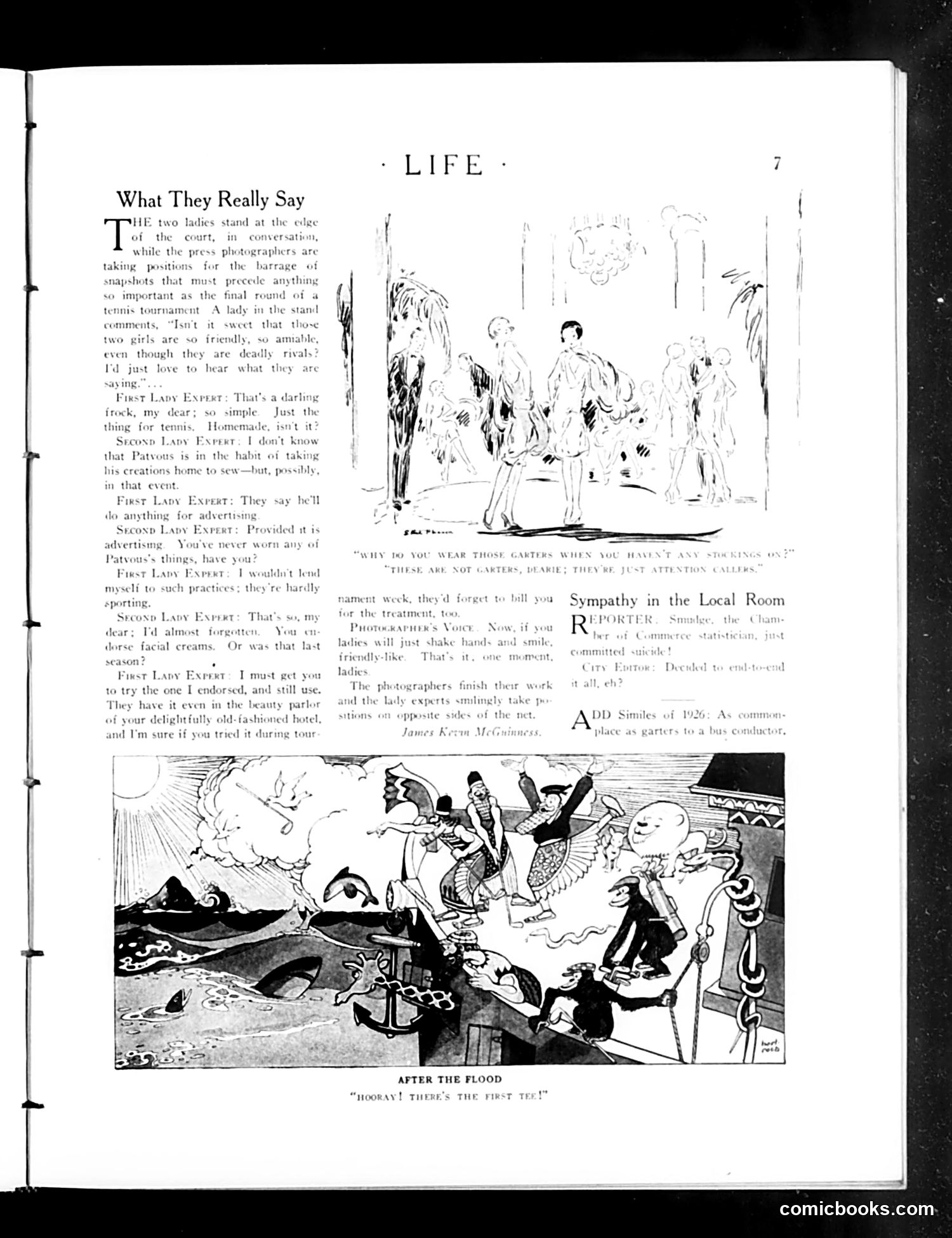
This page contains two satirical pieces from *Life* magazine. **"What They Really Say"** mocks ladies at a tennis tournament who claim friendliness while making cutting remarks about each other's appearance and fashion choices. The humor lies in the gap between their polite public behavior and their actual cattiness—a common satirical target of the era regarding high-society women. **"After the Flood"** (cartoon below) depicts post-disaster survivors celebrating their first tea service, absurdly prioritizing social ritual over survival necessities. The joke critiques British adherence to propriety and routine even in dire circumstances—a recurring theme in period satire about class-conscious behavior. Both pieces satirize the gap between appearance and reality in genteel society.
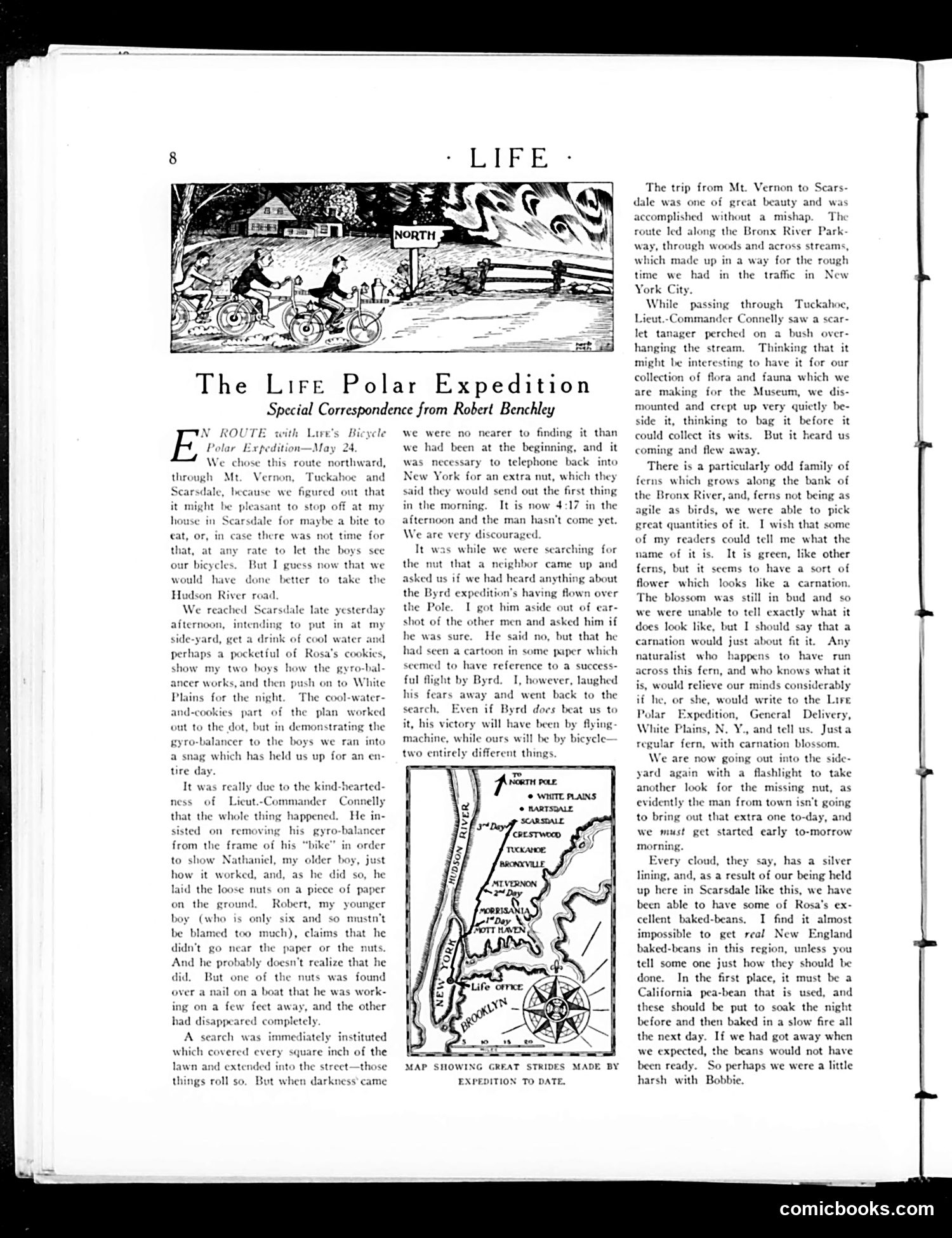
This page documents a humorous expedition by *Life* magazine staff traveling by bicycle from Mt. Vernon to Scarsdale, New York. The accompanying illustration shows cyclists on a rural road near a farmhouse. The article describes their search for a missing nutmeg plant and mentions attempting to spot a scarlet tanager. Lt. Commander Connelly reportedly saw a bird but the expedition had difficulty confirming sightings. The included map shows their route through the Bronx River Parkway area. The tone is lighthearted satire of serious polar expeditions (like Byrd's contemporary Arctic flights), with the authors humorously treating a modest local bicycle trip as an adventurous scientific mission, complete with specimen collection and detailed documentation.
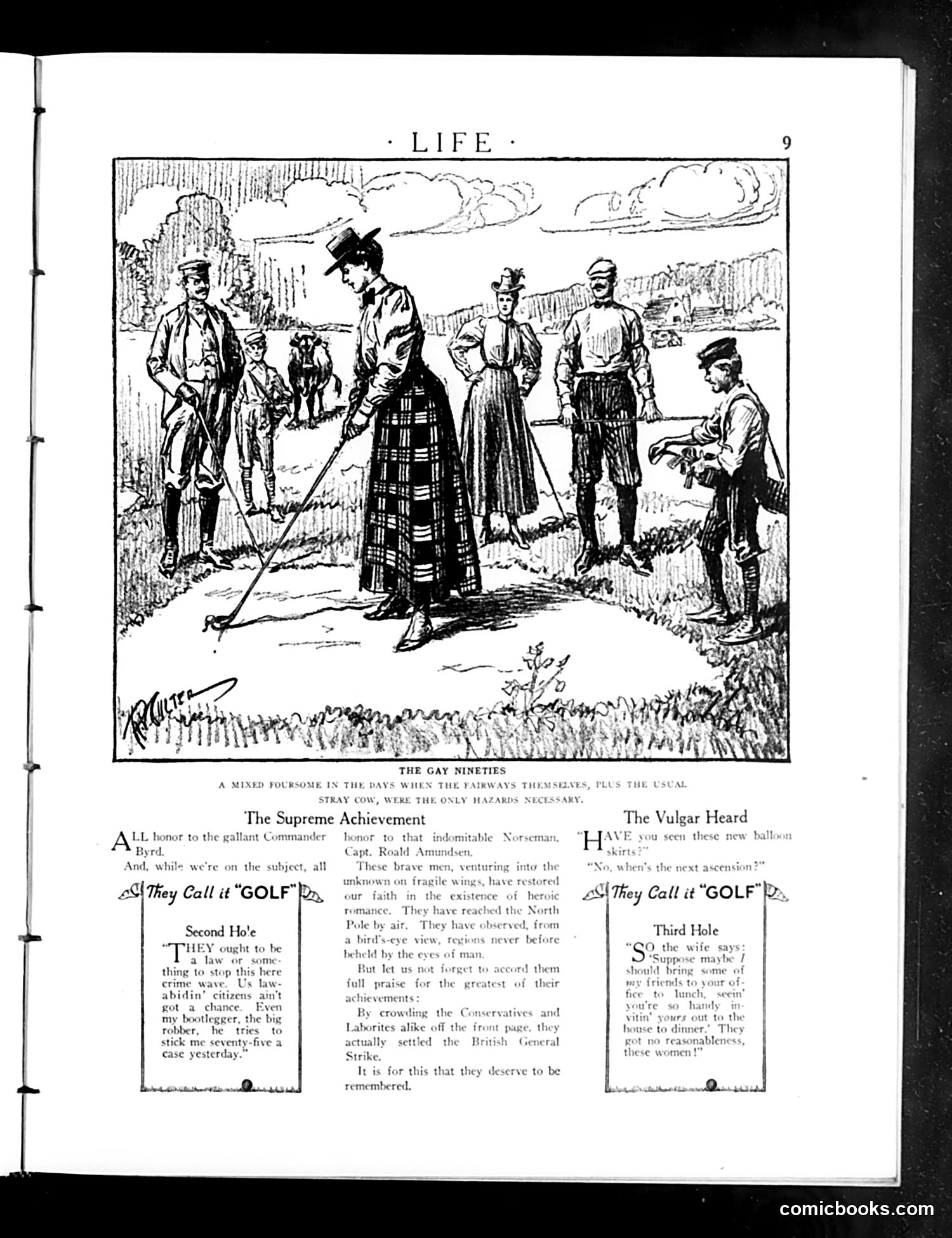
This page satirizes golf as a leisure activity among the upper classes in the 1890s. The main illustration shows a mixed group of well-dressed men and women at a golf course, with the caption noting that fairways "plus the usual stray cow, were the only hazards necessary." The two side columns mock golf pretensions: "The Supreme Achievement" praises golf as heroic and noble, while "The Vulgar Heard" presents working-class skepticism about the sport's value. One section jokes that a golfer who scores seventy-five "tries to do seventy-five a case yesterday"—suggesting golfers exaggerate their achievements as badly as they lie about other matters. The satire targets golf's elevation to an almost mythic status among the affluent, treating a leisure game as worthy of serious praise.
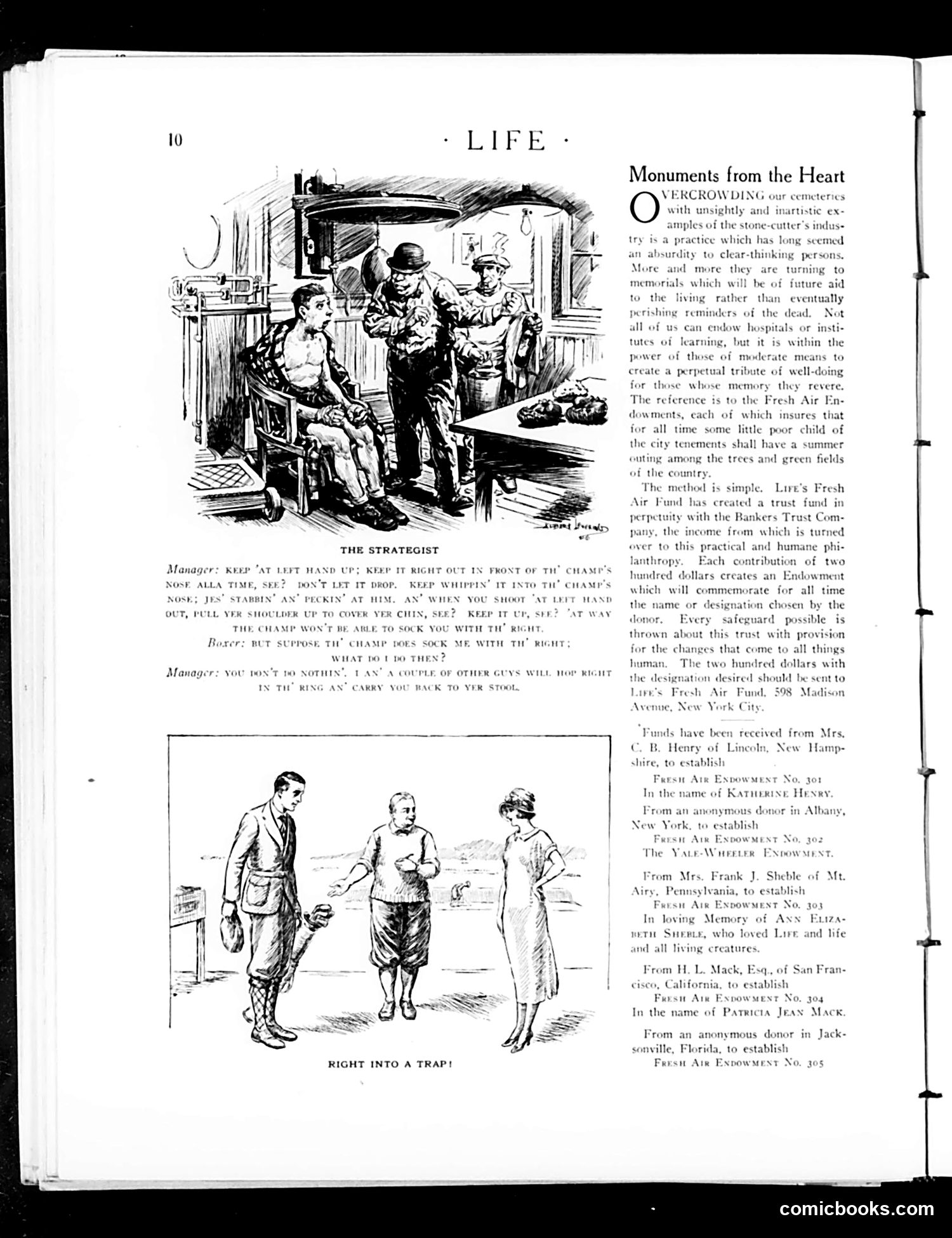
**"The Strategist"** depicts a domestic argument. A wife sits while a husband and two other men stand, apparently giving him boxing/fighting instructions. The dialogue reveals the joke: the men coach him on boxing stance and strategy, but when his wife interrupts, he instantly defers to her authority—demonstrating that despite masculine posturing about fighting, husbands are actually subordinate to their wives at home. **"Right Into a Trap!"** shows a man approaching a woman while another man watches—suggesting the woman is setting up the approaching man for some romantic or social misadventure. The right column contains **"Monuments from the Heart,"** describing Life's Fresh Air Endowments—charitable funds creating perpetual memorials for deceased children through outdoor spaces and environmental conservation.
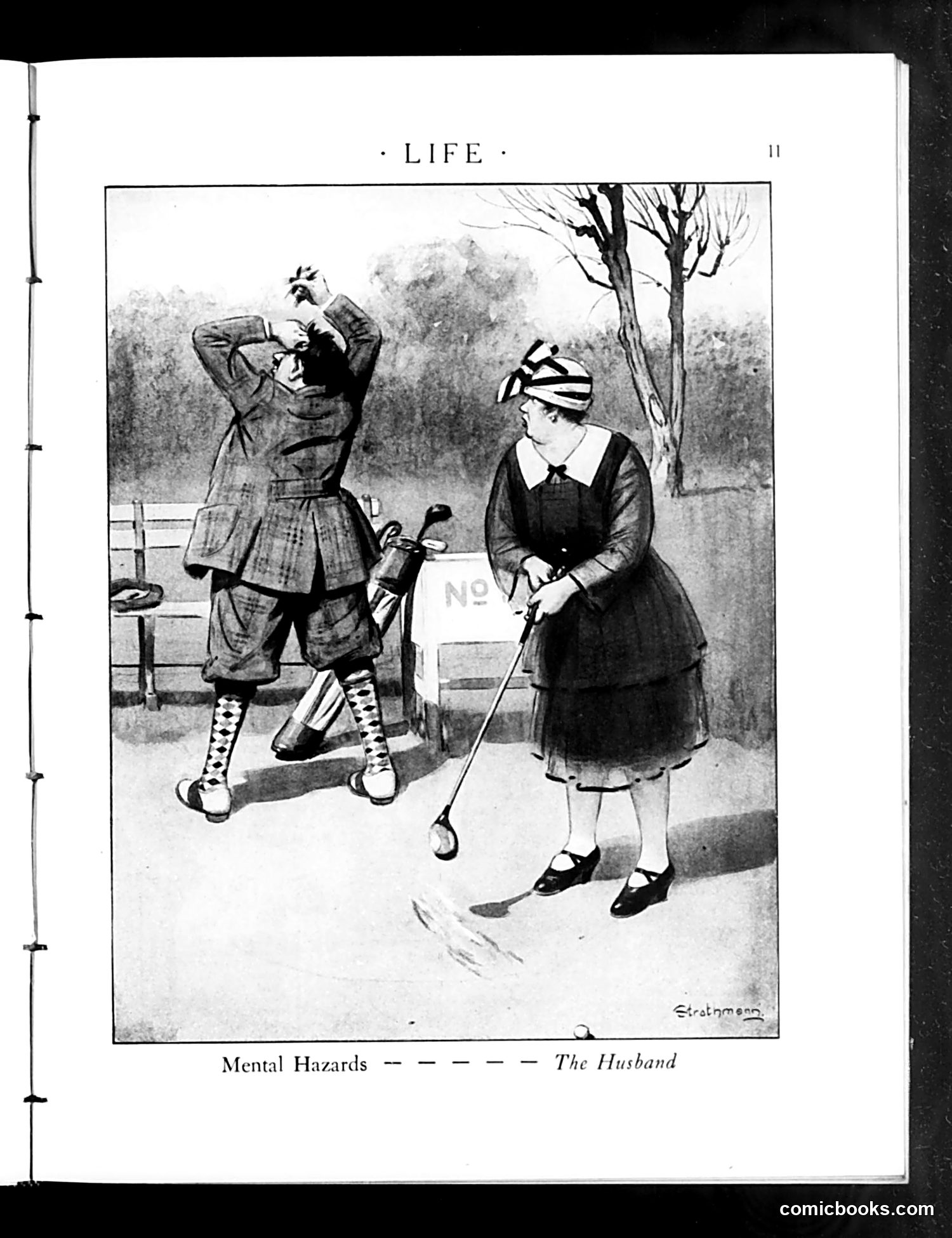
This cartoon satirizes the domestic anxieties of married men, specifically their concerns about their wives' new interest in golf. The illustration shows a husband in plaid knickers and checkered socks anxiously shielding his eyes—perhaps from the sun or in distress—while his wife confidently holds a golf club beside him on what appears to be a golf course. The joke plays on "mental hazards": rather than literal golf hazards, the husband's real worry is his wife's independent hobby and athletic pursuits. The early 20th-century satire suggests anxiety about changing gender roles, as women increasingly participated in sports and activities previously dominated by men, potentially threatening traditional domestic arrangements.
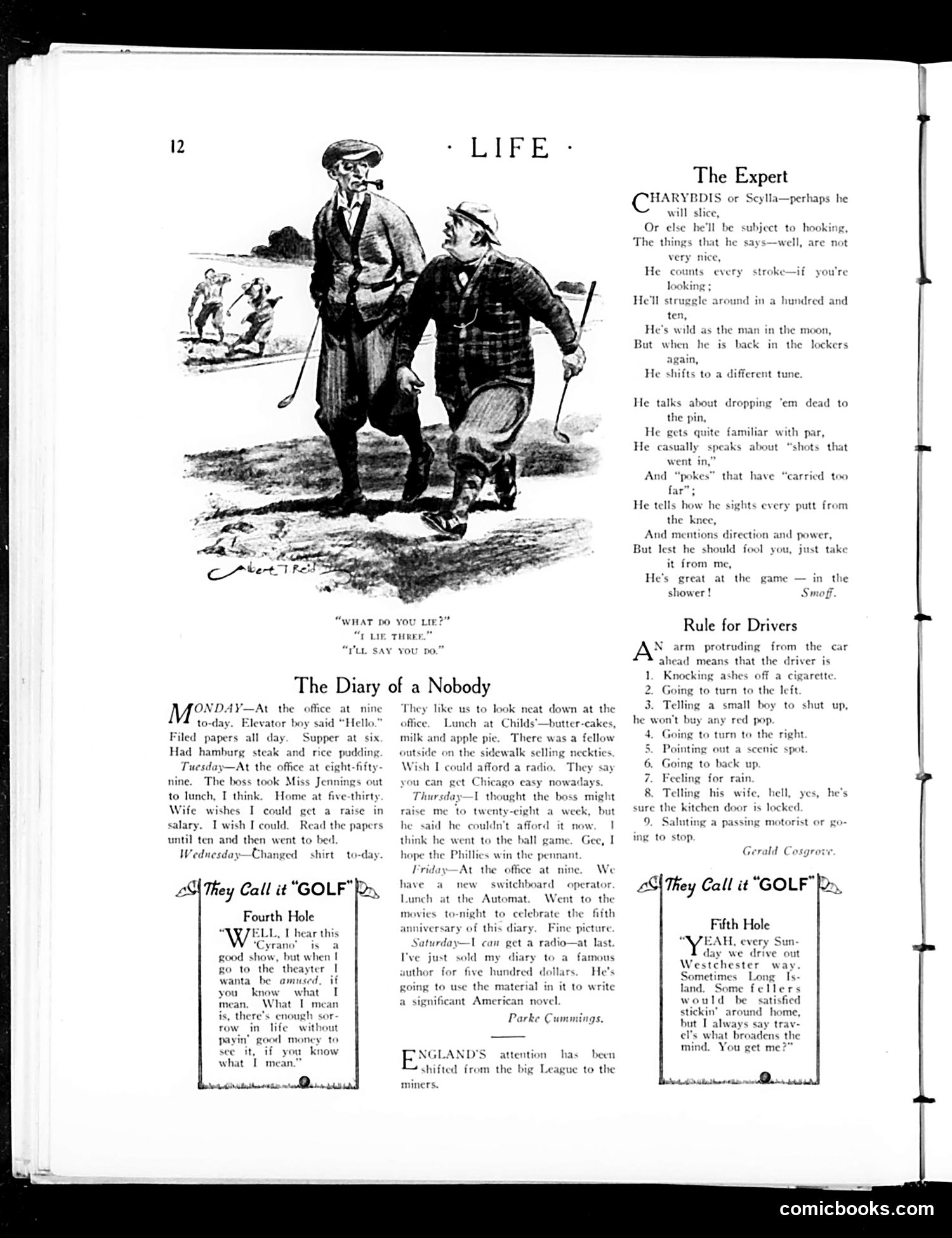
This page from *Life* magazine contains golf humor and social satire typical of early 20th-century American publications. **"The Expert"** cartoon mocks golfers who boast excessively about their game while performing poorly on the course. The accompanying verse describes a man who claims expertise but "shifts to a different tune" when back among peers—satirizing pretentious bragging and inconsistency. **"The Diary of a Nobody"** humorously documents a mundane office worker's week, capturing workplace tedium and modest aspirations (hoping for a radio, attending movies). The humor lies in the contrast between ordinary life and the character's modest hopes. **"Rule for Drivers"** satirizes poor driving etiquette—knocking ash from cigarettes, ignoring turn signals, speeding, and generally reckless behavior. It's social commentary on emerging automobile culture and irresponsible drivers. The golf sections feature amateur golfers discussing their handicaps and game frustrations.
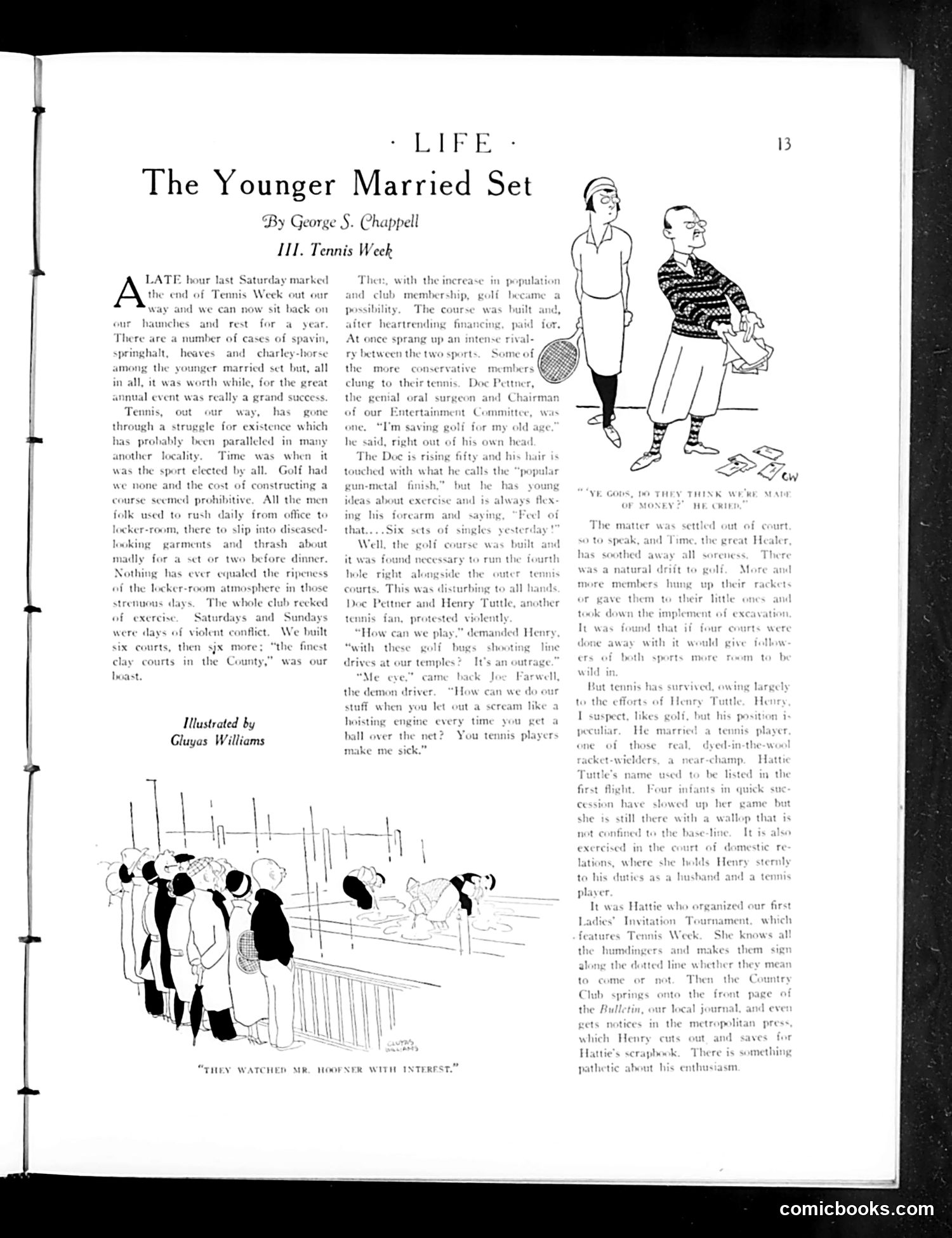
This article by George S. Chappell satirizes wealthy young married couples and their leisure pursuits around "Tennis Week." The piece mocks how golf and tennis have become status symbols among this social class, creating absurd rivalries and pretensions. The cartoon below illustrates the satire: spectators watching tennis with exaggerated interest, captioned "They watched Mr. Hoover with interest." This appears to reference Herbert Hoover (president 1929-1933), suggesting even prominent figures couldn't escape the fashionable obsession with lawn tennis among the elite. The article's broader joke: the younger married set's desperate social climbing through sports, their complaints about competition, and how these activities consume their lives—mocking the superficiality and status-consciousness of this demographic.
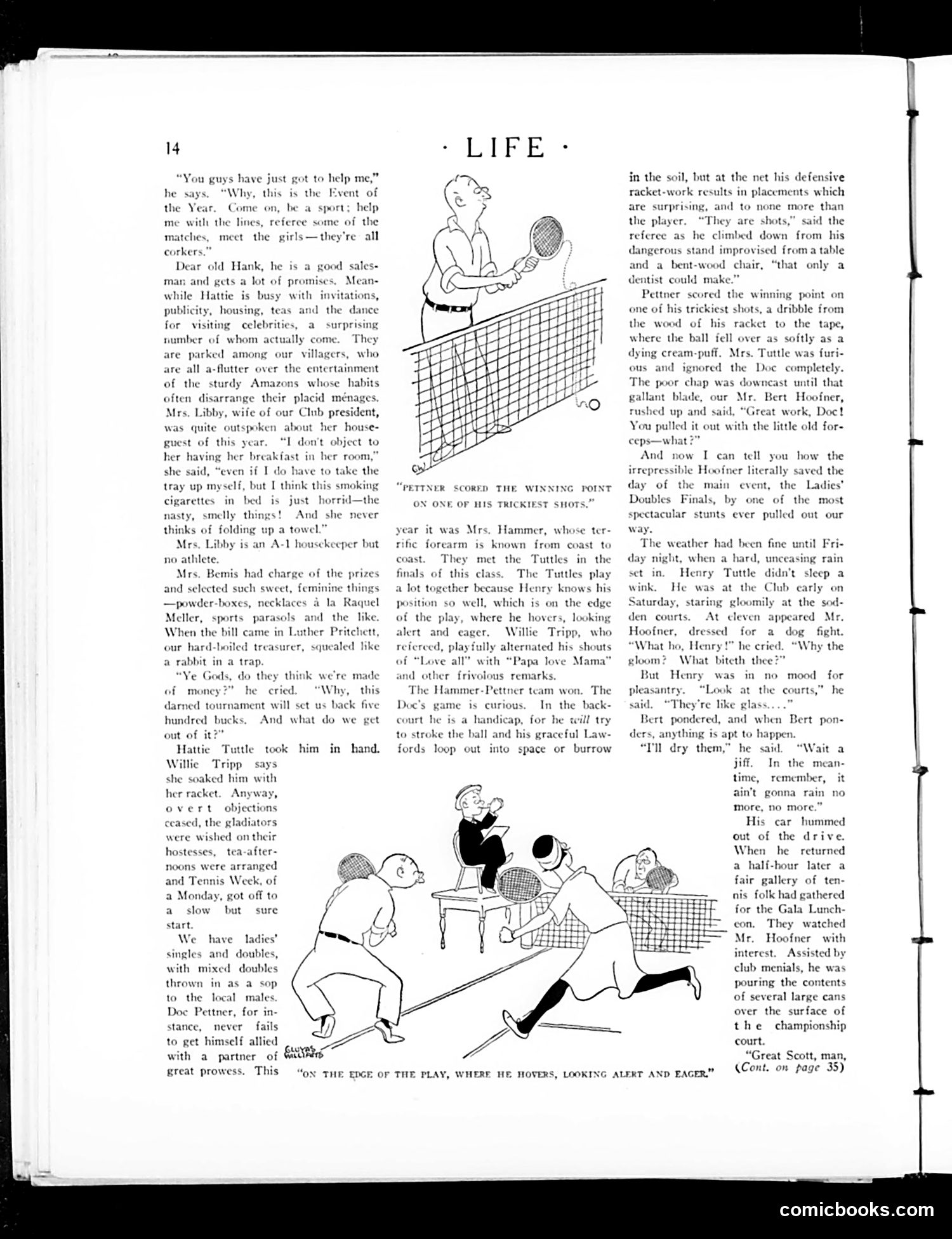
This page contains a humorous sports narrative about a tennis tournament, illustrated with line drawings. The main cartoon shows **Doc Pettner scoring a winning point** with an unorthodox shot—a dribble from his racket that drops softly over the net, described as "one of his trickiest shots." The accompanying text jokes about organizing a society tennis event featuring "ladies' singles and doubles, with mixed doubles" as a fundraiser. The satire targets the pretensions of wealthy socialites who patronize such tournaments, with references to prize-winners like "Mrs. Hank" and the competitive drama around securing partners. A secondary cartoon depicts players "on the edge of play" in characteristic dramatic poses. The humor stems from satirizing amateur society tennis and the self-importance surrounding these social sporting events among the leisure class.
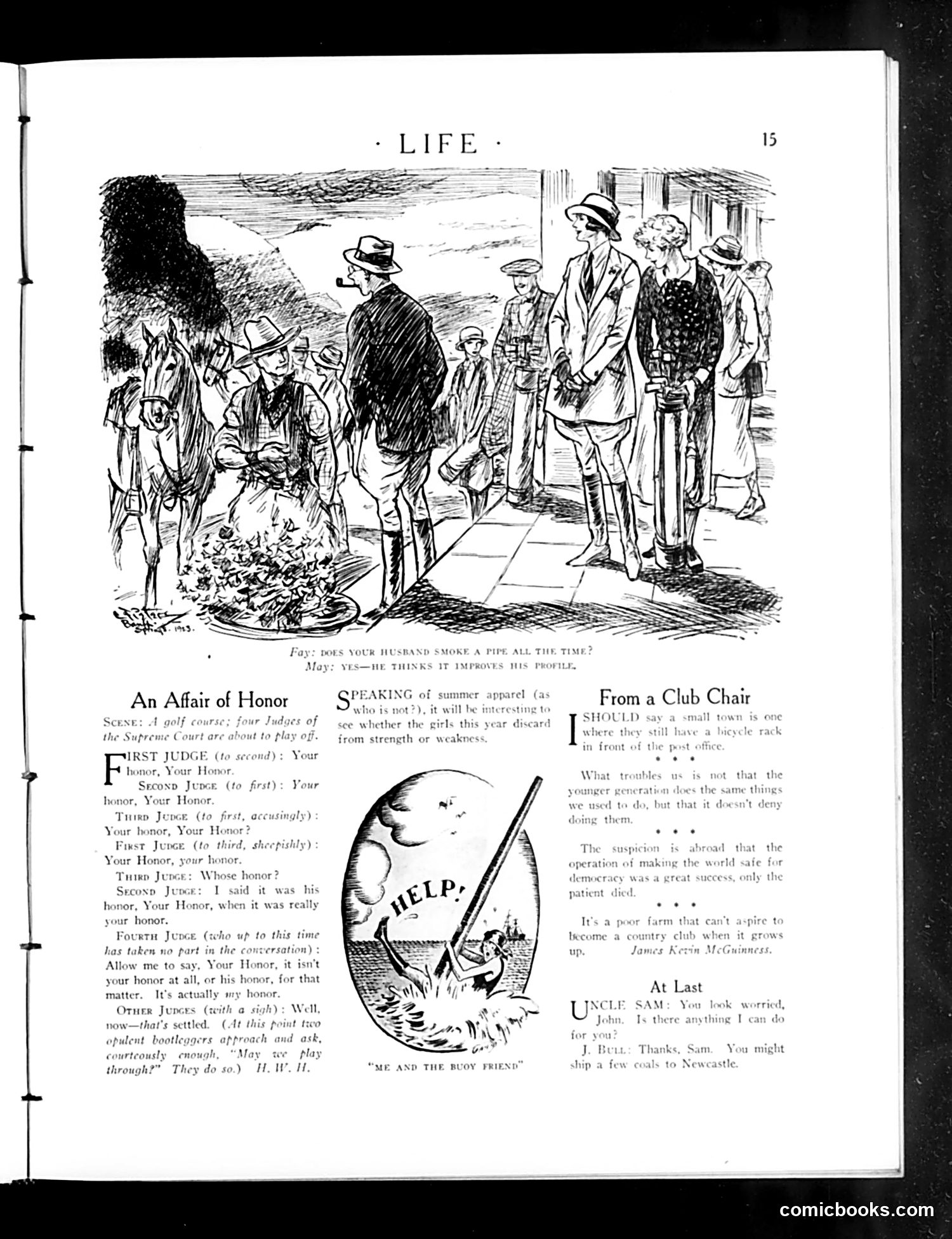
This page contains three distinct humor pieces: **Top cartoon**: Shows a couple with a woman asking her husband if he smokes a pipe all the time. The husband replies he thinks it "improves his profile"—a visual joke about vanity and self-perception versus reality. **"An Affair of Honor"**: A sketch-format satire depicting multiple judges debating whose honor has been insulted, likely mocking the absurdity of formal legal proceedings over trivial matters of pride or etiquette. **"Me and the Busy Friend"**: An illustration of a man clutching a buoy labeled "HELP," satirizing the difficulty of getting assistance from someone perpetually occupied. **"From a Club Chair"** and **"At Last"**: Brief prose humor pieces commenting on generational differences and social expectations, characteristic of Life's satirical style.
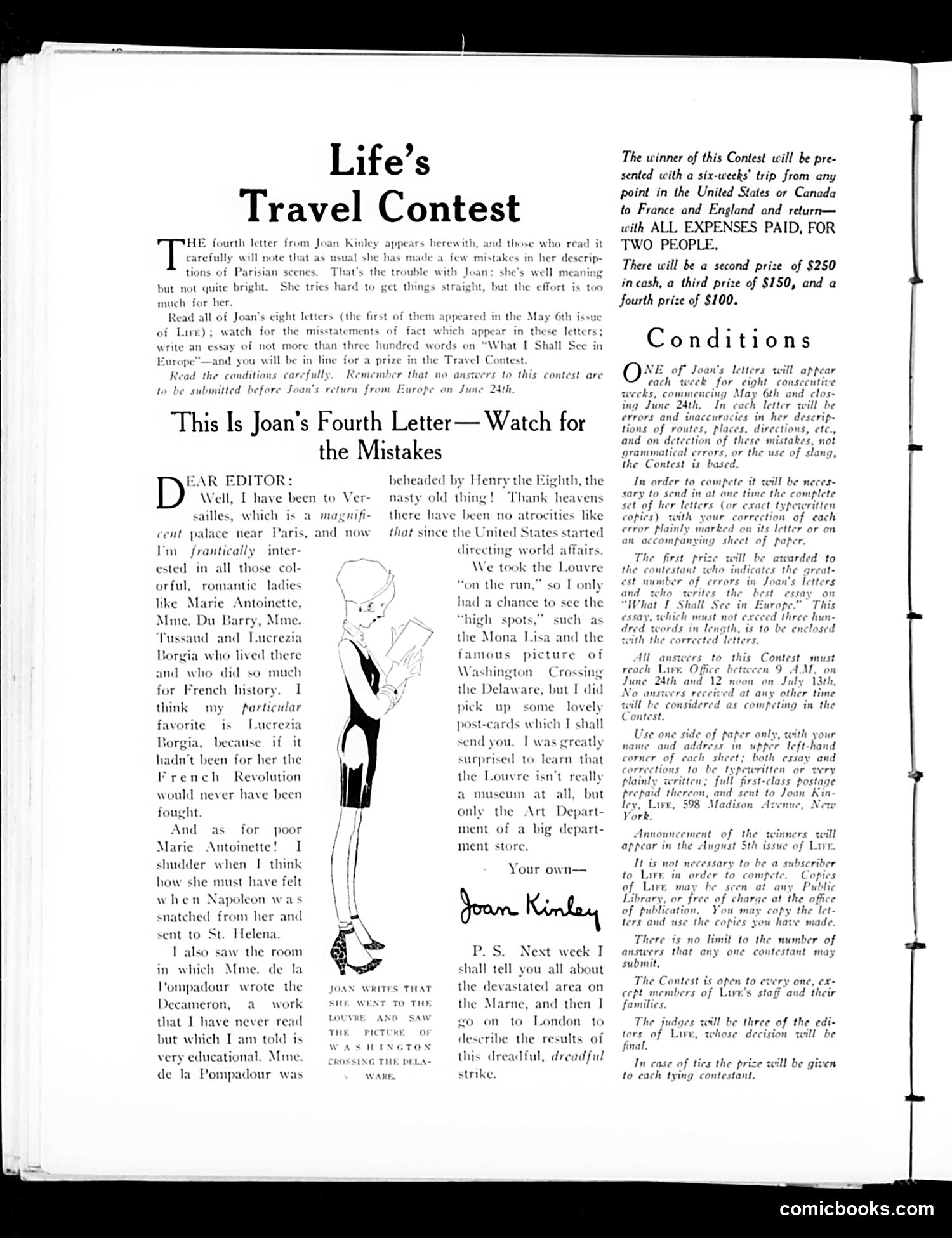
This page announces a travel writing contest soliciting essays from readers about European trips. Joan Kinley, identified as a regular Life contributor, presents her fourth letter describing travels to Versailles and Paris landmarks like the Louvre. The editorial framing humorously notes Kinley "has made a few mistakes in her descriptions of Parisian sights"—the contest explicitly invites readers to identify errors in her letter and submit corrected essays for prizes (a trip to Europe for the winner, plus cash awards). The small illustration shows a fashionably-dressed woman, likely representing Kinley or the typical female traveler of the era. The satire gently mocks both Kinley's imprecise travel reporting and the broader phenomenon of amateur travel writing, inviting reader participation through error-spotting.
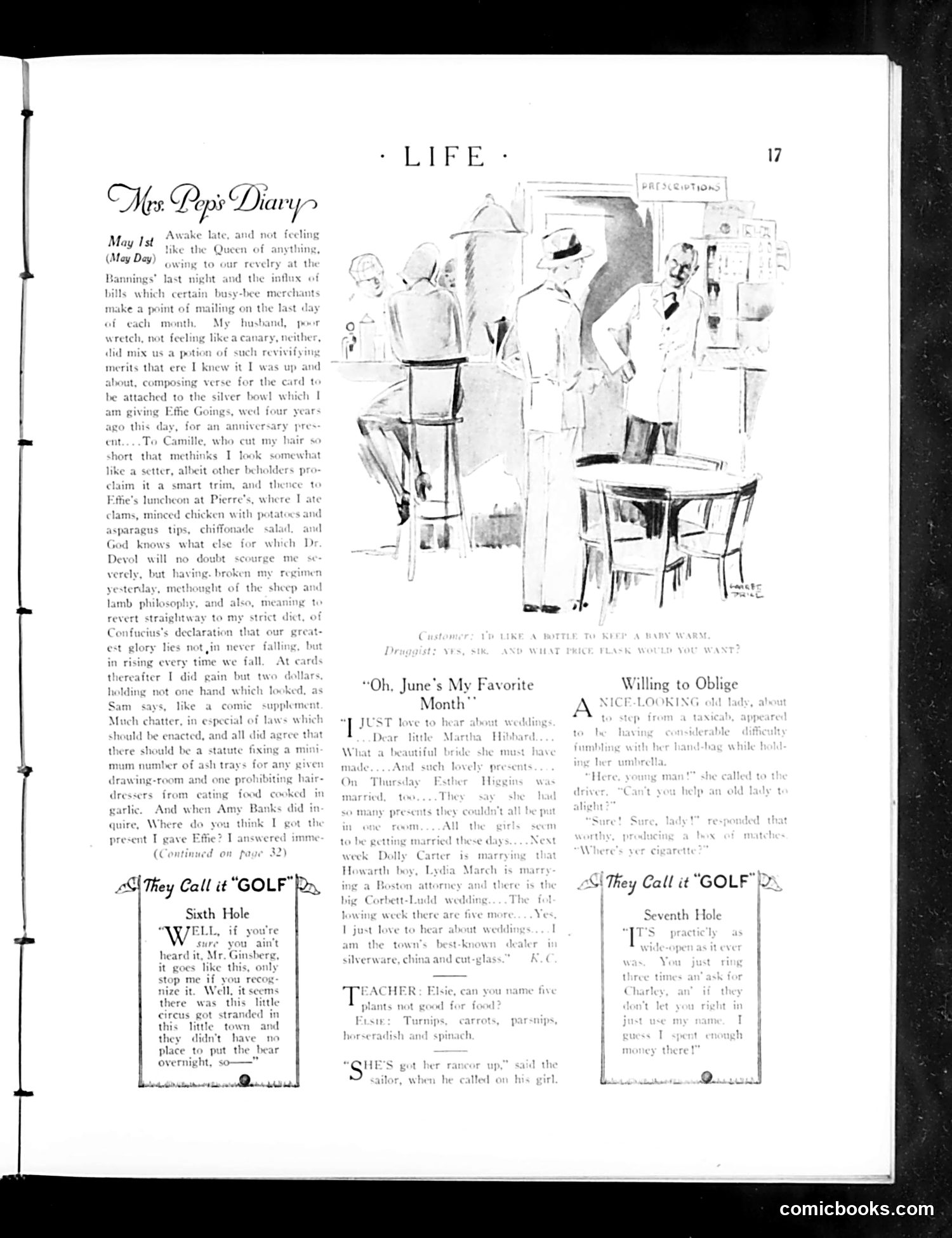
This page contains three satirical sections typical of Life magazine's humor format: **"Mrs. Pop's Diary"** (top left): A domestic diary entry for May Day expressing marital frustration—the wife feels neglected, complains about her husband's indifference, and sarcastically notes he's proposed renewing their vows for an anniversary, yet remains emotionally distant. This satirizes marriages that persist without genuine affection. **"Golf" Cartoons** (bottom): Two brief humor panels playing on golf terminology. The "Sixth Hole" and "Seventh Hole" comics appear to make double-entendre jokes using golf references—a common device in period humor magazines. **"Oh, June's My Favorite Month"** and **"Willing to Oblige"** (center): Gossip-style columns about weddings and social happenings, mocking the obsession with wedding season and society marriages. They satirize both women's preoccupation with matrimony and the superficiality of high-society events. The overall page targets domestic relationships, marriages of convenience, and women's social aspirations—typical targets of satirical magazines aimed at educated, urban readers.
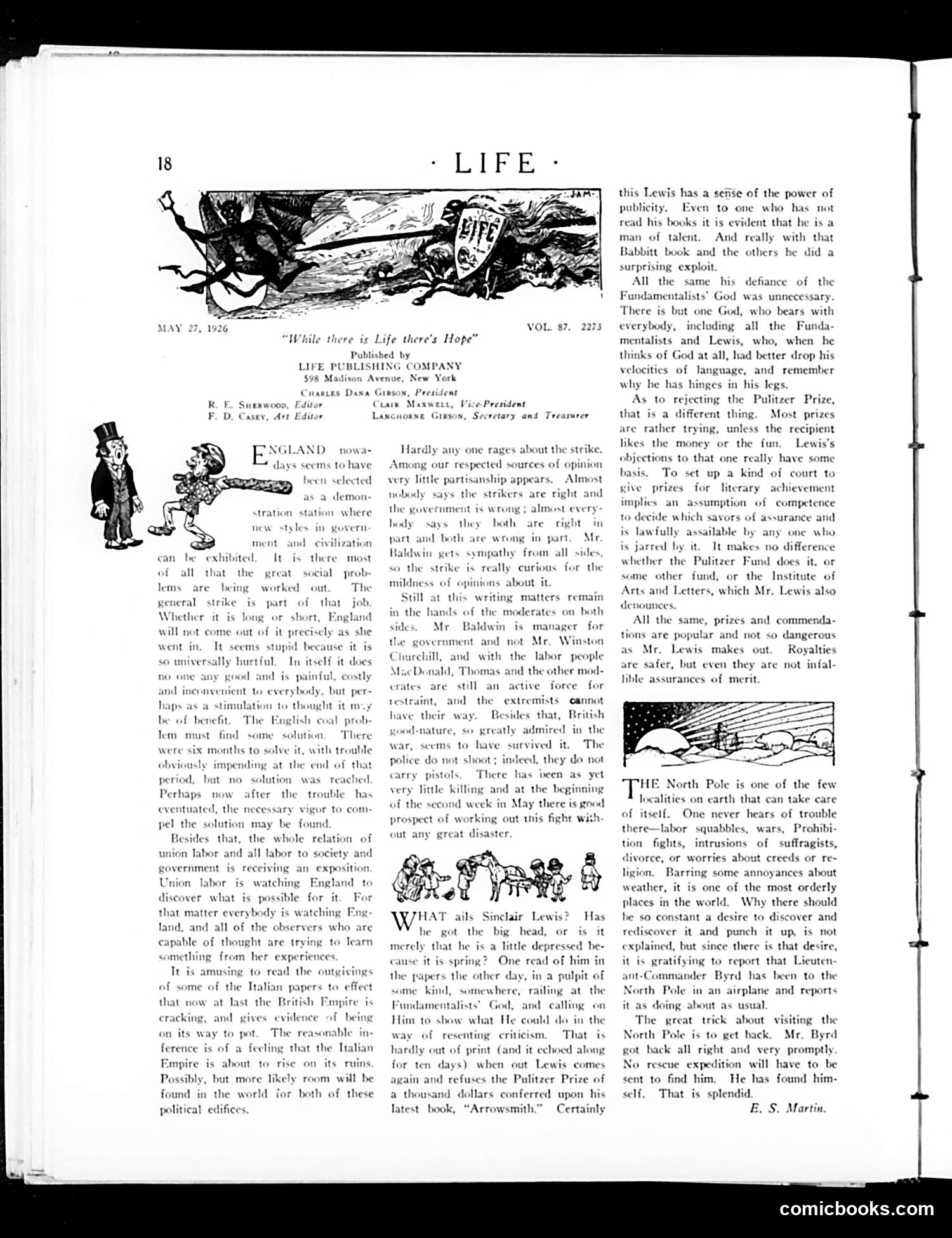
This page contains two distinct pieces of satire: **The English General Strike**: The lead article critiques Britain's 1926 coal miners' strike and general labor unrest. Life observes that England has become a "demonstration station" for new forms of government conflict. The author notes the strike solves nothing and causes suffering, yet serves as a "stimulation to thought" on labor relations. Notably, Life criticizes both strikers and government as partially wrong, and praises British restraint—police don't shoot, there's minimal killing. **Sinclair Lewis and the Pulitzer Prize**: The second section attacks novelist Sinclair Lewis for publicly rejecting the Pulitzer Prize and for his theatrical denunciation of Christian Fundamentalists. Life acknowledges Lewis's talent (*Babbitt*, *Arrowsmith*) but finds his defiance of Fundamentalists "unnecessary" and his publicity-seeking grandstanding. The magazine defends the Pulitzer while admitting literary prizes are inherently presumptuous—a characteristically backhanded compliment.
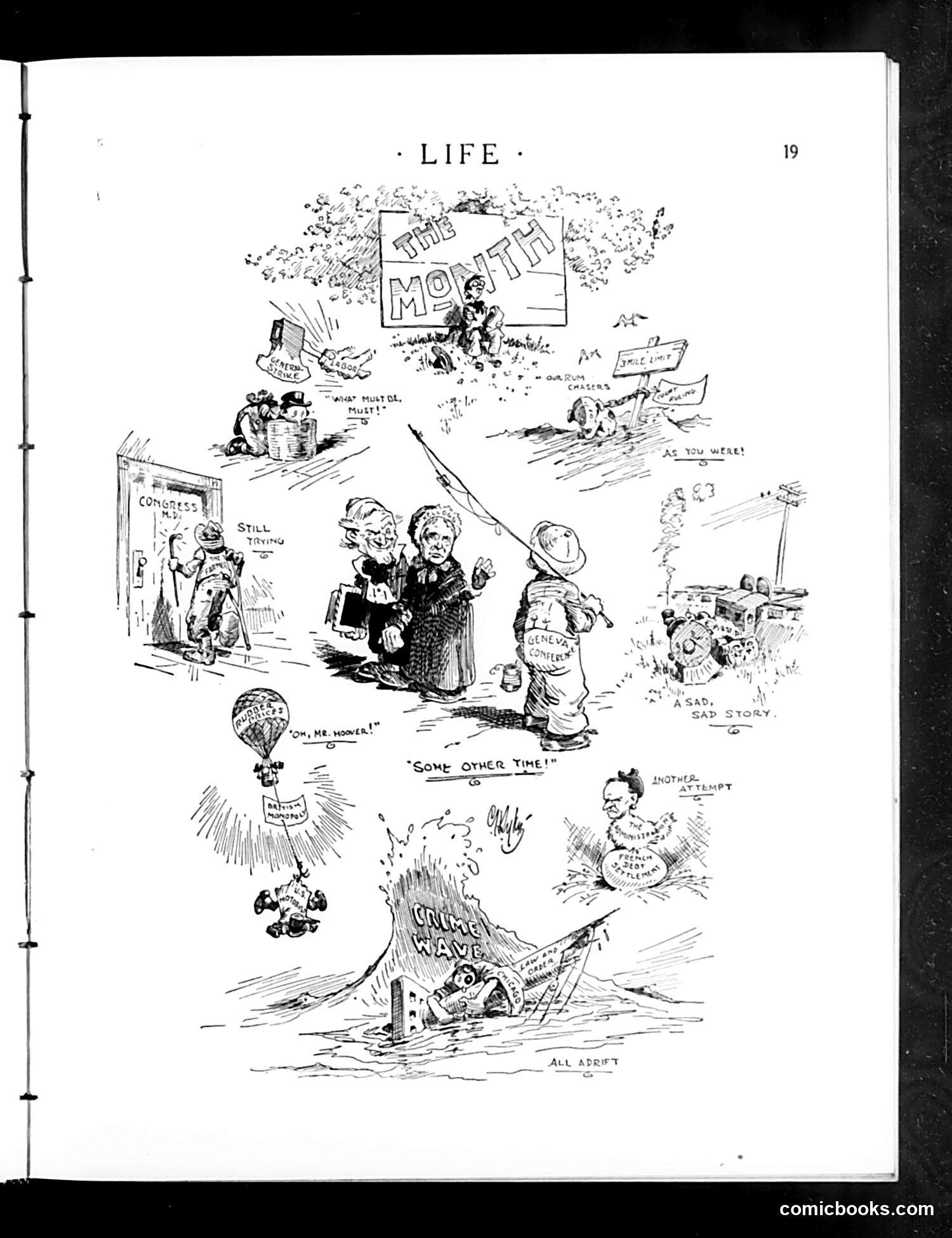
This is a satirical overview of current events, depicted through multiple vignettes. The central figures appear to be politicians or public figures engaged in various struggles and failures—suggested by captions like "Some Other Time," "A Sad, Sad Story," and "All Adrift." One scene shows a figure at a "Congress" door labeled "Still Trying," implying legislative frustration. Another depicts what appears to be economic or political turbulence ("The Wave"), with figures struggling amid chaos. The "Balloon" reference and "Oh, Me Homer!" suggest contemporary disasters or mishaps. The overall theme appears to satirize political incompetence, failed initiatives, and societal chaos during a specific period, though without dating information, the exact events referenced remain unclear.
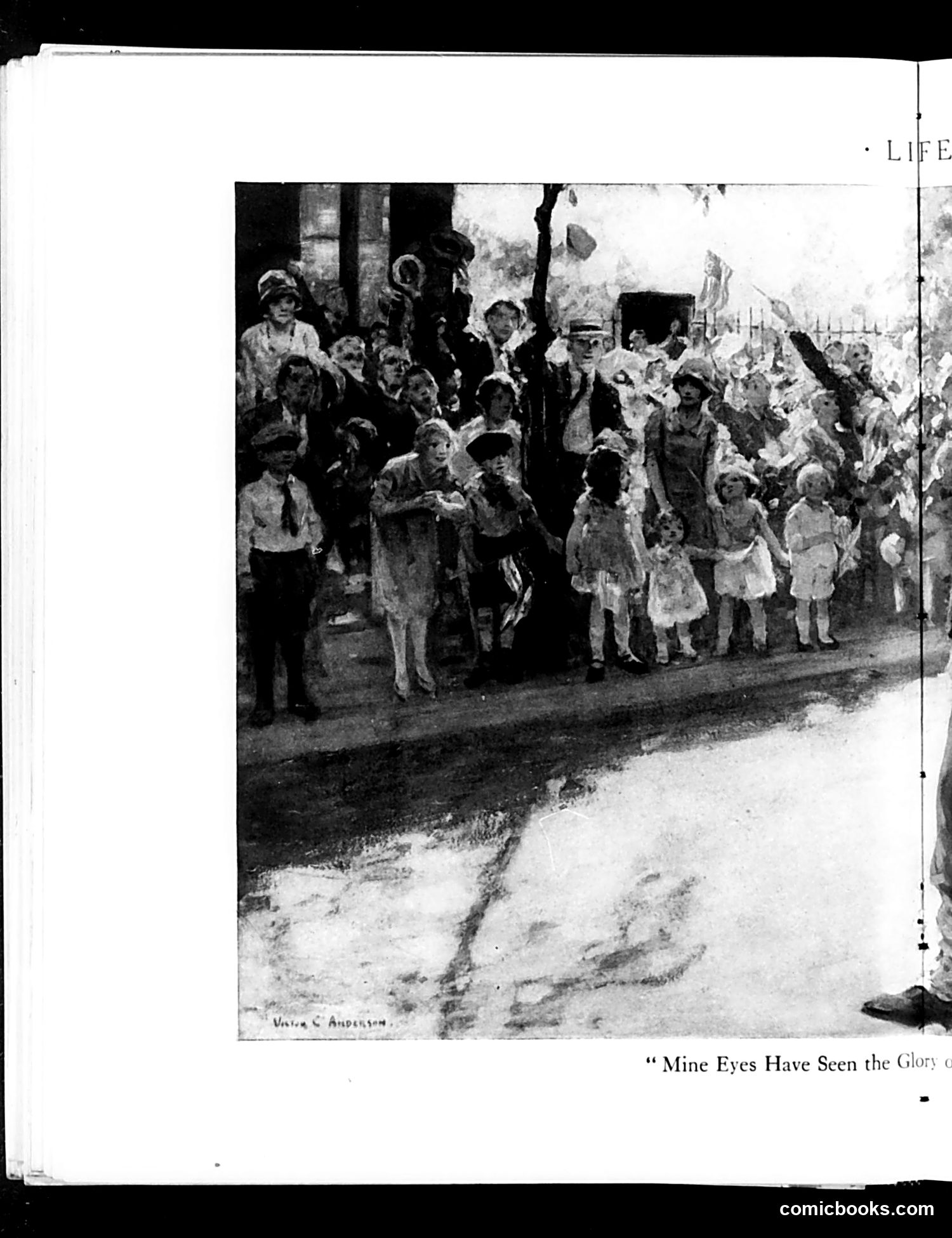
This appears to be a Life magazine page featuring a photograph credited to Vivian C. Anderson. The image shows a crowd scene with adults and children gathered outdoors, some wearing hats and period clothing that suggests early-to-mid 20th century. The caption begins "Mine Eyes Have Seen the Glory," referencing the hymn "Battle Hymn of the Republic," which carries patriotic or moral significance. Without the complete caption text, I cannot definitively identify what specific event, person, or social commentary this illustrates. The gathering appears celebratory or ceremonial in nature. The satirical intent—if present—likely connects the crowd scene to the patriotic hymn reference, but I cannot specify the exact political or social point without more textual context.
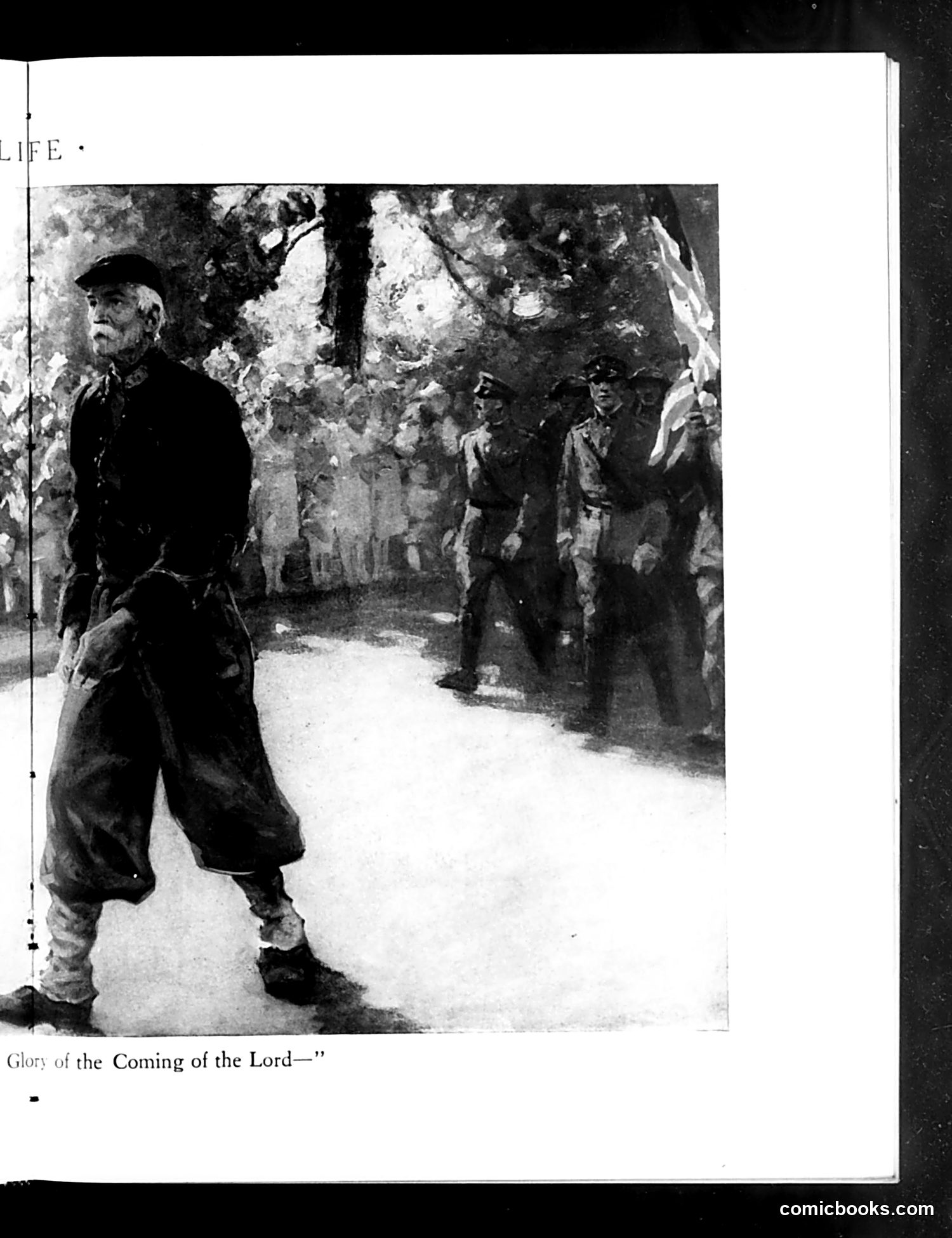
This appears to be a satirical illustration from *Life* magazine showing a military or authoritarian figure in the foreground (wearing a cap and heavy coat) confronting or surveying a group of people gathered against a wall in the background. The caption's religious reference—"Glory of the Coming of the Lord"—paired with the ominous, confrontational scene suggests ironic commentary on power, authority, or possibly militarism being presented under the guise of religious justification. The composition emphasizes the hierarchical relationship between the lone authority figure and the gathered crowd, implying social or political critique. Without the publication date visible, the specific historical event or political figure referenced remains unclear, though the style and tone suggest early-to-mid twentieth-century satirical commentary on authoritarian conduct or governance.
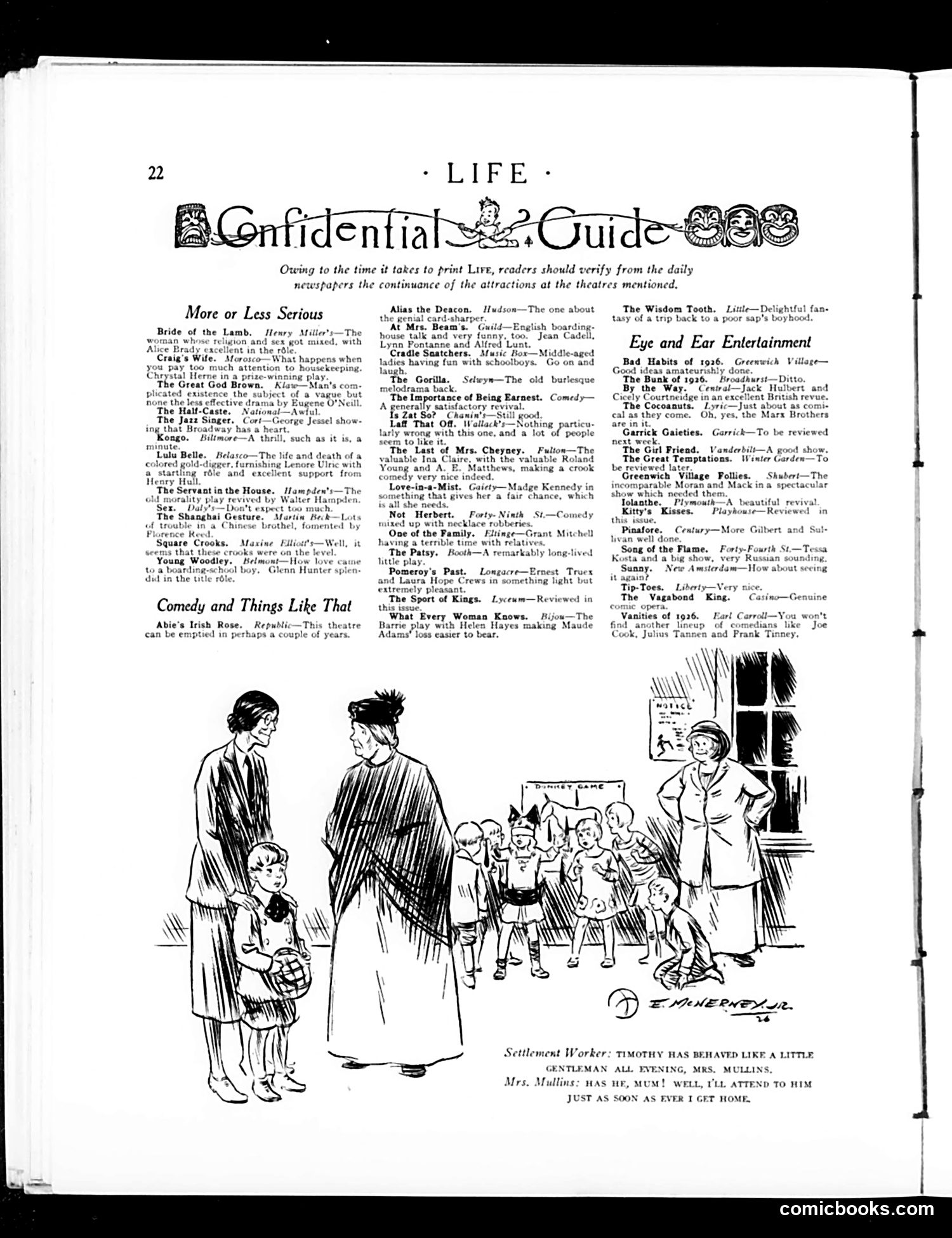
This page is primarily a **theater guide** listing Broadway shows currently playing, with brief critical capsule reviews organized by tone ("More or Less Serious," "Comedy and Things Like That," "Eye and Ear Entertainment"). The **single cartoon** at bottom depicts a domestic scene: a settlement worker praising a boy named Timothy for his gentlemanly behavior all evening, while the boy's mother responds she'll "attend to him just as soon as ever I get home." The **satire targets middle-class parenting contradictions**—the implication being that Timothy's good behavior under outside supervision will dissolve into misbehavior once home, and his mother threatens immediate punishment. It mocks both the performative nature of childhood propriety and the class anxiety around appearing respectable to authority figures like settlement workers (who served poor/working-class neighborhoods). The cartoon assumes readers recognize "settlement workers" as Progressive Era social reformers—a reference that would be familiar to 1920s Life readers but requires historical context today.
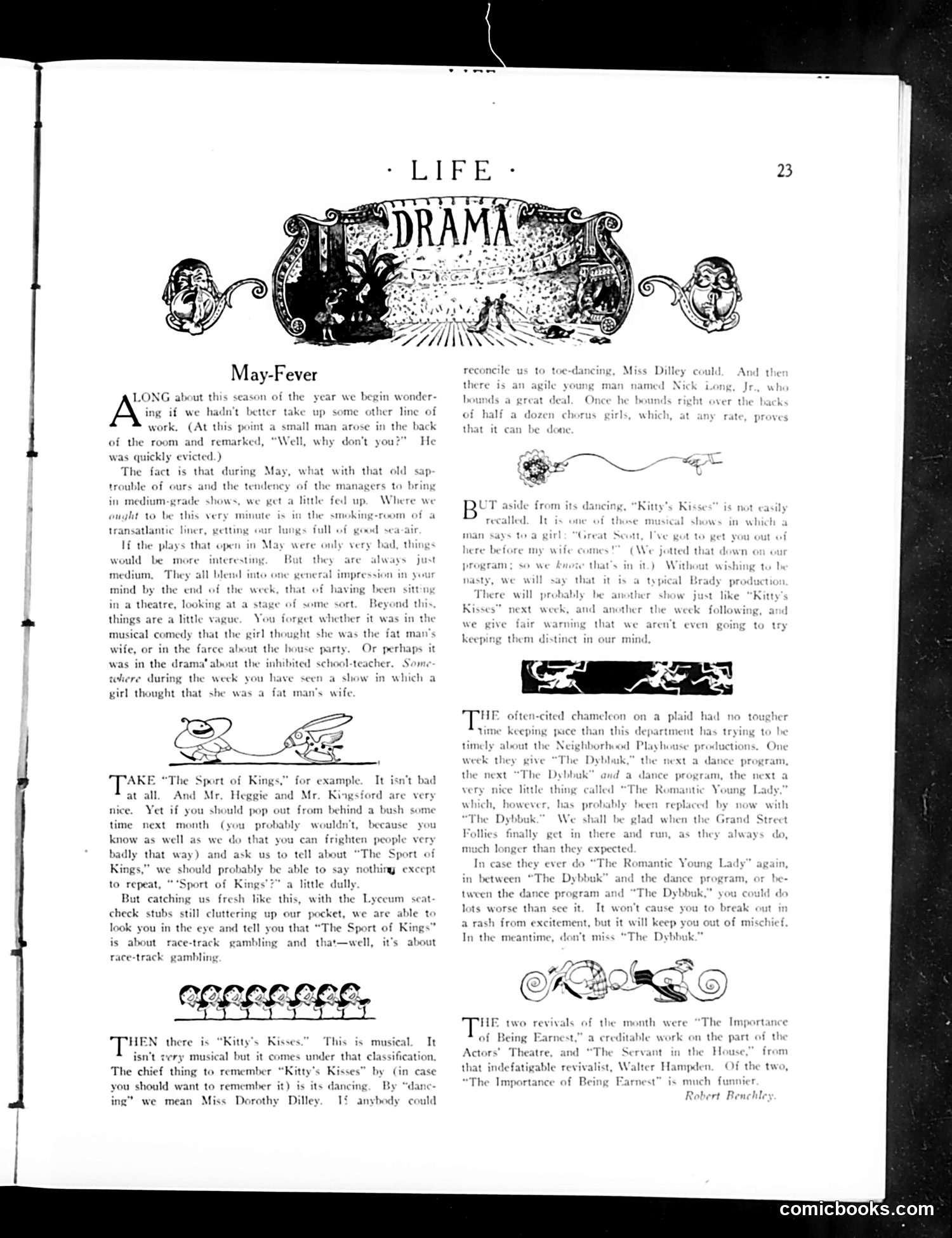
This is a theater review column about the spring theatrical season's peculiar challenges. The writer humorously complains that May's weather and theatrical glut create mental fog—audiences forget which show they attended or what happened in it. The column reviews several productions: "The Sport of Kings" (a race-track gambling drama), "Kitty's Kisses" (a musical featuring dancer Dorothy Dilley), "The Dybbuk" (a dance program), and revivals of "The Importance of Being Earnest" and "The Servant in the House." The satire targets theater-goers' distraction during May season. The opening anecdote—where someone in the audience is ejected for heckling—sets a comedic tone. The joke is that so many mediocre shows open simultaneously that patrons lose track of what they've seen, unable to recall basic plot details days later. It's social satire about urban entertainment consumption and mental exhaustion from cultural overload.
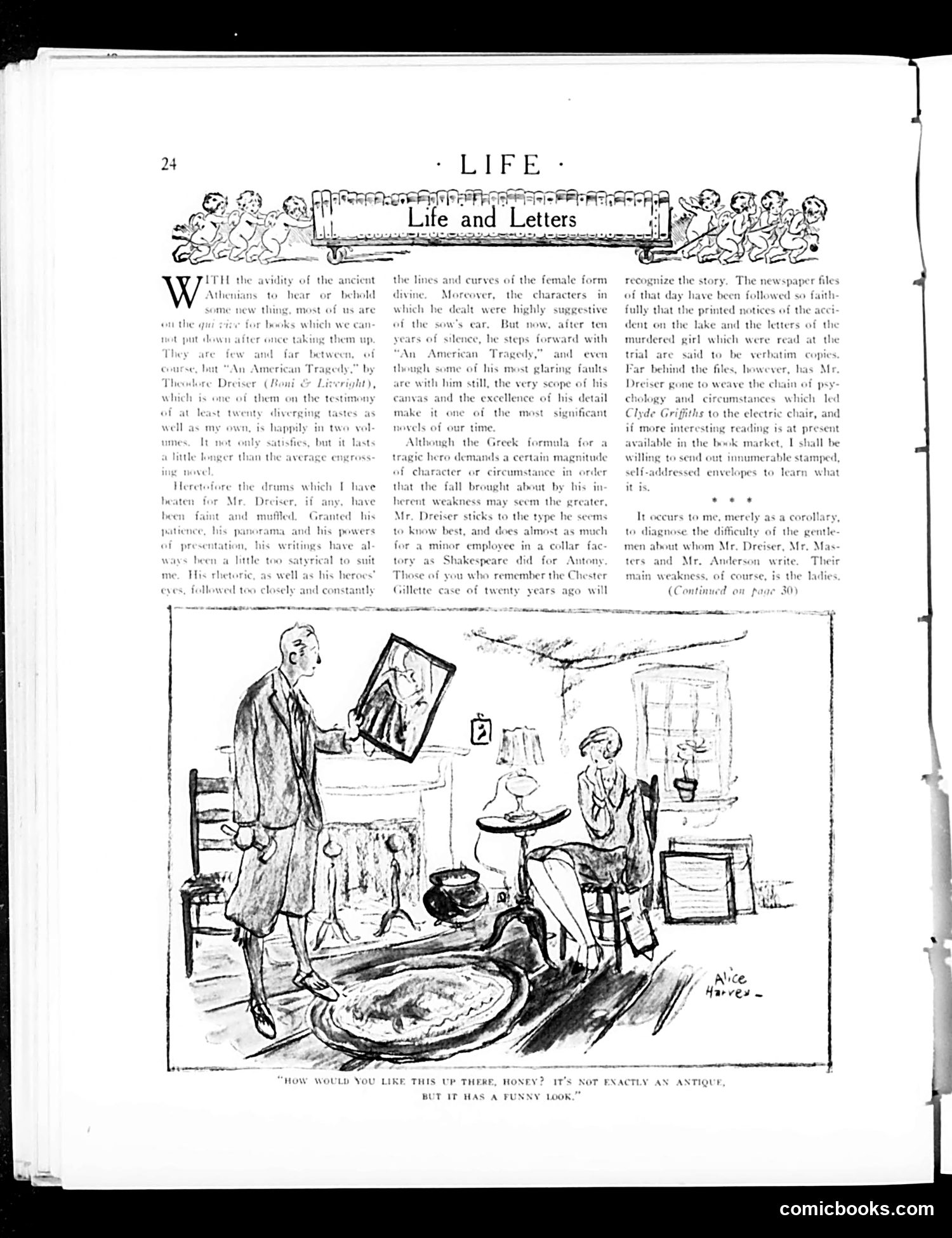
**The Article**: A literary critique of Theodore Dreiser's novel "An American Tragedy," praising his detailed portrayal of character and female form while noting his work drew from a real murder case (the Chester Gillette case of ~20 years prior). The author discusses Dreiser's artistic ambitions and the novel's significance. **The Cartoon**: A domestic scene showing a man holding up a large, oddly-shaped decorative object to his wife, who sits skeptically. He asks if she'd like it placed "up there," noting it's "not exactly an antique, but it has a funny look." **The Satire**: The cartoon humorously illustrates the tension between artistic merit and aesthetic appeal—much like the article's discussion of Dreiser's serious literary work. The wife's dubious expression mirrors potential reader skepticism: just because something is artistically ambitious doesn't mean it's visually or commercially appealing. The "funny look" parallels how Dreiser's unflinching realism might seem unattractive to some audiences despite its literary value.
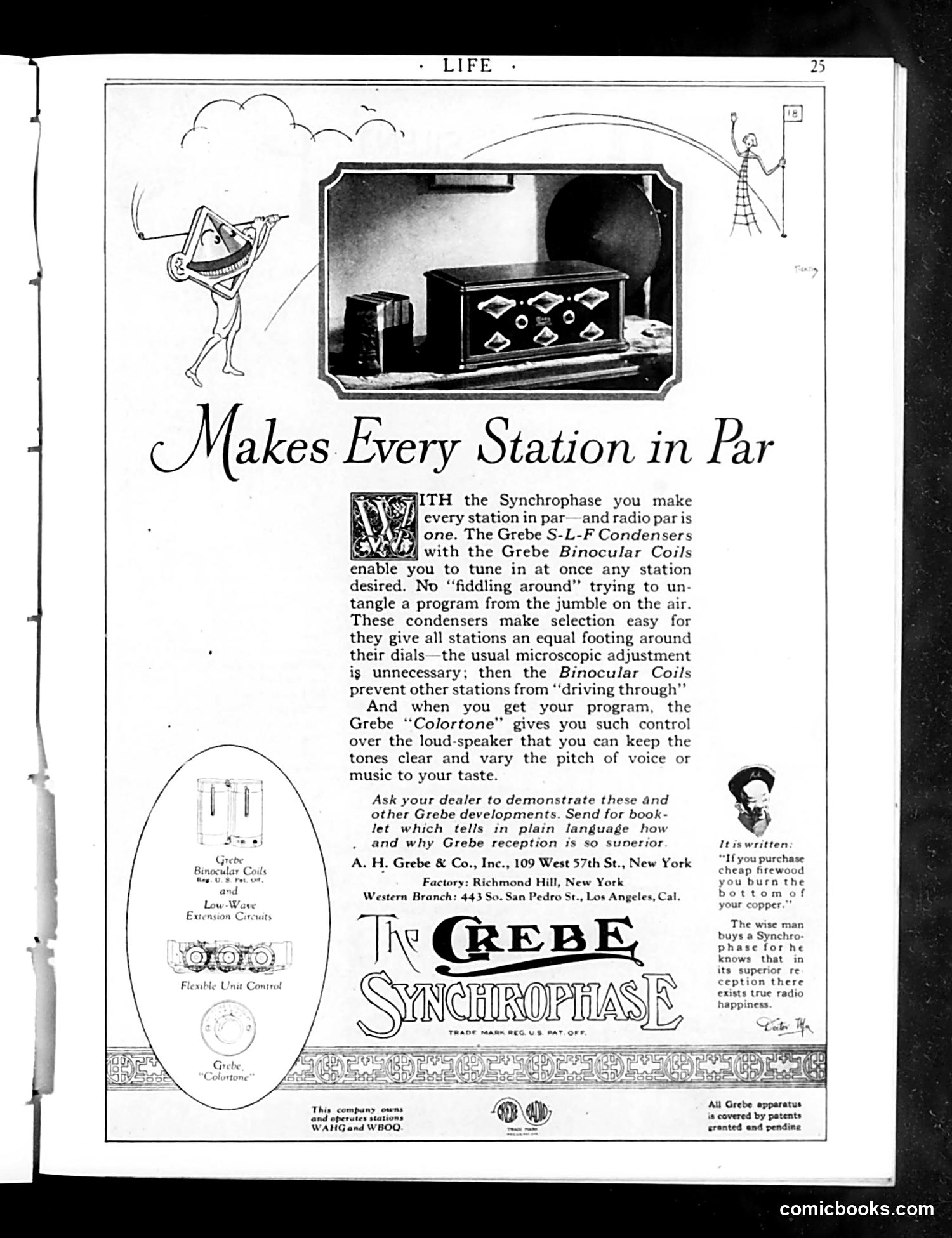
This is primarily a **radio equipment advertisement**, not political satire. It promotes the Grebe Synchrophase, an early radio receiver (likely 1920s era, based on the technology described). The page includes decorative cartoon elements—a figure tossing clouds at top left and a woman on a radio tower at right—but these are generic illustrations, not political caricatures. They simply convey the "joy" of radio reception. The advertisement's humor is gentle and commercial: it emphasizes that Grebe radios solve the frustration of radio tuning (described as "fiddling around" and "jumble on the air"), a common complaint when radio technology was new and stations interfered with each other. Sidebar testimonials use mild jokes about buying cheap firewood and gaining "true radio happiness." This reflects the excitement and technical growing pains of early radio broadcasting rather than any political commentary.
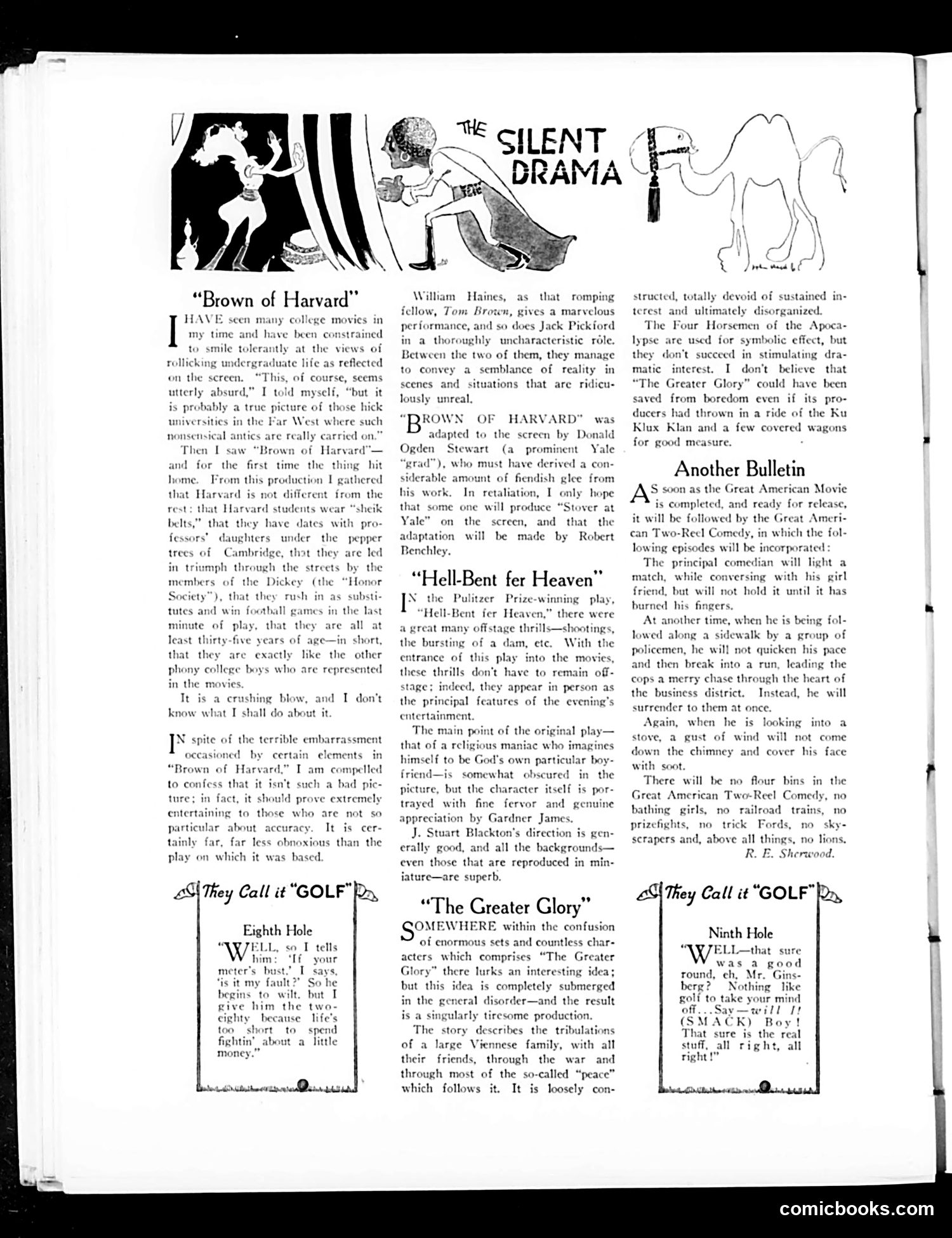
This 1920s *Life* magazine page reviews silent films, sarcastically critiquing their portrayal of college life. The main article mocks "Brown of Harvard," noting the author initially dismissed college movies as unrealistic but was disappointed to find Harvard students apparently *do* behave like stereotypical movie characters—dating, joining fraternities, playing football despite being "thirty-five years old." The humor relies on the contradiction: movies are phony, yet they accurately reflect actual campus behavior, which is equally phony. Two other film reviews appear: "Hell-Bent for Heaven" (adapted from a Pulitzer Prize play) and "The Greater Glory" (a war drama). The "They Call it GOLF" sidebar jokes feature working-class humor unrelated to the reviews. The satire targets both Hollywood's formulaic college narratives *and* the undergraduate culture itself—suggesting American campus life was itself performative entertainment.
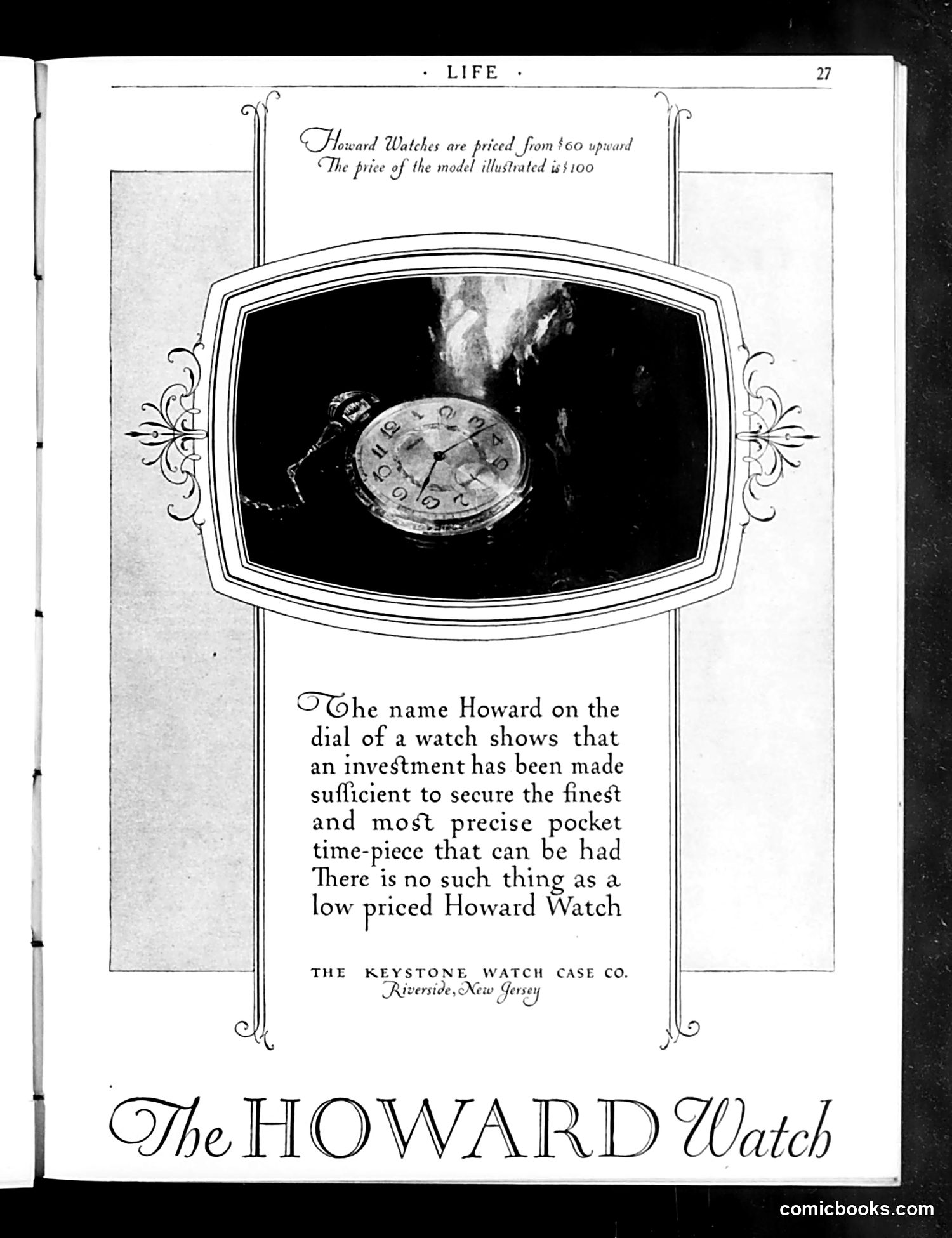
This is a **straightforward advertisement**, not satire or political commentary. It promotes Howard pocket watches manufactured by The Keystone Watch Case Co. of Riverside, New Jersey. The page features a photograph of a pocket watch displayed against a dark background, shown being held in someone's hand. The accompanying text emphasizes quality and precision as justifications for the $60-$100 price point—positioning Howard as a premium product where "there is no such thing as a low priced Howard Watch." This represents typical early 20th-century luxury goods marketing: appeals to investment value, craftsmanship, and exclusivity. The decorative Art Nouveau-style border frames reinforce the product's upscale positioning. For modern readers, this illustrates how pocket watches were once prestigious status symbols and essential professional tools, before wristwatches became standard.
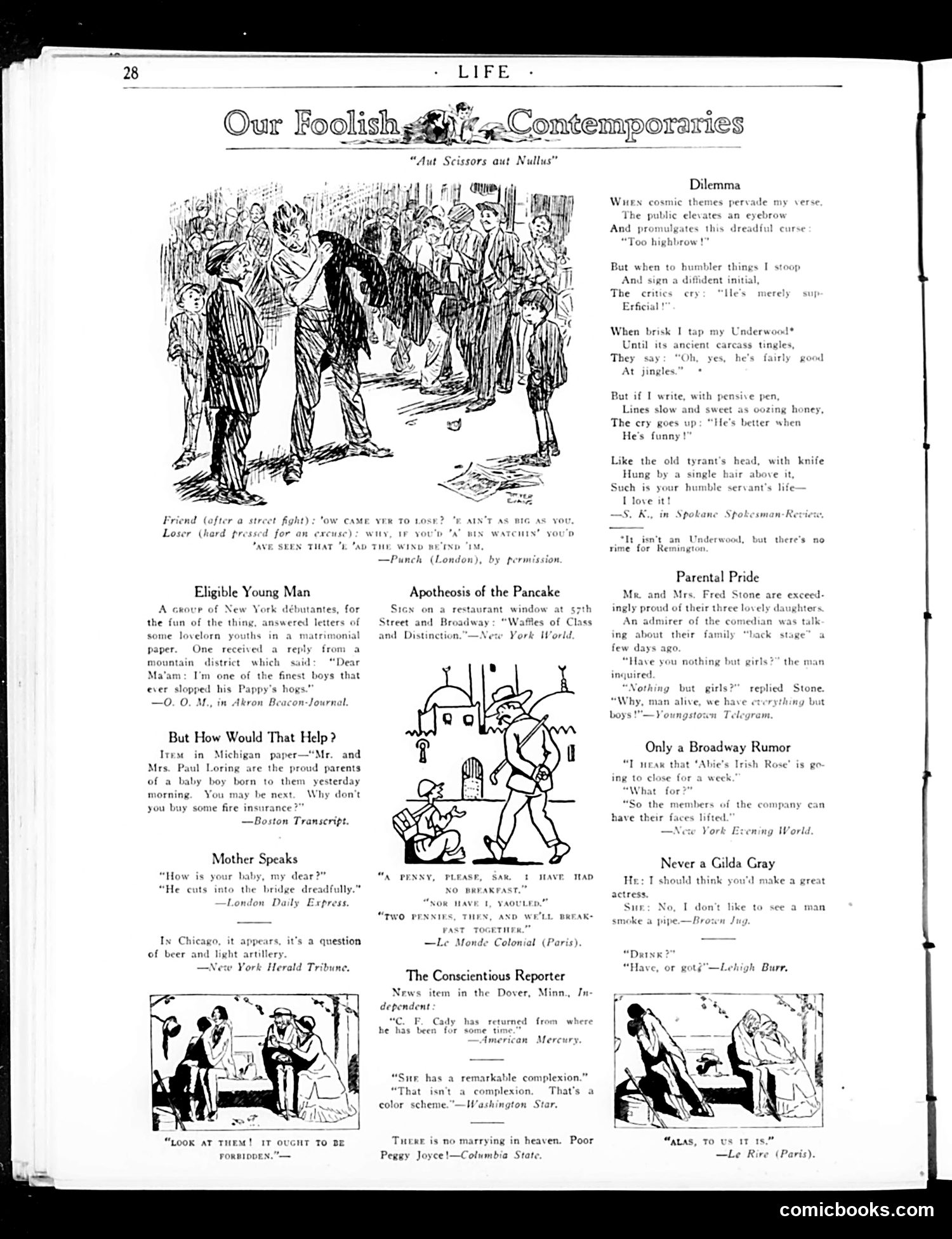
This page collects humorous newspaper clippings and reader submissions, satirizing absurdities in contemporary journalism and daily life. The recurring joke is that newspapers print ridiculous, contradictory, or tone-deaf content. **Key items:** - **"Eligible Young Man"**: A matrimonial ad claiming to be "one of the finest boys that ever slopped his Pappy's hogs"—mocking rural suitors advertising in debutante sections. - **"But How Would That Help?"**: A birth announcement suggesting readers have babies too—absurdly inappropriate parenting advice. - **"Mother Speaks"**: A baby who "cuts into the bridge dreadfully"—a bridge partner's complaint, a pun on social awkwardness. - **Cartoon panels** show domestic/social embarrassments (appears to reference Prohibition-era issues in one). The page satirizes how newspapers print genuinely foolish content without irony. References like "Abie's Irish Rose" (a contemporary Broadway play) and "Peggy Joyce" (a famous socialite) ground this in 1920s culture.
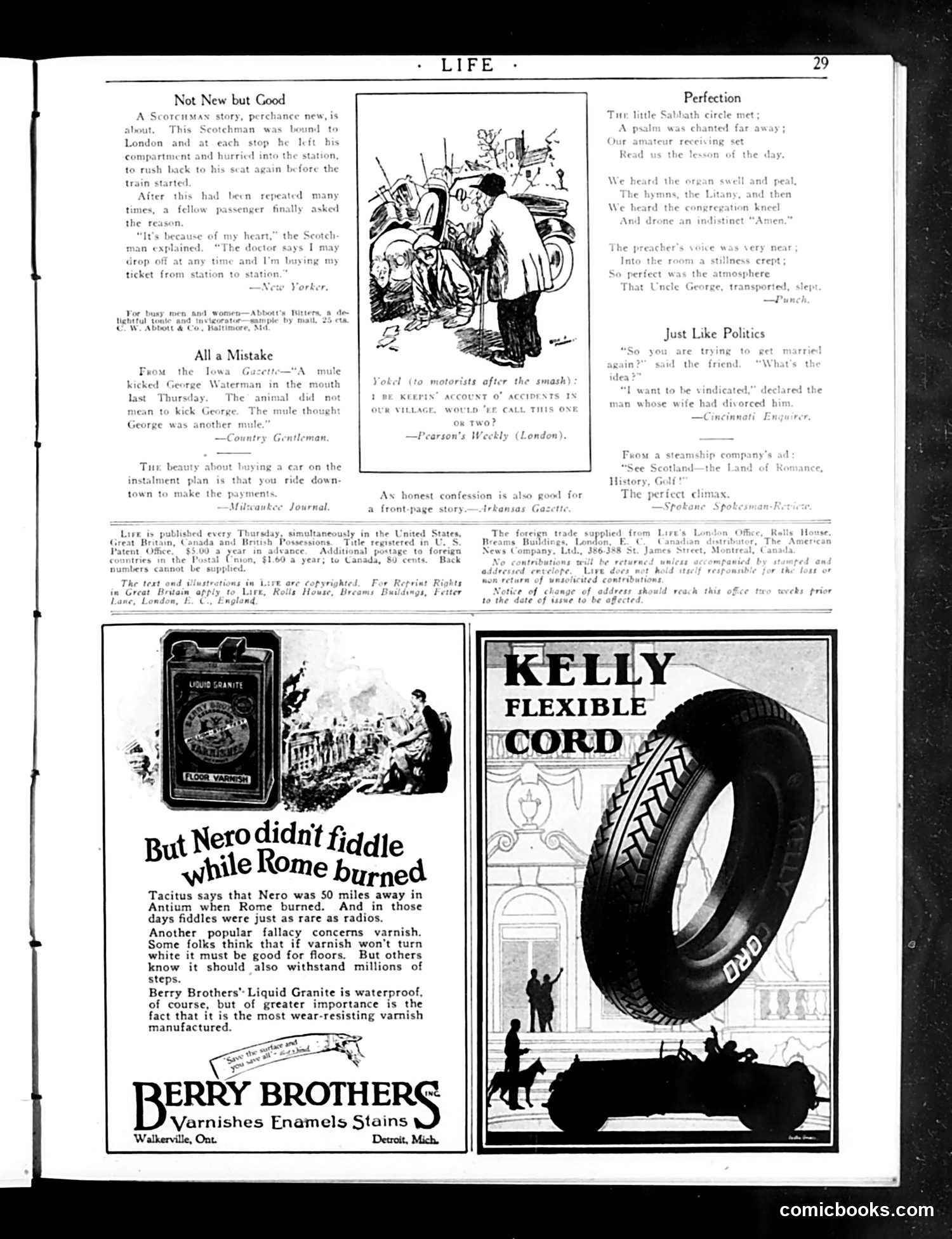
This page contains **three separate items**: humorous anecdotes, advertisements, and a poem. The **"Not New but Good"** section debunks the historical myth that Emperor Nero played fiddle while Rome burned—clarifying he was actually miles away, and fiddles didn't exist then anyway. **"All a Mistake"** is a brief joke from the Iowa Gazette about a mule that kicked a farmer, with a play on the phrase "the mule thought George was another mule." The **advertisements** for Berry Brothers varnish and Kelly flexible cord use the Nero reference as a hook—just as the popular misconception about Nero persists, so do myths about varnish (that it shouldn't turn white on floors). The ad claims their product is genuinely superior because it resists wear. The **"Perfection"** poem satirizes amateur religious singing groups. **"Just Like Politics"** mocks marital discord with a divorce joke. No specific political figures are caricatured here; this is general-interest satirical content typical of the era's Life magazine.
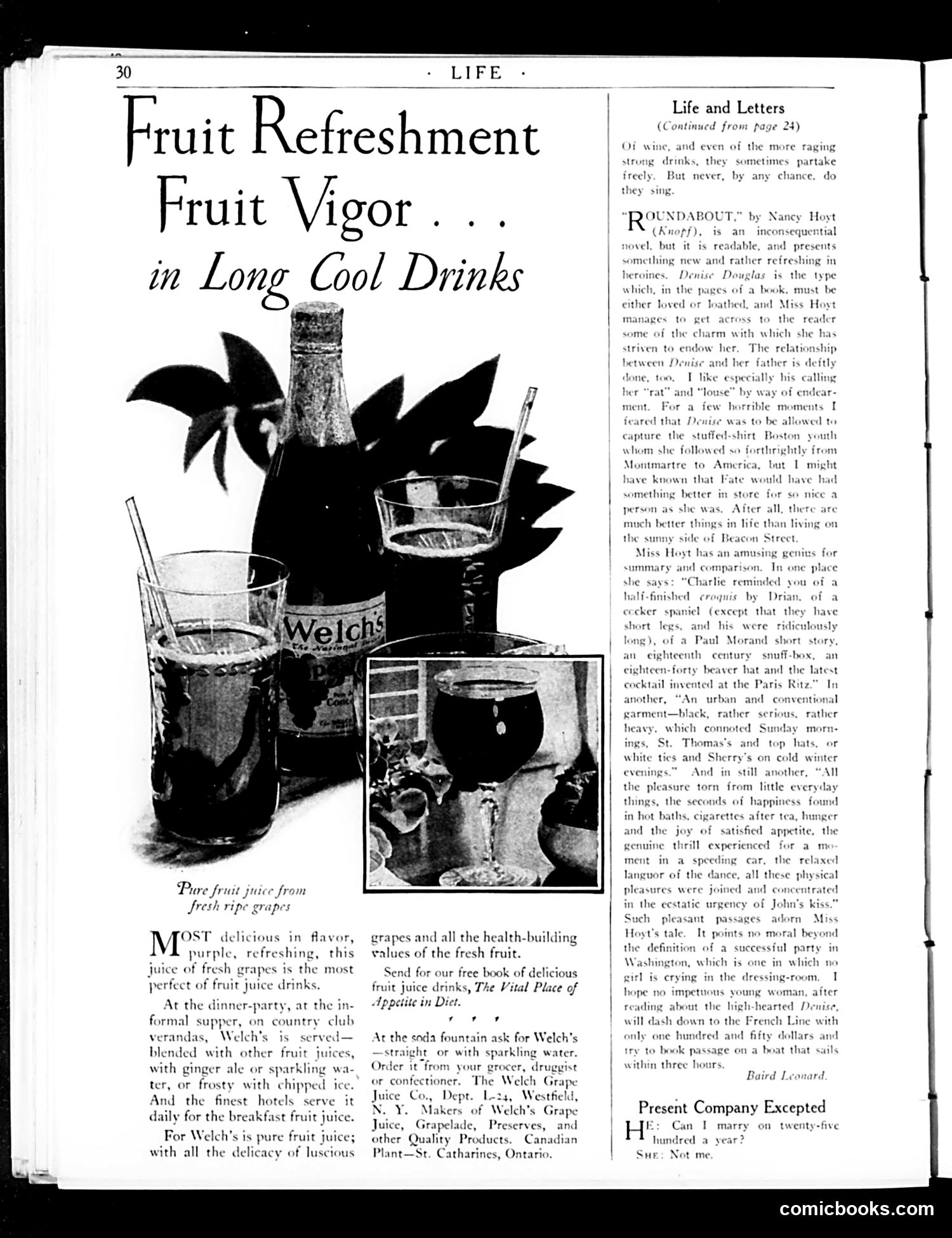
This page combines a **full-page Welch's Grape Juice advertisement** with a book review column ("Life and Letters"). The advertisement uses aspirational imagery—glasses of juice with decorative fruit garnish—to promote Welch's as a sophisticated beverage for upscale social settings: "dinner-party," "country club verandas," and "the finest hotels." The copy emphasizes purity and health benefits, positioning grape juice as an elegant alternative to alcohol. The right column reviews Nancy Hoyt's novel *Roundabout*, offering literary criticism through witty comparison—likening characters to obscure references (a "half-finished croquet" by Paul Morand, etc.). The final item, "Present Company Excepted," is a humorous Q&A where a man asks if he can marry on $2,500/year; a woman replies "Not me"—satirizing economic anxieties about marriage and living costs. The page reflects 1920s consumer culture and women's shifting social perspectives.
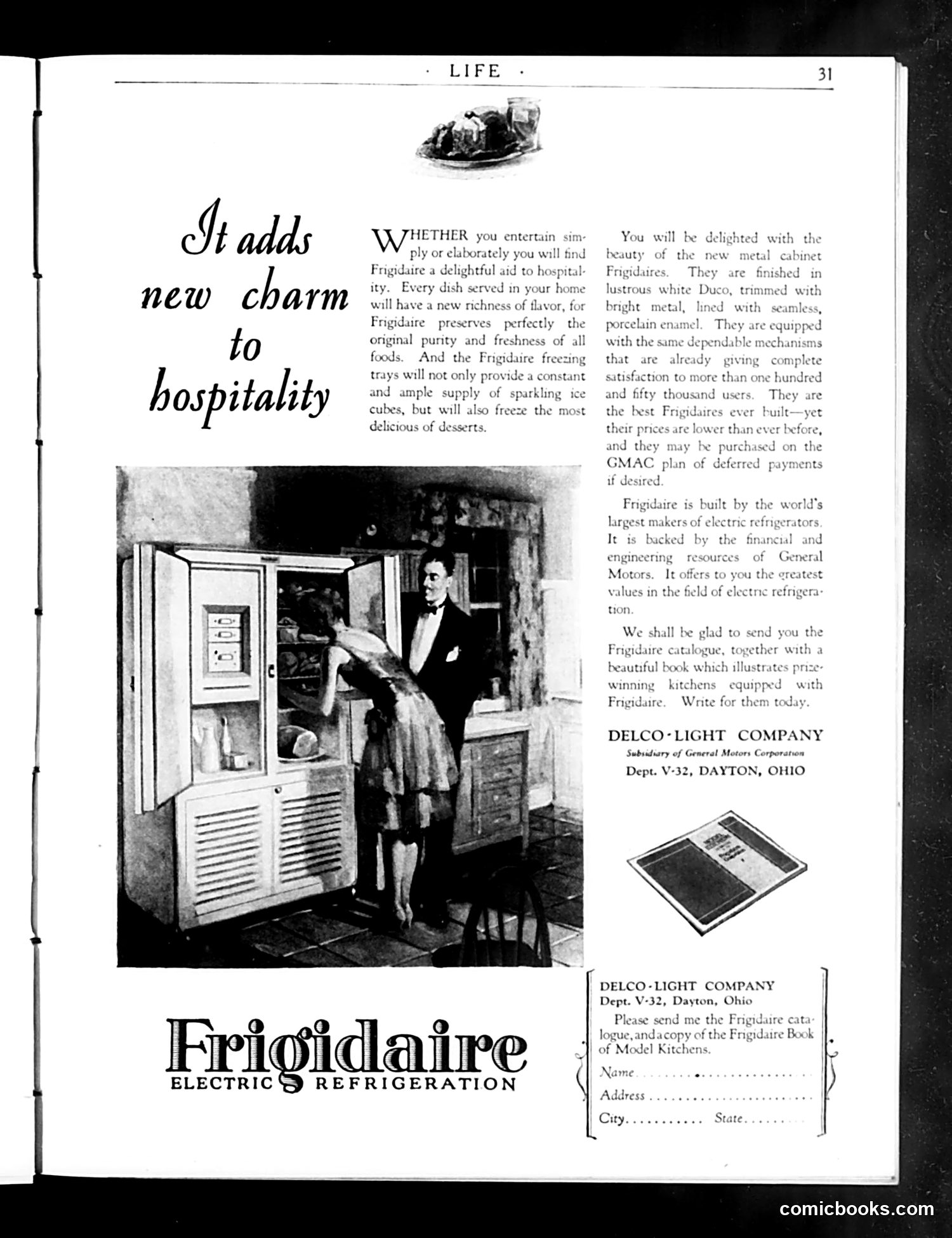
This is **not a cartoon or satire**—it's a product advertisement for Frigidaire electric refrigerators, placed in *Life* magazine (likely 1920s-1930s). The ad features a photograph of a well-dressed man and woman admiring an open Frigidaire unit in a kitchen, emphasizing hospitality and food preservation. The marketing pitch claims the refrigerator adds "new charm to hospitality" by keeping foods fresh and enabling frozen desserts. **Historical context**: This advertisement reflects early electric refrigeration as a luxury appliance and status symbol. The formal attire and emphasis on entertaining guests shows refrigerators were marketed to middle/upper-class households as enabling sophisticated entertaining. The Delco-Light Company's General Motors backing underscores corporate confidence in this emerging technology. For modern readers: this is essentially 1920s-30s marketing for what we now consider a basic household necessity.
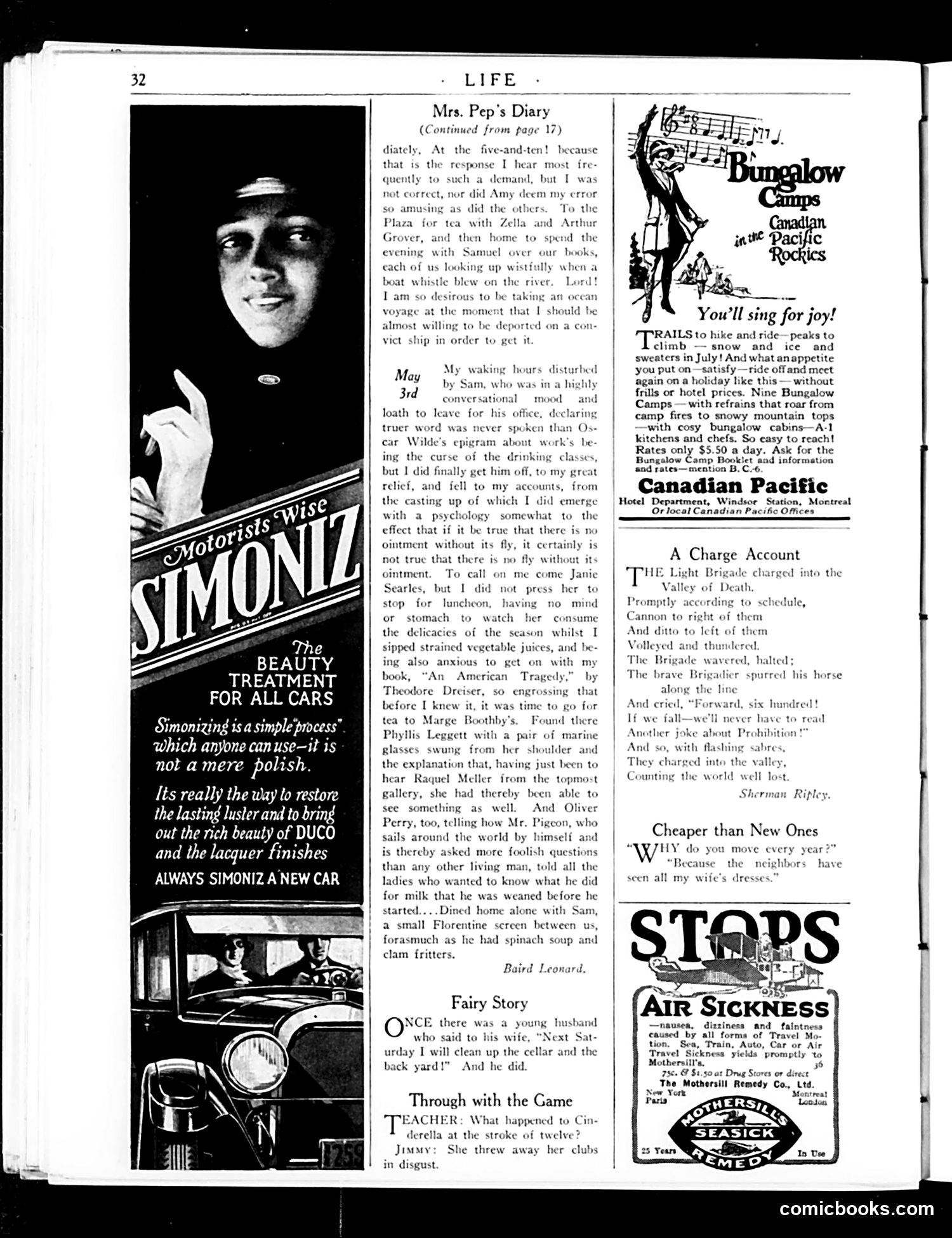
This page is primarily **advertising and light humor content** rather than political satire. **Main Advertisement:** A Simoniz car polish ad featuring a photograph of a man in a hat reading while driving. The copy emphasizes that Simonizing is a restoration process, not merely polish, that restores "lasting luster" to car finishes—a pitch to 1920s motorists concerned with maintaining their automobiles' appearance. **"Mrs. Pep's Diary"** (continued from earlier): A domestic humor column describing a society woman's mundane activities—tea dates, managing household accounts, reading Theodore Dreiser. The humor derives from middle-class social pretensions and marital observations. **Minor items include:** - Canadian Pacific bungalow camp advertisement - A "Fairy Story" joke about a husband promising (then actually) cleaning the cellar - "Through with the Game"—a joke about Cinderella discarding golf clubs at midnight - Ads for air sickness remedy and other products The page reflects 1920s concerns: automobile care, leisure travel, domestic comedy, and consumer products. No significant political content is present.
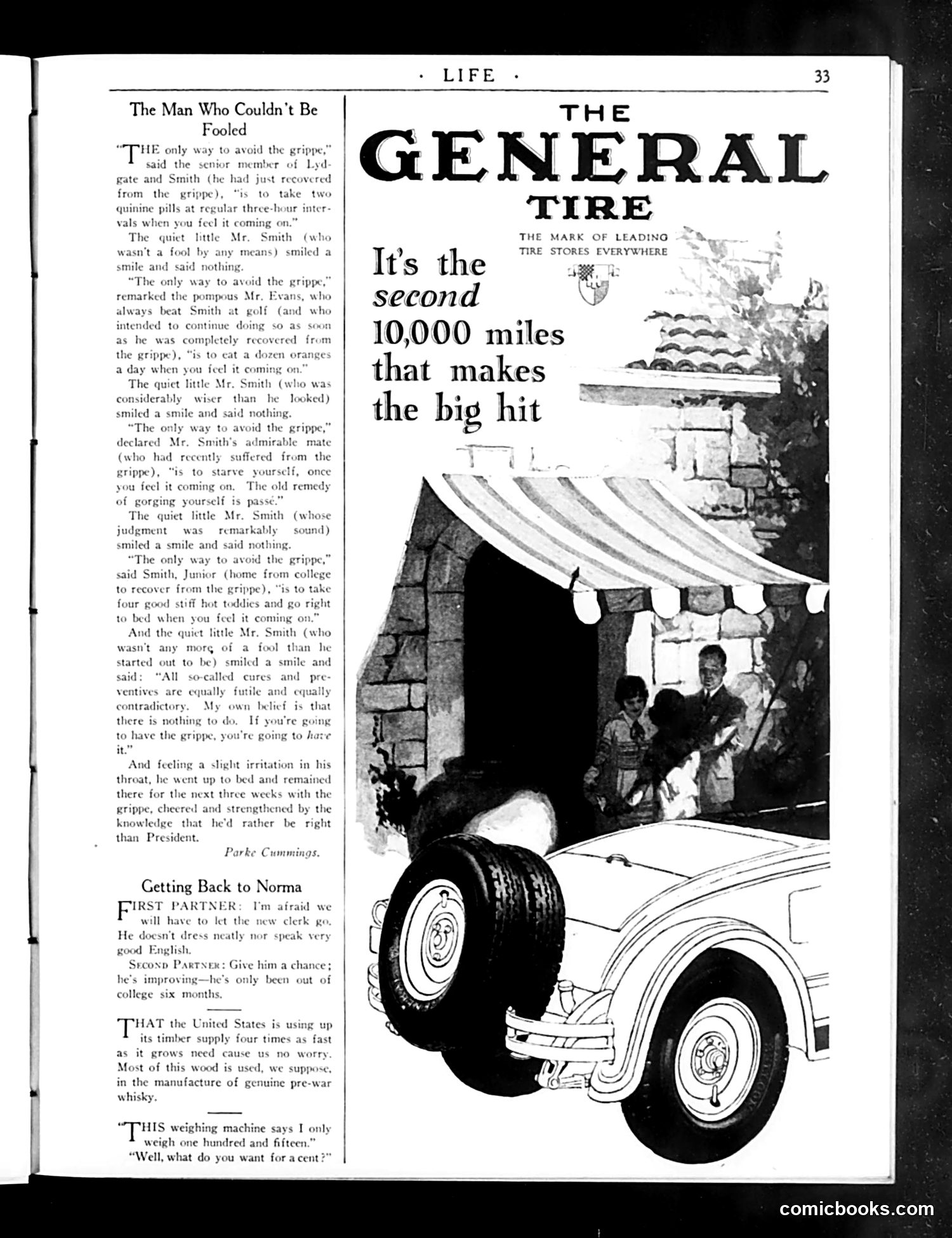
This page contains two distinct elements: **Left side ("The Man Who Couldn't Be Fooled"):** A humorous sketch satirizing folk remedies for influenza (the "grippe"). Multiple characters—including a pompous golfer (Mr. Evans), a colleague, and Smith's own family—each insist they have the definitive cure (quinine pills, starving oneself, hot toddies). The quiet Mr. Smith, wiser than he appears, listens to all this contradictory advice, then simply goes to bed and recovers—proving all the claimed remedies equally worthless. The satire mocks people's faith in unproven cures and their need to dispense unsolicited advice. **Right side:** A General Tire advertisement featuring an illustration of a car with prominent tires and the tagline "It's the second 10,000 miles that makes the big hit"—suggesting tire durability and reliability as a selling point. The page exemplifies LIFE's format: mixing satirical humor with advertising to appeal to early 20th-century readers.
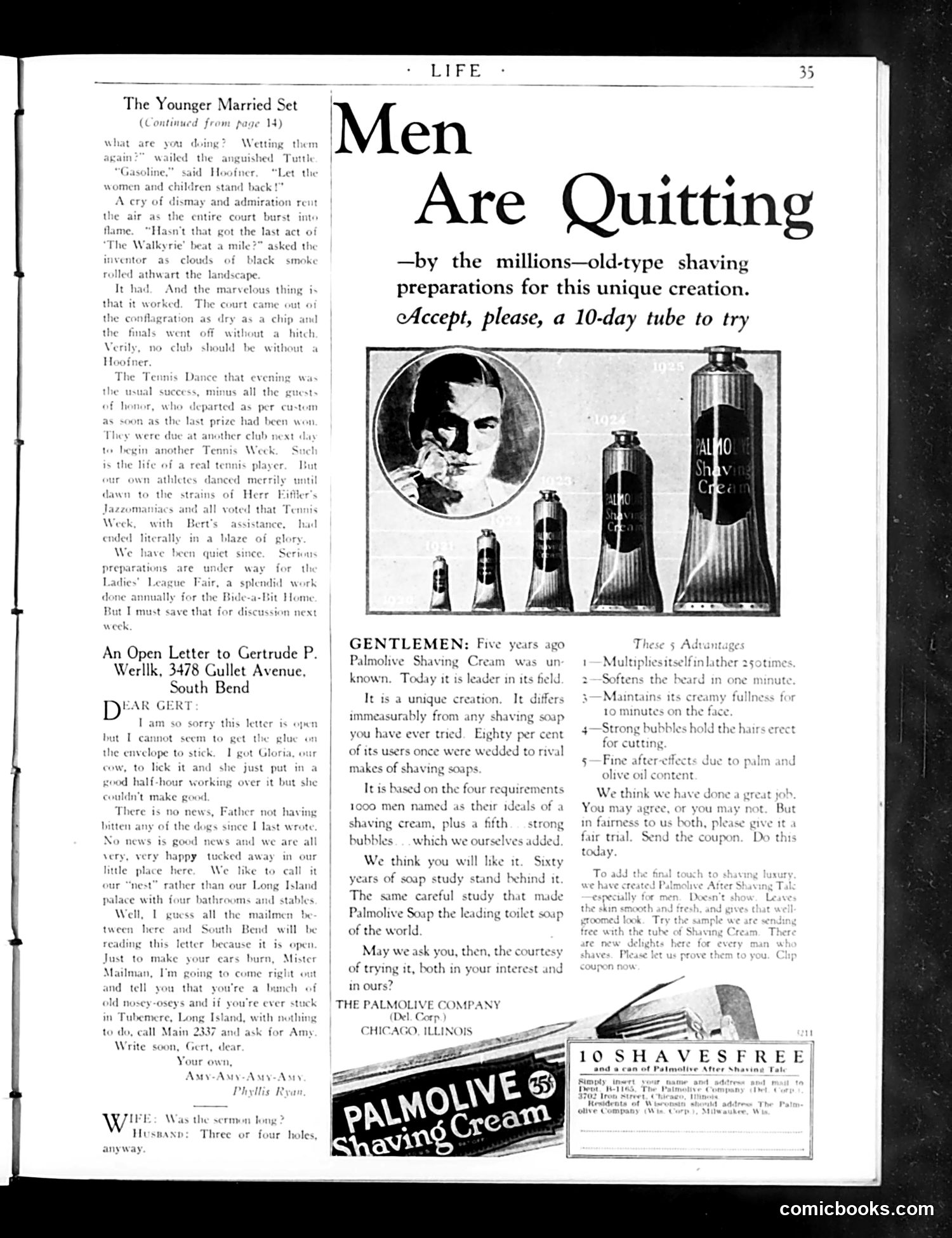
This page is primarily a **Palmolive Shaving Cream advertisement** disguised as editorial content in *Life* magazine. The ad claims men are "quitting...old-type shaving preparations" for Palmolive's product. It shows five tubes of increasing size and includes a man's face in profile. The advertisement lists five claimed advantages: simplified lather, softened beard, maintained cream fullness, strong bubbles, and fine after-effects. The page also contains an unrelated letter column ("The Younger Married Set") with domestic humor about a married couple's household complaints—typical of the era's light social satire. **Historical context**: This reflects early 20th-century advertising that blurred lines between editorial and commercial content. The claim that "eighty percent of [Palmolive's] users once were wedded to rival makes" is a competitive boast typical of aggressive marketing from that period. The "10-day tube to try" was a common promotional tactic to encourage consumer sampling.
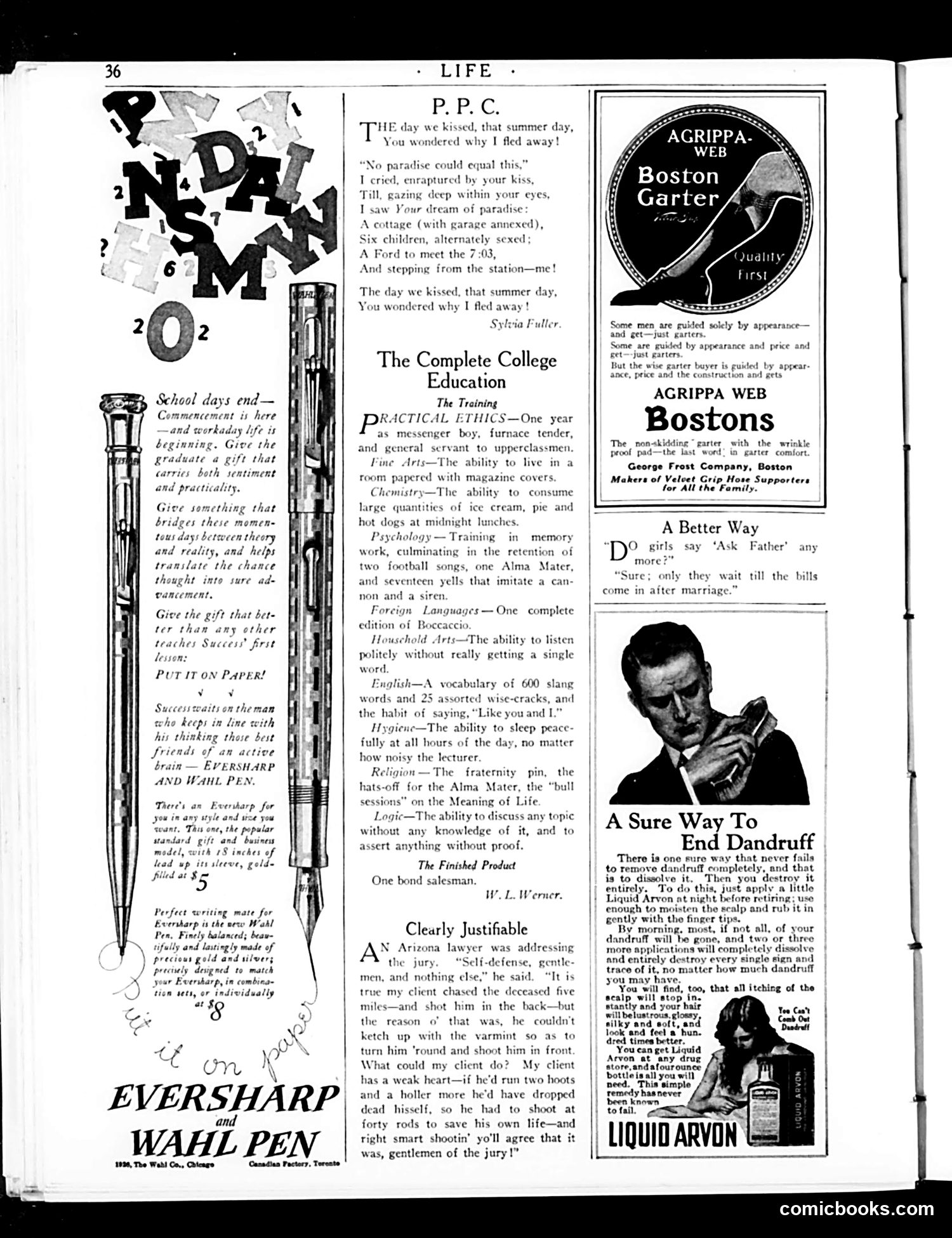
This page contains several pieces of satire and advertising from an early 20th-century American magazine: **"P.P.C." (Poem):** A romantic satire about courtship's harsh reality. A man recalls kissing a woman who dreamed of paradise; he fled because her "paradise" was mundane domesticity—a cottage with garage, six alternating-sex children, and a Ford automobile. The joke targets both women's limited aspirations and men's fear of marriage's ordinariness. **"The Complete College Education":** Mock-serious satire listing absurd "courses" graduates supposedly master—sleeping through lectures, memorizing drinking songs, consuming junk food at midnight. The punchline: all this produces "one bond salesman." It mocks both higher education's perceived uselessness and post-college disappointment. **"Clearly Justifiable":** A lawyer's courtroom defense is absurdly circular: his weak-hearted client shot someone in the back because he couldn't catch him otherwise. It satirizes legal sophistry and courtroom rhetoric. The page also features period advertisements for Eversharp pens, garters, and Liquid Arvon dandruff treatment—typical of magazine monetization of the era.
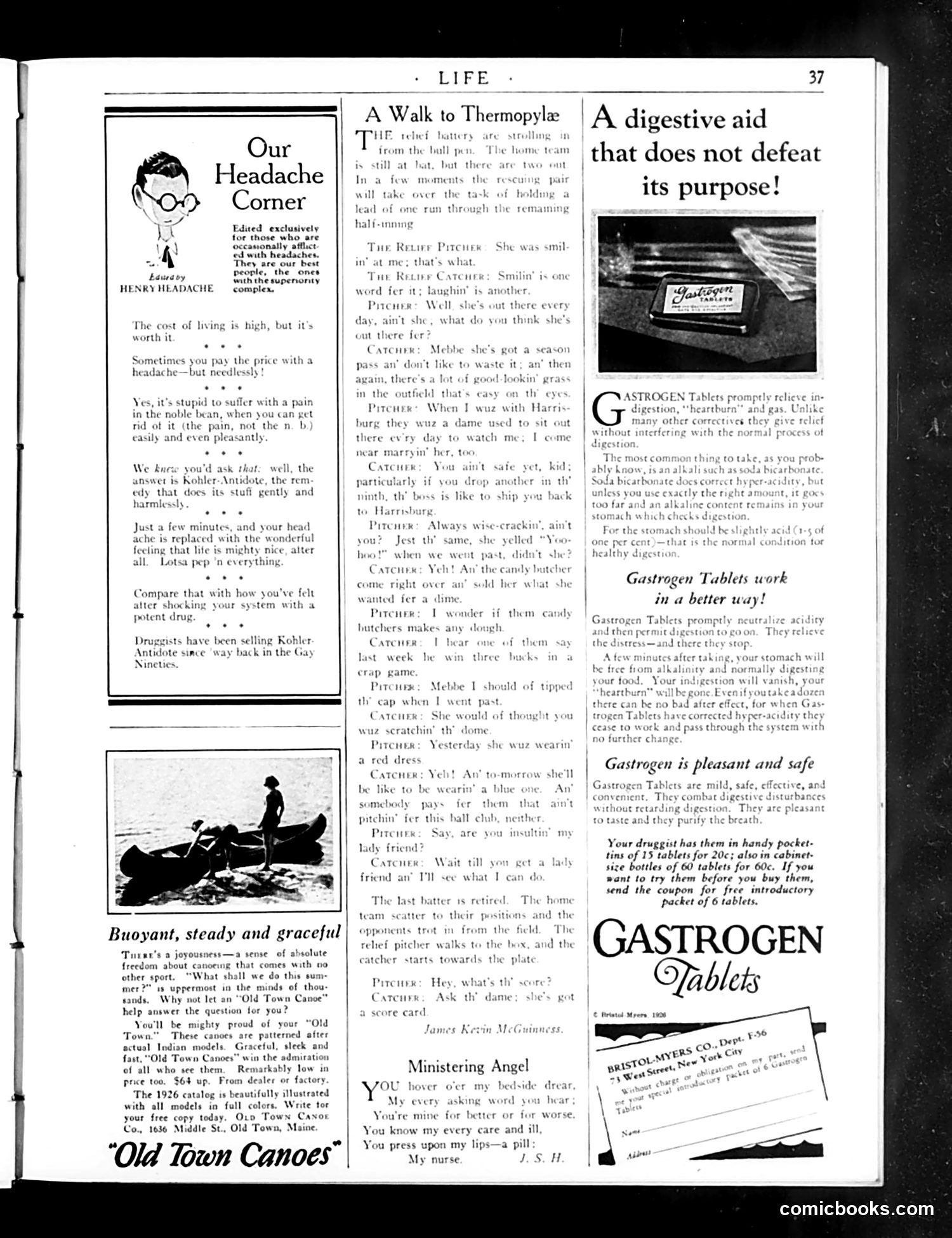
This page mixes humor with commercial promotion, typical of 1920s Life magazine. **"Our Headache Corner"** is a satirical advice column by "Henry Headache" that gently mocks readers who suffer from headaches—described as "our best people, the ones with the superiority complex." The humor suggests headaches are a marker of refined, stressed individuals. The column promotes Kohler Antidote, a headache remedy, claiming it works "gently and harmlessly" versus "potent drugs." **"A Walk to Thermopylae"** is a baseball dialogue between a pitcher and catcher with working-class vernacular, likely referencing a romantic interest named Harrisburg. It's unrelated satirical banter. The page is primarily **advertising**: for Kohler Antidote (headache remedy), Old Town Canoes (luxury recreational equipment), and Gastrogenogen Tablets (digestive aid). These ads use period-appropriate messaging about health and leisure that modern readers would find quaint—emphasizing safety, gentleness, and aspirational lifestyle imagery.
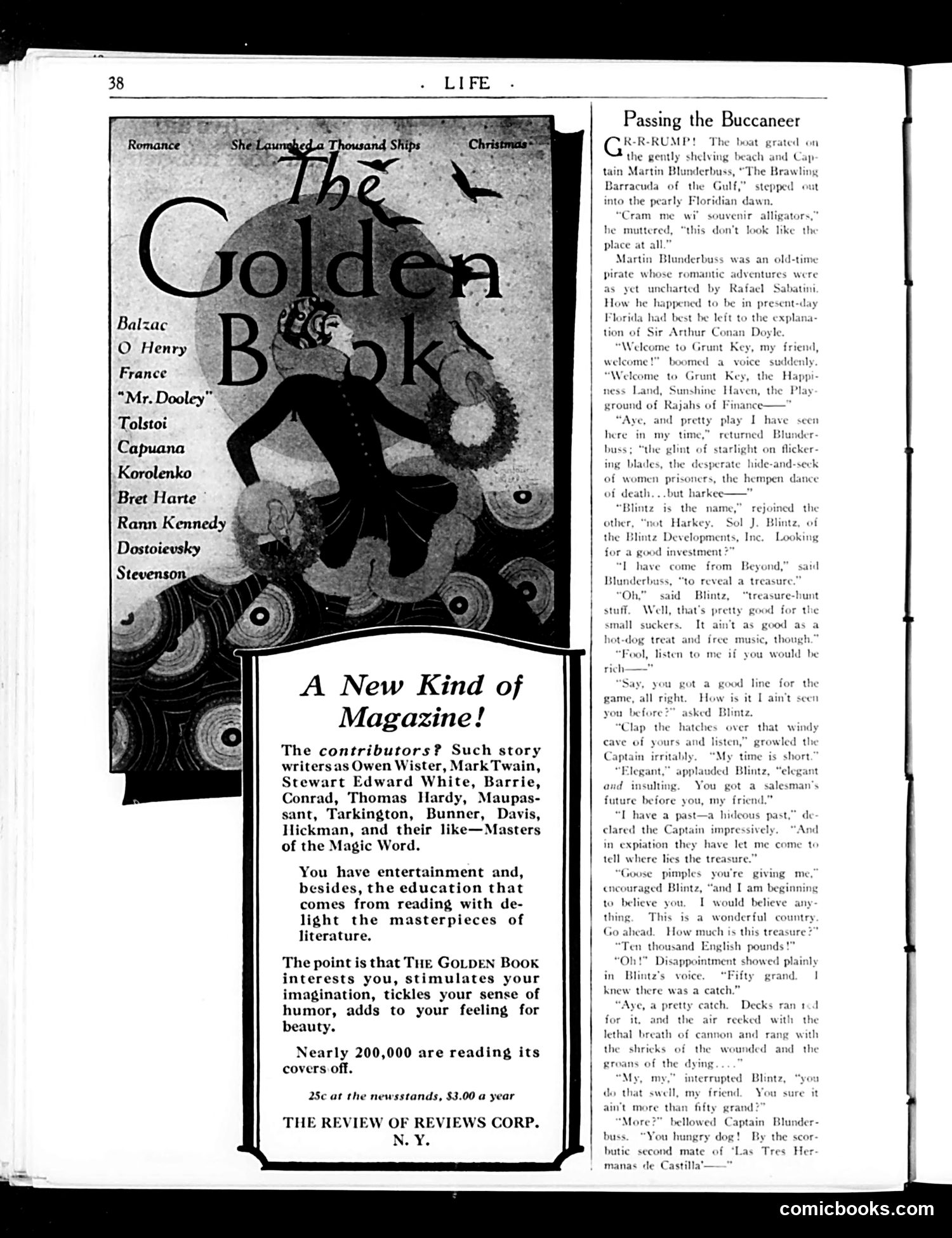
This is primarily **advertising** for *The Golden Book* magazine, not a political cartoon. The left panel promotes the publication by listing famous literary contributors (Balzac, O. Henry, Tolstoi, etc.) and promising readers entertainment plus literary education. The right column contains the opening of a **satirical fiction piece** titled "Passing the Buccaneer." It mocks the adventure-romance genre popular at the time—specifically stories like Rafael Sabatini's swashbuckling novels. The humor derives from the contrast between the protagonist "Captain Martin Blunderbuss," a supposedly romantic pirate with a storied past, and his interaction with "Sol J. Blintz," a crass modern real-estate developer ("Blintz Developments, Inc."). The satire ridicules both the overwrought language of period adventure fiction ("the desperate hide-and-seek of women prisoners") and the shallow commercialism of contemporary American business, represented by Blintz's sales-pitch mentality interrupting genuine drama.
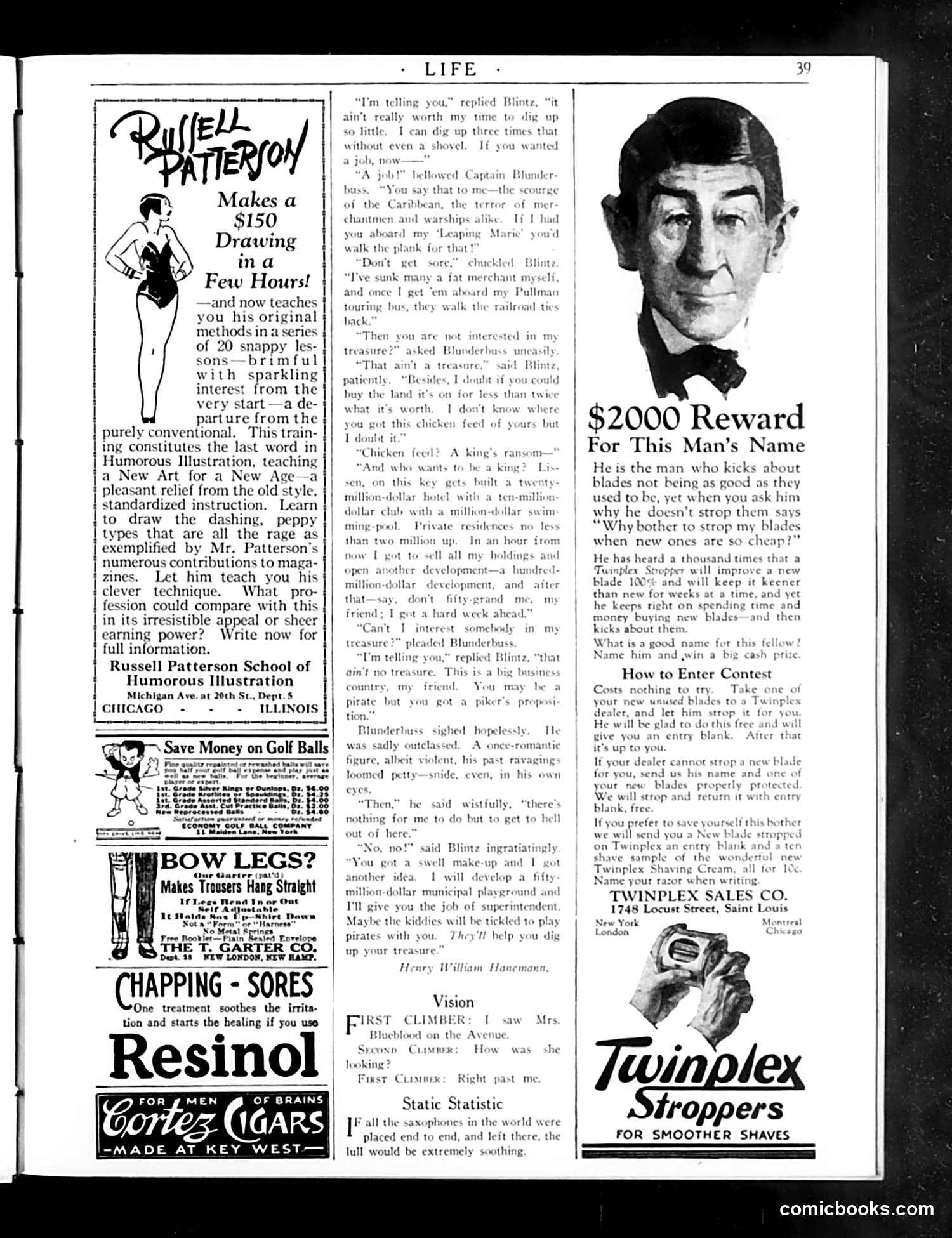
This page is primarily **advertising and humorous filler content** rather than political cartooning. The main elements include: **Advertisement for Russell Patterson's Drawing School**: Patterson was a prominent illustrator of the era known for drawing fashionable, stylized figures—"dashing, peppy types." The ad promotes his correspondence course in "Humorous Illustration" as a lucrative profession. **Satirical Story ("Vision")**: A brief narrative dialogue between two characters—apparently discussing a woman seen on the avenue. The humor appears to rely on misunderstanding or dramatic irony, though context is limited. **Twinplex Razor Contest**: A $2000 reward advertisement offering cash for naming "the man who complains razors aren't as good as they used to be, but won't strop them because new ones are cheap." This satirizes consumer hypocrisy—mocking people who want better products but won't maintain them properly. **Miscellaneous Product Ads**: Resinol (for chapping), Cortez cigars, and corrective garters round out the page. The page reflects 1920s consumer culture and light satire, with no significant political content.
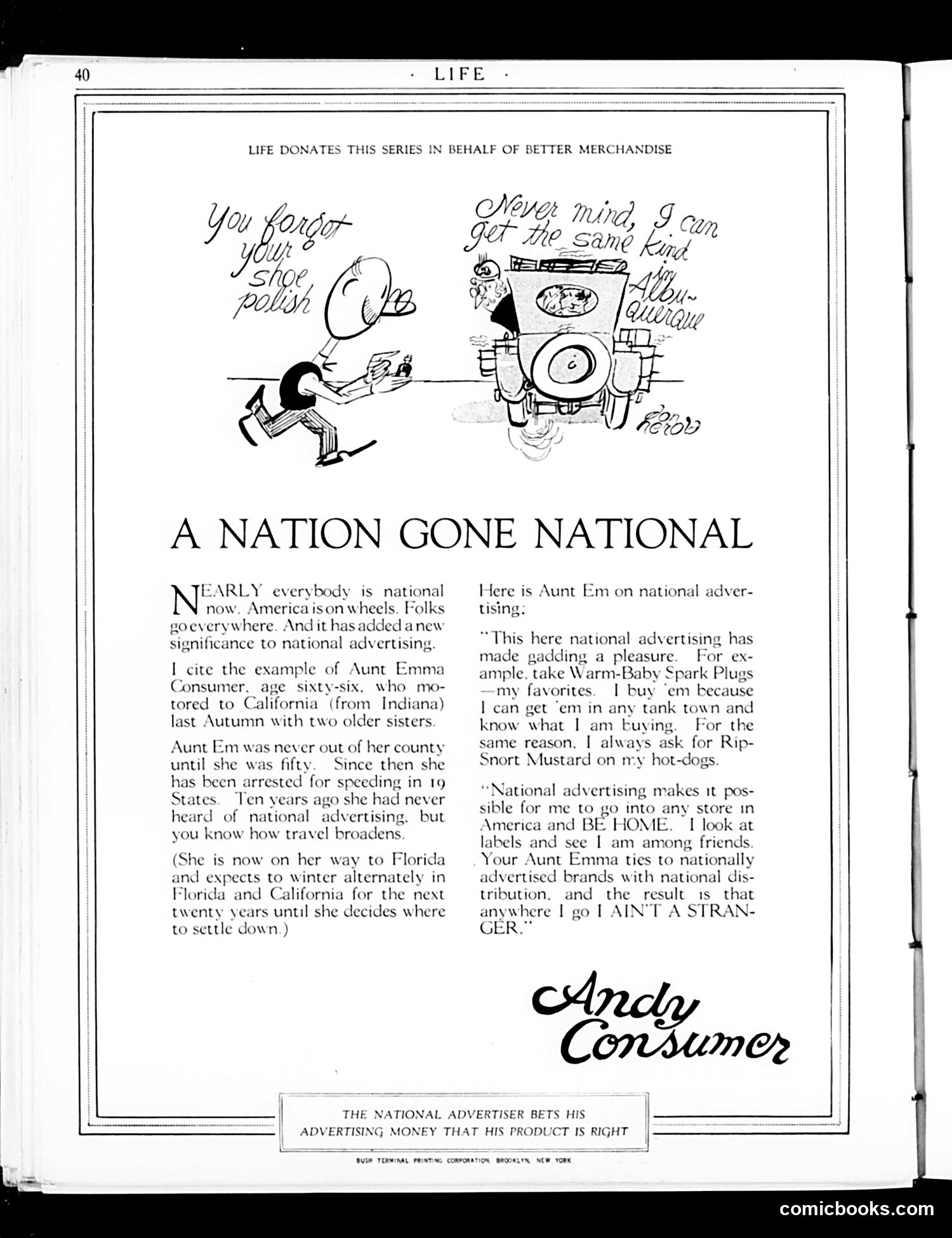
This Life magazine article satirizes how American automobile travel and national brand advertising have transformed consumer culture. The central figure is "Aunt Emma Consumer," a 66-year-old woman from Indiana who represents the newly mobile American public. The satire highlights the irony: she traveled for decades without leaving her county, but now motors across states and plans to winter in Florida and California. The cartoon's joke (top) shows her abandoning local shoe polish for mass-produced alternatives—a visual metaphor for how national brands have replaced local commerce. The satire's point: national advertising has made travel appealing by guaranteeing brand consistency. Aunt Emma can buy the same "Warm-Baby Spark Plugs" and "Rip-Snort Mustard" anywhere, so she feels "at home" as a stranger. Life ironically praises this as "better merchandise," but the text suggests anxiety about standardization erasing regional identity and local commerce—a common modernist critique of the 1920s-30s consumer economy.
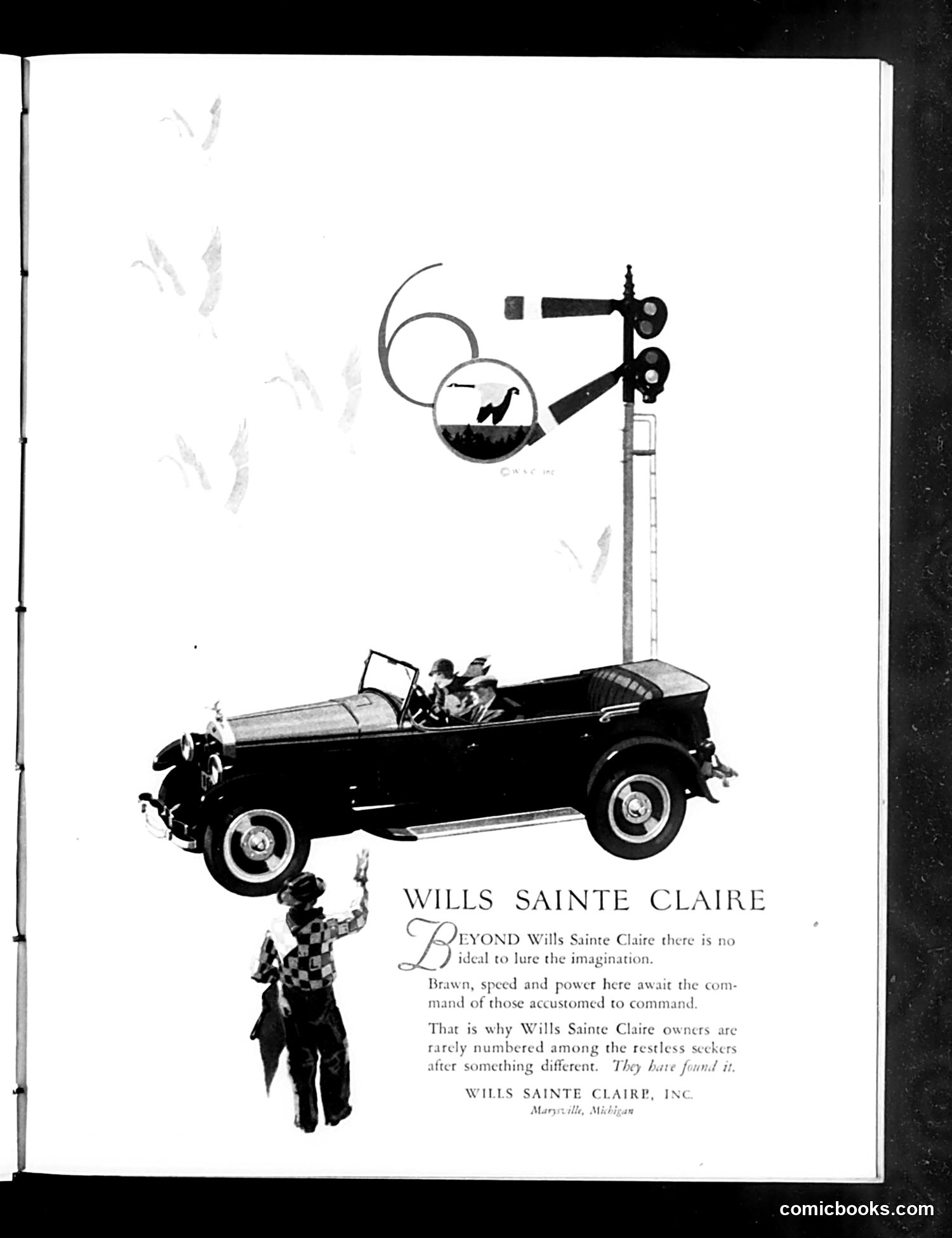
This is a **vintage automobile advertisement**, not political satire. It promotes the Wills Sainte Claire, a luxury car manufactured in Marysville, Michigan. The ad uses surreal, aspirational imagery: a wealthy couple in an open roadster beneath an oversized mechanical eye or observation device, with a jester figure below. These fantastical elements suggest the car appeals to those with imagination and refinement—people "accustomed to command." The copy promises "brawn, speed and power" and claims owners have "found it"—implying they've discovered something superior to competitors' offerings. The phrase "rarely numbered among the restless seekers after something different" suggests exclusivity: Wills Sainte Claire owners have elevated taste and don't chase trends. This reflects 1920s luxury marketing positioning the vehicle as status symbol for the sophisticated elite rather than mass-market appeal.
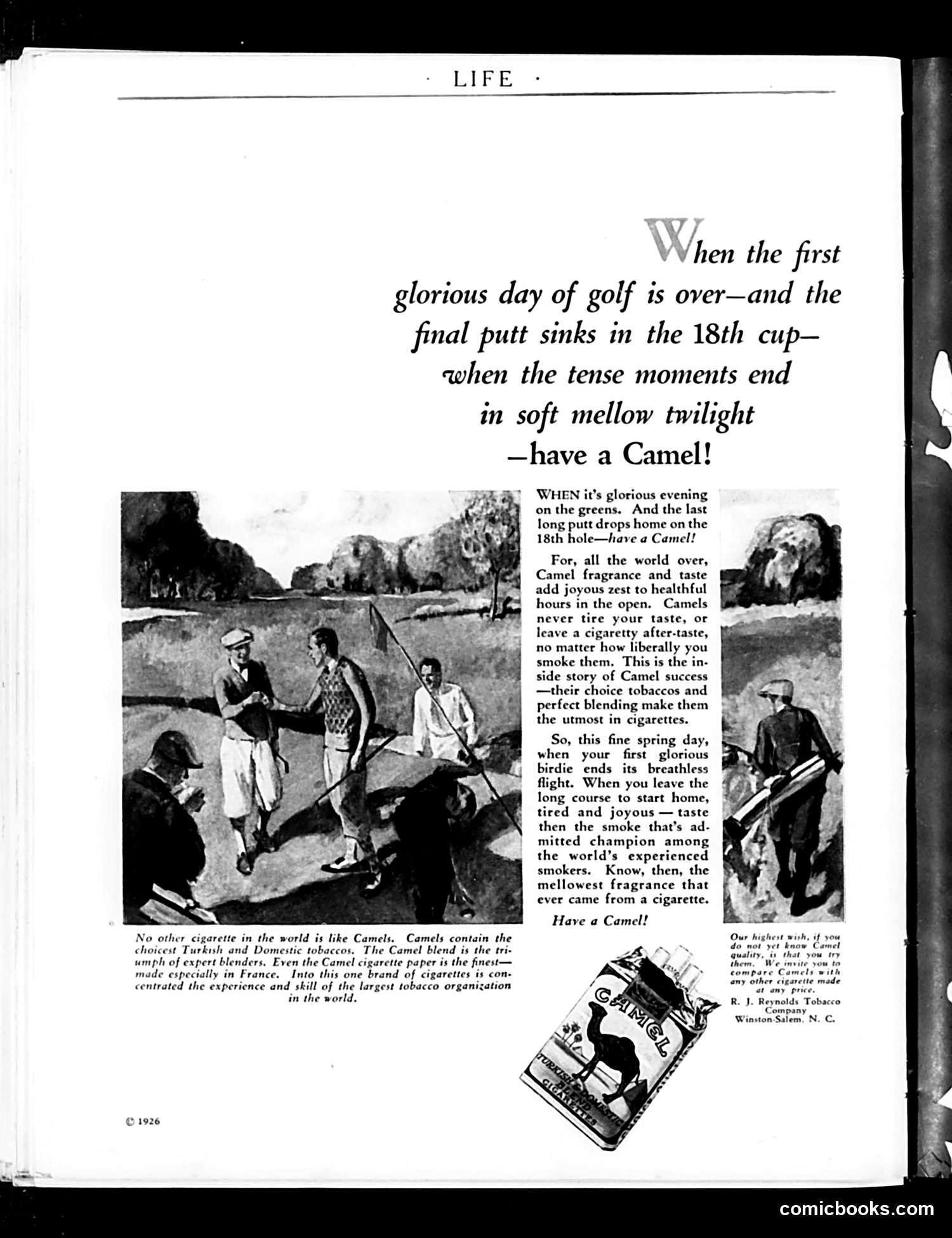
This is a **cigarette advertisement**, not satire—it's a straightforward Camel cigarette promotion from 1926. The ad associates smoking with leisurely golf, a sport then linked to affluence and relaxation. The text romanticizes the post-game cigarette as a reward after "glorious" athletic exertion, claiming Camel's superior tobacco blend and French paper deliver unmatched flavor without aftertaste, even with heavy smoking. The photographs show golfers in period dress on a course at twilight, framing cigarette consumption as part of an idealized lifestyle of outdoor gentlemanly pursuits. The copy emphasizes Camel's "choice tobaccos" and expert blending as proof of quality. **Modern context**: This predates widespread knowledge of smoking's health dangers. The ad's claims about never tiring the taste or leaving aftertaste would face immediate legal challenges today. The R.J. Reynolds company (Winston-Salem) directly targets experienced smokers as connoisseurs.