
Life, 1926-05-27 · page 28 of 44
Life — May 27, 1926 — page 28: what you’re looking at
What you’re looking at
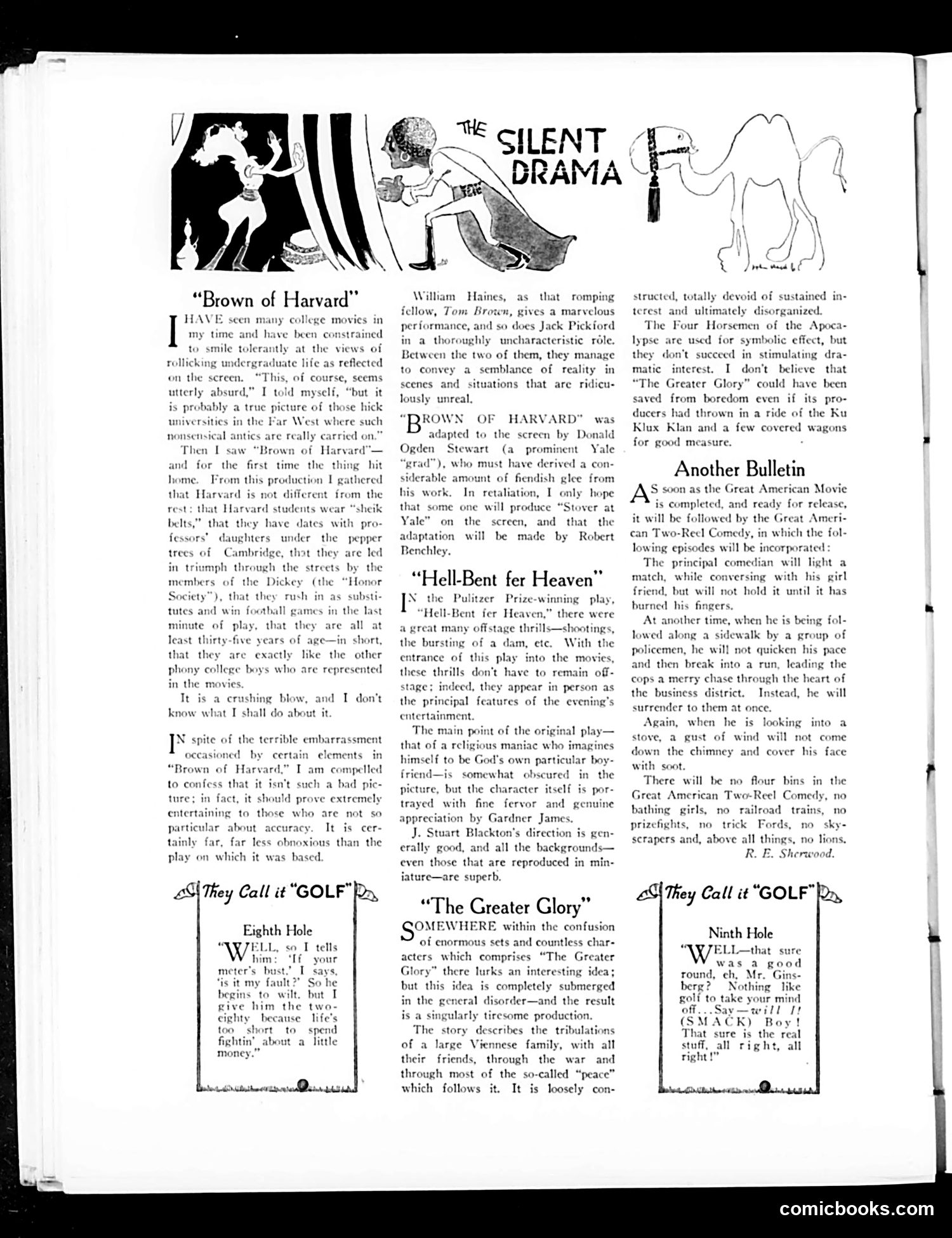
This 1920s *Life* magazine page reviews silent films, sarcastically critiquing their portrayal of college life. The main article mocks "Brown of Harvard," noting the author initially dismissed college movies as unrealistic but was disappointed to find Harvard students apparently *do* behave like stereotypical movie characters—dating, joining fraternities, playing football despite being "thirty-five years old." The humor relies on the contradiction: movies are phony, yet they accurately reflect actual campus behavior, which is equally phony. Two other film reviews appear: "Hell-Bent for Heaven" (adapted from a Pulitzer Prize play) and "The Greater Glory" (a war drama). The "They Call it GOLF" sidebar jokes feature working-class humor unrelated to the reviews. The satire targets both Hollywood's formulaic college narratives *and* the undergraduate culture itself—suggesting American campus life was itself performative entertainment.
📄 Transcribed text from this page (OCR, searchable)
Machine-transcribed from the original scan — historical spelling and the odd misread are preserved.
“Brown of Harvard” HAVE seen many colleg my time and have been c Hege movies in trained to smile tolerantly at the views of rollicking undergraduate life as reflected on the screen. “This, of course, seems utterly absurd,” I told myself, “but it hick West where such is probably a true picture of universities in the } nonsensical antics Then 1 saw nd for the home. of Harv first time the From this pro y carried on.” mM thing hit action I gathered that Harvard is not different from the rest: that Harvard students wear “sheik hey have dates with pro- daughters under the pepper trees of Cambridge, that they are led in triumph through the streets by: the members of Dickey ¢ “Honor Society”) at they rush in as substi- tutes and win football the last minute of play, that are all at least thirty-five years of age—in short, that they e exactly like the other phony college boys who are represented in the movies. It is a ery g blow, and I don't know what I shall d about N spite of the terrible embarrassment occasioned by certain elements in “Brown of Harvard,” I ss that it in fac am compelled a bad pic- it should prove extremely to confe n't such tu en who are particular about accuracy. It is tainly far less obnoxi play on which it was based. far, yu They Call it “GOLF” Eighth Hole my ELL, so T tells him: ‘If your meter’s | > ‘is it my fault? begins to wilt give him the tw cighty because life's too ‘short to spend fightin’ about a_ little money.” ond Nite areinet avr) William fcllow, Tom performance, in a thoroughly uncharacteristic role. Between the two of them, they man. to ec a semblance of scenes Haines, as Brown that rompin , gives a marvelous nd so does Jack Pickford reality in and situations that are ridicu- lously unreal, ROWN OF dapted to the screen by Stewart (a HARVARD” was Donald prominent Yale who must have derived Ogden “grad™), siderable an a con- nt of fiendish glee from his work. In retaliation, I only hope that some one will produce “Stover at Yale” on the screen, and that the adaptation will be made by Robert Benchley. “Hell-Bent fer Heaven” ps the Pulitzer Prize-winning pl “Hell-Bent fer Heaven,” a great many off the br a da entrance of this play these thrills don’t have to remain of stage; indeed, they appear in person as the principal features of the even entertainment The main po that ¢ there were stage thrills—shootings, . ete, With the » the movies, rsting of t of the original play— who imagines himself ticular bo friend—is somewhat obscured in the picture, but the character itself is por trayed with fine fervor and genuine appreciation by Gardner James. J. Stuart Blackton's direction is gen- erally good, and all the backgrounds— even those that are reproduced in min- jature—are superb. o “The Greater Glory OMEWHERE within the confusion of enormous sets and countless char- acters which comprises “The Greater Glory” there lurks an interesting idea; but this idea is completely submerged in the g¢ is a singularly tiresome production. ral disorder—and the result The story describes the tribulations of a large Viennese family, with all their friends, through the war and through most of the so-called “ is which follows it. It is loosely con- Jew structed, totally devoid of sustained in- terest and ultimately disorganized. The Four Horsemen of the Apoca- lypse are used for symbolic effect, but they don't succeed in stimulating dra- matic interest. I don't believe that “The Grea could have been aved from boredom even if its pro- ducers had thrown in a ride of the Ku Klux Klan and a few covered wagons for good measure. Another Bulletin ASS 200088 the Great American Movie d, and ready for rele: it will be followed by the Great Ameri- Reel Comedy, in which the fol- lowing episodes will be incorporated : ter Glory” is comple can Tw The principal comedian will light a ‘h, while conversing with his girl but will not hold it until it has burned his fingers. another time, when he is being fc lowed along a sidewalk by a group of policemen, he w and then break cops the business district. not quicken his pace 9 a run, leading the a merry chase through the heart of Instead, he will surrender to them at Again, , a gust of down the chimney when he is looking will not inte come sto! wind and cover his face with soot. T no flour bins in the Great American Two-Reel Comedy, no athing girls, no rail prizefigh no trick F scrapers and, above all thi re will be nad trains, no no skys lions. They Call it “GOLF” Ninth Hole ‘Ww that sure was a good round, ch, Mr. Gi berg? Nothing like golf to take your mind off... Say will Tt MACK) Boy! That sure is the re. stuff, all right, all right!” eu Nreertenes | EVEVE? comicbooks.com