
Life, 1926-05-27 · page 26 of 44
Life — May 27, 1926 — page 26: what you’re looking at
What you’re looking at
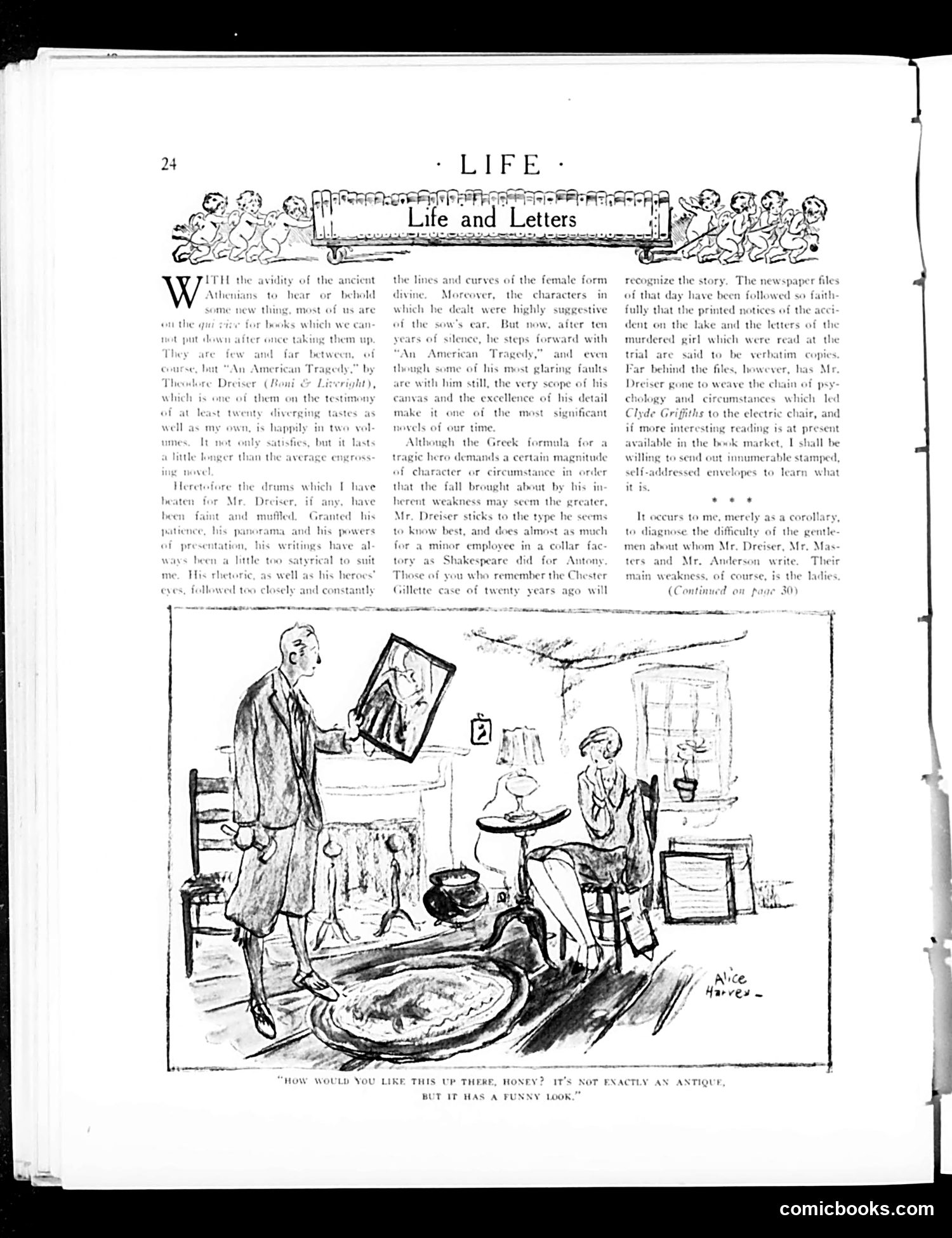
**The Article**: A literary critique of Theodore Dreiser's novel "An American Tragedy," praising his detailed portrayal of character and female form while noting his work drew from a real murder case (the Chester Gillette case of ~20 years prior). The author discusses Dreiser's artistic ambitions and the novel's significance. **The Cartoon**: A domestic scene showing a man holding up a large, oddly-shaped decorative object to his wife, who sits skeptically. He asks if she'd like it placed "up there," noting it's "not exactly an antique, but it has a funny look." **The Satire**: The cartoon humorously illustrates the tension between artistic merit and aesthetic appeal—much like the article's discussion of Dreiser's serious literary work. The wife's dubious expression mirrors potential reader skepticism: just because something is artistically ambitious doesn't mean it's visually or commercially appealing. The "funny look" parallels how Dreiser's unflinching realism might seem unattractive to some audiences despite its literary value.
📄 Transcribed text from this page (OCR, searchable)
Machine-transcribed from the original scan — historical spelling and the odd misread are preserved.
24 ‘LIFE: poasaanen= 20000470 sor aac onaaess Life and Letters ITH the avidity of the ancient — the lines and curves of the female form cognize the story. The newspaper files Ather to hear or behold divine. Moreover, the characters in of that day have been followed so faitl thing, most which were highly estive t the printed notice which we can of the w's car, Bi fr ten the lake and the | them up. years of silence, he steps forward with — murdered girl which wer 1 ure betwe “An American Tragedy,” and even trial are said verbatim course, but “An American Tragedy th tsome of his most glaring faults Far behind the fi howeve © ot them on the test with him still, the very scope of his Dreiser gone to weave the el psy canvas and the excellence of his de ey aad cireun wn, is happily in two vole novels of our time if more interesting reading is at present ly satisfies, but it Last Althongh the Greek formula for a — available in the book market, I shall be ul ge engross- tragic hero demands a certain magnitude out innumerable st 1 acter or circur order fall br s may seem the about by his in Heretofore the which [have ten for Mr. Dreiser, if any, have herent: weak ‘cater, been faint and mufiled. Granted his Mr. Dreiser sticks to the type he ns It occurs to me, merely as a cor ; patience, his panorama and his powe ww best, and st as to diagnose the difficulty of the gentle prese have yee in a collar fac: men about whom Mr. Dreiser, Mr. Mas ays bee atyrical to su as Shakespeare did for Antony. ters and Mr. Anderson write. Their as his her se of you who remember the Chester ly and consta Hette case of twenty years ago will ™ | . | \ { \ { ‘ j => | i | — : eres j “HOW WOULD YOU LIKE THIS UP THERE, HONEY? IT’S NOT ENACTLY AN ANTIQUE } _ BUT IT HAS A PUNNY 100k.” comicbooks.com