
Life, 1926-05-27 · page 25 of 44
Life — May 27, 1926 — page 25: what you’re looking at
What you’re looking at
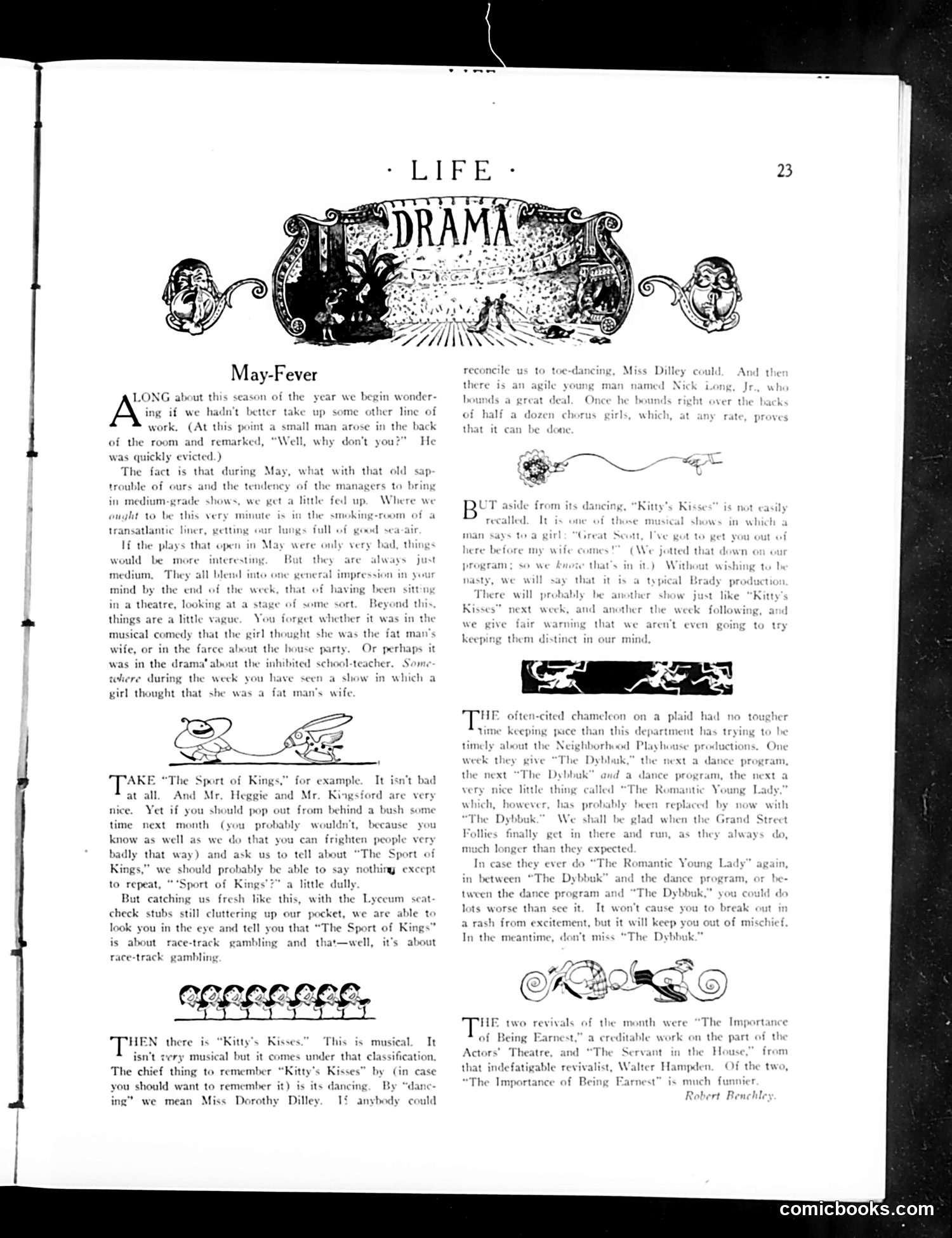
This is a theater review column about the spring theatrical season's peculiar challenges. The writer humorously complains that May's weather and theatrical glut create mental fog—audiences forget which show they attended or what happened in it. The column reviews several productions: "The Sport of Kings" (a race-track gambling drama), "Kitty's Kisses" (a musical featuring dancer Dorothy Dilley), "The Dybbuk" (a dance program), and revivals of "The Importance of Being Earnest" and "The Servant in the House." The satire targets theater-goers' distraction during May season. The opening anecdote—where someone in the audience is ejected for heckling—sets a comedic tone. The joke is that so many mediocre shows open simultaneously that patrons lose track of what they've seen, unable to recall basic plot details days later. It's social satire about urban entertainment consumption and mental exhaustion from cultural overload.
📄 Transcribed text from this page (OCR, searchable)
Machine-transcribed from the original scan — historical spelling and the odd misread are preserved.
= May-Fever LONG about this season of the year we begin wonder- A if we hadn't be ke up some oth line of (At this point man arose in the back work. of the room and remarke« , why don't you?” He was quickly evicted.) The { trouble t is that during May, what with that old sap and the tendency of the managers shows, we get a little fed up. Where we in medium-¢ ought to. be mot a mute is in the smokin very 1 nsatlantic liner, getting our lungs full of good sea-air ey are always would be more me They 3 mind by the e in a theatre, things are a little vague. You forget whether it was in the it she was the fat man’s 1 impression in y week cen sit a stage Seyond thi musical comedy that the girl the ut the house party. Or perhaps it wife, or in the farce al was in the drama’ about the inhibited school-teacher. Some which a > during the week you have seen a show wife girl thought that she was a fat ma "t bad Take “The Sport of Kings,” for example. Tt is tall. And Mr. Heggie do Mr. King nice. Yet if you should pop out from behind a bush time next month (you probably wouldn't, t know as well as we do that you can frighten people lly that way) and ask us to tell about “The we should probably be able to say nothing excer “a little dully with the Lyceum seat rd are very necause ki to repeat, “ ‘Sport of King But catching us fresh like thi check stubs still cluttering up c nd tell you that “Th 1 pocket look you in the eye and is about race-track gambli race-track gambling HEN there is “Kitty's Kisses.” This is music isn't very musical but it comes under that class The chi by (in case you should want to remember it) is its mean Miss Dorothy Dilley. If anybody could thing to remember “Kitty's K By “dane- ing” we named N Long, Jr at the Neighborh week they give “The Dy the next “The Dybb ce program, the next a he Romantic Young Lady “The Dyt d when the Grand t The Dybbuk,” you c¢ lots worse than see it. It won't cause y in betwee tween the ¢ from excitement, but it will keep y t miss “The Dy DRY a SQ G47 —~( — of the month were “The Importance able work on the part of the HE two revivals of Being Earnest,” a crec “The Servant in the House from alist, Walter Hampden. Of the two, comicbooks.com