
Life, 1926-05-27 · page 20 of 44
Life — May 27, 1926 — page 20: what you’re looking at
What you’re looking at
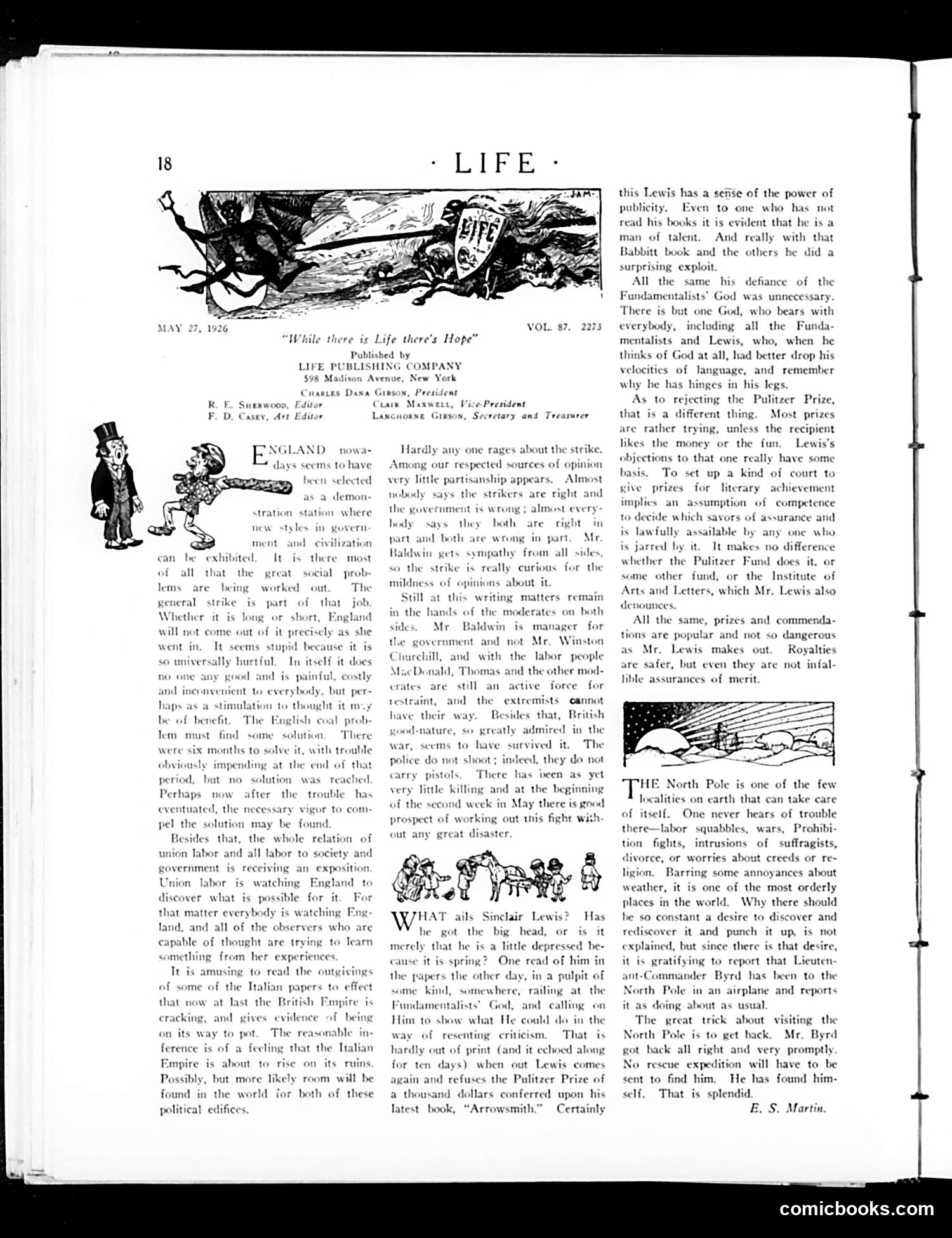
This page contains two distinct pieces of satire: **The English General Strike**: The lead article critiques Britain's 1926 coal miners' strike and general labor unrest. Life observes that England has become a "demonstration station" for new forms of government conflict. The author notes the strike solves nothing and causes suffering, yet serves as a "stimulation to thought" on labor relations. Notably, Life criticizes both strikers and government as partially wrong, and praises British restraint—police don't shoot, there's minimal killing. **Sinclair Lewis and the Pulitzer Prize**: The second section attacks novelist Sinclair Lewis for publicly rejecting the Pulitzer Prize and for his theatrical denunciation of Christian Fundamentalists. Life acknowledges Lewis's talent (*Babbitt*, *Arrowsmith*) but finds his defiance of Fundamentalists "unnecessary" and his publicity-seeking grandstanding. The magazine defends the Pulitzer while admitting literary prizes are inherently presumptuous—a characteristically backhanded compliment.
📄 Transcribed text from this page (OCR, searchable)
Machine-transcribed from the original scan — historical spelling and the odd misread are preserved.
Published by UBLISHID $98 Madison Avenw LIFE Cuances Dana Ginson, Presi Editor Cuae Editor Lancuoane Ginsox, Se R. FE. Sueawoo: F. D, Casey, A NGLAND nowa- days seems to have heen selected as a demon- stration station where new styles in govern ment and civilization can be exhibited. It is there most of all that the great social prob: lems are bei worked out. The xeneral strike is part of that jol Whether it is long or yrt, England will not come ¢ of it precisely as she went in, It seems stupid because it is ul, In itself it does no one any good and is painful, costly and onvenient to everybody, but per- haps as a stimulation to the ht it mey be of benefit. The English coal prob: Jem must find some solution. There were six months to solve it, with trouble obviously period, but no. solu npending at the end of th ion was reached Perhaps now after the trouble has eventuated, the neces: pel the soluti may be found Besides that, the whole relation of union labor and all labor to society and government is receiving an expositio m ta r is watching Engl. wer what is possible for it that matter everybody is watching land, and all of ¢ capable of thought are trying to learn e observers who are something from her experiences Tt is amusing to read the outgivings of some of the Italian papers to effe that now at last the F ish Empire is cracking, and gives evidence of being ble in- ference is of a feeling that the Italian on its way to pot. The reas Empire is about to rise on its ruins Possibly, but more likely room will be found in the world for bot these political edifices } COMPANY retary and Treasurer Hardly any one rages about the strike. Among our respected sources of opinion very little partisanship appears strikers are right a the government is wrong ; almost every- part and both are wrong in part Baldwin yets sympathy. fre mildness of opinions about it writing matters lerates on both © government MacDonald, Thomas and the other m sides that, British xood-nature, so greatly admired in the police do not shoot ; indeed, they do has been as yet at the beginning dd week in May there is good prospect of working out this fight with Sinclair Lewis? merely that he is a little depressed be- i One read of him in other day, in a pulpit of the papers the somewhere, amentalists’ God, and. calling en Him to show what He could do in the hardly out of print (and it echoed along when out Lewis comes Pulitzer Prize of liars conferred upon his a thousand « rrowsmith,” this Lewis has a sense of the power of publicity. E read his be en to one who has not Ss it is evident that he is a n of talent. And really with that Babbitt book and the others he did a surprising exploit. All the same his defiance of the Fundamentalists’ God was unnecessary There is but one God, who bears with everybody, including all the Funda- mentalists and Lewis, who, when he thinks of God at all, had better drop his velocities of language, and remember why he has hinges in his legs. As to rejecting the Pulitzer Prize, that is a different thing. Most prizes are rather trying, unless the recipient likes the money or the fun. Lewis's objections to that one really have some basis. To set up a kind of court to sive prizes for literary achievement implies an assumption of competence to decide which savors of assurance and is lawfully assailable by any one who is jarred by it. It makes no difference whether the Pulitzer Fund does it, or some other fund, or the Institute of Arts and Letters, which Mr. Lewis also denounces. All the same, prizes and nda- so dangerous ut. Royalties are safer, but even they are not infal- lible assurances of merit mm tions are popular and ni as Mr. Lewis makes HE North Pole is one of the few localities on earth that can take care of itself. One never hears of trouble there—labor squabbles, wars, Prohibi- tion fights, intrusions of suffragists, divorce, or worries about creeds or re- on, Barring some annoyances about weather, it is one of the most orderly places in the world. Why there should he so constant a desire to di lig! cover and rediscover it and punch it up, is not explained, but since there is that desire, it is gratifying to report that Lieuten- t-Commander Byrd has been to the orth Pole in an airplane and reports it as doing about as usual he great trick about visiting the North Py is to get back. Mr. Byrd got hack all right and very promptly No rescue expedition will have to be sent to find him. He has found him- self. That is splendid E, S. Martin. comicbooks.com