
A complete issue · 40 pages · 1926
Life — March 11, 1926
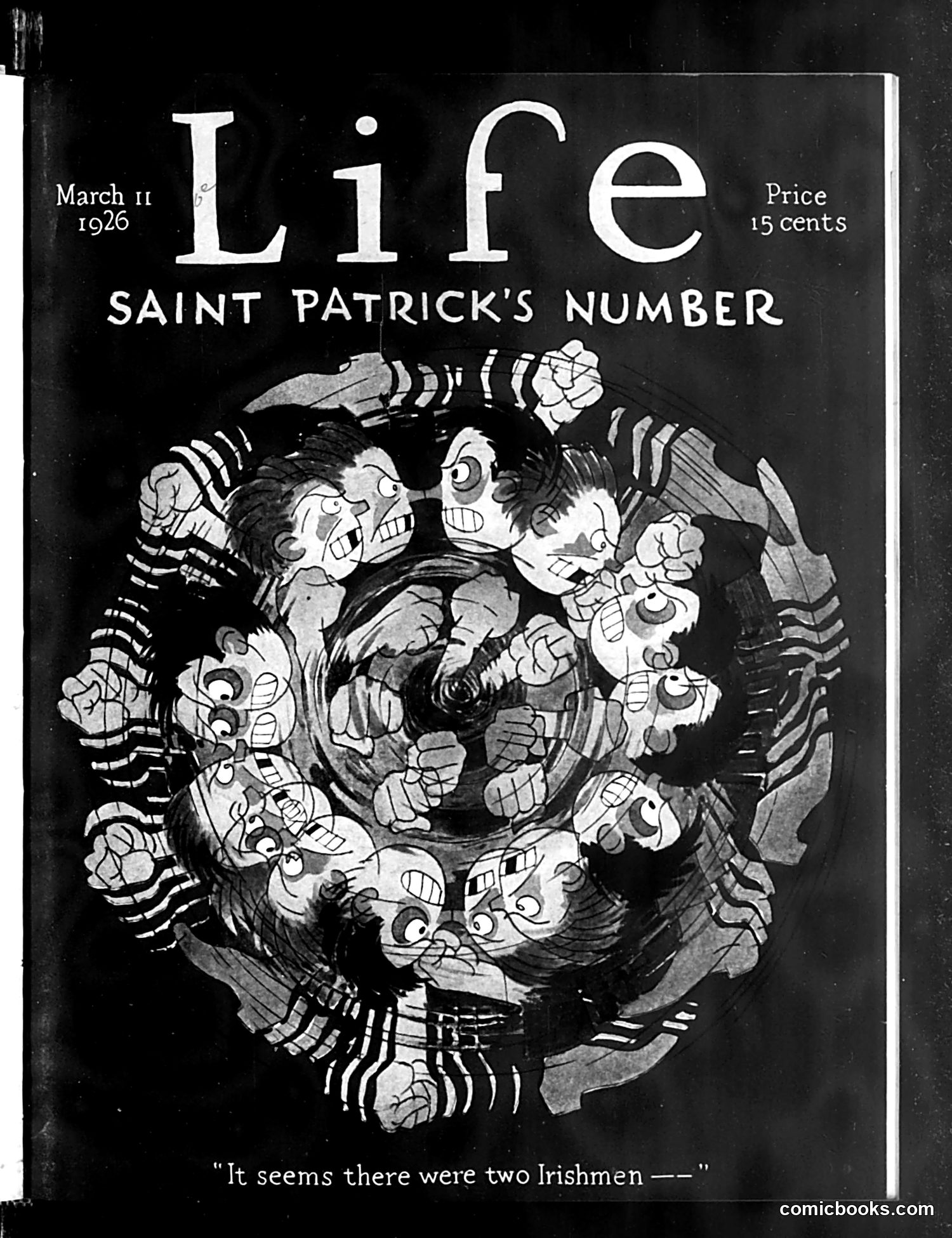
This is the cover of Life's Saint Patrick's Day special issue. The central illustration depicts a chaotic circular arrangement of exaggerated Irish caricatures—men with stereotypical features wearing bowler hats and striped clothing, their faces contorted in aggressive expressions. The caption reads: "It seems there were two Irishmen—" This references a classic joke setup implying conflict or argument. The circular composition and aggressive posturing suggest the stereotype of Irish people as quarrelsome or prone to fighting. This reflects 1920s American attitudes toward Irish immigrants—presenting them as comic subjects defined by stereotypical traits of drinking, fighting, and loud behavior. The satire targets both Irish identity and Irish-American culture of the period.
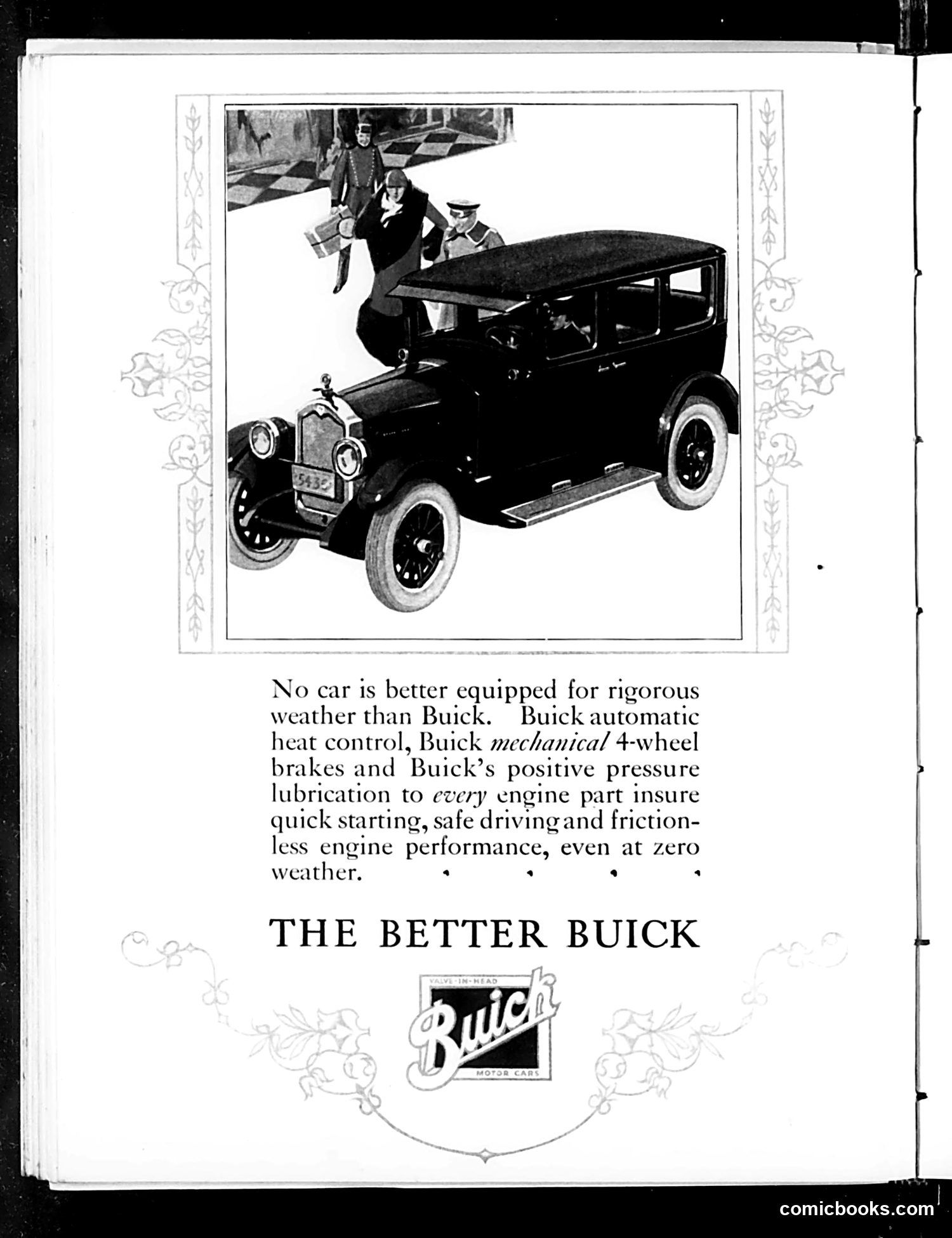
This page is **primarily an advertisement**, not satirical content. It's a Buick Motor Cars ad promoting "The Better Buick" automobile. The image shows a 1920s-era sedan with several well-dressed figures nearby, suggesting middle-class respectability. The advertisement emphasizes practical winter features: automatic heat control, mechanical 4-wheel brakes, and positive pressure lubrication for reliable cold-weather performance. The text highlights engineering advantages ("quick starting, safe driving and frictionless engine performance, even at zero weather"), appealing to buyers concerned about reliability in harsh conditions—a significant selling point for early automobiles when winter driving was genuinely challenging. The decorative borders and Buick logo are typical period advertising design. This represents straightforward product promotion rather than satire or political commentary.
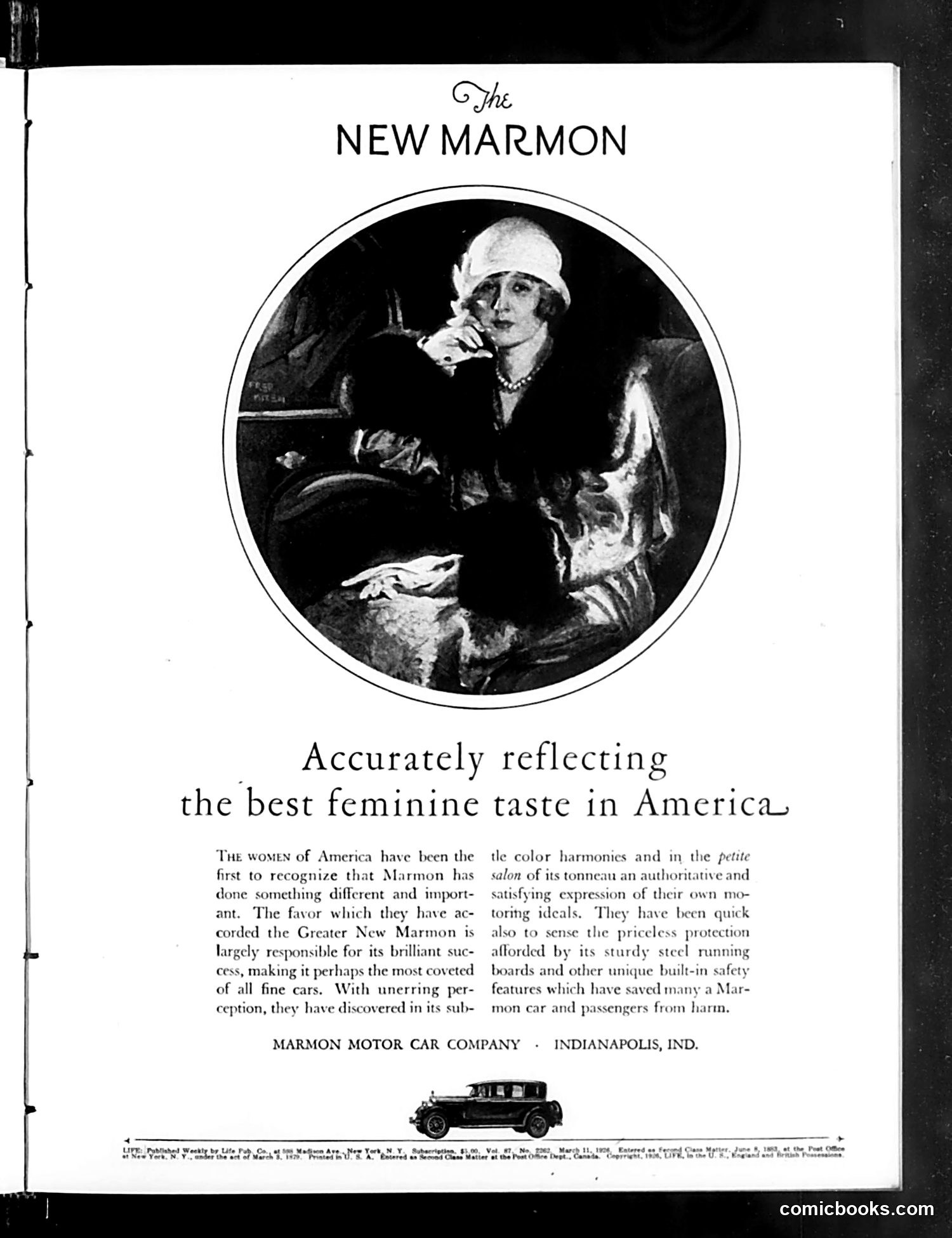
This is a **car advertisement**, not satire or political commentary. It promotes the Marmon automobile, made by the Marmon Motor Car Company in Indianapolis, Indiana. The advertisement uses a photograph of an elegant woman in 1920s fashion (cloche hat, fur stole) to appeal to female consumers. The tagline claims the car "accurately reflects the best feminine taste in America." The text addresses women directly, praising their recognition of Marmon's quality and design. It emphasizes safety features ("sturdy steel running boards") and aesthetic appeal ("subtle color harmonies"). This represents typical early-20th-century automotive marketing: associating luxury cars with refined femininity to reach wealthy female buyers or influence male purchasers buying for their wives.
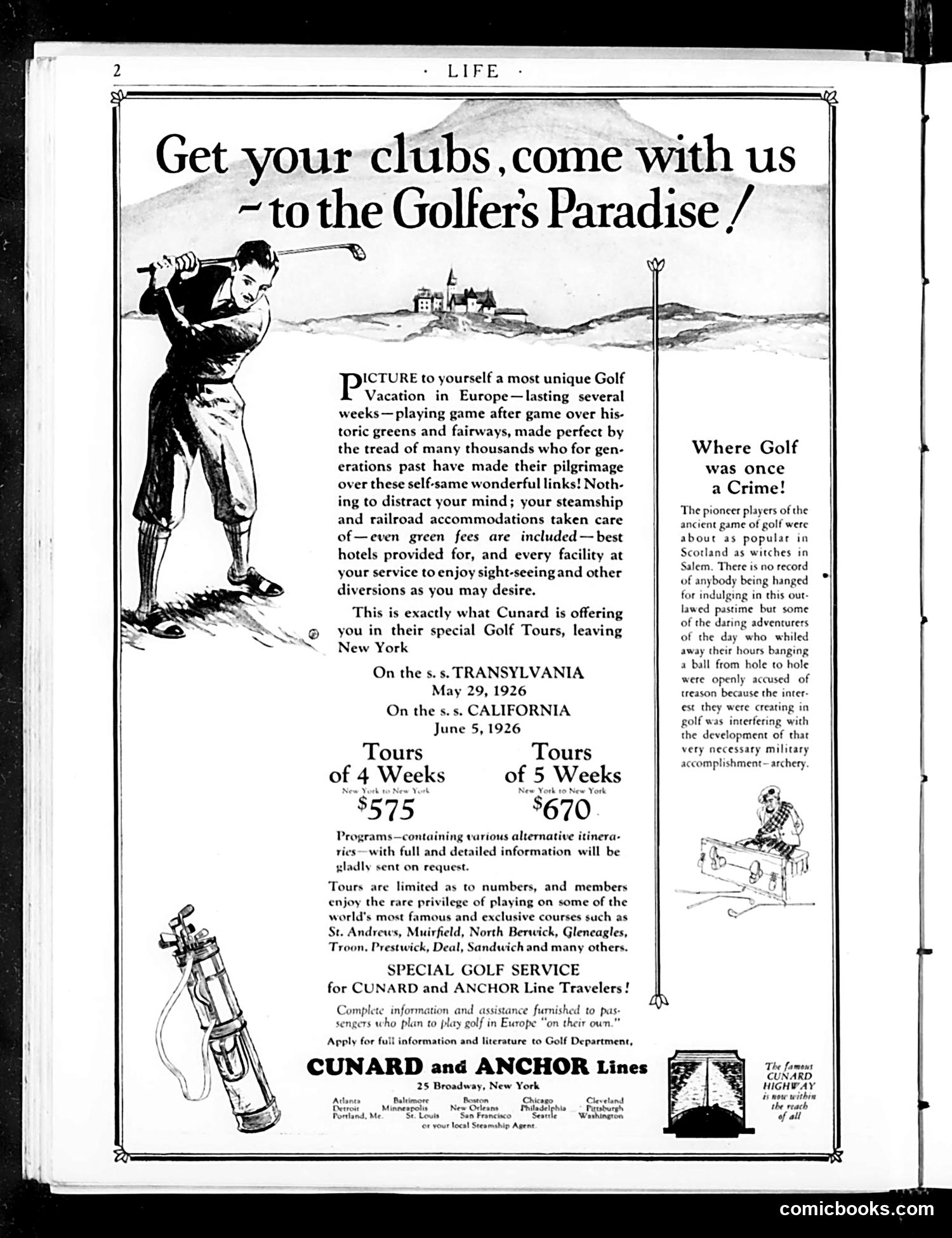
This page is **primarily advertising**, not political satire. It's a 1926 Cunard and Anchor Lines travel advertisement promoting luxury golf tours to Europe. The ad features: - A stylized golfer mid-swing (left side) - Illustrations of golf clubs and equipment - A sidebar titled "Where Golf was once a Crime!" describing how golf was historically outlawed in Scotland because it distracted from military archery practice The humor is mild and historical rather than satirical: the sidebar presents a genuine historical fact (golf was indeed restricted in medieval Scotland) as novelty entertainment to appeal to readers. The overall message is aspirational—positioning a European golf vacation as the ultimate leisure experience for wealthy American travelers during the prosperous 1920s. No political commentary or caricature is present.
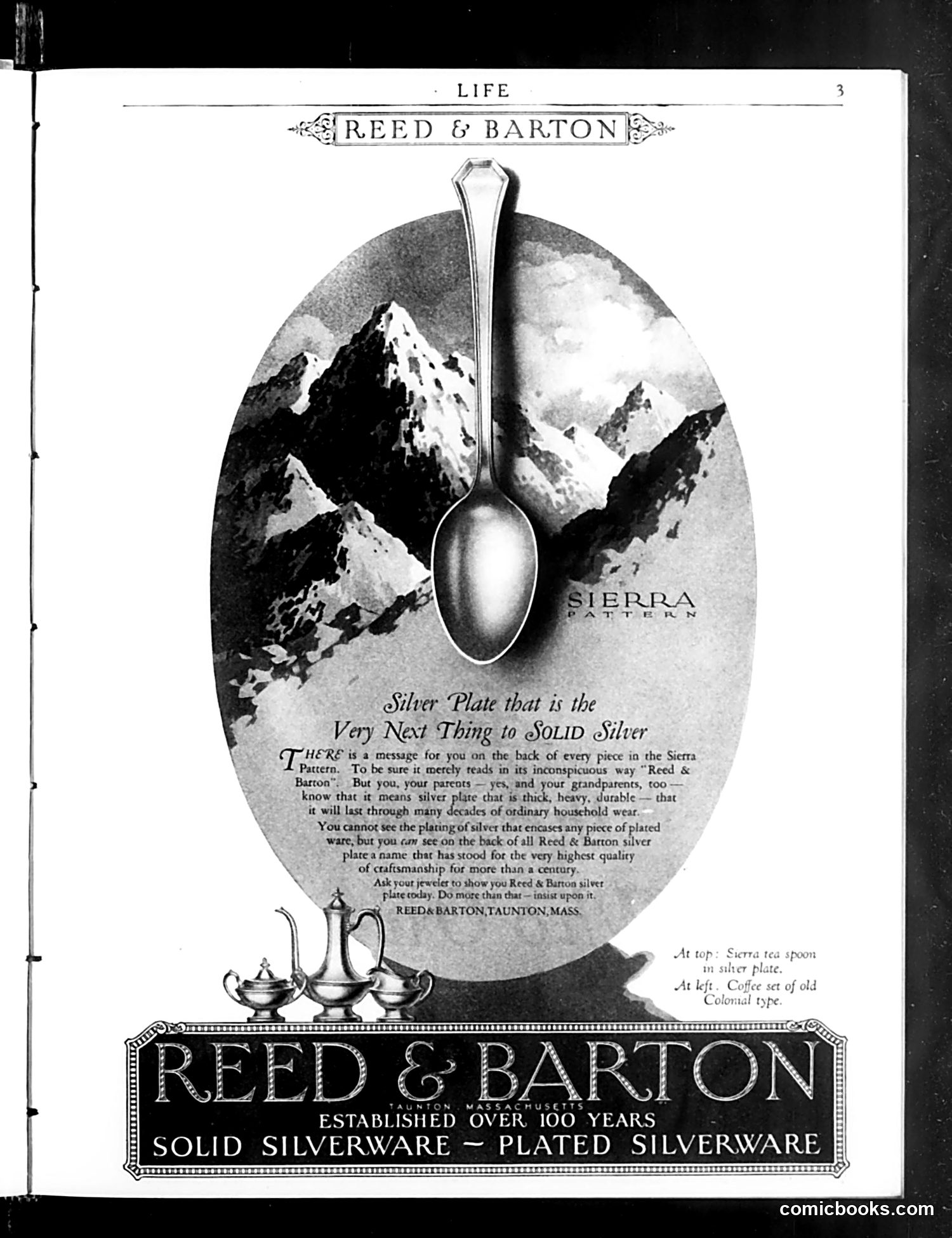
This page is **not a cartoon or satire** — it is a **straightforward advertisement** for Reed & Barton silverware, published in *Life* magazine. The ad promotes "Sierra Pattern" silver plate as a quality alternative to solid silver. The central image shows a decorative spoon overlaid on a mountain landscape (the Sierra), with tea service examples below. The accompanying text emphasizes the brand's century-old reputation for craftsmanship and durability, positioning silver plate as "the very next thing to solid silver." The only notable element is the phrase "insist upon it" — standard advertising language urging consumers to demand this brand from jewelers. This is commercial promotion, not political commentary or satire.
This page from *Life* magazine is an advertisement, not a political cartoon. It features typography-based copy promoting the purchase of automobiles. The text reads: "Now! MORE THAN EVER— Ask the Man Who Owns One" This appears to be a famous advertising slogan encouraging potential car buyers to seek advice from existing automobile owners about purchase decisions. The emphatic "Now!" suggests urgency, likely referencing a specific moment when car ownership was particularly desirable or newly accessible—possibly the 1920s-1930s when automobiles were becoming more common consumer goods. The page itself contains no identifiable caricatures, political figures, or satirical content. It is straightforward promotional material encouraging automobile purchasing through peer endorsement.
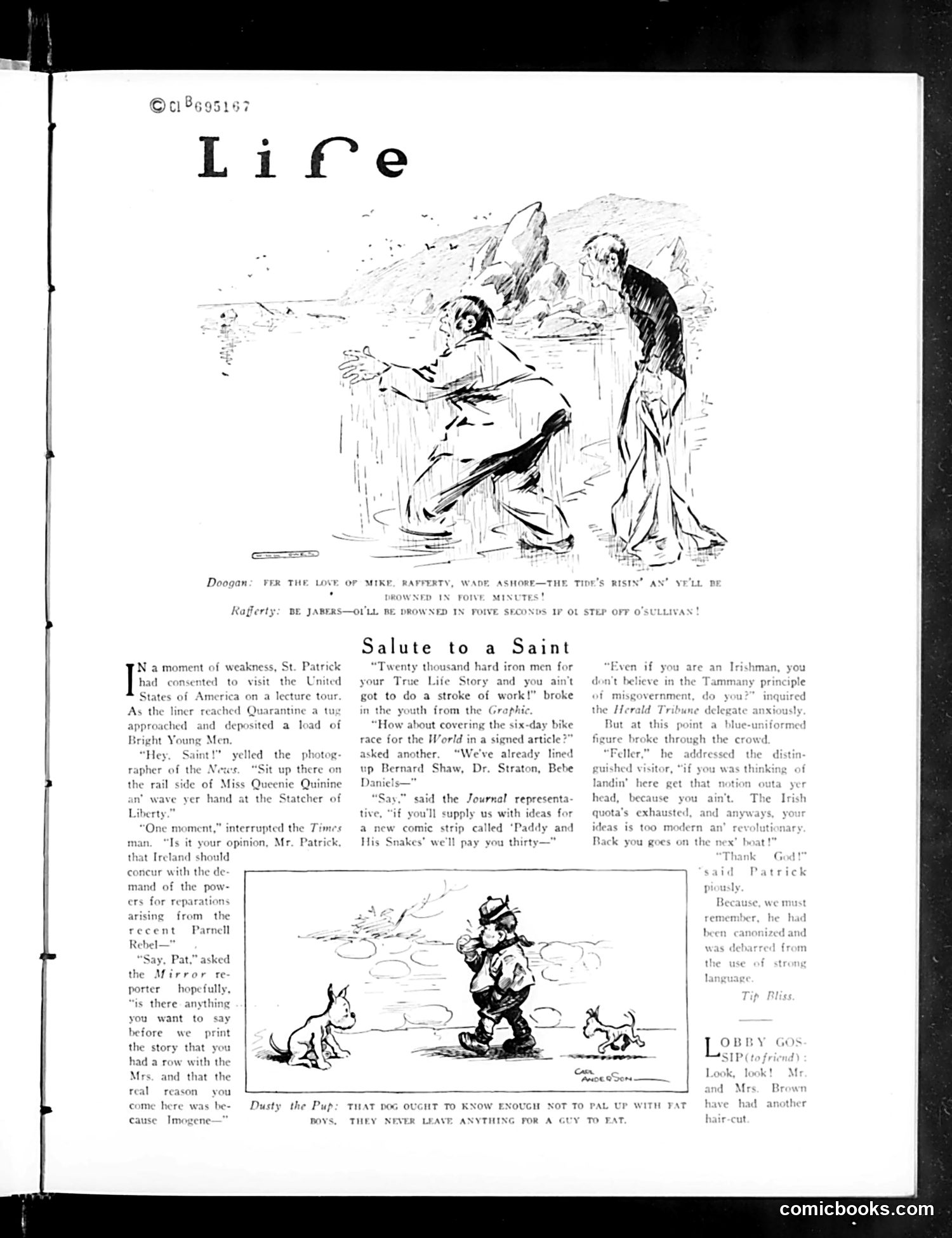
This page from the satirical magazine *Life* contains two main cartoons: **Top cartoon ("Salute to a Saint"):** depicts what appears to be Irish political figures—the text references "an Irishman" and mentions "Tammany" (New York's Irish-dominated political machine). The satire involves someone visiting the U.S. and being pressured to contribute ideas for a comic strip called "Paddy and His Snakes" for payment, mocking both Irish stereotypes and the commercialization of Irish identity in American media. **Bottom cartoon ("Dusty the Pup"):** A humorous dog illustration with the caption suggesting dogs are shrewd about not befriending overweight men, as they "never leave anything for a guy to eat"—a joke about canine food-stealing behavior. The page satirizes Irish-American politics, media stereotyping, and includes light humor about daily life.
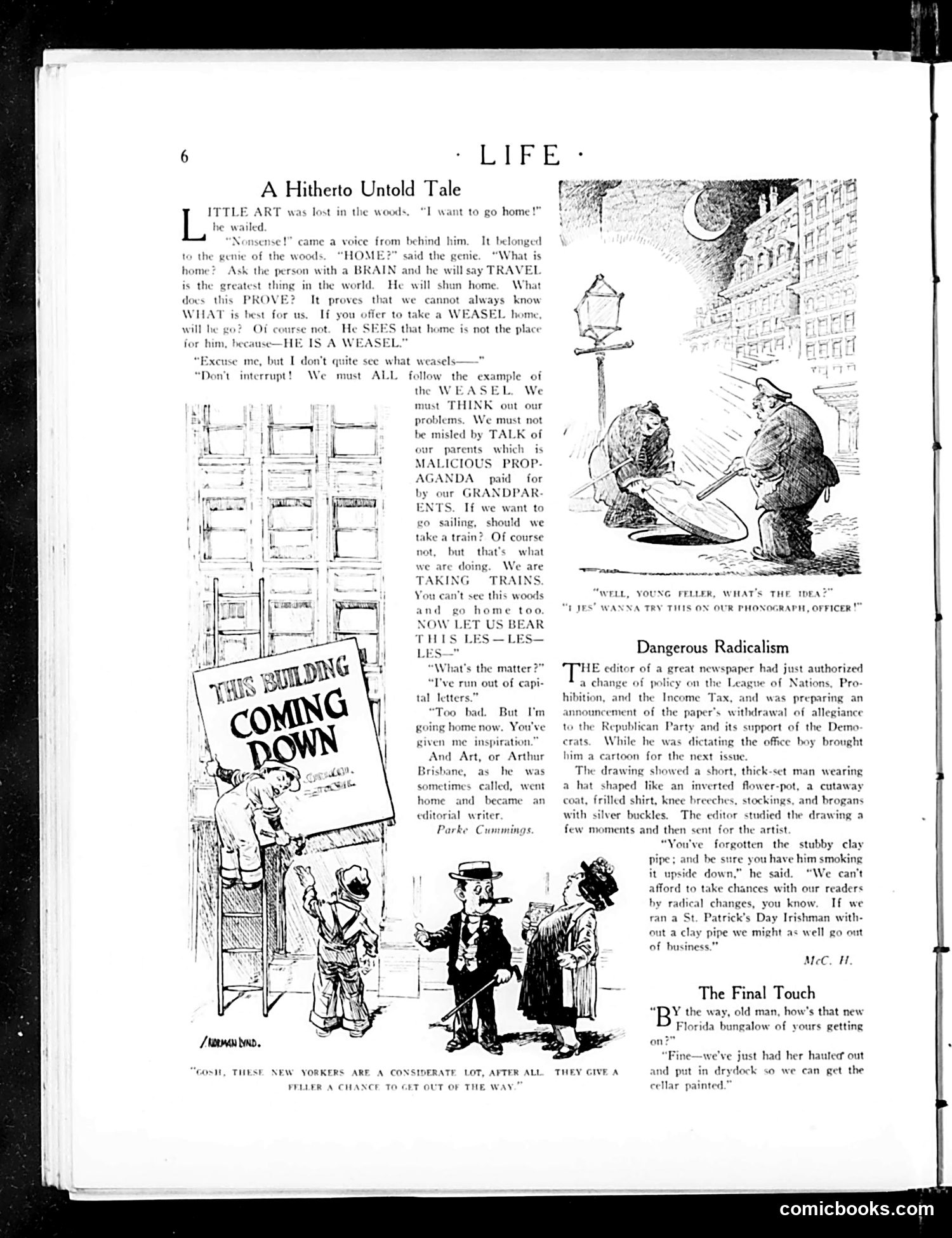
**"A Hitherto Untold Tale"** (top): A moral fable where Little Art, lost in woods, encounters a Genie offering travel as life's greatest reward. The genie warns against taking "a weasel home," arguing weasels represent bad influences. Art is tempted but chooses to stay put, learning that travel itself (taking trains) is the real goal, not destination. This appears to satirize restless American culture and wanderlust. **"This Building Coming Down"** (left): An advertisement-style cartoon showing New Yorkers cheerfully welcoming urban demolition, with the caption praising their consideration in "giving a filler a chance to get out of the way." **"Dangerous Radicalism"** (right): Commentary on editorial policy changes at the League of Nations regarding prohibition and income tax, with satire about the editor's cartoon depicting a radical in inverted flowerpot clothing smoking a clay pipe upside-down.
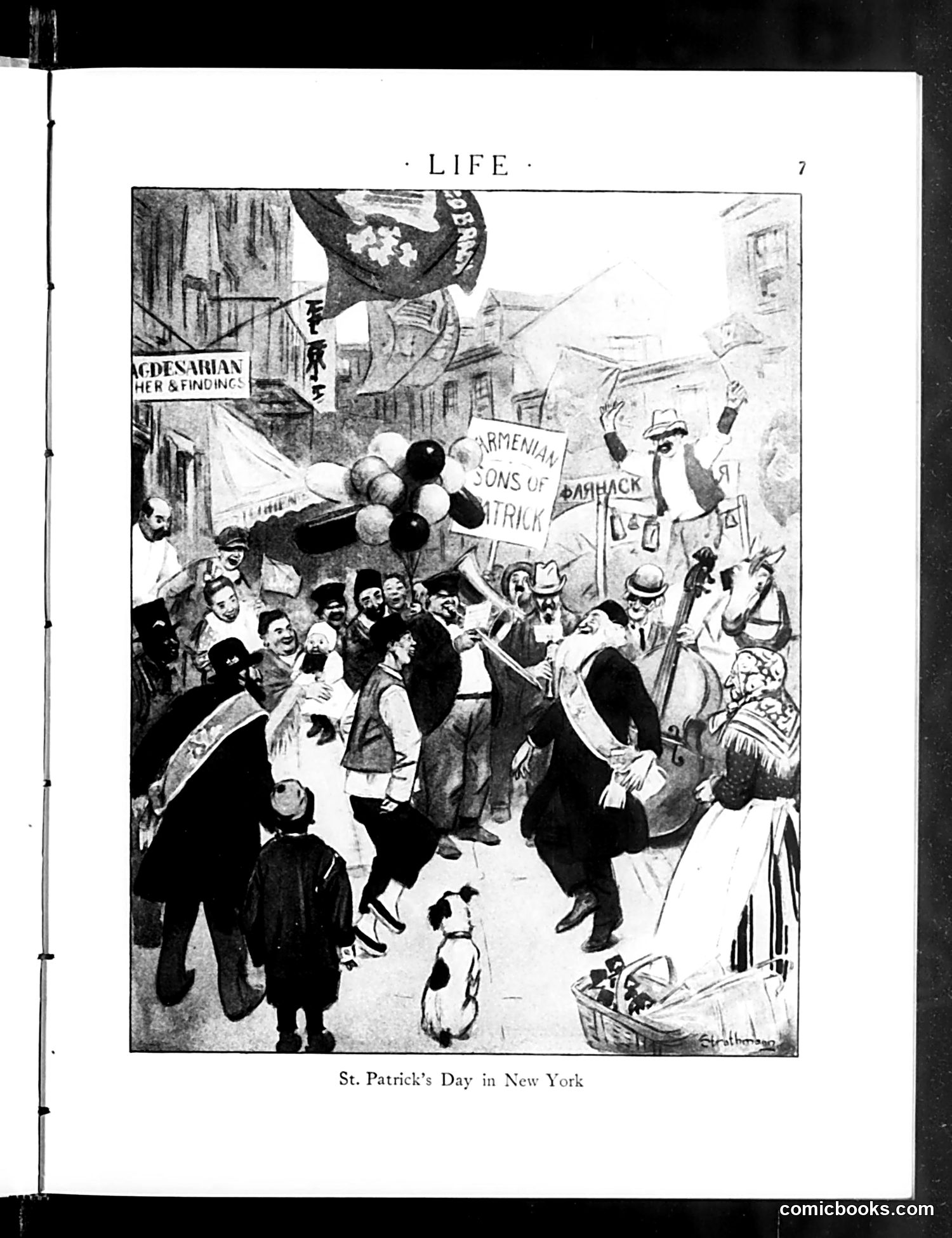
This satirical illustration depicts a crowded street celebration of St. Patrick's Day in New York City. The cartoon shows various ethnic and social groups celebrating together, with visible signs including "Armenian Sons of Strike" and what appears to be "Hayback" signage. The satire seems to mock the commercialization and broad inclusivity of the holiday—suggesting that St. Patrick's Day had become a generalized urban celebration embracing diverse immigrant communities beyond Irish participants. The presence of multiple ethnic groups and strike-related signage suggests commentary on labor activism and immigrant experiences in early 20th-century New York. The crowded, chaotic scene with balloons and varied participants satirizes how the holiday's meaning had expanded beyond its original cultural boundaries.
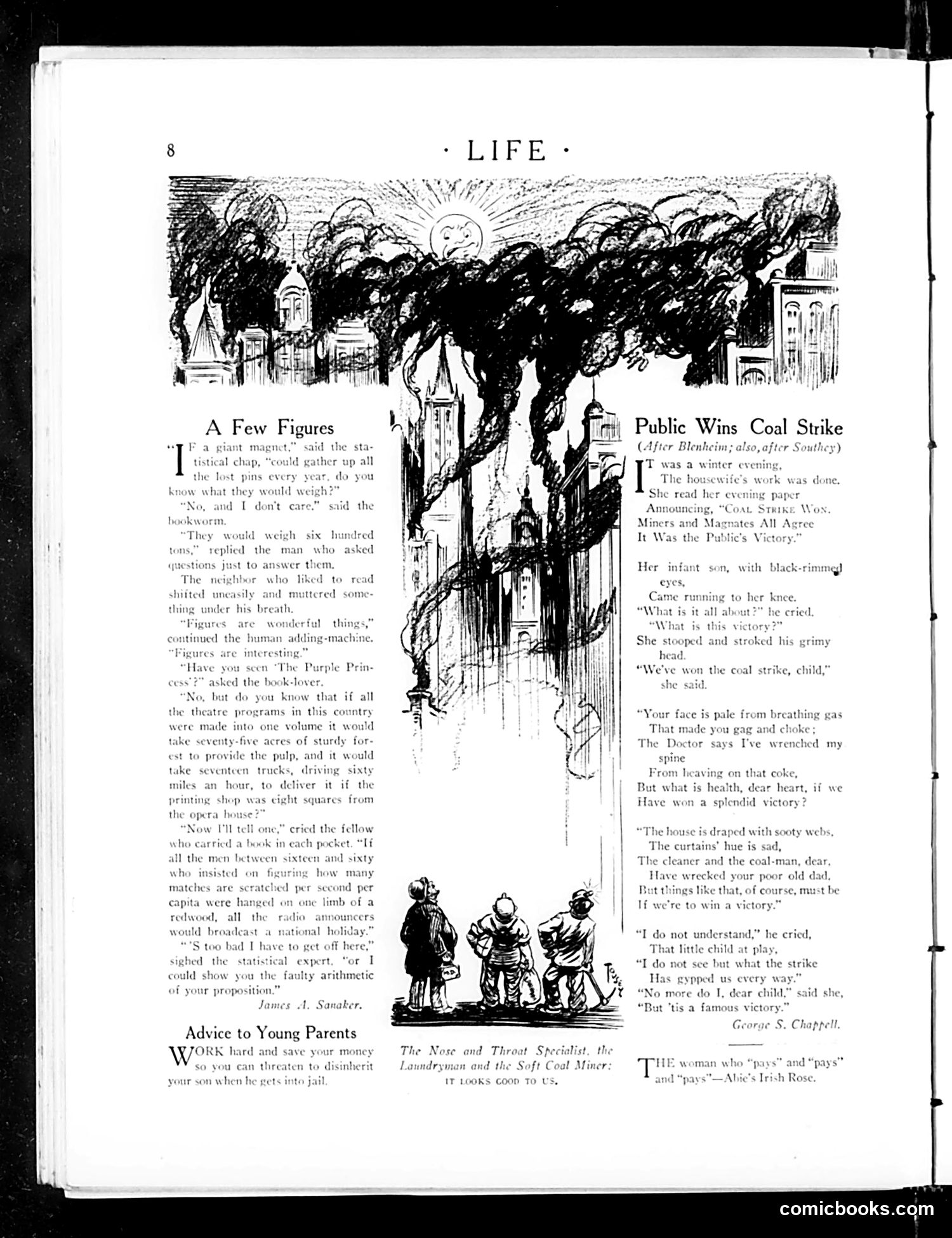
This page contains three distinct pieces: 1. **"A Few Figures"** (left): A dialogue satirizing statistical arguments about industrial output. A "giant magnet" and "statesman" debate whether six hundred tons of material moved yearly justifies the human cost. The satire mocks how statistics obscure real suffering—a common critique of industrialization. 2. **"Public Wins Coal Strike"** (right): A poem celebrating a miners' strike victory. It depicts a mother explaining to her sickly son that despite their hardship—pale from gas exposure, the home damaged—they've won a "splendid victory" for labor. The irony is heavy: the "victory" provides no immediate relief for their suffering. 3. **"Advice to Young Parents"** (bottom left): A brief, cynical quip about saving money to protect children from jail. The page critiques labor conditions and industrial capitalism.
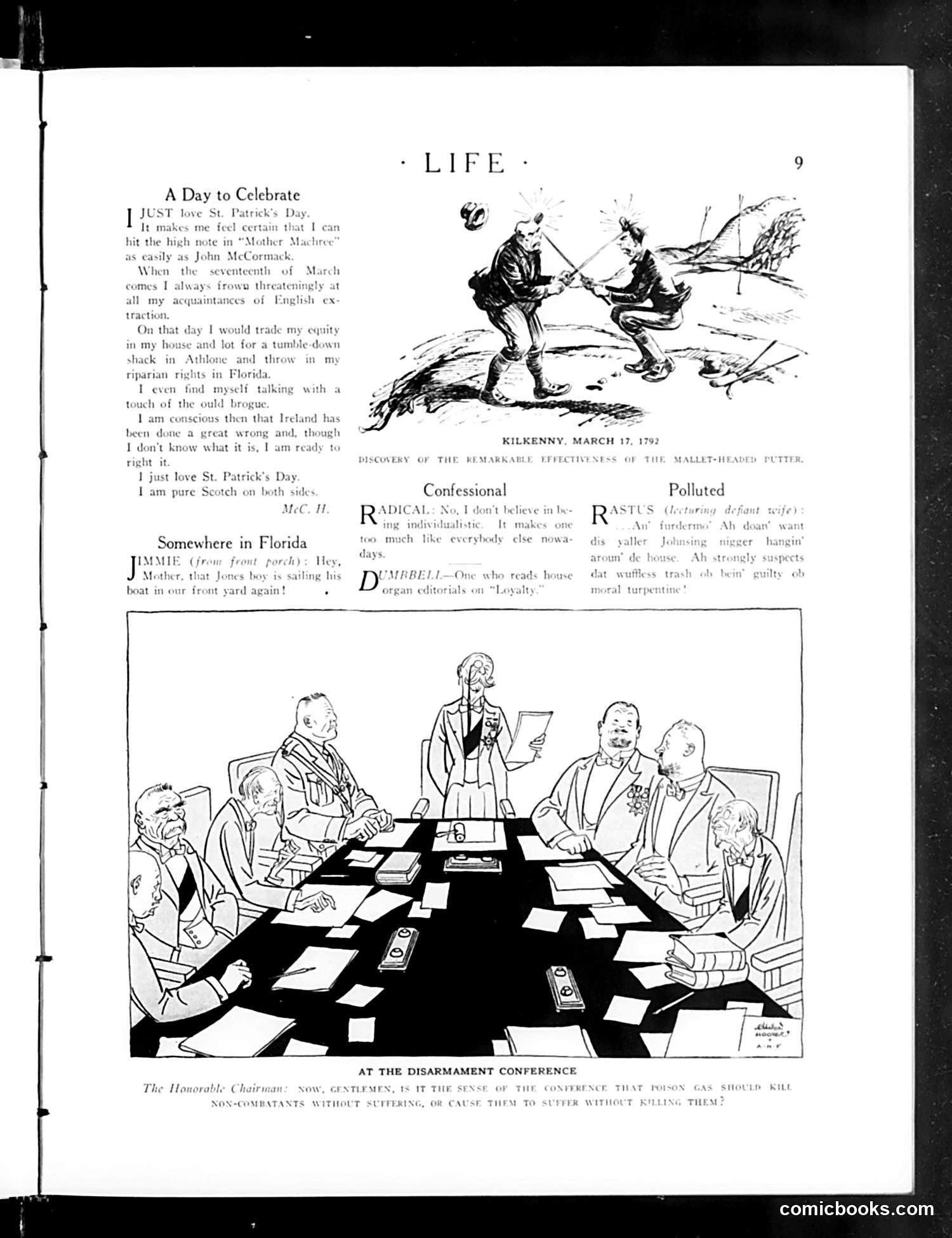
The main cartoon titled "At the Disarmament Conference" depicts several men seated around a table during what appears to be a post-WWI arms reduction negotiation. The caption poses a satirical question: whether it makes sense for the conference to allow poison gas to kill non-combatants without suffering, or force them to suffer without killing them—essentially mocking the hypocrisy of debating "humane" methods of chemical warfare. The upper sketch shows two figures in Kilkenny, March 17, 1792, demonstrating the "mallet-headed putter" (likely St. Patrick's Day-related humor). The page also includes brief humorous personal submissions about St. Patrick's Day and Florida, typical of Life's reader contribution sections. The satire targets the absurdity of disarmament discussions that still legitimized certain weapons.
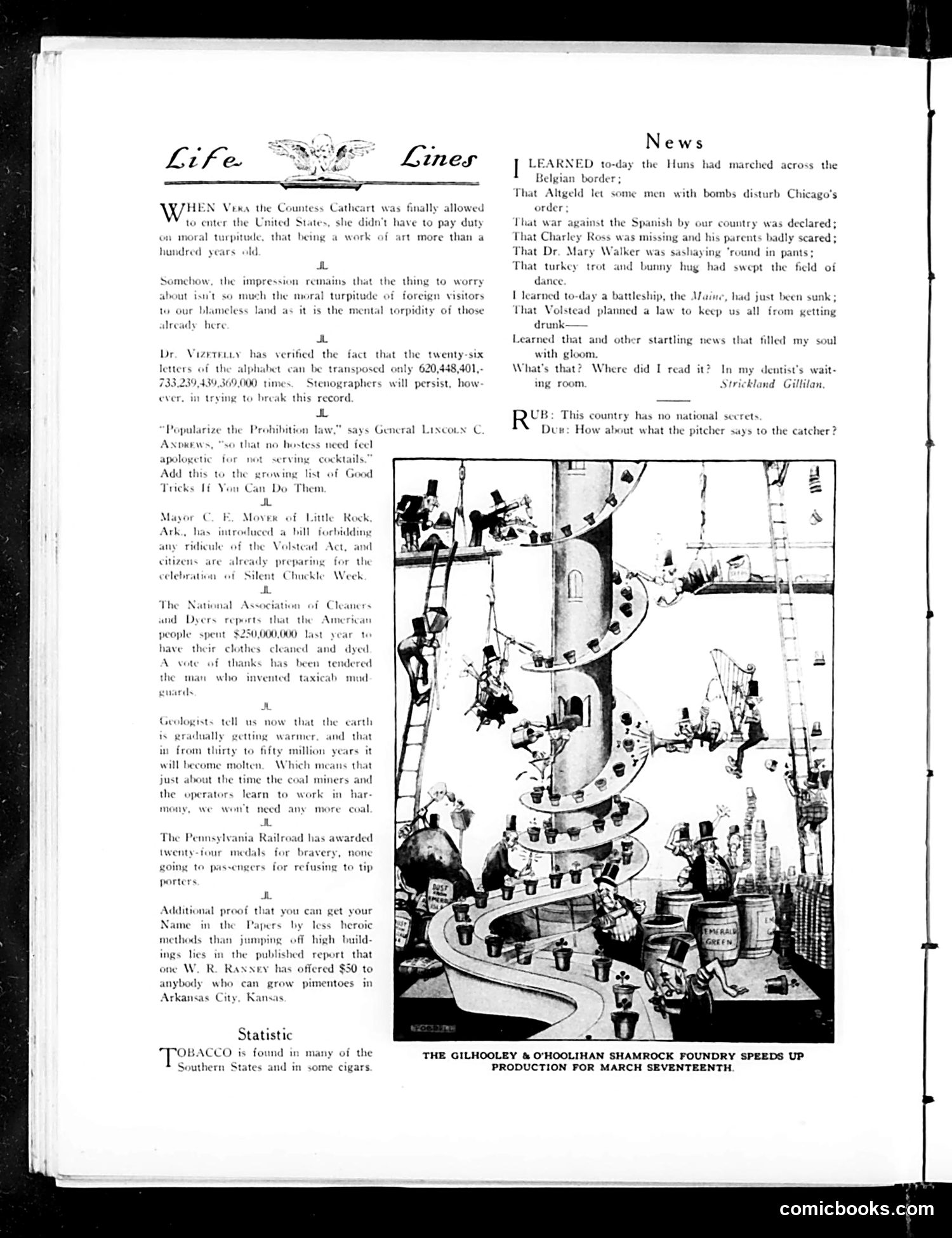
This page contains a satirical cartoon titled "The Gilhooley & O'Hoolihan Shamrock Foundry Speeds Up Production for March Seventeenth." The cartoon depicts an Irish-themed factory in chaotic operation, with workers climbing ladders and handling bottles—likely alcohol. The "March Seventeenth" reference indicates St. Patrick's Day. The satire appears to mock Irish-American stereotypes linking Irish identity to alcohol production and consumption during Prohibition (referenced in the text above). The frenzied factory activity suggests Irish businesses were supposedly rushing to produce alcohol before the holiday. The cartoon combines ethnic caricature with commentary on Prohibition enforcement. The fictional factory name uses exaggerated Irish stereotypes to make its satirical point about Irish-American culture and illegal liquor production during this era.
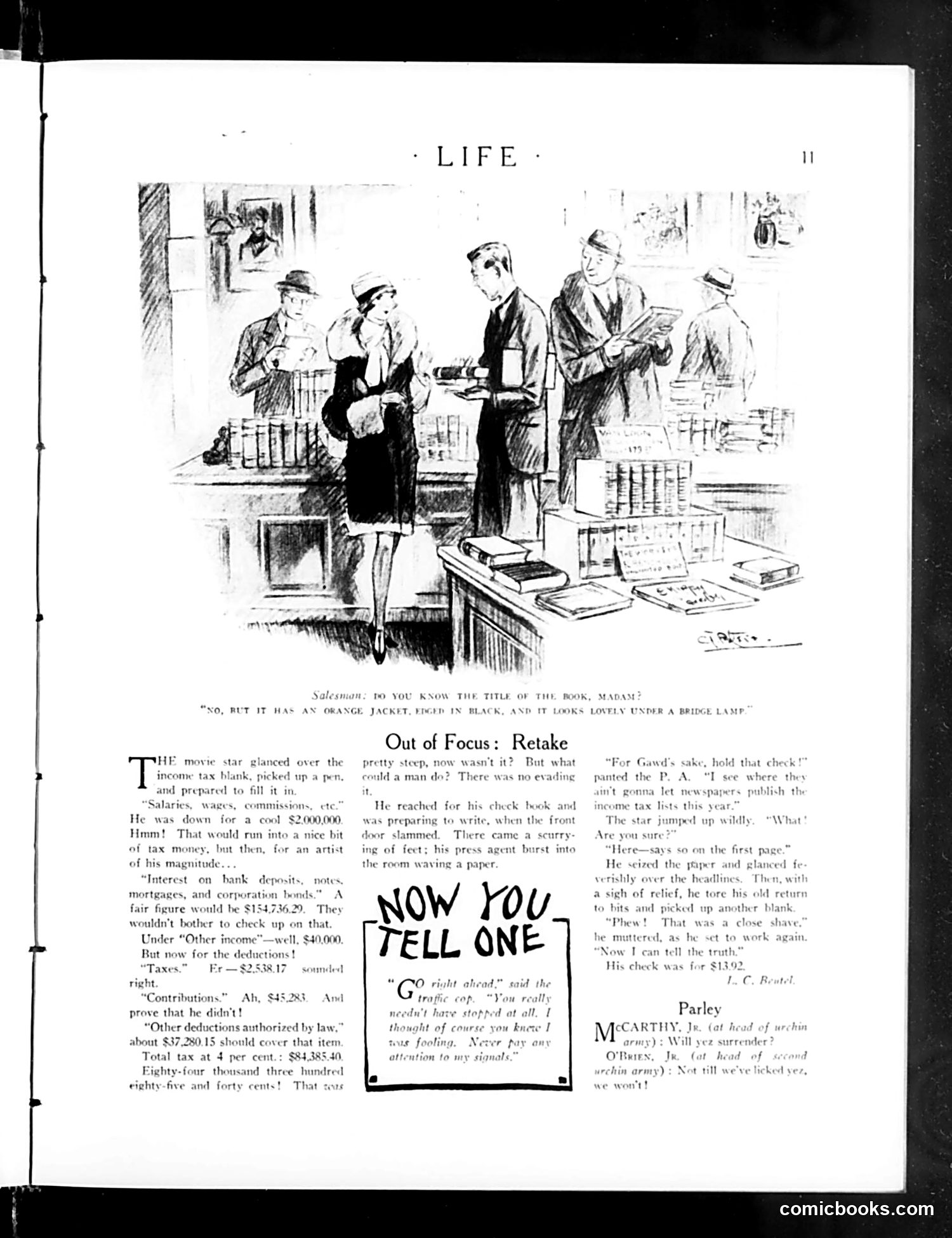
This cartoon satirizes a movie star's financial ignorance. The sketch shows a salesman presenting a book to the star, who initially balks at its $2,000,000 price tag—substantial even for a wealthy entertainer. The joke centers on the star's bewilderment about basic accounting: he doesn't understand tax deductions, bank deposits, or financial documents. When the salesman explains various financial obligations totaling over $84,000, the star remains confused about his own money. The inset caption "NOW YOU TELL ONE" presents the salesman's sarcastic response, suggesting the star's ignorance about his finances is laughably implausible—implying that even wealthy entertainers should understand fundamental money management. The satire targets both celebrity financial naiveté and the gap between earning power and fiscal literacy.
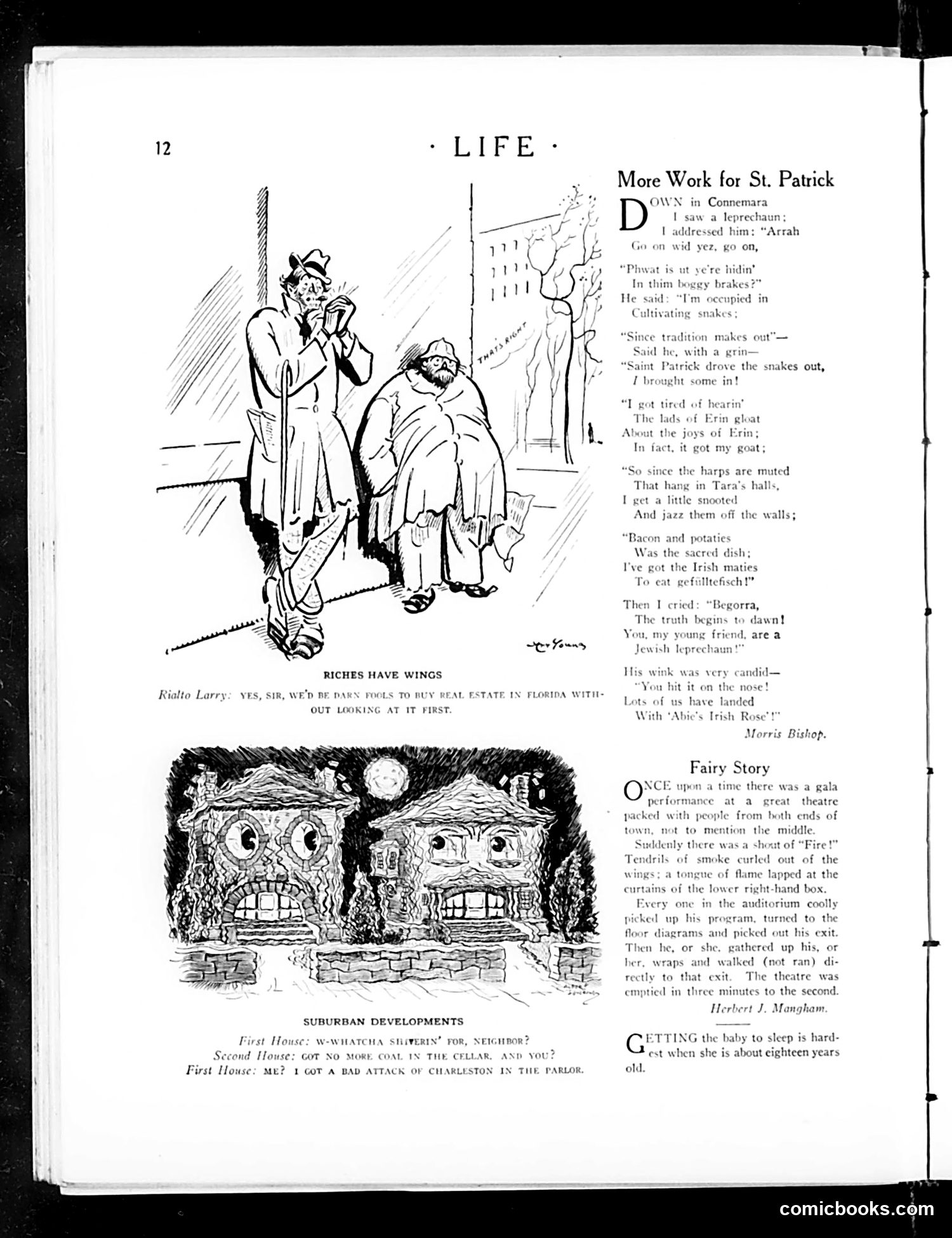
This page contains three distinct humorous pieces: 1. **"Riches Have Wings"**: A cartoon depicting two men discussing Florida real estate. The satire mocks the get-rich-quick mentality of Florida land speculation, suggesting that wealth in such schemes is ephemeral ("has wings"). The joke implies one should examine properties carefully before investing. 2. **"More Work for St. Patrick"**: A poem by Morris Bishop satirizing Irish-American stereotypes and traditions, referencing snakes, harps, Irish food, and Jewish culture in a comedic way typical of 1920s-30s American humor. 3. **"Suburban Developments"**: A cartoon about neighbors discussing shared walls and Charleston dancing—poking fun at cramped suburban housing and the era's popular dance crazes. 4. **"Fairy Story"**: A brief humorous anecdote about a theatre fire, by Herbert J. Mongham.
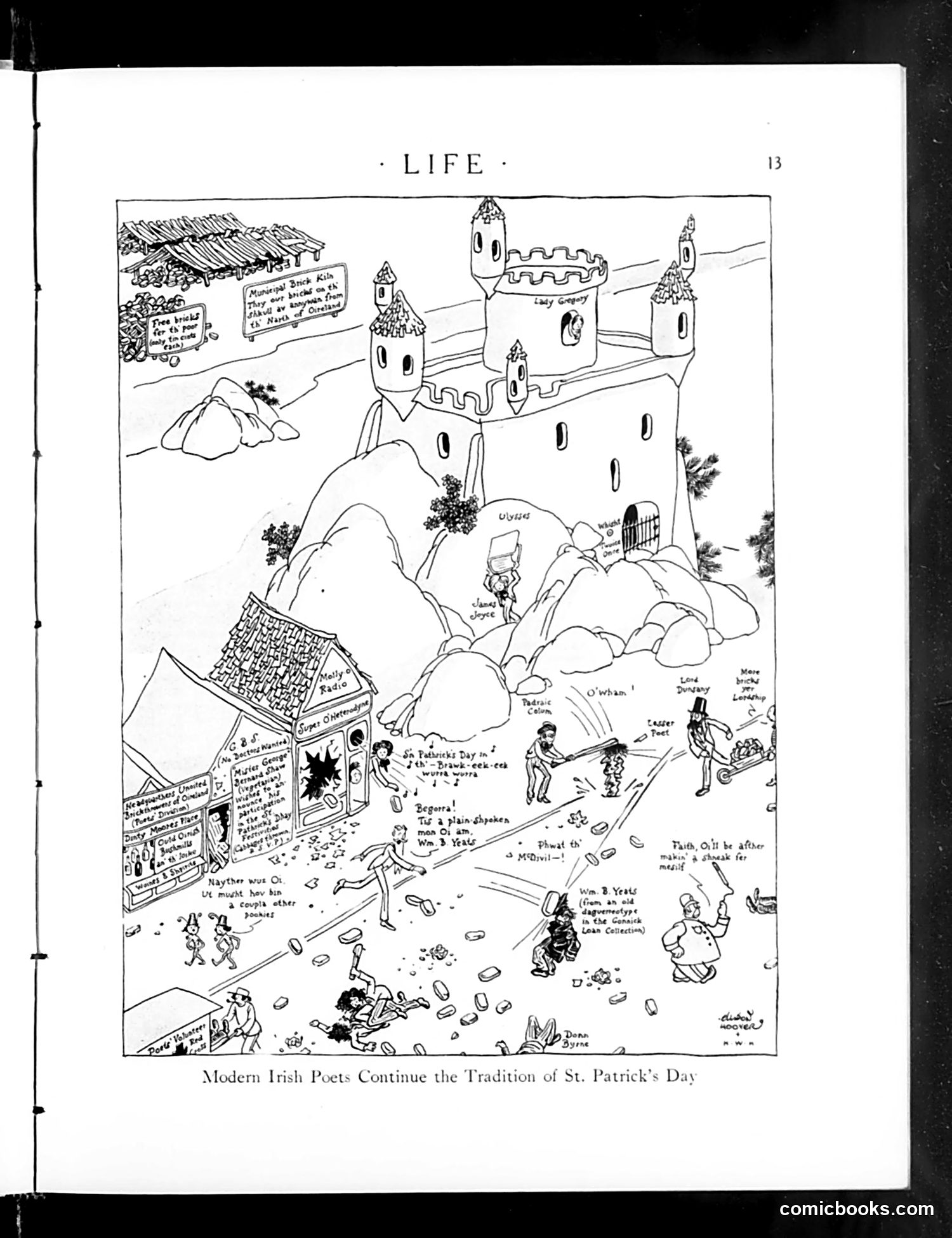
This satirical cartoon depicts an Irish fantastical landscape with castles, mountains, and various figures engaged in chaotic activity. The caption references "Modern Irish Poets" continuing St. Patrick's Day traditions, suggesting the cartoon mocks contemporary Irish literary figures or their cultural practices. The scene appears to satirize Irish stereotypes—featuring whimsical architecture, rural settings, and numerous human figures in apparent revelry or disorder. Various speech bubbles contain text, though most are illegible at this resolution. The satire likely comments on how Irish poets of the era (early 20th century, based on Life's publication style) perpetuated romantic or exaggerated cultural traditions associated with St. Patrick's Day, possibly critiquing either their literary pretensions or cultural kitsch. Without clearer legibility of the dialogue, specific targets remain unclear.
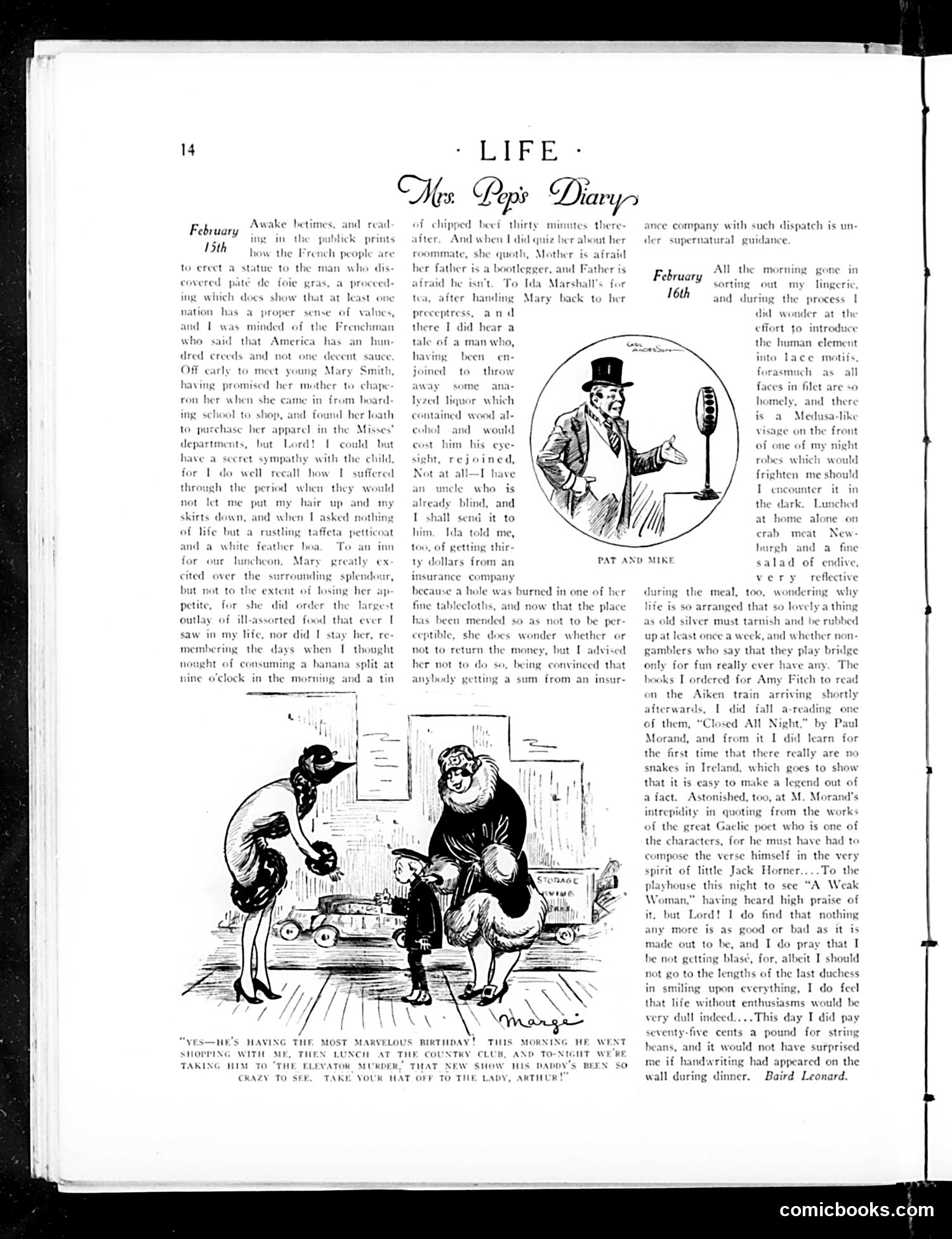
This is a diary entry feature titled "Mrs. Pop's Diary" dated February 15th-16th, with illustrations by Margot (visible signature). The page contains two cartoons depicting domestic life. The upper illustration labeled "PAT AND MIKE" shows a man in a top hat presenting something (possibly a microphone) to a woman. The lower cartoon depicts a family scene with children and adults, with the caption describing a birthday celebration involving shopping, lunch at a country club, and an elevator incident where the father's hair "looks so crazy." The diary text reflects genteel middle-class concerns: lingerie sorting, dinner menus, children's behavior, theater attendance, and social embarrassments. The satire gently mocks the preoccupations of upper-middle-class domestic life and parental anxieties typical of early 20th-century American magazine humor.
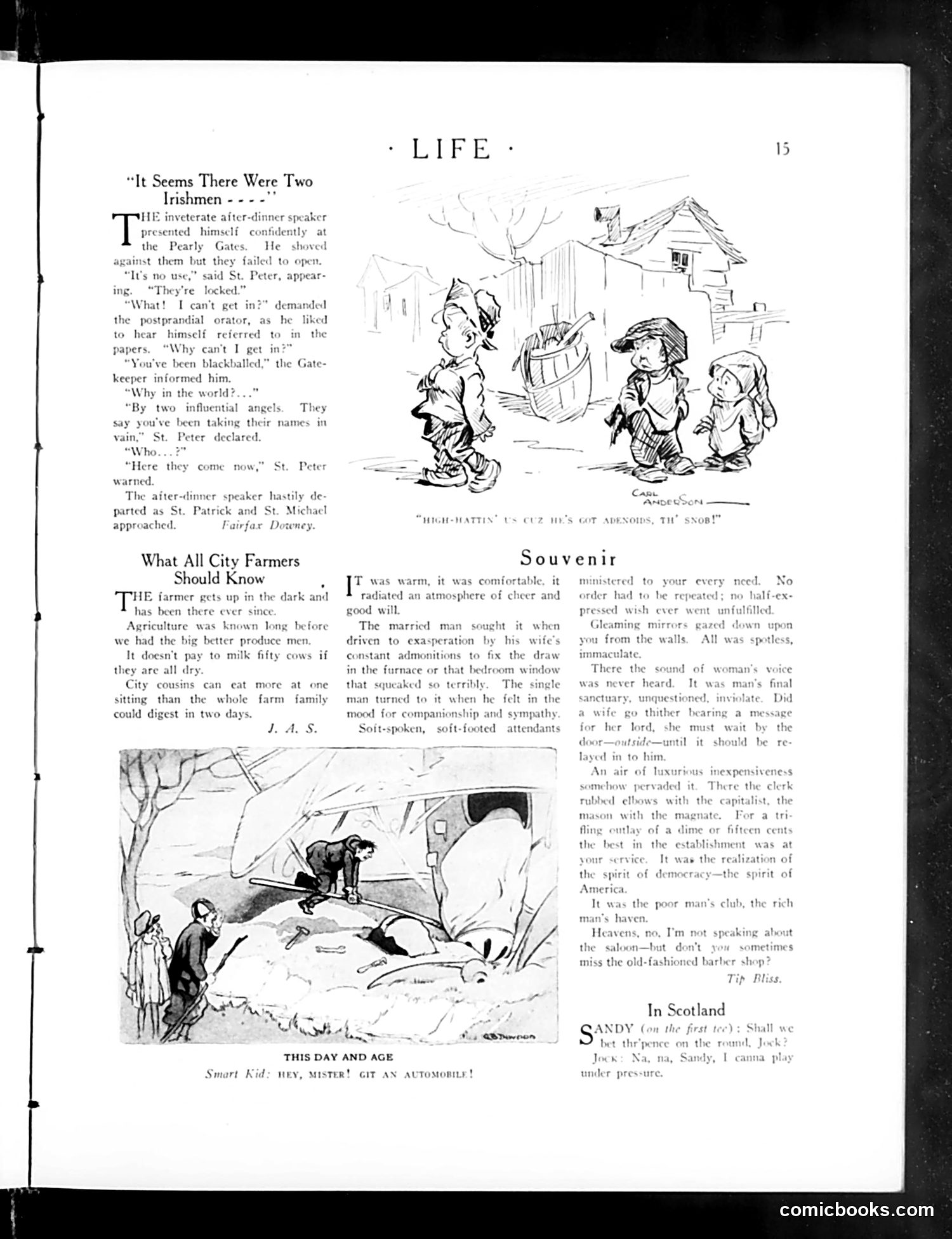
**Top Cartoon ("It Seems There Were Two Irishmen"):** A satirical after-dinner joke about Irish immigrants at the "Pearly Gates." St. Peter refuses entry to two Irishmen, claiming they're taking names "in vain." The joke plays on anti-Irish stereotypes common in early-20th-century America—depicting Irish people as irreverent and foolish. St. Patrick and St. Michael later "depart" (likely suggesting even saints abandon them), emphasizing religious mockery as the punchline's core. **"This Day and Age" Cartoon:** Shows a boy excitedly spotting an automobile while playing outdoors—reflecting early automobile culture's novelty and wonder. The caption's irony suggests modern life's mechanical intrusions disrupt traditional childhood play. **Written Sections:** Including pieces on city farming, a gentleman's club ("Souvenir"), and Scottish dialect humor—typical Life content mixing social commentary with period-specific humor and class observations.
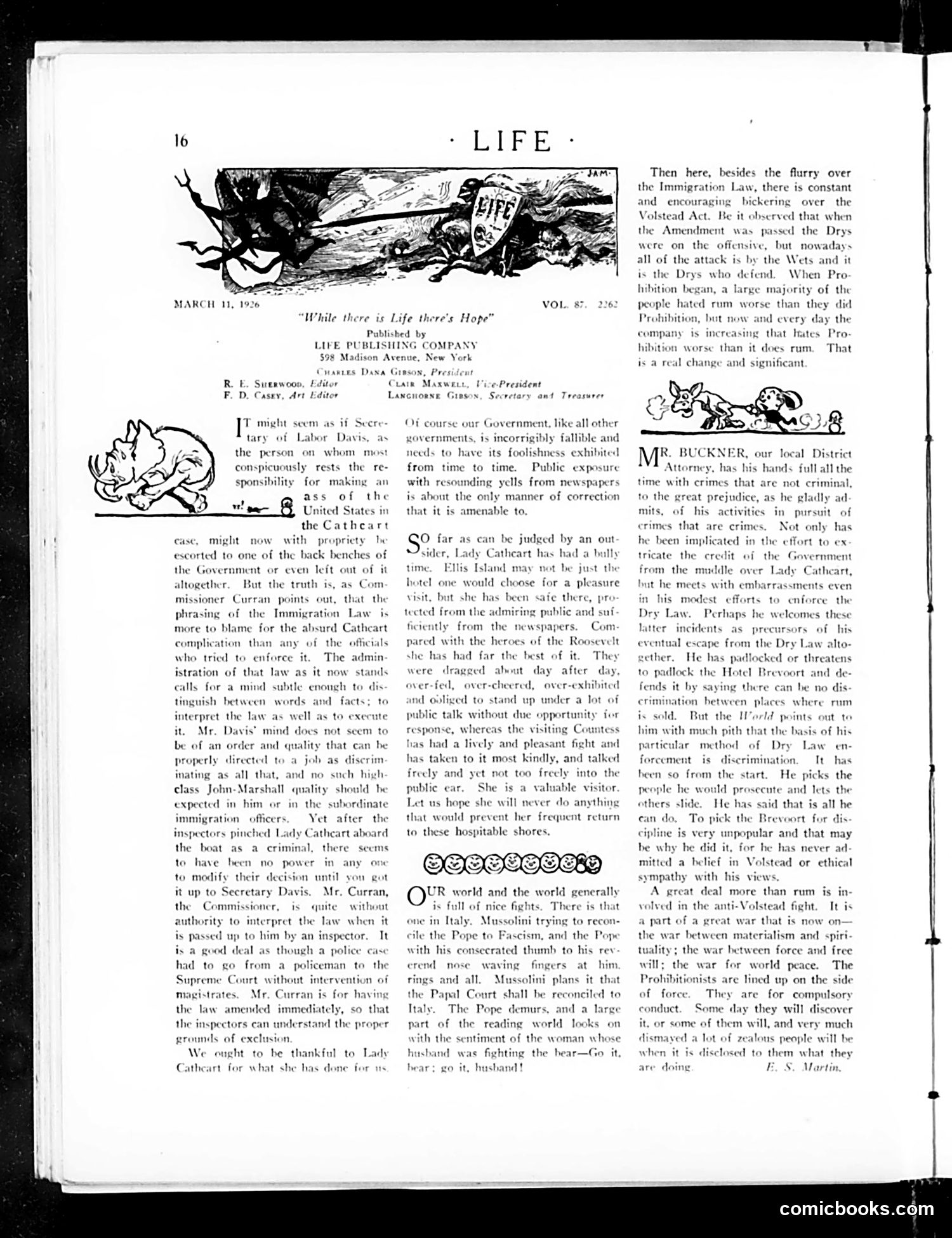
This editorial page discusses government incompetence and Prohibition enforcement. The main cartoon (top) depicts a figure labeled "LIFE" struggling against what appears to be bureaucratic obstacles—likely satirizing the messy implementation of Prohibition laws. The text criticizes how Lady Cathcart's visit to America exposed the government's inability to enforce its own laws, particularly regarding rum-running and bootlegging. The author argues that Prohibition enforcement has become a laughingstock, with officials either corrupt or ineffectual. The page also comments on broader government fumbling and hypocrisy, using the Cathcart incident as evidence that even distinguished foreign visitors witness America's failure to uphold its own Amendment. The satire targets governmental incompetence rather than Prohibition itself.
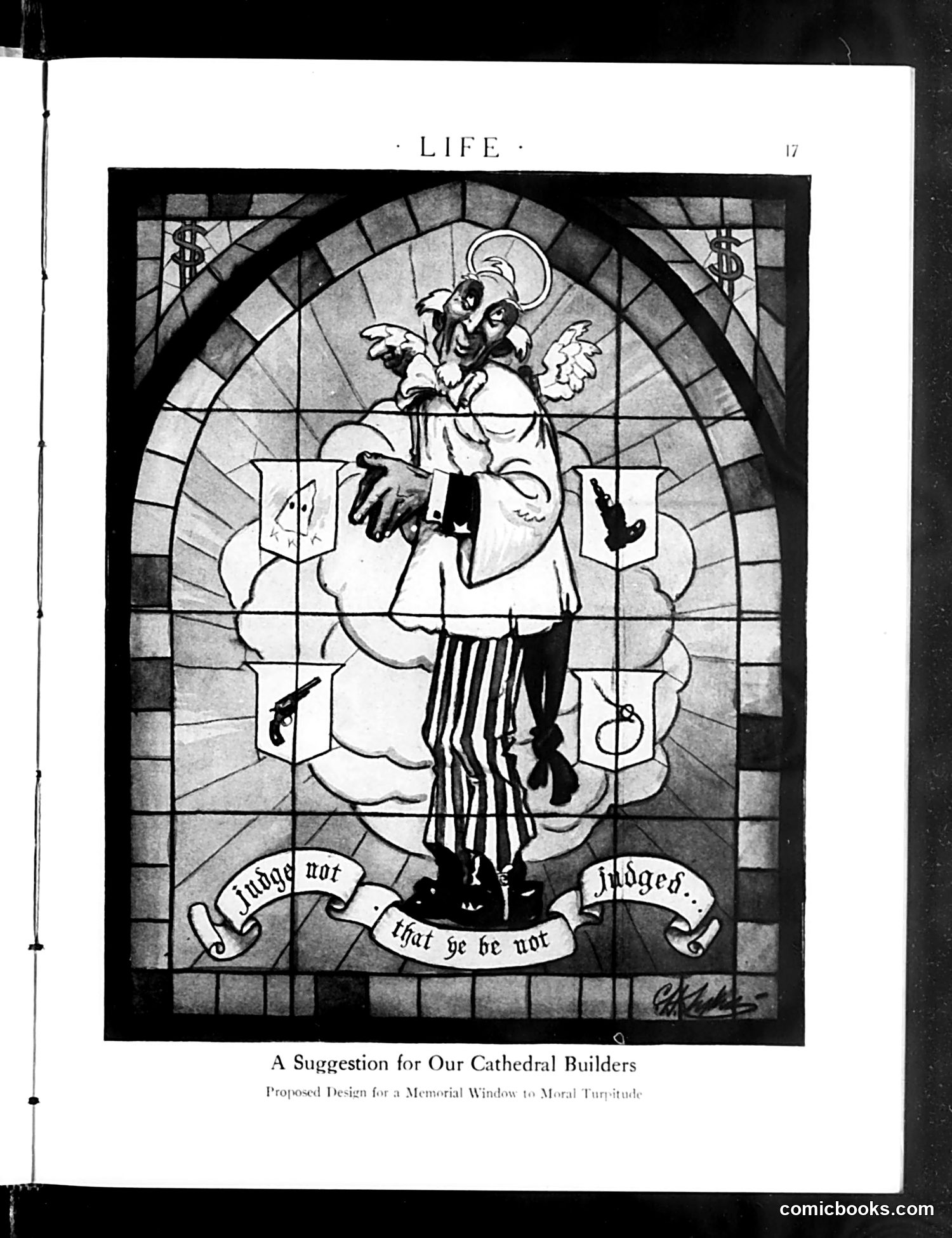
This is a stained-glass window design satirizing greed and moral corruption. The central grotesque figure appears to be a personification of "Moral Turpitude"—depicted as a bloated, devil-horned creature juggling money bags and guns while gesturing wickedly. Dollar signs ($) appear in the upper corners of the window frame. The banner at the base reads "Judge not that ye be not judged," suggesting ironic commentary on those who accumulate wealth through questionable means while presenting themselves as moral authorities. The subtitle indicates this is a "suggestion for cathedral builders," sarcastically proposing that such a window commemorates the very vices—greed, violence, and hypocrisy—that religious institutions supposedly oppose. The satire critiques wealthy industrialists or robber barons of the Gilded Age who built monuments to themselves while engaging in ethically dubious practices.
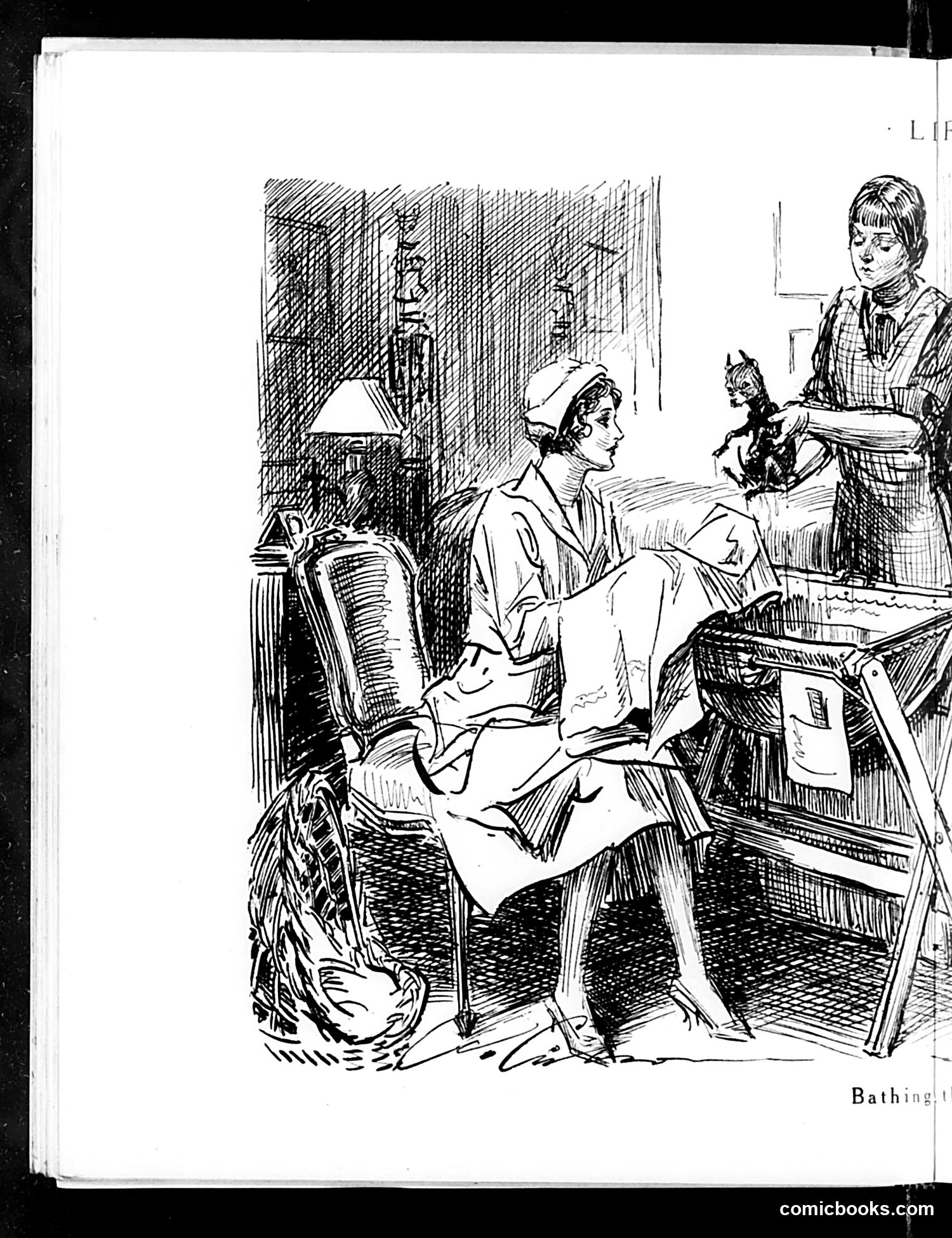
This page appears to be from Life magazine and shows a domestic scene with ink-line illustration style typical of early-to-mid 20th century satirical magazines. The image depicts a woman sitting in a chair wearing a head wrap or bonnet, while a young girl stands nearby holding what appears to be a doll or small figure. Another figure is visible in the background. The caption reads "Bathing" (partially visible at bottom right), suggesting the cartoon comments on bathing or hygiene practices. However, the OCR text is too corrupted to read the actual caption or dialogue that would explain the specific joke or social satire intended. Without legible text explaining the point, I cannot confidently identify what social commentary this makes or what specific behaviors or attitudes it's mocking. The illustration quality and style suggest social satire typical of Life magazine's era, but the satirical target remains unclear from the image alone.
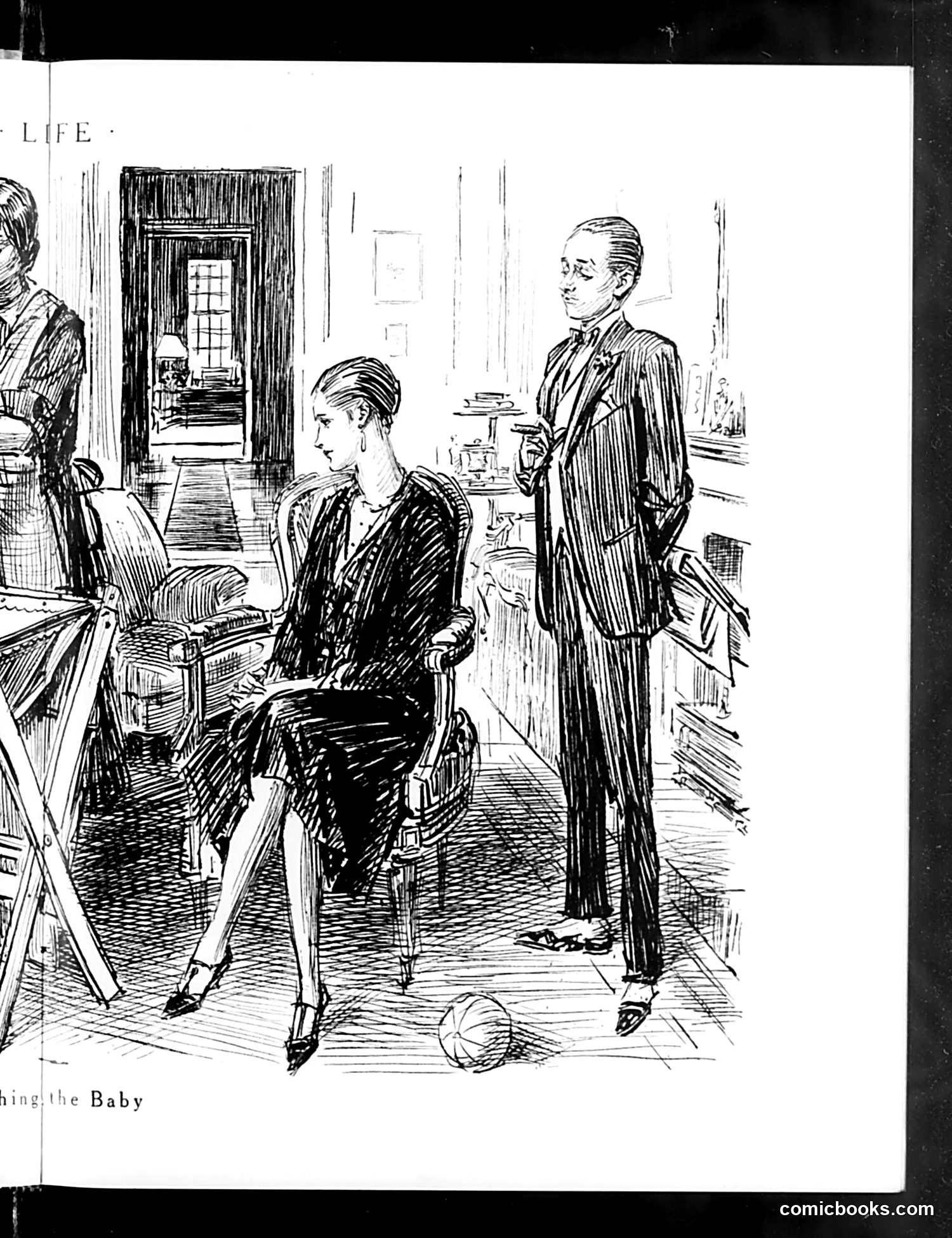
This appears to be a satirical domestic scene titled "Bathing the Baby." The sketch shows three figures in an early 20th-century interior: a seated woman in dark clothing, a standing man in a suit, and a partially visible figure on the left. A ball sits on the floor. The OCR text is fragmentary, making the specific satirical point unclear. However, the scene's composition—the woman's seated posture, the man's formal stance, the presence of a baby's bathing ball—suggests this may be satirizing social dynamics around childcare, domestic responsibilities, or gender roles of the period. Without complete caption text, the exact subject of the satire cannot be determined with certainty.
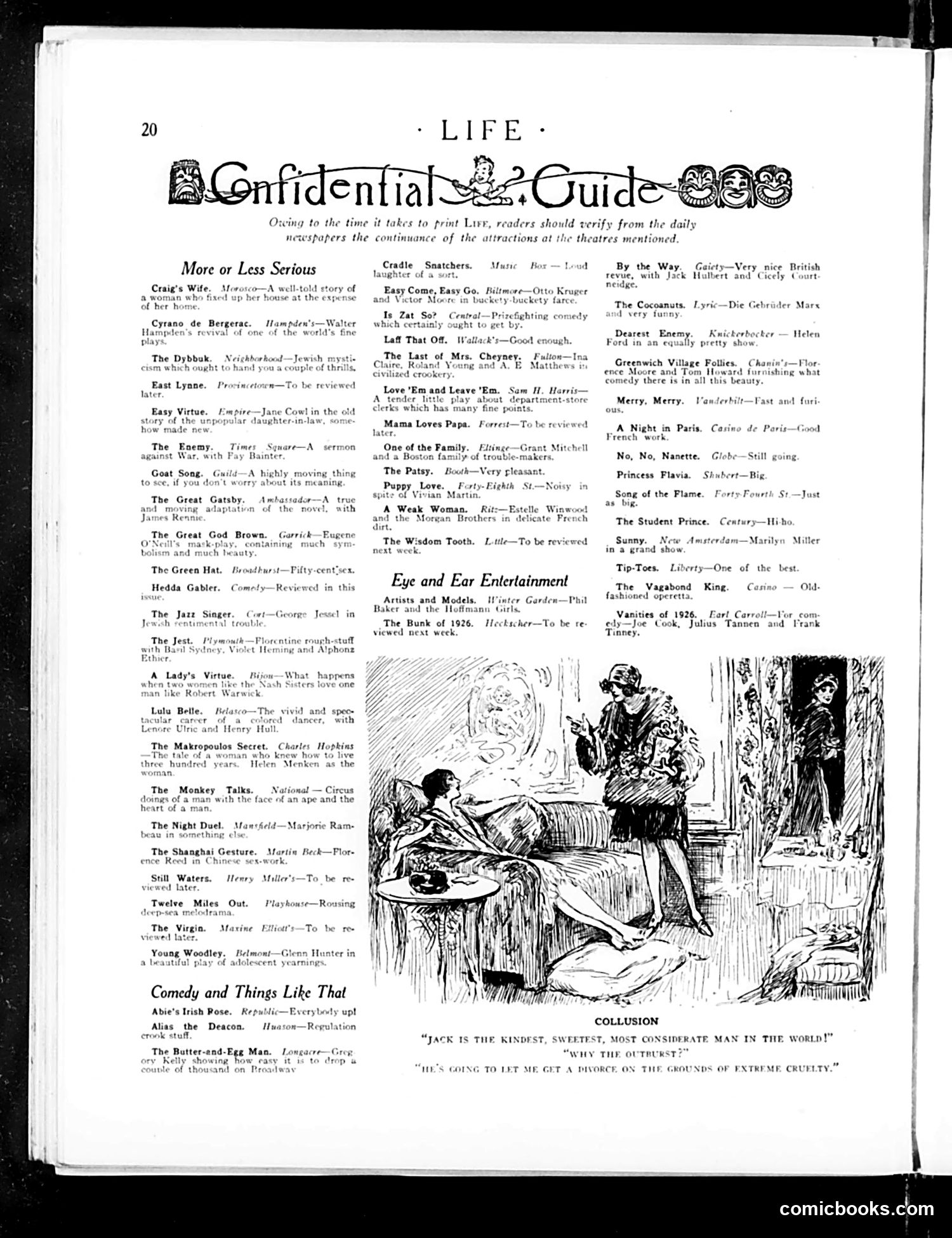
This page is primarily a **theater guide and entertainment listing** from Life magazine's early period, not a political cartoon. It catalogs Broadway shows and reviews, organized by genre ("More or Less Serious," "Comedy and Things Like That," "Eye and Ear Entertainment"). The single illustration shows a domestic scene labeled "COLLUSION"—a visual joke about divorce proceedings. A woman reclines on a bed while a man (appearing to be a hired actor or accomplice) stands in the doorway in theatrical costume, seemingly "caught" in a compromising position. The captions reference obtaining "a divorce on the grounds of extreme cruelty," satirizing how couples would stage fake infidelity scenes to satisfy legal requirements for divorce at a time when grounds were restricted. This reflects 1920s social reality: divorce laws required proof of wrongdoing, leading to manufactured "evidence" and collusive scenarios—a common, wink-wink practice the satirical Life magazine mocked.
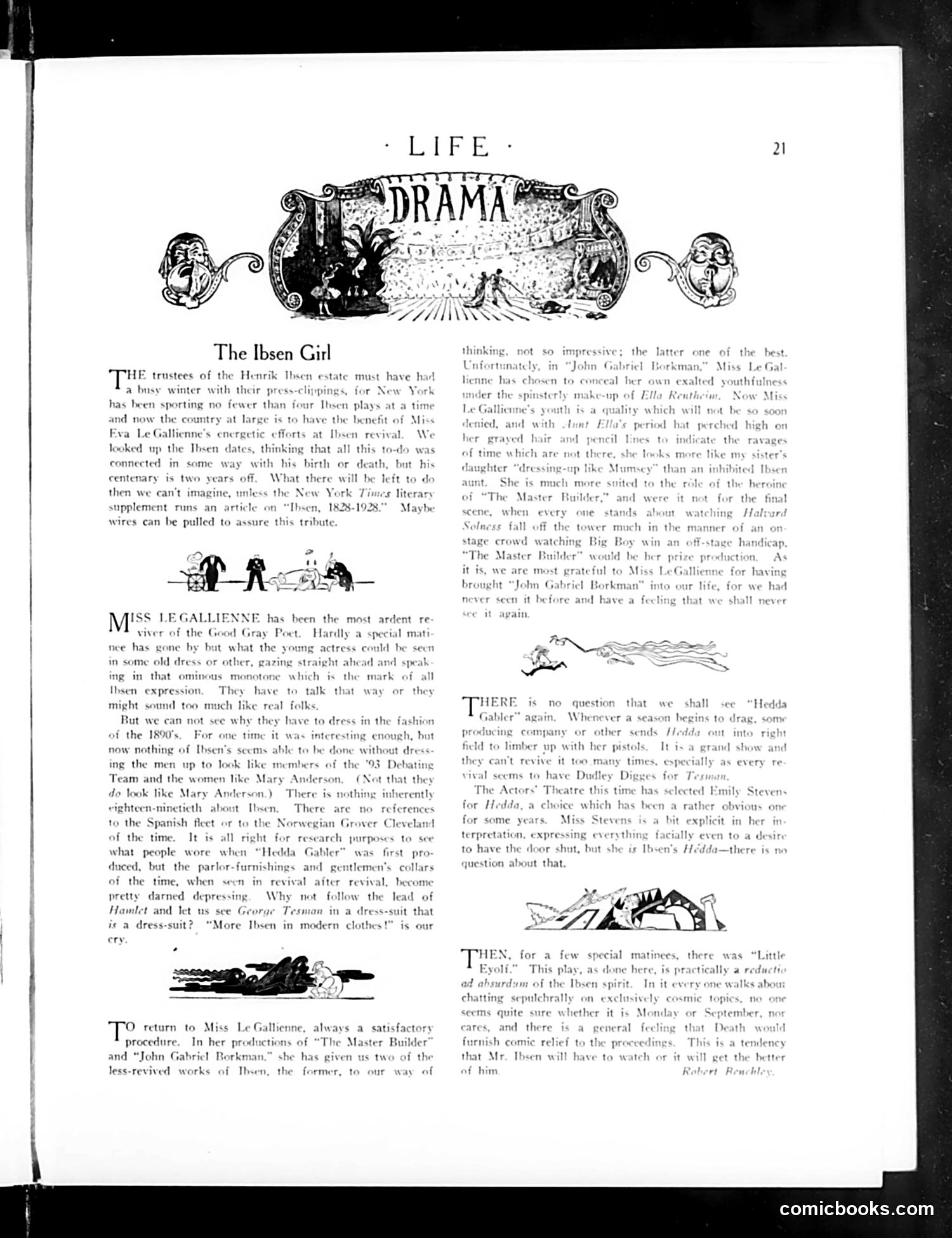
This article satirizes Eva Le Gallienne's revival productions of Henrik Ibsen plays, particularly her insistence on historically accurate 1890s costuming. The author mocks the practice of dressing modern actors in period clothing when performing Ibsen, arguing there's nothing inherently tied to 1890s fashion in his plays. The satire targets the pretentiousness of "serious" theatrical revivals—the idea that authentic Ibsen requires authentic Victorian wardrobes. The author suggests instead: "More Ibsen in modern clothes!" The critique reflects tension between theatrical authenticity and accessibility; Le Gallienne is praised as an "ardent reviver" of Ibsen's work, but criticized for making productions unnecessarily stiff and historically bound. The piece credits Le Gallienne with bringing important Ibsen plays like *The Master Builder* and *John Gabriel Borkman* to American audiences, acknowledging her cultural contribution while gently mocking her costume choices as overly scholarly and impractical.
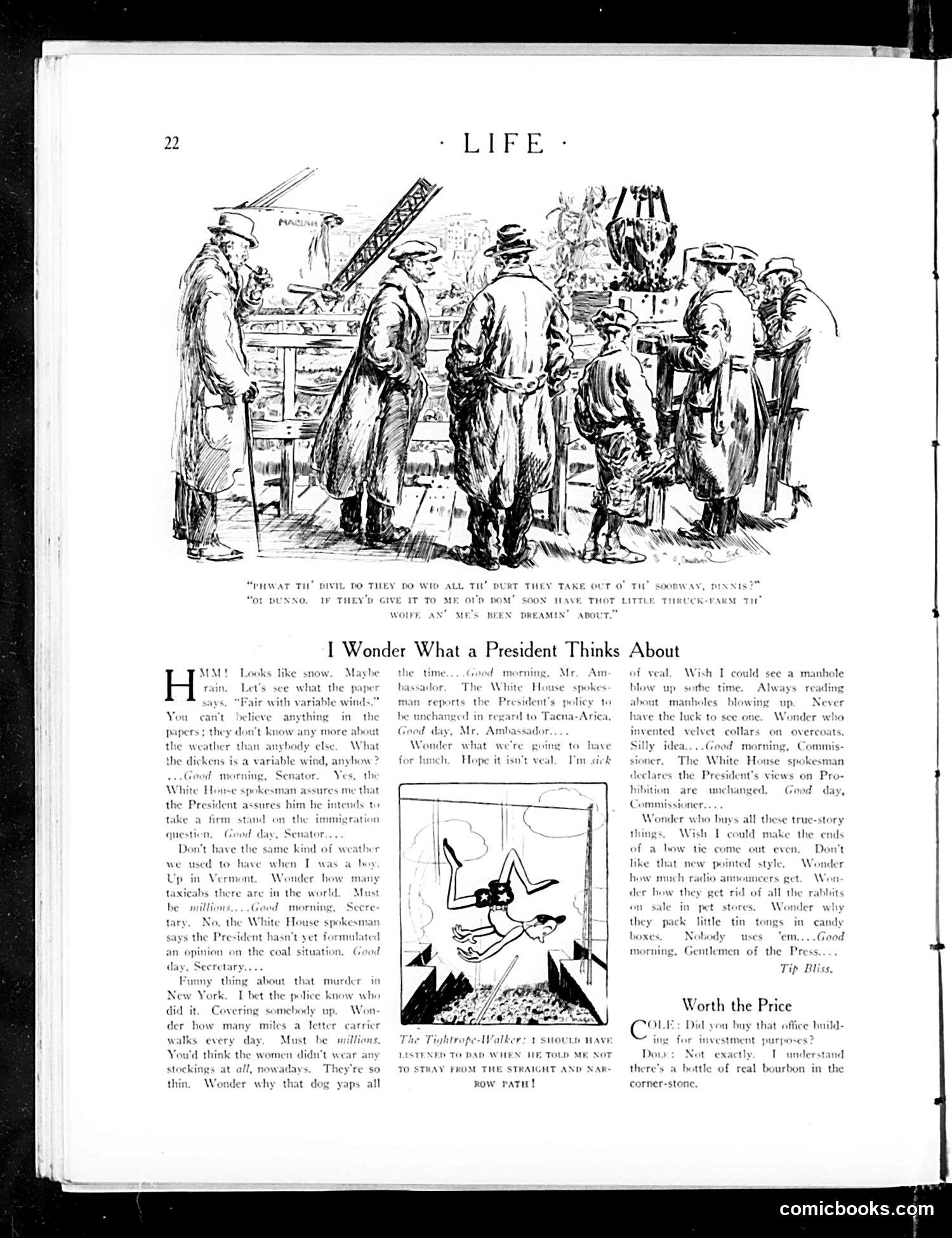
This page satirizes President Herbert Hoover's detachment from ordinary American concerns during the Great Depression era. **The Main Cartoon:** depicts construction workers (likely subway workers, given the "durt" reference) discussing what happens to all the excavated dirt they remove. The joke criticizes how distant the President seems from such mundane, practical realities affecting working people. **"I Wonder What a President Thinks About":** The article parodies Hoover's supposed preoccupations—weather conditions, lunch menus, coal policy—presented as trivial or disconnected from real problems. It contrasts the President's abstract concerns with citizens' practical worries (like whether letter carriers have proper stockings, or who buys pulp magazines). **The Tightrope-Walker cartoon** (center) reinforces the metaphor: the President must walk a narrow path, avoiding straying from protocol. **"Worth the Price":** a brief joke about building investments and finding bourbon in cornerstone deposits—likely mocking frivolous spending or corruption. Overall, the satire suggests Hoover is mentally disengaged from Depression-era hardship, focused on trivial matters while ordinary Americans struggle with practical concerns.
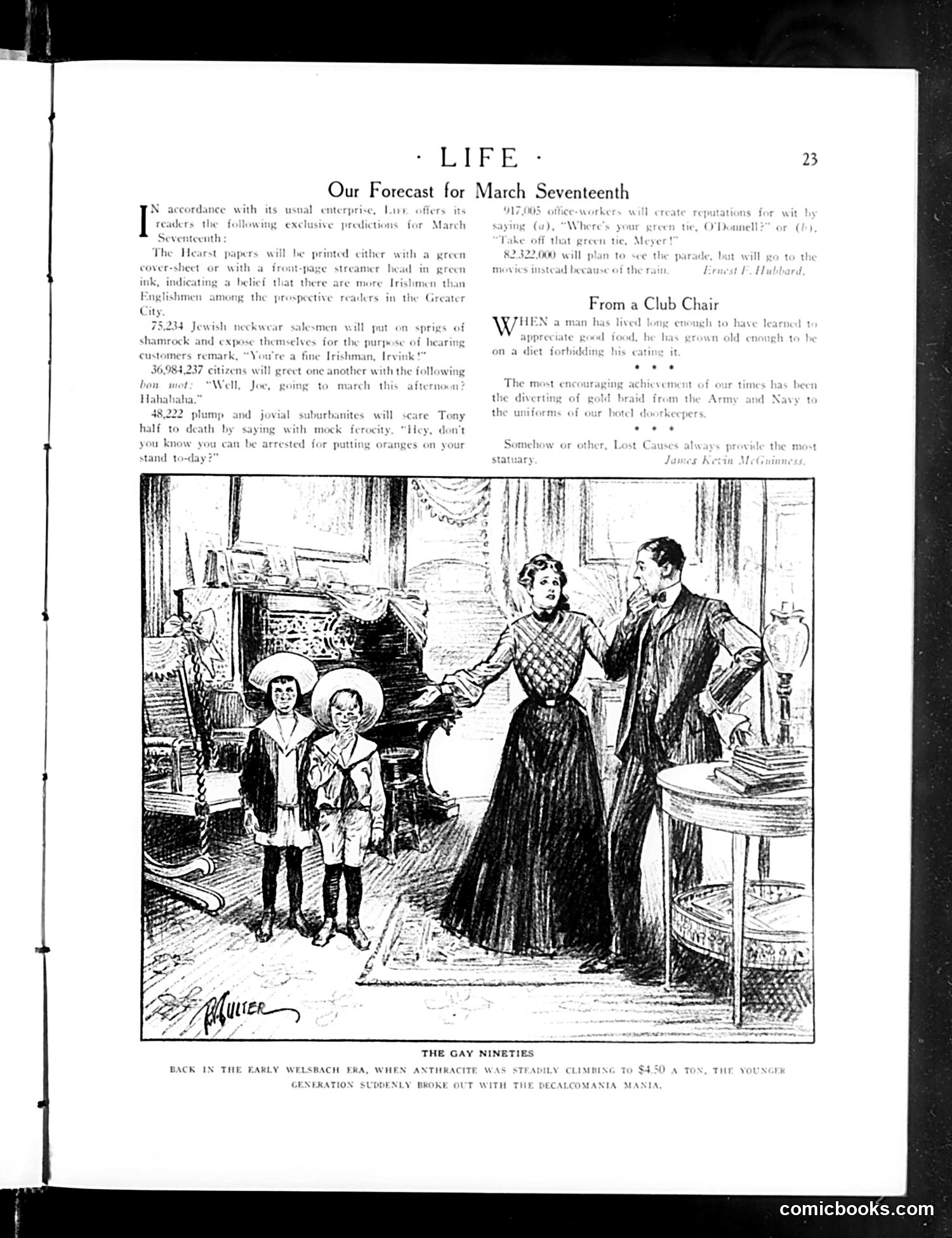
This cartoon satirizes nostalgia for the 1890s. The caption explains it depicts the "early Welsbach era" (referring to gas lighting technology), when anthracite coal was steadily climbing to $4.50 a ton and a younger generation "suddenly broke out with the decalomania mania." The scene shows an elegantly dressed couple with two children in period costume. The joke appears to target 1920s-era enthusiasm for 1890s fashion and aesthetics—likely a real trend among wealthy Americans who romanticized that decade as more refined and stable than their current post-WWI era. "Decalomania mania" (decorative transfer designs) references a specific fad. The cartoon mocks this nostalgic impulse as frivolous, suggesting affluent Americans were escaping present anxieties through artificial revival of a supposedly "gayer" (more carefree) past—while omitting the era's actual hardships like coal scarcity and rising costs.
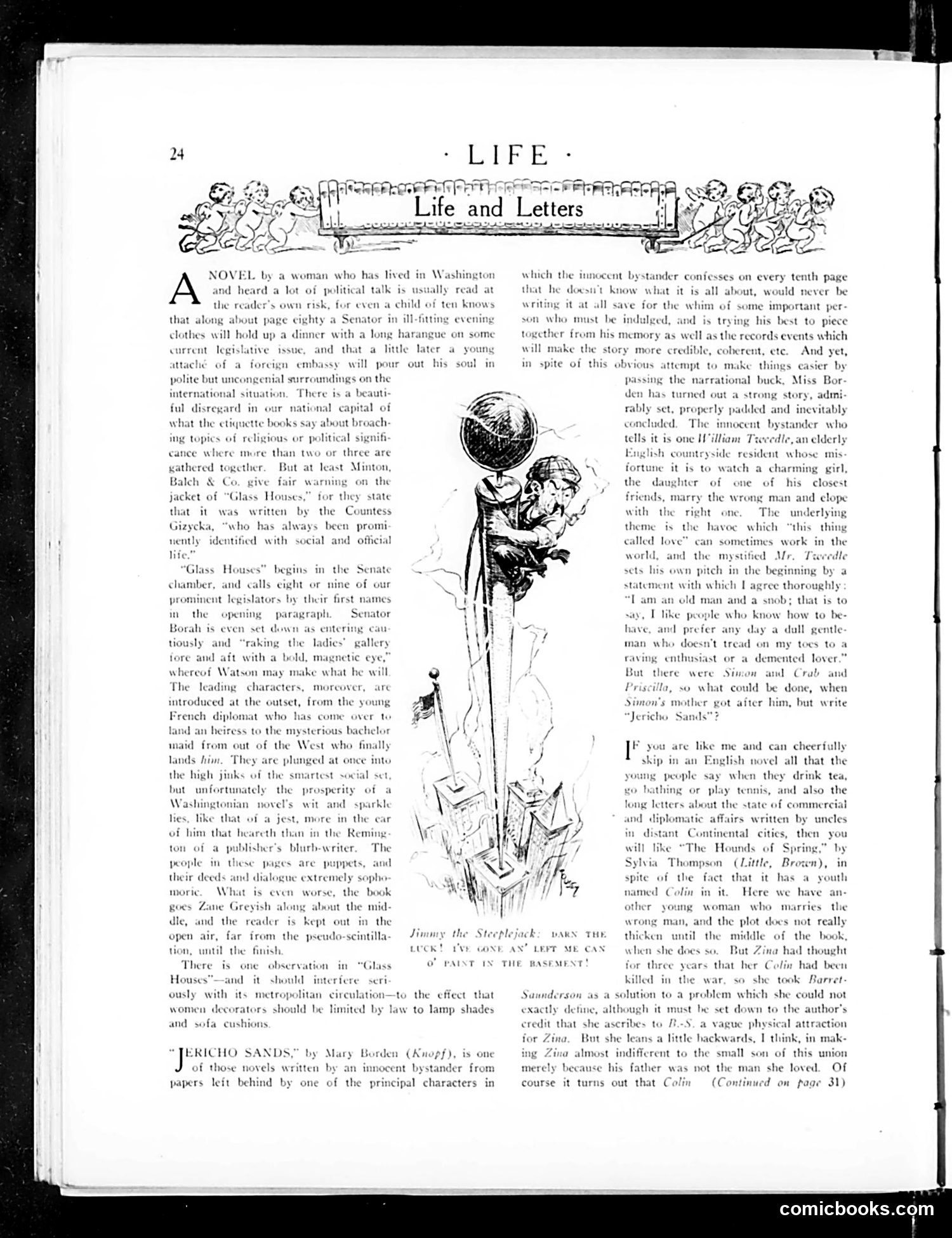
This page reviews contemporary novels, primarily discussing two books written by women about Washington, D.C. society and romantic entanglements. The illustration depicts "Jimmy the Steeplejack" carrying a large globe while scaling a building—a visual metaphor for ambitious undertaking, likely commenting on the literary ambitions of these novelists. The text critiques "Glass Houses" (by Countess Gizycka) for its predictable plot mechanics: a Washington Senator delivering tedious monologues at dinner, a foreign embassy attaché, romantic misunderstandings. The reviewer notes these are generic tropes of political fiction, satirizing how women writers repeatedly use identical stock characters and scenarios. "The Hounds of Spring" receives similar treatment—another novel where a young woman marries the "wrong man" and must sort out romantic complications. The satire suggests these plots are formulaic and interchangeable. The broader joke targets both the predictability of women's fiction about Washington society and readers' willingness to consume identical stories repeatedly dressed in different titles.
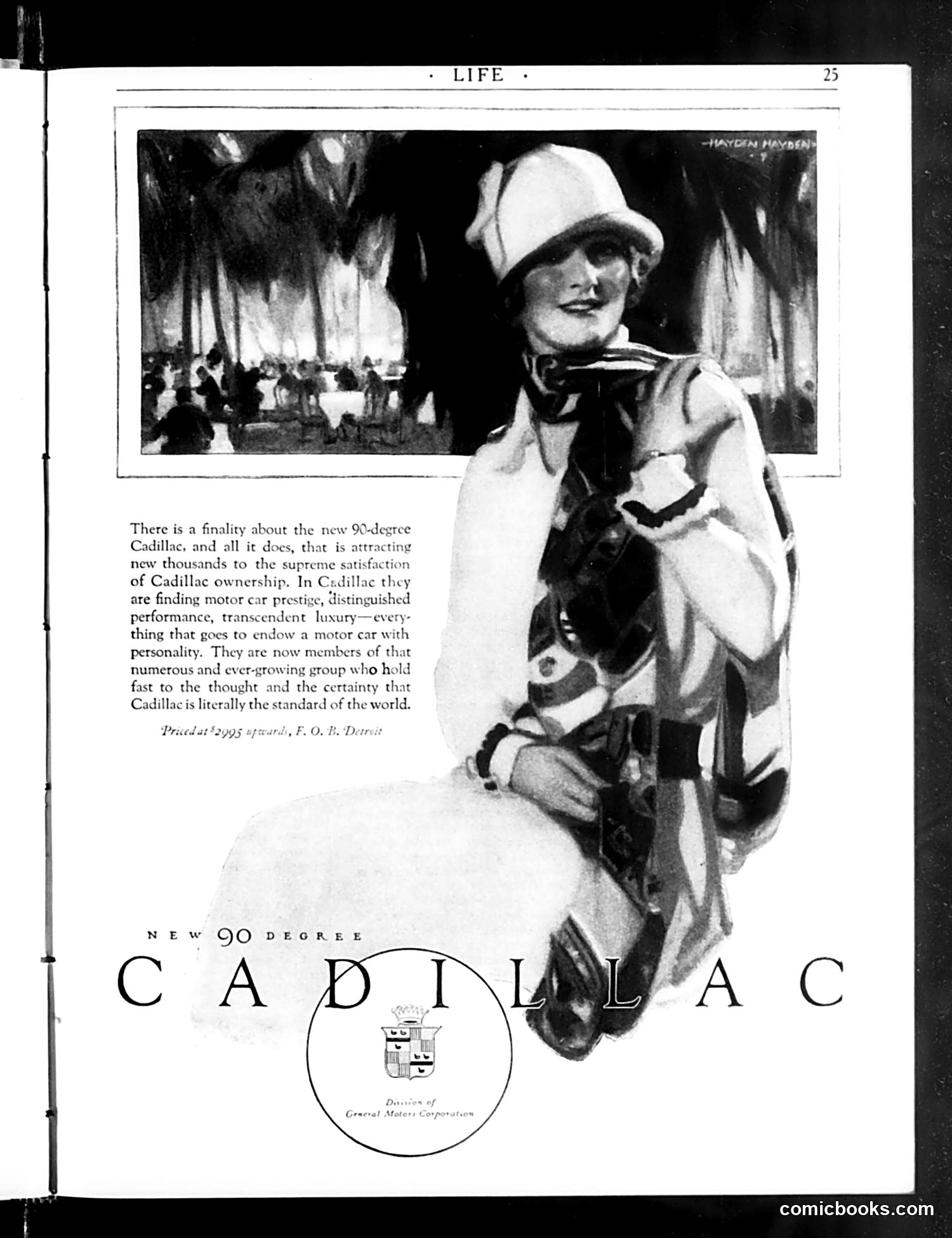
This is a **Cadillac automobile advertisement**, not political satire. The page features a stylishly dressed woman in 1920s fashion (cloche hat, pearl necklace) posed elegantly next to a small photograph showing what appears to be a formal event or gathering. The ad's text emphasizes the new "90-degree" Cadillac model as the ultimate luxury vehicle, claiming it represents "the standard of the world" and appeals to those seeking prestige and "transcendent luxury." The pricing starts at $2,995 (F.O.B. Detroit), which was substantial for the era. The imagery associates Cadillac ownership with social sophistication and refined taste—the fashionable woman embodies the aspirational lifestyle the company marketed. This reflects 1920s advertising that linked automobile ownership to personal status and modernity.
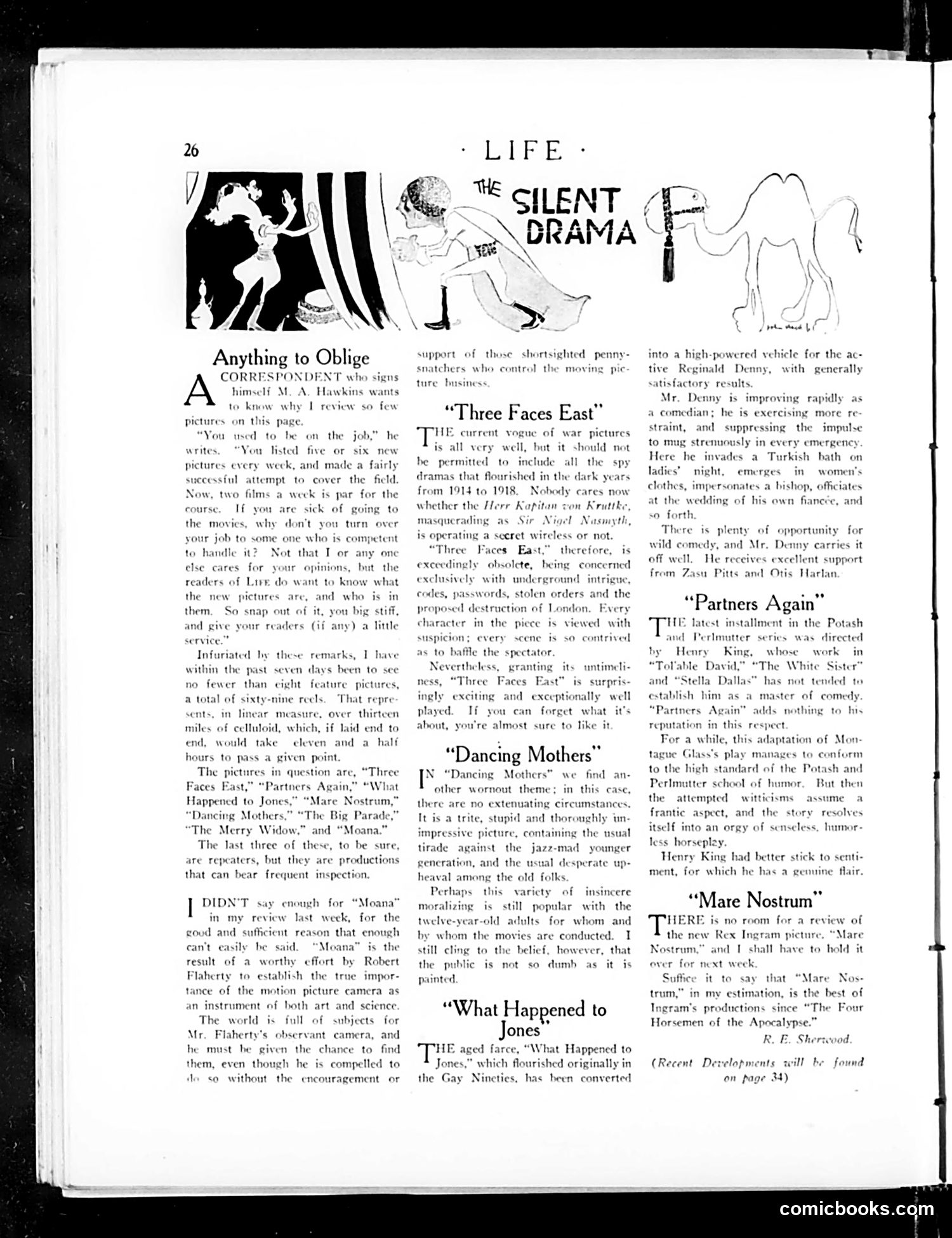
This page reviews five silent films from the 1920s. The opening section humorously responds to a critic who complained the author reviews too few movies—he retorts by listing eight films he's seen in one week, totaling "sixty-nine reels." **Key reviews:** - **"Three Faces East"**: A spy drama set during WWI featuring secret codes and wireless operations. The reviewer finds it "exceptionally well" executed despite its worn-out spy-story theme. - **"Dancing Mothers"**: Criticized as a "trite, stupid and thoroughly unimpressive" film recycling tired generational conflict (jazz-mad youth vs. elderly folk). - **"What Happened to Jones"**: A farcical comedy featuring Reginald Denny in drag and various disguises, praised for "excellent support" from fellow actors. - **"Moana"**: Praised as Robert Flaherty's serious attempt to establish cinema as legitimate art and science. The cartoon illustrations show typical silent-film scenes—dramatic gestures, exaggerated poses—reflecting the physical comedy and melodrama characteristic of the era.
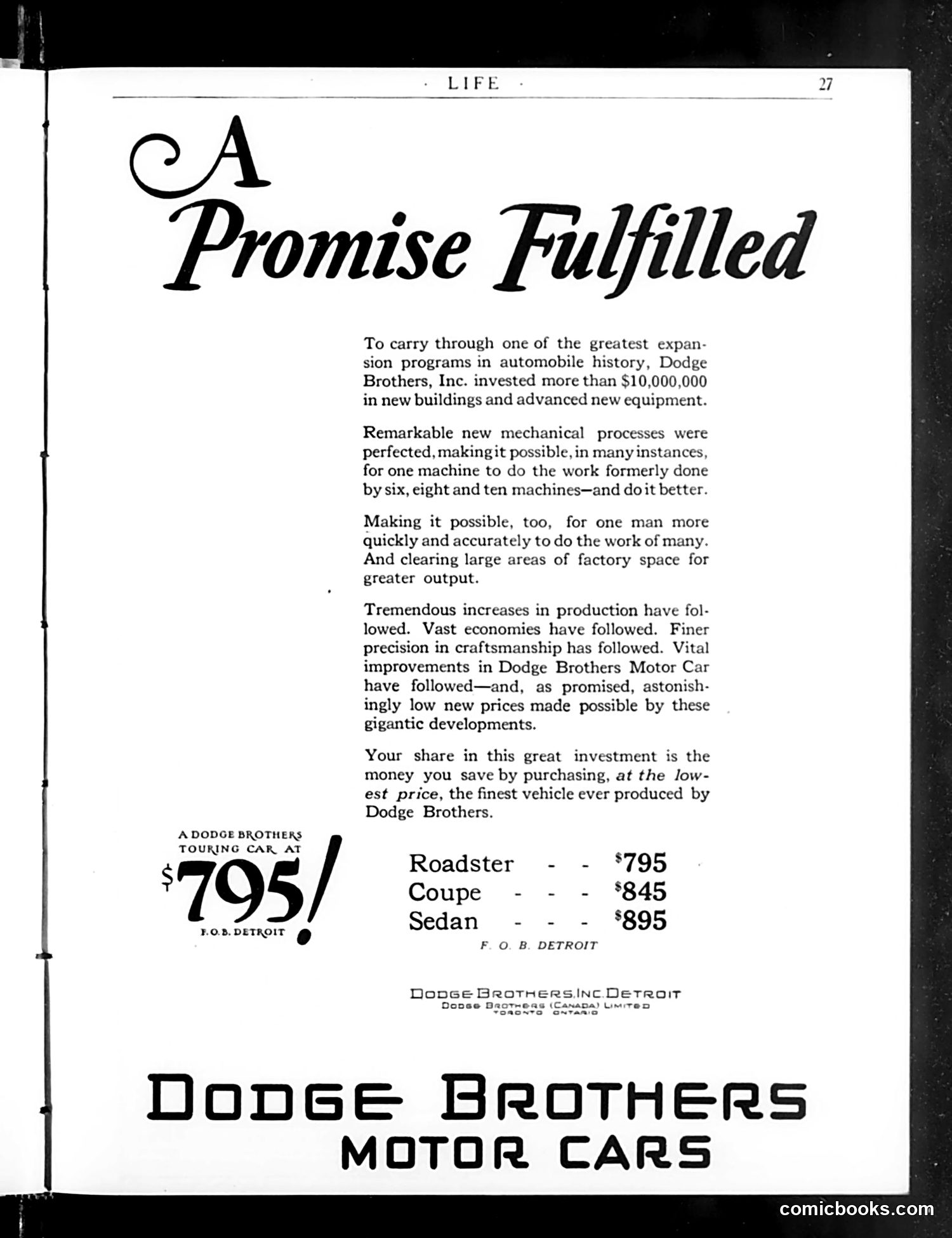
This is a **full-page advertisement**, not a cartoon or satire. It's a straightforward corporate marketing piece from Dodge Brothers promoting their automobiles. The text celebrates Dodge's $10 million factory expansion and new mechanical automation—machines that consolidate work formerly requiring six to ten machines into one, and workers who can accomplish more in less time. This reflects 1920s industrial enthusiasm for mechanization and efficiency. The "promise fulfilled" refers to delivering on claims of increased production, better craftsmanship, and lower prices through these manufacturing advances. Prices listed ($795-$895) are positioned as bargains resulting from economies of scale. The advertisement emphasizes that purchasing a Dodge represents the consumer's "share" in this industrial progress—a common marketing appeal of the era, framing consumer goods as participation in national advancement. There is no satire or political commentary visible; this is standard commercial copy celebrating American industrial capability.
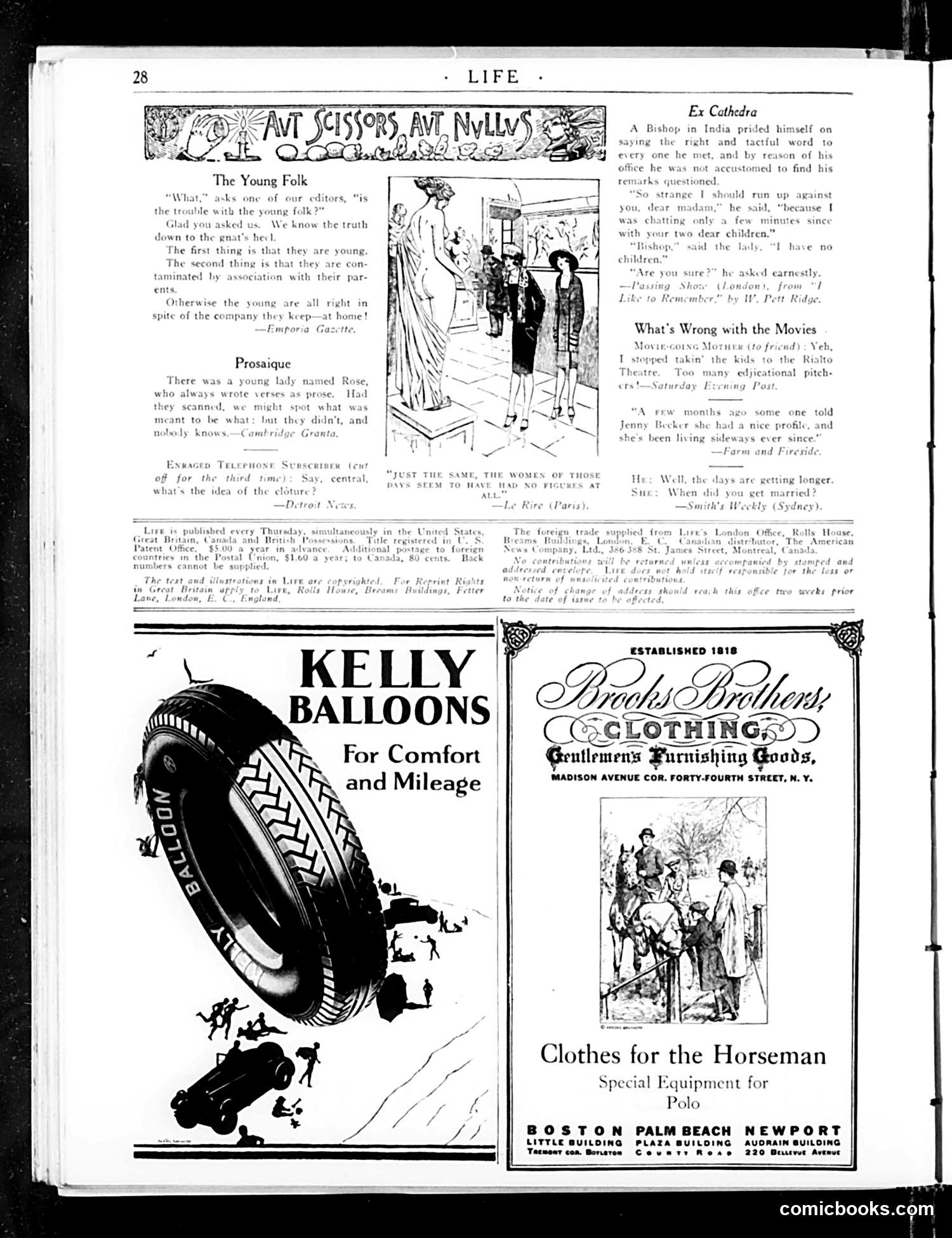
This page is primarily **advertising and filler content**, not political satire. The main elements are: **Editorial Content (top):** Brief humor columns titled "The Young Folk," "Posaique," and "Ex Cathedra"—light social commentary typical of Life's satirical format. These discuss young people staying home, a poet named Rose, and a bishop's remarks about children—gentle, domesticated humor with no political edge. **Advertisements (bottom):** Two full ads—Kelly Balloons (tires) and Brooks Brothers clothing—representing the magazine's commercial side. The Brooks Brothers ad emphasizes "Clothes for the Horseman" and polo equipment, targeting wealthy readers. **Historical Context:** This appears to be from the 1920s-30s era, when Life served affluent American audiences with lifestyle content and upscale advertising. There is **no significant political cartoon or satire** on this page—it's a typical interior spread mixing mild social humor with period advertisements.
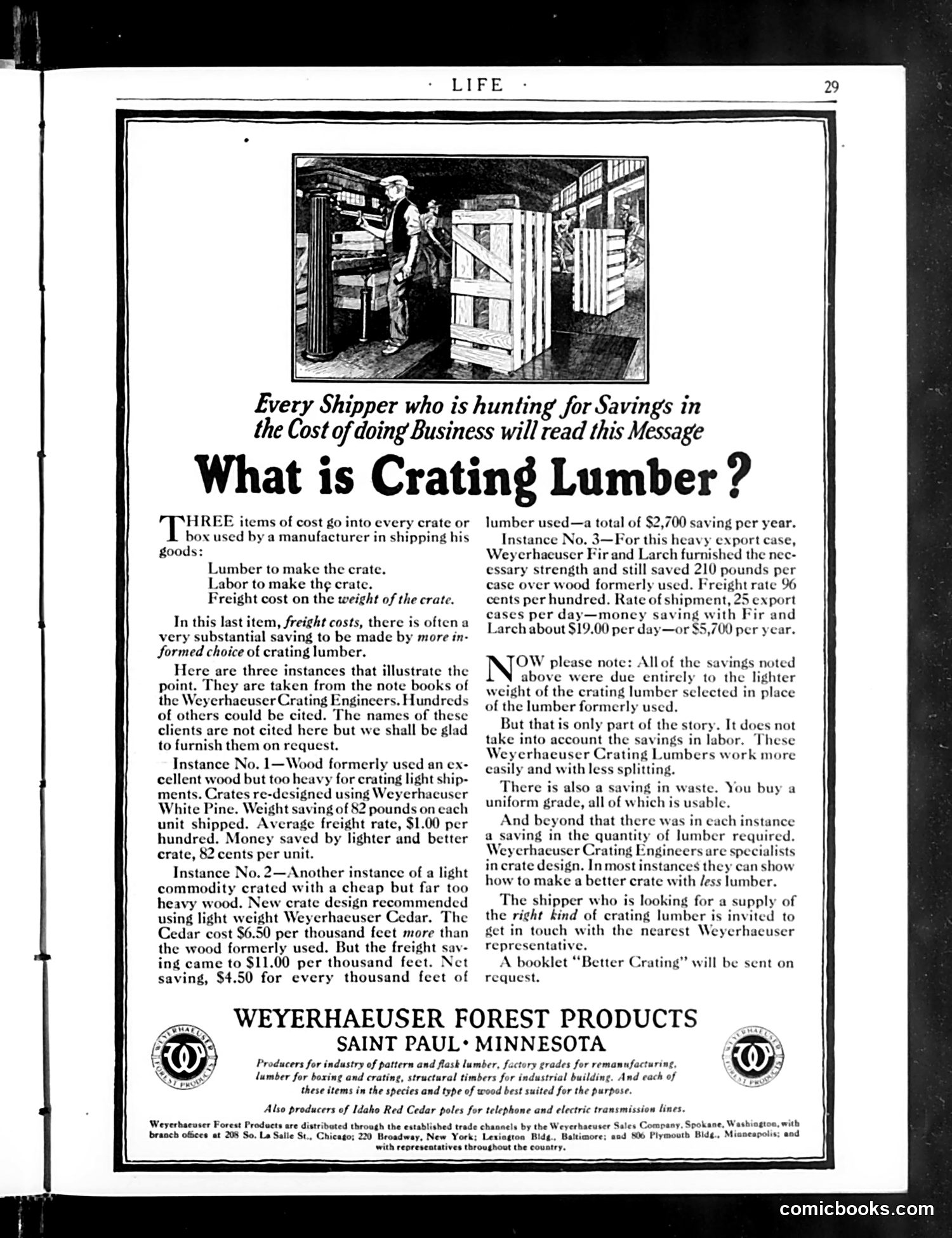
This page is **not a cartoon or satire**—it's a straightforward **corporate advertisement** for Weyerhaeuser Forest Products, a lumber company based in Saint Paul, Minnesota. The small illustration at the top shows a factory worker selecting lumber for crating, but it's documentary rather than satirical. The bulk of the page presents three case studies demonstrating how Weyerhaeuser lumber saves manufacturers money through reduced shipping weight and freight costs. For example, switching to lighter White Pine saved one client 82 cents per unit; using Cedar instead of heavier wood saved $4.50 per thousand feet. The advertisement targets business decision-makers ("Every Shipper who is hunting for Savings") with concrete financial arguments, positioning Weyerhaeuser's specialized crating engineers as experts who can optimize both materials and design. This represents early-twentieth-century industrial advertising strategy: using *Life* magazine's credibility to reach business audiences with detailed product testimonials and cost-benefit analysis rather than humor or satire.
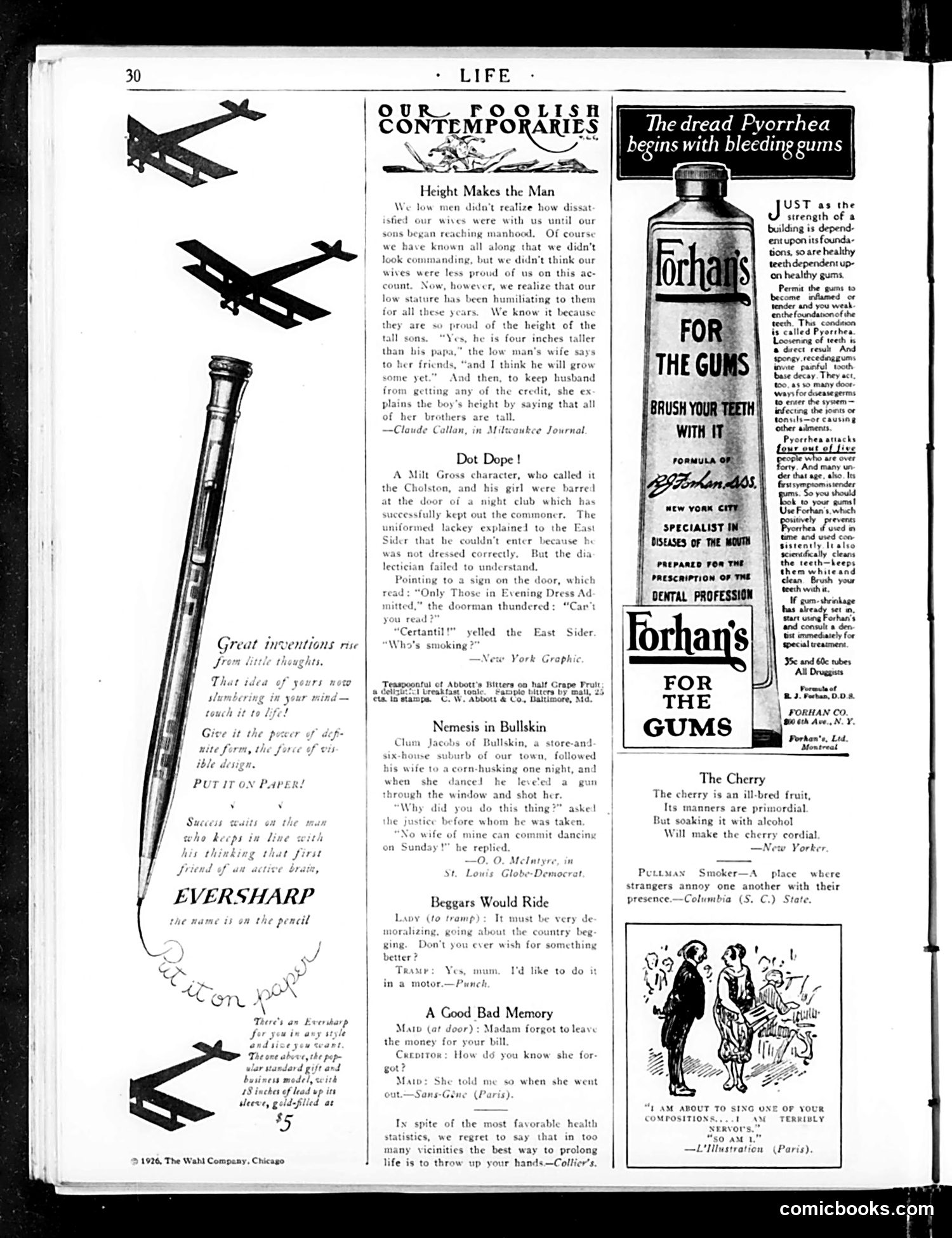
This page mixes advertisements with humorous anecdotes reflecting 1920s social attitudes. **Main Content:** The satirical pieces target domestic life and social pretense. "Height Makes the Man" jokes that wives are embarrassed by short husbands, hoping their sons grow taller. "Dot Dope" mocks a character who couldn't enter an exclusive club because he wasn't formally dressed, despite being a regular patron—the doorman's literalism prevents him from understanding the situation. "Nemesis in Bullskin" describes a jealous husband shooting his wife through a window at a corn-husking dance, then claiming "no wife of mine dances on Sunday"—dark humor about domestic violence and controlling behavior. "Beggars Would Ride" is a mild joke about a tramp's fantasy. **Advertising:** The Eversharp pencil and Forhan's toothpaste ads dominate the right side, with dramatic warnings about pyorrhea (gum disease), typical of medical fear-based marketing of the era. The cartoons reflect casual 1920s attitudes toward marriage tensions and class-consciousness.
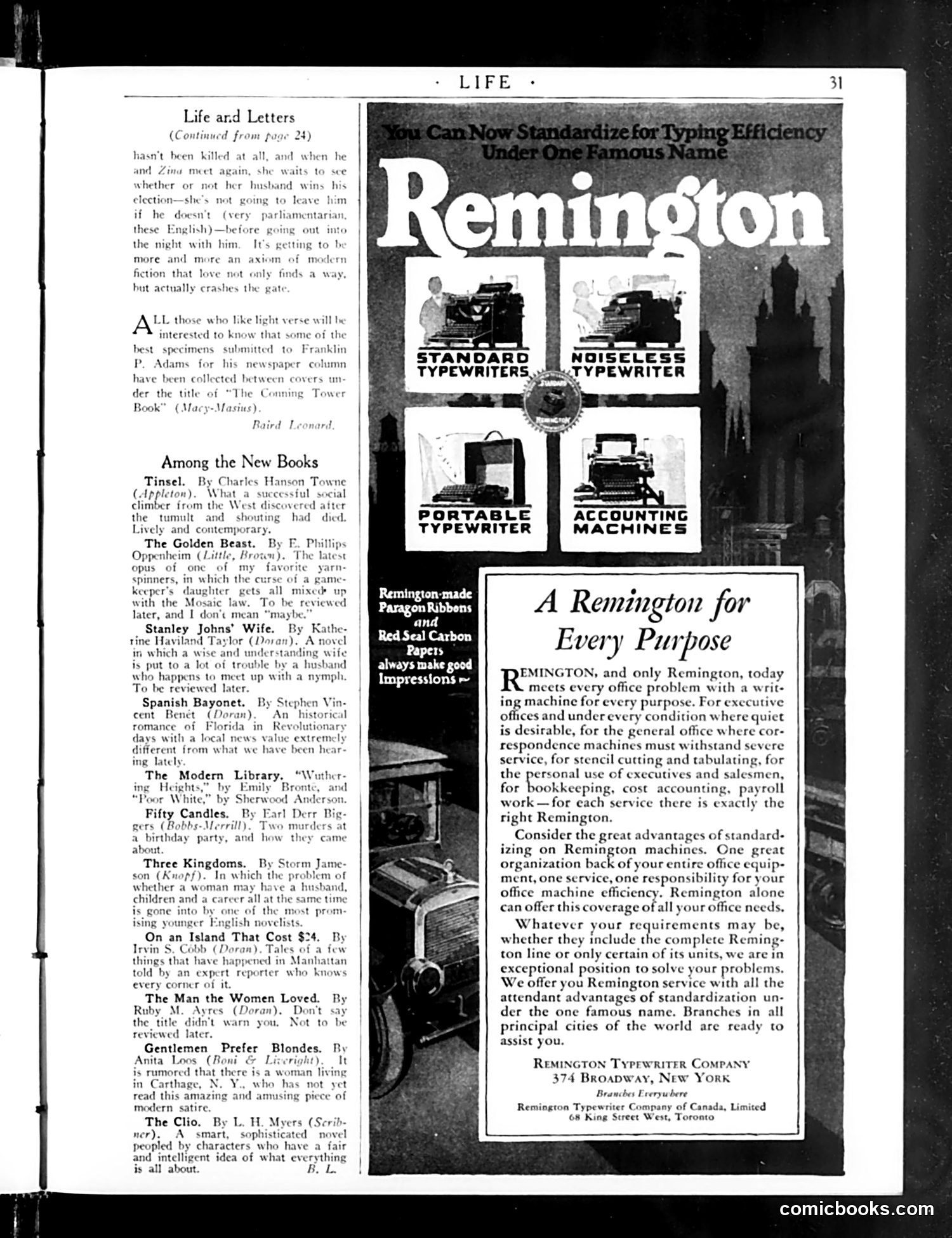
This is primarily a **book review section** ("Among the New Books") combined with a **full-page Remington typewriter advertisement**. There are no political cartoons or satire here. The left column reviews contemporary 1920s novels by authors like Charles Hanson Towne, E. Phillips Oppenheim, and Stephen Vincent Benét. At the top, reviewer Baird Leonard discusses a narrative involving characters named Zina and a husband, mocking modern fiction that relies on romantic plot devices. The right side is a commercial advertisement showcasing four Remington typewriter models (Standard, Noiseless, Portable, and Accounting Machines) and arguing that businesses should standardize all their office equipment under the Remington brand for efficiency and unified service. **No satire or caricature is present.** This is straightforward publishing industry content mixed with period advertising.
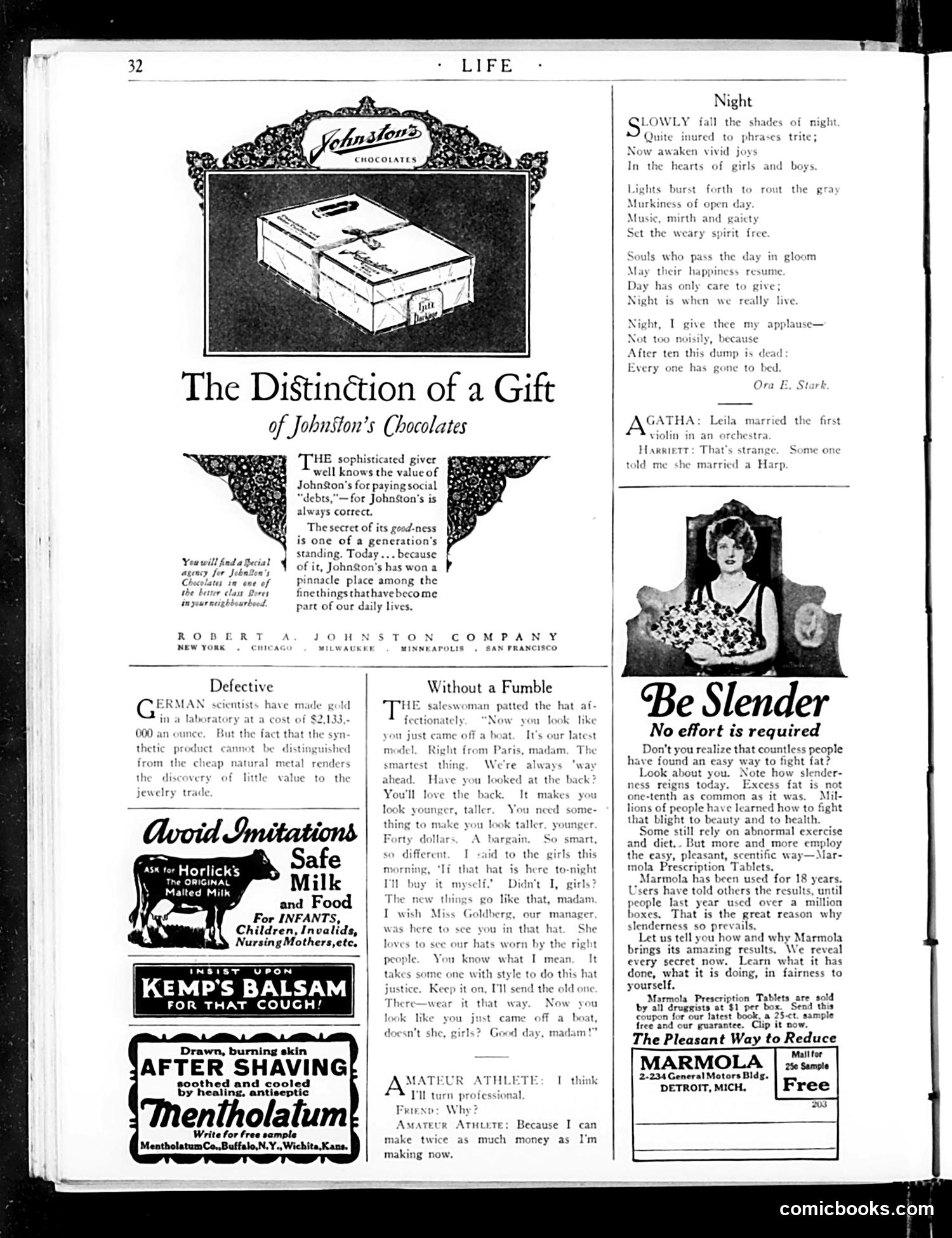
This page is primarily **advertising** rather than political satire or comics, typical of Life magazine's format. The main content features a **Johnston's Chocolates advertisement** positioning the product as an appropriate gift for fulfilling social obligations—framing chocolate as a marker of refined taste and social correctness among the upper classes. Additional advertisements include: - **Horlick's Malted Milk** (a infant/invalid nutritional product) - **Kemp's Balsam** (cough remedy) - **Mentholatum** (aftershave balm) - **Marmola** (weight-loss tablets) There are two brief humorous exchanges: one about a woman marrying a violin player versus a harpist, and another where an amateur athlete plans turning professional to earn double his current income. The **"Be Slender" advertisement** reflects 1920s beauty standards emphasizing thinness, promoting Marmola tablets as an "easy" solution requiring "no effort"—a marketing claim modern readers would recognize as dubious. The page reflects early-20th-century consumer culture and era-specific body image anxieties.
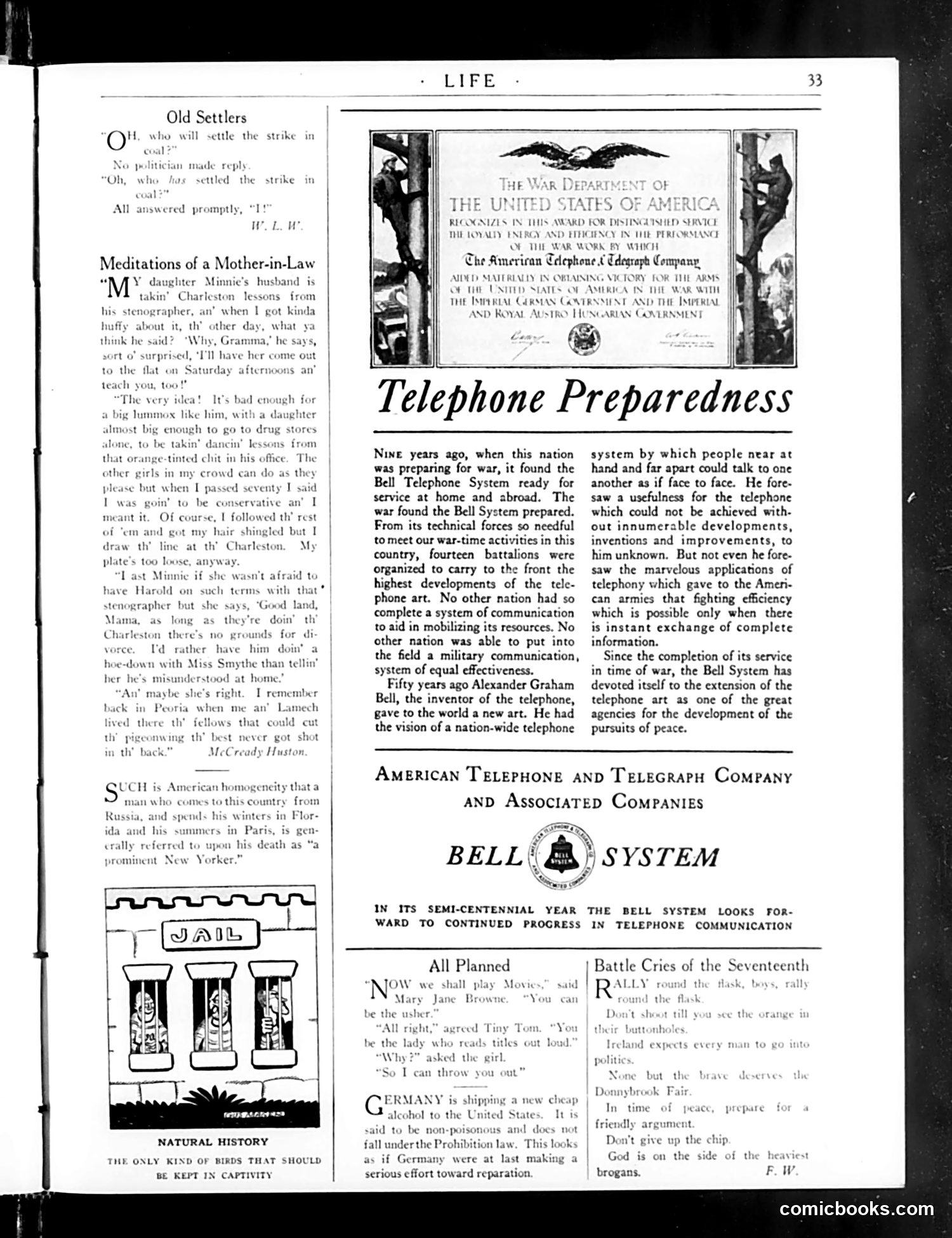
This page mixes editorial humor with a full-page **Bell Telephone System advertisement** celebrating its role in World War I. ## The Cartoons/Humor: The small comic strips and jokes are typical Life magazine fare from the 1920s—domestic humor about a mother-in-law disapproving of the Charleston dance craze, and a naturalist quip about captive birds. These reference contemporary social anxieties about changing morality and youth culture post-WWI. ## The Bell Advertisement: The centerpiece is a War Department commendation crediting Bell's telephone infrastructure as crucial to American military victory. It claims Bell organized "fourteen battalions" of technical personnel for the front lines, and emphasizes that no other nation had comparable communication systems. The advertisement frames telephone technology as essential to national strength and military efficiency—a patriotic appeal linking corporate service to American victory. This was typical corporate propaganda of the 1920s, leveraging wartime contributions to build brand prestige during peacetime. The smaller text about "reparations" and Germany attempting reform through alcohol shipments appears to be satirical commentary on post-war Germany's economic struggles.
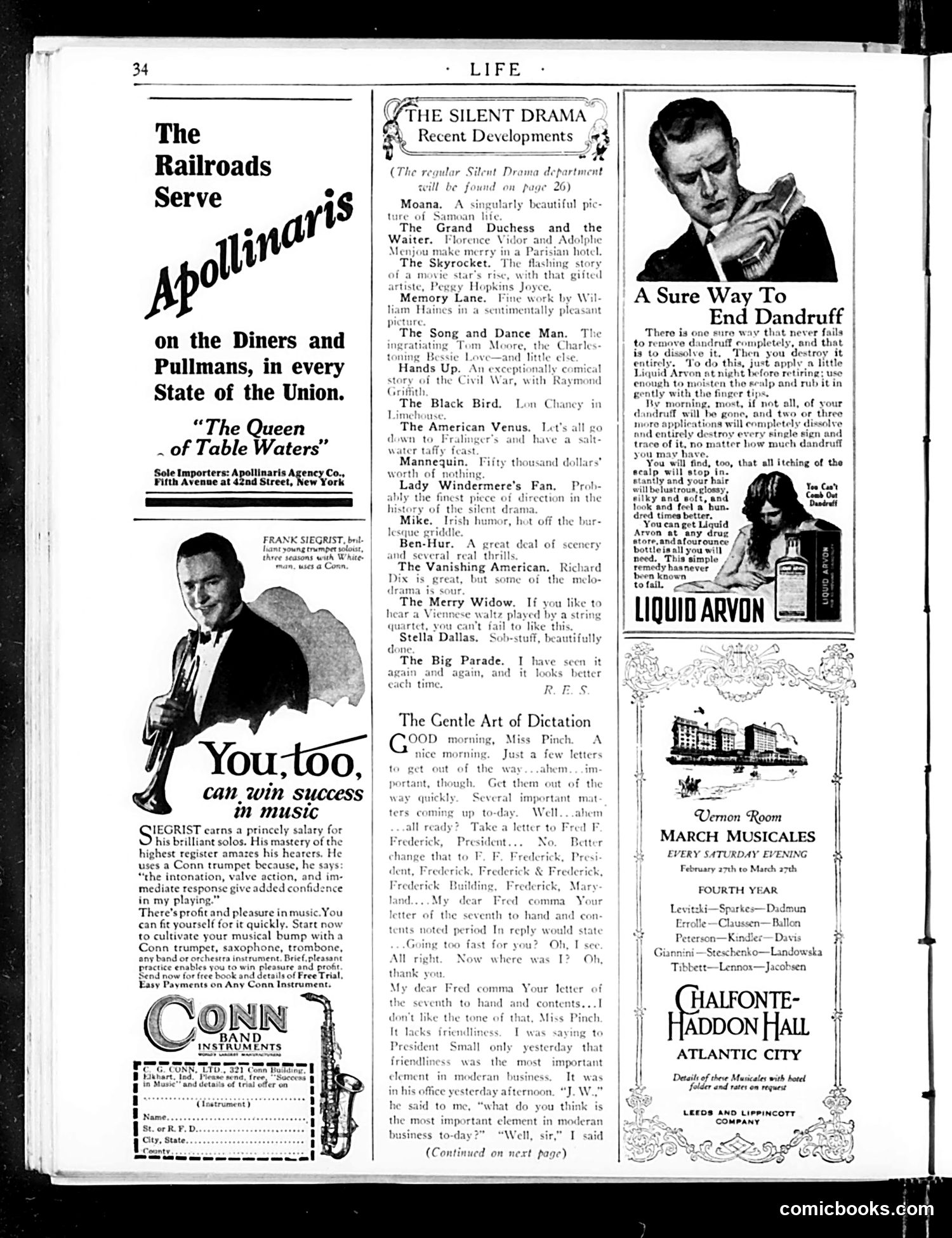
This is primarily a **commercial advertisement and entertainment page** from the 1920s, not a political cartoon. The page contains: **Main Content:** - Advertisements for Apollinaris water, Conn musical instruments, and Liquid Arvon hair treatment - A featured article, "The Gentle Art of Dictation," depicting workplace correspondence humor—showing the trivial back-and-forth between office staff and their boss - "The Silent Drama" section reviewing contemporary silent films (Ben-Hur, The Merry Widow, The Big Parade—all major releases of the mid-1920s) **Social Context for Modern Readers:** The page reflects 1920s consumer culture and entertainment priorities. The dandruff remedy ad ("A Sure Way to End Dandruff") and hair product promotions reflect period anxieties about grooming. The silent film reviews show cinema's dominant role in popular entertainment before sound films arrived. The "Dictation" piece gently satirizes workplace bureaucracy—the endless memo-writing between "Frederick" and his secretary—reflecting post-WWI office culture expanding dramatically in American business.
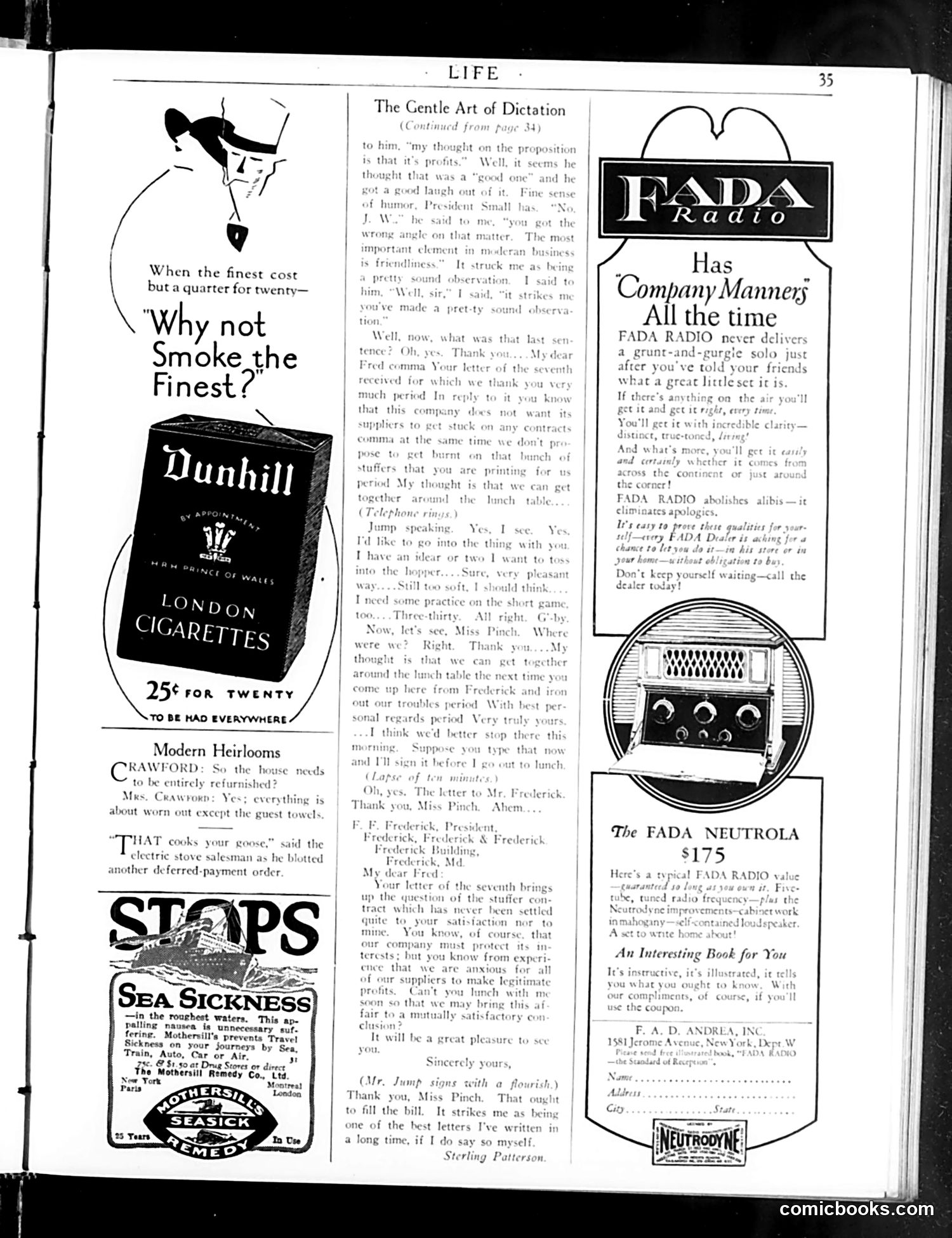
This page primarily contains vintage advertisements (Dunhill cigarettes, Stops seasickness remedy, Fada Radio) interspersed with a brief satirical piece titled "The Gentle Art of Dictation." The main cartoon/text humor appears to be a workplace comedy about office culture. A dialogue suggests someone dictating letters to a secretary, with exchanges about business etiquette and "company manners." The satire mocks formal business correspondence and the pretentious tone people adopt in professional settings—contrasting genuine thoughts with stilted written language. The advertisements reflect 1920s-30s consumer culture: luxury cigarettes (25¢ for twenty), radio technology as a novelty item ($175), and seasickness remedies for travelers. These ads reveal period anxieties and aspirations—leisure smoking, modern entertainment technology, and travel concerns. The page is primarily **advertising-driven**, with the satirical content serving as editorial filler between commercial pitches for wealthy readers.
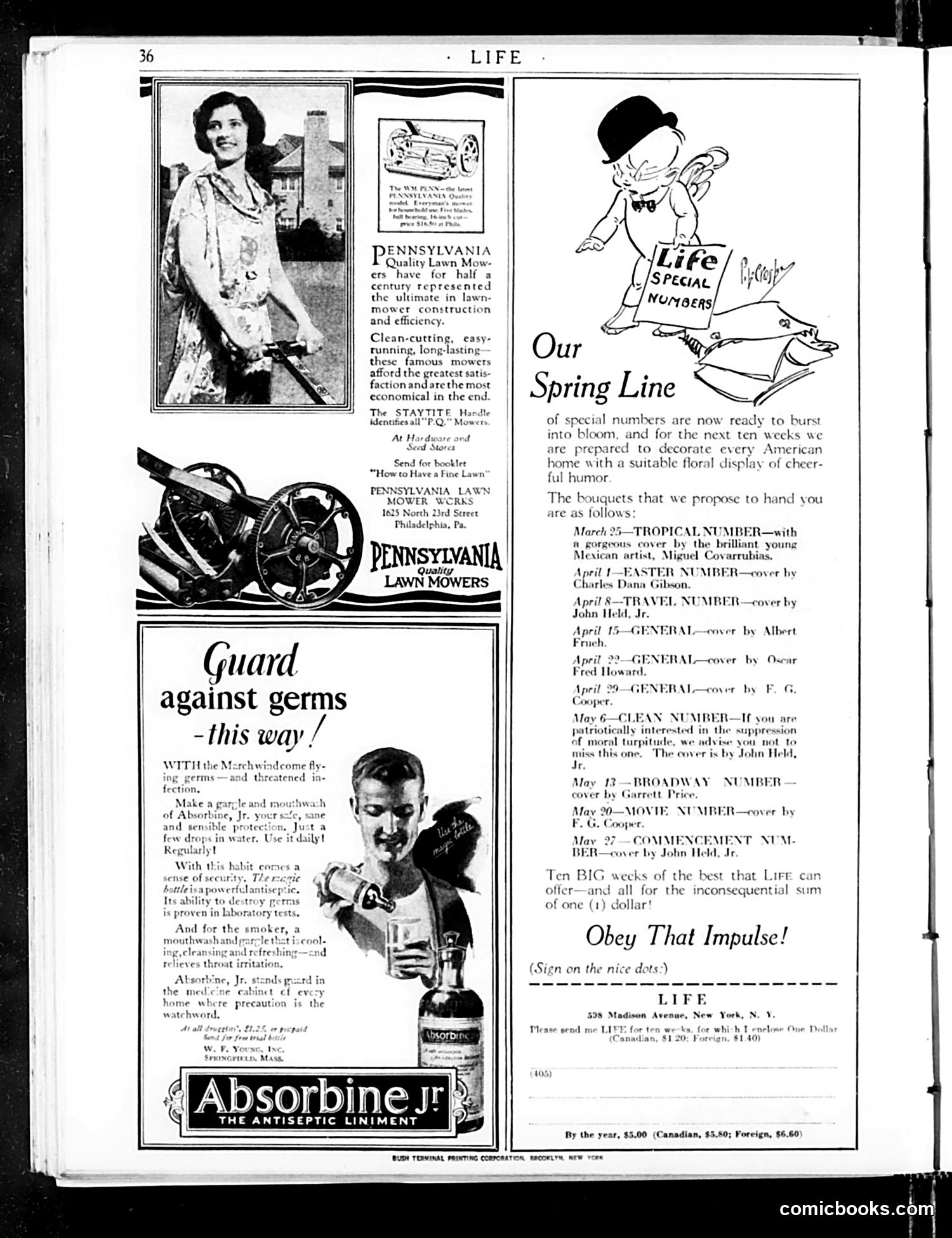
This page is primarily **advertising and promotional content** rather than political satire. It features: **Advertisements:** - Pennsylvania Lawn Mowers (emphasizing quality and durability) - Absorbine Jr. antiseptic liniment (marketed as germ-protection, with a man gargling) **Main Content:** Life magazine's "Spring Line" promotion—announcing special themed issues over ten weeks (March-May), each with notable cover artists including Miguel Covarrubias, Charles Dana Gibson, and John Held Jr. The language uses floral metaphors ("bouquets," "bloom") to describe upcoming humor issues. The cartoon figure (upper right) is Life's mascot promoting special numbered issues at one dollar for the ten-week subscription. This reflects **1920s consumer culture**: the simultaneous promotion of hygiene products, lawn care, and magazine entertainment as lifestyle essentials. The page demonstrates how Life positioned itself as a source of "cheerful humor" for American homes alongside practical goods.
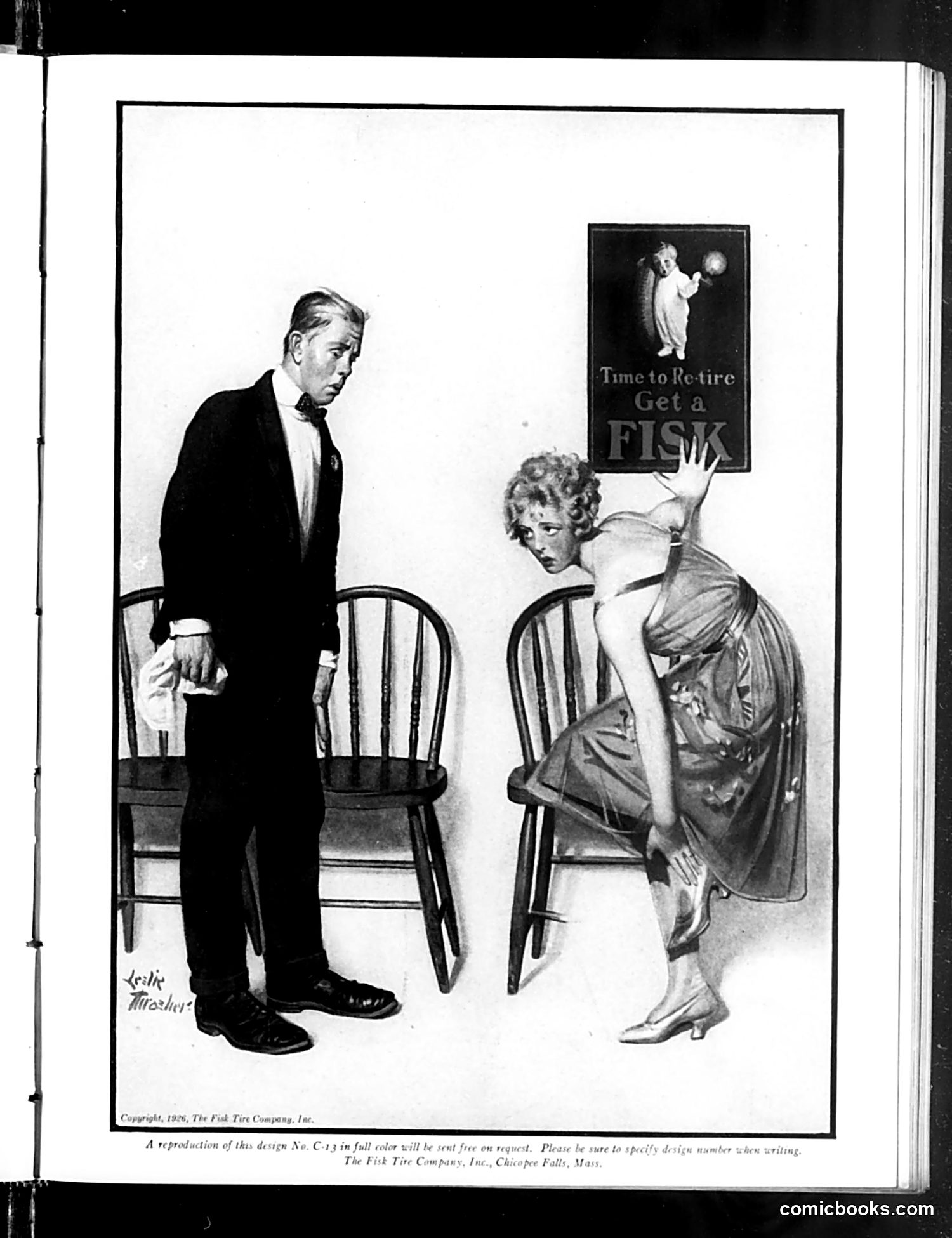
This is a 1926 advertisement for Fisk Tires, not a political cartoon. It depicts a domestic scene with satirical humor common to early 20th-century advertising. A man in formal attire stands while a woman holds up a sign reading "Time to Retire / Get a FISK." The joke plays on double meaning: "retire" suggests both ending one's career and replacing worn tires. The woman's suggestive pose and expression imply marital tension—the ad humorously suggests that worn tires are grounds for conflict, positioning Fisk Tires as the solution to keep both car and marriage running smoothly. This reflects period advertising's reliance on gender dynamics and domestic comedy to sell products to male consumers.
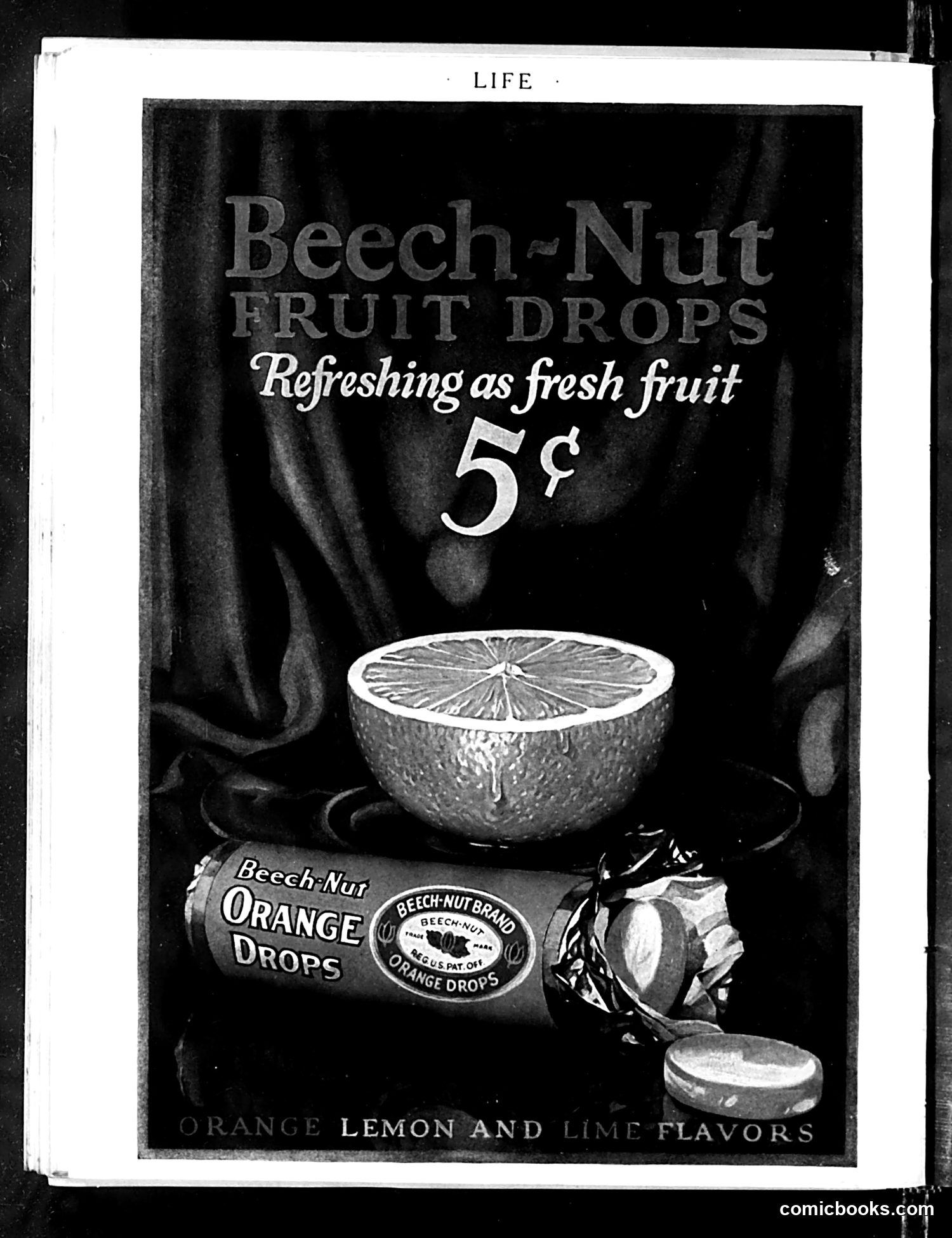
This is a straightforward product advertisement, not political satire. It promotes Beech-Nut brand fruit drops candy, priced at 5 cents, emphasizing their refreshing citrus flavors (orange, lemon, and lime). The ad uses an appealing visual of a halved orange against dark fabric to suggest natural fruit flavor and freshness. Below are product images showing the candy's packaging and wrapped individual drops. The tagline "Refreshing as fresh fruit" is the central marketing claim—positioning the candy as a wholesome alternative or equivalent to actual fruit. This type of advertising was common in early-to-mid 20th century American magazines, targeting consumers with simple, direct product messaging rather than complex narratives or social commentary.