
Life, 1926-03-11 · page 26 of 40
Life — March 11, 1926 — page 26: what you’re looking at
What you’re looking at
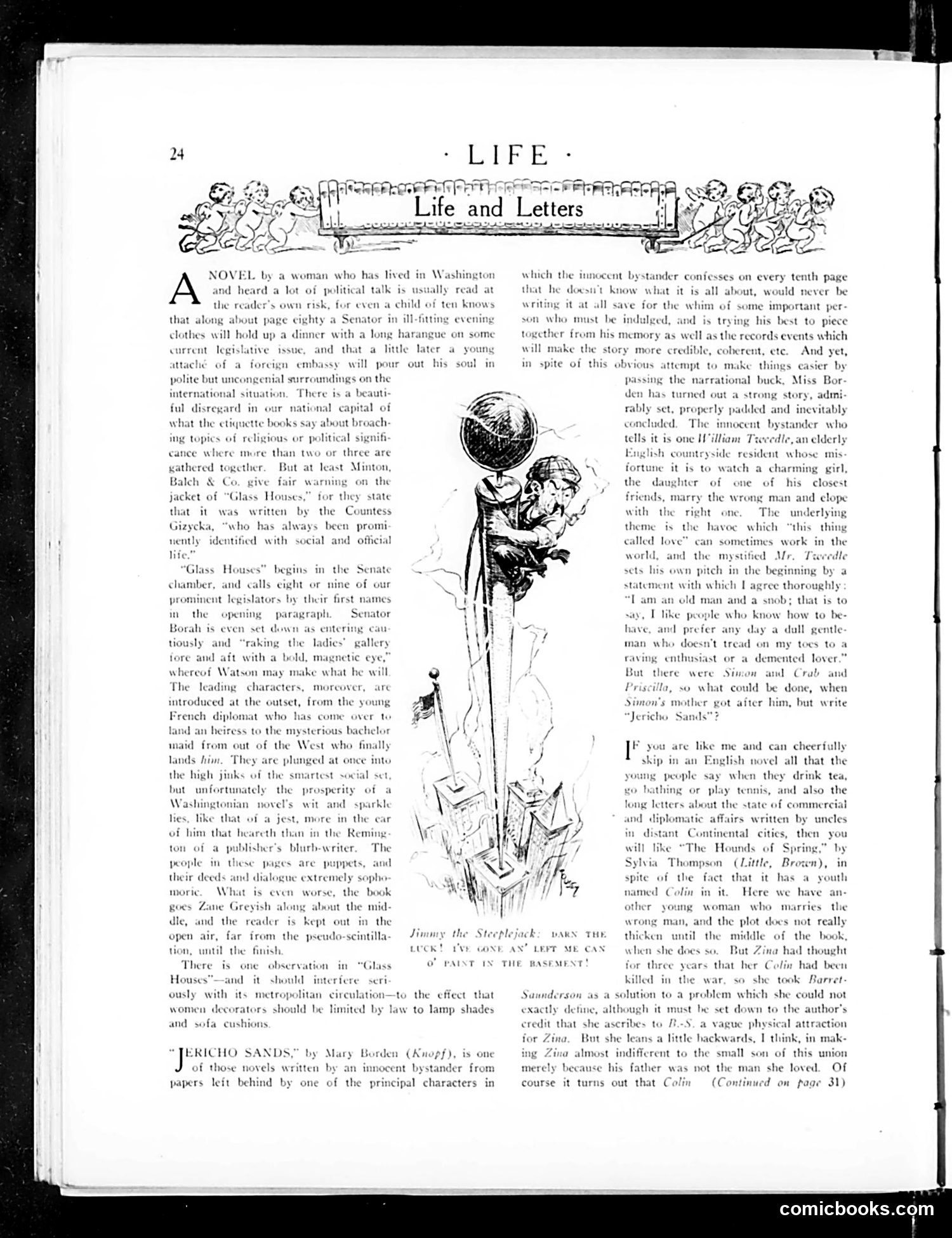
This page reviews contemporary novels, primarily discussing two books written by women about Washington, D.C. society and romantic entanglements. The illustration depicts "Jimmy the Steeplejack" carrying a large globe while scaling a building—a visual metaphor for ambitious undertaking, likely commenting on the literary ambitions of these novelists. The text critiques "Glass Houses" (by Countess Gizycka) for its predictable plot mechanics: a Washington Senator delivering tedious monologues at dinner, a foreign embassy attaché, romantic misunderstandings. The reviewer notes these are generic tropes of political fiction, satirizing how women writers repeatedly use identical stock characters and scenarios. "The Hounds of Spring" receives similar treatment—another novel where a young woman marries the "wrong man" and must sort out romantic complications. The satire suggests these plots are formulaic and interchangeable. The broader joke targets both the predictability of women's fiction about Washington society and readers' willingness to consume identical stories repeatedly dressed in different titles.
📄 Transcribed text from this page (OCR, searchable)
Machine-transcribed from the original scan — historical spelling and the odd misread are preserved.
LIFE Foe PEATE RRS ESC eT ARER an Life and_L Letters. f eee ane S28) NOVEL by a woman who has lived in Washington which the i nder confesses on every tenth page A and heard a lot of political talk is u: ly read a th 10W nat it is all about, would never be the reader's own risk, for even a child of ten k writing it at all save for the whim of some important per- that along about page cighty a Senator in ill-fitting evenir » must be indulged, is trying his best to piece clothes will hold up a dinner with a long harang om ther from his memory as well as the records events which ent legislative is and that a little a young ry more credible, coherent, ete. And yet, attaché of a foreign embassy will pour out h f spite of this obvious attempt to make things easier by polite but uncot surroundings on the passing the narrational buck, Miss Bor There is a beauti = den has turned « rong story, admi ful disreg national capital of rably set, properly padded and. inevitably what the et ay 3 a ¢ ded. The innocent bystander who 4{ topics of religious or political f tells it is one William Tee an elderly © more than two or three a nyglish ¢ yside resident: whose mis gathered together. But at least Minton, ortune it is to watch a charming girl, Balch & Co. give fair warning on the y the daughter of one of his closest jacket of “Glass Houses,” for they state : F s, marry the wr man and el was written by the Countess ’ th the right one, The underlyin who has always been promi _ theme is the havoc which “this thir identified with social and official called love” can sometimes work in the life.” orld, and. the ied Mr. Trecedle Glass Houses” begins in the the beginning by a chamber, and calls eight orn i statement with which [agree thoroughly in theo h. Sens sa people who know how to be- day a dull gentle tiously a 3 sal sn't tread on my toes to a fore and aft with a bold, m ye," raving enthusiast or a demented lover.” whereof Watson may make what he will if there were Simon and Crab and The leading characters, moreover, are riscilla, so what could be done, when introduced at the outset, from the young imon’s mother got a but write ‘rench diplomat who has come over to sf an heiress to the mysterious bach 1 from out of the West who final ‘ } you are like me and can cheerfully ands hin, They are plunged at once into ei x skip in an English novel all that the the high jinks of the s social set ) ! people say when they drink tea, but unfortunately the y of \ - go bathing or play tenni the Washingtonian novel's wit and sparkle Ze =A} \ long letters about the state : lies, like that of a jest, more in the car A S and diplomatic affairs written by uncles of him that hearcth than in the Reming : / in distant Continental cities, then you ton of a p rs blurb-writer We Me will like “The Hounds of Spring,” by people in these pages are puppets, and P j Sylvia Thompson (Little, Brown), in their deeds ane ¢ ue extremely s 4 spite of the fact that it has a youth moric. What is even worse, the b >A: ! ? named Colin in it. Here we have goes Zane Greyish along about the mid 7 other young woman who marries the dle, and the reader is kept out in the wrong man, and the plot does not really open air, far from the pseudo-scintilla. — Jinuny th ej VAKN thicke the middle of the book, tion, until the finish beck! rvs AN’ LEFT ME CAN when she does so. But Zing had thought There is one observation in’ “Glass voPAL N THE BASEMENT! for three years that her Colin had been Houses”—and it’ should interfere seri killed in the war, so she took Barret ously with its metropolitan circulation—to the effect Saunder 5 a solution to a problem which she could not uld be limited by law to lamp shades exactly define, although it must be set down to the author's credit that she ascribes t S. a vague physical attraction ior Zina, But she leans a little hackwards, I think, in mak- ERICHO SANDS,” by Mary Borden (Knopf), i ina almost indifferent to the small son of this union of those novels written. by . ) f merely because his father was not the man she loved. Of papers left behind by one of ers i course it turns out that Colin (Continued on page 31) comicbooks.com