
Life, 1926-03-11 · page 8 of 40
Life — March 11, 1926 — page 8: what you’re looking at
What you’re looking at
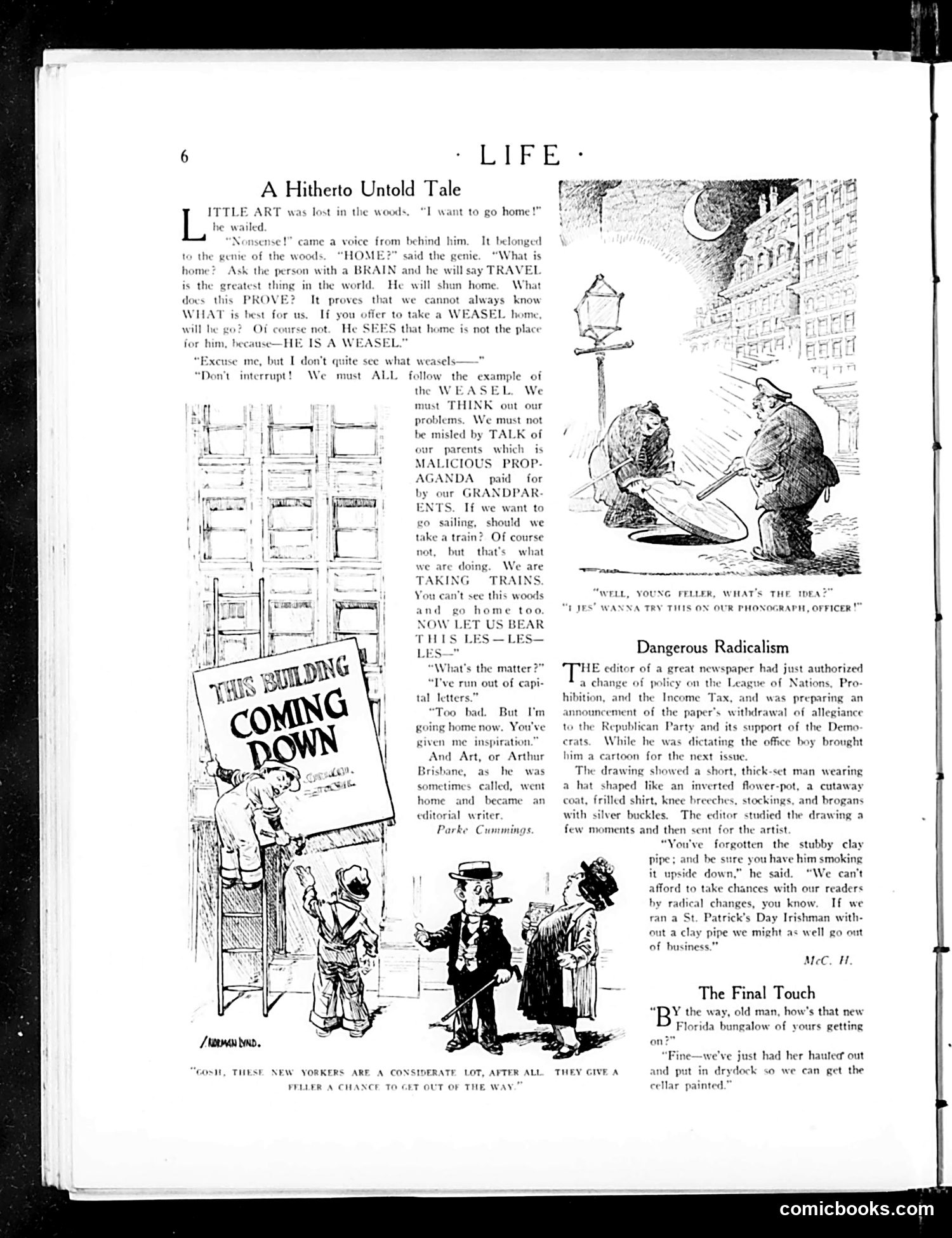
**"A Hitherto Untold Tale"** (top): A moral fable where Little Art, lost in woods, encounters a Genie offering travel as life's greatest reward. The genie warns against taking "a weasel home," arguing weasels represent bad influences. Art is tempted but chooses to stay put, learning that travel itself (taking trains) is the real goal, not destination. This appears to satirize restless American culture and wanderlust. **"This Building Coming Down"** (left): An advertisement-style cartoon showing New Yorkers cheerfully welcoming urban demolition, with the caption praising their consideration in "giving a filler a chance to get out of the way." **"Dangerous Radicalism"** (right): Commentary on editorial policy changes at the League of Nations regarding prohibition and income tax, with satire about the editor's cartoon depicting a radical in inverted flowerpot clothing smoking a clay pipe upside-down.
📄 Transcribed text from this page (OCR, searchable)
Machine-transcribed from the original scan — historical spelling and the odd misread are preserved.
A Hitherto Untold Tale ] ITTLE ART w he wailed. N ! sense! 1 in the woods, “I want to go home!” came a voice from behind him. to the genie of the woods, HOME?” s. Ask the person with a BRAI is the greatest thing in the world. He docs this PROVE? It belonged id the genie. “What is nd he will say TRAVEL will shun home. What It proves that we cannot always know WHAT is best for us. Tf you offer take a W SEL home will he Of course not. He SE that home is not the place for him, because—HE IS A WEASEL.” “Excuse me, but [ don't quite see what weasels— “Don't interrupt! We ALL follow the example of the WEASEL. We THINK out our problems. We must not be misled by TALK of our parents MALICIOUS PROP- AGANDA paid for by our GRANDPAR ENTS, go. sailing, home ? must must which is If we want to should we take a train? Of course not, but that’s what we are doing. We are TAKING — TRAINS. "t see this woods and NOW LE THIS Lt LES—" “What's the matter?” “I've run out of capi- tal letters.” “Too bad. But I'm going home now. You've home too. given me inspiration.” And Art, or Arthur Brisbane, as he was sometimes called, went home and became an editorial writer. Parke Cummings. “GOsM, THESE NEW YORKERS ARE A CONSIDERATE LOT, AFTER ALL PRLLER A CHANCE TO GET OUT OF THE WAY.” THEY GIVE A WELL, YOUNG FELLER, WHAT'S THE IDeA?” “L JES’ WANNA TRY THIS ON OUR PHONOGRAPH, OFFICER!” Dangerous Radicalism HE editor of a great newspaper had just authorized a change of policy on the Le Nations, Pro- hibition, and the Income Tax, and was preparing an nouncement of the paper's withdrawal of allegiance to the Republican Party and its support of the Demo: crats. While he was dictating the office boy brought him a cartoon for the next issue. The drawing showed a short, thick-set man wearing a hat shaped like an inverted flower-pot, a cutaway coat, frilled shirt, knee breeches, stockings, and brogans with silver buckles. The editor studied the drawing a few moments and then sent for the artist “You've forgotten the stubby clay pipe; and be stire you have him smoking he said. “We can't afford to take chances with our readers , you know. If we Patrick’s Day Irishman with- out a clay pipe we might as well go out of business.” it upside down, hy radical change: ran a St McC. 1 The Final Touch “DY the way, old man, how's that new Florida bungalow of yours getting “Fine—we've just had her hauled out put in drydock so we can get the cellar painted.” comicbooks.com