
Life, 1926-03-11 · page 28 of 40
Life — March 11, 1926 — page 28: what you’re looking at
What you’re looking at
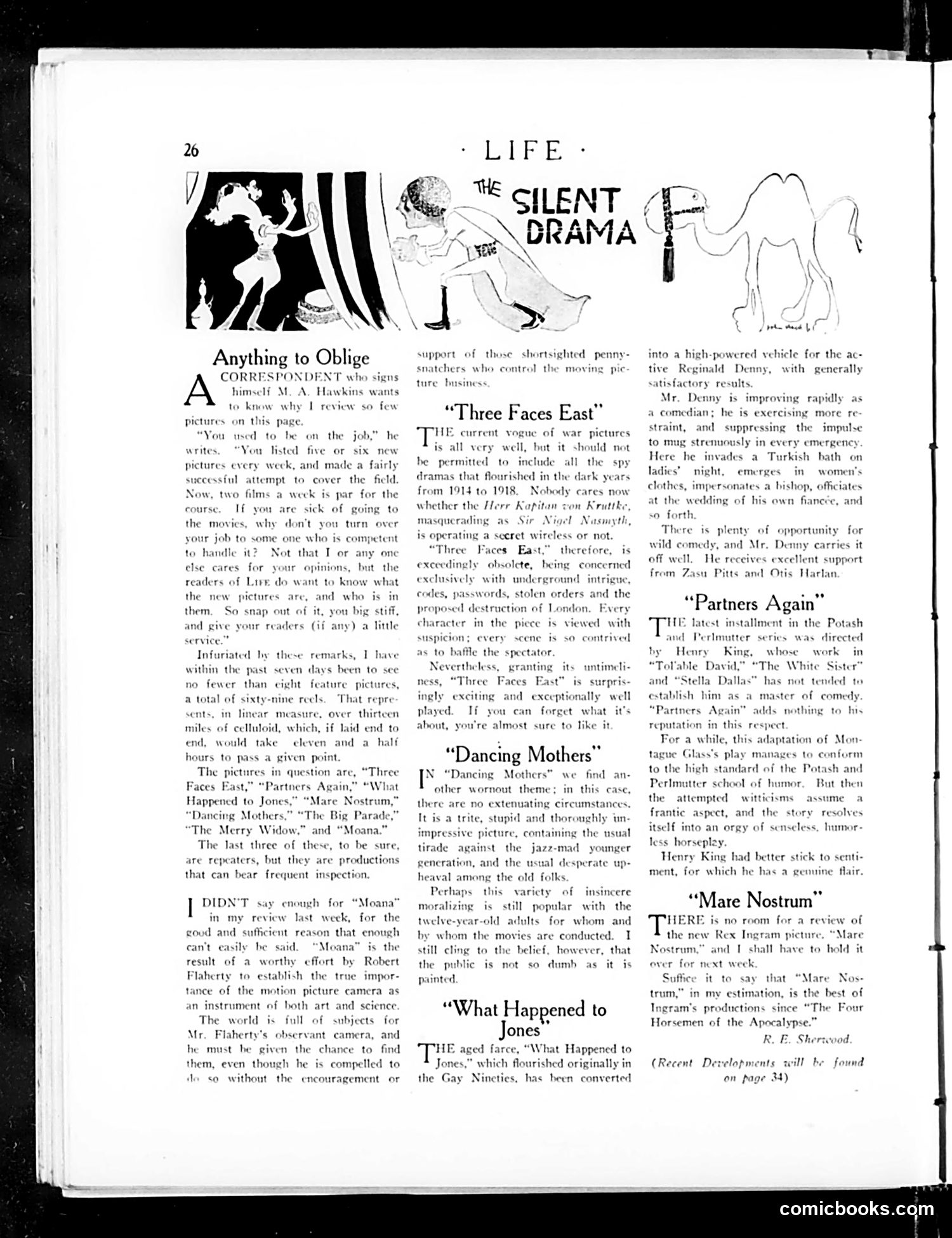
This page reviews five silent films from the 1920s. The opening section humorously responds to a critic who complained the author reviews too few movies—he retorts by listing eight films he's seen in one week, totaling "sixty-nine reels." **Key reviews:** - **"Three Faces East"**: A spy drama set during WWI featuring secret codes and wireless operations. The reviewer finds it "exceptionally well" executed despite its worn-out spy-story theme. - **"Dancing Mothers"**: Criticized as a "trite, stupid and thoroughly unimpressive" film recycling tired generational conflict (jazz-mad youth vs. elderly folk). - **"What Happened to Jones"**: A farcical comedy featuring Reginald Denny in drag and various disguises, praised for "excellent support" from fellow actors. - **"Moana"**: Praised as Robert Flaherty's serious attempt to establish cinema as legitimate art and science. The cartoon illustrations show typical silent-film scenes—dramatic gestures, exaggerated poses—reflecting the physical comedy and melodrama characteristic of the era.
📄 Transcribed text from this page (OCR, searchable)
Machine-transcribed from the original scan — historical spelling and the odd misread are preserved.
Anything to Oblige CORRESPONDENT who signs A himself M. A. Hawkins wants to know why | review so few pictures "You used to be on the job," he writes. You listed s every week, on this page five or six and made a fairly wer the field for the new pictur successful Now, course. If you arc attempt to. e¢ two films a week is par sick ¢ why don't the movies, you tur your job to some one who is ce Not that Tor for y vine t the Lire do want to kn to handle it? ny one else cares readers w what the new and who is in them. pictures are, So snap out of it, you big s and give your readers (if any) a little service.” Infuriated hy these T have within the past seven days been to. sec remarks, no fewer than cight feature pictures, a total of sixty-nine reels. That repre se in linear measure, miles of celluloid, end, take hours to pass a r thirteen id end to eleven and a_ half which, would iven point The picttires in question are, Faces E Happened to Jones, “Three “Partners “Dancing Mothers,” “The Merry Widow,” and “Moana The last three of these, to be are repeaters, but they are producti that can bear frequent inspect sure for week, ugh l DIDN'T say in my review last coud and sufficient reason that enough can't easily he Moana” is the result of a effort by Robert Flaherty to establish the said. worthy true impor- tance of the motion picture camera as an instrument of both art and science. The world is full of Mr. Flaherty'’s observant to find even though he is compelled to he must be given the chance them, de se. without the encouragement or LIFE \& —SSULENT we \DRA MA‘ support penny- 1 business “Three Faces East” aly 1E is all very ture current vogue of be permitted to war pictures but it should not include all the dramas that flourished in the dark years from 1914 to 1918, body cares now whether the Herr Kapitan von Kruttke, masquerading as Sir Nigel Nasmyth, spy is operating @ secret wirel “Three Faces East,” th exceedir olcte, with underground intr or not. efore, is being concerned exclusively codes, gue, and the Every swords, stolen orders dl destruction of 1 n. character in the picce is viewed with suspicion; every scene is so. contrived to baffle the spectator Nevertheless, granting Faces E. and ness, “Three ingly exciting except can forg to like ost sure “Dancing Mothers” [8 “Dancing Mothers” we find an- other wornout theme ; there in this case, are no extenuating circumstances. It is a trite, and thor stupid aghly: tin- impressive picture, containing the usual inst the nd the usual desperate up- old folks variety of still popular adults tirade ag: jazz-mad_ younger neration, heaval among th Perhaps moraliz’ is this insincere with t twelve-year-old for whom and are conducted. I that so dumb as it is by whom the movies still cling to the the public is belief, however, not painted “What Happened to Jones” ed farce, “What Happ which flourished originally in the Gay has been converted ) rt eae for the ac- generally into a high-powered veh tive Denny, satisfactory results. Mr Reginald with Denny is improving rapidly as : he is exercising more re suppressing the impulse 1g strenuously in every emergency Turkish emerges in invades a hath on ij women's clothes, impersonates a hishop, officiates wedding of his own fiancée, and orth, There wild comedy, off well and Mr. He receives excellent sup and Otis Harlan opportunity for Denny carries it ort from Zasu_ Pitts “Partners Again latest installment in the rimutter series y Henry King, whose work in Tolable David.” “The White Sister” “Stella Dall: has not tended to ho him Potash was directed THe and estaly “Partners Again” reputat aster of comedy nidds in this respect thing to For a while, this adaptation of Mon tague Glass's play manages to conform to the high s Perlmutter school of tandard of the sh and humor, But then the attempted witticisms assume a frantic and the resolves aspect, story Henry King had better stick to s ment, for which he has a genuine flair. “Mare Nostrum”™ RE is no room for a review of ture, “Mare to hold it the new Rex Ingram pi Nostrum,” and [shall have next week Suffice it to over for “Mare is th best of say that trum,” in my estimation, n's productions since “The Four Apocalyp: RE. Horsemen of the (Recent Developments will be MM) on page comicbooks.com